EP1013262B1 - Kosmetische und dermatologische O/W-Emulsionen mit einem Gehalt an Bornitrid - Google Patents
Kosmetische und dermatologische O/W-Emulsionen mit einem Gehalt an Bornitrid Download PDFInfo
- Publication number
- EP1013262B1 EP1013262B1 EP99124015A EP99124015A EP1013262B1 EP 1013262 B1 EP1013262 B1 EP 1013262B1 EP 99124015 A EP99124015 A EP 99124015A EP 99124015 A EP99124015 A EP 99124015A EP 1013262 B1 EP1013262 B1 EP 1013262B1
- Authority
- EP
- European Patent Office
- Prior art keywords
- bis
- salts
- triazine
- acid
- group
- Prior art date
- Legal status (The legal status is an assumption and is not a legal conclusion. Google has not performed a legal analysis and makes no representation as to the accuracy of the status listed.)
- Expired - Lifetime
Links
- 239000002537 cosmetic Substances 0.000 title claims abstract description 33
- 229910052582 BN Inorganic materials 0.000 title claims description 25
- PZNSFCLAULLKQX-UHFFFAOYSA-N Boron nitride Chemical compound N#B PZNSFCLAULLKQX-UHFFFAOYSA-N 0.000 title claims description 25
- 239000007764 o/w emulsion Substances 0.000 title claims description 18
- 239000000126 substance Substances 0.000 claims abstract description 45
- 239000000839 emulsion Substances 0.000 claims abstract description 28
- 239000004904 UV filter Substances 0.000 claims abstract description 22
- XLYOFNOQVPJJNP-UHFFFAOYSA-N water Substances O XLYOFNOQVPJJNP-UHFFFAOYSA-N 0.000 claims abstract description 21
- -1 glycerol diesters Chemical class 0.000 claims description 33
- 238000002360 preparation method Methods 0.000 claims description 29
- 150000003839 salts Chemical class 0.000 claims description 26
- PEDCQBHIVMGVHV-UHFFFAOYSA-N Glycerine Chemical compound OCC(O)CO PEDCQBHIVMGVHV-UHFFFAOYSA-N 0.000 claims description 19
- 239000002245 particle Substances 0.000 claims description 16
- 239000002253 acid Substances 0.000 claims description 14
- 125000004432 carbon atom Chemical group C* 0.000 claims description 11
- 239000003995 emulsifying agent Substances 0.000 claims description 11
- 125000001997 phenyl group Chemical group [H]C1=C([H])C([H])=C(*)C([H])=C1[H] 0.000 claims description 9
- 150000001875 compounds Chemical class 0.000 claims description 8
- 235000014113 dietary fatty acids Nutrition 0.000 claims description 8
- 239000000194 fatty acid Substances 0.000 claims description 8
- 229930195729 fatty acid Natural products 0.000 claims description 8
- 229910052708 sodium Inorganic materials 0.000 claims description 7
- 239000011734 sodium Substances 0.000 claims description 7
- DGAQECJNVWCQMB-PUAWFVPOSA-M Ilexoside XXIX Chemical compound C[C@@H]1CC[C@@]2(CC[C@@]3(C(=CC[C@H]4[C@]3(CC[C@@H]5[C@@]4(CC[C@@H](C5(C)C)OS(=O)(=O)[O-])C)C)[C@@H]2[C@]1(C)O)C)C(=O)O[C@H]6[C@@H]([C@H]([C@@H]([C@H](O6)CO)O)O)O.[Na+] DGAQECJNVWCQMB-PUAWFVPOSA-M 0.000 claims description 6
- ZLMJMSJWJFRBEC-UHFFFAOYSA-N Potassium Chemical compound [K] ZLMJMSJWJFRBEC-UHFFFAOYSA-N 0.000 claims description 6
- 150000007513 acids Chemical class 0.000 claims description 6
- 229910052700 potassium Inorganic materials 0.000 claims description 6
- 239000011591 potassium Substances 0.000 claims description 6
- 239000004480 active ingredient Substances 0.000 claims description 5
- 239000000654 additive Substances 0.000 claims description 5
- 150000001565 benzotriazoles Chemical class 0.000 claims description 5
- UVCJGUGAGLDPAA-UHFFFAOYSA-N ensulizole Chemical class N1C2=CC(S(=O)(=O)O)=CC=C2N=C1C1=CC=CC=C1 UVCJGUGAGLDPAA-UHFFFAOYSA-N 0.000 claims description 5
- 150000003918 triazines Chemical class 0.000 claims description 5
- GSEJCLTVZPLZKY-UHFFFAOYSA-O triethanolammonium Chemical class OCC[NH+](CCO)CCO GSEJCLTVZPLZKY-UHFFFAOYSA-O 0.000 claims description 5
- 239000007983 Tris buffer Substances 0.000 claims description 4
- HUVYTMDMDZRHBN-UHFFFAOYSA-N drometrizole trisiloxane Chemical compound C[Si](C)(C)O[Si](C)(O[Si](C)(C)C)CC(C)CC1=CC(C)=CC(N2N=C3C=CC=CC3=N2)=C1O HUVYTMDMDZRHBN-UHFFFAOYSA-N 0.000 claims description 4
- 235000021355 Stearic acid Nutrition 0.000 claims description 3
- 150000002314 glycerols Chemical class 0.000 claims description 3
- QIQXTHQIDYTFRH-UHFFFAOYSA-N octadecanoic acid Chemical compound CCCCCCCCCCCCCCCCCC(O)=O QIQXTHQIDYTFRH-UHFFFAOYSA-N 0.000 claims description 3
- OQCDKBAXFALNLD-UHFFFAOYSA-N octadecanoic acid Natural products CCCCCCCC(C)CCCCCCCCC(O)=O OQCDKBAXFALNLD-UHFFFAOYSA-N 0.000 claims description 3
- 150000004671 saturated fatty acids Chemical class 0.000 claims description 3
- 239000008117 stearic acid Substances 0.000 claims description 3
- FQUNFJULCYSSOP-UHFFFAOYSA-N bisoctrizole Chemical compound N1=C2C=CC=CC2=NN1C1=CC(C(C)(C)CC(C)(C)C)=CC(CC=2C(=C(C=C(C=2)C(C)(C)CC(C)(C)C)N2N=C3C=CC=CC3=N2)O)=C1O FQUNFJULCYSSOP-UHFFFAOYSA-N 0.000 claims description 2
- 235000003441 saturated fatty acids Nutrition 0.000 claims description 2
- BDHFUVZGWQCTTF-UHFFFAOYSA-N sulfonic acid Chemical compound OS(=O)=O BDHFUVZGWQCTTF-UHFFFAOYSA-N 0.000 claims 9
- HEAHZSUCFKFERC-UHFFFAOYSA-N ecamsule Chemical compound CC1(C)C2CCC1(CS(O)(=O)=O)C(=O)C2=CC(C=C1)=CC=C1C=C1C(=O)C2(CS(O)(=O)=O)CCC1C2(C)C HEAHZSUCFKFERC-UHFFFAOYSA-N 0.000 claims 4
- 125000002490 anilino group Chemical group [H]N(*)C1=C([H])C([H])=C([H])C([H])=C1[H] 0.000 claims 2
- XFYRXAGPHRDDND-UHFFFAOYSA-N 2-ethylhexyl 2-[[4,6-bis[2-(2-ethylhexoxycarbonyl)anilino]-1,3,5-triazin-2-yl]amino]benzoate Chemical compound CCCCC(CC)COC(=O)C1=CC=CC=C1NC1=NC(NC=2C(=CC=CC=2)C(=O)OCC(CC)CCCC)=NC(NC=2C(=CC=CC=2)C(=O)OCC(CC)CCCC)=N1 XFYRXAGPHRDDND-UHFFFAOYSA-N 0.000 claims 1
- KKJKXQYVUVWWJP-UHFFFAOYSA-N 4-[(4,7,7-trimethyl-3-oxo-2-bicyclo[2.2.1]heptanylidene)methyl]benzenesulfonic acid Chemical compound CC1(C)C2CCC1(C)C(=O)C2=CC1=CC=C(S(O)(=O)=O)C=C1 KKJKXQYVUVWWJP-UHFFFAOYSA-N 0.000 claims 1
- GSDLPJHQLLVRLI-QRSDNYJVSA-N CC(=O)[C@H](O)[C@@H](O)[C@H](O)[C@H](O)CO.CCCCCCCCCCCCCCCCCC(O)=O.CCCCCCCCCCCCCCCCCC(O)=O Chemical compound CC(=O)[C@H](O)[C@@H](O)[C@H](O)[C@H](O)CO.CCCCCCCCCCCCCCCCCC(O)=O.CCCCCCCCCCCCCCCCCC(O)=O GSDLPJHQLLVRLI-QRSDNYJVSA-N 0.000 claims 1
- 150000004665 fatty acids Chemical class 0.000 claims 1
- JFEONFLNUYQAFB-KZTXLXSCSA-N octadecanoic acid;(3r,4s,5r,6r)-3,4,5,6,7-pentahydroxyheptan-2-one Chemical compound CC(=O)[C@H](O)[C@@H](O)[C@H](O)[C@H](O)CO.CCCCCCCCCCCCCCCCCC(O)=O JFEONFLNUYQAFB-KZTXLXSCSA-N 0.000 claims 1
- 230000006641 stabilisation Effects 0.000 abstract 1
- 238000011105 stabilization Methods 0.000 abstract 1
- 239000003921 oil Substances 0.000 description 28
- 235000019198 oils Nutrition 0.000 description 28
- 239000000203 mixture Substances 0.000 description 23
- 210000003491 skin Anatomy 0.000 description 22
- 239000012071 phase Substances 0.000 description 19
- 235000002639 sodium chloride Nutrition 0.000 description 14
- 150000002148 esters Chemical class 0.000 description 13
- 230000005855 radiation Effects 0.000 description 12
- 238000009472 formulation Methods 0.000 description 11
- 239000003963 antioxidant agent Substances 0.000 description 10
- 235000006708 antioxidants Nutrition 0.000 description 10
- 230000000475 sunscreen effect Effects 0.000 description 8
- 239000000516 sunscreening agent Substances 0.000 description 8
- 125000004435 hydrogen atom Chemical group [H]* 0.000 description 7
- 125000004178 (C1-C4) alkyl group Chemical group 0.000 description 6
- LFQSCWFLJHTTHZ-UHFFFAOYSA-N Ethanol Chemical compound CCO LFQSCWFLJHTTHZ-UHFFFAOYSA-N 0.000 description 6
- DNIAPMSPPWPWGF-UHFFFAOYSA-N Propylene glycol Chemical compound CC(O)CO DNIAPMSPPWPWGF-UHFFFAOYSA-N 0.000 description 6
- XLOMVQKBTHCTTD-UHFFFAOYSA-N Zinc monoxide Chemical compound [Zn]=O XLOMVQKBTHCTTD-UHFFFAOYSA-N 0.000 description 6
- 150000001298 alcohols Chemical class 0.000 description 6
- 229920006395 saturated elastomer Polymers 0.000 description 6
- LYCAIKOWRPUZTN-UHFFFAOYSA-N Ethylene glycol Chemical compound OCCO LYCAIKOWRPUZTN-UHFFFAOYSA-N 0.000 description 5
- XEEYBQQBJWHFJM-UHFFFAOYSA-N Iron Chemical compound [Fe] XEEYBQQBJWHFJM-UHFFFAOYSA-N 0.000 description 5
- KRKNYBCHXYNGOX-UHFFFAOYSA-N citric acid group Chemical group C(CC(O)(C(=O)O)CC(=O)O)(=O)O KRKNYBCHXYNGOX-UHFFFAOYSA-N 0.000 description 5
- 239000006071 cream Substances 0.000 description 5
- 239000004205 dimethyl polysiloxane Substances 0.000 description 5
- 235000013870 dimethyl polysiloxane Nutrition 0.000 description 5
- 235000011187 glycerol Nutrition 0.000 description 5
- 125000002496 methyl group Chemical group [H]C([H])([H])* 0.000 description 5
- 229920000435 poly(dimethylsiloxane) Polymers 0.000 description 5
- 229920002545 silicone oil Polymers 0.000 description 5
- 239000004094 surface-active agent Substances 0.000 description 5
- VBICKXHEKHSIBG-UHFFFAOYSA-N 1-monostearoylglycerol Chemical compound CCCCCCCCCCCCCCCCCC(=O)OCC(O)CO VBICKXHEKHSIBG-UHFFFAOYSA-N 0.000 description 4
- RMTFNDVZYPHUEF-XZBKPIIZSA-N 3-O-methyl-D-glucose Chemical compound O=C[C@H](O)[C@@H](OC)[C@H](O)[C@H](O)CO RMTFNDVZYPHUEF-XZBKPIIZSA-N 0.000 description 4
- KFZMGEQAYNKOFK-UHFFFAOYSA-N Isopropanol Chemical compound CC(C)O KFZMGEQAYNKOFK-UHFFFAOYSA-N 0.000 description 4
- 239000003792 electrolyte Substances 0.000 description 4
- 239000010410 layer Substances 0.000 description 4
- 150000002632 lipids Chemical class 0.000 description 4
- 239000007788 liquid Substances 0.000 description 4
- IPCSVZSSVZVIGE-UHFFFAOYSA-N n-hexadecanoic acid Natural products CCCCCCCCCCCCCCCC(O)=O IPCSVZSSVZVIGE-UHFFFAOYSA-N 0.000 description 4
- OIQXFRANQVWXJF-QBFSEMIESA-N (2z)-2-benzylidene-4,7,7-trimethylbicyclo[2.2.1]heptan-3-one Chemical class CC1(C)C2CCC1(C)C(=O)\C2=C/C1=CC=CC=C1 OIQXFRANQVWXJF-QBFSEMIESA-N 0.000 description 3
- PAFJZWHXMSQJKV-UQZRNVAESA-N (3r,4s)-2-[(1r)-1,2-dihydroxyethyl]oxolane-3,4-diol;octadecanoic acid Chemical compound OC[C@@H](O)C1OC[C@H](O)[C@H]1O.OC[C@@H](O)C1OC[C@H](O)[C@H]1O.OC[C@@H](O)C1OC[C@H](O)[C@H]1O.CCCCCCCCCCCCCCCCCC(O)=O.CCCCCCCCCCCCCCCCCC(O)=O PAFJZWHXMSQJKV-UQZRNVAESA-N 0.000 description 3
- WSSJONWNBBTCMG-UHFFFAOYSA-N 2-hydroxybenzoic acid (3,3,5-trimethylcyclohexyl) ester Chemical compound C1C(C)(C)CC(C)CC1OC(=O)C1=CC=CC=C1O WSSJONWNBBTCMG-UHFFFAOYSA-N 0.000 description 3
- QGZKDVFQNNGYKY-UHFFFAOYSA-O Ammonium Chemical compound [NH4+] QGZKDVFQNNGYKY-UHFFFAOYSA-O 0.000 description 3
- UHOVQNZJYSORNB-UHFFFAOYSA-N Benzene Chemical compound C1=CC=CC=C1 UHOVQNZJYSORNB-UHFFFAOYSA-N 0.000 description 3
- FMRHJJZUHUTGKE-UHFFFAOYSA-N Ethylhexyl salicylate Chemical compound CCCCC(CC)COC(=O)C1=CC=CC=C1O FMRHJJZUHUTGKE-UHFFFAOYSA-N 0.000 description 3
- HEMHJVSKTPXQMS-UHFFFAOYSA-M Sodium hydroxide Chemical compound [OH-].[Na+] HEMHJVSKTPXQMS-UHFFFAOYSA-M 0.000 description 3
- 229910052783 alkali metal Inorganic materials 0.000 description 3
- 150000001340 alkali metals Chemical class 0.000 description 3
- 230000004888 barrier function Effects 0.000 description 3
- 229940008099 dimethicone Drugs 0.000 description 3
- 230000000694 effects Effects 0.000 description 3
- 150000002170 ethers Chemical class 0.000 description 3
- 239000003925 fat Substances 0.000 description 3
- 235000019197 fats Nutrition 0.000 description 3
- JVTAAEKCZFNVCJ-UHFFFAOYSA-N lactic acid Chemical group CC(O)C(O)=O JVTAAEKCZFNVCJ-UHFFFAOYSA-N 0.000 description 3
- 229920000642 polymer Polymers 0.000 description 3
- 108090000765 processed proteins & peptides Proteins 0.000 description 3
- 102000004196 processed proteins & peptides Human genes 0.000 description 3
- 235000013772 propylene glycol Nutrition 0.000 description 3
- 230000001681 protective effect Effects 0.000 description 3
- 229910010271 silicon carbide Inorganic materials 0.000 description 3
- PRAKJMSDJKAYCZ-UHFFFAOYSA-N squalane Chemical compound CC(C)CCCC(C)CCCC(C)CCCCC(C)CCCC(C)CCCC(C)C PRAKJMSDJKAYCZ-UHFFFAOYSA-N 0.000 description 3
- 239000001993 wax Substances 0.000 description 3
- 239000011787 zinc oxide Substances 0.000 description 3
- JNYAEWCLZODPBN-JGWLITMVSA-N (2r,3r,4s)-2-[(1r)-1,2-dihydroxyethyl]oxolane-3,4-diol Chemical compound OC[C@@H](O)[C@H]1OC[C@H](O)[C@H]1O JNYAEWCLZODPBN-JGWLITMVSA-N 0.000 description 2
- WRIDQFICGBMAFQ-UHFFFAOYSA-N (E)-8-Octadecenoic acid Natural products CCCCCCCCCC=CCCCCCCC(O)=O WRIDQFICGBMAFQ-UHFFFAOYSA-N 0.000 description 2
- GVJHHUAWPYXKBD-UHFFFAOYSA-N (±)-α-Tocopherol Chemical compound OC1=C(C)C(C)=C2OC(CCCC(C)CCCC(C)CCCC(C)C)(C)CCC2=C1C GVJHHUAWPYXKBD-UHFFFAOYSA-N 0.000 description 2
- JIHQDMXYYFUGFV-UHFFFAOYSA-N 1,3,5-triazine Chemical class C1=NC=NC=N1 JIHQDMXYYFUGFV-UHFFFAOYSA-N 0.000 description 2
- DURPTKYDGMDSBL-UHFFFAOYSA-N 1-butoxybutane Chemical compound CCCCOCCCC DURPTKYDGMDSBL-UHFFFAOYSA-N 0.000 description 2
- LALVCWMSKLEQMK-UHFFFAOYSA-N 1-phenyl-3-(4-propan-2-ylphenyl)propane-1,3-dione Chemical compound C1=CC(C(C)C)=CC=C1C(=O)CC(=O)C1=CC=CC=C1 LALVCWMSKLEQMK-UHFFFAOYSA-N 0.000 description 2
- FPIPGXGPPPQFEQ-UHFFFAOYSA-N 13-cis retinol Natural products OCC=C(C)C=CC=C(C)C=CC1=C(C)CCCC1(C)C FPIPGXGPPPQFEQ-UHFFFAOYSA-N 0.000 description 2
- MEZZCSHVIGVWFI-UHFFFAOYSA-N 2,2'-Dihydroxy-4-methoxybenzophenone Chemical compound OC1=CC(OC)=CC=C1C(=O)C1=CC=CC=C1O MEZZCSHVIGVWFI-UHFFFAOYSA-N 0.000 description 2
- KXTAOXNYQGASTA-UHFFFAOYSA-N 2-benzylidenepropanedioic acid Chemical compound OC(=O)C(C(O)=O)=CC1=CC=CC=C1 KXTAOXNYQGASTA-UHFFFAOYSA-N 0.000 description 2
- LQJBNNIYVWPHFW-UHFFFAOYSA-N 20:1omega9c fatty acid Natural products CCCCCCCCCCC=CCCCCCCCC(O)=O LQJBNNIYVWPHFW-UHFFFAOYSA-N 0.000 description 2
- ATVJXMYDOSMEPO-UHFFFAOYSA-N 3-prop-2-enoxyprop-1-ene Chemical compound C=CCOCC=C ATVJXMYDOSMEPO-UHFFFAOYSA-N 0.000 description 2
- QSBYPNXLFMSGKH-UHFFFAOYSA-N 9-Heptadecensaeure Natural products CCCCCCCC=CCCCCCCCC(O)=O QSBYPNXLFMSGKH-UHFFFAOYSA-N 0.000 description 2
- BPYKTIZUTYGOLE-IFADSCNNSA-N Bilirubin Chemical compound N1C(=O)C(C)=C(C=C)\C1=C\C1=C(C)C(CCC(O)=O)=C(CC2=C(C(C)=C(\C=C/3C(=C(C=C)C(=O)N\3)C)N2)CCC(O)=O)N1 BPYKTIZUTYGOLE-IFADSCNNSA-N 0.000 description 2
- LSNNMFCWUKXFEE-UHFFFAOYSA-M Bisulfite Chemical compound OS([O-])=O LSNNMFCWUKXFEE-UHFFFAOYSA-M 0.000 description 2
- FBPFZTCFMRRESA-FSIIMWSLSA-N D-Glucitol Natural products OC[C@H](O)[C@H](O)[C@@H](O)[C@H](O)CO FBPFZTCFMRRESA-FSIIMWSLSA-N 0.000 description 2
- FBPFZTCFMRRESA-JGWLITMVSA-N D-glucitol Chemical compound OC[C@H](O)[C@@H](O)[C@H](O)[C@H](O)CO FBPFZTCFMRRESA-JGWLITMVSA-N 0.000 description 2
- KCXVZYZYPLLWCC-UHFFFAOYSA-N EDTA Chemical compound OC(=O)CN(CC(O)=O)CCN(CC(O)=O)CC(O)=O KCXVZYZYPLLWCC-UHFFFAOYSA-N 0.000 description 2
- 206010015150 Erythema Diseases 0.000 description 2
- DHMQDGOQFOQNFH-UHFFFAOYSA-N Glycine Chemical compound NCC(O)=O DHMQDGOQFOQNFH-UHFFFAOYSA-N 0.000 description 2
- 235000018330 Macadamia integrifolia Nutrition 0.000 description 2
- 240000000912 Macadamia tetraphylla Species 0.000 description 2
- 235000003800 Macadamia tetraphylla Nutrition 0.000 description 2
- CSNNHWWHGAXBCP-UHFFFAOYSA-L Magnesium sulfate Chemical compound [Mg+2].[O-][S+2]([O-])([O-])[O-] CSNNHWWHGAXBCP-UHFFFAOYSA-L 0.000 description 2
- CQOVPNPJLQNMDC-UHFFFAOYSA-N N-beta-alanyl-L-histidine Natural products NCCC(=O)NC(C(O)=O)CC1=CN=CN1 CQOVPNPJLQNMDC-UHFFFAOYSA-N 0.000 description 2
- ZQPPMHVWECSIRJ-UHFFFAOYSA-N Oleic acid Natural products CCCCCCCCC=CCCCCCCCC(O)=O ZQPPMHVWECSIRJ-UHFFFAOYSA-N 0.000 description 2
- 235000021314 Palmitic acid Nutrition 0.000 description 2
- WCUXLLCKKVVCTQ-UHFFFAOYSA-M Potassium chloride Chemical compound [Cl-].[K+] WCUXLLCKKVVCTQ-UHFFFAOYSA-M 0.000 description 2
- VYGQUTWHTHXGQB-FFHKNEKCSA-N Retinol Palmitate Chemical compound CCCCCCCCCCCCCCCC(=O)OC\C=C(/C)\C=C\C=C(/C)\C=C\C1=C(C)CCCC1(C)C VYGQUTWHTHXGQB-FFHKNEKCSA-N 0.000 description 2
- VYPSYNLAJGMNEJ-UHFFFAOYSA-N Silicium dioxide Chemical compound O=[Si]=O VYPSYNLAJGMNEJ-UHFFFAOYSA-N 0.000 description 2
- 229920002125 Sokalan® Polymers 0.000 description 2
- NWGKJDSIEKMTRX-AAZCQSIUSA-N Sorbitan monooleate Chemical compound CCCCCCCC\C=C/CCCCCCCC(=O)OC[C@@H](O)[C@H]1OC[C@H](O)[C@H]1O NWGKJDSIEKMTRX-AAZCQSIUSA-N 0.000 description 2
- IYFATESGLOUGBX-YVNJGZBMSA-N Sorbitan monopalmitate Chemical compound CCCCCCCCCCCCCCCC(=O)OC[C@@H](O)[C@H]1OC[C@H](O)[C@H]1O IYFATESGLOUGBX-YVNJGZBMSA-N 0.000 description 2
- GWEVSGVZZGPLCZ-UHFFFAOYSA-N Titan oxide Chemical compound O=[Ti]=O GWEVSGVZZGPLCZ-UHFFFAOYSA-N 0.000 description 2
- FPIPGXGPPPQFEQ-BOOMUCAASA-N Vitamin A Natural products OC/C=C(/C)\C=C\C=C(\C)/C=C/C1=C(C)CCCC1(C)C FPIPGXGPPPQFEQ-BOOMUCAASA-N 0.000 description 2
- HCHKCACWOHOZIP-UHFFFAOYSA-N Zinc Chemical compound [Zn] HCHKCACWOHOZIP-UHFFFAOYSA-N 0.000 description 2
- TTZKGYULRVDFJJ-GIVMLJSASA-N [(2r)-2-[(2s,3r,4s)-3,4-dihydroxyoxolan-2-yl]-2-[(z)-octadec-9-enoyl]oxyethyl] (z)-octadec-9-enoate Chemical compound CCCCCCCC\C=C/CCCCCCCC(=O)OC[C@@H](OC(=O)CCCCCCC\C=C/CCCCCCCC)[C@H]1OC[C@H](O)[C@H]1O TTZKGYULRVDFJJ-GIVMLJSASA-N 0.000 description 2
- 238000010521 absorption reaction Methods 0.000 description 2
- 125000005250 alkyl acrylate group Chemical group 0.000 description 2
- ANVAOWXLWRTKGA-XHGAXZNDSA-N all-trans-alpha-carotene Chemical compound CC=1CCCC(C)(C)C=1/C=C/C(/C)=C/C=C/C(/C)=C/C=C/C=C(C)C=CC=C(C)C=CC1C(C)=CCCC1(C)C ANVAOWXLWRTKGA-XHGAXZNDSA-N 0.000 description 2
- FPIPGXGPPPQFEQ-OVSJKPMPSA-N all-trans-retinol Chemical compound OC\C=C(/C)\C=C\C=C(/C)\C=C\C1=C(C)CCCC1(C)C FPIPGXGPPPQFEQ-OVSJKPMPSA-N 0.000 description 2
- 229910052782 aluminium Inorganic materials 0.000 description 2
- 229940024606 amino acid Drugs 0.000 description 2
- 235000001014 amino acid Nutrition 0.000 description 2
- 150000001413 amino acids Chemical class 0.000 description 2
- MTHSVFCYNBDYFN-UHFFFAOYSA-N anhydrous diethylene glycol Natural products OCCOCCO MTHSVFCYNBDYFN-UHFFFAOYSA-N 0.000 description 2
- 150000001450 anions Chemical class 0.000 description 2
- 230000003078 antioxidant effect Effects 0.000 description 2
- 239000008346 aqueous phase Substances 0.000 description 2
- 150000005840 aryl radicals Chemical class 0.000 description 2
- 150000001746 carotenes Chemical class 0.000 description 2
- 235000005473 carotenes Nutrition 0.000 description 2
- 239000000919 ceramic Substances 0.000 description 2
- 239000011248 coating agent Substances 0.000 description 2
- 238000000576 coating method Methods 0.000 description 2
- 239000000470 constituent Substances 0.000 description 2
- 239000008271 cosmetic emulsion Substances 0.000 description 2
- 230000000254 damaging effect Effects 0.000 description 2
- DLAHAXOYRFRPFQ-UHFFFAOYSA-N dodecyl benzoate Chemical compound CCCCCCCCCCCCOC(=O)C1=CC=CC=C1 DLAHAXOYRFRPFQ-UHFFFAOYSA-N 0.000 description 2
- 230000007613 environmental effect Effects 0.000 description 2
- 231100000321 erythema Toxicity 0.000 description 2
- 125000001495 ethyl group Chemical group [H]C([H])([H])C([H])([H])* 0.000 description 2
- 230000002349 favourable effect Effects 0.000 description 2
- OVBPIULPVIDEAO-LBPRGKRZSA-N folic acid Chemical compound C=1N=C2NC(N)=NC(=O)C2=NC=1CNC1=CC=C(C(=O)N[C@@H](CCC(O)=O)C(O)=O)C=C1 OVBPIULPVIDEAO-LBPRGKRZSA-N 0.000 description 2
- RWSXRVCMGQZWBV-WDSKDSINSA-N glutathione Chemical compound OC(=O)[C@@H](N)CCC(=O)N[C@@H](CS)C(=O)NCC(O)=O RWSXRVCMGQZWBV-WDSKDSINSA-N 0.000 description 2
- 229920006007 hydrogenated polyisobutylene Polymers 0.000 description 2
- 239000001023 inorganic pigment Substances 0.000 description 2
- 229910052742 iron Inorganic materials 0.000 description 2
- QXJSBBXBKPUZAA-UHFFFAOYSA-N isooleic acid Natural products CCCCCCCC=CCCCCCCCCC(O)=O QXJSBBXBKPUZAA-UHFFFAOYSA-N 0.000 description 2
- 230000000670 limiting effect Effects 0.000 description 2
- 239000002184 metal Substances 0.000 description 2
- 229910052751 metal Inorganic materials 0.000 description 2
- POULHZVOKOAJMA-UHFFFAOYSA-N methyl undecanoic acid Natural products CCCCCCCCCCCC(O)=O POULHZVOKOAJMA-UHFFFAOYSA-N 0.000 description 2
- MJVGBKJNTFCUJM-UHFFFAOYSA-N mexenone Chemical compound OC1=CC(OC)=CC=C1C(=O)C1=CC=C(C)C=C1 MJVGBKJNTFCUJM-UHFFFAOYSA-N 0.000 description 2
- 244000005700 microbiome Species 0.000 description 2
- 235000013336 milk Nutrition 0.000 description 2
- 239000008267 milk Substances 0.000 description 2
- 210000004080 milk Anatomy 0.000 description 2
- 230000004048 modification Effects 0.000 description 2
- 238000012986 modification Methods 0.000 description 2
- 230000003020 moisturizing effect Effects 0.000 description 2
- WQEPLUUGTLDZJY-UHFFFAOYSA-N n-Pentadecanoic acid Natural products CCCCCCCCCCCCCCC(O)=O WQEPLUUGTLDZJY-UHFFFAOYSA-N 0.000 description 2
- 239000002777 nucleoside Substances 0.000 description 2
- 125000003835 nucleoside group Chemical group 0.000 description 2
- 239000002773 nucleotide Substances 0.000 description 2
- 125000003729 nucleotide group Chemical group 0.000 description 2
- 239000010466 nut oil Substances 0.000 description 2
- DXGLGDHPHMLXJC-UHFFFAOYSA-N oxybenzone Chemical compound OC1=CC(OC)=CC=C1C(=O)C1=CC=CC=C1 DXGLGDHPHMLXJC-UHFFFAOYSA-N 0.000 description 2
- 125000004430 oxygen atom Chemical group O* 0.000 description 2
- 239000000049 pigment Substances 0.000 description 2
- 229920000058 polyacrylate Polymers 0.000 description 2
- 229920005862 polyol Polymers 0.000 description 2
- 229920000098 polyolefin Polymers 0.000 description 2
- 150000003077 polyols Chemical class 0.000 description 2
- 239000000843 powder Substances 0.000 description 2
- 239000003755 preservative agent Substances 0.000 description 2
- NPCOQXAVBJJZBQ-UHFFFAOYSA-N reduced coenzyme Q9 Natural products COC1=C(O)C(C)=C(CC=C(C)CCC=C(C)CCC=C(C)CCC=C(C)CCC=C(C)CCC=C(C)CCC=C(C)CCC=C(C)CCC=C(C)C)C(O)=C1OC NPCOQXAVBJJZBQ-UHFFFAOYSA-N 0.000 description 2
- 239000000600 sorbitol Substances 0.000 description 2
- 239000003381 stabilizer Substances 0.000 description 2
- 239000002562 thickening agent Substances 0.000 description 2
- 231100000331 toxic Toxicity 0.000 description 2
- 230000002588 toxic effect Effects 0.000 description 2
- 150000004670 unsaturated fatty acids Chemical group 0.000 description 2
- 235000019155 vitamin A Nutrition 0.000 description 2
- 239000011719 vitamin A Substances 0.000 description 2
- 229940045997 vitamin a Drugs 0.000 description 2
- 150000003722 vitamin derivatives Chemical class 0.000 description 2
- 239000007762 w/o emulsion Substances 0.000 description 2
- 239000000230 xanthan gum Substances 0.000 description 2
- 229920001285 xanthan gum Polymers 0.000 description 2
- 235000010493 xanthan gum Nutrition 0.000 description 2
- 229940082509 xanthan gum Drugs 0.000 description 2
- 239000011701 zinc Substances 0.000 description 2
- 229910052725 zinc Inorganic materials 0.000 description 2
- HEOCBCNFKCOKBX-RELGSGGGSA-N (1s,2e,4r)-4,7,7-trimethyl-2-[(4-methylphenyl)methylidene]bicyclo[2.2.1]heptan-3-one Chemical compound C1=CC(C)=CC=C1\C=C/1C(=O)[C@]2(C)CC[C@H]\1C2(C)C HEOCBCNFKCOKBX-RELGSGGGSA-N 0.000 description 1
- KIUKXJAPPMFGSW-DNGZLQJQSA-N (2S,3S,4S,5R,6R)-6-[(2S,3R,4R,5S,6R)-3-Acetamido-2-[(2S,3S,4R,5R,6R)-6-[(2R,3R,4R,5S,6R)-3-acetamido-2,5-dihydroxy-6-(hydroxymethyl)oxan-4-yl]oxy-2-carboxy-4,5-dihydroxyoxan-3-yl]oxy-5-hydroxy-6-(hydroxymethyl)oxan-4-yl]oxy-3,4,5-trihydroxyoxane-2-carboxylic acid Chemical compound CC(=O)N[C@H]1[C@H](O)O[C@H](CO)[C@@H](O)[C@@H]1O[C@H]1[C@H](O)[C@@H](O)[C@H](O[C@H]2[C@@H]([C@@H](O[C@H]3[C@@H]([C@@H](O)[C@H](O)[C@H](O3)C(O)=O)O)[C@H](O)[C@@H](CO)O2)NC(C)=O)[C@@H](C(O)=O)O1 KIUKXJAPPMFGSW-DNGZLQJQSA-N 0.000 description 1
- OIQXFRANQVWXJF-ACCUITESSA-N (2e)-2-benzylidene-4,7,7-trimethylbicyclo[2.2.1]heptan-3-one Chemical compound CC1(C)C2CCC1(C)C(=O)\C2=C\C1=CC=CC=C1 OIQXFRANQVWXJF-ACCUITESSA-N 0.000 description 1
- CUNWUEBNSZSNRX-RKGWDQTMSA-N (2r,3r,4r,5s)-hexane-1,2,3,4,5,6-hexol;(z)-octadec-9-enoic acid Chemical compound OC[C@H](O)[C@@H](O)[C@H](O)[C@H](O)CO.OC[C@H](O)[C@@H](O)[C@H](O)[C@H](O)CO.CCCCCCCC\C=C/CCCCCCCC(O)=O.CCCCCCCC\C=C/CCCCCCCC(O)=O.CCCCCCCC\C=C/CCCCCCCC(O)=O CUNWUEBNSZSNRX-RKGWDQTMSA-N 0.000 description 1
- PDHSAQOQVUXZGQ-JKSUJKDBSA-N (2r,3s)-2-(3,4-dihydroxyphenyl)-3-methoxy-3,4-dihydro-2h-chromene-5,7-diol Chemical compound C1([C@H]2OC3=CC(O)=CC(O)=C3C[C@@H]2OC)=CC=C(O)C(O)=C1 PDHSAQOQVUXZGQ-JKSUJKDBSA-N 0.000 description 1
- HSINOMROUCMIEA-FGVHQWLLSA-N (2s,4r)-4-[(3r,5s,6r,7r,8s,9s,10s,13r,14s,17r)-6-ethyl-3,7-dihydroxy-10,13-dimethyl-2,3,4,5,6,7,8,9,11,12,14,15,16,17-tetradecahydro-1h-cyclopenta[a]phenanthren-17-yl]-2-methylpentanoic acid Chemical compound C([C@@]12C)C[C@@H](O)C[C@H]1[C@@H](CC)[C@@H](O)[C@@H]1[C@@H]2CC[C@]2(C)[C@@H]([C@H](C)C[C@H](C)C(O)=O)CC[C@H]21 HSINOMROUCMIEA-FGVHQWLLSA-N 0.000 description 1
- AALXZHPCKJILAZ-UHFFFAOYSA-N (4-propan-2-ylphenyl)methyl 2-hydroxybenzoate Chemical compound C1=CC(C(C)C)=CC=C1COC(=O)C1=CC=CC=C1O AALXZHPCKJILAZ-UHFFFAOYSA-N 0.000 description 1
- YYGNTYWPHWGJRM-UHFFFAOYSA-N (6E,10E,14E,18E)-2,6,10,15,19,23-hexamethyltetracosa-2,6,10,14,18,22-hexaene Chemical compound CC(C)=CCCC(C)=CCCC(C)=CCCC=C(C)CCC=C(C)CCC=C(C)C YYGNTYWPHWGJRM-UHFFFAOYSA-N 0.000 description 1
- OYHQOLUKZRVURQ-NTGFUMLPSA-N (9Z,12Z)-9,10,12,13-tetratritiooctadeca-9,12-dienoic acid Chemical compound C(CCCCCCC\C(=C(/C\C(=C(/CCCCC)\[3H])\[3H])\[3H])\[3H])(=O)O OYHQOLUKZRVURQ-NTGFUMLPSA-N 0.000 description 1
- KSEBMYQBYZTDHS-HWKANZROSA-M (E)-Ferulic acid Natural products COC1=CC(\C=C\C([O-])=O)=CC=C1O KSEBMYQBYZTDHS-HWKANZROSA-M 0.000 description 1
- DNIAPMSPPWPWGF-GSVOUGTGSA-N (R)-(-)-Propylene glycol Chemical compound C[C@@H](O)CO DNIAPMSPPWPWGF-GSVOUGTGSA-N 0.000 description 1
- IZFHEQBZOYJLPK-SSDOTTSWSA-N (R)-dihydrolipoic acid Chemical compound OC(=O)CCCC[C@@H](S)CCS IZFHEQBZOYJLPK-SSDOTTSWSA-N 0.000 description 1
- BJEPYKJPYRNKOW-REOHCLBHSA-N (S)-malic acid Chemical compound OC(=O)[C@@H](O)CC(O)=O BJEPYKJPYRNKOW-REOHCLBHSA-N 0.000 description 1
- WBYWAXJHAXSJNI-VOTSOKGWSA-M .beta-Phenylacrylic acid Natural products [O-]C(=O)\C=C\C1=CC=CC=C1 WBYWAXJHAXSJNI-VOTSOKGWSA-M 0.000 description 1
- XNCMQRWVMWLODV-UHFFFAOYSA-N 1-phenylbenzimidazole Chemical compound C1=NC2=CC=CC=C2N1C1=CC=CC=C1 XNCMQRWVMWLODV-UHFFFAOYSA-N 0.000 description 1
- SMZOUWXMTYCWNB-UHFFFAOYSA-N 2-(2-methoxy-5-methylphenyl)ethanamine Chemical compound COC1=CC=C(C)C=C1CCN SMZOUWXMTYCWNB-UHFFFAOYSA-N 0.000 description 1
- FLPJVCMIKUWSDR-UHFFFAOYSA-N 2-(4-formylphenoxy)acetamide Chemical compound NC(=O)COC1=CC=C(C=O)C=C1 FLPJVCMIKUWSDR-UHFFFAOYSA-N 0.000 description 1
- NIXOWILDQLNWCW-UHFFFAOYSA-N 2-Propenoic acid Natural products OC(=O)C=C NIXOWILDQLNWCW-UHFFFAOYSA-N 0.000 description 1
- RJFAYQIBOAGBLC-UHFFFAOYSA-N 2-amino-4-methylselanyl-butanoic acid Chemical compound C[Se]CCC(N)C(O)=O RJFAYQIBOAGBLC-UHFFFAOYSA-N 0.000 description 1
- LSHGMOIQPURPAK-UHFFFAOYSA-N 2-benzylidene-1,4,7,7-tetramethylbicyclo[2.2.1]heptan-3-one Chemical compound CC1(C)C(C2=O)(C)CCC1(C)C2=CC1=CC=CC=C1 LSHGMOIQPURPAK-UHFFFAOYSA-N 0.000 description 1
- TYYHDKOVFSVWON-UHFFFAOYSA-N 2-butyl-2-methoxy-1,3-diphenylpropane-1,3-dione Chemical compound C=1C=CC=CC=1C(=O)C(OC)(CCCC)C(=O)C1=CC=CC=C1 TYYHDKOVFSVWON-UHFFFAOYSA-N 0.000 description 1
- RRSYNAMOFATAOU-UHFFFAOYSA-N 2-cyano-3-(2-octan-3-ylphenyl)-3-phenylprop-2-enoic acid Chemical group CCCCCC(CC)C1=CC=CC=C1C(=C(C#N)C(O)=O)C1=CC=CC=C1 RRSYNAMOFATAOU-UHFFFAOYSA-N 0.000 description 1
- OSCJHTSDLYVCQC-UHFFFAOYSA-N 2-ethylhexyl 4-[[4-[4-(tert-butylcarbamoyl)anilino]-6-[4-(2-ethylhexoxycarbonyl)anilino]-1,3,5-triazin-2-yl]amino]benzoate Chemical compound C1=CC(C(=O)OCC(CC)CCCC)=CC=C1NC1=NC(NC=2C=CC(=CC=2)C(=O)NC(C)(C)C)=NC(NC=2C=CC(=CC=2)C(=O)OCC(CC)CCCC)=N1 OSCJHTSDLYVCQC-UHFFFAOYSA-N 0.000 description 1
- NPSJHQMIVNJLNN-UHFFFAOYSA-N 2-ethylhexyl 4-nitrobenzoate Chemical compound CCCCC(CC)COC(=O)C1=CC=C([N+]([O-])=O)C=C1 NPSJHQMIVNJLNN-UHFFFAOYSA-N 0.000 description 1
- LWLRMRFJCCMNML-UHFFFAOYSA-N 2-ethylhexyl dodecanoate Chemical compound CCCCCCCCCCCC(=O)OCC(CC)CCCC LWLRMRFJCCMNML-UHFFFAOYSA-N 0.000 description 1
- SFAAOBGYWOUHLU-UHFFFAOYSA-N 2-ethylhexyl hexadecanoate Chemical compound CCCCCCCCCCCCCCCC(=O)OCC(CC)CCCC SFAAOBGYWOUHLU-UHFFFAOYSA-N 0.000 description 1
- 239000004808 2-ethylhexylester Substances 0.000 description 1
- MWKPHOIHTLQZIY-UHFFFAOYSA-N 2-hexyldecyl octadecanoate Chemical compound CCCCCCCCCCCCCCCCCC(=O)OCC(CCCCCC)CCCCCCCC MWKPHOIHTLQZIY-UHFFFAOYSA-N 0.000 description 1
- LEACJMVNYZDSKR-UHFFFAOYSA-N 2-octyldodecan-1-ol Chemical compound CCCCCCCCCCC(CO)CCCCCCCC LEACJMVNYZDSKR-UHFFFAOYSA-N 0.000 description 1
- RUDXBXPTJPNTSO-UHFFFAOYSA-N 2-octyldodecyl hexadecanoate Chemical compound CCCCCCCCCCCCCCCC(=O)OCC(CCCCCCCC)CCCCCCCCCC RUDXBXPTJPNTSO-UHFFFAOYSA-N 0.000 description 1
- ODJQKYXPKWQWNK-UHFFFAOYSA-N 3,3'-Thiobispropanoic acid Chemical compound OC(=O)CCSCCC(O)=O ODJQKYXPKWQWNK-UHFFFAOYSA-N 0.000 description 1
- UIVPNOBLHXUKDX-UHFFFAOYSA-N 3,5,5-trimethylhexyl 3,5,5-trimethylhexanoate Chemical compound CC(C)(C)CC(C)CCOC(=O)CC(C)CC(C)(C)C UIVPNOBLHXUKDX-UHFFFAOYSA-N 0.000 description 1
- AGNTUZCMJBTHOG-UHFFFAOYSA-N 3-[3-(2,3-dihydroxypropoxy)-2-hydroxypropoxy]propane-1,2-diol Chemical class OCC(O)COCC(O)COCC(O)CO AGNTUZCMJBTHOG-UHFFFAOYSA-N 0.000 description 1
- QJZYHAIUNVAGQP-UHFFFAOYSA-N 3-nitrobicyclo[2.2.1]hept-5-ene-2,3-dicarboxylic acid Chemical compound C1C2C=CC1C(C(=O)O)C2(C(O)=O)[N+]([O-])=O QJZYHAIUNVAGQP-UHFFFAOYSA-N 0.000 description 1
- LFESLSYSZQYEIZ-UHFFFAOYSA-N 3-octanoyloxybutyl octanoate Chemical compound CCCCCCCC(=O)OCCC(C)OC(=O)CCCCCCC LFESLSYSZQYEIZ-UHFFFAOYSA-N 0.000 description 1
- GWXXFGWOWOJEEX-UHFFFAOYSA-N 4,4,4-trihydroxy-1-phenylbutan-1-one Chemical compound OC(CCC(=O)C1=CC=CC=C1)(O)O GWXXFGWOWOJEEX-UHFFFAOYSA-N 0.000 description 1
- YDIYEOMDOWUDTJ-UHFFFAOYSA-M 4-(dimethylamino)benzoate Chemical compound CN(C)C1=CC=C(C([O-])=O)C=C1 YDIYEOMDOWUDTJ-UHFFFAOYSA-M 0.000 description 1
- NGJJZCPADSICRI-UHFFFAOYSA-N 4-[[4,6-bis(4-carboxyanilino)-1,3,5-triazin-2-yl]amino]benzoic acid Chemical compound C1=CC(C(=O)O)=CC=C1N=C(NC(=NC=1C=CC(=CC=1)C(O)=O)N1)NC1=NC1=CC=C(C(O)=O)C=C1 NGJJZCPADSICRI-UHFFFAOYSA-N 0.000 description 1
- 150000005418 4-aminobenzoic acid derivatives Chemical class 0.000 description 1
- HIQIXEFWDLTDED-UHFFFAOYSA-N 4-hydroxy-1-piperidin-4-ylpyrrolidin-2-one Chemical compound O=C1CC(O)CN1C1CCNCC1 HIQIXEFWDLTDED-UHFFFAOYSA-N 0.000 description 1
- SJIDAAGFCNIAJP-UHFFFAOYSA-N 6-methylheptyl octadecanoate Chemical compound CCCCCCCCCCCCCCCCCC(=O)OCCCCCC(C)C SJIDAAGFCNIAJP-UHFFFAOYSA-N 0.000 description 1
- XUVVLJKRLAXOKZ-UHFFFAOYSA-N 7-methyloctyl octadecanoate Chemical compound CCCCCCCCCCCCCCCCCC(=O)OCCCCCCC(C)C XUVVLJKRLAXOKZ-UHFFFAOYSA-N 0.000 description 1
- 229910018072 Al 2 O 3 Inorganic materials 0.000 description 1
- 235000019489 Almond oil Nutrition 0.000 description 1
- 108010085443 Anserine Proteins 0.000 description 1
- CIWBSHSKHKDKBQ-JLAZNSOCSA-N Ascorbic acid Natural products OC[C@H](O)[C@H]1OC(=O)C(O)=C1O CIWBSHSKHKDKBQ-JLAZNSOCSA-N 0.000 description 1
- XHVAWZZCDCWGBK-WYRLRVFGSA-M Aurothioglucose Chemical compound OC[C@H]1O[C@H](S[Au])[C@H](O)[C@@H](O)[C@@H]1O XHVAWZZCDCWGBK-WYRLRVFGSA-M 0.000 description 1
- GWZYPXHJIZCRAJ-UHFFFAOYSA-N Biliverdin Natural products CC1=C(C=C)C(=C/C2=NC(=Cc3[nH]c(C=C/4NC(=O)C(=C4C)C=C)c(C)c3CCC(=O)O)C(=C2C)CCC(=O)O)NC1=O GWZYPXHJIZCRAJ-UHFFFAOYSA-N 0.000 description 1
- RCNSAJSGRJSBKK-NSQVQWHSSA-N Biliverdin IX Chemical compound N1C(=O)C(C)=C(C=C)\C1=C\C1=C(C)C(CCC(O)=O)=C(\C=C/2C(=C(C)C(=C/C=3C(=C(C=C)C(=O)N=3)C)/N\2)CCC(O)=O)N1 RCNSAJSGRJSBKK-NSQVQWHSSA-N 0.000 description 1
- JMGZEFIQIZZSBH-UHFFFAOYSA-N Bioquercetin Natural products CC1OC(OCC(O)C2OC(OC3=C(Oc4cc(O)cc(O)c4C3=O)c5ccc(O)c(O)c5)C(O)C2O)C(O)C(O)C1O JMGZEFIQIZZSBH-UHFFFAOYSA-N 0.000 description 1
- ZOXJGFHDIHLPTG-UHFFFAOYSA-N Boron Chemical compound [B] ZOXJGFHDIHLPTG-UHFFFAOYSA-N 0.000 description 1
- NLZUEZXRPGMBCV-UHFFFAOYSA-N Butylhydroxytoluene Chemical compound CC1=CC(C(C)(C)C)=C(O)C(C(C)(C)C)=C1 NLZUEZXRPGMBCV-UHFFFAOYSA-N 0.000 description 1
- ONJPCDHZCFGTSI-NJYHNNHUSA-N CC(C)CCCCCCCCCCCCCCC(=O)OC[C@@H](OC(=O)CCCCCCCCCCCCCCC(C)C)[C@H]1OC[C@H](O)[C@H]1O Chemical compound CC(C)CCCCCCCCCCCCCCC(=O)OC[C@@H](OC(=O)CCCCCCCCCCCCCCC(C)C)[C@H]1OC[C@H](O)[C@H]1O ONJPCDHZCFGTSI-NJYHNNHUSA-N 0.000 description 1
- 108010087806 Carnosine Proteins 0.000 description 1
- 229910052684 Cerium Inorganic materials 0.000 description 1
- WBYWAXJHAXSJNI-SREVYHEPSA-N Cinnamic acid Chemical compound OC(=O)\C=C/C1=CC=CC=C1 WBYWAXJHAXSJNI-SREVYHEPSA-N 0.000 description 1
- 241000723346 Cinnamomum camphora Species 0.000 description 1
- ACTIUHUUMQJHFO-UHFFFAOYSA-N Coenzym Q10 Natural products COC1=C(OC)C(=O)C(CC=C(C)CCC=C(C)CCC=C(C)CCC=C(C)CCC=C(C)CCC=C(C)CCC=C(C)CCC=C(C)CCC=C(C)CCC=C(C)C)=C(C)C1=O ACTIUHUUMQJHFO-UHFFFAOYSA-N 0.000 description 1
- ZAKOWWREFLAJOT-CEFNRUSXSA-N D-alpha-tocopherylacetate Chemical compound CC(=O)OC1=C(C)C(C)=C2O[C@@](CCC[C@H](C)CCC[C@H](C)CCCC(C)C)(C)CCC2=C1C ZAKOWWREFLAJOT-CEFNRUSXSA-N 0.000 description 1
- ZZZCUOFIHGPKAK-UHFFFAOYSA-N D-erythro-ascorbic acid Natural products OCC1OC(=O)C(O)=C1O ZZZCUOFIHGPKAK-UHFFFAOYSA-N 0.000 description 1
- WQZGKKKJIJFFOK-QTVWNMPRSA-N D-mannopyranose Chemical compound OC[C@H]1OC(O)[C@@H](O)[C@@H](O)[C@@H]1O WQZGKKKJIJFFOK-QTVWNMPRSA-N 0.000 description 1
- XMSXQFUHVRWGNA-UHFFFAOYSA-N Decamethylcyclopentasiloxane Chemical compound C[Si]1(C)O[Si](C)(C)O[Si](C)(C)O[Si](C)(C)O[Si](C)(C)O1 XMSXQFUHVRWGNA-UHFFFAOYSA-N 0.000 description 1
- 206010012434 Dermatitis allergic Diseases 0.000 description 1
- 239000002656 Distearyl thiodipropionate Substances 0.000 description 1
- 108010024636 Glutathione Proteins 0.000 description 1
- 239000004471 Glycine Substances 0.000 description 1
- 102100029360 Hematopoietic cell signal transducer Human genes 0.000 description 1
- CMBYOWLFQAFZCP-UHFFFAOYSA-N Hexyl dodecanoate Chemical compound CCCCCCCCCCCC(=O)OCCCCCC CMBYOWLFQAFZCP-UHFFFAOYSA-N 0.000 description 1
- 101000990188 Homo sapiens Hematopoietic cell signal transducer Proteins 0.000 description 1
- 206010061217 Infestation Diseases 0.000 description 1
- IMQLKJBTEOYOSI-GPIVLXJGSA-N Inositol-hexakisphosphate Chemical compound OP(O)(=O)O[C@H]1[C@H](OP(O)(O)=O)[C@@H](OP(O)(O)=O)[C@H](OP(O)(O)=O)[C@H](OP(O)(O)=O)[C@@H]1OP(O)(O)=O IMQLKJBTEOYOSI-GPIVLXJGSA-N 0.000 description 1
- 229940124091 Keratolytic Drugs 0.000 description 1
- XUJNEKJLAYXESH-REOHCLBHSA-N L-Cysteine Chemical compound SC[C@H](N)C(O)=O XUJNEKJLAYXESH-REOHCLBHSA-N 0.000 description 1
- SLRNWACWRVGMKD-UHFFFAOYSA-N L-anserine Natural products CN1C=NC(CC(NC(=O)CCN)C(O)=O)=C1 SLRNWACWRVGMKD-UHFFFAOYSA-N 0.000 description 1
- CIWBSHSKHKDKBQ-JLAZNSOCSA-M L-ascorbate Chemical compound OC[C@H](O)[C@H]1OC(=O)C(O)=C1[O-] CIWBSHSKHKDKBQ-JLAZNSOCSA-M 0.000 description 1
- QAQJMLQRFWZOBN-LAUBAEHRSA-N L-ascorbyl-6-palmitate Chemical compound CCCCCCCCCCCCCCCC(=O)OC[C@H](O)[C@H]1OC(=O)C(O)=C1O QAQJMLQRFWZOBN-LAUBAEHRSA-N 0.000 description 1
- 239000011786 L-ascorbyl-6-palmitate Substances 0.000 description 1
- LEVWYRKDKASIDU-IMJSIDKUSA-N L-cystine Chemical compound [O-]C(=O)[C@@H]([NH3+])CSSC[C@H]([NH3+])C([O-])=O LEVWYRKDKASIDU-IMJSIDKUSA-N 0.000 description 1
- HNDVDQJCIGZPNO-YFKPBYRVSA-N L-histidine Chemical compound OC(=O)[C@@H](N)CC1=CN=CN1 HNDVDQJCIGZPNO-YFKPBYRVSA-N 0.000 description 1
- QIVBCDIJIAJPQS-VIFPVBQESA-N L-tryptophane Chemical compound C1=CC=C2C(C[C@H](N)C(O)=O)=CNC2=C1 QIVBCDIJIAJPQS-VIFPVBQESA-N 0.000 description 1
- OUYCCCASQSFEME-QMMMGPOBSA-N L-tyrosine Chemical compound OC(=O)[C@@H](N)CC1=CC=C(O)C=C1 OUYCCCASQSFEME-QMMMGPOBSA-N 0.000 description 1
- 102000010445 Lactoferrin Human genes 0.000 description 1
- 108010063045 Lactoferrin Proteins 0.000 description 1
- UPYKUZBSLRQECL-UKMVMLAPSA-N Lycopene Natural products CC(=C/C=C/C=C(C)/C=C/C=C(C)/C=C/C1C(=C)CCCC1(C)C)C=CC=C(/C)C=CC2C(=C)CCCC2(C)C UPYKUZBSLRQECL-UKMVMLAPSA-N 0.000 description 1
- JEVVKJMRZMXFBT-XWDZUXABSA-N Lycophyll Natural products OC/C(=C/CC/C(=C\C=C\C(=C/C=C/C(=C\C=C\C=C(/C=C/C=C(\C=C\C=C(/CC/C=C(/CO)\C)\C)/C)\C)/C)\C)/C)/C JEVVKJMRZMXFBT-XWDZUXABSA-N 0.000 description 1
- FYYHWMGAXLPEAU-UHFFFAOYSA-N Magnesium Chemical compound [Mg] FYYHWMGAXLPEAU-UHFFFAOYSA-N 0.000 description 1
- PWHULOQIROXLJO-UHFFFAOYSA-N Manganese Chemical compound [Mn] PWHULOQIROXLJO-UHFFFAOYSA-N 0.000 description 1
- CERQOIWHTDAKMF-UHFFFAOYSA-N Methacrylic acid Chemical compound CC(=C)C(O)=O CERQOIWHTDAKMF-UHFFFAOYSA-N 0.000 description 1
- OVBPIULPVIDEAO-UHFFFAOYSA-N N-Pteroyl-L-glutaminsaeure Natural products C=1N=C2NC(N)=NC(=O)C2=NC=1CNC1=CC=C(C(=O)NC(CCC(O)=O)C(O)=O)C=C1 OVBPIULPVIDEAO-UHFFFAOYSA-N 0.000 description 1
- 125000003047 N-acetyl group Chemical group 0.000 description 1
- YBGZDTIWKVFICR-JLHYYAGUSA-N Octyl 4-methoxycinnamic acid Chemical compound CCCCC(CC)COC(=O)\C=C\C1=CC=C(OC)C=C1 YBGZDTIWKVFICR-JLHYYAGUSA-N 0.000 description 1
- 239000005642 Oleic acid Substances 0.000 description 1
- 229910019142 PO4 Inorganic materials 0.000 description 1
- 235000019482 Palm oil Nutrition 0.000 description 1
- 239000005662 Paraffin oil Substances 0.000 description 1
- 235000019483 Peanut oil Nutrition 0.000 description 1
- 239000004264 Petrolatum Substances 0.000 description 1
- IMQLKJBTEOYOSI-UHFFFAOYSA-N Phytic acid Natural products OP(O)(=O)OC1C(OP(O)(O)=O)C(OP(O)(O)=O)C(OP(O)(O)=O)C(OP(O)(O)=O)C1OP(O)(O)=O IMQLKJBTEOYOSI-UHFFFAOYSA-N 0.000 description 1
- 241000210053 Potentilla elegans Species 0.000 description 1
- XBDQKXXYIPTUBI-UHFFFAOYSA-N Propionic acid Chemical class CCC(O)=O XBDQKXXYIPTUBI-UHFFFAOYSA-N 0.000 description 1
- KNAHARQHSZJURB-UHFFFAOYSA-N Propylthiouracile Chemical compound CCCC1=CC(=O)NC(=S)N1 KNAHARQHSZJURB-UHFFFAOYSA-N 0.000 description 1
- 235000019484 Rapeseed oil Nutrition 0.000 description 1
- VYGQUTWHTHXGQB-UHFFFAOYSA-N Retinol hexadecanoate Natural products CCCCCCCCCCCCCCCC(=O)OCC=C(C)C=CC=C(C)C=CC1=C(C)CCCC1(C)C VYGQUTWHTHXGQB-UHFFFAOYSA-N 0.000 description 1
- ARCJQKUWGAZPFX-KBPBESRZSA-N S-trans-stilbene oxide Chemical compound C1([C@H]2[C@@H](O2)C=2C=CC=CC=2)=CC=CC=C1 ARCJQKUWGAZPFX-KBPBESRZSA-N 0.000 description 1
- 229910004298 SiO 2 Inorganic materials 0.000 description 1
- XUIMIQQOPSSXEZ-UHFFFAOYSA-N Silicon Chemical compound [Si] XUIMIQQOPSSXEZ-UHFFFAOYSA-N 0.000 description 1
- FAPWRFPIFSIZLT-UHFFFAOYSA-M Sodium chloride Chemical compound [Na+].[Cl-] FAPWRFPIFSIZLT-UHFFFAOYSA-M 0.000 description 1
- 229930006000 Sucrose Natural products 0.000 description 1
- CZMRCDWAGMRECN-UGDNZRGBSA-N Sucrose Chemical compound O[C@H]1[C@H](O)[C@@H](CO)O[C@@]1(CO)O[C@@H]1[C@H](O)[C@@H](O)[C@H](O)[C@@H](CO)O1 CZMRCDWAGMRECN-UGDNZRGBSA-N 0.000 description 1
- 206010042496 Sunburn Diseases 0.000 description 1
- 235000019486 Sunflower oil Nutrition 0.000 description 1
- BHEOSNUKNHRBNM-UHFFFAOYSA-N Tetramethylsqualene Natural products CC(=C)C(C)CCC(=C)C(C)CCC(C)=CCCC=C(C)CCC(C)C(=C)CCC(C)C(C)=C BHEOSNUKNHRBNM-UHFFFAOYSA-N 0.000 description 1
- 239000003490 Thiodipropionic acid Substances 0.000 description 1
- 102000002933 Thioredoxin Human genes 0.000 description 1
- 229910010413 TiO 2 Inorganic materials 0.000 description 1
- RTAQQCXQSZGOHL-UHFFFAOYSA-N Titanium Chemical compound [Ti] RTAQQCXQSZGOHL-UHFFFAOYSA-N 0.000 description 1
- QIVBCDIJIAJPQS-UHFFFAOYSA-N Tryptophan Natural products C1=CC=C2C(CC(N)C(O)=O)=CNC2=C1 QIVBCDIJIAJPQS-UHFFFAOYSA-N 0.000 description 1
- LEHOTFFKMJEONL-UHFFFAOYSA-N Uric Acid Chemical compound N1C(=O)NC(=O)C2=C1NC(=O)N2 LEHOTFFKMJEONL-UHFFFAOYSA-N 0.000 description 1
- TVWHNULVHGKJHS-UHFFFAOYSA-N Uric acid Natural products N1C(=O)NC(=O)C2NC(=O)NC21 TVWHNULVHGKJHS-UHFFFAOYSA-N 0.000 description 1
- 229930003268 Vitamin C Natural products 0.000 description 1
- 229930003427 Vitamin E Natural products 0.000 description 1
- PTFCDOFLOPIGGS-UHFFFAOYSA-N Zinc dication Chemical compound [Zn+2] PTFCDOFLOPIGGS-UHFFFAOYSA-N 0.000 description 1
- QCWXUUIWCKQGHC-UHFFFAOYSA-N Zirconium Chemical compound [Zr] QCWXUUIWCKQGHC-UHFFFAOYSA-N 0.000 description 1
- FGUZFFWTBWJBIL-XWVZOOPGSA-N [(1r)-1-[(2s,3r,4s)-3,4-dihydroxyoxolan-2-yl]-2-hydroxyethyl] 16-methylheptadecanoate Chemical compound CC(C)CCCCCCCCCCCCCCC(=O)O[C@H](CO)[C@H]1OC[C@H](O)[C@H]1O FGUZFFWTBWJBIL-XWVZOOPGSA-N 0.000 description 1
- LWZFANDGMFTDAV-BURFUSLBSA-N [(2r)-2-[(2r,3r,4s)-3,4-dihydroxyoxolan-2-yl]-2-hydroxyethyl] dodecanoate Chemical compound CCCCCCCCCCCC(=O)OC[C@@H](O)[C@H]1OC[C@H](O)[C@H]1O LWZFANDGMFTDAV-BURFUSLBSA-N 0.000 description 1
- BZUVPTAFNJMPEZ-CLFAGFIQSA-N [(z)-docos-13-enyl] (z)-docos-13-enoate Chemical compound CCCCCCCC\C=C/CCCCCCCCCCCCOC(=O)CCCCCCCCCCC\C=C/CCCCCCCC BZUVPTAFNJMPEZ-CLFAGFIQSA-N 0.000 description 1
- TXZRBCSUYLEATA-GALHSAGASA-N [(z)-docos-13-enyl] (z)-octadec-9-enoate Chemical compound CCCCCCCC\C=C/CCCCCCCCCCCCOC(=O)CCCCCCC\C=C/CCCCCCCC TXZRBCSUYLEATA-GALHSAGASA-N 0.000 description 1
- SZAMSYKZCSDVBH-CLFAGFIQSA-N [(z)-octadec-9-enyl] (z)-docos-13-enoate Chemical compound CCCCCCCC\C=C/CCCCCCCCCCCC(=O)OCCCCCCCC\C=C/CCCCCCCC SZAMSYKZCSDVBH-CLFAGFIQSA-N 0.000 description 1
- ONJPCDHZCFGTSI-UHFFFAOYSA-N [2-(3,4-dihydroxyoxolan-2-yl)-2-(16-methylheptadecanoyloxy)ethyl] 16-methylheptadecanoate Chemical compound CC(C)CCCCCCCCCCCCCCC(=O)OCC(OC(=O)CCCCCCCCCCCCCCC(C)C)C1OCC(O)C1O ONJPCDHZCFGTSI-UHFFFAOYSA-N 0.000 description 1
- 150000001242 acetic acid derivatives Chemical class 0.000 description 1
- 150000001252 acrylic acid derivatives Chemical class 0.000 description 1
- 239000013543 active substance Substances 0.000 description 1
- 239000002671 adjuvant Substances 0.000 description 1
- 230000032683 aging Effects 0.000 description 1
- 229910052784 alkaline earth metal Inorganic materials 0.000 description 1
- 150000001342 alkaline earth metals Chemical class 0.000 description 1
- 125000005210 alkyl ammonium group Chemical group 0.000 description 1
- 125000000217 alkyl group Chemical group 0.000 description 1
- OENHQHLEOONYIE-UKMVMLAPSA-N all-trans beta-carotene Natural products CC=1CCCC(C)(C)C=1/C=C/C(/C)=C/C=C/C(/C)=C/C=C/C=C(C)C=CC=C(C)C=CC1=C(C)CCCC1(C)C OENHQHLEOONYIE-UKMVMLAPSA-N 0.000 description 1
- 150000004347 all-trans-retinol derivatives Chemical class 0.000 description 1
- 230000002009 allergenic effect Effects 0.000 description 1
- 239000008168 almond oil Substances 0.000 description 1
- 229940061720 alpha hydroxy acid Drugs 0.000 description 1
- 150000001280 alpha hydroxy acids Chemical class 0.000 description 1
- 239000011795 alpha-carotene Substances 0.000 description 1
- 235000003903 alpha-carotene Nutrition 0.000 description 1
- ANVAOWXLWRTKGA-HLLMEWEMSA-N alpha-carotene Natural products C(=C\C=C\C=C(/C=C/C=C(\C=C\C=1C(C)(C)CCCC=1C)/C)\C)(\C=C\C=C(/C=C/[C@H]1C(C)=CCCC1(C)C)\C)/C ANVAOWXLWRTKGA-HLLMEWEMSA-N 0.000 description 1
- BJEPYKJPYRNKOW-UHFFFAOYSA-N alpha-hydroxysuccinic acid Natural products OC(=O)C(O)CC(O)=O BJEPYKJPYRNKOW-UHFFFAOYSA-N 0.000 description 1
- 150000004645 aluminates Chemical class 0.000 description 1
- XAGFODPZIPBFFR-UHFFFAOYSA-N aluminium Chemical compound [Al] XAGFODPZIPBFFR-UHFFFAOYSA-N 0.000 description 1
- UBNYRXMKIIGMKK-UHFFFAOYSA-N amiloxate Chemical compound COC1=CC=C(C=CC(=O)OCCC(C)C)C=C1 UBNYRXMKIIGMKK-UHFFFAOYSA-N 0.000 description 1
- 150000008064 anhydrides Chemical class 0.000 description 1
- MYYIAHXIVFADCU-QMMMGPOBSA-N anserine Chemical compound CN1C=NC=C1C[C@H](NC(=O)CC[NH3+])C([O-])=O MYYIAHXIVFADCU-QMMMGPOBSA-N 0.000 description 1
- 230000000844 anti-bacterial effect Effects 0.000 description 1
- 239000002260 anti-inflammatory agent Substances 0.000 description 1
- 230000000845 anti-microbial effect Effects 0.000 description 1
- BTFJIXJJCSYFAL-UHFFFAOYSA-N arachidyl alcohol Natural products CCCCCCCCCCCCCCCCCCCCO BTFJIXJJCSYFAL-UHFFFAOYSA-N 0.000 description 1
- 235000010385 ascorbyl palmitate Nutrition 0.000 description 1
- 229940071097 ascorbyl phosphate Drugs 0.000 description 1
- 229960001799 aurothioglucose Drugs 0.000 description 1
- XNEFYCZVKIDDMS-UHFFFAOYSA-N avobenzone Chemical compound C1=CC(OC)=CC=C1C(=O)CC(=O)C1=CC=C(C(C)(C)C)C=C1 XNEFYCZVKIDDMS-UHFFFAOYSA-N 0.000 description 1
- 229960005193 avobenzone Drugs 0.000 description 1
- 239000003899 bactericide agent Substances 0.000 description 1
- 239000002585 base Substances 0.000 description 1
- 230000008901 benefit Effects 0.000 description 1
- SRSXLGNVWSONIS-UHFFFAOYSA-N benzenesulfonic acid Chemical compound OS(=O)(=O)C1=CC=CC=C1 SRSXLGNVWSONIS-UHFFFAOYSA-N 0.000 description 1
- 229940092714 benzenesulfonic acid Drugs 0.000 description 1
- 150000001558 benzoic acid derivatives Chemical class 0.000 description 1
- 150000008366 benzophenones Chemical class 0.000 description 1
- 125000001743 benzylic group Chemical group 0.000 description 1
- 235000013734 beta-carotene Nutrition 0.000 description 1
- 239000011648 beta-carotene Substances 0.000 description 1
- TUPZEYHYWIEDIH-WAIFQNFQSA-N beta-carotene Natural products CC(=C/C=C/C=C(C)/C=C/C=C(C)/C=C/C1=C(C)CCCC1(C)C)C=CC=C(/C)C=CC2=CCCCC2(C)C TUPZEYHYWIEDIH-WAIFQNFQSA-N 0.000 description 1
- 229960002747 betacarotene Drugs 0.000 description 1
- 210000000941 bile Anatomy 0.000 description 1
- 239000003613 bile acid Substances 0.000 description 1
- QBUVFDKTZJNUPP-UHFFFAOYSA-N biliverdin-IXalpha Natural products N1C(=O)C(C)=C(C=C)C1=CC1=C(C)C(CCC(O)=O)=C(C=C2C(=C(C)C(C=C3C(=C(C=C)C(=O)N3)C)=N2)CCC(O)=O)N1 QBUVFDKTZJNUPP-UHFFFAOYSA-N 0.000 description 1
- 230000015572 biosynthetic process Effects 0.000 description 1
- DTVQVQGCVNNOSX-UHFFFAOYSA-N bis(2-ethylhexyl) 2-[(4-methoxyphenyl)methylidene]propanedioate Chemical compound CCCCC(CC)COC(=O)C(C(=O)OCC(CC)CCCC)=CC1=CC=C(OC)C=C1 DTVQVQGCVNNOSX-UHFFFAOYSA-N 0.000 description 1
- 229910052796 boron Inorganic materials 0.000 description 1
- 150000001642 boronic acid derivatives Chemical class 0.000 description 1
- IAQRGUVFOMOMEM-UHFFFAOYSA-N butene Natural products CC=CC IAQRGUVFOMOMEM-UHFFFAOYSA-N 0.000 description 1
- 235000014121 butter Nutrition 0.000 description 1
- 125000000484 butyl group Chemical group [H]C([*])([H])C([H])([H])C([H])([H])C([H])([H])[H] 0.000 description 1
- ULBTUVJTXULMLP-UHFFFAOYSA-N butyl octadecanoate Chemical compound CCCCCCCCCCCCCCCCCC(=O)OCCCC ULBTUVJTXULMLP-UHFFFAOYSA-N 0.000 description 1
- CZBZUDVBLSSABA-UHFFFAOYSA-N butylated hydroxyanisole Chemical compound COC1=CC=C(O)C(C(C)(C)C)=C1.COC1=CC=C(O)C=C1C(C)(C)C CZBZUDVBLSSABA-UHFFFAOYSA-N 0.000 description 1
- 229940114374 butylene glycol dicaprylate Drugs 0.000 description 1
- 150000004649 carbonic acid derivatives Chemical class 0.000 description 1
- CQOVPNPJLQNMDC-ZETCQYMHSA-N carnosine Chemical compound [NH3+]CCC(=O)N[C@H](C([O-])=O)CC1=CNC=N1 CQOVPNPJLQNMDC-ZETCQYMHSA-N 0.000 description 1
- 229940044199 carnosine Drugs 0.000 description 1
- 235000021466 carotenoid Nutrition 0.000 description 1
- 150000001747 carotenoids Chemical class 0.000 description 1
- 239000004359 castor oil Substances 0.000 description 1
- 235000019438 castor oil Nutrition 0.000 description 1
- 150000001768 cations Chemical class 0.000 description 1
- GWXLDORMOJMVQZ-UHFFFAOYSA-N cerium Chemical compound [Ce] GWXLDORMOJMVQZ-UHFFFAOYSA-N 0.000 description 1
- 229940081733 cetearyl alcohol Drugs 0.000 description 1
- 229940074979 cetyl palmitate Drugs 0.000 description 1
- 239000002738 chelating agent Substances 0.000 description 1
- 239000003795 chemical substances by application Substances 0.000 description 1
- 150000003841 chloride salts Chemical class 0.000 description 1
- HVYWMOMLDIMFJA-DPAQBDIFSA-N cholesterol group Chemical group [C@@H]1(CC[C@H]2[C@@H]3CC=C4C[C@@H](O)CC[C@]4(C)[C@H]3CC[C@]12C)[C@H](C)CCCC(C)C HVYWMOMLDIMFJA-DPAQBDIFSA-N 0.000 description 1
- 230000001684 chronic effect Effects 0.000 description 1
- 235000013985 cinnamic acid Nutrition 0.000 description 1
- 229930016911 cinnamic acid Natural products 0.000 description 1
- 235000015165 citric acid Nutrition 0.000 description 1
- 150000001860 citric acid derivatives Chemical class 0.000 description 1
- 238000004581 coalescence Methods 0.000 description 1
- 239000003240 coconut oil Substances 0.000 description 1
- 235000019864 coconut oil Nutrition 0.000 description 1
- 235000017471 coenzyme Q10 Nutrition 0.000 description 1
- ACTIUHUUMQJHFO-UPTCCGCDSA-N coenzyme Q10 Chemical compound COC1=C(OC)C(=O)C(C\C=C(/C)CC\C=C(/C)CC\C=C(/C)CC\C=C(/C)CC\C=C(/C)CC\C=C(/C)CC\C=C(/C)CC\C=C(/C)CC\C=C(/C)CCC=C(C)C)=C(C)C1=O ACTIUHUUMQJHFO-UPTCCGCDSA-N 0.000 description 1
- 238000004040 coloring Methods 0.000 description 1
- 229920001577 copolymer Polymers 0.000 description 1
- 229920006037 cross link polymer Polymers 0.000 description 1
- 125000004122 cyclic group Chemical group 0.000 description 1
- 229940086555 cyclomethicone Drugs 0.000 description 1
- OOTFVKOQINZBBF-UHFFFAOYSA-N cystamine Chemical compound CCSSCCN OOTFVKOQINZBBF-UHFFFAOYSA-N 0.000 description 1
- 229940099500 cystamine Drugs 0.000 description 1
- 229960002433 cysteine Drugs 0.000 description 1
- XUJNEKJLAYXESH-UHFFFAOYSA-N cysteine Natural products SCC(N)C(O)=O XUJNEKJLAYXESH-UHFFFAOYSA-N 0.000 description 1
- 235000018417 cysteine Nutrition 0.000 description 1
- 229960003067 cystine Drugs 0.000 description 1
- ZAKOWWREFLAJOT-UHFFFAOYSA-N d-alpha-Tocopheryl acetate Natural products CC(=O)OC1=C(C)C(C)=C2OC(CCCC(C)CCCC(C)CCCC(C)C)(C)CCC2=C1C ZAKOWWREFLAJOT-UHFFFAOYSA-N 0.000 description 1
- GHVNFZFCNZKVNT-UHFFFAOYSA-M decanoate Chemical compound CCCCCCCCCC([O-])=O GHVNFZFCNZKVNT-UHFFFAOYSA-M 0.000 description 1
- 238000000354 decomposition reaction Methods 0.000 description 1
- SASYSVUEVMOWPL-NXVVXOECSA-N decyl oleate Chemical compound CCCCCCCCCCOC(=O)CCCCCCC\C=C/CCCCCCCC SASYSVUEVMOWPL-NXVVXOECSA-N 0.000 description 1
- 230000018044 dehydration Effects 0.000 description 1
- 238000006297 dehydration reaction Methods 0.000 description 1
- 229940000033 dermatological agent Drugs 0.000 description 1
- 239000003241 dermatological agent Substances 0.000 description 1
- 150000001983 dialkylethers Chemical class 0.000 description 1
- NZZIMKJIVMHWJC-UHFFFAOYSA-N dibenzoylmethane Chemical class C=1C=CC=CC=1C(=O)CC(=O)C1=CC=CC=C1 NZZIMKJIVMHWJC-UHFFFAOYSA-N 0.000 description 1
- 150000002009 diols Chemical class 0.000 description 1
- KPUWHANPEXNPJT-UHFFFAOYSA-N disiloxane Chemical class [SiH3]O[SiH3] KPUWHANPEXNPJT-UHFFFAOYSA-N 0.000 description 1
- 239000006185 dispersion Substances 0.000 description 1
- 238000004090 dissolution Methods 0.000 description 1
- PWWSSIYVTQUJQQ-UHFFFAOYSA-N distearyl thiodipropionate Chemical compound CCCCCCCCCCCCCCCCCCOC(=O)CCSCCC(=O)OCCCCCCCCCCCCCCCCCC PWWSSIYVTQUJQQ-UHFFFAOYSA-N 0.000 description 1
- 235000019305 distearyl thiodipropionate Nutrition 0.000 description 1
- 238000009826 distribution Methods 0.000 description 1
- 125000003438 dodecyl group Chemical group [H]C([H])([H])C([H])([H])C([H])([H])C([H])([H])C([H])([H])C([H])([H])C([H])([H])C([H])([H])C([H])([H])C([H])([H])C([H])([H])C([H])([H])* 0.000 description 1
- 239000003814 drug Substances 0.000 description 1
- 239000000975 dye Substances 0.000 description 1
- 239000003974 emollient agent Substances 0.000 description 1
- OYFJQPXVCSSHAI-QFPUQLAESA-N enalapril maleate Chemical compound OC(=O)\C=C/C(O)=O.C([C@@H](C(=O)OCC)N[C@@H](C)C(=O)N1[C@@H](CCC1)C(O)=O)CC1=CC=CC=C1 OYFJQPXVCSSHAI-QFPUQLAESA-N 0.000 description 1
- 229960000655 ensulizole Drugs 0.000 description 1
- 210000002615 epidermis Anatomy 0.000 description 1
- 239000010696 ester oil Substances 0.000 description 1
- DEFVIWRASFVYLL-UHFFFAOYSA-N ethylene glycol bis(2-aminoethyl)tetraacetic acid Chemical compound OC(=O)CN(CC(O)=O)CCOCCOCCN(CC(O)=O)CC(O)=O DEFVIWRASFVYLL-UHFFFAOYSA-N 0.000 description 1
- 235000008524 evening primrose extract Nutrition 0.000 description 1
- 239000010475 evening primrose oil Substances 0.000 description 1
- 229940089020 evening primrose oil Drugs 0.000 description 1
- 239000000284 extract Substances 0.000 description 1
- 150000002191 fatty alcohols Chemical class 0.000 description 1
- KSEBMYQBYZTDHS-HWKANZROSA-N ferulic acid Chemical compound COC1=CC(\C=C\C(O)=O)=CC=C1O KSEBMYQBYZTDHS-HWKANZROSA-N 0.000 description 1
- 235000001785 ferulic acid Nutrition 0.000 description 1
- 229940114124 ferulic acid Drugs 0.000 description 1
- KSEBMYQBYZTDHS-UHFFFAOYSA-N ferulic acid Natural products COC1=CC(C=CC(O)=O)=CC=C1O KSEBMYQBYZTDHS-UHFFFAOYSA-N 0.000 description 1
- 239000000945 filler Substances 0.000 description 1
- 239000004872 foam stabilizing agent Substances 0.000 description 1
- 238000005187 foaming Methods 0.000 description 1
- 229960000304 folic acid Drugs 0.000 description 1
- 235000019152 folic acid Nutrition 0.000 description 1
- 239000011724 folic acid Substances 0.000 description 1
- VZCCETWTMQHEPK-UHFFFAOYSA-N gamma-Linolensaeure Natural products CCCCCC=CCC=CCC=CCCCCC(O)=O VZCCETWTMQHEPK-UHFFFAOYSA-N 0.000 description 1
- VZCCETWTMQHEPK-QNEBEIHSSA-N gamma-linolenic acid Chemical compound CCCCC\C=C/C\C=C/C\C=C/CCCCC(O)=O VZCCETWTMQHEPK-QNEBEIHSSA-N 0.000 description 1
- 235000020664 gamma-linolenic acid Nutrition 0.000 description 1
- WIGCFUFOHFEKBI-UHFFFAOYSA-N gamma-tocopherol Natural products CC(C)CCCC(C)CCCC(C)CCCC1CCC2C(C)C(O)C(C)C(C)C2O1 WIGCFUFOHFEKBI-UHFFFAOYSA-N 0.000 description 1
- 229960002733 gamolenic acid Drugs 0.000 description 1
- 150000002303 glucose derivatives Chemical class 0.000 description 1
- 229960003180 glutathione Drugs 0.000 description 1
- 150000004676 glycans Chemical class 0.000 description 1
- ZEMPKEQAKRGZGQ-XOQCFJPHSA-N glycerol triricinoleate Natural products CCCCCC[C@@H](O)CC=CCCCCCCCC(=O)OC[C@@H](COC(=O)CCCCCCCC=CC[C@@H](O)CCCCCC)OC(=O)CCCCCCCC=CC[C@H](O)CCCCCC ZEMPKEQAKRGZGQ-XOQCFJPHSA-N 0.000 description 1
- 125000005908 glyceryl ester group Chemical group 0.000 description 1
- 229940075529 glyceryl stearate Drugs 0.000 description 1
- 229940049294 glyceryl stearate se Drugs 0.000 description 1
- 150000002334 glycols Chemical class 0.000 description 1
- 125000003147 glycosyl group Chemical group 0.000 description 1
- 239000008169 grapeseed oil Substances 0.000 description 1
- UBHWBODXJBSFLH-UHFFFAOYSA-N hexadecan-1-ol;octadecan-1-ol Chemical compound CCCCCCCCCCCCCCCCO.CCCCCCCCCCCCCCCCCCO UBHWBODXJBSFLH-UHFFFAOYSA-N 0.000 description 1
- PXDJXZJSCPSGGI-UHFFFAOYSA-N hexadecanoic acid hexadecyl ester Natural products CCCCCCCCCCCCCCCCOC(=O)CCCCCCCCCCCCCCC PXDJXZJSCPSGGI-UHFFFAOYSA-N 0.000 description 1
- HTDJPCNNEPUOOQ-UHFFFAOYSA-N hexamethylcyclotrisiloxane Chemical compound C[Si]1(C)O[Si](C)(C)O[Si](C)(C)O1 HTDJPCNNEPUOOQ-UHFFFAOYSA-N 0.000 description 1
- HNDVDQJCIGZPNO-UHFFFAOYSA-N histidine Natural products OC(=O)C(N)CC1=CN=CN1 HNDVDQJCIGZPNO-UHFFFAOYSA-N 0.000 description 1
- 229960004881 homosalate Drugs 0.000 description 1
- 239000004021 humic acid Substances 0.000 description 1
- 229920002674 hyaluronan Polymers 0.000 description 1
- 229960003160 hyaluronic acid Drugs 0.000 description 1
- 229930195733 hydrocarbon Natural products 0.000 description 1
- 150000002430 hydrocarbons Chemical class 0.000 description 1
- 229910052739 hydrogen Inorganic materials 0.000 description 1
- 125000002887 hydroxy group Chemical group [H]O* 0.000 description 1
- 239000001866 hydroxypropyl methyl cellulose Substances 0.000 description 1
- 235000010979 hydroxypropyl methyl cellulose Nutrition 0.000 description 1
- UFVKGYZPFZQRLF-UHFFFAOYSA-N hydroxypropyl methyl cellulose Chemical compound OC1C(O)C(OC)OC(CO)C1OC1C(O)C(O)C(OC2C(C(O)C(OC3C(C(O)C(O)C(CO)O3)O)C(CO)O2)O)C(CO)O1 UFVKGYZPFZQRLF-UHFFFAOYSA-N 0.000 description 1
- 229920003088 hydroxypropyl methyl cellulose Polymers 0.000 description 1
- 150000002460 imidazoles Chemical class 0.000 description 1
- 238000010348 incorporation Methods 0.000 description 1
- 239000000077 insect repellent Substances 0.000 description 1
- 230000002427 irreversible effect Effects 0.000 description 1
- 229940100554 isononyl isononanoate Drugs 0.000 description 1
- XUGNVMKQXJXZCD-UHFFFAOYSA-N isopropyl palmitate Chemical compound CCCCCCCCCCCCCCCC(=O)OC(C)C XUGNVMKQXJXZCD-UHFFFAOYSA-N 0.000 description 1
- 229940089456 isopropyl stearate Drugs 0.000 description 1
- MOYKHGMNXAOIAT-JGWLITMVSA-N isosorbide dinitrate Chemical compound [O-][N+](=O)O[C@H]1CO[C@@H]2[C@H](O[N+](=O)[O-])CO[C@@H]21 MOYKHGMNXAOIAT-JGWLITMVSA-N 0.000 description 1
- 229940119170 jojoba wax Drugs 0.000 description 1
- 230000001530 keratinolytic effect Effects 0.000 description 1
- CSSYQJWUGATIHM-IKGCZBKSSA-N l-phenylalanyl-l-lysyl-l-cysteinyl-l-arginyl-l-arginyl-l-tryptophyl-l-glutaminyl-l-tryptophyl-l-arginyl-l-methionyl-l-lysyl-l-lysyl-l-leucylglycyl-l-alanyl-l-prolyl-l-seryl-l-isoleucyl-l-threonyl-l-cysteinyl-l-valyl-l-arginyl-l-arginyl-l-alanyl-l-phenylal Chemical compound C([C@H](N)C(=O)N[C@@H](CCCCN)C(=O)N[C@@H](CS)C(=O)N[C@@H](CCCNC(N)=N)C(=O)N[C@@H](CCCNC(N)=N)C(=O)N[C@@H](CC=1C2=CC=CC=C2NC=1)C(=O)N[C@@H](CCC(N)=O)C(=O)N[C@@H](CC=1C2=CC=CC=C2NC=1)C(=O)N[C@@H](CCCNC(N)=N)C(=O)N[C@@H](CCSC)C(=O)N[C@@H](CCCCN)C(=O)N[C@@H](CCCCN)C(=O)N[C@@H](CC(C)C)C(=O)NCC(=O)N[C@@H](C)C(=O)N1CCC[C@H]1C(=O)N[C@@H](CO)C(=O)N[C@@H]([C@@H](C)CC)C(=O)N[C@@H]([C@@H](C)O)C(=O)N[C@@H](CS)C(=O)N[C@@H](C(C)C)C(=O)N[C@@H](CCCNC(N)=N)C(=O)N[C@@H](CCCNC(N)=N)C(=O)N[C@@H](C)C(=O)N[C@@H](CC=1C=CC=CC=1)C(O)=O)C1=CC=CC=C1 CSSYQJWUGATIHM-IKGCZBKSSA-N 0.000 description 1
- 150000003893 lactate salts Chemical class 0.000 description 1
- 239000004310 lactic acid Substances 0.000 description 1
- 235000014655 lactic acid Nutrition 0.000 description 1
- 229940078795 lactoferrin Drugs 0.000 description 1
- 235000021242 lactoferrin Nutrition 0.000 description 1
- 239000000787 lecithin Substances 0.000 description 1
- 235000010445 lecithin Nutrition 0.000 description 1
- 239000004611 light stabiliser Substances 0.000 description 1
- AGBQKNBQESQNJD-UHFFFAOYSA-M lipoate Chemical compound [O-]C(=O)CCCCC1CCSS1 AGBQKNBQESQNJD-UHFFFAOYSA-M 0.000 description 1
- 235000019136 lipoic acid Nutrition 0.000 description 1
- 239000006210 lotion Substances 0.000 description 1
- 235000012661 lycopene Nutrition 0.000 description 1
- 229960004999 lycopene Drugs 0.000 description 1
- 239000001751 lycopene Substances 0.000 description 1
- OAIJSZIZWZSQBC-GYZMGTAESA-N lycopene Chemical compound CC(C)=CCC\C(C)=C\C=C\C(\C)=C\C=C\C(\C)=C\C=C\C=C(/C)\C=C\C=C(/C)\C=C\C=C(/C)CCC=C(C)C OAIJSZIZWZSQBC-GYZMGTAESA-N 0.000 description 1
- 229910052749 magnesium Inorganic materials 0.000 description 1
- 239000011777 magnesium Substances 0.000 description 1
- 229910052943 magnesium sulfate Inorganic materials 0.000 description 1
- 235000019341 magnesium sulphate Nutrition 0.000 description 1
- 239000001630 malic acid Substances 0.000 description 1
- 235000011090 malic acid Nutrition 0.000 description 1
- 229910052748 manganese Inorganic materials 0.000 description 1
- 239000011572 manganese Substances 0.000 description 1
- 238000004519 manufacturing process Methods 0.000 description 1
- HCZKYJDFEPMADG-TXEJJXNPSA-N masoprocol Chemical compound C([C@H](C)[C@H](C)CC=1C=C(O)C(O)=CC=1)C1=CC=C(O)C(O)=C1 HCZKYJDFEPMADG-TXEJJXNPSA-N 0.000 description 1
- 150000002736 metal compounds Chemical class 0.000 description 1
- 229910044991 metal oxide Inorganic materials 0.000 description 1
- 150000004706 metal oxides Chemical class 0.000 description 1
- 150000002739 metals Chemical class 0.000 description 1
- 238000000034 method Methods 0.000 description 1
- WBYWAXJHAXSJNI-UHFFFAOYSA-N methyl p-hydroxycinnamate Natural products OC(=O)C=CC1=CC=CC=C1 WBYWAXJHAXSJNI-UHFFFAOYSA-N 0.000 description 1
- 239000002480 mineral oil Substances 0.000 description 1
- 239000000178 monomer Substances 0.000 description 1
- JXTPJDDICSTXJX-UHFFFAOYSA-N n-Triacontane Natural products CCCCCCCCCCCCCCCCCCCCCCCCCCCCCC JXTPJDDICSTXJX-UHFFFAOYSA-N 0.000 description 1
- 125000000740 n-pentyl group Chemical group [H]C([H])([H])C([H])([H])C([H])([H])C([H])([H])C([H])([H])* 0.000 description 1
- 235000015097 nutrients Nutrition 0.000 description 1
- HMMGMWAXVFQUOA-UHFFFAOYSA-N octamethylcyclotetrasiloxane Chemical compound C[Si]1(C)O[Si](C)(C)O[Si](C)(C)O[Si](C)(C)O1 HMMGMWAXVFQUOA-UHFFFAOYSA-N 0.000 description 1
- WWZKQHOCKIZLMA-UHFFFAOYSA-N octanoic acid Chemical compound CCCCCCCC(O)=O WWZKQHOCKIZLMA-UHFFFAOYSA-N 0.000 description 1
- YBGZDTIWKVFICR-UHFFFAOYSA-N octinoxate Chemical compound CCCCC(CC)COC(=O)C=CC1=CC=C(OC)C=C1 YBGZDTIWKVFICR-UHFFFAOYSA-N 0.000 description 1
- 229960001679 octinoxate Drugs 0.000 description 1
- 229960003921 octisalate Drugs 0.000 description 1
- FMJSMJQBSVNSBF-UHFFFAOYSA-N octocrylene Chemical group C=1C=CC=CC=1C(=C(C#N)C(=O)OCC(CC)CCCC)C1=CC=CC=C1 FMJSMJQBSVNSBF-UHFFFAOYSA-N 0.000 description 1
- 229960000601 octocrylene Drugs 0.000 description 1
- 125000002347 octyl group Chemical group [H]C([*])([H])C([H])([H])C([H])([H])C([H])([H])C([H])([H])C([H])([H])C([H])([H])C([H])([H])[H] 0.000 description 1
- ZQPPMHVWECSIRJ-KTKRTIGZSA-N oleic acid Chemical compound CCCCCCCC\C=C/CCCCCCCC(O)=O ZQPPMHVWECSIRJ-KTKRTIGZSA-N 0.000 description 1
- 235000021313 oleic acid Nutrition 0.000 description 1
- BARWIPMJPCRCTP-UHFFFAOYSA-N oleic acid oleyl ester Natural products CCCCCCCCC=CCCCCCCCCOC(=O)CCCCCCCC=CCCCCCCCC BARWIPMJPCRCTP-UHFFFAOYSA-N 0.000 description 1
- 150000002889 oleic acids Chemical class 0.000 description 1
- 229940120511 oleyl erucate Drugs 0.000 description 1
- 125000001117 oleyl group Chemical group [H]C([*])([H])C([H])([H])C([H])([H])C([H])([H])C([H])([H])C([H])([H])C([H])([H])C([H])([H])/C([H])=C([H])\C([H])([H])C([H])([H])C([H])([H])C([H])([H])C([H])([H])C([H])([H])C([H])([H])C([H])([H])[H] 0.000 description 1
- BARWIPMJPCRCTP-CLFAGFIQSA-N oleyl oleate Chemical compound CCCCCCCC\C=C/CCCCCCCCOC(=O)CCCCCCC\C=C/CCCCCCCC BARWIPMJPCRCTP-CLFAGFIQSA-N 0.000 description 1
- 239000004006 olive oil Substances 0.000 description 1
- 235000008390 olive oil Nutrition 0.000 description 1
- 210000000056 organ Anatomy 0.000 description 1
- 150000002891 organic anions Chemical class 0.000 description 1
- 239000003960 organic solvent Substances 0.000 description 1
- LXTZRIBXKVRLOA-UHFFFAOYSA-N padimate a Chemical compound CCCCCOC(=O)C1=CC=C(N(C)C)C=C1 LXTZRIBXKVRLOA-UHFFFAOYSA-N 0.000 description 1
- 239000002540 palm oil Substances 0.000 description 1
- 229940098695 palmitic acid Drugs 0.000 description 1
- 125000001312 palmitoyl group Chemical group O=C([*])C([H])([H])C([H])([H])C([H])([H])C([H])([H])C([H])([H])C([H])([H])C([H])([H])C([H])([H])C([H])([H])C([H])([H])C([H])([H])C([H])([H])C([H])([H])C([H])([H])C([H])([H])[H] 0.000 description 1
- 230000036961 partial effect Effects 0.000 description 1
- 239000000312 peanut oil Substances 0.000 description 1
- 230000035515 penetration Effects 0.000 description 1
- WXZMFSXDPGVJKK-UHFFFAOYSA-N pentaerythritol Chemical compound OCC(CO)(CO)CO WXZMFSXDPGVJKK-UHFFFAOYSA-N 0.000 description 1
- 239000002304 perfume Substances 0.000 description 1
- 229940066842 petrolatum Drugs 0.000 description 1
- 235000019271 petrolatum Nutrition 0.000 description 1
- 230000005501 phase interface Effects 0.000 description 1
- 238000005191 phase separation Methods 0.000 description 1
- 235000021317 phosphate Nutrition 0.000 description 1
- 150000003013 phosphoric acid derivatives Chemical class 0.000 description 1
- 231100000760 phototoxic Toxicity 0.000 description 1
- 239000000467 phytic acid Substances 0.000 description 1
- 235000002949 phytic acid Nutrition 0.000 description 1
- 229940068041 phytic acid Drugs 0.000 description 1
- 229920003216 poly(methylphenylsiloxane) Polymers 0.000 description 1
- 229920001282 polysaccharide Polymers 0.000 description 1
- 239000005017 polysaccharide Substances 0.000 description 1
- 229920001296 polysiloxane Polymers 0.000 description 1
- 239000001103 potassium chloride Substances 0.000 description 1
- 235000011164 potassium chloride Nutrition 0.000 description 1
- 238000004321 preservation Methods 0.000 description 1
- 230000008569 process Effects 0.000 description 1
- PZQSQRCNMZGWFT-QXMHVHEDSA-N propan-2-yl (z)-octadec-9-enoate Chemical compound CCCCCCCC\C=C/CCCCCCCC(=O)OC(C)C PZQSQRCNMZGWFT-QXMHVHEDSA-N 0.000 description 1
- ZPWFUIUNWDIYCJ-UHFFFAOYSA-N propan-2-yl octadecanoate Chemical compound CCCCCCCCCCCCCCCCCC(=O)OC(C)C ZPWFUIUNWDIYCJ-UHFFFAOYSA-N 0.000 description 1
- 125000001436 propyl group Chemical group [H]C([*])([H])C([H])([H])C([H])([H])[H] 0.000 description 1
- 229960002662 propylthiouracil Drugs 0.000 description 1
- 239000011241 protective layer Substances 0.000 description 1
- 235000018102 proteins Nutrition 0.000 description 1
- 102000004169 proteins and genes Human genes 0.000 description 1
- 108090000623 proteins and genes Proteins 0.000 description 1
- 230000002797 proteolythic effect Effects 0.000 description 1
- 150000003254 radicals Chemical class 0.000 description 1
- 230000008929 regeneration Effects 0.000 description 1
- 238000011069 regeneration method Methods 0.000 description 1
- 239000011347 resin Substances 0.000 description 1
- 229920005989 resin Polymers 0.000 description 1
- 230000000717 retained effect Effects 0.000 description 1
- 229940108325 retinyl palmitate Drugs 0.000 description 1
- 235000019172 retinyl palmitate Nutrition 0.000 description 1
- 239000011769 retinyl palmitate Substances 0.000 description 1
- 230000002441 reversible effect Effects 0.000 description 1
- IKGXIBQEEMLURG-BKUODXTLSA-N rutin Chemical compound O[C@H]1[C@H](O)[C@@H](O)[C@H](C)O[C@@H]1OC[C@H]1[C@H](O)[C@@H](O)[C@H](O)[C@@H](OC=2C(C3=C(O)C=C(O)C=C3OC=2C=2C=C(O)C(O)=CC=2)=O)O1 IKGXIBQEEMLURG-BKUODXTLSA-N 0.000 description 1
- 229960004555 rutoside Drugs 0.000 description 1
- 229940058287 salicylic acid derivative anticestodals Drugs 0.000 description 1
- 150000003872 salicylic acid derivatives Chemical class 0.000 description 1
- 210000000697 sensory organ Anatomy 0.000 description 1
- 229910052710 silicon Inorganic materials 0.000 description 1
- 239000010703 silicon Substances 0.000 description 1
- 239000000377 silicon dioxide Substances 0.000 description 1
- 239000011780 sodium chloride Substances 0.000 description 1
- 239000007787 solid Substances 0.000 description 1
- 239000002904 solvent Substances 0.000 description 1
- 229940057429 sorbitan isostearate Drugs 0.000 description 1
- 229950006451 sorbitan laurate Drugs 0.000 description 1
- 235000011067 sorbitan monolaureate Nutrition 0.000 description 1
- 229950004959 sorbitan oleate Drugs 0.000 description 1
- 229950003429 sorbitan palmitate Drugs 0.000 description 1
- 229960005078 sorbitan sesquioleate Drugs 0.000 description 1
- 235000019337 sorbitan trioleate Nutrition 0.000 description 1
- 235000011078 sorbitan tristearate Nutrition 0.000 description 1
- 239000003549 soybean oil Substances 0.000 description 1
- 235000012424 soybean oil Nutrition 0.000 description 1
- 229940032094 squalane Drugs 0.000 description 1
- 229940031439 squalene Drugs 0.000 description 1
- TUHBEKDERLKLEC-UHFFFAOYSA-N squalene Natural products CC(=CCCC(=CCCC(=CCCC=C(/C)CCC=C(/C)CC=C(C)C)C)C)C TUHBEKDERLKLEC-UHFFFAOYSA-N 0.000 description 1
- 230000000087 stabilizing effect Effects 0.000 description 1
- ARCJQKUWGAZPFX-UHFFFAOYSA-N stilbene oxide Chemical compound O1C(C=2C=CC=CC=2)C1C1=CC=CC=C1 ARCJQKUWGAZPFX-UHFFFAOYSA-N 0.000 description 1
- 235000021286 stilbenes Nutrition 0.000 description 1
- 150000001629 stilbenes Chemical class 0.000 description 1
- 238000003860 storage Methods 0.000 description 1
- 239000005720 sucrose Substances 0.000 description 1
- 235000000346 sugar Nutrition 0.000 description 1
- 150000008163 sugars Chemical class 0.000 description 1
- 150000003458 sulfonic acid derivatives Chemical class 0.000 description 1
- 125000005555 sulfoximide group Chemical group 0.000 description 1
- 150000003467 sulfuric acid derivatives Chemical class 0.000 description 1
- 230000037072 sun protection Effects 0.000 description 1
- 239000002600 sunflower oil Substances 0.000 description 1
- 150000003892 tartrate salts Chemical class 0.000 description 1
- 125000000999 tert-butyl group Chemical group [H]C([H])([H])C(*)(C([H])([H])[H])C([H])([H])[H] 0.000 description 1
- 238000012360 testing method Methods 0.000 description 1
- 229960002663 thioctic acid Drugs 0.000 description 1
- 235000019303 thiodipropionic acid Nutrition 0.000 description 1
- 150000003573 thiols Chemical class 0.000 description 1
- 229940094937 thioredoxin Drugs 0.000 description 1
- 108060008226 thioredoxin Proteins 0.000 description 1
- 239000010496 thistle oil Substances 0.000 description 1
- 239000010936 titanium Substances 0.000 description 1
- 229910052719 titanium Inorganic materials 0.000 description 1
- 239000004408 titanium dioxide Substances 0.000 description 1
- 229930003799 tocopherol Natural products 0.000 description 1
- 239000011732 tocopherol Substances 0.000 description 1
- 229940042585 tocopherol acetate Drugs 0.000 description 1
- 125000002640 tocopherol group Chemical class 0.000 description 1
- 235000019149 tocopherols Nutrition 0.000 description 1
- 230000000699 topical effect Effects 0.000 description 1
- QURCVMIEKCOAJU-UHFFFAOYSA-N trans-isoferulic acid Natural products COC1=CC=C(C=CC(O)=O)C=C1O QURCVMIEKCOAJU-UHFFFAOYSA-N 0.000 description 1
- ZCIHMQAPACOQHT-ZGMPDRQDSA-N trans-isorenieratene Natural products CC(=C/C=C/C=C(C)/C=C/C=C(C)/C=C/c1c(C)ccc(C)c1C)C=CC=C(/C)C=Cc2c(C)ccc(C)c2C ZCIHMQAPACOQHT-ZGMPDRQDSA-N 0.000 description 1
- LOIYMIARKYCTBW-OWOJBTEDSA-N trans-urocanic acid Chemical compound OC(=O)\C=C\C1=CNC=N1 LOIYMIARKYCTBW-OWOJBTEDSA-N 0.000 description 1
- LOIYMIARKYCTBW-UHFFFAOYSA-N trans-urocanic acid Natural products OC(=O)C=CC1=CNC=N1 LOIYMIARKYCTBW-UHFFFAOYSA-N 0.000 description 1
- LADGBHLMCUINGV-UHFFFAOYSA-N tricaprin Chemical compound CCCCCCCCCC(=O)OCC(OC(=O)CCCCCCCCC)COC(=O)CCCCCCCCC LADGBHLMCUINGV-UHFFFAOYSA-N 0.000 description 1
- OUYCCCASQSFEME-UHFFFAOYSA-N tyrosine Natural products OC(=O)C(N)CC1=CC=C(O)C=C1 OUYCCCASQSFEME-UHFFFAOYSA-N 0.000 description 1
- 229940040064 ubiquinol Drugs 0.000 description 1
- QNTNKSLOFHEFPK-UPTCCGCDSA-N ubiquinol-10 Chemical compound COC1=C(O)C(C)=C(C\C=C(/C)CC\C=C(/C)CC\C=C(/C)CC\C=C(/C)CC\C=C(/C)CC\C=C(/C)CC\C=C(/C)CC\C=C(/C)CC\C=C(/C)CCC=C(C)C)C(O)=C1OC QNTNKSLOFHEFPK-UPTCCGCDSA-N 0.000 description 1
- 229940035936 ubiquinone Drugs 0.000 description 1
- 235000021122 unsaturated fatty acids Nutrition 0.000 description 1
- 229940116269 uric acid Drugs 0.000 description 1
- 229940099259 vaseline Drugs 0.000 description 1
- 239000012873 virucide Substances 0.000 description 1
- 229940088594 vitamin Drugs 0.000 description 1
- 229930003231 vitamin Natural products 0.000 description 1
- 235000013343 vitamin Nutrition 0.000 description 1
- 239000011782 vitamin Substances 0.000 description 1
- 235000019154 vitamin C Nutrition 0.000 description 1
- 239000011718 vitamin C Substances 0.000 description 1
- 235000019165 vitamin E Nutrition 0.000 description 1
- 229940046009 vitamin E Drugs 0.000 description 1
- 239000011709 vitamin E Substances 0.000 description 1
- 239000010497 wheat germ oil Substances 0.000 description 1
- NWONKYPBYAMBJT-UHFFFAOYSA-L zinc sulfate Chemical compound [Zn+2].[O-]S([O-])(=O)=O NWONKYPBYAMBJT-UHFFFAOYSA-L 0.000 description 1
- 229960001763 zinc sulfate Drugs 0.000 description 1
- 229910000368 zinc sulfate Inorganic materials 0.000 description 1
- 229910052984 zinc sulfide Inorganic materials 0.000 description 1
- 229910052726 zirconium Inorganic materials 0.000 description 1
- OENHQHLEOONYIE-JLTXGRSLSA-N β-Carotene Chemical compound CC=1CCCC(C)(C)C=1\C=C\C(\C)=C\C=C\C(\C)=C\C=C\C=C(/C)\C=C\C=C(/C)\C=C\C1=C(C)CCCC1(C)C OENHQHLEOONYIE-JLTXGRSLSA-N 0.000 description 1
Classifications
-
- A—HUMAN NECESSITIES
- A61—MEDICAL OR VETERINARY SCIENCE; HYGIENE
- A61K—PREPARATIONS FOR MEDICAL, DENTAL OR TOILETRY PURPOSES
- A61K8/00—Cosmetics or similar toiletry preparations
- A61K8/02—Cosmetics or similar toiletry preparations characterised by special physical form
- A61K8/04—Dispersions; Emulsions
- A61K8/06—Emulsions
- A61K8/062—Oil-in-water emulsions
-
- A—HUMAN NECESSITIES
- A61—MEDICAL OR VETERINARY SCIENCE; HYGIENE
- A61K—PREPARATIONS FOR MEDICAL, DENTAL OR TOILETRY PURPOSES
- A61K8/00—Cosmetics or similar toiletry preparations
- A61K8/02—Cosmetics or similar toiletry preparations characterised by special physical form
- A61K8/0241—Containing particulates characterized by their shape and/or structure
-
- A—HUMAN NECESSITIES
- A61—MEDICAL OR VETERINARY SCIENCE; HYGIENE
- A61K—PREPARATIONS FOR MEDICAL, DENTAL OR TOILETRY PURPOSES
- A61K8/00—Cosmetics or similar toiletry preparations
- A61K8/18—Cosmetics or similar toiletry preparations characterised by the composition
- A61K8/19—Cosmetics or similar toiletry preparations characterised by the composition containing inorganic ingredients
-
- A—HUMAN NECESSITIES
- A61—MEDICAL OR VETERINARY SCIENCE; HYGIENE
- A61K—PREPARATIONS FOR MEDICAL, DENTAL OR TOILETRY PURPOSES
- A61K8/00—Cosmetics or similar toiletry preparations
- A61K8/18—Cosmetics or similar toiletry preparations characterised by the composition
- A61K8/30—Cosmetics or similar toiletry preparations characterised by the composition containing organic compounds
- A61K8/33—Cosmetics or similar toiletry preparations characterised by the composition containing organic compounds containing oxygen
- A61K8/37—Esters of carboxylic acids
- A61K8/375—Esters of carboxylic acids the alcohol moiety containing more than one hydroxy group
-
- A—HUMAN NECESSITIES
- A61—MEDICAL OR VETERINARY SCIENCE; HYGIENE
- A61K—PREPARATIONS FOR MEDICAL, DENTAL OR TOILETRY PURPOSES
- A61K8/00—Cosmetics or similar toiletry preparations
- A61K8/18—Cosmetics or similar toiletry preparations characterised by the composition
- A61K8/30—Cosmetics or similar toiletry preparations characterised by the composition containing organic compounds
- A61K8/46—Cosmetics or similar toiletry preparations characterised by the composition containing organic compounds containing sulfur
- A61K8/466—Cosmetics or similar toiletry preparations characterised by the composition containing organic compounds containing sulfur containing sulfonic acid derivatives; Salts
-
- A—HUMAN NECESSITIES
- A61—MEDICAL OR VETERINARY SCIENCE; HYGIENE
- A61K—PREPARATIONS FOR MEDICAL, DENTAL OR TOILETRY PURPOSES
- A61K8/00—Cosmetics or similar toiletry preparations
- A61K8/18—Cosmetics or similar toiletry preparations characterised by the composition
- A61K8/30—Cosmetics or similar toiletry preparations characterised by the composition containing organic compounds
- A61K8/49—Cosmetics or similar toiletry preparations characterised by the composition containing organic compounds containing heterocyclic compounds
- A61K8/494—Cosmetics or similar toiletry preparations characterised by the composition containing organic compounds containing heterocyclic compounds with more than one nitrogen as the only hetero atom
- A61K8/4946—Imidazoles or their condensed derivatives, e.g. benzimidazoles
-
- A—HUMAN NECESSITIES
- A61—MEDICAL OR VETERINARY SCIENCE; HYGIENE
- A61K—PREPARATIONS FOR MEDICAL, DENTAL OR TOILETRY PURPOSES
- A61K8/00—Cosmetics or similar toiletry preparations
- A61K8/18—Cosmetics or similar toiletry preparations characterised by the composition
- A61K8/30—Cosmetics or similar toiletry preparations characterised by the composition containing organic compounds
- A61K8/49—Cosmetics or similar toiletry preparations characterised by the composition containing organic compounds containing heterocyclic compounds
- A61K8/494—Cosmetics or similar toiletry preparations characterised by the composition containing organic compounds containing heterocyclic compounds with more than one nitrogen as the only hetero atom
- A61K8/496—Triazoles or their condensed derivatives, e.g. benzotriazoles
-
- A—HUMAN NECESSITIES
- A61—MEDICAL OR VETERINARY SCIENCE; HYGIENE
- A61K—PREPARATIONS FOR MEDICAL, DENTAL OR TOILETRY PURPOSES
- A61K8/00—Cosmetics or similar toiletry preparations
- A61K8/18—Cosmetics or similar toiletry preparations characterised by the composition
- A61K8/30—Cosmetics or similar toiletry preparations characterised by the composition containing organic compounds
- A61K8/49—Cosmetics or similar toiletry preparations characterised by the composition containing organic compounds containing heterocyclic compounds
- A61K8/494—Cosmetics or similar toiletry preparations characterised by the composition containing organic compounds containing heterocyclic compounds with more than one nitrogen as the only hetero atom
- A61K8/4966—Triazines or their condensed derivatives
-
- A—HUMAN NECESSITIES
- A61—MEDICAL OR VETERINARY SCIENCE; HYGIENE
- A61K—PREPARATIONS FOR MEDICAL, DENTAL OR TOILETRY PURPOSES
- A61K8/00—Cosmetics or similar toiletry preparations
- A61K8/18—Cosmetics or similar toiletry preparations characterised by the composition
- A61K8/30—Cosmetics or similar toiletry preparations characterised by the composition containing organic compounds
- A61K8/60—Sugars; Derivatives thereof
-
- A—HUMAN NECESSITIES
- A61—MEDICAL OR VETERINARY SCIENCE; HYGIENE
- A61Q—SPECIFIC USE OF COSMETICS OR SIMILAR TOILETRY PREPARATIONS
- A61Q17/00—Barrier preparations; Preparations brought into direct contact with the skin for affording protection against external influences, e.g. sunlight, X-rays or other harmful rays, corrosive materials, bacteria or insect stings
- A61Q17/04—Topical preparations for affording protection against sunlight or other radiation; Topical sun tanning preparations
Definitions
- the present invention relates to cosmetic and dermatological O / W emulsions containing boron nitride.
- the present invention relates to an application which makes it possible to increase the stability of O / W emulsions.
- Emulsions are generally understood to mean heterogeneous systems which consist of two liquids that are immiscible or only slightly miscible with one another, which are usually referred to as phases.
- one of the two liquids is dispersed in the form of very fine droplets in the other liquid.
- O / W emulsion oil-in-water emulsion
- the basic character of an O / W emulsion is characterized by the water.
- a water-in-oil emulsion (W / O emulsion, eg butter) is the reverse principle, with the basic character being determined by the oil.
- Cosmetic emulsions consist of at least one fatty phase (for example natural and mineral oils, fatty alcohols, fatty acid esters, etc.) and at least one water phase (for example water, glycerol, sorbitol, glycols, etc.), which are finely dispersed into one another with the aid of emulsifiers.
- fatty phase for example natural and mineral oils, fatty alcohols, fatty acid esters, etc.
- water phase for example water, glycerol, sorbitol, glycols, etc.
- Emulsifier mixtures are often used to stabilize emulsions.
- emulsions are basically unstable systems. Nevertheless, it is possible to produce cosmetic emulsions of years of stability.
- An instability of the emulsion manifests itself in breaking or creaming the emulsion, ie in the formation of two or more layers, in which separate the water and fat phase, including the respective emulsifier.
- An emulsion becomes unstable as the finely dispersed particles regroup into larger aggregates and the contacting droplets converge. This process is also called coalescence. In the case of an O / W emulsion, this ultimately leads to an oil layer floating on the aqueous phase (creaming or oiling out).
- Simple emulsions can be formulated quite stably with modern emulsifiers. But if larger amounts of fats and oils difficult to emulsify, solvent-containing active ingredients, pigments or similar insoluble additives are part of the emulsion, then stabilizers are almost inevitable. This is especially true for W / O emulsions, but also O / W emulsions can be effectively improved in their stability.
- Disperse emulsion type emulsions play a prominent role in various fields of the cosmetics industry.
- Skin care products and dermatics for example, are predominantly complex emulsion-type preparations whose formulation, production and testing require comprehensive knowledge.
- FR 2 746 301 A discloses stable O / W emulsions containing boron nitride and nanopigments.
- An object of the present invention was thus to provide cosmetic or dermatological O / W emulsions which are easy to formulate and have high stability.
- the skin is the largest organ in humans. Among its many functions (for example, for heat regulation and as a sense organ) is the barrier function, which is dehydration the skin (and ultimately the entire organism) prevents, probably the most important. At the same time, the skin acts as a protective device against the penetration and absorption of substances coming from outside. This barrier function is caused by the epidermis, which, as the outermost layer, forms the actual protective cover against the environment.
- Cosmetic preparations are used essentially for skin care.
- Skin care in the cosmetic sense is primarily that the natural function of the skin as a barrier against environmental influences (eg dirt, chemicals, microorganisms) and against the loss of endogenous substances (eg water, lipids, electrolytes) strengthened or is restored. If this function is disturbed, it may lead to increased absorption of toxic or allergenic substances or the infestation of microorganisms and as a result to toxic or allergic skin reactions.
- the aim of skin care is also to compensate for the daily loss of fat and water loss of the skin. This is especially important when the natural regeneration capacity is insufficient.
- skin care products to protect against environmental influences, especially from the sun and wind, and delay the aging of the skin.
- UV-C radiation having a wavelength smaller than 290 nm has no physiological significance
- rays in the range between 290 nm and 320 nm cause , the so-called UV-B area, erythema, a simple sunburn or even more or less severe burns.
- UV-A radiation is far more dangerous than UV-B radiation in terms of triggering photodynamic, especially phototoxic, and chronic skin changes.
- the damaging effect of UV-B radiation can be further enhanced by UV-A radiation.
- UV filter substances For protection against UV radiation, numerous compounds (UV filter substances) are known, which are mostly polar compounds.
- Cosmetic sunscreens should be applied to the skin in a thin layer to protect them from the negative effects of the sun's rays.
- UV filter substances absorb unwanted UV radiation or parts of the UV radiation in the protective layer of the sunscreen on the skin.
- Another object of the present invention therefore, has been to remedy the disadvantages of the prior art and to provide O / W emulsions which are storable and stable over a long period of time even with a high content of polar components.
- polar oil components are oil components whose interfacial tension against water (determinable with a ring tensiometer from Krüss, K10 ring tensiometer) is less than 35 mN / m (milli-newton per meter).
- oil components are those whose interfacial tension against water (determinable with a ring tensiometer from Krüss, K10 ring tensiometer) is greater than 35 mN / m.
- formulations of the present invention will also be useful without the addition of nonpolar oils at a correspondingly high level of UV filters (such as symmetrically or asymmetrically substituted triazine derivatives and / or benzotriazoles) Oil components would have excellent stability to decomposition in oil and water phases.
- Boron nitride exists in three natural modifications, namely as graphite-analogous hexagonal ⁇ -BN, as diamond-analogous cubic ⁇ -BN (borazon) and as metastable ⁇ -BN (wurtzite BN).
- boron nitride may also have an amorphous structure. Essentially irrelevant to the present invention is in which of the naturally occurring modifications is the boron tride present. Particularly preferred is amorphous boron nitride.
- Advantageous in the context of the present invention is to choose the average particle diameter of the boron nitride particles used smaller than 25 microns, more preferably less than 7 microns.
- the boron nitride types listed below are advantageous: trade name Available at Boron Nitride Powder Advanced Ceramics Boron Nitride Powder Sintec ceramics Ceram Blanche Kawasaki HCST Boron Nitride strongly réelle BN ® Carborundum Wacker-Bomitrid BNP Wacker-Chemie
- boron nitride particles which are surface-treated ("coated") to repel water, an amphiphilic character being able to be formed or retained.
- boron nitride particles consists of dimethylpolysiloxane (also: dimethicone), a mixture of fully methylated, linear siloxane polymers which are terminally blocked with trimethylsiloxy units.
- dimethylpolysiloxane also: dimethicone
- a mixture of fully methylated, linear siloxane polymers which are terminally blocked with trimethylsiloxy units.
- Tres BN ® UHP 1106 Dimethicone-treated boron nitride particles are available in the Carborundum under the trade name Tres BN ® UHP 1106 Dimethicone-treated boron nitride particles.
- boron nitride particles with polymethylhydrogensiloxane, a linear polysiloxane, which is also referred to as methicone.
- Advantageous boron nitride particles treated with methicone are, for example, those available from Carborundum under the trade name réelle BN® UHP 1107.
- the total amount of one or more boron nitrides in the finished cosmetic or dermatological preparations is advantageously selected from the range from 0.1 to 20.0% by weight, preferably 0.5 to 10.0% by weight, based on the total weight the preparations.
- the emulsifier or emulsifiers are selected from the group of glycerol esters of ⁇ -hydroxycarboxylic acids and saturated fatty acids, particularly advantageously from the group of glycerol esters of ⁇ -hydroxycarboxylic acids in which the ⁇ -hydroxycarboxylic acid residue is a lactic acid residue or a citric acid residue represents.
- R 1 is a C 13 -C 19 -alkyl radical.
- citric acid esters are obtainable, for example, under the product name IMWITOR 370 "from Hüls AG.
- methyl glucose monostearate (formula as below) Methyl glucose distearate (formula as below) and any mixtures thereof, for example, approximately equimolar mixtures thereof, also referred to as methyl glucose sesquistearate.
- methyl glucose sesquistearate is commercially available, for example, under the trade name Tego® Care PS from Th. Goldschmidt KG.
- the surface-active substances B are selected from the group of compounds in which n assumes the value 3 and R 3 , R 4 and R 5 are independently selected from the group which comprises: H, branched or unbranched, saturated or unsaturated fatty acid residues having 14 to 20 carbon atoms, in particular the structures listed below:
- An emulsifier combination which is preferred according to the invention has an approximately equimolecular mixture of the compounds A2 and B1, wherein in B1 the radicals R 3 and R 5 both preferably denote a stearate radical.
- Such emulsifier combinations are available as Polyglyceryl (3) -methyl glucose distearate "(PGMS) under the tradename Tego Care® 450 from Th. Goldschmidt KG.
- emulsifiers according to the invention are branched and / or unbranched fatty acids having a chain length of 14 to 20 carbon atoms, for example stearic acid and / or isostearic acid.
- the emulsifier or emulsifiers are further selected from the group of glycerol mono- and / or glycerol diesters of stearic acid.
- emulsifiers are available, for example, as "Glyceryl Stearate SE” or “Glyceryl Stearate” under the trade names Tegin® or Tegin® M from Th. Goldschmidt KG and under the trade name Cutina GMS from Henkel KGaA.
- sorbitan fatty acid esters which are mixtures of partial fatty acid esters of sorbitol and its anhydrides (sorbitan and sorbide) with lauric, oleic, palmitic and stearic acid.
- sorbitan diisostearate (CAS No .: 68238-87-9), sorbitan dioleate (CAS No .: 29116-98-1), sorbitan isostearate (CAS No: 719020-10-7), sorbitan laurate (CAS No .: 1338- 39-2), sorbitan oleate (CAS No .: 1338-43-8), sorbitan palmitate (CAS No .: 26266-57-9), sorbitan sesquistearate (CAS No .: 71812-38-9), sorbitan sesquioleate (CAS No.
- the oil phase of the O / W emulsions according to the invention is advantageously selected from the group of polar oils, for example from the group of lecithins and fatty acid triglycerides, namely the triglycerol esters of saturated and / or unsaturated, branched and / or unbranched alkanecarboxylic acids having a chain length of 8 to 24 , in particular 12 to 18 carbon atoms.
- the fatty acid triglycerides can be advantageously selected from the group of synthetic, semi-synthetic and natural oils, such as e.g.
- Olive oil sunflower oil, soybean oil, peanut oil, rapeseed oil, almond oil, palm oil, coconut oil, castor oil, wheat germ oil, grapeseed oil, thistle oil, evening primrose oil, macadamia nut oil, and the like.
- polar oil components can be further selected for the purposes of the present invention from the group of esters of saturated and / or unsaturated, branched and / or unbranched alkanecarboxylic acids having a chain length of 3 to 30 carbon atoms and saturated and / or unsaturated, branched and / or unbranched alcohols having a chain length of 3 to 30 carbon atoms and from the group of esters of aromatic carboxylic acids and saturated and / or unsaturated, branched and / or unbranched alcohols having a chain length of 3 to 30 carbon atoms.
- ester oils can then be advantageously selected from the group isopropyl myristate, isopropyl palmitate, isopropyl stearate, isopropyl oleate, n-butyl stearate, n-hexyl laurate, n-decyl oleate, isooctyl stearate, isononyl stearate, isononyl isononanoate, 2-ethylhexyl palmitate, 2-ethylhexyl laurate, 2-hexyldecyl stearate, 2 Octyldodecyl palmitate, oleyl oleate, oleyl erucate, erucyl oleate, erucyl erucate and synthetic, semi-synthetic and natural mixtures of such esters, such as Jojoba oil.
- the oil phase may advantageously be selected from the group of dialkyl ethers, the group of saturated or unsaturated, branched or unbranched alcohols. It is particularly advantageous when the oil phase of the O / W emulsions according to the invention has a content of C 12-15 alkyl benzoate or consists entirely of this.
- any mixtures of such oil and wax components are also advantageous to use in the context of the present invention. It may also be advantageous, if appropriate, to use waxes, for example cetyl palmitate, as the sole lipid component of the oil phase.
- the oil phase of the O / W emulsions according to the invention although not necessarily, also advantageously contain nonpolar oils, for example those which are selected from the group of branched and unbranched hydrocarbons and waxes, in particular Vaseline (petrolatum), paraffin oil, squalane and squalene, polyolefins and hydrogenated polyisobutenes.
- nonpolar oils for example those which are selected from the group of branched and unbranched hydrocarbons and waxes, in particular Vaseline (petrolatum), paraffin oil, squalane and squalene, polyolefins and hydrogenated polyisobutenes.
- polyolefins polydecenes are the preferred substances.
- the oil phase may further comprise a content of cyclic or linear silicone oils or consist entirely of such oils, although it is preferred to use an additional content of other oil phase components in addition to the silicone oil or silicone oils.
- cyclomethicone octamethylcyclotetrasiloxane
- silicone oils are also advantageous for the purposes of the present invention, for example hexamethylcyclotrisiloxane, polydimethylsiloxane, poly (methylphenylsiloxane).
- the aqueous phase of the preparations according to the invention advantageously contains alcohols, diols or polyols of low C number, and their ethers, preferably ethanol, isopropanol, propylene glycol, glycerol, ethylene glycol, ethylene glycol monoethyl or monobutyl ether, propylene glycol monomethyl, monoethyl or monobutyl ether, diethylene glycol monomethyl - or -monoethylether and analogous products, further alcohols of low C number, for example, ethanol, isopropanol, 1,2-propanediol, glycerol and in particular one or more thickeners, which or which can be advantageously selected from the group of silica, aluminum silicates, polysaccharides or their derivatives, eg hyaluronic acid, xanthan gum, hydroxypropylmethylcellulose, especially advantageously from the group of polyacrylates, preferably a polyacrylate from the group of
- antioxidants are used as additives or active ingredients.
- the preparations advantageously contain one or more antioxidants.
- antioxidants all suitable or customary for cosmetic and / or dermatological applications or conventional antioxidants can be used.
- the antioxidants are selected from the group consisting of amino acids (eg glycine, histidine, tyrosine, tryptophan) and their derivatives, imidazoles (eg urocanic acid) and their derivatives, peptides such as D, L-carnosine, D-carnosine, L-carnosine and their derivatives (eg anserine), carotenoids, carotenes (eg ⁇ -carotene, ⁇ -carotene, lycopene) and their derivatives, lipoic acid and its derivatives (eg dihydrolipoic acid), aurothioglucose, propylthiouracil and other thiols (eg thioredoxin, glutathione, cysteine, cystine Cystamine and its glycosyl, N-acetyl, methyl, ethyl, propyl, amyl, butyl and lauryl, palmitoyl, oleyl
- oil-soluble antioxidants can be used.
- the amount of antioxidants (one or more compounds) in the preparations is preferably from 0.001 to 30% by weight, particularly preferably from 0.05 to 20% by weight, in particular from 1 to 10% by weight, based on the total weight of the preparation ,
- vitamin E and / or its derivatives represent the antioxidant (s)
- vitamin A or vitamin A derivatives, or carotenes or derivatives thereof are the antioxidant (s), it is advantageous if their respective concentrations are within the range of 0.001-10% by weight, based on the total weight of the formulation, of to choose.
- the cosmetic and dermatological preparations according to the invention may accordingly also contain cosmetic adjuvants conventionally used in such preparations, for example bodying agents, stabilizers, fillers, preservatives, perfumes, substances for preventing foaming, dyes, pigments which have a coloring effect, thickeners, surfactants, emulsifiers, emollients, moisturizing and / or moisturizing substances, anti-inflammatory substances, additional active ingredients such as vitamins or proteins, light stabilizers, insect repellents, bactericides, virucides, water, salts, antimicrobial, proteolytic or keratolytic substances, medicaments or other common constituents of a cosmetic or dermatological formulation such as alcohols, polyols, polymers, foam stabilizers, organic solvents or other electrolytes.
- cosmetic adjuvants conventionally used in such preparations, for example bodying agents, stabilizers, fillers, preservatives, perfumes, substances for preventing foaming, dyes, pigments which have a coloring effect, thick
- the latter can be selected, for example, from the group of salts with the following anions: chlorides, furthermore inorganic oxo element anions, of these in particular sulfates, carbonates, phosphates, borates and aluminates.
- organic anion-based electrolytes are advantageous, e.g. Lactates, acetates, benzoates, propionates, tartrates, citrates, amino acids, ethylenediaminetetraacetic acid and its salts and others.
- the cations of the salts used are preferably ammonium, alkylammonium, alkali metal, alkaline earth metal, magnesium, iron or zinc ions.
- Particularly preferred are potassium chloride, common salt, magnesium sulfate, zinc sulfate and mixtures thereof.
- the O / W emulsions according to the invention can serve as a basis for cosmetic or dermatological formulations. These may be composed as usual and serve, for example, for the treatment and care of the skin and / or the hair, as a lip care product, as a Deo etc and as make-up or make-up removal product in the decorative cosmetics or as a sunscreen preparation.
- the cosmetic and dermatological preparations according to the invention are applied to the skin and / or the hair in a sufficient amount in the manner customary for cosmetics or dermatological agents.
- cosmetic or topical dermatological compositions according to the present invention depending on their structure, for example, be used as skin protection cream, cleansing milk, sunscreen lotion, nutrient cream, day cream or night cream, etc. It may be possible and advantageous to use the compositions of the invention as a basis for pharmaceutical To use formulations.
- these preferably additionally contain at least one UV-A filter substance and / or at least one UV-B filter substance.
- Such formulations may optionally also contain one or more inorganic pigments as UV filter substances.
- inorganic pigments based on metal oxides and / or other sparingly water-soluble or insoluble metal compounds, in particular the oxides of titanium (TiO 2 ), zinc (ZnO), iron (eg Fe 2 O 3 ), zirconium (ZrO 2 ), Silicon (SiO 2 ), manganese (eg MnO), aluminum (Al 2 O 3 ), cerium (eg Ce 2 O 3 ), mixed oxides of the corresponding metals and mixtures of such oxides.
- An additional content of stabilizing titanium dioxide and / or zinc oxide particles may of course also be advantageous, but is not necessary for the purposes of the present invention.
- UV protectants as well as antioxidants and, if desired, preservatives, provide effective protection of the preparations themselves against spoilage.
- preparations according to the invention contain substances which absorb UV radiation in the UV-B range, the total amount of filter substances being e.g. 0.1 wt .-% to 30 wt .-%, preferably 0.5 to 10 wt .-%, in particular 1.0 to 6.0 wt .-%, based on the total weight of the preparations to cosmetic preparations for To provide the hair or the skin against the entire range of ultraviolet radiation. They can also serve as a sunscreen for hair or skin.
- UV-A filter substances for the purposes of the present invention are dibenzoylmethane derivatives, in particular 5-isopropyldibenzoylmethane (CAS No. 63250-25-9), which is sold by Merck under the trademark Eusolex ® 8020, and / or 4- (tert-butyl) -4'-methoxydibenzoylmethane (CAS-Nr. 70356-09-1), marketed by Givaudan under the trade name Parsol ® 1789 and is sold by Merck under the trade name Eusolex® 9020.
- dibenzoylmethane derivatives in particular 5-isopropyldibenzoylmethane (CAS No. 63250-25-9), which is sold by Merck under the trademark Eusolex ® 8020, and / or 4- (tert-butyl) -4'-methoxydibenzoylmethane (CAS-Nr. 70356-09-1), marketed by Givaudan under the trade name Parsol
- UV-A filter substances are the phenylene-1,4-bis (2-benzimidazyl) -3,3'-5,5'-tetrasulfonic acid: and their salts, especially the corresponding sodium, potassium or triethanolammonium salts, in particular the phenylene-1,4-bis (2-benzimidazyl) -3,3'-5,5'-tetrasulfonic acid bis-sodium salt, and the 1,4-di (2-oxo-10-sulfo-3-bomylidenemethyl) benzene and its salts (especially the entprechenden 10-sulfato compounds, in particular the corresponding sodium, potassium or triethanolammonium salt), also is benzene-1,4-di (2-oxo-3-bomylidenemethyl-10-sulfonic acid) and is characterized by the following structure:
- Advantageous UV filter substances for the purposes of the present invention are also so-called broadband filters, i. Filter substances that absorb both UV-A and UV-B radiation.
- Advantageous broadband filters are, for example, bis-resorcinyl triazine derivatives having the following structure: wherein R 1 , R 2 and R 3 are independently selected from the group of branched and unbranched alkyl groups having 1 to 10 carbon atoms or represent a single hydrogen atom.
- European Patent 775,698 discloses bis-resorcinyl triazine derivatives whose chemical structure is represented by the generic formula is reproduced, wherein R 1 , R 2 and A 1 represent a variety of organic radicals.
- Also advantageous for the purposes of the present invention are 2,4-bis - ⁇ [4- (3-sulfonato) -2-hydroxy-propyloxy) -2-hydroxy] -phenyl ⁇ -6- (4-methoxyphenyl) -1, 3,5-triazine sodium salt containing 2,4-bis - ⁇ [4- (3- (2-propyloxy) -2-hydroxy-propyloxy) -2-hydroxy] -phenyl ⁇ -6- (4-methoxyphenyl) - 1,3,5-triazine, the 2,4-bis - ⁇ [4- (2-ethyl-hexyloxy) -2-hydroxy] -phenyl ⁇ -6- [4- (2-methoxyethylcarboxyl) -phenylamino] 1,3,5-triazine, the 2,4-bis - ⁇ [4- (3- (2-propytoxy) -2-hydroxypropyloxy) -2-hydroxy] -phenyl ⁇
- Another advantageous UV filter for the purposes of the present invention is the 2,2'-methylene-bis (6- (2H-benzotriazol-2-yl) -4- (1,1,3,3-tetramethylbutyl) phenol ), which by the chemical structural formula is marked.
- Also advantageous for the purposes of the present invention is 2- (2H-benzotriazol-2-yl) -4-methyl-6- [2-methyl-3- [1,3,3,3-tetramethyl-1 - [(trimethylsilyl ) oxy] disiloxanyl] propyl] phenol (CAS No .: 155633-54-8) with the INCI name Drometrizole Trisiloxane, which is represented by the chemical structural formula is marked.
- light protection filter substance is ethylhexyl-2-cyano-3,3-diphenylacrylate (octocrylene), which is under the name Uvinul ® N 539 available from BASF and is characterized by the following structure:
- UV filters which can be used in the context of the present invention is of course not intended to be limiting.
Landscapes
- Health & Medical Sciences (AREA)
- Life Sciences & Earth Sciences (AREA)
- Public Health (AREA)
- Animal Behavior & Ethology (AREA)
- General Health & Medical Sciences (AREA)
- Veterinary Medicine (AREA)
- Birds (AREA)
- Epidemiology (AREA)
- Chemical & Material Sciences (AREA)
- Dispersion Chemistry (AREA)
- Oil, Petroleum & Natural Gas (AREA)
- Inorganic Chemistry (AREA)
- Emergency Medicine (AREA)
- Dermatology (AREA)
- Cosmetics (AREA)
Description
- Die vorliegende Erfindung betrifft kosmetische und dermatologische O/W-Emulsionen mit einem Gehalt an Bornitrid. In einer vorteilhaften Ausführungsform betrifft die vorliegende Erfindung eine Anwendung, welche es erlaubt, die Stabilität von O/W-Emulsionen zu steigern.
- Unter Emulsionen versteht man im allgemeinen heterogene Systeme, die aus zwei nicht oder nur begrenzt miteinander mischbaren Flüssigkeiten bestehen, die üblicherweise als Phasen bezeichnet werden. In einer Emulsion ist eine der beiden Flüssigkeiten in Form feinster Tröpfchen in der anderen Flüssigkeit dispergiert.
- Sind die beiden Flüssigkeiten Wasser und Öl und liegen Öltröpfchen fein verteilt in Wasser vor, so handelt es sich um eine Öl-in-Wasser-Emulsion (O/W-Emulsion, z. B. Milch). Der Grundcharakter einer O/W-Emulsion ist durch das Wasser geprägt. Bei einer Wasser-in-Öl-Emulsion ( W/O Emulsion, z. B. Butter) handelt es sich um das umgekehrte Prinzip, wobei der Grundcharakter hier durch das Öl bestimmt wird.
- Kosmetische Emulsionen bestehen aus mindestens einer Fettphase (beispielsweise natürliche und mineralische Öle, Fettalkohole, Fettsäureester usw.) und mindestens einer Wasserphase (z. B. Wasser, Glycerin, Sorbit, Glykole usw.), die mit Hilfe von Emulgatoren fein ineinander verteilt werden. Um eine dauerhafte Dispergierung zu erreichen, ist der Zusatz einer grenzflächenaktiven Substanz notwendig. Sie bildet an der Phasengrenze Öl/Wasser Grenzflächenfilme aus, wodurch dem irreversiblen Zusammenfließen der Tröpfchen entgegengewirkt wird. Zur Stabilisierung von Emulsionen werden häufig auch Emulgatorgemische verwendet.
- Vom thermodynamischen Standpunkt aus betrachtet sind Emulsionen grundsätzlich instabile Systeme. Dennoch gelingt es, kosmetische Emulsionen von jahrelanger Stabilität herzustellen. Eine Instabilität der Emulsion äußert sich im Brechen oder Aufrahmen der Emulsion, d. h. in der Ausbildung zweier oder mehrerer Schichten, in die die Wasser- und Fettphase unter Einschluß des jeweiligen Emulgators separieren. Eine Emulsion wird dann instabil, wenn sich die feindispergierten Teilchen wieder zu größeren Aggregaten zusammenballen und die sich berührenden Tröpfchen zusammenfließen. Dieser Vorgang wird auch als Koaleszenz bezeichnet. Dies führt bei einer O/W-Emulsion letzlich zu einer auf der wäßrigen Phase schwimmenden Ölschicht (Aufrahmung bzw. Ausölungen).
- Der Stand der Technik kennt mehrere wesentliche Faktoren, die einen positiven Einfluß auf die Stabilität von O/W-Emulsionen haben:
- 1. feinste Verteilung der Phasen ineinander:
- Je feiner die eine Phase in der anderen verteilt ist, je kleiner damit die dispergierten Teilchen sind, umso stabiler ist die Emulsion.
- 2. möglichst geringer Unterschied in der Dichte der beiden Phasen,
- 3. ein ausgewogenes Phasenvolumenverhältnis.
- Einfache Emulsionen lassen sich mit modernen Emulgatoren durchaus stabil formulieren. Sind aber größere Mengen schwierig zu emulgierender Fette und Öle, lösungsmittelhaltige Wirkstoffe, Pigmente oder ähnliche unlösliche Zusätze Bestandteil der Emulsion, dann sind Stabilisatoren nahezu unumgänglich. Dies gilt insbesondere für W/O-Emulsionen, aber auch O/W-Emulsionen können in ihrer Stabilität wirksam verbessert werden.
- Disperse Zubereitungen vom Typ der Emulsionen spielen in den verschiedensten Bereichen der Kosmetikindustrie eine herausragende Rolle. So handelt es sich beispielsweise bei Hautpflegemitteln und Dermatika überwiegend um komplexe emulsionsförmige Präparate, deren Formulierung, Herstellung und Prüfung umfassende Kenntnisse verlangen.
- Aus der FR 2 746 301 A sind stabile O/ W-Emulsionen enthaltend Bornitrid und Nanopigmente bekannt.
- Eine Aufgabe der vorliegenden Erfindung war es also, kosmetische oder dermatologische O/W-Emulsionen zur Verfügung zu stellen, welche einfach zu formulieren sind und dabei eine hohe Stabilität aufweisen.
- Die Haut ist das größte Organ des Menschen. Unter ihren vielen Funktionen (beispielsweise zur Wärmeregulation und als Sinnesorgan) ist die Barrierefunktion, die das Austrocknen der Haut (und damit letzlich des gesamten Organismus) verhindert, die wohl wichtigste. Gleichzeitig wirkt die Haut als Schutzeinrichtung gegen das Eindringen und die Aufnahme von außen kommender Stoffe. Bewirkt wird diese Barrierefunktion durch die Epidermis, welche als äußerste Schicht die eigentliche Schutzhülle gegenüber der Umwelt bildet.
- Kosmetische Zubereitungen werden im wesentlichen zur Hautpflege benutzt. Hautpflege im kosmetischen Sinn ist in erster Linie, daß die natürliche Funktion der Haut als Barriere gegen Umwelteinflüsse (z. B. Schmutz, Chemikalien, Mikroorganismen) und gegen den Verlust von körpereigenen Stoffen (z. B. Wasser, Lipide, Elektrolyte) gestärkt oder wiederhergestellt wird. Wird diese Funktion gestört, kann es zu verstärkter Resorption toxischer oder allergener Stoffe oder zum Befall von Mikroorganismen und als Folge zu toxischen oder allergischen Hautreaktionen kommen.
- Ziel der Hautpflege ist es ferner, den durch tägliches Waschen verursachten Fett- und Wasserverlust der Haut auszugleichen. Dies ist gerade dann wichtig, wenn das natürliche Regenerationsvermögen nicht ausreicht. Außerdem sollen Hautpflegeprodukte vor Umwelteinflüssen, insbesondere vor Sonne und Wind, schützen und die Hautalterung verzögern.
- Die schädigende Wirkung des ultravioletten Teils der Sonnenstrahlung auf die Haut ist allgemein bekannt. In Abhängigkeit von ihrer jeweiligen Wellenlänge haben die Strahlen verschiedene Wirkungen auf das Organ Haut: Während die sogenannte UV-C-Strahlung mit einer Wellenlänge, die kleiner als 290 nm ist, keine physiologische Bedeutung hat, verursachen Strahlen im Bereich zwischen 290 nm und 320 nm, dem sogenannten UV-B-Bereich, ein Erythem, einen einfachen Sonnenbrand oder sogar mehr oder weniger starke Verbrennungen. Als ein Maximum der Erythemwirksamkeit des Sonnenlichtes wird der engere Bereich um 308 nm angegeben. UV-A-Strahlung ist im Hinblick auf die Auslösung photodynamischer, speziell phototoxischer Reaktionen und chronischer Veränderungen der Haut noch weitaus gefährlicher als UV-B-Strahlung. Auch kann der schädigende Einfluß der UV-B-Strahlung durch UV-A-Strahlung zusätzlich verstärkt werden.
- Zum Schutz gegen UV-Strahlung sind zahlreiche Verbindungen (UV-Filtersubstanzen) bekannt, bei denen es sich zumeist um polare Verbindungen handelt.
- Kosmetische Lichtschutzmittel sollen, in dünner Schicht auf die Haut aufgetragen, diese vor den negativen Auswirkungen der Sonnenstrahlen schützen. UV-Filtersubstanzen absorbieren unerwünschte UV-Strahlung bzw. Teile der UV-Strahlung in der Schutzschicht des Sonnenschutzmittels auf der Haut.
- Allerdings ist die Stabilität von O/W-Emulsionen mit polaren UV-Filtersubstanzen bzw. mit polaren Bestandteilen, welche zur Lösung von als Feststoff vorliegenden UV-Filtersubstanzen beitragen sollen, ohne den Zusatz unpolarer Öle im allgemeinen unzureichend. Phasentrennungen und Ausölungen erfolgen bei den Zubereitungen des Standes der Technik häufig bereits nach einer sehr kurzen Lagerzeit. Eine hohe Polarität der Ölphase ist aber bei Sonnenschutzformulierungen durchaus erwünscht, da ansonsten die (polaren) UV-Filtersubstanzen auskristallisieren könnten und ein ausreichender Lichtschutzfaktor dann nicht erreicht wird.
- Eine weitere Aufgabe der vorliegenden Erfindung war es daher, den Nachteilen des Standes der Technik abzuhelfen und O/W-Emulsionen zur Verfügung zu stellen, welche auch bei einem hohen Gehalt an polaren Bestandteilen über einen langen Zeitraum lagerfähig und stabil sind.
- Ferner war es Aufgabe der Erfindung, kosmetische und dermatologische Grundlagen für kosmetische und dermatologische Zubereitungen zur Verfügung gestellt werden, die sich durch gute Hautverträglichkeit auszeichnen.
- Es war indes überraschend und für den Fachmann in keiner Weise vorauszusehen, daß kosmetische oder dermatologische O/W-Emulsionen gemäß Anspruch 1 den Nachteilen des Standes der Technik abhelfen würden.
- Polare Ölkomponenten sind im Sinne der vorliegeden Erfindung Ölkomponenten, deren Grenzflächenspannung gegen Wasser (bestimmbar mit einem Ringtensiometer der Fa. Krüss, Ringtensiometer K10) kleiner als 35 mN/m (Milli-Newton pro Meter) ist. Unpolare Ölkomponenten sind dementsprechend solche, deren Grenzflächenspannung gegen Wasser (bestimmbar mit einem Ringtensiometer der Fa. Krüss, Ringtensiometer K10) größer als 35 mN/m ist.
- Es war insbesondere für den Fachmann nicht vorauszusehen gewesen, daß erfindungsgemäße Zubereitungen auch ohne den Zusatz von unpolaren Ölen bei einem entsprechend hohen Gehalt an UV-Filtern (wie z.□B. symmetrisch oder unsymmetrisch substituierte Triazinderivate und/oder Benzotriazole) und/oder polaren Ölkomponenten eine hervorragende Stabilität gegenüber Zerfall in Öl- und Wasserphasen aufweisen würden.
- Erfindungsgemäß ist daher weiterhin auch die Verwendung nach einem der Ansprüche 2 und 3.
- Bornitrid (BN) existiert in drei natürlichen Modifikationen, nämlich als graphitanaloges hexagonales α-BN, als diamantanaloges kubisches β-BN (Borazon) ud als metastabiles γ-BN (Wurtzit-BN). Darüber hinaus kann Bornitrid auch eine amorphe Struktur haben. Im wesentlichen unerheblich für die vorliegende Erfindung ist es, in welcher der natürlich vorkommenden Modifikationen das Borntrid vorliegt. Besonders bevorzugt ist amorphes Bornitrid.
- Vorteilhaft im Sinne der vorliegenden Erfindung ist es, den mittleren Partikeldurchmesser der verwendeten Bornitridpartikel kleiner als 25 µm, besonders vorteilhaft kleiner als 7 µm zu wählen.
- Vorteilhaft im Sinne der vorliegenden Erfindung sind beispielsweise die im folgenden aufgelisteten Bornitridtypen:
Handelsname erhältlich bei Boron Nitride Powder Advanced Ceramics Boron Nitride Powder Sintec Keramik Ceram Blanche Kawasaki HCST Boron Nitride Stark Très BN® Carborundum Wacker-Bomitrid BNP Wacker-Chemie - Ebenfalls vorteilhaft im Sinne der vorliegenden Erfindung sind Bornitridpartikel, die oberflächlich wasserabweisend behandelt ("gecoatet") sind, wobei ein amphiphiler Charakter gebildet werden bzw. erhalten bleiben kann.
- Eine vorteilhafte Beschichtung der Bornitridpartikel besteht aus Dimethylpolysiloxan (auch: Dimethicone), einem Gemisch vollmethylierter, linearer Siloxanpolymere, die endständig mit Trimethylsiloxy-Einheiten blockiert sind. Vorteilhaft sind beispielsweise die bei der Firma Carborundum unter der Handelsbezeichnung Très BN® UHP 1106 erhältlichen, mit Dimethicone behandelten Bornitridpartikel.
- Vorteilhaft ist ferner eine Beschichtung der Bornitridpartikel mit Polymethylhydrogensiloxan, einem linearen Polysiloxan, welches auch als Methicone bezeichnet wird. Vorteilhafte, mit Methicone behandelte Bornitridpartikel sind beispielsweise die bei der Firma Carborundum unter der Handelsbezeichnung Très BN® UHP 1107 erhältlichen.
- Die Gesamtmenge an einem oder mehreren Bornitriden in den fertigen kosmetischen oder dermatologischen Zubereitungen wird vorteilhaft aus dem Bereich von 0,1 bis 20,0 Gew.-%, bevorzugt 0,5 bis 10,0 Gew.-% gewählt, bezogen auf das Gesamtgewicht der Zubereitungen.
- Vorteilhaft im Sinne der vorliegenden Erfindung werden der oder die Emulgatoren gewählt aus der Gruppe der Glycerinester von α-Hydroxycarbonsäuren und gesättigten Fettsäuren, besonders vorteilhaft aus der Gruppe der Glycerinester von α-Hydroxycarbonsäuren, bei denen der α-Hydroxycarbonsäurerest einen Milchsäurerest


- Vorteilhaft ist auch, den Fettsäurerest so zu wählen, daß R1 einen C13-C19-Alkylrest darstellt.
- Solche Citronensäureester sind beispielsweise erhältlich unter der Produktbezeichnung IMWITOR 370" der Gesellschaft Hüls AG.
- Ferner vorteilhaft im Sinne der vorliegenden Erfindung sind Mischungen aus
- (a) einer oder mehreren grenzflächenaktiven Substanzen A, gewählt aus der Gruppe der Glucosederivate, welche sich durch die Strukturformel

- (b) einer oder mehreren grenzflächenaktiven Substanzen B, gewählt aus der Gruppe der Substanzen der allgemeinen Strukturformel
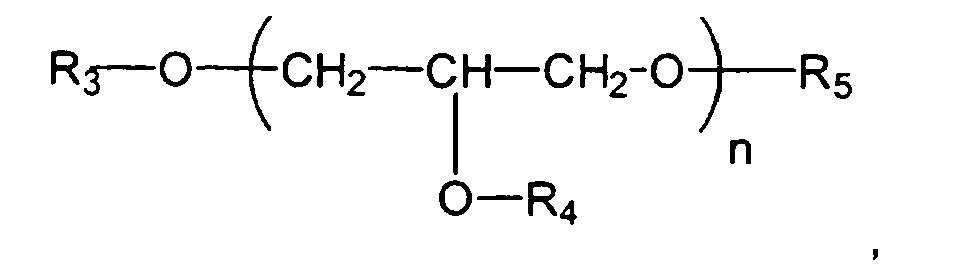
- Besonders vorteilhaft wird oder werden die grenzflächenaktiven Substanzen A aus der Gruppe Methylglucosemonostearat (Formel wie nachstehend)


- Besonders vorteilhaft wird oder werden die grenzflächenaktiven Substanzen B gewählt aus der Gruppe der Verbindungen, bei welcher n den Wert 3 annimmt und R3, R4 und R5 unabhängig voneinander gewählt werden aus der Gruppe, welche umfaßt: H, verzweigte bzw. unverzweigte, gesättigte bzw. ungesättigte Fettsäurereste mit 14 bis 20 Kohlenstoffatomen, insbesondere die nachfolgend aufgeführten Strukturen:

- Als erfindungsgemäß bevorzugte Emulgatorkombination hat sich ein ungefähr äquimolekulares Gemisch aus den Verbindungen A2 und B1, wobei in B1 die Reste R3 und R5 vorzugsweise beide einen Stearatrest bezeichnen, herausgestellt. Solche Emulgatorkombinationen sind als Polyglyceryl(3)-Methylglucosedistearat" (PGMS) unter der Warenbezeichnung Tego Care® 450 von der Gesellschaft Th. Goldschmidt KG erhältlich.
- Erfindungsgemäß vorteilhafte Emulgatoren sind ferner verzweigte und/oder unverzweigte Fettsäuren mit einer Kettenlänge von 14 bis 20 Kohlenstoffatomen, beispielsweise Stearinsäure und/oder Isostearinsäure.
- Vorteilhaft im Sinne der vorliegenden Erfindung werden der oder die Emulgatoren ferner gewählt aus der Gruppe der Glycerinmono- und/oder Glycerindiester der Stearinsäure. Solche Emulgatoren sind beispielsweise als "Glycerl Stearate SE" bzw. "Glycerl Stearate" unter den Handelsbezeichnungen Tegin® bzw. Tegin® M von der Th. Goldschmidt KG und unter der Handelsbezeichnung Cutina GMS bei der Henkel KGaA erhältlich.
- Erfindungsgemäß vorteilhaft sind ferner Sorbitanfettsäureester, welche Mischungen partieller Fettsäureester des Sorbit und seiner Anhydride (Sorbitan und Sorbid) mit Laurin-, Öl-, Palmitin- und Stearinsäure darstellen. Insbesondere vorteilhaft sind Sorbitandiisostearat (CAS-Nr.: 68238-87-9), Sorbitandioleat (CAS-Nr.: 29116-98-1), Sorbitanisostearat (CAS-Nr.:719020-10-7), Sorbitanlaurat (CAS-Nr.: 1338-39-2), Sorbitanoleat (CAS-Nr.: 1338-43-8), Sorbitanpalmitat (CAS-Nr.: 26266-57-9), Sorbitansesquistearat (CAS-Nr.: 71812-38-9), Sorbitansesquioleat (CAS-Nr.: 8007-43-0), Sorbitansesquistearate (CAS-Nr.: 51938-44-4), Sorbitanstearate (CAS-Nr.: 1338-41-6), Sorbitantristearate (CAS-Nr.: 54392-27-7 bzw. 26658-19-5) und/oder Sorbitantrioleate (CAS-Nr.: 26266-58-0).
- Die Ölphase der erfindungsgemäßen O/W-Emulsionen wird vorteilhaft gewählt aus der Gruppe der polaren Öle, beispielsweise aus der Gruppe der Lecithine und der Fettsäuretriglyceride, namentlich der Triglycerinester gesättigter und/oder ungesättigter, verzweigter und/oder unverzweigter Alkancarbonsäuren einer Kettenlänge von 8 bis 24, insbesondere 12 bis 18 C-Atomen. Die Fettsäuretriglyceride können beispielsweise vorteilhaft gewählt werden aus der Gruppe der synthetischen, halbsynthetischen und natürlichen Öle, wie z.B. Olivenöl, Sonnenblumenöl, Sojaöl, Erdnußöl, Rapsöl, Mandelöl, Palmöl, Kokosöl, Rizinusöl, Weizenkeimöl, Traubenkernöl, Distelöl, Nachtkerzenöl, Macadamianußöl und dergleichen mehr.
- Weitere vorteilhafte polare Ölkomponenten können im Sinne der vorliegenden Erfindung ferner gewählt werden aus der Gruppe der Ester aus gesättigten und/oder ungesättigten, ver-zweigten und/oder unverzweigten Alkancarbonsäuren einer Kettenlänge von 3 bis 30 C-Atomen und gesättigten und/oder ungesättigten, verzweigten und/oder unverzweigten Alkoholen einer Kettenlänge von 3 bis 30 C-Atomen sowie aus der Gruppe der Ester aus aromatischen Carbonsäuren und gesättigten und/oder ungesättigten, verzweigten und/oder unverzweigten Alkoholen einer Kettenlänge von 3 bis 30 C-Atomen. Solche Esteröle können dann vorteilhaft gewählt werden aus der Gruppe Isopropylmyristat, Isopropylpalmitat, Isopropylstearat, Isopropyloleat, n-Butylstearat, n-Hexyllaurat, n-Decyloleat, Isooctylstearat, Isononylstearat, Isononylisononanoat, 2-Ethylhexylpalmitat, 2-Ethylhexyllaurat, 2-Hexyldecylstearat, 2-Octyldodecylpalmitat, Oleyloleat, Oleylerucat, Erucyloleat, Erucylerucat sowie synthetische, halbsynthetische und natürliche Gemische solcher Ester, wie z.B. Jojobaöl.
- Ferner kann die Ölphase vorteilhaft gewählt werden aus der Gruppe der Dialkylether, der Gruppe der gesättigten oder ungesättigten, verzweigten oder unverzweigten Alkohole. Es ist insbesondere vorteilhaft, wenn die Ölphase der erfindungsgemäßen O/W-Emulsionen einen Gehalt an C12-15-Alkylbenzoat aufweist oder vollständig aus diesem besteht.
- Auch beliebige Abmischungen solcher Öl- und Wachskomponenten sind vorteilhaft im Sinne der vorliegenden Erfindung einzusetzen. Es kann auch gegebenenfalls vorteilhaft sein, Wachse, beispielsweise Cetylpalmitat, als alleinige Lipidkomponente der Ölphase einzusetzen.
- Ferner kann die Ölphase der erfindungsgemäßen O/W-Emulsionen, wenngleich nicht zwingend, ebenfalls vorteilhaft auch unpolare Öle enthalten, beispielsweise solche, welche gewählt werden aus der Gruppe der verzweigten und unverzweigten Kohlenwasserstoffe und -wachse, insbesondere Vaseline (Petrolatum), Paraffinöl, Squalan und Squalen, Polyolefine und hydrogenierte Polyisobutene. Unter den Polyolefinen sind Polydecene die bevorzugten Substanzen.
- Vorteilhaft kann die Ölphase ferner einen Gehalt an cyclischen oder linearen Silikonölen aufweisen oder vollständig aus solchen Ölen bestehen, wobei allerdings bevorzugt wird, außer dem Silikonöl oder den Silikonölen einen zusätzlichen Gehalt an anderen Ölphasenkomponenten zu verwenden.
- Vorteilhaft wird Cyclomethicon (Octamethylcyclotetrasiloxan) als erfindungsgemäß zu verwendendes Silikonöl eingesetzt. Aber auch andere Silikonöle sind vorteilhaft im Sinne der vorliegenden Erfindung zu verwenden, beispielsweise Hexamethylcyclotrisiloxan, Polydimethylsiloxan, Poly(methylphenylsiloxan).
- Die wäßrige Phase der erfindungsgemäßen Zubereitungen enthält gegebenenfalls vorteilhaft Alkohole, Diole oder Polyole niedriger C-Zahl, sowie deren Ether, vorzugsweise Ethanol, Isopropanol, Propylenglykol, Glycerin, Ethylenglykol, Ethylenglykolmonoethyl- oder -monobutylether, Propylenglykolmonomethyl, -monoethyl- oder -monobutylether, Diethylenglykolmonomethyl- oder -monoethylether und analoge Produkte, ferner Alkohole niedriger C-Zahl, z.B. Ethanol, Isopropanol, 1,2-Propandiol, Glycerin sowie insbesondere ein oder mehrere Verdickungsmittel, welches oder welche vorteilhaft gewählt werden können aus der Gruppe Siliciumdioxid, Aluminiumsilikate, Polysaccharide bzw. deren Derivate, z.B. Hyaluronsäure, Xanthangummi, Hydroxypropylmethylcellulose, besonders vorteilhaft aus der Gruppe der Polyacrylate, bevorzugt ein Polyacrylat aus der Gruppe der sogenannten Carbopole, beispielsweise Carbopole der Typen 980, 981, 1382, 2984, 5984, oder auch der Typen ETD (Easy-to-disperse) 2001, 2020, 2050, jeweils einzeln oder in beliebigen Kombinationen untereinander.
- Besonders vorteilhafte Zubereitungen werden ferner erhalten, wenn als Zusatz- oder Wirkstoffe Antioxidantien eingesetzt werden. Erfindungsgemäß enthalten die Zubereitungen vorteilhaft eines oder mehrere Antioxidantien. Als günstige, aber dennoch fakultativ zu verwendende Antioxidantien können alle für kosmetische und/oder dermatologische Anwendungen geeigneten oder gebräuchlichen Antioxidantien verwendet werden.
- Vorteilhaft werden die Antioxidantien gewählt aus der Gruppe bestehend aus Aminosäuren (z.B. Glycin, Histidin, Tyrosin, Tryptophan) und deren Derivate, Imidazole (z.B. Urocaninsäure) und deren Derivate, Peptide wie D,L-Carnosin, D-Carnosin, L-Carnosin und deren Derivate (z.B. Anserin), Carotinoide, Carotine (z.B. α-Carotin, β-Carotin, Lycopin) und deren Derivate, Liponsäure und deren Derivate (z.B. Dihydroliponsäure), Aurothioglucose, Propylthiouracil und andere Thiole (z.B. Thioredoxin, Glutathion, Cystein, Cystin; Cystamin und deren Glycosyl-, N-Acetyl-, Methyl-, Ethyl-, Propyl-, Amyl-, Butyl- und Lauryl-, Palmitoyl-, Oleyl-, γ-Linoleyl-, Cholesteryl - und Glycerylester) sowie deren Salze, Dilaurylthiodipropionat, Distearylthiodipropionat, Thiodipropionsäure und deren Derivate (Ester, Ether, Peptide, Lipide, Nukleotide, Nukleoside und Salze) sowie Sulfoximinverbindungen (z.B. Buthioninsulfoximine, Homocysteinsulfoximin, Buthioninsulfone, Penta-, Hexa-, Heptathioninsulfoximin) in sehr geringen verträglichen Dosierungen (z.B. pmol bis µmol/kg), ferner (Metall)-Chelatoren (z.B. α-Hydroxyfettsäuren, Palmitinsäure, Phytinsäure, Lactoferrin), α-Hydroxysäuren (z.B. Zitronensäure, Milchsäure, Apfelsäure), Huminsäure, Gallensäure, Gallenextrakte, Bilirubin, Biliverdin, EDTA, EGTA und deren Derivate, ungesättigte Fettsäuren und deren Derivate (z.B. γ-Linolensäure, Linolsäure, Ölsäure), Folsäure und deren Derivate, Ubichinon und Ubichinol und deren Derivate, Vitamin C und Derivate (z.B. Ascorbylpalmitat, Mg - Ascorbylphosphat, Ascorbylacetat), Tocopherole und Derivate (z.B. Vitamin E - acetat), Vitamin A und Derivate (Vitamin A - palmitat) sowie Konyferylbenzoat des Benzoeharzes, Rutinsäure und deren Derivate, Ferulasäure und deren Derivate, Butylhydroxytoluol, Butylhydroxyanisol, Nordihydroguajakharzsäure, Nordihydroguajaretsäure, Trihydroxybutyrophenon, Harnsäure und deren Derivate, Mannose und deren Derivate, Zink und dessen Derivate (z.B. ZnO, ZnSO4) Seien und dessen Derivate (z.B. Selenmethionin), Stilbene und deren Derivate (z.B. Stilbenoxid, Trans-Stilbenoxid) und die erfindungsgemäß geeigneten Derivate (Salze, Ester, Ether, Zucker, Nukleotide, Nukleoside, Peptide und Lipide) dieser genannten Wirkstoffe.
- Besonders vorteilhaft im Sinne der vorliegenden Erfindung können öllösliche Antioxidantien eingesetzt werden.
- Die Menge der Antioxidantien (eine oder mehrere Verbindungen) in den Zubereitungen beträgt vorzugsweise 0,001 bis 30 Gew.-%, besonders bevorzugt 0,05 - 20 Gew.-%, insbesondere 1 - 10 Gew.-%, bezogen auf das Gesamtgewicht der Zubereitung.
- Sofern Vitamin E und/oder dessen Derivate das oder die Antioxidantien darstellen, ist vorteilhaft, deren jeweilige Konzentrationen aus dem Bereich von 0,001 - 10 Gew.-%, bezogen auf das Gesamtgewicht der Formulierung, zu wählen.
- Sofern Vitamin A, bzw. Vitamin-A-Derivate, bzw. Carotine bzw. deren Derivate das oder die Antioxidantien darstellen, ist vorteilhaft, deren jeweilige Konzentrationen aus dem Bereich von 0,001 - 10 Gew.-%, bezogen auf das Gesamtgewicht der Formulierung, zu wählen.
- Es ist dem Fachmann natürlich bekannt, daß kosmetische Zubereitungen zumeist nicht ohne die üblichen Hilfs- und Zusatzstoffe denkbar sind. Die erfindungsgemäßen kosmetischen und dermatologischen Zubereitungen können dementsprechend ferner kosmetische Hilfsstoffe enthalten, wie sie üblicherweise in solchen Zubereitungen verwendet werden, beispielsweise Konsistenzgeber, Stabilisatoren, Füllstoffe, Konservierungsmittel, Parfüme, Substanzen zum Verhindern des Schäumens, Farbstoffe, Pigmente, die färbende Wirkung haben, Verdickungsmittel, oberflächenaktive Substanzen, Emulgatoren, weichmachende, anfeuchtende und/oder feuchthaltende Substanzen, entzündungshemmende Substanzen, zusätzliche Wirkstoffe wie Vitamine oder Proteine, Lichtschutzmittel, Insektenrepellentien, Bakterizide, Viruzide, Wasser, Salze, antimikrobiell, proteolytisch oder keratolytisch wirksame Substanzen, Medikamente oder andere übliche Bestandteile einer kosmetischen oder dermatologischen Formulierung wie Alkohole, Polyole, Polymere, Schaumstabilisatoren, organische Lösungsmittel oder auch weitere Elektrolyte.
- Letztere können beispielsweise gewählt werden aus der Gruppe der Salze mit folgenden Anionen: Chloride, ferner anorganische Oxo-Element-Anionen, von diesen insbesondere Sulfate, Carbonate, Phosphate, Borate und Aluminate. Auch auf organischen Anionen basierende Elektrolyte sind vorteilhaft, z.B. Lactate, Acetate, Benzoate, Propionate, Tartrate, Citrate, Aminosäuren, Ethylendiamintetraessigsäure und deren Salze und andere mehr. Als Kationen der Salze werden bevorzugt Ammonium,- Alkylammonium,-Alkalimetall-, Erdalkalimetall,- Magnesium-, Eisen- bzw. Zinkionen verwendet. Es bedarf an sich keiner Erwähnung, daß in Kosmetika nur physiologisch unbedenkliche Elektrolyte verwendet werden sollten. Besonders bevorzugt sind Kaliumchlorid, Kochsalz, Magnesiumsulfat, Zinksulfat und Mischungen daraus.
- Mutatis mutandis gelten entsprechende Anforderungen an die Formulierung medizinischer Zubereitungen.
- Die erfindungsgemäßen O/W-Emulsionen können als Grundlage für kosmetische oder dermatologische Formulierungen dienen. Diese können wie üblich zusammengesetzt sein und beispielsweise zur Behandlung und der Pflege der Haut und/oder der Haare, als Lippenpflegeprodukt, als Deoprodukt und als Schmink- bzw. Abschminkprodukt in der dekorativen Kosmetik oder als Lichtschutzpräparat dienen. Zur Anwendung werden die erfindungsgemäßen kosmetischen und dermatologischen Zubereitungen in der für Kosmetika oder Dermatika üblichen Weise auf die Haut und/oder die Haare in ausreichender Menge aufgebracht.
- Entsprechend können kosmetische oder topische dermatologische Zusammensetzungen im Sinne der vorliegenden Erfindung, je nach ihrem Aufbau, beispielsweise verwendet werden als Hautschutzcrème, Reinigungsmilch, Sonnenschutzlotion, Nährcrème, Tages- oder Nachtcrème usw. Es ist gegebenenfalls möglich und vorteilhaft, die erfindungsgemäßen Zusammensetzungen als Grundlage für pharmazeutische Formulierungen zu verwenden.
- Günstig sind auch solche kosmetischen und dermatologischen Zubereitungen, die in der Form eines Sonnenschutzmittels vorliegen. Vorzugsweise enthalten diese neben den erfindungsgemäßen Wirkstoffkombinationen zusätzlich mindestens eine UV-A-Filtersubstanz und/oder mindestens eine UV-B-Filtersubstanz. Solche Formulierungen können, obgleich nicht notwendig, gegebenenfalls auch ein oder mehrere anorganische Pigmente als UV-Filtersubstanzen enthalten.
- Bevorzugt sind anorganische Pigmente auf Basis von Metalloxiden und/oder anderen in Wasser schwerlöslichen oder unlöslichen Metallverbindungen enthalten, insbesondere der Oxide des Titans (TiO2), Zinks (ZnO), Eisens (z.B. Fe2O3), Zirkoniums (ZrO2), Siliciums (SiO2), Mangans (z.B. MnO), Aluminiums (Al2O3), Cers (z.B. Ce2O3), Mischoxiden der entsprechenden Metalle sowie Abmischungen aus solchen Oxiden.
- Auch ein zusätzlicher Gehalt an stabilisierend wirkenden Titandioxid- und/oder Zinkoxidpartikeln kann selbstverständlich vorteilhaft sein, ist aber im Sinne der vorliegenden Erfindung nicht notwendig.
- Es ist auch vorteilhaft im Sinne der vorliegenden Erfindungen, solche kosmetischen und dermatologischen Zubereitungen zu erstellen, deren hauptsächlicher Zweck nicht der Schutz vor Sonnenlicht ist, die aber dennoch einen Gehalt an UV-Schutzsubstanzen enthalten. So werden z.B. in Tagescrèmes gewöhnlich UV-A- bzw. UV-B-Filtersubstanzen eingearbeitet.
- Auch stellen UV-Schutzsubstanzen, ebenso wie Antioxidantien und, gewünschtenfalls, Konservierungsstoffe, einen wirksamen Schutz der Zubereitungen selbst gegen Verderb dar.
- Vorteilhaft enthalten erfindungsgemäße Zubereitungen Substanzen, die UV-Strahlung im UV-B-Bereich absorbieren, wobei die Gesamtmenge der Filtersubstanzen z.B. 0,1 Gew.-% bis 30 Gew.-%, vorzugsweise 0,5 bis 10 Gew.-%, insbesondere 1,0 bis 6,0 Gew.-% beträgt, bezogen auf das Gesamtgewicht der Zubereitungen, um kosmetische Zubereitungen zur Verfügung zu stellen, die das Haar bzw. die Haut vor dem gesamten Bereich der ultravioletten Strahlung schützen. Sie können auch als Sonnenschutzmittel fürs Haar oder die Haut dienen.
- Vorteilhafte UV-A-Filtersubstanzen im Sinne der vorliegenden Erfindung sind Dibenzoylmethanderivate, insbesondere 5-Isopropyldibenzoylmethan (CAS-Nr. 63250-25-9), welches von Merck unter der Marke Eusolex® 8020 verkauft wird, und/oder das 4-(tert.-Butyl)-4'-methoxydibenzoylmethan (CAS-Nr. 70356-09-1), welches von Givaudan unter der Marke Parsol® 1789 und von Merck unter der Handelsbezeichnung Eusolex® 9020 verkauft wird.
- Weitere vorteilhafte UV-A-Filtersubstanzen sind die Phenylen-1,4-bis-(2-benzimidazyl)-3,3'-5,5'-tetrasulfonsäure:


- Vorteilhafte UV-Filtersubstanzen im Sinne der vorliegenden Erfindung sind ferner sogenannte Breitbandfilter, d.h. Filtersubstanzen, die sowohl UV-A- als auch UV-B-Strahlung absorbieren.
- Vorteilhafte Breitbandfilter sind beispielsweise Bis-Resorcinyltriazinderivate mit der folgenden Struktur:

- Auch andere UV-Filtersubstanzen beschrieben, welche das Strukturmotiv
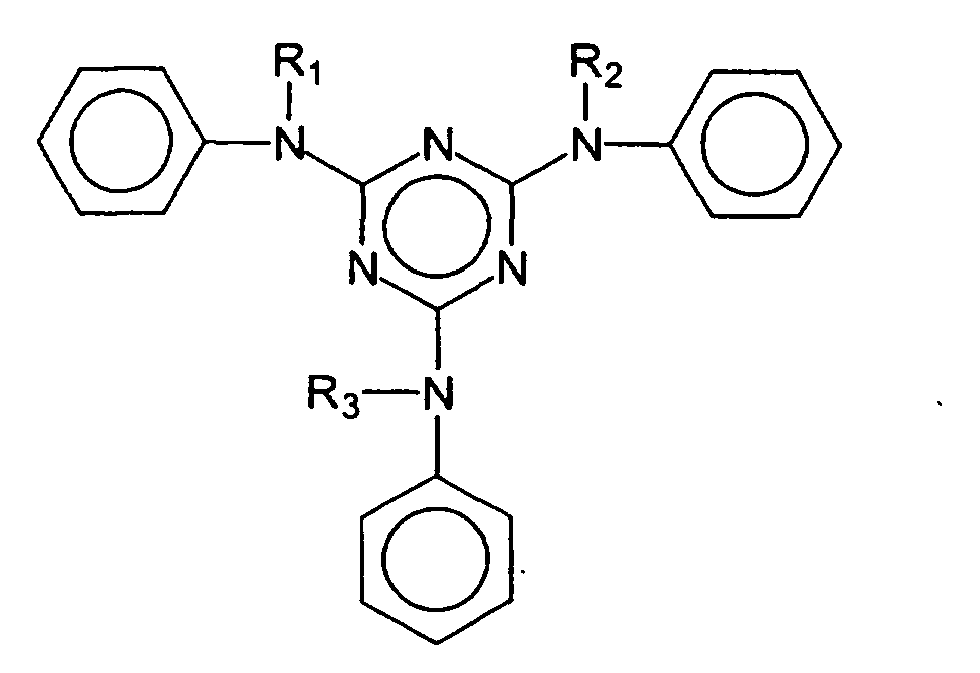

- R
- einen verzweigten oder unverzweigten C1-C18-Alkylrest, einen C5-C12-Cycloalkylrest, gegebenenfalls substituiert mit einer oder mehreren C1-C4- Alkylgruppen, darstellt,
- X
- ein Sauerstoffatom oder eine NH-Gruppe darstellt,
- R1
- einen verzweigten oder unverzweigten C1-C18-Alkylrest, einen C5-C12-Cycloalkylrest, gegebenenfalls substituiert mit einer oder mehreren C1-C4- Alkylgruppen, oder ein Wasserstoffatom, ein Alkalimetallatom, eine Ammoniumgruppe oder eine Gruppe der Formel

A einen verzweigten oder unverzweigten C1-C18-Alkylrest, einen C5-C12-Cycloalkyl- oder Arylrest darstellt, gegebenenfalls substituiert mit einer oder mehreren C1-C4- Alkylgruppen,
R3 ein Wasserstoffatom oder eine Methylgruppe darstellt,
n eine Zahl von 1 bis 10 darstellt, - R2
- einen verzweigten oder unverzweigten C1-C18-Alkylrest, einen C5-C12-Cycloalkylrest, gegebenenfalls substituiert mit einer oder mehreren C1-C4- Alkylgruppen, darstellt, wenn X die NH-Gruppe darstellt, und
einen verzweigten oder unverzweigten C1-C18-Alkylrest, einen C5-C12-Cycloalkylrest, gegebenenfalls substituiert mit einer oder mehreren C1-C4- Alkylgruppen, oder ein Wasserstoffatom, ein Alkalimetallatom, eine Ammoniumgruppe oder eine Gruppe der Formel
A einen verzweigten oder unverzweigten C1-C18-Alkylrest, einen C5-C12-Cycloalkyl- oder Arylrest darstellt, gegebenenfalls substituiert mit einer oder mehreren C1-C4-Alkylgruppen,
R3 ein Wasserstoffatom oder eine Methylgruppe darstellt,
n eine Zahl von 1 bis 10 darstellt, wenn X ein Sauerstoffatom darstellt. - Ein Beispiel für solche unsymmetrisch substituierte s-Triazine stellt das Dioctylbutylamidotriazon dar.
- Auch andere UV-Filtersubstanzen, deren Einarbeitung in kosmetische oder dermatologische Lichtschutzformulierungen bisher Probleme aufwies, sind bekannt. So werden in der Europäischen Offenlegungsschrift 775 698 Bis-Resorcinyltriazinderivate beschrieben, deren chemische Struktur durch die generische Formel

- Vorteilhaft im Sinne der vorliegenden Erfindung sind ferner das 2,4-Bis-{[4-(3-sulfonato)-2-hydroxy-propyloxy)-2-hydroxy]-phenyl}-6-(4-methoxyphenyl)-1,3,5-triazin Natriumsalz, das 2,4-Bis-{[4-(3-(2-Propyloxy)-2-hydroxy-propyloxy)-2-hydroxy]-phenyl}-6-(4-methoxyphenyl)-1,3,5-triazin, das 2,4-Bis-{[4-(2-ethyl-hexyloxy)-2-hydroxy]-phenyl}-6-[4-(2-methoxyethyl-carboxyl)-phenylamino]-1,3,5-triazin, das 2,4-Bis-{[4-(3-(2-propytoxy)-2-hydroxypropyloxy)-2-hydroxy]-phenyl}-6-[4-(2-ethyl-carboxyl)-phenylamino]-1,3,5-triazin, das 2,4-Bis-{[4-{2-ethyl-hexyloxy}-2-hydroxy]-phenyl}-6-(1-methyl-pyrrol-2-yl)-1,3,5-triazin, das 2,4-Bis-{[4-tris(trimethylsiloxy-silylpropyloxy)-2-hydroxy]-phenyl}-6-(4-methoxyphenyl)-1,3,5-triazin, das 2,4-Bis-{[4-(2"-methylpropenyloxy)-2-hydroxy]-phenyl}-6-(4-methoxyphenyl)-1,3,5-triazin und das 2,4-Bis-{[4-(1',1',1',3',5',5',5'-Heptamethylsiloxy-2"-methylpropyloxy)-2-hydroxy]-phenyl}-6-(4-methoxyphenyl)-1,3,5-triazin.
- Ein weiterer vorteilhafter UV-Filter im Sinne der vorliegenden Erfindung ist das 2,2'-Methylen-bis-(6-(2H-benzotriazol-2-yl)-4-(1,1,3,3-tetramethylbutyl)-phenol), welches durch die chemische Strukturformel

- Vorteilhaft im Sinne der vorliegenden Erfindung ist ferner das 2-(2H-benzotriazol-2-yl)-4-methyl-6-[2-methyl-3-[1,3,3,3-tetramethyl-1-[(trimethylsilyl)oxy]disiloxanyl]propyl]-phenol (CAS-Nr.: 155633-54-8) mit der INCI-Bezeichnung Drometrizole Trisiloxane, welches durch die chemische Strukturformel

- Die UV-B-Filter können öllöslich oder wasserlöslich sein. Vorteilhafte öllösliche UV-B-Filtersubstanzen sind z.B.:
- 3-Benzylidencampher-Derivate, vorzugsweise 3-(4-Methylbenzyliden)campher, 3-Benzylidencampher;
- 4-Aminobenzoesäure-Derivate, vorzugsweise 4-(Dimethylamino)-benzoesäure(2-ethylhexyl)ester, 4-(Dimethylamino)benzoesäureamylester;
- 2,4,6-Trianilino-(p-carbo-2'-ethyl-1'-hexyloxy)-1,3,5-triazin;
- Ester der Benzalmalonsäure, vorzugsweise 4-Methoxybenzalmalonsäuredi(2-ethylhexyl)ester;
- Ester der Zimtsäure, vorzugsweise 4-Methoxyzimtsäure(2-ethylhexyl)ester, 4-Methoxyzimtsäureisopentylester;
- Derivate des Benzophenons, vorzugsweise 2-Hydroxy-4-methoxybenzophenon, 2-Hydroxy-4-methoxy-4'-methylbenzophenon, 2,2'-Dihydroxy-4-methoxybenzophenon;
-
- Salze der 2-Phenylbenzimidazol-5-sulfonsäure, wie ihr Natrium-, Kalium- oder ihr Triethanolammonium-Salz, sowie die Sulfonsäure selbst;
- Sulfonsäure-Derivate des 3-Benzylidencamphers, wie z.B. 4-(2-Oxo-3-bornylidenmethyl)benzolsulfonsäure, 2-Methyl-5-(2-oxo-3-bornylidenmethyl)sulfonsäure und deren Salze.
- Eine weiterere erfindungsgemäß vorteilhaft zu verwendende Lichtschutzfiltersubstanz ist das Ethylhexyl-2-cyano-3,3-diphenylacrylat (Octocrylen), welches von BASF unter der Bezeichnung Uvinul® N 539 erhältlich ist und sich durch folgende Struktur auszeichnet:

- Es kann auch von erheblichem Vorteil sein, polymergebundene oder polymere UV-Filtersubstanzen in Zubereitungen gemäß der vorliegenden Erfindung zu verwenden, insbesondere solche, wie sie in der WO-A-92/20690 beschrieben werden.
- Ferner kann es gegebenenfalls von Vorteil sein, erfindungsgemäß weitere UV-A-und/oder UV-B-Filter in kosmetische oder dermatologische Zubereitungen einzuarbeiten, beispielsweise bestimmte Salicylsäurederivate wie 4-Isopropylbenzylsalicylat, 2-Ethylhexylsalicylat (= Octylsalicylat), Homomenthylsalicylat.
- Die Liste der genannten UV-Filter, die im Sinne der vorliegenden Erfindung eingesetzt werden können, soll selbstverständlich nicht limitierend sein.
- Die nachfolgenden Beispiele sollen die vorliegende Erfindung verdeutlichen, ohne sie einzuschränken. Alle Mengenangaben, Anteile und Prozentanteile sind, soweit nicht anders angegeben, auf das Gewicht und die Gesamtmenge bzw. auf das Gesamtgewicht der Zubereitungen bezogen.
-
O/W 1 O/W 2 O/W 3 O/W 4 O/W 5 Stearinsäure 1,5 1,5 Glycerinmonostearat 3 3 5 Sorbitanstearat 5 3 Polyglyceryl-3 Methylglucose Distearat 1,5 Cetearyl Alkohol 2 0,5 0,5 CapryliclCapric Triglycerid 10 5 5 Octyldodecanol 5 10 Dicaprylylether 5 2 5 Dimethicon 2 2 1 Hydriertes Polyisobuten 2 Macadamianußöl 5 2 2 Butylen Glycol Dicaprylat/Caprat 5 5 5 5 C12-15- Alkylbenzoat 5 5 Vitamen E-Acetat 0,5 0,5 0,5 0,5 0,5 Octyltriazon 2 4 5 3 4 Dioctyl Butamido Triazon 1 2 Methylbenzyliden Campher 4 2 4 4 Butyl Methoxydibenzoyl Methan 2 2 1 1,5 3 Bornitrid 1 1 5 2 2 Konservierung 0,5 0,5 0,5 0,5 0,5 Glycerin 3 5 5 5 10 Xanthan Gummi 0,3 0,1 0,2 Pemulen TR1a 0,1 0,1 0,3 0,1 Phenylbenzimidazol Sulfonsäure 4 2 Natronlauge 45% 0,5 0,6 1,4 1,2 Wasser ad 100 ad 100 ad 100 ad 100 ad 100 a Copolymer aus C10-30 Alkylacrylaten und einem oder mehreren Monomeren der Acrylsäure, der Methacrylsäure oder deren Ester, die kreuzvernetzt sind mit einem Allylether der Saccharose oder einem Allylether des Pentaerythrit (CTFA-Bez.: Acrylates/C 10-30 Alkyl Acrylate Crosspolymer)
Claims (11)
- Kosmetische oder dermatologische O/W-Emulsionen mit einem Gehalt an mindestens einem Bornitrid, wobei der mittlere Partikeldurchmesser der verwendeten Bornitridpartikel kleiner als 25 µm beträgt, mindestens einer UV-Filtersubstanz gewählt aus der Gruppe der Verbindungen der Triazinderivate, Benzotriazole, Phenylen-1,4-bis-(2-benzimidazyl)-3,3'-5,5'-tetrasulfonsäure und ihrer Salze, 1,4-di(2-oxo-10-Sulfo-3-bornylidenmethyl)-Benzol und dessen Salze, Salze der 2-Phenylbenzimidazol-5-sulfonsäure sowie die Sulfonsäure selbst sowie Sulfonsäure-Derivate des 3-Benzylidencamphers und deren Salze und einer Ölkomponente, deren Grenzflächenspannung gegen Wasser kleiner als 35 mN/m beträgt.
- Verwendung von mindestens einem Bornitrid, wobei der mittlere Partikeldurchmesser der verwendeten Bornitridpartikel kleiner als 25 µm beträgt, zum Erzielen oder Erhöhen der Stabilität von O/W-Emulsionen welche mindestens eine UV-Filtersubstanz gewählt aus der Gruppe der Verbindungen der Triazinderivate, Benzotriazole, Phenylen-1,4-bis-(2-benzimidazyl)-3,3'-5,5'-tetrasulfonsäure und ihrer Salze, 1,4-di(2-oxo-10-Sulfo-3-bornylidenmethyl)-Benzol und dessen Salze, Salze der 2-Phenylbenzimidazol-5-sulfonsäure sowie die Sulfonsäure selbst sowie Sulfonsäure-Derivate des 3-Benzylidencamphers und deren Salze und eine Ölkomponente, deren Grenzflächenspannung gegen Wasser kleiner als 35 mN/m beträgt, enthalten.
- Verwendung von mindestens einem Bornitrid zum Erzielen oder Erhöhen der Stabilität von O/W-Emulsionen in Gegenwart von Ölkomponenten, deren Grenzflächenspannung gegen Wasser kleiner als 35 mN/m beträgt, und polaren UV-Filtern gewählt aus der Gruppe der Verbindungen der Triazinderivate, Benzotriazole, Phenylen-1,4-bis-(2-benzimidazyl)-3,3'-5,5'-tetrasulfonsäure und ihrer Salze, 1,4-di(2-oxo-10-Suffo-3-bomylidenmethyl)-Benzol und dessen Salze, Salze der 2-Phenylbenzimidazol-5-sulfonsäure sowie die Sulfonsäure selbst sowie Sulfonsäure-Derivate des 3-Benzylidencamphers.
- O/W-Emulsion nach Anspruch 1 oder Verwendung nach einem der Ansprüche 2 und 3, dadurch gekennzeichnet, daß die Emulsion weniger als 2 Gew.%, insbesondere weniger als 1 Gew.-%, ganz besonders weniger als 0,5 Gew.-% Ölkomponenten bezogen auf das Gesamtgewicht der Zubereitungen enthält, deren Grenzflächenspannung gegen Wasser größer als 35 mN/m beträgt.
- O/W-Emulsion nach Anspruch 1 oder Verwendung nach einem der Ansprüche 2 und 3, dadurch gekennzeichnet, daß der mittlere Partikeldurchmesser der verwendeten Bornitridpartikel kleiner als 7 µm gewählt wird.
- O/W-Emulsion nach Anspruch 1 oder Verwendung nach einem der Ansprüche 2 und 3, dadurch gekennzeichnet, daß die Gesamtmenge an einem oder mehreren Bornitriden in den fertigen kosmetischen oder dermatologischen Zubereitungen aus dem Bereich von 0,1 bis 20,0 Gew.%, bevorzugt 0,5 bis 10,0 Gew.-% gewählt wird, bezogen auf das Gesamtgewicht der Zubereitungen.
- O/W-Emulsion nach Anspruch 1 oder Verwendung nach einem der Ansprüche 2 und 4, dadurch gekennzeichnet, daß der oder die Emulgatoren gewählt werden aus Gruppe der Glycerinester von α-Hydroxycarbonsäuren und gesättigten Fettsäuren, Methylglucosemonostearat, Methylglucosedistearat, Polyglyceryl(3)-Methylglucosedistearat, der verzweigten und/oder unverzweigten Fettsäuren mit einer Kettenlänge von 14 bis 20 Kohlenstoffatomen, Glycerinmono- und/oder Glycerindiester der Stearinsäure sowie Sorbitanfettsäureester.
- O/W-Emulsion nach Anspruch 1 oder Verwendung nach einem der Ansprüche 2 und 3, dadurch gekennzeichnet, daß mindestens eine UV-Filtersubstanz gewählt wird aus der Gruppe der Triazinderivate, insbesondere aus der Gruppe
(1,3,5-Triazin-2,4,6-triyltriimino)-tris-benzoesäure-tris(2-ethylhexylester),
2,4-Bis-{[4-(2-Ethyl-hexyloxy)-2-hydroxy]-phenyl}-6-(4-methoxyphenyl)-1,3,5-triazin,
2,4-Bis-{[4-(3-sulfonato)-2-hydroxy-propyloxy)-2-hydroxy]-phenyl}-6-(4-methoxyphe nyl)-1,3,5-triazin Natriumsalz,
2,4-Bis-{[4-(3-(2-Propyloxy)-2-hydroxy-propyloxy)-2-hydroxy]-phenyl}-6-(4-meth oxyphenyl)-1,3,5-triazin,
2,4-Bis-{[4-(2-ethyl-hexyloxy)-2-hydroxy]-phenyl}-6-[4-(2-methoxyethyl-carboxyl)-phe nylamino]-1,3,5-triazin,
2,4-Bis-{[4-(3-(2-propyloxy)-2-hydroxy-propyloxy)-2-hydroxy]-phenyl}-6-[4-(2-ethylcarboxyl)-phenylamino]-1,3,5-triazin,
2,4-Bis-{[4-(2-ethyl-hexyloxy)-2-hydroxy]-phenyl}-6-(1-methyl-pyrrol-2-yl)-1,3,5-triazin,
2,4-Bis-{[4-tris(trimethylsiloxy-silylpropyloxy)-2-hydroxy]-phenyl}-6-(4-methoxyphenyl)-1,3,5-triazin,
2,4-Bis-{[4-(2''-methylpropenyloxy)-2-hydroxy]-phenyl}-6-(4-methoxyphenyl)-1,3,5-triazin,
2,4-Bis-{[4-(1',1',1',3',5',5',5'-Heptamethylsiloxy-2''-methyl-propyloxy)-2-hydroxy]-phenyl}-6-(4-methoxyphenyl)-1,3,5-triazin. - O/W-Emulsion nach Anspruch 1 oder Verwendung nach einem der Ansprüche 2 und 3, dadurch gekennzeichnet, daß mindestens eine UV-Filtersubstanz gewählt wird aus der Gruppe
Phenylen-1,4-bis-(2-benzimidazyl)-3,3'-5,5'-tetrasulfonsäure und ihre Salze, besonders die entsprechenden Natrium-, Kalium- oder Triethanolammonium-Salze, insbesondere das Phenylen-1,4-bis-(2-benzimidazyl)-3,3'-5,5'-tetrasulfonsäure-bis-natriumsalz,
1,4-di(2-oxo-10-Sulfo-3-bornylidenmethyl)-Benzol und dessen Salze, besonders die entprechenden 10-Sulfato-verbindungen, insbesondere das entsprechende Natrium-, Kalium- oder Triethanolammonium-Salz),
Salze der 2-Phenylbenzimidazol-5-sulfonsäure, wie ihr Natrium-, Kalium- oder ihr Triethanolammonium-Salz, sowie die Sulfonsäure selbst sowie
Sulfonsäure-Derivate des 3-Benzylidencamphers, wie z. B. 4-(2-Oxo-3-bornylidenmethyl)benzolsulfonsäure, 2-Methyl-5-(2-oxo-3-bornylidenmethyl)sulfonsäure und deren Salze. - O/W-Emulsion nach Anspruch 1 oder Verwendung nach einem der Ansprüche 2 und 3, dadurch gekennzeichnet, daß mindestens eine UV-Filtersubstanz gewählt wird aus der Gruppe der Benzotriazole, insbesondere aus der Gruppe 2,2'-Methylen-bis-(6-(2H-benzotriazol-2-yl)-4-(1,1,3,3-tetramethylbutyl)-phenol) und 2-(2H-benzotriazol-2-yl)-4-methyl-6-[2-methyl-3-[1,3,3,3-tetramethyl-1-[(trimethylsilyl)oxy]disiloxanyl]propyl]-phenol.
- O/W-Emulsion nach Anspruch 1 oder Verwendung nach einem der Ansprüche 2 und 3, dadurch gekennzeichnet, daß zusätzlich weitere kosmetische oder pharmazeutische Hilfs-, Zusatz- und/oder Wirkstoffe enthalten sind.
Applications Claiming Priority (2)
| Application Number | Priority Date | Filing Date | Title |
|---|---|---|---|
| DE19860267A DE19860267A1 (de) | 1998-12-24 | 1998-12-24 | Kosmetische und dermatologische O/W-Emulsionen mit einem Gehalt an Bornitrid |
| DE19860267 | 1998-12-24 |
Publications (3)
| Publication Number | Publication Date |
|---|---|
| EP1013262A2 EP1013262A2 (de) | 2000-06-28 |
| EP1013262A3 EP1013262A3 (de) | 2001-12-19 |
| EP1013262B1 true EP1013262B1 (de) | 2006-11-29 |
Family
ID=7892809
Family Applications (1)
| Application Number | Title | Priority Date | Filing Date |
|---|---|---|---|
| EP99124015A Expired - Lifetime EP1013262B1 (de) | 1998-12-24 | 1999-12-08 | Kosmetische und dermatologische O/W-Emulsionen mit einem Gehalt an Bornitrid |
Country Status (4)
| Country | Link |
|---|---|
| EP (1) | EP1013262B1 (de) |
| AT (1) | ATE346655T1 (de) |
| DE (2) | DE19860267A1 (de) |
| ES (1) | ES2276501T3 (de) |
Families Citing this family (11)
| Publication number | Priority date | Publication date | Assignee | Title |
|---|---|---|---|---|
| DE19923771A1 (de) * | 1999-05-22 | 2000-11-23 | Beiersdorf Ag | Kosmetische oder dermatologische Lichtschutzzubereitungen mit einem Gehalt an Bornitrid und Ethylhexyl-2-cyano-3,3-diphenylacrylat sowie die Verwendung von Bornitrid zur Verstärkung des Lichtschutzfaktors und/oder der UV-A-Schutzleistung kosmetischer oder dermatologischer Lichtschutzmittel |
| DE19923667A1 (de) * | 1999-05-22 | 2000-11-23 | Beiersdorf Ag | Kosmetische oder dermatologische Lichtschutzzubereitungen mit einem Gehalt an Bornitrid und sowie die Verwendung von Bornitrid zur Verbesserung des Hautgefühls von Zubereitungen, die sich durch einen Gehalt an UV-Filtersubstanzen auszeichnen, welche das Strukturmotiv des s-Triazins aufweisen |
| DE19923671A1 (de) * | 1999-05-22 | 2000-11-23 | Beiersdorf Ag | Kosmetische oder dermatologische Lichtschutzzubereitungen mit einem Gehalt an Dioctylbutamidotriazon und einem oder mehreren Filmbildnern |
| DE19923773A1 (de) * | 1999-05-22 | 2000-11-23 | Beiersdorf Ag | Kosmetische oder dermatologische Lichtschutzzubereitungen mit einem Gehalt an Bornitrid und sulfonierten UV-Filtersubstanzen sowie die Verwendung von Bornitrid zur Stabilisierung von Emulsionen, die einen Gehalt an Elektrolyten, insbesondere einen Gehalt an sulfonierten UV-Filtersubstanzen, aufweisen |
| DE10000209A1 (de) * | 2000-01-05 | 2001-07-12 | Beiersdorf Ag | Kosmetische oder dermatologische Zubereitungen vom Typ Öl-in-Wasser |
| DE10063343A1 (de) * | 2000-12-19 | 2002-06-20 | Beiersdorf Ag | Kosmetische und dermatologische Lichtschutzformulierungen mit einem Gehalt an unsymmetrisch substitutierten Triazinderivaten und oberflächenaktiven Zitronensäureestern |
| DE10063345A1 (de) * | 2000-12-19 | 2002-06-20 | Beiersdorf Ag | Kosmetische und dermatologische Lichtschutzformulierungen mit einem Gehalt an Benzotriazolderivaten und oberflächenaktiven Zitronensäureestern |
| DE10129973A1 (de) * | 2001-06-21 | 2003-01-02 | Beiersdorf Ag | Kosmetische oder dermatologische getränkte Tücher |
| FR2854068B1 (fr) * | 2003-04-28 | 2006-09-01 | Oreal | Utilisation du nitrure de bore associe a au moins une huile pour le conditionnement des cheveux et composition cosmetique les comprenant. |
| FR2854067B1 (fr) * | 2003-04-28 | 2006-09-22 | Oreal | Composition detergente contenant du nitrure de bore associe a au moins une huile. |
| FR3124698A1 (fr) * | 2021-06-30 | 2023-01-06 | L'oreal | Composition comprenant au moins un filtre UV, du nitrure de bore, et un tensioactif non ionique de type ester |
Citations (2)
| Publication number | Priority date | Publication date | Assignee | Title |
|---|---|---|---|---|
| FR2746301A1 (fr) * | 1996-03-20 | 1997-09-26 | Oreal | Compositions cosmetiques comprenant des nanopigments |
| WO2000007549A1 (de) * | 1998-08-01 | 2000-02-17 | Beiersdorf Ag | Emulgatorfreie und bornitrid enthaltende feindisperse systeme vom typ öl-in-wasser und wasser-in-öl |
Family Cites Families (4)
| Publication number | Priority date | Publication date | Assignee | Title |
|---|---|---|---|---|
| GB9114317D0 (en) * | 1991-07-02 | 1991-08-21 | Unilever Plc | Cosmetic composition |
| DE19842744B4 (de) * | 1998-09-18 | 2006-12-21 | Beiersdorf Ag | Emulgatorfreie feindisperse Systeme vom Typ Öl-in-Wasser und Wasser-in-Öl und deren Verwendung |
| DE19923771A1 (de) * | 1999-05-22 | 2000-11-23 | Beiersdorf Ag | Kosmetische oder dermatologische Lichtschutzzubereitungen mit einem Gehalt an Bornitrid und Ethylhexyl-2-cyano-3,3-diphenylacrylat sowie die Verwendung von Bornitrid zur Verstärkung des Lichtschutzfaktors und/oder der UV-A-Schutzleistung kosmetischer oder dermatologischer Lichtschutzmittel |
| DE19923667A1 (de) * | 1999-05-22 | 2000-11-23 | Beiersdorf Ag | Kosmetische oder dermatologische Lichtschutzzubereitungen mit einem Gehalt an Bornitrid und sowie die Verwendung von Bornitrid zur Verbesserung des Hautgefühls von Zubereitungen, die sich durch einen Gehalt an UV-Filtersubstanzen auszeichnen, welche das Strukturmotiv des s-Triazins aufweisen |
-
1998
- 1998-12-24 DE DE19860267A patent/DE19860267A1/de not_active Withdrawn
-
1999
- 1999-12-08 DE DE59914025T patent/DE59914025D1/de not_active Expired - Lifetime
- 1999-12-08 ES ES99124015T patent/ES2276501T3/es not_active Expired - Lifetime
- 1999-12-08 AT AT99124015T patent/ATE346655T1/de not_active IP Right Cessation
- 1999-12-08 EP EP99124015A patent/EP1013262B1/de not_active Expired - Lifetime
Patent Citations (2)
| Publication number | Priority date | Publication date | Assignee | Title |
|---|---|---|---|---|
| FR2746301A1 (fr) * | 1996-03-20 | 1997-09-26 | Oreal | Compositions cosmetiques comprenant des nanopigments |
| WO2000007549A1 (de) * | 1998-08-01 | 2000-02-17 | Beiersdorf Ag | Emulgatorfreie und bornitrid enthaltende feindisperse systeme vom typ öl-in-wasser und wasser-in-öl |
Also Published As
| Publication number | Publication date |
|---|---|
| ES2276501T3 (es) | 2007-06-16 |
| DE59914025D1 (de) | 2007-01-11 |
| ATE346655T1 (de) | 2006-12-15 |
| EP1013262A3 (de) | 2001-12-19 |
| EP1013262A2 (de) | 2000-06-28 |
| DE19860267A1 (de) | 2000-06-29 |
Similar Documents
| Publication | Publication Date | Title |
|---|---|---|
| EP0821945B1 (de) | Schaumförmige Lichtzubereitungen mit einem Gehalt an wasserlöslichen Lichtschutzsubstanzen und grenzflächenaktiven Substanzen | |
| EP0987006B1 (de) | Emulgatorfreie feindisperse Systeme vom Typ Wasser-in-Öl | |
| DE19933463A1 (de) | W/O-Emulsionen mit einem Gehalt an Ectoinen | |
| EP1077062A2 (de) | Dünnflüssige kosmetische oder dermatologische Zubereitungen von Typ Öl-in-Wasser | |
| EP0847750A2 (de) | Lichtschutzzubereitungen mit einem Gehalt an oberflächenaktiven Mono- bzw. Oligoglycerylverbindungen und wasserlöslichen UV-Filtersubstanzen und ggf. anorganischen Mikropigmenten | |
| EP0821946B1 (de) | Stabile Lichtschutzzubereitungen mit einem Gehalt an grenzflächenaktiven Glucosederivaten und wasserlöslichen UV-Filtersubstanzen | |
| DE10038713B4 (de) | Kosmetische und dermatologische Lichtschutzformulierungen mit einem Gehalt an unsymmetrisch substituierten Triazinderivaten und Dialkyladipaten | |
| WO2003066012A1 (de) | Diolhaltige zubereitungen | |
| EP0876136B1 (de) | Stabile kosmetische und dermatologische lichtschutzzubereitungen in form von w/o-emulsionen mit einem gehalt an anorganischen mikropigmenten, triazinderivaten und/oder weiteren komponenten | |
| DE19860267A1 (de) | Kosmetische und dermatologische O/W-Emulsionen mit einem Gehalt an Bornitrid | |
| EP1213010A2 (de) | Verwendung von wasserlöslichen, filmbildenden Polymeren zur Verstärkung des Lichtschutzfaktors und/oder der UV-A-Schutzleistung kosmetischer oder dermatologischer Formulierungen | |
| DE10141472A1 (de) | Stabililsierung oxidations- und/oder UV-empfindlicher Wirkstoffe | |
| EP0821944B1 (de) | Wasserfeste Lichtschutzzubereitungen mit einem Gehalt an anorganischen Mikropigmenten und wasserlöslichen UV-Filtersubstanzen | |
| EP1013263B1 (de) | Kosmetische und dermatologische W/O-Emulsionen mit einem Gehalt an Bornitrid | |
| EP1075834A2 (de) | Kosmetische und dermatologische W/O-Emulsionen mit einem Gehalt an modifizierte Schichtsilikaten | |
| EP0904773B1 (de) | Dünnflüssige kosmetische oder dermatologische Zubereitungen vom Typ Wasser-in-Öl | |
| EP1180360B2 (de) | Kosmetische und dermatologische Lichtschutzformulierungen mit einem Gehalt an unsymmetrisch substituierten Triazinderivaten und Dialkylcarbonaten | |
| EP0826360B1 (de) | Verwendung von Dibenzoylmethanderivaten zur Erzielung oder Erhöhung der Löslichkeit von Triazinderivaten in Ölkomponenten | |
| EP0868904A2 (de) | Lichtschutzzubereitungen mit einem Gehalt an basischen Aminosäuren und wasserlöslichen UV-Filtersubtanzen | |
| EP1559413A2 (de) | Stabile kosmetische oder dermatologische Zubereitungen in Form von W/O-Emulsionen enthaltend unsymmetrisch substituierte Triazinderivate | |
| EP1055414B1 (de) | Kosmetische oder dermatologische Lichtschutzzubereitungen mit einem Gehalt an Bornitrid und sulfonierten UV-Filtersubstanzen sowie die Verwendung von Bornitrid zur Stabilisierung von Emulsionen, die einen Gehalt an Elektrolyten, insbesondere einen Gehalt an sulfonierten UV-Filtersubstanzen, aufweisen | |
| EP0850639B1 (de) | Wasserfeste Lichtschutzzubereitungen mit einem Gehalt an anorganischen Mikropigmenten und wasserlöslichen UV-Filtersubstanzen | |
| DE19645320B4 (de) | Schaumförmige Lichtschutzzubereitungen mit einem Gehalt an wasserlöslichen Lichtschutzfiltersubstanzen und grenzflächenaktiven Substanzen und deren Verwendung | |
| EP1074241A2 (de) | Ölfreie kosmetische oder dermatologische Zubereitungen mit einem Gehalt an unsymmetrisch substituierten Triazinderivaten und flüssigen UV-Filtersubstanzen | |
| DE10260877A1 (de) | Stabile zinkoxidhaltige Öl-in-Wasser-Emulsionen |
Legal Events
| Date | Code | Title | Description |
|---|---|---|---|
| PUAI | Public reference made under article 153(3) epc to a published international application that has entered the european phase |
Free format text: ORIGINAL CODE: 0009012 |
|
| AK | Designated contracting states |
Kind code of ref document: A2 Designated state(s): AT BE CH CY DE DK ES FI FR GB GR IE IT LI LU MC NL PT SE |
|
| AX | Request for extension of the european patent |
Free format text: AL;LT;LV;MK;RO;SI |
|
| PUAL | Search report despatched |
Free format text: ORIGINAL CODE: 0009013 |
|
| AK | Designated contracting states |
Kind code of ref document: A3 Designated state(s): AT BE CH CY DE DK ES FI FR GB GR IE IT LI LU MC NL PT SE |
|
| AX | Request for extension of the european patent |
Free format text: AL;LT;LV;MK;RO;SI |
|
| RIC1 | Information provided on ipc code assigned before grant |
Free format text: 7A 61K 7/42 A, 7A 61K 7/48 B, 7A 61K 7/00 B |
|
| 17P | Request for examination filed |
Effective date: 20020603 |
|
| AKX | Designation fees paid |
Free format text: AT BE CH CY DE DK ES FI FR GB GR IE IT LI LU MC NL PT SE |
|
| 17Q | First examination report despatched |
Effective date: 20040305 |
|
| GRAP | Despatch of communication of intention to grant a patent |
Free format text: ORIGINAL CODE: EPIDOSNIGR1 |
|
| RIC1 | Information provided on ipc code assigned before grant |
Ipc: A61K 8/35 20060101ALI20060516BHEP Ipc: A61K 8/49 20060101ALI20060516BHEP Ipc: A61K 8/19 20060101ALI20060516BHEP Ipc: A61K 8/04 20060101ALI20060516BHEP Ipc: A61Q 17/04 20060101AFI20060516BHEP |
|
| GRAS | Grant fee paid |
Free format text: ORIGINAL CODE: EPIDOSNIGR3 |
|
| GRAA | (expected) grant |
Free format text: ORIGINAL CODE: 0009210 |
|
| AK | Designated contracting states |
Kind code of ref document: B1 Designated state(s): AT BE CH CY DE DK ES FI FR GB GR IE IT LI LU MC NL PT SE |
|
| PG25 | Lapsed in a contracting state [announced via postgrant information from national office to epo] |
Ref country code: NL Free format text: LAPSE BECAUSE OF FAILURE TO SUBMIT A TRANSLATION OF THE DESCRIPTION OR TO PAY THE FEE WITHIN THE PRESCRIBED TIME-LIMIT Effective date: 20061129 Ref country code: IT Free format text: LAPSE BECAUSE OF FAILURE TO SUBMIT A TRANSLATION OF THE DESCRIPTION OR TO PAY THE FEE WITHIN THE PRESCRIBED TIME-LIMIT;WARNING: LAPSES OF ITALIAN PATENTS WITH EFFECTIVE DATE BEFORE 2007 MAY HAVE OCCURRED AT ANY TIME BEFORE 2007. THE CORRECT EFFECTIVE DATE MAY BE DIFFERENT FROM THE ONE RECORDED. Effective date: 20061129 Ref country code: IE Free format text: LAPSE BECAUSE OF FAILURE TO SUBMIT A TRANSLATION OF THE DESCRIPTION OR TO PAY THE FEE WITHIN THE PRESCRIBED TIME-LIMIT Effective date: 20061129 Ref country code: FI Free format text: LAPSE BECAUSE OF FAILURE TO SUBMIT A TRANSLATION OF THE DESCRIPTION OR TO PAY THE FEE WITHIN THE PRESCRIBED TIME-LIMIT Effective date: 20061129 |
|
| REG | Reference to a national code |
Ref country code: GB Ref legal event code: FG4D Free format text: NOT ENGLISH |
|
| REG | Reference to a national code |
Ref country code: IE Ref legal event code: FG4D Free format text: LANGUAGE OF EP DOCUMENT: GERMAN Ref country code: CH Ref legal event code: EP |
|
| PG25 | Lapsed in a contracting state [announced via postgrant information from national office to epo] |
Ref country code: MC Free format text: LAPSE BECAUSE OF NON-PAYMENT OF DUE FEES Effective date: 20061231 Ref country code: BE Free format text: LAPSE BECAUSE OF NON-PAYMENT OF DUE FEES Effective date: 20061231 |
|
| REG | Reference to a national code |
Ref country code: IE Ref legal event code: FG4D Free format text: LANGUAGE OF EP DOCUMENT: GERMAN |
|
| REF | Corresponds to: |
Ref document number: 59914025 Country of ref document: DE Date of ref document: 20070111 Kind code of ref document: P |
|
| GBT | Gb: translation of ep patent filed (gb section 77(6)(a)/1977) |
Effective date: 20070207 |
|
| PG25 | Lapsed in a contracting state [announced via postgrant information from national office to epo] |
Ref country code: SE Free format text: LAPSE BECAUSE OF FAILURE TO SUBMIT A TRANSLATION OF THE DESCRIPTION OR TO PAY THE FEE WITHIN THE PRESCRIBED TIME-LIMIT Effective date: 20070228 Ref country code: DK Free format text: LAPSE BECAUSE OF FAILURE TO SUBMIT A TRANSLATION OF THE DESCRIPTION OR TO PAY THE FEE WITHIN THE PRESCRIBED TIME-LIMIT Effective date: 20070228 |
|
| PG25 | Lapsed in a contracting state [announced via postgrant information from national office to epo] |
Ref country code: PT Free format text: LAPSE BECAUSE OF FAILURE TO SUBMIT A TRANSLATION OF THE DESCRIPTION OR TO PAY THE FEE WITHIN THE PRESCRIBED TIME-LIMIT Effective date: 20070430 |
|
| NLV1 | Nl: lapsed or annulled due to failure to fulfill the requirements of art. 29p and 29m of the patents act | ||
| REG | Reference to a national code |
Ref country code: ES Ref legal event code: FG2A Ref document number: 2276501 Country of ref document: ES Kind code of ref document: T3 |
|
| ET | Fr: translation filed | ||
| REG | Reference to a national code |
Ref country code: IE Ref legal event code: FD4D |
|
| PLBE | No opposition filed within time limit |
Free format text: ORIGINAL CODE: 0009261 |
|
| STAA | Information on the status of an ep patent application or granted ep patent |
Free format text: STATUS: NO OPPOSITION FILED WITHIN TIME LIMIT |
|
| 26N | No opposition filed |
Effective date: 20070830 |
|
| BERE | Be: lapsed |
Owner name: BEIERSDORF A.G. Effective date: 20061231 |
|
| PG25 | Lapsed in a contracting state [announced via postgrant information from national office to epo] |
Ref country code: AT Free format text: LAPSE BECAUSE OF NON-PAYMENT OF DUE FEES Effective date: 20061208 |
|
| PG25 | Lapsed in a contracting state [announced via postgrant information from national office to epo] |
Ref country code: GR Free format text: LAPSE BECAUSE OF FAILURE TO SUBMIT A TRANSLATION OF THE DESCRIPTION OR TO PAY THE FEE WITHIN THE PRESCRIBED TIME-LIMIT Effective date: 20070301 |
|
| PG25 | Lapsed in a contracting state [announced via postgrant information from national office to epo] |
Ref country code: LU Free format text: LAPSE BECAUSE OF NON-PAYMENT OF DUE FEES Effective date: 20061208 |
|
| PG25 | Lapsed in a contracting state [announced via postgrant information from national office to epo] |
Ref country code: CY Free format text: LAPSE BECAUSE OF FAILURE TO SUBMIT A TRANSLATION OF THE DESCRIPTION OR TO PAY THE FEE WITHIN THE PRESCRIBED TIME-LIMIT Effective date: 20061129 |
|
| PGFP | Annual fee paid to national office [announced via postgrant information from national office to epo] |
Ref country code: ES Payment date: 20091222 Year of fee payment: 11 Ref country code: CH Payment date: 20091224 Year of fee payment: 11 |
|
| PGFP | Annual fee paid to national office [announced via postgrant information from national office to epo] |
Ref country code: GB Payment date: 20091218 Year of fee payment: 11 |
|
| REG | Reference to a national code |
Ref country code: CH Ref legal event code: PFA Owner name: BEIERSDORF AKTIENGESELLSCHAFT Free format text: BEIERSDORF AKTIENGESELLSCHAFT#UNNASTRASSE 48#20245 HAMBURG (DE) -TRANSFER TO- BEIERSDORF AKTIENGESELLSCHAFT#UNNASTRASSE 48#20245 HAMBURG (DE) |
|
| REG | Reference to a national code |
Ref country code: CH Ref legal event code: PL |
|
| GBPC | Gb: european patent ceased through non-payment of renewal fee |
Effective date: 20101208 |
|
| PG25 | Lapsed in a contracting state [announced via postgrant information from national office to epo] |
Ref country code: LI Free format text: LAPSE BECAUSE OF NON-PAYMENT OF DUE FEES Effective date: 20101231 Ref country code: CH Free format text: LAPSE BECAUSE OF NON-PAYMENT OF DUE FEES Effective date: 20101231 |
|
| PG25 | Lapsed in a contracting state [announced via postgrant information from national office to epo] |
Ref country code: GB Free format text: LAPSE BECAUSE OF NON-PAYMENT OF DUE FEES Effective date: 20101208 |
|
| REG | Reference to a national code |
Ref country code: ES Ref legal event code: FD2A Effective date: 20120411 |
|
| PG25 | Lapsed in a contracting state [announced via postgrant information from national office to epo] |
Ref country code: ES Free format text: LAPSE BECAUSE OF NON-PAYMENT OF DUE FEES Effective date: 20101209 |
|
| REG | Reference to a national code |
Ref country code: FR Ref legal event code: PLFP Year of fee payment: 17 |
|
| REG | Reference to a national code |
Ref country code: FR Ref legal event code: PLFP Year of fee payment: 18 |
|
| REG | Reference to a national code |
Ref country code: FR Ref legal event code: PLFP Year of fee payment: 19 |
|
| PGFP | Annual fee paid to national office [announced via postgrant information from national office to epo] |
Ref country code: FR Payment date: 20181219 Year of fee payment: 20 |
|
| PGFP | Annual fee paid to national office [announced via postgrant information from national office to epo] |
Ref country code: DE Payment date: 20181231 Year of fee payment: 20 |
|
| REG | Reference to a national code |
Ref country code: DE Ref legal event code: R071 Ref document number: 59914025 Country of ref document: DE |