EP1013702A2 - Gas-permeable film - Google Patents
Gas-permeable film Download PDFInfo
- Publication number
- EP1013702A2 EP1013702A2 EP99123669A EP99123669A EP1013702A2 EP 1013702 A2 EP1013702 A2 EP 1013702A2 EP 99123669 A EP99123669 A EP 99123669A EP 99123669 A EP99123669 A EP 99123669A EP 1013702 A2 EP1013702 A2 EP 1013702A2
- Authority
- EP
- European Patent Office
- Prior art keywords
- group
- vinyl
- gas
- meth
- permeable film
- Prior art date
- Legal status (The legal status is an assumption and is not a legal conclusion. Google has not performed a legal analysis and makes no representation as to the accuracy of the status listed.)
- Withdrawn
Links
- TYCIZWULHXVEQW-UHFFFAOYSA-N CC(CC1)CC=C1C=C Chemical compound CC(CC1)CC=C1C=C TYCIZWULHXVEQW-UHFFFAOYSA-N 0.000 description 1
Classifications
-
- C—CHEMISTRY; METALLURGY
- C08—ORGANIC MACROMOLECULAR COMPOUNDS; THEIR PREPARATION OR CHEMICAL WORKING-UP; COMPOSITIONS BASED THEREON
- C08J—WORKING-UP; GENERAL PROCESSES OF COMPOUNDING; AFTER-TREATMENT NOT COVERED BY SUBCLASSES C08B, C08C, C08F, C08G or C08H
- C08J5/00—Manufacture of articles or shaped materials containing macromolecular substances
- C08J5/18—Manufacture of films or sheets
-
- C—CHEMISTRY; METALLURGY
- C08—ORGANIC MACROMOLECULAR COMPOUNDS; THEIR PREPARATION OR CHEMICAL WORKING-UP; COMPOSITIONS BASED THEREON
- C08G—MACROMOLECULAR COMPOUNDS OBTAINED OTHERWISE THAN BY REACTIONS ONLY INVOLVING UNSATURATED CARBON-TO-CARBON BONDS
- C08G77/00—Macromolecular compounds obtained by reactions forming a linkage containing silicon with or without sulfur, nitrogen, oxygen or carbon in the main chain of the macromolecule
- C08G77/42—Block-or graft-polymers containing polysiloxane sequences
- C08G77/442—Block-or graft-polymers containing polysiloxane sequences containing vinyl polymer sequences
-
- C—CHEMISTRY; METALLURGY
- C08—ORGANIC MACROMOLECULAR COMPOUNDS; THEIR PREPARATION OR CHEMICAL WORKING-UP; COMPOSITIONS BASED THEREON
- C08G—MACROMOLECULAR COMPOUNDS OBTAINED OTHERWISE THAN BY REACTIONS ONLY INVOLVING UNSATURATED CARBON-TO-CARBON BONDS
- C08G77/00—Macromolecular compounds obtained by reactions forming a linkage containing silicon with or without sulfur, nitrogen, oxygen or carbon in the main chain of the macromolecule
- C08G77/48—Macromolecular compounds obtained by reactions forming a linkage containing silicon with or without sulfur, nitrogen, oxygen or carbon in the main chain of the macromolecule in which at least two but not all the silicon atoms are connected by linkages other than oxygen atoms
- C08G77/50—Macromolecular compounds obtained by reactions forming a linkage containing silicon with or without sulfur, nitrogen, oxygen or carbon in the main chain of the macromolecule in which at least two but not all the silicon atoms are connected by linkages other than oxygen atoms by carbon linkages
-
- C—CHEMISTRY; METALLURGY
- C08—ORGANIC MACROMOLECULAR COMPOUNDS; THEIR PREPARATION OR CHEMICAL WORKING-UP; COMPOSITIONS BASED THEREON
- C08L—COMPOSITIONS OF MACROMOLECULAR COMPOUNDS
- C08L101/00—Compositions of unspecified macromolecular compounds
- C08L101/005—Dendritic macromolecules
-
- C—CHEMISTRY; METALLURGY
- C08—ORGANIC MACROMOLECULAR COMPOUNDS; THEIR PREPARATION OR CHEMICAL WORKING-UP; COMPOSITIONS BASED THEREON
- C08J—WORKING-UP; GENERAL PROCESSES OF COMPOUNDING; AFTER-TREATMENT NOT COVERED BY SUBCLASSES C08B, C08C, C08F, C08G or C08H
- C08J2383/00—Characterised by the use of macromolecular compounds obtained by reactions forming in the main chain of the macromolecule a linkage containing silicon with or without sulfur, nitrogen, oxygen, or carbon only; Derivatives of such polymers
- C08J2383/10—Block- or graft-copolymers containing polysiloxane sequences
Definitions
- This invention relates to a gas-permeable film. More particularly, this invention relates to a gas-permeable film that has an excellent gas permeability as represented by its oxygen permeability and that is also water repellent, moldable, heat resistant, and durable.
- Organic resin films are widely used as packaging materials for foods, personal care products, and sundries; as covering and thermal insulating materials in the agricultural industry; as printing substrates; as covering materials in civil engineering and construction; and as supporting substrates for medical products.
- the application of organic resin films to food products, medical products, and hygiene products in particular can require an excellent gas permeability in addition to such properties as high strength, water repellency, flexibility, light weight, chemical resistance, moisture retention, waterproofness, and cold resistance.
- Japanese Laid Open (Kokai or Unexamined) Patent Application Number Hei 8-41216 (41,216/1996) teaches a method for imparting oxygen permeability to organic resin films by the addition of inorganic powder or organic powder to the organic resin constituent of the organic resin film and then drawing to generate voids and penetrating channels.
- the object of this invention is to provide a gas-permeable film that has an excellent gas permeability as represented by its oxygen permeability and that is also water repellent, moldable, heat resistant, and durable.
- the gas-permeable film contains as its base component a vinyl-type polymer that contains a pendant carbosiloxane dendrimer structure (hereafter abbreviated as pendant carbosiloxane dendrimer-functional vinyl-type polymer).
- the gas-permeable film of this invention because it contains a pendant carbosiloxane dendrimer-functional vinyl-type polymer as base component, is characterized by the manifestation of water repellency, moldability, heat resistance, and durability in addition to its development of an excellent gas permeability as represented by its oxygen permeability.
- the vinyl-type polymer used in this invention is a vinyl-type polymer that contains a carbosiloxane dendrimer structure in a pendant or side chain position.
- This carbosiloxane dendrimer structure refers to a high-molecular-weight group with a predictable and highly branched structure that elaborates radially from a single core.
- An example of a carbosiloxane dendrimer having such a structure is the highly branched siloxane-silalkylene copolymer taught in Japanese Patent Application Number Hei 9-171154(1997).
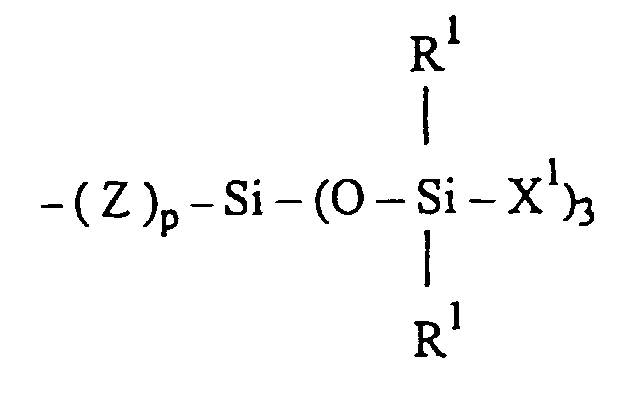
- the carbosiloxane dendrimer structure present in the vinyl-type polymer in the gas-permeable film of this invention preferably is a group with the following general formula.
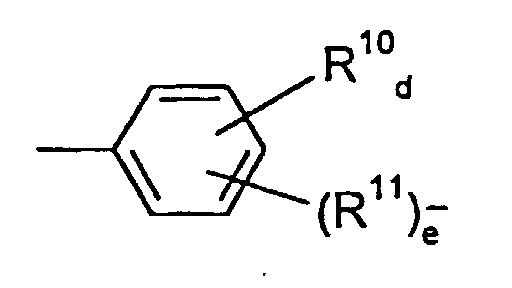
- Z is a divalent organic group, for example, an alkylene group, arylene group, aralkylene group, ester-containing divalent organic group, ether-containing divalent organic group, ketone-containing divalent organic group, or amide-containing divalent organic group, among which organic groups with the following structures are preferred.
- R 9 represents C 1 to C 10 alkylene, for example, methylene, ethylene, propylene, and butylene with methylene and propylene being preferred.
- R 10 represents C 1 to C 10 alkyl, for example, methyl, ethyl, propyl, and butyl with methyl being preferred.
- R 11 represents C 1 to C 10 alkylene, for example, methylene, ethylene, propylene, and butylene with ethylene being preferred.
- the subscript d is an integer from 0 to 4, and the subscript e is 0 or 1.
- R 1 is C 1 to C 10 alkyl or aryl.
- the alkyl encompassed by R 1 is exemplified by methyl, ethyl, propyl, butyl, pentyl, isopropyl, isobutyl, cyclopentyl, and cyclohexyl.
- the aryl encompassed by R 1 is exemplified by phenyl and naphthyl. Methyl and phenyl are preferred for R 1 , and methyl is particularly preferred.
- R 1 is defined as above.
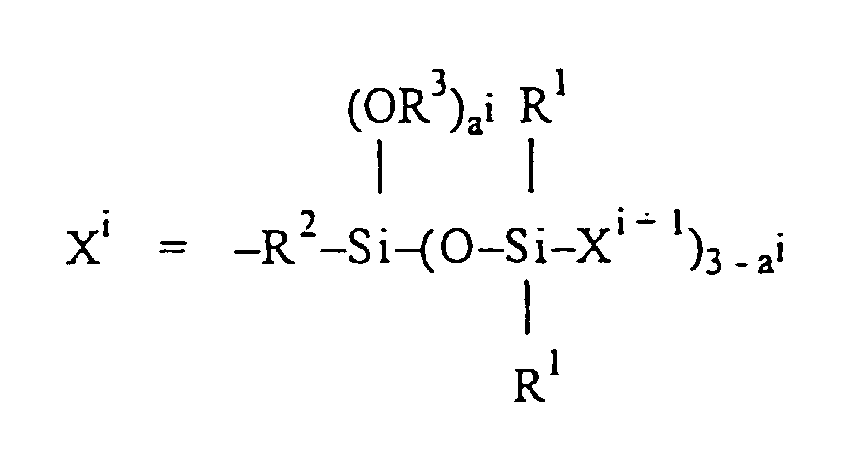
- R 2 represents C 2 to C 10 alkylene and is exemplified by straight-chain alkylene such as ethylene, propylene, butylene, and hexylene, and by branched alkylene such as methylmethylene, methylethylene, 1-methylpentylene, and 1,4-dimethylbutylene. Ethylene, methylethylene, hexylene, 1-methylpentylene, and 1,4-dimethylbutylene are preferred for R 2 .
- R 3 is C 1 to C 10 alkyl and is exemplified by methyl, ethyl, propyl, butyl, and isopropyl.
- X i+1 is selected from the set consisting of the hydrogen atom, C 1 to C 10 alkyl, aryl, and the above-defined silylalkyl group.
- Preferred for use in the gas-permeable film of this invention is a carbosiloxane dendrimer-functional vinyl-type polymer afforded by the polymerization of
- R 1 is C 1 to C 10 alkyl or aryl.
- the alkyl encompassed by R 1 is exemplified by methyl, ethyl, propyl, butyl, pentyl, isopropyl, isobutyl, cyclopentyl, and cyclohexyl.
- the aryl encompassed by R 1 is exemplified by phenyl and naphthyl. Methyl and phenyl are preferred for R 1 , and methyl is particularly preferred.
- R 1 is defined as above;
- R 2 is C 2 to C 10 alkylene;
- R 3 is C 1 to C 10 alkyl, for example, methyl, ethyl, propyl, and butyl;
- X i+1 is selected from the set consisting of the hydrogen atom, C 1 to C 10 alkyl, aryl, and the above-defined silylalkyl group;
- i is an integer with a value from 1 to 10 that specifies the generation of said silylalkyl group; and
- a i is an integer from 0 to 3.
- the vinyl monomer (A) should contain a radically polymerizable vinyl group, but the type and other properties of this monomer are not otherwise critical.
- This vinyl monomer (A) is exemplified by lower alkyl (meth)acrylates such as methyl (meth)acrylate, ethyl (meth)acrylate, n-propyl (meth)acrylate, and isopropyl (meth)acrylate; higher alkyl (meth)acrylates such as n-butyl (meth)acrylate, isobutyl (meth)acrylate, tert-butyl (meth)acrylate, n-hexyl (meth)acrylate, cyclohexyl (meth)acrylate, 2-ethylhexyl (meth)acrylate, octyl (meth)acrylate, lauryl (meth)acrylate, and stearyl (meth)acrylate; the vinyl esters of
- Component (A) is preferably a (meth)acrylate, for which specific examples are alkyl (meth)acrylates such as methyl (meth)acrylate, ethyl (meth)acrylate, n-butyl (meth)acrylate, and 2-ethylhexyl (meth)acrylate; hydroxyalkyl (meth)acrylates such as 2-hydroxyethyl (meth)acrylate, 2-hydroxypropyl (meth)acrylate, and 2-hydroxybutyl (meth)acrylate; fluoroalkyl (meth)acrylates such as trifluoropropyl (meth)acrylate, perfluorobutylethyl (meth)acrylate, and perfluorooctylethyl (meth)acrylate; and epoxy-functional (meth)acrylates such as glycidyl (meth)acrylate and 3,4-epoxycyclohexylmethyl (meth)acrylate.
- multifunctional vinyl monomers exemplified by (meth)acryloyl-functional monomers such as trimethylolpropane tri(meth)acrylate, pentaerythritol tri(meth)acrylate, ethylene glycol di(meth)acrylate, tetraethylene glycol di(meth)acrylate, polyethylene glycol di(meth)acrylate, 1,4-butanediol di(meth)acrylate, 1,6-hexanediol di(meth)acrylate, neopentyl glycol di(meth)acrylate, trimethylolpropane trioxyethyl(meth)acrylate, tris(2-hydroxyethyl)isocyanurate di(meth)acrylate, tris(2-hydroxyethyl)isocyanurate tri(meth)acrylate, the di(meth)acrylates of diols that are the adducts of ethylene oxide or propylene oxide on bisphenol A
- component (A) of a silicone compound containing both a radically polymerizable unsaturated group and a hydrolyzable group can improve the durability of the water repellency of the resulting polymer.
- This radically polymerizable unsaturated group is exemplified by (meth)acryloxy-functional organic groups, (meth)acrylamide-functional organic groups, styryl-functional organic groups, C 2 to C 10 alkenyl, vinyloxy, and allyloxy.
- the hydrolyzable group is exemplified by halogen, alkoxy, and acetoxy.
- This type of component (A) is exemplified by organosilanes such as methacryloxypropyltrimethoxysilane, methacryloxypropylmethyldimethoxysilane, methacryloxypropyldimethylmethoxysilane, acryloxypropyltrimethoxysilane, acryloxypropylmethyldimethoxysilane, acryloxypropyldimethylmethoxysilane, vinyltrimethoxysilane, vinyltriethoxysilane, and vinylbutyldibutoxysilane.
- organosilanes such as methacryloxypropyltrimethoxysilane, methacryloxypropylmethyldimethoxysilane, methacryloxypropyldimethylmethoxysilane, acryloxypropyltrimethoxysilane, vinyltrimethoxysilane, vinyltriethoxysilane, and vinylbutyldibutoxysilane.
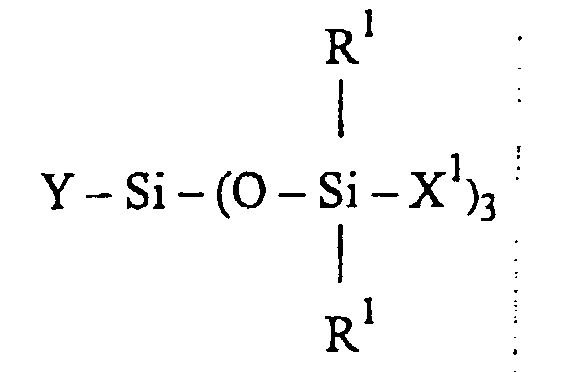
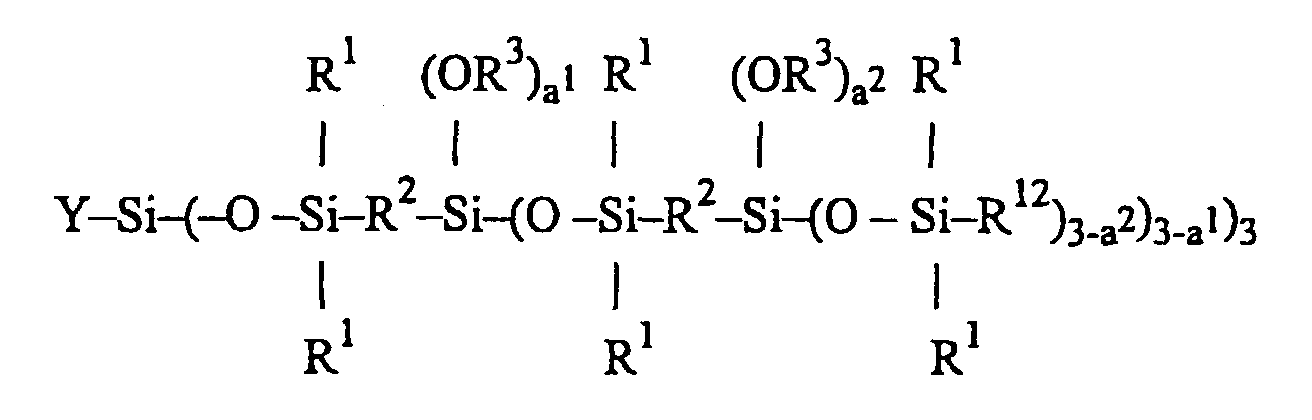
- the carbosiloxane dendrimer (B) has the following general formula.
- Y is a radically polymerizable organic group.
- this will be an organic group capable of undergoing radical-mediated addition, while more specifically this group is exemplified by C 2 to C 10 alkenyl and by the (meth)acryloxy-functional organic groups, (meth)acrylamide-functional organic groups, and styryl-functional organic groups with the following general formulas.
- R 4 and R 6 are hydrogen or methyl;
- R 5 and R 8 are C 1 to C 10 alkylene;
- R 7 is C 1 to C 10 alkyl;
- b is an integer from 0 to 4; and
- c is 0 or 1.
- radically polymerizable organic groups are exemplified by acryloxymethyl, 3-acryloxypropyl, methacryloxymethyl, 3-methacryloxypropyl, 4-vinylphenyl, 3-vinylphenyl, 4-(2-propenyl)phenyl, 3-(2-propenyl)phenyl, 2-(4-vinylphenyl)ethyl, 2-(3-vinylphenyl)ethyl, vinyl, allyl, methallyl, and 5-hexenyl.
- R 1 is C 1 to C 10 alkyl or aryl.
- the alkyl encompassed by R 1 is exemplified by methyl, ethyl, propyl, butyl, pentyl, isopropyl, isobutyl, cyclopentyl, and cyclohexyl.
- the aryl encompassed by R 1 is exemplified by phenyl and naphthyl. Methyl and phenyl are preferred for R 1 , and methyl is particularly preferred.
- R 1 is defined as above.
- R 2 represents C 2 to C 10 alkylene and is exemplified by straight-chain alkylene such as ethylene, propylene, butylene, and hexylene, and by branched alkylene such as methylmethylene, methylethylene, 1-methylpentylene, and 1,4-dimethylbutylene. Ethylene, methylethylene, hexylene, 1-methylpentylene, and 1,4-dimethylbutylene are preferred for R 2 .
- R 3 is C 1 to C 10 alkyl, for example, methyl, ethyl, propyl, butyl, or isopropyl.
- X i+1 is selected from the set consisting of the hydrogen atom, C 1 to C 10 alkyl, aryl, and the above-defined silylalkyl group.
- a i is an integer from 0 to 3.
- i is an integer with a value from 1 to 10 that specifies the generation of said silylalkyl group, i.e., that indicates the number of repetitions of this silylalkyl group.
- the carbosioxane dendrimer (B) has the following general formula when the number of generations is 1: wherein Y, R 1 , R 2 , and R 3 are defined as above; R 12 is the hydrogen atom or is defined as for R 1 ; a 1 is defined as for a i ; and the average of the sum of the a 1 values in each molecule is from 0 to 7.
- the carbosiloxane dendrimer (B) has the following general formula when the number of generations is 2: wherein Y, R 1 , R 2 , R 3 , and R 12 are defined as above; a 1 and a 2 are defined as for a i ; and the average of the sum of the a 1 and a 2 values in each molecule is from 0 to 25.
- the carbosiloxane dendrimer (B) has the following general formula when the number of generations is 3: wherein Y, R 1 , R 2 , R 3 , and R 12 are defined as above; a 1 , a 2 and a 3 are defined as for a i ; and the average of the sum of the a 1 , a 2 , and a 3 values in each molecule is from 0 to 79.
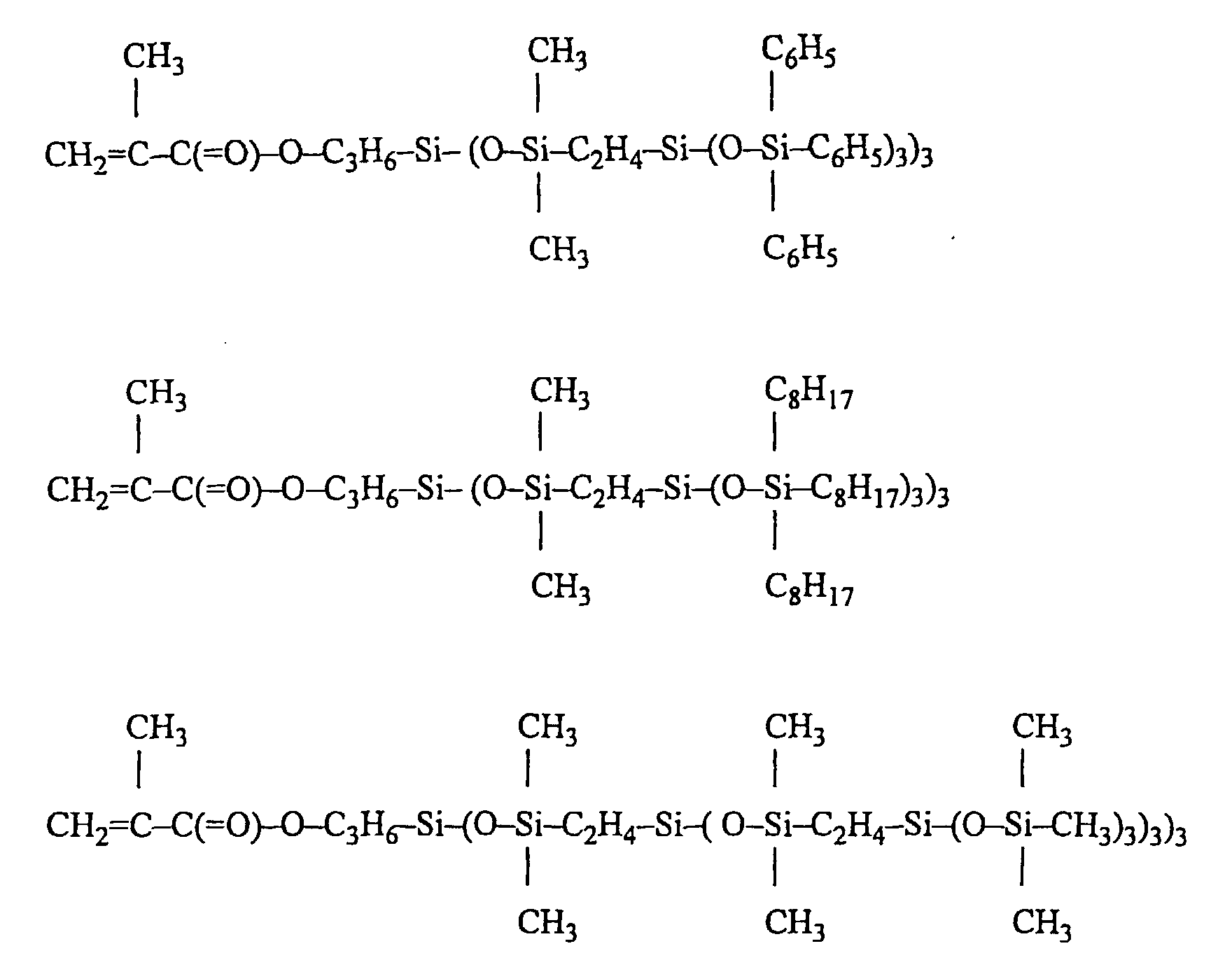
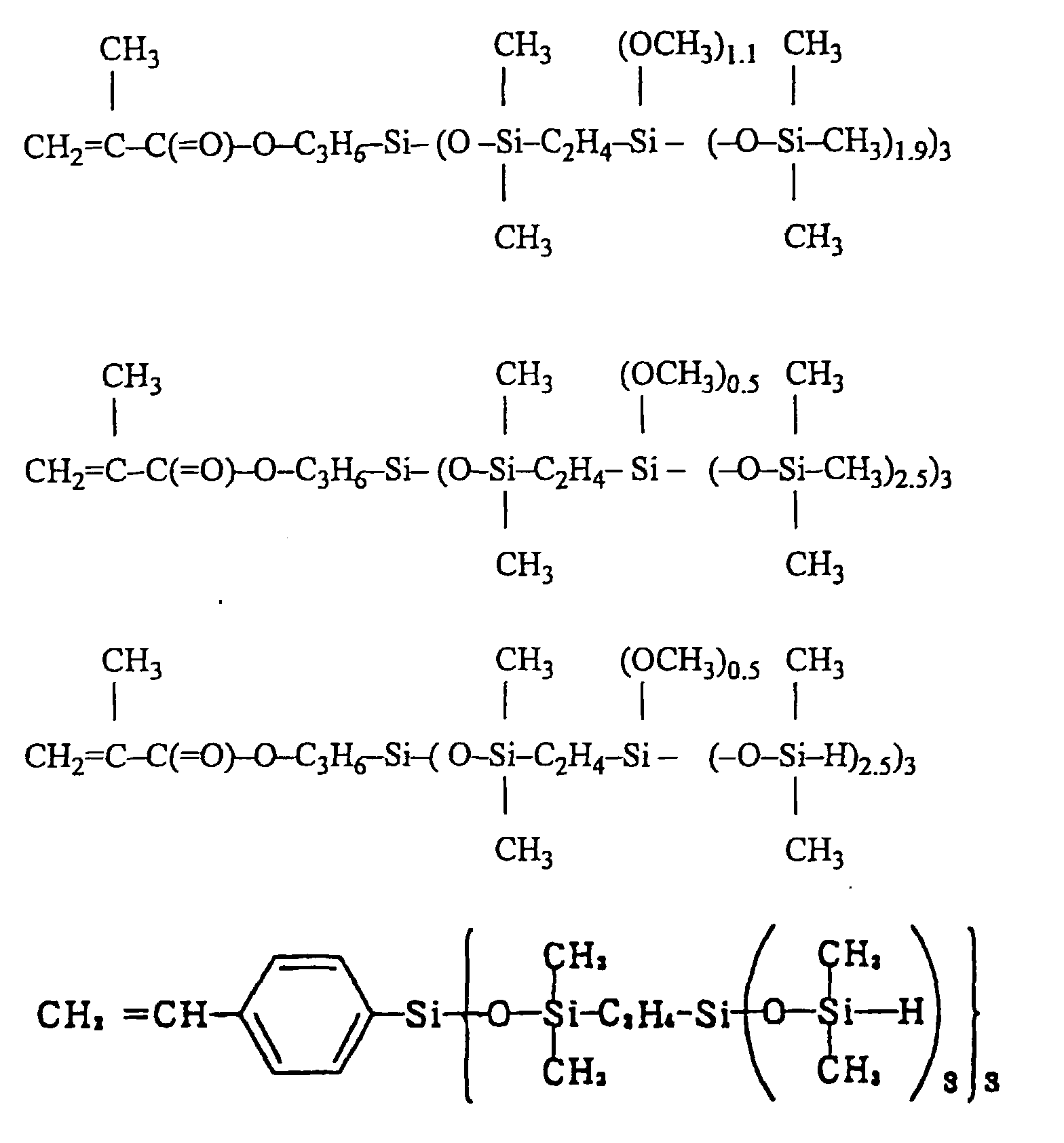
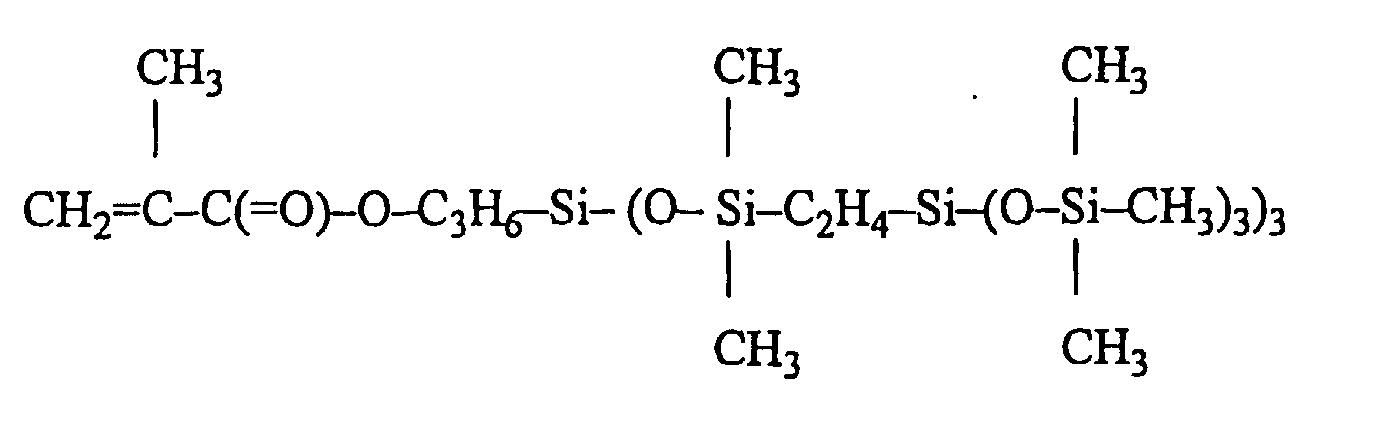
- Carbosiloxane dendrimers with the following average compositional formulas are examples of component (B), i.e., carbosiloxane dendrimer functionalized with a radically polymerizable organic group.
- the carbosiloxane dendrimer described above can be synthesized by the method for synthesizing the branched siloxane-silalkylene copolymer described in Japanese Patent Application Number Hei 9-171154 (1997). This synthesis can be carried out, for example, by running a hydrosilylation reaction between an alkenyl-functional organosilicon compound and an SiH-functional silicon compound with the following general formula in which R 1 and Y are defined as above.
- the silicon compound with this formula is exemplified by 3-methacryloxypropyltris(dimethylsiloxy)silane, 3-acryloxypropyltris(dimethylsiloxy)silane, and 4-vinylphenyltris(dimethylsiloxy)silane.
- the alkenyl-functional organosilicon compound referenced above is exemplified by vinyltris(trimethylsiloxy)silane, vinyltris(dimethylphenylsiloxy)silane, and 5-hexenyltris(trimethylsiloxy)silane.
- This hydrosilylation reaction is preferably run in the presence of a transition metal catalyst, e.g., chloroplatinic acid or a platinum-vinylsiloxane complex.
- the component (A) : component (B) polymerization ratio in the vinyl-type polymer used in this invention should be in the range from 0 : 100 to 99.9 : 0.1 as the component (A) : component (B) weight ratio and is preferably from 1 : 99 to 99 : 1 and more preferably is from 10 : 90 to 80 : 20.
- a component (A) : component (B) ratio of 0 : 100 indicates that the vinyl-type polymer used in this invention is a homopolymer of component (B).
- the vinyl-type polymer used in this invention is afforded by the copolymerization of the components (A) and (B) or by the polymerization of component (B) alone.
- This polymerization can be effected by a radical polymerization mechanism or an ionic polymerization mechanism using solution polymerization, emulsion polymerization, suspension polymerization, or bulk polymerization techniques. Solution polymerization using a radical polymerization mechanism is optimally used.
- This solution polymerization can be run by reacting components (A) and (B) in solvent in the presence of a radical initiator for 3 to 20 hours at a temperature of 50 to 180°C.
- the solvent used for this solution polymerization is exemplified by aliphatic hydrocarbons such as hexane, octane, decane, and cyclohexane; aromatic hydrocarbons such as benzene, toluene, and xylene; ethers such as diethyl ether, dibutyl ether, tetrahydrofuran, and dioxane; ketones such as acetone, methyl ethyl ketone, methyl isobutyl ketone, and diisobutyl ketone; esters such as methyl acetate, ethyl acetate, butyl acetate, and isobutyl acetate; alcohols such as methanol, ethanol, isopropyl alcohol, and but
- radical initiator Those compounds generally known in the art for use in radical polymerization can be used as the radical initiator. These are exemplified by azobis compounds such as 2,2'-azobis(isobutyronitrile), 2,2'-azobis(2-methylbutyronitrile), and 2,2'-azobis(2,4-dimethylvaleronitrile), and by organoperoxides such as benzoyl peroxide, lauroyl peroxide, tert-butyl peroxybenzoate, and tert-butyl peroxy-2-ethylhexanoate.
- This radical initiator can be a single compound or a combination of two or more compounds.
- the radical initiator is preferably used from 0.1 to 5 weight parts for each 100 weight parts of the sum of components (A) and (B).
- a chain transfer agent may also be added to the polymerization.
- This chain transfer agent is exemplified by mercapto compounds such as 2-mercaptoethanol, butyl mercaptan, n-dodecyl mercaptan, 3-mercaptopropyltrimethoxysilane, and mercaptopropyl-functional polydimethylsiloxane, and by halogenated compounds such as methylene chloride, chloroform, carbon tetrachloride, butyl bromide, and 3-chloropropyltrimethoxysilane.
- Production of the vinyl-type polymer of the invention preferably includes a post-polymerization removal of the residual unreacted vinyl monomer by heating under reduced pressure.
- the number-average molecular weight of the vinyl-type polymer used in this invention should generally be from 3,000 to 2,000,000 and is preferably from 5,000 to 1,000,000 and more preferably is from 10,000 to 100,000.
- the number-average molecular weight of the vinyl-type polymer used by this invention can be below 3,000 when this pendant carbosiloxane dendrimer-functional vinyl-type polymer is blended with another organic resin.
- the gas-permeable film of this invention uses the pendant carbosiloxane dendrimer-functional vinyl-type polymer as its base component.
- this film can comprise a resin composition that is a mixture comprising said vinyl-type polymer and an additional thermoplastic resin.
- This additional thermoplastic resin can be any moldable thermoplastic resin, and its type and other properties are not otherwise critical.
- thermoplastic resin is exemplified by the following: polyolefins comprising the homopolymers and copolymers of alpha-olefins such as ethylene, propylene, 1-butene, 1-pentene, 1-hexene, and 4-methyl-1-pentene, e.g., polyethylene, low-density polyethylene, high-density polyethylene, ultrahigh-molecular-weight polyethylene, polypropylene, and ethylene-propylene copolymers; olefin resins that are the copolymers of the above-listed alpha-olefins with non-alpha-olefin monomers such as vinyl acetate, methyl methacrylate, and maleic acid, e.g., ethylene-vinyl acetate copolymers and ethylene/(meth)acrylate ester copolymers; the homopolymers and copolymers of acrylic monomers such as acrylic acid, methacrylic acid, (meth)acrylate esters
- the resin composition comprising the pendant carbosiloxane dendrimer-functional vinyl-type polymer and additional thermoplastic resin preferably contains from 0.01 to 99.9 weight% of the pendant carbosiloxane dendrimer-functional vinyl-type polymer.
- the gas-permeable film of this invention may contain, insofar as the advantageous effects of the invention are not impaired, the various additives known for admixture into films.
- additives are exemplified by fillers such as glass fiber, carbon fiber, thermoplastic resin fiber, graphite, mica, talc, and silica micropowder, by molding aids such as lubricants; by stabilizers such as lightproofing agents, oxidation inhibitors, and UV stabilizers; and by flame retardants, antistatics, colorants such as pigments, surfactants, and antimicrobials.
- the gas-permeable film can be produced by molding a film from the subject pendant carbosiloxane dendrimer-functional vinyl-type polymer ⁇ or from its resin composition with the additional thermoplastic resin ⁇ using the usual molding techniques known for molding films.
- the films encompassed by the present invention include sheet moldings in addition to film moldings.
- the thickness of the films encompassed by this invention will generally be from 1 micrometers to 3 mm and is preferably from 1 micrometer to 200 micrometers.
- the gas-permeable film can be integrated into a single body with a film substrate, for example, nonwoven textiles composed of a thermoplastic resin as described above, piece fabrics, perforated films and sheet moldings, metal meshes, porous ceramic sheets, and paper.
- film substrates can be made into gas-permeable films and gas-permeable sheets by such methods as lamination, impregnation, and integration into a single element by painting.
- the gas-permeable film has an excellent gas permeability as represented by its oxygen permeability and is also water repellent, moldable, heat resistant, and durable. It will, therefore, be useful in those applications where such characteristics are critical, for example, as a film for medical and hygiene applications, e.g., as a base film for feminine hygiene products and diapers, compresses, and adhesive plasters and adhesive bandages; and as a packaging material for oxygen absorbents, odor absorbents, perfumes and fragrances, reagents, and oxygen-reacting warming agents.
- the following examples are given only for illustrative purposes without limiting the scope
- the releasability of the moldings, appearance of the moldings, water repellency, and oxygen permeability were measured by the following procedures.
- the resin was filled into a stainless steel mold designed to produce 1 sheet molding with dimensions of 100 mm ⁇ 100 mm ⁇ 3 mm and was compression molded at 220°C for 10 minutes. After the mold cooled, the sheet molding was manually demolded and the releasability of the sheet molding from the mold during this operation was evaluated on a relative basis by feel.
- the contact angle versus water was measured on the sheet molding using an automatic contact angle instrument from Kyowa Kaimen Kagaku Co., Ltd.
- the oxygen permeability was measured at 23°C, 0% humidity, and a 5% oxygen concentration using the oxygen permeability test described in JIS K-7126.
- the measurement instrumentation was an oxygen permeation tester (Model 10/50 from Modern Controls, Inc.).
- the test sample had a membrane area of 50 cm 2 .
- the measured value P is the oxygen permeation coefficient times 10 10 .
- the unit is cm 3 ⁇ cm/(cm 2 ⁇ sec ⁇ mmHg).
- This resin composition was evaluated as in Example 1, and the results are in Table 1.
- the 35 micrometer-thick vinyl-type resin composition film fabricated in Example 2 was laminated on the printed surface of a polypropylene nonwoven fabric on which text had been printed.
- the back, print-free side was then laminated with a perforated polyethylene sheet to give a packaging material with a three-layer structure.
- This packaging material was folded in half with the printed side on the outside, and an iron-based oxygen scavenger (Hokaron from Lotte Co., Ltd.) was introduced into the interior to serve as the contents. Execution of a seal on the three sides then gave a packet of an iron-based oxygen scavenger.
- This iron-based oxygen scavenger packet was then wrapped in a 500-mL volume with a nylon bag, and the oxygen concentration in the overwrapping bag was measured at 25°C and 100% humidity. Absolutely no exudation or outmigration of the packaged iron-based oxygen scavenger was observed.
- the measurement results are in Table 2. elapsed time: after 24 hours after 48 hours after 72 hours oxygen concentration in % 2.5 0.2 0.1
- a packet was prepared as in Example 3, but in this case using a nylon resin film in place of the film used in Example 3 that had been fabricated from the resin composition containing a pendant carbosiloxane dendrimer-functional vinyl-type polymer.
- the oxygen concentration in the overwrapping bag was similarly measured, and these results are in Table 3. elapsed time: after 24 hours after 48 hours after 72 hours oxygen concentration in % 19 18 17
Landscapes
- Chemical & Material Sciences (AREA)
- Organic Chemistry (AREA)
- Health & Medical Sciences (AREA)
- Chemical Kinetics & Catalysis (AREA)
- Medicinal Chemistry (AREA)
- Polymers & Plastics (AREA)
- Manufacturing & Machinery (AREA)
- Engineering & Computer Science (AREA)
- Materials Engineering (AREA)
- Compositions Of Macromolecular Compounds (AREA)
- Manufacture Of Macromolecular Shaped Articles (AREA)
- Addition Polymer Or Copolymer, Post-Treatments, Or Chemical Modifications (AREA)
- Macromonomer-Based Addition Polymer (AREA)
- Silicon Polymers (AREA)
- Absorbent Articles And Supports Therefor (AREA)
Abstract
Description

and








| releasability | appearance of the molding | water repellency (°) | oxygen permeation coefficient | |
| Example 1 | excellent | excellent | 103 | 3.6 |
| Comp. Ex. 1 | excellent | oil bleed out | 110 | 0.9 |
| Comp. Ex. 2 | poor | excellent | 100 | - |
| elapsed time: | after 24 hours | after 48 hours | after 72 hours |
| oxygen concentration in % | 2.5 | 0.2 | 0.1 |
| elapsed time: | after 24 hours | after 48 hours | after 72 hours |
| oxygen concentration in % | 19 | 18 | 17 |
Claims (15)
- A gas-permeable film comprising:A) a thermoplastic resin, andB) a pendant carbosiloxane dendrimer-functional vinyl-type polymer, wherein the pendant carbosiloxane dendrimer-functional vinyl-type polymer comprises a group having the formulawherein Z is a divalent organic group, p is 0 or 1, R1 is C1 to C10 alkyl or aryl, and X1 is a silylalkyl group with the formula at i = 1
 wherein R1 is defined as above; R2 is C2 to C10 alkylene; R3 is C1 to C10 alkyl; Xi+1 is selected from the group consisting of a hydrogen atom, C1 to C10 alkyl, aryl, and the silylalkyl group; i is an integer with a value from 1 to 10, and a1 is an integer from 0 to 3.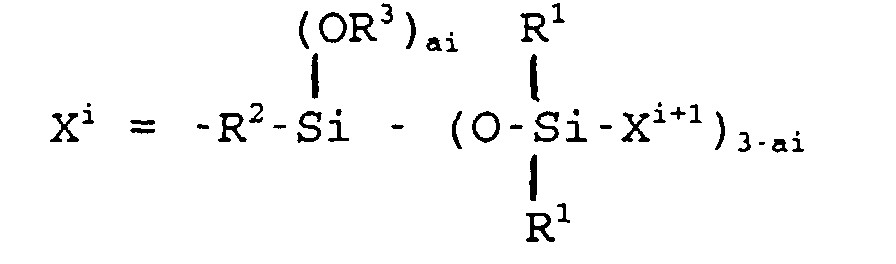
- The gas-permeable film of claim 1, wherein the pendant carboxiloxane dendrimer-functional vinyl-type polymer is prepared by polymerizing a composition comprising: (b) a carbosiloxane dendrimer that comprises a radically polymerizable organic group, said carbosiloxane dendrimer having the general formulawherein Y is a radically polymerizable organic group, and R1, X1, i, and ai are as described above.
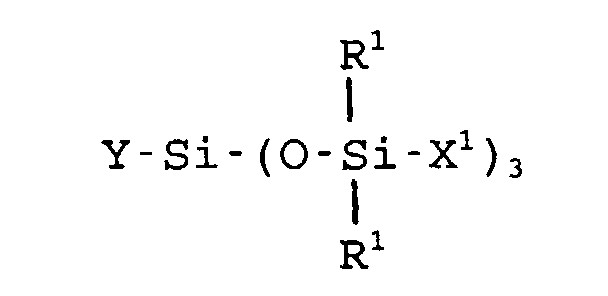
- The gas-permeable film of claim 2, wherein Y is a group selected from the group consisting of:i) acryl- and methacryl-functional organic groups with the general formulasand
 wherein R4 is selected from the group consisting of a hydrogen atom and a methyl group, and R5 is C1 to C10 alkylene;
 ii) a styryl-functional organic group with the general formulawherein R6 is selected from the group consisting of a hydrogen atom and a methyl group, R7 is C1 to C10 alkyl, R8 is C1 to C10 alkylene, b is an integer from 0 to 4, and c is 0 or 1; and
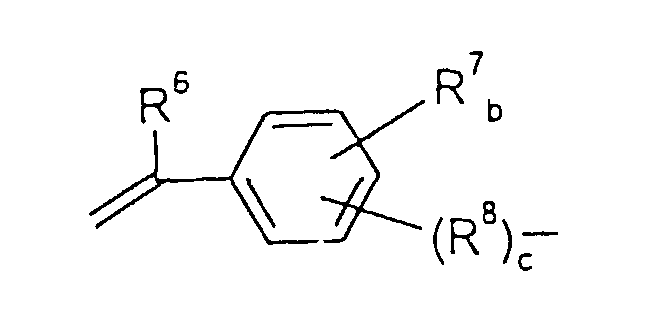 iii) C2 to C10 alkenyl.
 - The gas-permeable film of claims 2-3, wherein the composition further comprisesa) a vinyl monomer comprising a radically polymerizable vinyl group.
- The gas-permeable film of claim 4, wherein the vinyl monomer is selected from the group consisting of lower alkyl(meth)acrylates, higher alkyl(meth)acrylates; vinyl esters of lower aliphatic acids; vinyl esters of higher aliphatic acids; aromatic vinyl monomers; amide-functional vinyl monomers; hydroxyl-functional vinyl monomers; fluorinated vinyl monomers; epoxy-functional vinyl monomers; carboxyl-functional vinyl monomers; ether linkage-containing vinyl monomers; unsaturated group-functionalized silicone compounds; butadiene; vinyl-chloride; vinylidene chlo-ride; (meth)acrylonitrile; dibutyl fumarate; maleic anhydride; dodecylsuccinic anhydride; (meth)acryl glycidyl ether; alkali metal salts, ammonium salts, and organic amine salts of radically polymerizable unsaturated carboxylic acids; radically polymerizable unsaturated monomers that contain a sulfonic acid residue and their alkali metal salts, ammonium salts, and organic amine salts; quaternary ammonium salts that are derived from (meth)acrylic acid; methacrylate esters of alcohols that contain a tertiary amine group and quaternary ammonium salts thereof; multifunctional vinyl monomers; unsaturated group-functional silicone compounds; and a silicone compound comprising both a radically polymerizable unsaturated group and a hydrolyzable group.
- The gas-permeable film of claims 4-5, wherein components a) and b) are present in amounts such that a weight ratio of component a):component b) is 10:90 to 80:20.
- The gas-permeable film of claims 1-6, wherein A) the thermoplastic resin is selected from the group consisting of polyolefins comprising homopolymers and copolymers of alpha-olefins; olefin resins that are copolymers of alpha-olefins with non-alpha-olefin monomers; homopolymers and copolymers of acrylic monomers; acrylic resins afforded by copolymerization of an acrylic monomer with a monomer selected from the group consisting of styrene monomers, vinyl monomers, and maleimide monomers; halogenated vinyl resins; styrene resins; polyamides; polyoxyalkylene resins; polycarbonates; polyvinyl acetates; polysulfones; polyethersulfones; polyarylene sulfides; polyarylates; polyimides; polyamideimides; polyetherimides; polyether-etherketones; liquid-crystal polyesters; fluororesins; thermoplastic elastomers; and mixtures and copolymers that can be prepared from two or more of said thermoplastic resins.
- The gas-permeable film of claims 1-7, wherein component A) is present at 0.01 to 99.9 weight % of the gas-permeable film.
- The gas-permeable film of claims 1-8, further comprising an additive selected from the group consisting of fillers, molding aids, stabilizers, flame retardants, antistatics, colorants, surfactants, and antimicrobials.
- The gas-permeable film of claims 1-9, wherein the gas-permeable film has a thickness of 1 micrometer to 3 millimeters.
- A method for preparing a gas-permeable film of claims 1-10, wherein the method comprises:1) molding a film from a mixture comprisingA) a thermoplastic resin, andB) a pendant carbosiloxane dendrimer-functional vinyl-type polymer B) a pendant carbosiloxane dendrimer-functional vinyl-type polymer, wherein the pendant carbosiloxane dendrimer-functional vinyl-type polymer comprises a group having the formulawherein Z is a divalent organic group, p is 0 or 1, R1 is C1 to C10 alkyl or aryl, and X1 is a silylalkyl group with the formula at i = 1
 wherein R1 is defined as above; R2 is C2 to C10 alkylene; R3 is C1 to C10 alkyl; Xi+1 is selected from the group consisting of a hydrogen atom, C1 to C10 alkyl, aryl, and the silylalkyl group; i is an integer with a value from 1 to 10; and ai is an integer from 0 to 3; and
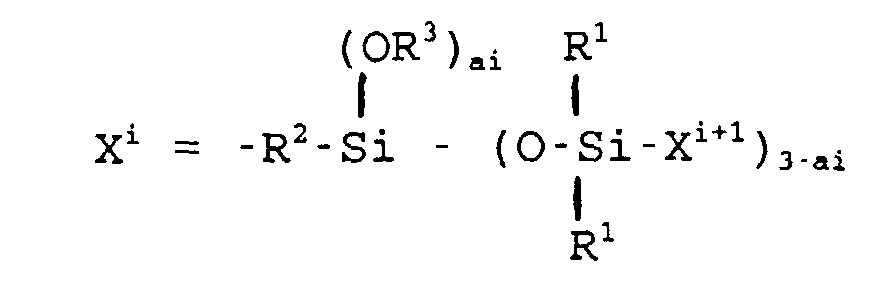 2) demolding the product of step 1).
 - The method of claim 11, wherein molding is carried out by a technique selected from the group consisting of compression molding, extrusion molding, and casting.
- The method of claim 12, wherein compressione molding is carried out byi) filling a mold with the mixtureii) heating the product of step i), and thereafteriii) cooling the product of step ii).
- The method of claims 11-13, wherein the method further comprises integrating the gas-permeable film into a single body with a film substrate, wherein integrating is carried out by a method selected from the group consisting of lamination, impregnation, and integration into a single element by painting.
- The method of claim 14, wherein the substrate is selected from the group consisting of nonwoven textiles comprising a thermoplastic resin, piece fabrics, perforated films, sheet moldings, metal meshes, porous ceramic sheets, and paper.
Applications Claiming Priority (4)
| Application Number | Priority Date | Filing Date | Title |
|---|---|---|---|
| JP36320898 | 1998-12-21 | ||
| JP36320898 | 1998-12-21 | ||
| JP00834099A JP4148582B2 (en) | 1998-12-21 | 1999-01-14 | Gas permeable film |
| JP834099 | 1999-01-14 |
Publications (2)
| Publication Number | Publication Date |
|---|---|
| EP1013702A2 true EP1013702A2 (en) | 2000-06-28 |
| EP1013702A3 EP1013702A3 (en) | 2001-01-31 |
Family
ID=26342837
Family Applications (1)
| Application Number | Title | Priority Date | Filing Date |
|---|---|---|---|
| EP99123669A Withdrawn EP1013702A3 (en) | 1998-12-21 | 1999-11-29 | Gas-permeable film |
Country Status (3)
| Country | Link |
|---|---|
| EP (1) | EP1013702A3 (en) |
| JP (1) | JP4148582B2 (en) |
| CA (1) | CA2291212A1 (en) |
Cited By (4)
| Publication number | Priority date | Publication date | Assignee | Title |
|---|---|---|---|---|
| WO2001074946A1 (en) * | 2000-03-30 | 2001-10-11 | General Electric Company | Use of dendrimers as a processing aid and surface modifier for thermoplastic resins |
| WO2008140123A1 (en) | 2007-05-14 | 2008-11-20 | Sumitomo Chemical Company, Limited | Process for producing porous film |
| EP2098357A4 (en) * | 2006-12-28 | 2010-03-10 | Mgc Filsheet Co Ltd | POLYMER FILM |
| EP2104548B1 (en) * | 2006-12-23 | 2017-03-29 | Evonik Degussa GmbH | Gas separation membranes |
Family Cites Families (2)
| Publication number | Priority date | Publication date | Assignee | Title |
|---|---|---|---|---|
| JPH0258570A (en) * | 1988-08-23 | 1990-02-27 | Dainippon Printing Co Ltd | Packaging materials for oxygen absorbers |
| JP3950197B2 (en) * | 1997-06-12 | 2007-07-25 | 東レ・ダウコーニング株式会社 | Method for producing silicone-containing organic polymer |
-
1999
- 1999-01-14 JP JP00834099A patent/JP4148582B2/en not_active Expired - Fee Related
- 1999-11-29 CA CA 2291212 patent/CA2291212A1/en not_active Abandoned
- 1999-11-29 EP EP99123669A patent/EP1013702A3/en not_active Withdrawn
Cited By (8)
| Publication number | Priority date | Publication date | Assignee | Title |
|---|---|---|---|---|
| WO2001074946A1 (en) * | 2000-03-30 | 2001-10-11 | General Electric Company | Use of dendrimers as a processing aid and surface modifier for thermoplastic resins |
| US6497959B1 (en) | 2000-03-30 | 2002-12-24 | General Electric Company | Use of dendrimers as a processing aid and surface modifier for thermoplastic resins |
| US6663966B2 (en) | 2000-03-30 | 2003-12-16 | General Electric Company | Use of dendrimers as a processing aid and surface modifiers for thermoplastic resins |
| EP2104548B1 (en) * | 2006-12-23 | 2017-03-29 | Evonik Degussa GmbH | Gas separation membranes |
| EP2098357A4 (en) * | 2006-12-28 | 2010-03-10 | Mgc Filsheet Co Ltd | POLYMER FILM |
| US8790766B2 (en) | 2006-12-28 | 2014-07-29 | Mgc Filsheet Co., Ltd. | Polymer film |
| WO2008140123A1 (en) | 2007-05-14 | 2008-11-20 | Sumitomo Chemical Company, Limited | Process for producing porous film |
| EP2157123A4 (en) * | 2007-05-14 | 2011-08-31 | Sumitomo Chemical Co | METHOD FOR MANUFACTURING POROUS FILM |
Also Published As
| Publication number | Publication date |
|---|---|
| CA2291212A1 (en) | 2000-05-30 |
| JP4148582B2 (en) | 2008-09-10 |
| JP2000239413A (en) | 2000-09-05 |
| EP1013702A3 (en) | 2001-01-31 |
Similar Documents
| Publication | Publication Date | Title |
|---|---|---|
| CA1267240A (en) | Polymer and cured product of the same | |
| US6291021B1 (en) | Coating material | |
| SE443667B (en) | CONTACT LENS MANUFACTURED FROM POLYMERS OF POLYSILOXAN AND POLYCYCLIC ESTERS OF ACRYLIC ACID AND METACRYLIC ACID | |
| EP0190505B1 (en) | Hydrophilic silicone-organic copolymer elastomers | |
| US4525528A (en) | Peroxide-curable fluorosilicone copolymer compositions | |
| JP4757991B2 (en) | Silicone graft vinyl copolymer emulsion composition | |
| KR102390078B1 (en) | Hydrophilic silicone composition | |
| JPH09508665A (en) | Reinforcing composition and lens body prepared therefrom | |
| SE443665B (en) | POLYSILOXAN CONTACT LENSES | |
| EP0798342A2 (en) | Curable organosiloxane composition with improved hysteresis characteristics | |
| CA2291212A1 (en) | Gas-permeable film | |
| EP0458617A2 (en) | Silicone rubber composition | |
| JPH05247432A (en) | Adhesive composition | |
| CN115298282A (en) | Silicone composition for release sheet and release sheet | |
| CN111148795B (en) | Photo radical curing of silicones | |
| JPS6213447A (en) | Oil-resistant rubber composition | |
| JP4136117B2 (en) | Thermoplastic resin composition | |
| WO2000034392A1 (en) | Flame retardant for thermoplastic resin and flame-retardant resin composition | |
| KR20000047796A (en) | Gas-permeable film | |
| EP0678542A1 (en) | Photocurable silicone composition | |
| JP4281853B2 (en) | Ophthalmic lens material | |
| KR20100002845A (en) | Siloxan compound for silicon hydrogel lens | |
| JP6864651B2 (en) | Silicone rubber composition and silicone rubber parts | |
| JP7667889B1 (en) | Vinyl chloride-silicone graft copolymer and its manufacturing method | |
| JP3188620B2 (en) | Foamable silicone rubber composition |
Legal Events
| Date | Code | Title | Description |
|---|---|---|---|
| PUAI | Public reference made under article 153(3) epc to a published international application that has entered the european phase |
Free format text: ORIGINAL CODE: 0009012 |
|
| AK | Designated contracting states |
Kind code of ref document: A2 Designated state(s): DE FR GB IT NL |
|
| AX | Request for extension of the european patent |
Free format text: AL;LT;LV;MK;RO;SI |
|
| PUAL | Search report despatched |
Free format text: ORIGINAL CODE: 0009013 |
|
| AK | Designated contracting states |
Kind code of ref document: A3 Designated state(s): AT BE CH CY DE DK ES FI FR GB GR IE IT LI LU MC NL PT SE |
|
| AX | Request for extension of the european patent |
Free format text: AL;LT;LV;MK;RO;SI |
|
| RIC1 | Information provided on ipc code assigned before grant |
Free format text: 7C 08J 5/18 A, 7C 08F 299/08 B, 7C 08L 101/00 B, 7C 08L 101/00 J, 7C 08L 83:10 J |
|
| AKX | Designation fees paid |
Free format text: DE FR GB IT NL |
|
| STAA | Information on the status of an ep patent application or granted ep patent |
Free format text: STATUS: THE APPLICATION IS DEEMED TO BE WITHDRAWN |
|
| 18D | Application deemed to be withdrawn |
Effective date: 20010901 |