EP1013719A1 - Verfahren zum Trichromie-Färben oder Bedrucken - Google Patents
Verfahren zum Trichromie-Färben oder Bedrucken Download PDFInfo
- Publication number
- EP1013719A1 EP1013719A1 EP98124535A EP98124535A EP1013719A1 EP 1013719 A1 EP1013719 A1 EP 1013719A1 EP 98124535 A EP98124535 A EP 98124535A EP 98124535 A EP98124535 A EP 98124535A EP 1013719 A1 EP1013719 A1 EP 1013719A1
- Authority
- EP
- European Patent Office
- Prior art keywords
- alkyl
- alkoxy
- formula
- dye
- hydrogen
- Prior art date
- Legal status (The legal status is an assumption and is not a legal conclusion. Google has not performed a legal analysis and makes no representation as to the accuracy of the status listed.)
- Withdrawn
Links
- 238000000034 method Methods 0.000 title claims description 29
- 238000004043 dyeing Methods 0.000 title claims description 19
- 239000000975 dye Substances 0.000 claims abstract description 87
- 229910052739 hydrogen Inorganic materials 0.000 claims abstract description 46
- 239000001257 hydrogen Substances 0.000 claims abstract description 46
- 229910052736 halogen Inorganic materials 0.000 claims abstract description 29
- 150000002367 halogens Chemical class 0.000 claims abstract description 29
- 125000001997 phenyl group Chemical group [H]C1=C([H])C([H])=C(*)C([H])=C1[H] 0.000 claims abstract description 25
- 125000000113 cyclohexyl group Chemical group [H]C1([H])C([H])([H])C([H])([H])C([H])(*)C([H])([H])C1([H])[H] 0.000 claims abstract description 14
- 239000000203 mixture Substances 0.000 claims abstract description 14
- 125000000217 alkyl group Chemical group 0.000 claims abstract description 13
- 125000002785 azepinyl group Chemical group 0.000 claims abstract description 9
- 125000000951 phenoxy group Chemical group [H]C1=C([H])C([H])=C(O*)C([H])=C1[H] 0.000 claims abstract description 6
- 125000002496 methyl group Chemical group [H]C([H])([H])* 0.000 claims description 48
- UFHFLCQGNIYNRP-UHFFFAOYSA-N Hydrogen Chemical compound [H][H] UFHFLCQGNIYNRP-UHFFFAOYSA-N 0.000 claims description 40
- 238000004040 coloring Methods 0.000 claims description 26
- 125000001495 ethyl group Chemical group [H]C([H])([H])C([H])([H])* 0.000 claims description 26
- 150000002431 hydrogen Chemical class 0.000 claims description 17
- 125000002887 hydroxy group Chemical group [H]O* 0.000 claims description 17
- 125000002924 primary amino group Chemical group [H]N([H])* 0.000 claims description 14
- XEEYBQQBJWHFJM-UHFFFAOYSA-N Iron Chemical compound [Fe] XEEYBQQBJWHFJM-UHFFFAOYSA-N 0.000 claims description 11
- PXBRQCKWGAHEHS-UHFFFAOYSA-N dichlorodifluoromethane Chemical compound FC(F)(Cl)Cl PXBRQCKWGAHEHS-UHFFFAOYSA-N 0.000 claims description 11
- 239000004952 Polyamide Substances 0.000 claims description 10
- 229920002647 polyamide Polymers 0.000 claims description 10
- 229910052757 nitrogen Inorganic materials 0.000 claims description 8
- 125000004433 nitrogen atom Chemical group N* 0.000 claims description 8
- 239000002657 fibrous material Substances 0.000 claims description 7
- 125000001951 carbamoylamino group Chemical group C(N)(=O)N* 0.000 claims description 6
- UUEVFMOUBSLVJW-UHFFFAOYSA-N oxo-[[1-[2-[2-[2-[4-(oxoazaniumylmethylidene)pyridin-1-yl]ethoxy]ethoxy]ethyl]pyridin-4-ylidene]methyl]azanium;dibromide Chemical compound [Br-].[Br-].C1=CC(=C[NH+]=O)C=CN1CCOCCOCCN1C=CC(=C[NH+]=O)C=C1 UUEVFMOUBSLVJW-UHFFFAOYSA-N 0.000 claims description 4
- 210000002268 wool Anatomy 0.000 claims description 3
- 239000003086 colorant Substances 0.000 claims 1
- -1 (2-trifluoromethyl-phenylazo)-8-hydroxy-naphthalene-6-sulfonic acid Chemical compound 0.000 abstract description 7
- 125000001424 substituent group Chemical group 0.000 abstract description 7
- 239000000980 acid dye Substances 0.000 abstract 4
- UHOVQNZJYSORNB-UHFFFAOYSA-N benzene Substances C1=CC=CC=C1 UHOVQNZJYSORNB-UHFFFAOYSA-N 0.000 abstract 2
- OKTJSMMVPCPJKN-UHFFFAOYSA-N Carbon Chemical compound [C] OKTJSMMVPCPJKN-UHFFFAOYSA-N 0.000 abstract 1
- 125000005236 alkanoylamino group Chemical group 0.000 abstract 1
- 125000003545 alkoxy group Chemical group 0.000 abstract 1
- 229910052799 carbon Inorganic materials 0.000 abstract 1
- 125000004435 hydrogen atom Chemical group [H]* 0.000 abstract 1
- 125000002023 trifluoromethyl group Chemical group FC(F)(F)* 0.000 abstract 1
- 125000004178 (C1-C4) alkyl group Chemical group 0.000 description 13
- 150000001875 compounds Chemical class 0.000 description 13
- 125000000229 (C1-C4)alkoxy group Chemical group 0.000 description 11
- 125000000956 methoxy group Chemical group [H]C([H])([H])O* 0.000 description 11
- 125000001301 ethoxy group Chemical group [H]C([H])([H])C([H])([H])O* 0.000 description 10
- XLYOFNOQVPJJNP-UHFFFAOYSA-N water Substances O XLYOFNOQVPJJNP-UHFFFAOYSA-N 0.000 description 9
- ZAMOUSCENKQFHK-UHFFFAOYSA-N Chlorine atom Chemical compound [Cl] ZAMOUSCENKQFHK-UHFFFAOYSA-N 0.000 description 7
- 229910052801 chlorine Inorganic materials 0.000 description 7
- 239000000460 chlorine Substances 0.000 description 7
- OKKJLVBELUTLKV-UHFFFAOYSA-N Methanol Chemical compound OC OKKJLVBELUTLKV-UHFFFAOYSA-N 0.000 description 6
- 239000002253 acid Substances 0.000 description 6
- 239000000463 material Substances 0.000 description 6
- WKBOTKDWSSQWDR-UHFFFAOYSA-N Bromine atom Chemical compound [Br] WKBOTKDWSSQWDR-UHFFFAOYSA-N 0.000 description 5
- GDTBXPJZTBHREO-UHFFFAOYSA-N bromine Substances BrBr GDTBXPJZTBHREO-UHFFFAOYSA-N 0.000 description 5
- 229910052794 bromium Inorganic materials 0.000 description 5
- 150000003839 salts Chemical class 0.000 description 5
- NAWXUBYGYWOOIX-SFHVURJKSA-N (2s)-2-[[4-[2-(2,4-diaminoquinazolin-6-yl)ethyl]benzoyl]amino]-4-methylidenepentanedioic acid Chemical compound C1=CC2=NC(N)=NC(N)=C2C=C1CCC1=CC=C(C(=O)N[C@@H](CC(=C)C(O)=O)C(O)=O)C=C1 NAWXUBYGYWOOIX-SFHVURJKSA-N 0.000 description 4
- 0 *c(cc1)cc(C(F)(F)F)c1N=Nc(c(c(cc1)cc(S(O)(=O)=O)c2)c2O)c1N Chemical compound *c(cc1)cc(C(F)(F)F)c1N=Nc(c(c(cc1)cc(S(O)(=O)=O)c2)c2O)c1N 0.000 description 4
- VEXZGXHMUGYJMC-UHFFFAOYSA-N Hydrochloric acid Chemical compound Cl VEXZGXHMUGYJMC-UHFFFAOYSA-N 0.000 description 4
- JUJWROOIHBZHMG-UHFFFAOYSA-N Pyridine Chemical compound C1=CC=NC=C1 JUJWROOIHBZHMG-UHFFFAOYSA-N 0.000 description 4
- 239000000654 additive Substances 0.000 description 4
- 230000008878 coupling Effects 0.000 description 4
- 238000010168 coupling process Methods 0.000 description 4
- 238000005859 coupling reaction Methods 0.000 description 4
- LPXPTNMVRIOKMN-UHFFFAOYSA-M sodium nitrite Chemical compound [Na+].[O-]N=O LPXPTNMVRIOKMN-UHFFFAOYSA-M 0.000 description 4
- 239000000243 solution Substances 0.000 description 4
- 239000000725 suspension Substances 0.000 description 4
- WFDIJRYMOXRFFG-UHFFFAOYSA-N Acetic anhydride Chemical compound CC(=O)OC(C)=O WFDIJRYMOXRFFG-UHFFFAOYSA-N 0.000 description 3
- ZMXDDKWLCZADIW-UHFFFAOYSA-N N,N-Dimethylformamide Chemical compound CN(C)C=O ZMXDDKWLCZADIW-UHFFFAOYSA-N 0.000 description 3
- HEMHJVSKTPXQMS-UHFFFAOYSA-M Sodium hydroxide Chemical compound [OH-].[Na+] HEMHJVSKTPXQMS-UHFFFAOYSA-M 0.000 description 3
- 125000000484 butyl group Chemical group [H]C([*])([H])C([H])([H])C([H])([H])C([H])([H])[H] 0.000 description 3
- 125000000959 isobutyl group Chemical group [H]C([H])([H])C([H])(C([H])([H])[H])C([H])([H])* 0.000 description 3
- 125000001449 isopropyl group Chemical group [H]C([H])([H])C([H])(*)C([H])([H])[H] 0.000 description 3
- RZWZRACFZGVKFM-UHFFFAOYSA-N propanoyl chloride Chemical compound CCC(Cl)=O RZWZRACFZGVKFM-UHFFFAOYSA-N 0.000 description 3
- 125000001436 propyl group Chemical group [H]C([*])([H])C([H])([H])C([H])([H])[H] 0.000 description 3
- 125000002914 sec-butyl group Chemical group [H]C([H])([H])C([H])([H])C([H])(*)C([H])([H])[H] 0.000 description 3
- 125000000999 tert-butyl group Chemical group [H]C([H])([H])C(*)(C([H])([H])[H])C([H])([H])[H] 0.000 description 3
- 125000004169 (C1-C6) alkyl group Chemical group 0.000 description 2
- VOWZNBNDMFLQGM-UHFFFAOYSA-N 2,5-dimethylaniline Chemical compound CC1=CC=C(C)C(N)=C1 VOWZNBNDMFLQGM-UHFFFAOYSA-N 0.000 description 2
- IAZDPXIOMUYVGZ-UHFFFAOYSA-N Dimethylsulphoxide Chemical compound CS(C)=O IAZDPXIOMUYVGZ-UHFFFAOYSA-N 0.000 description 2
- 125000000738 acetamido group Chemical group [H]C([H])([H])C(=O)N([H])[*] 0.000 description 2
- 150000001412 amines Chemical class 0.000 description 2
- 150000003863 ammonium salts Chemical class 0.000 description 2
- 239000012267 brine Substances 0.000 description 2
- 239000003795 chemical substances by application Substances 0.000 description 2
- 239000004744 fabric Substances 0.000 description 2
- 125000002510 isobutoxy group Chemical group [H]C([H])([H])C([H])(C([H])([H])[H])C([H])([H])O* 0.000 description 2
- UMJSCPRVCHMLSP-UHFFFAOYSA-N pyridine Natural products COC1=CC=CN=C1 UMJSCPRVCHMLSP-UHFFFAOYSA-N 0.000 description 2
- 239000011541 reaction mixture Substances 0.000 description 2
- 235000010288 sodium nitrite Nutrition 0.000 description 2
- HPALAKNZSZLMCH-UHFFFAOYSA-M sodium;chloride;hydrate Chemical compound O.[Na+].[Cl-] HPALAKNZSZLMCH-UHFFFAOYSA-M 0.000 description 2
- 239000004753 textile Substances 0.000 description 2
- RNFJDJUURJAICM-UHFFFAOYSA-N 2,2,4,4,6,6-hexaphenoxy-1,3,5-triaza-2$l^{5},4$l^{5},6$l^{5}-triphosphacyclohexa-1,3,5-triene Chemical compound N=1P(OC=2C=CC=CC=2)(OC=2C=CC=CC=2)=NP(OC=2C=CC=CC=2)(OC=2C=CC=CC=2)=NP=1(OC=1C=CC=CC=1)OC1=CC=CC=C1 RNFJDJUURJAICM-UHFFFAOYSA-N 0.000 description 1
- NGNBDVOYPDDBFK-UHFFFAOYSA-N 2-[2,4-di(pentan-2-yl)phenoxy]acetyl chloride Chemical compound CCCC(C)C1=CC=C(OCC(Cl)=O)C(C(C)CCC)=C1 NGNBDVOYPDDBFK-UHFFFAOYSA-N 0.000 description 1
- JJKWHOSQTYYFAE-UHFFFAOYSA-N 2-methoxyacetyl chloride Chemical compound COCC(Cl)=O JJKWHOSQTYYFAE-UHFFFAOYSA-N 0.000 description 1
- PPVRMPPLECDING-UHFFFAOYSA-N 4-[(4-aminophenyl)diazenyl]benzenesulfonic acid Chemical compound C1=CC(N)=CC=C1N=NC1=CC=C(S(O)(=O)=O)C=C1 PPVRMPPLECDING-UHFFFAOYSA-N 0.000 description 1
- LSNNMFCWUKXFEE-UHFFFAOYSA-M Bisulfite Chemical compound OS([O-])=O LSNNMFCWUKXFEE-UHFFFAOYSA-M 0.000 description 1
- 229920001353 Dextrin Polymers 0.000 description 1
- 239000004375 Dextrin Substances 0.000 description 1
- IAYPIBMASNFSPL-UHFFFAOYSA-N Ethylene oxide Chemical compound C1CO1 IAYPIBMASNFSPL-UHFFFAOYSA-N 0.000 description 1
- PXGOKWXKJXAPGV-UHFFFAOYSA-N Fluorine Chemical compound FF PXGOKWXKJXAPGV-UHFFFAOYSA-N 0.000 description 1
- DGAQECJNVWCQMB-PUAWFVPOSA-M Ilexoside XXIX Chemical compound C[C@@H]1CC[C@@]2(CC[C@@]3(C(=CC[C@H]4[C@]3(CC[C@@H]5[C@@]4(CC[C@@H](C5(C)C)OS(=O)(=O)[O-])C)C)[C@@H]2[C@]1(C)O)C)C(=O)O[C@H]6[C@@H]([C@H]([C@@H]([C@H](O6)CO)O)O)O.[Na+] DGAQECJNVWCQMB-PUAWFVPOSA-M 0.000 description 1
- WHXSMMKQMYFTQS-UHFFFAOYSA-N Lithium Chemical compound [Li] WHXSMMKQMYFTQS-UHFFFAOYSA-N 0.000 description 1
- IOVCWXUNBOPUCH-UHFFFAOYSA-M Nitrite anion Chemical compound [O-]N=O IOVCWXUNBOPUCH-UHFFFAOYSA-M 0.000 description 1
- 229920002292 Nylon 6 Polymers 0.000 description 1
- ZLMJMSJWJFRBEC-UHFFFAOYSA-N Potassium Chemical compound [K] ZLMJMSJWJFRBEC-UHFFFAOYSA-N 0.000 description 1
- GSEJCLTVZPLZKY-UHFFFAOYSA-N Triethanolamine Chemical compound OCCN(CCO)CCO GSEJCLTVZPLZKY-UHFFFAOYSA-N 0.000 description 1
- WETWJCDKMRHUPV-UHFFFAOYSA-N acetyl chloride Chemical compound CC(Cl)=O WETWJCDKMRHUPV-UHFFFAOYSA-N 0.000 description 1
- 239000012346 acetyl chloride Substances 0.000 description 1
- 125000002777 acetyl group Chemical group [H]C([H])([H])C(*)=O 0.000 description 1
- 230000002378 acidificating effect Effects 0.000 description 1
- 230000000996 additive effect Effects 0.000 description 1
- 235000010443 alginic acid Nutrition 0.000 description 1
- 229920000615 alginic acid Polymers 0.000 description 1
- 239000003513 alkali Substances 0.000 description 1
- 229910052783 alkali metal Inorganic materials 0.000 description 1
- 125000003277 amino group Chemical group 0.000 description 1
- 239000002518 antifoaming agent Substances 0.000 description 1
- 239000000010 aprotic solvent Substances 0.000 description 1
- 125000000751 azo group Chemical group [*]N=N[*] 0.000 description 1
- 230000008033 biological extinction Effects 0.000 description 1
- 229920003086 cellulose ether Polymers 0.000 description 1
- 239000007795 chemical reaction product Substances 0.000 description 1
- 150000001805 chlorine compounds Chemical class 0.000 description 1
- 239000007859 condensation product Substances 0.000 description 1
- 238000010014 continuous dyeing Methods 0.000 description 1
- 238000010411 cooking Methods 0.000 description 1
- 235000019425 dextrin Nutrition 0.000 description 1
- 125000000664 diazo group Chemical group [N-]=[N+]=[*] 0.000 description 1
- ZBCBWPMODOFKDW-UHFFFAOYSA-N diethanolamine Chemical compound OCCNCCO ZBCBWPMODOFKDW-UHFFFAOYSA-N 0.000 description 1
- BNIILDVGGAEEIG-UHFFFAOYSA-L disodium hydrogen phosphate Chemical compound [Na+].[Na+].OP([O-])([O-])=O BNIILDVGGAEEIG-UHFFFAOYSA-L 0.000 description 1
- RIFGWPKJUGCATF-UHFFFAOYSA-N ethyl chloroformate Chemical compound CCOC(Cl)=O RIFGWPKJUGCATF-UHFFFAOYSA-N 0.000 description 1
- 239000000835 fiber Substances 0.000 description 1
- 239000003063 flame retardant Substances 0.000 description 1
- 229910052731 fluorine Inorganic materials 0.000 description 1
- 239000011737 fluorine Substances 0.000 description 1
- 239000006260 foam Substances 0.000 description 1
- 125000004051 hexyl group Chemical group [H]C([H])([H])C([H])([H])C([H])([H])C([H])([H])C([H])([H])C([H])([H])* 0.000 description 1
- 229910052500 inorganic mineral Inorganic materials 0.000 description 1
- PNDPGZBMCMUPRI-UHFFFAOYSA-N iodine Chemical compound II PNDPGZBMCMUPRI-UHFFFAOYSA-N 0.000 description 1
- 229910052744 lithium Inorganic materials 0.000 description 1
- 239000011707 mineral Substances 0.000 description 1
- 229910000403 monosodium phosphate Inorganic materials 0.000 description 1
- 235000019799 monosodium phosphate Nutrition 0.000 description 1
- 230000007935 neutral effect Effects 0.000 description 1
- 239000001048 orange dye Substances 0.000 description 1
- 125000001147 pentyl group Chemical group C(CCCC)* 0.000 description 1
- 239000004014 plasticizer Substances 0.000 description 1
- 229910052700 potassium Inorganic materials 0.000 description 1
- 239000011591 potassium Substances 0.000 description 1
- WYVAMUWZEOHJOQ-UHFFFAOYSA-N propionic anhydride Chemical compound CCC(=O)OC(=O)CC WYVAMUWZEOHJOQ-UHFFFAOYSA-N 0.000 description 1
- 125000001501 propionyl group Chemical group O=C([*])C([H])([H])C([H])([H])[H] 0.000 description 1
- 150000003254 radicals Chemical group 0.000 description 1
- 230000035484 reaction time Effects 0.000 description 1
- 230000000630 rising effect Effects 0.000 description 1
- 229910052708 sodium Inorganic materials 0.000 description 1
- 239000011734 sodium Substances 0.000 description 1
- AJPJDKMHJJGVTQ-UHFFFAOYSA-M sodium dihydrogen phosphate Chemical compound [Na+].OP(O)([O-])=O AJPJDKMHJJGVTQ-UHFFFAOYSA-M 0.000 description 1
- 238000001228 spectrum Methods 0.000 description 1
- 125000000020 sulfo group Chemical group O=S(=O)([*])O[H] 0.000 description 1
- 239000002562 thickening agent Substances 0.000 description 1
- 239000000080 wetting agent Substances 0.000 description 1
- 239000001043 yellow dye Substances 0.000 description 1
Classifications
-
- D—TEXTILES; PAPER
- D06—TREATMENT OF TEXTILES OR THE LIKE; LAUNDERING; FLEXIBLE MATERIALS NOT OTHERWISE PROVIDED FOR
- D06P—DYEING OR PRINTING TEXTILES; DYEING LEATHER, FURS OR SOLID MACROMOLECULAR SUBSTANCES IN ANY FORM
- D06P1/00—General processes of dyeing or printing textiles, or general processes of dyeing leather, furs, or solid macromolecular substances in any form, classified according to the dyes, pigments, or auxiliary substances employed
- D06P1/39—General processes of dyeing or printing textiles, or general processes of dyeing leather, furs, or solid macromolecular substances in any form, classified according to the dyes, pigments, or auxiliary substances employed using acid dyes
-
- C—CHEMISTRY; METALLURGY
- C09—DYES; PAINTS; POLISHES; NATURAL RESINS; ADHESIVES; COMPOSITIONS NOT OTHERWISE PROVIDED FOR; APPLICATIONS OF MATERIALS NOT OTHERWISE PROVIDED FOR
- C09B—ORGANIC DYES OR CLOSELY-RELATED COMPOUNDS FOR PRODUCING DYES, e.g. PIGMENTS; MORDANTS; LAKES
- C09B67/00—Influencing the physical, e.g. the dyeing or printing properties of dyestuffs without chemical reactions, e.g. by treating with solvents grinding or grinding assistants, coating of pigments or dyes; Process features in the making of dyestuff preparations; Dyestuff preparations of a special physical nature, e.g. tablets, films
- C09B67/0033—Blends of pigments; Mixtured crystals; Solid solutions
- C09B67/0046—Mixtures of two or more azo dyes
-
- D—TEXTILES; PAPER
- D06—TREATMENT OF TEXTILES OR THE LIKE; LAUNDERING; FLEXIBLE MATERIALS NOT OTHERWISE PROVIDED FOR
- D06P—DYEING OR PRINTING TEXTILES; DYEING LEATHER, FURS OR SOLID MACROMOLECULAR SUBSTANCES IN ANY FORM
- D06P3/00—Special processes of dyeing or printing textiles, or dyeing leather, furs, or solid macromolecular substances in any form, classified according to the material treated
- D06P3/02—Material containing basic nitrogen
- D06P3/04—Material containing basic nitrogen containing amide groups
- D06P3/14—Wool
- D06P3/16—Wool using acid dyes
-
- D—TEXTILES; PAPER
- D06—TREATMENT OF TEXTILES OR THE LIKE; LAUNDERING; FLEXIBLE MATERIALS NOT OTHERWISE PROVIDED FOR
- D06P—DYEING OR PRINTING TEXTILES; DYEING LEATHER, FURS OR SOLID MACROMOLECULAR SUBSTANCES IN ANY FORM
- D06P3/00—Special processes of dyeing or printing textiles, or dyeing leather, furs, or solid macromolecular substances in any form, classified according to the material treated
- D06P3/02—Material containing basic nitrogen
- D06P3/04—Material containing basic nitrogen containing amide groups
- D06P3/24—Polyamides; Polyurethanes
- D06P3/241—Polyamides; Polyurethanes using acid dyes
Definitions
- the present invention relates to a method for trichromatic dyeing or printing of natural and synthetic polyamide fiber materials.
- the object underlying the present invention was to provide a method for dyeing or printing on natural and synthetic polyamide fiber materials with Combination to find suitable dyes based on the trichromatic principle.
- the additive color mix is suitably chosen yellow, orange, red and to understand blue-coloring dyes with which any desired shade of the visible Color spectrum adjusted by suitable choice of the proportions of the dyes can be.
- R 1 -C 4 alkyl for R 1 , R 2 , R 3 , R 4 , R 8 , R 9 , R 10 , R 13 and as a substituent of the benzene rings I, II and III of the dyes of the formula (1) independently of one another methyl, ethyl, propyl, isopropyl, butyl, sec-butyl, tert-butyl or isobutyl, in particular methyl or ethyl, into consideration.
- the radical R 1 as C 1 -C 4 alkyl can be further substituted by hydroxy, halogen such as bromine or preferably chlorine, or in particular by C 1 -C 4 alkoxy such as ethoxy or preferably methoxy.
- the methoxymethyl radical may be mentioned as an example of corresponding substituted radicals.
- Suitable C 1 -C 6 alkyl for R 5 and R 6 are, for example, methyl, ethyl, propyl, isopropyl, butyl, isobutyl, sec-butyl, tert-butyl or straight-chain or branched pentyl or hexyl. Methyl and ethyl, in particular methyl, are preferred.
- R 1 , R 9 and R 10 and as a substituent of the benzene rings I, II and III of the dyes of the formula (1) independently of one another for example methoxy, ethoxy, propoxy, isopropoxy, butoxy or isobutoxy, in particular methoxy or preferably ethoxy.
- the radical R 1 as C 1 -C 4 alkoxy can be further substituted by hydroxy, halogen such as bromine or preferably chlorine, or in particular by C 1 -C 4 alkoxy such as methoxy or ethoxy.
- the corresponding unsubstituted radicals are preferred.
- Suitable C 2 -C 4 alkanoyl for R 3 and R 4 are, for example, propionyl or, in particular, acetyl, independently of one another.
- the radicals R 3 and R 4 can be further substituted as C 2 -C 4 alkanoyl by hydroxyl or in particular C 1 -C 4 alkoxy, such as methoxy or ethoxy.
- the phenyl or phenoxy for R 1 are those which are substituted by C 1 -C 4 -alkyl, such as methyl, ethyl, propyl, isopropyl, butyl, sec-butyl, tert-butyl or isobutyl, C 1 -C 4 -alkoxy, such as methoxy, ethoxy, propoxy, isopropoxy, butoxy or isobutoxy, or radicals substituted by halogen, such as fluorine, bromine or, in particular, chlorine.
- halogen such as fluorine, bromine or, in particular, chlorine.
- the corresponding phenyl radicals are preferred.
- halogen for R 7 and as a substituent of the benzene rings I, II and III of the dyes of the formula (1) for example bromine or in particular chlorine are suitable.
- Suitable C 2 -C 4 alkanoylamino for R 7 and as a substituent for the benzene rings I, II and III of the dyes of the formula (1) are, in particular, acetylamino.
- a C 1 -C 4 -hydroxyalkylsulphamoyl radical for R 12 is in particular a radical of the formula -SO 2 -NH-CH 2 -CH 2 -OH.
- Possible further substituents of the benzene rings I, II and III of the dyes of the formula (1) are preferably C 1 -C 4 alkyl, C 1 -C 4 alkoxy, ureido or halogen, in particular C 1 -C 4 alkyl, C 1 -C 4 alkoxy or ureido and preferably C 1 -C 4 alkyl or C 1 -C 4 alkoxy into consideration.
- the benzene rings I and II of the dyes of the formula (1) particularly preferably contain no substituents and the benzene ring III contains one or two C 1 -C 4 -alkyl substituents.
- R 3 and R 4 are very particularly preferably hydrogen.
- R 1 is preferably unsubstituted or substituted by hydroxyl, C 1 -C 4 alkoxy or halogen, C 1 -C 4 alkyl or C 1 -C 4 alkoxy, or a radical of the formula -N (R 3 ) R 4 , where the meanings and preferences given above apply to R 3 and R 4 .
- R 3 is hydrogen and R 4 is hydrogen or C 2 -C 4 alkanoyl, in particular hydrogen, which is further substituted in the alkyl part by C 1 -C 4 alkoxy.
- R 1 is preferably C 1 -C 4 alkoxy, unsubstituted or substituted by C 1 -C 4 alkoxy C 1 -C 4 alkyl, or a radical of the formula -N (R 3 ) R 4 , where R 3 and R 4 the meanings and preferences given above apply.
- R 3 is hydrogen and R 4 is hydrogen or C 2 -C 4 alkanoyl, in particular hydrogen, which is further substituted in the alkyl part by C 1 -C 4 alkoxy.
- R 1 is very particularly preferably methyl, ethyl, methoxy or ethoxy, in particular methoxy or ethoxy.
- R 2 is preferably ethyl or particularly preferably methyl.
- dyes of the formula (1) in which R 1 is C 1 -C 4 alkyl or C 1 -C 4 alkoxy, in particular C 1 -C 4 alkoxy, and R 2 is ethyl, in particular methyl , and preferably those of the formula (1a), in which R 1 is C 1 -C 4 -alkyl or C 1 -C 4 -alkoxy, in particular C 1 -C 4 -alkoxy, R 2 is ethyl, in particular methyl and R 14 Is ethyl, especially methyl.
- dyes of the formula (1a) is the dye of the formula very particularly preferred.
- the sulfo group in the dyes of the formula (1) and in particular in the dyes of the Formula (1a) is preferably attached in the para position relative to the azo group.
- the radical R 5 is preferably phenyl or cyclohexyl, in particular cyclohexyl.
- the radical R 6 is preferably methyl or ethyl, in particular methyl.
- radicals R 5 and R 6 can form an azepinyl ring together with the nitrogen atom connecting them.
- the radical R 7 is preferably hydrogen, chlorine or in particular acetylamino.
- the radical R 8 is preferably hydrogen.
- the radical R 9 is preferably methyl, ethyl or amino, in particular methyl or ethyl and preferably ethyl.
- the radical R 10 is preferably hydrogen or methyl, in particular hydrogen.
- the radical R 11 is preferably methyl.
- the red-coloring dyes of the formula (2) used are preferably those in which R 5 is phenyl or cyclohexyl and R 6 is methyl or ethyl, or the radicals R 5 and R 6 together with the nitrogen atom connecting them form an azepinyl ring.
- red-coloring dyes of the formula (2) those in which R 5 is cyclohexyl and R 6 is methyl, or the radicals R 5 and R 6 together with the nitrogen atom connecting them form an azepinyl ring, in particular those in which R 5 is cyclohexyl and R 6 is methyl.
- red-coloring dyes preference is given to those of the formula (2) for which the The meanings and preferences given above apply.
- the blue-coloring dyes of the formula (4) used are preferably those in which the remainder of the formula -N (R 8 ) -CO-R 9 is bound in the meta or para position, in particular in the meta position, relative to the amino group.
- R 8 is preferably hydrogen and R 9 is methyl, ethyl or amino, in particular methyl or ethyl and preferably ethyl.
- the radical R 10 here is preferably hydrogen or methyl, in particular hydrogen.
- the blue-coloring dyes of the formula (5) used are preferably those in which R 12 is a radical of the formula -SO 2 -NH-CH 2 -CH 2 -OH.
- R 11 is preferably hydrogen.
- Preferred blue-coloring dyes for the process according to the invention are the dye of the formula (4) or a mixture of the dye of the formula (4) with a dye of the formula (5). Mixtures of the dye of the formula (4) with a dye of the formula (5) are of particular interest.
- dyes of the formulas (4) and (5) are preferred in which R 8 is hydrogen, R 9 is methyl, ethyl or amino, R 10 is hydrogen or methyl and R 12 is a radical of the formula -SO 2 -NH-CH 2 - Is CH 2 -OH.
- Another object of the present invention are dye mixtures, which together form at least one yellow or orange coloring dye of the formula (1) with at least one red-coloring dye of the formulas (2) and (3) and together with contain at least one blue-coloring dye of the formulas (4), (5) and (6).
- the dyes of the formulas (1), (2), (3), (4), (5) and (6) and their mixtures apply the meanings and preferences given above.
- Dyes of the formulas (1), (2), (3), (4), (5), (6) and (7) are known or can be produced in analogy to known dyes.
- dyes of formula (1) can be obtained by using an amine of formula diazotized, on a coupling component of the formula couples and the reaction product obtained with a the rest of the formula introducing compound, wherein R 1 and R 2 have the meanings given above under formula (1).
- the compound of formula (8) is diazotized in a manner known per se, e.g. With a nitrite, e.g. with an alkali metal nitrite such as sodium nitrite, in a mineral acid medium, e.g. in a hydrochloric acid medium, at temperatures of, for example, -5 to 40 ° C and preferably at 0 to 10 ° C.
- a nitrite e.g. with an alkali metal nitrite such as sodium nitrite
- a mineral acid medium e.g. in a hydrochloric acid medium
- the coupling to the coupling component of the formula (9) is carried out in a manner known per se, at acidic, neutral to weakly alkaline pH values, for example a pH of 3 to 7, and temperatures of, for example, -5 to 30 ° C., preferably 0 to 25 ° C.
- acidic, neutral to weakly alkaline pH values for example a pH of 3 to 7, and temperatures of, for example, -5 to 30 ° C., preferably 0 to 25 ° C.
- Hal halogen
- compounds of the formula (10) are acetyl chloride, propionyl chloride, methoxyacetyl chloride and ethyl chloroformate.
- Acetic anhydride and propionic anhydride may be mentioned as further examples of compounds introducing the rest of the formula (10).
- the rest of the above formula (10) can be introduced, for example, in dipolar aprotic solvents, such as dimethylformamide or dimethyl sulfoxide, or in water or preferably in pyridine, at a temperature of, for example, 10 to 80 ° C., in particular 10 to 50 ° C. .
- the dyes used in the process according to the invention for trichromatic dyeing or printing are either in the form of their free sulfonic acid or preferably as their salts.
- the salts include, for example, the alkali, alkaline earth or ammonium salts or the salts an organic amine.
- Examples include sodium, lithium, potassium or Ammonium salts or the salt of mono-, di- or triethanolamine called.
- the dyes used in the process according to the invention can contain further additives, such as. Cooking salt or dextrin.
- the inventive method for trichromatic dyeing or printing can be based on usual dyeing or printing processes are used.
- the dyeing liquors or printing pastes In addition to water and the dyes, other additives, such as wetting agents, Antifoam, leveling agent or influencing the property of the textile material Agents such as Plasticizers, additives for flame retardant or dirt, water and oil repellants, water softeners and natural or synthetic Thickeners, e.g. Alginates and cellulose ethers.
- the inventive method for trichromatic dyeing or printing is also for Dyeing from short liquors, e.g. for continuous dyeing processes or discontinuous and continuous foam coloring process, suitable.
- the amounts in which the individual dyes are used in the dye baths or printing pastes can vary widely depending on the desired color depth, in general, amounts of 0.01 to 15 wt .-%, in particular 0.01 to 10% by weight, based on the dye material or the printing paste, has been found to be advantageous.
- the dyeing is preferably carried out at a pH of 3 to 7, in particular 4 to 7.
- the liquor ratio can be chosen within a wide range, e.g. from 1: 5 to 1:50, preferably 1: 5 to 1:30. It is preferred to dye at a temperature of 70 to 110 ° C, especially 80 to 105 ° C.
- the dyes used in the process according to the invention are notable for trichromatic dyeing or printing through uniform color build-up, good mounting behavior, good consistency of shades also in different concentrations, good fastness properties and Solubility and especially from very good combinability.
- the inventive method for trichromatic dyeing or printing is suitable for Dyeing or printing of both natural polyamide materials such as Wool, such as in particular of synthetic polyamide materials, e.g. Polyamide 6 or polyamide 6.6, and is suitable for dyeing or printing wool and synthetic polyamide blends or yarn.
- the textile material mentioned can be in a wide variety of processing forms, such as. as fiber, yarn, woven or knitted fabric and in particular in the form of carpets.
- parts represent parts by weight.
- the temperatures are degrees Celsius.
- the relationship between parts by weight and parts by volume is the same as that between grams and cubic centimeters.
- a leveling aid (based on the condensation product of a higher aliphatic amine and ethylene oxide) is added to 2000 parts by weight of demineralized water at room temperature. The bath is then adjusted to a pH of 6 using 4 parts by weight of sodium dihydrogen phosphate and 0.6 part by weight of disodium hydrogen phosphate. Then you give 0.16 part by weight of a dye which is in the form of the free acid of the compound of the formula corresponds to 0.09 parts of a dye in the form of the free acid of the compound of the formula corresponds to 0.033 parts of a dye in the form of the free acid of the compound of the formula corresponds, and 0.098 parts of a dye in the form of the free acid of the compound of the formula corresponds to.
- a leveling aid based on the condensation product of a higher aliphatic amine and ethylene oxide
Landscapes
- Chemical & Material Sciences (AREA)
- Engineering & Computer Science (AREA)
- Textile Engineering (AREA)
- Chemical Kinetics & Catalysis (AREA)
- Organic Chemistry (AREA)
- Coloring (AREA)
Abstract
Verfahren zum Trichromie-Färben oder -Bedrucken von natürlichem oder synthetischem Polyamidfasermaterial, dadurch gekennzeichnet, dass man mindestens einen gelb- oder orangefärbenden Farbstoff der Formel (1) <IMAGE> zusammen mit mindestens einem rotfärbenden Farbstoff der Formeln (2) und (3) <IMAGE> zusammen mit mindestens einem der blaufärbenden Farbstoffe der Formeln (4), (5) und (6) <IMAGE> verwendet, wobei die Substituenten die in Anspruch 1 angegebenen Bedeutungen haben. Das erfindungsgemässe Verfahren eignet sich zum Färben von natürlichen oder synthetischen Polyamidfasermaterialien aus wässriger Flotte oder zum Drucken mit Druckpasten.
Description
Die vorliegende Erfindung betrifft ein Verfahren zum Trichromie-Färben oder -Bedrucken
von natürlichen und synthetischen Polyamidfasermaterialien.
Die der vorliegenden Erfindung zugrundeliegende Aufgabe war es, ein Verfahren zum Färben
oder Bedrucken von natürlichen und synthetischen Polyamidfasermaterialien mit zur
Kombination nach dem Trichromie-Prinzip geeigneten Farbstoffen zu finden.
Es wurde nun gefunden, dass man diese Aufgabe erfindungsgemäss durch das nachfolgend
beschriebene Verfahren lösen kann. Die so erhaltenen Färbungen genügen den gestellten
Aufgaben. Insbesondere zeichnen sich die erhaltenen Färbungen durch einen gleichmässigen
Farbaufbau bei gleichzeitiger Nuancenkonstanz in verschiedenen Konzentrationen und
eine gute Kombinierbarkeit aus.
Gegenstand der vorliegenden Erfindung ist ein Verfahren zum Trichromie-Färben oder -Bedrucken
von natürlichem oder synthetischem Polyamidfasermaterial, welches dadurch gekennzeichnet
ist, dass man
mindestens einen gelb- oder orangefärbenden Farbstoff der Formel (1)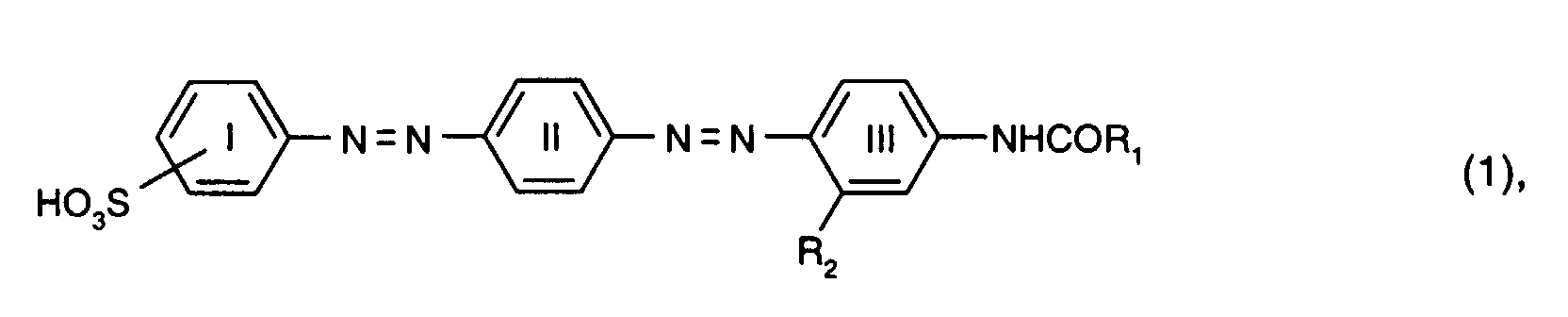 worin
mindestens einen gelb- oder orangefärbenden Farbstoff der Formel (1)
zusammen mit mindestens einem rotfärbenden Farbstoff der Formeln (2) und (3)
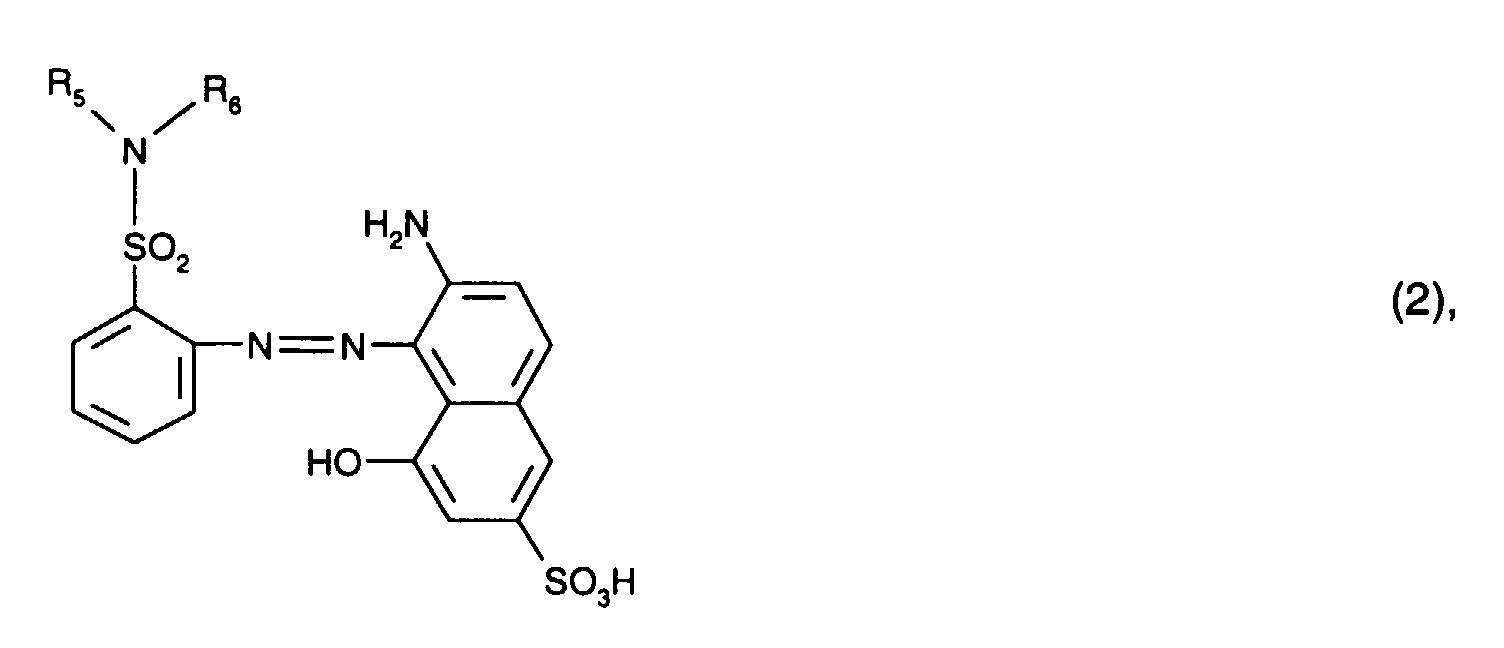
die Reste R5 und R6 zusammen mit dem sie verbindenden Stickstoffatom einen Azepinylring bilden,
zusammen mit mindestens einem der blaufärbenden Farbstoffe der Formeln (4), (5) und (6)
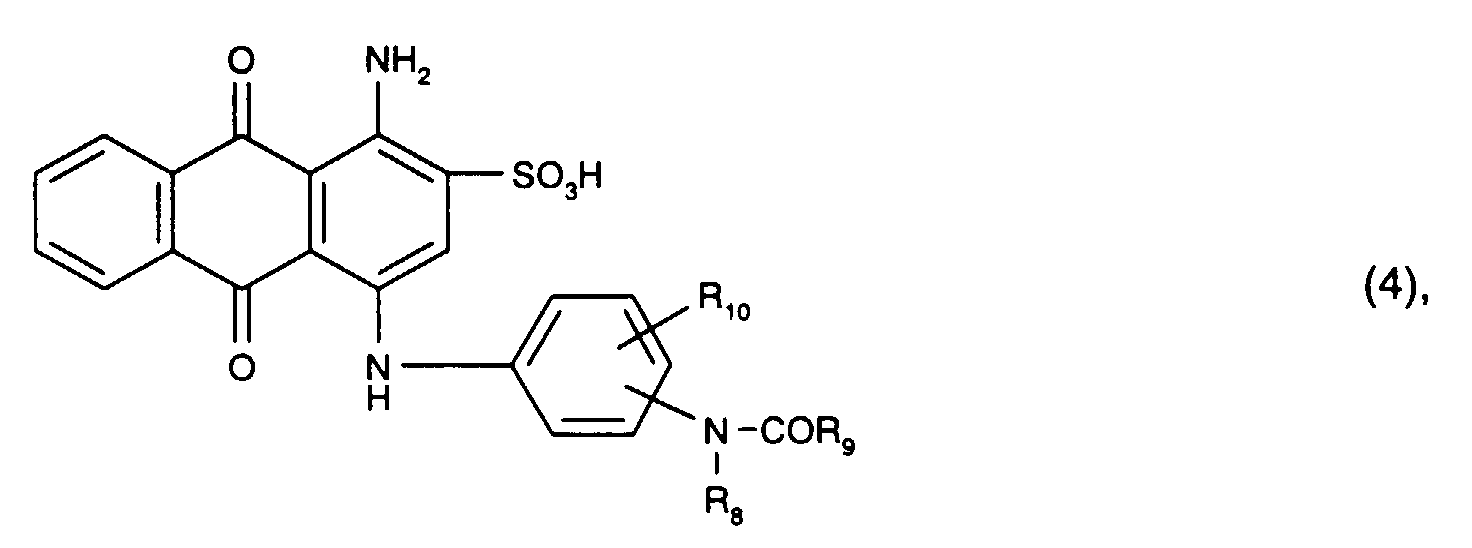
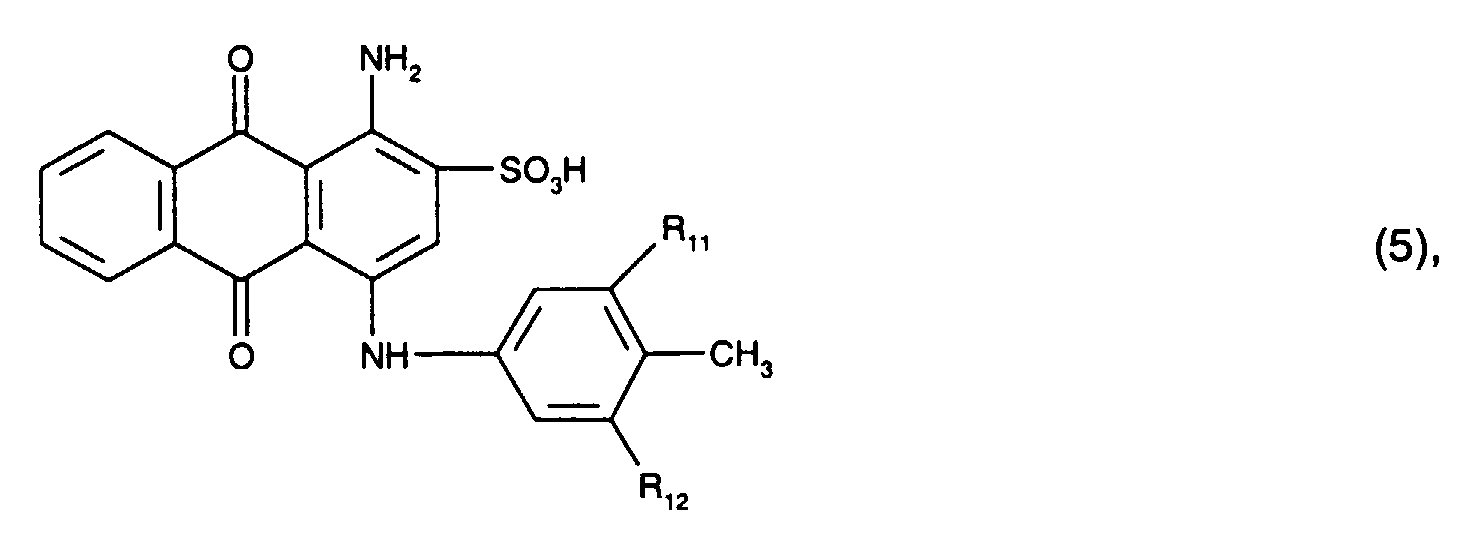
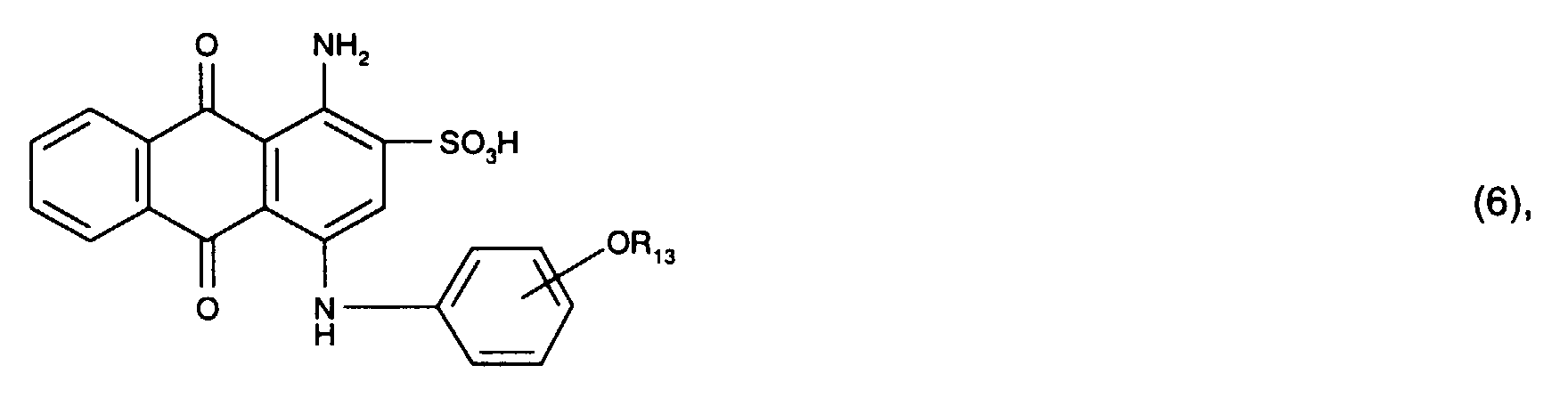
verwendet.
Unter Trichromie ist die additive Farbmischung passend gewählter gelb- bzw. orange-, rot- und
blaufärbender Farbstoffe zu verstehen, mit denen jede gewünschte Nuance des sichtbaren
Farbspektrums durch geeignete Wahl der Mengenverhältnisse der Farbstoffe eingestellt
werden kann.
Als C1-C4-Alkyl kommen für R1, R2, R3, R4, R8, R9, R10, R13 sowie als Substituent der Benzolringe
I, II und III der Farbstoffe der Formel (1) unabhängig voneinander Methyl, Äthyl,
Propyl, Isopropyl, Butyl, sek.-Butyl, tert.-Butyl oder Isobutyl, insbesondere Methyl oder
Aethyl, in Betracht. Der Rest R1 in der Bedeutung als C1-C4-Alkyl kann durch Hydroxy, Halogen
wie z.B. Brom oder vorzugsweise Chlor, oder insbesondere durch C1-C4-Alkoxy, wie z.B.
Aethoxy oder vorzugsweise Methoxy, weitersubstituiert sein. Als Beispiel für entsprechende
substituierte Reste sei der Methoxymethylrest genannt.
Als C1-C6-Alkyl kommen für R5 und R6 z.B. Methyl, Aethyl, Propyl, Isopropyl, Butyl, Isobutyl,
sek.-Butyl, tert.-Butyl oder geradkettiges oder verzweigtes Pentyl oder Hexyl in Betracht.
Bevorzugt sind Methyl und Aethyl, insbesondere Methyl.
Als C1-C4-Alkoxy kommen für R1, R9 und R10 sowie als Substituent der Benzolringe I, II und
III der Farbstoffe der Formel (1) unabhängig voneinander z.B. Methoxy, Äthoxy, Propoxy,
Isopropoxy, Butoxy oder Isobutoxy, insbesondere Methoxy oder vorzugsweise Aethoxy, in
Betracht. Der Rest R1 in der Bedeutung als C1-C4-Alkoxy kann durch Hydroxy, Halogen wie
z.B. Brom oder vorzugsweise Chlor, oder insbesondere durch C1-C4-Alkoxy, wie z.B. Methoxy
oder Aethoxy, weitersubstituiert sein. Bevorzugt sind die entsprechenden unsubstituierten
Reste.
Als C2-C4-Alkanoyl kommen für R3 und R4 unabhängig voneinander z.B. Propionyl oder insbesondere
Acetyl in Betracht. Die Reste R3 und R4 können in der Bedeutung als C2-C4-Alkanoyl
durch Hydroxy oder insbesondere C1-C4-Alkoxy, wie z.B. Methoxy oder Aethoxy, weitersubstituiert
sein.
Als Phenyl oder Phenoxy kommen für R1 neben den entsprechenden unsubstituierten Resten
die durch C1-C4-Alkyl, wie Methyl, Äthyl, Propyl, Isopropyl, Butyl, sek.-Butyl, tert.-Butyl
oder Isobutyl, C1-C4-Alkoxy, wie z.B. Methoxy, Äthoxy, Propoxy, Isopropoxy, Butoxy oder
Isobutoxy, oder durch Halogen, wie z.B. Fluor, Brom oder insbesondere Chlor, substituierten
Reste in Betracht. Bevorzugt sind hierbei die entsprechenden Phenylreste.
Als Halogen kommt für R7 sowie als Substituent der Benzolringe I, II und III der Farbstoffe
der Formel (1) beispielsweise Brom oder insbesondere Chlor in Betracht.
Als C2-C4-Alkanoylamino kommt für R7 sowie als Substituent der Benzolringe I, II und III der
Farbstoffe der Formel (1) insbesondere Acetylamino in Betracht.
Bilden die Reste R5 und R6 zusammen mit dem sie verbindenden Stickstoffatom einen Azepinylring
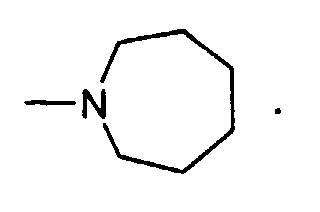 so handelt es sich um den Rest der Formel
Als C1-C4-Hydroxyalkylsulphamoylrest kommt für R12 insbesondere ein Rest der Formel
-SO2-NH-CH2-CH2-OH in Betracht.
Als mögliche weitere Substituenten der Benzolringe I, II und III der Farbstoffe der Formel (1)
kommen bevorzugt C1-C4-Alkyl, C1-C4-Alkoxy, Ureido oder Halogen, insbesondere C1-C4-Alkyl,
C1-C4-Alkoxy oder Ureido und vorzugsweise C1-C4-Alkyl oder C1-C4-Alkoxy in Betracht.
Besonders bevorzugt enthalten die Benzolringe I und II der Farbstoffe der Formel (1) keine
Substituenten und der Benzolring III einen oder zwei C1-C4-Alkylsubstituenten.
Von besonderem Interesse als Farbstoffe der Formel (1) sind solche der Formel
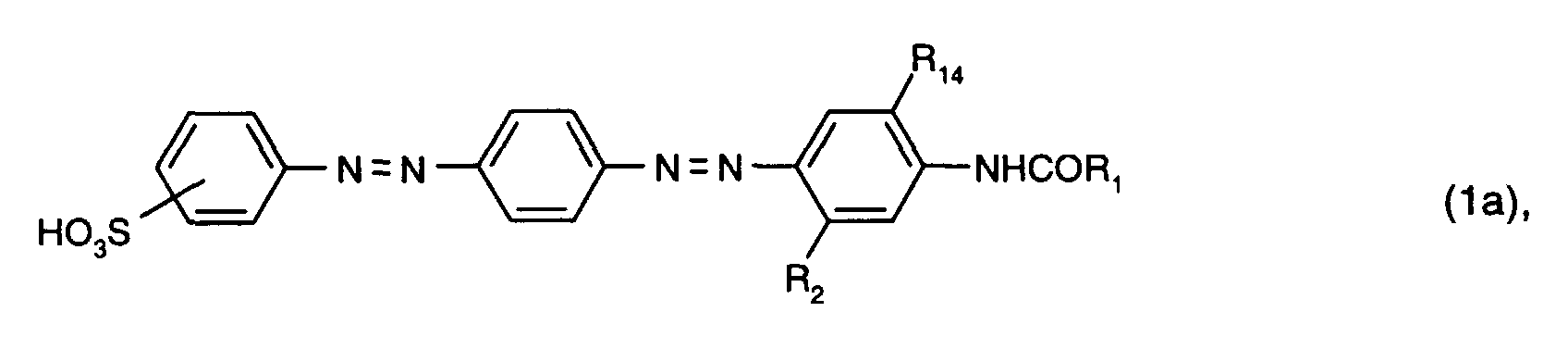 worin
Ganz besonders bevorzugt sind R3 und R4 Wasserstoff.
R1 ist vorzugsweise unsubstituiertes oder durch Hydroxy, C1-C4-Alkoxy oder Halogen substituiertes
C1-C4-Alkyl oder C1-C4-Alkoxy, oder ein Rest der Formel -N(R3)R4, wobei für R3 und
R4 die oben angegebenen Bedeutungen und Bevorzugungen gelten. Vorzugsweise sind
hierbei R3 Wasserstoff und R4 Wasserstoff oder im Alkylteil durch C1-C4-Alkoxy weitersubstituiertes
C2-C4-Alkanoyl, insbesondere Wasserstoff.
Bevorzugt ist R1 C1-C4-Alkoxy, unsubstituiertes oder durch C1-C4-Alkoxy substituiertes
C1-C4-Alkyl, oder ein Rest der Formel -N(R3)R4, wobei für R3 und R4 die oben angegebenen
Bedeutungen und Bevorzugungen gelten. Vorzugsweise sind hierbei R3 Wasserstoff und R4
Wasserstoff oder im Alkylteil durch C1-C4-Alkoxy weitersubstituiertes C2-C4-Alkanoyl, insbesondere
Wasserstoff.
Ganz besonders bevorzugt ist R1 Methyl, Aethyl, Methoxy oder Aethoxy, insbesondere Methoxy
oder Aethoxy.
R2 ist bevorzugt Aethyl oder besonders bevorzugt Methyl.
Von besonderem Interesse sind Farbstoffe der Formel (1), worin R1 C1-C4-Alkyl oder
C1-C4-Alkoxy, insbesondere C1-C4-Alkoxy, ist, und R2 Aethyl, insbesondere Methyl, ist, und
vorzugsweise solche der Formel (1a), worin R1 C1-C4-Alkyl oder C1-C4-Alkoxy, insbesondere
C1-C4-Alkoxy, ist, R2 Aethyl, insbesondere Methyl ist und R14 Aethyl, insbesondere Methyl ist.
Von ganz besonderem Interesse sind Farbstoffe der Formel (1), worin R1 Methyl, Aethyl, Methoxy
oder Aethoxy, insbesondere Methoxy oder Aethoxy, ist, und R2 Aethyl, insbesondere
Methyl, ist, und vorzugsweise solche der Formel (1a), worin R1 Methyl, Aethyl, Methoxy oder
Aethoxy, insbesondere Methoxy oder Aethoxy, ist, R2 Aethyl, insbesondere Methyl und R14
Methyl ist.
Unter den Farbstoffen der Formel (1a) ist der Farbstoff der Formel
 ganz besonders bevorzugt.
Die Sulfogruppe in den Farbstoffen der Formel (1) und insbesondere in den Farbstoffen der
Formel (1a) ist vorzugsweise in para-Stellung, relativ zur Azogruppe, gebunden.
Der Rest R5 ist bevorzugt Phenyl oder Cyclohexyl, insbesondere Cyclohexyl.
Der Rest R6 ist bevorzugt Methyl oder Aethyl, insbesondere Methyl.
Weiterhin können die Reste R5 und R6 zusammen mit dem sie verbindenden Stickstoffatom
einen Azepinylring bilden.
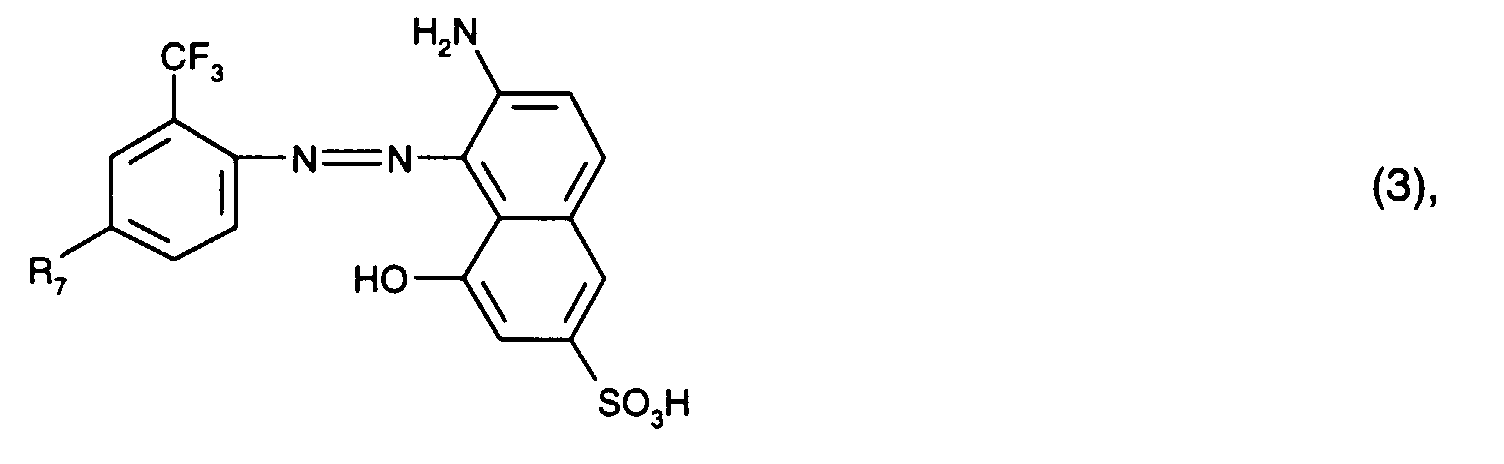
Der Rest R7 ist bevorzugt Wasserstoff, Chlor oder insbesondere Acetylamino.
Der Rest R8 ist bevorzugt Wasserstoff.
Der Rest R9 ist bevorzugt Methyl, Aethyl oder Amino, insbesondere Methyl oder Aethyl und
vorzugsweise Aethyl.
Der Rest R10 ist bevorzugt Wasserstoff oder Methyl, insbesondere Wasserstoff.
Der Rest R11 ist bevorzugt Methyl.
Als rotfärbende Farbstoffe der Formel (2) verwendet man bevorzugt solche, worin R5 Phenyl
oder Cyclohexyl und R6 Methyl oder Aethyl ist, oder die Reste R5 und R6 zusammen mit dem
sie verbindenden Stickstoffatom einen Azepinylring bilden.
Besonders bevorzugt verwendet man als rotfärbende Farbstoffe der Formel (2) solche, worin
R5 Cyclohexyl und R6 Methyl ist, oder die Reste R5 und R6 zusammen mit dem sie verbindenden
Stickstoffatom einen Azepinylring bilden, insbesondere solche, worin R5 Cyclohexyl und
R6 Methyl ist.
Als rotfärbende Farbstoffe verwendet man bevorzugt solche der Formel (2), für welche die
oben angegebenen Bedeutungen und Bevorzugungen gelten.
Als blaufärbende Farbstoffe der Formel (4) verwendet man bevorzugt solche, worin der Rest
der Formel -N(R8)-CO-R9 in meta- oder para-Stellung, insbesondere in meta-Stellung, relativ
zur Aminogruppe, gebunden ist. Hierbei ist vorzugsweise R8 Wasserstoff und R9 Methyl,
Aethyl oder Amino, insbesondere Methyl oder Aethyl und vorzugsweise Aethyl. Der Rest R10
ist hierbei bevorzugt Wasserstoff oder Methyl, insbesondere Wasserstoff.
Als blaufärbende Farbstoffe der Formel (5) verwendet man bevorzugt solche, worin R12 ein
Rest der Formel -SO2-NH-CH2-CH2-OH ist. R11 ist hierbei vorzugsweise Wasserstoff.
Als blaufärbende Farbstoffe sind für das erfindungsgemässe Verfahren der Farbstoff der
Formel (4) oder eine Mischung des Farbstoffs der Formel (4) mit einem Farbstoff der Formel
(5) bevorzugt. Von besonderem Interesse sind Mischungen des Farbstoffs der Formel (4)
mit einem Farbstoff der Formel (5). Hierbei sind insbesondere solche Farbstoffe der Formeln
(4) und (5) bevorzugt, worin R8 Wasserstoff, R9 Methyl, Äthyl oder Amino, R10 Wasserstoff
oder Methyl und R12 ein Rest der Formel -SO2-NH-CH2-CH2-OH ist.
Eine besonders bevorzugte Ausführungsform des erfindungsgemässen Verfahren ist dadurch
gekennzeichnet, dass man
Einen weiteren Gegenstand der vorliegenden Erfindung stellen Farbstoffmischungen dar,
welche mindestens einen gelb- oder orangefärbenden Farbstoff der Formel (1) zusammen
mit mindestens einem rotfärbenden Farbstoff der Formeln (2) und (3) und zusammen mit
mindestens einem blaufärbenden Farbstoff der Formeln (4), (5) und (6) enthalten.
Hierbei gelten für die Farbstoffe der Formeln (1), (2), (3), (4), (5) und (6) sowie für deren Mischungen
die oben angegebenen Bedeutungen und Bevorzugungen.
Die in dem erfindungsgemässen Verfahren zum Trichromie-Färben oder -Bedrucken verwendeten
Farbstoffe der Formeln (1), (2), (3), (4), (5), (6) und (7) sind bekannt oder können
in Analogie zu bekannten Farbstoffen hergestellt werden.
So können Farbstoffe der Formel (1) z.B. erhalten werden, indem man ein Amin der Formel
 diazotiert, auf eine Kupplungskomponente der Formel
 kuppelt und das erhaltene Reaktionsprodukt mit einer den Rest der Formel
 einführenden Verbindung umsetzt, wobei R1 und R2 die oben unter Formel (1) angegebenen
Bedeutungen haben.
Die Diazotierung der Verbindung der Formel (8) erfolgt in an sich bekannter Weise, z.B. mit
einem Nitrit, z.B. mit einem Alkalimetallnitrit wie Natriumnitrit, in einem mineralsauren Medium,
z.B. in einem salzsauren Medium, bei Temperaturen von beispielsweise -5 bis 40°C
und vorzugsweise bei 0 bis 10°C.
Die Kupplung auf die Kupplungskomponente der Formel (9) erfolgt in an sich bekannter
Weise, bei sauren, neutralen bis schwach alkalischen pH-Werten, z.B. einem pH-Wert von 3
bis 7, und Temperaturen von beispielsweise -5 bis 30°C, vorzugsweise 0 bis 25°C.
Zur Einführung des Restes der Formel (10) können beispielsweise Verbindungen der Formel
 worin Hal Halogen, wie Chlor, Brom oder Jod, insbesondere Chlor, bedeutet, verwendet werden.
Als Beispiele für Verbindungen der Formel (10) seien Acetylchlorid, Propionylchlorid,
Methoxyacetylchlorid sowie Chlorameisensäure-äthylester genannt. Als weitere Beispiele für
den Rest der Formel (10) einführende Verbindungen seien Essigsäureanhydrid und Propionsäureanhydrid
genannt.
Die Einführung des Restes der oben genannten Formel (10) kann z.B. in dipolaren aprotischen
Lösungsmitteln, wie z.B. Dimethylformamid oder Dimethylsulfoxid, oder in Wasser
oder vorzugsweise in Pyridin erfolgen, bei einer Temperatur von beispielsweise 10 bis 80°C,
insbesondere 10 bis 50°C.
Die in dem erfindungsgemässen Verfahren zum Trichromie-Färben oder -Bedrucken verwendeten Farbstoffe liegen entweder in der Form ihrer freien Sulfonsäure oder vorzugsweise als deren Salze vor.
Die in dem erfindungsgemässen Verfahren zum Trichromie-Färben oder -Bedrucken verwendeten Farbstoffe liegen entweder in der Form ihrer freien Sulfonsäure oder vorzugsweise als deren Salze vor.
Als Salze kommen beispielsweise die Alkali-, Erdalkali- oder Ammoniumsalze oder die Salze
eines organischen Amins in Betracht. Als Beispiele seien die Natrium-, Lithium-, Kalium- oder
Ammoniumsalze oder das Salz des Mono-, Di- oder Triäthanolamins genannt.
Die in dem erfindungsgemässen Verfahren verwendeten Farbstoffe können weitere Zusätze,
wie z.B. Kochsalz oder Dextrin, enthalten.
Das erfindungsgemässe Verfahren zum Trichromie-Färben oder -Bedrucken kann auf die
üblichen Färbe- bzw. Druckverfahren angewendet werden. Die Färbeflotten oder Druckpasten
können ausser Wasser und den Farbstoffen weitere Zusätze, beispielsweise Netzmittel,
Antischaummittel, Egalisiermittel oder die Eigenschaft des Textilmaterials beeinflussende
Mittel wie z.B. Weichmachungsmittel, Zusätze zum Flammfestausrüsten oder schmutz-,
wasser- und öl-abweisende Mittel sowie wasserenthärtende Mittel und natürliche oder synthetische
Verdicker, wie z.B. Alginate und Celluloseäther, enthalten.
Das erfindungsgemässe Verfahren zum Trichromie-Färben oder -Bedrucken ist auch zum
Färben aus Kurzflotten, wie z.B. bei Kontinuefärbeverfahren oder diskontinuierlichen und
kontinuierlichen Schaumfärbeverfahren, geeignet.
Die Mengen, in denen die einzelnen Farbstoffe in den Färbebädern oder Druckpasten verwendet
werden, können je nach der gewünschten Farbtiefe in weiten Grenzen schwanken,
im allgemeinen haben sich Mengen von 0,01 bis 15 Gew.-%, insbesondere 0,01 bis
10 Gew.-%, bezogen auf das Färbegut bzw. die Druckpaste, als vorteilhaft erwiesen.
Vorzugsweise färbt man bei einem pH-Wert von 3 bis 7, insbesondere 4 bis 7. Das Flottenverhältnis
kann innerhalb eines weiten Bereichs gewählt werden, z.B. von 1:5 bis 1:50, vorzugsweise
1:5 bis 1:30. Vorzugsweise färbt man bei einer Temperatur von 70 bis 110°C, insbesondere
80 bis 105°C.
Die in dem erfindungsgemässen Verfahren verwendeten Farbstoffe zeichnen sich beim Trichromie-Färben
oder -Bedrucken durch gleichmässigen Farbaufbau, gutes Aufziehverhalten,
gute Nuancenkonstanz auch in verschiedenen Konzentrationen, gute Echtheiten und
Löslichkeit sowie insbesondere durch sehr gute Kombinierbarkeit aus.
Das erfindungsgemässe Verfahren zum Trichromie-Färben oder -Bedrucken eignet sich zum
Färben oder Bedrucken sowohl von natürlichen Polyamidmaterialien wie z.B. Wolle, wie insbesondere
von synthetischen Polyamidmaterialien, wie z.B. Polyamid 6 oder Polyamid 6.6,
und ist geeignet zum Färben oder Bedrucken von Woll- und synthetischem Polyamid-Mischgeweben
oder -Garnen.
Das genannte Textilmaterial kann dabei in den verschiedensten Verarbeitungsformen vorliegen,
wie z.B. als Faser, Garn, Gewebe oder Gewirke und insbesondere in Form von Teppichen.
Es werden egale Färbungen mit guten Allgemeinechtheiten, insbesondere guter Reib-,
Nass-, Nassreib- und Lichtechtheit erhalten.
In den folgenden Beispielen stehen Teile für Gewichtsteile. Die Temperaturen sind Celsiusgrade.
Die Beziehung zwischen Gewichtsteilen und Volumenteilen ist dieselbe wie diejenige
zwischen Gramm und Kubikzentimeter.
111 Gewichtsteile 4-Amino-azobenzol-4'-sulfosäure werden bei 80°C in 500 Gewichtsteilen
Wasser gelöst. Nach dem Abkühlen der Lösung auf 40°C wird diese mit 200 Gewichtsteilen
Eis und 118,5 Gewichtsteilen konzentrierter Salzsäure versetzt. Zu der entstehenden orangen
Suspension werden innert 30 Minuten bei 38-40°C 100 Gewichtsteile 4N-Natriumnitritlösung
4N zugetropft und 90 Minuten bei 40°C ausreagieren gelassen.
Danach wird die Diazosuspension innert 30 Minuten bei 20-25°C und einem pH-Wert von 3,5 zu einer Suspension, bestehen aus 48,5 Gewichtsteilen 2,5-Dimethylanilin in 330 Gewichtsteilen Wasser, zugetropft, wobei der pH-Wert mit 10%-iger wässrigen Natriumhydroxidlösung bei 3,5 gehalten wird. Nach beendeter Zugabe wird der pH-Wert stufenweise auf 6 erhöht.
Nach beendeter Kupplung wird das Reaktionsgemisch bei 60°C abfiltriert, der Rückstand zweimal in 400 Gewichtsteilen Wasser von 60°C angeschlämmt, abfiltriert und getrocknet. Man erhält 143 Gewichtteile der Verbindung der Formel 4,1 Gewichtsteile der Verbindung der Formel (50) werden in 60 Gewichtsteilen Pyridin verrührt
und zu dieser Mischung werden innert 5 Minuten 4,6, Gewichtsteile Propionylchlorid zugetropft
wobei die Temperatur bis auf 35°C ansteigt. Nach einer Reaktionsdauer von 60 Minuten,
wobei die Temperatur der Reaktionsmischung allmählich bis auf die Raumtemperatur
sinkt, werden 10 Gewichtsteile Methylalkohol zugegeben.
Die entstandene orange Suspension wird auf 100 Gewichtsteile 25%-iger Sole ausgetragen und danach abfiltriert. Der Fitrerrückstand wird mit 5%-iger Sole und Methanol gewaschen und getrocknet.
Man erhält 3,8 Gewichtsteile der Verbindung der Formel mit einer Extinction λmax 394 nm.
Danach wird die Diazosuspension innert 30 Minuten bei 20-25°C und einem pH-Wert von 3,5 zu einer Suspension, bestehen aus 48,5 Gewichtsteilen 2,5-Dimethylanilin in 330 Gewichtsteilen Wasser, zugetropft, wobei der pH-Wert mit 10%-iger wässrigen Natriumhydroxidlösung bei 3,5 gehalten wird. Nach beendeter Zugabe wird der pH-Wert stufenweise auf 6 erhöht.
Nach beendeter Kupplung wird das Reaktionsgemisch bei 60°C abfiltriert, der Rückstand zweimal in 400 Gewichtsteilen Wasser von 60°C angeschlämmt, abfiltriert und getrocknet. Man erhält 143 Gewichtteile der Verbindung der Formel
Die entstandene orange Suspension wird auf 100 Gewichtsteile 25%-iger Sole ausgetragen und danach abfiltriert. Der Fitrerrückstand wird mit 5%-iger Sole und Methanol gewaschen und getrocknet.
Man erhält 3,8 Gewichtsteile der Verbindung der Formel
Verfährt man wie in Beispiel 1 angegeben, verwendet jedoch anstelle 4,6 Gewichtsteilen
Propionylchlorid die equimolare Menge eines der in der folgenden Tabelle 1 in Spalte 2 angegebenen
Säurechloride, so erhält man Verbindungen der Formel
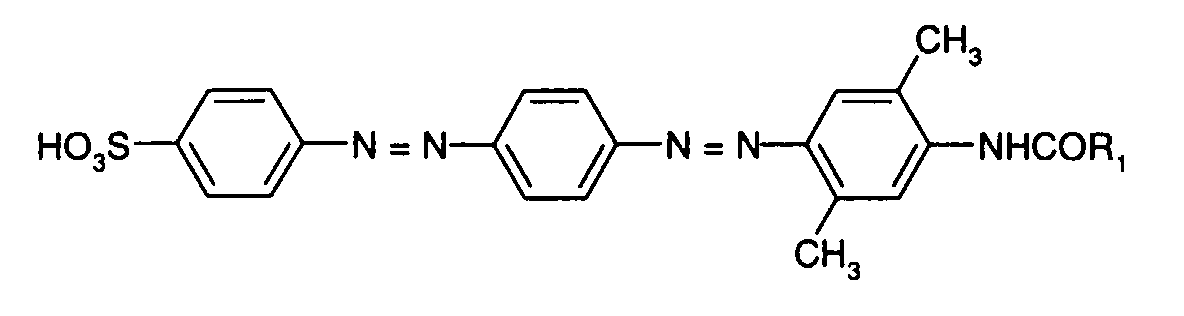
| Beispiel | Säurechlorid | R1 | Nuance |
| 2 | CH3COCl | CH3 | orange |
| 3 | CH3OCOCl | OCH3 | orange |
| 4 | CH3CH2OCOCl | OCH2CH3 | orange |
Zu 2000 Gewichtsteilen entmineralisiertem Wasser wird bei Raumtemperatur 1 Gewichtsteil
eines Egalisierhilfsmittels (basierend auf dem Kondensationsprodukt aus einem höheren
aliphatischen Amin und Ethylenoxid) zugegeben. Anschliessend wird das Bad mit 4 Gewichtsteilen
Natriumdihydrogenphosphat und 0,6 Gewichtsteilen Dinatriumhydrogenphosphat
auf einen pH-Wert von 6 gestellt. Dann gibt man
0,16 Gewichtsteilen eines Farbstoffs, der in Form der freien Säure der Verbindung der Formel entspricht,
0,09 Teilen eines Farbstoffs, der in Form der freien Säure der Verbindung der Formel entspricht,
0,033 Teilen eines Farbstoffs, der in Form der freien Säure der Verbindung der Formel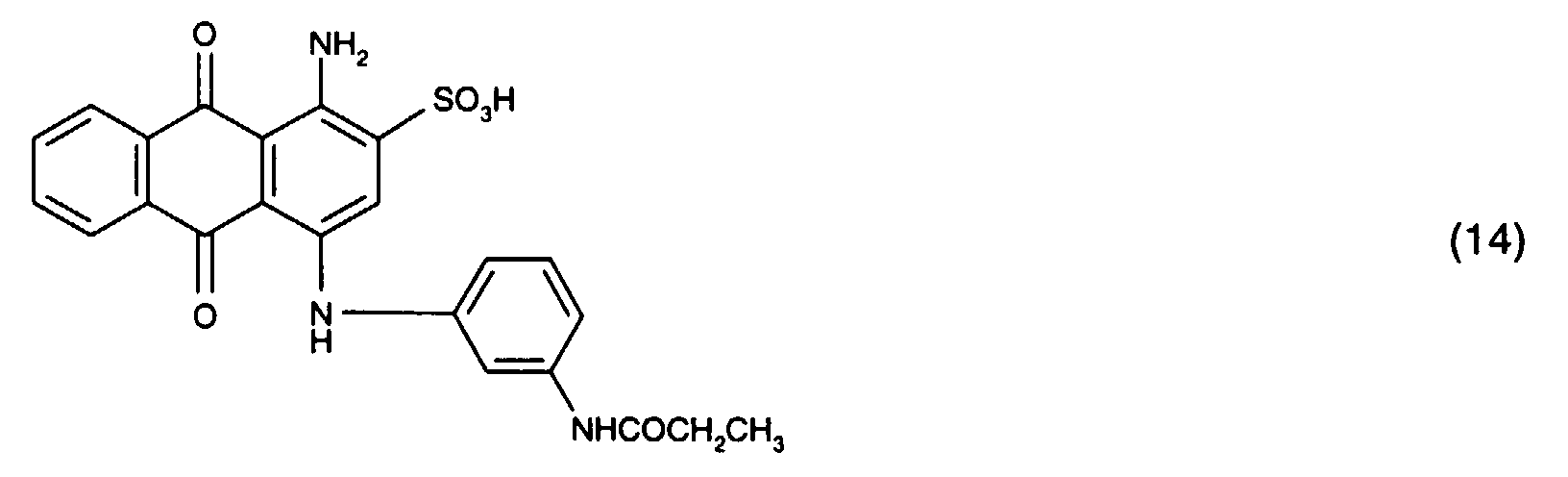 entspricht, und
0,098 Teilen eines Farbstoffs, der in Form der freien Säure der Verbindung der Formel entspricht, zu.
In die erhaltene Farbstofflösung geht man mit 100 Teilen Polyamid-6.6 Fasermaterial (Helancatrikot) ein und erwärmt das Färbebad innerhalb von 45 Minuten auf eine Temperatur von ca. 96°C. Man hält die Temperatur 45 bis 60 Minuten, kühlt anschliessend auf eine Temperatur von 70°C ab und entnimmt das Färbegut, welches mit Wasser gespült und anschliessend getrocknet wird. Man erhält ein in einem beige-braunen Farbton gefärbtes Gewebe.
0,16 Gewichtsteilen eines Farbstoffs, der in Form der freien Säure der Verbindung der Formel
0,09 Teilen eines Farbstoffs, der in Form der freien Säure der Verbindung der Formel
0,033 Teilen eines Farbstoffs, der in Form der freien Säure der Verbindung der Formel
0,098 Teilen eines Farbstoffs, der in Form der freien Säure der Verbindung der Formel
In die erhaltene Farbstofflösung geht man mit 100 Teilen Polyamid-6.6 Fasermaterial (Helancatrikot) ein und erwärmt das Färbebad innerhalb von 45 Minuten auf eine Temperatur von ca. 96°C. Man hält die Temperatur 45 bis 60 Minuten, kühlt anschliessend auf eine Temperatur von 70°C ab und entnimmt das Färbegut, welches mit Wasser gespült und anschliessend getrocknet wird. Man erhält ein in einem beige-braunen Farbton gefärbtes Gewebe.
Claims (12)
- Verfahren zum Trichromie-Färben oder -Bedrucken von natürlichem oder synthetischem Polyamidfasermaterial, dadurch gekennzeichnet, dass man
mindestens einen gelb- oder orangefärbenden Farbstoff der Formel (1)worin R1 unsubstituiertes oder durch Hydroxy, C1-C4-Alkoxy oder Halogen substituiertes C1-C4-Alkyl oder C1-C4-Alkoxy, unsubstituiertes oder durch C1-C4-Alkyl, C1-C4-Alkoxy oder Halogen substituiertes Phenyl oder Phenoxy, oder ein Rest der Formel -N(R3)R4 sind, wobei R3 und R4 unabhängig voneinander Wasserstoff, C1-C4-Alkyl oder gegebenenfalls im Alkylteil durch Hydroxy oder C1-C4-Alkoxy weitersubstituiertes C2-C4-Alkanoyl ist, R2 C1-C4-Alkyl ist unddie Benzolringe I, II und III der Farbstoffe der Formel (1) gegebenenfalls durch C1-C4-Alkyl, C1-C4-Alkoxy, C2-C4-Alkanoylamino, Ureido oder Halogen ein- oder mehrfach weitersubstituiert sind,
zusammen mit mindestens einem rotfärbenden Farbstoff der Formeln (2) und (3)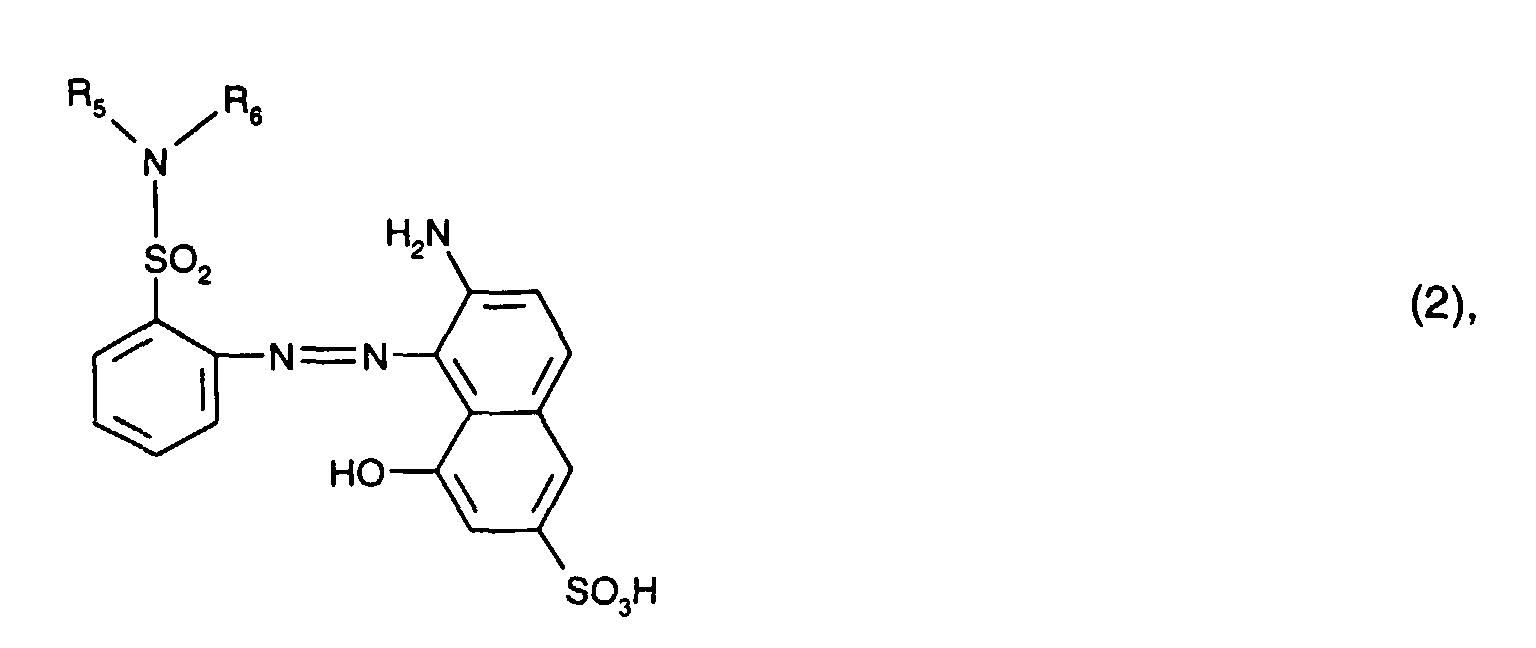 worin R5 C1-C6-Alkyl, Phenyl oder Cyclohexyl und R6 C1-C6-Alkyl ist, oder die Reste R5 und R6 zusammen mit dem sie verbindenden Stickstoffatom einen Azepinylring bilden,
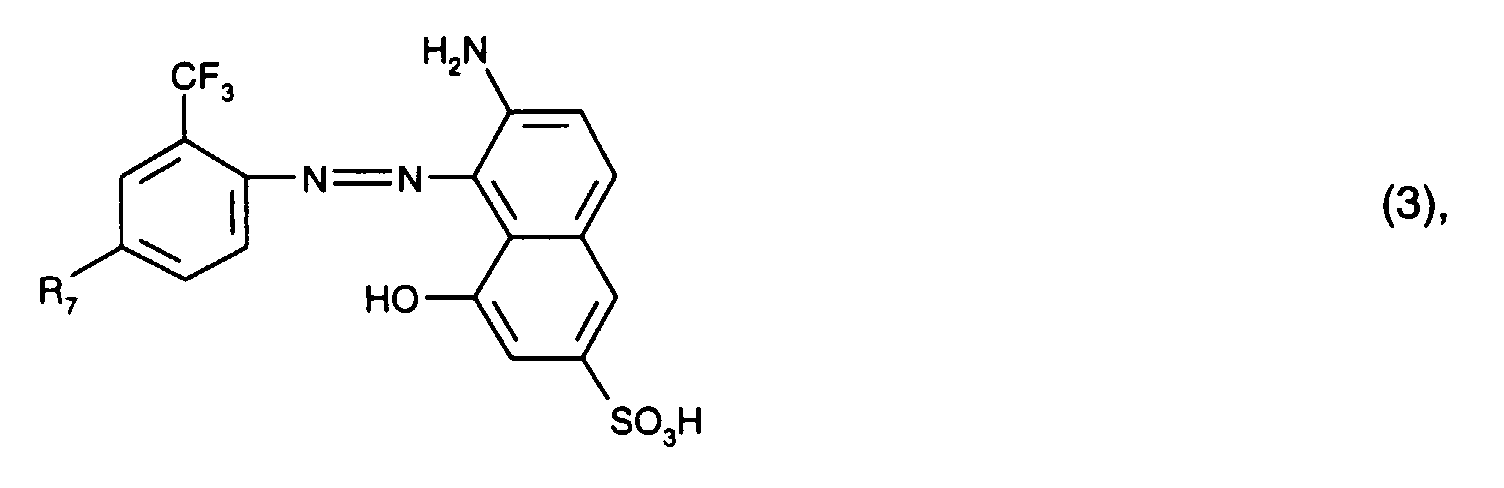 worin R7 Wasserstoff, Halogen oder C2-C4-Alkanoylamino bedeutet, und
zusammen mit mindestens einem der blaufärbenden Farbstoffe der Formeln (4), (5) und (6)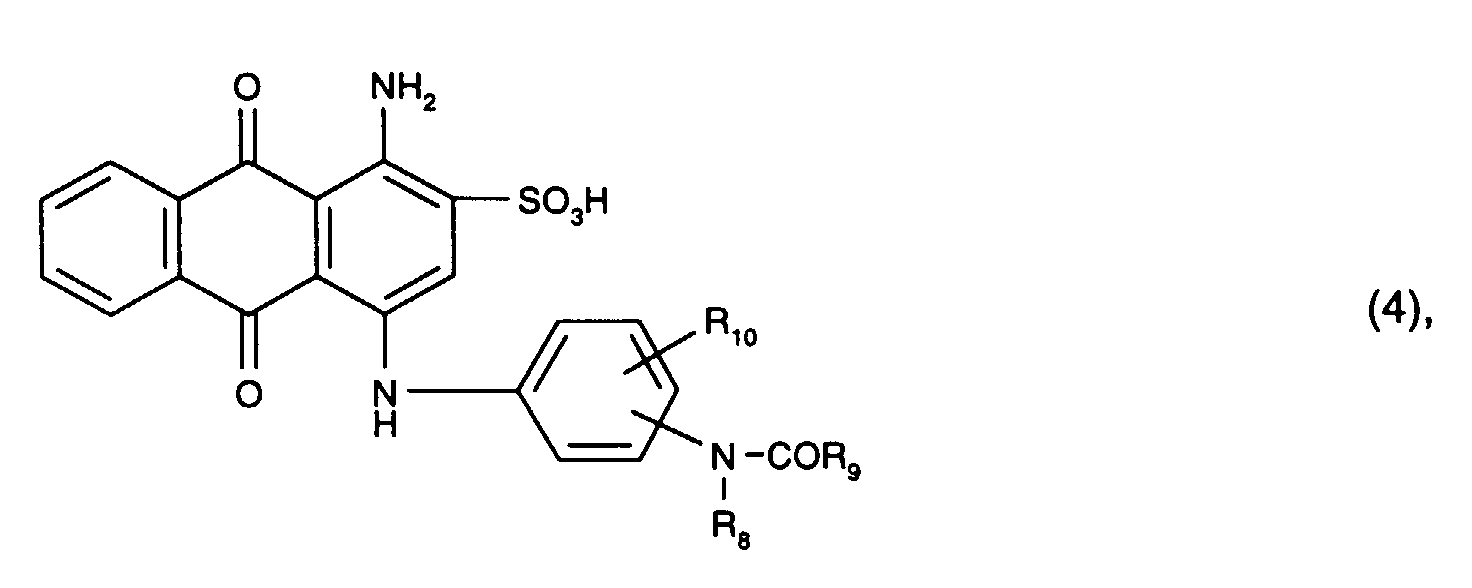 worin R8 Wasserstoff oder C1-C4-Alkyl ist, R9 unsubstituiertes oder durch Hydroxy, C1-C4-Alkoxy oder Halogen substituiertes C1-C4-Alkyl oder C1-C4-Alkoxy, oder Amino ist, und R10 Wasserstoff, C1-C4-Alkyl oder C1-C4-Alkoxy ist,
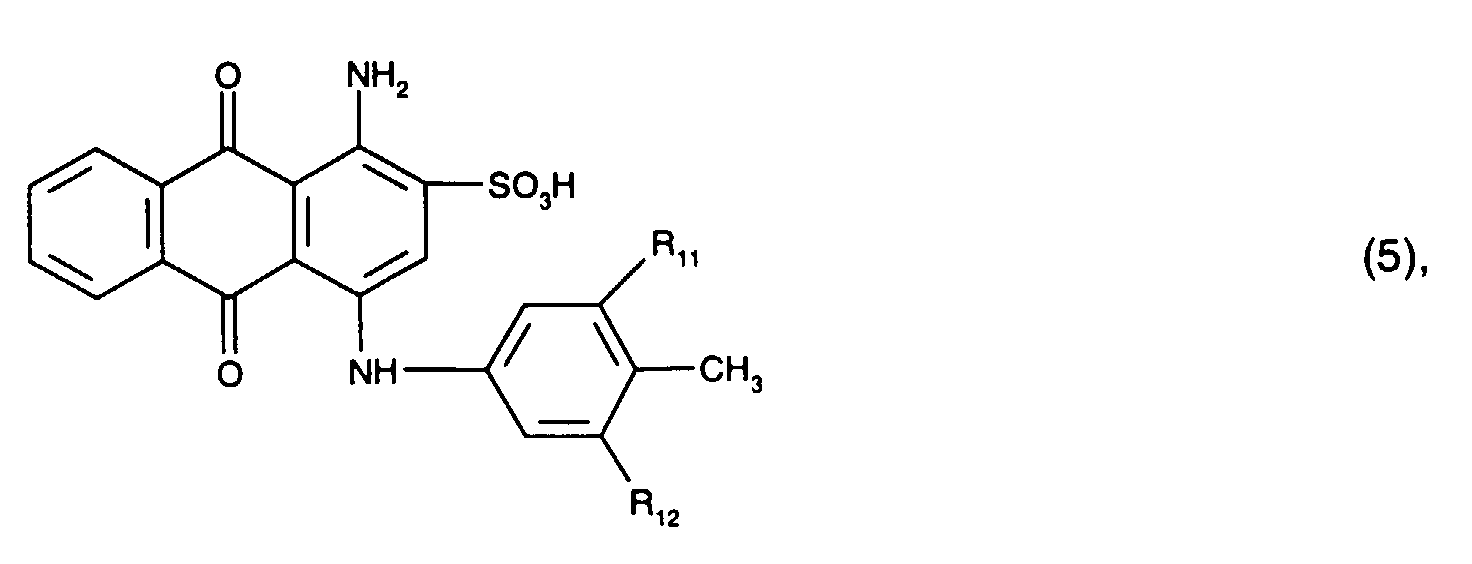 worin R11 Wasserstoff oder Methyl ist und R12 ein C2-4-Hydroxyalkylsulphamoylrest ist,
 worin R13 C1-C4-Alkyl ist,
verwendet. - Verfahren gemäss Anspruch 1, dadurch gekennzeichnet, dass man
als Farbstoff der Formel (1) einen Farbstoff der Formelverwendet, worin R1 und R2 die in Anspruch 1 angegebenen Bedeutungen haben und R14 C1-C4-Alkyl ist.
- Verfahren gemäss einem der Ansprüche 1 und 2, dadurch gekennzeichnet, dass R1 unsubstituiertes oder durch Hydroxy, C1-C4-Alkoxy oder Halogen substituiertes C1-C4-Alkyl oder C1-C4-Alkoxy, oder ein Rest der Formel -N(R3)R4 ist, wobei R3 Wasserstoff und R4 Wasserstoff oder im Alkylteil gegebenenfalls durch C1-C4-Alkoxy weitersubstituiertes C2-C4-Alkanoyl ist.
- Verfahren gemäss einem der Ansprüche 1 bis 3, dadurch gekennzeichnet, dass R1 C1-C4-Alkoxy, unsubstituiertes oder durch C1-C4-Alkoxy substituiertes C1-C4-Alkyl, oder Amino ist.
- Verfahren gemäss einem der Ansprüche 1 bis 4, dadurch gekennzeichnet, dass R1 C1-C4-Alkoxy ist.
- Verfahren gemäss einem der Ansprüche 1 bis 5, dadurch gekennzeichnet, dass man als rotfärbenden Farbstoff einen Farbstoff der Formel (2) verwendet, worin R5 Cyclohexyl und R6 Methyl ist, oder die Reste R5 und R6 zusammen mit dem sie verbindenden Stickstoffatom einen Azepinylring bilden.
- Verfahren gemäss einem der Ansprüche 1 bis 6, dadurch gekennzeichnet, dass man als blaufärbenden Farbstoff einen Farbstoff der Formel (4) oder eine Mischung des Farbstoffs der Formel (4) mit einem Farbstoff der Formel (5) verwendet, wobei R8 Wasserstoff, R9 Methyl, Äthyl oder Amino, R10 Wasserstoff oder Methyl und R12 ein Rest der Formel -SO2-NH-CH2-CH2-OH ist.
- Verfahren gemäss Anspruch 7, dadurch gekennzeichnet, dass man
als blaufärbenden Farbstoff eine Mischung des Farbstoffs der Formel (4) mit einem Farbstoff der Formel (5) verwendet, wobei R8 Wasserstoff, R9 Methyl, Äthyl oder Amino, R10 Wasserstoff oder Methyl und R12 ein Rest der Formel -SO2-NH-CH2-CH2-OH ist. - Verfahren gemäss einem der Ansprüche 1 bis 8, dadurch gekennzeichnet, dass man als rotfärbenden Farbstoff einen Farbstoff der Formel (2) verwendet, worin R5 Cyclohexyl und R6 Methyl ist.
- Verfahren gemäss einem der Ansprüche 1 bis 9, dadurch gekennzeichnet, dass man Wolle oder synthetisches Polyamidfasermaterial färbt oder bedruckt.
- Verfahren gemäss Anspruch 10, dadurch gekennzeichnet, dass man synthetisches Polyamidfasermaterial färbt oder bedruckt.
- Farbstoffmischungen, dadurch gekennzeichnet, dass sie
mindestens einen mindestens einen gelb- oder orangefärbenden Farbstoff der Formel (1)worin R1 unsubstituiertes oder durch Hydroxy, C1-C4-Alkoxy oder Halogen substituiertes C1-C4-Alkyl oder C1-C4-Alkoxy, unsubstituiertes oder durch C1-C4-Alkyl, C1-C4-Alkoxy oder Halogen substituiertes Phenyl oder Phenoxy, oder ein Rest der Formel -N(R3)R4 sind, wobei R3 und R4 unabhängig voneinander Wasserstoff, C1-C4-Alkyl oder gegebenenfalls im Alkylteil durch Hydroxy oder C1-C4-Alkoxy weitersubstituiertes C2-C4-Alkanoyl ist, R2 C1-C4-Alkyl ist unddie Benzolringe I, II und III der Farbstoffe der Formel (1) gegebenenfalls durch C1-C4-Alkyl, C1-C4-Alkoxy, C2-C4-Alkanoylamino, Ureido oder Halogen ein- oder mehrfach weitersubstituiert sind,
zusammen mit mindestens einem rotfärbenden Farbstoff der Formeln (2) und (3)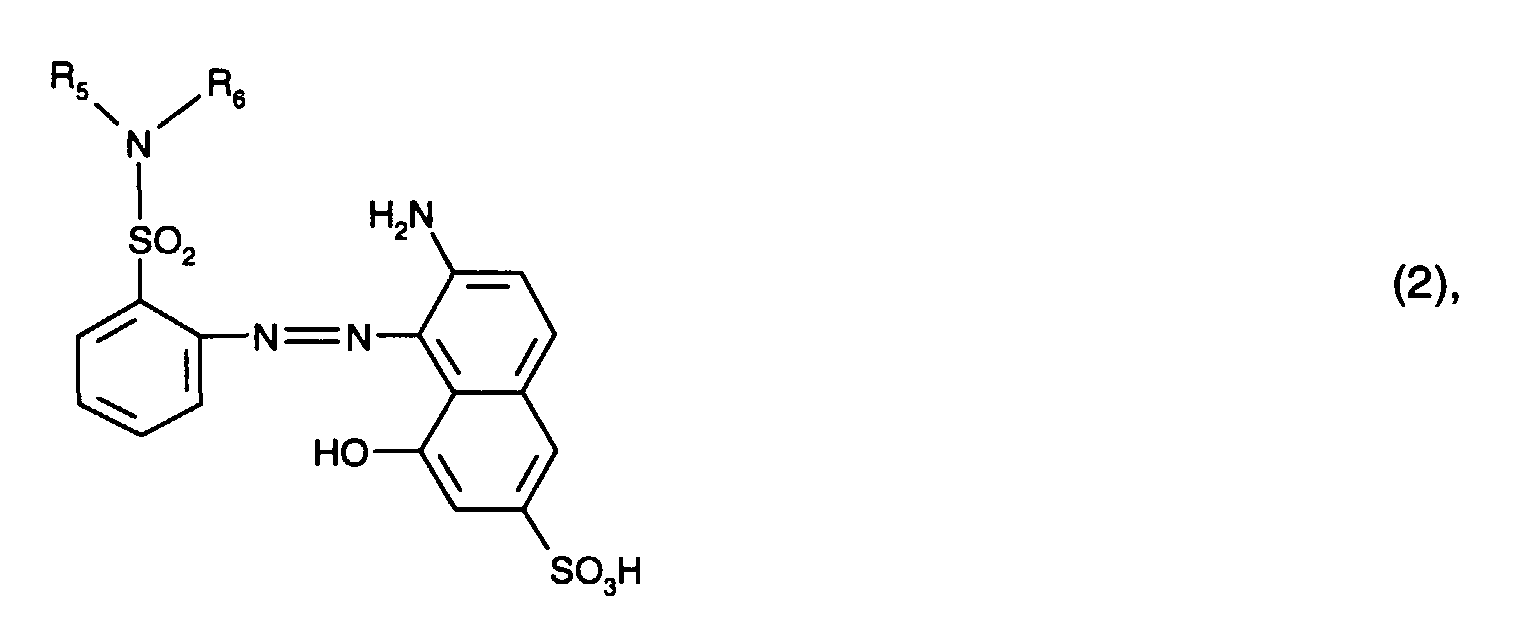 worin R5 C1-C6-Alkyl, Phenyl oder Cyclohexyl und R6 C1-C6-Alkyl ist, oder die Reste R5 und R6 zusammen mit dem sie verbindenden Stickstoffatom einen Azepinylring bilden,
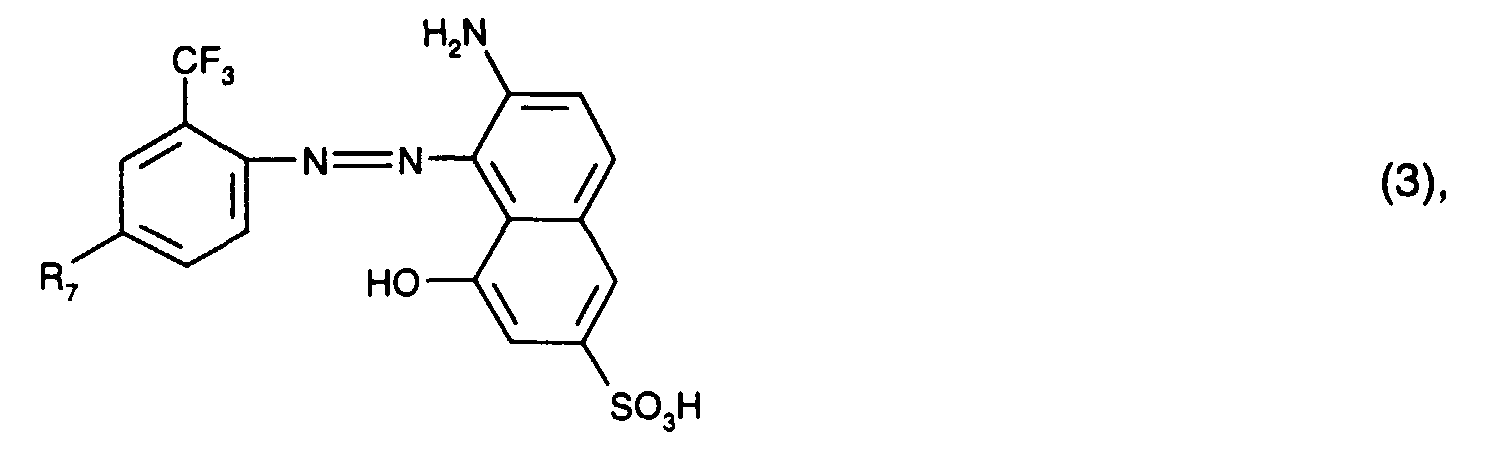 worin R7 Wasserstoff, Halogen oder C2-C4-Alkanoylamino bedeutet, und zusammen mit mindestens einem der blaufärbenden Farbstoffe der Formeln (4), (5) und (6)
 worin R8 Wasserstoff oder C1-C4-Alkyl ist, R9 unsubstituiertes oder durch Hydroxy, C1-C4-Alkoxy oder Halogen substituiertes C1-C4-Alkyl oder C1-C4-Alkoxy, oder Amino ist, und R10 Wasserstoff, C1-C4-Alkyl oder C1-C4-Alkoxy ist,
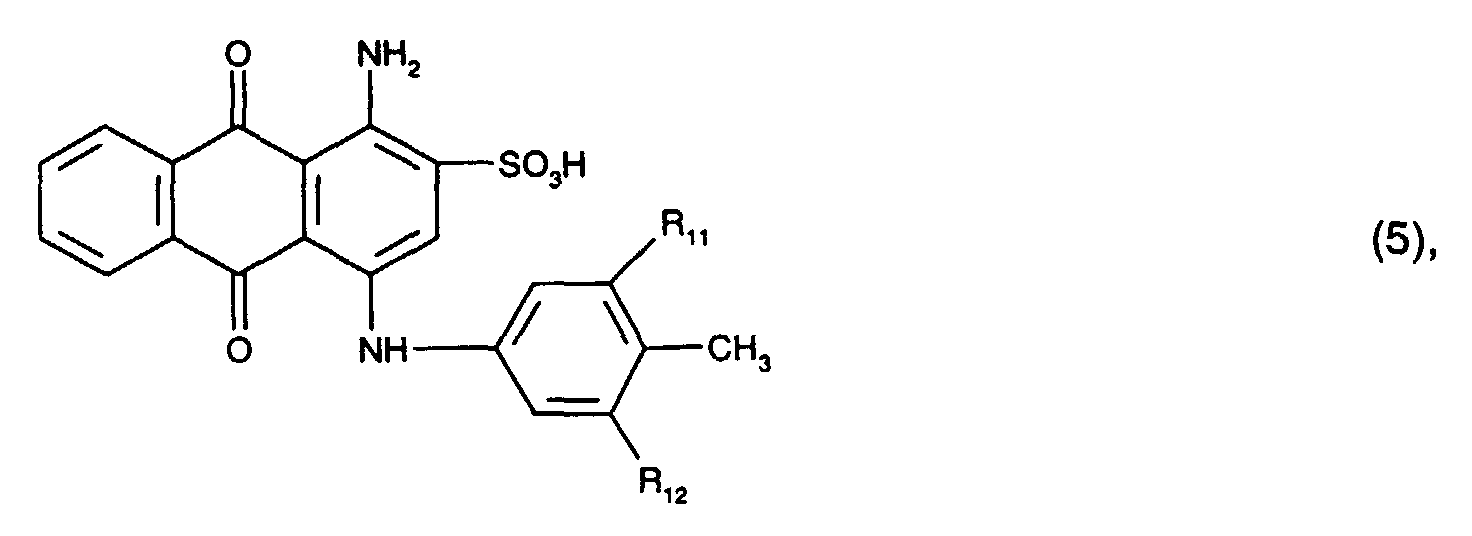 worin R11 Wasserstoff oder Methyl ist und R12 ein C2-4-Hydroxyalkylsulphamoylrest ist,
 worin R13 C1-C4-Alkyl ist,
enthalten.
Priority Applications (1)
| Application Number | Priority Date | Filing Date | Title |
|---|---|---|---|
| EP98124535A EP1013719A1 (de) | 1998-12-22 | 1998-12-22 | Verfahren zum Trichromie-Färben oder Bedrucken |
Applications Claiming Priority (1)
| Application Number | Priority Date | Filing Date | Title |
|---|---|---|---|
| EP98124535A EP1013719A1 (de) | 1998-12-22 | 1998-12-22 | Verfahren zum Trichromie-Färben oder Bedrucken |
Publications (1)
| Publication Number | Publication Date |
|---|---|
| EP1013719A1 true EP1013719A1 (de) | 2000-06-28 |
Family
ID=8233227
Family Applications (1)
| Application Number | Title | Priority Date | Filing Date |
|---|---|---|---|
| EP98124535A Withdrawn EP1013719A1 (de) | 1998-12-22 | 1998-12-22 | Verfahren zum Trichromie-Färben oder Bedrucken |
Country Status (1)
| Country | Link |
|---|---|
| EP (1) | EP1013719A1 (de) |
Cited By (2)
| Publication number | Priority date | Publication date | Assignee | Title |
|---|---|---|---|---|
| CN1298789C (zh) * | 2003-08-15 | 2007-02-07 | 上海染料化工八厂 | 一种蓝色染料组合物的制备及应用 |
| CN102807773A (zh) * | 2012-08-01 | 2012-12-05 | 上海雅运纺织化工股份有限公司 | 蓝色染料组合物及其在纤维上的染色应用 |
Citations (2)
| Publication number | Priority date | Publication date | Assignee | Title |
|---|---|---|---|---|
| EP0595768A1 (de) * | 1992-10-26 | 1994-05-04 | Ciba-Geigy Ag | Azofarbstoffe, Verfahren zu deren Herstellung und deren Verwendung |
| EP0823505A1 (de) * | 1996-07-12 | 1998-02-11 | Ciba SC Holding AG | Verfahren zum Trichromie-Färben oder -Bedrucken |
-
1998
- 1998-12-22 EP EP98124535A patent/EP1013719A1/de not_active Withdrawn
Patent Citations (2)
| Publication number | Priority date | Publication date | Assignee | Title |
|---|---|---|---|---|
| EP0595768A1 (de) * | 1992-10-26 | 1994-05-04 | Ciba-Geigy Ag | Azofarbstoffe, Verfahren zu deren Herstellung und deren Verwendung |
| EP0823505A1 (de) * | 1996-07-12 | 1998-02-11 | Ciba SC Holding AG | Verfahren zum Trichromie-Färben oder -Bedrucken |
Cited By (3)
| Publication number | Priority date | Publication date | Assignee | Title |
|---|---|---|---|---|
| CN1298789C (zh) * | 2003-08-15 | 2007-02-07 | 上海染料化工八厂 | 一种蓝色染料组合物的制备及应用 |
| CN102807773A (zh) * | 2012-08-01 | 2012-12-05 | 上海雅运纺织化工股份有限公司 | 蓝色染料组合物及其在纤维上的染色应用 |
| CN102807773B (zh) * | 2012-08-01 | 2014-04-02 | 上海雅运纺织化工股份有限公司 | 蓝色染料组合物及其在纤维上的染色应用 |
Similar Documents
| Publication | Publication Date | Title |
|---|---|---|
| EP0719837B1 (de) | Azofarbstoffe, Verfahren zu deren Herstellung und deren Verwendung | |
| EP0658605B1 (de) | Verfahren zum Trichromie-Färben oder -Bedrucken | |
| EP0823505B1 (de) | Verfahren zum Trichromie-Färben oder -Bedrucken | |
| EP0527704B1 (de) | Farbstoffe, Verfahren zu deren Herstellung und deren Verwendung | |
| EP0718374B1 (de) | 1:2-Chromkomplexfarbstoffe enthaltende Farbstoffmischungen und 1:2 Chromkomplexfarbstoffe | |
| EP0657508A1 (de) | Reaktivfarbstoffe, Verfahren zu deren Herstellung und deren Verwendung | |
| EP0754732B1 (de) | Azofarbstoffe, Verfahren zu deren Herstellung und deren Verwendung | |
| EP0808940B1 (de) | Verfahren zum Trichromie-Färben oder-Bedrucken | |
| EP0524148B1 (de) | Farbstoffmischungen und deren Verwendung | |
| EP0271893B1 (de) | Cyangruppenhaltige Azoverbindungen, Verfahren zu deren Herstellung und ihre Verwendung als Farbstoffe | |
| EP0675171B1 (de) | Reaktivfarbstoffe, Verfahren zu deren Herstellung und deren Verwendung | |
| EP0651028B1 (de) | Verfahren zum Trichromie-Färben oder -Bedrucken | |
| EP0595768B1 (de) | Azofarbstoffe, Verfahren zu deren Herstellung und deren Verwendung | |
| EP0601971B1 (de) | Verfahren zum Trichromie-Färben oder -Bedrucken | |
| EP0739952B1 (de) | Azofarbstoffmischungen und deren Verwendung | |
| EP1081196B1 (de) | Verfahren zum Färben oder Bedrucken von polyamidhaltigen Materialien | |
| EP0524147B1 (de) | Azofarbstoffe, Verfahren zu deren Herstellung und deren Verwendung | |
| EP0625550B1 (de) | Farbstoffmischungen, 1:2-Kobaltkomplexformazanfarbstoffe und deren Verwendung | |
| EP0439423B1 (de) | Azofarbstoffe, Verfahren zu deren Herstellung und deren Verwendung | |
| EP0586339B1 (de) | Azofarbstoffe, Verfahren zu deren Herstellung und deren Verwendung | |
| EP0457729B1 (de) | Azofarbstoffe, Verfahren zu deren Herstellung und deren Verwendung | |
| EP0524149B1 (de) | Azofarbstoffe, Verfahren zu deren Herstellung und deren Verwendung | |
| EP0601970A1 (de) | Anthrachinonfarbstoffe, Verfahren zu deren Herstellung und deren Verwendung | |
| CH628667A5 (en) | Process for preparing anionic disazo compounds | |
| EP1054040B1 (de) | Azofarbstoffe, Verfahren zu deren Herstellung und deren Verwendung zum Färben oder Bedrucken von natürlichen oder synthetischen Materialien |
Legal Events
| Date | Code | Title | Description |
|---|---|---|---|
| PUAI | Public reference made under article 153(3) epc to a published international application that has entered the european phase |
Free format text: ORIGINAL CODE: 0009012 |
|
| AK | Designated contracting states |
Kind code of ref document: A1 Designated state(s): AT BE CH CY DE DK ES FI FR GB GR IE IT LI LU MC NL PT SE |
|
| AX | Request for extension of the european patent |
Free format text: AL;LT;LV;MK;RO;SI |
|
| STAA | Information on the status of an ep patent application or granted ep patent |
Free format text: STATUS: THE APPLICATION HAS BEEN WITHDRAWN |
|
| 18W | Application withdrawn |
Withdrawal date: 20000710 |