EP1013775A1 - Quantitative Polymerase-Kettenreaktion mittels fluorogenen Echtzeiterfassungssystem - Google Patents
Quantitative Polymerase-Kettenreaktion mittels fluorogenen Echtzeiterfassungssystem Download PDFInfo
- Publication number
- EP1013775A1 EP1013775A1 EP98124317A EP98124317A EP1013775A1 EP 1013775 A1 EP1013775 A1 EP 1013775A1 EP 98124317 A EP98124317 A EP 98124317A EP 98124317 A EP98124317 A EP 98124317A EP 1013775 A1 EP1013775 A1 EP 1013775A1
- Authority
- EP
- European Patent Office
- Prior art keywords
- probe
- sequence
- pcr
- primers
- nucleic acid
- Prior art date
- Legal status (The legal status is an assumption and is not a legal conclusion. Google has not performed a legal analysis and makes no representation as to the accuracy of the status listed.)
- Withdrawn
Links
- 238000003753 real-time PCR Methods 0.000 title abstract description 7
- 238000011897 real-time detection Methods 0.000 title 1
- 239000000523 sample Substances 0.000 claims abstract description 227
- 244000052769 pathogen Species 0.000 claims abstract description 23
- 239000013615 primer Substances 0.000 claims description 120
- 238000000034 method Methods 0.000 claims description 84
- 108020004414 DNA Proteins 0.000 claims description 71
- 150000007523 nucleic acids Chemical class 0.000 claims description 37
- 238000009396 hybridization Methods 0.000 claims description 31
- 238000001514 detection method Methods 0.000 claims description 28
- 239000002987 primer (paints) Substances 0.000 claims description 27
- 125000003729 nucleotide group Chemical group 0.000 claims description 25
- 102000039446 nucleic acids Human genes 0.000 claims description 23
- 108020004707 nucleic acids Proteins 0.000 claims description 23
- 239000002773 nucleotide Substances 0.000 claims description 23
- 108091093088 Amplicon Proteins 0.000 claims description 22
- 108091034117 Oligonucleotide Proteins 0.000 claims description 22
- 230000000694 effects Effects 0.000 claims description 22
- 238000002844 melting Methods 0.000 claims description 21
- 230000008018 melting Effects 0.000 claims description 21
- 230000000295 complement effect Effects 0.000 claims description 20
- 230000001717 pathogenic effect Effects 0.000 claims description 18
- 108091028043 Nucleic acid sequence Proteins 0.000 claims description 17
- 239000012634 fragment Substances 0.000 claims description 12
- 108020004635 Complementary DNA Proteins 0.000 claims description 11
- 230000015572 biosynthetic process Effects 0.000 claims description 11
- 238000010804 cDNA synthesis Methods 0.000 claims description 11
- 239000002299 complementary DNA Substances 0.000 claims description 11
- 238000011002 quantification Methods 0.000 claims description 10
- 238000003786 synthesis reaction Methods 0.000 claims description 8
- 238000000137 annealing Methods 0.000 claims description 7
- 238000004925 denaturation Methods 0.000 claims description 7
- 230000036425 denaturation Effects 0.000 claims description 7
- 102000053602 DNA Human genes 0.000 claims description 6
- 238000002372 labelling Methods 0.000 claims description 6
- 108010037497 3'-nucleotidase Proteins 0.000 claims description 5
- 108020005187 Oligonucleotide Probes Proteins 0.000 claims description 5
- 230000001419 dependent effect Effects 0.000 claims description 5
- 239000002751 oligonucleotide probe Substances 0.000 claims description 5
- 238000002944 PCR assay Methods 0.000 claims description 4
- 239000003795 chemical substances by application Substances 0.000 claims description 4
- 239000003155 DNA primer Substances 0.000 claims description 3
- 108700024394 Exon Proteins 0.000 claims description 3
- 239000003153 chemical reaction reagent Substances 0.000 claims description 3
- 230000000379 polymerizing effect Effects 0.000 claims description 3
- 230000001351 cycling effect Effects 0.000 claims description 2
- 238000011144 upstream manufacturing Methods 0.000 claims description 2
- 238000004458 analytical method Methods 0.000 abstract description 17
- 108020004999 messenger RNA Proteins 0.000 abstract description 6
- 108090000695 Cytokines Proteins 0.000 abstract description 5
- 102000004127 Cytokines Human genes 0.000 abstract description 4
- 230000006872 improvement Effects 0.000 abstract description 4
- 108090000623 proteins and genes Proteins 0.000 abstract description 4
- 102000004169 proteins and genes Human genes 0.000 abstract description 3
- 238000003752 polymerase chain reaction Methods 0.000 description 71
- 241000713800 Feline immunodeficiency virus Species 0.000 description 62
- 239000013612 plasmid Substances 0.000 description 51
- 230000003321 amplification Effects 0.000 description 45
- 238000003199 nucleic acid amplification method Methods 0.000 description 45
- 238000010790 dilution Methods 0.000 description 44
- 239000012895 dilution Substances 0.000 description 44
- 238000003757 reverse transcription PCR Methods 0.000 description 35
- 238000003556 assay Methods 0.000 description 27
- 108091032973 (ribonucleotides)n+m Proteins 0.000 description 24
- 238000006243 chemical reaction Methods 0.000 description 23
- 239000000047 product Substances 0.000 description 18
- 241000700605 Viruses Species 0.000 description 15
- 238000004113 cell culture Methods 0.000 description 13
- 238000011109 contamination Methods 0.000 description 13
- 239000012228 culture supernatant Substances 0.000 description 13
- 230000035945 sensitivity Effects 0.000 description 12
- 238000012360 testing method Methods 0.000 description 12
- 241000282326 Felis catus Species 0.000 description 11
- 238000010839 reverse transcription Methods 0.000 description 11
- 241000711506 Canine coronavirus Species 0.000 description 10
- 241000711493 Porcine respiratory coronavirus Species 0.000 description 10
- 238000013459 approach Methods 0.000 description 10
- 241000894007 species Species 0.000 description 10
- 241000711484 Transmissible gastroenteritis virus Species 0.000 description 9
- 230000009260 cross reactivity Effects 0.000 description 9
- 230000001965 increasing effect Effects 0.000 description 9
- 102000004190 Enzymes Human genes 0.000 description 8
- 108090000790 Enzymes Proteins 0.000 description 8
- 244000309467 Human Coronavirus Species 0.000 description 8
- 101710163270 Nuclease Proteins 0.000 description 8
- 229960005486 vaccine Drugs 0.000 description 8
- 241000711573 Coronaviridae Species 0.000 description 7
- 238000012864 cross contamination Methods 0.000 description 7
- 201000010099 disease Diseases 0.000 description 7
- 208000037265 diseases, disorders, signs and symptoms Diseases 0.000 description 7
- 238000007478 fluorogenic assay Methods 0.000 description 7
- 241000282324 Felis Species 0.000 description 6
- 230000008901 benefit Effects 0.000 description 6
- 238000004364 calculation method Methods 0.000 description 6
- 244000309466 calf Species 0.000 description 6
- 238000003776 cleavage reaction Methods 0.000 description 6
- 230000002860 competitive effect Effects 0.000 description 6
- 238000011156 evaluation Methods 0.000 description 6
- 230000035772 mutation Effects 0.000 description 6
- 230000008569 process Effects 0.000 description 6
- 230000007017 scission Effects 0.000 description 6
- 210000001541 thymus gland Anatomy 0.000 description 6
- 108010014303 DNA-directed DNA polymerase Proteins 0.000 description 5
- 102000016928 DNA-directed DNA polymerase Human genes 0.000 description 5
- 241000283073 Equus caballus Species 0.000 description 5
- 241001135549 Porcine epidemic diarrhea virus Species 0.000 description 5
- 108010006785 Taq Polymerase Proteins 0.000 description 5
- 241000589499 Thermus thermophilus Species 0.000 description 5
- 108020000999 Viral RNA Proteins 0.000 description 5
- 230000009977 dual effect Effects 0.000 description 5
- 238000002474 experimental method Methods 0.000 description 5
- 238000010438 heat treatment Methods 0.000 description 5
- 208000015181 infectious disease Diseases 0.000 description 5
- 239000000203 mixture Substances 0.000 description 5
- 210000003819 peripheral blood mononuclear cell Anatomy 0.000 description 5
- 238000011084 recovery Methods 0.000 description 5
- BZTDTCNHAFUJOG-UHFFFAOYSA-N 6-carboxyfluorescein Chemical compound C12=CC=C(O)C=C2OC2=CC(O)=CC=C2C11OC(=O)C2=CC=C(C(=O)O)C=C21 BZTDTCNHAFUJOG-UHFFFAOYSA-N 0.000 description 4
- 241000208199 Buxus sempervirens Species 0.000 description 4
- 102100031181 Glyceraldehyde-3-phosphate dehydrogenase Human genes 0.000 description 4
- 102100034343 Integrase Human genes 0.000 description 4
- 241001465754 Metazoa Species 0.000 description 4
- 108010092799 RNA-directed DNA polymerase Proteins 0.000 description 4
- JLCPHMBAVCMARE-UHFFFAOYSA-N [3-[[3-[[3-[[3-[[3-[[3-[[3-[[3-[[3-[[3-[[3-[[5-(2-amino-6-oxo-1H-purin-9-yl)-3-[[3-[[3-[[3-[[3-[[3-[[5-(2-amino-6-oxo-1H-purin-9-yl)-3-[[5-(2-amino-6-oxo-1H-purin-9-yl)-3-hydroxyoxolan-2-yl]methoxy-hydroxyphosphoryl]oxyoxolan-2-yl]methoxy-hydroxyphosphoryl]oxy-5-(5-methyl-2,4-dioxopyrimidin-1-yl)oxolan-2-yl]methoxy-hydroxyphosphoryl]oxy-5-(6-aminopurin-9-yl)oxolan-2-yl]methoxy-hydroxyphosphoryl]oxy-5-(6-aminopurin-9-yl)oxolan-2-yl]methoxy-hydroxyphosphoryl]oxy-5-(6-aminopurin-9-yl)oxolan-2-yl]methoxy-hydroxyphosphoryl]oxy-5-(6-aminopurin-9-yl)oxolan-2-yl]methoxy-hydroxyphosphoryl]oxyoxolan-2-yl]methoxy-hydroxyphosphoryl]oxy-5-(5-methyl-2,4-dioxopyrimidin-1-yl)oxolan-2-yl]methoxy-hydroxyphosphoryl]oxy-5-(4-amino-2-oxopyrimidin-1-yl)oxolan-2-yl]methoxy-hydroxyphosphoryl]oxy-5-(5-methyl-2,4-dioxopyrimidin-1-yl)oxolan-2-yl]methoxy-hydroxyphosphoryl]oxy-5-(5-methyl-2,4-dioxopyrimidin-1-yl)oxolan-2-yl]methoxy-hydroxyphosphoryl]oxy-5-(6-aminopurin-9-yl)oxolan-2-yl]methoxy-hydroxyphosphoryl]oxy-5-(6-aminopurin-9-yl)oxolan-2-yl]methoxy-hydroxyphosphoryl]oxy-5-(4-amino-2-oxopyrimidin-1-yl)oxolan-2-yl]methoxy-hydroxyphosphoryl]oxy-5-(4-amino-2-oxopyrimidin-1-yl)oxolan-2-yl]methoxy-hydroxyphosphoryl]oxy-5-(4-amino-2-oxopyrimidin-1-yl)oxolan-2-yl]methoxy-hydroxyphosphoryl]oxy-5-(6-aminopurin-9-yl)oxolan-2-yl]methoxy-hydroxyphosphoryl]oxy-5-(4-amino-2-oxopyrimidin-1-yl)oxolan-2-yl]methyl [5-(6-aminopurin-9-yl)-2-(hydroxymethyl)oxolan-3-yl] hydrogen phosphate Polymers Cc1cn(C2CC(OP(O)(=O)OCC3OC(CC3OP(O)(=O)OCC3OC(CC3O)n3cnc4c3nc(N)[nH]c4=O)n3cnc4c3nc(N)[nH]c4=O)C(COP(O)(=O)OC3CC(OC3COP(O)(=O)OC3CC(OC3COP(O)(=O)OC3CC(OC3COP(O)(=O)OC3CC(OC3COP(O)(=O)OC3CC(OC3COP(O)(=O)OC3CC(OC3COP(O)(=O)OC3CC(OC3COP(O)(=O)OC3CC(OC3COP(O)(=O)OC3CC(OC3COP(O)(=O)OC3CC(OC3COP(O)(=O)OC3CC(OC3COP(O)(=O)OC3CC(OC3COP(O)(=O)OC3CC(OC3COP(O)(=O)OC3CC(OC3COP(O)(=O)OC3CC(OC3COP(O)(=O)OC3CC(OC3COP(O)(=O)OC3CC(OC3CO)n3cnc4c(N)ncnc34)n3ccc(N)nc3=O)n3cnc4c(N)ncnc34)n3ccc(N)nc3=O)n3ccc(N)nc3=O)n3ccc(N)nc3=O)n3cnc4c(N)ncnc34)n3cnc4c(N)ncnc34)n3cc(C)c(=O)[nH]c3=O)n3cc(C)c(=O)[nH]c3=O)n3ccc(N)nc3=O)n3cc(C)c(=O)[nH]c3=O)n3cnc4c3nc(N)[nH]c4=O)n3cnc4c(N)ncnc34)n3cnc4c(N)ncnc34)n3cnc4c(N)ncnc34)n3cnc4c(N)ncnc34)O2)c(=O)[nH]c1=O JLCPHMBAVCMARE-UHFFFAOYSA-N 0.000 description 4
- 230000027455 binding Effects 0.000 description 4
- 238000001816 cooling Methods 0.000 description 4
- 230000007423 decrease Effects 0.000 description 4
- 230000003247 decreasing effect Effects 0.000 description 4
- 238000003745 diagnosis Methods 0.000 description 4
- 239000003814 drug Substances 0.000 description 4
- 239000012530 fluid Substances 0.000 description 4
- 108020004445 glyceraldehyde-3-phosphate dehydrogenase Proteins 0.000 description 4
- 238000010348 incorporation Methods 0.000 description 4
- 238000012163 sequencing technique Methods 0.000 description 4
- COCMHKNAGZHBDZ-UHFFFAOYSA-N 4-carboxy-3-[3-(dimethylamino)-6-dimethylazaniumylidenexanthen-9-yl]benzoate Chemical compound C=12C=CC(=[N+](C)C)C=C2OC2=CC(N(C)C)=CC=C2C=1C1=CC(C([O-])=O)=CC=C1C(O)=O COCMHKNAGZHBDZ-UHFFFAOYSA-N 0.000 description 3
- 101150028631 7b gene Proteins 0.000 description 3
- 208000030507 AIDS Diseases 0.000 description 3
- 241000589968 Borrelia Species 0.000 description 3
- 241000712083 Canine morbillivirus Species 0.000 description 3
- 241000588724 Escherichia coli Species 0.000 description 3
- 241000711475 Feline infectious peritonitis virus Species 0.000 description 3
- 208000016604 Lyme disease Diseases 0.000 description 3
- 241000604972 Neorickettsia risticii Species 0.000 description 3
- 238000012300 Sequence Analysis Methods 0.000 description 3
- 241000589500 Thermus aquaticus Species 0.000 description 3
- 238000000605 extraction Methods 0.000 description 3
- 210000003608 fece Anatomy 0.000 description 3
- 238000001502 gel electrophoresis Methods 0.000 description 3
- 230000001939 inductive effect Effects 0.000 description 3
- 239000003550 marker Substances 0.000 description 3
- 238000007857 nested PCR Methods 0.000 description 3
- 239000013076 target substance Substances 0.000 description 3
- ABZLKHKQJHEPAX-UHFFFAOYSA-N tetramethylrhodamine Chemical compound C=12C=CC(N(C)C)=CC2=[O+]C2=CC(N(C)C)=CC=C2C=1C1=CC=CC=C1C([O-])=O ABZLKHKQJHEPAX-UHFFFAOYSA-N 0.000 description 3
- 238000013518 transcription Methods 0.000 description 3
- 230000035897 transcription Effects 0.000 description 3
- 238000012546 transfer Methods 0.000 description 3
- 239000001226 triphosphate Substances 0.000 description 3
- 235000011178 triphosphate Nutrition 0.000 description 3
- 125000002264 triphosphate group Chemical class [H]OP(=O)(O[H])OP(=O)(O[H])OP(=O)(O[H])O* 0.000 description 3
- 230000003612 virological effect Effects 0.000 description 3
- YBJHBAHKTGYVGT-ZKWXMUAHSA-N (+)-Biotin Chemical compound N1C(=O)N[C@@H]2[C@H](CCCCC(=O)O)SC[C@@H]21 YBJHBAHKTGYVGT-ZKWXMUAHSA-N 0.000 description 2
- 206010003445 Ascites Diseases 0.000 description 2
- 241000894006 Bacteria Species 0.000 description 2
- 241001518086 Bartonella henselae Species 0.000 description 2
- 102100035875 C-C chemokine receptor type 5 Human genes 0.000 description 2
- 101710149870 C-C chemokine receptor type 5 Proteins 0.000 description 2
- 241000196324 Embryophyta Species 0.000 description 2
- 108700039887 Essential Genes Proteins 0.000 description 2
- 229920001917 Ficoll Polymers 0.000 description 2
- 241000589602 Francisella tularensis Species 0.000 description 2
- 241000193385 Geobacillus stearothermophilus Species 0.000 description 2
- 241000282414 Homo sapiens Species 0.000 description 2
- 241000725303 Human immunodeficiency virus Species 0.000 description 2
- 102000003814 Interleukin-10 Human genes 0.000 description 2
- 108090000174 Interleukin-10 Proteins 0.000 description 2
- 102000013462 Interleukin-12 Human genes 0.000 description 2
- 108010065805 Interleukin-12 Proteins 0.000 description 2
- 108090000978 Interleukin-4 Proteins 0.000 description 2
- 102000004388 Interleukin-4 Human genes 0.000 description 2
- 108090001005 Interleukin-6 Proteins 0.000 description 2
- KFZMGEQAYNKOFK-UHFFFAOYSA-N Isopropanol Chemical compound CC(C)O KFZMGEQAYNKOFK-UHFFFAOYSA-N 0.000 description 2
- 241000186779 Listeria monocytogenes Species 0.000 description 2
- TWRXJAOTZQYOKJ-UHFFFAOYSA-L Magnesium chloride Chemical compound [Mg+2].[Cl-].[Cl-] TWRXJAOTZQYOKJ-UHFFFAOYSA-L 0.000 description 2
- CSNNHWWHGAXBCP-UHFFFAOYSA-L Magnesium sulfate Chemical compound [Mg+2].[O-][S+2]([O-])([O-])[O-] CSNNHWWHGAXBCP-UHFFFAOYSA-L 0.000 description 2
- 241000124008 Mammalia Species 0.000 description 2
- 101710089543 Nitric oxide synthase, inducible Proteins 0.000 description 2
- 102100029438 Nitric oxide synthase, inducible Human genes 0.000 description 2
- 239000012807 PCR reagent Substances 0.000 description 2
- 241000589596 Thermus Species 0.000 description 2
- 238000009825 accumulation Methods 0.000 description 2
- 238000000246 agarose gel electrophoresis Methods 0.000 description 2
- 230000000903 blocking effect Effects 0.000 description 2
- 239000000872 buffer Substances 0.000 description 2
- 210000004027 cell Anatomy 0.000 description 2
- YTRQFSDWAXHJCC-UHFFFAOYSA-N chloroform;phenol Chemical compound ClC(Cl)Cl.OC1=CC=CC=C1 YTRQFSDWAXHJCC-UHFFFAOYSA-N 0.000 description 2
- 238000007405 data analysis Methods 0.000 description 2
- FFYPMLJYZAEMQB-UHFFFAOYSA-N diethyl pyrocarbonate Chemical compound CCOC(=O)OC(=O)OCC FFYPMLJYZAEMQB-UHFFFAOYSA-N 0.000 description 2
- 239000000539 dimer Substances 0.000 description 2
- 229940079593 drug Drugs 0.000 description 2
- 230000008030 elimination Effects 0.000 description 2
- 238000003379 elimination reaction Methods 0.000 description 2
- 230000003721 exogen phase Effects 0.000 description 2
- 230000002349 favourable effect Effects 0.000 description 2
- 229940118764 francisella tularensis Drugs 0.000 description 2
- 108700004026 gag Genes Proteins 0.000 description 2
- 101150098622 gag gene Proteins 0.000 description 2
- 239000000499 gel Substances 0.000 description 2
- 230000036541 health Effects 0.000 description 2
- 229910052739 hydrogen Inorganic materials 0.000 description 2
- 239000001257 hydrogen Substances 0.000 description 2
- 239000012535 impurity Substances 0.000 description 2
- 230000003993 interaction Effects 0.000 description 2
- -1 interferone gamma Proteins 0.000 description 2
- 238000004020 luminiscence type Methods 0.000 description 2
- 239000002245 particle Substances 0.000 description 2
- 125000002467 phosphate group Chemical group [H]OP(=O)(O[H])O[*] 0.000 description 2
- 238000002360 preparation method Methods 0.000 description 2
- 230000000171 quenching effect Effects 0.000 description 2
- 239000011541 reaction mixture Substances 0.000 description 2
- 230000002829 reductive effect Effects 0.000 description 2
- 238000011160 research Methods 0.000 description 2
- PYWVYCXTNDRMGF-UHFFFAOYSA-N rhodamine B Chemical compound [Cl-].C=12C=CC(=[N+](CC)CC)C=C2OC2=CC(N(CC)CC)=CC=C2C=1C1=CC=CC=C1C(O)=O PYWVYCXTNDRMGF-UHFFFAOYSA-N 0.000 description 2
- 239000002594 sorbent Substances 0.000 description 2
- 238000007619 statistical method Methods 0.000 description 2
- 238000004659 sterilization and disinfection Methods 0.000 description 2
- 239000000126 substance Substances 0.000 description 2
- 239000000725 suspension Substances 0.000 description 2
- 210000001519 tissue Anatomy 0.000 description 2
- XLYOFNOQVPJJNP-UHFFFAOYSA-N water Substances O XLYOFNOQVPJJNP-UHFFFAOYSA-N 0.000 description 2
- KFYNQHDEHFQNOD-MTLYETOXSA-N (2s,3r,4s,5r)-2-amino-2-(6-aminopurin-9-yl)-5-(hydroxymethyl)oxolane-3,4-diol;7h-purine-2,6-diamine Chemical class NC1=NC(N)=C2NC=NC2=N1.C1=NC=2C(N)=NC=NC=2N1[C@]1(N)O[C@H](CO)[C@@H](O)[C@H]1O KFYNQHDEHFQNOD-MTLYETOXSA-N 0.000 description 1
- 102000040650 (ribonucleotides)n+m Human genes 0.000 description 1
- QKNYBSVHEMOAJP-UHFFFAOYSA-N 2-amino-2-(hydroxymethyl)propane-1,3-diol;hydron;chloride Chemical compound Cl.OCC(N)(CO)CO QKNYBSVHEMOAJP-UHFFFAOYSA-N 0.000 description 1
- BFSVOASYOCHEOV-UHFFFAOYSA-N 2-diethylaminoethanol Chemical compound CCN(CC)CCO BFSVOASYOCHEOV-UHFFFAOYSA-N 0.000 description 1
- OCKGFTQIICXDQW-ZEQRLZLVSA-N 5-[(1r)-1-hydroxy-2-[4-[(2r)-2-hydroxy-2-(4-methyl-1-oxo-3h-2-benzofuran-5-yl)ethyl]piperazin-1-yl]ethyl]-4-methyl-3h-2-benzofuran-1-one Chemical compound C1=C2C(=O)OCC2=C(C)C([C@@H](O)CN2CCN(CC2)C[C@H](O)C2=CC=C3C(=O)OCC3=C2C)=C1 OCKGFTQIICXDQW-ZEQRLZLVSA-N 0.000 description 1
- AGFIRQJZCNVMCW-UAKXSSHOSA-N 5-bromouridine Chemical compound O[C@@H]1[C@H](O)[C@@H](CO)O[C@H]1N1C(=O)NC(=O)C(Br)=C1 AGFIRQJZCNVMCW-UAKXSSHOSA-N 0.000 description 1
- 241000238876 Acari Species 0.000 description 1
- 241000605281 Anaplasma phagocytophilum Species 0.000 description 1
- 241000713838 Avian myeloblastosis virus Species 0.000 description 1
- 241000537222 Betabaculovirus Species 0.000 description 1
- 241000908522 Borreliella Species 0.000 description 1
- 241001148604 Borreliella afzelii Species 0.000 description 1
- 241001148605 Borreliella garinii Species 0.000 description 1
- 102000019034 Chemokines Human genes 0.000 description 1
- 108010012236 Chemokines Proteins 0.000 description 1
- 238000007400 DNA extraction Methods 0.000 description 1
- 230000004543 DNA replication Effects 0.000 description 1
- 230000006820 DNA synthesis Effects 0.000 description 1
- 102000016911 Deoxyribonucleases Human genes 0.000 description 1
- 108010053770 Deoxyribonucleases Proteins 0.000 description 1
- 238000009007 Diagnostic Kit Methods 0.000 description 1
- 241000605314 Ehrlichia Species 0.000 description 1
- 108060002716 Exonuclease Proteins 0.000 description 1
- 241000701087 Felid alphaherpesvirus 1 Species 0.000 description 1
- 241000725579 Feline coronavirus Species 0.000 description 1
- 241000710831 Flavivirus Species 0.000 description 1
- 241000589601 Francisella Species 0.000 description 1
- HTTJABKRGRZYRN-UHFFFAOYSA-N Heparin Chemical compound OC1C(NC(=O)C)C(O)OC(COS(O)(=O)=O)C1OC1C(OS(O)(=O)=O)C(O)C(OC2C(C(OS(O)(=O)=O)C(OC3C(C(O)C(O)C(O3)C(O)=O)OS(O)(=O)=O)C(CO)O2)NS(O)(=O)=O)C(C(O)=O)O1 HTTJABKRGRZYRN-UHFFFAOYSA-N 0.000 description 1
- 241000711467 Human coronavirus 229E Species 0.000 description 1
- 102100037850 Interferon gamma Human genes 0.000 description 1
- 108010074328 Interferon-gamma Proteins 0.000 description 1
- 241000713666 Lentivirus Species 0.000 description 1
- 239000006391 Luria-Bertani Medium Substances 0.000 description 1
- 108091027974 Mature messenger RNA Proteins 0.000 description 1
- 241000589496 Meiothermus ruber Species 0.000 description 1
- 241000203367 Methanothermus fervidus Species 0.000 description 1
- 241000712045 Morbillivirus Species 0.000 description 1
- 206010028980 Neoplasm Diseases 0.000 description 1
- 108091005461 Nucleic proteins Proteins 0.000 description 1
- 238000012408 PCR amplification Methods 0.000 description 1
- 102000006382 Ribonucleases Human genes 0.000 description 1
- 108010083644 Ribonucleases Proteins 0.000 description 1
- 108091028664 Ribonucleotide Proteins 0.000 description 1
- 241000606701 Rickettsia Species 0.000 description 1
- 108020004682 Single-Stranded DNA Proteins 0.000 description 1
- 241000205180 Thermococcus litoralis Species 0.000 description 1
- 241000204666 Thermotoga maritima Species 0.000 description 1
- 108010085671 Thermus thermophilus DNA polymerase Proteins 0.000 description 1
- 241001529801 Tick-borne flavivirus Species 0.000 description 1
- 108010001244 Tli polymerase Proteins 0.000 description 1
- 108020004566 Transfer RNA Proteins 0.000 description 1
- 239000007984 Tris EDTA buffer Substances 0.000 description 1
- 239000007983 Tris buffer Substances 0.000 description 1
- 229920004890 Triton X-100 Polymers 0.000 description 1
- 239000013504 Triton X-100 Substances 0.000 description 1
- 102000006943 Uracil-DNA Glycosidase Human genes 0.000 description 1
- 108010072685 Uracil-DNA Glycosidase Proteins 0.000 description 1
- 239000002253 acid Substances 0.000 description 1
- 150000003838 adenosines Chemical class 0.000 description 1
- 239000011543 agarose gel Substances 0.000 description 1
- 238000011166 aliquoting Methods 0.000 description 1
- AVKUERGKIZMTKX-NJBDSQKTSA-N ampicillin Chemical compound C1([C@@H](N)C(=O)N[C@H]2[C@H]3SC([C@@H](N3C2=O)C(O)=O)(C)C)=CC=CC=C1 AVKUERGKIZMTKX-NJBDSQKTSA-N 0.000 description 1
- 229960000723 ampicillin Drugs 0.000 description 1
- 238000010171 animal model Methods 0.000 description 1
- 230000000852 anti-lentiviral effect Effects 0.000 description 1
- 230000000798 anti-retroviral effect Effects 0.000 description 1
- 244000052616 bacterial pathogen Species 0.000 description 1
- 229940092524 bartonella henselae Drugs 0.000 description 1
- 229960002685 biotin Drugs 0.000 description 1
- 235000020958 biotin Nutrition 0.000 description 1
- 239000011616 biotin Substances 0.000 description 1
- 210000004369 blood Anatomy 0.000 description 1
- 239000008280 blood Substances 0.000 description 1
- 210000000601 blood cell Anatomy 0.000 description 1
- 239000006143 cell culture medium Substances 0.000 description 1
- 230000010261 cell growth Effects 0.000 description 1
- 239000013592 cell lysate Substances 0.000 description 1
- 210000003850 cellular structure Anatomy 0.000 description 1
- 238000005119 centrifugation Methods 0.000 description 1
- 238000012512 characterization method Methods 0.000 description 1
- 238000004737 colorimetric analysis Methods 0.000 description 1
- 239000003636 conditioned culture medium Substances 0.000 description 1
- 239000000470 constituent Substances 0.000 description 1
- 239000013078 crystal Substances 0.000 description 1
- 230000000593 degrading effect Effects 0.000 description 1
- 238000013461 design Methods 0.000 description 1
- 238000011161 development Methods 0.000 description 1
- 239000005546 dideoxynucleotide Substances 0.000 description 1
- 230000029087 digestion Effects 0.000 description 1
- 238000006073 displacement reaction Methods 0.000 description 1
- 206010014599 encephalitis Diseases 0.000 description 1
- 230000002255 enzymatic effect Effects 0.000 description 1
- ZMMJGEGLRURXTF-UHFFFAOYSA-N ethidium bromide Chemical compound [Br-].C12=CC(N)=CC=C2C2=CC=C(N)C=C2[N+](CC)=C1C1=CC=CC=C1 ZMMJGEGLRURXTF-UHFFFAOYSA-N 0.000 description 1
- 229960005542 ethidium bromide Drugs 0.000 description 1
- 102000013165 exonuclease Human genes 0.000 description 1
- 230000014509 gene expression Effects 0.000 description 1
- 229960002897 heparin Drugs 0.000 description 1
- 229920000669 heparin Polymers 0.000 description 1
- 230000003301 hydrolyzing effect Effects 0.000 description 1
- 125000002887 hydroxy group Chemical group [H]O* 0.000 description 1
- 238000000338 in vitro Methods 0.000 description 1
- 238000012606 in vitro cell culture Methods 0.000 description 1
- 239000012678 infectious agent Substances 0.000 description 1
- 239000004615 ingredient Substances 0.000 description 1
- 230000002401 inhibitory effect Effects 0.000 description 1
- 230000002452 interceptive effect Effects 0.000 description 1
- 230000000670 limiting effect Effects 0.000 description 1
- 210000004880 lymph fluid Anatomy 0.000 description 1
- 229910001629 magnesium chloride Inorganic materials 0.000 description 1
- 229910052943 magnesium sulfate Inorganic materials 0.000 description 1
- 230000005389 magnetism Effects 0.000 description 1
- 239000000463 material Substances 0.000 description 1
- 238000005259 measurement Methods 0.000 description 1
- 239000002609 medium Substances 0.000 description 1
- MIKKOBKEXMRYFQ-WZTVWXICSA-N meglumine amidotrizoate Chemical compound C[NH2+]C[C@H](O)[C@@H](O)[C@H](O)[C@H](O)CO.CC(=O)NC1=C(I)C(NC(C)=O)=C(I)C(C([O-])=O)=C1I MIKKOBKEXMRYFQ-WZTVWXICSA-N 0.000 description 1
- 239000012528 membrane Substances 0.000 description 1
- 238000012544 monitoring process Methods 0.000 description 1
- 230000007935 neutral effect Effects 0.000 description 1
- 230000009871 nonspecific binding Effects 0.000 description 1
- 229920002114 octoxynol-9 Polymers 0.000 description 1
- 210000000056 organ Anatomy 0.000 description 1
- 230000008506 pathogenesis Effects 0.000 description 1
- 150000004713 phosphodiesters Chemical class 0.000 description 1
- UEZVMMHDMIWARA-UHFFFAOYSA-M phosphonate Chemical group [O-]P(=O)=O UEZVMMHDMIWARA-UHFFFAOYSA-M 0.000 description 1
- 238000006116 polymerization reaction Methods 0.000 description 1
- 230000001566 pro-viral effect Effects 0.000 description 1
- 238000012545 processing Methods 0.000 description 1
- 230000000644 propagated effect Effects 0.000 description 1
- 238000000746 purification Methods 0.000 description 1
- 238000010791 quenching Methods 0.000 description 1
- 230000002441 reversible effect Effects 0.000 description 1
- 239000002336 ribonucleotide Substances 0.000 description 1
- 125000002652 ribonucleotide group Chemical group 0.000 description 1
- 239000011435 rock Substances 0.000 description 1
- 239000004576 sand Substances 0.000 description 1
- 238000000926 separation method Methods 0.000 description 1
- 210000002966 serum Anatomy 0.000 description 1
- 230000011664 signaling Effects 0.000 description 1
- 108010068698 spleen exonuclease Proteins 0.000 description 1
- 238000010186 staining Methods 0.000 description 1
- 238000010561 standard procedure Methods 0.000 description 1
- 230000001954 sterilising effect Effects 0.000 description 1
- 238000006467 substitution reaction Methods 0.000 description 1
- 230000001629 suppression Effects 0.000 description 1
- 210000001179 synovial fluid Anatomy 0.000 description 1
- 230000008685 targeting Effects 0.000 description 1
- 210000001138 tear Anatomy 0.000 description 1
- 238000002560 therapeutic procedure Methods 0.000 description 1
- 230000005758 transcription activity Effects 0.000 description 1
- LENZDBCJOHFCAS-UHFFFAOYSA-N tris Chemical compound OCC(N)(CO)CO LENZDBCJOHFCAS-UHFFFAOYSA-N 0.000 description 1
- 241001529453 unidentified herpesvirus Species 0.000 description 1
- 210000002700 urine Anatomy 0.000 description 1
- 238000012795 verification Methods 0.000 description 1
- 239000002023 wood Substances 0.000 description 1
Images



Classifications
-
- C—CHEMISTRY; METALLURGY
- C12—BIOCHEMISTRY; BEER; SPIRITS; WINE; VINEGAR; MICROBIOLOGY; ENZYMOLOGY; MUTATION OR GENETIC ENGINEERING
- C12Q—MEASURING OR TESTING PROCESSES INVOLVING ENZYMES, NUCLEIC ACIDS OR MICROORGANISMS; COMPOSITIONS OR TEST PAPERS THEREFOR; PROCESSES OF PREPARING SUCH COMPOSITIONS; CONDITION-RESPONSIVE CONTROL IN MICROBIOLOGICAL OR ENZYMOLOGICAL PROCESSES
- C12Q1/00—Measuring or testing processes involving enzymes, nucleic acids or microorganisms; Compositions therefor; Processes of preparing such compositions
- C12Q1/68—Measuring or testing processes involving enzymes, nucleic acids or microorganisms; Compositions therefor; Processes of preparing such compositions involving nucleic acids
- C12Q1/6876—Nucleic acid products used in the analysis of nucleic acids, e.g. primers or probes
- C12Q1/6888—Nucleic acid products used in the analysis of nucleic acids, e.g. primers or probes for detection or identification of organisms
- C12Q1/689—Nucleic acid products used in the analysis of nucleic acids, e.g. primers or probes for detection or identification of organisms for bacteria
-
- C—CHEMISTRY; METALLURGY
- C12—BIOCHEMISTRY; BEER; SPIRITS; WINE; VINEGAR; MICROBIOLOGY; ENZYMOLOGY; MUTATION OR GENETIC ENGINEERING
- C12Q—MEASURING OR TESTING PROCESSES INVOLVING ENZYMES, NUCLEIC ACIDS OR MICROORGANISMS; COMPOSITIONS OR TEST PAPERS THEREFOR; PROCESSES OF PREPARING SUCH COMPOSITIONS; CONDITION-RESPONSIVE CONTROL IN MICROBIOLOGICAL OR ENZYMOLOGICAL PROCESSES
- C12Q1/00—Measuring or testing processes involving enzymes, nucleic acids or microorganisms; Compositions therefor; Processes of preparing such compositions
- C12Q1/68—Measuring or testing processes involving enzymes, nucleic acids or microorganisms; Compositions therefor; Processes of preparing such compositions involving nucleic acids
- C12Q1/6813—Hybridisation assays
- C12Q1/6816—Hybridisation assays characterised by the detection means
- C12Q1/6818—Hybridisation assays characterised by the detection means involving interaction of two or more labels, e.g. resonant energy transfer
-
- C—CHEMISTRY; METALLURGY
- C12—BIOCHEMISTRY; BEER; SPIRITS; WINE; VINEGAR; MICROBIOLOGY; ENZYMOLOGY; MUTATION OR GENETIC ENGINEERING
- C12Q—MEASURING OR TESTING PROCESSES INVOLVING ENZYMES, NUCLEIC ACIDS OR MICROORGANISMS; COMPOSITIONS OR TEST PAPERS THEREFOR; PROCESSES OF PREPARING SUCH COMPOSITIONS; CONDITION-RESPONSIVE CONTROL IN MICROBIOLOGICAL OR ENZYMOLOGICAL PROCESSES
- C12Q1/00—Measuring or testing processes involving enzymes, nucleic acids or microorganisms; Compositions therefor; Processes of preparing such compositions
- C12Q1/68—Measuring or testing processes involving enzymes, nucleic acids or microorganisms; Compositions therefor; Processes of preparing such compositions involving nucleic acids
- C12Q1/6813—Hybridisation assays
- C12Q1/6816—Hybridisation assays characterised by the detection means
- C12Q1/6823—Release of bound markers
-
- C—CHEMISTRY; METALLURGY
- C12—BIOCHEMISTRY; BEER; SPIRITS; WINE; VINEGAR; MICROBIOLOGY; ENZYMOLOGY; MUTATION OR GENETIC ENGINEERING
- C12Q—MEASURING OR TESTING PROCESSES INVOLVING ENZYMES, NUCLEIC ACIDS OR MICROORGANISMS; COMPOSITIONS OR TEST PAPERS THEREFOR; PROCESSES OF PREPARING SUCH COMPOSITIONS; CONDITION-RESPONSIVE CONTROL IN MICROBIOLOGICAL OR ENZYMOLOGICAL PROCESSES
- C12Q1/00—Measuring or testing processes involving enzymes, nucleic acids or microorganisms; Compositions therefor; Processes of preparing such compositions
- C12Q1/70—Measuring or testing processes involving enzymes, nucleic acids or microorganisms; Compositions therefor; Processes of preparing such compositions involving virus or bacteriophage
- C12Q1/701—Specific hybridization probes
Definitions
- the present invention concerns the characterization of assay conditions and specific nucleotide sequence for use in a quantitative PCR with enhanced rapidity and sensitivity.
- the invention concerns an improved one tube fluorogenic real time PCR method suited for the detection of infectious agents, the quantitation of mRNA expression and the detection of genetic mutations.
- qcPCR quantitative competitive PCR
- ELOSA Enzyme Linked Oligonucleotide Sorbent Assay
- the ratio of PCR products reflects the ratio between the initial amount of the two sequences allowing precise evaluation of the amount of wild-type template.
- Another approach is the end-point dilution PCR, a method that was among the first developed (Simmonds et al., 1990; Zhang et al., 1993).
- the described PCR approaches have several important drawbacks (Clementi et al., 1993): (i) In particular, the techniques require several amplification reactions per sample, thus, they are expensive and allow the analysis of only a few samples for each amplification run. (ii) The postamplification steps are time consuming and may lead to inaccuracy and contamination or carryover. (iii) Quantitation using end-point dilution assay narrows the linear range to three to four log decades (Sundfors and Collan 1996).
- a quantitative system comprising a dual-labeled fluorogenic probes e.g. described in WO 92/02638 the disclosure of which is incorporated herein by reference.
- dual-labeled fluorogenic probes are e.g. available as TaqManTM probe (TaqManTM, Perkin-Elmer Corp./Applied Biosystems, Foster City, California; Holland et al., 1991).
- the fluorogenic 5' nuclease PCR assay takes advantage of the endogenous 5'-3' nuclease activity of polymerases such as Taq DNA polymerase to digest the TaqManTM probe which hybridizes to the amplicon during PCR.
- the two fluorophores interact such that the emission of the reporter dye is quenched. Reporter and quencher in proximity results in suppression of reporter fluorescence of the intact probe by Förster-type energy transfer (Förster, 1948).
- Förster-type energy transfer Förster, 1948.
- the 5'-3' nuclease activity of Taq DNA polymerase releases the reporter from the vicinity of the quencher dye resulting in increased reporter fluorescence.
- Fluorescence intensity is directly related to the amount of input target DNA and can be detected with an automated fluorometer. Quantitation is accomplished by comparison of fluorescence signals obtained from samples with unknown amounts of nucleotide sequence to be amplified with the fluorescence signals obtained from standard dilutions of the target substance.
- the TaqManTM method provides essential advantages over the usual quantitative PCR methods, due to the use of usual probes and primers it has several drawbacks.
- the reliability and security of diagnosis is often limited due to the fact that closely related mutations, although leading to the same or a very similar disease, often are not detected or similar mutations are detected although only some of them are pathogenic.
- the hitherto used method is only suitable for a limited number of targets.
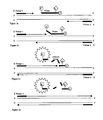
- Figure 1 shows the principles of the 5'-3' nuclease fluorogenic assay
- Figure 1a showing the polymerase chain reaction (PCR) forward primer 1, the PCR reverse primer 2 and the fluorogenic probe labeled with a reporter dye R and a quencher dye Q and 3' phosphate group P, all annealed to the DNA template.
- PCR polymerase chain reaction
- Figure 1b shows how upon polymerization the polymerase extends the primer and displaces the probe.
- Figure 1 c shows the cleavage of the displaced probe resulting in an increase in relative fluorescence of the reporter.
- Figure 1 d shows the completion of the polymerisation.
- FIG 2 shows the position of primers and probe in the sequence of the FCoV 7b gene (SEQ ID No 85).
- FIG 3 shows the conformity of the FCoV fluorogenic assay sequence (FCoVfa)with the sequence of canine coronavirus (CCV), transmissible gastroenteritis virus (TGEV), porcine respiratory coronavirus (PRCV), and human coronavirus 229E (HCV).
- FCoVfa FCoV fluorogenic assay sequence
- CCV canine coronavirus
- TGEV transmissible gastroenteritis virus
- PRCV porcine respiratory coronavirus
- HCV human coronavirus 229E
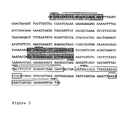
- Figure 5 shows the positions of the two FIV gag-specific probes and corresponding primers within the FIV gag-sequence of FIV Petaluma (GenBank accession no M25381)(SEQ ID No 86).
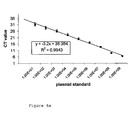
- Figure 6a shows the linearity of a dilution of standard molecules derived from FIV gag (see Fig. 5) over 8 log decades.
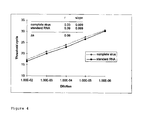
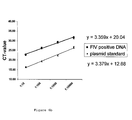
- Figure 6b shows the amplification efficiency of target DNA and standard plasmid with probe FIV581p.
- Figure 6c shows the results of a recovery experiment with standard plasmid spiked cell lysates and standard plasmid alone.
- Figure 6d shows the influence of carrier DNA (calf thymus DNA) with FIV581p: 50 molecules of standard plasmids were amplified in a PCR method according to the present invention with varying amounts of carrier DNA (6000 ⁇ g/ml - 5 ⁇ g/ml).
- Figure 7 shows the primer and probe sequences of Examples 3 to 26.
- telomere accumulation is measured through at least one specific label such as a label-system, e.g. a dual-labeled fluorogenic probe, and whereby the probe as well as the primers are designed to meet specific requirements.
- a label-system e.g. a dual-labeled fluorogenic probe
- the at least one probe of the present invention must meet the following requirements.
- pathogens can exist in form of slightly different isolates or mutants, respectively, all of which induce the same disease. In order to recognize such a disease or a risk for the outbreak of such disease it is of great importance to detect all possible variants of the respective pathogen. Using a usual probe, very often several analyses have to be performed in order to get all relevant mutants. On the other hand, there exist very similar mutants of which only part acts as a pathogen in a specific organism. For such mutants it is of interest to distinguish between the pathogenic and the non-pathogenic mutants.
- the detection is improved if the probe and primers lead to a total amplicon length of at most 300 bp, preferably of at most 350 bp, much preferred about 100 to about 225 bp.
- the minimal length possible must allow for the at least one nucleotide between the primer and the probe, and thus corresponds to the length of the two primers plus the length of the probe plus one further base.
- longer amplicons of at least about 100 bp are much preferred (see above).
- the short amplicon length preferred according to the present invention leads to several advantages such as very fast analysis cycles due to the fast termination of the amplification because of the shortness of the amplicon (the time needed for a full amplification is in the range of the heating time), and improved integrity (completeness) of the DNA sequence, therewith improving the reliability of the quantification of the pathogen.
- probes of the length as disclosed herein readily hybridize with sequences where the intron interrupting the "probe sequence" is spliced off, i.e. cDNA sequences derived from mature mRNA, whereby for genomic DNA no loop formation and therefore also no hybridization was found.
- the requirement that the probe is selected from two exons ensures that only intron free DNA is measured, i.e. cDNA derived from mRNA, and not also genomic DNA.
- crosscontamination can largely be prevented by performing all pipetting in a laminar flow hood.
- the present invention provides a method for the identification and quantification of at least one pathogen in a sample, said method being performed on the DNA level, and said method comprising:
- the length is at least about 20 nucleic acids and the minimal hybridization force is about 50, calculated as the sum of all hydrogen bonds, e.g. 3 bonds for each C or G and 2 bonds for each A or T.
- the length of the probe is dependent on the mismatches of mutants to be covered or eliminated, respectively, whereby the hybridization force of the probe must be greater for more mismatches.
- the mismatches reduce the hybridization to an extent of not more but 20 %, much preferably not more but 15 %, whereby the minimal hybridization force was determined to be about 50.
- a sample comprising a target can be any substance containing or presumed to contain a nucleic acid target and includes a sample of tissue or fluid isolated from an individual or individuals, including but not limited to, for example, skin, plasma, serum, spinal fluid, lymph fluid, synovial fluid, urine, tears, blood cells, organs, tumors, and also to samples of in vitro cell culture constituents (including but not limited to conditioned medium resulting from the growth of cells in cell culture medium, recombinant cells and cell components), and to material in the environment including but not limited to for example, plants, wood, rock, sand, etc.
- a set of primers refers to two primers, one for each strand of a double-stranded nucleic acid sequence.
- Primers and probes preferably are DNA oligonucleotides, whereby specific nucleic acids can be present in one or both of the primers of a set and/or in a probe in order to provide them with specific features.
- the primers and probes are not necessarily physically derived from any existing or natural sequence but may be generated in any manner, including chemical synthesis, DNA replication, reverse transcription, mutations such as site specific mutations or a combination of such methods.
- the primers and probes of the present invention can be designed or selected so that they allow much faster and more significant analysis since due to the specific probes mutants of one pathogen, all inducing the disease, can be simultaneously detected and mutants not causing a specific disease can be excluded from analysis.
- the number of needed probes can be reduced, thereby reducing the preparation time and costs.
- the specific length of the amplicon preferred according to the present invention the time for one analysis cycle is much reduced and the integrity of the DNA sequence is improved. Furthermore, although the limited amplicon length reduces the possible distance between the primer and the probe, the probes of the present invention readily bind leading to the desired signaling effect.
- the melting temperature T m of a particular nucleic acid duplex under specified conditions is the temperature at which half of the base pairs have disassociated.
- target refers to a DNA or RNA sequence or a region thereof which is to be either amplified, detected or both.
- the target sequence resides between the two primer sequences used for amplification and can be a part of either one specific sequence to be distinguished from similar sequences or can include parts of several mutants of a specific pathogen.
- the term "probe” refers to a labeled oligonucleotide which forms a duplex structure with a sequence in the target nucleic acid, due to complementarity of at least a part of the sequence of the probe with a sequence in the target region.
- the probe is designated thus that it does not contain a sequence complementary to sequence(s) used to prime the polymerase chain reaction, or at least such a complementary sequence must be so small to ensure that no competitive hybridization occurs. Generally the 3' terminus of the probe will be "blocked” to prohibit incorporation of the probe into a primer extension product.
- Blocking can be achieved by using non-complementary bases or by adding a chemical moiety such as biotin or a phosphate group to the 3' hydroxyl of the last nucleotide, which may, depending upon the selected moiety, serve a dual purpose by also acting as a label for subsequent detection or capture of the nucleic acid attached to the label. Blocking can also be achieved by removing the 3'-OH or by using a nucleotide that lacks a 3'-OH such as a dideoxynucleotide.
- the probe is incorporated into the strain synthezised by the polymerase. Such incorporation might be desirable if the primer and the probe each carry part of a labeling system that upon interaction shows an amendment of a detectable and quantifiable signal.
- label comprises any detectable and quantifiable signal that can be attached to a nucleic acid or protein.
- Preferred labels provide directly detectable signals, e.g. signals detectable by fluorescence, radioactivity, colorimetry, magnetism, enzymatic activity, and the like.
- Polymerases suitable for the present invention have 5' to 3' nuclease activity, are temperature stable up to 95°C and ensure that nucleotides are removed from the 5' end of the probe in a sequential manner.
- Such polymerase are known (see e.g. WO 92/02638).
- polymerases incorporating a probe can be used in the presence of a suitable labeling-system.
- the primer and probe are preferably separated by 1 to about 800 nucleotides, more preferably about 1 to 400 nucleotides, and most preferably about 1 to 20 nucleotides.
- polymerase refers to an enzyme which is relatively stable to heat and preferably hydrolyzing intervening annealed probe to release both labeled and unlabeled probe fragments, or possibly incorporating intervening annealed probe, until synthesis terminates.
- a presently preferred thermostable enzyme isolated from Thermus aquaticus (Taq) is described in U.S. Patent No. 4,889,818 and a method for using it in conventional PCR is described in Saiki et al., 1998. Taq DNA polymerase has the needed exonuclease activity (see Gelfand, 1989).
- first transcription to cDNA is performed at temperatures of from 32 to 50°C, preferably from 37 to 48°C.
- the amplification/quantification reaction is then performed in cycles.
- First the strands are separated at temperatures of from about 85 to about 96°C, preferably from 90 to 95°C.
- the annealing temperature of the primer preferably about 57 to 61°C, due to the difference in the melting temperatures, first the probe is annealed and then the primers.
- the polymerase starts synthesis of the complementary strand starting from the 3'-end of the primer towards the probe of which, in a preferred embodiment, mononucleotides or small oligonucleotides are cleaved by the 5'-3' nuclease activity of the polymerase thereby influencing the label system of the probe so that uncleaved labeled probe can be distinguished from the cleaved fragments thereof.
- the separated nucleic acid strands are then incubated with primers and probes (preferably selected according to the present invention) under the above outlined hybridization conditions.
- probe(s) and primers In order to avoid problems due to double-strand formation of the target with its complementary strand, a high molar excess of probe(s) and primers, is used.
- the primers preferably have a hybridizing length of 18 to 22 bp. This allows for up to two mismatches provided that the last six nucleotides at the 3' end have a perfect match. A non hybridizing 5'-end does not influence the inventive method, whereby a non hybridizing sequence at the 3' end has to be avoided.
- the probe preferably has a hybridizing length of 24 to 30 bp, whereby shorter probes may be used to distinguish possible targets and longer probes to allow more mismatches, and whereby additional non hybridizing bp are not critical and can even be advantageous, especially at the 5'-end with regard to a faciliated cleavage of a 5' situated label.
- the probe can be situated so that the 5'-end of the probe is relatively far from the 3'-end of the primer, thereby giving the probe more time to anneal before primer extension blocks the probe binding site.
- the nucleotide composition of the probe can be chosen to have greater G/C content. This can of course also be used to enhance T m or thermal stability, respectively, of the primers.
- modified nucleotides into the probe (primers), which modified nucleotides contain base analogs that form e.g. more stable base pairs than the bases that are typically present in naturally occurring nucleic acids.
- positively charged or neutral phosphodiester linkages can be incorporated in the probe to decrease the repulsion of the polyanionic backbones of the probe and target.
- Other methods are: the incorporation of alkylated or halogenated bases, such as 5-bromouridine, in the probe to increase base stacking; the incorporation of ribonucleotides into the probe to force the probe:target duplex into an "A" structure, which has increased base stacking; and the substitution of 2,6-diaminopurine (amino adenosine) for some or all of the adenosines in the probe (see WO 92/02638).
- a general transcription process with following heating/cooling cycles of the method of the present invention comprises the following temperatures, heating/cooling steps and holding times:
- the primers and probes may be prepared by any suitable method for the preparation of oligonucleotides which are known in the art, and the probe can be labeled, as described in WO92/02658.
- oligonucleotide such as Rhodamine and crystal violet or 6-Carboxyfluorescein and 6-carboxytetramethylrhodamine. It is of course also possible to use a label system with one component placed on the primer and a second component placed on the probe inducing or quenching a signal upon interaction due to polymerase activity.
- two preferably differently labeled probes complementary to separate regions of the same strand are used in order to enhance security and reliability of the analyse.
- two probes are used, each complementary to separate regions of separate strands of a double-stranded target region, but not to each other, so that each of the two probes anneals downstream of each primer.
- probes can be prepared to search for the same or different mutants of the same pathogen.
- probes it is also within the scope of the present invention to use two or more probes to accumulate, or achieve additional, benefits. For instance, one could test for more than one pathogen (the term pathogen includes various mutants) in a sample simply by putting several probes specific for different pathogens into the reaction mixture; the probes preferably comprise a different label each to facilitate detection, e.g. fluorescent markes emitting at different wave length and respective quenchers.
- Suitable DNA polymerases include, for example, Thermus flavus (Tfl) DNA polymerase, Thermus thermophilus (Tth) DNA polymerase, Bacillus stearothermophilus DNA polymerase, Thermococcus litoralis DNA polymerase and the presently preferred Thermus aquaticus (Taq) DNA polymerase.
- the reaction conditions for catalyzing DNA synthesis with these DNA polymerases are well known in the art, whereby it has to be secured that the polymerizing agent efficiently cleaves the probe and releases labeled fragments so that the signal is directly or indirectly generated.
- the reaction mixture - preferably after reverse transcription - is cycled through a denaturing step, a probe and primer annealing step, and a synthesis step, whereby cleavage and displacement occurs simultaneously with primer-dependent template extension.
- a DNA thermal cycler such as the commercially available machine from Perkin-Elmer ABI Prism 7700 Sequence Detection System, which is specifically designed for use with a thermostable enzyme, may be employed.
- temperature stable polymerases are important in the present method, in particular in an automated process, because the preferred way of denaturing the double stranded extension products is by exposing them to a high temperature (about 95°C) during the PCR cycle.
- a suitable thermostable enzyme isolated from Thermus aquaticus is e.g. disclosed in U.S. Patent No. 4,889,818.
- Further temperature stable polymerases include polymerases extracted from the thermostable bacteria Thermus flavus, Thermus ruber, Thermus thermophilus, Bacillus stearothermophilus, Thermus lacteus, Thermus rubens, Thermotoga maritima, Thermococcus litoralis, and Methanothermus fervidus.
- thermo stable polymerases Efficacy of thermo stable polymerases is increased if these enzymes are protected either by antibody or by other molecules resulting in the constant and slow release of active enzyme with every heating process. This goal is reached e.g. by use of TaqGold marketed, e.g. by Perkin-Elmer Inc. Use of such a heat protection system in addition allows the so-called hot start method which results in a decreased effect of non-specific binding which occurs if a cold start has to be carried out.
- Reagents employed in the methods of the invention can be packed into diagnostic kits comprising the at least one probe and the at least one set of primers in separate containers. If desired, the probe(s) can be unlabeled, and specific labeling reagents may also be provided as separate component in the kit.
- the method of the present invention is very broadly applicable. It is suitable to detect and quantitate e.g. viruses, bacteria, rickettsia, mRNAs coding for cytokines, chemokines, or other proteins, whereby it is of outstanding interest for the detection of infections by viruses since viruses are known to possibly mutate at high mutation rates. Especially for such fast mutating viruses, but also for viruses and bacteria with relatively stable genes, the method of the present invention is very favorable.
- Another embodiment of the present invention provides the presence of a so called housekeeping gene as additional means for standardization of the quantification. Although such a housekeeping gene with the method of the present invention is likely to be superfluous, it nevertheless adds to the security of the obtained result.
- the present invention is not only applicable to a broad variety of pathogenic organisms but also to a broad variety of possible host organisms.
- Such organisms include all animals, whereby of course higher animals such as mammals including man are preferred, but also plants.
- FCoV RT-PCR assay based on the reverse transcription activity of avian myeloblastosis virus reverse transcriptase ( AMV -RT) in combination with the polymerisation and 5' nuclease activity of Thermus flavus (Tfl) polymerase is described.
- AMV -RT avian myeloblastosis virus reverse transcriptase
- Tfl Thermus flavus
- a dilution series of FCoV RNA-standard is amplified with the samples.
- the assay is based on the reverse transcription and amplification of a portion of the FCoV 7b gene, which is known to be highly conserved among coronavirus isolates (Herrewegh et al. 1995).
- a fluorogenic probe (a 25 base target cDNA specific oligonucleotide which is added to the RT-PCR mixture) was designed according to the present invention to hybridise to a sequence located between the PCR primers (FIG 1).
- a fluorescent reporter dye FAM (6-carboxy-fluorescein) was covalently attached to the 5' end of the probe and a quencher dye TAMRA (6-carboxytetramethylrhodamine) was covalently attached to the 3' end of the probe.
- the quencher dye absorbs the emission of the reporter dye by Förster-type energy transfer while the probe is intact (Förster, 1948).
- the 3' end of the probe was phosphorylated to prevent extension by the Tfl during the polymerisation steps.
- the 5' ⁇ 3' exonuclease activity of Tfl polymerase leads to cleavage of the probe in the extension phase of the PCR cycle.
- the effect is a dislocation of the reporter dye and, as a result of the decrease of the energy transfer, a rise of the reporter's fluorescence.
- the resulting relative increase of the reporter dye's fluorescencent emission was measured in the course of every PCR cycle using a Perkin-Elmer ABI Prism 7700 Sequence Detection System, which is a combination of thermal cycler and luminescence spectrometer. The data were transferred to a connected computer where calculations and graphics are demonstrated by a special software.
- FCoV primers and probe for the FCoV fluorogenic assay were as follows with the length of the whole amplicon (fragment) being 102 bp:
- a first selection of possible probe sequences was made in conformity to the manufacturers guidelines (Livak et al., December 1995), which are briefly (a) a melting temperature of approximately 5°C above the annealing temperature, (b) no complementarity to forward or revers primer, (c) no self-complentarity, (d) not four or more identical nucleotides in a row, especially Gs, (e) no G at the 5' end of the probe and (f) a slightly increased melting temperature compared to that of the primers.
- the TaqManTM fluorogenic probe of the finally selected probe was synthesised by PE, Rothstadt, Germany.
- the fluorescent reporter dye at the 5' end of the FCoV probe was FAM (6-carboxyfluorescein) and the rhodamine quencher dye at the 3' end was TAMRA (6-carboxytetramethylrhodamine).
- a phosphate group was added at the 3' end of the probe to prevent extension during polymerisation.
- the primer pair for the FCoV fluorogenic probe was selected by paying attention that there was no loop or dimer formation with the other primers and a melting temperature of approximately 59°C. Because all FCoV strains should be detectable, probe and primers were designed according to the present invention to have a high crossreactivity with all known FCoV strains (for the location of the primers and the probe see Figure 2). A compilation of sequence comparisons and the crossreactivity of the inventive FCoV fluorogenic approach with different coronaviruses is shown in Figure 3. The Genetics Computer Group (GCG, University of Wisconsin) sequence analysis package was used for sequence analysis.
- GCG Genetics Computer Group
- RNA templates for FCoV were created as described elsewhere (Sambrook et al., 1989). Briefly, complementary DNA (cDNA) from an American FCoV strain was amplified by PCR with primers FCoV1128f and FCoV1229r. The fragment was separated on a 2 % agarose gel, excised, isolated from the gel and ligated into the polylinker of a pT7-blue vector (Novagen, Madison, WI, USA). The recombinant plasmid (named pT7-StFCoV) was transformed into E.coli (NovaBlue, Novagen, Madison, USA) and a positive colony was amplified in LB-medium (Luria-Bertani Medium) containing ampicillin.
- cDNA complementary DNA
- the plasmids were purified (Birnboim and Doly, 1979), linearised, purified by gel electrophoresis and extracted from the gel using a DEAE membrane (Sambrook et al., 1989). The standard plasmids were quantified by spectrophotometrical analysis. Verification and orientation of the sequence was verified by sequencing. The amount of 1.5 ⁇ g of the linearised plasmid was used to perform an in vitro transcription with T7 polymerase (Boehringer Mannheim, Mannheim, Germany) at 37°C for 2 hours. After digestion with RNase free DNase, the resulting RNA transcripts were purified with phenolchloroform and precipitated with isopropanol.
- RNA transcripts were disolved in diethylpyrocarbonate (DEPC) treated water and quantified by spectrophotometrical analysis.
- DEPC diethylpyrocarbonate
- the dilutions of the standard plasmid were carried out in TE buffer (pH 7.6) containing 30 ⁇ g carrier RNA (transfer RNA from E.coli, Sigma, Buchs, Switzerland) per ml. Endpoint dilution amplification was used to confirm the calculated copy number.
- the diluted RNA stock was aliquoted and frozen immediately at -70°C. Each aliquot was only used once for a fluorogenic RT-PCR.
- Example 1C Fluorogenic RT-PCR
- the 50 ⁇ l PCR mixture for one reaction contained 7 ⁇ l optimized single-buffer 5x (Access RT-PCR system, Promega Corp., Madison, USA), 1.5 ⁇ l PCR buffer lOx (500mM KCl, 100mM Tris-HCl (pH 8.3), passive reference dye ROX), 2 mM MgSO 4 , 500 ⁇ M deoxynucleotide triphosphates, 0.1% Triton X-100 (t-octylphenoxypolyethoxyethanol, Sigma, Buchs, Switzerland), 1 ⁇ m of each primer, 200nM of fluorogenic probe, 5U of AMV reverse transcriptase per reaction, 5U of Tfl polymerase per reaction and 10 ⁇ l of diluted standard or template RNA.
- 7 ⁇ l optimized single-buffer 5x accession RT-PCR system, Promega Corp., Madison, USA
- 1.5 ⁇ l PCR buffer lOx 500mM KCl, 100mM Tris-HCl (pH 8.3),
- Example 1D FCoV strains and other coronaviruses
- FCoV FCoV fluorogenic assay
- FCoV FCoV fluorogenic assay
- FCoV FCoV fluorogenic assay
- FCoV UCD 1 VPII cell culture supernatant detectable UCD 3 cell culture supernatant detectable UCD 5 cell culture supernatant detectable FIPV UCD 8 ascites fluid detectable FeCV UCD 1 feces suspension detectable FeCV RM feces suspension detectable
- Canine coronavirus CMV
- TGEV Transmissible gastroenterits virus
- PRCV Porcine respiratory coronavirus
- fluorescence intensity of FAM, TAMRA and ROX in each tube of a 96 well plate was measured by the Perkin-Elmer ABI Prism 7700 Sequence Detection System. Fluorescence was monitored after each cycle when running the «real time» mode or only at the end point of PCR running the «plate read only» mode. The «real time» mode was accordingly used for quantitative PCR, the «plate read only» mode for qualitative results. Data were transferred to a connected computer and saved. Calculations and graphic presentation of the generation of fluorescence were carried out by the Sequence Detection System Software (SDS), which is part of the ABI Prism 7700 Sequence Detection system. For statistical analysis data were exported into a Microsoft Excel worksheet.
- SDS Sequence Detection System Software
- the SDS software offers two possibilities for data anlaysis, ⁇ Rn and C T (threshold cycle value) calculation.
- the ⁇ Rn calculation mode is based on the R n value, which is the ratio of the fluorescence signal between the reporter dye and the passive reference ROX.
- R n increases due to the cleavage of a probe with every copy of target that is produced, until the reaction reaches its plateau.
- ⁇ R n represents the normalised reporter signal minus the base line signal established in the first few cycles of PCR. Like R n , ⁇ R n increases during PCR as amplicon copy number increases until the reaction approaches a plateau.
- the threshold cycle (C T ) represents the PCR cycle at which an increase in reporter fluorescence above a base line signal can first be detected.
- a threshold of ten standard deviations above the base line is used to determine the C T values. Because of a correlation between C T value and starting copy number of the template, the C T value is used for quantitation of the initial template number in the samples.
- the Sequence Detection software generates a standard curve of C T vs starting copy number for all standards and then determines the starting copy number of unknowns by interpolation.
- the specificity of the fluorogenic RT-PCR was confirmed by sequencing the linearised plasmid pT7-StFCoV by the chain termination method (Microsynth, Balgach, Switzerland). Two sequencing attempts showed right insert and right orientation of the insert in the plasmid.
- the analytical sensitivity of the inventive assay was 10 to 100 times better than the conventional nested RT-PCR (Herrewegh et al., 1995).
- a dilution series of a modified life FCoV vaccine (Primucell-FIPTM, Pfizer animal health group, Belgium) was prepared and tested in triplicate by the fluorogenic RT-PCR according to the present invention and by nested RT-PCR. Nested RT-PCR products were evaluated by agarose gel electrophoresis. Whereas the conventional nested RT-PCR detected the FCoV down to a 1:10 7 dilution (2 of 3 positive), the inventive method detected the whole virus even to a 1:10 9 dilution (1 of 3 positive) (Table 2).
- PCR is an extremely sensitive method for the detection of specific nucleic acid sequences.
- a disadvantage of conventional PCR is that this method is a very time-consuming process, especially if the template is RNA and a reverse transcription step is needed or if a second round of amplification is necessary to achieve the required sensitivity. Furthermore, such steps increase the risk of inaccuracy and contamination.
- RT-PCR assays have been developed to detect FCoV (Gamble et al., 1997; Herrewegh et al., 1995; Li and Scott, 1994). Two of those assays are nested PCR's and in all of those ethidium bromide staining and UV light transillumination of electrophoretically separated PCR products is necessary to detect PCR products.
- a further big disadvantage of all those RT-PCR's is that none of them is able to quantitate FCoV.
- the one-tube fluorogenic RT-PCR assay for FCoV quantitation described here is fast, simple and reliable.
- the base of this assay is a specific fluorogenic oligonucleotide synthesised according to the present invention to allow broad identification.
- Said oligonucleotide is provided with a labelling system known from the so-called TaqManTM probe, which is added to the RT-PCR mix.
- This fluorogenic probe is cleaved during the PCR polymerisation steps due to a 5' nuclease activity of the Thermus flavus (Tfl) polymerase. While the unhybridised probe does not contribute significantly to the signal, the cleavage of the probe leads to the generation of fluorescence.
- This fluorescence is measured during each cycle by a luminescence spectrometer (ABI Prism 7700, Perkin-Elmer, Foster City, USA) and transferred to a connected computer, where graphics and calculations, for example standard curves or initial amounts of template in the samples, are automatically performed.
- the use of such a fluorogenic probe increases the level of specificity of the assay.
- This assay is a one-tube RT-PCR, where all ingredients for RT and PCR are mixed and RT-PCR is performed without additional handling or reopening of the tubes. No post amplification steps are required and calculation of the initial amount of viral particles is done by the software, resulting in a very short processing and assay time.
- RT-PCR testing of about 90 samples, including pipetting, can be performed on a 96 well plate including some non template controls and standard dilutions in less than 6 hours.
- the precision within run and from run to run was evaluated with dilutions of the standard RNA transcripts and dilutions of a modified life vaccine (Primucell-FIPTM, Pfizer animal health group, Belgium).
- the coefficient of variation of the precision within run and from run to run was in the range of 0.57% to 1.50% and 1.16% to 3.42%, respectively (see Table 3).
- the reproducibility in this assay is better than in conventional RT-PCR, where, for example, the precision within run is in the range of 2-7% (Kinoshita et al., 1992; Nagano and Kelly, 1994; Wang et al., 1989) .
- the analytical sensitivity of the assay described here was 10 to 100 times higher than that of the conventional nested PCR (see Table 2). This sensitivity combined with the capability of quantitation and the specific security to specifically get the desired target(s) makes th is assay a valuable tool for FCoV research and diagnosis of FCoV infection.
- the standard template was shown to be useful for quantitation of the complete viral RNA, based on the amplification efficieny which was shown to be approximately equal for both amplicons.
- FCoV assay was designed to detect all strains of FCoV. It is also useful for the detection of other coronaviruses, such as canine coronavirus (CCV), transmissible gastroenteritis virus (TGEV) and porcine respiratory coronavirus (PRCV) (see Table 1).
- CCV canine coronavirus
- TGEV transmissible gastroenteritis virus
- PRCV porcine respiratory coronavirus
- the FCoV sequence selected in the present study has, as desired, a high conformity to CCV, TGEV and PRCV but only a low conformity to HCV 229E. All FCoV strains tested and several coronaviruses of other species than the cat were detected by the assay revealing its wide crossreactivity. HCV 229E and PEDV were in fact not detectable PEDV presumably since it is known to lack the 7 b gene.
- Feline immunodeficiency virus (FIV), a lentivirus first isolated in California (USA) by Pedersen and coworkers (1987), is morphologically and genetically similar to the human immunodeficiency virus (HIV) (Gardner et al., 1991). Because FIV is a naturally occurring infection inducing an AIDS-like disease in cats, FIV infection is considered to be an important animal model for the study of AIDS in human beings.
- the FIV model has proven to be useful for studying AIDS pathogenesis, evaluating new antilentiviral drugs, and establishing criteria for the development of safe and efficacious vaccines against lentiviral infections (Johnson et al., 1995; Bachmann et al., 1997; pronegger et al., 1998).
- qcPCR quantitative competitive PCR
- ELOSA Enzyme Linked Oligonucleotide Sorbent Assay
- the ratio of PCR products reflects the ratio between the initial amount of the two sequences allowing precise evaluation of the amount of wild-type template.
- Another approach is the end-point dilution PCR, a method that was among the first developed (Simmonds et al., 1990; Zhang et al., 1993).
- the described PCR approaches have several important drawbacks (Clementi et al., 1993): (i) In particular, the techniques require several amplification reactions per sample, thus, they are expensive and allow the analysis of only a few samples for each amplification run. (ii) The postamplification steps are time consuming and may lead to inaccuracy and contamination or carryover.
- the present example shows a much easier method for FIV detection based on a quantitative FIV PCR, namely the inventive real time PCR method.
- the method measures PCR product accumulation through a dual-labeled fluorogenic probe (i.e. the labelling system known for use in TaqMan probes; TaqMan, Perkin-Elmer Corp./Applied Biosystems, Foster City, California; Holland et al., 1991), taking advantage of the endogenous 5'-3' nuclease activity of Taq DNA polymerase to digest the probe which hybridizes to the amplicon during PCR.
- a dual-labeled fluorogenic probe i.e. the labelling system known for use in TaqMan probes; TaqMan, Perkin-Elmer Corp./Applied Biosystems, Foster City, California; Holland et al., 1991
- Quantitation was accomplished by comparison of fluorescence signals obtained from samples with unknown FIV DNA load with the fluorescence signals obtained from FIV plasmid standard dilutions. Two probes were designed to detect different FIV isolates. Both probes were based on the PCR amplification of a portion of the FIV gag gene.
- Probe and primer sequences were designed with Primer Express software (Version 1, Perkin-Elmer, Foster City, California).
- a first primer/probe system designated
- FIV0771f, FIV1081r and FIV1010p was obtained by simply following the Warce of the computer system.
- the whole length of the amplicon obtained by this method was 311 bp.
- a further primer/probe system was chosen by the method of the invention.
- the inventive system is designated as FIV551f, FIV671r and FIV581p. (For the meaning of (i) and (ii) see above, Example 1)
- the probe sequence of the first system was selected based on the criteria according to Livak et al. 1995, namely melting temperature of the probe of 69°C, lack of predicted dimer formation with corresponding primers, lack of self-annealing, no stretches of identical nucleotides longer than four, no G at 5' end of probe, 10°C higher melting temperature of the probe than that of the primers.
- the probe sequence of the probe of the second system was selected according to the criteria of Livak et al., 1995 extended by the criteria of the present invention.
- the fluorescent reporter dye at the 5 ends of both FIV probes was FAM (6-carboxyfluorescein). From the sequences obtained by applying these criteria, such ones meeting the requirements of the present invention were selected.
- probes and primers were designed to have a high crossreactivity between gag sequences from different FIV subtypes.
- the location of the probes and primers is shown in Figure 5.
- Probe FIV581p was designed to be 100% homologous to FIV Zurich 2 (FIV Z2) and FIV Petaluma (FIV Pet).
- Probe FIV1010p was designed to be 100% identical to FIV Utrecht, Zurich 1, Amsterdam AM6, and San Diego, respectively.
- a compilation of sequence comparisons between the two probes and different FIV subtypes is given in Table 4.
- FIV gag -specific sequence similarities of probes with different FIV subtypes Subtype Description Match with probe (%) Numbers of mismatches (bp) FIV1010p FIV581p FIV1010p FIV581p A FIV Petaluma (California) 100 100 0 0 FIV Zurich 2 (Switzerland) 95.5 100 1 0 FIV San Diego (USA) 100 100 0 0 FIV Utrecht (NL) 100 96 0 1 B FIV Sendai 2 (Japan) 91 84 2 4 FIV Aomori 1/2 (Japan) 86.5 84 3 4 FIV Tokyo 1 (Japan) 86.5 84 3 4 D FIV Shizuoka (Japan) 77 80 5 5 FIV Fukuoka (Japan) 73 80 6 5
- Example 2B DNA samples and FIV subtypes
- Genomic DNA was prepared from peripheral blood mononuclear cells (PBMC) purified by Ficoll Hypaque gradient centrifugation from heparin treated blood samples. DNA extraction was performed with a phenolchloroform standard method (Chomczynski and Sacchi, 1987). Genomic DNA (500 ng) was used as template for amplification in the TaqMan PCR. Purified cat DNA harbouring different FIV subtypes were obtained from Japan (subtypes A, B and D, obtained by A. Hasegawa), from Europe (subtypes A and B, obtained by M. Horzinek, H. Egberink, A.D.M.E. Osterhaus, M. Bendinelli, and O. Jarrett), and from the United States ( obtained by N. Pedersen).
- PBMC peripheral blood mononuclear cells
- a plasmid standard for FIV DNA PCR was prepared as described earlier (Allenspach et al., 1996). Briefly, genomic DNA (gDNA) from an FIV Pet infected cell line (FL-4, kindly provided by. J. Yamamoto) was amplified by PCR with primers within the gag gene showing high sequence homology between FIV Z2 and FIV Pet (both subtype A, Kakinuma et al., 1995). The 602 bp fragment was cloned into a Bluescript II plasmid (pBSII; Stratagene, La Jolla, CA, USA) and propagated in E.coli (BL21 pLysS, Novagen, Madison, WI, USA).
- pBSII Bluescript II plasmid
- Dilutions of linearized and purified plasmid standard contained 30 ⁇ g calf thymus DNA (Sigma, Buchs, Switzerland) per ml as a carrier. Aliquots of dilutions were frozen at -20°C and used only once in TaqMan PCR.
- the 50 ⁇ l PCR mixtures contained 10 mM Tris (pH 8.3), 50 mM KCl, 75 mM passive reference dye ROX, 5 mM MgCl 2 , 200 ⁇ M deoxynucleotide triphosphates, 500 nM of each primer, 100 nM of fluorogenic probe, 0.25 U of Taq DNA polymerase per reaction and 10 ⁇ l of diluted template or plasmid standard. After target denaturation for 3 min at 95°C, amplification conditions were: 5 cycles of 30 sec at 95°C, 30 sec at 64°C, followed by 40 cycles of 30 sec at 85°C, 60 sec at 64°C.
- Amplification, data acquisition and data analysis was carried out in an ABI Prism 7700 Sequence Detection System (Perkin-Elmer, Applied Biosystems, Foster City, California). Data were analysed with a Sequence Detection System Software (SDS, Version 1.6) and C T values were exported into a Microsoft Excel worksheet for further statistical analysis. The specificity of the TaqMan PCR was confirmed by sequencing a PCR product.
- Seminested FIV PCR The protocol for the seminested FIV PCR was described previously (Leutenegger et al., 1998)
- Precision within-run was calculated from testing 10 aliquots each of 50, 500 and 5000 plasmid standard molecules and an FIV Z2 positive gDNA sample in parallel at the same time. Precision between runs was calculated after testing of 50, 500 and 5000 copies of the FIV plasmid standard and an FIV Z2 positive genomic DNA sample on 10 different occasions.
- Analytical sensitivity To compare the analytical sensitivity of the seminested FIV PCR with the TaqMan PCR, end-point dilution amplifications were carried out with the same dilutions in both systems.
- the analytical sensitivity of the conventional seminested PCR (Leutenegger et al., 1998) was comparable to that achieved by the TaqMan PCR assay. Dilution series containing 0, 0.1, 1, 5, 10, 50, 100 and 500 molecules of plasmid standards was tested in triplicate. Seminested PCR products were evaluated by agarose gel electrophoresis. Whereas the conventional seminested PCR detected two out of three samples containing 1 molecule of plasmid standard, only one was scored positive in the TaqMan PCR. This result could be explained by the probability that 1 molecule may be present or absent in a volume of 10 microliter. All nontemplate controls and all samples containing 0.1 plasmid standard gave negative results in both systems. All other reactions scored positive in both tests.
- 50 molecules of plasmid standards were amplified with varying amounts of carrier DNA (calf thymus DNA, Sigma, Buchs, Switzerland; gDNA from an FIV negative cat) ranging from 6000 ⁇ g/ml to 5 ⁇ g/ml in a 50 ⁇ l reaction volume. 50 molecules could be detected throughout the whole range with calf thymus DNA ( Figure 6d) with an increase in the C T value of 0.5 at the highest concentration of carrier DNA (6000 ⁇ g/ml). A C T value of 0.5 corresponds to a difference of 50% of target recognition. As a control, carrier DNA alone (and at highest concentration) gave negative results in the PCR method of the present invention.
- carrier DNA calf thymus DNA, Sigma, Buchs, Switzerland; gDNA from an FIV negative cat
- the CV(C T ) of the between-run experiment was in the range of 0.88 to 2.27%, the CV(abs) in the range of 18.26 to 28.89% (Table 5).
- CV ( in %) of within-run and between-run precision.
- CV's were calculated on the basis of the CT values (CV(C T )) and with the absolute values of the initial copy numbers (CV(abs)) probe FIV1010p (comparision) FIV581p (invention) copy number/DNA: 50 500 5000 gDNA 50 500 5000 gDNA CV(C T ) within run 1.13 0.96 0.29 0.43 1.26 1.0 0.96 1.6 between run 1.33 1.44 1.59 1.24 1.19 1.86 2.27 1.88 CV (abs) within run 24.1 17.7 4.4 - 27.13 18.51 15.28 - between run 28.89 27.55 26.7 - 25.37 18.26 18.8 -
- Amplification efficiency was determined with dilution series of plasmid standard and DNA.
- the standard curves for the plasmid standard and for gDNA were used to provide the necessary data.
- Figure 6b shows the average CT values for the plasmid standard and target gDNA. If the efficiencies of the plasmid standard and the gDNA are approximately the same, the difference of the slopes ( ⁇ s) of the two dilution curves should be smaller than 0.1.
- Efficiency determination for the plasmid standard and the gDNA revealed a ⁇ s of 0.02 (3.379 vs 3.359).
- FIV Z2 A yes yes FIV Pet (FL-4) A yes yes FIV Pet (CrFK) A yes yes Glasgow 1 A yes yes Glasgow 2 A yes yes Glasgow 5 A yes yes Glasgow 8 A yes yes Glasgow 14 A yes yes Utrecht 113 A yes yes Amsterdam 6 A yes yes Dutch F2663E A yes yes Dutch F2494E A no no Dutch F3045E A yes yes Dutch F3109E A no no Dutch F3120E A yes no Dutch F3046E A yes no Dutch F3127E A yes no Dutch F3432E A yes no Dutch F3144E A yes yes Japan 8 A yes no Italy M2 B yes yes Italy M8 B yes yes Italy M9 B yes yes Italy M16 B yes no Italy M18 B yes yes Italy M20 B yes yes yes Italy M88 B yes yes Italy L99 B yes yes Italy L155 B yes Japan 6 B no no Japan 7 B no yes Japan 1 D no no Japan 2 D no no Japan 3 D no no Japan 4 D no no Japan 5 D no no no Detection frequency: subtypes A 18/20 subtypes A
- the inventive FIV fluorogenic assay described here is an improvement on hitherto used methods based on the use of end-point dilution analysis or on the coamplification of a competitive internal standard together with the viral sequences. Such tests need parallel reactions of plasmid standard dilutions and timeconsuming postamplification steps.
- the inventive assay is a fast, simple and reliable alternative to quantify FIV provirus in genomic DNA from various tissues and feline PBMC's. It is a convenient, relatively inexpensive assay and is ideal to quantify large numbers of specimens.
- the elimination of the postamplification steps increases reliability and reproducibility of the assay, demonstrated by the high precision.
- loss of postamplification steps help to eliminate the risk of carryover.
- amplification can be done in the absence of any competition or saturation phenomena.
- a total of e.g. 88 DNA samples can be quantified on one 96 well plate together with three non template controls and 5 dilutions of the plasmid standard.
- this methodology offers a significant saving of time: pipetting, amplification and quantitation of 88 samples to be quantified was achieved in less than 4 hours with hands-on-time of around 60 minutes.
- probe and primers should recognize a wide range of FIV subtypes. Inventive probe-primer combinations were therefore designed to be crossreactive with FIV subtypes from the A and B clade representing the majority of isolates in Europe. Testing of FIV isolates originating from different geographical areas and representing different subtypes has revealed that the two systems presented herein may detect a large variety of isolates. From these results two important conclusions have to be drawn: First, monitoring of naturally infected cats is possible with sufficient quantitation of the virus load. Only if very accurate quantitation of one particular FIV subtype has to be achieved, it might be preferable that probes and primers are designed which are 100% complementary to the target strain.
- probe-primer-systems are as follows, the length of the amplicon (in general between 100 and 225 bp) is shown in Figure 7:
- Said system is especially suited for the simultaneous determination of several isolates.
- Said system is especially suited for the simultaneous determination of many isolates.
- Said system is suitable for the simultaneous determination of subtypes A and B.
- said system recognizes some of the subtype C isolates of FeLV.
- Said system is especially suited for the selected determination of endogenous FeLV.
- Said system is specific for the detection and quantification of the feline herpes virus (no interference with other herpes viruses).
- Said system is especially suited for the determination of the canine morbilli virus. Morbilli viruses of other species are generally not detected.
- This assay is especially suited to be used as a control for RT(reverse transcriptase)-PCR applications in all species except canids.
- Said system is especially suited for the determination of the three Borrelia agents currently known to be important pathogens which are Borrelia burgdorferi sensu lato, Borrelia afzelii and garinii.
- Said system is especially suited for the detection and quantification of B. henselae.
- Said system is especially suited for the detection and quantification of Francisella tularensis.
- Said system is selective for isolates of the E. risticii genogroup.
- Said system is selective for the E. phagocytophilia geno group.
- Said system is selective for a tick-borne flavi virus occurring in central Europe.
- Said system is selective for the four serovars of L. monocytogenes.
- Said system recognizes most of the bacterial pathogens.
- the complementary sequences lead to suitable probe/primer systems as well, due to a quenching effect on at least the fluorescent marker used in the examples, the probe sequences richer in C than G are preferred.
- sequences that have already been detected and quantified are as follows: already detected sequence: kind of nucleic acid already searched - FIV DNA in proviral form and as RNA as it is present in the mature virus - FCoV as viral RNA - FeLV exogen as with FIV as provirus and virus - FeLV endogen DNA (DNA of endogenous FeLV which is present in the genome of many cat species) - CDV RNA - Borrelia DNA - Francisella tullarensis DNA - Ehrlichia risticii DNA - Ehrlichia phagozytophila DNA - FSME RNA - L.
- DNA - pan bakt marker DNA - feline GAPDH, IL-4, IL-10, IL-12, interferone gamma, IL-16 as well as CCR5 RNA - equine GAPDH, IL-1 ⁇ , IL-6 as well as iNOS RNA
- the target nucleid acid is an RNA
- a reverse transcription step has to be performed prior to the polymerase step.
- CMV canine coronavirus
- TGE transmissible gastroenteritis virus
- PRCV porcine respiratory coronavirus
Landscapes
- Chemical & Material Sciences (AREA)
- Life Sciences & Earth Sciences (AREA)
- Organic Chemistry (AREA)
- Proteomics, Peptides & Aminoacids (AREA)
- Health & Medical Sciences (AREA)
- Zoology (AREA)
- Wood Science & Technology (AREA)
- Engineering & Computer Science (AREA)
- Analytical Chemistry (AREA)
- Immunology (AREA)
- Microbiology (AREA)
- Molecular Biology (AREA)
- Biotechnology (AREA)
- Biophysics (AREA)
- Physics & Mathematics (AREA)
- Biochemistry (AREA)
- Bioinformatics & Cheminformatics (AREA)
- General Engineering & Computer Science (AREA)
- General Health & Medical Sciences (AREA)
- Genetics & Genomics (AREA)
- Virology (AREA)
- Measuring Or Testing Involving Enzymes Or Micro-Organisms (AREA)
Priority Applications (3)
| Application Number | Priority Date | Filing Date | Title |
|---|---|---|---|
| EP98124317A EP1013775A1 (de) | 1998-12-21 | 1998-12-21 | Quantitative Polymerase-Kettenreaktion mittels fluorogenen Echtzeiterfassungssystem |
| AU15449/00A AU1544900A (en) | 1998-12-21 | 1999-12-17 | Quantitative polymerase chain reaction using a fluorogenic real-time detection system |
| PCT/CH1999/000610 WO2000037672A1 (en) | 1998-12-21 | 1999-12-17 | Quantitative polymerase chain reaction using a fluorogenic real-time detection system |
Applications Claiming Priority (1)
| Application Number | Priority Date | Filing Date | Title |
|---|---|---|---|
| EP98124317A EP1013775A1 (de) | 1998-12-21 | 1998-12-21 | Quantitative Polymerase-Kettenreaktion mittels fluorogenen Echtzeiterfassungssystem |
Publications (1)
| Publication Number | Publication Date |
|---|---|
| EP1013775A1 true EP1013775A1 (de) | 2000-06-28 |
Family
ID=8233198
Family Applications (1)
| Application Number | Title | Priority Date | Filing Date |
|---|---|---|---|
| EP98124317A Withdrawn EP1013775A1 (de) | 1998-12-21 | 1998-12-21 | Quantitative Polymerase-Kettenreaktion mittels fluorogenen Echtzeiterfassungssystem |
Country Status (3)
| Country | Link |
|---|---|
| EP (1) | EP1013775A1 (de) |
| AU (1) | AU1544900A (de) |
| WO (1) | WO2000037672A1 (de) |
Cited By (5)
| Publication number | Priority date | Publication date | Assignee | Title |
|---|---|---|---|---|
| WO2006136639A1 (es) * | 2005-06-17 | 2006-12-28 | Instituto De Salud Carlos Iii | Método y kit de detección de especies bacterianas mediante análisis de adn |
| ES2264642A1 (es) * | 2005-06-17 | 2007-01-01 | Instituto De Salud Carlos Iii | Metodo y kit de detecion de especies bacterianas mediante analisis de adn. |
| US8207316B1 (en) * | 2002-11-26 | 2012-06-26 | Rosetta Genomics, Inc. | HCMV-related nucleic acids and microRNA |
| US8346485B2 (en) | 2008-11-25 | 2013-01-01 | Quest Diagnostics Investments Incorporated | Methods and apparatuses for estimating initial target nucleic acid concentration in a sample by modeling background signal and cycle-dependent amplification efficiency of a polymerase chain reaction |
| CN114959084A (zh) * | 2016-03-03 | 2022-08-30 | 米密德诊断学有限公司 | 分析rna用于诊断感染类型 |
Families Citing this family (4)
| Publication number | Priority date | Publication date | Assignee | Title |
|---|---|---|---|---|
| RU2586504C1 (ru) * | 2015-04-29 | 2016-06-10 | Федеральное государственное бюджетное образовательное учреждение высшего профессионального образования "Саратовский государственный аграрный университет имени Н.И. Вавилова" | Набор синтетических олигонуклеотидных праймеров и способ его применения для индикации вирусов иммунодефицита и лейкемии кошек в клиническом материале методом мультиплексной полимеразной цепной реакции |
| CN111334565A (zh) * | 2020-03-31 | 2020-06-26 | 时力生物科技(北京)有限公司 | 一种荧光定量pcr检测t淋巴细胞中car基因拷贝数的方法 |
| CN113025754A (zh) * | 2021-03-29 | 2021-06-25 | 上海基灵生物科技有限公司 | 一种检测猫贫血病原体的核酸组合物、试剂盒及检测方法 |
| CN113667751B (zh) * | 2021-08-20 | 2024-05-10 | 迈杰转化医学研究(苏州)有限公司 | 一种bcr-abl基因融合检测的校准品和参考品的制备方法及其应用 |
Citations (4)
| Publication number | Priority date | Publication date | Assignee | Title |
|---|---|---|---|---|
| WO1997029210A2 (en) * | 1996-02-05 | 1997-08-14 | The Perkin-Elmer Corporation | Fluorescence detection assay for homogeneous pcr hybridization systems |
| WO1997046714A1 (en) * | 1996-06-04 | 1997-12-11 | University Of Utah Research Foundation | Monitoring hybridization during pcr |
| US5804375A (en) * | 1990-08-06 | 1998-09-08 | Roche Molecular Systems, Inc. | Reaction mixtures for detection of target nucleic acids |
| WO1998048046A2 (en) * | 1997-04-22 | 1998-10-29 | Bavarian Nordic Research Institute A/S | Taqmantm-pcr for the detection of pathogenic e. coli strains |
-
1998
- 1998-12-21 EP EP98124317A patent/EP1013775A1/de not_active Withdrawn
-
1999
- 1999-12-17 WO PCT/CH1999/000610 patent/WO2000037672A1/en not_active Ceased
- 1999-12-17 AU AU15449/00A patent/AU1544900A/en not_active Abandoned
Patent Citations (4)
| Publication number | Priority date | Publication date | Assignee | Title |
|---|---|---|---|---|
| US5804375A (en) * | 1990-08-06 | 1998-09-08 | Roche Molecular Systems, Inc. | Reaction mixtures for detection of target nucleic acids |
| WO1997029210A2 (en) * | 1996-02-05 | 1997-08-14 | The Perkin-Elmer Corporation | Fluorescence detection assay for homogeneous pcr hybridization systems |
| WO1997046714A1 (en) * | 1996-06-04 | 1997-12-11 | University Of Utah Research Foundation | Monitoring hybridization during pcr |
| WO1998048046A2 (en) * | 1997-04-22 | 1998-10-29 | Bavarian Nordic Research Institute A/S | Taqmantm-pcr for the detection of pathogenic e. coli strains |
Non-Patent Citations (2)
| Title |
|---|
| LETTENEGGER C ET AL: "rapid feline immunodeficiency virus provirus quantiation by polymerase chain reaction using the TAQMAN.RTM. fluorogenic real-time detection system", JOURNAL OF VIROLOGY METHODS, vol. 78, January 1999 (1999-01-01), pages 105 - 116, XP002103560 * |
| WOUDENBERG T M ET AL: "QUANTITATIVE PCR BY REAL TIME DETECTION", PROCEEDINGS OF THE SPIE, vol. 2680, no. 11, 1 January 1996 (1996-01-01), pages 306 - 315, XP000197422 * |
Cited By (8)
| Publication number | Priority date | Publication date | Assignee | Title |
|---|---|---|---|---|
| US8207316B1 (en) * | 2002-11-26 | 2012-06-26 | Rosetta Genomics, Inc. | HCMV-related nucleic acids and microRNA |
| WO2006136639A1 (es) * | 2005-06-17 | 2006-12-28 | Instituto De Salud Carlos Iii | Método y kit de detección de especies bacterianas mediante análisis de adn |
| ES2264642A1 (es) * | 2005-06-17 | 2007-01-01 | Instituto De Salud Carlos Iii | Metodo y kit de detecion de especies bacterianas mediante analisis de adn. |
| ES2264642B1 (es) * | 2005-06-17 | 2007-11-16 | Instituto De Salud Carlos Iii | Metodo y kit de detecion de especies bacterianas mediante analisis de adn. |
| US8318915B2 (en) | 2005-06-17 | 2012-11-27 | Instituto De Salud Carlos Iii | Kit for detection of bacterial species by means of DNA analysis |
| US8445195B2 (en) | 2005-06-17 | 2013-05-21 | Instituto De Salud Carlos Iii | Method and kit for the detection of bacterial species by means of DNA analysis |
| US8346485B2 (en) | 2008-11-25 | 2013-01-01 | Quest Diagnostics Investments Incorporated | Methods and apparatuses for estimating initial target nucleic acid concentration in a sample by modeling background signal and cycle-dependent amplification efficiency of a polymerase chain reaction |
| CN114959084A (zh) * | 2016-03-03 | 2022-08-30 | 米密德诊断学有限公司 | 分析rna用于诊断感染类型 |
Also Published As
| Publication number | Publication date |
|---|---|
| WO2000037672A1 (en) | 2000-06-29 |
| AU1544900A (en) | 2000-07-12 |
Similar Documents
| Publication | Publication Date | Title |
|---|---|---|
| EP0887427B1 (de) | Amplifizierung und Detektion von HIV-1 und/oder HIV-2 | |
| Gut et al. | One-tube fluorogenic reverse transcription-polymerase chain reaction for the quantitation of feline coronaviruses | |
| Chen et al. | Amplification of DNA polymerase gene fragments from viruses infecting microalgae | |
| CA2283919A1 (en) | Method and kit for quantitation and nucleic acid sequencing of nucleic acid analytes in a sample | |
| KR102030244B1 (ko) | 뎅기 바이러스 검출용 올리고뉴클레오티드 세트 및 이의 용도 | |
| JP4727771B2 (ja) | 増幅によるクラミジア・トラコマティスの分析およびクラミジア・トラコマティスの核酸の検出 | |
| EP1147225A1 (de) | Multiplex echtzeit-pcr | |
| KR20170026350A (ko) | 가닥-침투 기반 dna 증폭방법 | |
| JP2018516594A5 (de) | ||
| CN114317690B (zh) | 预扩增多靶核酸结合荧光定量pcr检测的方法 | |
| WO2011015356A1 (en) | Nucleic acids and methods for the detection of enterobacter sakazakii (cronobacter spp.) | |
| WO2000037672A1 (en) | Quantitative polymerase chain reaction using a fluorogenic real-time detection system | |
| JP4209977B2 (ja) | 淋菌の核酸の増幅および検出による淋菌の検出 | |
| EP4308726A2 (de) | Zusammensetzungen und verfahren zum nachweis schwerer varianten des akuten atemwegssyndroms coronavirus 2 (sars-cov-2) mit spikeproteinmutationen | |
| CA2207065C (en) | Strand displacement amplification using boronated nucleotides | |
| KR102653475B1 (ko) | 코로나 바이러스 동시 검출용 조성물 및 검출 방법 | |
| US20260055475A1 (en) | Compositions and methods for detecting monkeypox virus | |
| KR102030245B1 (ko) | 치쿤군야 바이러스 검출용 올리고뉴클레오티드 세트 및 이의 용도 | |
| JP2002320488A (ja) | マイコプラズマ・ニューモニエの増幅および検出 | |
| JP5315519B2 (ja) | コイヘルペスウイルス(khv)の検出方法 | |
| JP4176134B2 (ja) | 病原微生物の検出方法 | |
| EP1591544A1 (de) | Nachweis von Enterovirus Nukleinsäure | |
| KR101618435B1 (ko) | 조류 인플루엔자 바이러스 다중 검출용 조성물 및 이의 용도 | |
| EP2421969A2 (de) | Selektiver nachweis von bordetella-spezies | |
| JP2023036344A (ja) | SARS-CoV-2の型を判定する方法、前記方法に用いるプローブセット及び前記方法に用いるプライマープローブセット |
Legal Events
| Date | Code | Title | Description |
|---|---|---|---|
| PUAI | Public reference made under article 153(3) epc to a published international application that has entered the european phase |
Free format text: ORIGINAL CODE: 0009012 |
|
| AK | Designated contracting states |
Kind code of ref document: A1 Designated state(s): AT BE CH CY DE DK ES FI FR GB GR IE IT LI LU MC NL PT SE |
|
| AX | Request for extension of the european patent |
Free format text: AL;LT;LV;MK;RO;SI |
|
| STAA | Information on the status of an ep patent application or granted ep patent |
Free format text: STATUS: THE APPLICATION IS DEEMED TO BE WITHDRAWN |
|
| 18D | Application deemed to be withdrawn |
Effective date: 20000422 |