EP1014240A1 - Fall-basiertes Schlussfolgerungsystem für Sensorprädiktion in einer technischen Anlage , insbesondere in einem Zementofen , Verfahren und Gerät dafür - Google Patents
Fall-basiertes Schlussfolgerungsystem für Sensorprädiktion in einer technischen Anlage , insbesondere in einem Zementofen , Verfahren und Gerät dafür Download PDFInfo
- Publication number
- EP1014240A1 EP1014240A1 EP98124063A EP98124063A EP1014240A1 EP 1014240 A1 EP1014240 A1 EP 1014240A1 EP 98124063 A EP98124063 A EP 98124063A EP 98124063 A EP98124063 A EP 98124063A EP 1014240 A1 EP1014240 A1 EP 1014240A1
- Authority
- EP
- European Patent Office
- Prior art keywords
- case
- cases
- values
- sensor
- stored
- Prior art date
- Legal status (The legal status is an assumption and is not a legal conclusion. Google has not performed a legal analysis and makes no representation as to the accuracy of the status listed.)
- Withdrawn
Links
- 238000000034 method Methods 0.000 title claims abstract description 88
- 239000004568 cement Substances 0.000 title claims abstract description 58
- 230000008569 process Effects 0.000 title claims description 54
- 238000012360 testing method Methods 0.000 claims abstract description 28
- 230000006872 improvement Effects 0.000 claims description 3
- 238000000926 separation method Methods 0.000 claims 1
- 230000009897 systematic effect Effects 0.000 claims 1
- 238000012549 training Methods 0.000 description 26
- 230000006399 behavior Effects 0.000 description 22
- 238000011156 evaluation Methods 0.000 description 15
- 238000013528 artificial neural network Methods 0.000 description 9
- 238000013459 approach Methods 0.000 description 8
- 230000008859 change Effects 0.000 description 7
- 230000000875 corresponding effect Effects 0.000 description 6
- 230000006870 function Effects 0.000 description 6
- 238000012423 maintenance Methods 0.000 description 6
- 230000015654 memory Effects 0.000 description 6
- 238000005516 engineering process Methods 0.000 description 5
- 230000009467 reduction Effects 0.000 description 5
- 230000000694 effects Effects 0.000 description 4
- 238000000605 extraction Methods 0.000 description 4
- 238000009826 distribution Methods 0.000 description 3
- 239000000284 extract Substances 0.000 description 3
- 238000009434 installation Methods 0.000 description 3
- 238000004519 manufacturing process Methods 0.000 description 3
- 230000004044 response Effects 0.000 description 3
- 230000003936 working memory Effects 0.000 description 3
- 230000003542 behavioural effect Effects 0.000 description 2
- 230000008901 benefit Effects 0.000 description 2
- 230000006835 compression Effects 0.000 description 2
- 238000007906 compression Methods 0.000 description 2
- 238000010586 diagram Methods 0.000 description 2
- 230000008030 elimination Effects 0.000 description 2
- 238000003379 elimination reaction Methods 0.000 description 2
- 238000013383 initial experiment Methods 0.000 description 2
- 238000007689 inspection Methods 0.000 description 2
- 230000007774 longterm Effects 0.000 description 2
- 238000010801 machine learning Methods 0.000 description 2
- 238000012544 monitoring process Methods 0.000 description 2
- 230000000630 rising effect Effects 0.000 description 2
- 238000011524 similarity measure Methods 0.000 description 2
- 230000009471 action Effects 0.000 description 1
- 230000004913 activation Effects 0.000 description 1
- 230000032683 aging Effects 0.000 description 1
- 238000004458 analytical method Methods 0.000 description 1
- 238000013473 artificial intelligence Methods 0.000 description 1
- 230000015556 catabolic process Effects 0.000 description 1
- 230000002596 correlated effect Effects 0.000 description 1
- 125000004122 cyclic group Chemical group 0.000 description 1
- 238000003066 decision tree Methods 0.000 description 1
- 230000007423 decrease Effects 0.000 description 1
- 238000006731 degradation reaction Methods 0.000 description 1
- 238000013461 design Methods 0.000 description 1
- 230000005611 electricity Effects 0.000 description 1
- 238000002474 experimental method Methods 0.000 description 1
- 238000007667 floating Methods 0.000 description 1
- 239000012535 impurity Substances 0.000 description 1
- 238000005259 measurement Methods 0.000 description 1
- 230000007246 mechanism Effects 0.000 description 1
- 230000004048 modification Effects 0.000 description 1
- 238000012986 modification Methods 0.000 description 1
- 230000010355 oscillation Effects 0.000 description 1
- 238000004886 process control Methods 0.000 description 1
- 238000013442 quality metrics Methods 0.000 description 1
- 230000000717 retained effect Effects 0.000 description 1
- 238000005070 sampling Methods 0.000 description 1
- 238000002922 simulated annealing Methods 0.000 description 1
- 238000003860 storage Methods 0.000 description 1
- 208000024891 symptom Diseases 0.000 description 1
- 230000001960 triggered effect Effects 0.000 description 1
Images




Classifications
-
- G—PHYSICS
- G05—CONTROLLING; REGULATING
- G05B—CONTROL OR REGULATING SYSTEMS IN GENERAL; FUNCTIONAL ELEMENTS OF SUCH SYSTEMS; MONITORING OR TESTING ARRANGEMENTS FOR SUCH SYSTEMS OR ELEMENTS
- G05B13/00—Adaptive control systems, i.e. systems automatically adjusting themselves to have a performance which is optimum according to some preassigned criterion
-
- G—PHYSICS
- G05—CONTROLLING; REGULATING
- G05B—CONTROL OR REGULATING SYSTEMS IN GENERAL; FUNCTIONAL ELEMENTS OF SUCH SYSTEMS; MONITORING OR TESTING ARRANGEMENTS FOR SUCH SYSTEMS OR ELEMENTS
- G05B13/00—Adaptive control systems, i.e. systems automatically adjusting themselves to have a performance which is optimum according to some preassigned criterion
- G05B13/02—Adaptive control systems, i.e. systems automatically adjusting themselves to have a performance which is optimum according to some preassigned criterion electric
- G05B13/0265—Adaptive control systems, i.e. systems automatically adjusting themselves to have a performance which is optimum according to some preassigned criterion electric the criterion being a learning criterion
-
- G—PHYSICS
- G05—CONTROLLING; REGULATING
- G05B—CONTROL OR REGULATING SYSTEMS IN GENERAL; FUNCTIONAL ELEMENTS OF SUCH SYSTEMS; MONITORING OR TESTING ARRANGEMENTS FOR SUCH SYSTEMS OR ELEMENTS
- G05B13/00—Adaptive control systems, i.e. systems automatically adjusting themselves to have a performance which is optimum according to some preassigned criterion
- G05B13/02—Adaptive control systems, i.e. systems automatically adjusting themselves to have a performance which is optimum according to some preassigned criterion electric
- G05B13/0205—Adaptive control systems, i.e. systems automatically adjusting themselves to have a performance which is optimum according to some preassigned criterion electric not using a model or a simulator of the controlled system
- G05B13/026—Adaptive control systems, i.e. systems automatically adjusting themselves to have a performance which is optimum according to some preassigned criterion electric not using a model or a simulator of the controlled system using a predictor
-
- G—PHYSICS
- G05—CONTROLLING; REGULATING
- G05B—CONTROL OR REGULATING SYSTEMS IN GENERAL; FUNCTIONAL ELEMENTS OF SUCH SYSTEMS; MONITORING OR TESTING ARRANGEMENTS FOR SUCH SYSTEMS OR ELEMENTS
- G05B13/00—Adaptive control systems, i.e. systems automatically adjusting themselves to have a performance which is optimum according to some preassigned criterion
- G05B13/02—Adaptive control systems, i.e. systems automatically adjusting themselves to have a performance which is optimum according to some preassigned criterion electric
- G05B13/04—Adaptive control systems, i.e. systems automatically adjusting themselves to have a performance which is optimum according to some preassigned criterion electric involving the use of models or simulators
- G05B13/048—Adaptive control systems, i.e. systems automatically adjusting themselves to have a performance which is optimum according to some preassigned criterion electric involving the use of models or simulators using a predictor
Definitions
- the invention concerns a method and an apparatus for a case-based reasoning (CBR) system,especially developed for the task of sensor value prediction within a cement kiln control system.
- CBR case-based reasoning
- Providing accurate predictions of the cement kiln behaviour for a limited period into the future, e.g. approx. 1 hour, can enable a human controller of the cement kiln to make more informed decisions, as well as providing a basis for more automated control within a cement making plant.
- the invention provides an alternative to existing technologies, such as rule-based control systems, that require prohibitively high installation and maintenance costs.
- the sensor sampling rate inside a cement kiln is typically once a minute or more frequent, there are typically over 400 sensors in the cement kiln and related apparatus, and the data archive can contain in access of 1 year's storage of data.
- the raw data can be of the order of 10 8 -> 10 9 floating point numbers. Therefore, any automated method that exploits this data to perform sensor value prediction needs to be able to cope with a large amount of unstructured sensor data.
- the invention is most suited to technical processes that involve human intervention.
- the cement kiln in an active cement production plant is monitored and controlled by a human expert, roughly every 10-15 minutes. Due to the high numbers of sensors involved, it is difficult for a human expert to get an adequate over-view of the status of the kiln and, therefore, there is a need for automated support in the analysis task.
- exceptional behaviour e.g. sensor values going out of predefined ranges, or an abrupt change in sensor values
- support is required to determine both what the likely/possible consequences are of the exceptional behaviour and what corrective actions the human expert should carry out.
- an automated system is required that can accurately project the values of all sensors for a significant time period, e.g. >1 hour, into the future.
- the user may, at any one time, dynamically select a reduced subset of signature sensors that are considered to contain the most salient information to characterise the current state of the technical process.
- the automated prediction system must be flexible enough to react to this dynamic user selection.
- the sensor data collected for a technical process can often be problematic. For example, due to the relative close proximity of many of the sensors within the cement kiln, there is significant redundancy in the information that is represented in the data stored for different sensors. Some level of random noise in the recorded data must also be tollerated. Perhaps more significantly, it cannot be guaranteed that all values for all sensors are always available. There are some periods of time where no sensor values are recorded, e.g. due to a failure in the database. More commonly, missing values will occur for a single sensor for a period of time,e.g. due to a failure in the sensor itself. These impurities in the raw data must be tollerated by the prediction system.
- each cement kiln has its own behaviour characteristics. Indeed, the set of sensors contained is likely to change from cement kiln to cement kiln. Hence, the sensor-value prediction system must be newly adapted to each cement plant in which it is installed; a costly procedure for any technique that is model-based. Furthermore, as for many other types of manufacturing apparatus, a single individual cement kiln is subject to ageing. In other words, the behavioural characteristics of a single cement kiln are known to drift gradually over time. Hence, any behavioural model developed for an individual cement kiln must be periodically refitted to adapt to these changes; this is also a potentially costly maintenance problem.
- Model-based techniques in conjunction with Artificial Intelligence technology, such as Neural Networks and Fuzzy Logic, represent the state-of-the-art for automated control systems for cement plants.
- the main problem with this type of approach is that the general model of the technical system embedded in the prediction system must be adapted and parameterised by highly-skilled experts in order to be applied within a particular cement plant.
- the model needs to be periodically maintained, e.g. re-parameterised, so as to remain reliable over time.
- the disadvantages of high application and maintenance costs are likely to be encountered by any model-based technique.
- a general alternative to hand-constructed and adapted models are machine learning techniques that can be trained on existing data.
- the most popular of such machine learning approaches are artificial neural networks that have been successfully employed to perform diagnostic tasks based on sensor data in similar application fields to that of this invention. Nevertheless, some fundamental problems remain with artificial neural networks that serious prohibit their use for the cement kiln control application:
- CBR c ase- b ased r easoning
- the system described here is unique in the way it applies CBR to the problem of sensor prediction in technical processes.
- the case base is built directly on top of the archive of sensor data in such a way that the cases within the case base and the actual sensor data are coupled. This means that the system can directly exploit the most up-to-date sensor data without any need for manual modification. In this way, the system responds to drift in the behaviour of the technical process, as reflected by the sensor data.
- the system matches the current state of the technical process, as reflected in the sensor data, with all past cases representing example previous states in order to extract the most similar previous state(s) of the technical process.
- a number of alternative previous states can be retrieved simultaneously for the current state and presented as possible alternative predictions to a human expert. There is a relatively high degree of flexibility in the retrieval of previous states; it can be based on a comparison across all 400+ sensors or on a small number of signature sensors selected by a user.
- the current state and each previous state can be graphically plotted. For example, because actual cement kiln data is re-used as the basis for the prediction, the results can be easily interpreted by a human expert.
- the CBR approach has proved successful and robust in the cement kiln application. Experimental trials have shown that the system is capable of making accurate predictions of up to and beyond 1 hour into the future. Furthermore, experiments have verified that a CBR approach is capable of predicting both general trends, such as stable sensor values as well as rare events, such as global changes to the state of the cement oven triggered by a single event.
- the cases are defined as partially virtual views of the data in the sensor data archive.
- Each sensor can be thought of as a time-stamped sequence of values.
- a single case represents a particular time-window within the data for all sensors. There are two consecutive time periods within a single case's time window:
- a number of more abstract features e.g. number of oscillations in the preceding period, were automatically extracted from the sensor data and included as part of the case description, in order to improve the accuracy of case matching.
- preceding period represents the problem description for a case and the projected period represents the problem solution.
- the actual time span for preceding and projected periods is defined by system parameters and can be configured for a particular application.
- Case Index represents the minimal amount of sensor information from the preceding period that is required to produce reliable retrieval of previous cases.
- the extraction of the appropriate case index is achieved via a fully automated optimisation technique, (described below). It is important to note, however, that the system can operate successfully,although sub-optimally, even without a Case Index, i.e. using all sensor information for case retrieval.
- the case base optimisation system can be seen as a process that is first used to improve system performance after the system has been in operation for some weeks and may be used as an off-line means of occasionally recalabrating the control system in response to gradual changes in the behaviour of the technical process,e.g. the process of the cement kiln.
- the goal of the case-based optimisation is to minimise the amount of data replicated within the case base without reducing the quality of case retrieval.
- Data reduction means :
- the case base optimisation starts with a training archive of sensor data from the technical process, e.g.the process of a cement kiln. On top of this data, a training case base and a test case base are generated, disjoint from one another, i.e. there is no overlap in the case time-span. Initially, the index for each case base contains all sensors and all values for each sensor within the preceding period.
- test cases are based on archived data, the actual behaviour of each test case in its projected period is known. Therefore, for each test case, it is possible to predetermine which training cases have the most similar projected period, e.g. using a standard measurement of curve closeness, such as R oot M ean S quared (RMS) error.
- RMS R oot M ean S quared
- the actual retrieval ordering of training cases for a given test case is achieved via a comparison of the preceding periods.
- a general measure of the "fitness" of a given index description for a given training case base and test case base is given by the average closeness of the retrieval ordering of training cases per test case, with respect to the precomputed ideal orderings of training cases. This "fitness" is computed at each cycle in the case base optimisation process.
- a single sensor is randomly selected and the number of values for that sensor within the index of each case is halved.
- the resulting "fitness" of the case base is then determined. If there is no reduction in case base "fitness” then the reduction in the number of sensor values is accepted, else the failed number of values becomes a lower bound for the number of required values for that sensor.
- the optimisation converges via a strict "hill-climbing" approach - i.e. the amount of information in the sensors that is used is monotonically reduced while no degradation in retrieval quality is tolerated. Strict "hill-climbing" is implemented mainly to ensure efficiency of the optimisation process - better results may be obtained with a variation of the invention that uses a more global optimisation algorithm, such as simulated annealing.
- CBR systems pre-structure their case memory to support rapid case retrieval, e.g. through the use of decision trees to segregate the underlying cases.
- the massive amount of data stored in each case coupled with the need for flexibility in case retrieval, e.g. the run-time selection of relevant sensors by a user, makes such pre-structuring of memory extremely difficult.
- the implemented retrieval mechansim involves a linear search through all stored cases.
- a similarity function computes a normalised similarity value for each stored case, with respect to the current state of the technical process, e.g. cement kiln, and with respect to the sensors selected as relevant by a user.
- the result of retrieval is an imposed, similarity-based ordering across all stored cases.
- a more efficient variation of the invention is to imploy this ordering just for a limited number,e.g. 20, of the best previous cases.
- the similarity function operates upon the case index.
- the similarity of the current situation to a stored case is equal to the normalised sun of the similarities of each pair of corresponding index sensors.
- the similarity in the value sets for two matched sensors can be computed by standard mathmatical functions, e.g. RMS.
- sensors are represented not just by their value sets but also by features extracted from these value sets,e.g. number of fluctuations in the preceding period. Such features can also be compared using specialised similarity functions and combined with the similarity between value sets to give an overall similarity measure between two matched sensors. The inclusion of such extracted sensor features was shown to improve the overall accuracy of the retrieval mechanism.
- the Case Base Optimisation Framework includes the Case Base 100, a Test Generator 101, an Optimiser 102, an Evaluator 103 and an Acceptor 104.
- the units 101 to 104 are interactively coupled to the Case Base 100.
- the Test Generator 101 triggers the Optimiser 102, which creates signals.
- the Optimiser 102 activates the Evaluator 103 and Acceptor 104. Signals from Acceptor 104 are channelled back to the Optimiser 102 in order to trigger cyclic activation of the devices.
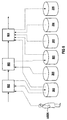
- the Figures 2 to 7 includes a series of flow diagrams that define the main component activities and data resources that define the behaviour of the new system.
- Figure 2 shows the top-level architecture of the claimed method. It comprises:
- FIG. 1 represents the top level behaviour of the new control system. What is noteworthy is that the system in normal operation will have three possible cycles:
- results of the system are represented as a similarity ordered sequence of previous cases. This provides the basic information that allows the most relevant old sensor values to be extracted from the underlying data base of the technical process. Extracted data can either be presented to a human expert as an aid to manual process control, or as the input to an automated control system to guide computer-based decisions.
- Figure 3 shows the internal architecture of the training unit 206 of figure 2. It comprises:
- Figure 3 represents the relative complex internal behaviour of the training activity of the invented system. From the raw sensor data, a test and training case base are contructed along with the set of sensor clusters. The system then iteratively refines the case index so that a minimal amount of sensor data is included in the case index without producing a degredation in retrieval accuracy.
- Figure 4 shows the internal architecture of the central evaluation unit 310 of Figure 3 of the training unit 206 of Figure 2. Further it comprises:
- the evaluation takes each case of the test case base in turn and performs a retrieval from the training case base.
- the resulting retrieval ordering is compared to a precomputed ideal ordering of training cases for the test case.
- a numerical value for the degree of correspondance of the two orderings is computed and added to a combined evaluation value for the whole test case.
- Figure 5 shows the internal architecture of the unit 207, see also 304, used to extract a case base in the top level architecture. It comprises:
- Figure 5 represents the way in which a case base is extracted from the database of sensor values for the tecnical process.
- the process iterates from a start time to an end time and generates a case at every time point that is defined as "interesting" with respect to a computed metric.
- the extraction will iterate from the first stored sensor values up to the most recent data.
- the data needs to be segregated into disjoint test and training time periods.
- Figure 6 shows the internal architecture of the unit 208 of figure 2 used to make sensor value predictions. It comprises:
- Figure 6 represents the internal behaviour of the main activity to predict future sensor values.
- the prediction process corresponds to the process of case retrieval.
- the only addition is that the user may first interact with the system in order to select which sensors are currently of interest. Only these sensors are then considered in the retrieval of relevant past cases.
- Figure 7 shows the internal architecture of the retrieval unit 604 of figure 6. It comprises:
- Figure 7 represents the case retrieval process.
- this involves a linear search through all stored cases in a given case base. Each of these cases is compared to a given new case.
- the similarity between an old and new case is based on the summation of similarities of pairs of sensors between the two cases.
- the case index specifies both which sensors are worthy of consideration during retrieval, and how many values for each pair of sensors need to be compared for a reliable similarity measure.
- the result of retrieval is an ordered list of previous cases for the technical process, e.g. cement kiln.
- the one or more most similar cases provide the basis on which an evaluation of the most likely future state of the technical process can be made and, consequently, the appropriate control decisions made.
- the invented system could act as a part of a fully automated control system
- the main mode of operation is in collaboration with a human expert
- the invented control system presents the expert with the retrieved cases in a clearly understandable format, i.e. a graphical plot, and the human expert makes the informed control decisions.
- the system includes a general-purpose viewer for browsing the cement kiln database.
- the preceding and projected periods of a retrieved case are super-imposed as vertical lines onto a more continuous plot of sensor values.
- the browser allows a much longer time period into the past to be viewed than defined by a case's preceding period, in turn, enabling a more complete understanding of the similarity between the current situation and a retrieved case. It is also possible to view beyond the projected period for the previous case to get a longer prediction for the future behaviour of the cement kiln.
- the invented system is often capable of predicting long-term trends in a technical process.
- the invented system generally made predictions concerning the cement kiln that remain valid for longer than the default 1 hour projection periods of cases.
- Results Plot of Figure 8 are a typical example of the results of the new system, during evaluation period.
- Figure 8 shows, on the right-hand side, the prediction made for three selected sensors, sensor 41, sensor 59 and sensor 92 for an evaluation case selected by a human expert.
- the actual data is plotted alongside the predicted data in order to enable comparison - in normal operation, in contrast to the evaluation phase, beyond the similarity time period, only predicted values will be available and hence, displayed.
- Figure 8 illustrates a number of key characteristics of the system:
- the system is a unique attempt at applying CBR technology to the task of sensor prediction within a technical process, specifically a cement kiln.
- the advantages that the approach provides are as follows:
- the potential for this technology is very high.
- the cement kiln application itself is open to future extension.
- Within the underlying data archive are also recorded the control decisions made by the human experts monitoring the cement kiln. Therefore, in retrieving a previous case, the system may not only provide the means for predicting future kiln behaviour, but also for reusing control decisions. This may provide the basis for a more automated control system with cement factories.
- the system could be used as a training system for new human controllers, allowing them to investigate how existing experts actually responded in various situations.
- time-stamped quality metrics are also routinely stored. For example, samples of the output cement clinker are routinely taken and tested in a laboratory. The results of these tests allow classification to be made of how successfully the cement kiln had performed at any given time. Such evaluations could be incorporated into the case retrieval mechansim to classify cases as "good” or "bad". The system could, therefore, guide a user towards reusing successful control decisions while warning against the reuse of control decisions that had proven unsuccesssful in the past. This should lead to an overall improvement in the performance of the cement kiln.
Landscapes
- Engineering & Computer Science (AREA)
- Artificial Intelligence (AREA)
- General Physics & Mathematics (AREA)
- Automation & Control Theory (AREA)
- Evolutionary Computation (AREA)
- Medical Informatics (AREA)
- Software Systems (AREA)
- Physics & Mathematics (AREA)
- Health & Medical Sciences (AREA)
- Computer Vision & Pattern Recognition (AREA)
- Testing And Monitoring For Control Systems (AREA)
- Curing Cements, Concrete, And Artificial Stone (AREA)
- Investigating Or Analyzing Materials By The Use Of Fluid Adsorption Or Reactions (AREA)
- Waste-Gas Treatment And Other Accessory Devices For Furnaces (AREA)
- Feedback Control In General (AREA)
- Investigating And Analyzing Materials By Characteristic Methods (AREA)
- Investigating Or Analyzing Materials Using Thermal Means (AREA)
Priority Applications (10)
| Application Number | Priority Date | Filing Date | Title |
|---|---|---|---|
| EP98124063A EP1014240A1 (de) | 1998-12-17 | 1998-12-17 | Fall-basiertes Schlussfolgerungsystem für Sensorprädiktion in einer technischen Anlage , insbesondere in einem Zementofen , Verfahren und Gerät dafür |
| DE69901626T DE69901626T2 (de) | 1998-12-17 | 1999-12-14 | Fall-basiertes deduktives system, verfahren und gerät für sensor-prediktion in einem technischen prozess, insbesondere in einem zementofen |
| AT99959412T ATE218217T1 (de) | 1998-12-17 | 1999-12-14 | Fall-basiertes deduktives system, verfahren und gerät für sensor-prediktion in einem technischen prozess, insbesondere in einem zementofen |
| PCT/EP1999/009927 WO2000036476A1 (en) | 1998-12-17 | 1999-12-14 | A system of case-based reasoning for sensor prediction in a technical process, especially in a cement kiln, method and apparatus therefor |
| ES99959412T ES2178493T3 (es) | 1998-12-17 | 1999-12-14 | Un sistema de razonamiento basado en casos para la prediccion de sensores en un proceso tecnico, especialmente en un horno de fabricacion de cemento, procedimiento y aparato para el mismo. |
| KR1020017007695A KR20010086121A (ko) | 1998-12-17 | 1999-12-14 | 기술적 프로세스에 있어서 센서 예측을 위한 케이스베이스 추론 시스템의 방법 및 장치 |
| EP99959412A EP1145087B1 (de) | 1998-12-17 | 1999-12-14 | Fall-basiertes deduktives system, verfahren und gerät für sensor-prediktion in einem technischen prozess, insbesondere in einem zementofen |
| JP2000588659A JP2002532799A (ja) | 1998-12-17 | 1999-12-14 | 特にセメントキルンの技術プロセスにおけるセンサ予測のための事例ベース推論システムと方法および装置 |
| DK99959412T DK1145087T3 (da) | 1998-12-17 | 1999-12-14 | Case-baseret beslutningsstøttesystem til sensorforudsigelse i en teknisk proces, især i en cementovn, samt fremgangsmåde og anordning dertil |
| US09/883,051 US6701195B2 (en) | 1998-12-17 | 2001-06-15 | Sensor prediction system utilizing case based reasoning |
Applications Claiming Priority (1)
| Application Number | Priority Date | Filing Date | Title |
|---|---|---|---|
| EP98124063A EP1014240A1 (de) | 1998-12-17 | 1998-12-17 | Fall-basiertes Schlussfolgerungsystem für Sensorprädiktion in einer technischen Anlage , insbesondere in einem Zementofen , Verfahren und Gerät dafür |
Publications (1)
| Publication Number | Publication Date |
|---|---|
| EP1014240A1 true EP1014240A1 (de) | 2000-06-28 |
Family
ID=8233169
Family Applications (2)
| Application Number | Title | Priority Date | Filing Date |
|---|---|---|---|
| EP98124063A Withdrawn EP1014240A1 (de) | 1998-12-17 | 1998-12-17 | Fall-basiertes Schlussfolgerungsystem für Sensorprädiktion in einer technischen Anlage , insbesondere in einem Zementofen , Verfahren und Gerät dafür |
| EP99959412A Expired - Lifetime EP1145087B1 (de) | 1998-12-17 | 1999-12-14 | Fall-basiertes deduktives system, verfahren und gerät für sensor-prediktion in einem technischen prozess, insbesondere in einem zementofen |
Family Applications After (1)
| Application Number | Title | Priority Date | Filing Date |
|---|---|---|---|
| EP99959412A Expired - Lifetime EP1145087B1 (de) | 1998-12-17 | 1999-12-14 | Fall-basiertes deduktives system, verfahren und gerät für sensor-prediktion in einem technischen prozess, insbesondere in einem zementofen |
Country Status (9)
| Country | Link |
|---|---|
| US (1) | US6701195B2 (de) |
| EP (2) | EP1014240A1 (de) |
| JP (1) | JP2002532799A (de) |
| KR (1) | KR20010086121A (de) |
| AT (1) | ATE218217T1 (de) |
| DE (1) | DE69901626T2 (de) |
| DK (1) | DK1145087T3 (de) |
| ES (1) | ES2178493T3 (de) |
| WO (1) | WO2000036476A1 (de) |
Cited By (4)
| Publication number | Priority date | Publication date | Assignee | Title |
|---|---|---|---|---|
| EP1518839A1 (de) * | 2003-09-24 | 2005-03-30 | Powitec Intelligent Technologies GmbH | Verfahren zum Betrieb einer Zementproduktionsanlage |
| WO2008052542A1 (en) * | 2006-11-02 | 2008-05-08 | Fls Automation A/S | A SYSTEM AND A METHOD FOR PREDICTION OF NOx EMISSION AND/OR FREE LIME CONCENTRATION IN A CEMENT KILN |
| CN111736544A (zh) * | 2020-05-19 | 2020-10-02 | 北京坚构创新科技有限公司 | 一种水泥智能工厂管理控制平台 |
| CN112341011A (zh) * | 2020-11-19 | 2021-02-09 | 南京释加软件科技有限公司 | 一种水泥窑协同智能配伍方法 |
Families Citing this family (22)
| Publication number | Priority date | Publication date | Assignee | Title |
|---|---|---|---|---|
| US20020091972A1 (en) * | 2001-01-05 | 2002-07-11 | Harris David P. | Method for predicting machine or process faults and automated system for implementing same |
| IES20010724A2 (en) * | 2001-07-30 | 2003-02-05 | Univ Dublin | Data processing system and method |
| US20030061007A1 (en) * | 2001-09-07 | 2003-03-27 | Klaus Sigl | Error condition processing in an automation system |
| JP2005513601A (ja) * | 2001-12-18 | 2005-05-12 | エムティエス・システムズ・コーポレーション | 制御システムのための制御パラメータを確定する方法 |
| US7788109B2 (en) * | 2004-04-03 | 2010-08-31 | Altusys Corp. | Method and apparatus for context-sensitive event correlation with external control in situation-based management |
| US20050222895A1 (en) * | 2004-04-03 | 2005-10-06 | Altusys Corp | Method and Apparatus for Creating and Using Situation Transition Graphs in Situation-Based Management |
| US8694475B2 (en) * | 2004-04-03 | 2014-04-08 | Altusys Corp. | Method and apparatus for situation-based management |
| US20050222810A1 (en) * | 2004-04-03 | 2005-10-06 | Altusys Corp | Method and Apparatus for Coordination of a Situation Manager and Event Correlation in Situation-Based Management |
| US8688405B2 (en) * | 2007-06-15 | 2014-04-01 | Shell Oil Company | Remote monitoring systems and methods |
| US8396825B2 (en) * | 2009-02-25 | 2013-03-12 | Toyota Motor Engineering & Manufacturing North America | Method and system to recognize temporal events using enhanced temporal decision trees |
| US10679131B2 (en) | 2012-07-12 | 2020-06-09 | Eaton Intelligent Power Limited | System and method for efficient data collection in distributed sensor measurement systems |
| WO2014055486A1 (en) | 2012-10-01 | 2014-04-10 | Cooper Technologies Company | System and method for support of one-way endpoints in two-way wireless networks |
| US9699708B2 (en) | 2014-01-17 | 2017-07-04 | Cooper Technologies Company | Dynamically-selectable multi-modal modulation in wireless multihop networks |
| CN108647481A (zh) * | 2018-08-14 | 2018-10-12 | 华东理工大学 | 一种回转窑烧成带温度软测量方法 |
| EP3715987A1 (de) | 2019-03-29 | 2020-09-30 | Siemens Aktiengesellschaft | Verfahren und system zum management von meldungen eines automatisierungssystems |
| US12164279B2 (en) * | 2019-07-16 | 2024-12-10 | Nec Corporation | Estimation apparatus, control system, estimation method, and program |
| CN110386768B (zh) * | 2019-08-28 | 2020-07-31 | 燕山大学 | 水泥烧成过程中能耗动态实时控制方法 |
| CN111158336A (zh) * | 2019-11-22 | 2020-05-15 | 万洲电气股份有限公司 | 一种基于水泥窑故障诊断的工业智能优化节能系统 |
| JP2021089505A (ja) * | 2019-12-03 | 2021-06-10 | 株式会社日立製作所 | 監視支援装置、および、監視支援方法 |
| CN112100916B (zh) * | 2020-09-10 | 2023-07-25 | 北京百度网讯科技有限公司 | 用于构建强化学习模型的方法、装置、电子设备及介质 |
| CN113239482B (zh) * | 2021-04-23 | 2022-02-08 | 北京科技大学 | 一种转炉后吹碳含量动态预测方法及装置 |
| CN118915668A (zh) | 2024-08-02 | 2024-11-08 | 中国建筑材料科学研究总院有限公司 | 一种全氧燃烧的水泥工艺自动调控方法、装置及设备 |
Citations (7)
| Publication number | Priority date | Publication date | Assignee | Title |
|---|---|---|---|---|
| EP0477490A2 (de) * | 1990-07-27 | 1992-04-01 | Omron Corporation | Annäherndes Dekutionsgerät |
| EP0529307A1 (de) * | 1991-07-31 | 1993-03-03 | Air Products And Chemicals, Inc. | Regelsystem für Gasverflüssigungsverfahren |
| WO1993021587A2 (en) * | 1992-04-15 | 1993-10-28 | Inference Corporation | Machine learning with a relational database |
| EP0582069A2 (de) * | 1992-06-16 | 1994-02-09 | Praxair Technology, Inc. | Zweiphasen-Methode zur Echtzeitprozesssteuerung |
| US5574638A (en) * | 1995-04-03 | 1996-11-12 | Lu; Zhuxin J. | Method of optimal scaling of variables in a multivariable predictive controller utilizing range control |
| EP0745916A1 (de) * | 1995-05-29 | 1996-12-04 | Siemens Aktiengesellschaft | Methode und Vorrichtung zur Regelung eines technischen Prozesses |
| US5587897A (en) * | 1993-12-27 | 1996-12-24 | Nec Corporation | Optimization device |
Family Cites Families (7)
| Publication number | Priority date | Publication date | Assignee | Title |
|---|---|---|---|---|
| US6002839A (en) * | 1992-11-24 | 1999-12-14 | Pavilion Technologies | Predictive network with graphically determined preprocess transforms |
| US5586221A (en) * | 1994-07-01 | 1996-12-17 | Syracuse University | Predictive control of rolling mills using neural network gauge estimation |
| US5519605A (en) * | 1994-10-24 | 1996-05-21 | Olin Corporation | Model predictive control apparatus and method |
| US6144952A (en) * | 1995-09-20 | 2000-11-07 | Keeler; James D. | Predictive network with learned preprocessing parameters |
| US5973662A (en) * | 1997-04-07 | 1999-10-26 | Johnson Controls Technology Company | Analog spectrum display for environmental control |
| US6453308B1 (en) * | 1997-10-01 | 2002-09-17 | Aspen Technology, Inc. | Non-linear dynamic predictive device |
| JP3762840B2 (ja) * | 1998-11-24 | 2006-04-05 | 富士通株式会社 | 類似事例に基づく予測を行う予測装置および方法 |
-
1998
- 1998-12-17 EP EP98124063A patent/EP1014240A1/de not_active Withdrawn
-
1999
- 1999-12-14 DK DK99959412T patent/DK1145087T3/da active
- 1999-12-14 DE DE69901626T patent/DE69901626T2/de not_active Expired - Fee Related
- 1999-12-14 JP JP2000588659A patent/JP2002532799A/ja not_active Withdrawn
- 1999-12-14 AT AT99959412T patent/ATE218217T1/de not_active IP Right Cessation
- 1999-12-14 WO PCT/EP1999/009927 patent/WO2000036476A1/en not_active Ceased
- 1999-12-14 KR KR1020017007695A patent/KR20010086121A/ko not_active Withdrawn
- 1999-12-14 ES ES99959412T patent/ES2178493T3/es not_active Expired - Lifetime
- 1999-12-14 EP EP99959412A patent/EP1145087B1/de not_active Expired - Lifetime
-
2001
- 2001-06-15 US US09/883,051 patent/US6701195B2/en not_active Expired - Fee Related
Patent Citations (7)
| Publication number | Priority date | Publication date | Assignee | Title |
|---|---|---|---|---|
| EP0477490A2 (de) * | 1990-07-27 | 1992-04-01 | Omron Corporation | Annäherndes Dekutionsgerät |
| EP0529307A1 (de) * | 1991-07-31 | 1993-03-03 | Air Products And Chemicals, Inc. | Regelsystem für Gasverflüssigungsverfahren |
| WO1993021587A2 (en) * | 1992-04-15 | 1993-10-28 | Inference Corporation | Machine learning with a relational database |
| EP0582069A2 (de) * | 1992-06-16 | 1994-02-09 | Praxair Technology, Inc. | Zweiphasen-Methode zur Echtzeitprozesssteuerung |
| US5587897A (en) * | 1993-12-27 | 1996-12-24 | Nec Corporation | Optimization device |
| US5574638A (en) * | 1995-04-03 | 1996-11-12 | Lu; Zhuxin J. | Method of optimal scaling of variables in a multivariable predictive controller utilizing range control |
| EP0745916A1 (de) * | 1995-05-29 | 1996-12-04 | Siemens Aktiengesellschaft | Methode und Vorrichtung zur Regelung eines technischen Prozesses |
Cited By (4)
| Publication number | Priority date | Publication date | Assignee | Title |
|---|---|---|---|---|
| EP1518839A1 (de) * | 2003-09-24 | 2005-03-30 | Powitec Intelligent Technologies GmbH | Verfahren zum Betrieb einer Zementproduktionsanlage |
| WO2008052542A1 (en) * | 2006-11-02 | 2008-05-08 | Fls Automation A/S | A SYSTEM AND A METHOD FOR PREDICTION OF NOx EMISSION AND/OR FREE LIME CONCENTRATION IN A CEMENT KILN |
| CN111736544A (zh) * | 2020-05-19 | 2020-10-02 | 北京坚构创新科技有限公司 | 一种水泥智能工厂管理控制平台 |
| CN112341011A (zh) * | 2020-11-19 | 2021-02-09 | 南京释加软件科技有限公司 | 一种水泥窑协同智能配伍方法 |
Also Published As
| Publication number | Publication date |
|---|---|
| ATE218217T1 (de) | 2002-06-15 |
| EP1145087B1 (de) | 2002-05-29 |
| US6701195B2 (en) | 2004-03-02 |
| WO2000036476A1 (en) | 2000-06-22 |
| DK1145087T3 (da) | 2002-09-23 |
| KR20010086121A (ko) | 2001-09-07 |
| ES2178493T3 (es) | 2002-12-16 |
| DE69901626D1 (de) | 2002-07-04 |
| EP1145087A1 (de) | 2001-10-17 |
| JP2002532799A (ja) | 2002-10-02 |
| DE69901626T2 (de) | 2002-11-28 |
| US20020010517A1 (en) | 2002-01-24 |
Similar Documents
| Publication | Publication Date | Title |
|---|---|---|
| EP1014240A1 (de) | Fall-basiertes Schlussfolgerungsystem für Sensorprädiktion in einer technischen Anlage , insbesondere in einem Zementofen , Verfahren und Gerät dafür | |
| JP7069269B2 (ja) | デジタル・ツイン・シミュレーション・データを利用した時系列データに基づく、大規模な産業用監視システム向けの半教師あり深層異常検出のための方法およびシステム | |
| CN118051827A (zh) | 基于深度学习的电网故障预测方法 | |
| CN119957473B (zh) | 一种压缩机控制方法及系统 | |
| Colone et al. | Predictive repair scheduling of wind turbine drive‐train components based on machine learning | |
| EP3968103B1 (de) | Erläuterung einer maschinenlernausgabe in industriellen anwendungen | |
| Philip | CNN-LSTM hybrid deep learning model for remaining useful life estimation | |
| CN120069673A (zh) | 一种机电系统phm体系的综合评估方法及系统 | |
| CN120387553B (zh) | 基于物联网的设备维修故障智能分析方法及系统 | |
| Gunasekara et al. | Recurrent concept drifts on data streams | |
| Theumer et al. | Anomaly detection on industrial time series for retaining energy efficiency | |
| CN120891781A (zh) | 基于深度强化学习的工业设备智能控制系统及方法 | |
| CN121030250A (zh) | 基于多源异构张量数据的组合碳排放预测方法 | |
| CN116982009A (zh) | 工业变点的检测方法与系统 | |
| EP3303835B1 (de) | Verfahren zur überwachung eines windparks | |
| EP4551999B1 (de) | Erkennung einer anomalie in einem herstellungsprozess | |
| Lecoeuche et al. | New supervision architecture based on on-line modelling of non-stationary data | |
| CN112465044B (zh) | 基于敏感参数多证据融合的卫星工况识别与分割方法及系统 | |
| Mohd Irwan Shah et al. | Development of Digital Twin Data-driven Modelling for Gas Turbine Operation Behaviour. | |
| CN121169334B (zh) | 一种智慧园区能源数据动态管控系统 | |
| Das et al. | Prolego: Time-Series Analysis for Predicting Failures in Complex Systems | |
| CN121211394A (zh) | 基于退化数据的光伏设备剩余寿命预测方法 | |
| Cerquitelli et al. | A Methodology Primer | |
| Sánchez et al. | Early Fault Detection on CMAPSS with Unsupervised LSTM Autoencoders | |
| Mizoguchi et al. | Unsupervised Concept Drift Detection and Adaptation for Hashing Based Multivariate Time Series Anomaly Detection |
Legal Events
| Date | Code | Title | Description |
|---|---|---|---|
| PUAI | Public reference made under article 153(3) epc to a published international application that has entered the european phase |
Free format text: ORIGINAL CODE: 0009012 |
|
| AK | Designated contracting states |
Kind code of ref document: A1 Designated state(s): AT BE CH CY DE DK ES FI FR GB GR IE IT LI LU MC NL PT SE |
|
| AX | Request for extension of the european patent |
Free format text: AL;LT;LV;MK;RO;SI |
|
| AKX | Designation fees paid | ||
| STAA | Information on the status of an ep patent application or granted ep patent |
Free format text: STATUS: THE APPLICATION IS DEEMED TO BE WITHDRAWN |
|
| 18D | Application deemed to be withdrawn |
Effective date: 20001229 |