EP1014612A2 - Unité de réseau optique universelle pour utilisation dans les réseaux d'accès à bandes large et étroite - Google Patents
Unité de réseau optique universelle pour utilisation dans les réseaux d'accès à bandes large et étroite Download PDFInfo
- Publication number
- EP1014612A2 EP1014612A2 EP99310354A EP99310354A EP1014612A2 EP 1014612 A2 EP1014612 A2 EP 1014612A2 EP 99310354 A EP99310354 A EP 99310354A EP 99310354 A EP99310354 A EP 99310354A EP 1014612 A2 EP1014612 A2 EP 1014612A2
- Authority
- EP
- European Patent Office
- Prior art keywords
- downstream
- broadband
- narrowband
- upstream
- onu
- Prior art date
- Legal status (The legal status is an assumption and is not a legal conclusion. Google has not performed a legal analysis and makes no representation as to the accuracy of the status listed.)
- Withdrawn
Links
- 230000003287 optical effect Effects 0.000 title claims abstract description 29
- 238000012545 processing Methods 0.000 claims abstract description 145
- 239000013307 optical fiber Substances 0.000 claims abstract description 39
- 230000001419 dependent effect Effects 0.000 claims abstract description 8
- 238000011144 upstream manufacturing Methods 0.000 claims description 183
- 230000005693 optoelectronics Effects 0.000 claims description 33
- 238000005070 sampling Methods 0.000 claims description 25
- 238000011084 recovery Methods 0.000 claims description 16
- 230000005540 biological transmission Effects 0.000 claims description 8
- 239000002131 composite material Substances 0.000 claims description 8
- 238000000034 method Methods 0.000 claims description 7
- 230000011664 signaling Effects 0.000 claims description 7
- 230000004044 response Effects 0.000 claims description 3
- 238000012546 transfer Methods 0.000 claims description 2
- 210000004027 cell Anatomy 0.000 description 143
- 239000000835 fiber Substances 0.000 description 21
- 230000006870 function Effects 0.000 description 9
- 238000010586 diagram Methods 0.000 description 8
- 238000013507 mapping Methods 0.000 description 8
- 238000004891 communication Methods 0.000 description 7
- 238000013461 design Methods 0.000 description 7
- 230000002457 bidirectional effect Effects 0.000 description 5
- 239000000872 buffer Substances 0.000 description 5
- 229920006235 chlorinated polyethylene elastomer Polymers 0.000 description 5
- 238000000136 cloud-point extraction Methods 0.000 description 5
- RYGMFSIKBFXOCR-UHFFFAOYSA-N Copper Chemical compound [Cu] RYGMFSIKBFXOCR-UHFFFAOYSA-N 0.000 description 4
- 229910052802 copper Inorganic materials 0.000 description 4
- 239000010949 copper Substances 0.000 description 4
- 238000006243 chemical reaction Methods 0.000 description 2
- 238000001914 filtration Methods 0.000 description 2
- 238000009434 installation Methods 0.000 description 2
- 239000000203 mixture Substances 0.000 description 2
- 210000004287 null lymphocyte Anatomy 0.000 description 2
- 238000007493 shaping process Methods 0.000 description 2
- 238000001228 spectrum Methods 0.000 description 2
- 101150012579 ADSL gene Proteins 0.000 description 1
- 102100020775 Adenylosuccinate lyase Human genes 0.000 description 1
- 108700040193 Adenylosuccinate lyases Proteins 0.000 description 1
- 230000006835 compression Effects 0.000 description 1
- 238000007906 compression Methods 0.000 description 1
- 230000001934 delay Effects 0.000 description 1
- 230000003111 delayed effect Effects 0.000 description 1
- 238000011161 development Methods 0.000 description 1
- 230000003467 diminishing effect Effects 0.000 description 1
- 238000011143 downstream manufacturing Methods 0.000 description 1
- 230000001747 exhibiting effect Effects 0.000 description 1
- RGNPBRKPHBKNKX-UHFFFAOYSA-N hexaflumuron Chemical compound C1=C(Cl)C(OC(F)(F)C(F)F)=C(Cl)C=C1NC(=O)NC(=O)C1=C(F)C=CC=C1F RGNPBRKPHBKNKX-UHFFFAOYSA-N 0.000 description 1
- 238000007689 inspection Methods 0.000 description 1
- 238000004519 manufacturing process Methods 0.000 description 1
- 239000013589 supplement Substances 0.000 description 1
- 230000001131 transforming effect Effects 0.000 description 1
- 230000001960 triggered effect Effects 0.000 description 1
Images

Classifications
-
- H—ELECTRICITY
- H04—ELECTRIC COMMUNICATION TECHNIQUE
- H04J—MULTIPLEX COMMUNICATION
- H04J3/00—Time-division multiplex systems
- H04J3/16—Time-division multiplex systems in which the time allocation to individual channels within a transmission cycle is variable, e.g. to accommodate varying complexity of signals, to vary number of channels transmitted
- H04J3/1694—Allocation of channels in TDM/TDMA networks, e.g. distributed multiplexers
-
- H—ELECTRICITY
- H04—ELECTRIC COMMUNICATION TECHNIQUE
- H04Q—SELECTING
- H04Q11/00—Selecting arrangements for multiplex systems
- H04Q11/04—Selecting arrangements for multiplex systems for time-division multiplexing
- H04Q11/0428—Integrated services digital network, i.e. systems for transmission of different types of digitised signals, e.g. speech, data, telecentral, television signals
- H04Q11/0478—Provisions for broadband connections
-
- H—ELECTRICITY
- H04—ELECTRIC COMMUNICATION TECHNIQUE
- H04L—TRANSMISSION OF DIGITAL INFORMATION, e.g. TELEGRAPHIC COMMUNICATION
- H04L12/00—Data switching networks
- H04L12/54—Store-and-forward switching systems
- H04L12/56—Packet switching systems
- H04L12/5601—Transfer mode dependent, e.g. ATM
- H04L2012/5603—Access techniques
- H04L2012/5609—Topology
- H04L2012/561—Star, e.g. cross-connect, concentrator, subscriber group equipment, remote electronics
Definitions
- the present invention relates to fiber optic telecommunications access networks and, in particular, to a novel optical network unit and host digital terminal for use in such networks.
- FTTN fiber-to-the-neighbourhood
- FTTC fiber-to-the-curb
- HDT host digital terminal
- CPE customer premises equipment
- ONUs optical network units
- ONUs are used depending on whether the communications service to be delivered is of the narrowband or broadband variety.
- a specialized narrowband ONU may perform the conversion of mu-law compressed voice samples arriving from the HDT into linear samples for delivery to a customer's telephone.
- the narrowband ONU may be required to convert DS-1 digital data arriving from an analog modem at the customer premises into a cell-based data structure to be delivered to the HDT.
- a narrowband ONU must perform various complex processing tasks. Traditionally, this is achieved with the aid of mission-specific or service-specific line cards, although the number of line card types can be reduced by the deployment of powerful digital signal processing (DSP) engines on some or all of the line cards to allow them to adapt their functions, thereby to provide a wider range of service types. Still, conventional narrowband ONUs have severe drawbacks, such as high cost, high power consumption, low reliability and overall large physical volume.
- DSP digital signal processing
- a completely different type of ONU is required when contemplating the delivery of broadband services (based on, e.g., asynchronous transfer mode-ATM or Internet protocol-IP), which are typically asynchronous and packet-based.
- broadband services based on, e.g., asynchronous transfer mode-ATM or Internet protocol-IP
- problems arise when the peak data rate demanded by a particular subscriber exceeds the data rate available on an individual copper drop leading to that subscriber's CPE.
- the aggregate data rate transmitted by multiple subscribers to exceed the bandwidth available on the fiber leading to the HDT. In both situations, data is caused to accumulate in the ONU, usually leading to an unacceptable delay and/or loss of data.
- One technique used to help prevent bottlenecks from appearing at a broadband ONU consists of installing memory buffers ("queues") in the ONU for storing excess data until it can be delivered.
- the buffer size required to safeguard against data loss is a function of the peak bandwidth demand as well as the duration of such a demand.
- neither of these two parameters is controllable, leading to the installation of very long queues in the ONU for handling an estimated worst-case scenario.
- either narrowband or broadband services can be delivered by a small, simplified ONU.
- neither ONU is capable, on its own, of delivering both narrowband and broadband services simultaneously.
- the improved narrowband ONU disclosed in Canadian Patent Application No. 2,268,589 does not address the traffic control problems associated with the delivery of broadband services
- the improved broadband ONU disclosed in Canadian Patent Application No. 2,272,978 is ill-equipped to accommodate the signal-processing demands associated with the delivery of narrowband services.
- the invention may be summarized according to a first broad aspect as an optical network unit (ONU) connectable between an optical fiber and a plurality of twisted pairs, the optical fiber carrying data between a host digital terminal (HDT) and the ONU, the data consisting of broadband and narrowband data destined for the twisted pairs in a downstream direction and originating from the twisted pairs in an upstream direction, the ONU comprising: interface circuitry for connection to the optical fiber, for receiving a downstream optical signal on the optical fiber and for extracting a downstream data stream therefrom; a demultiplexer connected to the interface circuitry, for receiving the downstream data stream from the interface circuitry and controllably separating it into a plurality of downstream broadband data streams destined for respective ones of the twisted pairs and a plurality of downstream narrowband data streams also destined for respective ones of the plurality of twisted pairs; and for each twisted pair: a respective broadband processing unit connected to the demultiplexing means, comprising circuitry for receiving the respective downstream broadband data stream from the demultiplexer and converting it
- the invention may be summarized as an optical network unit (ONU) connectable between an optical fiber and a plurality of twisted pairs, the optical fiber carrying data between a host digital terminal (HDT) and the ONU, the data consisting of broadband and narrowband data destined for the twisted pairs in a downstream direction and originating from the twisted pairs in an upstream direction, the ONU comprising: interface circuitry for connection to the optical fiber, for receiving a downstream optical signal on the optical fiber and for extracting a downstream data stream therefrom; a demultiplexer connected to the interface circuitry, for receiving the downstream data stream from the interface circuitry and separating it into a plurality of intermediate downstream broadband data streams for connection to a downstream broadband processing pool and a plurality of downstream narrowband data streams destined for respective ones of the plurality of twisted pairs; a downstream broadband processing pool connected to the demultiplexer, comprising processing means for processing the intermediate downstream broadband data streams received from the demultiplexer and a cross-connect for selectably routing the processed intermediate downstream broadband data
- the invention may be summarized according to a third broad aspect as a method of transmitting data received on an optical fiber to a plurality of twisted pairs, the data arriving on the optical fiber as a series of downstream traffic elements, each downstream traffic element having a header and a body, the header indicating a destination twisted pair and a service type associated with the traffic element, the ONU comprising: determining, from the header of each traffic element, the service type associated with the traffic element; determining, from the header of each traffic element, the destination twisted pair associated with the traffic element; and processing the traffic elements and transmitting at least the body of each traffic element to the associated destination twisted pair in a data format dependent on the associated service type.
- the invention may be summarized as an optical network unit (ONU) connectable between an optical fiber and a plurality of twisted pairs, the optical fiber carrying downstream traffic elements from a host digital terminal (HDT) to the ONU, each downstream traffic element having a header and a body, the header indicating a destination twisted pair and a service type associated with the traffic element, the ONU comprising: means for determining, from the header of each traffic element, the service type associated with the traffic element; means for determining, from the header of each traffic element, the destination twisted pair associated with the traffic element; and means for processing the traffic elements and transmitting at least the body of each traffic element to the associated destination twisted pair in a data format dependent on the associated service type.
- HDT host digital terminal
- the invention may be summarized according yet another broad aspect as an access network, comprising: a host digital terminal for processing downstream data destined for an optical network unit and transmitting the downstream data thereto as a series of downstream traffic elements on an optical fiber, each downstream traffic element having a header and a body, the header indicating at least one destination twisted pair from a plurality of twisted pairs and a service type associated with the traffic element; an optical network unit (ONU) connected to the HDT by the optical fiber and connectable to the plurality of twisted pairs, the ONU comprising: means for determining, from the header of each traffic element, the service type associated with the traffic element; means for determining, from the header of each traffic element, the at least one destination twisted pair associated with the traffic element; and means for processing the traffic elements and transmitting at least the body of each traffic element to the at least one associated destination twisted pair in a data format dependent on the associated service type.
- ONU optical network unit
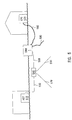
- FIGURE 5 there is shown a schematic view of a simple access system comprising an inventive host digital terminal (HDT) 510 connected to customer premises equipment (CPE) 520 via an inventive universal optical network unit (ONU) 1.
- the CPE 520 is of standard design and generally consists of filters, converters, narrowband equipment (e.g., analog or digital telephones, ISDN modems) and broadband equipment (e.g., broadband modems).
- the path between the HDT and the ONU is all-optical and consists of a fiber umbilical 530 connected at one end to the HDT 510 and at another end to a passive optical splitter 540.
- the passive optical splitter 540 then branches out into several optical fibers 550,560,570, one of which (fiber 550) leads to ONU 1.
- ONU 1 is connected to the CPE 520 via a copper twisted pair 580 and to other CPEs (not shown) via other twisted pairs, one of which (twisted pair 590) is shown in FIGURE 5.
- the arrangement of the HDT 510, ONU 1 and other ONUs not shown in FIGURE 5 is known as a passive optical network (PON) and is the preferred interconnection topology. Nevertheless, it is to be appreciated that the HDT 510 may be connected to each ONU via an individual point-to-point link, thereby obviating the need for an optical splitter. Alternatively, the HDT 510, ONU 1 and other ONUs not shown in FIGURE 5 could be interconnected in a ring configuration using SONET or SDH signalling.
- PON passive optical network
- separate optical fibers may be used for "downstream” (HDT to ONU) and "upstream” (ONU to HDT) communication, although preferably a single optical fiber carries both upstream and downstream traffic in accordance with one of many known multiplexing techniques, such as time compression multiplexing (TCM) or wavelength division multiplexing (WDM).
- TCM time compression multiplexing
- WDM wavelength division multiplexing
- the present invention can be applied to a unidirectional communications scenario in which downstream data, e.g., a television channel, is broadcast by the HDT 510 to multiple CPEs via the ONU, in which case it is relevant to consider only those components and methods used for processing downstream traffic.
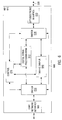
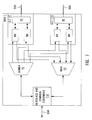
- the HDT 510 and ONU 1 are shown in simplified block diagram form in FIGURES 6 and 7, respectively.
- the ONU 1 can be generically described as comprising an optoelectronic interface and common equipment block 710 connected to fiber 550, to a demultiplexer 16 (for separating downstream traffic) and to a multiplexer 15 (for combining upstream traffic).
- the optoelectronic interface and common equipment block 710 comprises an optoelectronic transceiver for interfacing with fiber 550, as well as circuitry for recovering a clock from received downstream data, a downstream outstation for redirecting selected downstream data to the demultiplexer and an upstream outstation for organizing upstream data into a suitable format for upstream transmission to the HDT 510.
- the ONU 1 also comprises a plurality of universal line circuits (ULCs), among which only ULCs 17 and 17A are shown in FIGURE 7.
- ULCs 17,17A are each connected to the demultiplexer 16 and to the multiplexer 15, and also interface with respective twisted pairs 580,590.
- Each ULC 17,17A comprises a broadband processing section BB for performing residual modem functions, a narrowband processing section NB for performing residual analog/digital functions as well as combiner circuitry 41 for performing interfacing functions with the corresponding twisted pair.
- the HDT 510 comprises an optoelectronic interface 610 for interfacing with the fiber umbilical 530, a first digital switch 620 connected to the optoelectronic interface 610, a digital signal processing bank 630 and a traffic shaper 640 both connected between digital switch 620 and a second digital switch 650, a "hairpin" connection 660 linking the digital switches 620,650, a control processor 670 connected to the digital switches 620,650, to the digital signal processing bank 630 and to the traffic shaper 640, as well as a core network interface 680 connected to the second digital switch 650, for interfacing with a core network (not shown), which may be circuit-switched or packet-switched.
- a core network not shown
- the data format exchanged between the core network interface 680 and the core network itself may consist of ATM cells, IP packets, time-division-multiplexed data or any other data format, while the data format exchanged between the optoelectronic interface 610 and the interface and common equipment block 710 in the ONU 1 preferably consists of so-called "frames".
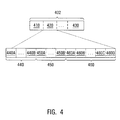
- a typical downstream frame 402 emitted by the optoelectronic interface 610 is composed of a plurality of subframes 410,420,430 of various sizes, each subframe being destined for a corresponding ONU sharing the PON.
- an upstream frame containing subframes originating from the various ONUs will be similarly formatted except that the subframes will typically be separated by guard bands to allow tolerance of round-trip burst delays.
- Each subframe 410,420,430 and, in particular, the expanded subframe 420 consists of an address field 440, a control field 450 and a traffic field 460, each field preferably consisting of transport cells (e.g., ATM cells or IP packets) each having a header and a body.
- transport cells e.g., ATM cells or IP packets
- the address, control or traffic fields could also comprise a time-division multiplexed component that is shared among various ONUs or among various narrowband or broadband circuits within a particular ONU. Nevertheless, it is assumed for the sake of simplicity that the address, control and traffic fields are comprised solely of transport cells.
- the address field 440 consists of one or more transport cells 440A...B uniquely identifying the destination ONU in the case of a downstream frame or the source ONU in the case of an upstream frame.
- the control field 450 also consists of one or more transport cells 450A...B which could carry, in the downstream direction, information such as ring generation commands, a new virtual circuit mapping for a cross-connect or a demultiplexer within an ONU or instructions for coordinating the transmittal of upstream subframes by the ONUs sharing the PON.
- the control field may contain loop status information or a request for additional bandwidth as made by an ONU.
- the traffic field 460 preferably consists of a plurality of transport cells 460AB...CD destined for (or originating from) the various CPEs connected to the various copper twisted pairs serviced by the ONU.
- the size of the traffic field 460, and therefore the size of the corresponding ONU's downstream or upstream subframe, will be proportional to the aggregate bandwidth of the narrowband and broadband services being delivered by that ONU.
- certain ones of the traffic transport cells, or simply "traffic cells” will be broadband cells while others will be narrowband cells.
- each transport cell 460AB...CD in the traffic field 460 of a given subframe 420 depends on whether the service associated with the cell is of the broadband or narrowband type and whether the direction of traffic flow is upstream or downstream.
- each cell contains an over-sampled bit stream in its body, which over-sampled bit stream may be destined for a particular CPE or may be intended to be broadcast to all CPEs.
- the cell's header is not intended to be delivered to the destination CPE.
- the header of a downstream narrowband cell will identify the ULC associated with the destination CPE or will consist of a special code if it is associated with a broadcast service.
- An upstream narrowband traffic cell analogously comprises a header identifying the source address of the ULC associated with the originating CPE along with a body containing over-sampled data.
- each cell's header and body depends on the design of the ONU; the remainder of the detailed description deals in particular with two preferred embodiments.
- the header of a downstream broadband traffic cell arriving from the HDT contains the virtual circuit (VC) address of a destination CPE.
- the body of a downstream broadband traffic cell contains binary information destined for the destination CPE. Both the header and the body of the downstream broadband traffic cell are to be modulated "as is" by the ONU.
- the header and body of an upstream broadband traffic cell contain a demodulated binary version of a symbol stream transmitted by the CPE.
- the header of a downstream broadband traffic cell is not intended to be delivered to the CPE but must nevertheless be delivered to the associated ULC. Therefore, it contains the address of the ULC associated with the destination CPE.
- the body of a downstream broadband traffic cell contains a series of n-bit commands for controlling the analog output level of the ONU, where n > 1 and where each n-bit command represents the encoded cell stream to the destination CPE, including the VC address thereof.
- the body of an upstream broadband traffic cell contains a sampled version of the possibly distorted CPE output containing entire line coded customer-generated cells, while the header is inserted locally to the ONU by the ULC connected to the originating CPE.
- the optoelectronic interface 610 in the HDT receives frames such as those illustrated in FIGURE 4 across fiber umbilical 530. Subframes are extracted from the incoming frames (after removal of guard bands), then the transport cells in the address field in each subframe is extracted and used by the optoelectornic interface 610 to modify the mapping of digital switch 620. The transport cells in the control field of the upstream subframes are extracted and used by the optoelectronic interface 610 to control the digital signal processing bank 630 and the traffic shaper 640 via control lines (not shown in FIGURE 6).
- the traffic cells in each upstream subframe are then sent by the optoelectronic interface 610 to digital switch 620, where they are routed in accordance with a mapping that is modifiable in the just described manner.
- the upstream traffic cells are generally routed by digital switch 620 towards the digital signal processing bank 630, where the processing operations performed on a given upstream traffic cell depend on whether the cell is associated with a narrowband service or with a broadband service, and in the latter case, the processing operations will also depend on the format of the cell.
- the operations performed by the digital signal processing bank 630 may include, in a first stage: header removal; then in a second stage, decimation of the over-sampled data output by the CPE; then in a third stage: format conversion from, e.g., PCM to mu-law; and in a fourth stage: formatting the converted data into cells for delivery across the core network.
- the operations performed by the digital signal processing bank 630 may be minimal, since the header and body of each cell are the actual data cells intended to be received at the HDT 510.
- the digital signal processing bank may therefore be responsible, if necessary, for the simple task of changing the format of the received upstream traffic cells into a different format for transmission through the core network.
- the headers must be removed by the digital signal proessing bank 630. Since the bits in the body of each cell represent only the samples of the data output by the originating CPE, a demodulation or decoding function must be executed on these bits to recover the originally transmitted symbols. Furthermore, the originally transmitted symbols may have to be re-packetized by the digital signal processing bank into a format suitable for transmission across the core network. Again, these processing operations may be operated by dedicated processors in the digital signal processing bank, although it is preferable to use a simpler bank of parallel processors linked by the hairpin connection 660.
- the data in the narrowband traffic elements received from the core network by the core network interface 680 must be formatted into the body of downstream cells by the digital signal processing bank 630.
- broadband traffic elements are controllably delayed by the traffic shaper 640 prior to processing by the digital signal processing bank 630.
- the traffic shaper must also account for the fiber bandwidth of the downstream signal sent to the ONU, which will differ depending on the format of the downstream broadband traffic cells.
- broadband traffic may be required to be delivered intact (first preferred embodiment) or it may have to be pre-line coded or pre-modulated by the digital signal processing bank 630 (second preferred embodiment) in order to generate a bit stream comprised of n-bit commands and then the bit stream would be placed into the body of downstream traffic cells sent across the PON by the optoelectronic interface 610.
- the latter option requires a slightly higher downstream fiber bandwidth but, as will be shown later, results in a simpler ONU.
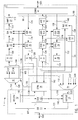
- the interface and common equipment block 710 comprises an optoelectronic transceiver (O/E) 11 having a bidirectional port connected to fiber 550, a downstream port from which emerges a downstream received electronic signal 102 leading to a downstream outstation (D/S O/S) 12 and an upstream port for accepting an upstream transmitted electronic signal 103 from an upstream outstation (U/S O/S) 13.
- O/E optoelectronic transceiver
- U/S O/S upstream outstation
- the interface and common equipment block 710 further comprises a clock recovery circuit 42 having an input connected to the downstream outstation 12 and an output for sending a recovered clock signal 142 to the downstream outstation 13 and to various other parts of the ONU 1, as well as a control unit 14 accepting ONU control commands 106 from the downstream outstation 12 and providing a transmit control signal 120 to the upstream outstation 13.
- the control unit 14 may be a micro-processor, a micro-controller, a programmable digital signal processor (DSP) or any other programmable logic device (PLD).
- demultiplexer 16 can be implemented as a pure ATM demultiplexer, a pure IP packet demultiplexer, a hybrid ATM/TDM demultiplexer or a hybrid IP/TDM demultiplexer.
- the implementation is chosen to be purely cell-based for reasons of clarity. Therefore, the signal 103 output by the downstream outstation 12 to the demultiplexer is a downstream cell stream.
- multiplexer 15 is implemented as a pure cell-based multiplexer, although it could be an IP packet multiplexer, a hybrid ATM/TDM multiplexer or an IP/TDM multiplexer.
- the demultiplexer 16 is connected to a plurality of universal line circuits (ULCs), among which only ULC 17 is shown in FIGURE 1. Specifically, the demultiplexer 16 creates a number of different cell streams from the downstream broadband cell stream 103 according to a selectable virtual circuit mapping controllable by a mapping selection signal 139 received from the control unit 14. In FIGURE 1, the demultiplexer 16 feeds the broadband processing section BB in ULC 17 with a downstream broadband cell stream 104 and a feeds the narrowband processing section NB in ULC 17 with a downstream narrowband cell stream 105. The demultiplexer 16 feeds other ULCs with corresponding pairs of cell streams 107,108.
- ULCs universal line circuits
- the broadband and narrowband processing paths of the ULC 17 supply the multiplexer 15 with respective upstream cell streams 118,131 which are combined by the multiplexer 15 with other pairs of cell streams 137,138 received from other ULCs to give a single upstream cell stream 122 fed to the upstream outstation 13.
- the upstream outstation 13 converts the upstream cell stream 122 into the upstream transmitted electronic signal 121 fed to the optoelectronic converter 11.
- the upstream outstation 13 may delay sending the upstream cell stream 122 to the optoelectronic transceiver 11 on the basis of the transmit control signal 120 received from the control unit 14. This requires the presence of a first-in-first-out (FIFO) queue in the upstream outstation 13, whose properties are determined by the ONU-to-HDT transmission link design (and not by the service mix travelling therethrough).
- FIFO first-in-first-out
- Each ULC is structurally identical to ULC 17, the broadband and narrowband processing sections of which will be described later on in further detail.
- the broadband processing section BB feeds the combiner circuitry 41 with a downstream broadband analog signal 113 and receives an upstream broadband analog signal 115 therefrom, while the narrowband processing section NB feeds the combiner circuitry 41 with a downstream narrowband analog signal 127 and receives an upstream narrowband analog signal 128 therefrom.
- the combiner circuitry 41 consists of filtering and diplexing circuits, which allows upstream and downstream components to share the same twisted pair 580.
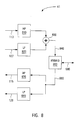
- the combiner circuitry 41 (or “combiner") can be implemented in many ways, the preferred manner being shown in FIGURE 8.
- the combiner 41 is seen to comprise a high-pass filter 910 for accepting the downstream broadband analog signal 113, a low-pass filter 920 for accepting the downstream narrowband analog signal 127, a summing node 930 having two inputs respectively connected to the high-pass and low pass filters 910,920 and an output that produces a downstream signal 940 connected to an input port of a hybrid 950.
- the hybrid 950 also has an output port producing an upstream signal 960 that leads both to a high-pass filter 970 producing the upstream broadband analog signal 115 and to a low-pass filter 980 producing the upstream narrowband analog signal 128.
- the hybrid 950 comprises diplexing means for combining the downstream and upstream signals 940,960 into a single composite bidirectional analog signal travelling on twisted pair 580 between the CPE 520 and an input-output port of the hybrid 950.
- the pass band of the high-pass filters 910,970 must be kept separate from the pass band of the low-pass filters 920,980.
- the combiner circuitry 41 may comprise a broadband hybrid and a bidirectional high-pass filter associated with the broadband processing section BB, a narrowband hybrid and a bidirectional low-pass filter associated with the narrowband processing section NB, as well as diplexing means for allowing the two filtered signals to coexist on the same twisted pair 580.
- This alternative design of the combiner 41 has fewer filters but a greater number of combiners than the design of FIGURE 8.
- the broadband processing section BB comprises a downstream broadband de-jittering queue (Q) 21 for accepting the downstream broadband cell stream 104 from the demultiplexer 16 and removing residual multiplexing jitter caused by the arrival of more cells in a given time interval than can be processed by subsequent processing blocks in the broadband processing section BB.
- Q broadband de-jittering queue
- the downstream broadband de-jittering queue 21 produces a de-jittered downstream broadband cell stream 109 that is fed to a modulator/encoder (M/E) 22.
- the modulator/encoder 22 applies a line code or modulation scheme to the de-jittered downstream broadband cell stream 109, producing a multi-level downstream broadband sample stream 110 fed to a wideband digital-to-analog converter (D/A) 23.
- the wideband digital-to-analog converter 23 transforms the downstream broadband sample stream 110 into an analog signal 112 which is fed to and amplified by a line driver (amplifier) 27, becoming the downstream broadband analog signal 113 fed to the combiner circuitry 41.
- the broadband processing section BB in the ULC 17 comprises a wideband analog-to-digital converter (A/D) 26, which accepts the upstream broadband analog signal 115 from the combiner circuitry 41 and converts it into an upstream broadband sample stream 116.
- a demodulator/decoder (DD) 25 demodulates or decodes the upstream broadband sample stream 116 and produces an upstream broadband cell stream 117 fed to an upstream broadband queue (Q) 24.
- Queue 24 buffers the upstream broadband cell stream 117 before delivering cell stream 118 to the multiplexer 15.
- Queue 24 also provides the control unit 14 with a queue fill control signal 136 indicating the level to which the queue 24 is full.
- a control signal 135 leading from the control unit 14 may provide the modulator/encoder 22, demodulator/decoder 25, wideband digital-to-analog converter 23 and wideband analog-to-digital converter 26 with an indication of the modulation format or line code to be applied, while the clock recovery circuit 42 provides these components with timing information via the recovered clock signal 142.
- the narrowband processing section NB in the ULC 17 comprises a downstream narrowband de-jittering queue (Q) 31 for temporarily storing the downstream narrowband cell stream 105 output by the demultiplexer 16.
- the output of the downstream narrowband de-jittering queue 31 is a de-jittered downstream narrowband cell stream 124 fed to a cell disassembly (CDS) block 32.
- the CDS block 32 removes the header from each cell in the de-jittered downstream narrowband cell stream 124 and produces a downstream narrowband raw bit stream 125, which is fed to an over-sampling decoder (OSD) 35A.
- OSD over-sampling decoder
- the over-sampling decoder 35A preferably of the one-bit sigma-delta variety, is used in the downstream direction for transforming the downstream narrowband raw bit stream 125 into an analog signal 126 exhibiting incremental variations that are in the positive or negative sense based on the value of each bit in the downstream narrowband raw bit stream 125.
- Analog signal 126 is fed to an analog front end (AFE) 36, where it is combined with a ringing voltage waveform 140 and an appropriate loop drive DC current and sent to the combiner circuitry in the form of the narrowband downstream analog signal 127.
- the ringing voltage waveform 140 is supplied by a ringing generator (R/G) 38 which is responsive to a control signal 132 supplied by the control unit 14.
- the ringing generator 38 can be an autonomous 20, 25 or 16 2/3 Hz generator, or it can be a power amplifier fed from the output of the over-sampling decoder 35A.
- the upstream narrowband analog signal 128 received from the combiner circuitry 41 reaches an over-sampling encoder (OSE) 35B, where it is over-sampled and converted into an upstream narrowband raw bit stream 129.
- the upstream narrowband raw bit stream 129 enters a cell assembly block (CAS) 34, which organizes the arriving bits into the bodies of traffic cells that are fed to an upstream narrowband queue 33.
- the cell header address information as sent by the HDT 510 and decoded by the control unit 14 is fed to the CAS block 34 via a control signal 143.
- Queue 33 buffers the cell stream received from the CAS block 34, producing the upstream narrowband cell stream 131 that is fed to the ATM multiplexer 15.
- LSD loop status detector
- the ringing generator 38 can be instantly tripped by a ring-trip control signal 134 from the loop status detector 37.
- the status of the loop is fed by the loop status detector 37 to the control unit 14 in the form of a control signal 133.
- the modulator/encoder 22 and the demodulator/decoder 25 may constitute a single component known as a modem or a codec, depending on the application.
- the CDS block 32 and the CAS block 34 can be fused into a single segmentation-and-reconstruct (SAR) block.
- the over-sampling decoder 35A and over-sampling encoder 35B can be joined into a single over-sampling codec.
- multiplexer 15 and demultiplexer 16 may be hardware components controlled by the control unit 14 or they may be software elements of the same processor as that which accommodates the control unit 14.
- a single, bidirectional mux/demux can perform the functions of the multiplexer 15 and demultiplexer 16.
- the downstream received electronic signal 102 representing the received optical signal is converted internally into an intermediate digital signal, from which timing information is fed to the clock recovery circuit 42 and from which subframes containing transport cells are identified.
- the downstream outstation 12 in ONU 1 verifies the transport cells in the address field of each subframe against a locally stored address (either predetermined or downloadable from the HDT) to determine whether the subframe in question is destined that ONU. If so, then control information is extracted from the transport cells in the control field of the corresponding subframe and sent to the ONU control unit 14 as the ONU control commands 106.
- traffic cells containing data are extracted from the traffic field of the corresponding subframe and are sent to the demultiplexer 16 as the downstream cell stream 103.
- the demultiplexer 16 reads the header of each traffic cell in the downstream cell stream 103 and, by comparing the cell address against either a fixed address map or an address map downloaded from the HDT via the control unit 14 and the mapping selection signal 139, determines the destination CPE and associated service type (narrowband or broadband). The demultiplexer 16 then consults the mapping and routes the incoming traffic cells towards the appropriate de-jittering queue (21 or 31) of the appropriate ULC in the form of the downstream broadband or narrowband cell stream (104 or 105).
- each traffic cell associated with a broadband service is passed intact to the CPE, and so the downstream fiber bandwidth occupied by a 25 Mb/s downstream service equals 25 Mb/s. Therefore, the entire contents of each cell in the downstream broadband cell stream 104 is to be line coded or modulated by the broadband processing section BB.
- the downstream broadband cell stream 104 is received by the downstream broadband de-jittering queue 21, which queue removes so-called "residual multiplexing jitter" as previously described.
- queue 21 is required to store as many broadband cells as could arrive in a single frame transmitted by the HDT. By the time the next frame arrives at the ONU, all the cells previously in the queue 21 will have been processed by the subsequent broadband processing stages.
- the de-jittered downstream broadband cell stream 109 exits the downstream broadband de-jittering queue 21 and enters the modulator/encoder 22.
- the modulator/encoder 22 may be hard coded in its functionality or it may be re-programmable to execute any one of a number of different line coding or carrier modulation functions required by the particular digital subscriber loop standard (e.g., ADSL or VDSL) used by the broadband equipment in the CPE with which it communicates. While line coding and carrier modulation are both useful, it is preferable to employ line coding, as the implementation of the modulator/encoder 22 is simpler.
- ADSL or VDSL digital subscriber loop standard
- the modulator/encoder thus applies a chosen line code or carrier modulation scheme to the de-jittered downstream broadband cell stream and produces the multi-level downstream broadband sample stream 110 fed to the wideband digital-to-analog converter 23.
- a 4B3T line code is used, then delivery of a 25 Mb/s downstream broadband service will result in the downstream broadband sample stream 110 having a sample rate of 18.75 Msample/s, while if a 16-QAM modulation scheme is used, then delivery of the same 25 Mb/s service would result in the downstream broadband sample 110 stream having a sample rate just above 12.5 Msample/s (in order to satisfy the Nyquist criterion), but having a wider dynamic range.
- the choice of line code or carrier modulation scheme may also be influenced by limitations in bandwidth or dynamic range of the wideband digital-to-analog converter 23.
- the wideband digital-to-analog converter 23 subsequently converts the downstream broadband sample stream 110 into analog signal 112 having a frequency range preferably limited by a lower bound which is above the highest narrowband frequency (e.g., 100 kHz) and an upper bound which is still transmittable over a reasonable length of twisted pair cable (e.g., 5-10 MHz).
- analog signal 112 preferably has a frequency range between about 100 kHz and 5-10 MHz.
- Analog signal 112 is then amplified by the line driver 27 before being delivered to the combiner circuitry 41 as the downstream braodband analog signal 113.
- each traffic cell associated with a narrowband service has a header containing the ULC address and has a body containing over-sampled data. Therefore, the downstream fiber bandwidth occupied a downstream service is equal to the bit rate of the service, multiplied by an overhead factor (to account for the cell header, equal to 1.17 for ATM cells) and by a bandwidth expansion factor (related to the resolution provided by the over-sampling decoder, usually equal to about 8 or more for good resolution).
- the typical downstream fiber bandwidth will be about 0.6 Mb/s, while for a 2 Mb/s DS-1 sevice, it will be on the order of 18.85 Mb/s.
- the downstream narrowband cell stream 105 enters the downstream narrowband de-jittering queue 31 which serves to compensate for residual multiplex jitter, as was the case with the downstream broadband de-jittering queue 21 in the broadband processing section of ULC 17.
- the headers of the cells arriving from the downstream narrowband de-jittering queue 31 are then removed by the CDS block 32, producing the downstream narrowband raw bit stream 125 having a bit rate in the just mentioned range of about 0.6 Mb/s to about 18.85 Mb/s.
- the over-sampling decoder 35A then accepts the downstream narrowband bit stream 125 at the high bit rate and produces analog signal 126 having a limited and relatively narrow frequency range, preferably between DC and a maximum of about 100 kHz.
- the analog front end 36 then supplements analog signal 126 with any necessary ring voltages and loop currents consistent with telephony standards.
- the analog front end 36 may add a ringing waveform 140 received from the ring generator 38, which is under the control of both the control signal 132 received from the control unit 14 and the ring-trip control signal 134 received from the loop status detector 37.
- the analog front end 36 thus produces the downstream narrowband analog signal 127 fed to the combiner circuitry 41.
- the downstream broadband analog signal 113 and the downstream narrowband analog signal 127 pass through respective filters 910,920 which apply respective frequency responses that enhance disjoint regions of the frequency spectrum.
- the downstream signal 940 output by the summing node 930 and fed to the hybrid 950 is therefore a frequency-division multiplexed interference-free signal.
- the hybrid 940 interfaces to twisted pair 580 in a standard way, allowing the downstream signal 940 to be sent onto the twisted pair but also allowing the upstream signal 960 to be extracted from the signal arriving on the twisted pair.
- Filters 970,980 then enhance the same disjoint regions of the frequency spectrum of the upstream signal 960 as was done by filters 910,920 with respect to downstream signals 113,127.
- filter 970 produces the upstream broadband analog signal 115 fed to the wideband analog-to-digital converter 26 in the broadband processing section BB and filter 980 producing the upstream broadband abalog signal 128 fed to the over-sampling encoder 35B in the narrowband processing section NB.
- Broadband services generally require a lower data rate in the upstream direction than in the downstream direction and as such the upstream bit rate is not expected to exceed 3 Mb/s.
- each traffic cell associated with a broadband service has a meaningful header and body, and therefore a 3 Mb/s service requires an upstream fiber bandwidth of 3 Mb/s.
- a narrowband service such as voice-band telephony is generally more symmetric in its data rate demands than a broadband service.
- over-sampled data is contained in the body of upstream narrowband cells and therefore the upstream fiber bandwidth occupied by an upstream narrowband service is equal to the bit rate of the service, multiplied by the same overhead factor and bandwidth expansion factor as discussed with respect to the downstream path, resulting in an upstream fiber bandwidth per service ranging from about 0.6 Mb/s to about 18.85 Mb/s.
- the CPE 520 sends a sequence of cells whose bits have been line coded or modulated and which arrive at the wideband analog-to-digital converter 26 as the upstream broadband analog signal 115.
- the output of the wideband analog-to-digital converter 26 is the upstream broadband sample stream 116 containing samples of line coded or modulated symbols.
- the demodulator/decoder 25 decodes or demodulates the encoded or modulated signal samples and recovers the cells contained therein.
- the upstream queue 24 then retains the upstream cells until the multiplexer 15 is ready to accept them. If the upstream queue 24 is full (or close to being full), it signals this fact to the control unit 14 via the queue fill control signal 136.
- the cells recovered by the demodulator/decoder 25 will be null cells, which can be discarded by the multiplexer 15, by the queue 24 or by the demodulator/decoder itself.
- the over-sampling encoder 35B accepts the upstream narrowband analog signal 128 from the combiner circuitry 41, samples it at a very high rate and encodes the incremental variations as the upstream narrowband raw bit stream 129.
- This narrowband signal may contain samples of data in a format such as PCM, DS-1, ISDN, etc., neither of which is cell-based.
- the upstream narrowband raw bit stream 129 arrives at the CAS block 34, where it is mapped by the CAS block 34 into a cell stream fed to the upstream narrowband queue 33.
- the upstream narrowband queue 33 then retains the cells output by the CAS block 34 until the multiplexer 15 is ready to accept them.
- the upstream cell streams 118,131 received respectively from the broadband and narrowband processing sections in ULC 17 are combined together with the cell streams 137,138 received from other ULCs to give the upstream cell stream 122 fed to the upstream outstation 13. If any cells in the upstream cell stream 122 are null cells (as might be produced by the broadband processing section in a given ULC), these may be recognized and discarded by the multiplexer 15.
- the upstream outstation 13 then groups the traffic cells from the upstream cell stream 122 into subframes.
- the upstream outstation 13 also appends appropriate address and control information to the subframe. Specifically, transport cells in the address field identify the ONU 1 as being associated with that subframe.
- the upstream outstation 13 modifies the content of the transport cells in the control field to signal a request for additional upstream bandwidth triggered by the queue fill control signal 136.
- the upstream outstation 13 modifies the content of the transport cells in the control field to indicate loop status information (e.g., on-hook, off-hook) provided to the control unit 14 by the loop status detector 37 via control signal 133.
- loop status information e.g., on-hook, off-hook
- the upstream outstation 13 buffers the newly formed subframes until the transmit control signal 120 received from the control unit 14 signals that the subframe is ready to be transmitted.
- Each ONU in the PON is instructed to transmit its respective subframes at specific times in order to prevent upstream traffic from other ONUs from being overwritten, hence guard bands may separate the upstream subframes transmitted by the various ONUs in the PON.
- the HDT can control the exact transmission time of each ONU by sending instructions via the control field in the downstream subframes which are extracted by the downstream outstation 12, decoded by the control unit 14 and sent to the upstream outstation 13 as transmit control signal 120.
- the header of a downstream broadband traffic cell contains the destination ULC address, while the body contains a series of n-bit commands (preferably two-bit commands) for controlling the analog output level of the ONU.
- the header of an upstream broadband traffic cell contains the source ULC address, while the body contains a sampled and digitized version of the possibly distorted broadband CPE output.
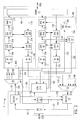
- FIGURE 2 shows an ONU 2, wherein the broadband processing section comprises a cell disassembly (CDS) block 222 connected to a two-bit digital-to-analog converter (D/A) 223 for downstream processing, as well as an analog-to-digital converter (A/D) 226 connected to a cell assembly (CAS) block 225 for upstream processing.
- the ONU 2 also comprises a modified control unit 214.
- the CDS block 222 removes headers from the cells in the de-jittered downstream broadband cell 109 stream output by the downstream broadband de-jittering queue 21, resulting in a downstream broadband raw bit stream 210 delivered to the two-bit digital-to-analog converter 222.
- the downstream broadband raw bit stream 210 contains pairs of bits representing the level of the ternary or quaternary line coded symbol intended to be delivered to the CPE.
- a 25 Mb/s downstream broadband service (having a line coded symbol rate of 14.0625 Msymbol/s) would be encoded by the digital signal processing bank 630 at the HDT into a bit stream inserted into the body of traffic cells of the downstream data stream, wherein each pair of bits in the bit stream represents a line coded symbol.
- the bit rate to be delivered to the two-bit digital-to-analog converter would therefore equal twice the symbol rate, and therefore the fiber bandwidth occupied by the 25 Mb/s downstream service would equal 28.125 Mb/s, multiplied by the overhead factor associated with the traffic cells, for a total of 33.125 Mb/s in the case of ATM.
- the ONU 2 would preferably comprise a 4-bit wideband digital-to-analog converter (for a better signal-to-quantizing-noise ratio than can be obtained with a 2-bit D/A converter) and at least 4 samples per symbol (to maintain phase information) resulting in 16 bits per symbol, each symbol carrying 2 bits of data. This results in a bandwidth expansion of at least 8 compared to the total downstream bandwidth calculated hereinabove.
- the upstream broadband analog signal 115 fed by the combiner circuitry 41 to the analog-to-digital converter 226 contains a distorted line coded or carrier modulated version of a broadband data signal transmitted by the CPE.
- the analog-to-digital converter 226 samples the upstream broadband analog signal 115 at (or above) the Nyquist rate and produces an upstream broadband raw bit stream 216 in which each group of a certain number (e.g., 8) of bits corresponds to a respective sample.
- the CAS block 225 packages the bits in the upstream broadband raw bit stream 216 into transport cells, adds a header thereto, and produces an upstream broadband cell stream 217 fed to the upstream broadband queue 24. Subsequent upstream processing is effected in a manner identical to that described with reference to FIGURE 1.
- the symbol rate will be 1.6875 Msymbol/s and therefore the analog-to-digital converter 226 produces the upstream broadband raw bit stream 216 having a bit rate of 27 Mb/s, for an 8-bit analog-to-digital converter operating at the Nyquist rate.
- the upstream fiber bandwidth will be on the order of 31.8 Mb/s in the case of ATM.
- FIGURE 3 shows an ONU 3 in accordance with a variation of the second preferred embodiment of the present invention, comprising a number of downstream broadband de-jittering queues 321A,B connected to respective CDS blocks 322A,B, which form a pool of downstream broadband processing resources, and a number of CAS blocks 325A,B connected to respective upstream broadband queues 324A,B, which form a pool of upstream broadband processing resources.
- the downstream broadband de-jittering queues 321A,B are fed by a demultiplexer 316, which must know exactly which of the downstream broadband processing paths are free so as to properly route each cell broadband cell in the downstream cell stream 103 to the appropriate processing block. (Narrowband cells continue to be routed in the usual manner.) Routing instructions for the demultiplexer 316 and the cross-connect 350 are provided by a modified mapping selection signal 339 and a routing control signal 370, respectively, both of which are received from the modified control unit 314.
- a key component of the ONU 3 is a cross-connect 350 for accepting the cell streams output by the pool of CDS blocks 322A,B and feeding each cell stream to the digital-to-analog converter in the broadband processing section of a selected ULC (e.g., digital-to-analog (D/A) converter 223 in ULC 17).
- Cross-connect 350 will typically have fewer inputs than outputs and should be capable of routing the output of any CDS block 322A,B towards any individual ULC (for unicast services) or group of ULCs (for multicast/broadcast services). It is to be noted that regardless of the variability in the data rates associated with the individual broadband services delivered to the various CPEs, the CDS blocks 322A,B must produce respective output bit streams having a common bit rate in order that these be accepted by the cross-connect 350.
- ONU 3 also comprises a cross-connect 351, typically with fewer outputs than inputs, connected between the analog-to-digital (A/D) converter 226 in the broadband processing section BB of each ULC and the input to each CAS block 325A,B in the pool of upstream processing resources. Routing instructions for the cross-connect 351 are provided by a modified routing control signal 371 received from the modified control unit 314.
- an over-sampling decoder and encoder could be used in place of the digital-to-analog and analog-to-digital converters 223,226, in which case the processing required for broadband and narrowband services would be similar, although a large amount of fiber bandwidth would be required.
- the narrowband processing section NB in each ULC could be scaled down to resemble the broadband processing section BB and hence pooled processing resources can be used both for broadband and for narrowband services.
- the ONU 2 is advantageously protected from any future changes in the cell format exchanged with the CPE, and, in addition, the ONU can be embodied in a compact package.
Landscapes
- Engineering & Computer Science (AREA)
- Computer Networks & Wireless Communication (AREA)
- Signal Processing (AREA)
- Data Exchanges In Wide-Area Networks (AREA)
Applications Claiming Priority (2)
| Application Number | Priority Date | Filing Date | Title |
|---|---|---|---|
| US217898 | 1994-03-25 | ||
| US09/217,898 US6519255B1 (en) | 1998-12-22 | 1998-12-22 | Universal optical network unit for use in narrowband and broadband access networks |
Publications (2)
| Publication Number | Publication Date |
|---|---|
| EP1014612A2 true EP1014612A2 (fr) | 2000-06-28 |
| EP1014612A3 EP1014612A3 (fr) | 2002-08-14 |
Family
ID=22812936
Family Applications (1)
| Application Number | Title | Priority Date | Filing Date |
|---|---|---|---|
| EP99310354A Withdrawn EP1014612A3 (fr) | 1998-12-22 | 1999-12-21 | Unité de réseau optique universelle pour utilisation dans les réseaux d'accès à bandes large et étroite |
Country Status (3)
| Country | Link |
|---|---|
| US (1) | US6519255B1 (fr) |
| EP (1) | EP1014612A3 (fr) |
| CA (1) | CA2292315C (fr) |
Cited By (2)
| Publication number | Priority date | Publication date | Assignee | Title |
|---|---|---|---|---|
| EP1253752A3 (fr) * | 2001-04-27 | 2004-02-11 | Mitsubishi Denki Kabushiki Kaisha | Appareil de ligne optique terminale, système APON et procédé de commande de la variation du retard de cellules |
| GB2418088A (en) * | 2004-09-10 | 2006-03-15 | Marconi Comm Ltd | Upgrading optical telecommunications networks |
Families Citing this family (60)
| Publication number | Priority date | Publication date | Assignee | Title |
|---|---|---|---|---|
| FI981319L (fi) * | 1998-06-10 | 1999-12-11 | Nokia Networks Oy | Kapea- ja laajakaistaisten palvelujen erotus siirtoyhteydellä |
| JP3529296B2 (ja) * | 1999-04-16 | 2004-05-24 | 富士通株式会社 | 光加入者終端装置 |
| KR100317124B1 (ko) * | 1999-12-27 | 2001-12-24 | 오길록 | 에이티엠-피오엔 시스템의 광망유니트 기능 처리장치 |
| JP2001203736A (ja) * | 2000-01-19 | 2001-07-27 | Nec Corp | Pon伝送システム及びそれに用いるダイナミック帯域割当方式 |
| EP1126650A3 (fr) * | 2000-02-18 | 2007-01-03 | Ericsson AB | Dispositif de communication optique |
| US6965603B1 (en) * | 2000-03-20 | 2005-11-15 | Cortina Systems, Inc. | Circuits for combining ATM and packet data on an optical fiber |
| US6721797B1 (en) * | 2000-05-16 | 2004-04-13 | Lucent Technologies Inc. | Partial back pressure (PBP) transmission technique for ATM-PON using rate controllers to reduce a maximum output rate from a peak rate to a controlled rate |
| US20020063932A1 (en) * | 2000-05-30 | 2002-05-30 | Brian Unitt | Multiple access system for communications network |
| US20020174434A1 (en) * | 2001-05-18 | 2002-11-21 | Tsu-Chang Lee | Virtual broadband communication through bundling of a group of circuit switching and packet switching channels |
| EP1271825A1 (fr) * | 2001-06-25 | 2003-01-02 | Lucent Technologies Inc. | Procédé et système pour le transport d'information optique multiplexé |
| JP2003078540A (ja) * | 2001-09-04 | 2003-03-14 | Nec Corp | 多重化伝送システム及びそのデータ転送方法 |
| US6975642B2 (en) * | 2001-09-17 | 2005-12-13 | Finisar Corporation | Optoelectronic device capable of participating in in-band traffic |
| US20030058505A1 (en) * | 2001-09-26 | 2003-03-27 | Joseph Arol | Passive distribution of wavelengths in optical networks |
| US6862302B2 (en) * | 2002-02-12 | 2005-03-01 | Finisar Corporation | Maintaining desirable performance of optical emitters over temperature variations |
| US7486894B2 (en) * | 2002-06-25 | 2009-02-03 | Finisar Corporation | Transceiver module and integrated circuit with dual eye openers |
| US7561855B2 (en) | 2002-06-25 | 2009-07-14 | Finisar Corporation | Transceiver module and integrated circuit with clock and data recovery clock diplexing |
| US7809275B2 (en) | 2002-06-25 | 2010-10-05 | Finisar Corporation | XFP transceiver with 8.5G CDR bypass |
| US7437079B1 (en) | 2002-06-25 | 2008-10-14 | Finisar Corporation | Automatic selection of data rate for optoelectronic devices |
| US7664401B2 (en) * | 2002-06-25 | 2010-02-16 | Finisar Corporation | Apparatus, system and methods for modifying operating characteristics of optoelectronic devices |
| US6888846B2 (en) * | 2002-07-11 | 2005-05-03 | Flexlight Networks | Data transfer in an optical network communication system |
| US7477847B2 (en) * | 2002-09-13 | 2009-01-13 | Finisar Corporation | Optical and electrical channel feedback in optical transceiver module |
| US8660427B2 (en) * | 2002-09-13 | 2014-02-25 | Intel Corporation | Method and apparatus of the architecture and operation of control processing unit in wavelenght-division-multiplexed photonic burst-switched networks |
| KR20050083685A (ko) * | 2002-09-13 | 2005-08-26 | 패씨브 엘티디. | 다수의 엔티티를 갖는 통신망 유닛을 포함하는 이더넷 수동광 통신망에서의 동작 방법 |
| US6848012B2 (en) * | 2002-09-27 | 2005-01-25 | Broadcom Corporation | Method and system for an adaptive multimode media queue |
| US6928495B2 (en) * | 2002-09-27 | 2005-08-09 | Broadcom Corporation | Method and system for an adaptive multimode media queue |
| US7317743B2 (en) * | 2002-11-08 | 2008-01-08 | Finisar Corporation | Temperature and jitter compensation controller circuit and method for fiber optics device |
| US7230961B2 (en) | 2002-11-08 | 2007-06-12 | Finisar Corporation | Temperature and jitter compensation controller circuit and method for fiber optics device |
| US7450520B2 (en) * | 2003-02-14 | 2008-11-11 | Nortel Networks Limited | Remote interface for a network device in the physical plant |
| US7428383B2 (en) * | 2003-02-28 | 2008-09-23 | Intel Corporation | Architecture, method and system of WDM-based photonic burst switched networks |
| US7848649B2 (en) * | 2003-02-28 | 2010-12-07 | Intel Corporation | Method and system to frame and format optical control and data bursts in WDM-based photonic burst switched networks |
| US7298973B2 (en) * | 2003-04-16 | 2007-11-20 | Intel Corporation | Architecture, method and system of multiple high-speed servers to network in WDM based photonic burst-switched networks |
| US7266295B2 (en) * | 2003-04-17 | 2007-09-04 | Intel Corporation | Modular reconfigurable multi-server system and method for high-speed networking within photonic burst-switched network |
| US7526202B2 (en) * | 2003-05-19 | 2009-04-28 | Intel Corporation | Architecture and method for framing optical control and data bursts within optical transport unit structures in photonic burst-switched networks |
| US9337948B2 (en) | 2003-06-10 | 2016-05-10 | Alexander I. Soto | System and method for performing high-speed communications over fiber optical networks |
| US7266296B2 (en) * | 2003-06-11 | 2007-09-04 | Intel Corporation | Architecture and method for framing control and data bursts over 10 Gbit Ethernet with and without WAN interface sublayer support |
| US7310480B2 (en) | 2003-06-18 | 2007-12-18 | Intel Corporation | Adaptive framework for closed-loop protocols over photonic burst switched networks |
| US7272310B2 (en) * | 2003-06-24 | 2007-09-18 | Intel Corporation | Generic multi-protocol label switching (GMPLS)-based label space architecture for optical switched networks |
| US20050030951A1 (en) * | 2003-08-06 | 2005-02-10 | Christian Maciocco | Reservation protocol signaling extensions for optical switched networks |
| US20050068968A1 (en) * | 2003-09-30 | 2005-03-31 | Shlomo Ovadia | Optical-switched (OS) network to OS network routing using extended border gateway protocol |
| US8732782B1 (en) * | 2003-10-10 | 2014-05-20 | Verizon Services Corp. | Systems and methods for providing communication services over telephone lines |
| US7768938B2 (en) * | 2003-10-10 | 2010-08-03 | Verizon Services Corp. | Systems and methods for providing multiple communication services over existing twisted pair access lines |
| US7315693B2 (en) * | 2003-10-22 | 2008-01-01 | Intel Corporation | Dynamic route discovery for optical switched networks |
| US7340169B2 (en) | 2003-11-13 | 2008-03-04 | Intel Corporation | Dynamic route discovery for optical switched networks using peer routing |
| US7426586B2 (en) * | 2003-12-15 | 2008-09-16 | Finisar Corporation | Configurable input/output terminals |
| US7734176B2 (en) * | 2003-12-22 | 2010-06-08 | Intel Corporation | Hybrid optical burst switching with fixed time slot architecture |
| US20050177749A1 (en) * | 2004-02-09 | 2005-08-11 | Shlomo Ovadia | Method and architecture for security key generation and distribution within optical switched networks |
| US20050175183A1 (en) * | 2004-02-09 | 2005-08-11 | Shlomo Ovadia | Method and architecture for secure transmission of data within optical switched networks |
| US7630631B2 (en) * | 2004-04-14 | 2009-12-08 | Finisar Corporation | Out-of-band data communication between network transceivers |
| US7447438B2 (en) * | 2004-07-02 | 2008-11-04 | Finisar Corporation | Calibration of digital diagnostics information in an optical transceiver prior to reporting to host |
| US8639122B2 (en) * | 2004-07-02 | 2014-01-28 | Finisar Corporation | Filtering digital diagnostics information in an optical transceiver prior to reporting to host |
| US7532820B2 (en) | 2004-10-29 | 2009-05-12 | Finisar Corporation | Systems and methods for providing diagnostic information using EDC transceivers |
| US20060171714A1 (en) * | 2005-02-02 | 2006-08-03 | Calix Networks, Inc. | Electrically shared passive optical network |
| US9059946B2 (en) * | 2005-09-29 | 2015-06-16 | Broadcom Corporation | Passive optical network (PON) packet processor |
| US7643753B2 (en) * | 2005-09-29 | 2010-01-05 | Broadlight Ltd. | Enhanced passive optical network (PON) processor |
| KR100786040B1 (ko) | 2006-05-19 | 2007-12-17 | 한국과학기술원 | 높은 스펙트럼 효율을 구비한 전송 포맷을 이용하여 고속광신호 전송이 가능한 파장 분할 다중방식 수동형 광가입자망 |
| CN100571206C (zh) * | 2006-06-19 | 2009-12-16 | 上海贝尔阿尔卡特股份有限公司 | 混合组网中基站系统及其呼叫建立、切换和释放处理方法 |
| US8130742B2 (en) * | 2007-06-15 | 2012-03-06 | Microsoft Corporation | Communication protocol for a wireless device and a game console |
| US20090052901A1 (en) * | 2007-08-20 | 2009-02-26 | Knology, Inc. | Hybrid fiber coax (hfc) circuit |
| US8451864B2 (en) * | 2010-06-23 | 2013-05-28 | Broadcom Corporation | Passive optical network processor with a programmable data path |
| CN114499584B (zh) * | 2022-01-24 | 2022-10-14 | 中国矿业大学(北京) | 矿用双绞线宽带多址复用系统 |
Family Cites Families (11)
| Publication number | Priority date | Publication date | Assignee | Title |
|---|---|---|---|---|
| US4408189A (en) | 1981-05-18 | 1983-10-04 | Northern Telecom Limited | Method and apparatus for code conversion of binary to multilevel signals |
| US4528550A (en) | 1983-10-31 | 1985-07-09 | Northern Telecom Limited | Method and apparatus for code conversion of binary of multilevel signals |
| US5572347A (en) | 1991-07-30 | 1996-11-05 | Alcatel Network Systems, Inc. | Switched video architecture for an optical fiber-to-the-curb telecommunications system |
| US5303229A (en) * | 1991-07-31 | 1994-04-12 | Alcatel Network Systems, Inc. | Optical network unit |
| US5189671A (en) * | 1991-12-20 | 1993-02-23 | Raynet Corporation | Apparatus and method for formatting variable length data packets for a transmission network |
| GB2291562B (en) * | 1994-05-21 | 1998-09-23 | Northern Telecom Ltd | Communications system |
| WO1997018649A1 (fr) | 1995-11-14 | 1997-05-22 | Dsc Communications Corporation | Procede et appareil pour multiplexer des signaux mrt et mta sur une ligne de communication |
| US5917815A (en) * | 1995-12-29 | 1999-06-29 | Lucent Technologies Inc. | Method and apparatus for converting synchronous narrowband signals into a SONET virtual tributary group for combining with broadband asynchronous transfer mode signals in an integrated telecommunications network |
| US5808767A (en) * | 1996-05-30 | 1998-09-15 | Bell Atlantic Network Services, Inc | Fiber optic network with wavelength-division-multiplexed transmission to customer premises |
| US5903372A (en) * | 1997-02-10 | 1999-05-11 | Alcatel Network Systems, Inc. | Means for remote addition of video services to subscribers |
| US6023467A (en) * | 1997-05-08 | 2000-02-08 | Ericsson, Inc. | Operations and maintenance data flows over a point to multipoint broadband access network |
-
1998
- 1998-12-22 US US09/217,898 patent/US6519255B1/en not_active Expired - Lifetime
-
1999
- 1999-12-16 CA CA002292315A patent/CA2292315C/fr not_active Expired - Fee Related
- 1999-12-21 EP EP99310354A patent/EP1014612A3/fr not_active Withdrawn
Cited By (2)
| Publication number | Priority date | Publication date | Assignee | Title |
|---|---|---|---|---|
| EP1253752A3 (fr) * | 2001-04-27 | 2004-02-11 | Mitsubishi Denki Kabushiki Kaisha | Appareil de ligne optique terminale, système APON et procédé de commande de la variation du retard de cellules |
| GB2418088A (en) * | 2004-09-10 | 2006-03-15 | Marconi Comm Ltd | Upgrading optical telecommunications networks |
Also Published As
| Publication number | Publication date |
|---|---|
| CA2292315C (fr) | 2007-07-31 |
| US6519255B1 (en) | 2003-02-11 |
| EP1014612A3 (fr) | 2002-08-14 |
| CA2292315A1 (fr) | 2000-06-22 |
Similar Documents
| Publication | Publication Date | Title |
|---|---|---|
| CA2292315C (fr) | Unite de reseau optique universelle pour reseaux d'acces a bande etroite et a large bande | |
| US5459722A (en) | Asynchronous transfer mode (ATM) transport of voice-band signals | |
| EP0815703B1 (fr) | Dispositif visant a adapter un trafic vocal a bande etroite d'un reseau d'acces local afin de permettre la transmission par reseau a mode de transfert asynchrone a large bande | |
| Pattavina | Switching Theory | |
| JP3159926B2 (ja) | 同期ディジタル信号キャリアをatmディジタル信号とsonet仮想トリビュタリグループとを結合した結合信号に変換する方法および統合通信ネットワーク | |
| US5889773A (en) | Method and apparatus for placing time division multiplexed telephony traffic into an asynchronous transfer mode format | |
| US6421150B2 (en) | Architecture repartitioning to simplify outside-plant component of fiber-based access system | |
| US5940456A (en) | Synchronous plesiochronous digital hierarchy transmission systems | |
| US7012922B1 (en) | Packet communications system and method | |
| US20020085563A1 (en) | Packet processing method and engine | |
| JP3299749B2 (ja) | デジタル送信ネットワーク用のネットワークインターフェイス方法及びネットワークインターフェイス | |
| EP0961517A1 (fr) | Appareil pour l'accès des rèseaux analogues, RNIS et XDSL à un réseau ATM | |
| EP1237309A1 (fr) | Système de communication par fibres optiques | |
| US7254134B2 (en) | Systems for transferring various data types across an ATM network | |
| US6795436B1 (en) | Method to generate data cells, data cell generating arrangement, and data cell receiving arrangement | |
| US20020089715A1 (en) | Fiber optic communication method | |
| HK1030498A (en) | Universal optical network unit for use in narrowband and broadband access networks. | |
| CN101729706A (zh) | 通信系统、通信装置及终端收容装置 | |
| EP0735794A2 (fr) | Méthode pour transporter des signaux de bande vocale par des réseaux à mode de transfert asynchrone (ATM) | |
| EP1014670A2 (fr) | Système de télécommunication et procédé avec une ligne d'abonné numérique (DSL) multicanaux | |
| Nyangaresi et al. | Empirical Analysis of Clustered Network Traffic over Digital Communication Channels | |
| JP2003134163A (ja) | Dsl伝送方法及びdsl伝送装置 | |
| Ahamed et al. | Knowledge Highways | |
| HK1031491A (en) | Line card with modem interface |
Legal Events
| Date | Code | Title | Description |
|---|---|---|---|
| PUAI | Public reference made under article 153(3) epc to a published international application that has entered the european phase |
Free format text: ORIGINAL CODE: 0009012 |
|
| AK | Designated contracting states |
Kind code of ref document: A2 Designated state(s): AT BE CH CY DE DK ES FI FR GB GR IE IT LI LU MC NL PT SE |
|
| AX | Request for extension of the european patent |
Free format text: AL;LT;LV;MK;RO;SI |
|
| RAP1 | Party data changed (applicant data changed or rights of an application transferred) |
Owner name: NORTEL NETWORKS LIMITED |
|
| PUAL | Search report despatched |
Free format text: ORIGINAL CODE: 0009013 |
|
| AK | Designated contracting states |
Kind code of ref document: A3 Designated state(s): AT BE CH CY DE DK ES FI FR GB GR IE IT LI LU MC NL PT SE |
|
| AX | Request for extension of the european patent |
Free format text: AL;LT;LV;MK;RO;SI |
|
| 17P | Request for examination filed |
Effective date: 20030214 |
|
| AKX | Designation fees paid |
Designated state(s): DE FR GB |
|
| RAP1 | Party data changed (applicant data changed or rights of an application transferred) |
Owner name: NORTEL NETWORKS LIMITED |
|
| 17Q | First examination report despatched |
Effective date: 20040709 |
|
| STAA | Information on the status of an ep patent application or granted ep patent |
Free format text: STATUS: THE APPLICATION IS DEEMED TO BE WITHDRAWN |
|
| 18D | Application deemed to be withdrawn |
Effective date: 20050701 |
|
| REG | Reference to a national code |
Ref country code: HK Ref legal event code: WD Ref document number: 1030498 Country of ref document: HK |