EP1014745B1 - Verfahren und Vorrichtung zur Erzeugung von Datenzellen und Anordnung zum Empfang von Datenzellen - Google Patents
Verfahren und Vorrichtung zur Erzeugung von Datenzellen und Anordnung zum Empfang von Datenzellen Download PDFInfo
- Publication number
- EP1014745B1 EP1014745B1 EP98403294A EP98403294A EP1014745B1 EP 1014745 B1 EP1014745 B1 EP 1014745B1 EP 98403294 A EP98403294 A EP 98403294A EP 98403294 A EP98403294 A EP 98403294A EP 1014745 B1 EP1014745 B1 EP 1014745B1
- Authority
- EP
- European Patent Office
- Prior art keywords
- data
- minicell
- overhead
- data cell
- speech
- Prior art date
- Legal status (The legal status is an assumption and is not a legal conclusion. Google has not performed a legal analysis and makes no representation as to the accuracy of the status listed.)
- Expired - Lifetime
Links
- 238000000034 method Methods 0.000 title claims description 20
- 230000006978 adaptation Effects 0.000 claims abstract description 12
- 238000012546 transfer Methods 0.000 claims abstract description 8
- 230000005540 biological transmission Effects 0.000 description 9
- 230000008878 coupling Effects 0.000 description 3
- 238000010168 coupling process Methods 0.000 description 3
- 238000005859 coupling reaction Methods 0.000 description 3
- 239000000284 extract Substances 0.000 description 3
- 238000004891 communication Methods 0.000 description 2
- 238000010348 incorporation Methods 0.000 description 2
- 238000003780 insertion Methods 0.000 description 2
- 230000037431 insertion Effects 0.000 description 2
- 238000012545 processing Methods 0.000 description 2
- 101150012579 ADSL gene Proteins 0.000 description 1
- 102100020775 Adenylosuccinate lyase Human genes 0.000 description 1
- 108700040193 Adenylosuccinate lyases Proteins 0.000 description 1
- 230000007423 decrease Effects 0.000 description 1
- 238000005538 encapsulation Methods 0.000 description 1
- 238000011156 evaluation Methods 0.000 description 1
- 230000003287 optical effect Effects 0.000 description 1
- 238000012552 review Methods 0.000 description 1
- 230000011664 signaling Effects 0.000 description 1
- 230000001629 suppression Effects 0.000 description 1
Images
Classifications
-
- H—ELECTRICITY
- H04—ELECTRIC COMMUNICATION TECHNIQUE
- H04Q—SELECTING
- H04Q11/00—Selecting arrangements for multiplex systems
- H04Q11/04—Selecting arrangements for multiplex systems for time-division multiplexing
- H04Q11/0428—Integrated services digital network, i.e. systems for transmission of different types of digitised signals, e.g. speech, data, telecentral, television signals
- H04Q11/0478—Provisions for broadband connections
-
- H—ELECTRICITY
- H04—ELECTRIC COMMUNICATION TECHNIQUE
- H04L—TRANSMISSION OF DIGITAL INFORMATION, e.g. TELEGRAPHIC COMMUNICATION
- H04L12/00—Data switching networks
- H04L12/54—Store-and-forward switching systems
- H04L12/56—Packet switching systems
- H04L12/5601—Transfer mode dependent, e.g. ATM
- H04L2012/5638—Services, e.g. multimedia, GOS, QOS
- H04L2012/5646—Cell characteristics, e.g. loss, delay, jitter, sequence integrity
- H04L2012/5652—Cell construction, e.g. including header, packetisation, depacketisation, assembly, reassembly
- H04L2012/5653—Cell construction, e.g. including header, packetisation, depacketisation, assembly, reassembly using the ATM adaptation layer [AAL]
- H04L2012/5656—Cell construction, e.g. including header, packetisation, depacketisation, assembly, reassembly using the ATM adaptation layer [AAL] using the AAL2
-
- H—ELECTRICITY
- H04—ELECTRIC COMMUNICATION TECHNIQUE
- H04L—TRANSMISSION OF DIGITAL INFORMATION, e.g. TELEGRAPHIC COMMUNICATION
- H04L12/00—Data switching networks
- H04L12/54—Store-and-forward switching systems
- H04L12/56—Packet switching systems
- H04L12/5601—Transfer mode dependent, e.g. ATM
- H04L2012/5638—Services, e.g. multimedia, GOS, QOS
- H04L2012/5671—Support of voice
Definitions
- the present invention relates to a method to generate a data cell as defined in the non-characteristic part of claim 1, a data cell generating arrangement able to perform this method as defined in the non-characteristic part of claim 2, a data cell receiving arrangement able to communicate with the data cell generating arrangement as defined in the non-characteristic part of claim 8, and a telecommunication system including such data cell generating and receiving arrangements as defined in the non-characteristic part of claim 9.
- ATM Asynchronous Transfer Mode
- ATM is a well-known protocol used in telecommunication systems that is based on transmission of data in fixed size cells, the so called ATM cells.
- Such an ATM cell has a length of 53 octets or 53 bytes: 5 bytes form the ATM cell header whereas the remaining 48 bytes constitute a payload section that can be filled with the data to be transferred.
- bandwidth utilisation of ATM can be improved by incorporation of an additional layer, the so called ATM Adaptation Layer.
- the ATM Adaptation Layer is based on encapsulation of data in minicells which afterwards are multiplexed in an ATM cell.
- the ATM Adaptation Layer can be subdivided into two parts: one or more service specific convergence sublayers (SSCS) and a common part sublayer (CPS).
- the service specific convergence sublayer (SSCS) serves as an interface between a telecommunication service, for instance a mobile telephony service, and the common part sublayer (CPS). Its task is to segment incoming information into packets that can be embedded in an ATM Adaptation Layer minicell.
- the common part sublayer (CPS) on the other hand inserts each packet in an ATM Adaptation Layer minicell, adds a 3 bytes minicell header to each minicell, and inserts the minicells in an ATM cell.
- the current invention is in fact dealing with the service specific convergence sublayer (SSCS).
- each speech packet separately to the common part sublayer (CPS) so that each speech packet is embedded in a separate minicell.
- SSCS service specific convergence sublayer
- CCS common part sublayer
- a minicell contains a complete data or speech packet.
- speech data packets or speech frames typically have lengths of 10 or 20 bytes.
- ATM Adaptation Layer minicells have a header of 3 bytes.
- this object is realised by the method for generating data cells defined by claim 1, the data cell generating arrangement defined by claim 2, the data cell receiving arrangement defined by claim 8, and the telecommunication system defined by claim 9.
- the term 'coupled' should not be interpreted as being limitative to direct connections only.
- the scope of the expression 'a device A coupled to a device B' should not be limited to devices or systems wherein an output of device A is directly connected to an input of device B. It means that there exists a path between an output of A and an input of B which may be a path including other devices or means.
- the lengths of the multiplexed packets can be communicated from the transmitting entity to the receiving entity via a code of N bits per multiplexed packet. If for example 3 data packets are multiplexed into a minicell and it is supposed that data packets can have 4 different lengths, then a 2 bit code is sufficient to indicate the length of a single packet, and the transmitting entity consequently has to add 6 bits of overhead information to the minicell.
- an empty packet is a packet with a length of 0 bytes so that the embodiment defined by claim 4 can be seen as a specialisation of the embodiment of claim 3 wherein one of the predefined packet lengths equals 0 bytes.
- a further advantageous feature of the data cell generating arrangement according to the present invention is defined in claim 5.
- data packets with different origins and different destinations which have to be transferred over one and the same link somewhere in the network may be multiplexed according to the present invention into a single minicell so that the available link capacity is not only used in an optimal way by the different users individually but is also efficiently used in a multiplexed way between the different users.
- What is described here is another way of grouping speech packets. Normally however, speech packets belonging to one connection will be concatenated in one minicell if the present invention is applied.
- the present invention is very suitable for implementation in an ATM (Asynchronous Transfer Mode) based environment wherein an AAL (ATM Adaptation Layer) is incorporated.
- ATM Asynchronous Transfer Mode
- ATM ATM Adaptation Layer
- an ATM (Asynchronous Transfer Mode) network will be considered wherein a very cost-effective voice service, i.e. at a very low network cost but possibly with a lower speech quality due to larger delay, is provided.
- a customer for instance can make a choice between a good speech quality service at the normal price or a less good speech quality service at a reduced price.
- the core ATM network can be optimised by incorporation of voice codecs at the edges of this network which encode the 64 kbps PCM (Pulse Code Modulation) stream into lower bit rate streams of for instance 8 kbps.
- PCM Pulse Code Modulation
- the average bit rate can be further reduced by using silence suppression, meaning that during silent periods no or very limited information is transferred.
- the speech packets P1, P2 and P3 of such a low bit rate voice service have to be transferred between a sending entity and a receiving entity.
- This sending entity and receiving entity should be considered as ATM network nodes between whom all considered speech packets, P1, P2 and P3, have to be transferred.
- the sending and receiving entity are not necessarily the originating terminal and destination terminal of the speech packets P1, P2 and P3. In fact, the speech packets P1, P2 and P3 may even originate from different originating terminals and may be destined to different destination terminals.
- the ATM Adaptation Layer 2 is incorporated which implies that user data packets and speech packets are inserted in minicells with possibly different lengths, each having a header of 3 bytes, and that these minicells are multiplexed into the 48 byte long ATM cell payload sections.
- the speech packets P1, P2 and P3 that have to be transferred between the sending entity and receiving entity may have three different lengths: 10 bytes, 20 bytes or 0 bytes. Speech packets with 0 bytes are so called silent frames transferred during silent periods.
- speech packet P1 has a length of 10 bytes
- speech packet P2 has a length of 20 bytes
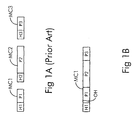
- speech packet P3 has a length of 10 bytes. If these speech packets would be transferred in accordance with the known method, then the first packet P1 would be inserted in a first minicell MC1 having a first three byte header H1, the second packet P2 would be inserted into a second minicell MC2 having a second three byte header H2, and the third packet P3 would be inserted into a third minicell MC3 having a third three byte header H3. As is illustrated by Fig.
- the known method would involve transmission of 49 bytes (10 bytes for P1, 20 bytes for P2, 10 bytes for P3, and 3 headers of 3 bytes) from the sending entity to the receiving entity. If the three speech packets P1, P2 and P3 are transferred in accordance with the present invention, then only a single minicell MC1 including the three speech packets P1, P2 and P3 and having a three byte header H1 has to be transferred between the sending and receiving entity. As is illustrated by Fig. 1B, only 44 bytes would be transferred (10 bytes for P1, 20 bytes for P2, 10, bytes for P3, 1 header of 3 bytes and an additional overhead section OH of 1 byte) then.
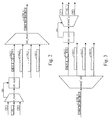
- Arrangements that can be used in the sending and receiving entity to realise a transmission of the speech packets P1, P2 and P3 as illustrated by Fig. 1 B are drawn in Fig. 2 and Fig. 3 respectively.
- the ATM cell generating arrangement drawn in Fig. 2 includes a packet multiplexer P_MUX, an overhead adder OH_ADD, and an AAL2 minicell multiplexer MC_MUX.
- the packet multiplexer P_MUX and the overhead adder OH_ADD are cascade connected between three input terminals of the arrangement and a first input terminal of the AAL2 minicell multiplexer MC_MUX.
- a control output of the packet multiplexer P_MUX is interconnected with a control input of the overhead adder OH_ADD.
- Cascade couplings of a packet multiplexer and an overhead adder are coupled to three additional input terminals of the AAL2 minicell multiplexer MC_MUX but are not drawn in Fig. 2 to avoid overloading the figure.
- the AAL2 minicell multiplexer MC_MUX in addition to its four input terminals also has an output terminal which serves as an output terminal for the whole arrangement.
- the three speech packets P1, P2 and P3 of Fig. 1A and Fig. 1B are supplied to the three input terminals of the ATM cell generating arrangement of Fig. 2.
- the first speech packet P1 has a length of 10 bytes
- the second speech packet P2 has a length of 20 bytes
- the third speech packet P3 has a length of 10 bytes
- these speech packets are supposed to contain information originating from different users and destined for different users.
- the three speech packets P1, P2 and P3, somewhere in the telecommunication system have to be transferred over one and the same ATM (Asynchronous Transfer Mode) link between a sending entity equipped with the ATM cell generating arrangement of Fig.
- the packet multiplexer P_MUX of Fig. 2 thus receives the three speech packets P1, P2 and P3 respectively at its first, second and third input terminal.
- the packet multiplexer P_MUX determines the lengths of the three speech packets P1, P2 and P3, and informs the overhead adder OH_ADD via information sent over the link between the control output of the packet multiplexer P_MUX and the control input of the overhead adder OH_ADD that speech packet P1 has a length of 10 bytes, speech packet P2 has a length of 20 bytes and speech packet P3 has a length of 10 bytes.
- the format wherein this information is communicated between the packet multiplexer P_MUX and the overhead adder OH_ADD is of no importance with respect to the present invention.
- the packet multiplexer P_MUX concatenates the three speech packets P1, P2 and P3 and applies the concatenated packet as one data packet of 40 bytes to the overhead adder OH_ADD.
- the overhead adder OH_ADD adds an overhead section OH indicative for the length of the three packets P1, P2 and P3 to the data packet of 40 bytes. In this way, a first headerless minicell MC1' is generated.
- the overhead adder OH can indicate via a 2-bit code the length of each speech packet.
- the overhead adder OH_ADD indicates that the length of a speech packet is 0 bytes via the code 00, indicates that the length of a speech packet is 10 bytes via the code 01, and indicates that the length of a speech packet is 20 bytes via the code 10.
- the overhead section OH inserted by the overhead adder OH_ADD in the headerless minicell MC1' to indicate that the first speech packet P1 has a length of 10 bytes, the second speech packet P2 has a length of 20 bytes and the third speech packet P3 has a length of 10 bytes is equal to 011001.
- the use of such a code to indicate the length of multiplexed packets evidently requires that the receiving entity is aware of this code.
- each having a 3 byte header have to be transferred between the transmitting entity and receiving entity: instead of 49 bytes, 44 bytes are to be transferred which is a significant reduction. It is noted that only complete bytes can be transferred. So, for the remaining two bits, two options are open, i.e. use these two bits for header (OH) protection or use some padding bits. In the last case, it is of course possible to concatenate 4 speech packets instead of 3 in order to further increase efficiency.
- the AAL2 minicell multiplexer MC_MUX performs the functionality of the common part sublayer (CPS) of the AAL2 layer.
- the AAL2 minicell multiplexer MC_MUX hence performs traditional AAL2 CP (common part) functionality.
- a minicell header is added to the headerless minicells MC1', MC2', MC3' and MC4', the different minicells MC1, MC2, MC3 and MC4 are multiplexed into the 48 byte payload section of a single ATM cell ATM_C and an ATM cell header of 5 bytes is added to the cell ATM_C.
- the so generated ATM cell ATM_C is sent over an ATM link towards the ATM cell receiving arrangement drawn in Fig. 3.
- the ATM cell receiving arrangement of Fig. 3 includes a minicell demultiplexer MC_DMUX, an overhead extractor OH_EXT and a packet demultiplexer P_DMUX.
- the input terminal of the ATM cell receiving arrangement and the input terminal of the minicell demultiplexer MC_DMUX are interconnected.
- the minicell demultiplexer MC_DMUX further has four output terminals whereto similar arrangements are coupled. To avoid overloading the figure only the arrangement coupled to the first output terminal of the minicell demultiplexer MC_DMUX is shown in Fig. 3. This arrangement is constituted by the cascade coupling of the overhead extractor OH_EXT and the packet demultiplexer P_DMUX.
- the packet demultiplexer P_DMUX further has three outputs, and a control input interconnected with a control output of the overhead extractor OH_EXT.
- the ATM cell receiving arrangement of Fig. 3 is able to receive the ATM cell ATM_C generated by the ATM cell generator of Fig. 2 and is able to extract from this ATM cell ATM_C the speech packets P1, P2 and P3 that were inserted therein by the cell generating arrangement of Fig. 2.
- the minicell demultiplexer MC_DMUX thereto demultiplexes the payload section of the ATM cell ATM_C to thereby extract the four minicells MC1, MC2, MC3 and MC4 embedded therein and subtracts the minicell headers therefrom.
- the so generated four headerless minicells MC1', MC2', MC3' and MC4' are sourced respectively via the four output terminals of the minicell demultiplexer MC_DMUX.
- the first headerless minicell MC1' in this way is supplied to the overhead extractor OH_EXT which extracts the overhead section OH from the headerless minicell MC1' and decodes the contents of this overhead section OH into information that indicates to the packet demultiplexer P_DMUX the lengths of the packets carried by the headerless minicell MC1'.
- the overhead extractor EXT extracts the six bits 011001 that constitute the overhead section OH from the headerless minicell MC1' and thereupon informs the packet demultiplexer P_DMUX via the control link between them that the headerless minicell MC1' contains three packets P1, P2 and P3 with a length of respectively 10 bytes, 20 bytes and 10 bytes.
- the packet demultiplexer P_DMUX uses this information to correctly demultiplex the packets P1, P2 and P3 carried by the headerless minicell MC1' and sources the three packets P1, P2 and P3 via respectively its first, second and third output terminal.
- the minicell demultiplexer MC_DMUX performs the functionality of the AAL2 common part sublayer (CPS) in a traditional way, whereas the overhead extractor OH_EXT and the packet demultiplexer P_DMUX perform the functionality of the AAL2 service specific convergence sublayer (SSCS) in accordance with the present invention.
- CPS common part sublayer
- SSCS service specific convergence sublayer
- the network efficiency for the transmission of three speech packets is improved from 49 bytes to 44 bytes by concatenating the speech packets P1, P2 and P3 into a single minicell MC1 which allows the AAL (ATM Adaptation Layer) overhead to be shared over different speech packets.
- AAL ATM Adaptation Layer
- the increased network efficiency allows the operator to offer a service at a lower cost.
- the price to be paid for this increased network efficiency is some additional processing in the service specific convergence sublayer (SSCS) of the ATM Adaptation Layer to packetise and depacketise the speech packets, and to restore the timing. As a result of this additional processing, the overall delay will be slightly increased.
- SSCS service specific convergence sublayer
- the lengths of the speech frames, the lengths of the minicells and their overhead sections, and the lengths of the codes used to indicate the lengths of the multiplexed speech packets are only given by way of example. Any skilled person will be able to adopt the above described embodiment so that it can be integrated in a telecommunication system wherein packets, minicells and cells with other dimensions and other overhead sections are transmitted.
- the overhead adder OH_ADD for example may be integrated within the packet multiplexer P_MUX, thus avoiding that the packet multiplexer P_MUX has to send signals indicating the length of the packets P1, P2 and P3 via a control link to the overhead adder OH_ADD.
- the overhead extractor OH_EXT in the cell receiving arrangement may be integrated with the packet demultiplexer P_DMUX hence avoiding that packet length information has to be communicated via a control link between the units OH_EXT and P_DMUX of Fig. 3.
- the means OH_ADD foreseen to add the overhead section OH to the headerless minicell MC1' may be the means which also adds the standard minicell header to the headerless minicell MC1'. In other words, various ways can be thought off to add the overhead section OH with packet length information to the headerless minicell MC1', and the present invention is not limited to any particular way wherein this is done.
- the applicability of the invention is not reduced to telecommunication systems with a particular physical transmission medium or wherein any particular physical layer transmission protocol is used.
- the invention in other words can be applied in any cell-based transmission system, irrespective of the fact whether the cells are sent over twisted pair cables, coaxial cables, optical fibres, radio links, satellite links, or the like, and irrespective of the physical layer protocol (e.g. ADSL - Asymmetric Digital Subscriber Line) that is used to represent the bits on the transmission link.
- the physical layer protocol e.g. ADSL - Asymmetric Digital Subscriber Line
Landscapes
- Engineering & Computer Science (AREA)
- Computer Networks & Wireless Communication (AREA)
- Data Exchanges In Wide-Area Networks (AREA)
- Communication Control (AREA)
- Time-Division Multiplex Systems (AREA)
Claims (9)
- Verfahren, um in einem Telekommunikationssystem eine Datenzelle (ATM_C) zu erzeugen, wobei das Verfahren die Schritte der Multiplexens einer Vielzahl von Minizellen (MC1', MC2', MC3', MC4') in die Datenzelle (ATM_C) umfasst,
DADURCH GEKENNZEICHNET, DASS vor dem Schritt des Multiplexens der Vielzahl von Minizellen (MC1', MC2', MC3', MC4') in die Datenzelle (ATM_C) das Verfahren folgende Schritte umfasst:a. Multiplexen einer Vielzahl von Daten-/Sprachpaketen (P1, P2, P3) in mindestens eine Minizelle (MC1') der Vielzahl von Minizellen (MC1', MC2', MC3', MC4'); undb. Zu mindestens einer Minizelle (MC1') Hinzufügen von Kopfinformation (OH), welche die Länge der darin gemultiplexten Daten-/Sprachpakete (P1, P2, P3) anzeigt. - Anordnung zur Erzeugung von Datenzellen für den Einsatz in einem Telekommunikationssystem, um darin eine Datenzelle (ATM_C) zu erzeugen, wobei die Anordnung zur Erzeugung von Datenzellen Mittel zum Multiplexen von Minizellen (MC_MUX) enthält, deren Ausgang mit einem Ausgang der Anordnung gekoppelt ist und die so angepasst sind, dass sie eine Vielzahl von Minizellen (MC1', MC2', MC3', MC4') in die Datenzelle (ATM_C) multiplexen,
DADURCH GEKENNZEICHNET, DASS die Anordnung zur Erzeugung von Datenzellen weiterhin folgendes umfasst:a. Mittel zum Multiplexen von Daten-/Sprachpaketen (P_MUX), die mit einem Eingang der Anordnung gekoppelt und so angepasst sind, dass sie in mindestens eine Minizelle (MC1') der Vielzahl von Minizellen (MC1', MC2', MC3', MC4') eine Vielzahl von Daten-/Sprachpaketen (P1, P2, P3) multiplexen; undb. Mittel zum Hinzufügen von Kopfinformation (OH_ADD), die zwischen den Mitteln zum Multiplexen von Daten-/Sprachpaketen (P_MUX) und den Mitteln zum Multiplexen von Minizellen (MC_MUX) angeschlossen und so angepasst sind, dass sie zu der mindestens einen Minizelle (MC1') Kopfinformation (OH) hinzufügen, welche die Länge der darin gemultiplexten Daten-/Sprachpakete (P1, P2, P3) anzeigt. - Anordnung zur Erzeugung von Datenzellen gemäß Anspruch 2,
DADURCH GEKENNZEICHNET, DASS die Mittel zum Hinzufügen von Kopfinformation (OH_ADD) so angepasst sind, für jedes in die Minizelle (MC1') gemultiplexte Daten-/Sprachpaket (P1, P2, P3) N Kopfinformations-Bits zu der Minizelle (MC1') hinzuzufügen, wobei N ein ganzzahliger Wert ist, der so gewählt wird, dass die Daten-/Sprachpakete 2N verschiedene Längen haben können. - Anordnung zur Erzeugung von Datenzellen gemäß Anspruch 2,
DADURCH GEKENNZEICHNET, DASS die Mittel zum Hinzufügen von Kopfinformation (OH_ADD) so angepasst sind, für jedes in die Minizelle (MC1') gemultiplexte Daten-/Sprachpaket (P1, P2, P3) N Kopfinformations-Bits zu der Minizelle (MC1') hinzuzufügen, wobei N ein ganzzahliger Wert ist, der so gewählt wird, dass die Daten-/Sprachpakete leer sein können oder 2N-1 verschiedene Längen haben können. - Anordnung zur Erzeugung von Datenzellen gemäß Anspruch 3 oder Anspruch 4,
DADURCH GEKENNZEICHNET, DASS, wenn die Anzahl von Kopfinformations-Bits, die zu der Minizelle (MC1') hinzugefügt werden, kein Vielfaches von 8 ist, das Mittel zum Hinzufügen von Kopfinformation (OH_ADD) weiterhin so angepasst ist, eine Anzahl von Fehlersicherungs-Bits zur Sicherung der Kopfinformations-Bits hinzuzufügen, wobei die Anzahl der Fehlersicherungs-Bits und die Anzahl von Kopfinformations-Bits zusammen eine ganze Zahl von Bytes bilden. - Anordnung zur Erzeugung von Datenzellen gemäß jedem der Ansprüche 2 bis 4,
DADURCH GEKENNZEICHNET, DASS die Mittel zum Multiplexen von Daten-/Sprachpaketen (P_MUX) so angepasst sind, dass sie Daten-/Sprachpakete (P1, P2, P3), die von verschiedenen Benutzern kommen, empfangen und in die Minizelle (MC1') multiplexen. - Anordnung zur Erzeugung von Datenzellen gemäß jedem der Ansprüche 2 bis 6,
DADURCH GEKENNZEICHNET, DASS die Datenzelle (ATM_C) eine Zelle des Asynchronous Transfer Mode ist und dadurch, dass die Minizellen (MC1', MC2', MC3', MC4') Minizellen der Asynchronous Transfer Mode Adaption Layer sind. - Anordnung zum Empfang von Datenzellen zum Einsatz in einem Telekommunikationssystem, um darin eine Datenzelle (ATM_C) zu empfangen, wobei die Anordnung zum Empfang von Datenzellen Mittel zum Demultiplexen von Minizellen (MC_DMUX) enthält, die mit einem Eingang der Anordnung verbunden und so angepasst sind, dass sie eine Vielzahl von Minizellen (MC1', MC2', MC3', MC4'), die in die Datenzelle (ATM_C) eingebettet sind, demultiplexen,
DADURCH GEKENNZEICHNET, DASS die Anordnung zum Empfang von Datenzellen weiterhin folgendes umfasst:a. Mittel zum Extrahieren von Kopfinformation (OH_EXT), die mit den Mitteln zum Demultiplexen von Minizellen (MC_DMUX) gekoppelt und so angepasst sind, dass sie von mindestens einer Minizelle (MC1') der Vielzahl von Minizellen (MC1', MC2', MC3', MC4') Kopfinformation (OH) subtrahieren, welche die Länge einer Vielzahl von Daten-/Sprachpaketen (P1, P2, P3) anzeigt, die darin gemultiplext sind; undb Mittel zum Demultiplexen von Daten-/Sprachpaketen (P_DMUX), die mit den Mitteln zum Extrahieren von Kopfinformation (OH_EXT) gekoppelt und so angepasst sind, dass sie aus der mindestens einen Minizelle (MC1') die Vielzahl von Daten-/Sprachpaketen (P1, P2, P3) demultiplexen und dabei die Kopfinformation (OH) benutzen. - Telekommunikationssystem, das eine Vielzahl von Netzwerkknoten und Netzwerkverbindungen enthält,
DADURCH GEKENNZEICHNET, DASS mindestens einer der Netzwerkknoten eine Anordnung zur Erzeugung von Datenzellen, wie in Anspruch 2 definiert, enthält und mindestens einer der Netzwerkknoten eine Anordnung zum Empfang von Datenzellen, wie in Anspruch 8 definiert, enthält.
Priority Applications (7)
| Application Number | Priority Date | Filing Date | Title |
|---|---|---|---|
| AT98403294T ATE308865T1 (de) | 1998-12-23 | 1998-12-23 | Verfahren und vorrichtung zur erzeugung von datenzellen und anordnung zum empfang von datenzellen |
| DE69832186T DE69832186T2 (de) | 1998-12-23 | 1998-12-23 | Verfahren und Vorrichtung zur Erzeugung von Datenzellen und Anordnung zum Empfang von Datenzellen |
| EP98403294A EP1014745B1 (de) | 1998-12-23 | 1998-12-23 | Verfahren und Vorrichtung zur Erzeugung von Datenzellen und Anordnung zum Empfang von Datenzellen |
| AU64361/99A AU6436199A (en) | 1998-12-23 | 1999-12-07 | Method to generate data cells, data cell generating arrangement and data cell receiving arrangement |
| JP35596699A JP2000216795A (ja) | 1998-12-23 | 1999-12-15 | デ―タセルを生成する方法、デ―タセル生成装置、およびデ―タセル受信装置 |
| US09/468,228 US6795436B1 (en) | 1998-12-23 | 1999-12-20 | Method to generate data cells, data cell generating arrangement, and data cell receiving arrangement |
| CA002292860A CA2292860A1 (en) | 1998-12-23 | 1999-12-21 | Method to generate data cells, data cell generating arrangement, and date cell receiving arrangement |
Applications Claiming Priority (1)
| Application Number | Priority Date | Filing Date | Title |
|---|---|---|---|
| EP98403294A EP1014745B1 (de) | 1998-12-23 | 1998-12-23 | Verfahren und Vorrichtung zur Erzeugung von Datenzellen und Anordnung zum Empfang von Datenzellen |
Publications (2)
| Publication Number | Publication Date |
|---|---|
| EP1014745A1 EP1014745A1 (de) | 2000-06-28 |
| EP1014745B1 true EP1014745B1 (de) | 2005-11-02 |
Family
ID=8235607
Family Applications (1)
| Application Number | Title | Priority Date | Filing Date |
|---|---|---|---|
| EP98403294A Expired - Lifetime EP1014745B1 (de) | 1998-12-23 | 1998-12-23 | Verfahren und Vorrichtung zur Erzeugung von Datenzellen und Anordnung zum Empfang von Datenzellen |
Country Status (7)
| Country | Link |
|---|---|
| US (1) | US6795436B1 (de) |
| EP (1) | EP1014745B1 (de) |
| JP (1) | JP2000216795A (de) |
| AT (1) | ATE308865T1 (de) |
| AU (1) | AU6436199A (de) |
| CA (1) | CA2292860A1 (de) |
| DE (1) | DE69832186T2 (de) |
Families Citing this family (8)
| Publication number | Priority date | Publication date | Assignee | Title |
|---|---|---|---|---|
| JP3348778B2 (ja) | 1999-06-07 | 2002-11-20 | 日本電気株式会社 | Aal2sarにおけるプロファイル通知システム及びそのプロファイル通知方法 |
| US6654376B1 (en) * | 1999-12-28 | 2003-11-25 | Nortel Networks Limited | ATM packet scheduler |
| EP1346513B1 (de) * | 2000-08-30 | 2010-10-20 | Tmt Coaxial Networks Inc. | Verfahren und system fur ein hausnetzwerk |
| US8724485B2 (en) | 2000-08-30 | 2014-05-13 | Broadcom Corporation | Home network system and method |
| US7408957B2 (en) * | 2002-06-13 | 2008-08-05 | International Business Machines Corporation | Selective header field dispatch in a network processing system |
| DE102005008503B3 (de) * | 2005-02-24 | 2006-06-29 | Siemens Ag | Verfahren und Netzwerk zur Daten- und Signalübertragung |
| JP5456507B2 (ja) * | 2010-02-16 | 2014-04-02 | 日本電信電話株式会社 | パケット転送装置およびパケット転送方法 |
| CN114710529B (zh) * | 2022-03-25 | 2024-03-12 | 广州小鹏汽车科技有限公司 | 数据传输方法、装置、系统、车辆及存储介质 |
Family Cites Families (11)
| Publication number | Priority date | Publication date | Assignee | Title |
|---|---|---|---|---|
| JP3262142B2 (ja) * | 1992-01-16 | 2002-03-04 | 富士通株式会社 | Atmセル化装置、atmセル化方法、ノード、及びノードにおける多重化方法 |
| JP3002348B2 (ja) * | 1992-11-30 | 2000-01-24 | シャープ株式会社 | 画像通信システム |
| SE505845C2 (sv) * | 1995-04-24 | 1997-10-13 | Ericsson Telefon Ab L M | Telekommunikationssystem och sätt att överföra mikroceller i detta |
| SE515588C2 (sv) * | 1996-01-25 | 2001-09-03 | Ericsson Telefon Ab L M | Miniceller med variabel för storlek på nyttolasten i ett mobiltelefonnät |
| US5822321A (en) | 1996-04-10 | 1998-10-13 | Telefonaktiebolaget Lm Ericsson | Minicell segmentation and reassembly |
| GB9624917D0 (en) * | 1996-11-29 | 1997-01-15 | Northern Telecom Ltd | Distribution network |
| JP3434994B2 (ja) * | 1996-12-12 | 2003-08-11 | 富士通株式会社 | セル組立多重化装置 |
| GB2321568A (en) * | 1997-01-22 | 1998-07-29 | Northern Telecom Ltd | ATM communications system and method |
| GB2331430A (en) * | 1997-11-12 | 1999-05-19 | Northern Telecom Ltd | Communications system and method |
| US6449276B1 (en) * | 1998-05-20 | 2002-09-10 | Nokia Telecommunications Oy | Method and apparatus for efficient switching of partial minicells in ATM adaptation layer 2 |
| US6600746B1 (en) * | 1999-03-30 | 2003-07-29 | Telefonaktiebolaget Lm Ericsson | AAL2 framing on NX64 KBPS E1/T1 |
-
1998
- 1998-12-23 AT AT98403294T patent/ATE308865T1/de not_active IP Right Cessation
- 1998-12-23 DE DE69832186T patent/DE69832186T2/de not_active Expired - Fee Related
- 1998-12-23 EP EP98403294A patent/EP1014745B1/de not_active Expired - Lifetime
-
1999
- 1999-12-07 AU AU64361/99A patent/AU6436199A/en not_active Abandoned
- 1999-12-15 JP JP35596699A patent/JP2000216795A/ja active Pending
- 1999-12-20 US US09/468,228 patent/US6795436B1/en not_active Expired - Fee Related
- 1999-12-21 CA CA002292860A patent/CA2292860A1/en not_active Abandoned
Also Published As
| Publication number | Publication date |
|---|---|
| DE69832186D1 (de) | 2005-12-08 |
| EP1014745A1 (de) | 2000-06-28 |
| DE69832186T2 (de) | 2006-07-13 |
| JP2000216795A (ja) | 2000-08-04 |
| AU6436199A (en) | 2000-06-29 |
| US6795436B1 (en) | 2004-09-21 |
| ATE308865T1 (de) | 2005-11-15 |
| CA2292860A1 (en) | 2000-06-23 |
Similar Documents
| Publication | Publication Date | Title |
|---|---|---|
| KR100447071B1 (ko) | 데이터셀생성방법과장치,데이터패킷전송방법과장치,통신시스템 | |
| EP0690653B1 (de) | Übertragung von Sprachbandsignalen in (ATM) Asynchronous Transfer Mode | |
| US6009100A (en) | Asynchronous transfer mode switching system | |
| US6052371A (en) | System and method for the communication of operation and maintenance, administration and provisioning information over an asynchronous transfer mode network | |
| US6434151B1 (en) | Communications system and method | |
| US20070183437A1 (en) | System and method for transporting a call | |
| CZ298611B6 (cs) | Zpusob provozování telekomunikacní síte pro rízení hovoru a telekomunikacní systém pro rízení hovoru | |
| US6795436B1 (en) | Method to generate data cells, data cell generating arrangement, and data cell receiving arrangement | |
| KR100364747B1 (ko) | Aal2/aal5 변환 장치 및 방법 | |
| US7342927B1 (en) | Systems and methods for transferring various data types across an ATM network | |
| JP3537318B2 (ja) | 特定のコネクションの通信データを加工する交換機および交換方法 | |
| US20020126700A1 (en) | Transmission techniques using universal data link protocol | |
| Bentall et al. | ATM and Internet Protocol | |
| EP1113696A2 (de) | ATM uber einem DSL-Dienst | |
| KR100287417B1 (ko) | 수요밀집형 광가입자 전송장치에서의 가입자 접속장치 | |
| EP0979566A2 (de) | Datenunterdrückung und -regenerierung | |
| US7697424B2 (en) | Method and device to transfer data in a communication network comprising a low-bit rate artery | |
| EP1396123B1 (de) | Verfahren zum transport von paketen variabler länge in zeitlichen leitungsrahmen | |
| WO2001047199A1 (en) | Method and apparatus for transparent transmission between a tdm network and a packet or cell based network | |
| US7154882B1 (en) | Method of transmitting data via a packet-oriented communications network | |
| KR0169644B1 (ko) | Atm-mss의 정합 모듈 | |
| EP1238562B1 (de) | Verfahren, system, umrichter und vermittlungsstelle zur atm-kommunikation | |
| EP0735794A2 (de) | Verfahren zum Transportieren von Sprachbandsignalen über nach dem asynchronen Transfermodus (ATM) arbeitenden Netzwerken | |
| Eng | ATM Objectives and Requirements For Next-Generation Networks |
Legal Events
| Date | Code | Title | Description |
|---|---|---|---|
| PUAI | Public reference made under article 153(3) epc to a published international application that has entered the european phase |
Free format text: ORIGINAL CODE: 0009012 |
|
| AK | Designated contracting states |
Kind code of ref document: A1 Designated state(s): AT BE DE ES FR GB IT SE |
|
| AX | Request for extension of the european patent |
Free format text: AL;LT;LV;MK;RO;SI |
|
| 17P | Request for examination filed |
Effective date: 20001228 |
|
| AKX | Designation fees paid |
Free format text: AT BE DE ES FR GB IT SE |
|
| GRAP | Despatch of communication of intention to grant a patent |
Free format text: ORIGINAL CODE: EPIDOSNIGR1 |
|
| RIC1 | Information provided on ipc code assigned before grant |
Ipc: 7H 04L 12/56 B Ipc: 7H 04Q 11/04 A |
|
| GRAS | Grant fee paid |
Free format text: ORIGINAL CODE: EPIDOSNIGR3 |
|
| GRAA | (expected) grant |
Free format text: ORIGINAL CODE: 0009210 |
|
| AK | Designated contracting states |
Kind code of ref document: B1 Designated state(s): AT BE DE ES FR GB IT SE |
|
| PG25 | Lapsed in a contracting state [announced via postgrant information from national office to epo] |
Ref country code: BE Free format text: LAPSE BECAUSE OF FAILURE TO SUBMIT A TRANSLATION OF THE DESCRIPTION OR TO PAY THE FEE WITHIN THE PRESCRIBED TIME-LIMIT Effective date: 20051102 Ref country code: AT Free format text: LAPSE BECAUSE OF FAILURE TO SUBMIT A TRANSLATION OF THE DESCRIPTION OR TO PAY THE FEE WITHIN THE PRESCRIBED TIME-LIMIT Effective date: 20051102 |
|
| REG | Reference to a national code |
Ref country code: GB Ref legal event code: FG4D |
|
| REF | Corresponds to: |
Ref document number: 69832186 Country of ref document: DE Date of ref document: 20051208 Kind code of ref document: P |
|
| PG25 | Lapsed in a contracting state [announced via postgrant information from national office to epo] |
Ref country code: SE Free format text: LAPSE BECAUSE OF FAILURE TO SUBMIT A TRANSLATION OF THE DESCRIPTION OR TO PAY THE FEE WITHIN THE PRESCRIBED TIME-LIMIT Effective date: 20060202 |
|
| PG25 | Lapsed in a contracting state [announced via postgrant information from national office to epo] |
Ref country code: ES Free format text: LAPSE BECAUSE OF FAILURE TO SUBMIT A TRANSLATION OF THE DESCRIPTION OR TO PAY THE FEE WITHIN THE PRESCRIBED TIME-LIMIT Effective date: 20060213 |
|
| ET | Fr: translation filed | ||
| PLBE | No opposition filed within time limit |
Free format text: ORIGINAL CODE: 0009261 |
|
| STAA | Information on the status of an ep patent application or granted ep patent |
Free format text: STATUS: NO OPPOSITION FILED WITHIN TIME LIMIT |
|
| 26N | No opposition filed |
Effective date: 20060803 |
|
| PGFP | Annual fee paid to national office [announced via postgrant information from national office to epo] |
Ref country code: IT Payment date: 20071221 Year of fee payment: 10 |
|
| PGFP | Annual fee paid to national office [announced via postgrant information from national office to epo] |
Ref country code: GB Payment date: 20071218 Year of fee payment: 10 |
|
| PGFP | Annual fee paid to national office [announced via postgrant information from national office to epo] |
Ref country code: DE Payment date: 20071221 Year of fee payment: 10 |
|
| PGFP | Annual fee paid to national office [announced via postgrant information from national office to epo] |
Ref country code: FR Payment date: 20071217 Year of fee payment: 10 |
|
| GBPC | Gb: european patent ceased through non-payment of renewal fee |
Effective date: 20081223 |
|
| REG | Reference to a national code |
Ref country code: FR Ref legal event code: ST Effective date: 20090831 |
|
| PG25 | Lapsed in a contracting state [announced via postgrant information from national office to epo] |
Ref country code: DE Free format text: LAPSE BECAUSE OF NON-PAYMENT OF DUE FEES Effective date: 20090701 |
|
| PG25 | Lapsed in a contracting state [announced via postgrant information from national office to epo] |
Ref country code: GB Free format text: LAPSE BECAUSE OF NON-PAYMENT OF DUE FEES Effective date: 20081223 |
|
| PG25 | Lapsed in a contracting state [announced via postgrant information from national office to epo] |
Ref country code: FR Free format text: LAPSE BECAUSE OF NON-PAYMENT OF DUE FEES Effective date: 20081231 |
|
| PG25 | Lapsed in a contracting state [announced via postgrant information from national office to epo] |
Ref country code: IT Free format text: LAPSE BECAUSE OF NON-PAYMENT OF DUE FEES Effective date: 20081223 |