EP1015428B1 - Sulfo-n-hydroxysuccinimide et procede d'elaboration - Google Patents
Sulfo-n-hydroxysuccinimide et procede d'elaboration Download PDFInfo
- Publication number
- EP1015428B1 EP1015428B1 EP98946097A EP98946097A EP1015428B1 EP 1015428 B1 EP1015428 B1 EP 1015428B1 EP 98946097 A EP98946097 A EP 98946097A EP 98946097 A EP98946097 A EP 98946097A EP 1015428 B1 EP1015428 B1 EP 1015428B1
- Authority
- EP
- European Patent Office
- Prior art keywords
- sulfo
- product
- acid
- diester
- hydroxylamine
- Prior art date
- Legal status (The legal status is an assumption and is not a legal conclusion. Google has not performed a legal analysis and makes no representation as to the accuracy of the status listed.)
- Expired - Lifetime
Links
- 238000000034 method Methods 0.000 title claims description 80
- GVJXGCIPWAVXJP-UHFFFAOYSA-N 2,5-dioxo-1-oxoniopyrrolidine-3-sulfonate Chemical compound ON1C(=O)CC(S(O)(=O)=O)C1=O GVJXGCIPWAVXJP-UHFFFAOYSA-N 0.000 title claims description 60
- 238000002360 preparation method Methods 0.000 title description 14
- 239000002253 acid Substances 0.000 claims description 62
- OKKJLVBELUTLKV-UHFFFAOYSA-N Methanol Chemical compound OC OKKJLVBELUTLKV-UHFFFAOYSA-N 0.000 claims description 60
- QTBSBXVTEAMEQO-UHFFFAOYSA-N Acetic acid Chemical compound CC(O)=O QTBSBXVTEAMEQO-UHFFFAOYSA-N 0.000 claims description 40
- XLYOFNOQVPJJNP-UHFFFAOYSA-N water Substances O XLYOFNOQVPJJNP-UHFFFAOYSA-N 0.000 claims description 28
- AVXURJPOCDRRFD-UHFFFAOYSA-N Hydroxylamine Chemical compound ON AVXURJPOCDRRFD-UHFFFAOYSA-N 0.000 claims description 25
- 150000005690 diesters Chemical class 0.000 claims description 25
- WFDIJRYMOXRFFG-UHFFFAOYSA-N Acetic anhydride Chemical compound CC(=O)OC(C)=O WFDIJRYMOXRFFG-UHFFFAOYSA-N 0.000 claims description 24
- 150000001875 compounds Chemical class 0.000 claims description 24
- 125000002950 monocyclic group Chemical group 0.000 claims description 22
- KZNICNPSHKQLFF-UHFFFAOYSA-N succinimide Chemical compound O=C1CCC(=O)N1 KZNICNPSHKQLFF-UHFFFAOYSA-N 0.000 claims description 21
- 150000001768 cations Chemical class 0.000 claims description 19
- WTDHULULXKLSOZ-UHFFFAOYSA-N Hydroxylamine hydrochloride Chemical compound Cl.ON WTDHULULXKLSOZ-UHFFFAOYSA-N 0.000 claims description 18
- 230000018044 dehydration Effects 0.000 claims description 16
- 238000006297 dehydration reaction Methods 0.000 claims description 16
- NEAQRZUHTPSBBM-UHFFFAOYSA-N 2-hydroxy-3,3-dimethyl-7-nitro-4h-isoquinolin-1-one Chemical compound C1=C([N+]([O-])=O)C=C2C(=O)N(O)C(C)(C)CC2=C1 NEAQRZUHTPSBBM-UHFFFAOYSA-N 0.000 claims description 15
- -1 sulfo-succinic acid compound Chemical class 0.000 claims description 15
- ULUAUXLGCMPNKK-UHFFFAOYSA-N Sulfobutanedioic acid Chemical compound OC(=O)CC(C(O)=O)S(O)(=O)=O ULUAUXLGCMPNKK-UHFFFAOYSA-N 0.000 claims description 14
- 238000006243 chemical reaction Methods 0.000 claims description 14
- 229960002317 succinimide Drugs 0.000 claims description 14
- LFQSCWFLJHTTHZ-UHFFFAOYSA-N Ethanol Chemical compound CCO LFQSCWFLJHTTHZ-UHFFFAOYSA-N 0.000 claims description 13
- HBAQYPYDRFILMT-UHFFFAOYSA-N 8-[3-(1-cyclopropylpyrazol-4-yl)-1H-pyrazolo[4,3-d]pyrimidin-5-yl]-3-methyl-3,8-diazabicyclo[3.2.1]octan-2-one Chemical class C1(CC1)N1N=CC(=C1)C1=NNC2=C1N=C(N=C2)N1C2C(N(CC1CC2)C)=O HBAQYPYDRFILMT-UHFFFAOYSA-N 0.000 claims description 12
- 150000002148 esters Chemical class 0.000 claims description 11
- BLSAPDZWVFWUTL-UHFFFAOYSA-N 2,5-dioxopyrrolidine-3-sulfonic acid Chemical compound OS(=O)(=O)C1CC(=O)NC1=O BLSAPDZWVFWUTL-UHFFFAOYSA-N 0.000 claims description 10
- 125000000217 alkyl group Chemical group 0.000 claims description 7
- QOSSAOTZNIDXMA-UHFFFAOYSA-N Dicylcohexylcarbodiimide Chemical compound C1CCCCC1N=C=NC1CCCCC1 QOSSAOTZNIDXMA-UHFFFAOYSA-N 0.000 claims description 6
- PFKFTWBEEFSNDU-UHFFFAOYSA-N carbonyldiimidazole Chemical compound C1=CN=CN1C(=O)N1C=CN=C1 PFKFTWBEEFSNDU-UHFFFAOYSA-N 0.000 claims description 6
- NQTADLQHYWFPDB-UHFFFAOYSA-N N-Hydroxysuccinimide Chemical compound ON1C(=O)CCC1=O NQTADLQHYWFPDB-UHFFFAOYSA-N 0.000 claims description 5
- 125000003118 aryl group Chemical group 0.000 claims description 5
- 229910052739 hydrogen Inorganic materials 0.000 claims description 5
- 239000001257 hydrogen Substances 0.000 claims description 5
- 125000000962 organic group Chemical group 0.000 claims description 5
- 125000002887 hydroxy group Chemical group [H]O* 0.000 claims description 4
- 125000001997 phenyl group Chemical group [H]C1=C([H])C([H])=C(*)C([H])=C1[H] 0.000 claims description 4
- 230000002194 synthesizing effect Effects 0.000 claims description 4
- 238000011065 in-situ storage Methods 0.000 claims description 3
- 239000000843 powder Substances 0.000 claims description 3
- 125000004435 hydrogen atom Chemical group [H]* 0.000 claims 1
- 230000003301 hydrolyzing effect Effects 0.000 claims 1
- 239000000047 product Substances 0.000 description 31
- RPENMORRBUTCPR-UHFFFAOYSA-M sodium;1-hydroxy-2,5-dioxopyrrolidine-3-sulfonate Chemical compound [Na+].ON1C(=O)CC(S([O-])(=O)=O)C1=O RPENMORRBUTCPR-UHFFFAOYSA-M 0.000 description 22
- XEKOWRVHYACXOJ-UHFFFAOYSA-N Ethyl acetate Chemical compound CCOC(C)=O XEKOWRVHYACXOJ-UHFFFAOYSA-N 0.000 description 21
- 239000000203 mixture Substances 0.000 description 19
- CSCPPACGZOOCGX-UHFFFAOYSA-N Acetone Chemical compound CC(C)=O CSCPPACGZOOCGX-UHFFFAOYSA-N 0.000 description 18
- ZMXDDKWLCZADIW-UHFFFAOYSA-N N,N-Dimethylformamide Chemical compound CN(C)C=O ZMXDDKWLCZADIW-UHFFFAOYSA-N 0.000 description 12
- HEMHJVSKTPXQMS-UHFFFAOYSA-M Sodium hydroxide Chemical compound [OH-].[Na+] HEMHJVSKTPXQMS-UHFFFAOYSA-M 0.000 description 12
- 229960000583 acetic acid Drugs 0.000 description 12
- 159000000000 sodium salts Chemical class 0.000 description 12
- 239000002904 solvent Substances 0.000 description 12
- 230000015572 biosynthetic process Effects 0.000 description 11
- LYCAIKOWRPUZTN-UHFFFAOYSA-N Ethylene glycol Chemical compound OCCO LYCAIKOWRPUZTN-UHFFFAOYSA-N 0.000 description 10
- KWYUFKZDYYNOTN-UHFFFAOYSA-M Potassium hydroxide Chemical compound [OH-].[K+] KWYUFKZDYYNOTN-UHFFFAOYSA-M 0.000 description 9
- 239000012535 impurity Substances 0.000 description 9
- 239000000463 material Substances 0.000 description 8
- 239000007787 solid Substances 0.000 description 8
- TYFQFVWCELRYAO-UHFFFAOYSA-N suberic acid Chemical compound OC(=O)CCCCCCC(O)=O TYFQFVWCELRYAO-UHFFFAOYSA-N 0.000 description 8
- 238000005160 1H NMR spectroscopy Methods 0.000 description 7
- 239000002244 precipitate Substances 0.000 description 7
- IAZDPXIOMUYVGZ-UHFFFAOYSA-N Dimethylsulphoxide Chemical compound CS(C)=O IAZDPXIOMUYVGZ-UHFFFAOYSA-N 0.000 description 6
- YXFVVABEGXRONW-UHFFFAOYSA-N Toluene Chemical compound CC1=CC=CC=C1 YXFVVABEGXRONW-UHFFFAOYSA-N 0.000 description 6
- 239000003153 chemical reaction reagent Substances 0.000 description 6
- 239000000543 intermediate Substances 0.000 description 6
- VLKZOEOYAKHREP-UHFFFAOYSA-N n-Hexane Chemical compound CCCCCC VLKZOEOYAKHREP-UHFFFAOYSA-N 0.000 description 6
- QVZVAUZTNCXLPV-UHFFFAOYSA-M sodium;2,5-dioxooxolane-3-sulfonate Chemical compound [Na+].[O-]S(=O)(=O)C1CC(=O)OC1=O QVZVAUZTNCXLPV-UHFFFAOYSA-M 0.000 description 6
- AKEJUJNQAAGONA-UHFFFAOYSA-N sulfur trioxide Chemical compound O=S(=O)=O AKEJUJNQAAGONA-UHFFFAOYSA-N 0.000 description 6
- VYPSYNLAJGMNEJ-UHFFFAOYSA-N Silicium dioxide Chemical compound O=[Si]=O VYPSYNLAJGMNEJ-UHFFFAOYSA-N 0.000 description 5
- 239000013078 crystal Substances 0.000 description 5
- WGCNASOHLSPBMP-UHFFFAOYSA-N hydroxyacetaldehyde Natural products OCC=O WGCNASOHLSPBMP-UHFFFAOYSA-N 0.000 description 5
- 238000007363 ring formation reaction Methods 0.000 description 5
- 239000000741 silica gel Substances 0.000 description 5
- 229910002027 silica gel Inorganic materials 0.000 description 5
- 238000003786 synthesis reaction Methods 0.000 description 5
- YBJHBAHKTGYVGT-ZKWXMUAHSA-N (+)-Biotin Chemical compound N1C(=O)N[C@@H]2[C@H](CCCCC(=O)O)SC[C@@H]21 YBJHBAHKTGYVGT-ZKWXMUAHSA-N 0.000 description 4
- 0 **(*(CC1[N+]([O-])=O)=O)*1=O Chemical compound **(*(CC1[N+]([O-])=O)=O)*1=O 0.000 description 4
- KFZMGEQAYNKOFK-UHFFFAOYSA-N Isopropanol Chemical compound CC(C)O KFZMGEQAYNKOFK-UHFFFAOYSA-N 0.000 description 4
- 239000011616 biotin Substances 0.000 description 4
- 229960002685 biotin Drugs 0.000 description 4
- DIOQZVSQGTUSAI-UHFFFAOYSA-N decane Chemical compound CCCCCCCCCC DIOQZVSQGTUSAI-UHFFFAOYSA-N 0.000 description 4
- 230000000694 effects Effects 0.000 description 4
- 150000002431 hydrogen Chemical class 0.000 description 4
- 150000003839 salts Chemical class 0.000 description 4
- LPXPTNMVRIOKMN-UHFFFAOYSA-M sodium nitrite Chemical compound [Na+].[O-]N=O LPXPTNMVRIOKMN-UHFFFAOYSA-M 0.000 description 4
- 238000006467 substitution reaction Methods 0.000 description 4
- WSLDOOZREJYCGB-UHFFFAOYSA-N 1,2-Dichloroethane Chemical compound ClCCCl WSLDOOZREJYCGB-UHFFFAOYSA-N 0.000 description 3
- YMWUJEATGCHHMB-UHFFFAOYSA-N Dichloromethane Chemical compound ClCCl YMWUJEATGCHHMB-UHFFFAOYSA-N 0.000 description 3
- VEXZGXHMUGYJMC-UHFFFAOYSA-N Hydrochloric acid Chemical compound Cl VEXZGXHMUGYJMC-UHFFFAOYSA-N 0.000 description 3
- UFHFLCQGNIYNRP-UHFFFAOYSA-N Hydrogen Chemical class [H][H] UFHFLCQGNIYNRP-UHFFFAOYSA-N 0.000 description 3
- ZMANZCXQSJIPKH-UHFFFAOYSA-N Triethylamine Chemical compound CCN(CC)CC ZMANZCXQSJIPKH-UHFFFAOYSA-N 0.000 description 3
- 238000003556 assay Methods 0.000 description 3
- 238000010923 batch production Methods 0.000 description 3
- 239000000356 contaminant Substances 0.000 description 3
- 231100001261 hazardous Toxicity 0.000 description 3
- 150000002430 hydrocarbons Chemical class 0.000 description 3
- 239000013067 intermediate product Substances 0.000 description 3
- 238000004189 ion pair high performance liquid chromatography Methods 0.000 description 3
- VGYOVKDAMGIIJU-UHFFFAOYSA-M sodium;1-acetyloxy-2,5-dioxopyrrolidine-3-sulfonate Chemical compound [Na+].CC(=O)ON1C(=O)CC(S([O-])(=O)=O)C1=O VGYOVKDAMGIIJU-UHFFFAOYSA-M 0.000 description 3
- 238000003756 stirring Methods 0.000 description 3
- KDYFGRWQOYBRFD-UHFFFAOYSA-N succinic acid Chemical class OC(=O)CCC(O)=O KDYFGRWQOYBRFD-UHFFFAOYSA-N 0.000 description 3
- 125000001273 sulfonato group Chemical group [O-]S(*)(=O)=O 0.000 description 3
- 239000000725 suspension Substances 0.000 description 3
- KSPFAUIYWOFTPK-UHFFFAOYSA-K trisodium 2-methyl-3-sulfonatobutanedioate Chemical compound [Na+].[Na+].[Na+].CC(C(C([O-])=O)S([O-])(=O)=O)C([O-])=O KSPFAUIYWOFTPK-UHFFFAOYSA-K 0.000 description 3
- LQILVUYCDHSGEU-UHFFFAOYSA-N 4-[(2,5-dioxopyrrol-1-yl)methyl]cyclohexane-1-carboxylic acid Chemical compound C1CC(C(=O)O)CCC1CN1C(=O)C=CC1=O LQILVUYCDHSGEU-UHFFFAOYSA-N 0.000 description 2
- IJGRMHOSHXDMSA-UHFFFAOYSA-N Atomic nitrogen Chemical compound N#N IJGRMHOSHXDMSA-UHFFFAOYSA-N 0.000 description 2
- 238000010464 Blanc reaction Methods 0.000 description 2
- 239000004215 Carbon black (E152) Substances 0.000 description 2
- CURLTUGMZLYLDI-UHFFFAOYSA-N Carbon dioxide Chemical compound O=C=O CURLTUGMZLYLDI-UHFFFAOYSA-N 0.000 description 2
- 238000005698 Diels-Alder reaction Methods 0.000 description 2
- IAZDPXIOMUYVGZ-WFGJKAKNSA-N Dimethyl sulfoxide Chemical compound [2H]C([2H])([2H])S(=O)C([2H])([2H])[2H] IAZDPXIOMUYVGZ-WFGJKAKNSA-N 0.000 description 2
- YLQBMQCUIZJEEH-UHFFFAOYSA-N Furan Chemical compound C=1C=COC=1 YLQBMQCUIZJEEH-UHFFFAOYSA-N 0.000 description 2
- WCUXLLCKKVVCTQ-UHFFFAOYSA-M Potassium chloride Chemical compound [Cl-].[K+] WCUXLLCKKVVCTQ-UHFFFAOYSA-M 0.000 description 2
- 125000003342 alkenyl group Chemical group 0.000 description 2
- 125000003545 alkoxy group Chemical group 0.000 description 2
- 238000004458 analytical method Methods 0.000 description 2
- 235000020958 biotin Nutrition 0.000 description 2
- 125000004432 carbon atom Chemical group C* 0.000 description 2
- 239000007795 chemical reaction product Substances 0.000 description 2
- 239000003795 chemical substances by application Substances 0.000 description 2
- 238000002425 crystallisation Methods 0.000 description 2
- 230000008025 crystallization Effects 0.000 description 2
- 125000004093 cyano group Chemical group *C#N 0.000 description 2
- 230000007613 environmental effect Effects 0.000 description 2
- 238000010931 ester hydrolysis Methods 0.000 description 2
- 238000000605 extraction Methods 0.000 description 2
- 239000000706 filtrate Substances 0.000 description 2
- 239000012362 glacial acetic acid Substances 0.000 description 2
- 125000001475 halogen functional group Chemical group 0.000 description 2
- 229930195733 hydrocarbon Natural products 0.000 description 2
- FPYJFEHAWHCUMM-UHFFFAOYSA-N maleic anhydride Chemical compound O=C1OC(=O)C=C1 FPYJFEHAWHCUMM-UHFFFAOYSA-N 0.000 description 2
- 238000004519 manufacturing process Methods 0.000 description 2
- 239000002609 medium Substances 0.000 description 2
- 150000004702 methyl esters Chemical class 0.000 description 2
- LQNUZADURLCDLV-UHFFFAOYSA-N nitrobenzene Chemical compound [O-][N+](=O)C1=CC=CC=C1 LQNUZADURLCDLV-UHFFFAOYSA-N 0.000 description 2
- 239000012286 potassium permanganate Substances 0.000 description 2
- 230000001681 protective effect Effects 0.000 description 2
- 238000000746 purification Methods 0.000 description 2
- 238000004064 recycling Methods 0.000 description 2
- 238000006798 ring closing metathesis reaction Methods 0.000 description 2
- 238000000926 separation method Methods 0.000 description 2
- HRZFUMHJMZEROT-UHFFFAOYSA-L sodium disulfite Chemical compound [Na+].[Na+].[O-]S(=O)S([O-])(=O)=O HRZFUMHJMZEROT-UHFFFAOYSA-L 0.000 description 2
- 229940001584 sodium metabisulfite Drugs 0.000 description 2
- 235000010262 sodium metabisulphite Nutrition 0.000 description 2
- GEHJYWRUCIMESM-UHFFFAOYSA-L sodium sulfite Chemical compound [Na+].[Na+].[O-]S([O-])=O GEHJYWRUCIMESM-UHFFFAOYSA-L 0.000 description 2
- 239000002699 waste material Substances 0.000 description 2
- ADFXKUOMJKEIND-UHFFFAOYSA-N 1,3-dicyclohexylurea Chemical compound C1CCCCC1NC(=O)NC1CCCCC1 ADFXKUOMJKEIND-UHFFFAOYSA-N 0.000 description 1
- 238000001644 13C nuclear magnetic resonance spectroscopy Methods 0.000 description 1
- FALRKNHUBBKYCC-UHFFFAOYSA-N 2-(chloromethyl)pyridine-3-carbonitrile Chemical compound ClCC1=NC=CC=C1C#N FALRKNHUBBKYCC-UHFFFAOYSA-N 0.000 description 1
- DFATXMYLKPCSCX-UHFFFAOYSA-N 3-methylsuccinic anhydride Chemical compound CC1CC(=O)OC1=O DFATXMYLKPCSCX-UHFFFAOYSA-N 0.000 description 1
- JIGUICYYOYEXFS-UHFFFAOYSA-N 3-tert-butylbenzene-1,2-diol Chemical compound CC(C)(C)C1=CC=CC(O)=C1O JIGUICYYOYEXFS-UHFFFAOYSA-N 0.000 description 1
- QCQCHGYLTSGIGX-GHXANHINSA-N 4-[[(3ar,5ar,5br,7ar,9s,11ar,11br,13as)-5a,5b,8,8,11a-pentamethyl-3a-[(5-methylpyridine-3-carbonyl)amino]-2-oxo-1-propan-2-yl-4,5,6,7,7a,9,10,11,11b,12,13,13a-dodecahydro-3h-cyclopenta[a]chrysen-9-yl]oxy]-2,2-dimethyl-4-oxobutanoic acid Chemical compound N([C@@]12CC[C@@]3(C)[C@]4(C)CC[C@H]5C(C)(C)[C@@H](OC(=O)CC(C)(C)C(O)=O)CC[C@]5(C)[C@H]4CC[C@@H]3C1=C(C(C2)=O)C(C)C)C(=O)C1=CN=CC(C)=C1 QCQCHGYLTSGIGX-GHXANHINSA-N 0.000 description 1
- PEEHTFAAVSWFBL-UHFFFAOYSA-N Maleimide Chemical compound O=C1NC(=O)C=C1 PEEHTFAAVSWFBL-UHFFFAOYSA-N 0.000 description 1
- 238000005481 NMR spectroscopy Methods 0.000 description 1
- MHABMANUFPZXEB-UHFFFAOYSA-N O-demethyl-aloesaponarin I Natural products O=C1C2=CC=CC(O)=C2C(=O)C2=C1C=C(O)C(C(O)=O)=C2C MHABMANUFPZXEB-UHFFFAOYSA-N 0.000 description 1
- SVSLTKACVXNABI-UHFFFAOYSA-N OS(C(CC(O1)=O)C1=O)(=O)=O Chemical compound OS(C(CC(O1)=O)C1=O)(=O)=O SVSLTKACVXNABI-UHFFFAOYSA-N 0.000 description 1
- 229910019142 PO4 Inorganic materials 0.000 description 1
- ZLMJMSJWJFRBEC-UHFFFAOYSA-N Potassium Chemical compound [K] ZLMJMSJWJFRBEC-UHFFFAOYSA-N 0.000 description 1
- OFOBLEOULBTSOW-UHFFFAOYSA-N Propanedioic acid Natural products OC(=O)CC(O)=O OFOBLEOULBTSOW-UHFFFAOYSA-N 0.000 description 1
- 125000001931 aliphatic group Chemical group 0.000 description 1
- 150000008064 anhydrides Chemical class 0.000 description 1
- 239000003957 anion exchange resin Substances 0.000 description 1
- 150000001450 anions Chemical class 0.000 description 1
- 239000003963 antioxidant agent Substances 0.000 description 1
- 230000003078 antioxidant effect Effects 0.000 description 1
- 239000012736 aqueous medium Substances 0.000 description 1
- 125000004429 atom Chemical group 0.000 description 1
- 238000004166 bioassay Methods 0.000 description 1
- 230000006287 biotinylation Effects 0.000 description 1
- 238000007413 biotinylation Methods 0.000 description 1
- 239000006227 byproduct Substances 0.000 description 1
- 239000001569 carbon dioxide Substances 0.000 description 1
- 229910002092 carbon dioxide Inorganic materials 0.000 description 1
- 125000002915 carbonyl group Chemical group [*:2]C([*:1])=O 0.000 description 1
- 125000003178 carboxy group Chemical group [H]OC(*)=O 0.000 description 1
- 150000001767 cationic compounds Chemical class 0.000 description 1
- 238000004587 chromatography analysis Methods 0.000 description 1
- 238000001816 cooling Methods 0.000 description 1
- 239000003431 cross linking reagent Substances 0.000 description 1
- 239000012043 crude product Substances 0.000 description 1
- 239000008367 deionised water Substances 0.000 description 1
- 229910021641 deionized water Inorganic materials 0.000 description 1
- 230000001419 dependent effect Effects 0.000 description 1
- 238000005553 drilling Methods 0.000 description 1
- 238000001035 drying Methods 0.000 description 1
- 238000010828 elution Methods 0.000 description 1
- 238000005837 enolization reaction Methods 0.000 description 1
- 125000004185 ester group Chemical group 0.000 description 1
- 230000032050 esterification Effects 0.000 description 1
- 238000005886 esterification reaction Methods 0.000 description 1
- 239000012065 filter cake Substances 0.000 description 1
- 238000001914 filtration Methods 0.000 description 1
- 239000012467 final product Substances 0.000 description 1
- 239000007789 gas Substances 0.000 description 1
- 150000002334 glycols Chemical class 0.000 description 1
- 150000004820 halides Chemical class 0.000 description 1
- 239000000383 hazardous chemical Substances 0.000 description 1
- 238000004128 high performance liquid chromatography Methods 0.000 description 1
- 150000002483 hydrogen compounds Chemical class 0.000 description 1
- 230000007062 hydrolysis Effects 0.000 description 1
- 238000006460 hydrolysis reaction Methods 0.000 description 1
- 150000003949 imides Chemical class 0.000 description 1
- 238000003018 immunoassay Methods 0.000 description 1
- 229910001411 inorganic cation Inorganic materials 0.000 description 1
- 230000010354 integration Effects 0.000 description 1
- 239000007788 liquid Substances 0.000 description 1
- VZCYOOQTPOCHFL-UPHRSURJSA-N maleic acid Chemical compound OC(=O)\C=C/C(O)=O VZCYOOQTPOCHFL-UPHRSURJSA-N 0.000 description 1
- 239000011976 maleic acid Substances 0.000 description 1
- 238000012544 monitoring process Methods 0.000 description 1
- 150000002823 nitrates Chemical class 0.000 description 1
- 229910052757 nitrogen Inorganic materials 0.000 description 1
- 239000003129 oil well Substances 0.000 description 1
- 150000002892 organic cations Chemical class 0.000 description 1
- 239000008188 pellet Substances 0.000 description 1
- AHWALFGBDFAJAI-UHFFFAOYSA-N phenyl carbonochloridate Chemical compound ClC(=O)OC1=CC=CC=C1 AHWALFGBDFAJAI-UHFFFAOYSA-N 0.000 description 1
- 235000021317 phosphate Nutrition 0.000 description 1
- 150000003013 phosphoric acid derivatives Chemical class 0.000 description 1
- 229920000642 polymer Polymers 0.000 description 1
- 239000011591 potassium Substances 0.000 description 1
- 229910052700 potassium Inorganic materials 0.000 description 1
- 239000001103 potassium chloride Substances 0.000 description 1
- 235000011164 potassium chloride Nutrition 0.000 description 1
- 230000001376 precipitating effect Effects 0.000 description 1
- 238000001556 precipitation Methods 0.000 description 1
- 239000002243 precursor Substances 0.000 description 1
- 125000006239 protecting group Chemical group 0.000 description 1
- 238000000425 proton nuclear magnetic resonance spectrum Methods 0.000 description 1
- 238000012207 quantitative assay Methods 0.000 description 1
- 239000000376 reactant Substances 0.000 description 1
- 239000011541 reaction mixture Substances 0.000 description 1
- 238000010992 reflux Methods 0.000 description 1
- 238000007142 ring opening reaction Methods 0.000 description 1
- SYMLDCIKCPJCTE-UHFFFAOYSA-M sodium;1-hydroxy-4-methyl-2,5-dioxopyrrolidine-3-sulfonate Chemical compound [Na+].CC1C(S([O-])(=O)=O)C(=O)N(O)C1=O SYMLDCIKCPJCTE-UHFFFAOYSA-M 0.000 description 1
- CZMXPZUVTOUHOL-UHFFFAOYSA-M sodium;2,5-dioxopyrrolidine-3-sulfonate Chemical compound [Na+].[O-]S(=O)(=O)C1CC(=O)NC1=O CZMXPZUVTOUHOL-UHFFFAOYSA-M 0.000 description 1
- XIWKTLDOHRLRPL-UHFFFAOYSA-M sodium;4-methyl-2,5-dioxooxolane-3-sulfonate Chemical compound [Na+].CC1C(S([O-])(=O)=O)C(=O)OC1=O XIWKTLDOHRLRPL-UHFFFAOYSA-M 0.000 description 1
- 239000012265 solid product Substances 0.000 description 1
- 239000000126 substance Substances 0.000 description 1
- 125000001424 substituent group Chemical group 0.000 description 1
- 239000001384 succinic acid Substances 0.000 description 1
- 229940014800 succinic anhydride Drugs 0.000 description 1
- BDHFUVZGWQCTTF-UHFFFAOYSA-M sulfonate Chemical compound [O-]S(=O)=O BDHFUVZGWQCTTF-UHFFFAOYSA-M 0.000 description 1
- 150000008054 sulfonate salts Chemical class 0.000 description 1
- 238000006277 sulfonation reaction Methods 0.000 description 1
- 150000003467 sulfuric acid derivatives Chemical class 0.000 description 1
- 239000003491 tear gas Substances 0.000 description 1
- 238000004809 thin layer chromatography Methods 0.000 description 1
- 230000001988 toxicity Effects 0.000 description 1
- 231100000419 toxicity Toxicity 0.000 description 1
- VZCYOOQTPOCHFL-UHFFFAOYSA-N trans-butenedioic acid Natural products OC(=O)C=CC(O)=O VZCYOOQTPOCHFL-UHFFFAOYSA-N 0.000 description 1
- 238000002211 ultraviolet spectrum Methods 0.000 description 1
- 238000005406 washing Methods 0.000 description 1
Classifications
-
- C—CHEMISTRY; METALLURGY
- C07—ORGANIC CHEMISTRY
- C07C—ACYCLIC OR CARBOCYCLIC COMPOUNDS
- C07C303/00—Preparation of esters or amides of sulfuric acids; Preparation of sulfonic acids or of their esters, halides, anhydrides or amides
- C07C303/02—Preparation of esters or amides of sulfuric acids; Preparation of sulfonic acids or of their esters, halides, anhydrides or amides of sulfonic acids or halides thereof
- C07C303/22—Preparation of esters or amides of sulfuric acids; Preparation of sulfonic acids or of their esters, halides, anhydrides or amides of sulfonic acids or halides thereof from sulfonic acids, by reactions not involving the formation of sulfo or halosulfonyl groups; from sulfonic halides by reactions not involving the formation of halosulfonyl groups
-
- C—CHEMISTRY; METALLURGY
- C07—ORGANIC CHEMISTRY
- C07D—HETEROCYCLIC COMPOUNDS
- C07D207/00—Heterocyclic compounds containing five-membered rings not condensed with other rings, with one nitrogen atom as the only ring hetero atom
- C07D207/46—Heterocyclic compounds containing five-membered rings not condensed with other rings, with one nitrogen atom as the only ring hetero atom with hetero atoms directly attached to the ring nitrogen atom
-
- C—CHEMISTRY; METALLURGY
- C07—ORGANIC CHEMISTRY
- C07C—ACYCLIC OR CARBOCYCLIC COMPOUNDS
- C07C309/00—Sulfonic acids; Halides, esters, or anhydrides thereof
- C07C309/01—Sulfonic acids
- C07C309/02—Sulfonic acids having sulfo groups bound to acyclic carbon atoms
- C07C309/03—Sulfonic acids having sulfo groups bound to acyclic carbon atoms of an acyclic saturated carbon skeleton
- C07C309/17—Sulfonic acids having sulfo groups bound to acyclic carbon atoms of an acyclic saturated carbon skeleton containing carboxyl groups bound to the carbon skeleton
-
- C—CHEMISTRY; METALLURGY
- C07—ORGANIC CHEMISTRY
- C07D—HETEROCYCLIC COMPOUNDS
- C07D495/00—Heterocyclic compounds containing in the condensed system at least one hetero ring having sulfur atoms as the only ring hetero atoms
- C07D495/02—Heterocyclic compounds containing in the condensed system at least one hetero ring having sulfur atoms as the only ring hetero atoms in which the condensed system contains two hetero rings
- C07D495/04—Ortho-condensed systems
Definitions
- the present invention relates to a method for the synthesis of sulfo-N-hydroxy succinimide salts, novel reduced-impurity or impurity-free salts, and novel intermediate hydroxamic acid sulfonate salts.
- Sulfo-N-hydroxy succinimides (often referred to as "Sulfo-NHS” or “S-NHS”) including the acid and salt counterparts have a wide range of utility in a number of broad commercial areas, including but not limited to reagents for the manufacture of biotinylation reagents, oil well drilling agents, chemical and biological assay reagents, crosslinking agents for organic biological systems or polymer systems, side chain modifying agents, solubilizing agents, reactants, markers, and the like.
- the class may be generally represented by the formula below, representing the central nucleus: Wherein X + is a cation and R is H or an organic group, or especially any organic group formed from a compound R-OH wherein R-OH is an acid, and the symbolic extraction of OH (the hydroxyl) may leave the group R-, forming an ester with the remainder of the central nucleus.
- R-OH compounds are acetic acid, LC-biotin suberic acid, biotin, suberic acid, 4-[N-maleimidomethyl]-cyclohexane-1-carboxylic acid, and the like.
- the 2- and 3-positions on the central nucleus may also be substituted.
- the cation may be H', monovalent cations (such as H + , Na + , Li + , K + , NH 4 + ,Cs + ,other inorganic cations, organic cations, etc.), or polyvalent cations (including divalent cations) in which the remaining charge is satisfied by other anions (e.g., halides, nitrates, sulfates, phosphates, etc.) or forms a bis- or tris- configuration with other sulfo-NHS anions.
- This class of compounds is relatively expensive, mainly because of the expensive synthetic procedures which must be taken to obtain the product.
- This product is usually washed in toluene and hexane.
- the N-hydroxy succinimide adduct is then reacted at the hydroxyl group.
- This reaction is performed by combining the adduct with phenylchloroformate C 6 H 5 O 2 CCl (which is a strong lachrymator) in various combinations of triethylamine, dichloromethane, toluene and hexane and sometimes dimethyl formamide to produce the next intermediate product:
- This intermediate product is in turn dissolved in a hydrocarbon solvent, e.g., a non-polar hydrocarbon solvent (e.g., decane) and heated to elevated temperature to form the next intermediate by removal of the protecting group.
- a hydrocarbon solvent e.g., a non-polar hydrocarbon solvent (e.g., decane)
- the temperature is elevated to about 170°C, which is above the flashpoint for decane (46°C).
- the literature also shows the use of nitrobenzene as the solvent in this step.
- the reaction product tends to be a black, tarry product as result of using this commercially difficult step.
- t-Butyl catechol may be used as an antioxidant in this step.
- This last intermediate is then reacted with sodium metabisulfite in ethanol to form the sodium salt of sulfo-N-hydroxysuccinimide, which is recrystallized from aqueous methanol, isopropanol, and washed with acetone:
- This product is produced in about 95-98% purity as an amorphous solid even after repeated purification, with clear evidence of the succinimide counterpart (the succinimide or hydrogen analog of the hydroxysuccinimide) being present in the final product:
- Overall yield of the process from the original maleic anhydride is about 25-28% theoretical, and the complete time of the process is about 50 days. Numerous solvent strips must occur, and a kilogram of product is usually produced in reaction vessels of fifty liters or more.
- the salt of a sulfonated succinic acid is cyclized (e.g., with a Blanc reaction), then converted to novel sulfonated hydroxamic acids by reaction with hydroxylamine, and the novel hydroxamic acid is then cyclized (e.g., by dehydration) to the sulfo-N-hydroxysuccinimide salt.
- a process of forming a sulfo-N-hydroxysuccinimide by cyclizing a sulfohydroxamic acid is also described.
- the present invention describes a novel method for the synthesis of sulfo-N-hydroxy succinimide salts in which commercially available sulfosuccinic acid salt in an aqueous medium is heated in the presence of an alcohol to form a diester of the succinic acid sulfonate.
- the diester is then reacted with hydroxylamine (e.g., from the hydrochloride salt) (e.g., in an alkaline buffered aqueous environment, e.g., at room temperature) to form the sulfo-N-hydroxy succinimide.
- hydroxylamine e.g., from the hydrochloride salt
- This is an extremely simple and direct process that does not produce a significant level of irremovable impurities.
- the synthetic procedure of the present invention comprises fewer steps, can be performed in a batch process, requires fewer solvents, and produces novel intermediates and products without similar impurities as compared to processes of previous commercial use. Fewer hazardous materials are synthesized and used, and the process may be performed in a few days (e.g., 2-5 days) as compared to the approximate 50 days used for alternative procedures. Additionally, kilogram product amounts can be produced in a five liter batch process.
- One process of the present invention may be described as a synthetic process comprising the steps of:
- the process may more specifically comprise cyclizing a sulfo-succinic acid having the central nucleus of: to form a monocyclic first product, and
- the process may then continue towards the sulfo-N-hydroxysuccinimide wherein the sulfo-hydroxamic acid is then cyclized, as by dehydration, to form a monocyclic sulfo-N-hydroxysuccinimide, wherein the sulfo-N-hydroxysuccinimide comprises the central nucleus of:
- the cyclization (e.g., by dehydration) of the sulfo-hydroxamic acid is itself a novel process which may occur in the presence of methanol, water, acetic acid, acetic anhydride, dicyclohexylcarbodiimide and/or carbonyldiimidazole, as well as any other medium which assists or acts in the dehydration of the hydroxamic acid.
- the dehydration may be effected merely by leaving the hydroxamic acid in a solution of the additional material, as at room temperature in water, or at slightly elevated temperatures in water.
- This process may be done where opening a ring of said monocyclic first product in the presence of hydroxylamine acid complex to form a sulfo-hydroxamic acid is done in the presence of excess alcohol to produce a sulfo-hydroxamic acid ester (monoester or diester, depending upon the degree of excess) as a partial product.
- This ester subsequently performs in essentially the same manner as the acid in conversion to the sulfo-N-hydroxysuccinimide.
- the alcohol is preferably methanol, but any alcohol or even glycol may be used in this step, since the esterifying moiety is subsequently removed during cyclization or dehydration of the hydroxamic acid.
- the alcohol or glycol is reformed during the dehydration, and this may be readily recovered. This further reduces costs by recycling the alcohol or glycol and avoiding its release into the environment.
- Another process of the present invention may be described as a synthetic process for synthesizing a monocyclic sulfo-N-hydroxy succinimide comprising the steps of:
- Another process of the present invention may be described as a synthetic process for synthesizing a monocyclic sulfo-N-hydroxy succinimide comprising the steps of:
- the cyclization, e.g., by dehydration, of the sulfo-hydroxamic acid may occur in the presence of methanol, water, acetic acid, acetic anhydride, dicyclohexylcarbodiimide and/or carbonyldiimidazole, as well as any other medium which assists or acts in the dehydration of the hydroxamic acid.
- the dehydration may be effected merely by leaving the hydroxamic acid in a solution of the additional material, as at room temperature in water, or at slightly elevated temperatures in water.
- the diesters formed during the process of the present invention may be generally described as compounds having the core structure or general nucleus of: wherein X + is any cation (as described above), R 1 and R 2 are independently selected from the group consisting of aliphatic and aromatic groups, especially alkyl and aryl groups, and most particularly alkyl groups of 1 to 8 carbon atoms and phenyl groups.
- the alcohol used to form the diester is preferably methanol, but any alcohol (e.g., C1 to C30, preferably C1 to C8, more preferably C1 to C4) or even glycols (e.g., of 2 to thirty carbon atoms) may be used in this step, since the esterifying moiety is subsequently removed during cyclization or dehydration (e.g., of the hydroxamic acid, if formed). Because of the relatively low number of steps and the reduced amount of residues, waste material and numbers of solvents, the alcohol or glycol is reformed during the dehydration, and this may be readily recovered. This further reduces costs by recycling the alcohol or glycol and avoiding its release into the environment.
- any alcohol e.g., C1 to C30, preferably C1 to C8, more preferably C1 to C4
- glycols e.g., of 2 to thirty carbon atoms
- the sulfo-N-hydroxysuccinimide is present in the absence of the corresponding sulfosuccinimide (NH or hydrogen compounds) analogs.
- the sulfo-N-hydroxysuccinimide may have proportions of R and S enantiomers of the sulfo-N-hydroxysuccinimide present, for example, as 100 to 55% or 100 to 50% (or more than 50%, e.g., 51% or more) R or S enantiomers, and may be present as a white, crystalline powder.
- the sulfo-N-hydroxysuccinimide in any of these forms may be present in the absence of sulfosuccinimide (hydrogen) analogs.
- the process may begin with the appropriate sulfo-succinic acid, purchased commercially or formed by the sulfonation of succinic anhydride with sulfur trioxide.
- the first reagent is a compound having the basic core structure: wherein X+ is any cation, preferably a monovalent cation such as H + , Na + , Li + , K + , NH 4 + , etc. Where the term 'core structure' or 'groups' is used, the formula includes any substitution which does not change the actual atoms and bond structure shown.
- any substitution may be present on the unsubstituted portion between or intermediate the point of attachment of the sulfonate group and the carbonyl.
- the term 'having a core' or 'central nucleus' of Formula I therefore includes: wherein R is H or any other desired substituent.
- R may be alkyl, alkoxy, halo (I, Cl, Br, F), cyano, alkenyl, aryl (such as phenyl), etc.
- R 1 may be hydrogen, alkyl, alkoxy, halo (I, Cl, Br, F), cyano, alkenyl, aryl (e.g., phenyl), etc.
- a 'compound of the formula' that terminology excludes any substitution not specifically included in the description, e.g., allowing only the inherently understood R 1 at the position between the point of attachment of the sulfonate and the carboxy group.
- the terminology of 'a core formula' or 'central nucleus' could prevent any substitution where a double bond was inserted into the backbone of the hydrocarbon chain of the compound.
- the initial reagent having the core structure of the formula: is cyclized.
- This cyclization reaction may be performed, for example, with the common Blanc reaction, in sodium hydroxide and acetic anhydride.
- the resulting first intermediate was a central nucleus of the formula: This is a known compound and has a CAS registry number.
- This first product is then subjected to a ring opening reaction with hydroxylamine (e.g., as an acid adduct, as with hydrochloride) in methanol, producing the novel hydroxamic acid salts:
- Enolization may also occur such as:
- At least three other distinguishing aspects of the present invention also appear to be present in the compounds formed using the process of the present invention. These aspects may be individually or jointly present in the compositions formed using the process of the invention.
- the process of the prior art used to produce sulfo-NHS produced the imide analog of the sulfo-NHS compound as a by-product, that succinimide (hydrogen analog) compound being represented by the formula: It is typically present in amounts greater than 1.0% by weight of the sulfo-NHS compound, even after repeated purification and the attempt to produce a pure sulfo-NHS composition in the process of the prior art.
- the sulfo-NHS compounds produced using the process of the present invention may therefore be characterised as novel by the presence of less than 1% by weight of the succinimide counterpart, preferably less than 0.5% or less than 0.25%, and most preferably less than 0.1% down to 0% by weight of the succinimide.
- the resulting product from the process of the prior art which produces sulfo-NHS and the commercially available sulfo-NHS materials are amorphous solids. This is thought to be a result of the particular precipitation step used in the final step of the prior art process.
- the continuous batch process of the present invention produces distinct, white crystals.
- the clearly crystalline form of the sulfo-NHS compounds produced by this process is also distinct from the amorphous solid sulfo-NHS compounds produced by the prior art process.
- the sulfo-NHS compounds produced using the process of the present invention may be separated into the separate enantiomers by a chiral separator.
- the R and S enantiomers may be separated into more highly purified isomers. This can be very important, as the R and S enantiomers will normally be used to make conjugates for use in assays, e.g., blotting or Elisa based immunoassays, etc.
- An unpurified mixture of enantiomers may provide a material with only 50% activity, especially if only one of the R and S enantiomers might be reactive towards a site.
- the resultant conjugates may be created to form enhanced functional systems.
- This can enable systems which are tailored for their degree of activity, without having to alter the remaining portions of the composition. For example, if an assay system were provided with a nominal-activity of 10, using a 50/50 mixture of R and S enantiomers, the activity might be adjusted from 0 to 20 by appropriate selection of concentrations of the R or S enantiomer which was active in a particular assay.
- this chiral separation may be performed in a conventional manner (such as HPLC chromatography on a chiral column).
- Tetrahydro-2,5-dioxo-3-furansulfonic acid sodium salt was prepared by stirring 1.71 moles of sulfosuccinic acid with 1.87 moles of sodium hydroxide at 50°C until a milky suspension formed and then adding 1 kg acetic anhydride over 6 hours. After cooling, 1 L of ethyl acetate was added and the mixture was filtered. The filter cake was washed with 500 mL ethyl acetate. On drying 344.32 g of white crystalline product was obtained. 13 C-NMR (d6-DMSO) 171.3, 167.2, 60.4, 34.0 ppm.
- Sulfosuccinic monohydroxamic acid sodium salt was prepared by reacting tetrahydro-2,5-dioxo-3-furansulfonic acid sodium salt with hydroxylamine. 38.2 g hydroxylamine hydrochloride and 35.5 g potassium hydroxide were stirred at 5°C in 300 mL methanol. A white precipitate formed and was filtered off.
- the combined product was purified by crystallization from 20% aqueous acetic acid.
- the product was dried under vacuum at 40-55°C. (98.4% by quantitative 1 H-NMR in D 2 O with maleic acid internal standard).
- the product contained less than 0.1% sulfo-succinimide impurity by C-18 ion pair HPLC.
- 1-Hydroxy-2,5-dioxo-3-pyrrolidinesulfonic acid was prepared as follows. 17 g of the sodium salt of sulfo-N-hydroxysuccinimide was dissolved in 50 mL water and applied to a preformed 50 g column of Aglx8(OH-) anion exchange resin. The column was rinsed with 760 mL deionized water and the 1-hydroxy-2,5-dioxo-3-pyrrolidinesulfonic acid was eluted off with 200 mL 25% hydrochloric acid monitoring fractions by UV at 210 nm. The sulfo-N-hydroxysuccinimide containing fractions were stripped under high vacuum to produce 2.11 g viscous oil.
- sulfosuccinic monohydroxamic acid sodium salt in 50 mL dimethylsulfoxide (DMSO) was stirred with 0.68 g N,N-carbonyldiimidazole. Carbon dioxide gas evolved over 30 minutes.
- DMSO solution was stripped under high vacuum and 20 mL isopropanol was added. The white precipitate was filtered off and dried to give 0.3 g sulfo-N-hydroxysuccinimide as shown by 1 H-NMR.
- Sulfosuccinic monohydroxamic acid sodium salt prepared from 300 g tetrahydro-2,5-dioxo-3-furansulfonic acid sodium salt (as in Example 2) was treated with 650 mL acetic anhydride for 4 hours at 55°C while distilling off water and acetic acid under vacuum. 1.5 L ethyl acetate was added and the white powder was filtered off and dried under a vacuum at 50°C to give 305.53 g product. The product was mostly sulfo-N-acetoxy succinimide sodium salt by TLC comparison with an authentic standard and by NMR.
- X + is a cation and R is H or an organic group, or especially any organic group formed from a compound R-OH wherein R-OH is an acid, and the symbolic extraction of the hydroxyl forms an ester group with the residue (less - OR) of the central nucleus.
- R-OH compounds are acetic acid, LC-biotin suberic acid, biotin, suberic acid, 4-[N-maleimidomethyl]-cyclohexane-1-carboxylic acid, and the like, are also free of the hydrogen analog (the sulfosuccinimide as opposed to the sulfo-N-hydroxy succinimide) while the prior art ester derivatives would have some of that contaminant present. Therefore, the ester derivatives which are free of the sulfosuccinimide analog are also novel compositions.
- the hydroxamic acid (237 g) in glacial acetic acid (700 g) is heated to 80 C for 2 hours under nitrogen.
- the reaction mixture is cooled to room temperature and filtered to give 68 g of SNHS as a white solid.
- the filtrate is diluted with 1 liter of acetone and product is purified by crystallization from 20% water in acetic acid.
- the sulfo-N-hydroxysuccinimide materials produced using the process of the present invention can be used in critical qualitative and critical quantitative assays using materials from different lots. This adds a new use to the sulfo-N-hydroxysuccinimide compounds.
Landscapes
- Chemical & Material Sciences (AREA)
- Organic Chemistry (AREA)
- Chemical Kinetics & Catalysis (AREA)
- Pyrrole Compounds (AREA)
- Organic Low-Molecular-Weight Compounds And Preparation Thereof (AREA)
Claims (31)
- Procédé de synthèse, qui comprend les étapes de :caractérisé par l'ouverture du cycle dudit premier produit monocyclique en présence d'une hydroxylamine pour former un acide sulfo-hydroxamique.a) cyclisation d'un composé d'acide sulfosuccinique pour former un premier produit monocyclique, etb) ouverture d'un cycle dudit premier produit monocyclique,
- Procédé de synthèse suivant la revendication 1, qui comprend les étapes de :a) cyclisation d'un acide sulfo-succinique ayant le noyau central de :pour former un premier produit monocyclique,
 b) ouverture d'un cycle dudit premier produit monocyclique en présence d'hydroxylamine pour former un acide sulfo-hydroxamique.
 - Procédé de synthèse pour la synthèse d'un sulfo-N-hydroxysuccinimide monocyclique comprenant un procédé caractérisé en ce qu'il comprend des combinaisons d'étapes choisies dans le groupe consistant en :A-a) estérification d'un acide sulfosuccinique pour former un premier produit diester, etb) réaction dudit premier produit diester avec une hydroxylamine pour former un sulfo-N-hydroxy succinimide, etB-a) cyclisation d'un acide sulfo-succinique pour former un premier produit monocyclique,b) ouverture d'un cycle dudit premier produit monocyclique en présence d'une hydroxylamine pour former un acide sulfo-hydroxamique,c) déshydratation dudit acide sulfo-hydroxamique pour former un sulfo-N-hydroxy-succinimide monocyclique.
- Procédé suivant la revendication 3, dans lequel ledit acide sulfohydroxamique comprend un composé de formule générale :dans laquelle X+ est un cation.

- Procédé suivant la revendication 1, dans lequel ledit acide sulfohydroxamique est ensuite déshydraté pour former un sulfo-N-hydroxysuccinimide monocyclique.
- Procédé suivant la revendication 5, dans lequel ledit sulfo-N-hydroxysuccinimide comprend le noyau central de :dans lequel X+ est un cation.
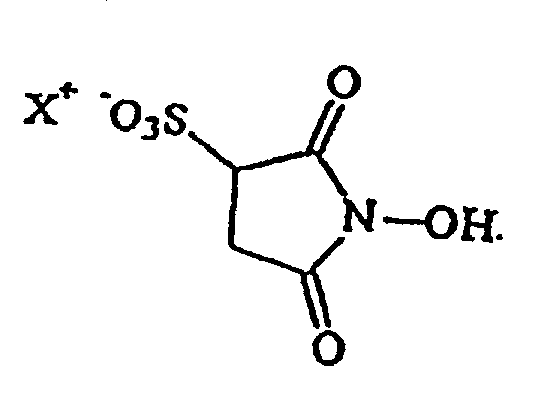
- Procédé suivant la revendication 5 ou 6, dans lequel ladite déshydratation de l'acide sulfohydroxamique a lieu en présence de méthanol, d'eau, d'acide acétique, d'anhydride acétique, de dicyclohexylcarbodiimide et/ou de carbonyldiimidazole.
- Procédé suivant la revendication 1, dans lequel ladite ouverture d'un cycle dudit premier produit monocyclique en présence d'un complexe acide d'hydroxylamine pour former un acide sulfo-hydroxamique est effectuée en présence d'un excès d'alcool pour produire un ester d'acide sulfo-hydroxamique en tant que produit partiel.
- Acide sulfo-hydroxamique ayant la formule générale :dans laquelle X+ est un cation.
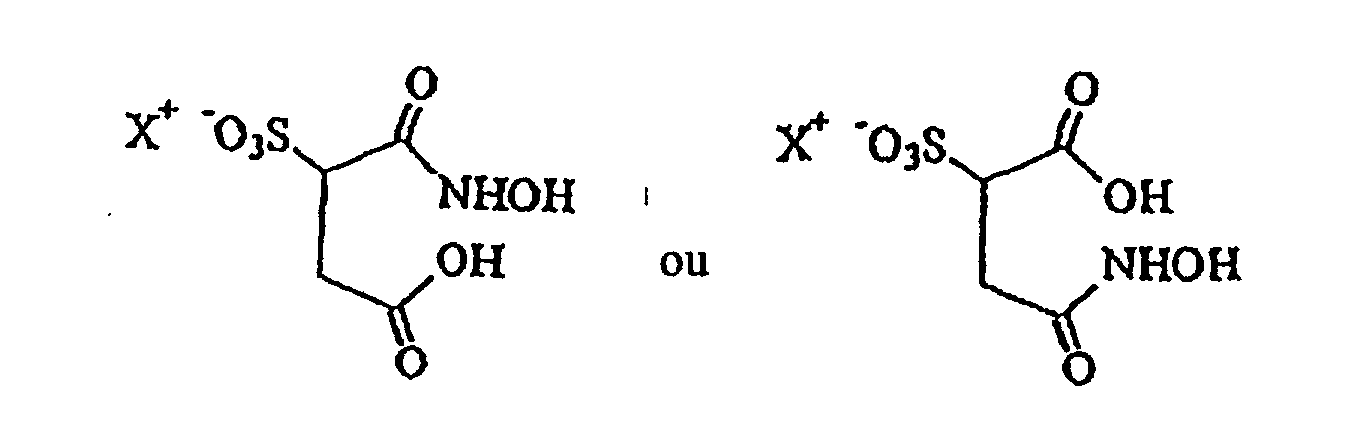
- Procédé suivant la revendication 2, dans lequel ledit acide hydroxamique est soumis à une cyclisation et à une estérification dans la même étape.
- Procédé comprenant l'hydrolyse du succinimide ayant la formule générale :dans laquelle X+ est un cation et R est un groupe organique formé à partir d'un composé R-OH dans lequel R-OH est un acide, dans lequel ledit succinimide est présent sous la forme d'une poudre cristalline blanche.

- Procédé de synthèse suivant la revendication 3, qui comprend les étapes de :a) estérification d'un acide sulfosuccinique pour former un premier produit diester, etb) réaction dudit premier produit diester avec de l'hydroxylamine pour former un sulfo-N-hydroxy succinimide.
- Procédé de synthèse suivant la revendication 12, dans lequel l'estérification d'un sulfosuccinimide pour former un premier produit diester comprend :a) l'estérification d'un acide sulfosuccinique ayant le noyau central de :pour former un premier produit diester, dans lequel X+ est un cation.
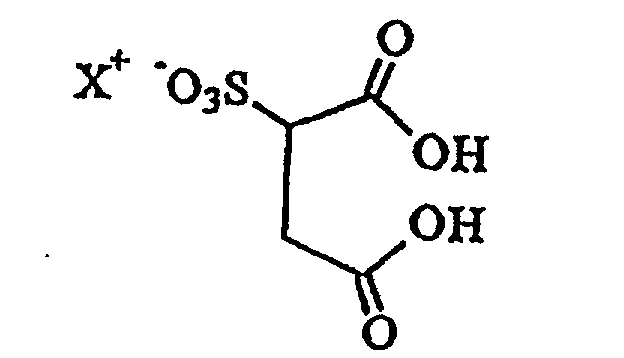
- Procédé suivant la revendication 12, dans lequel ladite hydroxylamine est ajoutée audit premier produit diester.
- Procédé suivant la revendication 12, dans lequel ladite hydroxylamine est formée en présence dudit premier produit diester.
- Procédé suivant la revendication 12, dans lequel un acide sulfohydroxamique est formé dans une réaction dudit premier produit diester avec une hydroxylamine pour former un sulfo-N-hydroxy succinimide.
- Procédé suivant la revendication 16, dans lequel ledit acide sulfo hydroxamique comprend un composé de formule générale :dans laquelle X+ est un cation, et R est un atome d'hydrogène ou un groupe alkyle.

- Procédé suivant la revendication 16, dans lequel ledit acide sulfo hydroxamique est soumis à une cyclisation pour former un sulfo-N-hydroxysuccinimide monocyclique.
- Procédé suivant la revendication 12, dans lequel ledit sulfo-N-hydroxysuccinimide comprend le noyau central de :dans lequel R-OH est un acide, et le groupe OH (hydroxy) qui, lorsqu'il est extrait, quitte le groupe R- pour former un ester dans le composé, et X+ est un cation.

- Procédé suivant la revendication 18, dans lequel ladite déshydratation de l'acide sulfohydroxamique a lieu en présence de méthanol, d'eau, d'acide acétique, de dicyclohexylcarbodiimide et/ou de carbonyldiimidazole.
- Procédé suivant la revendication 12, dans lequel ledit sulfo-N-hydroxysuccinimide est produit en l'absence d'un sulfosuccinimide de formule :dans laquelle X+ est un cation.

- Procédé suivant la revendication 12, dans lequel ledit premier produit diester comprend un composé ayant la formule :dans laquelle X+ est un cation, et R1 et R2 sont choisis indépendamment dans le groupe consistant en groupes alkyle et aryle.

- Procédé suivant la revendication 13 ou 16, dans lequel ledit premier produit diester comprend un composé ayant la formule :dans laquelle X+ est un cation, et R1 et R2 sont choisis indépendamment dans le groupe consistant en groupes alkyle et phényle.
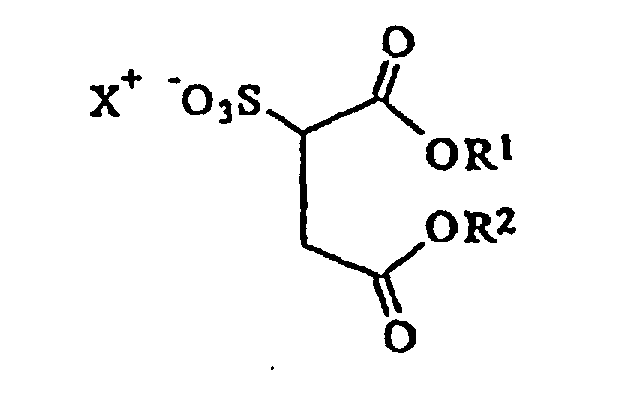
- Procédé suivant les revendications 12 ou 13, dans lequel le sulfo-N-hydroxysuccinimide est présent en l'absence de sulfo-succinimide.
- Procédé suivant les revendications 12, 13 ou 15, dans lequel ledit sulfo-N-hydroxysuccinimide a des proportions d'énantiomères R et S d'hydroxysuccinimide présents sous la forme de 100 à 50% d'énantiomères R ou S.
- Procédé pour la synthèse de sulfo-N-hydroxysuccinimides, ledit procédé étant caractérisé en ce qu'il comprend l'étape de :a) réaction d'un diester sulfosuccinate avec une hydroxylamine pour former un sulfo-N-hydroxysuccinimide.
- Procédé suivant la revendication 12, dans lequel ladite hydroxylamine comprend le chlorhydrate d'hydroxylamine, ajouté audit diester sulfosuccinate ou formé in situ.
- Procédé de synthèse, qui comprend les étapes de :a) estérification d'un composé sulfo-succinimide pour former un premier produit diester, etb) caractérisé de plus par la cyclisation dudit premier produit diester pour former un sulfo-N-hydroxysuccinimide.
- Procédé de synthèse comprenant l'étape de cyclisation d'un diester d'acide sulfosuccinique pour former un sulfo-N-hydroxy succinimide.
- Procédé suivant la revendication 29, dans lequel ladite cyclisation est effectuée en présence d'hydroxylamine.
- Procédé suivant la revendication 30, dans lequel ladite hydroxylamine est le chlorhydrate d'hydroxylamine.
Applications Claiming Priority (5)
| Application Number | Priority Date | Filing Date | Title |
|---|---|---|---|
| US932851 | 1997-09-18 | ||
| US08/932,851 US5892057A (en) | 1997-09-18 | 1997-09-18 | Preparation of sulfo-N-hydroxysuccinimide salts |
| US08/933,266 US5872261A (en) | 1997-09-18 | 1997-09-18 | Preparation of sulfo-N- hydroxy succinimide salts with intermediate formation of diester |
| US933266 | 1997-09-18 | ||
| PCT/US1998/019364 WO1999014192A1 (fr) | 1997-09-18 | 1998-09-17 | Sulfo-n-hydroxysuccinimide et procede d'elaboration |
Publications (2)
| Publication Number | Publication Date |
|---|---|
| EP1015428A1 EP1015428A1 (fr) | 2000-07-05 |
| EP1015428B1 true EP1015428B1 (fr) | 2003-05-02 |
Family
ID=27130035
Family Applications (1)
| Application Number | Title | Priority Date | Filing Date |
|---|---|---|---|
| EP98946097A Expired - Lifetime EP1015428B1 (fr) | 1997-09-18 | 1998-09-17 | Sulfo-n-hydroxysuccinimide et procede d'elaboration |
Country Status (6)
| Country | Link |
|---|---|
| EP (1) | EP1015428B1 (fr) |
| JP (1) | JP3484161B2 (fr) |
| AU (1) | AU9318498A (fr) |
| CA (1) | CA2303929A1 (fr) |
| DE (1) | DE69814110T2 (fr) |
| WO (1) | WO1999014192A1 (fr) |
Families Citing this family (2)
| Publication number | Priority date | Publication date | Assignee | Title |
|---|---|---|---|---|
| JP4526239B2 (ja) * | 2002-05-31 | 2010-08-18 | ダイセル化学工業株式会社 | N−置換環状イミド化合物の製造法 |
| US7335686B2 (en) * | 2003-10-20 | 2008-02-26 | Council Of Scientific And Industrial Research | Method and composition for treating osteoporosis |
Family Cites Families (11)
| Publication number | Priority date | Publication date | Assignee | Title |
|---|---|---|---|---|
| DE943050C (de) * | 1953-02-14 | 1956-05-09 | Bayer Ag | Verfahren zur Herstellung von Sulfonsaeureestern |
| HU178455B (en) * | 1979-07-17 | 1982-05-28 | Chinoin Gyogyszer Es Vegyeszet | Process for producing new 1-substituted-3-cycloalkyl-sulfonyl-pyrrolidine-2,5-dione derivatives |
| DE3030926A1 (de) * | 1980-08-16 | 1982-04-01 | Consortium für elektrochemische Industrie GmbH, 8000 München | Substituierte bernsteinsaeureimide |
| US4861869A (en) * | 1986-05-29 | 1989-08-29 | Mallinckrodt, Inc. | Coupling agents for joining radionuclide metal ions with biologically useful proteins |
| US4794189A (en) * | 1987-12-07 | 1988-12-27 | Akzo America Inc. | Synthesis of N-succinimidyl haloacetyl aminobenzoates |
| ATE120454T1 (de) * | 1988-06-14 | 1995-04-15 | Cetus Oncology Corp | Kupplungsmittel und sterisch gehinderte, mit disulfid gebundene konjugate daraus. |
| WO1992016520A1 (fr) * | 1991-03-20 | 1992-10-01 | British Technology Group Ltd | Ligands macrocycliques de thioether et leur utilisation en tant qu'intermediaires pour lier les ions aux substrats |
| DE4317651A1 (de) * | 1993-05-27 | 1994-12-01 | Hoechst Ag | Substituierte Bernsteinsäureimide |
| DE4336802A1 (de) * | 1993-10-28 | 1995-05-11 | Henkel Kgaa | Sulfosuccinamate |
| FR2724461B1 (fr) * | 1994-09-09 | 1996-12-20 | Prolabo Sa | Microsphere de latex biotinylee, procede de preparation d'une telle microsphere et utilisation en tant qu'agent de detection biologique |
| DE19504623A1 (de) * | 1995-02-13 | 1996-08-14 | Bayer Ag | Verfahren zur Herstellung von N-substituierten cyclischen Imiden |
-
1998
- 1998-09-17 EP EP98946097A patent/EP1015428B1/fr not_active Expired - Lifetime
- 1998-09-17 AU AU93184/98A patent/AU9318498A/en not_active Abandoned
- 1998-09-17 WO PCT/US1998/019364 patent/WO1999014192A1/fr not_active Ceased
- 1998-09-17 CA CA002303929A patent/CA2303929A1/fr not_active Abandoned
- 1998-09-17 JP JP2000511743A patent/JP3484161B2/ja not_active Expired - Fee Related
- 1998-09-17 DE DE69814110T patent/DE69814110T2/de not_active Expired - Fee Related
Also Published As
| Publication number | Publication date |
|---|---|
| EP1015428A1 (fr) | 2000-07-05 |
| WO1999014192A1 (fr) | 1999-03-25 |
| CA2303929A1 (fr) | 1999-03-25 |
| AU9318498A (en) | 1999-04-05 |
| JP2001516741A (ja) | 2001-10-02 |
| JP3484161B2 (ja) | 2004-01-06 |
| DE69814110T2 (de) | 2004-01-29 |
| DE69814110D1 (de) | 2003-06-05 |
Similar Documents
| Publication | Publication Date | Title |
|---|---|---|
| HU195182B (en) | Process for production of /z/-1-phenil-1-diethil-amino-carbonil-2-amino-methil-cyclopropan hcl | |
| EP1384707B1 (fr) | 4-Nitroxybutylester de naproxene | |
| US5087705A (en) | Process for preparation of n-substituted maleimides | |
| US5872261A (en) | Preparation of sulfo-N- hydroxy succinimide salts with intermediate formation of diester | |
| US6407263B1 (en) | Preparation of sulfo-N-hydroxy succinimide salts | |
| GB1598668A (en) | Indolyloxymethyl-2-oxazolidinone derivatives and their use in the preparation of 1-amino-3-(indolyloxy)-2-propanols | |
| SU1055333A3 (ru) | Способ получени алкалоидов типа лейрозина или их кислых аддитивных солей | |
| DE3887212T2 (de) | Verfahren zur Herstellung von Derivaten von 6,7-Diazyl-7-desacetylforskolin. | |
| WO1999014192A1 (fr) | Sulfo-n-hydroxysuccinimide et procede d'elaboration | |
| EP0252353B1 (fr) | 4-Benzyloxy-3-pyrroline-2-one-1-yl-acétamide, préparation et utilisation | |
| KR0141482B1 (ko) | 0-카르복시피리딜-및 0-카르복시퀴놀릴이미다졸리논의 개선된 제조방법 | |
| US5847152A (en) | Preparation of a D-(+)-biotin intermediate | |
| US4158012A (en) | Steroid synthesis process using mixed anhydride | |
| WO2006095362A1 (fr) | Procede de preparation du levetiracetam | |
| EP0243646B1 (fr) | Procédé pour la préparation de forskoline à partir de désoxy-9 forskoline et produits intermédiaires à cette fin | |
| GB2036744A (en) | Eburnane derivatives | |
| EP0119091B1 (fr) | Dérivés de l'acide 2,2-diéthoxypropionique | |
| CA1241337A (fr) | Preparation de derives de substitution en n d'acide azetidine-3-carboxylique | |
| US5599949A (en) | Bisphenol derivative and its manufacturing method | |
| US4906759A (en) | Process for the production of 4-alkoxy-2(5H) thiophenones | |
| US3121716A (en) | Pyrazinamide and derivatives thereof | |
| DE69106316T2 (de) | Verfahren zur Herstellung eines aliphatischen Amides und Salzen davon. | |
| SU1147250A3 (ru) | Способ получени производных 4-оксоазетидин-2,2-дикарбоновой кислоты | |
| US4234491A (en) | Steroid synthesis process using mixed anhydride | |
| KR830002204B1 (ko) | 카나마이신 a 유도체의 제조 방법 |
Legal Events
| Date | Code | Title | Description |
|---|---|---|---|
| PUAI | Public reference made under article 153(3) epc to a published international application that has entered the european phase |
Free format text: ORIGINAL CODE: 0009012 |
|
| 17P | Request for examination filed |
Effective date: 20000418 |
|
| AK | Designated contracting states |
Kind code of ref document: A1 Designated state(s): BE CH DE FR GB IT LI SE |
|
| 17Q | First examination report despatched |
Effective date: 20010703 |
|
| GRAG | Despatch of communication of intention to grant |
Free format text: ORIGINAL CODE: EPIDOS AGRA |
|
| GRAG | Despatch of communication of intention to grant |
Free format text: ORIGINAL CODE: EPIDOS AGRA |
|
| GRAH | Despatch of communication of intention to grant a patent |
Free format text: ORIGINAL CODE: EPIDOS IGRA |
|
| GRAH | Despatch of communication of intention to grant a patent |
Free format text: ORIGINAL CODE: EPIDOS IGRA |
|
| GRAA | (expected) grant |
Free format text: ORIGINAL CODE: 0009210 |
|
| AK | Designated contracting states |
Designated state(s): BE CH DE FR GB IT LI SE |
|
| PG25 | Lapsed in a contracting state [announced via postgrant information from national office to epo] |
Ref country code: LI Free format text: LAPSE BECAUSE OF FAILURE TO SUBMIT A TRANSLATION OF THE DESCRIPTION OR TO PAY THE FEE WITHIN THE PRESCRIBED TIME-LIMIT Effective date: 20030502 Ref country code: IT Free format text: LAPSE BECAUSE OF FAILURE TO SUBMIT A TRANSLATION OF THE DESCRIPTION OR TO PAY THE FEE WITHIN THE PRESCRIBED TIME-LIMIT;WARNING: LAPSES OF ITALIAN PATENTS WITH EFFECTIVE DATE BEFORE 2007 MAY HAVE OCCURRED AT ANY TIME BEFORE 2007. THE CORRECT EFFECTIVE DATE MAY BE DIFFERENT FROM THE ONE RECORDED. Effective date: 20030502 Ref country code: CH Free format text: LAPSE BECAUSE OF FAILURE TO SUBMIT A TRANSLATION OF THE DESCRIPTION OR TO PAY THE FEE WITHIN THE PRESCRIBED TIME-LIMIT Effective date: 20030502 Ref country code: BE Free format text: LAPSE BECAUSE OF FAILURE TO SUBMIT A TRANSLATION OF THE DESCRIPTION OR TO PAY THE FEE WITHIN THE PRESCRIBED TIME-LIMIT Effective date: 20030502 |
|
| REG | Reference to a national code |
Ref country code: GB Ref legal event code: FG4D |
|
| REG | Reference to a national code |
Ref country code: CH Ref legal event code: EP |
|
| REF | Corresponds to: |
Ref document number: 69814110 Country of ref document: DE Date of ref document: 20030605 Kind code of ref document: P |
|
| PG25 | Lapsed in a contracting state [announced via postgrant information from national office to epo] |
Ref country code: SE Free format text: LAPSE BECAUSE OF FAILURE TO SUBMIT A TRANSLATION OF THE DESCRIPTION OR TO PAY THE FEE WITHIN THE PRESCRIBED TIME-LIMIT Effective date: 20030802 |
|
| ET | Fr: translation filed | ||
| REG | Reference to a national code |
Ref country code: CH Ref legal event code: PL |
|
| PLBE | No opposition filed within time limit |
Free format text: ORIGINAL CODE: 0009261 |
|
| STAA | Information on the status of an ep patent application or granted ep patent |
Free format text: STATUS: NO OPPOSITION FILED WITHIN TIME LIMIT |
|
| 26N | No opposition filed |
Effective date: 20040203 |
|
| REG | Reference to a national code |
Ref country code: HK Ref legal event code: WD Ref document number: 1030932 Country of ref document: HK |
|
| PGFP | Annual fee paid to national office [announced via postgrant information from national office to epo] |
Ref country code: FR Payment date: 20060825 Year of fee payment: 9 |
|
| PGFP | Annual fee paid to national office [announced via postgrant information from national office to epo] |
Ref country code: DE Payment date: 20060830 Year of fee payment: 9 |
|
| PGFP | Annual fee paid to national office [announced via postgrant information from national office to epo] |
Ref country code: GB Payment date: 20060918 Year of fee payment: 9 |
|
| GBPC | Gb: european patent ceased through non-payment of renewal fee |
Effective date: 20070917 |
|
| PG25 | Lapsed in a contracting state [announced via postgrant information from national office to epo] |
Ref country code: DE Free format text: LAPSE BECAUSE OF NON-PAYMENT OF DUE FEES Effective date: 20080401 |
|
| REG | Reference to a national code |
Ref country code: FR Ref legal event code: ST Effective date: 20080531 |
|
| PG25 | Lapsed in a contracting state [announced via postgrant information from national office to epo] |
Ref country code: FR Free format text: LAPSE BECAUSE OF NON-PAYMENT OF DUE FEES Effective date: 20071001 |
|
| PG25 | Lapsed in a contracting state [announced via postgrant information from national office to epo] |
Ref country code: GB Free format text: LAPSE BECAUSE OF NON-PAYMENT OF DUE FEES Effective date: 20070917 |