EP1016477A2 - Verfahren zur Herstellung von Schmiedematerial aus Leichtmetall und Herstellung eines geschmiedeten Gegenstandes aus diesem Material - Google Patents
Verfahren zur Herstellung von Schmiedematerial aus Leichtmetall und Herstellung eines geschmiedeten Gegenstandes aus diesem Material Download PDFInfo
- Publication number
- EP1016477A2 EP1016477A2 EP99125044A EP99125044A EP1016477A2 EP 1016477 A2 EP1016477 A2 EP 1016477A2 EP 99125044 A EP99125044 A EP 99125044A EP 99125044 A EP99125044 A EP 99125044A EP 1016477 A2 EP1016477 A2 EP 1016477A2
- Authority
- EP
- European Patent Office
- Prior art keywords
- heat treatment
- forging
- light metal
- forging material
- manufacturing
- Prior art date
- Legal status (The legal status is an assumption and is not a legal conclusion. Google has not performed a legal analysis and makes no representation as to the accuracy of the status listed.)
- Withdrawn
Links
- 238000005242 forging Methods 0.000 title claims abstract description 203
- 239000000463 material Substances 0.000 title claims abstract description 169
- 229910052751 metal Inorganic materials 0.000 title claims abstract description 83
- 239000002184 metal Substances 0.000 title claims abstract description 83
- 238000004519 manufacturing process Methods 0.000 title claims abstract description 33
- 238000010438 heat treatment Methods 0.000 claims abstract description 180
- 238000000034 method Methods 0.000 claims abstract description 155
- 230000008569 process Effects 0.000 claims abstract description 112
- 239000012768 molten material Substances 0.000 claims abstract description 42
- 238000000465 moulding Methods 0.000 claims abstract description 33
- 238000003483 aging Methods 0.000 claims description 44
- 239000007787 solid Substances 0.000 claims description 33
- 230000015572 biosynthetic process Effects 0.000 claims description 16
- 229910000861 Mg alloy Inorganic materials 0.000 claims description 8
- 238000001816 cooling Methods 0.000 claims description 7
- 229910052782 aluminium Inorganic materials 0.000 claims description 3
- XAGFODPZIPBFFR-UHFFFAOYSA-N aluminium Chemical compound [Al] XAGFODPZIPBFFR-UHFFFAOYSA-N 0.000 claims description 3
- 239000000243 solution Substances 0.000 description 61
- 230000000694 effects Effects 0.000 description 36
- 238000012360 testing method Methods 0.000 description 35
- 238000001746 injection moulding Methods 0.000 description 33
- 238000005266 casting Methods 0.000 description 26
- 239000000047 product Substances 0.000 description 24
- 229910045601 alloy Inorganic materials 0.000 description 20
- 239000000956 alloy Substances 0.000 description 20
- 239000007790 solid phase Substances 0.000 description 15
- 238000002347 injection Methods 0.000 description 14
- 239000007924 injection Substances 0.000 description 14
- 239000002994 raw material Substances 0.000 description 13
- 238000000265 homogenisation Methods 0.000 description 12
- 239000007789 gas Substances 0.000 description 11
- 230000000052 comparative effect Effects 0.000 description 10
- 239000011777 magnesium Substances 0.000 description 7
- 238000002844 melting Methods 0.000 description 7
- 230000008018 melting Effects 0.000 description 7
- 230000007547 defect Effects 0.000 description 6
- 238000004512 die casting Methods 0.000 description 6
- 229920006395 saturated elastomer Polymers 0.000 description 6
- 150000001875 compounds Chemical class 0.000 description 5
- 239000007791 liquid phase Substances 0.000 description 5
- 230000014759 maintenance of location Effects 0.000 description 5
- 230000007246 mechanism Effects 0.000 description 5
- 230000006835 compression Effects 0.000 description 4
- 238000007906 compression Methods 0.000 description 4
- 239000013078 crystal Substances 0.000 description 4
- FYYHWMGAXLPEAU-UHFFFAOYSA-N Magnesium Chemical compound [Mg] FYYHWMGAXLPEAU-UHFFFAOYSA-N 0.000 description 3
- 230000007812 deficiency Effects 0.000 description 3
- 230000001771 impaired effect Effects 0.000 description 3
- 239000007788 liquid Substances 0.000 description 3
- 229910052749 magnesium Inorganic materials 0.000 description 3
- 230000009467 reduction Effects 0.000 description 3
- XKRFYHLGVUSROY-UHFFFAOYSA-N Argon Chemical compound [Ar] XKRFYHLGVUSROY-UHFFFAOYSA-N 0.000 description 2
- 230000006872 improvement Effects 0.000 description 2
- 238000005259 measurement Methods 0.000 description 2
- 239000008188 pellet Substances 0.000 description 2
- 229910000838 Al alloy Inorganic materials 0.000 description 1
- 229910052786 argon Inorganic materials 0.000 description 1
- 239000003638 chemical reducing agent Substances 0.000 description 1
- 238000012790 confirmation Methods 0.000 description 1
- 238000007796 conventional method Methods 0.000 description 1
- 230000006735 deficit Effects 0.000 description 1
- 238000013461 design Methods 0.000 description 1
- 239000011261 inert gas Substances 0.000 description 1
- 238000003754 machining Methods 0.000 description 1
- 238000012986 modification Methods 0.000 description 1
- 230000004048 modification Effects 0.000 description 1
- 238000007254 oxidation reaction Methods 0.000 description 1
- 230000002093 peripheral effect Effects 0.000 description 1
- 239000012056 semi-solid material Substances 0.000 description 1
- 239000011265 semifinished product Substances 0.000 description 1
- 231100000075 skin burn Toxicity 0.000 description 1
- 239000006104 solid solution Substances 0.000 description 1
- 238000007711 solidification Methods 0.000 description 1
- 230000008023 solidification Effects 0.000 description 1
- 230000008961 swelling Effects 0.000 description 1
- 230000000007 visual effect Effects 0.000 description 1
Images

Classifications
-
- C—CHEMISTRY; METALLURGY
- C22—METALLURGY; FERROUS OR NON-FERROUS ALLOYS; TREATMENT OF ALLOYS OR NON-FERROUS METALS
- C22F—CHANGING THE PHYSICAL STRUCTURE OF NON-FERROUS METALS AND NON-FERROUS ALLOYS
- C22F1/00—Changing the physical structure of non-ferrous metals or alloys by heat treatment or by hot or cold working
- C22F1/06—Changing the physical structure of non-ferrous metals or alloys by heat treatment or by hot or cold working of magnesium or alloys based thereon
-
- C—CHEMISTRY; METALLURGY
- C22—METALLURGY; FERROUS OR NON-FERROUS ALLOYS; TREATMENT OF ALLOYS OR NON-FERROUS METALS
- C22F—CHANGING THE PHYSICAL STRUCTURE OF NON-FERROUS METALS AND NON-FERROUS ALLOYS
- C22F1/00—Changing the physical structure of non-ferrous metals or alloys by heat treatment or by hot or cold working
-
- C—CHEMISTRY; METALLURGY
- C22—METALLURGY; FERROUS OR NON-FERROUS ALLOYS; TREATMENT OF ALLOYS OR NON-FERROUS METALS
- C22F—CHANGING THE PHYSICAL STRUCTURE OF NON-FERROUS METALS AND NON-FERROUS ALLOYS
- C22F1/00—Changing the physical structure of non-ferrous metals or alloys by heat treatment or by hot or cold working
- C22F1/04—Changing the physical structure of non-ferrous metals or alloys by heat treatment or by hot or cold working of aluminium or alloys based thereon
Definitions
- the present invention relates to a method for manufacturing a light metal forging material provided as a material to be subjected to a forging process for obtaining a light metal forged member and to a method for manufacturing a forged member obtained through the forging process using the material.
- a method for manufacturing a light metal member made of a light metal such as magnesium (occasionally represented by the symbol Mg for the element hereinafter), magnesium alloys, aluminum (occasionally represented by the symbol Al for the element hereinafter) and aluminum alloys a method based on the casting method is most general.
- the so-called die casting method for achieving an increase in speed of the casting process by injecting and charging a light metal molten material into a casting die at high pressure so as to allow the productivity to be remarkably improved.
- a light metal member manufacturing method using an injection molding method is being put into practical use particularly for Mg and its alloys or the like.
- This method uses an injection molding apparatus and injects and charges a light metal molten material in the molten state from its injection nozzle into the molding cavity of a molding die.
- This method can efficiently manufacture a molded product (light metal member) in a cycle time shorter than that of the casting method.
- This injection molding method is also known as a process that is relatively clean and has a higher safety in terms of the working environment as compared with the casting method such as the die casting method while enabling the obtainment of a light metal molded product with high accuracy, homogeneity and little deficiency of shrinkage cavity or the like in terms of quality.
- the molten material temperature (the term of "molten material” hereinafter also includes the semi-solid material that is not in the completely molten state) is relatively low when a semi-solid metal molten material is used, the so-called “burr” scarcely appears and being appropriate for injection at high speed and/or high pressure, also providing advantages for improving the productivity.
- the metal molten material is charged in a state close to a laminar flow, as a consequence of which the involvement of gas is allowed to be relatively little for the obtainment of a structure of a relatively uniform quality. This can improve the mechanical characteristics of the obtained member as a whole.
- solid phase means “the portion that is not molten but maintained in the solid state when the light metal molten material is in the semi-solid state
- liquid phase means “the portion that is completely molten and put in the liquid state” in the present specification.
- the aforementioned “solid phase” can be easily distinguished as “the portion that has not been molten in the semi-solid metal molten material state but maintained in the solid state” from the portion in the liquid phase "that was completely molten in the semi-solid metal molten material state and put in the liquid state” by observing the solidified structure of the obtained light metal member.
- solid phase used for the obtained member means the "portion that has not been molten in the semi-solid light metal molten material state but maintained in the solid state (has been solid phase)".
- solid phase rate means "the rate of the solid phase relative to the whole molten material (solid phase + liquid phase) in the semi-solid metal molten material” in the present specification.
- the above rate can be numerically obtained as the rate (area ratio) of the portion that has been in the "solid phase” relative to the whole observed region by observing the solidified structure of the molded product after the injection.
- solid state used for the light metal molten material basically means "a state in which the raw material in the solid state (solid phase) and the raw material that is molten and put in the liquid state (liquid phase) are coexisting" in the present specification. That is a state obtained normally by heating the raw material below its melting point. It is to be assumed that the case where the solid phase rate is substantially equal to 0 (zero) percent when the temperature of the light metal molten material is substantially at the melting point or just over the melting point is also included in this "semi-solid state”.
- the forging method is most generally adopted.
- the so-called casting-forging method for forming a material (forging material) appropriate for the forging process by a casting method prior to the forging process, setting this material to a specified forging die and subjecting the material to a forging process as disclosed in, for example, the prior art reference of Japanese Patent Laid-Open Publication No. 6-297127.
- a semi-finished product having a shape relatively resembling the shape of the finished product (forged member) can be formed through the forging process in the casting (material) stage.
- the material structure can be adjusted so that even a material of an inferior forging property can be subjected to the forging process without a trouble.
- the forming of the forging material in this casting-forging method can be performed by the injection molding method instead of the casting method.
- the casting process (forming process for forging material) of this casting-forging method sometimes involves a gas including air in a molten material charging stage or the like. If the solidification occurs in the state in which the gas is involved and internally existing, then there is remaining a gas defect inside the casting product. Particularly when a casting process capable of performing charging at high speed and high pressure such as die casting method is used for this forging material forming process, then the gas defect more easily occurs, and the problem becomes still more significant.
- the so-called T6 treatment for performing age hardening treatment after a solution heat treatment is normally performed as a heat treatment for increasing the strength by improving its mechanical properties.
- the forged product obtained by the casting-forging method is produced with the gas defect included inside as described above in the casting stage (i.e., in the material stage for forging), then swelling (the so-called blister) occurs, during the T6 treatment to be subsequently performed, due to the expansion of the gas that is existing inside in the solution heat treatment stage in which heating is maintained at a relatively high temperature, and the blister directly appears as a defect in the product (forged member) obtained through the forging process.
- the above disadvantages lead to the problem that the mechanical characteristics are impaired failing in sufficiently obtaining the effect of increasing the strength through the T6 treatment and further to the problem that a process for removing the impaired appearance is needed.
- the casting process for example, die casting
- the casting process capable of performing charging at high speed and high pressure
- the problem of the generation of a blister in the case of the forged product obtained through the subsequent process is similarly observed not only in the case where the forming of the forging material is performed by casting but also in the case where another process is adopted.
- a process for charging the light metal molten material into the molding cavity at high speed and/or high pressure is used (for example, in the case where the forging material is formed by the injection molding method), the problem of the generation of a blister in the forged product emerges more significantly.
- the “solution heat treatment” means a treatment for maintaining the heating of the material or the member for a specified time within the temperature range of the solid solution and then bringing the same into the room temperature, by which the homogenization of the material structure can be promoted.
- the compound (Mg17Al12) formed through the preceding process is dissolved into the material structure to promote the homogenization by performing the aforementioned solution heat treatment. It is to be noted that the aforementioned compound is not generated in the case where the Al content is smaller than four percent by weight. Therefore, the homogenization process through the solution heat treatment is generally not needed.
- the present invention has been made in view of the aforementioned technical problems that possibly occur when obtaining a light metal forged member by forming a forging material and subjecting the material to a forging process and has the object of reliably preventing the generation of a blister due to the heat treatment of the product (forged member) obtained through a forging process.
- a first aspect of the present invention provides a method for manufacturing a forging material that is made of a light metal and provided as a material to be subjected to a forging process for obtaining a forged member made of the light metal, comprising the steps of charging a light metal molten material into a molding cavity of a specified molding die so as to form a forging material and subjecting the forging material to a specified heat treatment before the forging process, thereby generating a blister attributed to internal gas expansion in the material.
- the light metal molten material is charged into the molding cavity of the specified molding die for the formation of a forging material, and this forging material is subjected to the specified heat treatment prior to the forging process, preparatorily causing a blister attributed to the expansion of the internal gas in the material. Therefore, by subjecting this forging material to the forging process in the subsequent process, the blister that has preparatorily been generated on the material surface and/or its vicinities is crushed.
- the cavity portion that has existed as the blister on the material (surface and/or its vicinities) is crushed by the compression force applied during the forging process, and this portion becomes a sound basis metal. That is, by preparatorily generating the blister in the material stage, this blister can be crushed through the forging process, by which the generation of blister in the forged member obtained in the subsequent process can be infallibly prevented.
- the specified heat treatment is a solution heat treatment.
- the aforementioned specified heat treatment is the solution heat treatment, and this can promote the homogenization of the material structure of the forging material, improve the forging property in the subsequent forging process and improve the mechanical characteristics of the forged member to be obtained.
- the heat treatment temperature of the solution heat treatment is not lower than 300°C.
- the reason why the lower limit value of the heat treatment temperature of the solution heat treatment is set to 300°C is that no blister can be generated previously (before the forging process) in the forging material even if the material is subjected to the solution heat treatment at a temperature lower than the above temperature.
- the third aspect of the present invention basically an effect similar to that of the above aspects on the invention can be produced.
- a blister can be generated preparatorily (before the forging process) in the forging material through this solution heat treatment.
- the heat treatment time of the solution heat treatment is not shorter than one hour.
- the reason why the lower limit value of the heat treatment time of the solution heat treatment is set to one hour is that the homogenization of the material structure cannot be effectively promoted through the solution heat treatment within a time shorter than the above value.
- the fourth aspect of the present invention basically an effect similar to that of the above aspects can be produced.
- the heat treatment time of the solution heat treatment to one hour or longer, the homogenization of the material structure can be effectively promoted through this solution heat treatment.
- the solution heat treatment is performed under the treatment conditions that the heat treatment temperature be not lower than 350°C and not higher than 450°C and the heat treatment time be not shorter than 10 hours and not longer than 24 hours.
- the reason why the heat treatment temperature of the solution heat treatment is set not lower than 350°C is that a blister can be reliably generated previous to the forging process in the forging material by performing the solution heat treatment at a temperature higher than the above temperature.
- the reason why the temperature is set not higher than 450°C is that a phenomenon of the growth of a crystal grain occurs in the material structure when the solution heat treatment temperature exceeds this value and the mechanical characteristics of the product obtained through the forging process are reduced.
- the reason why the heat treatment time of the solution heat treatment is set not shorter than 10 hours is that the effect of homogenizing the material structure can be reliably obtained through the solution heat treatment.
- the reason why the time is set not longer than 24 hours is that the effect is saturated and goes uneconomical when the treatment is continued in excess of this time.
- the fifth aspect of the present invention basically an effect similar to that of the above aspects of the invention can be produced.
- the heat treatment temperature is set to a temperature that is not lower than 350°C and not higher than 450°C on the solution heat treatment conditions, the reduction in mechanical characteristics of the forged member attributed to the phenomenon of the crystal grain growth inside the material structure can be effectively prevented and a blister can be reliably preparatorily generated in the forging material.
- the heat treatment time is set not shorter than 10 hours and not longer than 24 hours. Therefore, the effect of homogenizing the material structure can be reliably obtained through the solution heat treatment, and this prevents the effect from being saturated and going uneconomical.
- the relative density of the forging material after the specified heat treatment is set not smaller than 90%.
- the lower limit value of the relative density of the forging material is set to 90% is that the amount of blisters that have previously been generated in the forging material stage is too large when the relative density is smaller than this value, and the blister cannot be infallibly crushed. As a result, it is difficult to assure the tensile strength that is generally practically needed. Furthermore, a variation between the maximum value and the minimum value becomes large, and this leads to a difficulty in obtaining the stabilized strength.
- the relative density is set not smaller than 90% after the specified heat treatment. This enables the obtainment of a sound forged member by crushing the blister that has preparatorily been generated in the forging material stage and enables the assurance of the tensile strength that is generally practically needed.
- the relative density of the forging material after the specified heat treatment is set not smaller than 95%.
- the lower limit value of the relative density of the forging material is set to 95% is that a sound forged member can be obtained by infallibly crushing the blister that has previously been generated in the forging material stage when the relative density is not smaller than this value. As a result, the tensile strength that is generally practically needed can be sufficiently assured. Furthermore, the variation between the maximum value and the minimum value is very small, and this allows a high tensile strength to be stably obtained.
- the relative density is set not smaller than 95% after the specified heat treatment. This enables the obtainment of a sound forged member by more reliably crushing the blister that has preparatorily been generated in the forging material stage and consequently enables the assurance of the tensile strength that is generally practically needed. Furthermore, a high tensile strength having a very small variation between the maximum value and the minimum value can be stably obtained.
- the formation of the forging material is performed by charging the light metal molten material into the molding cavity of the specified molding die in a semi-solid state.
- the eighth aspect of the present invention basically an effect similar to that of the above aspects of the invention can be produced.
- a high-quality forging material having a smaller number of shrinkage cavities and gas defect can be obtained as compared with the case of the process that uses the molten material in the completely molten state.
- the so-called "burr" scarcely appears and is appropriate for the process of high speed and/or high pressure, also providing advantages for improving the productivity.
- the formation of the forging material is performed by injecting and charging the light metal molten material into the molding cavity of a specified molding die.
- the forging material can be manufactured in a short cycle time with high efficiency as compared with the case of the casting process. Furthermore, it is enabled to obtain a light metal forging material that is relatively clean and has a higher safety in terms of the working environment as compared with the casting method such as the die casting method and has high accuracy, homogeneity and little deficiency of shrinkage cavity or the like in terms of quality.
- the light metal is a magnesium (Mg) alloy containing four or more percent by weight of aluminum (Al).
- the reason why the lower limit value of the Al content is set to four percent by weight is that the homogenization process through the solution heat treatment is generally not needed since a compound (Mg17Al12) that hinders the homogenization of the material structure in the preceding process is not generated when the Al content is smaller than this value.
- a forged member manufacturing method comprising the step of subjecting the light metal forging material of any one of the claims 1 through 10 to a forging process, thereby crushing the blister included in the forging material.
- the light metal forging material according to any one of the first through tenth inventive aspects is subjected to the forging process so as to crush the blister that has been included in the forging material.
- the cavity portion that has internally existed as a blister on the material (surface and/or its vicinities) is crushed by the compression force applied during the forging process, and this portion becomes a sound basis metal. That is, by generating the blister in the material stage, this blister can be crushed through the forging process, reliably preventing the generation of a blister in the forged member obtained in the subsequent process.
- the light metal forging material is heated through the specified heat treatment and thereafter subjected directly to the forging process without undergoing a cooling process.
- the light metal forging material is heated through the specified heat treatment and thereafter directly subjected to the forging process without undergoing the cooling process. Therefore, the heating process to the forging temperature prior to the forging process can be eliminated, allowing the forging process to be remarkably simplified.
- a second heat treatment is performed after the forging process at a temperature lower than the heating temperature of the specified heat treatment.
- the second heat treatment is performed at a temperature lower than the heating temperature of the specified heat treatment after the forging process. Therefore, no blister is generated through the heat treatment after the forging process.
- the second heat treatment is a heat treatment related to the specified heat treatment.
- the fourteenth aspect of the present invention basically an effect similar to that of the above aspects of the invention can be produced.
- the necessary heat treatment can be performed without generating a blister in the forged member.
- the specified heat treatment is a solution heat treatment and the second heat treatment is an age hardening treatment.
- the fifteenth aspect of the present invention basically an effect similar to that of the above aspects of the invention can be produced.
- the necessary heat treatment can be performed without generating a blister in the forged member.
- the heat treatment temperature of the age hardening treatment is not lower than 100°C.
- the reason why the lower limit value of the heat treatment temperature of the age hardening treatment is set to 100°C is that the age hardening cannot effectively be generated in the forging material at a temperature lower than the above temperature.
- the heat treatment temperature of the age hardening treatment is set not lower than 100°C, and therefore, the age hardening effect can be effectively produced on the forged member.
- the age hardening treatment is performed under the treatment conditions that the heat treatment temperature be not lower than 100°C and not higher than 250°C, and the heat treatment time be not shorter than three hours and not longer than 24 hours.
- the reason why the lower limit value of the heat treatment time of the age hardening treatment is set to three hours is that the age hardening cannot effectively be generated within a time shorter than the above value.
- the reason why the upper limit value is set to 24 hours is that the effect is saturated and goes uneconomical when the treatment is continued in excess of this time.
- the heat treatment temperature of the age hardening treatment is set to a temperature that is not lower than 100°C and not higher than 250°C.
- the heat treatment time of the age hardening treatment is set not shorter than three hours and not longer than 24 hours.
- FIG. 1 is an explanatory view schematically showing the cross section of part of an injection molding apparatus for performing injection molding of a light metal forging material according to an embodiment of the present invention.
- the injection molding apparatus 1 is the so-called screw type including a cylinder 2 that has a nozzle 3 at its tip portion and is to be heated by a heater 4 provided on its peripheral surface, a screw 6 that is rotatably supported inside the cylinder 2 and a molding machine body 5 connected with the cylinder 2, a rotary driver 7 provided with, for example, a motor mechanism, a speed reducer and so on for rotatively driving the screw 6, a hopper 8 in which a raw material is loaded and stored and a feeder 9 for feeding the raw material into the molding machine body 5 while measuring the raw material inside the hopper 8.
- a screw type including a cylinder 2 that has a nozzle 3 at its tip portion and is to be heated by a heater 4 provided on its peripheral surface, a screw 6 that is rotatably supported inside the cylinder 2 and a molding machine body 5 connected with the cylinder 2, a rotary driver 7 provided with, for example, a motor mechanism, a speed reducer and so on for rotatively driving the screw 6, a
- the molding machine body 5 is internally provided with a high-speed injection mechanism for advancing the screw 6 toward the nozzle 3 side.
- This high-speed injection mechanism is constructed so as to advance the screw 6 in accordance with specified timing, detect the retreat of the screw 6 by a predetermined distance when it occurs, stop the rotation of the screw 6 and concurrently stop the retreating movement of the screw.
- the injection molding apparatus 1 is set in position so that the internal path of the nozzle 3 communicates with a runner portion 12 connected with a molding cavity 11 and used with the leading end side of the cylinder 2 joined with a metallic die 10.
- the raw material loaded and stored in the hopper 8 is measured by a specified amount and fed into the molding machine body 5 by the feeder 9 and then fed by the rotating screw 6 into the cylinder 2 put in a heated state.
- the fed raw material is heated to a specified temperature while being sufficiently stirred and kneaded by the rotation of the screw 6 inside the cylinder 2.
- a light metal molten material put preferably in a semi-solid state at a temperature lower than the melting point is obtained through this process.
- the screw 6 As the thus-obtained light metal molten material in the semi-solid state is squeezed out ahead of the screw 6, the screw 6 is retreated by the pressure. According to another method, the screw may be forcibly retreated at the desired speed.
- the high-speed injection mechanism inside the molding machine body 5 detects the above event and stops the rotation of the screw 6 and concurrently stops the retreating movement.
- the measurement of the raw material may be performed by setting the distance of retreat of the screw 6.
- the light metal molten material in the semi-solid state is injected from the nozzle 3 into the metallic die 10. That is, the light metal molten material is injected from the nozzle 3 and charged into the molding cavity 11 via the runner portion 12.
- a magnesium (Mg) alloy that is a kind of light metal is used as the raw material and this is fed in the form of, for example, chip-shaped pellets to the hopper 8 of the injection molding apparatus 1.
- a passage that extends from the hopper 8 to the inside of the molding machine body 5 is preferably filled with an inert gas (argon, for example) for preventing the oxidation reaction of the raw material (Mg alloy pellets).
- the molding cavity 11 of the metallic die 10 is preferably formed into a shape that resembles the shape of the forming cavity of the forging die (not shown) used for the forging process to be performed after this injection molding, and there can be obtained a half-finished injection molded product (forging material) resembling the forged member that is the product to be obtained in the subsequent process.
- the forging material injection-molded by the injection molding apparatus 1 and the metallic die 10 is subjected to the forging process (step S52) after undergoing the forming process (step S51) of the forging material, and the obtained forged member is subjected to the T6 treatment comprised of the solution heat treatment (step S53) and the subsequent age hardening treatment (step S54).
- the so-called blister in the solution heat treatment stage If this blister appears as a defect in the forged product (forged member) obtained in the subsequent process, then its mechanical characteristics are impaired, consequently failing in sufficiently obtaining the effect of improving the strength through the T6 treatment and also impairing the appearance. Therefore, a process for removing those blisters is needed.
- the present embodiment reliably prevents the generation of the blister associated with the heat treatment of this forged product (forged member) by contriving the order of the forging process and the heat treatment when obtaining the light metal forged product through the formation of a forging material and the forging of the material, allowing a sound forged member (i.e., a high-quality forged member having little deficiency and the specified mechanical characteristics) to be obtained.
- a sound forged member i.e., a high-quality forged member having little deficiency and the specified mechanical characteristics
- the forging material is formed by semi-solid injection molding by means of the injection molding apparatus 1 and the metallic die 10 (step S1), and thereafter the above forging material is subjected to the solution heat treatment on specified heat treatment conditions (step S2) prior to the forging process.
- a blister is preparatorily generated in the forging material stage. It is to be noted that this blister is normally generated in the form of a blister like a skin burn on the material surface and/or its vicinities, and therefore, the blister can be easily detected by visual observation.
- the forging material in which the blister has preparatorily been generated is subjected to the forging process by means of a specified forging die (step S3).
- the blister that has preparatorily been generated on the material surface and/or its vicinities is crushed. That is, the cavity portion that has existed as the blister on the material (surface and/or its vicinities) is crushed by a compression force applied during the forging process, and this portion becomes a sound basis metal.
- the forged member is subjected to the age hardening treatment on the specified heat treatment conditions (step S4).
- the raw materials of Mg alloys each contained four or more percent by weight of Al.
- the reason why the lower limit value of the Al content was set to four percent by weight is that a compound (Mg17Al12) hindering the homogenization of the material structure was not generated in the preceding processes when the Al content was smaller than this value and therefore the homogenization process by the solution heat treatment was originally not needed.
- the formation of the forging material is performed by the aforementioned semi-solid injection molding in each example.
- a comparative example 1 shows the case where no heat treatment is performed after the injection molding
- a comparative example 2 shows the case where the T6 treatment is performed after the injection molding according to the conventional process procedure (see Fig. 7).
- the heat treatment conditions of the solution heat treatment and the age hardening treatment were identical as follows.
- the forging process was performed by heating and maintaining the heat treatment temperature of the solution heat treatment and thereafter directly setting the forging material in the forging die without cooling, in the present embodiment. Therefore, the heating process to the forging temperature prior to the forging process could be eliminated and the forging process was remarkably simplified.
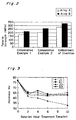
- a tension test piece was cut from each forged members of the comparative examples 1 and 2 and the embodiment of the present invention according to specified shape and dimensions, and the tensile strength of each of these test pieces were examined. The results are shown in Fig. 2.
- the comparative example 2 has the effect of improving the tensile strength by about 20% or less, whereas the present invention has the improvement effect of about 50% or more, with respect to the comparative example 1.
- the standard tensile strength of the generic die casting alloy of JIS MDI alloy is 230 [MPa] and this is generally the practically needed strength.
- the tensile strength of either of the materials of the alloy A and the alloy B sufficiently exceeds this strength (230 [MPa]).
- the light metal molten material in the semi-solid state is injected and charged into the molding cavity of the specified molding die for the formation of the forging material, and this forging material is subjected to the solution heat treatment prior to the forging process in order to preparatorily generate a blister attributed to the expansion of the internal gas of the material. Therefore, by subjecting this forging material to the forging process in the subsequent process, the blister that has preparatorily been generated on the material surface and/or its vicinities is crushed.
- the cavity portion that has existed as the blister on the material is crushed by the compression force applied during the forging process, and this portion becomes a sound basis metal.
- a sound forged member having a high strength free from the generation of a blister can be obtained.
- the forging process is performed by heating and maintaining the heat treatment temperature of the solution heat treatment and thereafter directly setting the forging material in the forging die without cooling.
- it is acceptable to perform the forging process by once cooling the forging material and thereafter heat the material to the forging temperature.
- Test 2 for examining a relation between the heat treatment temperature of the solution heat treatment and the generation of a blister.
- This Test 2 subjected the forging material obtained by the aforementioned semi-solid injection molding to the solution heat treatment at various heat treatment temperatures (200°C, 250°C, 300°C, 350°C and 400°C) and examined the presence or absence of the generation of a blister in each case.
- the blister generating test was performed by means of the alloy A of the aforementioned Table 1. The test results are shown in Table 2.
- Heat treatment temperature Blister generated 200 °C Absent 250 °C Absent 300 °C Absent 350 °C Present 400 °C Present
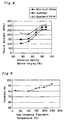
- Test 3 for examining an influence of the heat treatment time of the solution heat treatment on the hardness of the forged member, or the finished product.
- the test results are shown in Fig. 3.
- the alloy A of Table 1 was used as a material to be subjected to the semi-solid injection molding.
- the comparative example (the curve J1 and the curve J2 in the graph of Fig. 3) that has undergone the forging process and thereafter the T6 treatment (solution heat treatment + age hardening treatment) as in the conventional procedure
- the embodiment of the present invention the curve K1 and the curve K2 in the graph of Fig.
- the heat treatment temperature of the solution heat treatment of Test 3 was set in two ways as follows.
- the age hardening treatment was performed on the conditions that the material was maintained at a temperature of 175°C for 15 hours and thereafter be cooled in air.
- the graph of Fig. 3 shows the fact that the hardness of the forged product (forged member) is reduced in correspondence with the duration of the solution heat treatment time according to the curve J2 of the comparative example in the case where the heat treatment temperature is 450°C, thereby, it is discovered that the phenomenon of crystal grain growth occurs inside the material structure. Therefore, in this case, the mechanical characteristics of the product obtained through the forging process are degraded.
- the reduction in hardness is insufficient and unstable in each case of the curves so long as the heat treatment duration of the solution heat treatment is not longer than one hour.
- the heat treatment time of the solution heat treatment is required to be not shorter than one hour. It was discovered that the heat treatment time should more preferably be not shorter than 10 hours in order to more reliably obtain the effect. If the heat treatment is performed in excess of 24 hours, then the effect is saturated and goes uneconomical.
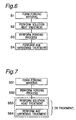
- Test 4 for examining the influence of the relative density of the material prior to the forging (i.e., the forging material obtained after the solution heat treatment) on the tensile strength of the forged member.
- This test is to examine the influence of the degree of the generation of a blister on the mechanical characteristics of the product (forged member) that has undergone the forging process and the age hardening treatment with regard to the case in which the blister has preparatorily been generated through the solution heat treatment before the forging process according to the present invention.
- the test results are shown in Fig. 4.
- the material of the alloy A of Table 1 was used as a material to be subjected to the semi-solid injection molding.
- Tension test pieces of specified shape and dimensions were cut from each product (forged member) obtained by subjecting the thus obtained forging material first to the solution heat treatment, then to the forging process and thereafter to the age hardening treatment according to the method of the present invention, and the tensile strengths of these test pieces were examined.
- the relative density of the material (forging material) prior to the forging was varied within a range of about 84% to 97% by variously changing the solution heat treatment conditions.
- the graph of Fig. 4 shows the fact that a sound forged member can be obtained by reliably crushing the blister that has previously been generated in the forging material stage when the relative density of the forging material prior to the forging is not smaller than 95% (corresponding to case where the amount of generated blister is smaller than 5%).
- the tensile strength of 260 [MPa] could be assured at minimum and a high tensile strength could be stably obtained with a very small variation between the maximum value and the minimum value.
- the relative density is not smaller than 90%, then the strength (230 [MPa]) that is generally practically needed can be assured at and around the maximum value although a certain degree of variation exists.
- the relative density of the forging material prior to the forging is required to set to a density of not smaller than 90% in order to assure the tensile strength (230 [MPa]) that is generally practically needed, and more preferably set the relative density to a density of not smaller than 95% in order to stably obtain a higher tensile strength.
- Test 5 for examining the influence of the heat treatment temperature of the age hardening treatment on the hardness of the forged product (forged member).
- the test results are shown in Fig. 5.
- the alloy B of Table 1 was used as a material to be subjected to the semi-solid injection molding, and the thus obtained forging material was subjected first to the solution heat treatment, then to the forging process and thereafter to the age hardening treatment with the heat treatment temperature variously changed according to the method of the present invention.
- the hardness (Vickers hardness: Hv) of the surface and/or its vicinities of the obtained product was measured.
- Test 5 The solution heat treatment of Test 5 was performed under the conditions that the heat treatment temperature was 410°C and the retention time was 16 hours.
- the age hardening treatment was performed under the conditions that the material was maintained at each temperature for 16 hours and thereafter cooled in air.
- the age hardening treatment temperature at 100°C or higher and it is preferable to set the upper limit of the temperature to 250°C or lower.
- the age hardening treatment time at least three hours are necessary for causing the effective age hardening in the forged member, however, the effect is saturated and goes uneconomical when the treatment is performed in excess of 24 hours.
- the aforementioned embodiment is based on the case where the semi-solid injection molding is adopted for the formation of the forging material.
- the present invention is not limited to this case and is able to be effectively applied to the case where a variety of other processes such as a semi-solid casting method, an injection molding method or a casting method using a light metal molten material in a completely molten state is adopted for the formation of the forging material.
- the aforementioned embodiment is based on the case where the Mg alloy is used as an injection material.
- the present invention can be effectively applied to the case where a light metal of another kind is used as a material.
- the present invention is not limited to the aforementioned embodiment and is, of course, able to be subjected to various modifications, improvement in design and so on within the scope not departing from the essence thereof.
Landscapes
- Chemical & Material Sciences (AREA)
- Physics & Mathematics (AREA)
- Thermal Sciences (AREA)
- Crystallography & Structural Chemistry (AREA)
- Engineering & Computer Science (AREA)
- Materials Engineering (AREA)
- Mechanical Engineering (AREA)
- Metallurgy (AREA)
- Organic Chemistry (AREA)
- Forging (AREA)
Applications Claiming Priority (2)
| Application Number | Priority Date | Filing Date | Title |
|---|---|---|---|
| JP37284098 | 1998-12-28 | ||
| JP10372840A JP2000197956A (ja) | 1998-12-28 | 1998-12-28 | 軽金属製鍛造用素材の製造方法および該素材を用いた鍛造部材の製造方法 |
Publications (2)
| Publication Number | Publication Date |
|---|---|
| EP1016477A2 true EP1016477A2 (de) | 2000-07-05 |
| EP1016477A3 EP1016477A3 (de) | 2001-03-14 |
Family
ID=18501136
Family Applications (1)
| Application Number | Title | Priority Date | Filing Date |
|---|---|---|---|
| EP99125044A Withdrawn EP1016477A3 (de) | 1998-12-28 | 1999-12-15 | Verfahren zur Herstellung von Schmiedematerial aus Leichtmetall und Herstellung eines geschmiedeten Gegenstandes aus diesem Material |
Country Status (4)
| Country | Link |
|---|---|
| EP (1) | EP1016477A3 (de) |
| JP (1) | JP2000197956A (de) |
| KR (1) | KR20000048268A (de) |
| TW (1) | TW464695B (de) |
Cited By (6)
| Publication number | Priority date | Publication date | Assignee | Title |
|---|---|---|---|---|
| WO2002078923A3 (en) * | 2001-03-28 | 2003-02-27 | Mazda Motor | Method for manufacturing plastic worked article |
| WO2008138034A1 (en) * | 2007-05-14 | 2008-11-20 | Joka Buha | Method of heat treating magnesium alloys |
| EP2264200A4 (de) * | 2008-04-01 | 2011-03-02 | Kobe Steel Ltd | Magnesiumlegierung und herstellungsverfahren dafür |
| US8012275B2 (en) * | 2008-09-18 | 2011-09-06 | Nissei Plastic Industrial Co., Ltd | Method for manufacturing material for forming composite metal and method for manufacturing article formed from composite metal |
| CN109517963A (zh) * | 2018-12-20 | 2019-03-26 | 佛山市罗斯特传动设备有限公司 | 一种行星减速机基座锻件的加工及热处理工艺 |
| CN115647257A (zh) * | 2022-10-27 | 2023-01-31 | 遵义航天新力精密铸锻有限公司 | 一种喷嘴锻造工艺 |
Families Citing this family (3)
| Publication number | Priority date | Publication date | Assignee | Title |
|---|---|---|---|---|
| KR100748757B1 (ko) * | 2006-06-16 | 2007-08-13 | 현대자동차주식회사 | 반응고 단조 공법으로 제조된 알루미늄 휠의 열처리 방법 |
| CN102438772B (zh) * | 2009-03-27 | 2014-05-28 | 新加坡科技研究局 | 形成液锻物品的方法和装置 |
| CN107790668A (zh) * | 2017-09-01 | 2018-03-13 | 东风精密铸造安徽有限公司 | 一种半固态金属触变注射成型设备 |
Family Cites Families (5)
| Publication number | Priority date | Publication date | Assignee | Title |
|---|---|---|---|---|
| US4694882A (en) * | 1981-12-01 | 1987-09-22 | The Dow Chemical Company | Method for making thixotropic materials |
| EP0305375B1 (de) * | 1986-05-12 | 1992-10-28 | The University Of Sheffield | Thixotropische werkstoffe |
| US5693158A (en) * | 1993-02-12 | 1997-12-02 | Mazda Motor Corporation | Magnesium light alloy product and method of producing the same |
| JP3467824B2 (ja) * | 1993-02-19 | 2003-11-17 | マツダ株式会社 | マグネシウム合金製部材の製造方法 |
| IT1279738B1 (it) * | 1995-09-29 | 1997-12-16 | Reynolds Wheels Spa | Procedimento di formatura di cerchi per pneumatici in lega metallica |
-
1998
- 1998-12-28 JP JP10372840A patent/JP2000197956A/ja active Pending
-
1999
- 1999-12-15 EP EP99125044A patent/EP1016477A3/de not_active Withdrawn
- 1999-12-17 TW TW088122223A patent/TW464695B/zh active
- 1999-12-20 KR KR1019990059536A patent/KR20000048268A/ko not_active Withdrawn
Cited By (10)
| Publication number | Priority date | Publication date | Assignee | Title |
|---|---|---|---|---|
| WO2002078923A3 (en) * | 2001-03-28 | 2003-02-27 | Mazda Motor | Method for manufacturing plastic worked article |
| WO2008138034A1 (en) * | 2007-05-14 | 2008-11-20 | Joka Buha | Method of heat treating magnesium alloys |
| AU2008251005B2 (en) * | 2007-05-14 | 2011-03-03 | Joka Buha | Method of heat treating magnesium alloys |
| RU2454479C2 (ru) * | 2007-05-14 | 2012-06-27 | Йока БУХА | Способ температурной обработки сплавов магния |
| US8414717B2 (en) | 2007-05-14 | 2013-04-09 | Joka Buha | Method of heat treating magnesium alloys |
| EP2264200A4 (de) * | 2008-04-01 | 2011-03-02 | Kobe Steel Ltd | Magnesiumlegierung und herstellungsverfahren dafür |
| US8329094B2 (en) | 2008-04-01 | 2012-12-11 | Kobe Steel, Ltd. | Magnesium alloy and process for producing the same |
| US8012275B2 (en) * | 2008-09-18 | 2011-09-06 | Nissei Plastic Industrial Co., Ltd | Method for manufacturing material for forming composite metal and method for manufacturing article formed from composite metal |
| CN109517963A (zh) * | 2018-12-20 | 2019-03-26 | 佛山市罗斯特传动设备有限公司 | 一种行星减速机基座锻件的加工及热处理工艺 |
| CN115647257A (zh) * | 2022-10-27 | 2023-01-31 | 遵义航天新力精密铸锻有限公司 | 一种喷嘴锻造工艺 |
Also Published As
| Publication number | Publication date |
|---|---|
| KR20000048268A (ko) | 2000-07-25 |
| TW464695B (en) | 2001-11-21 |
| EP1016477A3 (de) | 2001-03-14 |
| JP2000197956A (ja) | 2000-07-18 |
Similar Documents
| Publication | Publication Date | Title |
|---|---|---|
| JP3475707B2 (ja) | 金属の半溶融射出成形方法及びその装置 | |
| EP0968782B1 (de) | Verfahren und Vorrichtung zum Spritzgiessen halbflüssiger Metalle | |
| EP0905266B1 (de) | Verfahren zur Herstellung von Erzeugnis aus Leichtmetallwerkstoffen durch Formgebung im halbfesten Zustand | |
| EP1016477A2 (de) | Verfahren zur Herstellung von Schmiedematerial aus Leichtmetall und Herstellung eines geschmiedeten Gegenstandes aus diesem Material | |
| EP0968781B1 (de) | Verfahren und Vorrichtung zum Spritzgiessen halbflüssiger Metalle | |
| EP0904875B1 (de) | Verfahren zum Spritzgiessen einer Leichtmetalllegierung | |
| JP3603658B2 (ja) | 鍛造部材の製造方法 | |
| US6733722B2 (en) | Method for producing a moulded body from foamed metal | |
| US6818080B2 (en) | Method for manufacturing shaped light metal article | |
| JP3503521B2 (ja) | 鍛造用素材の成形方法、成形装置、並びに上記素材を用いた鍛造部材の製造方法 | |
| JP4631231B2 (ja) | 車両用マグネシウム合金製ホイール及びその製造方法 | |
| JP3370009B2 (ja) | マグネシウム合金部材の製造方法 | |
| US20030145918A1 (en) | Method for manufacturing plastic worked article | |
| JP3369993B2 (ja) | 金属部材の射出成形方法 | |
| JP2019063835A (ja) | マグネシウム合金からなる鍛造用素材の製造方法 | |
| JP3370008B2 (ja) | 金属部材の射出成形装置及び射出成形方法 | |
| JPH1157971A (ja) | 金属材料の射出成形装置 | |
| JP2002282986A (ja) | 塑性加工部材の製造方法 | |
| JPH11104801A (ja) | 軽金属合金の半溶融射出成形法および半溶融射出成形装置 | |
| JPH1157966A (ja) | 金属材料の射出成形装置 | |
| JP2000280055A (ja) | 金属部材の射出成形装置及び射出成形方法 | |
| JP2000280056A (ja) | 軽金属部材の半溶融射出成形方法 |
Legal Events
| Date | Code | Title | Description |
|---|---|---|---|
| PUAI | Public reference made under article 153(3) epc to a published international application that has entered the european phase |
Free format text: ORIGINAL CODE: 0009012 |
|
| AK | Designated contracting states |
Kind code of ref document: A2 Designated state(s): DE ES FR GB IT |
|
| AX | Request for extension of the european patent |
Free format text: AL;LT;LV;MK;RO;SI |
|
| PUAL | Search report despatched |
Free format text: ORIGINAL CODE: 0009013 |
|
| AK | Designated contracting states |
Kind code of ref document: A3 Designated state(s): AT BE CH CY DE DK ES FI FR GB GR IE IT LI LU MC NL PT SE |
|
| AX | Request for extension of the european patent |
Free format text: AL;LT;LV;MK;RO;SI |
|
| 17P | Request for examination filed |
Effective date: 20010525 |
|
| AKX | Designation fees paid |
Free format text: DE ES FR GB IT |
|
| STAA | Information on the status of an ep patent application or granted ep patent |
Free format text: STATUS: THE APPLICATION HAS BEEN WITHDRAWN |
|
| 18W | Application withdrawn |
Withdrawal date: 20020219 |