EP1016754A1 - Maschine sowie Verfahren zur Herstellung einer Faserstoffbahn - Google Patents
Maschine sowie Verfahren zur Herstellung einer Faserstoffbahn Download PDFInfo
- Publication number
- EP1016754A1 EP1016754A1 EP99125789A EP99125789A EP1016754A1 EP 1016754 A1 EP1016754 A1 EP 1016754A1 EP 99125789 A EP99125789 A EP 99125789A EP 99125789 A EP99125789 A EP 99125789A EP 1016754 A1 EP1016754 A1 EP 1016754A1
- Authority
- EP
- European Patent Office
- Prior art keywords
- press
- pressure
- shoe
- web
- max
- Prior art date
- Legal status (The legal status is an assumption and is not a legal conclusion. Google has not performed a legal analysis and makes no representation as to the accuracy of the status listed.)
- Granted
Links
- 238000004519 manufacturing process Methods 0.000 title claims description 12
- 238000000034 method Methods 0.000 title claims description 6
- 238000001035 drying Methods 0.000 claims abstract description 47
- 239000000835 fiber Substances 0.000 claims abstract description 7
- 238000000059 patterning Methods 0.000 claims abstract description 5
- 238000003825 pressing Methods 0.000 claims description 20
- 239000004744 fabric Substances 0.000 claims description 4
- 239000002250 absorbent Substances 0.000 abstract description 4
- 238000005553 drilling Methods 0.000 abstract 2
- 239000000123 paper Substances 0.000 description 7
- 238000007605 air drying Methods 0.000 description 3
- 239000000463 material Substances 0.000 description 3
- TZCXTZWJZNENPQ-UHFFFAOYSA-L barium sulfate Chemical compound [Ba+2].[O-]S([O-])(=O)=O TZCXTZWJZNENPQ-UHFFFAOYSA-L 0.000 description 2
- XLYOFNOQVPJJNP-UHFFFAOYSA-N water Substances O XLYOFNOQVPJJNP-UHFFFAOYSA-N 0.000 description 2
- 230000002745 absorbent Effects 0.000 description 1
- 210000000481 breast Anatomy 0.000 description 1
- 239000011111 cardboard Substances 0.000 description 1
- 230000000694 effects Effects 0.000 description 1
- 238000009413 insulation Methods 0.000 description 1
- 239000011087 paperboard Substances 0.000 description 1
- 239000000126 substance Substances 0.000 description 1
- 239000000725 suspension Substances 0.000 description 1
Images


Classifications
-
- D—TEXTILES; PAPER
- D21—PAPER-MAKING; PRODUCTION OF CELLULOSE
- D21F—PAPER-MAKING MACHINES; METHODS OF PRODUCING PAPER THEREON
- D21F3/00—Press section of machines for making continuous webs of paper
- D21F3/02—Wet presses
- D21F3/0209—Wet presses with extended press nip
- D21F3/0218—Shoe presses
-
- D—TEXTILES; PAPER
- D21—PAPER-MAKING; PRODUCTION OF CELLULOSE
- D21F—PAPER-MAKING MACHINES; METHODS OF PRODUCING PAPER THEREON
- D21F3/00—Press section of machines for making continuous webs of paper
- D21F3/02—Wet presses
- D21F3/0281—Wet presses in combination with a dryer roll
Definitions
- the invention relates to a machine for producing a fibrous web, in particular tissue or tissue paper web, with at least one between a shoe press unit and a drying or tissue cylinder formed press nip through which a water-absorbing carrier tape waterproof press tape and the fibrous web passed through are. It also relates to a method for producing a fibrous web 31 according to the preamble of claims 30 and 31.
- DE-A-42 24 730 describes several embodiments of a machine of the type mentioned above. This includes all embodiments at least two press nips are provided.
- the main press located at the rear comprises each a drying cylinder and an associated pressure element.
- Pressure element can be a suction press roll or a shoe press roll his.
- the aim of the invention is to provide a machine and a method to create the kind mentioned, avoiding the aforementioned Disadvantages as well as largely adhering to those for the produced
- the highest possible level of dryness as required by the railway and / or specific volume can be achieved.
- this object is achieved according to the invention solved that at least one between a shoe press unit and Drying or tissue cylinder formed press nip is provided, the Length considered in the direction of web travel or equal to a value of is about 60 mm and its resulting over the press nip length Pressure profile has a maximum pressure that is greater than or equal to is about 3.3 MPa.
- Machine is the press nip length of mine or a value of about 50 mm and the maximum pressing pressure greater than or equal to a value of about 4.3 MPa.
- the nip length is as the touched length between Drying cylinder and assigned pressure element and continuous new carrier tape defined.
- the specific volume is also increased slightly. Such The increase can be about 5%, for example.
- a significant one There is an increase in dry matter, which is particularly true in Comparison to a press nip applies by means of a suction press roll or by a shoe press with a gap length of, for example, 120 mm is formed.
- a constant line force 90 kN / m is assumed.
- Such a value may be the previously common Yankee cylinders given a maximum allowable mechanical stress must not be exceeded.
- the invention is therefore particularly useful when converting existing presses can be used with particular advantage. So compared to the conventional Presses despite a respective line force limit, increase in dry content as well as constant or higher values of the specific volume (Bulk) can be achieved.
- the press nip length is in a range of about 37 mm and the maximum pressure in one Range of about 4.8 MPa.
- the angle between the am Put the end of the press nip on the drying or tissue cylinder Tangent and the carrier tape emerging from the press nip an essential Has an influence on the dry content of the tissue web.
- An advantageous one Embodiment is characterized in that in particular to make a tissue web this angle between that at the end of the Press nip on the drying or tissue cylinder tangent and the carrier tape emerging from the press nip ⁇ 10 °, in particular ⁇ 18 ° and preferably ⁇ 20 °. This results in applications with suction press rolls an increase in dry content of approx. 1 to 3%.
- the press belt is preferably grooved and / or blind drilled.
- the aforementioned object is achieved in that at least one between a shoe press unit and the drying or tissue cylinder formed press nip is provided, the one viewed in the web running direction Length greater than a value of about 80 mm and preferably is less than 200 mm, in particular at most 150 mm, and its itself pressure profile resulting over the press nip length a maximum press pressure which is less than or equal to a value of about 2 MPa. It also takes into account the fact that longer shoes, contrary to expectations, the achievable dryness is lower becomes.
- the dwell time of the Fibrous web in the press nip greater than or equal to a value of, for example is approximately 3.5 ms and in particular is greater than or equal to 4 ms.
- the residence time can be defined in particular by the ratio of Gap or shoe length to the web speed.
- the maximum line force generated by the press nip can, for example are in a range from about 90 to about 120 kN / m.
- Machine includes the shoe press unit a press shoe that over several pressure elements arranged side by side transversely to the web running direction is pressed against the drying cylinder. With that one can Desired pressing force cross profile to even out the web properties especially at the edges of the web.
- a crepe cylinder i.e. a so-called Yankee cylinders can be provided.
- the pressure profile resulting over the press nip length is preferred asymmetrical.
- the press nip length is greater than a value of approximately 80 mm and the pressure profile has a maximum pressure that is less than or is equal to a value of about 2 MPa, the maximum pressing pressure can especially in the rear quarter of the web viewed in the direction of web travel Press nip length.
- the mean pressure rise gradient in the from the beginning of the gap to the maximum pressing section of the Print profile for a new carrier tape greater than or equal to one Value of approximately 40 kPa / mm, in particular greater than or equal to approximately 60 kPa / mm and preferably greater than or equal to about 120 kPa / mm.
- the mean pressure drop gradient in the end area of the pressure profile is at a new carrier tape preferably greater than or equal to one Value of approximately 300 kPa / mm, in particular greater than or equal to approximately 500 kPa / mm, and preferably greater than or equal to about 800 kPa / mm.
- the mean pressure drop gradient in the end area increases with increasing Operating time of the felt too. As a result, in a Press gap values of over 1000 to over 1600 kPa / m reached.
- a felt can be provided as the water-absorbing carrier tape.
- a felt can, for example, have a basis weight that is mine or a value of approximately 1450 g / m 2 .
- a felt structured in a special way in the manner of an embossed sieve or felt that is to say a so-called “imprinting fabric” or “imprinting felt” (see for example WO98 / 00604)) or a "patterning" having a roughly structured surface fabric “or” patterning felt "can be used.
- the special carrier tapes in particular in combination with a press nip according to the invention with a press nip length greater than or equal to approximately 80 mm, have an advantageous effect on the specific volume of the paper web produced.
- the water-absorbing carrier tape can have a different thickness Exhibit quality. So that facing the fibrous web Side of the carrier tape, for example, have a finer structure as its side facing away from the fibrous web.
- the press belt has a grooved and / or blanked surface, as described for example in DE-A-196 54 198.
- a further press nip can also be formed on the drying cylinder his. It can be useful in certain applications be if at least two by means of a respective on the drying cylinder Shoe press unit formed press nips are provided. Basically is it is also conceivable to add an additional one in the web running direction in front of the drying cylinder Provide press nip.
- the machine is the carrier tape and the fibrous web in the direction of web travel in front of the drying cylinder via at least one suction device guided, through which a corresponding preliminary drainage then takes place.
- At least one suction device or Suction box can be provided, the suction roller and / or a suction shoe includes.
- a shoe press roll is provided as a shoe press unit.
- the shoe press unit has at least one replaceable one Press shoe includes.
- the method according to the invention in the preamble of claim 30 specified type is characterized in that the drainage Fibrous web in the press nip for a period of at most 3 ms a maximum pressing pressure of the pressure curve of at least 3.3 MPa is exposed.
- the duration or dwell time of the fibrous web in the press nip defined by the ratio between the nip length and the web speed.
- the type specified in the preamble of claim 31 becomes the draining fibrous web in the press nip for a period of at least 3.5 ms exposed to a pressure of at most 2 MPa.
- the invention is applicable, for example, to a crescent former, a four-wire tissue paper machine, a twin wire former, one Suction breast roller machine etc.
- the material input for producing a tissue web can for example, consist of ground material ("refined pulp").
- the press nip according to the invention is particularly advantageous for increasing the dry content be used.
- tissue web Substance can also consist of unground material.
- the long press nip according to the invention can be used particularly advantageously Increase in specific volume.
- the invention can also be used, for example, for so-called "curled fibers".
- the stock suspension contains a proportion of fibers, that have been subjected to special treatment. In doing so the essentially straight or curved in one plane pulp fibers so curved that a spatial fiber shape, for example in the manner of a spiral.
- the invention is in particular also in a tissue paper machine at least one so-called "through-air-drying" drying process applicable, the press nip according to the invention in particular in front of a corresponding "through-air-drying" device is used.
- a such a combination is particularly important with regard to a high dry content and a high specific volume is an advantage.
- Press nip thus becomes a high dry content on the one hand achieved, thereby reducing the operating costs of the energy-intensive drying phase be reduced.
- the invention is particularly also in the production of multilayer Sheets using a single headbox or manufacturing multilayer webs using multiple headboxes applicable.
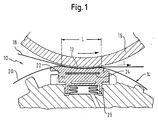
- Figure 1 shows a purely schematic partial representation of an embodiment a shoe press 10 according to the invention, for example in a Machine for producing a fibrous web, in particular one Tissue or tissue paper web can be used.
- the press nip 12 of this shoe press 10 is between a shoe press unit, in the present case a shoe press roll 14 and a drying cylinder 16 formed, through which in addition to the fibrous web a water-absorbing Carrier tape 18 and a waterproof press tape is passed, which in the present case is the press jacket 20 of the shoe press roll 14 acts.
- the water-absorbing carrier tape 18 can be formed in particular by a felt. In the present The case is the water-absorbing carrier tape 18 between the Press jacket 20 and the fibrous web passed through the press nip 12, the fibrous web touches the drying cylinder 16.
- the shoe press roll 14 has a two-part press shoe 22, a thermal between the two parts Insulating layer 24 is used.
- the press shoe 22 can be juxtaposed over several across the web running direction 1 arranged pressure elements 26 against the drying cylinder 16th be pressable.
- the drying cylinder 16 can be, for example, a Yankee cylinder act.
- the water-absorbing carrier tape formed, for example, by a felt 18 can have different properties in the thickness direction exhibit.
- the one facing the fibrous web Side of the carrier tape 18 have a finer structure than that of the side facing away from the fibrous web.
- the press jacket 20 can be a smooth, have a grooved and / or blanked surface.
- Press nip be formed. In the direction of web travel 1 in front of the drying cylinder 16 an additional press nip can be provided. Basically you can the carrier tape 18 and the fibrous web in the web running direction 1 before Drying cylinder 16 also guided over at least one suction device his.
- the shoe press unit 14 can have at least one replaceable one Include press shoe 22.
- the pressure profile or the pressure profile p (L) is one shown conventional shoe press.
- the pressure p is over the length L of the press nip 12 or the press shoe 22 is applied.
- the shoe press 10 according to the invention can now in particular be designed such that the length L of the press nip 12 (see FIG. 1) viewed in the web running direction l is less than or equal to a value of approximately 60 mm and its pressure profile p (L ) has a maximum pressure p max that is greater than or equal to a value of about 3.3 MPa.
- FIG. 3 shows the pressure pressure curve p (L) of an exemplary embodiment of such a shoe press 10 according to the invention with a relatively short press shoe 22. Starting from the beginning of the gap, this results in an extreme increase in the pressing pressure up to a relatively high maximum pressing pressure p max . Following this maximum pressing pressure p max , the pressing pressure in the end region then drops very quickly.
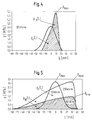
- FIG. 4 shows a comparison of the pressure pressure curve p 10 (L) of an exemplary embodiment of the shoe press 10 according to the invention with a relatively short press shoe 12 with the pressure pressure curve p S (L) of a conventional press provided with a suction press roll.
- p S the pressure pressure curve p S (L) of a conventional press provided with a suction press roll.
- the maximum line force generated in the press nip was 90 kN / m in each case.
- the length L of the press nip 12 (see FIG. 1) viewed in the web running direction l can be greater than a value of approximately 80 mm and the pressure profile p L resulting from the press nip length L means a maximum press pressure p max have less than or equal to a value of, for example, about 2 MPa.
- the maximum line force generated in the press nip can be in particular in a range from approximately 90 to approximately 110 kN / m. At higher maximum line forces, which are normally no longer possible with the usual, not additionally reinforced Yankee cylinders (see, for example, the high value of 270 kN / m indicated in FIG. 5), a higher maximum pressing pressure p max conceivable.
- FIG. 5 shows a comparison of the pressure pressure curve p 10 (L) of an exemplary embodiment of such a shoe press 10 according to the invention with a relatively long press shoe 12 with the pressure pressure curve p S (L) of a conventional press provided with a suction press roll.
- the shoe press 10 results in a significantly longer press nip 12.
- the corresponding press pressure curve p 10 (L) has a significantly lower maximum press pressure p max (cf. the hatched lower hatched for a maximum line force of 90 kN / m) Press pressure curve p 10 (L)).
- the maximum pressing pressure p max even with a considerably higher maximum line force of 270 kN / m here, is not higher than the maximum pressing pressure p max of the conventional press, for which in the present case a maximum line force of 90 kN / m is specified.
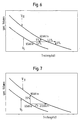
- FIG. 6 shows the specific volume versus the dry content, the results V 10 obtained for an exemplary embodiment of the shoe press 10 according to the invention with a relatively short press shoe 22 again being compared with the results V S for a conventional press provided with a suction press roll.
- a constant maximum line force of 90 kN / m in both cases, an increase in the dry content by 2.5% and an increase in the specific volume by 5% can be achieved compared to the conventional press.
- FIG. 7 shows the specific volume versus the dry content, the results V 10 obtained for an exemplary embodiment of the shoe press 10 according to the invention with a relatively long press shoe 12 again being compared with the results V S for a conventional press provided with a suction press roll.
- FIG. 8 shows a further embodiment in a schematic partial representation a shoe press 10 according to the invention.
- the angle ⁇ between the at the end of the press nip 12 applied to the drying or tissue cylinder 16 Tangent 30 and the carrier tape running out of the press nip 12 18 has a significant influence on the dry content of the tissue web 28 has.
- the present embodiment is now characterized by this from that in particular for the manufacture of a tissue web 28 this angle ⁇ between the at the end of the press nip 12 to the drying or tissue cylinder 16 created tangent 30 and the tapering from the press nip 12 Carrier tape 18 ⁇ 10 °, in particular ⁇ 18 ° and preferably ⁇ Is 20 °. This results in applications with suction press rolls a dry matter increase of approx. 1 to 3%.
- the press belt 18 is preferably grooved and / or blind drilled.
- the present shoe press 10 has again, for example the same structure as the elements corresponding to each other are provided with the same reference numerals.
Landscapes
- Paper (AREA)
- Spinning Methods And Devices For Manufacturing Artificial Fibers (AREA)
Abstract
Description
- Figur 1
- eine rein schematische Teildarstellung einer erfindungsgemäßen Schuhpresse mit einem zwischen einer Schuhpreßeinheit und einem Trockenzylinder gebildeten Preßspalt,
- Figur 2
- den Preßdruckverlauf einer herkömmlichen Schuhpresse,
- Figur 3
- den Preßdruckverlauf einer beispielhaften Ausführungsform der erfindungsgemäßen Schuhpresse mit relativ kurzem Preßschuh,
- Figur 4
- einen Vergleich des Preßdruckverlaufs einer beispielhaften Ausführungsform der erfindungsgemäßen Schuhpresse mit relativ kurzem Preßschuh mit dem Preßdruckverlauf einer mit einer Saugpreßwalze versehenen herkömmlichen Presse,
- Figur 5
- einen Vergleich des Preßdruckverlaufs einer beispielhaften Ausführungsform der erfindungsgemäßen Schuhpresse mit relativ langem Preßschuh mit dem Preßdruckverlauf einer mit einer Saugpreßwalze versehenen herkömmlichen Presse,
- Figur 6
- das spezifische Volumen gegenüber dem Trockengehalt, wobei die für eine beispielhafte Ausführungsform der erfindungsgemäßen Schuhpresse mit relativ kurzem Preßschuh erhaltenen Ergebnisse mit denen für eine mit einer Saugpreßwalze versehenen herkömmlichen Presse verglichen werden,
- Figur 7
- das spezifische Volumen gegenüber dem Trockengehalt, wobei die für eine beispielhafte Ausführungsform der erfindungsgemäßen Schuhpresse mit relativ langem Preßschuh erhaltenen Ergebnisse mit denen für eine mit einer Saugpreßwalze versehenen herkömmlichen Presse verglichen werden, und
- Figur 8
- eine rein schematische Teildarstellung einer weiteren Ausführungsform der erfindungsgemäßen Schuhpresse mit einem zwischen einer Schuhpreßeinheit und einem Tissuezylinder gebildeten Preßspalt.
- 10
- Schuhpresse
- 12
- Preßspalt
- 14
- Schuhpreßwalze
- 16
- Trockenzylinder
- 18
- Trägerband
- 20
- Preßband, Preßmantel
- 22
- Preßschuh
- 24
- thermische Isolierschicht
- 26
- Anpreßelement
- 28
- Tissuebahn
- 30
- Tangente
- L
- Preßspaltlänge
- l
- Bahnlaufrichtung
- p(L)
- Preßdruckverlauf, Druckprofil
- pmax
- maximaler Preßdruck
- α
- Winkel
Claims (17)
- Maschine zur Herstellung einer Faserstoffbahn, insbesondere Tissue- oder Hygienepapierbahn, mit wenigstens einem zwischen einer Schuhpreßeinheit (14) und einem Trocken- bzw. Tissuezylinder (16) gebildeten Preßspalt (12), durch den ein wasseraufnehmendes Trägerband (18), ein wasserundurchlässiges Preßband (20) und die Faserstoffbahn hindurchgeführt sind,
dadurch gekennzeichnet,
daß wenigstens ein zwischen einer Schuhpreßeinheit (14) und dem Trocken- bzw. Tissuezylinder (16) gebildeter Preßspalt (12) vorgesehen ist, dessen in Bahnlaufrichtung (l) betrachtete Länge (L) kleiner oder gleich einem Wert von etwa 60 mm ist und dessen sich über die Preßspaltlänge (L) ergebendes Druckprofil (p(L)) einen maximalen Preßdruck (pmax) aufweist, der größer oder gleich einem Wert von etwa 3,3 MPa ist. - Maschine nach Anspruch 1,
dadurch gekennzeichnet,
daß die Preßspaltlänge (L) Meiner oder gleich einem Wert von etwa 50 mm und der maximale Preßdruck (pmax) größer oder gleich einem Wert von etwa 4,3 MPa ist, wobei vorzugsweise die Preßspaltlänge (L) in einem Bereich von etwa 37 mm und der maximale Preßdruck (pmax) in einem Bereich von etwa 4,8 MPa liegt. - Maschine nach einem der vorhergehenden Ansprüche,
dadurch gekennzeichnet,
daß insbesondere zur Herstellung einer Tissuebahn (28) der Winkel (α) zwischen der am Ende des Preßspaltes (12) an den Trockenzylinder (16) angelegten Tangente (30) und dem aus dem Preßspalt (12) auslaufenden Trägerband (18) ≥ 10°, insbesondere ≥ 18° und vorzugsweise ≥ 20° ist, wobei das Preßband (20) vorzugsweise gerillt und/oder blindgebohrt ist. - Maschine zur Herstellung einer Faserstoffbahn, insbesondere Tissue- oder Hygienepapierbahn, mit wenigstens einem zwischen einer Schuhpreßeinheit (14) und einem Trocken- bzw. Tissuezylinder (16) gebildeten Preßspalt (12), durch den ein wasseraufnehmendes Trägerband (18), ein wasserundurchlässiges Preßband (20) und die Faserstoffbahn hindurchgeführt sind,
dadurch gekennzeichnet,
daß wenigstens ein zwischen einer Schuhpreßeinheit (14) und dem Trocken- bzw. Tissuezylinder (16) gebildeter Preßspalt (12) vorgesehen ist, dessen in Bahnlaufrichtung (l) betrachtete Länge (L) größer als ein Wert von etwa 80 mm und vorzugsweise kleiner als 200 mm, insbesondere höchstens 150 mm, ist und dessen sich über die Preßspaltlänge (L) ergebendes Druckprofil (p(L)) einen maximalen Preßdruck (pmax) aufweist, der Meiner oder gleich einem Wert von etwa 2 MPa ist. - Maschine nach einem der vorhergehenden Ansprüche,
dadurch gekennzeichnet,
daß die in dem Preßspalt (12) erzeugte maximale Linienkraft in einem Bereich von etwa 90 bis etwa 110 kN/m liegt, und/oder daß die Schuhpreßeinheit (14) einen Preßschuh (22) umfaßt, der über mehrere quer zur Bahnlaufrichtung (l) nebeneinander angeordnete, vorzugsweise unabhängig voneinander betätigbare Anpreßelemente (26) gegen den Trockenzylinder preßbar ist. - Maschine nach einem der vorhergehenden Ansprüche,
dadurch gekennzeichnet,
daß als Trockenzylinder (16) ein Yankee-Zylinder vorgesehen ist, und/oder daß das sich über die Preßspaltlänge (L) ergebende Druckprofil (p(L)) asymmetrisch ist. - Maschine nach einem der vorhergehenden Ansprüche,
dadurch gekennzeichnet,
daß die Preßspaltlänge (L) kleiner oder gleich einem Wert von etwa 60 mm ist und das Druckprofil (p(L)) einen maximalen Preßdruck (pmax) aufweist, der größer oder gleich einem Wert von etwa 3,3 MPa ist, und daß der maximale Preßdruck (pmax) in der in Bahnlaufrichtung (l) betrachtet hinteren Hälfte der Preßspaltlänge (L) liegt. - Maschine nach einem Ansprüche 1 bis 6,dadurch gekennzeichnet,
daß die Preßspaltlänge (L) größer als ein Wert von etwa 80 mm ist und das Druckprofil (p(L)) einen maximalen Preßdruck (pmax) aufweist, der kleiner oder gleich einem Wert von etwa 2 MPa ist, und daß der maximale Preßdruck (pmax) in dem in Bahnlaufrichtung (l) betrachtet hinteren Viertel der Preßspaltlänge (L) liegt. - Maschine nach einem der vorhergehenden Ansprüche,
dadurch gekennzeichnet,
daß der mittlere Druckanstiegsgradient in dem vom Spaltanfang bis zum maximalen Preßdruck (pmax) reichenden Abschnitt des Druckprofils (p(L)) bei einem neuwertigen Trägerband größer oder gleich einem Wert von etwa 40 kPa/mm, insbesondere größer oder gleich etwa 60 kPa/mm und vorzugsweise größer oder gleich etwa 120 kPa/mm ist, und/oder daß der mittlere Druckabfallsgradient im Endbereich des Druckprofils (p(L)) bei einem neuwertigen Trägerband größer oder gleich einem Wert von etwa 300 kPa/mm, insbesondere größer oder gleich etwa 500 kPa/mm, zweckmäßigerweise größer oder gleich etwa 800 kPa/mm und vorzugsweise größer oder gleich etwa 960 kPa/mm ist, und/oder daß das wasseraufnehmende Trägerband (18) im Preßspalt (12) zwischen dem wasserundurchlässigen Preßband (20) und der Faserstoffbahn liegt und die Faserstoffbahn den Trockenzylinder (16) berührt, und/oder daß als wasseraufnehmendes Trägerband (18) ein Filz vorgesehen ist. - Maschine nach einem der vorhergehenden Ansprüche,
dadurch gekennzeichnet,
daß das wasseraufnehmende Trägerband (18) in Dickenrichtung eine unterschiedliche Beschaffenheit aufweist und daß vorzugsweise die der Faserstoffbahn zugewandte Seite des Trägerbandes (18) eine feinere Struktur besitzt als dessen von der Faserstoffbahn abgewandte Seite. - Maschine nach einem der vorhergehenden Ansprüche,
dadurch gekennzeichnet,
daß das Preßband (20) eine glatte, gerillte und/oder mit Blindbohrungen versehene Oberfläche besitzt, und/oder daß am Trockenzylinder (16) wenigstens ein weiterer Preßspalt (12) gebildet ist, wobei am Trockenzylinder (16) vorzugsweise wenigstens zwei mittels einer jeweiligen Schuhpreßeinheit (14) gebildete Preßspalte (12) vorgesehen sind. - Maschine nach einem der vorhergehenden Ansprüche,
dadurch gekennzeichnet,
daß in Bahnlaufrichtung (l) vor dem Trockenzylinder (16) ein zusätzlicher Preßspalt (12) vorgesehen ist, und/oder daß das Trägerband (18) und die Faserstoffbahn in Bahnlaufrichtung (l) vor dem Trockenzylinder (16) über wenigstens eine Saugvorrichtung geführt sind, wobei vorzugsweise wenigstens eine Saugvorrichtung vorgesehen ist, die eine Saugwalze und/oder einen Saugschuh umfaßt, und/oder daß als Schuhpreßeinheit eine Schuhpreßwalze (14) vorgesehen ist, wobei das Preßband vorzugsweise durch den Preßmantel (20) der Schuhpreßwalze (14) gebildet ist. - Maschine nach einem der vorhergehenden Ansprüche,
dadurch gekennzeichnet,
daß die Schuhpreßeinheit (14) wenigstens einen austauschbaren Preßschuh (22) umfaßt, und/oder daß als Trägerband (18) ein strukturierter Filz in der Art eines mit Höckern versehenen Prägesiebes oder -filzes, d.h. eines sogenannten "imprinting fabric" oder "imprinting felt" oder eines eine grob strukturierte Oberfläche aufweisenden "patterning fabric" oder "patterning felt" vorgesehen ist. - Verwendung der Maschine nach einem der vorhergehenden Ansprüche zur Herstellung einer Faserstoffbahn unter Einsatz sogenannter "curled fibres".
- Verfahren zur Herstellung einer Faserstoffbahn, insbesondere Tissue- oder Hygienepapierbahn, bei dem die zu entwässernde Faserstoffbahn zusammen mit einem Trägerband (18) durch einen Preßspalt (12) geführt wird,
dadurch gekennzeichnet,
daß die zu entwässernde Faserstoffbahn in dem Preßspalt (12) für eine Zeitdauer von höchstens 3 ms einem Preßdruck von zumindest 3,3 MPa ausgesetzt wird. - Verfahren zur Herstellung einer Faserstoffbahn, insbesondere Tissue- oder Hygienepapierbahn, bei dem die zu entwässernde Faserstoffbahn zusammen mit einem Band (18) durch einen Preßspalt (12) geführt wird,
dadurch gekennzeichnet,
daß die zu entwässernde Faserstoffbahn in dem Preßspalt (12) für eine Zeitdauer von wenigstens 3,5 ms einem Preßdruck von höchstens 2 MPa ausgesetzt wird. - Verfahren nach einem der vorhergehenden Ansprüche,
gekennzeichnet durch
den Einsatz sogenannter "curled fibres".
Priority Applications (1)
| Application Number | Priority Date | Filing Date | Title |
|---|---|---|---|
| EP07106782A EP1816256B1 (de) | 1998-12-29 | 1999-12-23 | Maschine sowie Verfahren zur Herstellung einer Faserstoffbahn |
Applications Claiming Priority (2)
| Application Number | Priority Date | Filing Date | Title |
|---|---|---|---|
| DE19860687 | 1998-12-29 | ||
| DE19860687A DE19860687A1 (de) | 1998-12-29 | 1998-12-29 | Maschine sowie Verfahren zur Herstellung einer Faserstoffbahn |
Related Child Applications (1)
| Application Number | Title | Priority Date | Filing Date |
|---|---|---|---|
| EP07106782A Division EP1816256B1 (de) | 1998-12-29 | 1999-12-23 | Maschine sowie Verfahren zur Herstellung einer Faserstoffbahn |
Publications (2)
| Publication Number | Publication Date |
|---|---|
| EP1016754A1 true EP1016754A1 (de) | 2000-07-05 |
| EP1016754B1 EP1016754B1 (de) | 2008-06-25 |
Family
ID=7893096
Family Applications (2)
| Application Number | Title | Priority Date | Filing Date |
|---|---|---|---|
| EP99125789A Expired - Lifetime EP1016754B1 (de) | 1998-12-29 | 1999-12-23 | Maschine sowie Verfahren zur Herstellung einer Faserstoffbahn |
| EP07106782A Expired - Lifetime EP1816256B1 (de) | 1998-12-29 | 1999-12-23 | Maschine sowie Verfahren zur Herstellung einer Faserstoffbahn |
Family Applications After (1)
| Application Number | Title | Priority Date | Filing Date |
|---|---|---|---|
| EP07106782A Expired - Lifetime EP1816256B1 (de) | 1998-12-29 | 1999-12-23 | Maschine sowie Verfahren zur Herstellung einer Faserstoffbahn |
Country Status (6)
| Country | Link |
|---|---|
| US (4) | US6746574B2 (de) |
| EP (2) | EP1016754B1 (de) |
| AT (2) | ATE538243T1 (de) |
| BR (1) | BR9906261B1 (de) |
| CA (4) | CA2718114C (de) |
| DE (2) | DE19860687A1 (de) |
Cited By (5)
| Publication number | Priority date | Publication date | Assignee | Title |
|---|---|---|---|---|
| EP1111127A3 (de) * | 1999-12-23 | 2002-01-23 | Voith Paper Patent GmbH | Pressenanordnung |
| EP1342838A1 (de) * | 2002-03-05 | 2003-09-10 | Voith Paper Patent GmbH | Maschine zur Herstellung einer Tissuebahn |
| US6780282B2 (en) | 2000-07-03 | 2004-08-24 | Voith Pater Patent Gmbh | Machine and process for producing a fibrous material web |
| US7008506B2 (en) | 2000-01-28 | 2006-03-07 | Voith Paper Patent Gmbh | Machine and process for producing a tissue web |
| RU2335588C2 (ru) * | 2002-01-29 | 2008-10-10 | Метсо Пейпер, Инк. | Устройство для обработки волокнистого полотна с покрытием или без покрытия и способ работы этого устройства |
Families Citing this family (9)
| Publication number | Priority date | Publication date | Assignee | Title |
|---|---|---|---|---|
| DE10032923A1 (de) * | 2000-07-06 | 2002-01-24 | Bosch Gmbh Robert | Kraftstoffeinspritzvorrichtung für Brennkraftmaschinen |
| DE60110362T3 (de) * | 2001-02-16 | 2009-01-15 | The Procter & Gamble Company, Cincinnati | Verfahren zum Herstellen einer dicken und glatten geprägten Bahn |
| DE10233922A1 (de) * | 2002-07-25 | 2004-02-12 | Voith Paper Patent Gmbh | Schuhpresse |
| DE10332906A1 (de) * | 2003-07-19 | 2005-02-17 | Voith Paper Patent Gmbh | Entwässerungspresse |
| DE10351294A1 (de) | 2003-10-31 | 2005-06-02 | Voith Paper Patent Gmbh | Anpresseinrichtung |
| DE102014213512A1 (de) | 2014-07-11 | 2016-01-14 | Voith Patent Gmbh | Maschine zur Herstellung einer Faserstoffbahn |
| CN106988150B (zh) * | 2017-05-23 | 2019-06-25 | 东莞市白天鹅纸业有限公司 | 一种生活用纸造纸机 |
| DE102018119383A1 (de) * | 2018-08-09 | 2020-02-13 | Voith Patent Gmbh | Maschine und Verfahren zur Herstellung einer Wellpappenrohpapierbahn |
| DE102021117647A1 (de) * | 2021-07-08 | 2023-01-12 | Voith Patent Gmbh | Verfahren und Maschine zur Herstellung einer Faserstoffbahn |
Citations (8)
| Publication number | Priority date | Publication date | Assignee | Title |
|---|---|---|---|---|
| EP0289477A2 (de) * | 1987-04-28 | 1988-11-02 | Valmet Paper Machinery Inc. | Verfahren zur Heisspressung von Papierbahnen und Trocknungsanlage zur Durchführung des Verfahrens |
| US5092962A (en) * | 1989-03-30 | 1992-03-03 | Valmet Paper Machinery Inc. | Hot-pressing and drying device |
| WO1997043483A1 (en) * | 1996-05-10 | 1997-11-20 | Kimberly-Clark Worldwide, Inc. | Method for making high bulk wet-pressed tissue |
| DE29719501U1 (de) | 1997-11-03 | 1997-12-18 | LRE Technology Partner GmbH, 80807 München | Manschette für ein Blutdruckmeßgerät |
| WO1998000604A1 (en) * | 1996-06-28 | 1998-01-08 | The Procter & Gamble Company | Method of making wet pressed tissue paper |
| DE19654197A1 (de) * | 1996-12-23 | 1998-06-25 | Voith Sulzer Papiermasch Gmbh | Maschine zur Herstellung einer Faserstoffbahn |
| DE19654198A1 (de) * | 1996-12-23 | 1998-06-25 | Voith Sulzer Papiermasch Gmbh | Maschine zur Herstellung einer Faserstoffbahn |
| EP0852273A2 (de) * | 1996-12-05 | 1998-07-08 | Voith Sulzer Papiermaschinen GmbH | Entwässerungspresse |
Family Cites Families (10)
| Publication number | Priority date | Publication date | Assignee | Title |
|---|---|---|---|---|
| US4036670A (en) * | 1975-04-03 | 1977-07-19 | Continental Copper & Steel Industries, Inc. | Tool steel |
| US4036679A (en) * | 1975-12-29 | 1977-07-19 | Crown Zellerbach Corporation | Process for producing convoluted, fiberized, cellulose fibers and sheet products therefrom |
| US4139410A (en) * | 1976-06-09 | 1979-02-13 | Olli Tapio | Method of dewatering and drying in a Yankee machine |
| SE423118B (sv) * | 1978-03-31 | 1982-04-13 | Karlstad Mekaniska Ab | Forfarande och anordning for konsolodering och torkning av en fuktig poros bana |
| US4488932A (en) * | 1982-08-18 | 1984-12-18 | James River-Dixie/Northern, Inc. | Fibrous webs of enhanced bulk and method of manufacturing same |
| US5019211A (en) * | 1987-12-09 | 1991-05-28 | Kimberly-Clark Corporation | Tissue webs containing curled temperature-sensitive bicomponent synthetic fibers |
| FI82092C (fi) * | 1989-03-22 | 1991-01-10 | Valmet Paper Machinery Inc | Laongnyppress. |
| DE4216264C2 (de) * | 1992-05-16 | 2000-05-25 | Voith Sulzer Papiermasch Gmbh | Verfahren zum Trocknen und Auflockern einer Papierbahn |
| DE4224730C1 (en) * | 1992-07-27 | 1993-09-02 | J.M. Voith Gmbh, 89522 Heidenheim, De | Tissue paper mfg. machine preventing moisture return - comprises shoe press for press unit(s) for drying tissue web, for min. press units |
| US6248210B1 (en) * | 1998-11-13 | 2001-06-19 | Fort James Corporation | Method for maximizing water removal in a press nip |
-
1998
- 1998-12-29 DE DE19860687A patent/DE19860687A1/de not_active Withdrawn
-
1999
- 1999-12-23 CA CA2718114A patent/CA2718114C/en not_active Expired - Fee Related
- 1999-12-23 EP EP99125789A patent/EP1016754B1/de not_active Expired - Lifetime
- 1999-12-23 AT AT07106782T patent/ATE538243T1/de active
- 1999-12-23 BR BRPI9906261-5A patent/BR9906261B1/pt not_active IP Right Cessation
- 1999-12-23 CA CA2718288A patent/CA2718288A1/en not_active Abandoned
- 1999-12-23 DE DE59914794T patent/DE59914794D1/de not_active Expired - Lifetime
- 1999-12-23 CA CA2718031A patent/CA2718031C/en not_active Expired - Fee Related
- 1999-12-23 CA CA2293215A patent/CA2293215C/en not_active Expired - Fee Related
- 1999-12-23 AT AT99125789T patent/ATE399224T1/de active
- 1999-12-23 EP EP07106782A patent/EP1816256B1/de not_active Expired - Lifetime
-
2002
- 2002-02-14 US US10/073,917 patent/US6746574B2/en not_active Expired - Lifetime
-
2003
- 2003-12-23 US US10/743,461 patent/US7288168B2/en not_active Expired - Lifetime
-
2004
- 2004-04-26 US US10/831,291 patent/US7332059B2/en not_active Expired - Lifetime
- 2004-04-26 US US10/831,201 patent/US7326320B2/en not_active Expired - Fee Related
Patent Citations (8)
| Publication number | Priority date | Publication date | Assignee | Title |
|---|---|---|---|---|
| EP0289477A2 (de) * | 1987-04-28 | 1988-11-02 | Valmet Paper Machinery Inc. | Verfahren zur Heisspressung von Papierbahnen und Trocknungsanlage zur Durchführung des Verfahrens |
| US5092962A (en) * | 1989-03-30 | 1992-03-03 | Valmet Paper Machinery Inc. | Hot-pressing and drying device |
| WO1997043483A1 (en) * | 1996-05-10 | 1997-11-20 | Kimberly-Clark Worldwide, Inc. | Method for making high bulk wet-pressed tissue |
| WO1998000604A1 (en) * | 1996-06-28 | 1998-01-08 | The Procter & Gamble Company | Method of making wet pressed tissue paper |
| EP0852273A2 (de) * | 1996-12-05 | 1998-07-08 | Voith Sulzer Papiermaschinen GmbH | Entwässerungspresse |
| DE19654197A1 (de) * | 1996-12-23 | 1998-06-25 | Voith Sulzer Papiermasch Gmbh | Maschine zur Herstellung einer Faserstoffbahn |
| DE19654198A1 (de) * | 1996-12-23 | 1998-06-25 | Voith Sulzer Papiermasch Gmbh | Maschine zur Herstellung einer Faserstoffbahn |
| DE29719501U1 (de) | 1997-11-03 | 1997-12-18 | LRE Technology Partner GmbH, 80807 München | Manschette für ein Blutdruckmeßgerät |
Cited By (7)
| Publication number | Priority date | Publication date | Assignee | Title |
|---|---|---|---|---|
| EP1111127A3 (de) * | 1999-12-23 | 2002-01-23 | Voith Paper Patent GmbH | Pressenanordnung |
| US6488814B2 (en) | 1999-12-23 | 2002-12-03 | Voith Paper Patent Gmbh | Pressing arrangement |
| US7008506B2 (en) | 2000-01-28 | 2006-03-07 | Voith Paper Patent Gmbh | Machine and process for producing a tissue web |
| US6780282B2 (en) | 2000-07-03 | 2004-08-24 | Voith Pater Patent Gmbh | Machine and process for producing a fibrous material web |
| RU2335588C2 (ru) * | 2002-01-29 | 2008-10-10 | Метсо Пейпер, Инк. | Устройство для обработки волокнистого полотна с покрытием или без покрытия и способ работы этого устройства |
| EP1342838A1 (de) * | 2002-03-05 | 2003-09-10 | Voith Paper Patent GmbH | Maschine zur Herstellung einer Tissuebahn |
| US6893539B2 (en) | 2002-03-05 | 2005-05-17 | Voith Paper Patent Gmbh | Machine for the production of a tissue web |
Also Published As
| Publication number | Publication date |
|---|---|
| US7288168B2 (en) | 2007-10-30 |
| CA2293215A1 (en) | 2000-06-29 |
| DE59914794D1 (de) | 2008-08-07 |
| DE19860687A1 (de) | 2000-07-06 |
| CA2718114C (en) | 2013-02-12 |
| EP1816256B1 (de) | 2011-12-21 |
| CA2293215C (en) | 2011-08-30 |
| US20040261967A1 (en) | 2004-12-30 |
| US20020069995A1 (en) | 2002-06-13 |
| EP1816256A1 (de) | 2007-08-08 |
| ATE538243T1 (de) | 2012-01-15 |
| US20040134632A1 (en) | 2004-07-15 |
| US7326320B2 (en) | 2008-02-05 |
| ATE399224T1 (de) | 2008-07-15 |
| CA2718031A1 (en) | 2000-06-29 |
| US7332059B2 (en) | 2008-02-19 |
| EP1016754B1 (de) | 2008-06-25 |
| BR9906261A (pt) | 2000-08-22 |
| BR9906261B1 (pt) | 2009-12-01 |
| CA2718288A1 (en) | 2000-06-29 |
| US6746574B2 (en) | 2004-06-08 |
| CA2718031C (en) | 2012-10-09 |
| CA2718114A1 (en) | 2000-06-29 |
| US20040194904A1 (en) | 2004-10-07 |
Similar Documents
| Publication | Publication Date | Title |
|---|---|---|
| EP1626122B1 (de) | Verfahren und Vorrichtung zur Herstellung einer mit einer dreidimensionalen Oberflächenstruktur versehenen Faserstoffbahn | |
| DE4224730C1 (en) | Tissue paper mfg. machine preventing moisture return - comprises shoe press for press unit(s) for drying tissue web, for min. press units | |
| EP1749934B1 (de) | Maschine zur Herstellung von Tissuepapier | |
| EP1314817A1 (de) | Verfahren und Vorrichtung zur Herstellung einer Faserstoffbahn | |
| EP1816256B1 (de) | Maschine sowie Verfahren zur Herstellung einer Faserstoffbahn | |
| EP0926296B1 (de) | Maschine zur Herstellung einer Faserstoffbahn, insbesondere einer Tissue-Papierbahn | |
| EP2576895A2 (de) | Maschine zur herstellung einer papierbahn, insbesondere sackpapierbahn | |
| EP1397553B1 (de) | Verfahren und maschine zur herstellung einer faserstoffbahn | |
| DE19855215A1 (de) | Verfahren zum Entfernen von Wasser aus einer Papier- oder Kartonbahn mittels Preßung, und Papier- oder Kartonmaschine | |
| EP0857818B1 (de) | Maschine zur Herstellung einer Faserstoffbahn | |
| DE19654197A1 (de) | Maschine zur Herstellung einer Faserstoffbahn | |
| EP0854230B1 (de) | Nasspresse | |
| DE102011077523A1 (de) | Maschine zur Herstellung einer einseitig-glatten Faserstoffbahn | |
| DE19604675C2 (de) | Maschine zur Herstellung einer Faserstoffbahn | |
| EP1036880A1 (de) | Verfahren und Vorrichtung zum Herstellen von Tissue-Papier sowie das damit erhältliche Tissue-Papier | |
| DE10254301A1 (de) | Verfahren und Siebpartie einer Maschine zur Herstellung einer mehrlagigen Faserstoffbahn | |
| DE102011005747A1 (de) | Blattbindungsvorrichtung | |
| DE19705030A1 (de) | Vorrichtung und Verfahren zur Entwässerung einer Materialbahn | |
| DE60316971T2 (de) | Verfahren zur herstellung von pappe und maschine zur herstellung von pappe | |
| DE20100509U1 (de) | Schuhpresse | |
| EP1111127A9 (de) | Pressenanordnung | |
| DE29624464U1 (de) | Maschine zur Herstellung einer Faserstoffbahn | |
| DE10132652A1 (de) | Pressenanordnung | |
| EP1407074A1 (de) | Verfahren und vorrichtung zur herstellung einer mit einer dreidimensionalen struktur versehenen faserstoffbahn | |
| DE102019125929A1 (de) | Maschine und Verfahren zur Herstellung einer Dekorrohpapierbahn |
Legal Events
| Date | Code | Title | Description |
|---|---|---|---|
| PUAI | Public reference made under article 153(3) epc to a published international application that has entered the european phase |
Free format text: ORIGINAL CODE: 0009012 |
|
| AK | Designated contracting states |
Kind code of ref document: A1 Designated state(s): AT DE FI SE |
|
| AX | Request for extension of the european patent |
Free format text: AL;LT;LV;MK;RO;SI |
|
| RAP1 | Party data changed (applicant data changed or rights of an application transferred) |
Owner name: VOITH PAPER PATENT GMBH |
|
| AKX | Designation fees paid | ||
| RBV | Designated contracting states (corrected) |
Designated state(s): AT DE FI SE |
|
| RAP1 | Party data changed (applicant data changed or rights of an application transferred) |
Owner name: VOITH PATENT GMBH |
|
| 17P | Request for examination filed |
Effective date: 20010308 |
|
| 17Q | First examination report despatched |
Effective date: 20061227 |
|
| GRAP | Despatch of communication of intention to grant a patent |
Free format text: ORIGINAL CODE: EPIDOSNIGR1 |
|
| GRAS | Grant fee paid |
Free format text: ORIGINAL CODE: EPIDOSNIGR3 |
|
| GRAA | (expected) grant |
Free format text: ORIGINAL CODE: 0009210 |
|
| AK | Designated contracting states |
Kind code of ref document: B1 Designated state(s): AT DE FI SE |
|
| REF | Corresponds to: |
Ref document number: 59914794 Country of ref document: DE Date of ref document: 20080807 Kind code of ref document: P |
|
| REG | Reference to a national code |
Ref country code: SE Ref legal event code: TRGR |
|
| PLBE | No opposition filed within time limit |
Free format text: ORIGINAL CODE: 0009261 |
|
| STAA | Information on the status of an ep patent application or granted ep patent |
Free format text: STATUS: NO OPPOSITION FILED WITHIN TIME LIMIT |
|
| 26N | No opposition filed |
Effective date: 20090326 |
|
| PGFP | Annual fee paid to national office [announced via postgrant information from national office to epo] |
Ref country code: FI Payment date: 20151211 Year of fee payment: 17 |
|
| PGFP | Annual fee paid to national office [announced via postgrant information from national office to epo] |
Ref country code: SE Payment date: 20151221 Year of fee payment: 17 Ref country code: AT Payment date: 20151222 Year of fee payment: 17 |
|
| PG25 | Lapsed in a contracting state [announced via postgrant information from national office to epo] |
Ref country code: FI Free format text: LAPSE BECAUSE OF NON-PAYMENT OF DUE FEES Effective date: 20161223 |
|
| REG | Reference to a national code |
Ref country code: SE Ref legal event code: EUG |
|
| REG | Reference to a national code |
Ref country code: AT Ref legal event code: MM01 Ref document number: 399224 Country of ref document: AT Kind code of ref document: T Effective date: 20161223 |
|
| PG25 | Lapsed in a contracting state [announced via postgrant information from national office to epo] |
Ref country code: SE Free format text: LAPSE BECAUSE OF NON-PAYMENT OF DUE FEES Effective date: 20161224 |
|
| PG25 | Lapsed in a contracting state [announced via postgrant information from national office to epo] |
Ref country code: AT Free format text: LAPSE BECAUSE OF NON-PAYMENT OF DUE FEES Effective date: 20161223 |
|
| PGFP | Annual fee paid to national office [announced via postgrant information from national office to epo] |
Ref country code: DE Payment date: 20181210 Year of fee payment: 20 |
|
| REG | Reference to a national code |
Ref country code: DE Ref legal event code: R071 Ref document number: 59914794 Country of ref document: DE |