EP1017173A2 - Dispositif de commande d'alimentation et procédé de commande correspondant - Google Patents
Dispositif de commande d'alimentation et procédé de commande correspondant Download PDFInfo
- Publication number
- EP1017173A2 EP1017173A2 EP99126089A EP99126089A EP1017173A2 EP 1017173 A2 EP1017173 A2 EP 1017173A2 EP 99126089 A EP99126089 A EP 99126089A EP 99126089 A EP99126089 A EP 99126089A EP 1017173 A2 EP1017173 A2 EP 1017173A2
- Authority
- EP
- European Patent Office
- Prior art keywords
- semiconductor switch
- power supply
- voltage
- control device
- supply control
- Prior art date
- Legal status (The legal status is an assumption and is not a legal conclusion. Google has not performed a legal analysis and makes no representation as to the accuracy of the status listed.)
- Withdrawn
Links
- 238000000034 method Methods 0.000 title claims description 70
- 239000004065 semiconductor Substances 0.000 claims abstract description 278
- 230000002401 inhibitory effect Effects 0.000 claims description 16
- 230000001052 transient effect Effects 0.000 claims description 6
- 101100464779 Saccharomyces cerevisiae (strain ATCC 204508 / S288c) CNA1 gene Proteins 0.000 abstract description 43
- 238000010586 diagram Methods 0.000 description 38
- 230000006870 function Effects 0.000 description 30
- 238000001514 detection method Methods 0.000 description 29
- 238000004519 manufacturing process Methods 0.000 description 24
- 239000003990 capacitor Substances 0.000 description 18
- 230000002159 abnormal effect Effects 0.000 description 16
- 230000009467 reduction Effects 0.000 description 15
- 230000000694 effects Effects 0.000 description 11
- 230000002829 reductive effect Effects 0.000 description 10
- 230000004048 modification Effects 0.000 description 8
- 238000012986 modification Methods 0.000 description 8
- 230000004044 response Effects 0.000 description 8
- 230000007423 decrease Effects 0.000 description 7
- 238000010438 heat treatment Methods 0.000 description 7
- 230000000737 periodic effect Effects 0.000 description 7
- 230000008569 process Effects 0.000 description 7
- 238000007599 discharging Methods 0.000 description 6
- 101100464782 Saccharomyces cerevisiae (strain ATCC 204508 / S288c) CMP2 gene Proteins 0.000 description 5
- 238000010276 construction Methods 0.000 description 5
- 230000001174 ascending effect Effects 0.000 description 4
- 230000008859 change Effects 0.000 description 3
- 230000003247 decreasing effect Effects 0.000 description 3
- 238000012544 monitoring process Methods 0.000 description 3
- 238000004806 packaging method and process Methods 0.000 description 3
- 229920006395 saturated elastomer Polymers 0.000 description 3
- 230000035945 sensitivity Effects 0.000 description 3
- 238000013459 approach Methods 0.000 description 2
- 230000001934 delay Effects 0.000 description 2
- 230000007274 generation of a signal involved in cell-cell signaling Effects 0.000 description 2
- 230000000873 masking effect Effects 0.000 description 2
- 102220041690 rs368070922 Human genes 0.000 description 2
- 230000000087 stabilizing effect Effects 0.000 description 2
- 230000005856 abnormality Effects 0.000 description 1
- 238000009825 accumulation Methods 0.000 description 1
- 230000009471 action Effects 0.000 description 1
- 230000002411 adverse Effects 0.000 description 1
- 230000008901 benefit Effects 0.000 description 1
- 230000015556 catabolic process Effects 0.000 description 1
- 239000002131 composite material Substances 0.000 description 1
- 230000010485 coping Effects 0.000 description 1
- 238000013461 design Methods 0.000 description 1
- 230000005669 field effect Effects 0.000 description 1
- 230000006872 improvement Effects 0.000 description 1
- 230000006698 induction Effects 0.000 description 1
- 230000007246 mechanism Effects 0.000 description 1
- 238000012545 processing Methods 0.000 description 1
- 230000000630 rising effect Effects 0.000 description 1
- 230000006641 stabilisation Effects 0.000 description 1
- 238000011105 stabilization Methods 0.000 description 1
- 230000003068 static effect Effects 0.000 description 1
Images






Classifications
-
- H—ELECTRICITY
- H03—ELECTRONIC CIRCUITRY
- H03K—PULSE TECHNIQUE
- H03K17/00—Electronic switching or gating, i.e. not by contact-making and –breaking
-
- H—ELECTRICITY
- H03—ELECTRONIC CIRCUITRY
- H03K—PULSE TECHNIQUE
- H03K17/00—Electronic switching or gating, i.e. not by contact-making and –breaking
- H03K17/08—Modifications for protecting switching circuit against overcurrent or overvoltage
- H03K17/082—Modifications for protecting switching circuit against overcurrent or overvoltage by feedback from the output to the control circuit
- H03K17/0822—Modifications for protecting switching circuit against overcurrent or overvoltage by feedback from the output to the control circuit in field-effect transistor switches
-
- H—ELECTRICITY
- H03—ELECTRONIC CIRCUITRY
- H03K—PULSE TECHNIQUE
- H03K17/00—Electronic switching or gating, i.e. not by contact-making and –breaking
- H03K17/08—Modifications for protecting switching circuit against overcurrent or overvoltage
- H03K2017/0806—Modifications for protecting switching circuit against overcurrent or overvoltage against excessive temperature
Definitions
- the present invention relates to a power supply control device and a method of controlling the same. More particularly, the invention relates to a power supply control device with a semiconductor switch for controlling the supply of electric power from a power supply to a load by its switching control in response to a control signal, and a power supply control method for the controlling the same.
- a power supply control device with a semiconductor switch as shown in Fig. 19 is known.
- This conventional power supply control device supplies electric power from a battery selectively to each load in a motor vehicle, and controls the power supply to the load.
- the power supply control device is arranged such that a shunt resistor RS and the drain (D) - source (S) path of a thermal FET QF are connected in series in a path for applying an output voltage VB of a power source 101 to a load 102, such as head lamps and drive motors for power windows.
- the power supply control device includes a driver 901 for detecting a current flowing through the shunt resistor RS and controlling the drive of the thermal FET QF by a hardware circuit, an A/D converter 902 for performing an on/off control of a drive signal to the thermal FET QF in accordance with a current value monitored by the driver 901, and a microcomputer (CPU) 903.
- the thermal FET QF containing a temperature sensor (not shown therein, has such an overheat cut-off function that when a temperature of the thermal FET QF rises to a predetermined temperature or higher, a gate cut-off circuit contained therein forcibly turns off the thermal FET QF.
- RG represents a resistor RG
- ZD1 is a Zener diode which keeps a voltage across the gate (G)- source (S) path at 12V, and when an overvoltage will reach the gate G, provides a bypath for the overvoltage.
- the conventional power supply control device has also a protection function against an overcurrent flowing through the load 102 or the drain-source path of the thermal FET QF.
- the power supply control device includes a driver 901, differential amplifiers 911 and 913 as current monitoring circuits, another differential amplifier 912 as a current restriction circuit, a charge pump circuit 915, and a drive circuit 914 for driving the gate G of the thermal FET QF in accordance with an on/off control signal from the microcomputer 903 and an overcurrent judging result signal from the current restriction circuit.
- the drive circuit 914 When it is judged through the differential amplifier 912 that the current exceeds a judging value (upper limit) of current, by a voltage drop across the shunt resistor RS, viz., an overcurrent is detected, the drive circuit 914 turns off the thermal FET QF, and when the current decreases below a judging value (lower limit), it turns on the thermal FET QF.
- the microcomputer 903 always monitors the current by use of the current monitoring circuit (differential amplifiers 911 and 913). If an abnormal current flows which is in excess of a normal current in value, it interrupts the drive signal to the thermal FET QF to turn off the thermal FET QF. Before the microcomputer 903 outputs a drive signal for an off control, when a temperature of the thermal FET QF exceeds a predetermined value of temperature, the thermal FET QF is turned off by the overheat cut-off function.
- the current monitoring circuit differential amplifiers 911 and 913
- the shunt resistor RS connected in series to the power supplying path is required for the current detection.
- the on-resistance of the recent thermal FET QF reduces, so that the load current is large. For this reason, a heat loss by the shunt resistor amounts to a quantity not negligible.
- the overheat cut-off function and the overcurrent restriction circuit effectively function when a large current flows because of a dead short in the load 102 or wirings.
- an imperfect short-circuit such as a layer short-circuit, having a certain amount of short resistance occurs, and a small short-circuit current flows, the overheat cut-off function and the overcurrent restriction circuit fail to function.
- the microcomputer 903 detects an abnormal current by the current monitoring circuit and turns off the thermal FET QF.
- the control by the microcomputer has a disadvantage of slow response to the abnormal current.
- shunt resistor RS the shunt resistor RS, the microcomputer 903 and the like indispensably requires a large mounting space. Further, those components are relatively expensive, so that cost to manufacture the power supply control device is high.
- an object of the present invention is to provide a power supply control device in which there is no need of using the shunt resistor connected in series to the power supply path for detecting current, to thereby reduce the heat loss, and it quickly responds to an abnormal current when an imperfect short-circuit, such as a layer short-circuit, having a certain amount of short-circuit resistance occurs, and it may be fabricated into an integrated circuit and has a reduced cost to manufacture, and a method of controlling such a power supply control device.
- a first power supply control device comprising:
- a second power supply control device of the invention corresponds to the first power supply control device specified such that the reference voltage generating means includes a circuit connected in parallel with the semiconductor switch and the load, the circuit containing a series circuit consisting of a second semiconductor switch and a second load , and generates a voltage between the terminals of the second semiconductor switch as the reference voltage.
- a third power supply control device of the invention corresponds to the first or second power supply control device specified such that a voltage characteristic of the reference voltage of the reference voltage generating means is substantially equivalent to a voltage characteristic in a state that a target current, which is in excess of a maximum current within a normal operation range, flows into the semiconductor switch and the load.
- a fourth power supply control device of the invention corresponds to the second or third power supply control device specified such that a transient voltage characteristic of a voltage between the terminals of the semiconductor switch when the semiconductor switch shifts its state from an off state to an on state is equivalent to the corresponding one when the second semiconductor switch shift its state so.
- a fifth power supply control device of the invention corresponds to any of the second to fourth power supply control device specified such that a current capacity of the second semiconductor switch is smaller than that of the semiconductor switch, and a resistance ratio of the load and the second load is substantially inversely proportional to a current capacity ratio of the semiconductor switch and the second semiconductor switch.
- a sixth power supply control device of the invention corresponds to any of the first to fifth power supply control device which further comprises second reference voltage generating means including a circuit, connected in parallel with the semiconductor switch and the load, containing a series circuit consisting of a third semiconductor switch switched in accordance with the control signal and a third load, and the second reference voltage generating means generating a second reference voltage having a voltage characteristic substantially equivalent to a voltage characteristic of the voltage between the terminals of the semiconductor switch, the second reference voltage being a voltage between the terminals of the third semiconductor switch; and second detecting means for detecting a difference between the voltage between the terminals of the semiconductor switch and the second reference voltage.
- second reference voltage generating means including a circuit, connected in parallel with the semiconductor switch and the load, containing a series circuit consisting of a third semiconductor switch switched in accordance with the control signal and a third load, and the second reference voltage generating means generating a second reference voltage having a voltage characteristic substantially equivalent to a voltage characteristic of the voltage between the terminals of the semiconductor switch, the second reference
- a seventh power supply control device of the invention corresponds to the sixth power supply control device specified such that a voltage characteristic of the reference voltage of the second reference voltage generating means is substantially equivalent to a voltage characteristic in a state that a target current, which is below a minimum current within a normal operation range, flows into the semiconductor switch and the load.
- An eighth power supply control device of the invention corresponds to the sixth or seventh power supply control device specified such that a transient voltage characteristic of a voltage between the terminals of the semiconductor switch when the semiconductor switch shifts its state from an off state to an on state is equivalent to the corresponding one when the third semiconductor switch shift its state so.
- a ninth power supply control device of the invention corresponds to any of the sixth to eighth power supply control device specified such that a current capacity of the third semiconductor switch is smaller than that of the semiconductor switch, and a resistance ratio of the load and the third load is substantially inversely proportional to a current capacity ratio of the semiconductor switch and the third semiconductor switch.
- a tenth power supply control device of the invention corresponds to any of the second to ninth power supply control device specified such that the second or third load includes a plurality of resistors, and a resistance value of the second or third load is adjustable by selectively connecting the plurality of resistors.
- An 11th power supply control device of the invention corresponds to any of the second to tenth power supply control device specified such that the second or third load includes variable resistors connected in parallel, and a resistance value of the second or third load is adjustable by use of the variable resistors.
- a 12th power supply control device of the invention corresponds to any of the second to eleventh power supply control device which further comprises voltage dividing means for dividing a voltage between the terminals of the semiconductor switch at a voltage division ratio based on a resistance value ratio, and applying the resultant voltage to the detecting means, and the voltage division ratio of the voltage dividing means is adjusted through a resistance value variation.
- a 13th power supply control device of the invention corresponds to any of the first to 12th power supply control device specified such that the control means performs an off control of the semiconductor switch when a difference between the detected terminal-to-terminal voltage and the reference voltage exceeds a first threshold value, and an on control of the semiconductor switch when a difference between the detected terminal-to-terminal voltage and the reference voltage is below the second threshold value.
- a 14th power supply control device of the invention corresponds to any of the first to 13th power supply control device which further comprises overheat protecting means for protecting the semiconductor switch by performing an off-control of the semiconductor switch when the semiconductor switch is excessively heated.
- a 15th power supply control device of the invention corresponds to any of the first to 14th power supply control device specified such that the semiconductor switch, the reference voltage generating means, the detecting means, the control means, the second reference voltage generating means, the second detecting means or the overheat protecting means are fabricated on a single chip.
- a 16th power supply control device of the invention corresponds to the 15th power supply control device specified such that the second load within the reference voltage generating means and the third load within the second reference voltage generating means are mounted outside the chip.
- a 17th power supply control device of the invention corresponds to any of the first to 16th power supply control device specified such that the period of the on/off control of the semiconductor switch by the control means is used as a control clock signal.
- An 18th power supply control device of the invention corresponds to any of the first to 17th power supply control device which further comprises inhibiting means for inhibiting the control means from performing the on/off control by the semiconductor switch during a fixed time period after the semiconductor switch is turned on.
- a 19th power supply control device of the invention corresponds to any of the 14th to 18th power supply control device which further comprises overheat cut-off quickening means for quickening the off control by the overheat protecting means when the control means performs the on/off control of the semiconductor switch.
- a 20th power supply control device of the invention corresponds to any of the first to 19th power supply control device which further comprises time control means operating such that the time control means accumulates the number of on/off controls of the semiconductor switch by the control means, and when the number of on/off controls reaches a predetermined number of times, the time control means performs an off control of the semiconductor switch.
- a first method of controlling a power supply control device having a semiconductor switch which responds to a control signal applied to a control signal input terminal to be switched and controls the supply of electric power from a power supply to a load comprising the steps of:
- the invention provides a second method of controlling the power supply control device, which corresponds to the first method, specified such that in the reference voltage generating step, a voltage characteristic of the reference voltage is substantially equivalent to a voltage characteristic in a state that a target current, which is in excess of a maximum current within a normal operation range, flows into the semiconductor switch and the load.
- the invention provides a third method of controlling the power supply control device, which corresponds to the first or second method, specified such that the control step includes an off control step for performing an off control of the semiconductor switch when a difference between the detected terminal-to-terminal voltage and the reference voltage exceeds a first threshold value, and an on control step for performing an on control of the semiconductor switch when a difference between the detected terminal-to-terminal voltage and the reference voltage is below the second threshold value
- the invention provides a fourth method of controlling the power supply control device, which corresponds to any of the first to third methods, the fourth method further comprising an overheat protecting step for protecting the semiconductor switch by performing an off-control of the semiconductor switch when the semiconductor switch is excessively heated.
- the invention provides a fifth method of controlling the power supply control device, which corresponds to any of the first to fourth methods, the fifth method further comprising inhibiting step for inhibiting the control means from performing the on/off control by the semiconductor switch during a fixed time period after the semiconductor switch is turned on.
- the invention provides a sixth method of controlling the power supply control device, which corresponds to the fourth or fifth method, specified such the off control by the overheat protecting step is quickened when the on/off control of the semiconductor switch is performed in the control step.
- the invention provides a seventh method of controlling the power supply control device, which corresponds to any of the first to sixth methods, the seventh method further comprising a time control step for accumulating the number of on/off controls of the semiconductor switch by the control means, and when the number of on/off controls reaches a predetermined number of times, the time control step performs an off control of the semiconductor switch.
- reference voltage generating means when the power supply from the power source to the load is controlled in a switching manner by the semiconductor switch, reference voltage generating means (reference voltage generating step) generates a reference voltage having a voltage characteristic substantially equivalent to that of a voltage between the terminals of the semiconductor switch.
- Detecting means detects a difference between the voltage between the terminals of the semiconductor switch and the reference voltage.
- Control means performs an on/off control of the semiconductor switch in accordance with the difference between the voltage between the terminals of the semiconductor switch and the reference voltage.
- the semiconductor switch may be any of the following switching elements: FET (field effect transistor), SIT (static induction transistor), MOS composite type semiconductor device, e.g., MCT (MOS control thyristor), insulated gate power device, e.g., IGBT (insulated gate bipolar transistor), and others.
- Those switching elements may be of the n-channel type or the p-channel type.
- the reference voltage generating means includes a circuit connected in parallel with the semiconductor switch and the load, the circuit containing a series circuit consisting of a second semiconductor switch and a second load, and generates a voltage between the terminals of the second semiconductor switch as the reference voltage.
- second reference voltage generating means includes a circuit, connected in parallel with the semiconductor switch and the load, containing a series circuit consisting of a third semiconductor switch and a third load, and generates a voltage between the terminals of the third semiconductor switch as a second reference voltage
- second detecting means detects a difference between the voltage between the terminals of the semiconductor switch and the second reference voltage.
- a voltage characteristic of the reference voltage of the reference voltage generating means is substantially equivalent to a voltage characteristic in a state that a target current, which is in excess of a maximum current within a normal operation range, flows into the semiconductor switch and the load.
- a voltage characteristic of the reference voltage of the second reference voltage generating means is substantially equivalent to a voltage characteristic in a state that a target current, which is below a minimum current within a normal operation range, flows into the semiconductor switch and the load.
- a transient voltage characteristic of a voltage between the terminals of the semiconductor switch when the semiconductor switch shifts its state from an off state to an on state is equivalent to the corresponding one when the second or third semiconductor switch shift its state so.
- the semiconductor switch be an FET.
- the voltage between the terminals (across drain-source path) of the FET as a part of the power supply path varies (in the voltage characteristic (descending curve of the n-channel FET, for example) when the FET shifts its state from an off state to an on state) depending on a state of the power supply path and the load, viz., in accordance with a time constant of the wiring inductance and the wiring and short-circuit resistance of the power supply path.
- the voltage swiftly converges to a voltage below a predetermined voltage.
- the voltage does not drop to below the predetermined one.
- an imperfect short-circuit having some resistance some time is taken till the voltage has converged to the predetermined one.
- the present invention utilizes a transient voltage characteristic of the semiconductor switch when it shifts its state from an off state to an on state.
- An offset of a voltage between the terminals of the semiconductor switch (viz., current of the power supply path) as a part of the power supply path, from a normal one is judged by detecting a difference between a voltage between the terminals of the semiconductor switch and a reference voltage generated by the reference voltage generating means (reference voltage generating step) or the second reference voltage generated by the second reference voltage generating means. If a voltage characteristic of the reference voltage is substantially equivalent to a voltage characteristic in a state that a target current, which is in excess of a maximum current within a normal operation range, flows into the load, an overcurrent can be detected by the detecting means (detecting step).
- the detecting means can detect a too-small or minute current.
- the power supply control device enables the hardware circuit or a software process by the microcomputer to successively detect not only the overcurrent arising from the dead short-circuit but also the abnormal current arising from the layer short-circuit, such as an imperfect short-circuit having a certain amount of resistance. Further, the power supply control device can detect an overcurrent without the shunt resistor. In particular when the on/off control of the semiconductor switch is constructed by a hardware circuit, there is no need of the microcomputer, and this leads to reduction of the mounting space and device manufacturing cost.
- a current capacity of the second semiconductor switch is smaller than that of the semiconductor switch, and a resistance ratio of the load and the second load is substantially inversely proportional to a current capacity ratio of the semiconductor switch and the second semiconductor switch.
- the current capacity ratio of the semiconductor switch and the second semiconductor switch may be realized by a ratio of the numbers of transistors of the switches connected in parallel when the semiconductor switch and the second semiconductor switch are FETs.
- a resistance of the second load is defined by (load resistance) x (current capacity of the semiconductor switch / current capacity of the second semiconductor switch).
- the second load is, for example, a fixed resistor
- a load resistance when the filament of a lamp load, for example, is cool is different from the corresponding one when it is heated, it is impossible to exactly match the resistance ratio of the load and the second load to the current capacity ratio.
- it is desirable to match those ratios for example, by setting the resistance of the second load to the load resistance when the lamp load is continuously lit on.
- the reference voltage generating means including the semiconductor switch and the second load is minimized in size, leading to reduction of the element fabricating space and cost to fabricate the device.
- a current capacity of the third semiconductor switch is smaller than that of the semiconductor switch, and a resistance ratio of the load and the third load is substantially inversely proportional to a current capacity ratio of the semiconductor switch and the third semiconductor switch.
- the second reference voltage generating means including the third semiconductor switch and the third load is minimized in size, leading to reduction of the element fabricating space and cost to fabricate the device.
- the second or third load includes a plurality of resistors and a resistance value of the second or third load is adjustable by selectively connecting the plurality of resistors.
- a set value of the reference voltage generating means or the second reference voltage generating means in judging an offset of a voltage between the terminals of the semiconductor switch (viz., current of the power supply path) from a normal one, viz., a reference for the judgement of an overcurrent caused by a short-circuit or the like may be set by varying the resistance of the second load, and a reference for judging a minute current may be set by varying the resistance of the third load.
- the set value (reference) of the reference voltage generating means or the second reference voltage generating means may be set to a target specification by selecting a proper one of those resistors.
- one chip may cover a plurality of specifications.
- the variable setting of the variable resistor it is possible to perfectly discriminate between the dead short-circuit and the imperfect short-circuit for the type of the load (e.g., head lamps, drive motor, or the like). Protection against the short-circuit trouble is effected with high precision.
- the second or third load includes variable resistors connected in parallel, and a resistance value of the second or third load is adjustable by use of the variable resistors.
- the second or third load for example, is formed on a chip, a plurality of resistors are disposed in parallel within the chip.
- the set value (reference) of the reference voltage generating means or the second reference voltage generating means may be set to a target specification by varying resistor resistance.
- variable setting of the variable resistor it is possible to perfectly discriminate between the dead short-circuit and the imperfect short-circuit for the type of the load (e.g., head lamps, drive motor, or the like). Protection against the short-circuit trouble is effected with high precision.
- the second load resistor When the second load resistor is toned on the chip, a temperature drift of resistance occurs in the resistor, and the resistance value shifts from the resistance value of the load resistor which is determined depending on the current capacity ratio.
- the second load resistor may be mounted outside the chip so as to be insensitive to temperature variation. In this case, one chip may cover a plurality of specifications by selecting the resistance value according to the specification.
- voltage dividing means for dividing a voltage between the terminals of the semiconductor switch at a voltage division ratio based on a resistance value ratio, and applying the resultant voltage to the detecting means, and the voltage division ratio of the voltage dividing means is adjusted through a resistance value variation.
- the variable resistor for voltage division ratio adjustment is mounted outside the chip.
- the set value (reference) of the reference voltage generating means may be set to a target specification by adjusting the resistance of the variable resistor.
- variable setting of the variable resistor it is possible to perfectly discriminate between the dead short-circuit and the imperfect short-circuit for the type of the load (e.g., head lamps, drive motor, or the like). Protection against the short-circuit trouble is effected with high precision.
- the control means performs an off control of the semiconductor switch when a difference between the terminal-to-terminal voltage detected (in the off control step) and the reference voltage exceeds a first threshold value, and an on control of the semiconductor switch when a difference between the terminal-to-terminal voltage detected (in on control step) and the reference voltage is below the second threshold value.
- overheat protecting means (overheat protecting step) is further provided for protecting the semiconductor switch by performing an off-control of the semiconductor switch when the semiconductor switch is excessively heated.
- the control means control step, viz., the off control step and on control step
- the semiconductor switch is periodically heated to quicken the cutting off of the semiconductor switch by the overheat protecting means (overheat protecting step).
- the power supply control device of the invention can deal with the abnormal current by the hardware circuit contained therein, not the external control using the microcomputer. This feature leads to simplification of the circuit and reduction of manufacturing cost.
- the semiconductor switch, the second semiconductor switch, the reference voltage generating means, the detecting means, the control means, the second reference voltage generating means, the second detecting means or the overheat protecting means are fabricated on a single chip.
- the second load within the reference voltage generating means and the third load within the second reference voltage generating means are mounted outside the chip.
- the circuit is integrated onto a same chip. This results in reduction of the device circuit, mounting space, and manufacturing space.
- a current detecting method of the invention is based on the detection of a difference between a voltage between the terminals of semiconductor switch and a reference voltage or the second reference voltage, which is carried out by the detecting means or the second detecting means. Therefore, with fabrication of the semiconductor switch and the second or third semiconductor switch on a same chip, it is possible to eliminate (reduce) the error caused by common mode deviation in the current detection, viz., unwanted effects by drifts of the power source voltage and temperature, and variations among different manufacturing lots. Additionally, the mounting of the second or third load outside the chip makes the reference voltage or the second reference voltage insensitive to temperature variations of the chip, realizing highly accurate current detection.
- the power supply side terminal and the control signal input terminal of the semiconductor switch are respectively connected to the power supply side terminal and the control signal input terminal of the second semiconductor switch of the reference voltage generating means or the third semiconductor switch of the second reference voltage generating means.
- the load side terminal of the second or third semiconductor switch is connected to the second or third load present independently of the load. With such connections, judgment may be made as to whether a current flowing through the power supply path is normal or abnormal by comparing a potential at the load side terminal of the semiconductor switch with a potential at the load side terminal of the second or third semiconductor switch.
- the terminals of the semiconductor switches are used in common for both the semiconductor switch and the second or third semiconductor switch. This makes it easy to fabricate those switches into a same semiconductor chip.
- the period of the on/off control of the semiconductor switch by the control means is used as a control clock signal.
- the semiconductor switch is an FET
- a variation of the drain-source voltage of the FET with respect to a variation of the load current in the pinch off region is higher than that in the ohmic region. Because of this, it is turned off in the pinch off region during the on/off control (there is no case that it is turned off in the ohmic region following the pinch off region). Accordingly, the period of the on/off control of the FET is stable, and a stable clock signal is produced.
- inhibiting means is further provided for inhibiting the control means from performing the on/off control by the semiconductor switch during a fixed time period after the semiconductor switch is turned on.
- a rush current flows through the power supply control device.
- a value of the rush current amounts to several to several tens times as large as a current value the current flowing in a stable state of the circuit. If the overcurrent control is performed during the rush-current flowing period, some time is taken till the load 102 settles down. This appears as unwanted phenomena; the turning on of the head lamp delays and a response of the load per se is slow.
- This invention can solve the problem by using inhibiting means (inhibiting step).
- overheat cut-off quickening means control step
- control step is further provided for quickening the off control by the overheat protecting means (overheat protecting step) when the control means performs the on/off control of the semiconductor switch.
- the overheat protecting means quickly functions to cut off (off control) the semiconductor switch.
- the on/off control of the semiconductor switch is repeated, and the resultant periodic heating of the semiconductor switch causes the protecting means to operate. Therefore, some time will elapse consumed till the semiconductor switch is turned off.
- the present invention can quicken the cutting off of the semiconductor switch even in the case of the layer short-circuit by use of the overheat cut-off quickening means.
- time control means time control step
- the time control means accumulates the number of on/off controls of the semiconductor switch by the control means (in control step), and when the number of on/off controls reaches a predetermined number of times, the time control means performs an off control of the semiconductor switch.
- the overheat protecting means quickly functions to cut off (off control) the semiconductor switch.
- the on/off control of the semiconductor switch is repeated, and the resultant periodic heating of the semiconductor switch causes the protecting means to operate. Therefore, some time will elapse consumed till the semiconductor switch is turned off.
- the semiconductor switch when the number of on/off controls of the semiconductor switch reaches a predetermined number of times, the semiconductor switch is turned off. Therefore, even in the case of the layer short-circuit, the cutting off of the semiconductor switch is quickened and the switch is cut off at a preset time.
- a power supply control device and a method of controlling the same will be described with reference to Figs. 1 through 18. In the description, the embodiments will be given in the order of first to sixth embodiments, and a modification of the sixth embodiment, and seventh to eighth embodiments.
- the power supply control device and the method of controlling the same which are constructed according to the present invention will be described by use of a power supply control device for controlling the supply of electric power from a battery to a load including lamps in a vehicle, such as a motor vehicle.
- a power supply control device for controlling the supply of electric power from a battery to a load including lamps in a vehicle, such as a motor vehicle.
- the present invention may be applied to any power supply control device if it is capable of controlling the power supply from a power source to a load in a switching manner, and a method of controlling the same.
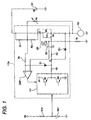
- Fig. 1 is a circuit diagram showing a power supply control device which is a first embodiment of the present invention.
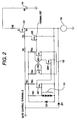
- Fig. 2 is a circuit diagram showing in detail a semiconductor switch (MAIN CONTROL FET) used in the embodiment.
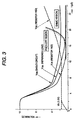
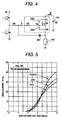
- Figs. 3, 4 and 5 are explanatory diagrams useful in explaining the principles of the power supply control device and the method of controlling the same, which form a first embodiment of the present invention.
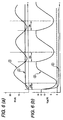
- Fig. 6 is a waveform diagram showing a current and a voltage in a semiconductor switch used in the power supply control device when the power supply control device suffers from short-circuit and it normally operates.
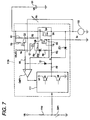
- Fig. 7 is a circuit diagram showing a power supply control device which is a second embodiment of the present invention.
- Fig. 1 is a circuit diagram showing a power supply control device which is a first embodiment of the present invention.
- Fig. 2 is a circuit diagram showing in detail a semiconductor switch (MAIN CONTROL FET) used in the embodiment.
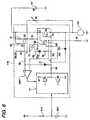
- FIG. 8 is a circuit diagram showing a power supply control device which is a third embodiment of the present invention.
- Figs. 9 and 10 are circuit diagrams showing a power supply control device which is a fourth embodiment of the present invention.
- Figs. 11 and 12 are circuit diagrams showing a power supply control device which is a fifth embodiment of the present invention.
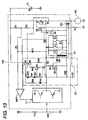
- Figs. 13 and 14 are circuit diagrams showing a power supply control device which is a sixth embodiment of the present invention.
- Fig. 15 is a circuit diagram showing a second load (resistors) in a modification of the power supply control device.
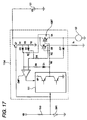
- Figs. 16 and 17 are circuit diagrams showing a power supply control device which is a seventh embodiment of the present invention.
- Fig. 18 is a circuit diagram showing a power supply control device which is an eighth embodiment of the present invention.
- a drain D - source SA path of a main control FET QA as a semiconductor switch is inserted in series in a path for applying an output voltage VB of a power source 101 to a load 102. While the main control FETQA is of the NMOS type in the circuit, it may be of the PMOS type.
- a circuit section for driving the main control FETQA contains an REFERENCE FETQB, resistors R1, R2, R5, R8, R10, RG, Rr and RV , a Zener diode ZD1, a diode D1, a comparator CMP1, a drive circuit 111, and a switch SW1.
- Rs resistors
- R1, R2, R5, R8, R10, RG, Rr and RV resistors
- ZD1 a diode D1
- comparator CMP1 a drive circuit 111
- switch SW1 a switch SW1.
- capital letters "Rs" with numerals and characters attached thereto are used for designating the resistors and also their resistance values.
- a portion enclosed by a dotted line indicates an analog IC chip onto which the circuit components within the enclosed portion are integrated.
- the load 102 includes head lamps, drive motors for power windows and others. It is operated when a user turns on the switch SW1.
- the drive circuit 111 includes a series circuit of a source transistor Q5 connected at the collector to a potential VP, and a sink transistor Q6 connected at the emitter to ground potential (GND). In response to an on/off signal of the switch SW1, the source transistor Q5 and the sink transistor Q6 are turned on and off, so that the drive circuit 111 outputs a signal for driving the FET QA.
- VB indicates an output voltage of 12V, for example.
- VP indicates an output voltage of a charge pump.
- VP is of VB + 10V, for example.
- the main control FETQA includes an internal resistor RG, a temperature sensor 121, a latch circuit 122, and an overheat cut-off FET QS.
- the Zener diode ZD1 keeps the voltage between the gate G and the source SA of the FET at 12V, and when an overvoltage is applied to the gate G of FET, it forms a bypass for the overvoltage flow or progration.
- the main control FETQA of the present embodiment has such an overheat cut-off function that when the temperature sensor 121 detects that a temperature of the main control FETQA rises to a predetermined temperature or higher, information of the high temperature is held in the latch circuit 122 and the overheat cut-off FET QS as a gate cut-off circuit is turned on to forcibly turn off the main control FETQA.
- the temperature sensor 121 consists of four diodes connected in series, and when fabricated, it is located near the main control FETQA. With increase of a temperature of the main control FETQA, resistance values of those diodes of the temperature sensor 121 decrease. Accordingly, when a potential at the gate of a FET Q51 lowers to a potential corresponding to "L" level, a state of the FET Q51 shifts from an on state to an off state. As a result, a gate potential of an FET Q54 is pulled up to a potential at the gate control terminal G of the main control FETQA, a state of the FET Q54 shifts from an off state to an on state, and finally "1" is latched in the latch circuit 122.
- an output signal level of the latch circuit 122 is an "H" level, and the overheat cut-off FET QS shifts its state from an off state to an on state. Accordingly, the true gate TG of the main control FETQA and the source SA of the same are at an equal potential. The main control FETQA shifts its state from an on state to an off state. As a result, the overheat cut-off operation is effected.
- the power supply control device has also protection function against an overcurrent caused by a shot-circuit which occurs at the load 102 or between the source SA of the main control FETQA and the load 102, or against an abnormal current caused by an imperfect short-circuit.
- a circuit arrangement to realize the protection functions will be described with reference to Fig. 1.
- Reference voltage generating means which is used in claims, is made up of the FET (second semiconductor switch) QB and the resistor (second load) Rr.
- the drain and gate of the REFERENCE FETQB are connected to the drain D and the true gate TG of the main control FETQA, respectively.
- the source SB of the REFERENCE FETQB is connected to one of the terminals of the resistor Rr, which is connected at the other terminal to ground potential GND.
- the drain D and the true gate TG are used in common for both the main control FETQA and the REFERENCE FETQB. This makes it easy to fabricate those FETs into a same semiconductor chip.
- the main control FETQA and the REFERENCE FETQB are fabricated on a same chip by a same process.
- a current detecting method which is employed in the embodiment, is based on a detection of a difference between a voltage V DSA across the drain-source path of the main control FETQA and a reference voltage, the detection being carried out by the comparator CMP1. Therefore, with fabrication of the REFERENCE FETQB and the main control FETQA into the same chip, it is possible to eliminate (reduce) the error caused by common mode deviation in the current detection, viz., unwanted effects by drifts of the power source voltage and temperature, and variations among different manufacturing lots.
- the mounting of the resistor (second load) Rr outside the chip 110a makes the reference voltage insensitive to temperature variations of the chip 110a, realizing highly accurate current detection.
- the drain D and the true gate TG are used in common for both the main control FETQA and the SECOND REFERENCE FETQB. This makes it easy to fabricate those FETs into a same semiconductor chip.
- ratios of the numbers of parallel-connected transistors which form those FETs are selected to be: (number of transistors of the reference FETQB : 1 transistor) ⁇ (number of transistors of the main control FETQA : 1000 transistors)
- a resistance value of the resistor Rr is set to be (resistance value of the load 102) x (number of transistors of the main control FETQA : 1000 transistors/number of transistors of the REFERENCE FETQB : 1 transistor).
- a resistance of the resistor R2 is equivalently varied by varying the resistance of the variable resistor RV.
- Varying the variable resistor RV in its resistance may equivalently vary a resistance value of the resistor R2.
- Voltage division means which includes the resistors R1, R2 and RV, divides the drain-source voltage VDSA of the main control FETQA at a voltage division ratio based on a resistance value ratio of those resistors, and applies the resultant voltage to the comparator CMP1.
- the voltage division ratio is varied with the variable resistor RV.
- a threshold value of the drain-source voltage VDS may be varied which is used for switching the output signal level of the comparator CMP1 from an "H" level to a "L” level with r espect to a fixed set value (reference value) of the reference voltage generating means. This enables a same type of semiconductor chip 110a to cover a plurality of specifications when the circuit is fabricated into an analog integrated circuit.
- the comparator CMP1 is involved in "detecting means", which is used in setting forth claims.
- a "+” input terminal of the comparator CMP1 receives through the resistor R5 a voltage, which is produced by dividing the drain-source voltage VDSA of the main control FETQA by a parallel resistance (R2
- a "-" input terminal of the comparator CMP1 receives the drain-source voltage VDSB of the REFERENCE REFERENCE FETQB. When a potential at the + input terminal of the comparator CMP1 is higher than that at the - input terminal, the output of the comparator CMP1 is valid ("H" level).
- the comparator CMP1 has a hysteresis characteristic.
- Fig. 3 is a graph showing a descending characteristic curve of a voltage across the drain-source path of the FET QA when the FET QA shifts its state from an off state to an on state.
- Fig. 4 is a circuit diagram showing the concept of a power supply path ranging from the power source 101 to the load 102.
- Fig. 5 is a graph useful in explaining a characteristic curve of a drain current of the thermal FET with respect to the gate-source voltage.
- a power supply path ranging from the power source 101 to the load 102 may electrically be expressed as shown in Fig. 4 when the main control FETQA is used for the semiconductor switch.
- the load 102 includes a wire inductance L0 and a wire resistance R0 of the power supply path.
- the wire resistance includes a short-circuit resistance.
- the short-circuit resistance is approximately 40 m ⁇ when the dead short-circuit occurs and approximately 40 to 500 m ⁇ when the layer short-circuit occurs if the load 102 is head lamps in the motor vehicle to which the present invention is applied.
- a curve representative of a voltage across the drain-source path of the main control FETQA descends as shown in Fig. 3 when the main control FETQA as a part of the power supply path shifts its state from an off state to an on state.
- the characteristic curve plotted are those of cases where a short-circuit occurs, the load is a reference load (normally operates), and the load resistance is 1 K ⁇ .
- the descending characteristic curves varies depending on states of the power supply path and the load, viz., a time constant defined by wire inductance and resistance of the power supply path, and the short-circuit resistance.
- Examples of known methods for detecting an overcurrent by utilizing the characteristic variation of the drain-source voltage VDS are an overcurrent detecting method described hereunder and a method for detecting an overcurrent by comparing the present current value with a predetermined reference value at predetermined timings.
- circuit components such as capacitors and resistors are required. Fluctuation of the value of those circuit components lead to detection errors. Further, the capacitors, which are indispensably used, cannot be fabricated into the semiconductor chip. Therefore, those must be located outside the chip, leading to increase of the cost to manufacture.
- the main control FETQA operates in a pinch-off region till the main control FETQA shifts its state to an on state and the drain-source voltage VDS is saturated.
- the main control FETQA is, for example, "HAF2001", manufactured by Hitachi corporation in Japan at power supply voltage in 12V
- the charging of the gate G by the drive circuit 111 continues. If it continues, the
- the drain-source voltage VDS drops to discharge the gate-drain capacity CGD at such a rate as to cause the gate-drain capacity CGD to discharge such an amount of charge as to prevent the charge supplied by the gate drive circuitfrom further increasing the voltage of VTGS.
- the gate-source voltage VTGS is kept at approximately 1.6 V. With the decrease of the gate-drain voltage VTGD, the drain-source voltage VDS also drops.
- a first factor is the discharging of the gate-drain capacity CGD due to the drop of the gate-drain voltage VTGD
- a second factor is an increase of the capacitance of the gate-drain capacity CGD due to a decrease of the depletion layer of the n-region.
- the following interpretation may also hold about a variation of the drain-source voltage VDS when the load 102 is 1 K ⁇ .
- the gate-source voltage VTGS has been increased from 1.6V by this amount of charge.
- ⁇ VDSGAP is proportional to (gate-source voltage VTGS - 1.6V).
- a substantially linear proportional relationship of 1 : 1 is present between the drain current ID and the gate-source voltage VTGS, as shown in Fig. 5.
- the characteristic curve plotted in Fig. 5 is that of "HAF2001", manufactured by Hitachi corporation.
- the gate-source voltage VGS corresponds to the gate-source voltage VTGS.
- ⁇ VDSGAP represents the drain current ID on the basis of the relationship as shown in Fig. 5.
- the gate-source voltage VTGS varies by 60 mV.
- the gate-source voltage VTGS varies by ⁇ 0.3 V.
- this resolution corresponds to a resolution which corresponds to 60 m ⁇ of the shunt resistance RS.
- a curve of the drain-source voltage VDS is determined by only the circuit for charging the gate and the mirror capacitance.
- the drain current ID flows, it is affected by an inductance LC of the circuit and a resistance RC of the whole circuit.
- the curve of the drain-source voltage VDS rises.
- an ascending slope of the drain current ID shown in the graph with the horizontal axis of time scale and the vertical axis of ID current tends to a fixed value, which is determined by a charging rate of the gate charging circuit. Therefore, the curve of the gate-source voltage VTGS also converges.
- An ascending slope of the drain current ID which is determined by a rise of the curve of the gate-source voltage VTGS when a variation of the gate-drain voltage VTGD is zero, is a limit slope.
- the source transistor Q5 in the drive circuit 111 When the source transistor Q5 in the drive circuit 111 is shifts its state to an off state and the sink transistor Q6 shifts its state to an on state, the charge stored in the true gate TG is discharged through the internal resistor RG and a resistor R8, and the sink transistor Q6.
- the drain current ID is little influenced by the voltage drop.
- the drain-source voltage VDS also little varies.
- the gate charge discharging will lower the gate-source voltage VTGS and reduce the drain current ID.
- the drain current ID will maintain its current state that is set up under the condition determined by the external circuit. Therefore, the drain-source voltage VDS increases to charge the gate-drain capacity CGD, so that the electrical charges discharged from the gate are neutralized, to thereby eliminate their influence to the drain current ID.
- This phenomenon occurs due to the magnitude relation between a force to maintain the drain current ID and a force to maintain the drain-source voltage VDS. Specifically, it is caused by the fact that The former force is considerably larger than the latter force. Such a covering operation continues within a range within which the drain-source voltage VDS is variable.
- the drain current ID continues its increase so long as a variation (increase) of the drain-source voltage VDS is allowed since the drain-source voltage VDS varies (increase).
- the drain current ID begins to decrease in accordance with the reduction of the gate source voltage VTGS which is determined by only the discharging of the gate electrical charges.
- the drain current ID is little influenced by the off-control till the variation of the drain-source voltage VDS terminates.
- the on/off operation of the main control FETQA is based on the mechanism mentioned above.
- overheat cutting-off operation by the overheat protection function may be quickened if the drain-source voltage VDS is increased with respect to the drain current ID by utilizing this nature.
- An overheat cut-off quickening circuit (overheat cut-off quickening means) to be described later is designed by the utilization of this idea.
- the reference voltage generating means (REFERENCE FETQB and resistor Rr) will first be described.
- the main control FETQA and the REFERENCE FETQB form a current mirror circuit of 1000 : 1.
- the drain current IDQA 1000 x drain current IDQB.
- VDSA and VDSB are drain-source voltages of the main control FETQA and FETQB
- VTGSA and VTGSB are the gate-source voltages of the main control FETQA and REFERENCE FETQB.
- a value (curve) of the drain-source voltage VDS when current of 5A flows into the main control FETQA is used as a reference value.
- the gate-source voltage VTGSA takes a value determined by the drain current IDQA, and also rises while being braked by the mirror effect of the gate-drain capacity CGD, which is due to the lowering of the drain-source voltage VDSA.
- the gate-source voltage VTGSB of the REFERENCE FETQB is determined through the operation of the REFERENCE FETQB as a source follower with the resistor Rr of 1.4 k ⁇ as its load.
- the drain-source voltage VDSB of the REFERENCE FETQB is directly input to the comparator CMP1, and the drain-source voltage VDSA of the main control FETQA is divided by the resistance R1 and the resistance R2 (in this case, resistance of the variable resistor RV is not considered), and the resultant is applied to the comparator CMP1. That is, the voltage applied to the comparator CMP1 is given by VDSA X R1/ (R1+R2) Immediately after the main control FETQA shifts its state to the on state, the VDSB of the REFERENCE FETQB > (1). With increase of the drain current IDQA of the main control FETQA, the value of the expression (1) decreases but exceeds the drain-source voltage VDSB. At this time, the output level of the comparator CMP1 shifts from an "H" level to a "L” level to turn off the main control FETQA.
- the hysteresis characteristic of the comparator CMP1 is formed by the diode D1 and the resistor R5.
- the gate potential is connected to ground by the sink transistor Q6 of the drive circuit 111, and a potential difference between the cathode of the diode D1 and the drain D of the main control FETQA is VDSA + 0.7 V (voltage drop of the Zener diode ZD1 in the forward direction). Accordingly, current flows through a path of R1 ⁇ r5 ⁇ D1, and a potential at the + input terminal of the comparator CMP1 lowers to below that the drive circuit 111 performs the on control.
- the main control FETQA maintains the off state because VDSA-VDSB is lower than that when its state was shifted to an off state.
- VDSA and VDSB increase and approach to VB, the condition that expression (1) is smaller than VDSB is re-established and then it shifts its state to an on state.
- ways of forming the hysteresis characteristic the above mentioned one is one example of those ways.
- VDSAth-VDSB R2/R1 X VDSB (at 5 [mA])
- An overcurrent judging value is given by the equation (2).
- the resistance of the variable resistor RV which is connected in parallel with the resistor R2 and which is located outside the chip 110a, is adjusted. Specifically, the overcurrent judging value may be reduced by decreasing the resistance of the variable resistor RV.
- the main control FETQA When the drain current IDQA increases by a short-circuit of the wiring, the value of the equation (3) increases, and when it exceeds the overcurrent judging value, the main control FETQA is placed to an off state. Thereafter, the main control FETQA enters the pinch off region in its operation, and it repeats the on and off states
- Fig. 6 is a waveform diagram showing waveforms of a voltage and a current in the main control FETQA used in the power supply control device, which is the present embodiment.
- Fig. 6(a) shows a waveform of the drain current ID (A)
- Fig. 6(b) shows a waveform of the drain-source voltage VDS.
- (2) indicates the waveforms when the power supply control device normally operates
- (3) indicates the waveforms when an overload condition (including the short-circuit between the source and the load).
- the power supply control device for the current detection, there is no need of using the shunt resistor connected in series to the power supply path, while the shunt resistor is indispensably used in the conventional power supply control device.
- the power supply control device can highly accurately detect an overcurrent without the shunt resistor. Additionally, the power supply control device enables the hardware circuit to successively detect not only the overcurrent arising from the dead short-circuit but also the abnormal current arising from the layer short-circuiting having some short-circuit resistance, such as layer short-circuit.
- the power supply control device repeats the on/off control of the main control FETQA to greatly vary the current and to cause a periodic heating of the semiconductor switch.
- the periodic heating quickens the shutting off (off control) of the main control FETQA by the overheat protection function.
- the on/off control of the semiconductor switch can be effected by use of only the hardware circuit not using the microcomputer. This feature leads to reduction of the device mounting space, and remarkable reduction of device manufacturing cost.
- the overcurrent detection of the embodiment has the following advantages.
- Such circuit components as capacitors and a plurality of resistors are unnecessary. Therefore, there is eliminated detection errors caused by variations of circuit constants of those components. Further, there is no need of the capacitor mounted outside the chip 110a. The result is to reduction of the fabricating space and device fabricating cost.
- variable resistor RV With the adjustment of the variable resistor RV, it is possible to perfectly discriminate between the dead short-circuit and the layer short-circuit for the type of the load 102 (e.g., head lamps, drive motor, or the like). Protection against the short-circuit trouble is effected highly accurately.
- a power supply control device and a method of controlling the same, which form a second embodiment of the present invention, will be described with reference to Fig. 7.
- the power supply control device of the second embodiment corresponds to that of the first embodiment additionally having resistors R3, R4, R6, R9 and FETs Q1 and Q2, and a Zener diode ZD2.
- a portion enclosed with a dotted line in Fig. 7 is an analog IC chip 110b onto which the circuit components within the enclosed portion are integrated.
- the resistor R9 interconnects the gate and the source of the FET Q1.
- the true gate TG of the main control FETQA is connected to the gate of the FET Q1, through the Zener diode ZD2 and the resistor R6.
- the drain of the FET Q1 is connected to VB + 5V, through the resistor R4.
- the source of the FET Q1 is connected to the source SA of the main control FETQA.
- the resistor R1 is connected in parallel with a circuit in which the resistor R3 and the FET Q2. A voltage division of the drain-source voltage VDSA of the main control FETQA is varied through the on/off control of the FET Q2.
- the drain-source voltage VDSB of the REFERENCE FETQB is directly connected to the comparator CMP1.
- the drain-source voltage VDSA of the FET QA is divided by a parallel resistance (R1
- VDSA X (Rl
- VDSB Immediately after the FET QA is turned on, VDSB > where VDSB is the drain-source voltage of the REFERENCE FETQB. With increase of the drain current IDQA of the FET QA, the value (1') the drain-source voltage VDSB of the REFERENCE FETQB. At this time, the output level of the comparator CMP1 shifts from an "H" level to a "L" level. As a result, the FET QA is turned off.
- VDSAth-VDSB R2/ (Rl
- An overcurrent judging value is determined by the equation (2'). To change the overcurrent judging value, the resistance of the variable resistor RV, which is connected in parallel with the resistor R2 outside the chip 110b, is adjusted. Specifically, the overcurrent judging value may be reduced by decreasing the resistance of the variable resistor RV.
- the overcurrent judging value will be discussed. It is assumed that the overcurrent judging value for the pinch off region is equal to that for the ohmic region.
- VDSA-VDSB / ⁇ ID in the pinch off region.
- ⁇ VTGSA/ ⁇ IDQA 60 [mV/A]
- a voltage e.g., + 5V, in excess of the output voltage VB is required.
- a breakdown voltage of the Zener diode ZD2 is set at (5V - 1.6V) (1.6V; threshold voltage of the FET Q1)
- VTGSA gate-source voltage
- the FET Q1 is turned on and the FET Q2 is turned off. Then, the resistor R3 coupled in parallel to the resistor R1 is removed out of the circuit.
- the measure by the additional circuit of the embodiment is not taken.
- the current completely rises within the pinch off region.
- the current reaches the final load current value within the pinch off region when the final load current is small.
- the current is still in the middle of rising within the pinch off region. Even in the case of the dead short-circuit, the current is limited to within about 40A.
- the current variation converges to a current rise characteristic curve having a fixed slope.
- the difference of the drain-source voltage VDSA is not so large as one that will be appear when each load current is fully saturated. Because of presence of this phenomenon, where the current sensitivity is large in the pinch off region, the drain-source voltage difference VDSA-VDSB does not grow large. Accordingly, if the current value in the reference voltage generating circuit is appropriately selected, a practical power supply control device with an overcurrent protection function is realized by use of the arrangement of the first embodiment even if the additional circuit as of the present embodiment is not used.
- the FET QA when the wiring is normal, the FET QA is turned on and operates in the ohmic region. So long as the wire is normal, its operation continues in the ohmic region, and it maintains an on state.
- the FET QA is turned off and operates in the pinch off region. So long as the abnormal wiring is present, the FET QA repeats the on and off states, and continues the operation in the pinch off region, and finally it is shut off by overheat.
- the overcurrent judging value satisfies the following two conditions.
- a first condition is that the FET QA is absolutely not turned off within the normal current range.
- a second condition is that after the current detected in the ohmic region is judged to be overcurrent, the FET QA continues the on and off states in the pinch off region so long as the abnormality in the wiring is not removed. This is needed for stabilizing the period of the on/off control.
- the stabilizing the period of the on/off control leads to a stability of the control.
- a timer is set by use of the period of the on/off control (see the sixth embodiment to be described later). Also to this end, the stabilization of the on/off control period is needed.
- the overcurrent judging value in the ohmic region is set at a current value of "normal current maximum value + ⁇ " (corresponding to (VDSA-VDSB), and the overcurrent judging value in the pinch off region is set at a current value of "normal current maximum value + ⁇ ".
- a power supply control device and a method of controlling the same, which form a third embodiment of the present invention, will be described with reference to Fig. 8.
- a power supply control device of this embodiment is different from that of the power supply control device of the second embodiment (Fig. 7) in that the gate of the REFERENCE FETQB is not connected to the true gate TG of the FET QA, and a resistor R41 is additionally used as a gate resistor of the REFERENCE FETQB.
- the resistor R41 is connected at one end to the gate of the REFERENCE FETQB and at the other end to the gate G of the FET QA.
- the remaining circuit construction of the power supply control device of the embodiment is substantially the same as of the Fig. 7 circuit construction.
- a portion enclosed by a dotted line indicates an analog IC chip onto which the circuit components within the enclosed portion are integrated.
- the resistance of the resistor R41 is set at 1000x RG.
- the operation of the power supply control device of this embodiment is substantially equal to that of the power supply control device of the second embodiment, and produces useful effects comparable with those by the power supply control device of the first embodiment.
- a power supply control device and a method of controlling the same, which form a fourth embodiment of the present invention, will be described with reference to Figs. 9 and 10.
- the power supply control device of this embodiment is directed to improvement of the voltage dividing means (R1, R2 and RV) in the circuitry of the power supply control device of the first embodiment (Fig. 1).
- the voltage dividing means divides the drain-source voltage VDSA of the FET QA at a voltage division ratio based on the resistance value ratio and applies the divided voltage to the comparator CMP1.
- a portion 110a' enclosed by a dotted line in Fig. 9 and a portion 110a'' enclosed by a dotted line in Fig. 10 indicate analog IC chips onto which the circuit components within the enclosed portions are integrated.
- a circuit section for driving the FET QA includes an REFERENCE FETQB, a transistor Q7, resistors R1 to R6, R8 to R10, RG, Rr, a Zener diode ZD1, diodes D1 to D3, a comparator CMP1, a drive circuit 111 and a switch SW1.
- the FET QA as the semiconductor switch, which is used in this embodiment, has a construction as shown in Fig. 2 as in the first embodiment.
- the functions and operations of the comparator CMP1, the drive circuit 111 and the switch SW1, and the generation of a reference voltage by the REFERENCE FETQB and the resistor Rr are also as in the first embodiment.
- circuit portion transistor Q7, resistors R1 to R6, and diodes D2 and D3, which are different from the corresponding one in the power supply control device of the first embodiment (Fig. 1) will be described.
- the PNP transistor Q7 connected between the power source 101 and the resistor R1 is provided for coping with the dark current.
- a dark current path ranging from the power source 101 to the load 102 by way of the resistors R1 and R2 of the voltage dividing means even when an instruction to supply electric power to the load 102 is not issued, viz., when the FET QA is not driven. Therefore, even during the off state of the switch SW1, a little electric power of the power source 101 is consumed.
- the transistor Q7 is provided and arranged such that only when the switch SW1 is turned on (an instruction to supply power source to the load 102 is issued), the transistor Q7 is turned on. That is, when the switch SW1 is not turned on, the transistor Q7 is placed in an off state, to thereby cut off the path of the dark current.
- the resistors R1 to R6, and diodes D2 and D3 make up a diode clamp circuit. Assuming that a potential at the node of the resistors R1 and R3 is VC, and a potential at the node of the resistors R3 and R2 is VE, VC > VE when the transistor Q7 is in an on state.
- VSA source voltage of the FET QA
- the source voltage VSA is input to the "+” input terminal of the comparator CMP1.
- VSA ⁇ VC-0.7V the voltage of "VC-0.7V” is input to the "+” input terminal of the comparator CMP1, irrespective of the source voltage VSA.
- the "+" input terminal of the comparator CMP1 is clamped at "VC-0.7V", and does not lower below that voltage.
- the "-" input terminal of the comparator CMP1 is also clamped at "VE-0. 7V", even it the source voltage VSB of the REFERENCE FETQB drops below "VE-0.7V”.
- the "+” and "-" input terminals of the comparator CMP1 are clamped at (VC-0.7V) and (VE-0.7V). Since VC > VE, the output signal level of the comparator CMP1 is set at an "H” level, and hence the FET QA may reliably be turned on independently of the amplitudes of the source voltage VS and the source voltage VB. Further, the voltage withstanding of the "+” and "-” input terminals of the comparator CMP1 is improved since the potentials at those input terminals of the comparator CMP1 never drop below a predetermined value of potential.
- the gate of the REFERENCE FETQB is not connected to the true gate TG of the FET QA, and a resistor R41 is additionally used as a gate resistor of the REFERENCE FETQB.
- the resistor R41 is connected at one end to the gate of the REFERENCE FETQB and at the other end to the gate G of the FET QA.
- the setting of the resistor R41 and others are the same as those in the third embodiment already described.
- a power supply control device and a method of controlling the same, which form a fifth embodiment of the present invention, will be described with reference to Figs. 11 and 12.
- a power supply control device of this embodiment corresponds to the power supply control device of the first embodiment (Fig. 1) to which a rush current mask circuit 105 and an overheat cut-off quickening circuit 106 are added.
- a portion 110d enclosed by a dotted line in Fig. 11 and a portion 110d' enclosed by a dotted line in Fig. 12 indicate analog IC chips onto which the circuit components within the enclosed portions are integrated.
- a rush current flows through the power (source) supply control device.
- a value of the rush current amounts to several to several tens times as large as a current value the current flowing in a stable state of the circuit.
- a period of time of the flowing of the rush current depends on a type and capacity of the load 102, usually 3 to 20 msec. If the overcurrent control as described in the first, second or third embodiment is performed during the rush-current flowing period, some time is taken till the load 102 settles down. This appears as unwanted phenomena; the turning on of the head lamp delays and a response of the load per se is slow.
- This embodiment solves the problem by adding the rush current mask circuit 105 ("inhibiting means" in claims) to the circuit of Fig. 1.
- the overheat protection function when an overcurrent arising from a dead short-circuit is detected, the overheat protection function operates to cut off the FET QA (off control). In the case of the layer short-circuit, the on/off control of the FET QA is repeated. The resultant periodic heating of the FET QA makes the overheat cutting-off function effective. Accordingly, a time taken for the cutting-off function to be effective will be relatively long.
- the overheat cut-off quickening circuit 106 (overheat cut-off quickening means) quickens the cutting off of the FET QA even in the case of the layer short.
- the rush current mask circuit 105 includes the FETs Q11 and Q12, a diode D11, resistors R11 to R13 and a capacitor C11.
- the gate of the FET Q12 is connected to the source SA of the FET QA. Immediately after the FET QA is turned on, the capacitor C11 is not yet charged. Accordingly, a gate potential of the FET Q12 insufficiently rises, and the FET Q12 fails to shift its state to an on state.
- the FET Q11 maintains its on state during the off state of the FET Q12, and couples the "-" input terminal of the comparator CMP1 with the source SA of the FET QA. Therefore, the output level of the comparator CMP1 is kept at an "H" level, and in this state the FET QA is not turned off if a large rush current flows.
- the resistor R13 is a discharging resistor for discharge and resetting the capacitor C11 after the FET QA is turned off. In this case, selection of R12 « R13 is desirable in order that the discharging operation of the capacitor C11 does not affect the mask time.
- the mask time is determined by a time constant of R12 x C11. This implies that when the circuit is fabricated into one chip, the mask time may be adjusted by properly changing the capacitance of the capacitor C11.
- the overheat cut-off quickening circuit 106 is made up of FET Q21 to Q24, diodes D21 and D22, a Zener diode ZD21, and resistors R21 to R27.
- the power supply control device is placed to an overcurrent control mode, the gate drive circuit periodically performs an on/off control, and the gate potential of the FET QA becomes the potential of an "L" level.
- the gate potential of the FET QA becomes the potential of an "L" level.
- a capacitor C21 is charged through the transistors Q22 and Q24 and the resistor R22.
- the gate potential of the FET Q21 is below a threshold value in an initial stage. With progress of charging the capacitor C21, the gate potential rises and the FET Q21 is turned on.
- the resistor R23 is a discharging resistor for the capacitor C21. Selection of R22 « R23 is preferable.
- the power supply control device shown in Fig. 12 corresponds to the power supply control device of the fourth embodiment (Fig. 9) to which a rush current mask circuit 105' and an overheat cut-off quickening circuit 106' are added.
- the circuit arrangements of the rush current mask circuit 105' and the overheat cut-off quickening circuit 106' and the operations of them are substantially the same as those of the corresponding ones shown Fig. 11.
- a power supply control device of a sixth embodiment of the present invention will be described with reference to Figs. 13 and 14.
- the power supply control device of this embodiment corresponds to the power supply control device of the first embodiment (Fig. 1) in which an on/off-time accumulating circuit 107 is additionally used.
- a portion 110e enclosed by a dotted line in Fig. 13 and a portion 110e' enclosed by a dotted line in Fig. 14 indicate analog IC chips onto which the circuit components within the enclosed portions are integrated.
- an on/off-time accumulating circuit (time control means) 107 for causing the power supply control device to perform the off control when the number of on/off controls of the FET QA reaches a predetermined number is additionally used, whereby the cutting off of the FET QA is quickened.
- the on/off-time accumulating circuit 107 is made up of transistors Q31 to Q34, diodes D31 to D33, a Zener diode ZD31, resistors R31 to R37, and a capacitor C31.
- the power supply control device is placed to the overcurrent control made, the capacitor C31 is charged through the transistors Q32 and Q34 and the resistor R32 every time the off-control is performed (the gate potential is set at an "L" level) during the on/off operations of the FET QA.
- the capacitor C31 is charged only when the drain-source voltage VDSA is set at the "H" level during the off-control (the gate potential is set at the "L” level).
- the on- or off-control is consecutively performed, it is not charged.
- the gate potential of the FET Q31 is below a threshold value and hence it is in an off state.
- the FET Q31 When the gate potential rises with progress of the charging of the capacitor C31, the FET Q31 is turned on. At this time, anode of a temperature sensor 121 (consisting of four diodes) is lowered in potential. As a result, the same condition as at high temperature is set up, the overheat cut-off FET QS is turned on, and the FET QA is cut off (off-control).
- a cut-off time by the on/off time accumulation is preferably about 1 second.
- a variation of the drain-source voltage VDSA of the FET QA with respect to a variation of the load current in the pinch off region is greater than that in the ohmic region. Because of this, it is turned off in the pinch off region during the on/off control (there is no case that it is turned off in the ohmic region following the pinch off region). Accordingly, the period of the on/off control of the FET QA is stable.
- the on/off-time accumulating circuit 107 the number of on/off controls of the FET QA is judged by an amount of electric charge stored in the capacitor C31.
- the on/off-time accumulating circuit may be constructed by use of a counter which directly counts an output signal of the drive circuit 111. In this case, when a count value of the counter for counting the output signal of the drive circuit 111 reaches a predetermined value, the overheat cut-off FET QS is turned on to cut off the FET QA (off control).
- Fig. 14 is a circuit diagram showing a circuit arrangement in which an on/off-time accumulating circuit 107' is added to the power supply control device of the fourth embodiment.
- the circuit arrangement and operations of the on/off-time accumulating circuit 107 are substantially the same as those of the fourth embodiment of the invention (Fig. 9).
- the overheat cut-off function which is constituted of the temperature sensor 121, a latch circuit 122 and the overheat cut-off FETQS (as shown in Fig. 2), controls the main control FETQA to the OFF state.
- the present invention could employ the following modification. Namely, according to a first modificatin, the drain of the FETQ31 is connected to the real gate (TG) of the main control FETQA via a series circuit of a diode and a resistor.
- the prohibited gate (binary input AND gate) is provided on the output of the comparator CMP1 and the drain voltage of the FETQ31 is used for prohibited control signal.
- the drain of the FETQ31 is connected to "+" input terminal of comparator CMP 1 via a series circuit of a diode and a resistor.
- the resistor R31 will be omitted, and in order to keep the information such that the on/off-time accumulating circuit 107 cuts off the main control FETQA, the latch circuit which is composed of a PMOSFET and resistors must be added.
- the source of the PMOSFET is connected to power supply voltage VB and the drain of the PMOSFET is connected to the gate of the FETQ31, and then the gate of the PMOSFET is connected to the drain of the FETQ31 and the source of itself via resistors respectively.
- the reference voltage generating means is set a fixed voltage value.
- the reference voltage generating means copes with the load variation by correspondingly varying the overcurrent judging value.
- the resistances R1 to R3 are set in accordance with the maximum load used when those are fabricated into a semiconductor chip.
- the variable resistor RV is located outside the chip while being connected in parallel with the resistor R2, whereby the overcurrent judging value is lowered.
- a first problem is that control accuracy decreases with increase of the overcurrent judging value.
- a second problem is that it is necessary to change the overcurrent judging value between the pinch off region and the ohmic region.
- the overcurrent judging value for the pinch off region, to be exact must be set in accordance with an ascending slope of the drain current ID.
- An ascending slope of the drain current ID varies when the wire inductance and the wire resistance vary. It is difficult to accurately set the overcurrent judging value.
- the reference voltage generating means is set to a voltage value corresponding to a current value in excess of the maximum current value of the load 102.
- the drain-source voltage on the load drive transistor i.e., the drain-source voltage VDSA of the FET QA
- the drain-source voltage VDS of the reference voltage generating means i.e., the drain-source voltage VDSB of the REFERENCE FETQB
- the same overcurrent judging value may be used for both the pinch off region and the ohmic region. In other words, even if the operation region of the FET shifts from the pinch off region to the ohmic region and vice versa, there is no need of changing the overcurrent judging value. Further, in the method, the overcurrent may be judged by judging whether or not the drain-source voltage of the load drive transistor exceeds the drain-source voltage VDS of the reference voltage generating means. Therefore, its detection accuracy is determined by only the resolution of the comparator CMP1.
- a plurality of resistors Rr1 to Rr4 is disposed in parallel within the chip.
- the set value (reference) of the reference voltage generating means may be set to a target specification by selecting a proper one of those resistors by means of a switch SW2.
- one chip may cover a plurality of specifications.
- the variable setting of the variable resistor RV it is possible to perfectly discriminate between the dead short-circuit and the layer short-circuit for the type of the load 102 (e.g., head lamps, drive motor, or the like). Protection against the short-circuit trouble is effected highly accurately.
- a power supply control device according to a seventh embodiment of the present invention will be described with reference to Figs. 16 and 17.
- the power supply control device of Fig. 16 corresponds to the power supply control device of the fourth embodiment (Fig. 9) in which the thermal FETs QA and QB are of the p-channel type.
- the power supply control device of Fig. 17 corresponds to the power supply control device of the fourth embodiment (Fig. 9) in which the thermal FETs QA and QB are IGBTs (insulated gate bipolar transistors).
- a portion 110ap enclosed by a dotted line in Fig. 16 and a portion 110ai enclosed by a dotted line in Fig. 17 indicate analog IC chips onto which the circuit components within the enclosed portions are integrated.
- the power supply control device of this embodiment is a power supply control device having such a circuit arrangement that a too-small or minute current detecting function is applied to a circuitry formed by composing the power supply control devices of the first, fifth and sixth embodiment.
- a section for driving the main control FET QA contains reference FETs QB and second reference QC, R1, R2, R5, RG, R10, Rr1, Rr2, a Zener diode ZD1, a diode D1, compactors CMP1 and CMP2, a drive circuit 111, and a switch SW1.
- a portion enclosed by a dotted line indicates an analog IC chip onto which the circuit components within the enclosed portion are integrated.
- the FET QA as the semiconductor switch, as in the first embodiment, is constructed as shown in Fig. 2.
- the functions and operations of a charge pump 305, a cut-off latch circuit 306, a comparator CMP1, a drive circuit 111, a switch SW1 and others, and the generation of a reference voltage by the REFERENCE FETQB and the resistor Rr are also similar to those in the first embodiment.
- a masking circuit 303 for avoiding the judgement of the rush current flow is substantially the same as the rush current mask circuit 105 in the fifth embodiment.
- An on/off-time accumulating circuit 304 for performing a cut-off control by accumulating the number of on/off operations is substantially the same as of the on/off-time accumulating circuit 107 in the sixth embodiment.
- the FET (third semiconductor switch) QC and the resistor (third load) Rr2 are involved in the word "second reference voltage generating means" used in claims.
- the drain and gate of the SECOND REFERENCE FETQC are respectively connected to the drain D and the true gate TG of the FET QA.
- the source SC of the SECOND REFERENCE FETQC is connected to one of the terminals of the resistor Rr2.
- the other end of the terminals of the resistor Rr2 is connected to ground (GND).
- GND ground
- the SECOND REFERENCE FETQC and MAIN CONTROL FET QA are fabricated on the same chip by the same process.
- a current detection is based on a detection of a difference between a voltage V DSA across the drain-source path of the main control FETQA and a reference voltage, and a second reference voltage, the detection being carried out by the comparators CMP1 and CMP2. Therefore, fabrication of the FETs QA, QB and QC into the same chip will eliminate (reduce) the error caused by common mode deviation in the current detection, viz., unwanted effects by drifts of the power source voltage and temperature, and variations among different manufacturing lots. Additionally, the mounting of the resistor (second load) Rr1 and resistor (third load) Rr2 outside the chip 110af makes the reference voltage insensitive to temperature variations of the chip 110f, realizing highly accurate current detection.
- ratios of the numbers of parallel-connected transistors which form those FETs are selected to be: (number of transistors of the SECOND REFERENCE FETQC : 1 transistor) ⁇ (number of transistors of the main control FETQA : 1000 transistors)
- a resistance value of the resistor Rr2 is set to be (resistance value of the load 102 when an extremely small current flows) x (number of transistors of the main control FETQA : 1000 transistors/number of transistors of the SECOND REFERENCE FETQC : 1 transistor).
- the comparator CMP2 forms a part of "second detecting means” used in claim.
- the source voltage VSA of the FET QA is applied to the "+” input terminal of the comparator CMP2, and the source voltage VSC of the SECOND REFERENCE FETQC is applied to the "-" input terminal of the same.
- the output of the comparator is valid ("H” level).
- the output of the comparator is valid ("L” level).
- the overheat cut-off function and the on/off-time accumulating circuit 304 realizes a high-speed processing when comparing with a software (program) using a microprocessor.
- a software program
- the current detection is based on the detection of a difference between the drain-source voltage VDSA of the FET QA and the reference voltage, and the second reference voltage. Therefore, fabrication of the FETs QA, QB and QC into the same chip will eliminate the error caused by common mode deviation in the current detection, viz., unwanted effects by drifts of the power source voltage and temperature, and variations among different manufacturing lots.
- reference voltage generating means when the power supply from the power source to the load is controlled in a switching manner by the semiconductor switch, reference voltage generating means (reference voltage generating step) generates a reference voltage having a voltage characteristic substantially equivalent to that of a voltage between the terminals of the semiconductor switch being connected to a predetermined load.
- Detecting means detects a difference between the voltage between the terminals of the semiconductor switch and the reference voltage.
- Control means performs an on/off control of the semiconductor switch in accordance with the difference between the voltage between the terminals of the semiconductor switch and the reference voltage.
- the reference voltage generating means includes a circuit connected in parallel with the semiconductor switch and the load, the circuit containing a series circuit consisting of a second semiconductor switch and a second load, and generates a voltage between the terminals of the second semiconductor switch as the reference voltage.
- An offset of a voltage between the terminals of the semiconductor switch (viz., current of the power supply path) as a part of the power supply path, from a normal one is judged by detecting a difference between a voltage between the terminals of the semiconductor switch and a reference voltage generated by the reference voltage generating means (reference voltage generating step). Accordingly, there is no need of the shunt resistor connected in series to the power supply path, while the shunt resistor is indispensably used in the conventional power supply control device.
- the power supply control device enables the hardware circuit or a software process by the microcomputer to successively detect not only the overcurrent arising from the dead short-circuit but also the abnormal current arising from the layer short-circuit, such as an imperfect short-circuit having a certain amount of resistance occurs.
- the on/off control of the semiconductor switch is constructed by a hardware circuit, there is no need of the microcomputer, and this leads to reduction of the mounting space and device manufacturing cost.
- second reference voltage generating means includes a circuit, connected in parallel with the semiconductor switch and the load, containing a series circuit consisting of a third semiconductor switch and a third load, and generates a voltage between the terminals of the third semiconductor switch as a second reference voltage, and second detecting means detects a difference between the voltage between the terminals of the semiconductor switch and the second reference voltage. Therefore, the second detecting means detects a too-small or minute current if a voltage characteristic of the reference voltage of the second reference voltage generating means is substantially equivalent to a voltage characteristic in a state that a target current, which is below a minimum current within a normal operation range, flows into the semiconductor switch and the load.
- a current capacity of the second or third semiconductor switch is smaller than that of the semiconductor switch, and a resistance ratio of the load and the second or third load is substantially inversely proportional to a current capacity ratio of the semiconductor switch and the second or third semiconductor switch. Therefore, the circuit constructions of the reference voltage generating means including the second semiconductor switch and the second load and the second reference voltage generating means including third semiconductor switch and the third load are reduced in size. This leads to reduction of the packaging space and device manufacturing cost.
- the second or third load includes a plurality of resistors, and those resistors are selectively connected or a variable resistor is connected in parallel to the second or third load. Resistance of the second or third load is equivalently varied by varying the resistance of the variable resistor.
- the voltage between the terminals of the semiconductor switch is divided by the voltage dividing means at a voltage division ratio based on the resistance ratio, and the resultant is applied to the detecting means. With this, one chip may cover a plurality of specifications. And it is possible to perfectly discriminate between the dead short-circuit and the imperfect short-circuit for the type of the load. Protection against the short-circuit trouble is effected with high precision.
- overheat protecting means (overheat protecting step) is further provided for protecting the semiconductor switch by performing an off-control of the semiconductor switch when the semiconductor switch is excessively heated.
- the control means control step, viz., the off control step and on control step
- the semiconductor switch is periodically heated to quicken the cutting off of the semiconductor switch by the overheat protecting means (overheat protecting step).
- the software process using the microcomputer for example, is permitted for dealing with the abnormal current caused when the layer short-circuit occurs.
- the power supply control device of the invention can deal with the abnormal current by the hardware circuit contained therein, not the external control using the microcomputer. This feature leads to simplification of the circuit and reduction of manufacturing cost. With this, a high response to the abnormal current at the time of the imperfect short-circuit is realized.
- the semiconductor switch, the second semiconductor switch, the reference voltage generating means, the detecting means, the control means, the second reference voltage generating means, the second detecting means or the overheat protecting means are integrated onto a single chip. This leads to reduction of the device circuit construction, mounting space, and manufacturing cost.
- a current detecting method of the invention is based on the detection of a difference between a voltage between the terminals of semiconductor switch and a reference voltage or the second reference voltage, which is carried out by the detecting means or the second detecting means.
- the semiconductor switch and the second or third semiconductor switch on a same chip, it is possible to eliminate (reduce) the error caused by common mode deviation in the current detection, viz., unwanted effects by drifts of the power source voltage and temperature, and variations among different manufacturing lots. Additionally, the mounting of the second or third load outside the chip makes the reference voltage or the second reference voltage insensitive to temperature variations of the chip, realizing highly accurate current detection.
- the period of the on/off control of the semiconductor switch by the control means is used as a control clock signal.
- inhibiting means is further provided for inhibiting the control means from performing the on/off control by the semiconductor switch during a fixed time period after the semiconductor switch is turned on. It inhibits the overcurrent control when a rush current flows at the start of the load. A slow of the load response is reduced.
- overheat cut-off quickening means control step
- control step is further provided for quickening the off control by the overheat protecting means (overheat protecting step) when the control means performs the on/off control of the semiconductor switch. Therefore, it quickens the cutting off of the semiconductor switch at the time of the layer short-circuit, and a quick response is realized.
- time control means time control step
- the time control means accumulates the number of on/off controls of the semiconductor switch by the control means (in control step), and when the number of on/off controls reaches a predetermined number of times, the time control means performs an off control of the semiconductor switch. Therefore, even in the case of the layer short-circuit, the cutting off of the semiconductor switch is quickened and the switch is cut off at a preset time.
Landscapes
- Electronic Switches (AREA)
- Emergency Protection Circuit Devices (AREA)
- Protection Of Static Devices (AREA)
- Power Conversion In General (AREA)
- Dc-Dc Converters (AREA)
Applications Claiming Priority (6)
| Application Number | Priority Date | Filing Date | Title |
|---|---|---|---|
| JP37387798 | 1998-12-28 | ||
| JP37387798 | 1998-12-28 | ||
| JP14042199 | 1999-05-20 | ||
| JP14042199 | 1999-05-20 | ||
| JP36148399 | 1999-12-20 | ||
| JP36148399A JP3706515B2 (ja) | 1998-12-28 | 1999-12-20 | 電源供給制御装置および電源供給制御方法 |
Publications (2)
| Publication Number | Publication Date |
|---|---|
| EP1017173A2 true EP1017173A2 (fr) | 2000-07-05 |
| EP1017173A3 EP1017173A3 (fr) | 2003-07-30 |
Family
ID=27318058
Family Applications (1)
| Application Number | Title | Priority Date | Filing Date |
|---|---|---|---|
| EP99126089A Withdrawn EP1017173A3 (fr) | 1998-12-28 | 1999-12-28 | Dispositif de commande d'alimentation et procédé de commande correspondant |
Country Status (7)
| Country | Link |
|---|---|
| US (1) | US6222355B1 (fr) |
| EP (1) | EP1017173A3 (fr) |
| JP (1) | JP3706515B2 (fr) |
| KR (1) | KR100676544B1 (fr) |
| CN (1) | CN1147998C (fr) |
| BR (1) | BR9917593A (fr) |
| CA (1) | CA2293932C (fr) |
Cited By (6)
| Publication number | Priority date | Publication date | Assignee | Title |
|---|---|---|---|---|
| EP1126610A2 (fr) * | 2000-02-14 | 2001-08-22 | Yazaki Corporation | Fusible actif à semi-conducteur fonctionnant sous une tension d'alimentation élevée et utilisant une oscillation de courant |
| EP1122871A3 (fr) * | 2000-02-02 | 2002-04-03 | Yazaki Corporation | Dispositif de control pour une alimentation de puissance et méthode |
| WO2002097940A3 (fr) * | 2001-05-25 | 2003-03-06 | Yazaki Corp | Appareil de detection et de protection de surintensite destine a un element de commutation |
| EP1349251A3 (fr) * | 2000-07-24 | 2006-09-13 | Yazaki Corporation | Dispositif de commutation à semiconducteur comportant un FET de puissance à sources multiples fournissant un courant de mesure et permettant un nombre prédéterminé d'essais de reconnexion avant l'arrêt d'urgence |
| DE10114908B4 (de) * | 2000-03-27 | 2007-08-02 | Yazaki Corp. | Dimmer |
| WO2015077234A3 (fr) * | 2013-11-19 | 2015-07-16 | Qualcomm Incorporated | Jauges de charge de batteries utilisant la commande de segments de fet pour accroître la précision de mesure des courants faibles |
Families Citing this family (83)
| Publication number | Priority date | Publication date | Assignee | Title |
|---|---|---|---|---|
| JP3628576B2 (ja) * | 1999-02-14 | 2005-03-16 | 矢崎総業株式会社 | 微少電流検出装置 |
| JP3631933B2 (ja) * | 1999-02-14 | 2005-03-23 | 矢崎総業株式会社 | スイッチングデバイス |
| JP2001110184A (ja) * | 1999-10-14 | 2001-04-20 | Hitachi Ltd | 半導体装置 |
| JP3563333B2 (ja) * | 2000-08-04 | 2004-09-08 | Necエレクトロニクス株式会社 | インラッシュ電流対応ハイサイドスイッチ及び過電流制御方法 |
| US6329800B1 (en) * | 2000-10-17 | 2001-12-11 | Sigmatel | Method and apparatus for reducing power consumption in driver circuits |
| IT1316002B1 (it) * | 2000-11-08 | 2003-03-26 | St Microelectronics Srl | Regolatore di tensione per circuiti a basso consumo. |
| JP2003078361A (ja) * | 2001-08-31 | 2003-03-14 | Fujitsu Ltd | 電源回路及び半導体装置 |
| US6759891B2 (en) | 2002-04-29 | 2004-07-06 | Semiconductor Components Industries, L.L.C. | Thermal shutdown circuit with hysteresis and method of using |
| JP3990218B2 (ja) * | 2002-07-12 | 2007-10-10 | 矢崎総業株式会社 | 半導体素子の保護装置 |
| DE10236532C1 (de) * | 2002-08-09 | 2003-08-14 | Semikron Elektronik Gmbh | Schaltungsanordnung zur Ansteuerung von Leistungstransistoren |
| JP2004198335A (ja) * | 2002-12-20 | 2004-07-15 | Seiko Instruments Inc | 電圧検出回路 |
| JP2004247588A (ja) * | 2003-02-14 | 2004-09-02 | Auto Network Gijutsu Kenkyusho:Kk | 保護回路 |
| US6989649B2 (en) | 2003-07-09 | 2006-01-24 | A. O. Smith Corporation | Switch assembly, electric machine having the switch assembly, and method of controlling the same |
| JP4319012B2 (ja) * | 2003-11-25 | 2009-08-26 | セイコーインスツル株式会社 | 過電流保護回路及びボルテージレギュレータ |
| US8540493B2 (en) | 2003-12-08 | 2013-09-24 | Sta-Rite Industries, Llc | Pump control system and method |
| JP4278572B2 (ja) * | 2004-06-16 | 2009-06-17 | 矢崎総業株式会社 | 半導体スイッチの制御装置 |
| JP4398312B2 (ja) * | 2004-07-06 | 2010-01-13 | 矢崎総業株式会社 | 半導体スイッチの制御装置 |
| US20060022620A1 (en) * | 2004-07-27 | 2006-02-02 | Siemens Vdo Automotive Inc. | Series speed manipulation for dual fan module |
| US8019479B2 (en) | 2004-08-26 | 2011-09-13 | Pentair Water Pool And Spa, Inc. | Control algorithm of variable speed pumping system |
| US8469675B2 (en) | 2004-08-26 | 2013-06-25 | Pentair Water Pool And Spa, Inc. | Priming protection |
| US8480373B2 (en) | 2004-08-26 | 2013-07-09 | Pentair Water Pool And Spa, Inc. | Filter loading |
| US7845913B2 (en) | 2004-08-26 | 2010-12-07 | Pentair Water Pool And Spa, Inc. | Flow control |
| US7874808B2 (en) | 2004-08-26 | 2011-01-25 | Pentair Water Pool And Spa, Inc. | Variable speed pumping system and method |
| US7686589B2 (en) | 2004-08-26 | 2010-03-30 | Pentair Water Pool And Spa, Inc. | Pumping system with power optimization |
| US7854597B2 (en) | 2004-08-26 | 2010-12-21 | Pentair Water Pool And Spa, Inc. | Pumping system with two way communication |
| US8602745B2 (en) | 2004-08-26 | 2013-12-10 | Pentair Water Pool And Spa, Inc. | Anti-entrapment and anti-dead head function |
| US7583120B2 (en) * | 2006-11-21 | 2009-09-01 | Semiconductor Components Industries, L.L.C. | Power supply controller and method therefor |
| JP4914738B2 (ja) * | 2007-02-17 | 2012-04-11 | セイコーインスツル株式会社 | ボルテージレギュレータ |
| KR100821687B1 (ko) | 2007-05-29 | 2008-04-14 | 마노자동차(주) | 모터 보호용 회로를 구비한 자동 발판 제어 시스템 |
| JP4995647B2 (ja) * | 2007-06-12 | 2012-08-08 | 矢崎総業株式会社 | 過熱保護機能付き半導体装置の制御回路 |
| DE102007055104A1 (de) * | 2007-11-16 | 2009-07-30 | Atmel Duisburg Gmbh | Schaltungsanordnung zum Abgleich einer Widerstandsschaltung |
| JP5180714B2 (ja) * | 2008-07-17 | 2013-04-10 | ルネサスエレクトロニクス株式会社 | 負荷短絡保護回路 |
| EP3418570B1 (fr) | 2008-10-06 | 2020-01-22 | Pentair Water Pool and Spa, Inc. | Procédé d'actionnement d'un système brise-vide de sécurité |
| JP5069711B2 (ja) * | 2009-03-09 | 2012-11-07 | 三菱電機株式会社 | Mosfetモデルのパラメータ抽出方法 |
| JP5381248B2 (ja) * | 2009-03-31 | 2014-01-08 | 株式会社オートネットワーク技術研究所 | 電力供給制御装置およびその制御方法 |
| US9556874B2 (en) | 2009-06-09 | 2017-01-31 | Pentair Flow Technologies, Llc | Method of controlling a pump and motor |
| JP2011071174A (ja) * | 2009-09-24 | 2011-04-07 | Renesas Electronics Corp | 半導体装置、及び半導体装置の特性劣化検出方法 |
| BR112013014476A2 (pt) | 2010-12-08 | 2016-09-20 | Pentair Water Pool & Spa Inc | válvula de descarga de alívio de vácuo para um sistema de segurança de liberação de vácuo |
| CN102069776A (zh) * | 2010-12-13 | 2011-05-25 | 吴清芳 | 感应无骨架真空/静电吸盘式雨刮器 |
| JP5714924B2 (ja) * | 2011-01-28 | 2015-05-07 | ラピスセミコンダクタ株式会社 | 電圧識別装置及び時計制御装置 |
| US8791679B2 (en) | 2011-03-31 | 2014-07-29 | Fairchild Semiconductor Corporation | Self-sustaining, high voltage tolerant power supply |
| WO2013067206A1 (fr) | 2011-11-01 | 2013-05-10 | Pentair Water Pool And Spa, Inc. | Système et procédé de blocage de débit |
| JP5974548B2 (ja) * | 2012-03-05 | 2016-08-23 | 富士電機株式会社 | 半導体装置 |
| JP5952060B2 (ja) * | 2012-04-05 | 2016-07-13 | 矢崎総業株式会社 | 発熱保護回路及び発熱保護方法 |
| EP2846464B1 (fr) | 2012-05-01 | 2019-01-09 | Shunzou Ohshima | Appareil d'alimentation électrique avec protection contre les surintensités |
| JP6030849B2 (ja) * | 2012-05-10 | 2016-11-24 | 矢崎総業株式会社 | 半導体スイッチの制御装置 |
| US9885360B2 (en) | 2012-10-25 | 2018-02-06 | Pentair Flow Technologies, Llc | Battery backup sump pump systems and methods |
| CN103219694B (zh) * | 2013-04-17 | 2015-09-23 | 宁波汉浦工具有限公司 | 过流保护电路 |
| CN103490391B (zh) * | 2013-08-30 | 2016-08-10 | 宁波凯耀电器制造有限公司 | 一种pwm输出短路保护电路 |
| US20160241227A1 (en) * | 2013-11-14 | 2016-08-18 | Mitsubishi Electric Corporation | Semiconductor switching element driver circuit |
| CN103683481B (zh) * | 2013-12-27 | 2015-05-20 | 无锡紫芯集成电路系统有限公司 | 无损耗单片集成电源选择电路 |
| EP2955849A1 (fr) * | 2014-06-11 | 2015-12-16 | CT-Concept Technologie GmbH | Dispositif de fabrication d'un signal de référence dynamique pour un circuit d'excitation pour un disjoncteur à semi-conducteur |
| JP6635439B2 (ja) | 2016-02-05 | 2020-01-29 | 大島俊蔵 | 電源装置 |
| JP6323485B2 (ja) * | 2016-03-24 | 2018-05-16 | 株式会社オートネットワーク技術研究所 | 給電制御装置 |
| JP6740709B2 (ja) * | 2016-05-20 | 2020-08-19 | 株式会社オートネットワーク技術研究所 | 給電制御装置 |
| JP2017212870A (ja) * | 2016-05-20 | 2017-11-30 | 株式会社デンソー | スイッチング素子の駆動制御装置 |
| US10305362B2 (en) * | 2016-06-28 | 2019-05-28 | Fuji Electric Co., Ltd. | Semiconductor device |
| JP6663813B2 (ja) * | 2016-07-15 | 2020-03-13 | 矢崎総業株式会社 | 半導体スイッチ制御装置 |
| JP6834366B2 (ja) * | 2016-11-04 | 2021-02-24 | 船井電機株式会社 | 電源装置 |
| KR101887497B1 (ko) * | 2016-12-09 | 2018-08-13 | 현대오트론 주식회사 | 배터리 단락 검출 장치 |
| KR101793698B1 (ko) * | 2017-01-11 | 2017-11-03 | 주식회사 모스트파워 | 위상 제어장치 및 이를 이용한 위상 제어 방법 |
| JP6824103B2 (ja) * | 2017-04-25 | 2021-02-03 | 三菱電機株式会社 | 電力半導体装置および電力半導体駆動システム |
| CN107947123B (zh) * | 2017-10-24 | 2024-08-06 | 杭州必易微电子有限公司 | Acdc开关电源保护电路及acdc开关电源装置 |
| JP7140140B2 (ja) * | 2017-11-21 | 2022-09-21 | ソニーグループ株式会社 | センサ装置及びセンシング方法 |
| JP6891835B2 (ja) * | 2018-02-22 | 2021-06-18 | 株式会社オートネットワーク技術研究所 | 制御装置 |
| CN111509693B (zh) * | 2019-01-31 | 2022-08-19 | 瑞昱半导体股份有限公司 | 切换装置与漏电控制方法 |
| JP7305987B2 (ja) * | 2019-03-07 | 2023-07-11 | 富士電機株式会社 | 半導体集積回路 |
| JP7118027B2 (ja) * | 2019-04-17 | 2022-08-15 | 三菱電機株式会社 | ゲートドライバ |
| DE102019212889A1 (de) * | 2019-08-28 | 2021-03-04 | Robert Bosch Gmbh | Verfahren und Vorrichtung zur Kurzschlussdetektion durch Sättigungserkennung in Leistungshalbleiterschaltern |
| CN110797837A (zh) * | 2019-11-29 | 2020-02-14 | 鉴丰电子科技有限公司 | 一种过流保护电路 |
| JP7512670B2 (ja) * | 2020-05-13 | 2024-07-09 | 株式会社オートネットワーク技術研究所 | 給電制御装置 |
| CN113676170A (zh) * | 2020-05-15 | 2021-11-19 | 佛山市顺德区顺达电脑厂有限公司 | 具有过电流保护之电子装置 |
| CN113054622B (zh) * | 2021-03-31 | 2024-06-25 | 黄山学院 | 用于高压栅驱动芯片的高精度宽电压范围过温保护电路 |
| GB2606170B (en) * | 2021-04-27 | 2024-02-14 | Nordic Semiconductor Asa | Control of bias current to a load |
| CN114937973A (zh) * | 2022-05-23 | 2022-08-23 | 厦门科华数能科技有限公司 | 过流保护装置及电源 |
| CN115173371B (zh) * | 2022-07-19 | 2025-07-11 | 惠州华星光电显示有限公司 | 电源异常侦测电路及显示终端 |
| CN115793763A (zh) * | 2022-11-02 | 2023-03-14 | 深圳航天东方红卫星有限公司 | 一种星载太阳电池阵同步分流调节装置 |
| CN115755694B (zh) * | 2022-11-16 | 2025-05-09 | 广西水利电力职业技术学院 | 多路同步控制电路 |
| CN116031830B (zh) * | 2023-03-28 | 2023-06-13 | 深圳市德晟达电子科技有限公司 | 一种采用阻抗侦测的负载开关保护电路 |
| CN116260107B (zh) * | 2023-05-16 | 2023-08-01 | 盈力半导体(上海)有限公司 | buck电路和DC-DC芯片 |
| CN117118029B (zh) * | 2023-09-06 | 2024-02-02 | 南京模砾半导体有限责任公司 | 基于锂电池包短路保护放电mos管的优化方法 |
| US20250253642A1 (en) * | 2024-02-07 | 2025-08-07 | Abb Schweiz Ag | Fault Detection Circuit for Solid-State Motor Controllers |
| CN118391241B (zh) * | 2024-06-25 | 2024-08-27 | 山东黄海智能装备有限公司 | 一种用于牙科治疗机的磨牙喷水速度控制优化方法 |
Family Cites Families (9)
| Publication number | Priority date | Publication date | Assignee | Title |
|---|---|---|---|---|
| US4430608A (en) * | 1981-12-22 | 1984-02-07 | Hughes Aircraft Company | Base drive circuit |
| US4750079A (en) * | 1986-05-27 | 1988-06-07 | Motorola, Inc. | Low side switch integrated circuit |
| US4890009A (en) * | 1987-04-30 | 1989-12-26 | Hitachi, Ltd. | Monolithic integrated circuit device |
| GB2207315B (en) * | 1987-06-08 | 1991-08-07 | Philips Electronic Associated | High voltage semiconductor with integrated low voltage circuitry |
| US4893158A (en) * | 1987-06-22 | 1990-01-09 | Nissan Motor Co., Ltd. | MOSFET device |
| DE3936544A1 (de) * | 1988-12-21 | 1990-06-28 | Siemens Ag | Schaltungsanordnung zum schutz eines leistungs-mosfet |
| JPH06244693A (ja) * | 1992-03-03 | 1994-09-02 | Nec Corp | Mos電界効果トランジスタスイッチ回路 |
| JPH1014099A (ja) * | 1996-06-21 | 1998-01-16 | Nec Corp | 過電流検出回路 |
| US5998981A (en) * | 1997-06-03 | 1999-12-07 | International Business Machines Corporation | Weak inversion NMOS regulator with boosted gate |
-
1999
- 1999-12-20 JP JP36148399A patent/JP3706515B2/ja not_active Expired - Fee Related
- 1999-12-27 BR BR9917593-2A patent/BR9917593A/pt not_active Application Discontinuation
- 1999-12-28 KR KR1019990064213A patent/KR100676544B1/ko not_active Expired - Fee Related
- 1999-12-28 US US09/472,871 patent/US6222355B1/en not_active Expired - Lifetime
- 1999-12-28 CN CNB991281098A patent/CN1147998C/zh not_active Expired - Fee Related
- 1999-12-28 EP EP99126089A patent/EP1017173A3/fr not_active Withdrawn
- 1999-12-29 CA CA002293932A patent/CA2293932C/fr not_active Expired - Fee Related
Cited By (7)
| Publication number | Priority date | Publication date | Assignee | Title |
|---|---|---|---|---|
| EP1122871A3 (fr) * | 2000-02-02 | 2002-04-03 | Yazaki Corporation | Dispositif de control pour une alimentation de puissance et méthode |
| EP1126610A2 (fr) * | 2000-02-14 | 2001-08-22 | Yazaki Corporation | Fusible actif à semi-conducteur fonctionnant sous une tension d'alimentation élevée et utilisant une oscillation de courant |
| DE10114908B4 (de) * | 2000-03-27 | 2007-08-02 | Yazaki Corp. | Dimmer |
| EP1349251A3 (fr) * | 2000-07-24 | 2006-09-13 | Yazaki Corporation | Dispositif de commutation à semiconducteur comportant un FET de puissance à sources multiples fournissant un courant de mesure et permettant un nombre prédéterminé d'essais de reconnexion avant l'arrêt d'urgence |
| WO2002097940A3 (fr) * | 2001-05-25 | 2003-03-06 | Yazaki Corp | Appareil de detection et de protection de surintensite destine a un element de commutation |
| WO2015077234A3 (fr) * | 2013-11-19 | 2015-07-16 | Qualcomm Incorporated | Jauges de charge de batteries utilisant la commande de segments de fet pour accroître la précision de mesure des courants faibles |
| US9797959B2 (en) | 2013-11-19 | 2017-10-24 | Qualcomm Incorporated | Battery fuel gauges using FET segment control to increase low current measurement accuracy |
Also Published As
| Publication number | Publication date |
|---|---|
| CA2293932C (fr) | 2003-04-29 |
| JP2001036393A (ja) | 2001-02-09 |
| KR100676544B1 (ko) | 2007-01-30 |
| US6222355B1 (en) | 2001-04-24 |
| CN1265539A (zh) | 2000-09-06 |
| CA2293932A1 (fr) | 2000-06-28 |
| KR20000048460A (ko) | 2000-07-25 |
| EP1017173A3 (fr) | 2003-07-30 |
| BR9917593A (pt) | 2002-09-24 |
| JP3706515B2 (ja) | 2005-10-12 |
| CN1147998C (zh) | 2004-04-28 |
Similar Documents
| Publication | Publication Date | Title |
|---|---|---|
| US6222355B1 (en) | Power supply control device for protecting a load and method of controlling the same | |
| US6335577B1 (en) | Power supply control unit and power supply control method | |
| EP1176685B1 (fr) | Dispositif de commutation à semiconducteur comportant un FET de puissance à sources multiples fournissant un courant de mesure et permettant un nombre prédéterminé d'essais de reconnexion avant l'arrêt d'urgence | |
| US6222709B1 (en) | Device and method for supplying electric power to a load | |
| US7158359B2 (en) | Circuit configuration having a semiconductor switch and a protection circuit | |
| US10476496B2 (en) | Drive circuit and power module including the same | |
| US6369556B2 (en) | Power supply control device and method | |
| US7443645B2 (en) | Overcurrent detecting device | |
| US6788128B2 (en) | Overcurrent protection structure of load driving circuit | |
| KR100687018B1 (ko) | 과열보호회로를 구비한 반도체장치 및 그것을 이용한전자회로 | |
| US6140806A (en) | Power supply control unit and power supply control method | |
| EP1028526B1 (fr) | Circuit de détection de courants faibles | |
| US7405916B2 (en) | Control apparatus of semiconductor switch | |
| US8134388B2 (en) | Low EMC/EMI emissions' gate driver for wide supply voltage ranges | |
| EP0576772B1 (fr) | Régulateur de tension à sortie programmable | |
| JPH0526912A (ja) | 過電流検出回路 | |
| US6356138B1 (en) | Switching device with break detecting function | |
| JP2000235424A (ja) | カレントミラー回路、電流センサ及びこれを具備したスイッチング回路並びにスイッチングデバイス | |
| JP2000298152A (ja) | 故障検出装置 | |
| JP2000193692A (ja) | 過電流検出回路及び過電流検出・保護回路 | |
| EP0391672A1 (fr) | Circuit pour couper automatiquement l'alimentation d'un dispositif CMOS en cas de "latch up" | |
| JPH09182448A (ja) | インバータ制御装置の過電流保護回路 | |
| KR100539401B1 (ko) | 절연게이트형 전력소자의 단락상태 유지를 위한 보호회로 | |
| JP3620782B2 (ja) | ノイズ除去装置 | |
| JP2000231845A (ja) | 電流振動型遮断機能付きスイッチング回路を用いたスイッチ装置 |
Legal Events
| Date | Code | Title | Description |
|---|---|---|---|
| PUAI | Public reference made under article 153(3) epc to a published international application that has entered the european phase |
Free format text: ORIGINAL CODE: 0009012 |
|
| AK | Designated contracting states |
Kind code of ref document: A2 Designated state(s): AT BE CH CY DE DK ES FI FR GB GR IE IT LI LU MC NL PT SE |
|
| AX | Request for extension of the european patent |
Free format text: AL;LT;LV;MK;RO;SI |
|
| PUAL | Search report despatched |
Free format text: ORIGINAL CODE: 0009013 |
|
| AK | Designated contracting states |
Designated state(s): AT BE CH CY DE DK ES FI FR GB GR IE IT LI LU MC NL PT SE |
|
| AX | Request for extension of the european patent |
Extension state: AL LT LV MK RO SI |
|
| 17P | Request for examination filed |
Effective date: 20040130 |
|
| AKX | Designation fees paid |
Designated state(s): AT BE CH CY DE DK ES FI FR GB GR IE IT LI LU MC NL PT SE |
|
| RAP1 | Party data changed (applicant data changed or rights of an application transferred) |
Owner name: YAZAKI CORPORATION |
|
| GRAP | Despatch of communication of intention to grant a patent |
Free format text: ORIGINAL CODE: EPIDOSNIGR1 |
|
| STAA | Information on the status of an ep patent application or granted ep patent |
Free format text: STATUS: THE APPLICATION IS DEEMED TO BE WITHDRAWN |
|
| 18D | Application deemed to be withdrawn |
Effective date: 20091029 |