EP1017190A2 - Verfahren zur Funkkanalverschachtelung für Kommunikation, mobile Einheit, und Basisstation in einer CDMA mobilen Kommunikationssanordnung - Google Patents
Verfahren zur Funkkanalverschachtelung für Kommunikation, mobile Einheit, und Basisstation in einer CDMA mobilen Kommunikationssanordnung Download PDFInfo
- Publication number
- EP1017190A2 EP1017190A2 EP99124648A EP99124648A EP1017190A2 EP 1017190 A2 EP1017190 A2 EP 1017190A2 EP 99124648 A EP99124648 A EP 99124648A EP 99124648 A EP99124648 A EP 99124648A EP 1017190 A2 EP1017190 A2 EP 1017190A2
- Authority
- EP
- European Patent Office
- Prior art keywords
- signal
- base station
- communication
- time slots
- synchronous signal
- Prior art date
- Legal status (The legal status is an assumption and is not a legal conclusion. Google has not performed a legal analysis and makes no representation as to the accuracy of the status listed.)
- Withdrawn
Links
Images


Classifications
-
- H—ELECTRICITY
- H04—ELECTRIC COMMUNICATION TECHNIQUE
- H04B—TRANSMISSION
- H04B7/00—Radio transmission systems, i.e. using radiation field
- H04B7/24—Radio transmission systems, i.e. using radiation field for communication between two or more posts
- H04B7/26—Radio transmission systems, i.e. using radiation field for communication between two or more posts at least one of which is mobile
- H04B7/2618—Radio transmission systems, i.e. using radiation field for communication between two or more posts at least one of which is mobile using hybrid code-time division multiple access [CDMA-TDMA]
-
- H—ELECTRICITY
- H04—ELECTRIC COMMUNICATION TECHNIQUE
- H04W—WIRELESS COMMUNICATION NETWORKS
- H04W56/00—Synchronisation arrangements
- H04W56/001—Synchronization between nodes
-
- G—PHYSICS
- G01—MEASURING; TESTING
- G01S—RADIO DIRECTION-FINDING; RADIO NAVIGATION; DETERMINING DISTANCE OR VELOCITY BY USE OF RADIO WAVES; LOCATING OR PRESENCE-DETECTING BY USE OF THE REFLECTION OR RERADIATION OF RADIO WAVES; ANALOGOUS ARRANGEMENTS USING OTHER WAVES
- G01S19/00—Satellite radio beacon positioning systems; Determining position, velocity or attitude using signals transmitted by such systems
- G01S19/01—Satellite radio beacon positioning systems transmitting time-stamped messages, e.g. GPS [Global Positioning System], GLONASS [Global Orbiting Navigation Satellite System] or GALILEO
-
- H—ELECTRICITY
- H04—ELECTRIC COMMUNICATION TECHNIQUE
- H04W—WIRELESS COMMUNICATION NETWORKS
- H04W24/00—Supervisory, monitoring or testing arrangements
- H04W24/08—Testing, supervising or monitoring using real traffic
-
- H—ELECTRICITY
- H04—ELECTRIC COMMUNICATION TECHNIQUE
- H04W—WIRELESS COMMUNICATION NETWORKS
- H04W64/00—Locating users or terminals or network equipment for network management purposes, e.g. mobility management
-
- H—ELECTRICITY
- H04—ELECTRIC COMMUNICATION TECHNIQUE
- H04W—WIRELESS COMMUNICATION NETWORKS
- H04W72/00—Local resource management
- H04W72/04—Wireless resource allocation
- H04W72/044—Wireless resource allocation based on the type of the allocated resource
- H04W72/0446—Resources in time domain, e.g. slots or frames
Definitions
- the present invention relates to a code division multiple access (CDMA) mobile communication system and, more particularly, to a radio channel multiplex communication method a mobile unit, and a base station which are for use in the CDMA mobile communication system.
- CDMA code division multiple access
- a mobile communication system which comprises a base station control device connected to a mobile communication switching unit via a wire channel, a plurality of base stations connected to the base station control device via wire channels, and a plurality of mobile units located in a service area of each base station connected to the base station via a radio channel.
- CDMA code division multiple access
- the CDMA mobile communication system has advantages in that it is strong against a narrow bandwidth disturbance and that a multiplicity of radio channels can be accommodated in the same carrier wave.
- the number of radio channels is determined in the service area by the number of diffusion codes in the CDMA mobile communication system.
- the number of diffusion codes, which can be used, is limited and limits the number of radio channels which can simultaneously be secured. Therefore, when the traffic amount is large, there are a multiplicity of mobile units which cannot simultaneously communicate.
- a radio base station for the purpose of the time division multiple access of a channel to enhance the use efficiency of the channel, comprises spectrum diffusion modulating means for performing spectrum diffusion/modulation based on a diffusion code selected by control means, time division multiplexing means for time-division multiplexing the signal modulated by the spectrum diffusion modulating means to dispose the signal in a time slot and transmitting means for transmitting the time-division multiplexed and disposed signal.
- an object is to provide a pilot channel arrangement and transmission method in CDMA mobile communication system, in which a descending radio channel is time-division multiplexed, the pilot channel is efficiently assigned, and the interference power of the pilot channel to other cells can be reduced.
- a pilot channel arrangement and transmission method in which a plurality of cells are connected to base stations, the base stations are modulated with the same frequency, the pilot channels diffused with different assigned diffusion codes are transmitted, and a mobile station judges a cell located in an area by receiving the pilot channel.
- the method comprises the steps of time dividing a descending radio channel leading toward the mobile station from the base station into a plurality of time slots to perform the time division multiplexing, and assigning one of the plurality of time slots as the pilot channel.
- an object is to provide a communication method and system in which the number of users in one network or cell can be increased.
- Data is transmitted using CDMA/TDMA or TDMA/CDMA combination for multiplex use, and a complementary code set (completely orthogonal codes or mutually non-acting codes) is used as a spreading code.
- CDMA section is added to the system.
- diffusion coding CDMA multi-access can be utilized in all time, slots of TDMA frame in the above-described system.
- an object is to provide a mobile communication system which has a large capacity, which is strong against narrow bandwidth disturbance, and which can change the data rate.
- the spectrum diffusion system is used in the radio communication system, and a plurality of data strings are sent on the same carrier wave by changing a diffusion code pattern by a diffusion circuit
- the data string of the same diffusion code pattern is time-division multiplexed in a burst generating circuit and a parallel/serial converting circuit, and the communication channels are assigned to the slots.
- the advantage that the system is strong against the narrow bandwidth disturbance of the spectrum diffusion system, and the advantage that the data rate of time division multiplex system can be varied can both be utilized. More communication channels can be secured with less diffusion code patterns as compared with the prior art, and the deterioration of a desired wave reception level by other diffusion codes in the same carrier wave can be suppressed.
- the conventional mobile unit or base station is not constituted to obtain accurate time information by itself.
- the time information obtained by the base station control device is received with a control signal as occasion demands. Therefore, it is difficult to obtain accurate synchronization of the time slots on the transmission and reception sides.
- a guard timing for absorbing synchronization deviation has to be set to be large, which deteriorates the communication efficiency.
- a radio channel multiplex communication method for a code division multiple access mobile communication system including a bas station and a plurality of mobile units and using a communication signal, modulated and multiplexed with different diffusion codes in date communication between the base station and each of the mobile units.
- the radio channel multiplex communication method comprises the steps of producing, as the communication signal, a time division multiplex signal with a repeated frame having a plurality of time slots, assigning the time slots to different radio channels, respectively, obtaining a reference clock signal of a global positioning system, producing a slot synchronous signal in accordance with the reference clock signal, and synchronizing the time slots between the base station and each of the mobile units in accordance with the slot synchronous signal.
- the radio channel multiplex communication method further comprises the steps of obtaining measured position information of the global positioning system processing the measured position information to produce communication distance information representative of a distance between the base station and each of the mobile units, delaying the slot synchronous signal in accordance with the communication distance information to produce a delayed slot synchronous signal, and using the delayed slot synchronous signal to synchronize the time slots used in a reception side of the data communication.
- the radio channel multiplex communication method further comprising the step of deviating the ascending and the descending frames to each other by one of the time slots.
- the radio channel multiplex communication method further comprises the step of making the time slots be different from one another in length.
- a mobile unit for use in a code division multiple access mobile communication system including a base station and using a communication signal, modulated and multiplexed with different diffusion codes, in data communication between the base station and the mobile unit, the communication signal being a time division multiplex signal with a repeated frame having a plurality of time slots which are assigned to different radio channels, respectively.
- the mobile unit comprises a GPS receiver for receiving a reference clock signal of a global positioning system, clock processing means connected to the GPS receiver for processing the reference clock signal into a slot synchronous signal, and synchronizing means connected to the clock processing means for synchronizing the time slots between the base station and the mobile unit in accordance with the slot synchronous signal.
- the GPS receiver further receives measured position information at the global positioning system
- the mobile unit further comprising information processing means connected to the GPS receiver for processing the measured position information to produce communication distance information representative of a distance between the base station and the mobile unit and delaying means connected to the information processing means and the synchronizing means for delaying the slot synchronous signal in accordance with the communication distance information to produce a delayed slot synchronous signal, the synchronizing means synchronizing the time slots in accordance with the delayed slot synchronous signal at a reception side of the mobile unit.
- a base station for use in a code division multiple access mobile communication system including a plurality of mobile units and using a communication signal, modulated and multiplexed with different diffusion codes.
- the communication signal being a time division multiplex signal with a repeated frame having a plurality of time slots which are assigned to different radio channels, respectively.
- the base station comprises a GPS receiver for receiving a reference clock signal of a global positioning system, clock processing means connected to the GPS receiver for processing the reference clock signal into a slot synchronous signal, and synchronizing means connected to the clock processing means for synchronizing the time slots between each of the mobile units and the base station in accordance with the slot synchronous signal.
- the GPS receiver further receives measured position information of the global positioning system
- the base station further comprising information processing means connected to the GPS receiver for processing the measured position information to produce communication distance information representative of a distance between each of the mobile units and the base station and delaying means connected to the information processing means and the synchronizing means for delaying the slot synchronous signal in accordance with the communication distance information to produce a delayed slot synchronous signal, the synchronizing means synchronizing the time slots in accordance with the delayed slot synchronous signal at a reception side of the bas station.
- the CDMA mobile communication system comprises a base station 500 and a plurality of mobile units 510, 520, and 530 located in the service area of the base station 500.
- a radio channel 515 with a diffusion code #1 is assigned to the mobile unit 510
- a radio channel 525 with a diffusion code #2 is assigned to the mobile unit 520
- a radio channel 536 with a diffusion code #3 is assigned to the mobile unit 530.
- the number of radio channels is determined in the service area by the number of diffusion codes.
- the number of diffusion codes, which can be used, is limited and limits the number of radio channels which can simultaneously be secured. Therefore, when the traffic amount is large, there are a multiplicity of mobile units which cannot simultaneously communicate.
- the description will be directed to a CDMA mobile communication system according to a first embodiment of the present invention.
- the CDMA mobile communication system use is made of a radio channel multiplex communication method which will become clear as the description proceeds.
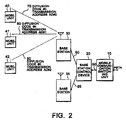
- the CDMA mobile communication system includes a mobile communication switching unit 10, a base station control device 20, a plurality of base stations 30 and 35, and a plurality of mobile units 40, 41, and 42 located in the service area of the base station 30.
- the CDMA mobile communication system uses a communication signal, modulated and multiplexed with different diffusion codes, in data communication between each of the base stations 30 and 50 and each of the mobile units 40, 41, and 42.
- the communication signal is a time division multiplex signal with a repeated frame having a plurality of time slots which are assigned to different radio channels, respectively.
- the mobile communication switching unit 10 is connected between a public network (PSTN) and the base station control device 20 via a communication channel (wire) 50.
- PSTN public network
- the mobile communication switching unit 10 has an interface function for a call processing of a mobile network and a fixed network or the public network.
- the base station control device 20 is connected to the base stations 30 and 35 via communication channels (wires) 60 and 65, respectively, and performs the call processing with the mobile units.
- the base station 30 is connected to the mobile units 40, 41, and 42 via separate radio channels 70, 80, and 90, respectively, to perform transmission/reception of communication data.
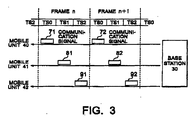
- radio channels 70, 80, and 90 are connected to the different mobile units 40, 41, and 42 by time division multiplexing using the same frequency and the same diffusion code, that is, by using a time division multiplex signal with a repeated frame formed of different time slots for each mobile unit
- the time division multiplex signal has a frame signal or the repeated frame repeatedly transmitted towards each of the radio channels 70, 80, and 90.
- the repeated frame has, for example, three time slots TS0, TS1, and TS2.
- Communication signals 71 and 72 to the mobile unit 40 (or from the mobile unit 40) use the time slot TS0.
- Communication signals 81 and 82 to the mobile unit 41 (or from the mobile unit 41) use the time slot TS1.
- Communication signals 91 and 92 to the mobile unit 42 (or from the mobile unit 42) use the time slot TS2.
- the different mobile units 40, 41, and 42 are accommodated using the same frequency and the same diffusion code and using the separate radio channels 70, 80, and 90.
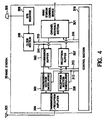
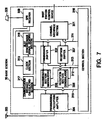
- the base station 30 comprises a channel interface section 301, a transmission buffer 302, a transmission section 303, a transmission/reception amplifier 304, a communication antenna 305, a reception section 306, a reception buffer 307, a GPS antenna 308, a GPS receiver 309, a clock section 310, a control section 316, and control signal conductors 312, 313, 314, and 315.
- the channel interface section 301 is connected to the base station control device 20 via the communication channel 60 (65) and is for performing data communication with the base station control device 20. Namely, the channel interface section 301 transmits data signals for the mobile units 40, 41, and 42, received from the base station control device 20, to the transmission buffer 302 via a transmission/communication channel. Additionally, call control known in the art is performed via the control signal conductor 314.
- the inputted data are separated and assigned to the time slots in accordance with a slot synchronous signal 311 transmitted from the clock section 310, and sent to the transmission section 303.
- the clock section 310 receives a control signal 315, supplied from the control section 316, to produce a slot synchronous signal 311 from a reference clock signal which will later be described.
- the clock section 310 processes the reference clock signal into the slot synchronous signal 311 under control of the control signal 315. Therefore, the clock section 310 is referred to as a clock processing arrangement.
- the time slot number for use is notified via the control signal conductor 313.
- the data signal is modulated with predetermined frequency and diffusion code, transmitted to the transmission/reception amplifier 304, and radio-transmitted to the mobile units 40, 41, 42 via the communication antenna 305. Additionally, the frequency and diffusion code to be set are notified to the transmission section 303 and the reception section 306 via the control signal conductor 312.
- the reception section 306 receives communication data signals from the mobile units 40, 41, 42 via the communication antenna 305 and the transmission/reception amplifier 304, and demodulates and transmits the signals to the reception buffer 307.
- the reception buffer 307 concentrates reception signals for each corresponding time slot and transmits them to the channel interface section 301.
- the GPS receiver 309 receives via the GPS antenna 308 the reference clock signal of a global positioning system known in the art and transmits the clock to the clock section 310.
- the control section 316 is constituted to control the entire base station device.
- Each of the transmission buffer 302 and the reception buffer 307 is referred to as a synchronizing arrangement for synchronizing the time slots between the base stations 30 and 35 and the mobile units 41, 42, and 43 in accordance with the slot synchronous signal 311.
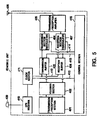
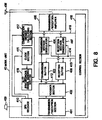
- the mobile unit 40 comprises a transmission/reception section 401, a vocoder section 402, a transmission buffer 403, a transmission section 404, a transmission/reception amplifier 405, a communication antenna 406, a reception section 407, a reception buffer 408, a GPS antenna 409, a GPS receiver 410, a clock section 411, control signal conductors 413, 414, 415, and a control section 416.
- Voice inputted via the transmission/reception section 401 is coded by the vocoder section 402 and is transmitted to the transmission buffer 403.
- the transmission buffer 403 assigns the inputted communication data to the time slot for use based on a slot synchronous signal 412 from the clock section 411, and transmits the data to the transmission section 404. Additionally, the time slot number for use is notified to the transmission buffer 403 and the reception buffer 408 via the control signal conductor 413.
- the transmission section 404 modulates the inputted communication data with the predetermined frequency and diffusion code, transmits the data to the transmission/reception amplifier 405, and further transmits the data to the base station 30 via the communication antenna 406. Additionally the frequency and diffusion code to be set are notified to the transmission section 404 and the reception section 407 via the control signal conductor 414.
- the reception section 407 demodulates the reception signal received via the communication antenna 406 and the transmission/reception amplifier 405 and transmits the signal to the reception buffer 408.
- the reception buffer 408 concentrates the reception signals for each corresponding self time slot, and transmits them to the vocoder section 402.
- the vocoder section 402 decodes and converts the signal to a voice signal to output voice via the transmission/reception section 401.
- the GPS receiver 410 receives the above-mentioned reference clock signal via the GPS antenna 409, and transmits the clock to the clock section 411.
- Each of the transmission buffer 403 and the reception buffer 408 is referred to as the synchronizing arrangement.
- the clock section 411 receives the control signal 415 from the control section 416 and produces the slot synchronous signal 412 in accordance with the reference clock signal. In other words, the clock section 411 processes the reference clock signal into the slot synchronous signal 412 under control of the control signal 415. Therefore, the clock section 411 is referred to as the clock processing arrangement.
- the control section 416 is constituted to control the entire mobile unit.
- the base station 30 (35) and the mobile unit 40 (41, 42) are both provided with GPS receivers and are constituted to generate the slot synchronous signals using the reference clock signals obtained from the GPS receivers in the synchronization of the time slots. Therefore, the synchronization of the time slots on the transmission and reception sides can be obtained more accurately. As a result, the guard timing (T) for absorbing the synchronization deviation does not need to be set to be large and can be smaller than the guard timing (t) in the time division multiplex signal in previous technique.
- the base station 30 (35) further comprises a communication distance calculating section 317 and a slot synchronous signal sending section 318.
- the GPS receiver 309 further receives measured position information of the global positioning system.
- the communication distance calculating section 317 calculates the communication distance to a communication partner mobile unit from the measured position information from the GPS receiver 309 and the position information 319 at the mobile units 40, 41, and 42 sent via the control signals or the communication signal.
- the communication distance calculating section 317 processes the measured position information to produce communication distance information representative of the communication distance. Therefore, the communication distance calculating section 317 will be referred to as an information processing arrangement.
- the slot synchronous signal sending section 318 calculates the delay of reception timing attributed to the communication distance.
- the synchronization deviation by a distance factor can be absorbed by delaying the slot synchronous signal 311 for reception with this timing. More particularly, the slot synchronous signal sending section 318 delays the slot synchronous signal 311 in accordance with the communication distance information to produce a delayed slot synchronous signal. Therefore, the slot synchronous signal sending section 318 will be referred to as a delaying arrangement.
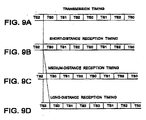
- synchronization can be obtained at the same timing as the transmission timing shown in Fig. 9A.
- the mobile unit is located in a medium or long distance, however, by delaying the timing of the slot synchronous signal 311 sent from the slot synchronous signal sending section 318, the reception timing is delayed as shown in Figs. 9C or 9D.
- the synchronization deviation by the distance factor is absorbed, so that the synchronization of the time slots on the transmission and reception sides can be established more accurately.
- the mobile unit 40 (41, 42) comprises a communication distance calculating section 417 and a slot synchronous signal sending section 418.
- Each section operation is the same as that in the above-described base station 30.
- a communication distance calculating section 417 processes the measured position information to produce the communication distance information. Therefore, the communication distance calculating section 317 will be referred to as the information processing arrangement
- a slot synchronous signal sending section 418 delays the slot synchronous signal 412 in accordance with the communication distance information to produce the delayed slot synchronous signal. Therefore, the slot synchronous signal sending section 418 will be referred to as the delaying arrangement.
- the reference clock signal obtained from GPS reception signal is used in the synchronization of the time slots at the base station and each mobile unit. Furthermore, the timing signal is used in the slot timing of the reception signal, in which the delay time by the communication distance information based on the measured position information obtained from the GPS reception signal is considered. Therefore, the synchronization of the time slots on the transmission and reception sides can be obtained more accurately in the radio channel multiplex communication method.
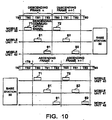
- the communication frame of descending communication signals deviates from that of ascending communication signals by one time slot, and by preventing the transmission processing and reception processing from being simultaneously performed in one mobile unit, the load of the mobile unit is lightened.
- the frame signal constituted of a plurality of time slots is used in the communication signal
- the reference clock signal obtained from the GPS reception signal is used in the synchronization of the time slots of the base station and each mobile unit, and further the reception timing is allowed to deviate in accordance with the communication distance calculated based on the measured position information obtained from the GPS reception signal.
- the multiplexing of the radio channel performed both in the CDMA and TDMA can be realized with high efficiency and precision while the guard timing is minimized. Therefore, there can be provided a system in which a plurality of radio channels can efficiently be secured in one diffusion code, the resource of the radio channel can be increased without multiplexing the frequency, and a large traffic can be handled without enlarging the equipment.
- the reception operation may be performed at the timing of the time slot assigned from the base station control device, the reception operation can be halted at the other timings, and the power consumption can effectively be reduced.
- time-divided time slots are assigned to the communication channels with the mobile units in the above-mentioned embodiments, they may be assigned to a cellular phone and a portable data terminal device, or to terminals connected to LAN or a party telephone.
- the slots are assigned to the cellular phone and the portable data terminal device, the lengths of the time slots do not have to be the same, and the time slots different in length may be used.
- the time slots to be assigned to the radio channels may be varied in length.
Landscapes
- Engineering & Computer Science (AREA)
- Computer Networks & Wireless Communication (AREA)
- Signal Processing (AREA)
- Radar, Positioning & Navigation (AREA)
- Remote Sensing (AREA)
- Physics & Mathematics (AREA)
- General Physics & Mathematics (AREA)
- Mobile Radio Communication Systems (AREA)
- Time-Division Multiplex Systems (AREA)
- Synchronisation In Digital Transmission Systems (AREA)
Applications Claiming Priority (2)
| Application Number | Priority Date | Filing Date | Title |
|---|---|---|---|
| JP35231398 | 1998-12-11 | ||
| JP35231398A JP2000184433A (ja) | 1998-12-11 | 1998-12-11 | Cdma移動通信システムにおける無線チャネル多重通信方式 |
Publications (2)
| Publication Number | Publication Date |
|---|---|
| EP1017190A2 true EP1017190A2 (de) | 2000-07-05 |
| EP1017190A3 EP1017190A3 (de) | 2003-08-13 |
Family
ID=18423212
Family Applications (1)
| Application Number | Title | Priority Date | Filing Date |
|---|---|---|---|
| EP19990124648 Withdrawn EP1017190A3 (de) | 1998-12-11 | 1999-12-10 | Verfahren zur Funkkanalverschachtelung für Kommunikation, mobile Einheit, und Basisstation in einer CDMA mobilen Kommunikationssanordnung |
Country Status (6)
| Country | Link |
|---|---|
| US (1) | US6542487B1 (de) |
| EP (1) | EP1017190A3 (de) |
| JP (1) | JP2000184433A (de) |
| KR (1) | KR100309232B1 (de) |
| CN (1) | CN1118219C (de) |
| BR (1) | BR9906208A (de) |
Cited By (2)
| Publication number | Priority date | Publication date | Assignee | Title |
|---|---|---|---|---|
| GB2383217A (en) * | 2001-07-26 | 2003-06-18 | Codar Ocean Sensors Ltd | Synchronisation of multiple radars operating within the same frequency band |
| DE10315063A1 (de) * | 2003-04-02 | 2004-10-14 | Siemens Ag | Verfahren zur Übertragung von Daten |
Families Citing this family (18)
| Publication number | Priority date | Publication date | Assignee | Title |
|---|---|---|---|---|
| US7039098B2 (en) * | 2000-08-07 | 2006-05-02 | Qualcomm Incorporated | Method and apparatus for base station and mobile station time calibration |
| ES2281049T3 (es) * | 2000-10-24 | 2007-09-16 | Nortel Networks Limited | Metodos, sistemas y estructura de canal compartido. |
| US20030012158A1 (en) * | 2001-01-25 | 2003-01-16 | Hang Jin | System and method for synchronizing a base station in a distributed radio system |
| JP3923941B2 (ja) | 2001-10-19 | 2007-06-06 | インターデイジタル テクノロジー コーポレーション | ダウンリンクにおける全dtxモードオペレーション中の省電力化改善のためのシステム |
| KR100517834B1 (ko) * | 2002-10-28 | 2005-10-04 | 주식회사 이노와이어리스 | 통신망에서의 데이터 측정 시스템 |
| US6863825B2 (en) | 2003-01-29 | 2005-03-08 | Union Oil Company Of California | Process for removing arsenic from aqueous streams |
| CN1960435B (zh) * | 2006-08-25 | 2010-10-06 | 中兴通讯股份有限公司 | 一种移动多媒体广播时钟同步的方法和系统 |
| US8066874B2 (en) | 2006-12-28 | 2011-11-29 | Molycorp Minerals, Llc | Apparatus for treating a flow of an aqueous solution containing arsenic |
| US8349764B2 (en) * | 2007-10-31 | 2013-01-08 | Molycorp Minerals, Llc | Composition for treating a fluid |
| US8252087B2 (en) | 2007-10-31 | 2012-08-28 | Molycorp Minerals, Llc | Process and apparatus for treating a gas containing a contaminant |
| JP2009170990A (ja) * | 2008-01-11 | 2009-07-30 | Nec Corp | 移動局、移動通信システムおよび同期制御方法 |
| JP5260131B2 (ja) * | 2008-04-28 | 2013-08-14 | 株式会社エヌ・ティ・ティ・ドコモ | 基地局、移動局及び共通情報通信方法 |
| CN100576285C (zh) * | 2008-09-02 | 2009-12-30 | 南京厚华通信设备有限责任公司 | 大型短波通信网络船舶监控定位和应急报警设备及其方法 |
| US9233863B2 (en) | 2011-04-13 | 2016-01-12 | Molycorp Minerals, Llc | Rare earth removal of hydrated and hydroxyl species |
| KR101480953B1 (ko) * | 2012-10-19 | 2015-01-21 | 레드원테크놀러지 주식회사 | 위치기반 시간 - 메시지 동기화 기법을 적용한 이기종 단말 간 통신 방법 |
| KR101558674B1 (ko) * | 2013-11-22 | 2015-10-07 | 현대자동차주식회사 | 배터리 승온 시스템 및 그 제어 방법 |
| US9975787B2 (en) | 2014-03-07 | 2018-05-22 | Secure Natural Resources Llc | Removal of arsenic from aqueous streams with cerium (IV) oxide compositions |
| JP6896377B2 (ja) * | 2016-06-01 | 2021-06-30 | ソニーグループ株式会社 | 通信装置、通信方法、及びプログラム |
Family Cites Families (16)
| Publication number | Priority date | Publication date | Assignee | Title |
|---|---|---|---|---|
| DE3527329A1 (de) * | 1985-07-31 | 1987-02-05 | Philips Patentverwaltung | Digitales funkuebertragungssystem mit variabler zeitschlitzdauer der zeitschlitze im zeitmultiplexrahmen |
| ES2099228T3 (es) * | 1992-01-31 | 1997-05-16 | Cit Alcatel | Procedimiento para determinar el tiempo de propagacion entre la estacion terminal distante y la estacion terminal central en una red de transmision bidireccional del tipo punto-multipuntos. |
| FI925472L (fi) | 1992-12-01 | 1994-06-02 | Nokia Mobile Phones Ltd | Tiedonsiirtomenetelmä sekä -järjestelmä |
| JP3212169B2 (ja) | 1993-01-06 | 2001-09-25 | 株式会社東芝 | 無線通信システム及び基地局 |
| JPH06237214A (ja) | 1993-02-10 | 1994-08-23 | Matsushita Electric Ind Co Ltd | 移動通信システム |
| GB2277232B (en) * | 1993-03-20 | 1997-06-11 | Motorola Inc | A communications system and a mobile radio |
| US5510797A (en) * | 1993-04-15 | 1996-04-23 | Trimble Navigation Limited | Provision of SPS timing signals |
| DE69422852T2 (de) * | 1993-05-26 | 2000-06-15 | Nec Corp., Tokio/Tokyo | Netzwerksynchronisierung für zellulare TDMA Kommunikation unter Verwendung von Signalen von Mobilstationen in benachbarten Zellen |
| JP2636712B2 (ja) * | 1993-12-08 | 1997-07-30 | 日本電気株式会社 | 移動通信装置 |
| US5732076A (en) * | 1995-10-26 | 1998-03-24 | Omnipoint Corporation | Coexisting communication systems |
| JPH09261716A (ja) | 1996-03-22 | 1997-10-03 | Mitsubishi Electric Corp | 移動体通信子機、基地局通信装置、移動体通信用指令装置、移動体通信システム、並びに移動体通信方法 |
| JPH09327073A (ja) | 1996-06-07 | 1997-12-16 | N T T Ido Tsushinmo Kk | Cdma移動通信システムにおけるパイロットチャネル配置および送信方法 |
| JPH09252490A (ja) | 1997-01-31 | 1997-09-22 | Hitachi Ltd | 無線基地局 |
| JPH10224316A (ja) | 1997-02-07 | 1998-08-21 | Unyusho Senpaku Gijutsu Kenkyusho | 時分割多重アクセス通信方法およびこの方法を用いた複数の移動体の自動従属監視方法およびその装置 |
| JP3244016B2 (ja) | 1997-02-28 | 2002-01-07 | 株式会社村田製作所 | 移動体通信システム |
| US6016322A (en) * | 1997-09-22 | 2000-01-18 | Kor Electronics, Inc. | Apparatus and method for self synchronization in a digital data wireless communication system |
-
1998
- 1998-12-11 JP JP35231398A patent/JP2000184433A/ja active Pending
-
1999
- 1999-12-10 CN CN99125979A patent/CN1118219C/zh not_active Expired - Fee Related
- 1999-12-10 US US09/458,656 patent/US6542487B1/en not_active Expired - Fee Related
- 1999-12-10 KR KR1019990056402A patent/KR100309232B1/ko not_active Expired - Fee Related
- 1999-12-10 EP EP19990124648 patent/EP1017190A3/de not_active Withdrawn
- 1999-12-10 BR BR9906208A patent/BR9906208A/pt not_active IP Right Cessation
Cited By (4)
| Publication number | Priority date | Publication date | Assignee | Title |
|---|---|---|---|---|
| GB2383217A (en) * | 2001-07-26 | 2003-06-18 | Codar Ocean Sensors Ltd | Synchronisation of multiple radars operating within the same frequency band |
| GB2383217B (en) * | 2001-07-26 | 2004-01-14 | Codar Ocean Sensors Ltd | Multi-station radar frequency sharing with gps time modulation multiplexing |
| US6856276B2 (en) | 2001-07-26 | 2005-02-15 | Codar Ocean Sensors, Ltd. | Multi-station HF FMCW radar frequency sharing with GPS time modulation multiplexing |
| DE10315063A1 (de) * | 2003-04-02 | 2004-10-14 | Siemens Ag | Verfahren zur Übertragung von Daten |
Also Published As
| Publication number | Publication date |
|---|---|
| KR20000048056A (ko) | 2000-07-25 |
| EP1017190A3 (de) | 2003-08-13 |
| BR9906208A (pt) | 2000-10-17 |
| KR100309232B1 (ko) | 2001-11-05 |
| US6542487B1 (en) | 2003-04-01 |
| JP2000184433A (ja) | 2000-06-30 |
| CN1259838A (zh) | 2000-07-12 |
| CN1118219C (zh) | 2003-08-13 |
Similar Documents
| Publication | Publication Date | Title |
|---|---|---|
| US6542487B1 (en) | Radio channel multiplex communication method, a mobile unit, and a base station in CDMA mobile communication system | |
| CN1130090C (zh) | 时分多址-时分双工/频分双工无线电通信系统和用于此种系统的信道选择方法和设备 | |
| US6301289B1 (en) | To a telecommunication system using code division multiple access (CDMA) | |
| US6567389B1 (en) | Method and arrangement for high-speed data transmission in a mobile telecommunications system | |
| EP1249092B1 (de) | Adaptive rahmenstrukturen für hybride cdma / tdma systeme | |
| US6219347B1 (en) | Mobile communication system | |
| KR20010043442A (ko) | 무선 통신 시스템에서 채널을 할당하기 위한 방법 및기지국 시스템 | |
| RU2216100C2 (ru) | Способ планирования показания переменных блоков с помощью флага состояния восходящей линии связи в системе передачи пакетных данных | |
| JPH07177569A (ja) | 移動通信装置 | |
| JPS6335025A (ja) | デジタル無線伝送系 | |
| US6487392B1 (en) | Assign channel distributing system and distributing method therefor | |
| CA2235551A1 (en) | Coexisting communication systems | |
| JPH08130766A (ja) | 移動通信システム | |
| CN1122175A (zh) | 在cdma蜂窝无线系统中发送和接收功率控制消息的方法 | |
| KR20000010593A (ko) | 다중코드압축모드ds-cdma시스템및방법 | |
| JP3970467B2 (ja) | 無線通信システム | |
| US6810270B1 (en) | Providing reference signal to radio heads | |
| US7068629B1 (en) | Method and radio communication system for synchronizing subscriber stations | |
| US20040114468A1 (en) | Synchronization of a multi-mode base station using a common system clock | |
| US6545990B1 (en) | Method and apparatus for a spectrally compliant cellular communication system | |
| EP1209838A1 (de) | Asymmetrische Ratenrückkopplung und System zur Einstellung der Datenübertragungsrate für drahtlose Kommunikation | |
| AU2938299A (en) | Method of transmitting synchronized channel in radio transmitter | |
| CN100450262C (zh) | 在无线电通信系统中传输应用数据的方法 | |
| KR100827139B1 (ko) | 비동기방식 이동통신시스템의 기지국간 동기화장치 및 방법 | |
| KR20050088323A (ko) | 랜덤 액세스 제어 방법, 기지국 및 단말 장치 |
Legal Events
| Date | Code | Title | Description |
|---|---|---|---|
| PUAI | Public reference made under article 153(3) epc to a published international application that has entered the european phase |
Free format text: ORIGINAL CODE: 0009012 |
|
| AK | Designated contracting states |
Kind code of ref document: A2 Designated state(s): AT BE CH CY DE DK ES FI FR GB GR IE IT LI LU MC NL PT SE |
|
| AX | Request for extension of the european patent |
Free format text: AL;LT;LV;MK;RO;SI |
|
| PUAL | Search report despatched |
Free format text: ORIGINAL CODE: 0009013 |
|
| AK | Designated contracting states |
Designated state(s): AT BE CH CY DE DK ES FI FR GB GR IE IT LI LU MC NL PT SE |
|
| AX | Request for extension of the european patent |
Extension state: AL LT LV MK RO SI |
|
| STAA | Information on the status of an ep patent application or granted ep patent |
Free format text: STATUS: THE APPLICATION HAS BEEN WITHDRAWN |
|
| 18W | Application withdrawn |
Effective date: 20031015 |