EP1017212A2 - Systéme et procédé pour l' accés simultané d' un utilisateur aux services téléphoniques d'abonné de provenances multiples - Google Patents
Systéme et procédé pour l' accés simultané d' un utilisateur aux services téléphoniques d'abonné de provenances multiples Download PDFInfo
- Publication number
- EP1017212A2 EP1017212A2 EP99309835A EP99309835A EP1017212A2 EP 1017212 A2 EP1017212 A2 EP 1017212A2 EP 99309835 A EP99309835 A EP 99309835A EP 99309835 A EP99309835 A EP 99309835A EP 1017212 A2 EP1017212 A2 EP 1017212A2
- Authority
- EP
- European Patent Office
- Prior art keywords
- subscriber
- zone manager
- provisioning
- client
- registration data
- Prior art date
- Legal status (The legal status is an assumption and is not a legal conclusion. Google has not performed a legal analysis and makes no representation as to the accuracy of the status listed.)
- Pending
Links
Images

Classifications
-
- H—ELECTRICITY
- H04—ELECTRIC COMMUNICATION TECHNIQUE
- H04M—TELEPHONIC COMMUNICATION
- H04M3/00—Automatic or semi-automatic exchanges
- H04M3/42—Systems providing special services or facilities to subscribers
- H04M3/487—Arrangements for providing information services, e.g. recorded voice services or time announcements
- H04M3/493—Interactive information services, e.g. directory enquiries ; Arrangements therefor, e.g. interactive voice response [IVR] systems or voice portals
- H04M3/4931—Directory assistance systems
-
- H—ELECTRICITY
- H04—ELECTRIC COMMUNICATION TECHNIQUE
- H04M—TELEPHONIC COMMUNICATION
- H04M3/00—Automatic or semi-automatic exchanges
- H04M3/42—Systems providing special services or facilities to subscribers
- H04M3/42229—Personal communication services, i.e. services related to one subscriber independent of his terminal and/or location
-
- H—ELECTRICITY
- H04—ELECTRIC COMMUNICATION TECHNIQUE
- H04M—TELEPHONIC COMMUNICATION
- H04M3/00—Automatic or semi-automatic exchanges
- H04M3/42—Systems providing special services or facilities to subscribers
- H04M3/54—Arrangements for diverting calls for one subscriber to another predetermined subscriber
-
- H—ELECTRICITY
- H04—ELECTRIC COMMUNICATION TECHNIQUE
- H04M—TELEPHONIC COMMUNICATION
- H04M7/00—Arrangements for interconnection between switching centres
- H04M7/12—Arrangements for interconnection between switching centres for working between exchanges having different types of switching equipment, e.g. power-driven and step by step or decimal and non-decimal
- H04M7/1205—Arrangements for interconnection between switching centres for working between exchanges having different types of switching equipment, e.g. power-driven and step by step or decimal and non-decimal where the types of switching equipement comprises PSTN/ISDN equipment and switching equipment of networks other than PSTN/ISDN, e.g. Internet Protocol networks
- H04M7/128—Details of addressing, directories or routing tables
Definitions
- the present invention relates to multiple appearance directory number (MADN) systems. More specifically, the present invention relates to multiple appearance directory number systems capable of being implemented intermittently across multiple telephone networks.
- MADN multiple appearance directory number
- EKTS Electronic Key Telephone System
- MADN Northern Telecom's Multiple Appearance Directory Numbers
- An intermittent extension service system is presented within a telephone network system permitting a subscriber to provision and manage a registration table of clients.
- the registration table is maintained in memory means within a zone manager coupled between a telephone network switch and a plurality of clients.
- a provisioning system allows a subscriber to manage the physical locations of each client for each allotted extension ordered from a service provider.
- the telephone network switch is coupled between the zone manager memory means and the provisioning system for communicating extension registration data from the provisioning system to the zone manager memory means. When an incoming call on a telephone network is received by the switch it is routed to each active, i.e. registered, extension.
- the intermittent extension service of the present invention is a mechanism for temporarily adding a member to a multi-appearance directory number type of service (e.g., EKTS or MADN) without sacrificing security.
- a key enhancement over the prior art is the ability of the subscriber to provision and manage the terminals or clients which will receive the service rather than having the service provider provision and manage the service for each client.
- Service subscription data identifies the subscriber as having ordered a specific number of simultaneous extensions just as in prior art systems.
- the number of extensions is then provisioned by the appropriate network resources. This is the only provisioning done by the service provider.
- Once the number of extensions ordered by the subscriber have been provisioned for by the service provider it is up to the subscriber to provision each client individually to one of the ordered extensions until the number of ordered extensions (maximum number of appearances) has been reached.
- the subscriber activates additional extensions for new clients (terminals) by causing it to register with the telephone network.
- Subscribers to the intermittent extension service are identified by some type of security mechanism such as a Smart Card, or digital signature from, for instance, ENTRUST TM Technologies.
- the registration limit i.e. maximum number of appearances
- the subscriber is given the ability to bump one of their existing registrations using a web based procedure in favour of the new registration. While the subscriber has the ability to provision a new client at will, he cannot register locations which exceed the number of extensions he has ordered from the service provider. However, the subscriber is permitted to selectively manage the registered table by adding or deleting specific clients using the aforementioned web based procedure.
- the present invention therefore advantageously provides a multiple appearance directory number (MADN) system implementable across a plurality of telephone networks.
- MADN multiple appearance directory number
- FIGURE 1 illustrates a message sequence among various hardware nodes for provisioning, registering, and utilizing the intermittent extension service.
- the hardware nodes shown include a client, a zone manager, a network telephone switch, a provisioning system, and a PSTN network. Equivalents of each node may be substituted without departing from the scope of the present invention.
- the network telephone switch includes gateway functionality. The gateway may be internal or external to the switch.
- the zone manager may also be referred to as a gatekeeper.
- a subscriber (or user) is an individual who has signed up for telephone service from a telephone service provider.
- a client is a terminal device such as a phone that is used by the subscriber to place and receive calls. The client is connected to the telephone network and its hardware.
- FIGURE 1 has been broken down into four distinct message groupings which have been designated A, B, C , and D .
- Group A represents a failed attempt by a subscriber to access and use the service. This may arise, for instance, when the subscriber attempts to use the service from a client that is not yet a member of the subscriber's current registered table. In this case, when the client attempts to automatically register the service with the zone manager, the zone manager returns a message indicating that the registration request is denied. If the subscriber still wishes to access the service from that client he must first make room for the client in the registered table by removing a previously registered client and then register the client with the zone manager.
- Message group B illustrates the provisioning process while message group C illustrates a successful registration process. The subscriber can remove a client registration by deactivating the client directly, deactivating via the web interface, or via an interactive voice response (IVR) system.
- IVR interactive voice response
- Aliases are provisioned by the service provider when the subscriber activates the intermittent extension service.
- the subscriber is allocated a maximum number of appearances, i.e., number of extensions, from the service provider. If the subscriber's current registration table utilizes all of the extensions he has ordered from the service provider, then the subscriber must choose one to delete in order to make room for the new client.
- the preferred embodiment deletion process is software driven from a web based application.
- the web based application guides the subscriber through a series of instructions that result in the subscriber viewing his particular registration table and deleting a client in the table in order to make room for a new client.
- the deletion process may be interactive voice response (IVR) driven.
- IVR interactive voice response
- the subscriber calls the service provider and manipulates his registration table over the phone with voice responses to certain prompts.
- the provisioning system downloads the information to the zone manager that maintains a table with the subscriber's current intermittent extension service registration data.
- the zone manager responds with an acknowledgment message upon completion of the download. Subsequently, when the subscriber attempts to register a new client with the zone manager, the registration request will be automatically accepted since there is now room for an additional extension.
- Message group D illustrates use of the intermittent extension service beginning when the switch receives an incoming call from a network (PSTN) and sends an authorization request (ARQ) message to the zone manager which returns an authorization confirmed (ACF) message back to the network telephone switch.
- the authorization request (ARQ) and authorization confirmed (ACF) messages serve to authenticate the nodes and grant admission to the call on a per call basis.
- Setup of the call to each registered client is then commenced with a setup message that originates in the switch and terminates at each client after being relayed through the zone manager.
- the setup messaging informs the clients that the switch is ready to initiate a call.
- extension service processing may proceed according to, for instance, BellCore's prior art EKTS system as described in technical specification GR-205 previously cited.
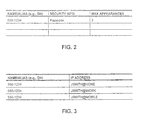
- FIGURE 2 is a table illustrating the name, security information, and maximum number of appearances for an intermittent extension service subscriber. Upon the subscriber ordering the intermittent extension service, the table is provisioned by appropriate network resources with the number of extensions ordered.
- FIGURE 3 is a table illustrating the name/alias and IP address of each client registration for an intermittent extension service subscriber.
- the table is dynamically allocated in the zone manager during the registration process described in FIGURE 1 .
- the table contains cells corresponding a subscriber's name/alias, e.g., directory number, with an IP address identifying the physical location of the client.
- the maximum number of entries in the table depends on the number of extensions the subscriber has ordered for the intermittent extension service.
- the above described system provides two significant advantages over prior art systems such as BellCore's EKTS.
- the service is capable of spanning multiple networks rather than being confined to physical locations that are all served by the same network.
- the subscriber has control over the provisioning and registration process meaning they can register and de-register physical locations (clients) at will via a web-based software procedure over the Internet.
- the web-based software procedure provides a user interface that guides the user/subscriber in the maintenance of his registration table.
- the user interface receives input from the subscriber in response to instructions designed to guide the subscriber through the process of managing his client registration data. Once the subscriber has manipulated the data to his satisfaction it is downloaded to the zone manager memory means where it is maintained. Access to the provisioning system interface is typically gained via a personal computer (PC) communicable with the interface's Internet web site via a data network. Standard security measures such as passcodes, digital signatures, or the like, can be employed to maintain system integrity.
- PC personal computer
- the subscriber While the total number of active registrations is limited by how many extensions the subscriber has actually ordered, the subscriber has the ability to manipulate the registration table. This is significant in that the subscriber can arrange it so that locations are not continuously mapped when there is not going to be anyone at a particular location to answer the phone even if it rings.
- a subscriber For instance, if a subscriber is on vacation they can opt to de-register the home location in favor of the temporary vacation location without incurring any more network resources. Upon return from vacation, the subscriber merely de-registers the vacation location and re-registers the home location.
- the intermittent extension service could also be used to allow a small business to avoid the expense of a PBX switching network to manage calls. For example, say the business has subscribed for a single directory number (DN). With the intermittent extension service, the DN can be allotted a specific number of extensions, e.g. twelve (12). Thus, twelve clients may be provisioned throughout the office at various locations. A telephone receptionist can be given the responsibility of primary call answerer. Once the receptionist notifies the intended called party within the office, that person can pick up their phone (client) and conduct the call from their location. Moreover, one or more of the clients may be set up to ring outside the office as well. This is especially useful when the office is closed but someone would like to field calls at home, for instance. The registered client table may be accessed and manipulated to suit such purposes. This provides a cost effective means of achieving many of the results of the more expensive PBX systems.
- DN directory number
- twelve clients may be provisioned throughout the office at various locations.
- a telephone receptionist can be given
- An intermittent extension service that is a mechanism for temporarily adding a member to a multi-appearance directory number type of service (eg EKTS or MADN) without sacrificing security is presented.
- Service subscription data identifies the subscriber as having ordered a specific number of simultaneous extensions. The number of extensions is then provisioned by appropriate network resources. Thereafter, whenever a subscriber wishes they can activate an additional extension by causing it to register with the telephone network. Similarly, the subscriber can de-activate extensions located where it is known that there is no-one present to answer the terminal/phone when it rings. Thus, the subscriber is given the ability to provision and manage the physical locations of clients for the number of extensions ordered from the service provider.
Landscapes
- Engineering & Computer Science (AREA)
- Signal Processing (AREA)
- Telephonic Communication Services (AREA)
Applications Claiming Priority (2)
| Application Number | Priority Date | Filing Date | Title |
|---|---|---|---|
| US22387998A | 1998-12-31 | 1998-12-31 | |
| US223879 | 1998-12-31 |
Publications (1)
| Publication Number | Publication Date |
|---|---|
| EP1017212A2 true EP1017212A2 (fr) | 2000-07-05 |
Family
ID=22838335
Family Applications (1)
| Application Number | Title | Priority Date | Filing Date |
|---|---|---|---|
| EP99309835A Pending EP1017212A2 (fr) | 1998-12-31 | 1999-12-07 | Systéme et procédé pour l' accés simultané d' un utilisateur aux services téléphoniques d'abonné de provenances multiples |
Country Status (2)
| Country | Link |
|---|---|
| EP (1) | EP1017212A2 (fr) |
| CA (1) | CA2282805A1 (fr) |
-
1999
- 1999-09-17 CA CA002282805A patent/CA2282805A1/fr not_active Abandoned
- 1999-12-07 EP EP99309835A patent/EP1017212A2/fr active Pending
Also Published As
| Publication number | Publication date |
|---|---|
| CA2282805A1 (fr) | 2000-06-30 |
Similar Documents
| Publication | Publication Date | Title |
|---|---|---|
| US6320857B1 (en) | Telephone doubler arrangement | |
| US6779020B1 (en) | Establishing communications between a calling server and a called server according to services subscribed by their respective calling and called parties | |
| US8724788B2 (en) | Enhanced services provided using communication redirection and processing | |
| US6400816B1 (en) | Network-independent communications system | |
| US20070121590A1 (en) | System and method for providing call management services in a virtual private network using voice or video over Internet protocol | |
| US7088810B1 (en) | Caller originated multiple calling | |
| CA2270047A1 (fr) | Procede et systeme pour selectionner une parmi plusieurs passerelles telephoniques destinees a servir une application eloignee | |
| US7450562B2 (en) | Method for transmitting short message using internet phones and system therefor | |
| US20090245499A1 (en) | Call transfer system and call transfer control method | |
| US8073977B2 (en) | Internet telephony through hosts | |
| US7474665B2 (en) | Apparatus and method for compulsively receiving multi-calls over internet protocol phones in internet protocol telephony system | |
| US20100037298A1 (en) | Method and System for Protecting a Service Access Link | |
| US8259922B2 (en) | Emulation of private branch exchange behavior | |
| EP1017212A2 (fr) | Systéme et procédé pour l' accés simultané d' un utilisateur aux services téléphoniques d'abonné de provenances multiples | |
| US20080232564A1 (en) | Call hunt and ringback on the phone through messenger | |
| EP2353285B1 (fr) | Procédé de gestion d'appels de groupe dans un système de télécommunication | |
| EP4552310A1 (fr) | Plateforme de service de téléphonie fournissant des services à valeur ajoutée | |
| Headquarters | Cisco Unified Communications Manager Express Command Reference |
Legal Events
| Date | Code | Title | Description |
|---|---|---|---|
| PUAI | Public reference made under article 153(3) epc to a published international application that has entered the european phase |
Free format text: ORIGINAL CODE: 0009012 |
|
| STAA | Information on the status of an ep patent application or granted ep patent |
Free format text: STATUS: THE APPLICATION HAS BEEN PUBLISHED |
|
| AK | Designated contracting states |
Kind code of ref document: A2 Designated state(s): AT BE CH CY DE DK ES FI FR GB GR IE IT LI LU MC NL PT SE |
|
| AX | Request for extension of the european patent |
Free format text: AL;LT;LV;MK;RO;SI |
|
| RAP1 | Party data changed (applicant data changed or rights of an application transferred) |
Owner name: NORTEL NETWORKS LIMITED |