EP1017217A2 - Datenbankarbeitsfluss für Multimedia Netzwerk und VoIP - Google Patents
Datenbankarbeitsfluss für Multimedia Netzwerk und VoIP Download PDFInfo
- Publication number
- EP1017217A2 EP1017217A2 EP99310477A EP99310477A EP1017217A2 EP 1017217 A2 EP1017217 A2 EP 1017217A2 EP 99310477 A EP99310477 A EP 99310477A EP 99310477 A EP99310477 A EP 99310477A EP 1017217 A2 EP1017217 A2 EP 1017217A2
- Authority
- EP
- European Patent Office
- Prior art keywords
- workflow
- database
- gateway
- agents
- gatekeeper
- Prior art date
- Legal status (The legal status is an assumption and is not a legal conclusion. Google has not performed a legal analysis and makes no representation as to the accuracy of the status listed.)
- Withdrawn
Links
Images



Classifications
-
- H—ELECTRICITY
- H04—ELECTRIC COMMUNICATION TECHNIQUE
- H04M—TELEPHONIC COMMUNICATION
- H04M3/00—Automatic or semi-automatic exchanges
- H04M3/42—Systems providing special services or facilities to subscribers
- H04M3/50—Centralised arrangements for answering calls; Centralised arrangements for recording messages for absent or busy subscribers ; Centralised arrangements for recording messages
- H04M3/51—Centralised call answering arrangements requiring operator intervention, e.g. call or contact centers for telemarketing
-
- H—ELECTRICITY
- H04—ELECTRIC COMMUNICATION TECHNIQUE
- H04L—TRANSMISSION OF DIGITAL INFORMATION, e.g. TELEGRAPHIC COMMUNICATION
- H04L65/00—Network arrangements, protocols or services for supporting real-time applications in data packet communication
- H04L65/1066—Session management
- H04L65/1101—Session protocols
- H04L65/1106—Call signalling protocols; H.323 and related
-
- H—ELECTRICITY
- H04—ELECTRIC COMMUNICATION TECHNIQUE
- H04L—TRANSMISSION OF DIGITAL INFORMATION, e.g. TELEGRAPHIC COMMUNICATION
- H04L65/00—Network arrangements, protocols or services for supporting real-time applications in data packet communication
- H04L65/40—Support for services or applications
- H04L65/401—Support for services or applications wherein the services involve a main real-time session and one or more additional parallel real-time or time sensitive sessions, e.g. white board sharing or spawning of a subconference
-
- H—ELECTRICITY
- H04—ELECTRIC COMMUNICATION TECHNIQUE
- H04L—TRANSMISSION OF DIGITAL INFORMATION, e.g. TELEGRAPHIC COMMUNICATION
- H04L9/00—Cryptographic mechanisms or cryptographic arrangements for secret or secure communications; Network security protocols
- H04L9/40—Network security protocols
-
- H—ELECTRICITY
- H04—ELECTRIC COMMUNICATION TECHNIQUE
- H04M—TELEPHONIC COMMUNICATION
- H04M7/00—Arrangements for interconnection between switching centres
- H04M7/006—Networks other than PSTN/ISDN providing telephone service, e.g. Voice over Internet Protocol (VoIP), including next generation networks with a packet-switched transport layer
-
- H—ELECTRICITY
- H04—ELECTRIC COMMUNICATION TECHNIQUE
- H04L—TRANSMISSION OF DIGITAL INFORMATION, e.g. TELEGRAPHIC COMMUNICATION
- H04L65/00—Network arrangements, protocols or services for supporting real-time applications in data packet communication
- H04L65/1066—Session management
- H04L65/1101—Session protocols
-
- H—ELECTRICITY
- H04—ELECTRIC COMMUNICATION TECHNIQUE
- H04M—TELEPHONIC COMMUNICATION
- H04M3/00—Automatic or semi-automatic exchanges
- H04M3/42—Systems providing special services or facilities to subscribers
- H04M3/50—Centralised arrangements for answering calls; Centralised arrangements for recording messages for absent or busy subscribers ; Centralised arrangements for recording messages
- H04M3/53—Centralised arrangements for recording incoming messages, i.e. mailbox systems
- H04M3/5307—Centralised arrangements for recording incoming messages, i.e. mailbox systems for recording messages comprising any combination of audio and non-audio components
Definitions
- the field of invention relates to multimedia networking. More specifically, the field of invention relates to the incorporation of database workflows for networking functions.
- ACD Automatic Call Distribution
- the ACD is responsible for routing an incoming (i.e., customer's) call to a proper corporate agent having the necessary skill sets to handle the customer's call. For example, if a Spanish speaking customer requiring technical support calls the corporation's "1-800" number, the ACD is responsible for routing the customer's call to an available (or nearest available), Spanish speaking, technical support agent.
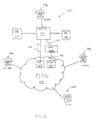
- Figure 1 shows a typical ACD center (also referred to as a pre-call router) 100.
- the customer based in Los Angeles calls the corporate "1-800" number from his personal or office telephone 108.
- the call is directed through the Public Switched Telephone Network 107 (PSTN) to the ACD 100, located in Denver.
- PSTN Public Switched Telephone Network
- the corporate "1-800" number is essentially the phone number of the ACD 100 itself.
- POP Point of Presence
- Caller confirmation involves: 1) verification that the destination of the call is the ACD and 2) identification of the source of the call (the customer's location). This information is found via the ANI/DNIS information relating to the customer's particular call. The ANI provides the caller's location while the DNIS provides the caller's intended destination. This information may be obtained either from a reserved channel of the physical layer connection 109 or from the Service Control Point (SCP) 104 that is located within the PSTN 107 and maintained by the carrier.
- SCP Service Control Point
- the ACD usually communicates with the SCP via a Network Interface Controller 102 (NIC).
- the ACD 100 initiates an Integrated Voice Response Unit (IVRU) which is an automated voice directory system.
- IVRU is responsible for identifying the basic skill sets that the customer requires. For example, the IVRU asks the caller to push a button corresponding to his language preference (e.g., English or Spanish) and his required area of service (e.g., sales, marketing, or technical support).
- the ACD 100 retains this data, referred to as skill sets, and uses it to properly route the call.
- the ACD 100 searches its database 105 for available agents having the required skill sets.
- the database 105 is a storage system that keeps track of the agents or groups of agents having particular skill sets.
- the ACD 100 also knows which agents are currently busy.
- the ACD is capable of matching agents having particular skills (e.g., Spanish speaking with technical support) with the agents currently available. From this the ACD 100 can determine which agents are available to handle the call.
- skill sets and availability are an initial set of conditions against which the entire pool of corporate agents are screened and reduced prior to selection.
- Figure 1 shows three agent locations 109a, 109b and 109c which correspond to available Spanish speaking, technical support agents in Denver (where the ACD 100 itself is located), New York, and Chicago respectively.
- the ACD may select the agent at the Denver location 109a since that is the closest location to the caller's location in L.A.
- a myriad of other conditions may also be required or desired in different instances.
- the router 101 places a new DNIS for the customer's call into the SCP 104. That is, the ACD 100 changes the caller's original DNIS (the corporate "1-800" number) to the specific DNIS value that corresponds to the selected agent.
- the ACD 100 changes the caller's original DNIS (the corporate "1-800" number) to the specific DNIS value that corresponds to the selected agent.
- a problem with current ACDs is a combination of granularity and bandwidth.
- Many ACDs employ a relatively modest storage system 102 and CPU resulting in limitations in the number of skill sets tracked per agent as well as limitations in the number of conditions that can be screened against the agent pool.
- the NIC 102 is typically capable of handling no more than 150-200 calls per second.
- there is also a bandwidth bottleneck because of the ACD center's 100 dependence on the PSTN's SCP 104 to re-route the customer's call (via changing the SCP's 104 DNIS information for each caller).
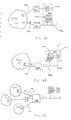
- Fig. 2a shows a traditional network configuration for a corporate campus.
- a telephone 202a and a computer 203a atop a corporate worker's desktop 201a.
- two entirely separate network architectures having unique pieces of hardware are used to connect the worker's telephone 202a and computer 203a to the world outside his or her office.
- a PBX 206 is used to manage employee telephone calls across the PSTN 107 while a router 205 is used to translate packets between the employee's Local Area Network (LAN) 204a and the PSTN 107.
- LAN Local Area Network
- Packet switched telephony is highly desirable as it eliminates the "dual" networking topography of Figure 2a and allows for the single architecture of Figure 2b.
- different media types e.g., voice or data
- PBX 206 or router 205 e.g., PBX 206 or router 205
- PBX 206 or router 205 e.g., PBX 206 or router 205
- PBX 206 or router 205 e.g., PBX 206 or router 205
- All media travels across a single path (e.g., trunk 209 and LAN 204b) through the same equipment (gateway 213a). This results in lower equipment and maintenance costs for MIS managers.
- ATM was once considered a technology that could transport voice and data over a single LAN architecture.
- ATM has packet switching features, however, ATM also has many connection-oriented features and is therefore generally not deemed a packet switched technology.
- ATM is seen more as an extension of traditional circuit switched telephony.
- ATM's connection oriented and pre-emptive queuing features result in high overhead and poor efficiency as compared to a purely IP based packet switched approach.
- gateway 213b handle all different forms of media (e.g., voice, FAX, data, video, etc.) it must also handle all different sources of that media (e.g., PSTN, ISDN, the internet, etc.).
- media e.g., voice, FAX, data, video, etc.
- sources of that media e.g., PSTN, ISDN, the internet, etc.
- H.323 To help manage the transition to real time packet based traffic flow, the ITU-T has introduced the H.323 standard (hereinafter "H.323") to define and organize the assorted requirements and functions necessary to implement campus architectures similar to that shown in Figure 2c. H.323 employs IP (Internet Protocol) addressing rather than ANI/DNIS for voice traffic.
- IP Internet Protocol
- an intelligent and fast gateway 213b is highly desirable in order to manage all the sources of media as well as manage all the different types of media that flow from them.
- Object oriented database workflows are used to automate expensive administrative business procedures.
- Database workflow application programs typically run on higher end machines such as workstations and therefore have access to high-speed data storage devices and high performance CPUs.
- database workflows provide the level of intelligence and speed necessary to automate complicated business processes. "Intelligence" is a derivative of hardware and software sophistication.
- Figure 3a shows a sample business workflow 300.
- a customer request for a specific part number invokes an inquiry into the corporate inventory. If the part number is not available the request is rejected; if the part number is available the shipping department is told to deliver the part to the customer and the accounts receivable department is told to update its records.
- Figure 3b shows the workflow of Figure 3a reduced to an object oriented database environment 301.
- the database has four objects: an order form object 303, an inventory object 302, a shipment object 304 and an accounts receivable object 305.
- Each object has associated methods having exclusive access to its database.
- the order form object 303 has a process order form method 303c and a process customer request method 303b which share exclusive access to the order form database 303a.
- Figure 3b the method of Figure 3a is realized in Figure 3b.
- the customer request generates the check inventory method 302b which searches the inventory database 302a. If the search is positive, the process order form method 303c is invoked which creates an official order from the data within the order form database 303a as well as invokes the update ship queue method 304b and the update accounts receivable method 305b. These methods then update their respective databases 304a, 305b thereby informing the shipping department of a new shipping requirement and recording the sale in the corporate account.
- a gatekeeper having a database that supports a networking workflow is communicatively coupled to a gateway.
- the database may comprise an object-oriented database.
- the networking workflow may be a networking layer, session layer or other layer workflow.
- the gateway may comprise an IP intranet network interface, where the IP intranet network is capable of transporting real time packet switched traffic, separated from a network interface by a translation layer.
- the IP intranet network may be an H.323 network.
- the network interfaces include but are not limited to PSTN, ISDN, ATM, Cable TV or the internet.
- the gatekeeper and gateway may be integrated within the same chassis.
- a gatekeeper having a database that supports an agent selection workflow and a gateway communicatively coupled to the gatekeeper.
- the database may be object oriented and may comprise an available agent object that contains the set of agents currently available. Further still, the object oriented database may comprise a tech support agent object that contains the set of agents having tech support skills, or a sales agent object that contains the set of agents having sales skills, or an additional conditions object that contains flow control policies.
- a gatekeeper having a database that supports a networking workflow; a first server, where the first server stores a first media type and is communicatively coupled to the gatekeeper; and a gateway communicatively coupled to the gatekeeper.
- the database may have a plurality of workflow libraries organized by media type, which may include a voice library, a data library, or a FAX library.
- the workflow may comprise a parser coupled to a plurality of decision blocks where there is one of decision blocks per media type.
- the media types may include but are not limited to data, voice mail or FAX.
- An embodiment of a method involves invoking an object method against a condition to produce at least one selected agent and directing real time traffic to the selected agent.
- the object may comprise an available agents object where the object method searches for available agents against the condition.
- the condition may comprise a technical expertise skill, a language skill, or a subset of agents from the corporate pool of agents.
- the object may also comprise a technical support agents object where the object method searches for technical support agents against a condition.
- the object may also comprise a sales agents object where the object method searches for sales agents against the condition.
- the object may also comprise an additional conditions object where the object method searches for agents meeting flow control policy requirements against the condition.
- the real time traffic may comprise real time voice traffic or real time video traffic.
- the real time traffic may be directed over a packet switched network including an IP based network.
- Another embodiment of a method includes determining the media type of a network event and initiating a networking workflow unique to the media type.
- the method may further comprise directing the event to a decision block unique to the media type before initiating the networking workflow.
- the method may further comprise a parser that makes the determination of the media type of the event.
- the method may be executed upon an object-oriented database.
- the networking workflow may be a pre-call routing workflow. It also may update an agent's file space in a server and send a message to the agent's system.
- a gatekeeper having a database that supports a networking workflow and a gateway communicatively coupled to the gatekeeper.
- the database may comprise an object oriented database.
- the networking workflow may be a networking layer, session layer or other layer workflow.
- the gateway may comprise an IP intranet network interface, where the IP intranet network is capable of transporting real time packet switched traffic, separated from a network interface by a translation layer.
- the IP intranet network may be an H.323 network.
- the network interfaces include but are not limited to PSTN, ISDN, ATM, Cable TV or the internet.
- the gatekeeper and gateway may be integrated within the same chassis.
- a gatekeeper having a database that supports an agent selection workflow and a gateway communicatively coupled to the gatekeeper.
- the database may be object oriented and may comprise an available agent object that contains the set of agents currently available. Further still, the object oriented database may comprise a tech support agent object that contains the set of agents having tech support skills, or a sales agent object that contains the set of agents having sales skills, or an additional conditions object that contains flow control policies.
- a gatekeeper having a database that supports a networking workflow; a first server, where the first server stores a first media type and is communicatively coupled to the gatekeeper; and a gateway communicatively coupled to the gatekeeper.
- the database may have a plurality of workflow libraries organized by media type which may include a voice library, a data library, or a FAX library.
- the workflow may comprise a parser coupled to a plurality of decision blocks where there is one of decision blocks per media type.
- the media types may include but are not limited to data, voice mail or FAX.
- An embodiment of a method involves invoking an object method against a condition to produce at least one selected agent and directing real time traffic to the selected agent.
- the object may comprise an available agents object where the object method searches for available agents against the condition.
- the condition may comprise a technical expertise skill, a language skill, or a subset of agents from the corporate pool of agents.
- the object may also comprise a technical support agents object where the object method searches for technical support agents against a condition.
- the object may also comprise a sales agents object where the object method searches for sales agents against the condition.
- the object may also comprise an additional conditions object where the object method searches for agents meeting flow control policy requirements against the condition.
- the real time traffic may comprise real time voice traffic or real time video traffic.
- the real time traffic may be directed over a packet switched network including an IP based network.
- Another embodiment of a method includes determining the media type of a network event and initiating a networking workflow unique to the media type.
- the method may further comprise directing the event to a decision block unique to the media type before initiating the networking workflow.
- the method may further comprise a parser that makes the determination of the media type of the event.
- the method may be executed upon an object oriented database.
- the networking workflow may be a pre-call routing workflow. It also may update an agent's file space in a server and send a message to the agent's system.
- H.323 is directed to networking systems capable of transporting packet switched voice traffic
- many embodiments discussed herein employ the H.323 standard.
- any packet switched voice (and/or other real time) protocol or standard is adaptable to the embodiments discussed herein.
- the exact means or mechanisms employed by any specific protocol or standard is transparent to the embodiments themselves.
- VoIP Voice over IP
- H.323 packet switched technologies for real time traffic generally (e.g., H.323) are an important motivation for integrating database workflow intelligence into a networking environment. That is, as the underlying network technologies (e.g., H.323) become increasingly versatile as represented in their ability to handle multiple media types across a single network architecture, the equipment implementing that architecture must be similarly versatile. Database workflow technology offers the degree of versatility needed to meet that challenge.
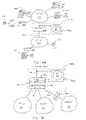
- Figure 4a shows an ACD center 400 having an improved level of granularity and bandwidth that also transports real time traffic over a packet switched network.
- Figure 4a is directed to the same example described in Figure 1. That is, a caller based in L.A. calls the corporate "1-800" number from his/her telephone 108.
- the PSTN 107 directs the call to the corporate ACD 400 via the physical layer connection 405 (e.g. a T3 line) between the PSTN 107 and the ACD 400.
- the physical layer connection 405 e.g. a T3 line
- the ACD gateway 401 is an endpoint on the H.323 corporate network 404 (also called a corporate intranet 404) that provides, two-way communication between H.323 based terminals (e.g., terminals 406a,b or c) on the corporate intranet 404 and an endpoint (e.g., H.324 telephone 108) on a different network such as PSTN 107.
- gateways enable two-way communication by providing the appropriate translation between different transmission formats and different communication procedures necessary for proper communication between endpoints existing on two different networks. For example, in order to provide communication between a terminal (e.g., terminal 406a) on the corporate intranet 404 and a terminal (e.g., telephone 108) on PSTN 107, the ACD gateway 401 of Figure 4a must translate the H.225 transmission format of the H.323 endpoint to/from the transmission format of the H.324 endpoint. A similar translation occurs for communication procedures such as capability exchange.
- gateways provide translation between different network technologies, regardless of the specific network technologies in use.
- Different networks are networks having different communication formats (e.g., frame structure) and/or procedures (e.g., call setup).
- a routing function is to be distinguished from a gateway function. Routing is related to the selection and/or identification of the most efficient path (or endpoint) traffic may travel (or travel to) in order to reach a destination point from a source point. Routing is therefore generally associated with determining the most efficient use of network resources.
- a gateway function is integrated with a routing function within a single machine.
- the ACD gateway 401 is also capable of communicating with other gateways, such as gateway 407 and gateway 410.
- non-H.323 terminals connected to the corporate Intranet 404 such as telephone 409 may communicate with terminals on the circuit switched network 107.
- H.323 terminals (such as terminal 410) connected to the circuit switched network 107 may communicate with terminals on the H.323 corporate intranet 404.
- any device connected to the PSTN 107 may communicate with any device connected to the corporate intranet 404 if gateways are properly employed and the endpoints are compatible with one another.
- gatekeepers generally provide call control services such as address translation, admission control, bandwidth control, zone management, call forwarding and call transfer.
- the tasks associated with the gatekeeper 402 are a form of gatekeeping as they perform admission control (e.g., caller confirmation) and call forwarding (e.g., agent or agent group selection).
- admission control e.g., caller confirmation
- call forwarding e.g., agent or agent group selection
- entity 402b e.g., agent or agent group selection
- a gatekeeper is therefore any device or function that monitors or controls (as opposed to simply translates) traffic flow between two different networks. Routing may be viewed as within the gatekeeping function as routing involves controlling the path or direction of traffic flow.
- the gateway/gatekeeper combination may enable and manage traffic flow in both directions across the boundary separating the two different networks.
- a workflow 403 is an integral part of the ACD 400. That is, ACD tasks such as caller confirmation and/or agent selection are performed by database workflows similar to those described in reference to Figure 3. As discussed, workflows are intelligent. Intelligence stems from the use of sophisticated software, high-speed storage devices and/or high performance CPUs. Introduction of a similar hardware platform within the ACD 400 environment results in (when compared to some traditional ACDs) massive databases that may be searched and or processed in small amounts of time. Thus, the CPU and data storage platforms that are typical of machines running business workflows (e.g., a UNIX workstation) are generally sufficient. Of course, as the functional complexity grows, higher performance equipment may be used. Regardless, the granularity problem that limited the number of skill sets per agent as well as the number of conditions per call screening is avoided at least in part.
- the hardware platform supporting the workflow 403 as well as the entire ACD 400 may have many different embodiments.
- a database supports a workflow if the workflow invokes methods and/or data from that database regardless of where the actual storage device resides.
- a workflow runs on or executes over a database.
- the high speed storage and high performance CPU that run the workflow 403 may be integrated with the ACD gateway 401 within the same frame chassis; or the gateway 401 and workflow 403 functions may be spread out into different hardware elements (such as a separate ACD gateway 401 in communication with a workstation or server responsible for running the workflow 403 as shown in Fig. 4).
- a gateway CPU may be the same high performance CPU that runs the workflow or the two processing elements may be split into separate processing cores.
- the gatekeeper 402 does not update DNIS information within a SCP 104 of the PSTN 107 (referring briefly to Figure 1). Instead, the gatekeeper 402 permits the initiation of call setup between the customer and the selected agent over the corporate intranet 404. Whereas the traditional ACD shown back in Figure 1 requires the call to be re-rerouted across the PSTN 107, in this embodiment the call is routed across the corporate intranet 404 and the bandwidth problem associated with the NIC of traditional ACDs is avoided.
- Figure 5 shows the functional processing associated with ACD 400. More specifically, Figure 5 shows the complete process 500 from caller confirmation to agent selection. The process 500 is similar to the operation of a traditional ACD. During caller confirmation, the source is identified 501 via the ANI and the destination is confirmed 502 via the DNIS. Skill sets and additional conditions are screened against the pool of available agents (blocks 504-506). From this an agent is selected.
- caller confirmation (blocks 501-502) may be done in hardware and software environments typical of traditional ACDs leaving only the agent selection process (blocks 504-506) to be performed over the database.
- agent selection process (blocks 504-506)
- Such an embodiment may be preferable, as only the agent selection process (because of the complexities of large skill set searching) is likely to require demanding processing from a database perspective.
- overhead constraints may make it easier to integrate caller confirmation and the IVRU within the workflow environment as well.
- Figure 6a shows an embodiment of an object oriented database architecture 600 for the agent selection workflow having two main classes of objects: 1) agents 601 and 2) additional conditions 602.
- object oriented database architecture 600 for the agent selection workflow having two main classes of objects: 1) agents 601 and 2) additional conditions 602.
- this specific embodiment has an agents object 601 class having three inherent classes: available 603, tech support 604 and sales 605. Agents may be tracked or identified throughout the workflow, for example, by IP address or employee serial number.
- the available object 603 contains a database of all available agents within the corporation. The database adds and deletes specific agents dynamically with customer usage of the agent resource pool. The meaning of "available" need not be strict. That is, the threshold for availability may be based on a customer queue measured in minutes for each agent.
- methods associated with the available object 603 database may use methods of a "intranet" object (not shown in Figure 6) responsible for monitoring and tracking traffic flow over the corporate intranet.
- the tech support object 604 contains a database of all tech support agents within the corporation. In this embodiment, it contains a record or profile of the entire skill set (e.g., languages, technical specialties, experience level etc.) for each tech support agent as well as a record of each tech support agent's location, time zone, etc. This data is entered consistent with corporate records.
- the sales object 605 contains a database of all the sales agents within the corporation. Its organization is similar to the tech support object 604 database except the technical items are replaced with specific sales related skills such as expertise within specific markets.
- Each of the three inherent classes 603, 604, 605 has methods unique to itself as well as methods common to the entire class. Methods associated with an object are also referred to as object methods.
- the available object 603 may have an object method for identifying agents based on the customer queue for that agent.
- the tech support object 604 may have an object method for identifying tech support agents based on the specific technical areas they have been approved to provide support for.
- the sales object 605 may have an object method for identifying sales agents based on the specific markets they have been approved to sell in.
- all three classes may have an object method for identifying an agent's name based on his or her IP address.
- the agent selection workflow (blocks 504-506 of Figure 5) is shown at the database level in Figure 6B.
- the workflow starts (in the example of this embodiment) with the preliminary IVRU information that the caller has requested a Spanish speaking tech support agent.
- the workflow employs the "identify by language" object method 606 of the tech support agent object 607.
- This method accepts "Spanish” as an input parameter and searches the encapsulated tech support database 607 profile for Spanish speaking skills to identify a first subset 608 of all Spanish speaking tech support agents within the corporation.
- the method requests the available object 603 to search its database 609 for any of the agents from the first subset 608 by invoking the "search for agents" object method 612.
- the "search for agents” method 612 accepts the first subset 608 as an input parameter.
- the available object 609 returns a second subset 610 containing all available, Spanish speaking tech support agents.
- the subsets may track the agents in any number of ways including but not limited to IP address or employee serial number.
- the additional conditions object 602 is responsible for determining the proper agent based on various corporate policies such as (but not limited to) flow balancing.
- the additional conditions database 611 records at least an estimated intranet 404 offered load parameter for each agent.
- the additional conditions database 611 uses the aforementioned "intranet" object (not shown in Figure 6) to dynamically track traffic flow over the corporate intranet 404 as it relates to each agent. Agents near intranet bottlenecks will have higher offered load figures than agents near less active portions of the intranet 404.
- Other policies such as a preference to route callers to the closest agent location (as discussed with reference to Figure 1), may also be implemented by keeping the proper data within the additional conditions database 611.
- the "determine final agent(s)" object method 613 of the additional conditions object 602 maps the subset 610 of available, Spanish speaking tech support agents (e.g., by IP address or employee serial number) against its encapsulated additional conditions database 611 and returns with the agent (or group of agents) having the least offered load to the intranet. That is, the additional conditions object 602 determines the final (i.e., selected) agent or group of agents by "steering" corporate intranet traffic away from congested regions.
- the incoming call is directed from the ACD gateway 401 to the IP address of the selected agent(s).
- the ACD 400 swaps the incoming DNIS with an IP address.
- the routing function of the ACD 400 is complete. Note the routing function of the ACD 400 (i.e., determination of the call destination via identification of the proper agent) is performed by the database workflow 403.
- a network function is a function within any of the OSI Reference Model layers (physical, data link, network, transport, session, presentation or application).
- a database having a network workflow is therefore any database workflow that performs a function associated with at least one OSI Reference Model layer.
- the ACD 400 just described determines the destination of an incoming call.
- the ACD database workflow 403 is performing a networking layer function.
- the ACD workflow 403 just described may be viewed as call setup which is a typically viewed as a session layer function. Either way, the ACD workflow 403 is a network workflow as the network and session layers are OSI Reference Model layers.
- the workflow of Figure 6 is just one embodiment.
- the agent class objects 603-605 may be an inherent class of a conditions object of which the additional conditions object 602 is also inherent. Further still, availability could be searched before agent skill sets. Policies of the type found in the additional conditions object 611 could be searched before or in between the skill set or availability searches. Many other types of searches may be performed as needed. Thus a multitude of different agent selection workflows exist.
- any protocol or standard that supports packet switched voice (or other real time) traffic may be employed as the concept of integrating a workflow with a gateway is transparent to the actual protocols or standards the gateway translates between.
- any IP based network including H.323 as well as more traditional TCP/IP intranets having 802.3 or 802.6 endpoints
- Real time traffic is traffic that cannot withstand significant delay.
- Circuit switched voice traffic as discussed in relation to Figure 2, is an example of real time traffic.
- packet switched telephony is a motivating factor for integrating a workflow within an ACD
- packet switched real time traffic is not an absolute requirement.
- the gateway itself is only required if two different networks are involved.
- the database 105 of Figure 1 is an object oriented workflow.
- workflow technology is simply integrated into existing ACDs such as Figure 1.
- embodiments may exist where a gateway is not used because translation is simply not required.
- a gateway (when used) does not necessarily need to translate to a corporate intranet 404 either.
- the gateway could connect two WANs.
- the corporate intranet may be "replaced" by a Cable TV network that transmits information (e.g., TV, video or other multimedia services) to homes rather than corporate offices.
- the agent selection workflow could route customer calls to a decentralized agent pool who work from home and have multimedia services via their cable TV carrier.
- SOHO Small Office Home Office
- networking applications can make use of database workflow technology regardless of the specific network technology (e.g., H.323 or otherwise) or the specific environment (e.g., corporate intranet otherwise).
- a device having the intelligence and speed to manage multiple types of media such as voice, data, video, etc.
- multiple sources/sinks of that media i.e., different networks such as PSTN, ISDN, the internet, ATM, H.323 etc.
- Figure 4b shows the ACD router 400b having a gateway 401b capable of, for example, translating corporate intranet 404 traffic with multiple networks such as the PSTN 107, an ISDN network 411 and the internet 412 via an ATM connection 415 to an internet service provider (ISP) 420.
- ISP internet service provider
- FIG. 4b shows a gateway 401b architecture consisting of an H.323 network interface 413, a translation layer 414 and three other network interfaces 415, 416, and 417 (corresponding to the ATM 415, ISDN 411 and the PSTN 107 respectively).
- gateways will have at least two different network interfaces and a translation layer.
- Network interfaces have signaling and physical connections consistent with their applicable standard.
- the PSTN 107 network interface 417 and ISDN 411 network interface 416 are capable of communicating with an H.324 terminal and H.320 terminal respectively.
- Other network interfaces may include but are not limited to B-ISDN (H.310), ATM (H.321), GQoS-LAN (H.322), Mobile (H.324M) and POTS.
- the translation layer 414 is responsible for translating between the corporate intranet 404 and the three external networks 107, 411 and 412.
- the translation layer for H.323 based networks is specified in ITU-T H.246.
- the gateway 401b is responsible for managing the multiple networks that may connect to the ACD 400b.
- the gateway 401b communicates with the gatekeeper 402b along communication channel 418.
- the communication channel is an H.323 extension of the corporate intranet 404.
- the H.323 gateway 401 and gatekeeper 402b are typically separate pieces of hardware (e.g., the gateway 401b is a commercially available gateway and the gatekeeper is a workstation running the workflow 403).
- the gateway 401 may also be integrated into the same chassis with the gatekeeper 402 such that the communication channel 418 is not an external corporate intranet but rather an internal system backplane or other bus within the chassis. Whether the gateway 401 and gatekeeper 402 communicate externally over a network (such as corporate intranet 404) or internally over a system backplane or bus; in either case the gateway 401 and gatekeeper 402 are deemed "communicatively coupled".
- the ACD 400b of Figure 4b can manage traffic media beyond voice.
- standard customer calls to the corporate "1-800" number will arrive via the PSTN 107 similar to the discussion regarding the embodiment of Figure 4a.
- customers may also attempt to correspond with the corporate agent pool via the corporate web page or through e-mail, both of which may arrive through the internet 412.
- sophisticated customers may attempt to have live video conferences with corporate agents via the ISDN network 411.
- the ACD 400b of Figure 4b must operate within a multimedia environment.
- database related workflows are highly versatile, they are ideally suited to manage multimedia environments.
- FIG. 7 shows another embodiment that acts as a centralized multimedia management station 700 (hereinafter, "station") that handles the various forms of customer inquiries to corporate agents that arrive in a multimedia environment (e.g., e-mail, voice calls, video, FAX, etc.).
- the station 700 integrates a number of servers 701-704 with an ACD 705 (that is similar to the ACD 400 of Figure 4) in order to facilitate multimedia networking environments. In so doing, the station 700 acts not only as a pre-call router ACD but also a multimedia server.
- the station 700 is capable of (among other tasks): 1) selecting an agent to receive a real time voice call or real time video call; 2) storing e-mail or FAX or video or voice-mail sent to a specific agent; and 3) selecting an agent to receive and then storing e-mail or FAX or video or voice-mail sent to a particular agent skill group (e.g., "sales" as opposed to a specific agent).
- a particular agent skill group e.g., "sales" as opposed to a specific agent.
- the voice server 701 stores voice mail
- the e-mail/data server 702 stores e-mail messages or other data files
- the FAX server 703 stores FAX messages.
- the web server 704 manages the corporate web page which may be configured to demand additional station 700 functionality. For example, the corporate web page may enable customers to directly purchase products. Thus the web server 704 will generate purchase orders that may be at least partially processed within the station 700 workflow 711 itself. Additional media server embodiments are possible such as a video-mail server.
- the various forms of media may enter the gateway 709 from any of the various networks (e.g., PSTN 706, ISDN 707, internet 708) to which the gateway 709 is connected.
- the gateway 709 of station 700 is similar to the gateway 401 already discussed in relation to Figure 4 and is responsible for managing the potentially multiple network interfaces.
- This format may be a corporate intranet packet in cases where the gateway 709 and workflow 711 functions operate on separate pieces of hardware.
- the format may be the data format used within the system backplane or other system bus if the workflow 711 and gateway 709 functions are integrated into a single machine.
- the media type (voice, e-mail, etc.) is identified by tagging the incoming traffic within a header or control field with a media type identifier.
- the workflow 711 ultimately makes use of this tag to initiate media dependent workflows.
- the station 700 has the ability to recognize the different media types and execute different workflows accordingly.
- a database workflow 800 for the station 700 is shown in Figure 8.
- the database parser 801 of Figure 8 immediately identifies the media type of the incoming network event or traffic 802. Once the media type is identified, specific workflows designed to operate solely on that form of media may be initiated.
- the workflow is organized into objects or libraries 803a,b,c which contain the media dependent database workflows 804.
- each library or object 803 contains media dependent workflows 804 that are specific to a certain type of media.
- Such workflows are deemed unique to the media type. Any processes that are inherently media independent (such as the agent selection process of Figures 5 and 6) may be used when needed as well.
- a media independent library or object 805 may also exist.
- the agent selection may also be media dependent in the sense that the agent's desktop equipment may be viewed as additional skill set criteria. That is, an agent must have real time video equipment to entertain a real time video customer call.
- An example of the operation of the embodiment of station 700 follows.
- An e-mail from the internet 708 for a specific agent, a voice call for the corporate "1-800" number from the PSTN 706 and a FAX for another specific agent from the ISDN network 707 all arrive at the gateway at approximately the same time.
- the gateway 709 translates the traffic to the H.323 format and prioritizes the traffic. For this example, the gateway 709 places the voice call, the FAX and then the e-mail in its outbound queue. Less intelligent gateways may simply handle all incoming traffic in FIFO fashion. Of course if the prioritization method were specified by the applicable standard or protocol the gateway must behave accordingly.
- the voice call, FAX and e-mail are sent to the workflow in order.
- the parser 801 uses the appropriate header information to first determine what type of media (e.g., voice, FAX or e-mail) the incoming event is characterized by. Since the voice call arrives first, the parser 801 determines that the incoming event is voice related and invokes the voice workflow library or object 803a.
- the workflow library also has a voice decision block 805a which is responsible for determining which specific workflow is to be initiated as a result of the specific event that arrives. For example, by using additional header information the voice decision block knows the incoming event is a general customer call to the "1-800" number.
- caller confirmation 805a and the IVRU function 804b are performed by the workflow 711. They may instead be performed by another server (e.g., an IVRU server - not shown in Figure 7) within the corporate intranet.
- another server e.g., an IVRU server - not shown in Figure 7
- an agent selection workflow 805a similar to the one discussed in relation to Figures 4, 5 and 6 is initiated. The agent is identified and the voice call is directed over the packet switched intranet.
- the workflows may operate over an object oriented database although this is not an absolute requirement.
- the parser 801 identifies the second event as an incoming FAX the parser 801 invokes the FAX workflow library 803b which also has a FAX decision block 805b.
- the FAX decision block 805b identifies the nature of the event (e.g., an incoming FAX requiring storage on the FAX server 703) and executes an appropriate workflow 804d (e.g., which identifies the agent to whom the FAX is directed and updates that agent's "FAX mailbox" on the FAX server 703).
- the e-mail is handled similar to the FAX.
- the parser 801 identifies the event as e-mail related (or more generally, "data") which invokes the e-mail/data library or object 803c.
- the e-mail/data decision block 805c identifies the event and initiates the proper e-mail/data workflow 804e which stores the e-mail message on the e-mail/data server 704.
- Both the FAX and e-mail/data workflows 804c,d could also send the specific destination agents a message that updates the "in" boxes on their desktop system.
- Figure 7 shows the various servers interconnected on a local LAN 720 which is an extension of the corporate intranet.
- the entire system could be integrated within a single chassis. That is, for example, each "server” is actually a partitioned region of a database platform within a single piece of hardware. From a software perspective each server may be viewed as its own object.
- Other embodiments that are a mixture of partitioned space within a single chassis and external servers that are communicated with over the corporate intranet are also possible.
- the various embodiments are not limited to those networks shown in Figure 7.
- the corporate intranet may be "replaced" by a Cable TV network (e.g., a Schedule 5 based network).
- the station 700 is a multimedia center that services homes rather than corporate desktops.
Landscapes
- Engineering & Computer Science (AREA)
- Signal Processing (AREA)
- Computer Networks & Wireless Communication (AREA)
- Business, Economics & Management (AREA)
- Multimedia (AREA)
- General Business, Economics & Management (AREA)
- Marketing (AREA)
- Computer Security & Cryptography (AREA)
- Data Exchanges In Wide-Area Networks (AREA)
Applications Claiming Priority (2)
| Application Number | Priority Date | Filing Date | Title |
|---|---|---|---|
| US09/224,410 US20010046209A1 (en) | 1998-12-31 | 1998-12-31 | Database workflow for multimedia networking and voip |
| US224410 | 1998-12-31 |
Publications (1)
| Publication Number | Publication Date |
|---|---|
| EP1017217A2 true EP1017217A2 (de) | 2000-07-05 |
Family
ID=22840547
Family Applications (1)
| Application Number | Title | Priority Date | Filing Date |
|---|---|---|---|
| EP99310477A Withdrawn EP1017217A2 (de) | 1998-12-31 | 1999-12-23 | Datenbankarbeitsfluss für Multimedia Netzwerk und VoIP |
Country Status (4)
| Country | Link |
|---|---|
| US (1) | US20010046209A1 (de) |
| EP (1) | EP1017217A2 (de) |
| BR (1) | BR9906036A (de) |
| CA (1) | CA2291801A1 (de) |
Cited By (12)
| Publication number | Priority date | Publication date | Assignee | Title |
|---|---|---|---|---|
| RU2303857C2 (ru) * | 2005-07-28 | 2007-07-27 | Борис Алексеевич Хозяинов | Персональный компьютер, интегрированный со шлюзом пакетной телефонии (варианты) |
| US7593415B2 (en) * | 2001-02-23 | 2009-09-22 | Santera Systems, Llc | Voice packet switching systems and methods |
| US7729346B2 (en) | 2004-09-18 | 2010-06-01 | Genband Inc. | UMTS call handling methods and apparatus |
| US7792150B2 (en) | 2005-08-19 | 2010-09-07 | Genband Us Llc | Methods, systems, and computer program products for supporting transcoder-free operation in media gateway |
| US7830864B2 (en) | 2004-09-18 | 2010-11-09 | Genband Us Llc | Apparatus and methods for per-session switching for multiple wireline and wireless data types |
| US7835346B2 (en) | 2006-01-17 | 2010-11-16 | Genband Us Llc | Methods, systems, and computer program products for providing transcoder free operation (TrFO) and interworking between unlicensed mobile access (UMA) and universal mobile telecommunications system (UMTS) call legs using a media gateway |
| US7990865B2 (en) | 2004-03-19 | 2011-08-02 | Genband Us Llc | Communicating processing capabilities along a communications path |
| US8027265B2 (en) | 2004-03-19 | 2011-09-27 | Genband Us Llc | Providing a capability list of a predefined format in a communications network |
| US8228926B2 (en) | 2005-04-12 | 2012-07-24 | Genband Us Llc | Dynamic loading for signaling variants |
| US8254372B2 (en) | 2003-02-21 | 2012-08-28 | Genband Us Llc | Data communication apparatus and method |
| US8346239B2 (en) | 2006-12-28 | 2013-01-01 | Genband Us Llc | Methods, systems, and computer program products for silence insertion descriptor (SID) conversion |
| US8908541B2 (en) | 2009-08-04 | 2014-12-09 | Genband Us Llc | Methods, systems, and computer readable media for intelligent optimization of digital signal processor (DSP) resource utilization in a media gateway |
Families Citing this family (19)
| Publication number | Priority date | Publication date | Assignee | Title |
|---|---|---|---|---|
| US6657992B1 (en) | 1999-02-12 | 2003-12-02 | Nortel Networks Limited | System and method for providing service control to a single telephone end terminal from multiple service providers |
| US6985957B2 (en) | 1999-06-29 | 2006-01-10 | Nec Corporation | Gateway system, gateway system configuring method, and gateway apparatus |
| EP1107562A1 (de) * | 1999-12-02 | 2001-06-13 | Alcatel | Eine Internet-geholfene verfahren zum aufstellen von einen Telefonanruf |
| FI20001293A7 (fi) * | 2000-05-30 | 2001-12-01 | Nokia Networks Oy | IP-puheen välitys langattomassa tietoliikennejärjestelmässä |
| FI20001382L (fi) * | 2000-06-09 | 2001-12-10 | Nokia Networks Oy | Kanavan allokointi verkoelementissä |
| US7103066B2 (en) * | 2000-10-12 | 2006-09-05 | At&T Corp. | Method and apparatus for providing common intelligent value-added service protocols for accessing value-added services by all multimedia application protocols |
| US7453830B2 (en) * | 2002-09-05 | 2008-11-18 | Rockwell Electronic Commerce Technologies, Llc | Internet architecture for software based ACD |
| DE10245547B3 (de) * | 2002-09-30 | 2004-05-13 | Tenovis Gmbh & Co. Kg | Verfahren zum Aufbau einer VoIP-Telefonverbindung in einem gesicherten Netzwerk sowie Schaltungsanordnung |
| NO319422B1 (no) * | 2003-05-23 | 2005-08-08 | Tandberg Telecom As | Fremgangsmate for handtering av datahastighetsendringer |
| KR100603569B1 (ko) * | 2004-09-13 | 2006-07-24 | 삼성전자주식회사 | 유무선으로 음성 및 데이터를 서비스하는 통신 단말시스템 및 그 신호 제어 방법 |
| GB0423326D0 (en) * | 2004-10-21 | 2004-11-24 | Nortel Networks Ltd | Improvements in or relating to call polarisation methods in a call center |
| US7864945B2 (en) * | 2004-11-30 | 2011-01-04 | Aspect Software, Inc. | Method for detecting availability of non-traditional agent |
| EP1972129A4 (de) * | 2006-01-11 | 2012-03-07 | Grape Technology Group Inc | Verbessertes telefonauskunftssystem mit peripherer anrufreihung und handhabung |
| US8086254B2 (en) | 2007-05-18 | 2011-12-27 | Tango Networks, Inc. | System, method, and apparatus for using alternative numbers for routing voice calls and short messages in a communications network |
| CN102165433A (zh) | 2008-07-31 | 2011-08-24 | Juma技术公司 | 模块化软件系统中为命令选路的系统和方法 |
| US8792631B2 (en) * | 2009-04-07 | 2014-07-29 | Echostar Technologies L.L.C. | System and method for matching service representatives with customers |
| US10078674B2 (en) * | 2010-06-04 | 2018-09-18 | Mcl Systems Limited | Integrated workflow and database transactions |
| US9020888B1 (en) | 2012-04-04 | 2015-04-28 | Nectar Services Corp. | Data replicating systems and data replication methods |
| FR3053197A1 (fr) * | 2016-06-24 | 2017-12-29 | Orange | Procede de communication udp via des chemins multiples entre deux terminaux |
-
1998
- 1998-12-31 US US09/224,410 patent/US20010046209A1/en not_active Abandoned
-
1999
- 1999-12-07 CA CA002291801A patent/CA2291801A1/en not_active Abandoned
- 1999-12-23 EP EP99310477A patent/EP1017217A2/de not_active Withdrawn
- 1999-12-31 BR BR9906036-1A patent/BR9906036A/pt not_active IP Right Cessation
Cited By (13)
| Publication number | Priority date | Publication date | Assignee | Title |
|---|---|---|---|---|
| US7593415B2 (en) * | 2001-02-23 | 2009-09-22 | Santera Systems, Llc | Voice packet switching systems and methods |
| US8254372B2 (en) | 2003-02-21 | 2012-08-28 | Genband Us Llc | Data communication apparatus and method |
| US7990865B2 (en) | 2004-03-19 | 2011-08-02 | Genband Us Llc | Communicating processing capabilities along a communications path |
| US8027265B2 (en) | 2004-03-19 | 2011-09-27 | Genband Us Llc | Providing a capability list of a predefined format in a communications network |
| US7830864B2 (en) | 2004-09-18 | 2010-11-09 | Genband Us Llc | Apparatus and methods for per-session switching for multiple wireline and wireless data types |
| US7729346B2 (en) | 2004-09-18 | 2010-06-01 | Genband Inc. | UMTS call handling methods and apparatus |
| US8228926B2 (en) | 2005-04-12 | 2012-07-24 | Genband Us Llc | Dynamic loading for signaling variants |
| RU2303857C2 (ru) * | 2005-07-28 | 2007-07-27 | Борис Алексеевич Хозяинов | Персональный компьютер, интегрированный со шлюзом пакетной телефонии (варианты) |
| US7792150B2 (en) | 2005-08-19 | 2010-09-07 | Genband Us Llc | Methods, systems, and computer program products for supporting transcoder-free operation in media gateway |
| US7835346B2 (en) | 2006-01-17 | 2010-11-16 | Genband Us Llc | Methods, systems, and computer program products for providing transcoder free operation (TrFO) and interworking between unlicensed mobile access (UMA) and universal mobile telecommunications system (UMTS) call legs using a media gateway |
| US8346239B2 (en) | 2006-12-28 | 2013-01-01 | Genband Us Llc | Methods, systems, and computer program products for silence insertion descriptor (SID) conversion |
| US8908541B2 (en) | 2009-08-04 | 2014-12-09 | Genband Us Llc | Methods, systems, and computer readable media for intelligent optimization of digital signal processor (DSP) resource utilization in a media gateway |
| US9559978B2 (en) | 2009-08-04 | 2017-01-31 | Genband Us Llc | Methods, systems, and computer readable media for intelligent optimization of digital signal processor (DSP) resource utilization in a media gateway |
Also Published As
| Publication number | Publication date |
|---|---|
| US20010046209A1 (en) | 2001-11-29 |
| BR9906036A (pt) | 2000-09-12 |
| CA2291801A1 (en) | 2000-06-30 |
Similar Documents
| Publication | Publication Date | Title |
|---|---|---|
| EP1017217A2 (de) | Datenbankarbeitsfluss für Multimedia Netzwerk und VoIP | |
| US8428047B2 (en) | Enterprise contact server with enhanced routing features | |
| EP1162814B1 (de) | Multimedia Kundenanrufzentrale mit schichtformigen Steuerarchitektur | |
| US9648168B2 (en) | Method and apparatus for optimizing response time to events in queue | |
| US7454505B2 (en) | Communication endpoint supporting multiple provider models | |
| US6185292B1 (en) | Skill-based real-time call routing in telephony systems | |
| US6735621B1 (en) | Method and apparatus for messaging between disparate networks | |
| US7619996B2 (en) | Determining presence for interaction routing | |
| US6185287B1 (en) | Parallel data transfer and synchronization | |
| US6374302B1 (en) | Method and system to provide an action control point master gatekeeper | |
| US5963632A (en) | Agent-initiated dynamic requeing of misrouted calls in call-routing systems | |
| US8031698B2 (en) | Telephony intelligence in a data packet network | |
| USRE46776E1 (en) | Method and apparatus for optimizing response time to events in queue | |
| US6549539B1 (en) | Platform-independent DNT intelligent network | |
| US8024401B1 (en) | Customer relationship management system with network contact center server configured to control automated web and voice dialogues | |
| US6920441B2 (en) | Method and apparatus for building communication between agent desktop scripting applications and an outbound call software suite within a telecommunications center | |
| US20040120501A1 (en) | Connection manager for integrating legacy telephony environments and IP networks | |
| US20020159475A1 (en) | Integrated internet and voice enabled call center | |
| AU771695B2 (en) | Enterprise contact server with enhanced routing features | |
| EP1380155B1 (de) | Anrufzentrale |
Legal Events
| Date | Code | Title | Description |
|---|---|---|---|
| PUAI | Public reference made under article 153(3) epc to a published international application that has entered the european phase |
Free format text: ORIGINAL CODE: 0009012 |
|
| AK | Designated contracting states |
Kind code of ref document: A2 Designated state(s): AT BE CH CY DE DK ES FI FR GB GR IE IT LI LU MC NL PT SE |
|
| AX | Request for extension of the european patent |
Free format text: AL;LT;LV;MK;RO;SI |
|
| RAP1 | Party data changed (applicant data changed or rights of an application transferred) |
Owner name: NORTEL NETWORKS LIMITED |
|
| STAA | Information on the status of an ep patent application or granted ep patent |
Free format text: STATUS: THE APPLICATION HAS BEEN WITHDRAWN |
|
| 18W | Application withdrawn |
Effective date: 20030214 |