EP1017280B1 - Fongicides de traitement de semences permettant de lutter contre des maladies vegetales - Google Patents
Fongicides de traitement de semences permettant de lutter contre des maladies vegetales Download PDFInfo
- Publication number
- EP1017280B1 EP1017280B1 EP98943518A EP98943518A EP1017280B1 EP 1017280 B1 EP1017280 B1 EP 1017280B1 EP 98943518 A EP98943518 A EP 98943518A EP 98943518 A EP98943518 A EP 98943518A EP 1017280 B1 EP1017280 B1 EP 1017280B1
- Authority
- EP
- European Patent Office
- Prior art keywords
- recited
- methyl
- compound
- plant
- independently
- Prior art date
- Legal status (The legal status is an assumption and is not a legal conclusion. Google has not performed a legal analysis and makes no representation as to the accuracy of the status listed.)
- Expired - Lifetime
Links
- 201000010099 disease Diseases 0.000 title description 7
- 208000037265 diseases, disorders, signs and symptoms Diseases 0.000 title description 7
- 239000000417 fungicide Substances 0.000 title description 7
- 239000000203 mixture Substances 0.000 claims abstract description 35
- 238000000034 method Methods 0.000 claims abstract description 31
- -1 thiophanate compound Chemical class 0.000 claims abstract description 29
- 150000001875 compounds Chemical class 0.000 claims abstract description 19
- 230000000855 fungicidal effect Effects 0.000 claims abstract description 17
- 241000233866 Fungi Species 0.000 claims abstract description 14
- 125000002947 alkylene group Chemical group 0.000 claims abstract description 11
- 239000012990 dithiocarbamate Substances 0.000 claims abstract description 11
- 150000003839 salts Chemical class 0.000 claims abstract description 8
- XERJKGMBORTKEO-VZUCSPMQSA-N (1e)-2-(ethylcarbamoylamino)-n-methoxy-2-oxoethanimidoyl cyanide Chemical compound CCNC(=O)NC(=O)C(\C#N)=N\OC XERJKGMBORTKEO-VZUCSPMQSA-N 0.000 claims description 31
- 239000005756 Cymoxanil Substances 0.000 claims description 29
- 244000061456 Solanum tuberosum Species 0.000 claims description 26
- 239000005802 Mancozeb Substances 0.000 claims description 24
- 241000233622 Phytophthora infestans Species 0.000 claims description 21
- 241000196324 Embryophyta Species 0.000 claims description 19
- 239000001257 hydrogen Substances 0.000 claims description 16
- 229910052739 hydrogen Inorganic materials 0.000 claims description 16
- 125000004178 (C1-C4) alkyl group Chemical group 0.000 claims description 14
- 125000001495 ethyl group Chemical group [H]C([H])([H])C([H])([H])* 0.000 claims description 14
- 125000002496 methyl group Chemical group [H]C([H])([H])* 0.000 claims description 14
- QGHREAKMXXNCOA-UHFFFAOYSA-N thiophanate-methyl Chemical compound COC(=O)NC(=S)NC1=CC=CC=C1NC(=S)NC(=O)OC QGHREAKMXXNCOA-UHFFFAOYSA-N 0.000 claims description 14
- 125000004435 hydrogen atom Chemical group [H]* 0.000 claims description 13
- 239000005842 Thiophanate-methyl Substances 0.000 claims description 12
- 125000004169 (C1-C6) alkyl group Chemical group 0.000 claims description 8
- 229910052725 zinc Inorganic materials 0.000 claims description 5
- 125000003903 2-propenyl group Chemical group [H]C([*])([H])C([H])=C([H])[H] 0.000 claims description 4
- UFHFLCQGNIYNRP-UHFFFAOYSA-N Hydrogen Chemical compound [H][H] UFHFLCQGNIYNRP-UHFFFAOYSA-N 0.000 claims description 3
- 235000002595 Solanum tuberosum Nutrition 0.000 description 23
- 239000000428 dust Substances 0.000 description 17
- YFNCATAIYKQPOO-UHFFFAOYSA-N thiophanate Chemical class CCOC(=O)NC(=S)NC1=CC=CC=C1NC(=S)NC(=O)OCC YFNCATAIYKQPOO-UHFFFAOYSA-N 0.000 description 14
- 238000012360 testing method Methods 0.000 description 8
- 238000009472 formulation Methods 0.000 description 7
- 230000012010 growth Effects 0.000 description 7
- 208000015181 infectious disease Diseases 0.000 description 6
- 239000000725 suspension Substances 0.000 description 5
- XLYOFNOQVPJJNP-UHFFFAOYSA-N water Substances O XLYOFNOQVPJJNP-UHFFFAOYSA-N 0.000 description 5
- 239000011701 zinc Substances 0.000 description 5
- 229920001817 Agar Polymers 0.000 description 4
- 241000219495 Betulaceae Species 0.000 description 4
- 239000008272 agar Substances 0.000 description 4
- 239000012153 distilled water Substances 0.000 description 4
- 235000012015 potatoes Nutrition 0.000 description 4
- 230000010076 replication Effects 0.000 description 4
- WSFSSNUMVMOOMR-UHFFFAOYSA-N Formaldehyde Chemical compound O=C WSFSSNUMVMOOMR-UHFFFAOYSA-N 0.000 description 3
- 239000005821 Propamocarb Substances 0.000 description 3
- 239000010949 copper Substances 0.000 description 3
- WZZLDXDUQPOXNW-UHFFFAOYSA-N propamocarb Chemical compound CCCOC(=O)NCCCN(C)C WZZLDXDUQPOXNW-UHFFFAOYSA-N 0.000 description 3
- 239000007787 solid Substances 0.000 description 3
- 230000028070 sporulation Effects 0.000 description 3
- 238000003860 storage Methods 0.000 description 3
- QNBTYORWCCMPQP-JXAWBTAJSA-N (Z)-dimethomorph Chemical compound C1=C(OC)C(OC)=CC=C1C(\C=1C=CC(Cl)=CC=1)=C/C(=O)N1CCOCC1 QNBTYORWCCMPQP-JXAWBTAJSA-N 0.000 description 2
- 239000005761 Dimethomorph Substances 0.000 description 2
- 239000005807 Metalaxyl Substances 0.000 description 2
- 239000004480 active ingredient Substances 0.000 description 2
- 239000007844 bleaching agent Substances 0.000 description 2
- JHRWWRDRBPCWTF-OLQVQODUSA-N captafol Chemical compound C1C=CC[C@H]2C(=O)N(SC(Cl)(Cl)C(Cl)Cl)C(=O)[C@H]21 JHRWWRDRBPCWTF-OLQVQODUSA-N 0.000 description 2
- CRQQGFGUEAVUIL-UHFFFAOYSA-N chlorothalonil Chemical compound ClC1=C(Cl)C(C#N)=C(Cl)C(C#N)=C1Cl CRQQGFGUEAVUIL-UHFFFAOYSA-N 0.000 description 2
- 238000005520 cutting process Methods 0.000 description 2
- 239000003085 diluting agent Substances 0.000 description 2
- HKIOYBQGHSTUDB-UHFFFAOYSA-N folpet Chemical compound C1=CC=C2C(=O)N(SC(Cl)(Cl)Cl)C(=O)C2=C1 HKIOYBQGHSTUDB-UHFFFAOYSA-N 0.000 description 2
- 230000035784 germination Effects 0.000 description 2
- XEEYBQQBJWHFJM-UHFFFAOYSA-N iron Substances [Fe] XEEYBQQBJWHFJM-UHFFFAOYSA-N 0.000 description 2
- 239000007788 liquid Substances 0.000 description 2
- YKSNLCVSTHTHJA-UHFFFAOYSA-L maneb Chemical compound [Mn+2].[S-]C(=S)NCCNC([S-])=S YKSNLCVSTHTHJA-UHFFFAOYSA-L 0.000 description 2
- ZQEIXNIJLIKNTD-UHFFFAOYSA-N methyl N-(2,6-dimethylphenyl)-N-(methoxyacetyl)alaninate Chemical compound COCC(=O)N(C(C)C(=O)OC)C1=C(C)C=CC=C1C ZQEIXNIJLIKNTD-UHFFFAOYSA-N 0.000 description 2
- 238000002156 mixing Methods 0.000 description 2
- UWVQIROCRJWDKL-UHFFFAOYSA-N oxadixyl Chemical compound CC=1C=CC=C(C)C=1N(C(=O)COC)N1CCOC1=O UWVQIROCRJWDKL-UHFFFAOYSA-N 0.000 description 2
- SUKJFIGYRHOWBL-UHFFFAOYSA-N sodium hypochlorite Chemical compound [Na+].Cl[O-] SUKJFIGYRHOWBL-UHFFFAOYSA-N 0.000 description 2
- 239000004094 surface-active agent Substances 0.000 description 2
- 230000009885 systemic effect Effects 0.000 description 2
- 239000000454 talc Substances 0.000 description 2
- 229910052623 talc Inorganic materials 0.000 description 2
- 239000008399 tap water Substances 0.000 description 2
- 235000020679 tap water Nutrition 0.000 description 2
- 239000010457 zeolite Substances 0.000 description 2
- NHOWDZOIZKMVAI-UHFFFAOYSA-N (2-chlorophenyl)(4-chlorophenyl)pyrimidin-5-ylmethanol Chemical compound C=1N=CN=CC=1C(C=1C(=CC=CC=1)Cl)(O)C1=CC=C(Cl)C=C1 NHOWDZOIZKMVAI-UHFFFAOYSA-N 0.000 description 1
- 0 *OC(*C(Nc1c(*C(NC(O*)=O)=S)cccc1)=S)=O Chemical compound *OC(*C(Nc1c(*C(NC(O*)=O)=S)cccc1)=S)=O 0.000 description 1
- JMZRZEXRYJUHEB-UHFFFAOYSA-N 2-carbamothioylsulfanylethyl carbamodithioate;zinc Chemical compound [Zn].NC(=S)SCCSC(N)=S JMZRZEXRYJUHEB-UHFFFAOYSA-N 0.000 description 1
- UHPMCKVQTMMPCG-UHFFFAOYSA-N 5,8-dihydroxy-2-methoxy-6-methyl-7-(2-oxopropyl)naphthalene-1,4-dione Chemical compound CC1=C(CC(C)=O)C(O)=C2C(=O)C(OC)=CC(=O)C2=C1O UHPMCKVQTMMPCG-UHFFFAOYSA-N 0.000 description 1
- 239000005995 Aluminium silicate Substances 0.000 description 1
- KXDAEFPNCMNJSK-UHFFFAOYSA-N Benzamide Chemical compound NC(=O)C1=CC=CC=C1 KXDAEFPNCMNJSK-UHFFFAOYSA-N 0.000 description 1
- KXDHJXZQYSOELW-UHFFFAOYSA-M Carbamate Chemical compound NC([O-])=O KXDHJXZQYSOELW-UHFFFAOYSA-M 0.000 description 1
- TWFZGCMQGLPBSX-UHFFFAOYSA-N Carbendazim Natural products C1=CC=C2NC(NC(=O)OC)=NC2=C1 TWFZGCMQGLPBSX-UHFFFAOYSA-N 0.000 description 1
- 239000005747 Chlorothalonil Substances 0.000 description 1
- RYGMFSIKBFXOCR-UHFFFAOYSA-N Copper Chemical compound [Cu] RYGMFSIKBFXOCR-UHFFFAOYSA-N 0.000 description 1
- 239000005789 Folpet Substances 0.000 description 1
- 241000223218 Fusarium Species 0.000 description 1
- 244000020551 Helianthus annuus Species 0.000 description 1
- 235000003222 Helianthus annuus Nutrition 0.000 description 1
- 239000005909 Kieselgur Substances 0.000 description 1
- PWHULOQIROXLJO-UHFFFAOYSA-N Manganese Chemical compound [Mn] PWHULOQIROXLJO-UHFFFAOYSA-N 0.000 description 1
- 208000031888 Mycoses Diseases 0.000 description 1
- 241000233679 Peronosporaceae Species 0.000 description 1
- 241000233610 Plasmopara halstedii Species 0.000 description 1
- VYPSYNLAJGMNEJ-UHFFFAOYSA-N Silicium dioxide Chemical compound O=[Si]=O VYPSYNLAJGMNEJ-UHFFFAOYSA-N 0.000 description 1
- QAOWNCQODCNURD-UHFFFAOYSA-L Sulfate Chemical compound [O-]S([O-])(=O)=O QAOWNCQODCNURD-UHFFFAOYSA-L 0.000 description 1
- 239000004098 Tetracycline Substances 0.000 description 1
- 229910021536 Zeolite Inorganic materials 0.000 description 1
- HCHKCACWOHOZIP-UHFFFAOYSA-N Zinc Chemical compound [Zn] HCHKCACWOHOZIP-UHFFFAOYSA-N 0.000 description 1
- PTFCDOFLOPIGGS-UHFFFAOYSA-N Zinc dication Chemical compound [Zn+2] PTFCDOFLOPIGGS-UHFFFAOYSA-N 0.000 description 1
- 239000000654 additive Substances 0.000 description 1
- 235000012211 aluminium silicate Nutrition 0.000 description 1
- JXLHNMVSKXFWAO-UHFFFAOYSA-N azane;7-fluoro-2,1,3-benzoxadiazole-4-sulfonic acid Chemical compound N.OS(=O)(=O)C1=CC=C(F)C2=NON=C12 JXLHNMVSKXFWAO-UHFFFAOYSA-N 0.000 description 1
- RIOXQFHNBCKOKP-UHFFFAOYSA-N benomyl Chemical compound C1=CC=C2N(C(=O)NCCCC)C(NC(=O)OC)=NC2=C1 RIOXQFHNBCKOKP-UHFFFAOYSA-N 0.000 description 1
- 239000006013 carbendazim Substances 0.000 description 1
- JNPZQRQPIHJYNM-UHFFFAOYSA-N carbendazim Chemical compound C1=C[CH]C2=NC(NC(=O)OC)=NC2=C1 JNPZQRQPIHJYNM-UHFFFAOYSA-N 0.000 description 1
- 239000000969 carrier Substances 0.000 description 1
- WIIZWVCIJKGZOK-RKDXNWHRSA-N chloramphenicol Chemical compound ClC(Cl)C(=O)N[C@H](CO)[C@H](O)C1=CC=C([N+]([O-])=O)C=C1 WIIZWVCIJKGZOK-RKDXNWHRSA-N 0.000 description 1
- 229960005091 chloramphenicol Drugs 0.000 description 1
- 238000004140 cleaning Methods 0.000 description 1
- 238000000576 coating method Methods 0.000 description 1
- 239000007859 condensation product Substances 0.000 description 1
- 229910052802 copper Inorganic materials 0.000 description 1
- XERJKGMBORTKEO-UHFFFAOYSA-N cymoxanil Chemical compound CCNC(=O)NC(=O)C(C#N)=NOC XERJKGMBORTKEO-UHFFFAOYSA-N 0.000 description 1
- 125000000118 dimethyl group Chemical group [H]C([H])([H])* 0.000 description 1
- HNPSIPDUKPIQMN-UHFFFAOYSA-N dioxosilane;oxo(oxoalumanyloxy)alumane Chemical compound O=[Si]=O.O=[Al]O[Al]=O HNPSIPDUKPIQMN-UHFFFAOYSA-N 0.000 description 1
- 239000002270 dispersing agent Substances 0.000 description 1
- 230000000694 effects Effects 0.000 description 1
- 239000004495 emulsifiable concentrate Substances 0.000 description 1
- 239000000839 emulsion Substances 0.000 description 1
- 238000011156 evaluation Methods 0.000 description 1
- 150000002191 fatty alcohols Chemical class 0.000 description 1
- BFWMWWXRWVJXSE-UHFFFAOYSA-M fentin hydroxide Chemical compound C=1C=CC=CC=1[Sn](C=1C=CC=CC=1)(O)C1=CC=CC=C1 BFWMWWXRWVJXSE-UHFFFAOYSA-M 0.000 description 1
- 239000001963 growth medium Substances 0.000 description 1
- 238000000338 in vitro Methods 0.000 description 1
- 238000012750 in vivo screening Methods 0.000 description 1
- 238000011534 incubation Methods 0.000 description 1
- 239000003701 inert diluent Substances 0.000 description 1
- NLYAJNPCOHFWQQ-UHFFFAOYSA-N kaolin Chemical compound O.O.O=[Al]O[Si](=O)O[Si](=O)O[Al]=O NLYAJNPCOHFWQQ-UHFFFAOYSA-N 0.000 description 1
- 229920005610 lignin Polymers 0.000 description 1
- 229910052748 manganese Inorganic materials 0.000 description 1
- 239000011572 manganese Substances 0.000 description 1
- 239000002480 mineral oil Substances 0.000 description 1
- 235000010446 mineral oil Nutrition 0.000 description 1
- PSZYNBSKGUBXEH-UHFFFAOYSA-N naphthalene-1-sulfonic acid Chemical compound C1=CC=C2C(S(=O)(=O)O)=CC=CC2=C1 PSZYNBSKGUBXEH-UHFFFAOYSA-N 0.000 description 1
- 244000052769 pathogen Species 0.000 description 1
- 230000001717 pathogenic effect Effects 0.000 description 1
- 230000007918 pathogenicity Effects 0.000 description 1
- 230000003032 phytopathogenic effect Effects 0.000 description 1
- 230000008659 phytopathology Effects 0.000 description 1
- 239000000049 pigment Substances 0.000 description 1
- 239000004033 plastic Substances 0.000 description 1
- 239000000843 powder Substances 0.000 description 1
- 238000002360 preparation method Methods 0.000 description 1
- 239000000047 product Substances 0.000 description 1
- 238000012216 screening Methods 0.000 description 1
- 230000007226 seed germination Effects 0.000 description 1
- 239000002002 slurry Substances 0.000 description 1
- ZEVCJZRMCOYJSP-UHFFFAOYSA-N sodium;2-(dithiocarboxyamino)ethylcarbamodithioic acid Chemical compound [Na+].SC(=S)NCCNC(S)=S ZEVCJZRMCOYJSP-UHFFFAOYSA-N 0.000 description 1
- 239000002689 soil Substances 0.000 description 1
- 239000000243 solution Substances 0.000 description 1
- 239000000126 substance Substances 0.000 description 1
- 229910021653 sulphate ion Inorganic materials 0.000 description 1
- 208000024891 symptom Diseases 0.000 description 1
- 229960002180 tetracycline Drugs 0.000 description 1
- 229930101283 tetracycline Natural products 0.000 description 1
- 235000019364 tetracycline Nutrition 0.000 description 1
- 150000003522 tetracyclines Chemical class 0.000 description 1
- 239000004308 thiabendazole Substances 0.000 description 1
- WJCNZQLZVWNLKY-UHFFFAOYSA-N thiabendazole Chemical compound S1C=NC(C=2NC3=CC=CC=C3N=2)=C1 WJCNZQLZVWNLKY-UHFFFAOYSA-N 0.000 description 1
- 229960004546 thiabendazole Drugs 0.000 description 1
- 235000010296 thiabendazole Nutrition 0.000 description 1
- 239000002562 thickening agent Substances 0.000 description 1
- 238000009736 wetting Methods 0.000 description 1
- 239000000080 wetting agent Substances 0.000 description 1
- 150000003751 zinc Chemical class 0.000 description 1
Classifications
-
- A—HUMAN NECESSITIES
- A01—AGRICULTURE; FORESTRY; ANIMAL HUSBANDRY; HUNTING; TRAPPING; FISHING
- A01N—PRESERVATION OF BODIES OF HUMANS OR ANIMALS OR PLANTS OR PARTS THEREOF; BIOCIDES, e.g. AS DISINFECTANTS, AS PESTICIDES OR AS HERBICIDES; PEST REPELLANTS OR ATTRACTANTS; PLANT GROWTH REGULATORS
- A01N47/00—Biocides, pest repellants or attractants, or plant growth regulators containing organic compounds containing a carbon atom not being member of a ring and having no bond to a carbon or hydrogen atom, e.g. derivatives of carbonic acid
- A01N47/08—Biocides, pest repellants or attractants, or plant growth regulators containing organic compounds containing a carbon atom not being member of a ring and having no bond to a carbon or hydrogen atom, e.g. derivatives of carbonic acid the carbon atom having one or more single bonds to nitrogen atoms
- A01N47/28—Ureas or thioureas containing the groups >N—CO—N< or >N—CS—N<
- A01N47/34—Ureas or thioureas containing the groups >N—CO—N< or >N—CS—N< containing the groups, e.g. biuret; Thio analogues thereof; Urea-aldehyde condensation products
Definitions
- This invention relates to a method for controlling fungus diseases in plants by applying to the seed or tuber a fungicidally effective amount of a 2-alkoxyiminoacetamide compound such as cymoxanil, in admixture with one or more of an alkylene bis-dithiocarbamate complex salt such as mancozeb, and a thiophanate compound such as thiophanate-methyl.
- a fungicidal composition comprising, in a fungicidally effective aggregate amount, a 2-alkoxyiminoacetamide compound, an alkylene bis-dithiocarbamate complex salt, and a thiophanate compound.
- Late Blight is the devastating disease that affected the Irish potato crop over 150 years ago.
- the Late Blight fungus Phytophthora infestans
- New strains of P. infestans have evolved that are fungicide resistant and which are more aggressive with respect to pathogenicity on the potato tuber.
- the disease can now be introduced into potato fields by means of infected seed tubers more efficiently than in the past.
- GB-A-1 470 740 discloses a fungicidal mixture comprising 1 to 10 parts by weight of and from 1 to 1000 parts by weight of a fungicide selected from manganese ethylene-bisdithiocarbamate, admixed with inorganic zinc salts; co-ordination product of zinc ion and manganese ethylenebisdithiocarbamate (mancozeb); zinc ethylene bisdithiocarbamate; fixed copper; N-(trichloromethylthio)phthalimide (folpet); 2,4,5,6-tetrachloroisophthalonitrile (chlorothalonil); cis-N-[(1,1,2,2-tetrachloroethyl)thio]-4-cyclohexene-1,2-dicarboximide (captafol); and triphenyltin hydroxide.
- a fungicide selected from manganese ethylene-bisdithiocarbamate, admixed with inorgan
- DD-A-298 340 discloses compositions which preferably comprise a combination of carbendazim, fenarimol and cymoxanil, for controlling Fusarium dry-blight of potatoes.
- Plant Dis. (1989), 73(9), 751-3 describes a field control of potato late blight by fungicides selected from the group consisting of oxadixyl, metalaxyl, propamocarb, cymoxanil, and mancozeb and mixtures thereof.
- Crop Prot. (1988), 7(3), 210-15 describes a test concerning the efficacy over time of cymoxanil mixtures in controlling late blight in potatoes incited by a phenylamide-resistant isolate of Phytophthora infestans.
- US-A-5 007 953 discloses methods of using comminuted Alder bark as a stimulator of seed germination and growth media comprising comminuted Alder bark.
- RO-A-80510 discloses a composition for fighting tuber and tuber-bulb rot comprising mancozeb combined with benomil, methyl thiophanate or thia-bendazole and tetracycline or chloramphenicol.
- This invention relates to a method for combatting plant fungi in a plant, which comprises applying to the seeds or tubers of the plant, a fungicidally effective amount of:
- This invention further relates to a fungicidal composition
- a fungicidal composition comprising:
- the 2-alkoxyiminoacetamide compounds, alkylene bis-dithiocarbamate complex salts, and thiophanate compounds useful in the method and composition of this invention are known in the art, as are methods for their preparation. See, e.g., U. S. Patents Nos. 3,957,847; 3,379,610; and 5,571,443, respectively.
- the method and composition of this invention are particularly suitable for use against Phytophthora infestans on or in potato plants and tubers.
- composition of this invention and the compounds useful in the method of this invention can be formulated in conventional ways.
- useful formulations include slurries, solid seed coatings, soaks, dusts on the surface of the seed or tuber, solutions, suspensions, emulsions, wettable powders, emulsifiable concentrates, and the like.
- the formulations in general, comprise about 1% to 99% by weight of active ingredient.
- the formulations can additionally comprise additional additives such as surfactants, solid or liquid diluents, pigments, thickeners, and the like.
- the method of application of the formulations to the seeds or tubers can vary depending, e.g., on the compounds and/or the formulation used.
- the seed or tuber should be treated with about 50 to about 1200 ppm, preferably between about 300 to about 900 ppm, most preferably, about 700 ppm, per 45.36 kg (100 pounds) ("cwt") of seed or tuber, of the composition of this invention or of the compounds useful in the method of this invention.
- This invention preferably relates to a method for combatting plant fungi in a plant, which comprises applying to the seeds or tubers of the plant, an effective amount of a fungicidal composition comprising a fungicidally effective amount of:
- This invention further preferably relates to a fungicidal composition
- a fungicidal composition comprising cymoxanil, mancozeb and thiophanate-methyl, in an effective aggregate amount.
- Cymoxanil, mancozeb and thiophanate-methyl are all known compounds.
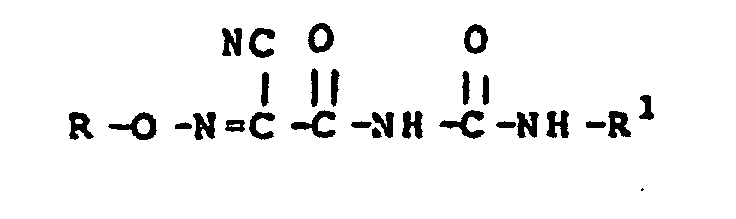
- Cymoxanil (a foliar fungicide sold under the trademarks CURZATE and DPX-3217 ) is 2-cyano-N-[(ethylamino)carbonyl]-2-(methoxyimino)-acetamide.
- Mancozeb (a fungicide sold under the trademarks MANZATE-200 and DITHANE M-45 ) is a mixture of [[1,2-ethanediylbis-(carbamodithioato)](2-)]manganese and [[1,2-ethanediylbis(carbamothioato)](2)-]zinc.
- Thiophanate-methyl (a systemic fungicide sold under the trademarks TOPSIN M and NF-44 ) is dimethyl[1,2-phenylene-bis-(iminocarbono-thioyl)-bis-[carbamate].
- composition of this invention in general, satisfactory results can be obtained when the weight ratio of cymoxanil:mancozeb:thiophanate-methyl is from about 3:1:1 to about 1:16:6, preferably, about 1.5:1:1 to about 1:8:3.
- the formulations can comprise from 0 to about 20% of an agriculturally acceptable surfactant such as wetting and dispersing agents, e.g., the condensation product of formaldehyde with naphthalene sulphonate, an alkylarylsulphonate, a lignin sulphonate, a fatty sulphate, an ethoxylated alkylphenol and an ethoxylated fatty alcohol.
- the formulations can additionally comprise from about 10 to about 99% of an agriculturally acceptable solid or liquid diluent, including carriers, such as talc, zeolites, Alder bark, kaolin, diatomaceous earth, mineral oil, water, and the like.
- Potato tubers were removed from 5°C storage and allowed to come to room temperature. The tubers were then washed with tap water and sterilized in 5% commercial bleach (Clorox) for 10 minutes. The tubers were then rinsed in sterile distilled water and dried.
- Chlorox commercial bleach
- Phytophthora infestans was grown on agar plates at 18°C for 10-14 days. 20 ml. of 5°C sterile distilled water were then added to each plate. The agar was then agitated or cut into smaller sections and placed at 10-12 °C for 2 hours to release zoospores.
- Tubers were cut into uniform sized slices, 1 cm thick). Each dust was applied to 20 slices at 0,2268kg/cwt (0.5 lb/cwt). Two sets of 20 potato slices were left untreated with dust and used as controls. Each dusted potato slice was then placed on sterile moistened filter paper in a sterile petri dish.
- a zoospore suspension was quantified to a concentration of 20,000 spores/ml. 100 ml of this spore suspension was then applied to a sterile filter paper disk. One such treated disk was placed in the center of each potato slice. One set of 20 undusted potato slices were not inoculated and used as a sterile control.
- Each potato slice was then placed in the dark at 18°C for 7 days. After the 7 days, the disease state of each potato slice was assessed.
- Potato tubers were removed from 5°C storage and allowed to come to room temperature. The tubers were then washed with tap water and sterilized in 5% commercial bleach (Clorox) for 10 minutes. The tubers were then rinsed in sterile distilled water and dried.
- Chlorox commercial bleach
- Phytophthora infestans was grown on agar plates at 18°C for 10-14 days. 20 ml. of 5°C sterile distilled water were then added to each plate. The agar was then agitated or cut into smaller sections and placed at 10-12°C for 2 hours to release zoospores. A zoospore suspension was quantified to a concentration of 20,000 spores/ml.
- Potatoes not dipped in the zoospores were also cut into 56,699-113,398 g (2-4 oz.) pieces and one set of 15 uninoculated potato pieces was used as a sterile control.
- potato pieces were then placed in sandy soil and incubated at 17°C days and 13°C nights for 32 days. Growth after emergence was monitored for 14-28 days. Disease symptoms were visually rated. Stem/leaf tissue was assayed for P. infestans on appropriate media. Finally, potato seed pieces were then removed and cut in half and disease presence was visually assessed.
- Example 4 The dusts prepared in Example 4 above (as well as Dusts Nos. 7 and 8) were tested using the procedure described in Example 2 above using Red Nordland tubers. The results of this testing (7 replications/treatment) are shown in Table 9 below.
- EMERGENCE AND STEM HEALTH Dust No. Emergence (%) Infection (%) Day 10 Day 38 Stems 7 0 0 no stems 8 14.3 14.3 100 14 0 0 no stems 15 85.7 100 14 16 57.1 85.7 0 17 42.9 85.7 14 18 71.4 100 0 Untreated 0 0 no stems Sterile 57.1 100 0
- Shepody potato tubers were contaminated/inoculated with Phytophthora infestans and set aside ("source tubers"). After two weeks, one (1) source tuber was cut into quarters through the diseased area with a cutting knife. Without cleaning or changing the knife, five (5) uninoculated Shepody potato tubers were then cut into quarters. This process (1 source tuber/5 uninfected tubers) was repeated to provide enough tubers for 30 replications per treatment (Table 10 below).
- the cut tubers (source and uninoculated) were weighed and the appropriate amount of each dust listed in Table 10 below was applied to the tubers by placing the tubers in a double paper bag with dust and then shaking the bag.
- the treated tubers were then placed in an unsealed plastic bag (one bag per treatment) and incubated at 10°C, 80-90% RH, for two (2) weeks. After two (2) weeks, the bagged tubers were removed from the 10°C, 80-90% RH environment. The bags were then rolled or shaken to simulate movement from storage to planting areas. The tubers were removed and the spread of P. infestans was determined - % infected tubers. The tubers were warmed to room temperature and planted. The source tubers were not planted. Emergence and infection data were obtained as described above in Example 2 (30 replications/treatment).
- Example 6 The procedure described above in Example 6 was repeated using Red Nordland potato tubers. The results of this test are present below in Table 11. EMERGENCE AND TUBER AND STEM HEALTH Dust No. Emergence (%) Infection (%) Day 8 Day 25 Tubers (Before planting) Stems 7 20 83.3 47.5 33 8 20 83.3 52.5 33 14 30 70 52.5 0 15 26.7 90 50 0 17 26.7 96.7 45 0 18 36.7 100 45 0 19 20 96.7 35 0 Untreated 10 20 60 33 Sterile 36.7 100 0 0 0 0
Landscapes
- Life Sciences & Earth Sciences (AREA)
- Agronomy & Crop Science (AREA)
- Pest Control & Pesticides (AREA)
- Plant Pathology (AREA)
- Health & Medical Sciences (AREA)
- Engineering & Computer Science (AREA)
- Dentistry (AREA)
- General Health & Medical Sciences (AREA)
- Wood Science & Technology (AREA)
- Zoology (AREA)
- Environmental Sciences (AREA)
- Agricultural Chemicals And Associated Chemicals (AREA)
- Organic Low-Molecular-Weight Compounds And Preparation Thereof (AREA)
Claims (18)
- Procédé de lutte contre des champignons des plantes dans une plante, qui comprend d'appliquer, aux semences ou aux tubercules de la plante, une quantité efficace d'une composition fongicide comprenant une quantité fongicidement efficace de :dans laquelle R2 et R3 sont chacun, indépendamment, un groupe alkyle en C1-C6.a) un composé de 2-alcoxyiminoacétamide, de formule :dans laquelle R est un groupe méthyle ou un groupe éthyle et R1 est un atome d'hydrogène, un groupe allyle ou un groupe alkyle en C1-C4;
 b) un sel en complexe d'alkylène bis-dithiocarbamate, de formule :dans laquelle R4 et R5 sont chacun, indépendamment, un atome d'hydrogène ou un groupe alkyle en C1-C6 ; Q est Zn, Fe ou Cu ; et le rapport de x à y est d'environ 3/1 à environ 100/1 ; et
 c) un composé de thiophanate, de formule :
- Procédé selon la revendication 1, dans lequel R1 et R2, et R3 sont chacun, indépendamment, un groupe alkyle en C1-C4, et R4 et R5 sont chacun, indépendamment, un atome d'hydrogène ou un groupe alkyle en C1-C4.
- Procédé selon la revendication 2, dans lequel R1, R2, et R3 sont chacun, indépendamment, un groupe méthyle ou un groupe éthyle, et R4 et R5 sont chacun, indépendamment, un atome d'hydrogène, un groupe méthyle ou un groupe éthyle.
- Procédé selon la revendication 3, dans lequel Q est Zn et le rapport de x à y est de 5/1 à 20/1.
- Procédé selon la revendication 4, dans lequel le rapport de x à y est de 6/1 à 10/1.
- Procédé selon la revendication 5, dans lequel le composé de 2-alcoxyiminoacétamide est le cymoxanil ; le composé sel en complexe d'alkylène bis-dithiocarbamate est le mancozeb ; et le composé de thiophanate est le thiophanate-méthyle.
- Procédé selon la revendication 1, dans lequel la plante est une plante de pomme de terre.
- Procédé selon la revendication 7, dans lequel le champignon est le champignon Phytophthora infestans du mildiou (Late Blight).
- Composition fongicide comprenant une quantité fongicidement efficace de :dans laquelle R2 et R3 sont chacun, indépendamment, un groupe alkyle en C1-C6.a) un composé de 2-alcoxyiminoacétamide, de formule :dans laquelle R est un groupe méthyle ou un groupe éthyle et R1 est un atome d'hydrogène, un groupe allyle ou un groupe alkyle en C1-C4 ;
 b) un composé sel en complexe d'alkylène bis-dithiocarbamate, de formule :dans laquelle R4 et R5 sont chacun, indépendamment, un atome d'hydrogène ou un groupe alkyle en C1-C6 ; Q est Zn, Fe ou Cu ; et le rapport de x à y est d'environ 3/1 à environ 100/1 ; et
 c) un composé de thiophanate, de formule :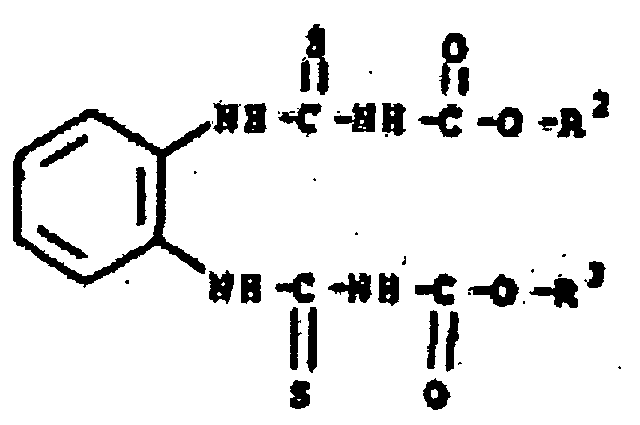
- Composition selon la revendication 9, dans laquelle R1 et R2, et R3 sont chacun, indépendamment, un groupe alkyle en C1-C4, et R4 et R5 sont chacun, indépendamment, un atome d'hydrogène ou un groupe alkyle en C1-C4.
- Composition selon la revendication 10, dans laquelle R1, R2, et R3 sont chacun, indépendamment, un groupe méthyle ou un groupe éthyle, et R4 et R5 sont chacun, indépendamment, un atome d'hydrogène, un groupe méthyle ou un groupe éthyle.
- Composition selon la revendication 11, dans laquelle Q est Zn et le rapport de x à y est de 5/1 à 20/1.
- Composition selon la revendication 12, dans laquelle le rapport de x à y est de 6/1 à 10/1.
- Composition selon la revendication 13, dans laquelle le composé de 2-alcoxyiminoacétamide est le cymoxanil ; le composé sel en complexe d'alkylène bis-dithiocarbamate est le mancozeb ; et le composé de thiophanate est le thiophanate-méthyle.
- Procédé de lutte contre des champignons des plantes dans une plante, qui comprend d'appliquer, aux semences ou aux tubercules de la plante, une quantité efficace d'une composition fongicide comprenant une quantité fongicidement efficace de cymoxanil associé dans un mélange avec du mancozeb et du thiophanate-méthyle.
- Procédé selon la revendication 15, dans lequel la plante est une plante de pomme de terre.
- Procédé selon la revendication 16, dans lequel le champignon est le champignon Phytophthora infestans du mildiou (Late Blight).
- Composition fongicide comprenant du cymoxanil, du mancozeb et du thiophanate-méthyle, en une quantité d'agrégat efficace.
Applications Claiming Priority (5)
| Application Number | Priority Date | Filing Date | Title |
|---|---|---|---|
| US5929397P | 1997-09-18 | 1997-09-18 | |
| US59293P | 1997-09-18 | ||
| US09/132,927 US6228883B1 (en) | 1997-09-18 | 1998-08-12 | Seed treatment fungicides for control of plant diseases |
| US132927 | 1998-08-12 | ||
| PCT/US1998/018221 WO1999013722A1 (fr) | 1997-09-18 | 1998-09-01 | Fongicides de traitement de semences permettant de lutter contre des maladies vegetales |
Publications (2)
| Publication Number | Publication Date |
|---|---|
| EP1017280A1 EP1017280A1 (fr) | 2000-07-12 |
| EP1017280B1 true EP1017280B1 (fr) | 2004-08-18 |
Family
ID=26738589
Family Applications (1)
| Application Number | Title | Priority Date | Filing Date |
|---|---|---|---|
| EP98943518A Expired - Lifetime EP1017280B1 (fr) | 1997-09-18 | 1998-09-01 | Fongicides de traitement de semences permettant de lutter contre des maladies vegetales |
Country Status (7)
| Country | Link |
|---|---|
| US (2) | US6228883B1 (fr) |
| EP (1) | EP1017280B1 (fr) |
| AT (1) | ATE273618T1 (fr) |
| CA (1) | CA2304153C (fr) |
| DE (1) | DE69825766T2 (fr) |
| EA (1) | EA004531B1 (fr) |
| WO (1) | WO1999013722A1 (fr) |
Families Citing this family (7)
| Publication number | Priority date | Publication date | Assignee | Title |
|---|---|---|---|---|
| AU779385B2 (en) * | 1999-08-11 | 2005-01-20 | Dow Agrosciences Llc | Oil in water flowable pesticide formulation |
| US8084393B1 (en) | 2006-02-06 | 2011-12-27 | Kresge Paul O | Potato treatment composition |
| AR075573A1 (es) | 2009-02-11 | 2011-04-20 | Basf Se | Dimethomorph como protector de plaguicidas con efectos fitotoxicos |
| US8209902B2 (en) * | 2009-07-02 | 2012-07-03 | Nanotech Industries, Inc. | Biologically active multifunctional nanochips and method of application thereof for production of high-quality seed |
| CN101983566A (zh) * | 2010-11-18 | 2011-03-09 | 利民化工股份有限公司 | 一种三元复配可湿性粉剂及其制备方法和应用 |
| CN102657202A (zh) * | 2012-04-23 | 2012-09-12 | 赵国彬 | 一种防治霜霉病、疫病的杀菌剂 |
| US20150101245A1 (en) * | 2013-10-15 | 2015-04-16 | Stuart Barclay | Seed coating compositions |
Family Cites Families (9)
| Publication number | Priority date | Publication date | Assignee | Title |
|---|---|---|---|---|
| BE617407A (fr) | 1961-05-09 | |||
| GB1407330A (en) | 1972-12-25 | 1975-09-24 | Nippon Soda Co | Process for the production of thiophane derivatives |
| US3957847A (en) | 1974-03-21 | 1976-05-18 | E. I. Du Pont De Nemours And Company | 2-cyano-2-hydroxyiminoacetamides as plant disease control agents |
| GB1470740A (en) | 1975-11-18 | 1977-04-21 | Du Pont | Fungicides |
| RO80510B1 (ro) * | 1979-07-30 | 1983-02-28 | Institutul De Cercetari Pentru Protectia Plantelor | Preparat pentru combaterea putregaiurilor tuberculilor, bulbilor si tuberobulbilor |
| US4742079A (en) | 1982-01-26 | 1988-05-03 | Sandoz Ltd. | Fungicides containing cymoxanil and metalaxyl |
| US5007953A (en) | 1986-05-07 | 1991-04-16 | Snake River Chemicals, Inc. | Seed treatment compositions |
| DD298340A5 (de) * | 1989-12-28 | 1992-02-20 | Berlin-Chemie Ag,De | Mittel zur bekaempfung von fusarium-trockenfaeule bei kartoffeln |
| DE4304172A1 (de) | 1993-02-12 | 1994-08-25 | Bayer Ag | Fungizide Wirkstoffkombinationen |
-
1998
- 1998-08-12 US US09/132,927 patent/US6228883B1/en not_active Expired - Lifetime
- 1998-09-01 AT AT98943518T patent/ATE273618T1/de not_active IP Right Cessation
- 1998-09-01 EP EP98943518A patent/EP1017280B1/fr not_active Expired - Lifetime
- 1998-09-01 DE DE69825766T patent/DE69825766T2/de not_active Expired - Lifetime
- 1998-09-01 EA EA200000333A patent/EA004531B1/ru not_active IP Right Cessation
- 1998-09-01 WO PCT/US1998/018221 patent/WO1999013722A1/fr not_active Ceased
- 1998-09-01 CA CA002304153A patent/CA2304153C/fr not_active Expired - Lifetime
-
1999
- 1999-06-25 US US09/340,104 patent/US6127411A/en not_active Expired - Lifetime
Also Published As
| Publication number | Publication date |
|---|---|
| US6228883B1 (en) | 2001-05-08 |
| DE69825766D1 (de) | 2004-09-23 |
| EA004531B1 (ru) | 2004-06-24 |
| DE69825766T2 (de) | 2005-08-25 |
| CA2304153C (fr) | 2008-12-02 |
| EP1017280A1 (fr) | 2000-07-12 |
| EA200000333A1 (ru) | 2000-10-30 |
| WO1999013722A1 (fr) | 1999-03-25 |
| CA2304153A1 (fr) | 1999-03-25 |
| ATE273618T1 (de) | 2004-09-15 |
| US6127411A (en) | 2000-10-03 |
Similar Documents
| Publication | Publication Date | Title |
|---|---|---|
| Gisi et al. | Synergistic interactions of fungicides with different modes of action | |
| EP1017280B1 (fr) | Fongicides de traitement de semences permettant de lutter contre des maladies vegetales | |
| EP1317178B1 (fr) | Compositions fongicides | |
| AU2002212227A1 (en) | Fungicidal compositions | |
| Samoucha et al. | Possible explanations of synergism in fungicide mixtures against Phytophthom infestans | |
| JPH07277909A (ja) | 殺菌剤組成物 | |
| US11261169B2 (en) | Manufacturing method for and insecticidal compositions comprising thiocyclam hydrochloride | |
| US7150877B2 (en) | Fungicidal mixtures comprising R-metalaxyl | |
| Lartey et al. | Control of Rhizoctonia solani and cotton seedling disease by Laetisaria arvalis and a mycophagous insect Proisotoma minuta (Collembola) | |
| EP0783836B1 (fr) | Mélanges fongicides synergiques pour lutter contre les maladies des plantes | |
| HU198825B (en) | Synergic fungicides | |
| Pfeiffer | Toxicity of avermectin B1 to San Jose scale (Homoptera: Diaspididae) crawlers, and effects on orchard mites by crawler sprays compared with full-season applications | |
| CA1120853A (fr) | Melange synergiste insecticide de 0,0-diethyl 0-(3,5,-trichloro-2-pyridinyl) phosphorothioate, et de 0-ethyl-0-(2-chloro-4-bromophenyl)-s-n-propyl- phosphorothioate | |
| Cooke et al. | Control of potato late blight (Phytophthora infestans) with systemic fungicides | |
| MXPA00002697A (en) | Seed treatment fungicides for control of plant diseases | |
| EP0018707B1 (fr) | Composition insecticide synergique contenant le phosphorothioate de 0,0-diéthyl-0-(3,5,6-trichloro-2-pyridinyle) et le phosphorothioate de 0-éthyl-0-((4-méthylthio)phényl-S-n-propyle et procédé de lutte contre des insectes au moyen de cette composition | |
| EP1006799B1 (fr) | Procede pour la protection des plantes | |
| US5601847A (en) | Microbicides | |
| CA1064823A (fr) | Procede de traitement des graines | |
| KR20000048280A (ko) | 엔-아세토닐벤즈아미드를 함유하는 살진균 조성물 | |
| EP1247449B1 (fr) | Composition fongicide, contenant une N-acétylbenzamide et du Folpet | |
| US20030189958A1 (en) | Fungicidal compositions | |
| JPS6156104A (ja) | ジスルフイドを有効成分とする種子殺菌剤 | |
| MXPA96006310A (en) | Synergistic fungicide mixtures for the control of diseases in plan |
Legal Events
| Date | Code | Title | Description |
|---|---|---|---|
| PUAI | Public reference made under article 153(3) epc to a published international application that has entered the european phase |
Free format text: ORIGINAL CODE: 0009012 |
|
| 17P | Request for examination filed |
Effective date: 20000207 |
|
| AK | Designated contracting states |
Kind code of ref document: A1 Designated state(s): AT DE DK ES FI FR GB IT NL |
|
| 17Q | First examination report despatched |
Effective date: 20020507 |
|
| GRAP | Despatch of communication of intention to grant a patent |
Free format text: ORIGINAL CODE: EPIDOSNIGR1 |
|
| GRAS | Grant fee paid |
Free format text: ORIGINAL CODE: EPIDOSNIGR3 |
|
| GRAA | (expected) grant |
Free format text: ORIGINAL CODE: 0009210 |
|
| AK | Designated contracting states |
Kind code of ref document: B1 Designated state(s): AT DE DK ES FI FR GB IT NL |
|
| PG25 | Lapsed in a contracting state [announced via postgrant information from national office to epo] |
Ref country code: FI Free format text: LAPSE BECAUSE OF FAILURE TO SUBMIT A TRANSLATION OF THE DESCRIPTION OR TO PAY THE FEE WITHIN THE PRESCRIBED TIME-LIMIT Effective date: 20040818 Ref country code: AT Free format text: LAPSE BECAUSE OF FAILURE TO SUBMIT A TRANSLATION OF THE DESCRIPTION OR TO PAY THE FEE WITHIN THE PRESCRIBED TIME-LIMIT Effective date: 20040818 |
|
| REG | Reference to a national code |
Ref country code: GB Ref legal event code: FG4D |
|
| REF | Corresponds to: |
Ref document number: 69825766 Country of ref document: DE Date of ref document: 20040923 Kind code of ref document: P |
|
| PG25 | Lapsed in a contracting state [announced via postgrant information from national office to epo] |
Ref country code: DK Free format text: LAPSE BECAUSE OF FAILURE TO SUBMIT A TRANSLATION OF THE DESCRIPTION OR TO PAY THE FEE WITHIN THE PRESCRIBED TIME-LIMIT Effective date: 20041118 |
|
| PG25 | Lapsed in a contracting state [announced via postgrant information from national office to epo] |
Ref country code: ES Free format text: LAPSE BECAUSE OF FAILURE TO SUBMIT A TRANSLATION OF THE DESCRIPTION OR TO PAY THE FEE WITHIN THE PRESCRIBED TIME-LIMIT Effective date: 20041129 |
|
| ET | Fr: translation filed | ||
| PLBE | No opposition filed within time limit |
Free format text: ORIGINAL CODE: 0009261 |
|
| STAA | Information on the status of an ep patent application or granted ep patent |
Free format text: STATUS: NO OPPOSITION FILED WITHIN TIME LIMIT |
|
| 26N | No opposition filed |
Effective date: 20050519 |
|
| PGFP | Annual fee paid to national office [announced via postgrant information from national office to epo] |
Ref country code: DE Payment date: 20100930 Year of fee payment: 13 |
|
| PGFP | Annual fee paid to national office [announced via postgrant information from national office to epo] |
Ref country code: FR Payment date: 20110901 Year of fee payment: 14 Ref country code: GB Payment date: 20110826 Year of fee payment: 14 |
|
| PGFP | Annual fee paid to national office [announced via postgrant information from national office to epo] |
Ref country code: NL Payment date: 20110912 Year of fee payment: 14 Ref country code: IT Payment date: 20110920 Year of fee payment: 14 |
|
| REG | Reference to a national code |
Ref country code: NL Ref legal event code: V1 Effective date: 20130401 |
|
| GBPC | Gb: european patent ceased through non-payment of renewal fee |
Effective date: 20120901 |
|
| REG | Reference to a national code |
Ref country code: FR Ref legal event code: ST Effective date: 20130531 |
|
| REG | Reference to a national code |
Ref country code: DE Ref legal event code: R119 Ref document number: 69825766 Country of ref document: DE Effective date: 20130403 |
|
| PG25 | Lapsed in a contracting state [announced via postgrant information from national office to epo] |
Ref country code: DE Free format text: LAPSE BECAUSE OF NON-PAYMENT OF DUE FEES Effective date: 20130403 Ref country code: GB Free format text: LAPSE BECAUSE OF NON-PAYMENT OF DUE FEES Effective date: 20120901 |
|
| PG25 | Lapsed in a contracting state [announced via postgrant information from national office to epo] |
Ref country code: FR Free format text: LAPSE BECAUSE OF NON-PAYMENT OF DUE FEES Effective date: 20121001 Ref country code: IT Free format text: LAPSE BECAUSE OF NON-PAYMENT OF DUE FEES Effective date: 20120901 Ref country code: NL Free format text: LAPSE BECAUSE OF NON-PAYMENT OF DUE FEES Effective date: 20130401 |