EP1017660B1 - Procede de production d'aldehydes par hydroformylation en presence d'ether couronne - Google Patents
Procede de production d'aldehydes par hydroformylation en presence d'ether couronne Download PDFInfo
- Publication number
- EP1017660B1 EP1017660B1 EP98948928A EP98948928A EP1017660B1 EP 1017660 B1 EP1017660 B1 EP 1017660B1 EP 98948928 A EP98948928 A EP 98948928A EP 98948928 A EP98948928 A EP 98948928A EP 1017660 B1 EP1017660 B1 EP 1017660B1
- Authority
- EP
- European Patent Office
- Prior art keywords
- rhodium
- aqueous phase
- reaction
- olefins
- olefin
- Prior art date
- Legal status (The legal status is an assumption and is not a legal conclusion. Google has not performed a legal analysis and makes no representation as to the accuracy of the status listed.)
- Expired - Lifetime
Links
- 150000003983 crown ethers Chemical class 0.000 title claims description 13
- 150000001299 aldehydes Chemical class 0.000 title claims description 9
- 238000004519 manufacturing process Methods 0.000 title claims description 6
- 238000007037 hydroformylation reaction Methods 0.000 title description 23
- 239000003054 catalyst Substances 0.000 claims description 44
- 239000010948 rhodium Substances 0.000 claims description 44
- 150000001336 alkenes Chemical class 0.000 claims description 43
- 229910052703 rhodium Inorganic materials 0.000 claims description 43
- MHOVAHRLVXNVSD-UHFFFAOYSA-N rhodium atom Chemical compound [Rh] MHOVAHRLVXNVSD-UHFFFAOYSA-N 0.000 claims description 41
- 238000006243 chemical reaction Methods 0.000 claims description 29
- 238000000034 method Methods 0.000 claims description 27
- 239000008346 aqueous phase Substances 0.000 claims description 26
- JRZJOMJEPLMPRA-UHFFFAOYSA-N olefin Natural products CCCCCCCC=C JRZJOMJEPLMPRA-UHFFFAOYSA-N 0.000 claims description 26
- 239000012074 organic phase Substances 0.000 claims description 21
- 150000001875 compounds Chemical class 0.000 claims description 16
- -1 phenylnaphthyl Chemical group 0.000 claims description 15
- 125000004432 carbon atom Chemical group C* 0.000 claims description 13
- UGFAIRIUMAVXCW-UHFFFAOYSA-N Carbon monoxide Chemical compound [O+]#[C-] UGFAIRIUMAVXCW-UHFFFAOYSA-N 0.000 claims description 12
- 229910002091 carbon monoxide Inorganic materials 0.000 claims description 12
- 239000001257 hydrogen Substances 0.000 claims description 12
- 229910052739 hydrogen Inorganic materials 0.000 claims description 12
- UFHFLCQGNIYNRP-UHFFFAOYSA-N Hydrogen Chemical compound [H][H] UFHFLCQGNIYNRP-UHFFFAOYSA-N 0.000 claims description 11
- YWAKXRMUMFPDSH-UHFFFAOYSA-N pentene Chemical compound CCCC=C YWAKXRMUMFPDSH-UHFFFAOYSA-N 0.000 claims description 11
- QGZKDVFQNNGYKY-UHFFFAOYSA-O Ammonium Chemical compound [NH4+] QGZKDVFQNNGYKY-UHFFFAOYSA-O 0.000 claims description 9
- ZUOUZKKEUPVFJK-UHFFFAOYSA-N diphenyl Chemical compound C1=CC=CC=C1C1=CC=CC=C1 ZUOUZKKEUPVFJK-UHFFFAOYSA-N 0.000 claims description 9
- 239000003446 ligand Substances 0.000 claims description 9
- LIKMAJRDDDTEIG-UHFFFAOYSA-N 1-hexene Chemical compound CCCCC=C LIKMAJRDDDTEIG-UHFFFAOYSA-N 0.000 claims description 8
- QQONPFPTGQHPMA-UHFFFAOYSA-N Propene Chemical compound CC=C QQONPFPTGQHPMA-UHFFFAOYSA-N 0.000 claims description 8
- VXNZUUAINFGPBY-UHFFFAOYSA-N 1-Butene Chemical compound CCC=C VXNZUUAINFGPBY-UHFFFAOYSA-N 0.000 claims description 7
- CRSBERNSMYQZNG-UHFFFAOYSA-N 1-dodecene Chemical compound CCCCCCCCCCC=C CRSBERNSMYQZNG-UHFFFAOYSA-N 0.000 claims description 6
- 229910001413 alkali metal ion Inorganic materials 0.000 claims description 6
- 239000007788 liquid Substances 0.000 claims description 5
- ZGEGCLOFRBLKSE-UHFFFAOYSA-N 1-Heptene Chemical compound CCCCCC=C ZGEGCLOFRBLKSE-UHFFFAOYSA-N 0.000 claims description 4
- KWKAKUADMBZCLK-UHFFFAOYSA-N 1-octene Chemical compound CCCCCCC=C KWKAKUADMBZCLK-UHFFFAOYSA-N 0.000 claims description 4
- DCTOHCCUXLBQMS-UHFFFAOYSA-N 1-undecene Chemical compound CCCCCCCCCC=C DCTOHCCUXLBQMS-UHFFFAOYSA-N 0.000 claims description 4
- XEZNGIUYQVAUSS-UHFFFAOYSA-N 18-crown-6 Chemical compound C1COCCOCCOCCOCCOCCO1 XEZNGIUYQVAUSS-UHFFFAOYSA-N 0.000 claims description 4
- 125000001931 aliphatic group Chemical group 0.000 claims description 4
- 235000010290 biphenyl Nutrition 0.000 claims description 4
- 239000004305 biphenyl Substances 0.000 claims description 4
- DDFNIWBATAORBX-UHFFFAOYSA-N 3-bis(3-sulfophenyl)phosphanylbenzenesulfonic acid;sodium Chemical compound [Na].[Na].[Na].OS(=O)(=O)C1=CC=CC(P(C=2C=C(C=CC=2)S(O)(=O)=O)C=2C=C(C=CC=2)S(O)(=O)=O)=C1 DDFNIWBATAORBX-UHFFFAOYSA-N 0.000 claims description 3
- ZDZHCHYQNPQSGG-UHFFFAOYSA-N binaphthyl group Chemical group C1(=CC=CC2=CC=CC=C12)C1=CC=CC2=CC=CC=C12 ZDZHCHYQNPQSGG-UHFFFAOYSA-N 0.000 claims description 3
- 229940069096 dodecene Drugs 0.000 claims description 3
- 125000001624 naphthyl group Chemical group 0.000 claims description 3
- VFTFKUDGYRBSAL-UHFFFAOYSA-N 15-crown-5 Chemical compound C1COCCOCCOCCOCCO1 VFTFKUDGYRBSAL-UHFFFAOYSA-N 0.000 claims description 2
- TVMXDCGIABBOFY-UHFFFAOYSA-N n-Octanol Natural products CCCCCCCC TVMXDCGIABBOFY-UHFFFAOYSA-N 0.000 claims description 2
- 125000001997 phenyl group Chemical group [H]C1=C([H])C([H])=C(*)C([H])=C1[H] 0.000 claims description 2
- 239000004711 α-olefin Substances 0.000 claims description 2
- 150000003984 12-crown-4 derivatives Chemical group 0.000 claims 1
- DIOQZVSQGTUSAI-UHFFFAOYSA-N n-butylhexane Natural products CCCCCCCCCC DIOQZVSQGTUSAI-UHFFFAOYSA-N 0.000 claims 1
- 239000012071 phase Substances 0.000 description 28
- RIOQSEWOXXDEQQ-UHFFFAOYSA-N triphenylphosphine Chemical class C1=CC=CC=C1P(C=1C=CC=CC=1)C1=CC=CC=C1 RIOQSEWOXXDEQQ-UHFFFAOYSA-N 0.000 description 12
- 230000015572 biosynthetic process Effects 0.000 description 9
- 239000000047 product Substances 0.000 description 9
- 239000000243 solution Substances 0.000 description 8
- 239000002904 solvent Substances 0.000 description 8
- 239000003153 chemical reaction reagent Substances 0.000 description 7
- 239000007789 gas Substances 0.000 description 7
- 238000003786 synthesis reaction Methods 0.000 description 7
- 229940077464 ammonium ion Drugs 0.000 description 6
- 150000001768 cations Chemical class 0.000 description 6
- 150000003242 quaternary ammonium salts Chemical class 0.000 description 6
- MYAJTCUQMQREFZ-UHFFFAOYSA-K tppts Chemical compound [Na+].[Na+].[Na+].[O-]S(=O)(=O)C1=CC=CC(P(C=2C=C(C=CC=2)S([O-])(=O)=O)C=2C=C(C=CC=2)S([O-])(=O)=O)=C1 MYAJTCUQMQREFZ-UHFFFAOYSA-K 0.000 description 6
- XLYOFNOQVPJJNP-UHFFFAOYSA-N water Substances O XLYOFNOQVPJJNP-UHFFFAOYSA-N 0.000 description 6
- 239000007983 Tris buffer Substances 0.000 description 5
- 125000004437 phosphorous atom Chemical group 0.000 description 5
- IJGRMHOSHXDMSA-UHFFFAOYSA-N Atomic nitrogen Chemical compound N#N IJGRMHOSHXDMSA-UHFFFAOYSA-N 0.000 description 4
- XYFCBTPGUUZFHI-UHFFFAOYSA-N Phosphine Chemical compound P XYFCBTPGUUZFHI-UHFFFAOYSA-N 0.000 description 4
- 239000007864 aqueous solution Substances 0.000 description 4
- 239000011203 carbon fibre reinforced carbon Substances 0.000 description 4
- 239000007795 chemical reaction product Substances 0.000 description 4
- 238000004821 distillation Methods 0.000 description 4
- 239000000203 mixture Substances 0.000 description 4
- 238000002360 preparation method Methods 0.000 description 4
- SVOOVMQUISJERI-UHFFFAOYSA-K rhodium(3+);triacetate Chemical compound [Rh+3].CC([O-])=O.CC([O-])=O.CC([O-])=O SVOOVMQUISJERI-UHFFFAOYSA-K 0.000 description 4
- 238000000926 separation method Methods 0.000 description 4
- 239000000126 substance Substances 0.000 description 4
- HRXKRNGNAMMEHJ-UHFFFAOYSA-K trisodium citrate Chemical class [Na+].[Na+].[Na+].[O-]C(=O)CC(O)(CC([O-])=O)C([O-])=O HRXKRNGNAMMEHJ-UHFFFAOYSA-K 0.000 description 4
- 229910000831 Steel Inorganic materials 0.000 description 3
- 150000001298 alcohols Chemical class 0.000 description 3
- 229910017052 cobalt Inorganic materials 0.000 description 3
- 239000010941 cobalt Substances 0.000 description 3
- GUTLYIVDDKVIGB-UHFFFAOYSA-N cobalt atom Chemical compound [Co] GUTLYIVDDKVIGB-UHFFFAOYSA-N 0.000 description 3
- 238000004817 gas chromatography Methods 0.000 description 3
- 238000002156 mixing Methods 0.000 description 3
- 238000005191 phase separation Methods 0.000 description 3
- 229920005862 polyol Polymers 0.000 description 3
- 150000003254 radicals Chemical class 0.000 description 3
- 239000010959 steel Substances 0.000 description 3
- 230000007306 turnover Effects 0.000 description 3
- 229910052725 zinc Inorganic materials 0.000 description 3
- 239000011701 zinc Substances 0.000 description 3
- AFFLGGQVNFXPEV-UHFFFAOYSA-N 1-decene Chemical compound CCCCCCCCC=C AFFLGGQVNFXPEV-UHFFFAOYSA-N 0.000 description 2
- 238000005160 1H NMR spectroscopy Methods 0.000 description 2
- LZZYPRNAOMGNLH-UHFFFAOYSA-M Cetrimonium bromide Chemical compound [Br-].CCCCCCCCCCCCCCCC[N+](C)(C)C LZZYPRNAOMGNLH-UHFFFAOYSA-M 0.000 description 2
- 229910052784 alkaline earth metal Inorganic materials 0.000 description 2
- 150000001342 alkaline earth metals Chemical class 0.000 description 2
- 125000003118 aryl group Chemical group 0.000 description 2
- 150000005840 aryl radicals Chemical class 0.000 description 2
- 230000000052 comparative effect Effects 0.000 description 2
- 239000000839 emulsion Substances 0.000 description 2
- 239000007791 liquid phase Substances 0.000 description 2
- 229910052751 metal Inorganic materials 0.000 description 2
- 239000002184 metal Substances 0.000 description 2
- 229910052757 nitrogen Inorganic materials 0.000 description 2
- 229910052698 phosphorus Inorganic materials 0.000 description 2
- 229910000073 phosphorus hydride Inorganic materials 0.000 description 2
- 229920000151 polyglycol Polymers 0.000 description 2
- 239000010695 polyglycol Substances 0.000 description 2
- 150000003077 polyols Chemical class 0.000 description 2
- 239000011541 reaction mixture Substances 0.000 description 2
- 230000035484 reaction time Effects 0.000 description 2
- 150000003283 rhodium Chemical class 0.000 description 2
- XQQZRZQVBFHBHL-UHFFFAOYSA-N 12-crown-4 Chemical compound C1COCCOCCOCCO1 XQQZRZQVBFHBHL-UHFFFAOYSA-N 0.000 description 1
- BMTDZORNBFQUEA-UHFFFAOYSA-K 2-ethylhexanoate;rhodium(3+) Chemical compound [Rh+3].CCCCC(CC)C([O-])=O.CCCCC(CC)C([O-])=O.CCCCC(CC)C([O-])=O BMTDZORNBFQUEA-UHFFFAOYSA-K 0.000 description 1
- GEKRISJWBAIIAA-UHFFFAOYSA-N 5-methylhexanal Chemical compound CC(C)CCCC=O GEKRISJWBAIIAA-UHFFFAOYSA-N 0.000 description 1
- OAICVXFJPJFONN-UHFFFAOYSA-N Phosphorus Chemical compound [P] OAICVXFJPJFONN-UHFFFAOYSA-N 0.000 description 1
- NTDQECXVEKMBFD-UHFFFAOYSA-K [Rh+3].CCC([O-])=O.CCC([O-])=O.CCC([O-])=O Chemical compound [Rh+3].CCC([O-])=O.CCC([O-])=O.CCC([O-])=O NTDQECXVEKMBFD-UHFFFAOYSA-K 0.000 description 1
- 125000003172 aldehyde group Chemical group 0.000 description 1
- 125000002947 alkylene group Chemical group 0.000 description 1
- 238000009835 boiling Methods 0.000 description 1
- VVDUCPQZFYLJDA-UHFFFAOYSA-K butanoate;rhodium(3+) Chemical compound [Rh+3].CCCC([O-])=O.CCCC([O-])=O.CCCC([O-])=O VVDUCPQZFYLJDA-UHFFFAOYSA-K 0.000 description 1
- IAQRGUVFOMOMEM-UHFFFAOYSA-N butene Natural products CC=CC IAQRGUVFOMOMEM-UHFFFAOYSA-N 0.000 description 1
- TVFDJXOCXUVLDH-UHFFFAOYSA-N caesium atom Chemical class [Cs] TVFDJXOCXUVLDH-UHFFFAOYSA-N 0.000 description 1
- 150000001721 carbon Chemical group 0.000 description 1
- 229910052799 carbon Inorganic materials 0.000 description 1
- 238000006555 catalytic reaction Methods 0.000 description 1
- 125000002091 cationic group Chemical group 0.000 description 1
- 230000009918 complex formation Effects 0.000 description 1
- 238000000354 decomposition reaction Methods 0.000 description 1
- 230000007423 decrease Effects 0.000 description 1
- 239000012153 distilled water Substances 0.000 description 1
- 238000002474 experimental method Methods 0.000 description 1
- 230000002349 favourable effect Effects 0.000 description 1
- 239000004088 foaming agent Substances 0.000 description 1
- 150000002334 glycols Chemical class 0.000 description 1
- 238000010438 heat treatment Methods 0.000 description 1
- 238000005984 hydrogenation reaction Methods 0.000 description 1
- CBOIHMRHGLHBPB-UHFFFAOYSA-N hydroxymethyl Chemical compound O[CH2] CBOIHMRHGLHBPB-UHFFFAOYSA-N 0.000 description 1
- 150000002500 ions Chemical class 0.000 description 1
- 238000003760 magnetic stirring Methods 0.000 description 1
- 239000000463 material Substances 0.000 description 1
- 238000010907 mechanical stirring Methods 0.000 description 1
- 239000003921 oil Substances 0.000 description 1
- MPQXHAGKBWFSNV-UHFFFAOYSA-N oxidophosphanium Chemical class [PH3]=O MPQXHAGKBWFSNV-UHFFFAOYSA-N 0.000 description 1
- 125000004430 oxygen atom Chemical group O* 0.000 description 1
- 230000000737 periodic effect Effects 0.000 description 1
- 150000003003 phosphines Chemical group 0.000 description 1
- AQSJGOWTSHOLKH-UHFFFAOYSA-N phosphite(3-) Chemical group [O-]P([O-])[O-] AQSJGOWTSHOLKH-UHFFFAOYSA-N 0.000 description 1
- 239000011574 phosphorus Substances 0.000 description 1
- 238000005086 pumping Methods 0.000 description 1
- 238000011084 recovery Methods 0.000 description 1
- VXNYVYJABGOSBX-UHFFFAOYSA-N rhodium(3+);trinitrate Chemical compound [Rh+3].[O-][N+]([O-])=O.[O-][N+]([O-])=O.[O-][N+]([O-])=O VXNYVYJABGOSBX-UHFFFAOYSA-N 0.000 description 1
- YWFDDXXMOPZFFM-UHFFFAOYSA-H rhodium(3+);trisulfate Chemical compound [Rh+3].[Rh+3].[O-]S([O-])(=O)=O.[O-]S([O-])(=O)=O.[O-]S([O-])(=O)=O YWFDDXXMOPZFFM-UHFFFAOYSA-H 0.000 description 1
- 229930195734 saturated hydrocarbon Natural products 0.000 description 1
- 239000007858 starting material Substances 0.000 description 1
- 238000003756 stirring Methods 0.000 description 1
- 238000006277 sulfonation reaction Methods 0.000 description 1
- 239000004094 surface-active agent Substances 0.000 description 1
- 238000005979 thermal decomposition reaction Methods 0.000 description 1
- 230000008542 thermal sensitivity Effects 0.000 description 1
- ZIBGPFATKBEMQZ-UHFFFAOYSA-N triethylene glycol Chemical compound OCCOCCOCCO ZIBGPFATKBEMQZ-UHFFFAOYSA-N 0.000 description 1
- LENZDBCJOHFCAS-UHFFFAOYSA-N tris Chemical compound OCC(N)(CO)CO LENZDBCJOHFCAS-UHFFFAOYSA-N 0.000 description 1
- 238000011144 upstream manufacturing Methods 0.000 description 1
- 239000002351 wastewater Substances 0.000 description 1
- 238000004065 wastewater treatment Methods 0.000 description 1
Classifications
-
- C—CHEMISTRY; METALLURGY
- C07—ORGANIC CHEMISTRY
- C07C—ACYCLIC OR CARBOCYCLIC COMPOUNDS
- C07C45/00—Preparation of compounds having >C = O groups bound only to carbon or hydrogen atoms; Preparation of chelates of such compounds
- C07C45/49—Preparation of compounds having >C = O groups bound only to carbon or hydrogen atoms; Preparation of chelates of such compounds by reaction with carbon monoxide
- C07C45/50—Preparation of compounds having >C = O groups bound only to carbon or hydrogen atoms; Preparation of chelates of such compounds by reaction with carbon monoxide by oxo-reactions
Definitions
- the present invention relates to a process for hydroformylation olefinically unsaturated compounds with 3 to 12 carbon atoms with hydrogen and Carbon monoxide at elevated pressure.
- rhodium allows the reaction to be low To carry out pressure, moreover when using terminal olefins preferably straight-chain n-aldehydes and only to a lesser extent iso-aldehydes educated.
- the hydrogenation of the olefinic compounds is also too saturated hydrocarbons in the presence of rhodium catalysts lower than when using cobalt catalysts.
- the rhodium catalyst is in shape of modified hydridorhodium carbonyls used, the additional and contain ligands which may be used in excess. Tried and tested have tertiary phosphines or phosphites as ligands. Your application enables the reaction pressure to be reduced to values below 30 MPa.
- DE-PS 27 43 630 relates to the production of alkane polyols (glycols) from synthesis gas using a crown ether containing at least 4 oxygen atoms as a solvent.
- This crown ether is used to separate ions from the homogeneous, liquid phase without simultaneous complex formation of the rhodium-containing catalyst.
- the reaction temperatures in all examples are above 220 ° C.
- US Pat. No. 4,320,064 describes the reaction of carbon monoxide with hydrogen to give polyols using rhodium carbonyl clusters in a homogeneous liquid phase.
- a cesium salt of [Rh 22 (CO) 35 H x ] n- complexed with 18-crown-6 is used as the catalyst.
- the crown ether serves to complex the cationic component of the rhodium carbonyl clusters.
- the temperatures given in the examples are between 250 and 270 ° C.
- the thermal load on the distillation material leads to considerable losses of valuable products and of catalyst due to decomposition of the rhodium complex compounds due to the formation of thick oil.
- the problem of thermal decomposition is avoided when using two-phase catalysis.
- the prerequisite for the use of this process is the solubility of the catalyst in the polar phase.
- an aqueous phase is used as the polar phase and a rhodium complex compound is used as the catalyst.
- the solubility of the catalyst in the aqueous phase is achieved by using sulfonated triarylphosphines as a complex component.
- the catalyst is separated off from the reaction product after the hydroformylation reaction has ended simply by separating the aqueous and organic phases, ie without distillation and thus without additional thermal process steps.
- a method is described for example in DE-PS 26 27 354.
- a special feature of this procedure is that n-aldehydes are formed from terminal olefins with high selectivity and iso-aldehydes (ie aldehydes branched in the ⁇ position to the aldehyde group) are formed only to a minor extent.
- carboxylated triarylphosphines are also used as complex components of water-soluble rhodium complex compounds.
- DE 34 12 335 relates to the hydroformylation of olefins using quaternary ammonium salts.
- Table 4 the Hydroformylation of hexene using rhodium and trisodium tris (m-sulfophenyl) phosphine without the addition of a solubilizer to a turnover of 36% (Example 10), while an addition of polyols as solubilizers (Ex. 11: 5% polyglycol 200; Ex. 14: 2.5% triethylene glycol) only a conversion of 43.5% or 43%.
- a very high turnover, namely 86%, is, however, by Added 2.5% trimethylhexadecylammonium bromide as solubilizer.
- amphiphilic reagents or solubilizers - ie with increasing miscibility of the aqueous catalyst phase and organic phase - the separation required for phase separation due to the formation of emulsions or solutions no longer takes place or does not take place to a sufficient extent.
- amphiphilic reagents that can also be used as surfactants or foaming agents.
- good demixability is an indispensable prerequisite for the required separation of the organic and aqueous phases that concludes the hydroformylation.
- the method according to the invention is characterized in particular in that Compared to the prior art, higher sales with a high selectivity can be achieved and that no significant increase in rhodium or ligands in the organic phase and thus no increased discharge of the catalyst over the organic phase is observed.
- crown ethers are described for example in "Ullmann's Encyclopedia of Industrial Chemistry” Weinheim (1987), 5 th Ed. Volume A8 S.91-97.
- M 1 , M 2 and M 3 represent other, higher-value cations, such as, for example, alkaline earth metal or zinc cations, the charge balance essentially determining the number of these cations.
- This trisulfonated triarylphosphine of the formula (I) is particularly preferably trisodium tris (m-sulfophenyl) phosphine of the formula
- this trisodium salt contains Triphenylphosphine shares in mono- and disulfonated compounds and low Proportions of the corresponding phosphine oxides.
- M 1 , M 2 , M 3 and M 4 represent other, higher-value cations, such as, for example, alkaline earth metal or zinc cations, the charge balance essentially determining the number of these cations.
- M 1 , M 2 , M 3 , M 4 , M 5 and M 6 represent other, higher-value cations, such as, for example, alkaline earth or zinc cations, the charge balance essentially determining the number of these cations.
- Such triarylphosphines of the formulas (II) and (III) containing two phosphorus atoms have in particular four to eight —SO 3 M radicals.
- the -SO 3 M residues are usually located on the aryl residues of the residue - (CH 2 ) x -Ar-Ar- (CH 2 ) x - and on the two further aryl residues which are connected to the phosphorus.
- triarylphosphines instead of sulfonated triarylphosphines, other triarylphosphines can be used as ligands in which the SO 3 M group is replaced by other groups which bring about a water solubility of the triarylphosphine, such as, for example, PO 3 M 2 groups.
- the crown ether is selected from the group of 12-crown-4, 15-crown-5, 18-crown-6 and hydroxymethyl-18-crown-6.
- the olefin can be composed of aliphatic, cycloaliphatic and araliphatic olefins, especially selected from aliphatic and cycloaliphatic ⁇ -olefins.
- the olefinic compound may contain one or more carbon-carbon double bonds.
- the carbon-carbon double bond can be arranged terminally or internally.
- Preferred are olefinic compounds with a terminal carbon-carbon double bond.
- Examples of ⁇ -olefinic compounds (with a terminal carbon-carbon double bond) are 1-alkenes, alkylalkenoates, alkylene alkanoates, alkenylalkyl ethers and alkenols.
- propene, 1-butene, 1-pentene, 1-hexene, 1-heptene, 1-octene, 1-nonen, 1-decene, 1-undecene and 1-dodecene may be mentioned as ⁇ -olefinic compounds.
- olefins which have at most 10, preferably at most 8 carbon atoms.
- the olefin is selected in particular from the group of propene, 1-butene, 1-pentene and 1-hexene.
- the aqueous phase contains 20 to 500 ppm, preferably 30 to 150 ppm, in particular 40 to 100 ppm, of rhodium.
- the ratio of rhodium to ligand can be between 1:10 and 1: 1000, preferably between 1:50 and 1: 200.
- the aqueous phase containing the catalyst can be prepared in a comparatively simple manner by dissolving a water-soluble rhodium salt, the trisulfonated triarylphosphines and the compound of the formula (1) in water.
- Suitable rhodium salts are, without claiming to be complete: rhodium (III) sulfate, rhodium (III) nitrate, rhodium (III) carboxylates such as rhodium (III) acetate, rhodium propionate, rhodium butyrate and rhodium-2-ethylhexanoate.
- the aqueous phase can be used directly in the hydroformylation or it can be subjected to a preforming of the catalyst under reaction conditions in order to subsequently use it in preformed form.
- the aqueous phase can preferably contain 2 x 10 -6 to 5 x 10 -2 moles of rhodium per mole of olefinic compound.
- the pressure during the reaction is generally between 20 and 150 bar, preferably between 30 and 80 bar.
- the ratio of carbon monoxide to hydrogen can vary within wide limits. A ratio of carbon monoxide to hydrogen from 10: 1 to 1:30, in particular from 5: 1 to 1: 8, preferably from 1: 2 to 2: 1, is favorable. It is particularly preferred to inject synthesis gas in a carbon monoxide to hydrogen ratio of 1: 1.
- the temperature during the reaction is usually between 20 and 170 ° C, preferably between 100 and 140 ° C.
- the pressure reactor After the end of the reaction, the pressure reactor is cooled by Pressure release from carbon monoxide and hydrogen and that Taken reaction mixture.
- the mixing device When the mixing device is switched off the phases separate on their own within seconds.
- the organic phase can be worked up by distillation and then, if necessary, by gas chromatography to be examined.
- rhodium (III) acetate 60 mg (0.23 mmol) of rhodium (III) acetate are degassed in 39 ml of a 0.6 M aqueous solution of the trisodium salt of TPPTS (tris (metasulfonato) triphenylphosphine) corresponding to a molar ratio of rhodium to ligand of 1: 100 and 21 ml distilled water and placed in a 200 ml steel autoclave under a stream of nitrogen.
- the product phase and catalyst phase are weighed.
- the composition of the product phase is determined by means of gas chromatography and 1 H-NMR spectroscopy and the yield of hydroformylation products and the ratio of n- to iso-heptanal are determined from the composition.
- the yield of hydroformylation products is 49.4% and the n / iso ratio is 96: 4.
- Comparative Examples 14 and 20 are analogous to Example 1 at 125 ° C and 50 bar synthesis gas performed.
- Examples 3 to 13, 15 to 19 according to the invention and 21 to 24 are carried out analogously to Example 2.
- a 0.6 M aqueous solution of Trisodium salt of TPPTS (tris (metasulfonato) triphenylphosphine) accordingly a molar ratio of rhodium to ligand of 1: 100 was used.
- the details regarding the amounts of rhodium (III) acetate and TPPTS solution, the ratio from olefin to rhodium as well as the starting materials and reaction results are shown in the table 1 can be seen.
Landscapes
- Chemical & Material Sciences (AREA)
- Organic Chemistry (AREA)
- Chemical Kinetics & Catalysis (AREA)
- Low-Molecular Organic Synthesis Reactions Using Catalysts (AREA)
- Organic Low-Molecular-Weight Compounds And Preparation Thereof (AREA)
Claims (13)
- Procédé de préparation d'aldéhydes par réaction d'une oléfine ayant 3 à 12 atomes de carbone avec l'hydrogène et le monoxyde de carbone en présence d'un catalyseur au rhodium, caractérisé en ce que(a) le catalyseur au rhodium est présent dans une phase aqueuse, la phase aqueuse comprenant:i) le rhodium sous forme élémentaire ou liée ;ii) une triarylphosphine trisulfonée de formule (I)dans laquelle
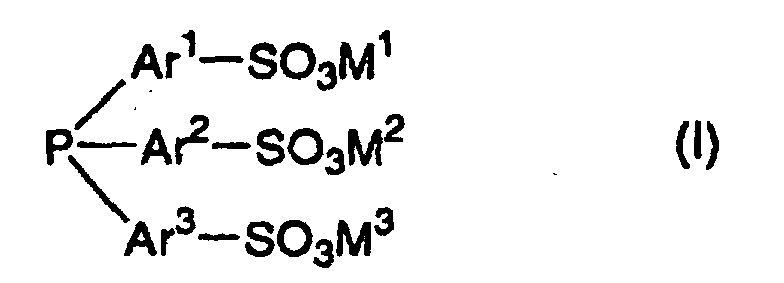 Ar1, Ar2 et Ar3 indépendamment l'un de l'autre représentent un groupe phényle, naphtyle, biphényle, phénylnaphtyle ou binaphtyle;M1, M2 et M3 indépendamment l'un de l'autre représentent chacun un ion de métal alcalin ou un ion ammonium ; etiii) un éther couronne, et(b) I'oléfine dans les conditions réactionnelles est présente dans une phase organique liquide qui n'est pas miscible avec la phase aqueuse.
 - Procédé selon la revendication 1, caractérisé en ce que la triarylphosphine trisulfonée de formule (I) est la tris(m-sulfophényl)phosphine trisodique.
- Procédé de préparation d'aldéhydes par réaction d'une oléfine ayant 3 à 12 atomes de carbone avec l'hydrogène et le monoxyde de carbone en présence d'un catalyseur au rhodium, caractérisé en ce que(a) le catalyseur au rhodium est présent dans une phase aqueuse, la phase aqueuse comprenant:i) le rhodium sous forme élémentaire ou liée ;ii) une triarylphosphine trisulfonée de formule (II)dans laquelle
 m1 et m2 peuvent avoir la valeur de 0 ou 1, la somme de m1 et m2 étant d'au moins 1, etM1, M2 M3 et M4 indépendamment l'un de l'autre représentent chacun un ion de métal alcalin ou un ion ammonium, etiii) un éther couronne ; et(b) l'oléfine dans les conditions réactionnelles est présente dans une phase organique liquide qui n'est pas miscible avec la phase aqueuse.
 - Procédé de préparation d'aldéhydes par réaction d'une oléfine ayant 3 à 12 atomes de carbone avec l'hydrogène et le monoxyde de carbone en présence d'un catalyseur au rhodium, caractérisé en ce que(a) le catalyseur au rhodium est présent dans une phase aqueuse, la phase aqueuse comprenant :i) le rhodium sous forme élémentaire ou liée ;ii) une triarylphosphine trisulfonée de formule (III)dans laquelle
 m3, m4, m5 et m6 peuvent avoir la valeur 0 ou 1, la somme de m3, m4, m5 et m6 étant d'au moins 2, etM1, M2 M3, M4, M5 et M6 indépendamment l'un de l'autre représentent chacun un ion de métal alcalin ou un ion ammonium, etiii) un éther couronne ; et(b) l'oléfine dans les conditions réactionnelles est présente dans une phase organique liquide qui n'est pas miscible avec la phase aqueuse.
 - Procédé selon l'une quelconque des revendications précédentes, caractérisé en ce que l'éther couronne est choisi dans le groupe formé par la 12-couronne -4, la 15-couronne-5, la 18-couronne-6 et l'hydroxyméthyl-18-couronne-6.
- Procédé selon l'une quelconque des revendications précédentes, caractérisé en ce que l'oléfine est choisie dans le groupe des oléfines aliphatiques, cycloaliphatiques et araliphatiques, en particulier les α-oléfines aliphatiques et les oléfines cycloaliphatiques.
- Procédé selon l'une quelconque des revendications précédentes, caractérisé en ce que l'oléfine est choisie dans le groupe formé par le propène, le 1-butène, le 1-pentène, le 1-hexène, le 1-heptène, le 1-octène. le 1-nonène, le 1-décène, le 1-undécène et le 1-dodécène.
- Procédé selon l'une quelconque des revendications précédentes, caractérisé en ce que l'oléfine présente au maximum 10, de préférence au maximum 8 atomes de carbone.
- Procédé selon l'une quelconque des revendications précédentes, caractérisé en ce que le rapport du rhodium au ligand est compris entre 1:10 et 1:1000, de préférence entre 1 : 50 et 1 : 200.
- Procédé selon l'une quelconque des revendications précédentes, caractérisé en ce que la phase aqueuse contient 20 à 500 ppm, de préférence 30 à 150 ppm, en particulier 40 à 100 ppm, de rhodium.
- Procédé selon l'une quelconque des revendications précédentes, caractérisé en ce que la phase aqueuse contient 2x10⁻⁶ à 5x10⁻² moles de rhodium par mole de composé oléfinique.
- Procédé selon l'une quelconque des revendications précédentes, caractérisé en ce que la pression pendant la réaction est comprise entre 20 et 150 bars, de préférence 30 et 80 bars.
- Procédé selon l'une quelconque des revendications précédentes, caractérisé en ce que la température pendant la réaction est comprise entre 20 et 170°C, de préférence entre 100 et 140°C.
Applications Claiming Priority (3)
| Application Number | Priority Date | Filing Date | Title |
|---|---|---|---|
| DE19742305 | 1997-09-25 | ||
| DE19742305A DE19742305A1 (de) | 1997-09-25 | 1997-09-25 | Verfahren zur Herstellung von Aldehyden durch Hydroformylierung in Gegenwart von Kronenether |
| PCT/EP1998/005683 WO1999015488A1 (fr) | 1997-09-25 | 1998-09-08 | Procede de production d'aldehydes par hydroformylation en presence d'ether couronne |
Publications (2)
| Publication Number | Publication Date |
|---|---|
| EP1017660A1 EP1017660A1 (fr) | 2000-07-12 |
| EP1017660B1 true EP1017660B1 (fr) | 2002-12-18 |
Family
ID=7843579
Family Applications (1)
| Application Number | Title | Priority Date | Filing Date |
|---|---|---|---|
| EP98948928A Expired - Lifetime EP1017660B1 (fr) | 1997-09-25 | 1998-09-08 | Procede de production d'aldehydes par hydroformylation en presence d'ether couronne |
Country Status (5)
| Country | Link |
|---|---|
| US (1) | US6388142B1 (fr) |
| EP (1) | EP1017660B1 (fr) |
| DE (2) | DE19742305A1 (fr) |
| ES (1) | ES2188019T3 (fr) |
| WO (1) | WO1999015488A1 (fr) |
Families Citing this family (2)
| Publication number | Priority date | Publication date | Assignee | Title |
|---|---|---|---|---|
| DE19940249A1 (de) * | 1999-08-25 | 2001-03-01 | Celanese Chem Europe Gmbh | Verfahren zur Herstellung von Aldehyden |
| DE102008044783B4 (de) * | 2008-08-28 | 2012-05-16 | Oxea Gmbh | Verfahren zur Gewinnung von aliphatischen C3- bis C10- Aldehyden aus Hochsiedern durch thermische Behandlung |
Family Cites Families (7)
| Publication number | Priority date | Publication date | Assignee | Title |
|---|---|---|---|---|
| US4320064A (en) * | 1980-03-31 | 1982-03-16 | Union Carbide Corporation | Polynuclear rhodium carbonyl complexes |
| GB2085874B (en) | 1980-09-04 | 1984-08-08 | Johnson Matthey Plc | Hydroformylation of olefins |
| US5091350A (en) * | 1984-03-26 | 1992-02-25 | Hoechst Aktiengesellschaft | Process for hydroformylation with rhodium catalysts and the separation of rhodium therefrom |
| US4731486A (en) * | 1986-11-18 | 1988-03-15 | Union Carbide Corporation | Hydroformylation using low volatile phosphine ligands |
| DE3726128A1 (de) | 1987-08-06 | 1989-02-16 | Ruhrchemie Ag | Verfahren zur herstellung von aldehyden |
| DE4040315A1 (de) | 1990-12-17 | 1992-06-25 | Hoechst Ag | Verfahren zur herstellung von aldehyden |
| TW225485B (fr) | 1992-05-29 | 1994-06-21 | Hoechst Ag |
-
1997
- 1997-09-25 DE DE19742305A patent/DE19742305A1/de not_active Withdrawn
-
1998
- 1998-09-08 DE DE59806752T patent/DE59806752D1/de not_active Expired - Fee Related
- 1998-09-08 ES ES98948928T patent/ES2188019T3/es not_active Expired - Lifetime
- 1998-09-08 WO PCT/EP1998/005683 patent/WO1999015488A1/fr not_active Ceased
- 1998-09-08 EP EP98948928A patent/EP1017660B1/fr not_active Expired - Lifetime
- 1998-09-08 US US09/509,143 patent/US6388142B1/en not_active Expired - Fee Related
Also Published As
| Publication number | Publication date |
|---|---|
| WO1999015488A1 (fr) | 1999-04-01 |
| ES2188019T3 (es) | 2003-06-16 |
| US6388142B1 (en) | 2002-05-14 |
| EP1017660A1 (fr) | 2000-07-12 |
| DE59806752D1 (de) | 2003-01-30 |
| DE19742305A1 (de) | 1999-04-01 |
Similar Documents
| Publication | Publication Date | Title |
|---|---|---|
| EP0695734B1 (fr) | Procédé pour la préparation d'aldéhydes | |
| EP0216315B1 (fr) | Procédé de préparation d'aldéhydes | |
| DE3739064A1 (de) | Hydroformylierungsverfahren unter verwendung niedrig fluechtiger phosphorliganden | |
| EP0761635B1 (fr) | Procédé d'hydroformylation de composés à insaturation oléfinique | |
| EP0157316B1 (fr) | Procédé de préparation d'aldéhydes | |
| DE19617257A1 (de) | Verfahren zur Hydroformylierung olefinisch ungesättigter Verbindungen | |
| EP0226988B1 (fr) | Procédé pour la préparation d'aldéhydes | |
| EP1017492B1 (fr) | Procede de preparation d'aldehydes par hydroformylation | |
| DE19700805C1 (de) | Verfahren zur Herstellung von Aldehyden durch Hydroformylierung olefinischer Verbindungen mit 3 bis 5 Kohlenstoffatomen in Anwesenheit einer Rhodium und sulfonierte Triarylphosphine als Katalysator enthhaltenden wäßrigen Phase | |
| DE19700804C1 (de) | Verfahren zur Herstellung von Aldehyden durch Hydroformylierung olefinischer Verbindungen mit 6 bis 16 Kohlenstoffatomen in Anwesenheit einer Rhodium und sulfonierte Triarylphosphine als Katalysator enthaltenden wäßrigen Phase | |
| EP0216314B1 (fr) | Procédé de préparation de nonadécanediols | |
| EP1017660B1 (fr) | Procede de production d'aldehydes par hydroformylation en presence d'ether couronne | |
| EP0602463A1 (fr) | Procédé pour la préparation d'aldéhydes | |
| EP0173219B1 (fr) | Procédé de préparation d'aldéhydes | |
| EP0160249B1 (fr) | Procédé de préparation d'aldéhydes | |
| EP0900779A2 (fr) | Procédé en une étape pour la préparation d'amines | |
| DE19609337C2 (de) | Verfahren zur Herstellung von Aldehyden mittels eines Rhodium und substituierte Diphenyldiphosphane enthaltenden Katalysatorsystems | |
| DE1955828C2 (de) | Verfahren zur Herstellung von Alkoholen und Aldehyden | |
| DE10035120A1 (de) | Verfahren zur Hydroformylierung von Olefinen in einem zweistufigen Reaktionssystem | |
| WO1997049490A1 (fr) | Catalyseur et procede pour la preparation d'aldehydes en presence de ce catalyseur | |
| DE3511428A1 (de) | Verfahren zur herstellung von aldehyden | |
| DE1955828B1 (de) | Verfahren zur Herstellung von Alkoholen und/oder Aldehyden |
Legal Events
| Date | Code | Title | Description |
|---|---|---|---|
| PUAI | Public reference made under article 153(3) epc to a published international application that has entered the european phase |
Free format text: ORIGINAL CODE: 0009012 |
|
| 17P | Request for examination filed |
Effective date: 20000425 |
|
| AK | Designated contracting states |
Kind code of ref document: A1 Designated state(s): DE ES FR GB NL |
|
| 17Q | First examination report despatched |
Effective date: 20010703 |
|
| GRAG | Despatch of communication of intention to grant |
Free format text: ORIGINAL CODE: EPIDOS AGRA |
|
| GRAG | Despatch of communication of intention to grant |
Free format text: ORIGINAL CODE: EPIDOS AGRA |
|
| GRAH | Despatch of communication of intention to grant a patent |
Free format text: ORIGINAL CODE: EPIDOS IGRA |
|
| GRAH | Despatch of communication of intention to grant a patent |
Free format text: ORIGINAL CODE: EPIDOS IGRA |
|
| GRAA | (expected) grant |
Free format text: ORIGINAL CODE: 0009210 |
|
| AK | Designated contracting states |
Kind code of ref document: B1 Designated state(s): DE ES FR GB NL |
|
| PG25 | Lapsed in a contracting state [announced via postgrant information from national office to epo] |
Ref country code: GB Free format text: LAPSE BECAUSE OF FAILURE TO SUBMIT A TRANSLATION OF THE DESCRIPTION OR TO PAY THE FEE WITHIN THE PRESCRIBED TIME-LIMIT Effective date: 20021218 |
|
| REG | Reference to a national code |
Ref country code: GB Ref legal event code: FG4D Free format text: NOT ENGLISH |
|
| REF | Corresponds to: |
Ref document number: 59806752 Country of ref document: DE Date of ref document: 20030130 Kind code of ref document: P Country of ref document: DE Date of ref document: 20030130 |
|
| REG | Reference to a national code |
Ref country code: ES Ref legal event code: FG2A Ref document number: 2188019 Country of ref document: ES Kind code of ref document: T3 |
|
| GBV | Gb: ep patent (uk) treated as always having been void in accordance with gb section 77(7)/1977 [no translation filed] |
Effective date: 20021218 |
|
| ET | Fr: translation filed | ||
| PG25 | Lapsed in a contracting state [announced via postgrant information from national office to epo] |
Ref country code: ES Free format text: LAPSE BECAUSE OF NON-PAYMENT OF DUE FEES Effective date: 20030910 |
|
| PLBE | No opposition filed within time limit |
Free format text: ORIGINAL CODE: 0009261 |
|
| STAA | Information on the status of an ep patent application or granted ep patent |
Free format text: STATUS: NO OPPOSITION FILED WITHIN TIME LIMIT |
|
| 26N | No opposition filed |
Effective date: 20030919 |
|
| PG25 | Lapsed in a contracting state [announced via postgrant information from national office to epo] |
Ref country code: NL Free format text: LAPSE BECAUSE OF NON-PAYMENT OF DUE FEES Effective date: 20040401 Ref country code: DE Free format text: LAPSE BECAUSE OF NON-PAYMENT OF DUE FEES Effective date: 20040401 |
|
| PG25 | Lapsed in a contracting state [announced via postgrant information from national office to epo] |
Ref country code: FR Free format text: LAPSE BECAUSE OF NON-PAYMENT OF DUE FEES Effective date: 20040528 |
|
| NLV4 | Nl: lapsed or anulled due to non-payment of the annual fee |
Effective date: 20040401 |
|
| REG | Reference to a national code |
Ref country code: FR Ref legal event code: ST |
|
| REG | Reference to a national code |
Ref country code: ES Ref legal event code: FD2A Effective date: 20030910 |