EP1018743A2 - Procédé et appareil pour enregistrer des informations de recherche simultanément avec codage de données aptes à subir une reproduction spéciale - Google Patents
Procédé et appareil pour enregistrer des informations de recherche simultanément avec codage de données aptes à subir une reproduction spéciale Download PDFInfo
- Publication number
- EP1018743A2 EP1018743A2 EP99114177A EP99114177A EP1018743A2 EP 1018743 A2 EP1018743 A2 EP 1018743A2 EP 99114177 A EP99114177 A EP 99114177A EP 99114177 A EP99114177 A EP 99114177A EP 1018743 A2 EP1018743 A2 EP 1018743A2
- Authority
- EP
- European Patent Office
- Prior art keywords
- data
- packs
- search information
- video
- prescribed
- Prior art date
- Legal status (The legal status is an assumption and is not a legal conclusion. Google has not performed a legal analysis and makes no representation as to the accuracy of the status listed.)
- Withdrawn
Links
Images




Classifications
-
- H—ELECTRICITY
- H04—ELECTRIC COMMUNICATION TECHNIQUE
- H04N—PICTORIAL COMMUNICATION, e.g. TELEVISION
- H04N9/00—Details of colour television systems
- H04N9/79—Processing of colour television signals in connection with recording
- H04N9/80—Transformation of the television signal for recording, e.g. modulation, frequency changing; Inverse transformation for playback
- H04N9/804—Transformation of the television signal for recording, e.g. modulation, frequency changing; Inverse transformation for playback involving pulse code modulation of the colour picture signal components
- H04N9/8042—Transformation of the television signal for recording, e.g. modulation, frequency changing; Inverse transformation for playback involving pulse code modulation of the colour picture signal components involving data reduction
-
- G—PHYSICS
- G11—INFORMATION STORAGE
- G11B—INFORMATION STORAGE BASED ON RELATIVE MOVEMENT BETWEEN RECORD CARRIER AND TRANSDUCER
- G11B20/00—Signal processing not specific to the method of recording or reproducing; Circuits therefor
- G11B20/10—Digital recording or reproducing
-
- G—PHYSICS
- G11—INFORMATION STORAGE
- G11B—INFORMATION STORAGE BASED ON RELATIVE MOVEMENT BETWEEN RECORD CARRIER AND TRANSDUCER
- G11B27/00—Editing; Indexing; Addressing; Timing or synchronising; Monitoring; Measuring tape travel
- G11B27/02—Editing, e.g. varying the order of information signals recorded on, or reproduced from, record carriers
- G11B27/031—Electronic editing of digitised analogue information signals, e.g. audio or video signals
- G11B27/034—Electronic editing of digitised analogue information signals, e.g. audio or video signals on discs
-
- G—PHYSICS
- G11—INFORMATION STORAGE
- G11B—INFORMATION STORAGE BASED ON RELATIVE MOVEMENT BETWEEN RECORD CARRIER AND TRANSDUCER
- G11B27/00—Editing; Indexing; Addressing; Timing or synchronising; Monitoring; Measuring tape travel
- G11B27/10—Indexing; Addressing; Timing or synchronising; Measuring tape travel
- G11B27/102—Programmed access in sequence to addressed parts of tracks of operating record carriers
- G11B27/105—Programmed access in sequence to addressed parts of tracks of operating record carriers of operating discs
-
- G—PHYSICS
- G11—INFORMATION STORAGE
- G11B—INFORMATION STORAGE BASED ON RELATIVE MOVEMENT BETWEEN RECORD CARRIER AND TRANSDUCER
- G11B27/00—Editing; Indexing; Addressing; Timing or synchronising; Monitoring; Measuring tape travel
- G11B27/10—Indexing; Addressing; Timing or synchronising; Measuring tape travel
- G11B27/19—Indexing; Addressing; Timing or synchronising; Measuring tape travel by using information detectable on the record carrier
- G11B27/28—Indexing; Addressing; Timing or synchronising; Measuring tape travel by using information detectable on the record carrier by using information signals recorded by the same method as the main recording
- G11B27/30—Indexing; Addressing; Timing or synchronising; Measuring tape travel by using information detectable on the record carrier by using information signals recorded by the same method as the main recording on the same track as the main recording
- G11B27/3027—Indexing; Addressing; Timing or synchronising; Measuring tape travel by using information detectable on the record carrier by using information signals recorded by the same method as the main recording on the same track as the main recording used signal is digitally coded
-
- G—PHYSICS
- G11—INFORMATION STORAGE
- G11B—INFORMATION STORAGE BASED ON RELATIVE MOVEMENT BETWEEN RECORD CARRIER AND TRANSDUCER
- G11B27/00—Editing; Indexing; Addressing; Timing or synchronising; Monitoring; Measuring tape travel
- G11B27/10—Indexing; Addressing; Timing or synchronising; Measuring tape travel
- G11B27/19—Indexing; Addressing; Timing or synchronising; Measuring tape travel by using information detectable on the record carrier
- G11B27/28—Indexing; Addressing; Timing or synchronising; Measuring tape travel by using information detectable on the record carrier by using information signals recorded by the same method as the main recording
- G11B27/32—Indexing; Addressing; Timing or synchronising; Measuring tape travel by using information detectable on the record carrier by using information signals recorded by the same method as the main recording on separate auxiliary tracks of the same or an auxiliary record carrier
- G11B27/327—Table of contents
- G11B27/329—Table of contents on a disc [VTOC]
-
- G—PHYSICS
- G11—INFORMATION STORAGE
- G11B—INFORMATION STORAGE BASED ON RELATIVE MOVEMENT BETWEEN RECORD CARRIER AND TRANSDUCER
- G11B2220/00—Record carriers by type
- G11B2220/20—Disc-shaped record carriers
- G11B2220/21—Disc-shaped record carriers characterised in that the disc is of read-only, rewritable, or recordable type
- G11B2220/213—Read-only discs
-
- G—PHYSICS
- G11—INFORMATION STORAGE
- G11B—INFORMATION STORAGE BASED ON RELATIVE MOVEMENT BETWEEN RECORD CARRIER AND TRANSDUCER
- G11B2220/00—Record carriers by type
- G11B2220/20—Disc-shaped record carriers
- G11B2220/21—Disc-shaped record carriers characterised in that the disc is of read-only, rewritable, or recordable type
- G11B2220/215—Recordable discs
- G11B2220/216—Rewritable discs
-
- G—PHYSICS
- G11—INFORMATION STORAGE
- G11B—INFORMATION STORAGE BASED ON RELATIVE MOVEMENT BETWEEN RECORD CARRIER AND TRANSDUCER
- G11B2220/00—Record carriers by type
- G11B2220/20—Disc-shaped record carriers
- G11B2220/21—Disc-shaped record carriers characterised in that the disc is of read-only, rewritable, or recordable type
- G11B2220/215—Recordable discs
- G11B2220/218—Write-once discs
-
- G—PHYSICS
- G11—INFORMATION STORAGE
- G11B—INFORMATION STORAGE BASED ON RELATIVE MOVEMENT BETWEEN RECORD CARRIER AND TRANSDUCER
- G11B2220/00—Record carriers by type
- G11B2220/20—Disc-shaped record carriers
- G11B2220/25—Disc-shaped record carriers characterised in that the disc is based on a specific recording technology
- G11B2220/2537—Optical discs
- G11B2220/2562—DVDs [digital versatile discs]; Digital video discs; MMCDs; HDCDs
-
- H—ELECTRICITY
- H04—ELECTRIC COMMUNICATION TECHNIQUE
- H04N—PICTORIAL COMMUNICATION, e.g. TELEVISION
- H04N5/00—Details of television systems
- H04N5/76—Television signal recording
- H04N5/84—Television signal recording using optical recording
- H04N5/85—Television signal recording using optical recording on discs or drums
-
- H—ELECTRICITY
- H04—ELECTRIC COMMUNICATION TECHNIQUE
- H04N—PICTORIAL COMMUNICATION, e.g. TELEVISION
- H04N9/00—Details of colour television systems
- H04N9/79—Processing of colour television signals in connection with recording
- H04N9/80—Transformation of the television signal for recording, e.g. modulation, frequency changing; Inverse transformation for playback
- H04N9/804—Transformation of the television signal for recording, e.g. modulation, frequency changing; Inverse transformation for playback involving pulse code modulation of the colour picture signal components
- H04N9/806—Transformation of the television signal for recording, e.g. modulation, frequency changing; Inverse transformation for playback involving pulse code modulation of the colour picture signal components with processing of the sound signal
- H04N9/8063—Transformation of the television signal for recording, e.g. modulation, frequency changing; Inverse transformation for playback involving pulse code modulation of the colour picture signal components with processing of the sound signal using time division multiplex of the PCM audio and PCM video signals
-
- H—ELECTRICITY
- H04—ELECTRIC COMMUNICATION TECHNIQUE
- H04N—PICTORIAL COMMUNICATION, e.g. TELEVISION
- H04N9/00—Details of colour television systems
- H04N9/79—Processing of colour television signals in connection with recording
- H04N9/80—Transformation of the television signal for recording, e.g. modulation, frequency changing; Inverse transformation for playback
- H04N9/82—Transformation of the television signal for recording, e.g. modulation, frequency changing; Inverse transformation for playback the individual colour picture signal components being recorded simultaneously only
- H04N9/8205—Transformation of the television signal for recording, e.g. modulation, frequency changing; Inverse transformation for playback the individual colour picture signal components being recorded simultaneously only involving the multiplexing of an additional signal and the colour video signal
-
- H—ELECTRICITY
- H04—ELECTRIC COMMUNICATION TECHNIQUE
- H04N—PICTORIAL COMMUNICATION, e.g. TELEVISION
- H04N9/00—Details of colour television systems
- H04N9/79—Processing of colour television signals in connection with recording
- H04N9/80—Transformation of the television signal for recording, e.g. modulation, frequency changing; Inverse transformation for playback
- H04N9/82—Transformation of the television signal for recording, e.g. modulation, frequency changing; Inverse transformation for playback the individual colour picture signal components being recorded simultaneously only
- H04N9/8205—Transformation of the television signal for recording, e.g. modulation, frequency changing; Inverse transformation for playback the individual colour picture signal components being recorded simultaneously only involving the multiplexing of an additional signal and the colour video signal
- H04N9/8227—Transformation of the television signal for recording, e.g. modulation, frequency changing; Inverse transformation for playback the individual colour picture signal components being recorded simultaneously only involving the multiplexing of an additional signal and the colour video signal the additional signal being at least another television signal
Definitions
- the present invention relates to a recording method of and a recording apparatus for recording search information that is used when searching and reproducing data able to undergo special reproduction (such as high speed image searching) into a recording medium enabling recording therein at least once.
- the invention concerns a data recording method and a data recording apparatus that make it possible to produce and record search information simultaneously with the encoding of data that is recorded into a recording medium.
- optical disk As a generally known optical disk that enables recording therein with a high density of video data covering a significantly large length of time and that has had recorded therein data containing therein navigation data that navigates data able to undergo special reproduction (such as high speed image searching), a so-called “DVD-VIDEO” has in recent years been made commercially available. Such an optical disk is called “a ROM” and further recording of data is impossible with respect thereto. From this point of view, as an optical disk that can record therein data containing navigation data for navigating data able to undergo special reproduction, a so-called “DVD-R”, DVD-RW, or “DVD-RAM” has in recent years been already made commercially available.
- MPEG Motion Picture Experts Group
- This MPEG system is known as a system for performing variable compression on video data.
- this MPEG system there is regulated a compression system that is called "an MPEG 2".
- MPEG 2 regulation is made of setting wherein, in order that moving picture data and audio data can be transferred and reproduced in synchronism with each other there are set a transfer starting time and reproduction starting time that have been prepared by expressing the respective data by the use of a reference time.
- the contents of the search information can be determined only after having encoded data capable of special reproduction such as video data and audio data that are going to be recorded in an optical disk and having finally produced all the recording data.
- this search information is recorded after having recorded all the recording data in the optical disk. Therefore, it is impossible to perform special reproduction immediately after having recorded, for example, video data and audio data.
- the present invention has been made in view of the above-described problems and has an object to provide a data recording method and a data recording apparatus that produces search information used for searching and reproducing data capable of special reproduction on a real-time basis and that enable recording thereof into a recording medium while encoding the recording data.
- a data recording method wherein input data is packed into a plurality of packs as defined in a prescribed signal processing system; the plurality of packs are stored into within a unit as a row of packs to be reproduced within a prescribed period of time; one or more units constitute a data cell; one or more data cells are arrayed to thereby constitute an object; a search information pack having prescribed search information is disposed at a foremost position of the row of packs in the unit; the search information includes at least a data reproduction termination time and data cell identification number of within the object; and an object set consisting of one or more objects is recorded into a recording medium, the data recording method comprising the step of: setting the data cell identification number of the unit to be stored into within the search information pack according to a recordable time length of one data cell that is designated beforehand and actual recording time length.
- the search information that is used for searching and reproducing data capable of special reproduction can be produced on a real time basis and also can be recorded into the recording medium while encoding the recording data. Accordingly, it becomes possible to search and reproduce necessary information, for example, immediately after recording has been completed and it is also possible to omit the use of a memory for storing the reproduction termination time beforehand.
- the input data consists of at least video data and audio data; and in the prescribed signal processing system the video data and audio data are compression encoded.
- a data recording method wherein input data is packed into a plurality of packs as defined in a prescribed signal processing system; the plurality of packs are stored into within a unit as a row of packs to be reproduced within a prescribed period of time; one or more units constitute a data cell; one or more data cells are arrayed to thereby constitute an object ; a search information pack having prescribed search information is disposed at a foremost position of the row of packs in the unit; the search information includes at least a data reproduction termination time of within the object; and an object set consisting of one or more objects is recorded into a recording medium, the data recording method comprising the step of: setting the data reproduction termination time to be stored into within the search information pack according to a signal processing time length that is designated beforehand.
- the search information that is used for searching and reproducing data capable of special reproduction can be produced on a real time basis and also can be recorded into the recording medium while encoding the recording data. Accordingly, it becomes possible to search and reproduce necessary information, for example, immediately after recording has been completed and it is also possible to omit the use of a memory for storing the reproduction termination time beforehand.
- the input data consists of at least video data and audio data; and in the prescribed signal processing system the video data and audio data are compression encoded.
- a data recording method wherein input data is packed into a plurality of packs as defined in a prescribed signal processing system; the plurality of packs are stored into within a unit as a row of packs to be reproduced within a prescribed period of time; one or more units constitute a data cell; one or more data cells are arrayed to thereby constitute an object ; a search information pack having prescribed search information is disposed at a foremost position of the row of packs in the unit; the search information includes at least a data reproduction termination time and termination addresses of one or a plurality of reference information pieces of within the object; and an object set consisting of one or more objects is recorded into a recording medium, the data recording method comprising the step of: setting the termination addresses of one or the plurality of reference information pieces to be stored into within the search information pack according to a predetermined size of reference information that is designated beforehand.
- the search information that is used for searching and reproducing data capable of special reproduction can be produced on a real time basis and also can be recorded into the recording medium while encoding the recording data. Accordingly, it becomes possible to search and reproduce necessary information, for example, immediately after recording has been completed and it is also possible to omit the use of a memory for storing the reproduction termination time beforehand.
- the input data consists of at least video data and audio data; and in the prescribed signal processing system the video data and audio data are compression encoded.
- the termination addresses of the one or the plurality of reference information pieces are termination addresses of reference pictures that are recorded as the compression encoded video data.
- a data recording apparatus wherein input data is packed into a plurality of packs as defined in a prescribed signal processing system; the plurality of packs are stored into within a unit as a row of packs to be reproduced within a prescribed period of time; one or more units constitute a data cell; one or more data cells are arrayed to thereby constitute an object ; a search information pack having prescribed search information is disposed at a foremost position of the row of packs in the unit; the search information includes at least a data reproduction termination time and data cell identification number of within the object; and an object set consisting of one or more objects is recorded into a recording medium, the data recording apparatus comprising: data cell identification number setting means for setting the data cell identification number of the unit to be stored into within the search information pack according to a recordable time length of one data cell that is designated beforehand and actual recording time length.
- the search information that is used for searching and reproducing data capable of special reproduction can be produced on a real time basis and also can be recorded into the recording medium while encoding the recording data. Accordingly, it becomes possible to search and reproduce necessary information, for example, immediately after recording has been completed and it is also possible to omit the use of a memory for storing the reproduction termination time beforehand.
- the input data consists of at least video data and audio data
- the data recording apparatus further comprises signal processing means for compression encoding the video data and audio data as defined in the prescribed signal processing system.
- a data recording apparatus wherein input data is packed into a plurality of packs as defined in a prescribed signal processing system; the plurality of packs are stored into within a unit as a row of packs to be reproduced within a prescribed period of time; one or more units constitute a data cell; one or more data cells are arrayed to thereby constitute an object ; a search information pack having prescribed search information is disposed at a foremost position of the row of packs in the unit; the search information includes at least a data reproduction termination time of within the object; and an object set consisting of one or more objects is recorded into a recording medium, the data recording apparatus comprising: signal processing time setting means for setting the data reproduction termination time to be stored into within the search information pack according to a signal processing time length that is designated beforehand.
- the search information that is used for searching and reproducing data capable of special reproduction can be produced on a real time basis and also can be recorded into the recording medium while encoding the recording data. Accordingly, it becomes possible to search and reproduce necessary information, for example, immediately after recording has been completed and it is also possible to omit the use of a memory for storing the reproduction termination time beforehand.
- the input data consists of at least video data and audio data
- the data recording apparatus further comprises signal processing means for compression encoding the video data and audio data as defined in the prescribed signal processing system.
- a data recording apparatus wherein input data is packed into a plurality of packs as defined in a prescribed signal processing system; the plurality of packs are stored into within a unit as a row of packs to be reproduced within a prescribed period of time; one or more units constitute a data cell; one or more data cells are arrayed to thereby constitute an object; a search information pack having prescribed search information is disposed at a foremost position of the row of packs in the unit; the search information includes at least a data reproduction termination time and termination addresses of one or a plurality of reference information pieces of within the object; and an object set consisting of one or more objects is recorded into a recording medium, the data recording apparatus comprising: reference information termination address setting means for setting the termination addresses of one or the plurality of reference information pieces to be stored into within the search information pack according to a predetermined size of reference information that is designated beforehand.
- the search information that is used for searching and reproducing data capable of special reproduction can be produced on a real time basis and also can be recorded into the recording medium while encoding the recording data. Accordingly, it becomes possible to search and reproduce necessary information, for example, immediately after recording has been completed and it is also possible to omit the use of a memory for storing the reproduction termination time beforehand.
- the input data consists of at least video data and audio data
- the data recording apparatus further comprises signal processing means for compression encoding the video data and audio data as defined in the prescribed signal processing system.
- the reference information termination setting means sets the termination address of a reference picture recorded as the compression encoded video data, as the termination address of the reference information.
- a data recording method wherein input data is packed into a plurality of packs as defined in a prescribed signal processing system; the plurality of packs are stored into within a unit as a row of packs to be reproduced within a prescribed period of time; one or more units constitute a data cell; one or more data cells are arrayed to thereby constitute an object ; a search information pack having prescribed search information is disposed at a foremost position of the row of packs in the unit; the search information includes at least a data reproduction termination time of within the object; and an object set consisting of one or more objects is recorded into a recording medium, the data recording method comprising the step of: setting the data reproduction termination time to be stored into within the search information pack at least according to a recordable capacity of the recording medium that has been obtained from a volume and file structure area recorded in the recording medium and a bit rate that has been obtained from the system information.
- the search information that is used for searching and reproducing data capable of special reproduction can be produced on a real time basis and also can be recorded into the recording medium while encoding the recording data. Accordingly, it becomes possible to search and reproduce necessary information, for example, immediately after recording has been completed and it is also possible to omit the use of a memory for storing the reproduction termination time beforehand. Further, it becomes possible to perform highly efficient recording with no useless information being added and without the user doing complex setting.
- a factor that represents how many units the object is constructed of is determined as a maximal positive integer that satisfies a following inequality: VOF ⁇ (FSS ⁇ FR) / (VTF ⁇ BR ⁇ GF) where the VOF represents a factor that represents how many units the object is constructed of; the FSS represents the recordable capacity of the recording medium; the FR represents a number of frames that are recorded during a unit length of time; the VTF represents a factor that represents a number of objects in the object set composed of a plurality of the objects; the BR represents the bit rate of the object; and the GF represents a factor that represents a number of frames in the group composed of a plurality of the frames.
- FIG.2 illustration is made of a concrete construction of a disk drive portion for driving the optical disk 10 illustrated in Fig.1
- Fig.3 illustration is made of a concrete structure of the optical disk 10 illustrated in Figs.1 and 2.
- the optical disk recording and reproducing apparatus 12 in order to make it possible to produce search information that is used for searching and reproducing data capable of special reproduction, i.e., navigation data as later described for navigating, e.g., data capable of special reproduction such as video data (main video data) and audio data on a real time basis on the optical disk 10 while encoding the video data and audio data and, immediately after the video data and audio data has finished their recording, to perform special reproduction of the thus-recorded data, is arranged to make the following settings.
- search information that is used for searching and reproducing data capable of special reproduction, i.e., navigation data as later described for navigating, e.g., data capable of special reproduction such as video data (main video data) and audio data on a real time basis on the optical disk 10 while encoding the video data and audio data and, immediately after the video data and audio data has finished their recording, to perform special reproduction of the thus-recorded data
- setting is performed of the recordable time length of a cell in a cell ID information processing portion 65 and setting is performed of, while comparing the recordable time length information of the cell and the recording time length during which recording time is passing, the cell identification number that is one of the navigation data pieces. Further, setting is performed beforehand of the encoding time length in the encode time information processing portion 66 and setting is performed of the reproduction termination time length of video and audio data that is one of the navigation data pieces according to the encoding time length.
- setting is performed, as later described, of a predetermined size of a reference picture beforehand in a video encode information production portion 81 and setting is performed of the termination addresses of one or a plurality of reference pictures that are among the navigation data pieces according to the predetermined size of the reference picture.
- the schematic construction and operation of the optical disk recording and reproducing apparatus 12 of this embodiment will be explained and further a logical format of the optical disk 10 will be explained in detail.
- the optical disk recording and reproducing apparatus 12 is equipped with a key operation/display portion 4, monitor portion 6, and speaker portion 8.
- the key operation/display portion 4 controls the recording and reproduction of data
- the data is recorded with respect to the optical disk 10 and the recorded data is also reproduced from the optical disk 10.
- Analog video signals, sub-video signals as later described, and audio signals that have been input are converted by digital conversion to video data (main video data) and sub-video data, and audio data.
- the above-described video data and sub-video data, and audio data are respectively compression encoded and are thereby made into recording data and are recorded into the optical disk 10. It is to be noted that although in the construction example of Fig.1 sub-video data also is recorded together with the video data that is main video data, sub-video data is not necessarily needed to be recorded.
- the reproduction data that has been reproduced from the optical disk 10 is video data and audio data, and sub-video data that have been compression encoded.
- the thus-compression encoded data are respectively extension decoded and thereafter analog conversion is performed thereon.
- the thus-obtained analog signals are sent to the monitor portion 6 or speaker portion 8 as the video signal and audio signal, and sub-video signal.
- the monitor portion 6 displays an image corresponding to the video signal and the speaker portion 8 generates a voice corresponding to the audio signal.
- the optical disk 10 has various structures.
- This optical disk 10 is one that enables data to be recorded with a high density only once or that enables data to be rewritten a plurality of times. It has, for example, a structure such as that illustrated in Fig.3.
- the optical disk 10 such as that illustrated in Fig.3 is composed of a pair of composite layers 18 and a bonding layer 20 interposed between this pair of composite layers.
- Each of the paired composite disk layers 18 is composed of a transparent substrate 14 and a recording layer 16.
- the recording layer 16 is made into a layer that enables recording to be made only once or that enables rewrite to be made a plurality of times.
- the recording layer 16 is disposed so as to come into contact with the surface of the bonding layer 20.
- the optical disk 10 has around the clamping region 24 of each of the both surfaces thereof an information region 25 into which information can be recorded.
- the outer-peripheral region of each information region 25 is made to be a lead-out region 26 and the inner-peripheral region thereof in contact with the clamping region 24 is made to be a lead-in region 27. Further, the region between the lead-out region 26 and the lead-in region 27 is determined as being a data recording region 28.
- the above-described optical disk recording and reproducing apparatus 12 is further constructed of a disk drive portion 30, system CPU portion 50, system ROM/RAM portion 52, system processor portion 54, data RAM portion 56, video decoder portion 58, audio decoder portion 60, sub-video decoder portion 62, D/A and data reproduction processing portion 64, video encoder portion 67, audio encoder portion 68, sub-video encoder portion 69, and A/D processing portion 63.
- the apparatus 12 is further constructed of a cell ID (cell identification) information processing portion 65, video encode information producing portion 81, and encode time information processing portion 66 that will be respectively described later.
- the optical disk 10 is loaded on the spindle motor 13 that is driven by the motor drive circuit 11, and is rotated by this spindle motor 13.
- An optical head 32 for radiating a laser beam onto the optical disk 10 is placed under the optical disk 10.
- a control signal that serves as an access signal.
- a head moving signal is supplied from the servo processing circuit 44 to the feed motor drive circuit 37.
- This circuit 37 supplies a drive signal to the feed motor 33. Accordingly, the feed motor 33 is driven, whereby the optical head 32 is moved in the radial direction of the optical disk 10.
- an analog video signal and sub-video signal from a video input terminal 55 and an analog audio signal from an audio input terminal 53 are sent to the A/D processing portion 63 and, in this portion 63, are converted to digital signals.
- the video data and sub-video data, and audio data, which are output from the A/D processing portion 63 are subjected to encode processing including compression encoding based on the bit rate (Bit Rate) information from the encode information processing portion 59, addition of error correction codes, etc. in their corresponding video encode portion 67, audio encode portion 68, and sub-video encode portion 69. These data pieces are sent to the system processor portion 54.
- the bit rate (Bit Rate) information from the encode information processing portion 59 in this case represents the bit rate of a video object. Defining strictly, the bit rate of the video object is a sum total of the respective bit rates of the video, audio, sub-video, and navigation data.
- compression encoding is performed thereon in accordance with a so-called "MPEG 2", regarding the sub-video data, compression thereof is performed in accordance with a so-called “run length encoding”, and regarding the audio data, encoding thereof is performed in accordance with a so-called “AC-3”, “linear PCM”, etc.
- the video data and sub-video data, and audio data, which have been respectively encode-processed are multiplexed by the system processor portion 64 and made into recording data, under the management of the system CPU portion 50 that is controlled in accordance with the program that has been recorded in the system ROM/RAM portion 52.
- the optical head 32 is driven in correspondence with the recording data from the head amplifier 40, whereby this recording data is recorded into the optical disk 10.
- a prescribed sector that has been formed on the recording layer 16 of the optical disk 10 is accessed by the optical head 32.
- the reproduction data at this time is reproduced from this prescribed sector and is supplied from the optical head 32 to the head amplifier 40 and amplified by this head amplifier 40, and is output from the disk drive portion 30.
- the thus-output reproduction data is stored into the data RAM portion 56 by the system processor portion 54 under the management of the system CPU portion 50 that is controlled with the program that has been recorded in the system ROM/RAM portion 52.
- the thus-stored reproduction data is processed by the system processor portion 54 and is thereby classified into video data and sub-video data, and audio data, which are output to the video decoder portion 58, audio decoder portion 60, and sub-video decoder portion 62, respectively.
- decode processing which is composed of error correction processing, extension decoding, etc., is performed on these respective classified data pieces.
- the thus-decode-processed video data and sub-video data, and audio data are converted to analog video signal, sub-video signal, and audio signal by the D/A and data reproduction processing circuit 64.
- the video signal is supplied to the monitor portion 6 and the audio signal is supplied to the speaker portion 8.
- a picture image is displayed on the monitor portion 6 by the video signal and sub-video signal and a voice is played back from the speaker portion 8 by the audio signal.
- data is recorded in the volume and file structure such as illustrated in Fig.4.
- This structure is determined as a logical format in accordance with a prescribed standard, e.g., micro UDF (micro UDF) and ISO 9660.
- this volume and file structure has a hierarchical structure, in which there are disposed a video manager 71, at least one or more video title sets 72, and other recording areas 73. Each of these areas is classified in units of a logical sector.
- one logical sector is defined as having a size of 2048 bytes as in the case of a conventional CD.
- one logical block is also defined as having a size of 2048 bytes. Accordingly, one logical sector is defined as being one logical block.
- the video title set 72 has stored therein compressed video data, sub-video data, and audio data, and reproduction information therefor and is similarly constructed of a plurality of files.
- the volume and file structure 70 corresponds to a management area that is determined in the micro UDF and ISO 9660 and, through this area, the video manager 71 is stored into the system ROM/RAM portion 52.
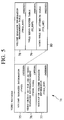
- the video manager 71 is constructed of a plurality of files 74 starting with a file #0. Specifically, as illustrated in Fig.5, it is constructed of a volume manager information (VMGI) 75, a video object set for use as video manager information menu (VMGM_VOBS) 76 and back-up of volume manager information (VMGI_BUP) 77. Further, the volume manager information (VMGI) 75 is constructed of a volume manager information management table (VMGI_MAT) 78, title search pointer table (TT_SRPT) 79, and video title set attribute table (VTS_ART) 80.
- VMGI volume manager information management table
- TT_SRPT title search pointer table
- VTS_ART video title set attribute table
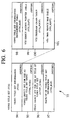
- each video title set 72 is constructed of 10 pieces at max. of files 74 starting with a file #j. Specifically, as illustrated in Fig.6, it is constructed of a video title set information (VTSI) 94, video object set for use as video title set menu (VTSI_VOBS) 95, video object set for use as title of video title set (VTSTT_VOBS) 96, and back-up of video title set information 97.
- VTSI video title set information
- VTSI_VOBS video object set for use as video title set menu
- VTSTT_VOBS video object set for use as title of video title set
- back-up of video title set information 97 back-up of video title set information
- VTSI video title set information
- VTSI_MAT video title set information management table
- VTS_DAPT VTS direct access pointer table
- VTS_PGCIT VTS program chain table
- VTS_MAPT VTS time search map table
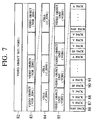
- this video object set (VOBS) 82 As the types of this video object set (VOBS) 82, as described above, there are three types of video object sets, two of which are video object sets for use as two menus 76 and 95, and the remainder of which is a video object set for use as title 96. Namely, in the video manager 71, there is the video object set for use as video manager information menu (VMGM_VOBS) 76. In the video title set (VTS) 72, there are the video object set for use as video title set menu 95 and at least one video object set for use as video object set title (VTSTT_VOBS) 96. Any one of the video object sets 82 is different only in terms of its use purpose and has the same structure.
- the video object set (VOBS) 82 is defined as an aggregation of one or more video objects (VOB) 83 and each video object 83 in the same video object set (VOBS) 82 is used for the same use purpose.
- the for-menu video object set (VOBS) 82 is constructed of one video object (VOB) 83 and has stored therein data that displays a plurality of for-menu picture image screens.
- the for-title video object set (VOBS) 82 is ordinarily constructed of a plurality of video objects (VOB) 83. It is to be noted that, with regard to the video object (VOB) 83 in an ordinary 1-story picture movie, one video object (VOB) 83 corresponds to one video object set (VOBS) 82, and one video stream is complete with the one video object set (VOBS) 82.
- the video object (VOB) 83 is constructed of one or a plurality of cells (data cells) 84.
- the "cell” is a fundamental unit of the contents to be reproduced and one cell can be used in different program chains (PGC) within one video title set (VTS).
- PPC program chains
- One cell must be constructed of an integral number of video object units (VOBU).
- the program chain (PGC) has a list for designating the cells in the order in which they are reproduced.
- An ordinary video stream is constructed of a plurality of cells.
- the for-menu video stream i.e., video object (VOB) 83, is constructed of one cell 84.
- the cell identification number is a serial number that is imparted to the cell within the video object (VOB).
- the cell identification number is written into the data search information (DSI) and program chain information (PGCI) together with the video object ID number (VOB_IDN).
- each cell 84 is constructed of one or a plurality of video object units (VOBU) 85, ordinarily a plurality of video object sets (VOBU) 85.
- VOBU video object units
- the video object unit (VOBU) 85 is defined as a row of packs having one navigation pack (NAV pack) 86 at its foremost position. Namely, the video object unit (VOBU) 85 is defined as an aggregation of all packs that are covered and recorded from a navigation pack 86 to a pack immediately before the next navigation pack.
- the reproduction time length of the video object unit (VOBU) 85 corresponds to the reproduction time length of the video data constructed of a singular or a plural GOP. This reproduction time length is defined as falling within a range of from 0. 4 second inclusive to 1 second inclusive. In the MPEG, 1 GOP represents compressed picture image data corresponding ordinarily to a time length of 0.5 second and corresponds to 15 sheets or so of picture images.
- the thus-input video data is compressed into packs defined in the MPEG 2; the thus-input sub-video data is compressed into packs defined in accordance with the run length encoding technique; the thus-input audio data is encoded in accordance with the so-called AC-3 or linear PCM technique; and these data pieces are stored into the video object unit 85 as a row of packs to be reproduced within a prescribed period of time.
- the video packs 88, sub-video packs 90, and audio packs 91 as defined in the MPEG standard are disposed within the video object unit 85.
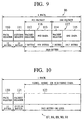
- the navigation pack 86 is constructed of a pack header 110, system header 111, playback control information (PCI) packet 116 (packet header 112 and PCI data 113), and data search information (DSI) packet 117 (packet header 114 and DSI data 115).
- the reproduction or playback control information is navigation data for making presentation in synchronism with the state of reproduction of the video data within the video object unit 85, namely, for making a change of the contents of the display.
- the reproduction control information is information for determining the reproduction conditions in accordance with the state of the presented data, in other words, real-time control data that has been disposed in a dispersed form on the stream of data.
- the data search information is navigation data for executing a search for the video object unit 85. Namely, this search information is one for performing fast forward/backward wind reproduction and seamless reproduction, i.e., is real-time control data that has been disposed in a dispersed form on the data stream.
- FIG.10 illustration is made of the structure of a video, audio, and sub-video pack.
- the video, audio, and sub-video pack is constructed of a pack header 120, packet header 121, and video, audio, or sub-video data 122.
- this navigation pack 86 has set therein the ID number (cell identification number) of the data cell to which the video object unit 85 belongs, in this setting case, going on producing the packs while encoding, for example, video data and audio data on a real time basis is followed by the possibility of the cell identification number becoming short of the cells in terms of the number, which makes it difficult to perform real time recording.
- the cell ID information processing portion 65 to set the recordable time length of the cell according to the key operation input that is done from the key operation/display portion 4 and, while comparing this cell recordable time length and the image-recording time that is passing, to output the cell identification number and for the pack production processing portion 54C to set the cell identification number of the video object unit 85 within the navigation pack 86.
- the cell ID information processing portion 65 previously sets as the cell recordable time length the capacity per cell (the length of the cell in terms of the time) and a sum total of the cells within the video object unit 85, according to the key operation input that is done from the key operation/display portion 4. And the portion 65 produces the cell identification number according to this cell recordable time length information and the image-recording passage time information.
- the pack production processing portion 54C sets the cell identification number within the video object unit 85 within the navigation pack 86, according to the cell identification number that has been set by the cell ID information processing portion 65.
- the first embodiment of the present invention it is possible, while real time encoding the video data and audio data, to unify the reproduction information for reproducing the video object unit 85 and the search information necessary for searching another video object unit 85 into a pack and thereby simultaneously to record them into the optical disk 10, and so it becomes possible to search and reproduce necessary information immediately after recording has ended. Also, it is also possible to omit the use of a memory for storing therein the compression-encode terminating time.
- the cell recordable time length by way of the key operation/display portion 4, for example, it is possible to consider such a setting example wherein the cell recordable time length sequentially increases in such a way as 1 min., 2 min., 3 mm., ⁇ each time a prescribed key is depressed once.
- the key operation/display portion 4 is equipped with, for example, a so-called "ten-key unit" consisting of ten keys of from 0 to 9 inclusive, it is also possible to set an arbitrary cell recordable time length by the use of this ten-key unit.
- the reproduction control information (PCI) and data search information (DSI) are written into the navigation pack 86 and accordingly, into this navigation pack 86, there are written the reproduction termination time of the video data within the video object (VOB) and the reproduction termination time of the audio data within the video object.
- the reproduction termination time of the video data within the video object and the reproduction terminating time of the audio data within the video object (VOB) become non-fixed when producing a pack while encoding the video data and audio data on a real time basis. This makes it impossible to perform real-time recording.
- the encode time information processing portion 66 when unifying the information pieces into a pack, it is arranged for the encode time information processing portion 66 to produce the encode time according to the key operation input from the key operation/display portion 4 and for the pack production processing portion 54C of the system processor portion 54 to write the reproduction termination time of the video data within the navigation pack 86 and the reproduction termination time of the audio data within the video object (VOB) while referring to this encode time.
- the navigation pack 86 prepared by the reproduction control information (PCI) and data search information (DSI) being packed and therefore to record this navigation pack 86 into the optical disk 10 simultaneously with the encoding of the data.
- PCI reproduction control information
- DSI data search information
- the navigation pack 86 since it is possible to record, while encoding the video data and audio data on a real time basis, the navigation pack 86 having unified therein as a pack the reproduction control information (PCI) and data search information (DSI) into the optical disk 10 simultaneously with the encoding of the data, it becomes possible to search and reproduce necessary information immediately after recording has ended. Also, it is possible to dispense with a memory for storing the compression-encode termination time therein.
- PCI reproduction control information
- DSI data search information
- the encode time length set using the key operation/display portion 4 for example, it is possible to consider such a time length which sequentially increases in such a way as 5 min., 10 min., 15 min., or 0.5 hr., 1 hr, 1.5 hrs, ⁇ ⁇ ⁇ each time a prescribed key is depressed once.
- the key operation/display portion 4 is equipped with, for example, a so-called "ten-key unit" consisting of ten keys of from 0 to 9 inclusive, it is also possible to set an arbitrary time length by the use of this ten-key unit.
- the first embodiment it is arranged, where performing the packing, for the encode information producing portion 81 to produce, for example, a predetermined size of the reference picture according to the key operation input from the key operation/display portion 4 and, for the pack production processing portion 54C of the system processor portion 54, to write the termination address of the reference picture within the navigation pack 86 while referring to this predetermined size of it.
- this method it is possible to construct, while real time encoding the video data and audio data, the navigation pack 86 prepared by the reference picture termination address that becomes necessary for reproduction of the video object unit 85 being packed and therefore to record this navigation pack 86 into the optical disk 10 simultaneously with the encoding of the data.
- the navigation pack 86 since it is possible to record, while encoding the video data and audio data on a real time basis, the navigation pack 86 having unified therein as a pack the reference picture termination address into the optical disk 10 simultaneously with the encoding of the data, it becomes possible to search and reproduce necessary information immediately after recording has ended. Also, it is possible to dispense with a memory for storing the compression-encode termination time therein.
- the optical disk recording and reproducing apparatus 12 of the first embodiment of the present invention may be constructed not only by being equipped with all of the cell ID information processing portion 65, encode time information processing portion 66, and encode information producing portion 81, but also by being equipped with any one of them or with any two in combination.
- the above-described structure is not limited to one wherein recording is done into a recording medium such as an optical disk, and can be also applied to a communication system such as that illustrated in Fig.11.
- the physical data that has been produced in accordance with the above-described procedures may be sent to a user or a cable subscriber side by a modulator/transmitter 310 by way of electric waves or a cable.
- encoded data may be produced on a side of a provider such as a broadcasting station by the optical disk recording and reproducing apparatus 12 illustrated in Fig.1 and this encoded data may be similarly sent to a user or a cable subscriber side by the modulator/ transmitter 310 by way of electric waves or a cable.
- this unit includes any one of video, audio, and sub-video data pieces. Namely, this unit may be constructed of only audio pack alone or only sub-video pack alone.
- this second embodiment it is arranged, when compression encoding and packing the signal containing at least one piece of video data, to set the reproduction termination time of, for example, the video data within the navigation pack while referring to the bit rate of the video object after encoding thereof and the remaining amount of capacity of the recording medium under the management of the file system.
- the pack production processing portion 54C to set the reproduction termination time of the video data within the video object (VOB) and the reproduction termination time of the audio data within the video object that is to be recorded in the navigation pack 86, according to the recordable capacity (Free Space Size) of the optical disk 10 that has been obtained from the file system recorded in the optical disk 10, the number of video frames recorded during 1 second (Frame Rate, e.g., 30 in case of the NTSC; and 25 in case of PAL), the factor (Vts Factor ⁇ 255) representing how many video objects (VOB) the video title set (VTS) is constructed of, the bit rate (Bit Rate) that has been obtained from the encode information processing portion 59, and the factor (GOP Factor) representing how many video frames the GOP is constructed of.
- the recordable capacity Free Space Size
- bit rate (Bit Rate) generated from the encode information processing portion 59 and the factor (GOP Factor) representing how many video frames the GOP is constructed of can be, for example, either preset or determined individually through arithmetic operations according to the key operation input from the key operation/display portion 4.
- the factor (GOP Factor) represents the above-described number of picture image frames that constitute 1 GOP, and, in the MPEG, is called "an N value".
- an N value is called "an N value”.
- file system a detailed technique thereof is disclosed in, for example, Japanese Patent Application Laid-Open Publication No.H8-263969, etc. and so an explanation thereof is omitted.
- Vts Factor represents the number of video objects constituting the VTS and, in a so-called DVD-video standard, is defined as 255 at max.
- the larger this factor (Vts Factor) is, the more effectively the disk recording area can be utilized. Therefore, the default value thereof is set to be 255 (Vts 255).
- the factor (Vob Factor) representing how many video object units 85 the video object (VOB) is constructed of is determined as a maximal plus integer that satisfies the following inequality (1).
- the VOF is determined as a maximal plus integer that satisfies the following inequality (1).
- PET VOF ⁇ (GF / FR)
- the navigation pack 86 having unified therein as a pack the reproduction or playback control information (PCI) and data search information (DSI) to thereby record the navigation pack 86 into the optical disk 10 simultaneously with the encoding of the data.
- PCI reproduction or playback control information
- DSI data search information
- the second embodiment in a case where previously setting the recording time length as in the case of, for example, a so-called "timer reservation", it becomes possible to perform recording into the optical disk 10 with no useless information being added. Namely, when previously setting the recording period of time as in the case of a timer reservation, it happens that in a case where at the time when, for example, a timer reservation is made a user has stopped the recording earlier than the time corresponding to the time length that has been set as above, useless data that corresponds to this set time length is inconveniently recorded in the last video object. However, in this second embodiment, such inconvenience does not occur and this makes it possible to efficiently record with no complex setting being performed by the user.
Landscapes
- Engineering & Computer Science (AREA)
- Multimedia (AREA)
- Signal Processing (AREA)
- Signal Processing For Digital Recording And Reproducing (AREA)
- Management Or Editing Of Information On Record Carriers (AREA)
Applications Claiming Priority (2)
| Application Number | Priority Date | Filing Date | Title |
|---|---|---|---|
| JP207799 | 1999-01-07 | ||
| JP00207799A JP3364594B2 (ja) | 1998-05-25 | 1999-01-07 | データ記録方法及び装置 |
Publications (2)
| Publication Number | Publication Date |
|---|---|
| EP1018743A2 true EP1018743A2 (fr) | 2000-07-12 |
| EP1018743A3 EP1018743A3 (fr) | 2004-08-18 |
Family
ID=11519293
Family Applications (1)
| Application Number | Title | Priority Date | Filing Date |
|---|---|---|---|
| EP99114177A Withdrawn EP1018743A3 (fr) | 1999-01-07 | 1999-07-22 | Procédé et appareil pour enregistrer des informations de recherche simultanément avec codage de données aptes à subir une reproduction spéciale |
Country Status (3)
| Country | Link |
|---|---|
| US (1) | US7136576B1 (fr) |
| EP (1) | EP1018743A3 (fr) |
| CN (2) | CN100349224C (fr) |
Families Citing this family (2)
| Publication number | Priority date | Publication date | Assignee | Title |
|---|---|---|---|---|
| US7366402B2 (en) * | 2000-06-02 | 2008-04-29 | Lg Electronics Inc. | Method and apparatus of recording a high definition digital television broadcast signal |
| CN100452857C (zh) * | 2002-07-12 | 2009-01-14 | 松下电器产业株式会社 | 数据处理装置 |
Citations (2)
| Publication number | Priority date | Publication date | Assignee | Title |
|---|---|---|---|---|
| EP0724264A2 (fr) * | 1995-01-30 | 1996-07-31 | Kabushiki Kaisha Toshiba | Un milieu d'enregistrement sur lequel à été enregistré une donnée comprenant des données de navigation, une méthode et un appareil pour reproduire une donnée suivant des données de navigation, une méthode et un appareil pour enregistrer une donnée comprenant des données de navigation sur un milieu d'enregistrement et une système pour transferer des données par une voie de communication à la base de données de navigation |
| EP0737975A2 (fr) * | 1995-04-11 | 1996-10-16 | Kabushiki Kaisha Toshiba | Milieu d'enregistrement et méthode, appareil d'enregistrement d'enregistrement pour enregistrer les données sur le milieu d'enregistrement, et appareil de reproduction et méthode de reproduction pour la reproduction de données du milieu d'enregistrement |
Family Cites Families (7)
| Publication number | Priority date | Publication date | Assignee | Title |
|---|---|---|---|---|
| DE4241986A1 (de) * | 1992-12-12 | 1994-06-16 | Thomson Brandt Gmbh | Verfahren zur Schrägspurmagnetbandaufzeichnung |
| JP2747268B2 (ja) * | 1995-01-30 | 1998-05-06 | 株式会社東芝 | ナビゲーションデータに従ってデータを再生する方法及びその装置、ナビゲーションデータを備えたデータを記録媒体に記録する方法及びその装置 |
| JP3570791B2 (ja) * | 1995-03-28 | 2004-09-29 | パイオニア株式会社 | デジタルデータ記録異種媒体情報再生装置 |
| US5745643A (en) * | 1995-04-06 | 1998-04-28 | Kabushiki Kaisha Toshiba | System for and method of reproducing playback data appropriately by the use of attribute information on the playback data |
| JP3761623B2 (ja) * | 1996-03-18 | 2006-03-29 | パイオニア株式会社 | 情報記録媒体、情報記録装置及び方法並びに情報再生装置及び方法 |
| DE69800480T2 (de) * | 1997-09-17 | 2001-06-13 | Matsushita Electric Industrial Co., Ltd. | Optische Platte, Videodatenschnittgeràt, Rechnerlesbares Aufzeichnungmedium das ein Schnittprogramm speichert, Wiedergabegerät für die optische Platte und rechnerlesbares Aufzeichnungsmedium das ein Wiedergabeprogramm speichert |
| KR100306195B1 (ko) * | 1998-08-18 | 2001-11-30 | 구자홍 | 재기록가능기록매체의내비게이션데이터관리방법 |
-
1999
- 1999-06-18 CN CNB2004100592778A patent/CN100349224C/zh not_active Expired - Lifetime
- 1999-06-18 CN CNB991090918A patent/CN1161780C/zh not_active Expired - Lifetime
- 1999-07-20 US US09/357,744 patent/US7136576B1/en not_active Expired - Fee Related
- 1999-07-22 EP EP99114177A patent/EP1018743A3/fr not_active Withdrawn
Patent Citations (2)
| Publication number | Priority date | Publication date | Assignee | Title |
|---|---|---|---|---|
| EP0724264A2 (fr) * | 1995-01-30 | 1996-07-31 | Kabushiki Kaisha Toshiba | Un milieu d'enregistrement sur lequel à été enregistré une donnée comprenant des données de navigation, une méthode et un appareil pour reproduire une donnée suivant des données de navigation, une méthode et un appareil pour enregistrer une donnée comprenant des données de navigation sur un milieu d'enregistrement et une système pour transferer des données par une voie de communication à la base de données de navigation |
| EP0737975A2 (fr) * | 1995-04-11 | 1996-10-16 | Kabushiki Kaisha Toshiba | Milieu d'enregistrement et méthode, appareil d'enregistrement d'enregistrement pour enregistrer les données sur le milieu d'enregistrement, et appareil de reproduction et méthode de reproduction pour la reproduction de données du milieu d'enregistrement |
Also Published As
| Publication number | Publication date |
|---|---|
| CN1161780C (zh) | 2004-08-11 |
| CN1259737A (zh) | 2000-07-12 |
| CN100349224C (zh) | 2007-11-14 |
| US7136576B1 (en) | 2006-11-14 |
| CN1551200A (zh) | 2004-12-01 |
| EP1018743A3 (fr) | 2004-08-18 |
Similar Documents
| Publication | Publication Date | Title |
|---|---|---|
| CA2173701C (fr) | Support d'enregistrement sur lequel des informations d'attributs sont integrees aux donnees enregistrees et systeme de lecture connexe | |
| EP0737008B1 (fr) | Un système et un procédé pour reproduire, de façon appropriée, des données de lecture, en utilisant des informations d'attribut concernant les données de lecture | |
| EP1234445B1 (fr) | Suppléments aux informations de navigation d'un DVD permettant des modes de lecture speciaux améliorés | |
| KR100220529B1 (ko) | 네비게이션 데이타를 구비한 기록 매체와 네비게이션 데이타를 구비한 재생 데이타를 기록 매체에 기록하는 방법 및 그 장치 | |
| JP4080499B2 (ja) | 静止画のための情報の再生装置 | |
| JP2747268B2 (ja) | ナビゲーションデータに従ってデータを再生する方法及びその装置、ナビゲーションデータを備えたデータを記録媒体に記録する方法及びその装置 | |
| US6763181B1 (en) | Optical disk recording/reproducing apparatus and method thereof | |
| US7099563B1 (en) | Multichannel recording device and method | |
| EP1236349B1 (fr) | Procede permettant d'enregistrer en ralenti ou en accelere des donnes video source sur un support d'enregistrement | |
| JP2005176399A (ja) | 記録媒体に記録された静止画情報の再生方法およびその装置 | |
| JP3518337B2 (ja) | データ記録方法及び装置 | |
| US7136576B1 (en) | Method of and apparatus for recording search information simultaneously with encoding of data able to undergo special reproduction | |
| JP3364594B2 (ja) | データ記録方法及び装置 | |
| JP3714553B2 (ja) | データ記録方法及び装置 | |
| KR100720017B1 (ko) | 기록매체, 및 기록 및 재생을 위한 기록장치와 기록방법 | |
| JP3714554B2 (ja) | データ生成方法及び装置 | |
| JP3499854B2 (ja) | 情報記録媒体、情報記録装置及び情報記録方法 | |
| EP1331816B1 (fr) | Procédé permettant d'enregistrer en accéléré des données vidéo source sur un support d'enregistrement | |
| JP3701485B2 (ja) | ディスク再生装置 | |
| JP3499853B2 (ja) | 情報記録媒体、情報記録装置及び情報記録方法 | |
| JP3898726B2 (ja) | 光ディスク再生装置及び光ディスクの再生方法 | |
| JP4810364B2 (ja) | 情報記録方法と再生方法と再生装置 | |
| JP2005328176A (ja) | 映像記録再生装置 | |
| JP2007124685A (ja) | 再生データの属性情報を利用して再生データを適切に再生するシステム及びその再生方法 | |
| JP2007037172A (ja) | 再生データの属性情報を利用して再生データを適切に再生するシステム及びその再生方法 |
Legal Events
| Date | Code | Title | Description |
|---|---|---|---|
| PUAI | Public reference made under article 153(3) epc to a published international application that has entered the european phase |
Free format text: ORIGINAL CODE: 0009012 |
|
| AK | Designated contracting states |
Kind code of ref document: A2 Designated state(s): AT BE CH CY DE DK ES FI FR GB GR IE IT LI LU MC NL PT SE |
|
| AX | Request for extension of the european patent |
Free format text: AL;LT;LV;MK;RO;SI |
|
| PUAL | Search report despatched |
Free format text: ORIGINAL CODE: 0009013 |
|
| AK | Designated contracting states |
Kind code of ref document: A3 Designated state(s): AT BE CH CY DE DK ES FI FR GB GR IE IT LI LU MC NL PT SE |
|
| AX | Request for extension of the european patent |
Extension state: AL LT LV MK RO SI |
|
| 17P | Request for examination filed |
Effective date: 20040915 |
|
| AKX | Designation fees paid |
Designated state(s): DE FR GB |
|
| RBV | Designated contracting states (corrected) |
Designated state(s): DE FR GB |
|
| RAP1 | Party data changed (applicant data changed or rights of an application transferred) |
Owner name: JVC KENWOOD CORPORATION |
|
| STAA | Information on the status of an ep patent application or granted ep patent |
Free format text: STATUS: THE APPLICATION IS DEEMED TO BE WITHDRAWN |
|
| 18D | Application deemed to be withdrawn |
Effective date: 20160909 |