EP1018808A2 - Procédé d'étalement spatio-temporel pour une communication sans fil à AMRC - Google Patents
Procédé d'étalement spatio-temporel pour une communication sans fil à AMRC Download PDFInfo
- Publication number
- EP1018808A2 EP1018808A2 EP99309995A EP99309995A EP1018808A2 EP 1018808 A2 EP1018808 A2 EP 1018808A2 EP 99309995 A EP99309995 A EP 99309995A EP 99309995 A EP99309995 A EP 99309995A EP 1018808 A2 EP1018808 A2 EP 1018808A2
- Authority
- EP
- European Patent Office
- Prior art keywords
- matrix
- data symbols
- transmitting antennas
- group
- signal
- Prior art date
- Legal status (The legal status is an assumption and is not a legal conclusion. Google has not performed a legal analysis and makes no representation as to the accuracy of the status listed.)
- Granted
Links
Images


Classifications
-
- H—ELECTRICITY
- H04—ELECTRIC COMMUNICATION TECHNIQUE
- H04B—TRANSMISSION
- H04B7/00—Radio transmission systems, i.e. using radiation field
- H04B7/02—Diversity systems; Multi-antenna system, i.e. transmission or reception using multiple antennas
- H04B7/04—Diversity systems; Multi-antenna system, i.e. transmission or reception using multiple antennas using two or more spaced independent antennas
- H04B7/06—Diversity systems; Multi-antenna system, i.e. transmission or reception using multiple antennas using two or more spaced independent antennas at the transmitting station
- H04B7/0613—Diversity systems; Multi-antenna system, i.e. transmission or reception using multiple antennas using two or more spaced independent antennas at the transmitting station using simultaneous transmission
- H04B7/0615—Diversity systems; Multi-antenna system, i.e. transmission or reception using multiple antennas using two or more spaced independent antennas at the transmitting station using simultaneous transmission of weighted versions of same signal
-
- H—ELECTRICITY
- H04—ELECTRIC COMMUNICATION TECHNIQUE
- H04B—TRANSMISSION
- H04B1/00—Details of transmission systems, not covered by a single one of groups H04B3/00 - H04B13/00; Details of transmission systems not characterised by the medium used for transmission
- H04B1/69—Spread spectrum techniques
- H04B1/707—Spread spectrum techniques using direct sequence modulation
Definitions
- This invention relates to the use of spreading codes in CDMA systems for wireless communication. More particularly, the invention relates to methods for coding messages for transmission on the downlink, so as beneficially to use multiple transmitting antennas for improved reception in fading environments.
- reception in wireless communication systems may suffer as a result of fluctuations in the propagation channel between the transmitting and receiving antennas. This phenomenon is referred to as "fading.”
- reception in fading environments can be improved by using multiple antennas at the transmitting or receiving end, or both, of the communication link. Multiple antennas can help by providing multiple, independent paths between the ends of the link. The existence of such independent paths is referred to as "diversity.”
- base station 10 is to transmit real-valued scalar data symbols b 1 and b 2 to users U1 (reference numeral 15.1) and U2 (reference numeral 15.2), respectively.
- data symbol b 1 multiplies code c 1
- data symbol b 2 multiplies code c 2 .
- the mobile receiver For effective recovery of the data symbols, it is advantageous for the mobile receiver to know the pertinent fading coefficient from, e.g., measurement of a pilot signal. It is also desirable, for this purpose, to have a relatively high channel gain (i.e., the absolute magnitude of the pertinent fading coefficient). This condition cannot be guaranteed, in general.
- a relatively high channel gain i.e., the absolute magnitude of the pertinent fading coefficient.
- the fading coefficients are not fixed quantities, but instead are described probabilistically, in terms of appropriate statistical distributions.
- the fading coefficients are complex-Gaussian variables having Rayleigh-distributed amplitude and uniformly distributed phase.
- the additive receiver noise is zero-mean complex-Gaussian.
- the squared magnitude of the individual fading coefficient h 1 or h 2 has a chi-square distribution with two degrees of freedom, which arise from the squares of the respective real and imaginary parts of the fading coefficients.
- the sum of squares of M independent, zero-mean, Gaussian random variables, each with unit variance has the chi-square distribution with M degrees of freedom.
- the squared magnitude of the effective fading coefficient is proportional to a chi-square random variable with 2 M degrees of freedom, we say that the diversity is " M -fold.”
- Diversity is useful in the context of CDMA transmission because increased diversity results in a probability density for the signal-to-noise ratio that is more sharply peaked about its mean value. As a consequence, there is less likelihood that the signal-to-noise ratio will fall into the range of values so low that dependable communication is precluded.
- h 1 (k) and h 2 (k) are the complex-Gaussian channel gains from antenna 1 and antenna 2, respectively, to user (i.e., mobile station) k , assuming, again, that there are no multipath effects.
- the subscript k i.e., the user index
- n the pre-despreading received noise terms
- v the post-despreading noise terms
- the symbols d (1) / k and d (2) / k are subscripted to indicate a respective user, and superscripted to indicate a respective spreading code.
- the despread signals are represented by:
- Diversity gain is achieved (for user k ) when the 2 ⁇ 1 matrix d k is multiplied on the left by h + , obtaining The superscript ( k ) has been dropped from the preceding expression to simplify the notation.
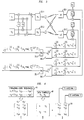
- antenna 1 (denoted by reference numeral 25.1) transmits the signal and antenna 2 (denoted by reference numeral 25.2) transmits the signal
- both codes are used for the data symbol destined for user 1
- both codes are also used for the data symbol destined for user 2.
- the users are respectively denoted in the figure by reference numerals 20.1 and 20.2.
- User k despreads the received signals, using each of the respective spreading codes, to obtain received signals d (1) / k and d (2) / k , given by
- the receiver left-multiplies d k by the conjugate transpose of h k , and takes the real part of the result:
- the symbol b k is then ready for hard or soft decoding, according to well-known techniques of CDMA signal processing.
- symbol recovery using the first row of H ⁇ is represented by blocks 30.1 and 35.1
- symbol recovery using the second row of H ⁇ is represented by blocks 30.2 and 35.2.
- our invention involves a method for CDMA transmission of sets of data symbols to users that are organized into one or more user groups.
- Each user group is paired with a group of spreading codes, referred to as a "code group.”
- Each set of data symbols that are destined for respective users of a given user group is transmitted in the form of two or more distinct signal sequences.
- Each such signal sequence is transmitted from a respective one of two or more transmitting antennas.
- Each signal sequence is a linear combination of spreading code sequences belonging to the corresponding code group.
- each spreading code sequence that appears has a scalar coefficient.
- Each of these scalar coefficients is a linear combination of pertinent data symbols (i.e., data symbols destined for users in the given user group) or of complex conjugates of pertinent data symbols.
- our invention involves a method for CDMA reception of data symbols belonging to such sets.
- a user belonging to a given user group despreads a received signal sequence using each spreading code sequence in the code group paired with the given user group.
- a linear combination is formed of the resulting, respective despread scalar signal values.
- Each scalar signal value in this linear combination has a scalar coefficient.
- Each of these scalar coefficients is a linear combination of fading coefficients or of complex conjugates of fading coefficients. The result of this sequence of operations is proportional to the desired data symbol.
- FIG. 1 is a simplified, schematic block diagram of a CDMA system for transmission from a base station to users, which are typically mobile stations.
- FIG. 2 is a schematic block diagram of a multiple-antenna transmission system of the prior art.
- FIG. 3 is a schematic block diagram of an illustrative, two-antenna transmission system according to the invention in one embodiment.
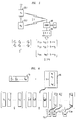
- FIG. 4 is a conceptual illustration of the relationship between spreading-code sequences, data symbols, and the baseband signal matrix to be transmitted, according to the invention in an illustrative embodiment.
- FIG. 5 is a conceptual illustration of the process of despreading a basebanded, received signal according to the invention in an illustrative embodiment.
- FIG. 6 is a conceptual illustration of the construction of a baseband signal matrix for transmission according to the invention in an illustrative embodiment.
- FIG. 7 is a flowchart of an exemplary procedure for constructing a baseband signal matrix for transmission.
- FIG. 8 is a graph showing the result of theoretical calculations of error probability versus expected signal-to-noise ratio, for signals communicated in accordance with techniques of the present invention.
- M represents the number of transmitting antennas
- K represents the total number of users
- L represents the total number of spreading codes used.
- the total number L of spreading codes must be at least the total number K of users. For economy in the use of spreading codes, it is advantageous for these numbers to be equal whenever possible.
- the k 'th column of B contains the data symbols that are to be coded for transmission from the k 'th antenna, and the k 'th column of S is the spread symbol to be transmitted from the k 'th antenna.
- the i 'th row of S is the baseband representations of the signals for the respective antennas at chip i of the code sequences.
- the raw, basebanded signal 55 received at the mobile user 60 is Sh + n , which is equal to CBh + n .
- Bh Hb .
- the k'th mobile user decodes its symbol by left-multiplying the despread signal by the k 'th row of H ⁇ and taking the real part, as described above.
- K users be grouped into K / K ' user groups of K' users each, and to each user group, assign L' spreading codes, where L' is at least K '. (For a given number of antennas, it is desirable to make L' as close as possible to K' .)
- the vector h represent the M fading coefficients from the respective transmitting antennas to the k 'th mobile user. (As above, the subscript or superscript indicating the user index k is omitted to simplify the notation.)
- the vector b represent the K' data symbols destined for respective users in a given user group:
- B be an L' ⁇ M matrix, each entry of which is a linear combination of data symbols
- H be an L' ⁇ K' matrix, each entry of which is a linear combination of fading coefficients.
- H T H ( h 2 / 1 + h 2 / 2 + ⁇ + h 2 / M ) I (where I is the K ' ⁇ K' identity matrix)
- B T B ( b 1 / 2 + b 2 / 2 + ⁇ + b 2 / K' ) I (where I is the M ⁇ M identity matrix).
- the transmitter can readily construct B
- the receiver (assuming that it has determined the pertinent fading coefficients) can readily construct H .
- FIG. 6 shows a matrix B constructed from a vector b (denoted in the figure by reference numeral 65) by applying B-generator matrices (denoted by reference numeral 70) in accordance with the above Rules 1-4.
- C [ c 1 c 2 ⁇ c L' ].
- the K users are segregated into user groups of K' users each, and each group applies its code group of L' spreading codes, as explained above.
- Each mobile user must know which spreading codes belong to its code group, and it must despread in accordance with them.
- the despreader will typically be a Rake receiver, which is well-known in the art. Generally, residual users that do not form a complete group of K' users will still need to apply a full code group of L ' spreading codes.
- a design for B or, alternatively, for H we may start with a design for B or, alternatively, for H .
- the mobile i.e., the receiver
- FIG. 7 a signal-design procedure is shown that begins by providing, at block 80, a matrix H as input.
- each column of this matrix consists of a respective permutation of all of the pertinent fading coefficients, each multiplied by +1 or -1.
- the H matrices need not be of this form, in general, such a form will often be useful.
- the H-generator matrices are shown as derived in block 85
- the B-generator matrices are shown as derived in block 90
- the matrix B is shown as generated at block 95.
- the transmitted signal should be As in the case of real-valued symbols, the mobile despreads the received baseband signal with C ⁇ , to give However, unlike the real-symbol case, the second entry of the result is now conjugated to yield
- the transmitted B matrix is The mobile, after despreading the received signal with C ⁇ , conjugates the second, third, and fourth entries of the resulting vector to obtain
- a simple extension of our reception technique is readily applied by, e.g., a Rake receiver, if each time delay is common to one path from each antenna, so that each time delay defines one path set from the transmitting antenna array.
- the despreading procedure is applied separately to the signal received on each path set, to produce a multiplicity of terms of the form (plus interference and noise terms).
- the Rake receiver implements a separate H matrix for each of the time delays.
- the index l ranges over all of the path sets. Symbol recovery is carried out, as described above, by applying the desired row of H ⁇ / l to each of these terms and taking the real part. Then, the resulting terms are summed over all the path sets to obtain the recovered symbol.
- FIG. 8 is a graph showing the result of theoretical calculations we have carried out of the BPSK probability of error, as a function of expected signal-to-noise ratio (SNR), when techniques of the kind described here are carried out.
- SNR signal-to-noise ratio
Landscapes
- Engineering & Computer Science (AREA)
- Computer Networks & Wireless Communication (AREA)
- Signal Processing (AREA)
- Mobile Radio Communication Systems (AREA)
- Radio Transmission System (AREA)
Applications Claiming Priority (4)
| Application Number | Priority Date | Filing Date | Title |
|---|---|---|---|
| US11462199P | 1999-01-04 | 1999-01-04 | |
| US114621P | 1999-01-04 | ||
| US285578 | 1999-04-02 | ||
| US09/285,578 US6452916B1 (en) | 1999-01-04 | 1999-04-02 | Space-time spreading method of CDMA wireless communication |
Publications (3)
| Publication Number | Publication Date |
|---|---|
| EP1018808A2 true EP1018808A2 (fr) | 2000-07-12 |
| EP1018808A3 EP1018808A3 (fr) | 2004-11-24 |
| EP1018808B1 EP1018808B1 (fr) | 2008-06-04 |
Family
ID=26812394
Family Applications (1)
| Application Number | Title | Priority Date | Filing Date |
|---|---|---|---|
| EP99309995A Expired - Lifetime EP1018808B1 (fr) | 1999-01-04 | 1999-12-10 | Procédé d'étalement spatio-temporel pour une communication sans fil à AMRC |
Country Status (5)
| Country | Link |
|---|---|
| US (1) | US6452916B1 (fr) |
| EP (1) | EP1018808B1 (fr) |
| JP (1) | JP3901898B2 (fr) |
| CA (1) | CA2292832A1 (fr) |
| DE (1) | DE69938861D1 (fr) |
Cited By (9)
| Publication number | Priority date | Publication date | Assignee | Title |
|---|---|---|---|---|
| EP1191707A1 (fr) * | 2000-08-04 | 2002-03-27 | Lucent Technologies Inc. | Partage des amplificateurs de puissance dans un système de télécommunication sans fil avec transmission en diversité |
| EP1182799A3 (fr) * | 2000-08-22 | 2002-06-26 | Lucent Technologies Inc. | Procédé pour améliorer des communications à AMCR sans fil utilisant une diversité d'emission spatio-temporel |
| EP1085677A3 (fr) * | 1999-09-13 | 2004-02-11 | Lucent Technologies Inc. | Architecture de récepteur utilisant un étalement spatio-temporel et des techniques de diversité d'émission orthogonales |
| WO2004049612A1 (fr) * | 2002-11-26 | 2004-06-10 | Linkair Communications,Inc. | Systeme de qs-amrc a programme d'etalement a deux niveaux et sequences a synchronisation lache |
| US6859643B1 (en) | 2000-08-04 | 2005-02-22 | Lucent Technologies Inc. | Power amplifier sharing in a wireless communication system with amplifier pre-distortion |
| CN101006659B (zh) * | 2004-08-17 | 2011-12-07 | 三星电子株式会社 | 用于增强性能的时空频率块编码装置和方法 |
| CN101567865B (zh) * | 2008-04-23 | 2012-07-11 | 鼎桥通信技术有限公司 | 一种下行数据传输方法 |
| US8272984B2 (en) | 2007-11-20 | 2012-09-25 | Aisin Aw Co., Ltd. | Endless metal belt |
| US8311492B2 (en) | 2000-12-07 | 2012-11-13 | Interdigital Technology Corporation | Simple block space time transmit diversity using multiple spreading codes |
Families Citing this family (9)
| Publication number | Priority date | Publication date | Assignee | Title |
|---|---|---|---|---|
| KR100526499B1 (ko) * | 2000-08-22 | 2005-11-08 | 삼성전자주식회사 | 두 개 이상 안테나를 사용하는 안테나 전송 다이버시티방법 및 장치 |
| US7113745B2 (en) * | 2001-02-21 | 2006-09-26 | Ericsson Inc. | Method to achieve diversity in a communication network |
| EP1394964A1 (fr) * | 2001-06-04 | 2004-03-03 | Mitsubishi Denki Kabushiki Kaisha | Appareil d'emission a acces multiple par repartition de code (amrc) en diversite |
| FR2826526B1 (fr) * | 2001-06-21 | 2003-10-24 | France Telecom | Procede de transmission a interferences reduites |
| KR100591904B1 (ko) * | 2004-03-18 | 2006-06-20 | 한국전자통신연구원 | 시공간 부호를 이용한 부호분할 다중접속 시스템의 전송다이버시티 송수신 장치, 및 그 방법 |
| WO2006019250A1 (fr) * | 2004-08-17 | 2006-02-23 | Samsung Electronics Co., Ltd. | Dispositif et procede de codage de bloc espace-temps-frequence pour de meilleures performances |
| KR100780363B1 (ko) | 2004-08-27 | 2007-11-29 | 삼성전자주식회사 | 2개의 송신안테나를 위한 최대 다이버시티 최대 전송율을갖는 시공간 블록 부호화 장치 및 방법 |
| US20070041457A1 (en) | 2005-08-22 | 2007-02-22 | Tamer Kadous | Method and apparatus for providing antenna diversity in a wireless communication system |
| CN116998130A (zh) * | 2021-02-10 | 2023-11-03 | 拉姆帕特通信股份有限公司 | 传输器或接收器内的信号样本的自同构变换 |
Family Cites Families (10)
| Publication number | Priority date | Publication date | Assignee | Title |
|---|---|---|---|---|
| JPH04157821A (ja) * | 1990-10-20 | 1992-05-29 | Nippon Telegr & Teleph Corp <Ntt> | 無線通信装置 |
| US5426668A (en) * | 1994-01-12 | 1995-06-20 | Bell Communications Research, Inc. | Tetherless access to communication networks |
| US5822359A (en) * | 1994-10-17 | 1998-10-13 | Motorola, Inc. | Coherent random access channel in a spread-spectrum communication system and method |
| DE69629633T2 (de) * | 1995-07-19 | 2004-06-17 | Nec Corp. | Vielfaltnachrichtenübertragungssystem mit Kodemultiplexvielfachzugriff |
| US6072778A (en) * | 1996-08-14 | 2000-06-06 | Motorola, Inc. | Method of controlling a communication system |
| US5970058A (en) * | 1997-04-12 | 1999-10-19 | Motorola, Inc. | Method and apparatus for freeing a frame to aid in handoff determination in a code division multiple access communication system |
| JPH1132028A (ja) * | 1997-07-14 | 1999-02-02 | Matsushita Electric Ind Co Ltd | 無線送信方法及び無線送信装置 |
| US6643338B1 (en) * | 1998-10-07 | 2003-11-04 | Texas Instruments Incorporated | Space time block coded transmit antenna diversity for WCDMA |
| US6154485A (en) * | 1998-10-19 | 2000-11-28 | Motorola, Inc. | Receiver in a wireless communications system for receiving signals having combined orthogonal transmit diversity and adaptive array techniques |
| US6317411B1 (en) * | 1999-02-22 | 2001-11-13 | Motorola, Inc. | Method and system for transmitting and receiving signals transmitted from an antenna array with transmit diversity techniques |
-
1999
- 1999-04-02 US US09/285,578 patent/US6452916B1/en not_active Expired - Lifetime
- 1999-12-10 DE DE69938861T patent/DE69938861D1/de not_active Expired - Lifetime
- 1999-12-10 EP EP99309995A patent/EP1018808B1/fr not_active Expired - Lifetime
- 1999-12-17 CA CA002292832A patent/CA2292832A1/fr not_active Abandoned
- 1999-12-24 JP JP36813499A patent/JP3901898B2/ja not_active Expired - Fee Related
Cited By (11)
| Publication number | Priority date | Publication date | Assignee | Title |
|---|---|---|---|---|
| EP1085677A3 (fr) * | 1999-09-13 | 2004-02-11 | Lucent Technologies Inc. | Architecture de récepteur utilisant un étalement spatio-temporel et des techniques de diversité d'émission orthogonales |
| EP1191707A1 (fr) * | 2000-08-04 | 2002-03-27 | Lucent Technologies Inc. | Partage des amplificateurs de puissance dans un système de télécommunication sans fil avec transmission en diversité |
| US6859643B1 (en) | 2000-08-04 | 2005-02-22 | Lucent Technologies Inc. | Power amplifier sharing in a wireless communication system with amplifier pre-distortion |
| US7054384B1 (en) | 2000-08-04 | 2006-05-30 | Lucent Technologies Inc. | Power amplifier sharing in a wireless communication system with transmit diversity |
| KR100773028B1 (ko) * | 2000-08-04 | 2007-11-02 | 루센트 테크놀러지스 인크 | 증폭 방법, 프로세싱 방법, 송신기 및 장치 |
| EP1182799A3 (fr) * | 2000-08-22 | 2002-06-26 | Lucent Technologies Inc. | Procédé pour améliorer des communications à AMCR sans fil utilisant une diversité d'emission spatio-temporel |
| US8311492B2 (en) | 2000-12-07 | 2012-11-13 | Interdigital Technology Corporation | Simple block space time transmit diversity using multiple spreading codes |
| WO2004049612A1 (fr) * | 2002-11-26 | 2004-06-10 | Linkair Communications,Inc. | Systeme de qs-amrc a programme d'etalement a deux niveaux et sequences a synchronisation lache |
| CN101006659B (zh) * | 2004-08-17 | 2011-12-07 | 三星电子株式会社 | 用于增强性能的时空频率块编码装置和方法 |
| US8272984B2 (en) | 2007-11-20 | 2012-09-25 | Aisin Aw Co., Ltd. | Endless metal belt |
| CN101567865B (zh) * | 2008-04-23 | 2012-07-11 | 鼎桥通信技术有限公司 | 一种下行数据传输方法 |
Also Published As
| Publication number | Publication date |
|---|---|
| CA2292832A1 (fr) | 2000-07-04 |
| DE69938861D1 (de) | 2008-07-17 |
| EP1018808B1 (fr) | 2008-06-04 |
| JP2000209137A (ja) | 2000-07-28 |
| JP3901898B2 (ja) | 2007-04-04 |
| US6452916B1 (en) | 2002-09-17 |
| EP1018808A3 (fr) | 2004-11-24 |
Similar Documents
| Publication | Publication Date | Title |
|---|---|---|
| US6452916B1 (en) | Space-time spreading method of CDMA wireless communication | |
| US7248645B2 (en) | Wireless transmission using an adaptive transmit antenna array | |
| Hochwald et al. | A transmitter diversity scheme for wideband CDMA systems based on space-time spreading | |
| US9923617B2 (en) | Communication channel optimization systems and methods in multi-user communication systems | |
| US7680211B1 (en) | MIMO maximum-likelihood space-time architecture | |
| US20030013468A1 (en) | Radio communication system | |
| US20020061768A1 (en) | Beam synthesis method for downlink beamforming in FDD wireless communication system | |
| Hassell et al. | A comparison of detection algorithms including BLAST for wireless communication using multiple antennas | |
| US7342970B2 (en) | Array processing using an aggregate channel matrix generated using a block code structure | |
| CN101807979B (zh) | 一种无线通信中基于单天线功率约束的多用户预编码方法 | |
| CN1941663B (zh) | 多天线信道复用的方法及波束赋形的方法 | |
| CN101179313A (zh) | 智能天线系统的分集发射接收装置 | |
| Reynolds et al. | Interference suppression and diversity exploitation for multiantenna CDMA with ultra-low complexity receivers | |
| WO2005002067A2 (fr) | Ondes porteuses multiples a spectre etale utilisant une modification non lineaire de bandes sous-porteuses | |
| Lin et al. | Space-time OFDM with adaptive beamforming: Performance in spatially correlated channels | |
| CN101160747B (zh) | 发送系统和发送方法及接收系统和接收方法 | |
| Kassouf et al. | Shannon capacity and eigen-beamforming for space dispersive multipath MIMO channels | |
| Vial et al. | Space time spreading with modified Walsh-Hadamard sequences | |
| Huang et al. | Achieving high data rates on the UMTS downlink shared channel using multiple antennas | |
| CN101179314A (zh) | 智能天线系统的分集发射接收方法 | |
| Benyarou et al. | Multi-user Detection by MMSE Adaptive Algorithm for Multi-Beam-MIMO-MC-CDMA using Sequences of References | |
| Zeng et al. | Direct decoding of uplink space-time block coded multicarrier code division multiple access systems | |
| Burr | Space-time coding in the third generation and beyond | |
| CN101521535B (zh) | Cdma系统空时扩谱方法的基站发射电路 | |
| CN101689873B (zh) | 一种td-scdma系统发射分集及接收机处理方法 |
Legal Events
| Date | Code | Title | Description |
|---|---|---|---|
| PUAI | Public reference made under article 153(3) epc to a published international application that has entered the european phase |
Free format text: ORIGINAL CODE: 0009012 |
|
| 17P | Request for examination filed |
Effective date: 19991229 |
|
| AK | Designated contracting states |
Kind code of ref document: A2 Designated state(s): AT BE CH CY DE DK ES FI FR GB GR IE IT LI LU MC NL PT SE |
|
| AX | Request for extension of the european patent |
Free format text: AL;LT;LV;MK;RO;SI |
|
| PUAL | Search report despatched |
Free format text: ORIGINAL CODE: 0009013 |
|
| AK | Designated contracting states |
Kind code of ref document: A3 Designated state(s): AT BE CH CY DE DK ES FI FR GB GR IE IT LI LU MC NL PT SE |
|
| AX | Request for extension of the european patent |
Extension state: AL LT LV MK RO SI |
|
| 17Q | First examination report despatched |
Effective date: 20050117 |
|
| AKX | Designation fees paid |
Designated state(s): DE FR GB |
|
| GRAP | Despatch of communication of intention to grant a patent |
Free format text: ORIGINAL CODE: EPIDOSNIGR1 |
|
| GRAS | Grant fee paid |
Free format text: ORIGINAL CODE: EPIDOSNIGR3 |
|
| GRAA | (expected) grant |
Free format text: ORIGINAL CODE: 0009210 |
|
| AK | Designated contracting states |
Kind code of ref document: B1 Designated state(s): DE FR GB |
|
| REG | Reference to a national code |
Ref country code: GB Ref legal event code: FG4D |
|
| REF | Corresponds to: |
Ref document number: 69938861 Country of ref document: DE Date of ref document: 20080717 Kind code of ref document: P |
|
| PLBE | No opposition filed within time limit |
Free format text: ORIGINAL CODE: 0009261 |
|
| STAA | Information on the status of an ep patent application or granted ep patent |
Free format text: STATUS: NO OPPOSITION FILED WITHIN TIME LIMIT |
|
| 26N | No opposition filed |
Effective date: 20090305 |
|
| REG | Reference to a national code |
Ref country code: GB Ref legal event code: 732E Free format text: REGISTERED BETWEEN 20131121 AND 20131127 |
|
| REG | Reference to a national code |
Ref country code: FR Ref legal event code: CD Owner name: ALCATEL-LUCENT USA INC. Effective date: 20131122 |
|
| REG | Reference to a national code |
Ref country code: FR Ref legal event code: GC Effective date: 20140410 |
|
| REG | Reference to a national code |
Ref country code: FR Ref legal event code: RG Effective date: 20141015 |
|
| REG | Reference to a national code |
Ref country code: FR Ref legal event code: PLFP Year of fee payment: 17 |
|
| REG | Reference to a national code |
Ref country code: FR Ref legal event code: PLFP Year of fee payment: 18 |
|
| PGFP | Annual fee paid to national office [announced via postgrant information from national office to epo] |
Ref country code: FR Payment date: 20161222 Year of fee payment: 18 |
|
| PGFP | Annual fee paid to national office [announced via postgrant information from national office to epo] |
Ref country code: DE Payment date: 20171211 Year of fee payment: 19 |
|
| PGFP | Annual fee paid to national office [announced via postgrant information from national office to epo] |
Ref country code: GB Payment date: 20171221 Year of fee payment: 19 |
|
| REG | Reference to a national code |
Ref country code: FR Ref legal event code: ST Effective date: 20180831 |
|
| PG25 | Lapsed in a contracting state [announced via postgrant information from national office to epo] |
Ref country code: FR Free format text: LAPSE BECAUSE OF NON-PAYMENT OF DUE FEES Effective date: 20180102 |
|
| REG | Reference to a national code |
Ref country code: GB Ref legal event code: 732E Free format text: REGISTERED BETWEEN 20190131 AND 20190206 |
|
| REG | Reference to a national code |
Ref country code: DE Ref legal event code: R082 Ref document number: 69938861 Country of ref document: DE Ref country code: DE Ref legal event code: R082 Ref document number: 69938861 Country of ref document: DE Representative=s name: MENZIETTI WETZEL, DE Ref country code: DE Ref legal event code: R081 Ref document number: 69938861 Country of ref document: DE Owner name: PROVENANCE ASSET GROUP LLC, PITTSFORD, US Free format text: FORMER OWNER: LUCENT TECHNOLOGIES INC., MURRAY HILL, N.J., US |
|
| REG | Reference to a national code |
Ref country code: DE Ref legal event code: R082 Ref document number: 69938861 Country of ref document: DE Ref country code: DE Ref legal event code: R081 Ref document number: 69938861 Country of ref document: DE Owner name: PROVENANCE ASSET GROUP LLC, PITTSFORD, US Free format text: FORMER OWNER: ALCATEL-LUCENT USA INC. (N. D. GES. D. STAATES DELAWARE), MURRAY HILL, N.J., US Ref country code: DE Ref legal event code: R081 Ref document number: 69938861 Country of ref document: DE Owner name: PROVENANCE ASSET GROUP LLC, PITTSFORD, US Free format text: FORMER OWNER: NOKIA OF AMERICA CORP. (N. D. GES. D. STAATES DELAWARE), MURRAY HILL, NJ, US |
|
| REG | Reference to a national code |
Ref country code: DE Ref legal event code: R119 Ref document number: 69938861 Country of ref document: DE |
|
| GBPC | Gb: european patent ceased through non-payment of renewal fee |
Effective date: 20181210 |
|
| PG25 | Lapsed in a contracting state [announced via postgrant information from national office to epo] |
Ref country code: DE Free format text: LAPSE BECAUSE OF NON-PAYMENT OF DUE FEES Effective date: 20190702 |
|
| PG25 | Lapsed in a contracting state [announced via postgrant information from national office to epo] |
Ref country code: GB Free format text: LAPSE BECAUSE OF NON-PAYMENT OF DUE FEES Effective date: 20181210 |