EP1018830A2 - Méthode et interface pour un transport efficace de données en paquets - Google Patents
Méthode et interface pour un transport efficace de données en paquets Download PDFInfo
- Publication number
- EP1018830A2 EP1018830A2 EP99303169A EP99303169A EP1018830A2 EP 1018830 A2 EP1018830 A2 EP 1018830A2 EP 99303169 A EP99303169 A EP 99303169A EP 99303169 A EP99303169 A EP 99303169A EP 1018830 A2 EP1018830 A2 EP 1018830A2
- Authority
- EP
- European Patent Office
- Prior art keywords
- transport
- packets
- customer
- digital data
- packet
- Prior art date
- Legal status (The legal status is an assumption and is not a legal conclusion. Google has not performed a legal analysis and makes no representation as to the accuracy of the status listed.)
- Withdrawn
Links
Images




Classifications
-
- H—ELECTRICITY
- H04—ELECTRIC COMMUNICATION TECHNIQUE
- H04L—TRANSMISSION OF DIGITAL INFORMATION, e.g. TELEGRAPHIC COMMUNICATION
- H04L61/00—Network arrangements, protocols or services for addressing or naming
-
- H—ELECTRICITY
- H04—ELECTRIC COMMUNICATION TECHNIQUE
- H04L—TRANSMISSION OF DIGITAL INFORMATION, e.g. TELEGRAPHIC COMMUNICATION
- H04L2101/00—Indexing scheme associated with group H04L61/00
- H04L2101/60—Types of network addresses
- H04L2101/618—Details of network addresses
- H04L2101/663—Transport layer addresses, e.g. aspects of transmission control protocol [TCP] or user datagram protocol [UDP] ports
Definitions
- the invention resides generally in the field of digital data transport through a network.
- it relates to an apparatus for and method of transporting digital data in streams of TCP packets efficiently between two transport access points of a data transport network.
- Transport systems such as the North American SONET networks are arrangements of multiplexers, switches, and transmission links that provide virtual "pipes" between service points.
- the pipes are administered and relatively static and the complexity of providing them is hidden from the higher layer services.
- Most of the traffic carried on the transport network is data.
- the increasing proportion of data traffic will require the transport systems change to handle data packet flows more efficiently, and also to work well with features of data traffic such as high-level end-system protocols like TCP.
- TDM time division multiplexing
- the TDM hierarchy has a coarse granularity at high bandwidths resulting in under-utilization and yet data flows are unable to exploit the leftover bandwidth of other data pipes.
- pipes in the current TDM hierarchy are derived from aggregating 64Kb/s circuits. This granularity becomes coarser as bandwidth increases, typical rates are 1.5Mb/s, 45Mb/s, 155Mb/s, 622Mb/s, 2.4Gb/s. Using a 2.4Gb/s pipe to deliver 1Gb/s of traffic is inefficient in using network bandwidth.
- a packet based transport system allows the access bandwidth to be dynamically allocated.
- Remote nodes can be represented as logical ports but there is no commitment of bandwidth when this is not needed.
- the physical access link is fully available for traffic to any destination.
- virtual pipes are provided between any two transport access points. These pipes may be guaranteed some minimum rate of transmission but certainly it is required that an access point can make opportunistic use of spare bandwidth.
- Frame relay as a packet based transport allows more efficient use of bandwidth by permitting statistical multiplexing of data streams, thus allowing to exploit unused bandwidth.
- ATM with an effective flow control can provide a lossless but dynamic transport. However, it relies on some reasonable level of complexity at the transport switching points to achieve the flow control, the effectiveness of which has not yet been proven in the field.
- ATM without flow control requires that cells be discarded under congestion conditions and this discard should be aware of packet boundaries and the impact on the higher layer protocol such as TCP protocol.
- Ethernet Another attribute of a packet based transport system is automatic configuration. This is evident in Ethernet, one of the current packet transport systems.
- new nodes can announce themselves on joining the network. They each have a unique transport (Ethernet) address and no manual configuration is needed. Any node can search for a resource, such as an IP address, using a multicast protocol and get an answer from the node which owns the resource. In this way it is very simple to build tables of associations.
- transport layer a layer under the networking layer and provides pipes between networking layer nodes.
- OSI open systems interconnect
- IP layer resides under TCP layer.
- the IP layer is the network layer in which IP (Internet protocol) runs and the TCP layer is the transfer layer in which the TCP (transmission control protocol) runs.
- the TCP has been used for ensuring reliable transfer of byte stream data between two end points over an internetwork which may be less reliable.
- An internetwork differs from a single network, because different parts may have wildly different topologies, bandwidth, delays, packet sizes, and other parameters.
- TCP allows adaptive use of available bandwidth and accommodation of different rates at different points in the internetwork or network.
- This invention re-uses TCP in a packet based transport network to provide for reliable delivery of data between two transport access points while permitting that transport to offer elasticity and bandwidth sharing.
- Other advantage such as reduced buffer sizes in transport routers and facilitation of load spreading are also achieved.
- the invention is directed to a packet transport network for efficiently transferring customer digital data.
- the packet transport network comprises a plurality of routing nodes, each having a routing table, for routing transport packets through routing links, and a plurality of transport access interface, each of which has an address table correlating destination of the customer digital data with addresses of transport access interfaces, for connecting one or more customer terminals through a customer access line on one side and to a routing node through a routing link on the other.
- Each of the transport access interfaces further converts between customer data on the customer access line and transport IP packets on the routing links.
- the invention is directed to an interface for transferring efficiently one or more digital data flows through a packet based transport network from a source transport access point to a destination transport access point.
- the interface comprises an input module for identifying one or more incoming digital data flows which are destined to the destination transport access point and an address table containing addresses of one or more destination transport access points.
- the interface further includes an encapsulation module for encapsulating said one or more so identified incoming digital data flows into a stream of transport packets, each transport packet having its own TCP header and transport header, the latter of which identifies the destination transport access point and a transmitter for transmitting the stream of transport packets to the packet based transport network.
- the invention is directed to a method of efficiently transferring digital data flows in a packet transport network having at least two transport access interface modules, each of which is connected to one or more customer equipments.
- the method comprises steps of receiving at a source transport access interface module one or more digital data flows from one or more customer equipments and identifying those digital data flows which are destined to a destination transport access interface module.
- the method further includes steps of encapsulating said one or more digital data flows in one transport packet stream addressed to said destination transport access interface module and including a TCP header within each transport packet before sending it through the packet transport network.
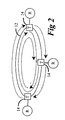
- three routers 10, designated R form a logical data network.
- this logical data network can be achieved by a transport fibre ring 12 with transport nodes 14, designated T, which function as add/drop points.
- a mesh with multiplexers 16 and cross connects 18 can also realizes the logical data network of Figure 1.
- paths are shown by dotted lines with arrow heads. Note that, in both the example implementations of Figures 2 and 3, paths pass through multiple nodes but if the bandwidth in a path is not being used it can not be made available to other paths passing through the same nodes. This means that links are usually either under utilized or under provisioned. The waste of bandwidth in a circuit cross-connected network is potentially much higher than the ATM cell tax that is more usually discussed.
- the switches and multiplexers In a transport network which was designed for packet traffic rather than voice traffic, the switches and multiplexers would be packet-based. In TDM systems the bitstreams from one node to another are steered through the network by pre-configured circuit switches at each multiplexing point. In a packet-based system this steering would be done by inspecting the header of each packet to determine its destination. Customer packets should be encapsulated in transport packets. The addressing scheme for the transport packets must be separate and not visible at the customer level. The encapsulation model must be recursive such that traffic can be aggregated at multiple levels in a similar way as it is in the TDM hierarchy. Instead of pre-configured, fixed-bandwidth circuits there would be a virtual path through the network from any node to any other node based on the destination transport address. No bandwidth resource would be used unless traffic was present.
- a packet transport network When providing services with bandwidth guarantees, a packet transport network should be able to emulate the circuit-based mesh in that a defined minimum bandwidth can be allocated between any pair of nodes. However, unused bandwidth should be made available to other flows in a dynamically shared fashion so that a flow can opportunistically exceed its minimum. The guaranteed bandwidth should be allocated at a much more (finer) granular level, than in the TDM networks.
- the transport network must support many customer networks and must provide protection of one customer from the traffic of another.
- the transport network In a circuit-based transport system there is a strong belief in security and isolation between users.
- the security attributes of the TDM world must be equally demonstrable in the packet-based system.
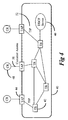
- FIG. 4 depicts a general architecture for a novel IP-based packet transport network 40.
- the network has the following subsystems, transport routers (TR) 42, transport access points (TAP) 44, and a dynamic host configuration protocol (DHCP) server 46.
- TR transport routers
- TAP transport access points
- DHCP dynamic host configuration protocol
- Customer routers or host machines (CR) 48 access to IP transport network 40 through a TAP 44 via a customer access line 50.
- the functions of these subsystems are as follows:
- FIG. 5 shows a known IP datagram format and the fields of an IP header.
- a TAP encapsulates customer's data and attaches an appropriate IP header.
- This encapsulated IP packet is a TIP and includes TIP destination and source addresses. Though they are called packets, customer router or host machine generates and sends to a TAP through its access line its data in any packets, frames or TDM formats.
- the IP-based packet transport network shown in Figure 4 can emulate an Ethernet network among customer's host machines.
- CRs are Ethernet terminals and when a CR 48 sends its data to the transport network 40, the TAP 44 connected to the CR removes the data from its Ethernet frame and encapsulate it in a TIP packet.
- the TIP destination address corresponds to the location with the matching destination Ethernet address of the Ethernet frame.
- TIP packets arriving from the transport network are put back into Ethernet frames with the correct source and destination Ethernet addresses. Ethernet multicast frames will be translated into IP multicast packets for that customer's community.
- a CR has a TIP interlace instead of an Ethernet interface.
- the transport network is transparent in the sense that it behaves like an Ethernet rather than a routed network.
- the customer's routing protocols do not involve TRs or TAPs.
- the customer's TIP packets do not increment their hop counts when journeying over the transport network.
- This Ethernet model allows the customer to use the transport system with conventional and easy network management methods.
- the TAP connected to the CR will receive from the CR's interface its Ethernet address, and from the DHCP server a TIP address for the CR to be used by the transport network.
- a TIP address for the CR to be used by the transport network.
- the CR will be able to receive ARP-request messages (address resolution protocol-request messages) and respond to them over the transport network, as if it were connected to an Ethernet network.
- CRs 60 can be connected to an IP-based packet transport network 62, using non-Ethernet links.
- an ARP-TAP 64 which is a TAP capable of performing address resolution protocol, can connect to a CR through a customer link using any layer-2 (Data Link) protocol.
- IP packets arriving from the CR are encapsulated into TIP packets, and conversely, TIP packets arriving from the transport network are decapsulated into IP packets.
- ARP-TAPs will learn the mapping between IP and TIP addresses, in a way similar to how CRs learns the mapping between TIP and Ethernet addresses under the Ethernet model.
- An advantage of IP is that it has been implemented over a large number of layer-2 links. Use of ARP-TAPs allows the transport network to support all these links while still using the Ethernet model.
- a powerful feature of local area networks is multicast and broadcast.
- a good model for this is Ethernet where broadcast between members of the same community is used to bootstrap up communications to new or previously unknown nodes.
- Within the transport network customers should be given multicast and broadcast capability for their community.
- the packet transport network must also provide for guaranteed levels of delay and packet loss.
- the Resource Reservation Protocol (RSVP) defined for P networks can be re-used in the packet transport network to allow the set-up of paths with a particular performance over and above best effort. Advances in routing to accommodate quality of service can also be re-used. It should be noted that the transport network will be much less subject to change than the public Internet making it simpler to introduce quality of service features.
- IP-based packet transport network all the customer traffic that is going to a destination (one TIP address) will be encapsulated in one flow of TIP packets. This reduces the size of tables in the transport routers and the number of contenting connections, but it also has the drawback that it hides the customer flow information that the routers might use to implement intelligent discard policies.
- the objective of sharing unused bandwidth means that there will be congestion and therefore packet discard at internal routers.
- multiple customer packets might be encapsulated in a single transport packet (TIP packet) to reduce header overheads.
- the discard of a TIP packet would result in the discard of multiple customer packets.
- the customer packets may be TCP packets and this discard of customer's TCP packets may potentially cause undesirable effects on the customer's TCP connections.
- the conventional IP network which is laid over a circuit-based network implements bandwidth sharing among host machines using the transport control protocol (TCP).
- TCP transport control protocol
- Figure 7 illustrates a TCP header.
- the sender sender host machine
- the loss of a packet determined by sequence numbers of TCP packets as an indication to decrease its rate. Any lost packets are sent again so that there is a reliable flow of traffic.
- the loss of many packets can cause the TCP connection to reduce its bandwidth too much or even to enter the timed out state.
- the transport access points use TCP for the TIP traffic flows which need to compete for bandwidth.
- One or more customer traffic between two access points is encapsulated in a TIP packet with both an TIP header and a TCP header.
- the TIP header includes TIP source and destination addresses.
- TCP Transmission Control Protocol
- TCP trunk of the embodiment would experience packet loss as it competes for bandwidth but since TCP resends all lost packets, all packets would ultimately arrive at the destination. It is therefore equivalent to a lossless pipe so that the higher layer traffic protocols are not impacted adversely.
- the re-use of TCP allows for dynamic competition for available bandwidth, adaptation of the flow rates to suit the network loading and reliable delivery of all information.
- an interface module at TAP receives customer digital data flows and it identifies those that are directed to a destination transport access point, by referring to an address table 82.
- An encapsulation module 84 encapsulates those digital data flows so identified in a series of TCP segments and with a help of an IP header module 86 attaches to each transport IP packet a transport IP header, containing the address of the destination transport access point.
- Those digital data flows are contained in the data field of a transport IP packet with proper demarcation among the digital data flows.
- the data field also contains a TCP header generated by a TCP header module 88.
- a TCP protocol processor 90 runs TCP protocol using all the relevant fields of the TCP header.
- a transmission module 92 emits a series of completed transport IP packets into the packet transport network which by reading the destination address properly routes the packets to the appropriate destination transport access point. And, of course, the reverse process is performed at the receiver.
- An admission process can limit the number of TCP connections over a TCP trunk, and also the number of other TCP connections which may compete with the TCP trunk on shared network resources. This will assure some guaranteed minimum bandwidth for the TCP trunk, and thus each of the TCP connections over the TCP trunk. TCP control will allow the TCP trunk and the TCP connections it carries to use more than their guaranteed bandwidths when extra bandwidth is available.
- TCP provides for inherent re-ordering of the transport stream and permits load spreading without this adverse effect.
- TCP performance can be very badly affected by inadequate buffer space at the congestion points.
- the aggregation of flows into one TCP trunk reduces the total number of flows seen by the transport network. This in turn permits the use of much less buffer space and more intelligent discard policies to further improve network performance.
- TCP protocol The essence of the TCP protocol is the adaptation of the rate to allow elastic sharing and the retransmission to provide reliable delivery.
- both ends of the trunk are owned and well understood by the network operator, it is possible to modify TCP to facilitate better performance, resulting in more assured and improved quality of service to customers.
- the transport system provides some minimum level of bandwidth for the total traffic between any pair of access points.
- TCP will reduce its transmission rate very aggressively when a packet is lost. If the guaranteed minimum bandwidth is known and the round trip time (RTT) between the access points is known or has been calculated, then the TCP sender node need only reduce its window to that which corresponds to a sending rate equal to that configured minimum rate. In this way the protocol will still probe for extra, opportunistic bandwidth but will be able to maintain the configured minimum. The access point would again do the accounting and ensure that, when there was traffic to send, it was able to achieve the promised minimum.
- RTT round trip time
- Accounting at the access point would use a moving average over some window of time. At any time when the average rate achieved is less than the allocated minimum, the access point would mark the packets with a higher delivery priority. For traffic sent opportunistically after the minimum is met the packets would be marked as lower priority for delivery and therefore discardable. If the allocations of bandwidth over the network are done conservatively then the higher priority packets should rarely be discarded.
- the TOS field in the IP header provides for an indication to "maximize reliability".
- the access point Since the access point has control over which packets are marked as discardable it can bias loss toward less fragile connections and maintain a more fair sharing between different flows. It can also use this control to allocate guaranteed bandwidth to preferred classes within the total traffic. Keeping the complexity of QoS management at the edges of the network and having simple mechanisms within the network is consistent with the scalable networks and with the trends in the internet world.
- both ends (access points) of the transport link are owned and well understood, it is possible to reduce the overhead of the encapsulation by modifying the IP and TCP headers to remove unnecessary information, thus resulting in more efficient utilization of the bandwidth. For example, some control packets will not be needed, e.g., connection set-up, connection tear-dawn packets etc.
- the TCP window size can also be extended in order to allow faster transmission over paths with long delay.
Landscapes
- Engineering & Computer Science (AREA)
- Computer Networks & Wireless Communication (AREA)
- Signal Processing (AREA)
- Data Exchanges In Wide-Area Networks (AREA)
- Small-Scale Networks (AREA)
Applications Claiming Priority (2)
| Application Number | Priority Date | Filing Date | Title |
|---|---|---|---|
| CA2236085 | 1998-04-27 | ||
| CA002236085A CA2236085C (fr) | 1998-04-27 | 1998-04-27 | Mecanisme efficace d'acheminement de donnees en paquet et interface du systeme |
Publications (2)
| Publication Number | Publication Date |
|---|---|
| EP1018830A2 true EP1018830A2 (fr) | 2000-07-12 |
| EP1018830A3 EP1018830A3 (fr) | 2002-04-10 |
Family
ID=4162372
Family Applications (1)
| Application Number | Title | Priority Date | Filing Date |
|---|---|---|---|
| EP99303169A Withdrawn EP1018830A3 (fr) | 1998-04-27 | 1999-04-23 | Méthode et interface pour un transport efficace de données en paquets |
Country Status (3)
| Country | Link |
|---|---|
| EP (1) | EP1018830A3 (fr) |
| JP (1) | JP2000032058A (fr) |
| CA (1) | CA2236085C (fr) |
Cited By (1)
| Publication number | Priority date | Publication date | Assignee | Title |
|---|---|---|---|---|
| US9866490B2 (en) | 2013-01-10 | 2018-01-09 | Fuji Xerox Co., Ltd. | Communication management system and non-transitory computer readable medium |
Families Citing this family (1)
| Publication number | Priority date | Publication date | Assignee | Title |
|---|---|---|---|---|
| KR102901292B1 (ko) * | 2020-06-19 | 2025-12-18 | 프라임완 리미티드 | 가상 네트워크를 형성하는 방법 |
-
1998
- 1998-04-27 CA CA002236085A patent/CA2236085C/fr not_active Expired - Fee Related
-
1999
- 1999-04-23 EP EP99303169A patent/EP1018830A3/fr not_active Withdrawn
- 1999-04-26 JP JP11831799A patent/JP2000032058A/ja active Pending
Non-Patent Citations (1)
| Title |
|---|
| MARTINEZ R.; SON C.W.; TAO J.: "INTERCONNECTION OF SYTEK LOCALNET 20 NETWORKS THROUGH THE NETWORK USING INTERNET PROTOCOL GATEWAYS", PROCEEDINGS OF THE ANNUAL INTERNATIONAL PHOENIX CONFERENCE ON COMPUTERS AND COMMUNICATIONS, vol. CONF. 6, 25 February 1987 (1987-02-25) - 27 February 1987 (1987-02-27), WASHINGTON, US, pages 354 - 360, XP000619491 * |
Cited By (1)
| Publication number | Priority date | Publication date | Assignee | Title |
|---|---|---|---|---|
| US9866490B2 (en) | 2013-01-10 | 2018-01-09 | Fuji Xerox Co., Ltd. | Communication management system and non-transitory computer readable medium |
Also Published As
| Publication number | Publication date |
|---|---|
| EP1018830A3 (fr) | 2002-04-10 |
| CA2236085C (fr) | 2003-01-07 |
| CA2236085A1 (fr) | 1999-10-27 |
| JP2000032058A (ja) | 2000-01-28 |
Similar Documents
| Publication | Publication Date | Title |
|---|---|---|
| US6643292B2 (en) | Efficient packet data transport mechanism and an interface therefor | |
| EP1739914B1 (fr) | Procede, appareil, routeur de bordure et systeme pouvant garantir la qualite de service (qos) | |
| US6477166B1 (en) | System, method and switch for an MPLS network and an ATM network | |
| US6963575B1 (en) | Enhanced data switching/routing for multi-regional IP over fiber network | |
| CN100547982C (zh) | 实现rpr网和mpls网之间端对端连接的方法和节点 | |
| US20140119367A1 (en) | Encoding Packets for Transport Over SDN Networks | |
| US7843962B2 (en) | Method to extend the physical reach of an infiniband network | |
| WO2000019680A2 (fr) | Systeme et procede d'optimisation d'intensite de trafic sur un reseau, au moyen de classes de trafic | |
| KR20040107379A (ko) | 분산 구조 라우터에서 가상 근거리 통신망 브리징 및 가상사설 통신망을 구현하는 장치 및 방법 | |
| US7756125B2 (en) | Method and arrangement for routing pseudo-wire encapsulated packets | |
| CN100563215C (zh) | 一种报文路由交换装置及其方法 | |
| EP1576770B1 (fr) | Tunnellisation de trafic tdm sur des reseaux mpls | |
| US6289017B1 (en) | Method of providing redundancy and load sharing among multiple LECs in an asynchronous mode network | |
| US7499449B2 (en) | Virtual Ethernet MAC switching | |
| US7061919B1 (en) | System and method for providing multiple classes of service in a packet switched network | |
| CA2236085C (fr) | Mecanisme efficace d'acheminement de donnees en paquet et interface du systeme | |
| Chapman et al. | Enhancing transport networks with Internet protocols | |
| Chin | Cisco Frame Relay Solutions Guide | |
| US20040240428A1 (en) | SDH/SONET-based data transmitting method | |
| KR100596587B1 (ko) | 이종망 연동 장치와, 그를 이용한 실시간 트래픽 변환 방법 | |
| CA2412914A1 (fr) | Offre de services differencies | |
| JP2002064542A (ja) | ラベル化パケット転送処理方法およびその通信装置 | |
| Gebali | Switches and Routers | |
| De Praetere et al. | Data networks integration |
Legal Events
| Date | Code | Title | Description |
|---|---|---|---|
| PUAI | Public reference made under article 153(3) epc to a published international application that has entered the european phase |
Free format text: ORIGINAL CODE: 0009012 |
|
| AK | Designated contracting states |
Kind code of ref document: A2 Designated state(s): AT BE CH CY DE DK ES FI FR GB GR IE IT LI LU MC NL PT SE Kind code of ref document: A2 Designated state(s): DE FR GB |
|
| AX | Request for extension of the european patent |
Free format text: AL;LT;LV;MK;RO;SI |
|
| RAP1 | Party data changed (applicant data changed or rights of an application transferred) |
Owner name: NORTEL NETWORKS LIMITED |
|
| PUAL | Search report despatched |
Free format text: ORIGINAL CODE: 0009013 |
|
| RIC1 | Information provided on ipc code assigned before grant |
Free format text: 7H 04L 29/06 A, 7H 04L 12/66 B, 7H 04L 29/12 B, 7H 04L 12/46 B |
|
| AK | Designated contracting states |
Kind code of ref document: A3 Designated state(s): AT BE CH CY DE DK ES FI FR GB GR IE IT LI LU MC NL PT SE |
|
| AX | Request for extension of the european patent |
Free format text: AL;LT;LV;MK;RO;SI |
|
| 17P | Request for examination filed |
Effective date: 20021009 |
|
| AKX | Designation fees paid |
Free format text: DE FR GB |
|
| 17Q | First examination report despatched |
Effective date: 20030526 |
|
| RAP1 | Party data changed (applicant data changed or rights of an application transferred) |
Owner name: NORTEL NETWORKS LIMITED |
|
| STAA | Information on the status of an ep patent application or granted ep patent |
Free format text: STATUS: THE APPLICATION IS DEEMED TO BE WITHDRAWN |
|
| 18D | Application deemed to be withdrawn |
Effective date: 20050315 |