EP1018968B1 - Procede et champ operatoire ophtalmique - Google Patents
Procede et champ operatoire ophtalmique Download PDFInfo
- Publication number
- EP1018968B1 EP1018968B1 EP98949643A EP98949643A EP1018968B1 EP 1018968 B1 EP1018968 B1 EP 1018968B1 EP 98949643 A EP98949643 A EP 98949643A EP 98949643 A EP98949643 A EP 98949643A EP 1018968 B1 EP1018968 B1 EP 1018968B1
- Authority
- EP
- European Patent Office
- Prior art keywords
- field
- web
- skin compatible
- adhesive
- compatible adhesive
- Prior art date
- Legal status (The legal status is an assumption and is not a legal conclusion. Google has not performed a legal analysis and makes no representation as to the accuracy of the status listed.)
- Expired - Lifetime
Links
- 238000000034 method Methods 0.000 title claims description 28
- 239000000853 adhesive Substances 0.000 claims description 138
- 230000001070 adhesive effect Effects 0.000 claims description 138
- 210000000744 eyelid Anatomy 0.000 claims description 44
- 239000000463 material Substances 0.000 claims description 11
- 238000004519 manufacturing process Methods 0.000 claims description 10
- 238000007373 indentation Methods 0.000 claims description 8
- 239000011248 coating agent Substances 0.000 description 4
- 238000000576 coating method Methods 0.000 description 4
- 239000004698 Polyethylene Substances 0.000 description 3
- -1 polyethylene Polymers 0.000 description 3
- 229920000573 polyethylene Polymers 0.000 description 3
- 238000001356 surgical procedure Methods 0.000 description 3
- NIXOWILDQLNWCW-UHFFFAOYSA-M Acrylate Chemical compound [O-]C(=O)C=C NIXOWILDQLNWCW-UHFFFAOYSA-M 0.000 description 2
- 238000010276 construction Methods 0.000 description 2
- 210000000720 eyelash Anatomy 0.000 description 2
- 239000002985 plastic film Substances 0.000 description 2
- 229920006255 plastic film Polymers 0.000 description 2
- 229920000642 polymer Polymers 0.000 description 2
- 229920001296 polysiloxane Polymers 0.000 description 2
- 239000004820 Pressure-sensitive adhesive Substances 0.000 description 1
- 239000002390 adhesive tape Substances 0.000 description 1
- 238000007607 die coating method Methods 0.000 description 1
- 210000004209 hair Anatomy 0.000 description 1
- 210000003128 head Anatomy 0.000 description 1
- 208000015181 infectious disease Diseases 0.000 description 1
- 230000036512 infertility Effects 0.000 description 1
- 238000005065 mining Methods 0.000 description 1
- 239000000203 mixture Substances 0.000 description 1
- 229920000098 polyolefin Polymers 0.000 description 1
Images




Classifications
-
- A—HUMAN NECESSITIES
- A61—MEDICAL OR VETERINARY SCIENCE; HYGIENE
- A61B—DIAGNOSIS; SURGERY; IDENTIFICATION
- A61B46/00—Surgical drapes
-
- A—HUMAN NECESSITIES
- A61—MEDICAL OR VETERINARY SCIENCE; HYGIENE
- A61B—DIAGNOSIS; SURGERY; IDENTIFICATION
- A61B46/00—Surgical drapes
- A61B46/20—Surgical drapes specially adapted for patients
- A61B2046/205—Adhesive drapes
Definitions
- the invention relates generally to surgical drapes, and more specifically to ophthalmic drapes having adhesive portions that allow them to be adhered to the skin adjacent the eye, and methods of manufacturing and applying such drapes.
- a surgical drape In order to perform surgery on the eye it is frequently desirable to apply a surgical drape to the patient, first to isolate the eyelashes and eyelids from the surgical site to improve exposure of the eye, and provide a sterile drape surface to reduce the chance of infection.
- draping may be primarily performed to pull eyelids and eyelashes away from the eye, and keep them out of the way of surgical instruments such as microkeratomes.
- Model 1020 ophthalmic drape commercially available from the Minnesota Mining and Manufacturing Company, St. Paul, Minnesota.
- This drape includes a sheet of material having a generally round aperture in roughly the center.
- a field of skin compatible adhesive contacts a portion of one side of the sheet adjacent this aperture. This adhesive allows the drape to be adhered around the patient's eye, and the rest of the sheet drapes down over the patient's head, hair and face to provide a sterile surface over these areas.
- medical practitioners find it inconvenient to conform the margins of the aperture to the edges of a particular patient's eyelids.
- one expedient that is known to some practitioners is to cut the drape, either partly or else completely into two sections, to relieve the tension in stretched areas or to prevent bunching of the adhesive, and allow the margin of the aperture to be more perfectly conformed to the margin of the patient's eye.
- cutting the drape before application is the preferred practice of many surgeons in order to facilitate one person applying the drape to the upper eyelid first without adhering the lower portions of the adhesive field to the lower eyelid until ready to do so.
- DE-C 39 31 803 discloses a surgical eye cover comprising a plastic film with a window, and cover flaps overlapping each other in the area of the window.
- the bottom side of the plastic film is coated with a pressure sensitive adhesive.
- This invention provides a method of draping the eye for ophthalmic surgery that allows a one-piece drape to be easily conformed to both lids of the eye by a single person without additional tools.
- This invention solves the problems discussed above by providing an ophthalmic drape that can easily be adhered to both the upper and lower margins of the eye without requiring the use of separate instruments for cutting and adjusting. This is accomplished by providing attachment surfaces on the drape for the upper and lower eyelids on very different portions of the drape. It is therefore not necessary to put a strain on one of the attachment surfaces during the application of the other attachment surface. The upper portion of this drape can be accurately positioned on the upper eyelid while the lower portion is kept away from the surgical site until ready to position the lower portion on the lower eyelid. This is accomplished with an easy-to-handle one-piece drate.
- an ophthalmic drape of the invention comprises a sheet having a first and a second side, a periphery, and an aperture spaced from the periphery of the sheet.
- a first field of skin compatible adhesive is provided contacting a portion of the first side of the sheet adjacent the aperture, and a second field of skin compatible adhesive is provided contacting a portion of the second side of the sheet adjacent the periphery of the sheet.
- the aperture adjacent the first field of skin compatible adhesive is formed by an edge of the sheet having a curved portion approximating an eyelid, and the periphery is defined in part by an edge portion adjacent the second field of skin compatible adhesive, the edge portion having a concave curved shape approximating an eyelid.
- a first release liner is adhered to the first field of skin compatible adhesive
- a second release liner is adhered to the second field of skin compatible adhesive.
- the first and second sides of the sheet may conveniently define a generally rectangular shape, and the sheet may be formed of polymeric film material.
- the section of the drape supporting the second field of skin compatible adhesive can be folded upwards and doubled back on the drape.
- the second field of skin compatible adhesive which had been the side away from the patient before folding, is turned side towards the patient after folding.
- the second field of skin compatible adhesive is therefore conveniently available to be adhered to the other eyelid (e.g., the lower eyelid).
- the method of the invention for applying an ophthalmic drape to the upper and lower eyelids of an eye of a patient comprises the following steps:
- the aperture has a curved portion approximating the eyelid, and the periphery has a concave curve-shaped edge portion, which approximates the shape of an eyelid, adjacent the second field of skin compatible adhesive.
- the step (b) of adhering one of the fields of skin compatible adhesive to one of the eyelids and the step (d) of adhering the other field of skin compatible adhesive to the other eyelid include placing one of the curved portion and the edge portion on one of the upper and lower eyelids (e.g., placing the curved portion on the upper eyelid), and placing the other of the curved portion and the edge portion on the other of the upper and lower eyelids (e.g., placing the edge portion on the lower eyelid).
- a first release liner is adhered to the first field of skin compatible adhesive; and a second release liner is adhered to the second field of skin compatible adhesive; and the method further comprises removing the first release liner from the first field of skin compatible adhesive and removing the second release liner from the second field of skin compatible adhesive.
- the ophthalmic drape is manufactured according to a "two-up" manufacturing process.
- this method makes an ophthalmic drape from an indefinite length web having first and second sides, a longitudinal direction and a width. This method comprises the following steps:
- the steps (b) of cutting a first opening through the first field of skin compatible adhesive and the web, (d) of cutting a second opening through the second field of skin compatible adhesive and the web, and (e) of cutting a third opening through the third field of skin compatible adhesive and the web each comprise cutting generally oval-shaped openings approximating generally the shape of an open eye, for example, by die cutting.
- the generally oval-shaped openings are cut to have a direction of elongation extending generally along the longitudinal direction of the web.
- the ophthalmic drape is manufactured according to a "one-up" manufacturing process.
- This method makes an ophthalmic drape from an indefinite length web having opposite major surfaces, opposite side edges and a lateral direction.
- this method comprises the following steps:
- the first opening is enlarged, for example, by die cutting, in the direction toward the indentation.
- the adhesive is applied to the web by applying a strip of transfer adhesive or double-stick patch to the web, then that strip of transfer adhesive or double-stick patch is cut to separate the first and second adhesive fields from one another before the web is unfolded. This may be conveniently done by a die-cut type roller that both cuts the transfer adhesive strip or double-stick patch and cuts the opening through the web.
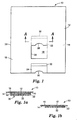
- the drape 10 includes a sheet of material 12 having a first side 14 (the underside in this view) and a second side 16 (the topside in this view).
- the sheet 12 has an aperture 18 therein, the aperture being at a position removed from the periphery 20 of the sheet.
- a first field 22 of skin compatible adhesive contacts a portion of the first side 14 of the sheet 12 adjacent the aperture 18; the first field of skin compatible adhesive is on the underside in this view, and is represented by the cross-hatched region bordered by dotted lines and the aperture.
- a second field 24 of skin compatible adhesive contacts a portion of the second side 16 of the sheet 12 adjacent the periphery 20 of the sheet.
- a portion 26 of the margin 28 of the aperture 18 adjacent the first field of skin compatible adhesive 22 includes a curved shape, such as oval, elliptical or round, approximating the human eyelid.
- a portion 30 of the periphery 20 adjacent the second field of skin compatible adhesive 24 also includes a curved shape approximating the human eyelid.
- release liner 32 Conveniently covering the second field of skin compatible adhesive 24 is a covering of release liner 32, which is shown transparent in this view for clarity.
- This release liner 32 protects the second field of skin compatible adhesive during shipping and handling, but is peeled away by the user of the drape just before application to the patient.
- a similar release liner protects the first field of skin compatible adhesive 22 on the far side of the drawing. For the convenience of the practitioner in taking a grip on release liner 32, one edge of it is permitted to extend beyond the edge of the field of skin compatible adhesive that it protects.
- the first and second fields of skin compatible adhesive 22 and 24 can either be pattern coated directly on the sheet 12, or applied as a transfer adhesive, or alternatively may be applied in a pick-and-place operation as a wholly or partly coated double-stick patch.
- Fig. 1a a partial cross-section view of the drape of Fig. 1 taken along section lines A-A, where a double stick patch has been used to apply the skin compatible adhesive, is illustrated.
- a double-stick patch 36 is shown adhered to the sheet 12.
- the patch 36 includes a backing 40 adhered to sheet 12 via adhesive 41.
- On the other side of backing 40 is the skin-compatible adhesive 22, which will eventually be adhered to the patient.
- release liner 32 can be seen protecting skin compatible adhesive 22 before use.
- Adhesives 22 and 41 may be the same, or may be different adhesives as convenient and compatible with the materials chosen.
- a second partial cross-section view of the drape of Fig. 1 taken along section lines A-A is illustrated so as to show the application of the field of skin compatible adhesive 22 directly to the sheet 12 as a transfer adhesive.
- the release liner 32 is pre-adhered to the field of skin compatible adhesive 22 before the transfer.
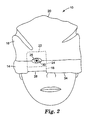
- a perspective view of the drape 10 of Fig. 1 is illustrated as adhered to a patient.
- the first field of skin compatible adhesive 22 has been adhered to the patient's upper eyelid, and the sheet 12 has been folded along fold line 34 so that part of the first side 14 is turned upwards. That also causes the second field of skin compatible adhesive 24 to be turned towards the patient, and it is illustrated after having been adhered to the lower eyelid of the patient.
- the distance between fold line 34 and the curved portion 30 allows the second field of skin compatible adhesive 24 to be settled into place against the patient's skin without reference to the position of the first field of skin compatible adhesive 22 on the other eyelid, although it is preferred to overlap the first and second fields 22 and 24 of skin compatible adhesive.
- the sheet 12 is conveniently fabricated from many sorts of polymeric film, especially polyolefin film.
- the use of antistatically treated polyethylene film is currently considered preferred.
- the skin compatible adhesive 22 and 24 is conveniently prepared from acrylate adhesive, and may be applied by various techniques, such as double-stick, pattern coating or as a transfer adhesive.
- suitable compositions can be found in coassigned U.S. Patent Re. 24,906 to Ulrich.
- the acrylate adhesive discussed as Example 5 of that document is suitable.
- a double-stick adhesive typically comprises adhesive tape with the adhesive coated on both sides and a liner (e.g., a paper or polymeric liner). Pattern coating may involve a printing-type process or die coating.
- a transfer adhesive typically comprises an adhesive coated on a first liner (e.g., paper or polymer, such as a polyethylene film liner 32 with a silicone release coating, depending on the adhesive) that is removed before or after the transfer adhesive is put to use.
- a second liner e.g., paper or polymer, such as a polyethylene film liner 32 with a silicone release coating
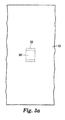
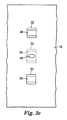
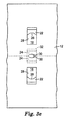
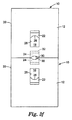
- FIGs. 3a-3f top views of a representative section of an indefinite length web at sequential stages of a "two-up" manufacturing scheme for the ophthalmic drape 10 are shown.
- the term "longitudinal direction” means the continuous or machine direction of the web
- the "width” means the cross web or lateral direction.
- an indefinite length of sheet material 12 conveniently 36 inches (91.4 cm) wide, has had adhered to it a strip of skin compatible adhesive 38 via transfer adhesive techniques.
- the strip 38 has conveniently been applied with release liner 32 adhered to the other side of the strip 38 with two of the ends of the release liner extending beyond the ends of the strip.
- Strip 38 will eventually form the second field of skin-compatible adhesive 24 on the two drapes 10 that will be formed side-by-side from this segment of the indefinite length sheet 12.
- a die cutter has punched an opening 46 that eventually will form the curved portion 30 on the two drapes 10 that will be formed from this segment of the indefinite length sheet.
- the indefinite length sheet may, if convenient, be rolled on a jumbo so that the remainder of the steps may be performed in a second pass through another converter. In converters that can act on both sides of the indefinite length sheet, it is not necessary to perform the roll-up.
- a die cutter has just cut two apertures 18 and created two mirror images of curved portion 26. Strips 48 and 50 have been converted into two copies of first field of skin compatible adhesive 22.
- a slitter has just sliced the indefinite length sheet 12 down the centerline, creating mirror imaged sections that are ready to be cut off to form a pair of drapes 10.
- opening 46 is divided into the two curved portions 30 on two facing drapes, and strip 38 is divided into two second fields of skin compatible adhesive 24 on these facing drapes.
- a cutter has just sheeted off two mirror imaged drapes 10 from the indefinite length material that are ready to be folded, packaged, and sterilized for the customer.
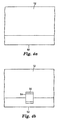
- FIGs. 4a-4f top views of a representative section of an indefinite length web at sequential stages of a "one-up" manufacturing process for the ophthalmic drape 10 are shown.
- an indefinite length of sheet material 12 conveniently 18 inches (45.7 cm) wide, has been folded at fold line 52.
- fold line 52 is approximately where the practitioner will eventually place fold line 34.
- Fig. 4b the indefinite length of sheet 12 has had adhered to it a strip 54 of adhesive with a release liner 32 adhered to it in a manner similar to strip 38 discussed above.
- Strip 54 is placed partly on and partly off the folded edge.
- Fig. 4c an opening 56 has been die cut into the web within strip 54.
- Fig. 4d the folded edge has been slit and the indefinite length of sheet 12 has been unfolded again, creating from strip 54 the first and second fields of skin compatible adhesive 22 and 24, and curved portion 30.
- a die cutter has just cut aperture 18 with its margin 28 and curved portion 26.
- a cutter has just sheeted off the finished drape 10 from the indefinite length of sheet material 12, which drape 10 is then ready to be folded, packaged, and sterilized for the customer.
Landscapes
- Health & Medical Sciences (AREA)
- Surgery (AREA)
- Life Sciences & Earth Sciences (AREA)
- Engineering & Computer Science (AREA)
- Biomedical Technology (AREA)
- Heart & Thoracic Surgery (AREA)
- Medical Informatics (AREA)
- Molecular Biology (AREA)
- Animal Behavior & Ethology (AREA)
- General Health & Medical Sciences (AREA)
- Public Health (AREA)
- Veterinary Medicine (AREA)
- Materials For Medical Uses (AREA)
Claims (12)
- Champ ophtalmique (10) pour appliquer sur les paupières supérieures et inférieures de l'oeil d'un patient, le champ (10) comprenant :une feuille (12) ayant un premier et un second côté (14 et 16), une périphérie (20), et une ouverture (18) distante de la périphérie (20) de la feuille (12) ;un premier champ (22) adhésif compatible avec la peau, en contact avec une partie du premier côté (14) de la feuille (12), adjacente à l'ouverture (18) ; etun deuxième champ (24) adhésif compatible avec la peau, en contact avec une partie du second côté (16) de la feuille (12), adjacente à la périphérie (20) de la feuille (12) ; caractérisé en ce quela périphérie (20) est en partie définie par une partie formant bord (30) adjacente au deuxième champ (24) adhésif compatible avec la peau, la partie formant bord (30) ayant une forme courbe et concave ressemblant à une paupière.
- Champ ophtalmique (10) selon la revendication 1, dans lequel l'ouverture (18) a une partie courbe ressemblant à une paupière.
- Champ ophtalmique (10) selon la revendication 1 ou 2, dans lequel les premier et second côtés (14 et 16) de la feuille (12) définissent une forme essentiellement rectangulaire, et la feuille (12) est formée d'un film polymère, le champ ophtalmique (10) comprenant en outre :une première bande détachable adhérée au premier champ (22) adhésif compatible avec la peau ; etune seconde bande détachable (32) adhérée au deuxième champ (24) adhésif compatible avec la peau.
- Procédé d'application du champ ophtalmique (10) selon l'une quelconque des revendications 1 à 3, le procédé comprenant l'étape suivante :le collage de l'un des champs (22 ou 24) adhésifs compatibles avec la peau sur l'une des paupières ; caractérisé en ce que le procédé comprend en outre les étapes consistant àplier le champ opératoire (10) de telle sorte que l'autre champ (24 ou 22) adhésif compatible avec la peau soit tourné vers le patient ; et àcoller l'autre champ (24 ou 26) adhésif compatible avec la peau sur l'autre paupière.
- Procédé selon la revendication 4, dans lequel l'étape (b) consistant à coller l'un des champs (22, 24) adhésifs compatibles avec la peau sur l'une des paupières, et l'étape (d) consistant à coller l'autre champ (24, 22) adhésif compatible avec la peau sur l'autre paupière, comprennent la mise en place de l'une des parties courbes et de la partie formant bord (30) sur l'une des paupières supérieure et inférieure, et celle de l'autre partie courbe et de la partie formant bord (30) sur l'autre paupière supérieure et inférieure.
- Procédé selon la revendication 4 ou 5, dans lequel l'étape (b) consistant à coller l'un des champs (22, 24) adhésifs compatibles avec la peau sur l'une des paupières, et l'étape (d) consistant à coller l'autre champ (24, 22) adhésif compatible avec la peau sur i l'autre paupière, comprennent la mise en place de la partie courbe sur la paupière supérieure, et celle de la partie formant bord (30) sur la paupière inférieure.
- Procédé de fabrication d'un champ ophtalmique (10) selon l'une quelconque des revendications 1-3, à partir d'un tissu (12) d'une longueur indéterminée ayant un premier et un second côté, un sens longitudinal et une largeur, le procédé comprenant les étapes suivantes :(a) l'application d'un premier champ (38) adhésif compatible avec la peau sur le premier côté du tissu (12) ;(b) le découpage d'une première ouverture (46) dans le premier champ (38) adhésif compatible avec la peau et dans le tissu (12) ;(c) l'application des deuxième et troisième champs (48 et 50) adhésifs compatibles avec la peau sur le second côté du tissu (12), espacés latéralement dans des directions opposées par rapport au premier champ (38) adhésif compatible avec la peau ;(d) le découpage d'une deuxième ouverture (18) dans le deuxième champ (48) adhésif compatible avec la peau et dans le tissu (12) ;(e) le découpage d'une troisième ouverture (18) dans le troisième champ (50) adhésif compatible avec la peau et dans le tissu (12) ;(f) le découpage du tissu (12) dans le sens longitudinal, dans la première ouverture (38) ;(g) le découpage du tissu (12) deux fois, dans le sens latéral le long de deux lignes de coupe, espacées longitudinalement dans des directions opposées par rapport aux première, deuxième et troisième ouvertures (38, 48, 50) pour former deux champs ophtalmiques (10).
- Procédé selon la revendication 7, dans lequel :l'étape (c) consistant à appliquer le deuxième et le troisième champ (48 et 50) adhésif compatible avec la peau sur le second côté du tissu, espacés latéralement dans des directions opposées par rapport au premier champ (38) adhésif compatible avec la peau, comprend l'espacement latéral des deuxième et troisième champs (48, 50) adhésifs compatibles avec la peau à une distance sensiblement égale du premier champ (38) adhésif compatible avec la peau ; etles étapes (f) et (g) forment des champs ophtalmiques à image inverse (10) sensiblement identiques.
- Procédé selon la revendication 7 ou 8, dans lequel :l'étape (b) consistant à découper une première ouverture (46) dans le premier champ (38) adhésif compatible avec la peau et dans le tissu (12), l'étape (d) consistant à découper une deuxième ouverture (18) dans le deuxième champ (48) adhésif compatible avec la peau et dans le tissu (12), et l'étape (e) consistant à découper une troisième ouverture (18) dans le troisième champ (50) adhésif compatible avec la peau et dans le tissu (12), comprennent chacune le découpage à l'emporte-pièce des première, deuxième et troisième ouvertures (30, 18) ; etl'étape (b) consistant à découper une première ouverture dans le premier champ (38) adhésif compatible avec la peau et dans le tissu (12), l'étape (d) consistant à découper une deuxième ouverture (18) dans le deuxième champ (48) adhésif compatible avec la peau et dans le tissu (12), et l'étape (e) consistant à découper une troisième ouverture (18) dans le troisième champ (50) adhésif compatible avec la peau et dans le tissu (12), comprennent chacune le découpage d'une ouverture (46) généralement ovale ou de parties formant bord (26) généralement semi-ovales, ressemblant habituellement à la forme d'un oeil ouvert, l'ouverture (46) et les parties formant bord (26), ovales, ayant un sens d'allongement s'étendant généralement dans le sens longitudinal du tissu (12).
- Procédé de fabrication du champ ophtalmique (10) selon l'une quelconque des revendications 1-3, à partir d'un tissu (12) d'une longueur indéterminée, ayant des surfaces principales et des bords latéraux, opposés, et un sens latéral, le procédé comprenant les étapes suivantes :(a) le repliage d'un bord latéral du tissu (12) sur lui-même pour former un volet replié sur une partie principale du tissu (12), ledit bord latéral chevauchant la partie principale du tissu (12) ;(b) l'application d'un adhésif compatible avec la peau (54) en partie sur le volet et sur la partie principale du tissu (12), ledit bord latéral divisant l'adhésif (54) en un premier champ adhésif (22) sur la partie principale du tissu (12) et en un deuxième champ adhésif (24) sur le volet ;(c) le découpage d'une ouverture (56) dans le champ (54) adhésif compatible avec la peau, dans le volet et dans la partie principale du tissu (12), et donc la formation d'une première ouverture (18) dans la partie principale et d'une échancrure (30) dans le volet ;(d) le dépliage du tissu (12) ;(e) le découpage du tissu (12) dans le sens latéral pour former un champ ophtalmique (10) ayant une première ouverture (18) et un premier champ adhésif (22), adjacents à la première ouverture (18) le long d'une surface principale, et une échancrure (30) et un deuxième champ adhésif (24), adjacents à l'échancrure (30) le long de l'autre surface principale.
- Procédé selon la revendication 10 comprenant en outre l'étape suivante :après l'étape (d) consistant à déplier le tissu (12), l'élargissement de la première ouverture (18) en direction de l'échancrure (30).
- Procédé selon la revendication 10 ou 11, dans lequel :l'étape (c) comprend le découpage à l'emporte-pièce d'une ouverture ovale (56) ;l'étape (b) comprend l'application d'un ruban adhésif de transfert (54) ou d'une bande adhésive double face sur le tissu (12) ; le procédé comprenant en outre le découpage du ruban adhésif de transfert (54) ou de la bande adhésive double face pour séparer les premier et deuxième champs adhésifs (22, 24) l'un de l'autre avant l'étape (d) ; etl'étape consistant à découper à l'emporte-pièce l'ouverture (56) et celle consistant à découper le ruban adhésif de transfert (54) pour séparer les premier et deuxième champs adhésifs (22, 24) l'un de l'autre sont réalisées en une seule opération avec un seul emporte-pièce.
Applications Claiming Priority (3)
| Application Number | Priority Date | Filing Date | Title |
|---|---|---|---|
| US08/941,820 US6070587A (en) | 1997-10-01 | 1997-10-01 | One-piece opthalmic drape and methods |
| US941820 | 1997-10-01 | ||
| PCT/US1998/020460 WO1999016376A1 (fr) | 1997-10-01 | 1998-09-29 | Procede et champ operatoire ophtalmique |
Publications (2)
| Publication Number | Publication Date |
|---|---|
| EP1018968A1 EP1018968A1 (fr) | 2000-07-19 |
| EP1018968B1 true EP1018968B1 (fr) | 2003-08-20 |
Family
ID=25477121
Family Applications (1)
| Application Number | Title | Priority Date | Filing Date |
|---|---|---|---|
| EP98949643A Expired - Lifetime EP1018968B1 (fr) | 1997-10-01 | 1998-09-29 | Procede et champ operatoire ophtalmique |
Country Status (7)
| Country | Link |
|---|---|
| US (1) | US6070587A (fr) |
| EP (1) | EP1018968B1 (fr) |
| JP (1) | JP2001517531A (fr) |
| AU (1) | AU728175B2 (fr) |
| CA (1) | CA2302594A1 (fr) |
| DE (1) | DE69817382T2 (fr) |
| WO (1) | WO1999016376A1 (fr) |
Families Citing this family (6)
| Publication number | Priority date | Publication date | Assignee | Title |
|---|---|---|---|---|
| US6345622B1 (en) * | 2000-02-18 | 2002-02-12 | Becton, Dickinson And Company | Method of using a dual refractive drape |
| US6345621B1 (en) * | 2000-02-18 | 2002-02-12 | Becton, Dickinson And Company | Dual refractive drape for use in eye surgery |
| US6863071B2 (en) * | 2002-07-03 | 2005-03-08 | Medical Concepts Development, Inc. | Refractive surgical drape |
| US6871651B2 (en) * | 2003-07-10 | 2005-03-29 | Ophthalmic surgical drape support | |
| EP1689309A4 (fr) * | 2003-12-02 | 2011-06-22 | Andrew Peter Davis | Champ operatoire retractable pour l'oeil |
| US10188573B2 (en) | 2014-11-05 | 2019-01-29 | Allen Medical Systems, Inc. | Boot stirrup |
Family Cites Families (37)
| Publication number | Priority date | Publication date | Assignee | Title |
|---|---|---|---|---|
| US24906A (en) * | 1859-07-26 | Simeon goodfellow | ||
| US1044698A (en) * | 1912-02-08 | 1912-11-19 | Reuben Sideman | Reversible breath-shield. |
| FR780734A (fr) * | 1934-01-22 | 1935-05-02 | Ensembles lumineux et leurs éléments constitutifs | |
| US2294593A (en) * | 1940-11-04 | 1942-09-01 | Jessie M Bailey | Head and face protector |
| USRE24906E (en) | 1955-11-18 | 1960-12-13 | Pressure-sensitive adhesive sheet material | |
| US3068863A (en) * | 1959-11-19 | 1962-12-18 | Charles L Bowman | Protective devices |
| US3410266A (en) * | 1966-06-24 | 1968-11-12 | Johnson & Johnson | Surgical apparel |
| US3565067A (en) * | 1968-09-23 | 1971-02-23 | Mars Mfg Co Inc | Laparotomy sheet with plastic reinforcement |
| US3561439A (en) * | 1968-12-12 | 1971-02-09 | Mars Mfg Co Inc | Laparotomy sheet with plastic center strip having absorbent layer |
| US3667458A (en) * | 1970-03-02 | 1972-06-06 | Kimberly Clark Co | Surgical drape sheet |
| US3766913A (en) * | 1970-04-29 | 1973-10-23 | Kendall & Co | Surgical drape with absorptive region |
| FR2128904A5 (fr) * | 1971-03-08 | 1972-10-27 | Ethnor | |
| US3736928A (en) * | 1971-03-15 | 1973-06-05 | Nils O W Rundblad | Collapsible face mask |
| US3750664A (en) * | 1972-04-17 | 1973-08-07 | Kendall & Co | Fenestrated surgical drape |
| US3923052A (en) * | 1972-06-06 | 1975-12-02 | Kendall & Co | Conformable surgical drape |
| US3930497A (en) * | 1974-12-05 | 1976-01-06 | Kimberly-Clark Corporation | Surgical drape and system incorporating it |
| US4033341A (en) * | 1976-03-03 | 1977-07-05 | Johnson & Johnson | Surgical drape having improved retaining means |
| US4089331A (en) * | 1976-12-06 | 1978-05-16 | The Kendall Company | Surgical drape with fenestration liner |
| FR2442047A1 (fr) * | 1978-11-22 | 1980-06-20 | Soplaril Sa | Champ operatoire utilisable en salle d'operations chirurgicales |
| US4275720A (en) * | 1979-08-08 | 1981-06-30 | The Kendall Company | Surgical drape with barrier member |
| US4316456A (en) * | 1980-01-25 | 1982-02-23 | American Hospital Supply Corporation | Surgical drape system |
| US4323062A (en) * | 1980-11-28 | 1982-04-06 | The Kendall Company | Surgical drape with retaining device |
| CA1187363A (fr) * | 1981-12-07 | 1985-05-21 | Don W. Oliver | Champ operatoire pour les chirurgies cardiovasculaires |
| US4711236A (en) * | 1982-07-06 | 1987-12-08 | Glassman Jacob A | Surgical drape |
| EP0166124A3 (fr) * | 1984-05-02 | 1987-09-02 | JOHNSON & JOHNSON MEDICAL, INC. | Drap ophtalmologique |
| US4739753A (en) * | 1987-08-26 | 1988-04-26 | Brehm, Inc. | Surgical drape support and oxygen delivery system |
| CH673938A5 (fr) * | 1987-12-04 | 1990-04-30 | Grounauer Pierre Alain | |
| US4873997A (en) * | 1988-04-25 | 1989-10-17 | Scherer Healthcare Ltd. | Surgical drape |
| US4966168A (en) * | 1989-01-03 | 1990-10-30 | Glassman Jacob A | Ophthalmic drape with built-in mini-mask |
| DE8904426U1 (de) * | 1989-04-08 | 1989-05-18 | Sengewald Klinikprodukte GmbH, 8201 Rohrdorf | Medizinisches Abdecktuch |
| DE3931803C1 (fr) * | 1989-09-23 | 1990-05-10 | Johnson & Johnson Medical Gmbh, 2000 Norderstedt, De | |
| US5140997A (en) * | 1989-10-04 | 1992-08-25 | Glassman Jacob A | Ophthalmologic surgical drape with breathing means |
| US5038798A (en) * | 1990-03-19 | 1991-08-13 | Baxter International Inc. | Opthalmic drape with fluid collection pouch |
| US5109873A (en) * | 1991-07-19 | 1992-05-05 | Scherer Healthcare Ltd. | Surgical drape |
| US5361780A (en) * | 1991-12-17 | 1994-11-08 | Kellan Robert E | Head stabilizer and superior rectus bridle suture fixator device and drainage device for use in eye surgery and methods therefor |
| US5345946A (en) * | 1993-04-23 | 1994-09-13 | Johnson & Johnson Medical, Inc. | Multi-element surgical drape with sealable surgical run-off pouches |
| CA2105347A1 (fr) * | 1993-04-29 | 1994-10-30 | Kimberly-Clark Worldwide, Inc. | Champ operatoire de lithotomie/pelviscopie modifie |
-
1997
- 1997-10-01 US US08/941,820 patent/US6070587A/en not_active Expired - Fee Related
-
1998
- 1998-09-29 DE DE69817382T patent/DE69817382T2/de not_active Expired - Fee Related
- 1998-09-29 JP JP2000513520A patent/JP2001517531A/ja active Pending
- 1998-09-29 EP EP98949643A patent/EP1018968B1/fr not_active Expired - Lifetime
- 1998-09-29 WO PCT/US1998/020460 patent/WO1999016376A1/fr not_active Ceased
- 1998-09-29 AU AU95925/98A patent/AU728175B2/en not_active Ceased
- 1998-09-29 CA CA002302594A patent/CA2302594A1/fr not_active Abandoned
Also Published As
| Publication number | Publication date |
|---|---|
| AU728175B2 (en) | 2001-01-04 |
| AU9592598A (en) | 1999-04-23 |
| EP1018968A1 (fr) | 2000-07-19 |
| US6070587A (en) | 2000-06-06 |
| DE69817382T2 (de) | 2004-06-09 |
| JP2001517531A (ja) | 2001-10-09 |
| DE69817382D1 (de) | 2003-09-25 |
| CA2302594A1 (fr) | 1999-04-08 |
| WO1999016376A1 (fr) | 1999-04-08 |
Similar Documents
| Publication | Publication Date | Title |
|---|---|---|
| EP1018969B1 (fr) | Drap ophtalmique pourvu de lignes de separation et procede correspondant | |
| JP2956943B2 (ja) | 外科用眼帯 | |
| US4531521A (en) | Skin closure means | |
| US6286511B1 (en) | Ophthalmic drape with tear line and method | |
| US4867146A (en) | Eye patch | |
| US6320094B1 (en) | Disposable eye patch and method of manufacturing a disposable eye patch | |
| US4489720A (en) | Cesarean section surgical drape | |
| EP2172164B2 (fr) | Champ opératoire | |
| US5354261A (en) | Fluid-retentive bandage | |
| US6863071B2 (en) | Refractive surgical drape | |
| US20180318027A1 (en) | Disposable surgical drape | |
| US7114499B2 (en) | Retracting eye drape | |
| US6070587A (en) | One-piece opthalmic drape and methods | |
| CA2030576A1 (fr) | Dispositif d'incision fenetre a deux couches | |
| JP2023545675A (ja) | 手術用ドレープ | |
| CA2030587A1 (fr) | Dispositif d'incision |
Legal Events
| Date | Code | Title | Description |
|---|---|---|---|
| PUAI | Public reference made under article 153(3) epc to a published international application that has entered the european phase |
Free format text: ORIGINAL CODE: 0009012 |
|
| 17P | Request for examination filed |
Effective date: 20000419 |
|
| AK | Designated contracting states |
Kind code of ref document: A1 Designated state(s): DE FR GB |
|
| GRAH | Despatch of communication of intention to grant a patent |
Free format text: ORIGINAL CODE: EPIDOS IGRA |
|
| GRAH | Despatch of communication of intention to grant a patent |
Free format text: ORIGINAL CODE: EPIDOS IGRA |
|
| GRAA | (expected) grant |
Free format text: ORIGINAL CODE: 0009210 |
|
| AK | Designated contracting states |
Designated state(s): DE FR GB |
|
| REG | Reference to a national code |
Ref country code: GB Ref legal event code: FG4D |
|
| REF | Corresponds to: |
Ref document number: 69817382 Country of ref document: DE Date of ref document: 20030925 Kind code of ref document: P |
|
| ET | Fr: translation filed | ||
| PLBE | No opposition filed within time limit |
Free format text: ORIGINAL CODE: 0009261 |
|
| STAA | Information on the status of an ep patent application or granted ep patent |
Free format text: STATUS: NO OPPOSITION FILED WITHIN TIME LIMIT |
|
| 26N | No opposition filed |
Effective date: 20040524 |
|
| PGFP | Annual fee paid to national office [announced via postgrant information from national office to epo] |
Ref country code: GB Payment date: 20070926 Year of fee payment: 10 |
|
| PGFP | Annual fee paid to national office [announced via postgrant information from national office to epo] |
Ref country code: DE Payment date: 20071031 Year of fee payment: 10 |
|
| PGFP | Annual fee paid to national office [announced via postgrant information from national office to epo] |
Ref country code: FR Payment date: 20070917 Year of fee payment: 10 |
|
| GBPC | Gb: european patent ceased through non-payment of renewal fee |
Effective date: 20080929 |
|
| REG | Reference to a national code |
Ref country code: FR Ref legal event code: ST Effective date: 20090529 |
|
| PG25 | Lapsed in a contracting state [announced via postgrant information from national office to epo] |
Ref country code: DE Free format text: LAPSE BECAUSE OF NON-PAYMENT OF DUE FEES Effective date: 20090401 |
|
| PG25 | Lapsed in a contracting state [announced via postgrant information from national office to epo] |
Ref country code: FR Free format text: LAPSE BECAUSE OF NON-PAYMENT OF DUE FEES Effective date: 20080930 |
|
| PG25 | Lapsed in a contracting state [announced via postgrant information from national office to epo] |
Ref country code: GB Free format text: LAPSE BECAUSE OF NON-PAYMENT OF DUE FEES Effective date: 20080929 |