EP1019102B1 - 32 p - polyphosphazene - polymere antithrombogenique radiomarque - Google Patents
32 p - polyphosphazene - polymere antithrombogenique radiomarque Download PDFInfo
- Publication number
- EP1019102B1 EP1019102B1 EP98952659A EP98952659A EP1019102B1 EP 1019102 B1 EP1019102 B1 EP 1019102B1 EP 98952659 A EP98952659 A EP 98952659A EP 98952659 A EP98952659 A EP 98952659A EP 1019102 B1 EP1019102 B1 EP 1019102B1
- Authority
- EP
- European Patent Office
- Prior art keywords
- antithrombogenic
- antithrombogenic polymer
- polymer
- artificial
- polymer according
- Prior art date
- Legal status (The legal status is an assumption and is not a legal conclusion. Google has not performed a legal analysis and makes no representation as to the accuracy of the status listed.)
- Expired - Lifetime
Links
- 229920000642 polymer Polymers 0.000 title claims abstract description 52
- 230000002965 anti-thrombogenic effect Effects 0.000 title claims abstract description 45
- 229920002627 poly(phosphazenes) Polymers 0.000 title description 9
- 239000007943 implant Substances 0.000 claims abstract description 59
- 230000001225 therapeutic effect Effects 0.000 claims abstract description 10
- 230000004663 cell proliferation Effects 0.000 claims abstract description 7
- 239000011248 coating agent Substances 0.000 claims description 26
- 238000000576 coating method Methods 0.000 claims description 26
- 239000002318 adhesion promoter Substances 0.000 claims description 24
- 239000000758 substrate Substances 0.000 claims description 24
- 230000002285 radioactive effect Effects 0.000 claims description 21
- 239000000463 material Substances 0.000 claims description 19
- IJGRMHOSHXDMSA-UHFFFAOYSA-N Atomic nitrogen Chemical compound N#N IJGRMHOSHXDMSA-UHFFFAOYSA-N 0.000 claims description 18
- 229910052757 nitrogen Inorganic materials 0.000 claims description 13
- GKTNLYAAZKKMTQ-UHFFFAOYSA-N n-[bis(dimethylamino)phosphinimyl]-n-methylmethanamine Chemical compound CN(C)P(=N)(N(C)C)N(C)C GKTNLYAAZKKMTQ-UHFFFAOYSA-N 0.000 claims description 12
- 229910052698 phosphorus Inorganic materials 0.000 claims description 12
- OAICVXFJPJFONN-UHFFFAOYSA-N Phosphorus Chemical compound [P] OAICVXFJPJFONN-UHFFFAOYSA-N 0.000 claims description 10
- 239000011574 phosphorus Substances 0.000 claims description 10
- 210000003709 heart valve Anatomy 0.000 claims description 9
- SJECZPVISLOESU-UHFFFAOYSA-N 3-trimethoxysilylpropan-1-amine Chemical compound CO[Si](OC)(OC)CCCN SJECZPVISLOESU-UHFFFAOYSA-N 0.000 claims description 7
- 239000008280 blood Substances 0.000 claims description 6
- 210000004369 blood Anatomy 0.000 claims description 6
- 229910052731 fluorine Inorganic materials 0.000 claims description 6
- 125000001153 fluoro group Chemical group F* 0.000 claims description 6
- 210000004204 blood vessel Anatomy 0.000 claims description 5
- 239000000470 constituent Substances 0.000 claims description 4
- 125000003545 alkoxy group Chemical group 0.000 claims description 3
- 125000004390 alkyl sulfonyl group Chemical group 0.000 claims description 3
- 239000002473 artificial blood Substances 0.000 claims description 3
- 125000004663 dialkyl amino group Chemical group 0.000 claims description 3
- 125000005842 heteroatom Chemical group 0.000 claims description 3
- 125000000592 heterocycloalkyl group Chemical group 0.000 claims description 3
- 206010028980 Neoplasm Diseases 0.000 claims description 2
- 239000011505 plaster Substances 0.000 claims description 2
- 230000005258 radioactive decay Effects 0.000 claims description 2
- 150000003961 organosilicon compounds Chemical group 0.000 claims 2
- 125000004437 phosphorous atom Chemical group 0.000 claims 1
- 230000036573 scar formation Effects 0.000 claims 1
- 230000037390 scarring Effects 0.000 abstract description 4
- -1 aryloxy radical Chemical class 0.000 description 35
- XEKOWRVHYACXOJ-UHFFFAOYSA-N Ethyl acetate Chemical compound CCOC(C)=O XEKOWRVHYACXOJ-UHFFFAOYSA-N 0.000 description 21
- 230000005855 radiation Effects 0.000 description 14
- 125000003652 trifluoroethoxy group Chemical group FC(CO*)(F)F 0.000 description 14
- WYURNTSHIVDZCO-UHFFFAOYSA-N Tetrahydrofuran Chemical compound C1CCOC1 WYURNTSHIVDZCO-UHFFFAOYSA-N 0.000 description 10
- 239000000126 substance Substances 0.000 description 10
- YXFVVABEGXRONW-UHFFFAOYSA-N Toluene Chemical compound CC1=CC=CC=C1 YXFVVABEGXRONW-UHFFFAOYSA-N 0.000 description 9
- 238000011282 treatment Methods 0.000 description 9
- 238000006116 polymerization reaction Methods 0.000 description 8
- 208000037803 restenosis Diseases 0.000 description 8
- 150000001875 compounds Chemical class 0.000 description 7
- 230000008878 coupling Effects 0.000 description 7
- 238000010168 coupling process Methods 0.000 description 7
- 238000005859 coupling reaction Methods 0.000 description 7
- 239000011261 inert gas Substances 0.000 description 7
- 238000000034 method Methods 0.000 description 7
- 239000000203 mixture Substances 0.000 description 7
- 229910052708 sodium Inorganic materials 0.000 description 7
- 239000011734 sodium Substances 0.000 description 7
- RHQDFWAXVIIEBN-UHFFFAOYSA-N Trifluoroethanol Chemical compound OCC(F)(F)F RHQDFWAXVIIEBN-UHFFFAOYSA-N 0.000 description 6
- 238000004519 manufacturing process Methods 0.000 description 6
- 210000001519 tissue Anatomy 0.000 description 6
- LFQSCWFLJHTTHZ-UHFFFAOYSA-N Ethanol Chemical compound CCO LFQSCWFLJHTTHZ-UHFFFAOYSA-N 0.000 description 5
- 208000007536 Thrombosis Diseases 0.000 description 5
- 230000015572 biosynthetic process Effects 0.000 description 5
- 230000000694 effects Effects 0.000 description 5
- UBIJTWDKTYCPMQ-UHFFFAOYSA-N hexachlorophosphazene Chemical compound ClP1(Cl)=NP(Cl)(Cl)=NP(Cl)(Cl)=N1 UBIJTWDKTYCPMQ-UHFFFAOYSA-N 0.000 description 5
- 238000002513 implantation Methods 0.000 description 5
- 239000000155 melt Substances 0.000 description 5
- FHHJDRFHHWUPDG-UHFFFAOYSA-N peroxysulfuric acid Chemical compound OOS(O)(=O)=O FHHJDRFHHWUPDG-UHFFFAOYSA-N 0.000 description 5
- YLQBMQCUIZJEEH-UHFFFAOYSA-N tetrahydrofuran Natural products C=1C=COC=1 YLQBMQCUIZJEEH-UHFFFAOYSA-N 0.000 description 5
- 238000002399 angioplasty Methods 0.000 description 4
- 125000003118 aryl group Chemical group 0.000 description 4
- 230000010261 cell growth Effects 0.000 description 4
- 230000032050 esterification Effects 0.000 description 4
- 238000005886 esterification reaction Methods 0.000 description 4
- 125000004433 nitrogen atom Chemical group N* 0.000 description 4
- 238000001420 photoelectron spectroscopy Methods 0.000 description 4
- 125000006413 ring segment Chemical group 0.000 description 4
- 239000002904 solvent Substances 0.000 description 4
- RWRDLPDLKQPQOW-UHFFFAOYSA-N Pyrrolidine Chemical compound C1CCNC1 RWRDLPDLKQPQOW-UHFFFAOYSA-N 0.000 description 3
- 125000004432 carbon atom Chemical group C* 0.000 description 3
- 238000004140 cleaning Methods 0.000 description 3
- 238000000151 deposition Methods 0.000 description 3
- 230000008021 deposition Effects 0.000 description 3
- 125000005265 dialkylamine group Chemical group 0.000 description 3
- 125000005843 halogen group Chemical group 0.000 description 3
- 238000005468 ion implantation Methods 0.000 description 3
- 230000001681 protective effect Effects 0.000 description 3
- 150000003839 salts Chemical class 0.000 description 3
- XLYOFNOQVPJJNP-UHFFFAOYSA-N water Substances O XLYOFNOQVPJJNP-UHFFFAOYSA-N 0.000 description 3
- NLXLAEXVIDQMFP-UHFFFAOYSA-N Ammonia chloride Chemical compound [NH4+].[Cl-] NLXLAEXVIDQMFP-UHFFFAOYSA-N 0.000 description 2
- OKTJSMMVPCPJKN-UHFFFAOYSA-N Carbon Chemical compound [C] OKTJSMMVPCPJKN-UHFFFAOYSA-N 0.000 description 2
- DGAQECJNVWCQMB-PUAWFVPOSA-M Ilexoside XXIX Chemical compound C[C@@H]1CC[C@@]2(CC[C@@]3(C(=CC[C@H]4[C@]3(CC[C@@H]5[C@@]4(CC[C@@H](C5(C)C)OS(=O)(=O)[O-])C)C)[C@@H]2[C@]1(C)O)C)C(=O)O[C@H]6[C@@H]([C@H]([C@@H]([C@H](O6)CO)O)O)O.[Na+] DGAQECJNVWCQMB-PUAWFVPOSA-M 0.000 description 2
- YNAVUWVOSKDBBP-UHFFFAOYSA-N Morpholine Chemical compound C1COCCN1 YNAVUWVOSKDBBP-UHFFFAOYSA-N 0.000 description 2
- GLUUGHFHXGJENI-UHFFFAOYSA-N Piperazine Chemical compound C1CNCCN1 GLUUGHFHXGJENI-UHFFFAOYSA-N 0.000 description 2
- NQRYJNQNLNOLGT-UHFFFAOYSA-N Piperidine Chemical compound C1CCNCC1 NQRYJNQNLNOLGT-UHFFFAOYSA-N 0.000 description 2
- JUJWROOIHBZHMG-UHFFFAOYSA-N Pyridine Chemical compound C1=CC=NC=C1 JUJWROOIHBZHMG-UHFFFAOYSA-N 0.000 description 2
- KAESVJOAVNADME-UHFFFAOYSA-N Pyrrole Chemical compound C=1C=CNC=1 KAESVJOAVNADME-UHFFFAOYSA-N 0.000 description 2
- SMWDFEZZVXVKRB-UHFFFAOYSA-N Quinoline Chemical compound N1=CC=CC2=CC=CC=C21 SMWDFEZZVXVKRB-UHFFFAOYSA-N 0.000 description 2
- 238000004833 X-ray photoelectron spectroscopy Methods 0.000 description 2
- 125000001931 aliphatic group Chemical group 0.000 description 2
- 239000003708 ampul Substances 0.000 description 2
- 150000005840 aryl radicals Chemical class 0.000 description 2
- 230000033228 biological regulation Effects 0.000 description 2
- 239000013590 bulk material Substances 0.000 description 2
- 229910052799 carbon Inorganic materials 0.000 description 2
- 239000000919 ceramic Substances 0.000 description 2
- 238000006243 chemical reaction Methods 0.000 description 2
- 238000009833 condensation Methods 0.000 description 2
- 230000005494 condensation Effects 0.000 description 2
- 125000004177 diethyl group Chemical group [H]C([H])([H])C([H])([H])* 0.000 description 2
- 125000000118 dimethyl group Chemical group [H]C([H])([H])* 0.000 description 2
- 238000001035 drying Methods 0.000 description 2
- 238000005516 engineering process Methods 0.000 description 2
- 125000001495 ethyl group Chemical group [H]C([H])([H])C([H])([H])* 0.000 description 2
- 125000001072 heteroaryl group Chemical group 0.000 description 2
- 230000033444 hydroxylation Effects 0.000 description 2
- 238000005805 hydroxylation reaction Methods 0.000 description 2
- AWJUIBRHMBBTKR-UHFFFAOYSA-N isoquinoline Chemical compound C1=NC=CC2=CC=CC=C21 AWJUIBRHMBBTKR-UHFFFAOYSA-N 0.000 description 2
- 238000002844 melting Methods 0.000 description 2
- 230000008018 melting Effects 0.000 description 2
- 229910052751 metal Inorganic materials 0.000 description 2
- 239000002184 metal Substances 0.000 description 2
- 150000002739 metals Chemical class 0.000 description 2
- 125000002496 methyl group Chemical group [H]C([H])([H])* 0.000 description 2
- 230000001590 oxidative effect Effects 0.000 description 2
- UHZYTMXLRWXGPK-UHFFFAOYSA-N phosphorus pentachloride Chemical compound ClP(Cl)(Cl)(Cl)Cl UHZYTMXLRWXGPK-UHFFFAOYSA-N 0.000 description 2
- 239000004033 plastic Substances 0.000 description 2
- 229920003023 plastic Polymers 0.000 description 2
- 125000001436 propyl group Chemical group [H]C([*])([H])C([H])([H])C([H])([H])[H] 0.000 description 2
- 239000012857 radioactive material Substances 0.000 description 2
- 230000035484 reaction time Effects 0.000 description 2
- FZHAPNGMFPVSLP-UHFFFAOYSA-N silanamine Chemical compound [SiH3]N FZHAPNGMFPVSLP-UHFFFAOYSA-N 0.000 description 2
- 125000006850 spacer group Chemical group 0.000 description 2
- 238000005507 spraying Methods 0.000 description 2
- 238000000859 sublimation Methods 0.000 description 2
- 230000008022 sublimation Effects 0.000 description 2
- 238000002560 therapeutic procedure Methods 0.000 description 2
- AIDFJGKWTOULTC-UHFFFAOYSA-N 1-butylsulfonylbutane Chemical class CCCCS(=O)(=O)CCCC AIDFJGKWTOULTC-UHFFFAOYSA-N 0.000 description 1
- KJCVRFUGPWSIIH-UHFFFAOYSA-N 1-naphthol Chemical class C1=CC=C2C(O)=CC=CC2=C1 KJCVRFUGPWSIIH-UHFFFAOYSA-N 0.000 description 1
- 125000004793 2,2,2-trifluoroethoxy group Chemical group FC(CO*)(F)F 0.000 description 1
- 208000005189 Embolism Diseases 0.000 description 1
- 206010061218 Inflammation Diseases 0.000 description 1
- 208000002260 Keloid Diseases 0.000 description 1
- 229910000990 Ni alloy Inorganic materials 0.000 description 1
- ISWSIDIOOBJBQZ-UHFFFAOYSA-N Phenol Chemical compound OC1=CC=CC=C1 ISWSIDIOOBJBQZ-UHFFFAOYSA-N 0.000 description 1
- BLRPTPMANUNPDV-UHFFFAOYSA-N Silane Chemical compound [SiH4] BLRPTPMANUNPDV-UHFFFAOYSA-N 0.000 description 1
- 208000000453 Skin Neoplasms Diseases 0.000 description 1
- 206010047139 Vasoconstriction Diseases 0.000 description 1
- 239000002253 acid Substances 0.000 description 1
- 230000004913 activation Effects 0.000 description 1
- 239000000654 additive Substances 0.000 description 1
- 230000000996 additive effect Effects 0.000 description 1
- 150000001298 alcohols Chemical class 0.000 description 1
- 229910052783 alkali metal Inorganic materials 0.000 description 1
- 150000001340 alkali metals Chemical class 0.000 description 1
- 235000019270 ammonium chloride Nutrition 0.000 description 1
- 238000004458 analytical method Methods 0.000 description 1
- 230000002785 anti-thrombosis Effects 0.000 description 1
- 239000003146 anticoagulant agent Substances 0.000 description 1
- 229940127219 anticoagulant drug Drugs 0.000 description 1
- 229910052787 antimony Inorganic materials 0.000 description 1
- VMPVEPPRYRXYNP-UHFFFAOYSA-I antimony(5+);pentachloride Chemical compound Cl[Sb](Cl)(Cl)(Cl)Cl VMPVEPPRYRXYNP-UHFFFAOYSA-I 0.000 description 1
- 229910052785 arsenic Inorganic materials 0.000 description 1
- 210000001367 artery Anatomy 0.000 description 1
- 125000004429 atom Chemical group 0.000 description 1
- 230000000975 bioactive effect Effects 0.000 description 1
- 125000004106 butoxy group Chemical group [*]OC([H])([H])C([H])([H])C(C([H])([H])[H])([H])[H] 0.000 description 1
- 239000012830 cancer therapeutic Substances 0.000 description 1
- 230000000747 cardiac effect Effects 0.000 description 1
- 150000001768 cations Chemical class 0.000 description 1
- 238000012412 chemical coupling Methods 0.000 description 1
- 239000003153 chemical reaction reagent Substances 0.000 description 1
- 230000015271 coagulation Effects 0.000 description 1
- 238000005345 coagulation Methods 0.000 description 1
- 125000004122 cyclic group Chemical group 0.000 description 1
- 238000011161 development Methods 0.000 description 1
- JQVDAXLFBXTEQA-UHFFFAOYSA-N dibutylamine Chemical class CCCCNCCCC JQVDAXLFBXTEQA-UHFFFAOYSA-N 0.000 description 1
- 125000004915 dibutylamino group Chemical group C(CCC)N(CCCC)* 0.000 description 1
- 125000004914 dipropylamino group Chemical group C(CC)N(CCC)* 0.000 description 1
- 206010014665 endocarditis Diseases 0.000 description 1
- 238000002474 experimental method Methods 0.000 description 1
- 239000007789 gas Substances 0.000 description 1
- 230000035876 healing Effects 0.000 description 1
- 229910052739 hydrogen Inorganic materials 0.000 description 1
- 210000000987 immune system Anatomy 0.000 description 1
- 230000004054 inflammatory process Effects 0.000 description 1
- 150000002500 ions Chemical class 0.000 description 1
- 125000002183 isoquinolinyl group Chemical group C1(=NC=CC2=CC=CC=C12)* 0.000 description 1
- 210000001117 keloid Anatomy 0.000 description 1
- 229910001092 metal group alloy Inorganic materials 0.000 description 1
- 230000004048 modification Effects 0.000 description 1
- 238000012986 modification Methods 0.000 description 1
- 125000002757 morpholinyl group Chemical group 0.000 description 1
- VLKZOEOYAKHREP-UHFFFAOYSA-N n-Hexane Chemical group CCCCCC VLKZOEOYAKHREP-UHFFFAOYSA-N 0.000 description 1
- 150000004780 naphthols Chemical class 0.000 description 1
- 229910017464 nitrogen compound Inorganic materials 0.000 description 1
- 150000002830 nitrogen compounds Chemical class 0.000 description 1
- 230000003647 oxidation Effects 0.000 description 1
- 238000007254 oxidation reaction Methods 0.000 description 1
- 230000035515 penetration Effects 0.000 description 1
- ZSRZHCIWJJKHAU-UHFFFAOYSA-N pentachloro-$l^{5}-arsane Chemical compound Cl[As](Cl)(Cl)(Cl)Cl ZSRZHCIWJJKHAU-UHFFFAOYSA-N 0.000 description 1
- 150000004707 phenolate Chemical class 0.000 description 1
- 125000000951 phenoxy group Chemical group [H]C1=C([H])C([H])=C(O*)C([H])=C1[H] 0.000 description 1
- 125000004193 piperazinyl group Chemical group 0.000 description 1
- 125000003386 piperidinyl group Chemical group 0.000 description 1
- 230000002980 postoperative effect Effects 0.000 description 1
- 238000002360 preparation method Methods 0.000 description 1
- 230000035755 proliferation Effects 0.000 description 1
- UBQKCCHYAOITMY-UHFFFAOYSA-N pyridin-2-ol Chemical compound OC1=CC=CC=N1 UBQKCCHYAOITMY-UHFFFAOYSA-N 0.000 description 1
- UMJSCPRVCHMLSP-UHFFFAOYSA-N pyridine Natural products COC1=CC=CN=C1 UMJSCPRVCHMLSP-UHFFFAOYSA-N 0.000 description 1
- 125000004076 pyridyl group Chemical group 0.000 description 1
- 125000000719 pyrrolidinyl group Chemical group 0.000 description 1
- 125000000168 pyrrolyl group Chemical group 0.000 description 1
- 125000002943 quinolinyl group Chemical group N1=C(C=CC2=CC=CC=C12)* 0.000 description 1
- 150000003254 radicals Chemical class 0.000 description 1
- 239000011541 reaction mixture Substances 0.000 description 1
- 238000010992 reflux Methods 0.000 description 1
- 238000011160 research Methods 0.000 description 1
- 229910000077 silane Inorganic materials 0.000 description 1
- 150000003377 silicon compounds Chemical class 0.000 description 1
- 201000000849 skin cancer Diseases 0.000 description 1
- 238000004611 spectroscopical analysis Methods 0.000 description 1
- 238000004528 spin coating Methods 0.000 description 1
- 239000007858 starting material Substances 0.000 description 1
- 150000005846 sugar alcohols Polymers 0.000 description 1
- QAOWNCQODCNURD-UHFFFAOYSA-N sulfuric acid Substances OS(O)(=O)=O QAOWNCQODCNURD-UHFFFAOYSA-N 0.000 description 1
- 229910000811 surgical stainless steel Inorganic materials 0.000 description 1
- 229910052715 tantalum Inorganic materials 0.000 description 1
- GUVRBAGPIYLISA-UHFFFAOYSA-N tantalum atom Chemical compound [Ta] GUVRBAGPIYLISA-UHFFFAOYSA-N 0.000 description 1
- 238000010345 tape casting Methods 0.000 description 1
- 210000000115 thoracic cavity Anatomy 0.000 description 1
- 230000001960 triggered effect Effects 0.000 description 1
- 230000002792 vascular Effects 0.000 description 1
- 230000025033 vasoconstriction Effects 0.000 description 1
- 229940019333 vitamin k antagonists Drugs 0.000 description 1
- 230000029663 wound healing Effects 0.000 description 1
Classifications
-
- C—CHEMISTRY; METALLURGY
- C08—ORGANIC MACROMOLECULAR COMPOUNDS; THEIR PREPARATION OR CHEMICAL WORKING-UP; COMPOSITIONS BASED THEREON
- C08G—MACROMOLECULAR COMPOUNDS OBTAINED OTHERWISE THAN BY REACTIONS ONLY INVOLVING UNSATURATED CARBON-TO-CARBON BONDS
- C08G79/00—Macromolecular compounds obtained by reactions forming a linkage containing atoms other than silicon, sulfur, nitrogen, oxygen, and carbon with or without the latter elements in the main chain of the macromolecule
- C08G79/02—Macromolecular compounds obtained by reactions forming a linkage containing atoms other than silicon, sulfur, nitrogen, oxygen, and carbon with or without the latter elements in the main chain of the macromolecule a linkage containing phosphorus
- C08G79/025—Polyphosphazenes
-
- A—HUMAN NECESSITIES
- A61—MEDICAL OR VETERINARY SCIENCE; HYGIENE
- A61K—PREPARATIONS FOR MEDICAL, DENTAL OR TOILETRY PURPOSES
- A61K51/00—Preparations containing radioactive substances for use in therapy or testing in vivo
- A61K51/02—Preparations containing radioactive substances for use in therapy or testing in vivo characterised by the carrier, i.e. characterised by the agent or material covalently linked or complexing the radioactive nucleus
- A61K51/04—Organic compounds
- A61K51/06—Macromolecular compounds, carriers being organic macromolecular compounds, i.e. organic oligomeric, polymeric, dendrimeric molecules
-
- A—HUMAN NECESSITIES
- A61—MEDICAL OR VETERINARY SCIENCE; HYGIENE
- A61K—PREPARATIONS FOR MEDICAL, DENTAL OR TOILETRY PURPOSES
- A61K51/00—Preparations containing radioactive substances for use in therapy or testing in vivo
- A61K51/12—Preparations containing radioactive substances for use in therapy or testing in vivo characterised by a special physical form, e.g. emulsion, microcapsules, liposomes, characterized by a special physical form, e.g. emulsions, dispersions, microcapsules
- A61K51/1282—Devices used in vivo and carrying the radioactive therapeutic or diagnostic agent, therapeutic or in vivo diagnostic kits, stents
-
- A—HUMAN NECESSITIES
- A61—MEDICAL OR VETERINARY SCIENCE; HYGIENE
- A61L—METHODS OR APPARATUS FOR STERILISING MATERIALS OR OBJECTS IN GENERAL; DISINFECTION, STERILISATION OR DEODORISATION OF AIR; CHEMICAL ASPECTS OF BANDAGES, DRESSINGS, ABSORBENT PADS OR SURGICAL ARTICLES; MATERIALS FOR BANDAGES, DRESSINGS, ABSORBENT PADS OR SURGICAL ARTICLES
- A61L33/00—Antithrombogenic treatment of surgical articles, e.g. sutures, catheters, prostheses, or of articles for the manipulation or conditioning of blood; Materials for such treatment
- A61L33/06—Use of macromolecular materials
- A61L33/068—Use of macromolecular materials obtained otherwise than by reactions only involving carbon-to-carbon unsaturated bonds
-
- A—HUMAN NECESSITIES
- A61—MEDICAL OR VETERINARY SCIENCE; HYGIENE
- A61P—SPECIFIC THERAPEUTIC ACTIVITY OF CHEMICAL COMPOUNDS OR MEDICINAL PREPARATIONS
- A61P7/00—Drugs for disorders of the blood or the extracellular fluid
- A61P7/02—Antithrombotic agents; Anticoagulants; Platelet aggregation inhibitors
-
- A—HUMAN NECESSITIES
- A61—MEDICAL OR VETERINARY SCIENCE; HYGIENE
- A61K—PREPARATIONS FOR MEDICAL, DENTAL OR TOILETRY PURPOSES
- A61K2121/00—Preparations for use in therapy
-
- A—HUMAN NECESSITIES
- A61—MEDICAL OR VETERINARY SCIENCE; HYGIENE
- A61M—DEVICES FOR INTRODUCING MEDIA INTO, OR ONTO, THE BODY; DEVICES FOR TRANSDUCING BODY MEDIA OR FOR TAKING MEDIA FROM THE BODY; DEVICES FOR PRODUCING OR ENDING SLEEP OR STUPOR
- A61M25/00—Catheters; Hollow probes
- A61M25/0043—Catheters; Hollow probes characterised by structural features
- A61M2025/0056—Catheters; Hollow probes characterised by structural features provided with an antibacterial agent, e.g. by coating, residing in the polymer matrix or releasing an agent out of a reservoir
-
- A—HUMAN NECESSITIES
- A61—MEDICAL OR VETERINARY SCIENCE; HYGIENE
- A61M—DEVICES FOR INTRODUCING MEDIA INTO, OR ONTO, THE BODY; DEVICES FOR TRANSDUCING BODY MEDIA OR FOR TAKING MEDIA FROM THE BODY; DEVICES FOR PRODUCING OR ENDING SLEEP OR STUPOR
- A61M25/00—Catheters; Hollow probes
- A61M25/0043—Catheters; Hollow probes characterised by structural features
- A61M25/0045—Catheters; Hollow probes characterised by structural features multi-layered, e.g. coated
Definitions
- the present invention relates to a radioactively labeled, antithrombogenic Polymer and its use as a component of therapeutic devices to prevent excessive cell proliferation or scarring as well
- Devices containing the radiolabelled antithrombogenic polymer include, for example, plasters or artificial implants with a biocompatible coating.
- stents in addition to the already known problems of increased thrombus formation, restenosis (ie the narrowing of the blood vessel in the area dilated by angioplasty, often the stent area) occurs. These complications are triggered by the activation of the coagulation and immune system by the implanted foreign body and damage to the vessel wall during stent implantation in the course of angioplasty.
- anticoagulants vitamin K antagonists
- stents is currently impossible due to thrombus formation in narrow (d ⁇ 4mm) and venous blood vessels.
- the ⁇ radiation emitted in this way has only a short range in the tissue (a few mm), but, unlike ⁇ radiation, is very well absorbed by the tissue and is therefore very effective.
- This property of the ⁇ radiation makes it possible to keep the total radiation exposure of the patient very low (applied activity ⁇ 10 ⁇ Ci, permitted annual oral intake of 32 P: 600 ⁇ Ci, integral radiation dose transmitted by stents about 700 gray) and the radiation, and therefore also to limit the therapy area locally.
- the protective measures required for the treating doctor and for transport, etc. are comparatively low.
- the method of ion implantation for stents is technically complex and expensive, and this treatment alone does not solve the problem of thrombus formation on the implant.
- the polymeric compound poly [bis (trifluoroethoxy) phosphazene] shows as a bulk material a good antithrombogenic effect (cf. Tur, studies on Thrombus resistance of poly [bis (trifluoroethoxy) phosphazene] and Hollemann Wiberg, "Nitrogen compounds of phosphorus” textbook of inorganic Chemistry, 666-669, 91.-100. Edition, Walter de Gruyter Verlag, 1985, and Tur, Vinogradova, etc. "Development trends in polymer-analogous implementations von Polyphosphazen ", Acta Polymerica 39, 424-429, No. 8, 1988).
- polyphosphazenes in the patent DE 196 13 048 as Coating used for the coating of artificial implants without the possibility of changing this material therapeutically by appropriate modification effective has been considered.
- This substance can also alone do not limit or limit the cell growth that leads to restenosis reduce.
- this polymeric compound has a pure bulk material not the hardness and mechanical resilience, for example for artificial Heart valves or stents are required.
- radioactive radiation can also be used in other implants or therapeutic devices or devices which are aimed at preventing excessive cell proliferation, respectively.
- the present invention is therefore based on the object of being a material for medical devices, for example catheters, plasters, implants etc., and to provide their coating, which is excellent on the one hand should have mechanical properties and antithrombogenic properties, to thereby improve the biocompatibility of such devices, on the other hand should also the aforementioned consequential damage after treatment or implantation can be prevented or reduced.
- uncontrolled Cell growth which, for example, after stent implantation Restenosis leads, can be prevented or reduced.
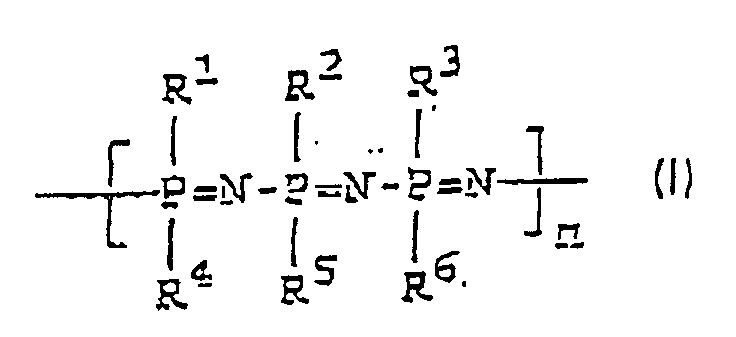
- an antithrombogenic polymer with the following general formula (I) where n is 2 to ⁇ , R 1 to R 6 are the same or different and are an alkoxy, alkylsulfonyl, dialkylamino or aryloxy radical or a heterocycloalkyl or heteroaryl radical with nitrogen as the hetero atom and at least part of the polymer chain of the antithrombogenic polymer contains a radioactive component.
- R 1 to R 6 are the same or different and are an alkoxy, alkylsulfonyl, dialkylamino or aryloxy radical or a heterocycloalkyl or heteroaryl radical with nitrogen as the hetero atom and at least part of the polymer chain of the antithrombogenic polymer contains a radioactive component.
- the radioactively labeled constituent contained in the antithrombogenic polymer preferably emits ⁇ -radiation during radioactive decay. However, depending on the isotope used, ⁇ radiation can also be emitted.
- the antithrombogenic polymer contains a radioactive phosphorus isotope. Even more preferably, the antithrombogenic polymer 32 P is labeled.
- the phosphorus isotope can be statistically distributed over the polyphosphazene backbone.
- each phosphorus in the polyphosphazene backbone, ie in the polymer chain of the antithrombogenic polymer is a radioactive phosphorus isotope.
- the phosphorus in the antithrombogenic polymer can be partially replaced by a radioactive asotope, preferably 76 As, or a radioactive Sb isotope, preferably 122 Sb, it being possible for the isotopes to be randomly distributed over the polymer chain of the antithrombogenic polymer.
- 32 P is a beta emitter with a maximum energy of 1.7 MeV, a maximum specific activity of 9000Ci / mmol and a half-life of 14.29 days.
- the maximum range of the ⁇ radiation emitted by 32 P is about 8 m in air. However, 80-90% of the water in the tissue is sufficient as a shield to attenuate the emitted radiation in such a way that only a maximum penetration depth of a few millimeters is achieved in the body tissue.
- the ⁇ radiation emitted by the phosphorus isotope reduces uncontrolled cell growth, which leads, for example, to restenosis after a stent implantation. However, this effect can also be achieved by using ⁇ radiation, such as that emitted by 76 As or 122 Sb.
- the degree of polymerization of the invention Polymers are 2 to ⁇ . However, a range for the degree of polymerization is preferred from 20 to 150,000, more preferably from 40 to 70,000.
- At least one of the radicals R 1 to R 6 in the antithrombogenic polymer is preferably an alkoxy radical which is substituted by at least one fluorine atom.
- alkyl radicals in the alkoxy, alkylsulfonyl and dialkylamino radicals are, for example straight or branched chain alkyl radicals with 1 to 20 carbon atoms, the alkyl radicals having, for example, at least one halogen atom, such as a fluorine atom.
- alkoxy radicals are methoxy, ethoxy, propoxy and butoxy groups, which can preferably be substituted with at least one fluorine atom.
- the 2,2,2-trifluoroethoxy group is particularly preferred.
- alkylsulfonyl radicals are methyl, ethyl, propyl and butylsulfonyl groups.
- examples for Dialkylamino residues are dimethyl, diethyl, dipropyl and dibutylamino groups.
- the aryl radical in the aryloxy radical is, for example, a compound with or several aromatic ring systems, the aryl radical, for example, with at least one alkyl radical defined above can be substituted.
- aryloxy radicals are phenoxy and naphthoxy groups and derivatives from that.
- the heterocycloalkyl radical is, for example, one containing 3 to 7 atoms Ring system, wherein at least one ring atom is a nitrogen atom.
- the heterocycloalkyl group can, for example, with at least one, as defined above Alkyl radical may be substituted.
- Examples of heterocycloalkyl radicals are piperidinyl, Piperazinyl, pyrrolidinyl and morpholinyl groups and derivatives thereof.
- the Heteroaryl is for example a compound with one or more aromatic ring systems, wherein at least one ring atom is a nitrogen atom is.
- the heteroaryl residue can be, for example, with at least one, above defined alkyl radical may be substituted.
- Examples of heteroaryl radicals are pyrrolyl, Pyridinyl, pyridinolyl, isoquinolinyl and quinolinyl groups, and derivatives thereof.
- the antithrombogenic polymer is a poly [bis (trifluoroethoxy) phosphazene] labeled with 32 P or As or Sb isotopes.
- Another object of the present invention is a Antithrombogenic polymer according to the invention having the general formula (I) for use as part of therapeutic devices to prevent excessive Cell proliferation or scarring or for tumor treatment.
- the antithrombogenic polymer of the invention with the general Formula (I) as a component of therapeutic devices such as artificial implants, Plasters, heart valves, artificial blood vessels, stents, catheters, Urethers or other implants without direct blood contact can be used.
- the antithrombogenic polymer according to the invention can not only be used as Coating, but in special applications, for example in the Use for endovascular prostheses or similar, also used as a full material become. Furthermore, this material can not only be used in arterial Vessels, also song when used in venous vessels as well as whole generally used for the coating of implants of any type become.
- a therapeutic device provided which comprises the antithrombogenic polymer according to the invention.
- such therapeutic devices are a plaster or Patch additive, which one or which is particularly enhanced for therapy Cell proliferation during wound healing (so-called keloids) or for treatment of various forms of skin cancer therapeutic use can find, or an artificial implant.
- a Artificial implant material provided that an implant material as a substrate and an at least partially applied to the surface of the substrate, includes a biocompatible coating that contains the radiolabelled, antithrombogenic Contains polymer with the aforementioned general formula (I).
- the biocompatible coating of the artificial implant according to the invention has for example a thickness of about 1 nm to about 100 microns, preferably to about 10 ⁇ m and particularly preferably up to about 1 ⁇ m.
- the implant material used as the substrate according to the invention has none special limitation to and can be any implant material, such as plastics, Metals, metal alloys and ceramics.
- the implant material an artificial heart valve made of pyrolyzed carbon or a metallic stent material.
- the artificial implant according to the invention between the surface of the substrate and that of the radiolabelled polyphosphazene derivative containing, biocompatible coating arranged a layer, which contains an adhesion promoter.
- the adhesion promoter or spacer is, for example, an organic silicon Compound, preferably an amino-terminated silane or based on Aminosilane, or an alkylphosphonic acid. Aminopropyltrimethoxysilane is particularly preferred.
- the adhesion promoter in particular improves the adhesion of the coating the surface of the device or implant material by coupling the Adhesion promoter to the surface of the implant material, for example via ionic and / or covalent bonds and by further coupling of the Adhesion promoter to reactive components, especially to the radioactive labeled, antithrombogenic polymer of the coating, for example via ionic and / or covalent bonds.
- Radioactive is used to manufacture the artificial implant according to the invention labeled polydichlorophosphazene applied to the surface of the substrate and with at least one reactive compound selected from aliphatic or aromatic alcohols or their salts, alkyl sulfones, dialkylamines and aliphatic or aromatic heterocycles with nitrogen as hetero atom, implemented.
- the aliphatic alcohols are, for example, straight or branched, one or polyhydric alcohols with 1 to 20 carbon atoms, the alcohols for example substituted with at least one halogen atom, such as a fluorine atom could be.
- alcoholates can be used as the salts thereof Alkali metals can be used as a cation. This is preferably applied radiolabelled polydichlorophosphazene with 2,2,2-sodium trifluoroethanolate esterified as a reactive compound.
- alkyl radicals of the alkyl sulfones and dialkylamines are, for example, straight or branched chain alkyl radicals having 1 to 20 carbon atoms, the alkyl radicals for example substituted with at least one halogen atom, such as a fluorine atom could be.
- alkyl sulfones are methyl, ethyl, propyl and butyl sulfones.
- dialkylamines are dimethyl, diethyl, dipropyl and dibutylamines.
- aromatic Alcohols are, for example, compounds with one or more aromatic ring systems, the aromatic alcohols, for example, with at least one alkyl radical defined above can be substituted.
- aromatic alcohols or their salts are phenol or phenolates and naphthols or naphtholates.
- the aliphatic heterocycles are, for example, 3 to 7 atoms containing Ring systems, wherein at least one ring atom is a nitrogen atom.
- the aliphatic Heterocycles can, for example, with at least one, above defined alkyl radical may be substituted.
- Examples of aliphatic heterocycles are Piperidine, piperazine, pyrrolidine and morpholine, and derivatives thereof.
- the aromatic heterocycles are, for example, compounds with one or several aromatic ring systems, at least one ring atom Is nitrogen atom.
- the aromatic heterocycles can, for example, with at least one alkyl radical defined above may be substituted.
- examples for aromatic heterocycles are pyrrole, pyridine, pyridinol, isoquinoline and quinoline, and derivatives thereof.
- the radioactively labeled polyphosphazene derivatives used according to the invention can be built up with ammonium chloride by condensation of 32 P-labeled phosphorus pentachloride, either as a pure substance or in a mixture with unlabeled phosphorus pentachloride. Radioisotopes of arsenic pentachloride or antimony pentachloride can also be introduced in this step. The amount of radioisotope, a few ⁇ g of these isotopes, depends on the desired activity and does not influence the mechanical, chemical and antithrombotic properties of the polyphosphazene derivative.
- the next step is the polymerization of the above Step obtained radioactively labeled hexachlorocyclotriphosphazene according to the methods described in the aforementioned prior art.
- the esterification of the radioactively labeled produced by the polymerization Polydichlorophosphazens is then carried out analogously to that in the aforementioned state methods described in technology.
- the radioactively labeled polydichlorophosphazene on the surface of the substrate coated with the adhesion promoter applied and for example via ionic and / or covalent bonds coupled to the radioactively labeled polydichlorophosphazene.
- the radioactively labeled polydichlorophosphazene is at least one implemented reactive compound defined above.
- the artificial implants according to the invention radiolabelled polydichlorophosphazene under an inert gas atmosphere applied to the surface of the substrate, optionally to the adhesion promoter coupled and implemented with the reactive connection. Furthermore, the radiolabelled polydichlorophosphazene under reduced pressure or applied in an air atmosphere and, if necessary, to the adhesion promoter be coupled.
- the adhesion promoter can be wet-chemical or in solution or from the melt or applied to the substrate by sublimation or spraying become.
- the wet chemical coupling of an adhesion promoter preferably based on aminosilanes on hydroxylated surfaces, is in Marco Mantar, diploma thesis, p. 23, Heidelberg University 1991. It However, other adhesion promoters known from the prior art can also be used. as well as reagents used as spacers.
- the adhesion promoter when using an adhesion promoter, can be used first applied to the surface of the substrate as stated above and if necessary be coupled to it, and after that it becomes radioactive labeled, antithrombogenic polymer on the one with the adhesion promoter coated surface of the substrate applied and optionally to the Adhesion promoter coupled.
- the antithrombogenic polymer wet-chemical or in solution or from the Applied melt and optionally coupled to the adhesion promoter.
- the surface of the substrate Before applying the radiolabelled polydichlorophosphazene, the Adhesion promoter or the radiolabelled, antithrombogenic polymer the surface of the substrate can be cleaned oxidatively.
- the oxidative Cleaning of surfaces with simultaneous hydroxylation, as for example for implants made of plastics, metals or ceramics can be found in Ulman Abraham, Analysis of Surface Properies, "An Introduction to Ultrathin Organic Films ", 108, 1991.
- the radioactively labeled implants according to the invention are advantageously easy to manufacture by means of the previously described method, since no technically complex ion implantation of radioactive material, for example 32 P, is necessary in the implant material, but the material, for example ⁇ -radiation emitting, is applied as a polymer coating.
- This application can also be carried out using the methods known in the field of coating from the prior art, such as. B. spin coating, knife coating etc. happen and affects not only the 32 P-polyphosphazene, but also the application of the adhesion promoter.
- the implants according to the invention surprisingly retain the excellent ones mechanical properties of the device or implant material as a substrate.
- the implants according to the invention not only exhibit antithrombogenic Properties on what the biocompatibility of such artificial Implants improved dramatically but also becomes uncontrolled cell growth, which, for example, leads to restenosis after a stent implantation, reduced due to the emitted radioactive radiation.
- the substrate For oxidative cleaning and simultaneous hydroxylation of the artificial implant surfaces, the substrate is placed in a mixture of 30% H 2 O 2 and concentrated sulfuric acid (Caro's acid) in a ratio of 1: 3 for 2 hours at a reaction temperature of 80 ° C. After this treatment, the substrate is washed with 0.5 L demineralized water of 18 MOhmcm and about pH 5 and then dried in a stream of nitrogen. Unless otherwise stated, this cleaning and oxidation step is carried out as the first step in the following examples according to the invention.
- Caro's acid concentrated sulfuric acid
- the 32 P-labeled polydichlorophosphazene on which the radioactively labeled poly [bis (trifluoroethoxy) phosphazene] is based can be prepared according to the methods described in the prior art, starting from the condensation of 32 PCl 5 , either as pure substance or with conventional, ie not radioactively labeled, Prepare PCl 5 mixed with NH 4 Cl.
- the subsequent polymerization of the radioactively labeled hexachlorocyclotriphosphazene is carried out in an ampoule with a diameter of 5.0 mm at 250 ° C. ⁇ 1 ° C. and a pressure in the ampoule of 10-2 mm Hg.
- a 0.1 M solution of 32 P-labeled polydichlorophosphazene is prepared under an inert gas atmosphere (0.174 g on 5 ml solvent). Absolute toluene is used as the solvent.
- the oxidatively cleaned artificial implant is then introduced into this solution under an inert gas atmosphere at room temperature for 24 hours.
- the radioactively labeled polydichlorophosphazene thus immobilized on the artificial implant is esterified with 2,2,2-sodium trifluoroethanolate in absolute tetrahydrofuran as a solvent (8 ml of absolute tetrahydrofuran, 0.23 g of sodium, 1.46 ml of 2,2,2-trifluoroethanol) ,
- the reaction mixture is refluxed throughout the reaction time.
- the esterification is carried out under an inert gas atmosphere at 80 ° C. and a reaction time of 3 hours. Then the substrate coated with the coating is washed with 4-5 ml of absolute tetrahydrofuran and dried in a stream of nitrogen.
- the artificial implant oxidatively cleaned with Caro's acid, is 30 minutes in a 2% aminopropyltrimethoxysilane solution in absolute ethanol immersed.
- the substrate is then washed with 4-5 ml of absolute ethanol and leave in an oven at 105 ° C for 1 hour.
- the surface of the substrate becomes so treated for 24 hours Room temperature under an inert gas atmosphere in a 0.1 M solution of radioactive labeled polydichlorophosphazene introduced in absolute toluene. Subsequently is treated with the artificial implant treated in this way under an inert gas atmosphere Wash 4-5 ml of absolute toluene, then in a freshly prepared 2,2,2-sodium trifluoroethanolate solution (8 ml absolute tetrahydrofuran, 0.23 g sodium, 1.46 ml of 2,2,2-trifluoroethanol) and 3 hours at 80 ° C under reflux and cooked in an inert gas atmosphere. Lastly, the artificial one made in this way The implant is washed with 4-5 ml of absolute tetrahydrofuran and in a stream of nitrogen dried.
- the surface was measured after this treatment using photoelectron spectroscopy on the elemental composition, stoichiometry and coating thickness examined. The results show that the respective couplings and coating thicknesses of greater than 5.5 nm were achieved.
- the artificial implant oxidatively cleaned with Caro's acid, is placed in a 2% aminopropyltrimethoxysilane solution in absolute ethanol for 30 minutes immersed at room temperature. Then the substrate with 4-5 ml of absolute Washed ethanol and left in the drying cabinet at 105 ° C for one hour. After coupling the aminopropyltrimethoxysilane to the surface of the substrate, the artificial implant treated in this way is used for 24 hours Room temperature in a 0.1 M solution of radioactively labeled Poly [bis (trifluoroethoxy) phosphazene] in ethyl acetate (0.121 g to 5 ml ethyl acetate) brought in. Then the artificial implant so produced is 4-5 ml of ethyl acetate washed and dried in a stream of nitrogen.
- the artificial implant oxidatively cleaned with Caro's acid, is at 70 ° C in a 0.1 M solution of radioactively labeled poly [bis (trifluoroethoxy) phosphazene] placed in ethyl acetate (0.121 g to 5 ml of ethyl acetate) for 24 hours. Subsequently is there treated artificial implant with 4-5 ml of ethyl acetate washed and dried in a stream of nitrogen.
- the artificial implant so produced was made using photoelectron spectroscopy on the elemental composition, stoichiometry and coating thickness examined.
- the results show that the coupling of the radioactive labeled poly [bis (trifluoroethoxy) phosphazens] on the implant surface and layer thicknesses of over 2.1 nm have been achieved.
- the artificial implant oxidatively cleaned with Caro's acid, is at 70 ° C into the melt of the radioactively labeled poly [bis (trifluoroethoxy) phosphazene] placed and left there for about 10 seconds to about 10 hours. Subsequently the implant treated in this way is washed with 4-5 ml of ethyl acetate and dried in a stream of nitrogen.
- the artificial implant so produced was made using photoelectron spectroscopy on the elemental composition, stoichiometry and coating thickness examined.
- the results show that the coupling of the radioactive labeled poly [bis (trifluoroethoxy) phosphazens] on the implant surface has taken place and any layer thicknesses of up to a few millimeters have been achieved.
Landscapes
- Health & Medical Sciences (AREA)
- Chemical & Material Sciences (AREA)
- Life Sciences & Earth Sciences (AREA)
- Veterinary Medicine (AREA)
- Medicinal Chemistry (AREA)
- Animal Behavior & Ethology (AREA)
- General Health & Medical Sciences (AREA)
- Public Health (AREA)
- Physics & Mathematics (AREA)
- Optics & Photonics (AREA)
- Epidemiology (AREA)
- Pharmacology & Pharmacy (AREA)
- Chemical Kinetics & Catalysis (AREA)
- Engineering & Computer Science (AREA)
- Organic Chemistry (AREA)
- Hematology (AREA)
- Materials Engineering (AREA)
- Surgery (AREA)
- Proteomics, Peptides & Aminoacids (AREA)
- Heart & Thoracic Surgery (AREA)
- Dispersion Chemistry (AREA)
- Polymers & Plastics (AREA)
- Bioinformatics & Cheminformatics (AREA)
- Diabetes (AREA)
- General Chemical & Material Sciences (AREA)
- Nuclear Medicine, Radiotherapy & Molecular Imaging (AREA)
- Materials For Medical Uses (AREA)
- Polymers With Sulfur, Phosphorus Or Metals In The Main Chain (AREA)
- Medicines Containing Antibodies Or Antigens For Use As Internal Diagnostic Agents (AREA)
Abstract
Claims (18)
- Polymère antithrombogène répondant à la formule générale (I) suivantedans laquelle n a une valeur de 2 à l'infini, R1 à R6 sont identiques ou différents et représentent un reste alkoxy, alkyl-sulfonyle, dialkylamino ou aryloxy, ou bien un reste hétérocycloalkyle ou hétéroaryle contenant de l'azote comme hétéroatome et une partie au moins de la chaíne du polymère antithrombogène contient un constituant marqué par la radioactivité.
- Polymère antithrombogène suivant la revendication 1, dans lequel le constituant marqué par la radioactivité émet un rayonnement β ou un rayonnement γ au cours de la désintégration radioactive.
- Polymère antithrombogène suivant la revendication 1 ou 2, qui contient un isotope radioactif du groupe principal V.
- Polymère antithrombogène suivant la revendication 3, qui contient un isotope radioactif du phosphore.
- Polymère antithrombogène suivant la revendication 4, dans lequel l'isotope du phosphore est 32P.
- Polymère antithrombogène suivant la revendication 5, dans lequel l'isotope de phosphore 32P est réparti statistiquement dans la chaíne du polymère antithrombogène.
- Polymère antithrombogène suivant la revendication 5, dans lequel chaque atome de phosphore présent dans la chaíne du polymère antithrombogène est un isotope 32P.
- Polymère antithrombogène suivant l'une des revendications 1 à 7, dans lequel l'un au moins des restes R1 à R6 est un reste alkoxy qui est substitué avec au moins un atome de fluor.
- Polymère antithrombogène suivant l'une des revendications 1 à 8, qui est un poly[bis(trifluoréthoxy)-phosphazène] marqué au 32P.
- Polymère antithrombogène suivant l'une des revendications 1 à 9, destiné à être utilisé comme composant de dispositifs thérapeutiques pour inhiber la prolifération excessive de cellules ou la formation de cicatrices ou pour le traitement de tumeurs.
- Polymère antithrombogène suivant la revendication 10, pour lequel le dispositif est choisi entre des implants artificiels, des emplâtres, des valvules cardiaques, des vaisseaux sanguins artificiels, des extenseurs, des cathéters, des urètres ou d'autres implants sans contact direct avec le sang.
- Dispositif thérapeutique comprenant un polymère antithrombogène suivant l'une des revendications 1 à 9.
- Dispositif suivant la revendication 12, qui est un emplâtre.
- Dispositif suivant la revendication 12, qui est un implant artificiel.
- Dispositif suivant la revendication 14, dans lequel l'implant artificiel comprend un matériau pour implant comme substrat et un revêtement biocompatible, appliqué au moins partiellement sur la surface du substrat, qui contient le polymère antithrombogène défini ci-dessus.
- Dispositif suivant la revendication 15, dans lequel une couche qui contient un activateur d'adhérence est disposée entre la surface du substrat et le revêtement biocompatible.
- Dispositif suivant la revendication 16, dans lequel le promoteur d'adhérence est un composé organique de silicium.
- Dispositif suivant la revendication 17, dans lequel le composé organique de silicium est l'aminopropyltriméthoxysilane.
Applications Claiming Priority (3)
| Application Number | Priority Date | Filing Date | Title |
|---|---|---|---|
| DE19743373 | 1997-09-30 | ||
| DE19743373A DE19743373A1 (de) | 1997-09-30 | 1997-09-30 | ·3··2·P-Polyphosphazen |
| PCT/EP1998/006167 WO1999016477A2 (fr) | 1997-09-30 | 1998-09-29 | 32p-polyphosphazene |
Publications (2)
| Publication Number | Publication Date |
|---|---|
| EP1019102A2 EP1019102A2 (fr) | 2000-07-19 |
| EP1019102B1 true EP1019102B1 (fr) | 2002-05-02 |
Family
ID=7844268
Family Applications (1)
| Application Number | Title | Priority Date | Filing Date |
|---|---|---|---|
| EP98952659A Expired - Lifetime EP1019102B1 (fr) | 1997-09-30 | 1998-09-29 | 32 p - polyphosphazene - polymere antithrombogenique radiomarque |
Country Status (7)
| Country | Link |
|---|---|
| US (1) | US20020054851A1 (fr) |
| EP (1) | EP1019102B1 (fr) |
| AU (1) | AU740470B2 (fr) |
| DE (2) | DE19743373A1 (fr) |
| DK (1) | DK1019102T3 (fr) |
| ES (1) | ES2173633T3 (fr) |
| WO (1) | WO1999016477A2 (fr) |
Families Citing this family (31)
| Publication number | Priority date | Publication date | Assignee | Title |
|---|---|---|---|---|
| US7208011B2 (en) | 2001-08-20 | 2007-04-24 | Conor Medsystems, Inc. | Implantable medical device with drug filled holes |
| US6241762B1 (en) | 1998-03-30 | 2001-06-05 | Conor Medsystems, Inc. | Expandable medical device with ductile hinges |
| US20040254635A1 (en) | 1998-03-30 | 2004-12-16 | Shanley John F. | Expandable medical device for delivery of beneficial agent |
| US7208010B2 (en) | 2000-10-16 | 2007-04-24 | Conor Medsystems, Inc. | Expandable medical device for delivery of beneficial agent |
| DE19855786A1 (de) * | 1998-12-03 | 2000-06-08 | Lothar Sellin | Radioaktiver Carbon Stent |
| US6290673B1 (en) | 1999-05-20 | 2001-09-18 | Conor Medsystems, Inc. | Expandable medical device delivery system and method |
| US6547816B1 (en) * | 1999-07-12 | 2003-04-15 | Civatech Corporation | Formable integral source material for medical devices |
| CA2402949C (fr) * | 2000-03-18 | 2009-09-08 | Polyzenix Gmbh | Derives de la polyphosphazene resistante aux bacteries et son utilisation |
| DE50111797D1 (de) * | 2000-04-11 | 2007-02-15 | Polyzenix Gmbh | Verwendung von Folien aus Poly-Tri-Fluor-Ethoxypolyphosphazenen zur Umhüllung von medizinischen Vorrichtungen |
| EP1179353A1 (fr) * | 2000-08-11 | 2002-02-13 | B. Braun Melsungen Ag | Implants antithrombotiques avec un revêtement de polyphosphazène et d'un agent actif |
| US20090004240A1 (en) * | 2000-08-11 | 2009-01-01 | Celonova Biosciences, Inc. | Implants with a phosphazene-containing coating |
| DE60133053T2 (de) | 2000-10-16 | 2009-02-26 | Conor Medsystems, Inc., Menlo Park | Ausdehnbare medizinische Vorrichtung zur Abgabe eines nützlichen Agens |
| DE10202467A1 (de) * | 2002-01-23 | 2003-07-24 | Polyzenix Gmbh | Vorrichtung auf Basis von Nitinol, ein Verfahren zu dessen Herstellung sowie dessen Verwendung |
| DE10100961B4 (de) | 2001-01-11 | 2005-08-04 | Polyzenix Gmbh | Körperverträglicher Werkstoff und mit diesem Werkstoff beschichtetes Substrat für die Züchtung von Zellen und künstlichen aus Zellen aufgebauten oder gewachsenen organischen Implantaten |
| US9080146B2 (en) | 2001-01-11 | 2015-07-14 | Celonova Biosciences, Inc. | Substrates containing polyphosphazene as matrices and substrates containing polyphosphazene with a micro-structured surface |
| US20040073294A1 (en) | 2002-09-20 | 2004-04-15 | Conor Medsystems, Inc. | Method and apparatus for loading a beneficial agent into an expandable medical device |
| US6964680B2 (en) | 2001-02-05 | 2005-11-15 | Conor Medsystems, Inc. | Expandable medical device with tapered hinge |
| DE10113971A1 (de) * | 2001-03-22 | 2002-10-24 | Polyzenix Gmbh | Verfahren zur Beschichtung von Oberflächen aus Kunststoff mit Bis-Poly-Trifluorethoxy-Polyphosphazen und Derivaten |
| DK1432380T3 (da) | 2001-08-17 | 2007-01-15 | Polyzenix Gmbh | Indretning baseret på nitrol med et overtræk af polyphosphazen |
| US7056338B2 (en) | 2003-03-28 | 2006-06-06 | Conor Medsystems, Inc. | Therapeutic agent delivery device with controlled therapeutic agent release rates |
| AU2004224772B2 (en) * | 2003-03-26 | 2009-09-10 | Celonova Biosciences Germany Gmbh | Coated dental implants |
| US7169179B2 (en) | 2003-06-05 | 2007-01-30 | Conor Medsystems, Inc. | Drug delivery device and method for bi-directional drug delivery |
| US7785653B2 (en) | 2003-09-22 | 2010-08-31 | Innovational Holdings Llc | Method and apparatus for loading a beneficial agent into an expandable medical device |
| USD516723S1 (en) | 2004-07-06 | 2006-03-07 | Conor Medsystems, Inc. | Stent wall structure |
| US9107850B2 (en) | 2004-10-25 | 2015-08-18 | Celonova Biosciences, Inc. | Color-coded and sized loadable polymeric particles for therapeutic and/or diagnostic applications and methods of preparing and using the same |
| US20210299056A9 (en) | 2004-10-25 | 2021-09-30 | Varian Medical Systems, Inc. | Color-Coded Polymeric Particles of Predetermined Size for Therapeutic and/or Diagnostic Applications and Related Methods |
| US9114162B2 (en) | 2004-10-25 | 2015-08-25 | Celonova Biosciences, Inc. | Loadable polymeric particles for enhanced imaging in clinical applications and methods of preparing and using the same |
| BRPI0717738A2 (pt) | 2006-10-10 | 2018-09-11 | Celonova Biosciences Inc | válvula cardíaca bioprotética, método de fabricação da mesma, método de aperfeiçoamento das qualidades anti-trombogênicas de biocompatibilidade ou hemocaptabilidade de uma válvula cardíaca bioprotética |
| EP2254605A4 (fr) * | 2008-02-22 | 2012-06-20 | Celonova Biosciences Inc | Matrices multifonctionnelles pour pansements et procédés associés |
| AU2013393811B2 (en) | 2013-07-01 | 2018-11-08 | The Australian National University | Radiolabelled material |
| CN110643046B (zh) * | 2018-06-07 | 2021-04-02 | 北京化工大学 | 一种提高聚磷腈弹性体分子量和产率的方法 |
Family Cites Families (6)
| Publication number | Priority date | Publication date | Assignee | Title |
|---|---|---|---|---|
| US4880622A (en) * | 1986-05-20 | 1989-11-14 | Research Corporation Technologies, Inc. | Water-soluble phosphazene polymers having pharmacological applications |
| FR2655046B1 (fr) * | 1989-11-24 | 1992-04-03 | Centre Nat Rech Scient | Composes oxodiaminodicyclophosphazenes de configuration mono-bino et di-bino, complexes derives de composes et applications desdits complexes et ces composes. |
| GB9407812D0 (en) * | 1994-04-20 | 1994-06-15 | Nycomed Salutar Inc | Compounds |
| DE4428056A1 (de) * | 1994-07-29 | 1996-02-08 | Schering Ag | Verwendung von Mikropartikelpräparationen zur Eliminierung gelöster, nicht nierengängiger Substanzen aus dem Blut |
| US5686113A (en) * | 1995-03-21 | 1997-11-11 | Temple University Of The Commonwealth System Of Higher Education | Microcapsules of predetermined peptide(s) specificity (ies), their preparation and uses |
| DE19613048C2 (de) * | 1995-03-30 | 1997-12-18 | Michael Prof Dr Grunze | Künstliche Implantate mit antithrombogenen Eigenschaften und Verfahren zu deren Herstellung |
-
1997
- 1997-09-30 DE DE19743373A patent/DE19743373A1/de not_active Withdrawn
-
1998
- 1998-09-29 EP EP98952659A patent/EP1019102B1/fr not_active Expired - Lifetime
- 1998-09-29 DK DK98952659T patent/DK1019102T3/da active
- 1998-09-29 DE DE59803995T patent/DE59803995D1/de not_active Expired - Lifetime
- 1998-09-29 AU AU10274/99A patent/AU740470B2/en not_active Ceased
- 1998-09-29 WO PCT/EP1998/006167 patent/WO1999016477A2/fr not_active Ceased
- 1998-09-29 ES ES98952659T patent/ES2173633T3/es not_active Expired - Lifetime
-
2000
- 2000-03-30 US US09/539,810 patent/US20020054851A1/en not_active Abandoned
Also Published As
| Publication number | Publication date |
|---|---|
| EP1019102A2 (fr) | 2000-07-19 |
| AU740470B2 (en) | 2001-11-08 |
| WO1999016477A3 (fr) | 1999-06-17 |
| DE19743373A1 (de) | 1999-04-15 |
| DK1019102T3 (da) | 2002-05-27 |
| WO1999016477A2 (fr) | 1999-04-08 |
| ES2173633T3 (es) | 2002-10-16 |
| DE59803995D1 (en) | 2002-06-06 |
| AU1027499A (en) | 1999-04-23 |
| US20020054851A1 (en) | 2002-05-09 |
Similar Documents
| Publication | Publication Date | Title |
|---|---|---|
| EP1019102B1 (fr) | 32 p - polyphosphazene - polymere antithrombogenique radiomarque | |
| DE60103620T2 (de) | Verwendung von polyphosphazen-derivaten für antibakterielle beschichtungen | |
| WO2002013882A1 (fr) | Implants pourvus d'un revetement contenant du phosphazene | |
| DE60026065T2 (de) | Elektropolymerisierbare monomere und polymerbeschichtungen auf implantierbaren geräten | |
| DE19613048C2 (de) | Künstliche Implantate mit antithrombogenen Eigenschaften und Verfahren zu deren Herstellung | |
| DE69721458T2 (de) | Ausrüstung enthaltend eine implantierbare Vorrichtung | |
| DE60115203T2 (de) | Beschichtete implantate | |
| EP0761244B1 (fr) | Procédé pour lier et fixer de l'héparine à la surface des substrats inorganiques d'implants cardiovasculaires | |
| DE19851334C2 (de) | Flexible Wundauflage auf Fibrinbasis und Verfahren zu ihrer Herstellung | |
| DE60018925T2 (de) | Biomaterialien, modifiziert mit superoxid-dismutase imitatoren | |
| DE2139455C3 (de) | Verfahren zur Herstellung eines Im plantats | |
| EP2432512B1 (fr) | Équipement médical antibactérien, et procédé de production correspondant | |
| DE102017118508B4 (de) | Verfahren zur Herstellung einer biokompatiblen Schicht auf einer Implantatoberfläche | |
| EP1274471B1 (fr) | Utilisation de films en poly-tri-fluoro-ethoxypolyhosphazene pour envelopper des objets médicaux | |
| DE3503126A1 (de) | Arzneimittel abgebender kollagenbeschichteter synthetischer gefaessersatz | |
| WO2004024205A1 (fr) | Procede de fabrication d'un produit antimicrobien en matiere plastique | |
| EP2185208B1 (fr) | Implant mammaire à effet antibactérien | |
| EP1644054B1 (fr) | Systeme de revetement pour implants destine a augmenter la compatibilite avec des tissus | |
| WO2000044357A2 (fr) | Moyen pour prevenir des restenoses intra-stent et des infections post-operatoires | |
| DE19718430A1 (de) | Behandlung von Biomaterial | |
| DE2601289C3 (de) | Verfahren zum Abdichten von synthetischen Velours-Gefäßprothesen | |
| DE112014005909B4 (de) | Verfahren zur Herstellung einer mehrschichtigen polymeren Schutzbeschichtung für Implantatmaterialien mit der Funktion der gesteuerten Freisetzung von Arzneimitteln | |
| DE4229947A1 (de) | Schrumpfungsarm polymerisierbare Zementmischungen für medizinische Zwecke | |
| EP4072606B1 (fr) | Implant, composant d'implant et méthode pour leur production | |
| DE19838183A1 (de) | Verfahren zur Herstellung von Gegenständen mit einer gekapselten Radioaktivität, insbesondere bei medizinischen Implantaten |
Legal Events
| Date | Code | Title | Description |
|---|---|---|---|
| PUAI | Public reference made under article 153(3) epc to a published international application that has entered the european phase |
Free format text: ORIGINAL CODE: 0009012 |
|
| 17P | Request for examination filed |
Effective date: 20000502 |
|
| AK | Designated contracting states |
Kind code of ref document: A2 Designated state(s): BE CH DE DK ES FR GB GR IT LI NL SE |
|
| GRAG | Despatch of communication of intention to grant |
Free format text: ORIGINAL CODE: EPIDOS AGRA |
|
| RIC1 | Information provided on ipc code assigned before grant |
Free format text: 7A 61L 15/00 A, 7A 61P 7/02 B |
|
| RIC1 | Information provided on ipc code assigned before grant |
Free format text: 7A 61L 15/00 A, 7A 61P 7/02 B |
|
| RIC1 | Information provided on ipc code assigned before grant |
Free format text: 7A 61L 15/00 A, 7A 61P 7/02 B |
|
| RTI1 | Title (correction) |
Free format text: 32 P - POLYPHOSPHAZENE - RADIOLABELLED ANTITHROMBOGENIC POLYMER |
|
| 17Q | First examination report despatched |
Effective date: 20010620 |
|
| RIC1 | Information provided on ipc code assigned before grant |
Free format text: 7A 61L 15/00 A, 7A 61P 7/02 B |
|
| RTI1 | Title (correction) |
Free format text: 32 P - POLYPHOSPHAZENE - RADIOLABELLED ANTITHROMBOGENIC POLYMER |
|
| GRAG | Despatch of communication of intention to grant |
Free format text: ORIGINAL CODE: EPIDOS AGRA |
|
| GRAH | Despatch of communication of intention to grant a patent |
Free format text: ORIGINAL CODE: EPIDOS IGRA |
|
| REG | Reference to a national code |
Ref country code: GB Ref legal event code: IF02 |
|
| GRAH | Despatch of communication of intention to grant a patent |
Free format text: ORIGINAL CODE: EPIDOS IGRA |
|
| GRAA | (expected) grant |
Free format text: ORIGINAL CODE: 0009210 |
|
| AK | Designated contracting states |
Kind code of ref document: B1 Designated state(s): BE CH DE DK ES FR GB GR IT LI NL SE |
|
| PG25 | Lapsed in a contracting state [announced via postgrant information from national office to epo] |
Ref country code: GR Free format text: LAPSE BECAUSE OF FAILURE TO SUBMIT A TRANSLATION OF THE DESCRIPTION OR TO PAY THE FEE WITHIN THE PRESCRIBED TIME-LIMIT Effective date: 20020502 |
|
| REG | Reference to a national code |
Ref country code: GB Ref legal event code: FG4D Free format text: NOT ENGLISH |
|
| REG | Reference to a national code |
Ref country code: CH Ref legal event code: EP |
|
| REG | Reference to a national code |
Ref country code: DK Ref legal event code: T3 |
|
| REG | Reference to a national code |
Ref country code: CH Ref legal event code: NV Representative=s name: A. BRAUN, BRAUN, HERITIER, ESCHMANN AG PATENTANWAE |
|
| REF | Corresponds to: |
Ref document number: 59803995 Country of ref document: DE Date of ref document: 20020606 |
|
| ET | Fr: translation filed | ||
| GBT | Gb: translation of ep patent filed (gb section 77(6)(a)/1977) |
Effective date: 20020720 |
|
| PG25 | Lapsed in a contracting state [announced via postgrant information from national office to epo] |
Ref country code: GB Free format text: LAPSE BECAUSE OF NON-PAYMENT OF DUE FEES Effective date: 20020929 |
|
| PG25 | Lapsed in a contracting state [announced via postgrant information from national office to epo] |
Ref country code: SE Free format text: LAPSE BECAUSE OF NON-PAYMENT OF DUE FEES Effective date: 20020930 Ref country code: LI Free format text: LAPSE BECAUSE OF NON-PAYMENT OF DUE FEES Effective date: 20020930 Ref country code: ES Free format text: LAPSE BECAUSE OF NON-PAYMENT OF DUE FEES Effective date: 20020930 Ref country code: DK Free format text: LAPSE BECAUSE OF NON-PAYMENT OF DUE FEES Effective date: 20020930 Ref country code: CH Free format text: LAPSE BECAUSE OF NON-PAYMENT OF DUE FEES Effective date: 20020930 Ref country code: BE Free format text: LAPSE BECAUSE OF NON-PAYMENT OF DUE FEES Effective date: 20020930 |
|
| REG | Reference to a national code |
Ref country code: ES Ref legal event code: FG2A Ref document number: 2173633 Country of ref document: ES Kind code of ref document: T3 |
|
| PLBE | No opposition filed within time limit |
Free format text: ORIGINAL CODE: 0009261 |
|
| STAA | Information on the status of an ep patent application or granted ep patent |
Free format text: STATUS: NO OPPOSITION FILED WITHIN TIME LIMIT |
|
| BERE | Be: lapsed |
Owner name: *UNIVERSITAT HEIDELBERG Effective date: 20020930 |
|
| PG25 | Lapsed in a contracting state [announced via postgrant information from national office to epo] |
Ref country code: NL Free format text: LAPSE BECAUSE OF NON-PAYMENT OF DUE FEES Effective date: 20030401 |
|
| 26N | No opposition filed |
Effective date: 20030204 |
|
| REG | Reference to a national code |
Ref country code: DK Ref legal event code: EBP |
|
| EUG | Se: european patent has lapsed | ||
| REG | Reference to a national code |
Ref country code: CH Ref legal event code: PL |
|
| GBPC | Gb: european patent ceased through non-payment of renewal fee |
Effective date: 20020929 |
|
| PG25 | Lapsed in a contracting state [announced via postgrant information from national office to epo] |
Ref country code: FR Free format text: LAPSE BECAUSE OF NON-PAYMENT OF DUE FEES Effective date: 20030603 |
|
| REG | Reference to a national code |
Ref country code: FR Ref legal event code: ST |
|
| REG | Reference to a national code |
Ref country code: ES Ref legal event code: FD2A Effective date: 20031011 |
|
| PG25 | Lapsed in a contracting state [announced via postgrant information from national office to epo] |
Ref country code: IT Free format text: LAPSE BECAUSE OF NON-PAYMENT OF DUE FEES;WARNING: LAPSES OF ITALIAN PATENTS WITH EFFECTIVE DATE BEFORE 2007 MAY HAVE OCCURRED AT ANY TIME BEFORE 2007. THE CORRECT EFFECTIVE DATE MAY BE DIFFERENT FROM THE ONE RECORDED. Effective date: 20050929 |
|
| PGFP | Annual fee paid to national office [announced via postgrant information from national office to epo] |
Ref country code: DE Payment date: 20091014 Year of fee payment: 12 |
|
| REG | Reference to a national code |
Ref country code: DE Ref legal event code: R119 Ref document number: 59803995 Country of ref document: DE Effective date: 20110401 |
|
| PG25 | Lapsed in a contracting state [announced via postgrant information from national office to epo] |
Ref country code: DE Free format text: LAPSE BECAUSE OF NON-PAYMENT OF DUE FEES Effective date: 20110401 |