EP1020681B1 - Projecteur à angle d'émission de lumière variable à lentille antérieure asphérique - Google Patents
Projecteur à angle d'émission de lumière variable à lentille antérieure asphérique Download PDFInfo
- Publication number
- EP1020681B1 EP1020681B1 EP99124750A EP99124750A EP1020681B1 EP 1020681 B1 EP1020681 B1 EP 1020681B1 EP 99124750 A EP99124750 A EP 99124750A EP 99124750 A EP99124750 A EP 99124750A EP 1020681 B1 EP1020681 B1 EP 1020681B1
- Authority
- EP
- European Patent Office
- Prior art keywords
- lens
- spotlight
- light source
- spotlight according
- reflector
- Prior art date
- Legal status (The legal status is an assumption and is not a legal conclusion. Google has not performed a legal analysis and makes no representation as to the accuracy of the status listed.)
- Expired - Lifetime
Links
Images




Classifications
-
- F—MECHANICAL ENGINEERING; LIGHTING; HEATING; WEAPONS; BLASTING
- F21—LIGHTING
- F21V—FUNCTIONAL FEATURES OR DETAILS OF LIGHTING DEVICES OR SYSTEMS THEREOF; STRUCTURAL COMBINATIONS OF LIGHTING DEVICES WITH OTHER ARTICLES, NOT OTHERWISE PROVIDED FOR
- F21V5/00—Refractors for light sources
- F21V5/04—Refractors for light sources of lens shape
- F21V5/048—Refractors for light sources of lens shape the lens being a simple lens adapted to cooperate with a point-like source for emitting mainly in one direction and having an axis coincident with the main light transmission direction, e.g. convergent or divergent lenses, plano-concave or plano-convex lenses
-
- F—MECHANICAL ENGINEERING; LIGHTING; HEATING; WEAPONS; BLASTING
- F21—LIGHTING
- F21S—NON-PORTABLE LIGHTING DEVICES; SYSTEMS THEREOF; VEHICLE LIGHTING DEVICES SPECIALLY ADAPTED FOR VEHICLE EXTERIORS
- F21S10/00—Lighting devices or systems producing a varying lighting effect
-
- F—MECHANICAL ENGINEERING; LIGHTING; HEATING; WEAPONS; BLASTING
- F21—LIGHTING
- F21V—FUNCTIONAL FEATURES OR DETAILS OF LIGHTING DEVICES OR SYSTEMS THEREOF; STRUCTURAL COMBINATIONS OF LIGHTING DEVICES WITH OTHER ARTICLES, NOT OTHERWISE PROVIDED FOR
- F21V14/00—Controlling the distribution of the light emitted by adjustment of elements
- F21V14/06—Controlling the distribution of the light emitted by adjustment of elements by movement of refractors
Definitions
- the invention relates to a headlight with variable beam angle, in which the change in the emission angle is caused differently than by shadowing of the beam path by aperture or mask, arranged with a headlight interior light source and a first lens, which is the front lens of the headlamp.
- This class of headlamps does not include profile projectors in which a slight change in the angle of emission occurs as a side effect in the sharpness adjustment of the image.
- variable headlamps known from the prior art can be divided into three classes, namely Fresnel spotlights, headlamps with a very deep reflector and headlamps with a second lens, a light source and a reflector movable relative to the front lens.
- Fresnel lens spotlights have a single Fresnel lens.
- halogen lamps or discharge lamps are used in these Fresnel spotlights.
- the light source and a reflector are mounted at a fixed distance from each other on a carriage.
- the carriage is movable relative to the Fresnel lens.
- the focusing takes place by means of the movement of the carriage.
- Fresnel spotlights there is a considerable effective loss of light for focusing settings of small emission angle. Since there is no second lens which concentrates the light toward the Fresnel lens, a large part of the light emitted by the light source is simply absorbed by the inner wall of the housing at said focus settings, resulting in loss of light and unnecessary housing heating.
- Headlamps with very deep reflector are in general designed so that lamp and reflector can be moved relative to each other, but the lamp always remains within the reflector on the optical axis. By changing the position of the lamp within the reflector, the beam angle of such a headlight is changed. However, the achievable focusing distance is low, so that the emission angle can only be varied within relatively narrow limits.
- headlamps provide a high luminous efficacy, but a unfavorable light distribution in almost all lamp positions. The reason for this generally poor light distribution is that the reflector shape fixed in each case for each individual such headlight can be optimally matched to only one single lamp position with respect to the resulting light distribution. Focusing movements of the lamp or of the reflector result in uneven light distributions.
- headlamps are known from US-A-4 823 243 and EP-A-0 846 913 of the generic type. They have a light source, a reflector associated with the light source, a first convergent lens (front lens) arranged in the beam path in the emission direction of the light source / reflector combination, and a second convergent lens arranged in the beam path between the light source and the first convergent lens.
- the reflector, the light source and the second condenser lens are mounted as an optical unit movable relative to the first condenser lens along the optical axis of the headlamp.
- the distance between the light source and the second condenser lens is changeable.
- Commercially also very similar headlamps in which, however, the mutual distances between the reflector, the light source and the second convergent lens can not be changed. In the latter headlamps, the optical unit can only be moved as a rigid whole.
- both the distance between the light source and the second condenser lens and the distance between the light source and the reflector can be changed.
- all of the headlights described in this paragraph have in common that the front lens is a spherical lens.
- variable angle headlamps provide a wide range of variation of the angle of radiation (see FIGS. 6a, 6b) and have a high efficiency of illuminance achieved with respect to the operation of the Headlamps needed energy. Furthermore, they offer an extraordinarily even light distribution. In addition, with these headlamps, a stray light defined according to the traditional concept (light intensity ⁇ 50% of the maximum light intensity) no longer exists due to the steep flanks of the light intensity at the edge of the illuminated area. As can be seen from Fig.
- the intensity increases occurring in the illuminance characteristic at the edge are attenuated, but they do not completely disappear.
- the reduction of the intensity increases at the edge is paid for by increased scattering effects and light loss.
- the invention has for its object to provide a generic headlight, which provides a more uniform light distribution, especially in the Abstrahlwinkeleinwolfen outside the spot position compared to the known from the prior art such headlamps.
- an aspherical lens as the first lens, that is, as the front lens of the generic headlight, ensures a uniform light distribution outside the spot position in comparison with the known headlights of the prior art.
- aspherical lenses refers to lenses in which at least one sub-surface is not spherical, with plane surfaces are always calculated here to the spherical surfaces.
- aspherical Lenses are lenses with an ellipsoid and a spherical surface and lenses with a spherical surface and a hyperbolic surface.
- Fresnel lenses with aspherically designed partial surfaces are also aspherical lenses as defined above.
- the prior art edge intensity increases the light distribution are completely smoothed, and it results with high variability of the radiation angle, a particularly uniform illumination of the illuminated area regardless of the selected Abstrahlwinkeleingnally.
- the graining according to claim 14 need not be carried out so deep in the headlight according to the invention, as the commonly known from the prior art graining the second lens. In this way results in a lower loss of light and, especially in the spot position, a higher light intensity with the same input power.
- a particularly uniform light distribution is obtained in the embodiments of the headlamp according to the invention according to claims 7, 10, 21 and 24.
- the headlamp according to the invention according to claim 26 it is ensured that the headlamp also has all the advantages of the known from US-A-4,823,243 headlamp.
- the headlamp in the embodiment of the headlamp according to the invention as claimed in claim 27 when dependent on claim 26 it is ensured that the headlamp also all the advantages of the headlamp known from EP-A-0 846 913, in particular the very large variability of the radiation angle and the light intensity, having.
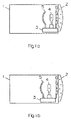
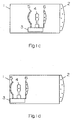
- FIG. 1a an embodiment of the headlamp according to the invention is shown in cross section.
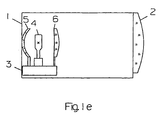
- the headlight has a cup-like, opaque housing 1, in which at the light exit side as the front lens of the headlamp, a first converging lens 2 is inserted.
- the facing in the direction of emission of the headlight surface of the first converging lens 2 is rotationally symmetrical and has the meridional section in the form of a hyperbola section, wherein the apex of the hyperbola lies on the optical axis of the pig launcher.
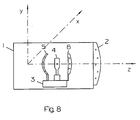
- the underlying coordinate system is shown in FIG.
- the interior of the headlight facing surface of the first converging lens 2 is a plane surface. However, it can also be executed concavely curved. This applies in principle for all embodiments of the headlamp according to the invention described below.
- a light source 4 which is formed by a filament lamp with a small filament, and a light source 4 associated with the reflector 5 are arranged on a carriage 3.
- the light source 4 and the reflector 5 are mounted so that the resulting light beam path is directed in the direction of the first converging lens 2.
- a second converging lens 6 is arranged on the carriage 3 in the beam path between the light source 4 and the first convergent lens 2.
- the second converging lens 6 is a meniscus lens whose surface facing the first condenser lens 2 is grained.
- the second converging lens 6 is rotationally symmetrical with respect to its optical axis.
- the grainy surface of the second converging lens 6 facing away from the light source 4 has the shape of a hyperbola section in the meridional section, the vertex of the hyperbola lying on the optical axis of the headlight.
- the light source 4, the reflector 5 and the second converging lens 6 are mounted so that both the distance between the light source 4 and the second condenser lens 6 and the Distance between the light source 4 and the reflector 5 can be changed.
- the first converging lens 2 it is also possible, even with the first converging lens 2 to provide a lens surface with a grain, so that a microlens structure is formed. By this measure, a particularly good uniformity of the light distribution is achieved.
- Fig. 1a shows the light source 4, the reflector 5 and the second converging lens 6 in a position maximum radiation angle of the headlamp according to the invention.
- the distance between the first condenser lens 2 and the second condenser lens 6 and the distance between the second condenser lens 6 and the light source 4 are minimal according to the spotlight dimensions, and the distance between the light source 4 and the reflector 5 is the maximum distance corresponding to the mounting conditions.
- the carriage 3 In order to reduce the emission angle, the carriage 3 is moved in the direction away from the first converging lens 2.
- the mechanism of the carriage and cooperating with him guide parts is designed so that the second converging lens 6 initially remains in its original position and move only the light source 4 and the reflector 5 while maintaining their original mutual distance in the direction of the first convergent lens 2 away , This type of movement continues until the distance between the light source 4 and the second converging lens 6 has reached a predetermined value.
- Fig. 1b shows the optical system of the headlamp according to the invention in just this position.
- the reflector 5 reaches a corresponding the headlamp dimensions outermost distance to the first converging lens 2 and stops in its movement (see Fig. 1d). This is the position at which the headlamp known from US-A-4 823 243 achieves its minimum beam angle and maximum illuminance.
- the headlamp undergoes a critical beam angle adjustment, in which the headlamp known from US-A-4,823,243 shows brighter illuminated edges in its light distribution characteristic (see Fig. 6a, 6b).
- the headlamp according to the invention with the aspherical front lens 2 shows a very uniform light distribution characteristic in all beam angle settings, in particular also in the beam angle setting critical according to the prior art. Such will be explained in more detail below with reference to FIGS. 7a and 7b with reference to another embodiment of the headlamp according to the invention.
- the headlamp according to the invention shown in FIGS. 1a to le corresponds to the headlamp shown in EP-A-0 846 913.
- D. h. It is possible, starting from the headlight position shown in Fig. 1d, the light source and the second converging lens 6 while maintaining their mutual distance achieved with the reflector 5 still further away from the first converging lens 2 and thus closer to the reflector 5 introduce (see Fig. 1e).
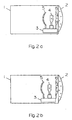
- FIGS. 2a to 2e a further embodiment of the headlamp according to the invention is shown.
- the surface of the first converging lens 2 directed in the emission direction of the headlight is rotationally symmetrical with respect to its optical axis, and the surface of the first converging lens 2 directed into the headlight interior is a plane surface.
- the difference from the embodiment of the headlight according to the invention shown in FIGS. 1a to 1e with respect to the first converging lens 2 is that in the emission direction of the headlamp facing surface of the first converging lens 2 has the shape of an ellipse section, wherein the minor axis of the ellipse lies on the optical axis of the headlight.
- the second converging lens 6 is a meniscus lens.
- the remote from the light source 4 surface of the second converging lens 6 is rotationally symmetrical with respect to its optical axis and has the meridional section in the form of an ellipse section, wherein the minor axis of the ellipse lies on the optical axis of the headlamp.
- the embodiment of the headlamp according to the invention shown in FIGS. 2a to 2e substantially corresponds to the exemplary embodiment of the headlamp according to the invention shown in FIGS. 1a to 1e.
- the only difference is that, when the reflector 5 has reached its outermost distance to the first converging lens 2 according to the spotlight dimensions, the second converging lens 6 can not be further moved away from the first converging lens 2 in the embodiment according to FIGS. 2a to 2e.
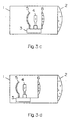
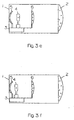
- the second converging lens 6 in the rear portion of the movement of the carriage 3 of the first converging lens 2 are not abrupt, but it is at constant relative speed between the light source 4 and the first converging lens 2, the relative velocity between the second converging lens 6 and the first convergent lens 2 continuously slows down until the second condenser lens 6 finally stops, while the reflector 5 and the light source 4 still move away from the first condenser lens 2 while maintaining their mutual distance (FIGS. 3a to 3e). Finally, the reflector 5 reaches the outermost position shown in Fig. 3e, and only the light source 4 moves away from the first converging lens 2 until the light source 4 finally reaches its outermost position (Fig. 3f). The reversal of this sequence of movements takes place accordingly.
- the second converging lens 6 is formed in the embodiment of Fig. 3a to 3f as Meniskuslinse whose remote from the light source 4 surface in meridional section has the shape of a hyperbola section, wherein the vertex of the hyperbola lies on the optical axis of the pig.
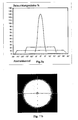
- FIG. 7a shows illuminance characteristics for the embodiment of the headlamp according to the invention shown in FIGS. 3a to 3f.
- the improved uniformity of illumination by means of the headlamp according to the invention becomes clear.
- the intensity increases at the edge occurring outside the spot position according to the prior art have also disappeared in the hitherto critical emission angle setting between spot position and flood position.
- a direct comparison for the critical Abstrahlwinkelein ein deliver Fig. 6b and 7b.
- FIGS. 1a to 3f there are many other possible variations for embodiments of the headlamp according to the invention.
- FIGS. 4a to 4c Such an embodiment of the headlight according to the invention is shown in FIGS. 4a to 4c.
- the facing in the direction of emission of the headlight surface of the first converging lens 2 is rotationally symmetric in this embodiment and has the meridional section in the form of a hyperbola section, the apex the hyperbola lies on the optical axis of the headlamp.
- the interior of the headlight facing surface of the first converging lens 2 is a plane surface.
- the second converging lens 6 is rotationally symmetrical with respect to its optical axis.
- the facing away from the light source 4, grained surface of the second converging lens 6 has the meridional section in the form of an ellipse section, wherein the vertex of the ellipse lies on the optical axis of the headlamp.
- FIG. 4a shows the light source 4, the reflector 5 and the second convergent lens 6 in a position of maximum emission angle of the headlamp.
- the carriage 3 is moved in the direction away from the first converging lens 2.
- the mechanism of the carriage and cooperating with him guide parts designed so that the distances of the second converging lens 6, the light source 4 and the reflector 5 with each other initially not change.
- the movement process just described proceeds in exactly the reverse order.
- the light source 4 and the reflector 5 move while maintaining their mutual distance to the two converging lenses 6 and 2.
- the second converging lens 6 participates in the movement, and the light source 4, the reflector 5 and the second convergent lens 6 move now while maintaining their mutual Distances to the first convergent lens 2 to.
- the second converging lens 6 does not necessarily have to be formed as a meniscus lens or as an aspherical lens.
- the inwardly directed surface of the first converging lens 2 is aspherical.
- the carriage system need not necessarily be formed as described in US-A-4,823,243 or EP-A-0 846 913.
- the distance between the reflector 5, the light source 4 and the second convergent lens 6 can not be changed.
- the possible design variants of the first lens 2 as an aspherical lens are just as little affected by this mechanical construction as the design variants of the second lens 6.
- a rotationally symmetrical lens is used as the aspheric front lens 2.
- Embodiments with non-rotationally symmetric aspherical lenses are also possible.
- aspherical lenses having hyperbolic or ellipsoidal surfaces they need not necessarily be arranged so that the hyperbola apexes or small ellipse ellipses are on the optical axis of the piglet.
- Embodiments are also conceivable in which the corresponding lenses are arranged offset relative to the optical axis of the pig launcher. This applies both to the first converging lens 2 and to the second converging lens 6.
- the reflector 5 is always shown as a relatively flat reflector and the light source 4 as an upright filament lamp. However, it is also possible to use a deep reflector and / or a recessed mounted lamp.
- the light source 4 may be e.g. also be formed by a halogen lamp or by a discharge lamp without helix with light spot between two electrodes.
- aspherical front lens Although the use of an aspherical front lens has been described above in connection with a very special variable-angle headlight, the aspherical front lens is even more uniform, especially in the spotlight positions between spot position and flood position Allows light distribution compared to the known from the prior art such headlamps, aspherical front lenses can also be used in all sorts of other lights with variable beam angle to influence the light distribution of the headlamp. This is especially true for headlamps with replaceable front lens.
- the aspherical front lens can in this case be rotationally symmetric or non-rotationally symmetrical and centered on the optical axis of the headlight or offset from the optical axis of the pig headlight.
- the conic constants r and k can assume many more values.
- the invention is not limited to headlights of a certain power class.
- headlamps according to the invention can be implemented both as miniature headlamps with a power of a few 10 W and as high-power headlamps with a power of a few 10 kW.
Landscapes
- Engineering & Computer Science (AREA)
- General Engineering & Computer Science (AREA)
- Non-Portable Lighting Devices Or Systems Thereof (AREA)
Claims (27)
- Projecteur à angle de rayonnement variable, dans lequel la variation de l'angle de rayonnement est réalisée autrement que par occultation du faisceau lumineux au moyen d'un diaphragme ou d'un masque, possédant une source lumineuse (4) disposée à l'intérieur du projecteur et une première lentille (2) qui est la lentille frontale du projecteur et est striée au moins sur une surface, caractérisé en ce que la première lentille (2) est une lentille asphérique.
- Projecteur selon la revendication 1, caractérisé en ce que la première lentille (2) est à symétrie de révolution par rapport à son axe optique.
- Projecteur selon une des revendications précédentes, caractérisé en ce que la surface de la première lentille (2) qui est dirigée vers l'intérieur du projecteur est asphérique.
- Projecteur selon une des revendications précédentes, caractérisé en ce que la surface de la première lentille (2) qui regarde dans la direction du rayonnement du projecteur a la forme d'un segment de section conique différente d'un segment de cercle en coupe méridienne.
- Projecteur selon la revendication 4, caractérisé en ce que la surface de la première lentille (2) qui regarde dans la direction du rayonnement du projecteur a la forme d'un segment d'hyperbole en coupe méridienne.
- Projecteur selon la revendication 5, caractérisé en ce que le sommet de l'hyperbole se trouve sur l'axe optique du projecteur.
- Projecteur selon la revendication 6, caractérisé en ce que l'hyperbole vérifie l'équation suivante :

où k est une valeur prise dans l'intervalle allant de -3,0 à -1,1, et r une valeur prise dans l'intervalle allant de 40 mm à 100 mm. - Projecteur selon la revendication 4, caractérisé en ce que la surface de la première lentille (2) qui regarde dans la direction du rayonnement du projecteur a la forme d'un segment d'ellipse en coupe méridienne.
- Projecteur selon la revendication 8, caractérisé en ce que le petit axe de l'ellipse est situé sur l'axe optique du projecteur.
- Projecteur selon la revendication 9, caractérisé en ce que l'ellipse vérifie l'équation suivante :

où k est une valeur prise dans l'intervalle allant de -0,9 à -0,5, et r une valeur prise dans l'intervalle allant de 40 mm à 100 mm. - Projecteur selon la revendication 1, caractérisé en ce que la surface de la première lentille (2) qui regarde vers l'intérieur du projecteur est sphérique.
- Projecteur selon la revendication 1, caractérisé en ce que la surface de la première lentille (2) qui regarde vers l'intérieur du projecteur est plane ou bombée dans la direction qui s'éloigne de la source lumineuse (4).
- Projecteur selon une des revendications précédentes, caractérisé par- un réflecteur (5) associé à la source lumineuse (4); et- une deuxième lentille (6) disposée sur la trajectoire du faisceau entre la source lumineuse (4) et la première lentille (2), le réflecteur (5), la source lumineuse (4) et la deuxième lentille (6) étant montés sous la forme d'une unité optique pouvant se déplacer par rapport à la première lentille (2) le long de l'axe optique du projecteur.
- Projecteur selon la revendication 13, caractérisé en ce que la deuxième lentille (6) est striée au moins sur une face.
- Projecteur selon la revendication 13 ou 14, caractérisé en ce que la deuxième lentille (6) est à symétrie de révolution par rapport à son axe optique.
- Projecteur selon une des revendications 13 à 15, caractérisé en ce que la deuxième lentille (6) est une lentille asphérique.
- Projecteur selon la revendication 16, caractérisé en ce que la surface de la deuxième lentille (6) qui est dirigée vers la source lumineuse (4) est asphérique.
- Projecteur selon la revendication 16 ou 17, caractérisé en ce que la surface de la deuxième lentille (6) qui est dirigée à l'opposé de la source lumineuse (4) a en coupe méridienne la forme d'un segment d'une section conique différente d'un segment de cercle.
- Projecteur selon la revendication 18, caractérisé en ce que la surface de la deuxième lentille (6) qui est dirigée à l'opposé de la source lumineuse (4) a la forme d'un segment d'hyperbole en section méridienne.
- Projecteur selon la revendication 19, caractérisé en ce que le sommet de l'hyperbole se trouve sur l'axe optique du projecteur.
- Projecteur selon la revendication 20, caractérisé en ce que l'hyperbole vérifie l'équation suivante :

où k est une valeur prise dans l'intervalle allant de -3,0 à -1,1, et r une valeur prise dans l'intervalle allant de 20 mm à 70 mm. - Projecteur selon la revendication 18, caractérisé en ce que la surface de la deuxième lentille (6) qui est dirigée à l'opposé de la source lumineuse (4) a la forme d'un segment d'ellipse en coupe méridienne.
- Projecteur selon la revendication 22, caractérisé en ce que le petit axe de l'ellipse se trouve sur l'axe optique du projecteur.
- Projecteur selon la revendication 23, caractérisé en ce que l'ellipse vérifie l'équation suivante :

où k est une valeur prise dans l'intervalle allant de -0,9 à -0,5, et r une valeur prise dans l'intervalle allant de 20 mm à 70 mm. - Projecteur selon une des revendications 13 à 24, caractérisé en ce que la deuxième lentille (6) est une lentille ménisque.
- Projecteur selon une des revendications 13 à 25, caractérisé en ce que la distance entre la source lumineuse (4) et la deuxième lentille (6) peut être modifiée à l'intérieur de l'unité optique.
- Projecteur selon une des revendications 13 à 26, caractérisé en ce que la distance entre la source lumineuse (4) et le réflecteur (5) peut être modifiée à l'intérieur de l'unité optique.
Applications Claiming Priority (2)
| Application Number | Priority Date | Filing Date | Title |
|---|---|---|---|
| DE19901391A DE19901391A1 (de) | 1999-01-15 | 1999-01-15 | Scheinwerfer mit veränderlichem Abstrahlwinkel und mit asphärischer Frontlinse |
| DE19901391 | 1999-01-15 |
Publications (3)
| Publication Number | Publication Date |
|---|---|
| EP1020681A2 EP1020681A2 (fr) | 2000-07-19 |
| EP1020681A3 EP1020681A3 (fr) | 2001-10-10 |
| EP1020681B1 true EP1020681B1 (fr) | 2007-05-30 |
Family
ID=7894370
Family Applications (1)
| Application Number | Title | Priority Date | Filing Date |
|---|---|---|---|
| EP99124750A Expired - Lifetime EP1020681B1 (fr) | 1999-01-15 | 1999-12-13 | Projecteur à angle d'émission de lumière variable à lentille antérieure asphérique |
Country Status (4)
| Country | Link |
|---|---|
| US (1) | US6499862B1 (fr) |
| EP (1) | EP1020681B1 (fr) |
| CN (1) | CN1122773C (fr) |
| DE (2) | DE19901391A1 (fr) |
Families Citing this family (20)
| Publication number | Priority date | Publication date | Assignee | Title |
|---|---|---|---|---|
| DE10361118B4 (de) * | 2003-12-22 | 2011-12-22 | Auer Lighting Gmbh | Stufenlinsenscheinwerfer |
| DE102004013962A1 (de) * | 2003-12-22 | 2005-07-21 | Schott Ag | Stufenlinsenscheinwerfer mit gekoppelter Abstandsveränderung lichttechnischer Elemente |
| DE502004012477D1 (de) * | 2003-12-22 | 2011-06-16 | Auer Lighting Gmbh | Stufenlinsenscheinwerfer |
| RU2302585C2 (ru) * | 2003-12-22 | 2007-07-10 | Шотт Аг | Прожектор с линзой френеля с взаимосвязанным изменением расстояния между осветительными элементами |
| DE10361116B4 (de) * | 2003-12-22 | 2010-06-17 | Auer Lighting Gmbh | Stufenlinsenscheinwerfer |
| US20050146875A1 (en) * | 2004-01-07 | 2005-07-07 | Tideland Signal Corporation | Side-emitting led marine signaling device |
| EP1610055B1 (fr) | 2004-06-23 | 2016-08-17 | Dedo Weigert Film GmbH | Projecteur focalisable avec distribution de lumière disymétrique |
| DE102008037054A1 (de) * | 2008-08-08 | 2010-02-11 | Oec Ag | Beleuchtungsvorrrichtung mit veränderlichem Abstrahlwinkel |
| US8075162B2 (en) * | 2008-09-12 | 2011-12-13 | Light Prescriptions Innovators, Llc | Zoom luminaire with compact non-imaging lens-mirror optics |
| DE102009015424B4 (de) | 2009-03-27 | 2010-12-09 | Oec Ag | Beleuchtungsvorrichtung |
| CN101761869B (zh) * | 2010-01-27 | 2012-02-08 | 海洋王照明科技股份有限公司 | 一种均匀配光透镜及其led灯具 |
| US20110227507A1 (en) * | 2010-03-18 | 2011-09-22 | Glp German Light Products Gmbh | Illumination apparatus |
| DE102010054922B4 (de) * | 2010-12-17 | 2025-01-16 | Volkswagen Ag | Scheinwerfer für ein Fahrzeug mit einer Halbleiterlichtquelle |
| CN103453341B (zh) * | 2012-05-31 | 2017-07-25 | 海洋王照明科技股份有限公司 | 灯具 |
| CN103851524B (zh) * | 2014-03-12 | 2015-12-16 | 广州市浩洋电子有限公司 | 一种具有图案及光束效果的舞台灯光学系统 |
| EP3146262A4 (fr) * | 2014-04-29 | 2018-03-14 | Chia Ming Chen | Systèmes et procédés de commande de lumière |
| US20160169475A1 (en) * | 2014-11-19 | 2016-06-16 | Production Resource Group, Llc | User Adjustable LED Lighting Luminaire and Accessories |
| CN110906264B (zh) * | 2019-12-11 | 2020-11-24 | 东阳市聚铕新材料有限公司 | 一种聚光震荡式led灯塔 |
| DE102020133588A1 (de) * | 2020-12-15 | 2022-06-15 | Arnold & Richter Cine Technik Gmbh & Co. Betriebs Kg | Scheinwerfer |
| US11835209B2 (en) * | 2021-04-12 | 2023-12-05 | Current Lighting Solutions, Llc | Top lighting and interlighting luminaire assembly with movable light source |
Family Cites Families (29)
| Publication number | Priority date | Publication date | Assignee | Title |
|---|---|---|---|---|
| DE1140364B (de) | 1962-11-29 | Zeiss Ikon Ag | Beleuchtungseinrichtung fuer Projektionszwecke | |
| AU2434471A (en) | 1970-06-03 | 1972-07-20 | Berkey Technical Gu. K. ) Limited | Improvements in or relating to spot lamps |
| US3833802A (en) * | 1972-05-15 | 1974-09-03 | Gen Electric | Wide angle optical system for uniform planar illumination |
| DD112008A1 (fr) | 1974-04-15 | 1975-03-12 | ||
| US4151584A (en) | 1977-03-14 | 1979-04-24 | Electro Controls Inc. | Light-collecting reflector |
| DE2901320A1 (de) | 1979-01-15 | 1980-07-24 | Bartenbach Christian | Beleuchtungseinrichtung |
| DD146213A1 (de) | 1979-09-20 | 1981-01-28 | Pentacon K Veb | Zweiteiliges asphaerisches kondensorsystem |
| DE3207926A1 (de) | 1982-03-05 | 1983-09-15 | Leybold-Heraeus GmbH, 5000 Köln | Experimentierleuchte |
| NL8500453A (nl) * | 1985-02-18 | 1986-09-16 | Philips Nv | Projektielenzenstelsel. |
| DE3505771C2 (de) | 1985-02-20 | 1987-01-22 | Helmut Hund GmbH, 6330 Wetzlar | Beleuchtungssystem für Dia-Projektoren |
| DE8618732U1 (de) | 1986-07-12 | 1986-09-04 | Helmut Hund GmbH, 6330 Wetzlar | Asphärischer Kondensor |
| DE8622788U1 (de) | 1986-08-26 | 1988-06-30 | Dedotec optronische und mechanische Systeme GmbH, 80333 München | Miniatur Spotlicht mit veränderlichem Beleuchtungsfeld |
| US4823243A (en) | 1986-08-26 | 1989-04-18 | Dedotec Optronische Und Mechanische Systeme Gmbh | Miniature spotlight with extremely variable exit angle and constant even field of illumination |
| DE3629253A1 (de) | 1986-08-28 | 1988-03-10 | Docter Optic Wetzlar Gmbh | Beleuchtungssystem fuer projektionszwecke |
| WO1989006770A1 (fr) * | 1988-01-14 | 1989-07-27 | Haehnel Walter | Unite d'eclairage |
| DE8906698U1 (de) | 1989-06-01 | 1989-09-07 | Kindermann, Ludwig, 4000 Düsseldorf | Projektionsapparat |
| DE4013421A1 (de) | 1990-04-26 | 1991-10-31 | Grapho Metronic Gmbh & Co | Beleuchtungsoptik fuer ein remissionsmessgeraet |
| FR2683296B1 (fr) * | 1991-11-06 | 1994-01-28 | Angenieux Ets Pierre | Systeme d'eclairage a champ eclaire variable. |
| US5345371A (en) * | 1992-11-05 | 1994-09-06 | Cunningham David W | Lighting fixture |
| DE9301883U1 (de) | 1993-02-11 | 1993-06-03 | Siemens AG, 8000 München | Optisches System für einen Scheinwerfer, insbesondere für einen Bühnenscheinwerfer |
| US5630661A (en) * | 1996-02-06 | 1997-05-20 | Fox; Donald P. | Metal arc flashlight |
| JPH09325275A (ja) * | 1996-06-04 | 1997-12-16 | Canon Inc | 照明装置及びそれを用いた投影露光装置 |
| EP0828111A1 (fr) * | 1996-08-23 | 1998-03-11 | Altmann, Josef, Dipl.-Ing., Ingenieurbüro für Optik und Lichttechnik | Système de formation d'image à focale variable pour un projecteur de plateau |
| EP0846913B1 (fr) * | 1996-12-04 | 2004-07-07 | Dedo Weigert Film GmbH | Projecteur à angle d'émission de lumière variable |
| DE19728956C2 (de) * | 1997-06-30 | 2003-04-24 | Vodafone Ag | Beleuchtungseinrichtung für Fahrzeuge |
| US6200011B1 (en) * | 1997-08-15 | 2001-03-13 | Jack V. Miller | Fixed-housing aimable-beam spotlight luminaire |
| DE29803429U1 (de) | 1998-02-27 | 1998-05-14 | Nehlmeyer, Christian, Dr., 59427 Unna | Vorrichtung zur Projektion von Bild- und/oder Datenträgern |
| DE29804251U1 (de) | 1998-03-10 | 1998-05-07 | Siemens AG, 80333 München | Scheinwerfer |
| US6092914A (en) * | 1998-06-22 | 2000-07-25 | Electronics Theatre Controls | Zoom lighting fixture having multifunction actuator |
-
1999
- 1999-01-15 DE DE19901391A patent/DE19901391A1/de not_active Withdrawn
- 1999-12-13 DE DE59914358T patent/DE59914358D1/de not_active Expired - Lifetime
- 1999-12-13 EP EP99124750A patent/EP1020681B1/fr not_active Expired - Lifetime
-
2000
- 2000-01-14 CN CN00100169A patent/CN1122773C/zh not_active Expired - Lifetime
- 2000-01-18 US US09/484,253 patent/US6499862B1/en not_active Expired - Lifetime
Also Published As
| Publication number | Publication date |
|---|---|
| EP1020681A3 (fr) | 2001-10-10 |
| DE19901391A1 (de) | 2000-09-14 |
| US6499862B1 (en) | 2002-12-31 |
| CN1122773C (zh) | 2003-10-01 |
| EP1020681A2 (fr) | 2000-07-19 |
| CN1261136A (zh) | 2000-07-26 |
| DE59914358D1 (de) | 2007-07-12 |
Similar Documents
| Publication | Publication Date | Title |
|---|---|---|
| DE102006033920B4 (de) | Fahrzeugleuchte | |
| EP1020681A2 (fr) | Projecteur à angle d'émission de lumière variable à lentille antérieure asphérique | |
| DE3734678C2 (fr) | ||
| DE102018010139B4 (de) | Optisches System für ein Fahrzeug und dieses verwendende Fahrzeugleuchte | |
| DE69608044T2 (de) | Leuchte | |
| DE19853402B4 (de) | Scheinwerfer mit hyperbolischem Reflektor und Scheinwerfereinsatz mit einem solchen Scheinwerfer | |
| EP1548358A1 (fr) | Projecteur avec lentille à échelons et distance variable entre la source et le réflecteur | |
| EP0846913B1 (fr) | Projecteur à angle d'émission de lumière variable | |
| EP3301350B1 (fr) | Module d'éclairage pour phare de véhicule automobile | |
| DE102004013962A1 (de) | Stufenlinsenscheinwerfer mit gekoppelter Abstandsveränderung lichttechnischer Elemente | |
| DE602006000872T2 (de) | Kfz-Scheinwerfer mit im Wesentlichen vertikaler Ausdehnung | |
| DE10100176A1 (de) | Lampe | |
| DE102015201300A1 (de) | Beleuchtungsvorrichtung mit Lichtquelle und Reflektor mit ellipsoidaler Reflexionsfläche | |
| EP0982534A2 (fr) | Lampe pour former un champ d'éclairage sans ombres | |
| DE102006045446B4 (de) | Fahrzeugleuchte | |
| DE10204481B4 (de) | Scheinwerfer, insbesondere für Kraftfahrzeuge | |
| DE102011115756A1 (de) | Scheinwerfer | |
| DE427143C (de) | Scheinwerferlampe, insbesondere fuer Automobile, mit Reflektor, Projektionslinse undObturator | |
| DE10211015A1 (de) | Reflektorlampe | |
| DE102019123515B4 (de) | Kraftfahrzeugscheinwerfer mit zwei Projektionslichtmodulen unterschiedlicher Brennweite und gleich breit ausgeleuchteten Lichtaustrittslinsen | |
| EP0696705B1 (fr) | Dispositif d'éclairage indirect | |
| DE10037196A1 (de) | Kraftfahrzeug-Ellipsoidscheinwerfer zur Erzeugung eines Lichtbündels mit zwei Funktionen | |
| DE4228890B4 (de) | Scheinwerfer für Fahrzeuge | |
| DE2033443A1 (de) | Beleuchtungsvorrichtung, insbeson dere fur Kraftfahrzeuge | |
| DE102020134057B4 (de) | LED-Leuchte, insbesondere Straßenleuchte, mit Linsenarray |
Legal Events
| Date | Code | Title | Description |
|---|---|---|---|
| PUAI | Public reference made under article 153(3) epc to a published international application that has entered the european phase |
Free format text: ORIGINAL CODE: 0009012 |
|
| AK | Designated contracting states |
Kind code of ref document: A2 Designated state(s): AT BE CH CY DE DK ES FI FR GB GR IE IT LI LU MC NL PT SE Kind code of ref document: A2 Designated state(s): DE FR GB IT |
|
| AX | Request for extension of the european patent |
Free format text: AL;LT;LV;MK;RO;SI |
|
| PUAL | Search report despatched |
Free format text: ORIGINAL CODE: 0009013 |
|
| AK | Designated contracting states |
Kind code of ref document: A3 Designated state(s): AT BE CH CY DE DK ES FI FR GB GR IE IT LI LU MC NL PT SE |
|
| AX | Request for extension of the european patent |
Free format text: AL;LT;LV;MK;RO;SI |
|
| 17P | Request for examination filed |
Effective date: 20011024 |
|
| AKX | Designation fees paid |
Free format text: DE FR GB IT |
|
| GRAP | Despatch of communication of intention to grant a patent |
Free format text: ORIGINAL CODE: EPIDOSNIGR1 |
|
| RIC1 | Information provided on ipc code assigned before grant |
Ipc: F21V 5/04 20060101ALI20061207BHEP Ipc: F21V 14/06 20060101ALI20061207BHEP Ipc: F21S 10/00 20060101ALI20061207BHEP Ipc: F21S 2/00 20060101AFI20061207BHEP |
|
| GRAS | Grant fee paid |
Free format text: ORIGINAL CODE: EPIDOSNIGR3 |
|
| GRAA | (expected) grant |
Free format text: ORIGINAL CODE: 0009210 |
|
| AK | Designated contracting states |
Kind code of ref document: B1 Designated state(s): DE FR GB IT |
|
| REG | Reference to a national code |
Ref country code: GB Ref legal event code: FG4D Free format text: NOT ENGLISH |
|
| GBT | Gb: translation of ep patent filed (gb section 77(6)(a)/1977) |
Effective date: 20070530 |
|
| REF | Corresponds to: |
Ref document number: 59914358 Country of ref document: DE Date of ref document: 20070712 Kind code of ref document: P |
|
| ET | Fr: translation filed | ||
| PLBE | No opposition filed within time limit |
Free format text: ORIGINAL CODE: 0009261 |
|
| STAA | Information on the status of an ep patent application or granted ep patent |
Free format text: STATUS: NO OPPOSITION FILED WITHIN TIME LIMIT |
|
| 26N | No opposition filed |
Effective date: 20080303 |
|
| REG | Reference to a national code |
Ref country code: FR Ref legal event code: PLFP Year of fee payment: 18 |
|
| REG | Reference to a national code |
Ref country code: FR Ref legal event code: PLFP Year of fee payment: 19 |
|
| REG | Reference to a national code |
Ref country code: FR Ref legal event code: PLFP Year of fee payment: 20 |
|
| PGFP | Annual fee paid to national office [announced via postgrant information from national office to epo] |
Ref country code: FR Payment date: 20181005 Year of fee payment: 20 Ref country code: GB Payment date: 20181227 Year of fee payment: 20 |
|
| PGFP | Annual fee paid to national office [announced via postgrant information from national office to epo] |
Ref country code: DE Payment date: 20181220 Year of fee payment: 20 Ref country code: IT Payment date: 20181220 Year of fee payment: 20 |
|
| REG | Reference to a national code |
Ref country code: DE Ref legal event code: R071 Ref document number: 59914358 Country of ref document: DE |
|
| REG | Reference to a national code |
Ref country code: GB Ref legal event code: PE20 Expiry date: 20191212 |
|
| PG25 | Lapsed in a contracting state [announced via postgrant information from national office to epo] |
Ref country code: GB Free format text: LAPSE BECAUSE OF EXPIRATION OF PROTECTION Effective date: 20191212 |