EP1020842A2 - Saitenmusikinstrument von Bambusplatten - Google Patents
Saitenmusikinstrument von Bambusplatten Download PDFInfo
- Publication number
- EP1020842A2 EP1020842A2 EP99116833A EP99116833A EP1020842A2 EP 1020842 A2 EP1020842 A2 EP 1020842A2 EP 99116833 A EP99116833 A EP 99116833A EP 99116833 A EP99116833 A EP 99116833A EP 1020842 A2 EP1020842 A2 EP 1020842A2
- Authority
- EP
- European Patent Office
- Prior art keywords
- bamboo
- musical instrument
- stringed musical
- neck
- board
- Prior art date
- Legal status (The legal status is an assumption and is not a legal conclusion. Google has not performed a legal analysis and makes no representation as to the accuracy of the status listed.)
- Granted
Links
Images




Classifications
-
- G—PHYSICS
- G10—MUSICAL INSTRUMENTS; ACOUSTICS
- G10D—STRINGED MUSICAL INSTRUMENTS; WIND MUSICAL INSTRUMENTS; ACCORDIONS OR CONCERTINAS; PERCUSSION MUSICAL INSTRUMENTS; AEOLIAN HARPS; SINGING-FLAME MUSICAL INSTRUMENTS; MUSICAL INSTRUMENTS NOT OTHERWISE PROVIDED FOR
- G10D3/00—Details of, or accessories for, stringed musical instruments, e.g. slide-bars
- G10D3/02—Resonating means, horns or diaphragms
-
- G—PHYSICS
- G10—MUSICAL INSTRUMENTS; ACOUSTICS
- G10D—STRINGED MUSICAL INSTRUMENTS; WIND MUSICAL INSTRUMENTS; ACCORDIONS OR CONCERTINAS; PERCUSSION MUSICAL INSTRUMENTS; AEOLIAN HARPS; SINGING-FLAME MUSICAL INSTRUMENTS; MUSICAL INSTRUMENTS NOT OTHERWISE PROVIDED FOR
- G10D3/00—Details of, or accessories for, stringed musical instruments, e.g. slide-bars
- G10D3/22—Material for manufacturing stringed musical instruments; Treatment of the material
Definitions
- This invention relates to a stringed musical instrument and, more particularly, to a stringed musical instrument such as, for example, a guitar, an electric acoustic guitar and a Japanese modern two-stringed plucked musical instrument called as "Taishogoto" in Japanese.
- An acoustic guitar is broken down into a body, a neck, turning keys, a tailpiece, bridges and strings.
- the body and the neck are usually formed of wood, and wooden boards define a hollow space or a resonator in the body.
- the large resonator makes the acoustic sound loud, and reverberates low-pitched tones. If the resonator is small, a player appreciates it for high-pitched tones. Thus, the body affects the acoustic sound.
- a front board, a rear board and side boards form in combination the body, and the front board has the strongest acoustic influence on the sound like the sound board of an acoustic piano. For this reason, the front board is usually formed of a kind of wood superior in acoustic properties.
- the strings are stretched between the turning keys and the tailpiece, and each string exerts the tensile force of the order of 6 - 7 kilograms on the tailpiece. Therefore, the manufacturer is to give appropriate mechanical strength to the front board.
- Plural wooden sound bars are bonded to the front board in order to propagate the vibrations from the bridge to the entire surface of the front board, and wooden reinforce members increases the mechanical strength.
- the rear board and the side boards are expected to offer large mechanical strength rather than good acoustic properties. The manufacturer forms the rear board and the side boards from wooden plates harder than the front board.
- a fingerboard is bonded to a reinforcing bar, and the fingerboard and the reinforcing bar form in combination the neck.
- the reinforcing bar is stiff enough to withstand the bending moment due to the tensile force of the strings. Frets are embedded in the fingerboard at intervals, and the player presses the strings against the fingerboard during the performance. Not only the strings but also the fingers are pressed against the fingerboard, and the fingerboard is liable to be soiled. For this reason, the fingerboard is formed of another kind of wood making the stains inconspicuous and less worn away.
- the components of the guitar have different duties, and, accordingly, different kinds of wood are used for the components.
- Typical examples are listed in the following table.
- Components Wood Front board Spruce Silver fir Cedar Rear board & Side boards Indian rose Maple Mahogany Jacaranda Reinforcing bar Mahogany Maple Fingerboard & Tail piece Ebony Indian rose Sound bar & Reinforce member Spruce Mahogany
- the other components i.e., the strings, the turning keys, the bridges and the frets are formed of metal or synthetic resin, and the metal and the synthetic resin are easily obtainable.
- the wood such as the spruce, the silver fir and ebony are getting a little, and the manufacturer feels the stable supply difficult in future. For this reason, the manufacturer changes those kinds of wood to the south-sea wood such as lauan and china wood. However, a large amount of south-sea wood is consumed as the building material. For this reason, stable supply is doubtful.
- the present invention proposes to use bamboo.
- a stringed musical instrument comprising a body structure including at least one component part formed of bamboo, an anchor means attached to the body structure and at least one strings anchored at the anchor means so as to be stretched over the body structure and vibrating for generating sounds.
- bamboo is defined in Webster's Third New International Dictionary as "woody or arborescent grass of Bambura, Arundinaria, Dendrocalamus, and related genera (tribe Bambuseae) widely distributed chiefly in the tropics and subtropics of both hemispheres". Although bamboo is much lower in price than wood such as spruce, it is not popular in the building industry. Bamboo grows faster than trees. For this reason, bamboo is easily and economically obtainable.
- a bamboo is formed from thin long fibers gathered at high density.
- the thin long fibers uniformly extend along the longitudinal direction of the bamboo, and are strong and flexible. However, the cohesion between the bamboo fibers is small. When small compressive force is exerted on a bamboo in the longitudinal direction, the bamboo is easily separated into the bamboo fibers. Those properties are appropriate for a kind of plywood.
- the bamboo is cut into bamboo sheets.
- the reverse surface of one bamboo sheet is, by way of example, bonded to the front sheet of another bamboo sheet so as to form a lamination.
- the lamination is less warped under a temperature difference.
- the bamboo is available for various structures of plywood.
- Some kinds of plywood have large mechanical strength and/ or good acoustic properties, and are appropriate for the board or boards of the stringed musical instrument.
- the bamboo offers good propagation characteristics to acoustic waves in the direction of the bamboo fibers.
- the acoustic waves are less propagated across the bamboo fibers.
- the acoustic wave velocity in the direction of the bamboo fibers is larger than that of wood, but the acoustic wave velocity in the direction across the bamboo fibers is smaller than that of wood.
- the electric acoustic stringed instrument will be hereinbelow described as an embodiment of the present invention.
- a pickup is incorporated in the electric acoustic stringed instrument, and converts the acoustic sound to an electric signal.
- the acoustic sound generated in the bamboo body is clear, and a preamplifier easily imparts a selected timbre to the electric sound on the basis of the clear acoustic sound.
- bamboo is appropriate for a body of a stringed musical instrument.
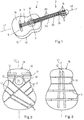
- an acoustic guitar embodying the present invention comprises a body 1, a neck 2 projecting from the body 1.
- the body 1 is constricted, and includes a front board la, a rear board 1b and a side board 1c or boards 1c.
- the front board la and the rear board 1b have contours identical with each other, and are symmetrical with respect to a line L1.
- the front board la is spaced from the rear board 1b, and the side boards 1c are connected along the outer peripheries of the front/ rear boards 1a/ 1b.
- the front board la, the rear board 1b and the side boards 1c thus assembled form hollow space serving as a resonator 3.
- a circular aperture is formed in the front board 1a, and serves as a sound hole 1d.
- the resonator 3 is open to the air through the sound hole 1d.
- the neck 2 is connected to the body 1, and is elongated along the line L1.
- the neck 2 includes a neck body 2a bonded to the body 1, a finger board 2a attached to the front surface of the neck body 2a, an upper bridge saddle 2c embedded into the leading end portion of the finger board 2b and plural frets 2d attached to the finger board at intervals.
- the leading end portion of the neck body 2a is widened, and slots are formed. As will be described hereinbelow, the leading end portion serves as a kind of peg box.
- the acoustic guitar further comprises a bridge 4 attached to the front board la, a lower bridge saddle 5 embedded in the bridge 4, turning keys 6 screwed into the leading end portion of the neck body 2a and strings 7 stretched between the bridge 4 and the turning keys 6.
- the strings 7 are terminated at the turning keys 6, and a player gives appropriate tensions to the strings 7 through rotation of the turning keys 6.
- the acoustic guitar has the contour similar to that of the prior art acoustic guitar. When the player plucks the strings 7, the strings 7 vibrate, and the vibrations are propagated through the bridge 4 to the body 1.
- the body 1 generates the acoustic sound from the vibrations, and the resonator 3 makes the acoustic sound loud.
- the acoustic sound is radiated through the sound hole 3.
- the strings 7 are brought into contact with the frets 2d, and the vibrating strings 7 change the pitches of the acoustic sound.
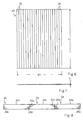
- Figure 2 shows the reverse surface of the front board la
- figure 3 shows the reverse surface of the rear board 1b.
- Sound bars 11 and reinforce members 12 are bonded to the reverse surfaces.
- the reinforce members 12 enhance the mechanical strength of the boards 1a/ 1b, and the sound bars 11 propagate the vibrations of the bridge 4 over the front/ rear boards 1a/ 1b.
- various parts are assembled into the acoustic guitar, and are formed of woody material except the strings 7, the bridge saddles 2c/ 5, the turning keys 6 and the frets 2d.
- the front board 1a, the rear board 1b, the side boards 1c, the sound bars 11, the reinforce members 12, the neck body 2a, the finger board 2b and the bridge 4 are formed of bamboo.
- the other parts i.e., the front board la, the rear board 1b, the side boards 1c, the sound bars 11, the reinforce members 12, the neck body 2a, the finger board 2b and the bridge 4 are similar in configuration to those of the prior art acoustic guitar.
- the bamboo is formed into bamboo plates available for the other parts as follows.
- Figure 4 illustrates a bamboo stem 20.
- the bamboo stem 20 belongs to a species of thick-stemmed bamboo. Of course, other species such as grown in Asian countries, African countries and North/ South American countries is available for the other parts.
- the bamboo has a subterranean stem and a terrestrial stem.
- the terrestrial stem is appropriate for the bamboo plates.
- the manufacturer firstly selects bamboo stems that are close in age and color to one another. The manufacturer checks the bamboo stems to see whether stains and scratches are serious or not. When the bamboo stems are acceptable, the manufacturer cuts the bamboo stem 20 into cylindrical parts 21. If there is a node 22, the manufacturer grinds the node 21, and makes the outer surface smooth.
- the manufacturer cuts the cylindrical part 21 into arc pieces 23.
- the cylindrical part 21 is cut into eight arc pieces along broken lines.
- the cylindrical part 21 may be cut into more than eight arc pieces depending upon the diameter of the bamboo stem 20.
- the corners 23a and a curved outer surface portion 23b are removed from the arc piece 23, and a bamboo strip 24 is formed from the arc piece 23.
- most of the epidermis is removed from the bamboo strip 24, residual epidermis 24a is seen as indicated by dots.
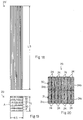
- the bamboo strips 24 are arranged as shown in figure 6. Only four bamboo strips are labeled with reference 24 for the sake of simplicity.
- the bamboo strips 24 form a bamboo plate 25, and the bamboo plate 25 has length L1 of 550 millimeters, width W1 of 420 millimeters and thickness T1 of 3 millimeters.
- the bamboo plate 25 may have different dimensions. Every other bamboo strip 24 is turned the inside 24b out, and the remaining bamboo strips keep the outside 24c out as shown in figure 8.
- the bamboo strips 24 are bonded to one another without gap therebetween. This feature is desirable, because the bamboo plate 25 is less warped under temperature difference.
- the residual epidermis 24a is periodically seen on the outer surface of the bamboo plate 25 like the grain of wood.
- the manufacturer shapes the bamboo plates 25 into the front board la and the rear board 1b.
- FIGs 9 and 10 illustrate another bamboo plate 26 for the side board 1c.
- the bamboo plate 26 has length L2 of 850 millimeters, width W2 of 120 millimeters and thickness T2 of 2.5 millimeters.
- the bamboo strips 24 are prepared as similar to those for the bamboo plate 25. The manufacturer puts the bamboo strips 24 side by side, and the inner surface 24b is alternated with the outer surface 24c as shown in figure 11. The bamboo strips 24 are bonded to the adjacent bamboo strips 24 without gap, and are formed into the bamboo plate 26.
- the bamboo plate 26 is shaped into the side board 1c.
- Figures 12 and 13 illustrate a bamboo plate 27 available for the sound bars 11 and the reinforce members 12.
- the bamboo plate 27 has length L3 of 500 millimeters, width W3 of 20 millimeters and thickness T3 of the order of 10 millimeters.
- the manufacturer prepares the bamboo strips 24 as similar to those of the bamboo plate 25.
- a pair of bamboo strips 24 is used for the bamboo plate 27, and the inner surface 24b of one bamboo strip 24 is bonded to the inner surface 24b of the other bamboo strip 24 without gap.
- the outer surfaces 24c serve as both surfaces of the bamboo plate 27 as shown in figure 14.
- the bamboo plate 27 is less warped under temperature difference.
- FIGs 15 and 16 illustrate another bamboo plate 28 also available for the sound bars 11 and the reinforce members 12.
- the bamboo plate 28 has length L4 of 500 millimeters, width W4 of 20 millimeters and thickness T4 of the order of 20 millimeters.
- the bamboo plate 28 is twice thicker than the bamboo plate 27.
- the manufacturer firstly forms the bamboo strips 24 as similar to those for the bamboo plate 25.
- Two pairs of bamboo strips 24 are used for the bamboo plate 27.
- the bamboo strips 24 are alternately laminated in such a manner that inner surface 24b and the outer surface 24c of one bamboo strip 24 are respectively laminated on the inner surface of an adjacent bamboo strip 24 and the outer surface of another adjacent bamboo strip 24 as shown in figure 17.
- the outer surfaces 24c serve as both surfaces of the bamboo plate 28.
- Two bamboo plates 27 may be bonded to one another without gap.
- the bamboo plate 28 is less warped under temperature difference.
- FIGS 18, 19 and 20 illustrate yet another bamboo plate 29 available for the neck body 2a.
- the bamboo plate 29 has length L5 of 630 millimeters, width W5 of 95 millimeters and thickness T5 of 110 millimeters.
- the manufacturer firstly forms the bamboo strips 24 as similar to those for the bamboo plate 25.
- the manufacturer laminates the bamboo strips 24, and bonds the bamboo strips 24 without gap so as to obtain two kinds of bamboo sub-plates 30/ 31.
- the bamboo strips 24 are laminated in such a manner that the inner surface 24b and the outer surface 24c are held in contact with the inner surface 24b of one adjacent bamboo strip 24 and the outer surface 24c of the other adjacent bamboo strip 24, and are bonded without gap.
- the bamboo sub-plate 30 exposes the inner surfaces to both sides thereof, and the bamboo sub-plate 31 exposes the outer surfaces to both sides thereof as shown.
- the bamboo sub-plates 30 are alternated with the bamboo sub-plates 31, and are bonded without gap.
- the inner surfaces 24b and the outer surfaces 24c are alternately exposed to each of the side surfaces of the bamboo plate 29, and the bamboo plate 29 is less warped under temperature difference.
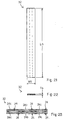
- FIGs 21, 22 and 23 illustrate a bamboo plate 32 available for the finger board 2b.
- the bamboo plate 32 has length L6 of 500 millimeters, width W6 of 60 millimeters and thickness T6 of 6 millimeters.
- the manufacturer forms the bamboo strips 24 as similar to those for the bamboo plate 25.
- three pairs of bamboo strips 24 are used for the bamboo plate 32.
- the first pair has the bamboo strips 24, the outer surfaces of which are bonded to one another.
- the inner surfaces 24c are exposed to both surfaces of the first pair.
- the bamboo strips 24 of the other pairs have inner surfaces 24b bonded to one another, and, accordingly, the outer surfaces 24c are exposed to both sides of the second/ third pair.
- the second pair and the third pair are placed on both sides of the first pair, and are bonded to the first pair without gap.
- the bridge 4 is also formed from the bamboo strips 24.
- the body 1, the neck 2 and the bridge 4 are formed from the bamboo strips 24.
- Any scarce wood such as spruce, cedar and Indian rose is never required for the acoustic guitar according to the present invention.
- the bamboo is economical.
- the bamboo is rapidly grown, and is constantly supplied to the manufacturer. The manufacturer does not need a large amount of stock.
- the bamboo strips 24 are easily assembled into the plates 25/ 26/ 27/ 28/ 29/ 32, and the manufacture does not need special machines. For this reason, the manufacturer reduces the production cost of the stringed musical instrument.
- the bamboo has constant cellular texture, and the cellular texture is straightly continued. Moreover, the bamboo plates 25/ 26/ 27/ 28/ 29/ 32 are less warped under temperature difference. For this reason, the stringed musical instrument according to the present invention is stable, and constantly generates the acoustic sound.
- the present inventor fabricated the acoustic guitar according to the present invention, and compared the acoustic sound with the acoustic sound of the prior art acoustic guitar. The difference of timbre was ignoreable.
- an electric acoustic guitar embodying the present invention largely comprises an acoustic guitar 41 and an electric sound generating system 42.
- the acoustic guitar 41 is similar to the acoustic guitar implementing the first embodiment, and component parts are labeled with the same references designating corresponding component parts of the first embodiment without detailed description.
- At least three holes 1f are formed in the side board 1c.
- the electric sound generating system 42 includes a pickup assembly 43, a pre-amplifier assembly 44, a battery holder assembly 45 and cord 46/ 47.
- the bridge 4 is replaced with the pickup assembly 43.
- the pickup assembly 43 is attached to the front board la, and coverts the vibrations to an electric signal.
- the electric signal is supplied through the chord 47 to the pre-amplifier assembly 44.
- the pre-amplifier assembly 44 includes a circuit board 44a, and the electric signal is processed by an electric circuit of the circuit board 44a.
- the electric circuit processes the electric signal, and controls the timbre of electric sound to be produced.
- the electric signal is supplied from the pre-amplifier assembly 44 through the cord 46 to a sound system (not shown), and the sound system generates the electric sound.
- the bamboo rapidly decays the high-order harmonics of the vibrations, and restricts split vibrations. For this reason, the high-order harmonics and noise components in the electric signal is little, and the pre-amplifier assembly 44 well controls the timbre.
- a battery unit is held by the battery holder assembly 45, and the battery holder assembly 45 is inserted into the resonator 3 through the first hole 1f.
- the battery unit energizes the pickup assembly 43 and the pre-amplifier assembly 44.
- the second hole If is assigned to the pre-amplifier assembly 44, and the cords 46/ 47 are connected through the hole 1f to the pre-amplifier assembly 44 attached to the side board 1c.
- the cord 46 passes through the third hole (not shown), and projects from the resonator 3 to the outside of the body 1.
- the bamboo plates 25/ 26/ 27/ 28/ 29/ 32 have good acoustic properties, and are appropriate for the component parts of the body 1.
- the bamboo is economical and easy to shape into component parts. For this reason, the manufacturer can reduce the production cost without sacrifice the quality of sound.
- the bamboo plates are available for a body of another stringed musical instrument such as, for example, the Taishogoto and other kinds of stringed musical instrument already known.
- the body or neck may be formed from the bamboo plates.
- a part of the body 1 such as, for example, the side board may be formed of wood.
- either neck body or finger board may be formed of wood.
Landscapes
- Engineering & Computer Science (AREA)
- Physics & Mathematics (AREA)
- Acoustics & Sound (AREA)
- Multimedia (AREA)
- Manufacturing & Machinery (AREA)
- Stringed Musical Instruments (AREA)
Applications Claiming Priority (2)
| Application Number | Priority Date | Filing Date | Title |
|---|---|---|---|
| JP702599 | 1999-01-13 | ||
| JP11007025A JPH11316583A (ja) | 1998-03-06 | 1999-01-13 | 弦楽器 |
Publications (3)
| Publication Number | Publication Date |
|---|---|
| EP1020842A2 true EP1020842A2 (de) | 2000-07-19 |
| EP1020842A3 EP1020842A3 (de) | 2001-06-27 |
| EP1020842B1 EP1020842B1 (de) | 2006-07-19 |
Family
ID=11654514
Family Applications (1)
| Application Number | Title | Priority Date | Filing Date |
|---|---|---|---|
| EP99116833A Expired - Lifetime EP1020842B1 (de) | 1999-01-13 | 1999-09-02 | Saitenmusikinstrument aus Bambusplatten |
Country Status (2)
| Country | Link |
|---|---|
| EP (1) | EP1020842B1 (de) |
| DE (1) | DE69932401T2 (de) |
Cited By (2)
| Publication number | Priority date | Publication date | Assignee | Title |
|---|---|---|---|---|
| CN107293274A (zh) * | 2017-06-23 | 2017-10-24 | 金容兰 | 一种竹子吉他桶及其制作方法 |
| WO2018122374A1 (de) * | 2016-12-29 | 2018-07-05 | Relish Brothers Ag | Gitarre mit griffbrett aus hochdichtem bambus |
Families Citing this family (1)
| Publication number | Priority date | Publication date | Assignee | Title |
|---|---|---|---|---|
| CH714562A2 (de) * | 2017-12-29 | 2019-07-15 | Relish Brothers Ag | Gitarre mit Hals und daran abgebogenem Kopf. |
Family Cites Families (4)
| Publication number | Priority date | Publication date | Assignee | Title |
|---|---|---|---|---|
| US3440919A (en) * | 1966-08-12 | 1969-04-29 | Baker Lewis Music Enterprises | Stringed instrument construction |
| US4184404A (en) * | 1976-12-29 | 1980-01-22 | Michiaki Tomioka | Neck for a stringed instrument |
| DE3641856A1 (de) * | 1986-12-08 | 1988-06-16 | Gerhard Kraus | Zupfinstrument |
| JP2688648B2 (ja) * | 1989-03-13 | 1997-12-10 | カシオ計算機株式会社 | 弦楽器 |
-
1999
- 1999-09-02 DE DE69932401T patent/DE69932401T2/de not_active Expired - Fee Related
- 1999-09-02 EP EP99116833A patent/EP1020842B1/de not_active Expired - Lifetime
Cited By (3)
| Publication number | Priority date | Publication date | Assignee | Title |
|---|---|---|---|---|
| WO2018122374A1 (de) * | 2016-12-29 | 2018-07-05 | Relish Brothers Ag | Gitarre mit griffbrett aus hochdichtem bambus |
| US10748513B2 (en) | 2016-12-29 | 2020-08-18 | Relish Brothers Ag | Guitar having fretboard consisting of high-density bamboo |
| CN107293274A (zh) * | 2017-06-23 | 2017-10-24 | 金容兰 | 一种竹子吉他桶及其制作方法 |
Also Published As
| Publication number | Publication date |
|---|---|
| DE69932401T2 (de) | 2007-03-08 |
| EP1020842B1 (de) | 2006-07-19 |
| DE69932401D1 (de) | 2006-08-31 |
| EP1020842A3 (de) | 2001-06-27 |
Similar Documents
| Publication | Publication Date | Title |
|---|---|---|
| US6051764A (en) | Stringed musical instrument formed from bamboo plates | |
| US5567896A (en) | String instrument with sound amplification | |
| US3892159A (en) | Soundboard-bridge configuration for acoustic guitars | |
| US20080110318A1 (en) | Tonally improved hollow body stringed instrument | |
| CN103314406A (zh) | 改善弦乐器声音品质的元件 | |
| US7579532B2 (en) | String musical instrument | |
| US6333454B1 (en) | Acoustic support structure for stringed musical instruments and method of making same | |
| US4103583A (en) | Electric guitar | |
| EP1281171B1 (de) | Schalllochform und -lage und deckplattenkonstruktion in einer akustischen gitarre | |
| US5025695A (en) | Stringed instrument with inwardly extending neck | |
| CN114375473B (zh) | 具有部分锥形音板反曲部的原声弦乐器主体 | |
| TWI869384B (zh) | 弓弦樂器 | |
| WO2022092327A2 (ja) | 弦楽器 | |
| US6667431B1 (en) | Stringed instrument | |
| JP2023138805A (ja) | 楽器 | |
| US11676561B1 (en) | Plectrum with striking edge inlay | |
| US7115803B2 (en) | Stringed instrument | |
| EP1020842A2 (de) | Saitenmusikinstrument von Bambusplatten | |
| CN102129853B (zh) | 用于吉他制作的一体化紧密组装梁架结构 | |
| US7166788B2 (en) | Stringed musical instrument | |
| JPS603200B2 (ja) | 音源特に弦楽器から発する音響を増幅するための音響共鳴器 | |
| US7288706B2 (en) | Stringed musical instrument with multiple bridge-soundboard units | |
| EP1279162B1 (de) | Stützstruktur für ein saiteninstrument | |
| US8648237B1 (en) | Mandolin with integrated armrest | |
| US20230260486A1 (en) | Plectrum with multiple striking edge inlays |
Legal Events
| Date | Code | Title | Description |
|---|---|---|---|
| PUAI | Public reference made under article 153(3) epc to a published international application that has entered the european phase |
Free format text: ORIGINAL CODE: 0009012 |
|
| AK | Designated contracting states |
Kind code of ref document: A2 Designated state(s): DE FR GB |
|
| AX | Request for extension of the european patent |
Free format text: AL;LT;LV;MK;RO;SI |
|
| PUAL | Search report despatched |
Free format text: ORIGINAL CODE: 0009013 |
|
| AK | Designated contracting states |
Kind code of ref document: A3 Designated state(s): AT BE CH CY DE DK ES FI FR GB GR IE IT LI LU MC NL PT SE |
|
| AX | Request for extension of the european patent |
Free format text: AL;LT;LV;MK;RO;SI |
|
| 17P | Request for examination filed |
Effective date: 20011221 |
|
| AKX | Designation fees paid |
Free format text: DE FR GB |
|
| 17Q | First examination report despatched |
Effective date: 20050630 |
|
| GRAP | Despatch of communication of intention to grant a patent |
Free format text: ORIGINAL CODE: EPIDOSNIGR1 |
|
| GRAS | Grant fee paid |
Free format text: ORIGINAL CODE: EPIDOSNIGR3 |
|
| GRAA | (expected) grant |
Free format text: ORIGINAL CODE: 0009210 |
|
| AK | Designated contracting states |
Kind code of ref document: B1 Designated state(s): DE FR GB |
|
| REG | Reference to a national code |
Ref country code: GB Ref legal event code: FG4D |
|
| REF | Corresponds to: |
Ref document number: 69932401 Country of ref document: DE Date of ref document: 20060831 Kind code of ref document: P |
|
| ET | Fr: translation filed | ||
| PLBE | No opposition filed within time limit |
Free format text: ORIGINAL CODE: 0009261 |
|
| STAA | Information on the status of an ep patent application or granted ep patent |
Free format text: STATUS: NO OPPOSITION FILED WITHIN TIME LIMIT |
|
| 26N | No opposition filed |
Effective date: 20070420 |
|
| PGFP | Annual fee paid to national office [announced via postgrant information from national office to epo] |
Ref country code: DE Payment date: 20070830 Year of fee payment: 9 |
|
| PGFP | Annual fee paid to national office [announced via postgrant information from national office to epo] |
Ref country code: GB Payment date: 20070829 Year of fee payment: 9 |
|
| PGFP | Annual fee paid to national office [announced via postgrant information from national office to epo] |
Ref country code: FR Payment date: 20070914 Year of fee payment: 9 |
|
| GBPC | Gb: european patent ceased through non-payment of renewal fee |
Effective date: 20080902 |
|
| REG | Reference to a national code |
Ref country code: FR Ref legal event code: ST Effective date: 20090529 |
|
| PG25 | Lapsed in a contracting state [announced via postgrant information from national office to epo] |
Ref country code: DE Free format text: LAPSE BECAUSE OF NON-PAYMENT OF DUE FEES Effective date: 20090401 |
|
| PG25 | Lapsed in a contracting state [announced via postgrant information from national office to epo] |
Ref country code: FR Free format text: LAPSE BECAUSE OF NON-PAYMENT OF DUE FEES Effective date: 20080930 |
|
| PG25 | Lapsed in a contracting state [announced via postgrant information from national office to epo] |
Ref country code: GB Free format text: LAPSE BECAUSE OF NON-PAYMENT OF DUE FEES Effective date: 20080902 |