EP1020844A2 - Pfeife - Google Patents
Pfeife Download PDFInfo
- Publication number
- EP1020844A2 EP1020844A2 EP00300273A EP00300273A EP1020844A2 EP 1020844 A2 EP1020844 A2 EP 1020844A2 EP 00300273 A EP00300273 A EP 00300273A EP 00300273 A EP00300273 A EP 00300273A EP 1020844 A2 EP1020844 A2 EP 1020844A2
- Authority
- EP
- European Patent Office
- Prior art keywords
- whistle
- sound
- chambers
- chamber
- khz
- Prior art date
- Legal status (The legal status is an assumption and is not a legal conclusion. Google has not performed a legal analysis and makes no representation as to the accuracy of the status listed.)
- Withdrawn
Links
Images



Classifications
-
- G—PHYSICS
- G10—MUSICAL INSTRUMENTS; ACOUSTICS
- G10K—SOUND-PRODUCING DEVICES; METHODS OR DEVICES FOR PROTECTING AGAINST, OR FOR DAMPING, NOISE OR OTHER ACOUSTIC WAVES IN GENERAL; ACOUSTICS NOT OTHERWISE PROVIDED FOR
- G10K5/00—Whistles
Definitions
- This invention relates to a whistle and is more particularly, but not exclusively, concerned with a sports whistle for use by a coach or referee.
- whistle users such as coaches and referees do not necessarily have a large lung capacity and yet are required to produce a loud sound when blowing the whistle.
- the whistle is used as a safety whistle, children, elderly people or asthmatics or anyone who happens to be short of breath will usually need to be able to produce 90DbA sound pressure even to obtain a "gentle" blow with such known whistles.
- the sports whistle is used by a user having a reasonable lung capacity it can still be tiring to have to blow constantly at a required pressure level throughout, for example, a game of football.
- the majority of referees use a blowing pressure of 1.2 p.s.i. and it can be uncomfortable having to maintain this pressure where the whistle is required to be blown a large number of times during a game.
- a whistle having one or more of the following features:
- mandolin shape is herein defined as meaning the shape of a whistle which in some sense resembles the shape of a mandolin, in which the mouthpiece of the whistle resembles the narrow elongate neck of the mandolin in side elevation with a somewhat bulbous (normally part circular or curved) rear portion usually accommodating two whistle chamber elements, the bulbous rear portion extending downwardly to form a shaped base which is, in practice, gripped by the user of the instrument on the sides thereof.
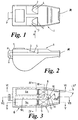
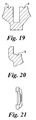
- FIGURES 1 to 21 of the drawings show various views of a plastics whistle 1 (including cross sectional views with and without top 7).
- whistle 1 is known for example from our previous patent specification No. U.S. 5086726 (hereby referred to in full) and therefore the following description is directed towards the major differences in accordance with the present invention.
- FIGURE 1 shows the top view of the whistle 1 including two whistle element sound chambers 2,3 with vents 4,5, said element sound chambers being side-by-side in the whistle in a common plane.
- FIGURE 2 shows a side view of the whistle 1 looking in the direction of arrow A in FIGURE 1, said whistle having a mouth piece M and being generally of a "mandolin" shape and being a sports whistle for use by referees.
- Whistle 1 has a rear projection p formed with aperture a for the reception of a cord or lanyard.
- the whistle 1 is formed from two interfitting parts, namely a top 7 (see FIGURES 15 to 21) and a base 6 (see FIGURES 3 to 14).
- FIGURE 3 shows a plan view of the whistle 1 with top 7 removed (i.e. a plan view of the base 6), and showing sound chamber halves 4a,5a separated by central wall W 1 .
- top 7 is welded to base 6.
- FIGURE 4 shows a cross section of the whistle base 6 taken on the line IV-IV of FIGURE 3 showing a cross section of each whistle element sound chamber half 4a,5a which mates with its associated cross sectional half chamber 4b,5b in the whistle top 7 (see FIGURES 15 and 17) to form asymmetrical or scalloped shaped sound element whistle chambers 2,3.
- each sound chamber 2,3 has a cross section which is part circular for 270° and which has a right angle corner 4c,5c for the remaining 90°.
- the corners 4c,5c are formed in the base 6 and face outwardly of the top.
- FIGURES 22 and 23 show graphs indicating frequency characteristics and sound pressure levels of a whistle with symmetrical (unscalloped) sound chambers and of a whistle in accordance with the present invention having asymmetrical (scalloped) sound chambers respectively.
- the two graphs demonstrate how, at constant blowing pressure of 0.5 p.s.i., the maximum frequency generated is 3.7 KHz in the whistle used to generate the graph of FIGURE 5 and the whistle used to generate the graph of FIGURE 6 produces 3.9 KHz.
- the whistle with scalloped chambers creates a 4.4% increase in sound pressure level from 115.0 DbA to 120.0 DbA. It is to be noted that every increase of 3 DbA represents a doubling up of the power of the whistle.
- every increase demonstrated for a whistle in accordance with the present invention at a constant blowing pressure is very considerable.
- FIGURES 3 and 5 director ramps 8,9 in the base 6 are angled at 68° to the vertical in order to guide air blown in the mouthpiece M into the associated sound chamber 2,3.
- the dashed lines in FIGURE 3 indicate V-shaped ribs (energy director ribs V - see FIGURE 10) which fit into mating grooves g (indicated by dashed lines in FIGURE 13) in the top 7. Details of the grooves g are shown in FIGURES 19 and 20.
- Peg 12 fits into circular aperture 13 (see FIGURE 13) in the top 7.
- Central wall W 2 (with recess R) separates chamber halves 4b,5b from each other and wall W 2 is provided with inclined faces 10a,11a in similar manner to faces 10,11 on wall W 1 (described later).
- FIGURE 15 demonstrates the division of the two whistle element sound chamber air splitter edges 2a and 3a by a fin F of thickness of about one tenth of an inch (0.25cm).
- the provision of the fin F and its selected dimensions is very important in the design of whistle 1 in creating a distinct well into which the air splitter edge 2a,3a is located.
- the fin F prevents air turbulence at the splitter edge 2a,3a, which turbulence could cause distortion of the frequency and at the same time the fin prevents interference between the two sound chambers 2 and 3 which could cause constant lack of clarity and unpredictable sound distortion.
- An interchangeable pad P is provided on which can be provided on appropriate Logo or information.
- the whistle 1 is appropriately shaped and dimensioned to:
- this type of high frequency sports whistle usually has three chambers
- Another feature which has an important effect on the production of an exceptional sound is the raising of a section at the back of the mouthpiece M of the whistle and from the air director ramps 8 and 9 (see FIGURE 3) so as to create a well, as previously mentioned, in order to enable a purer sound tone.
- the relative lengths of the whistle sound chamber elements 2 and 3 is also very important to producing two individual frequencies which, when in combination, produce an overall frequency as close to 4.00 KHz as possible.
- the frequency of 4.00 KHz provides the high pitch necessary to catch human attention, but low enough to be audible over a distance.
- Most sports whistles of a similar type produce frequencies of 4.35 KHz and 4.5 KHz; these frequencies are excellent indoors but do not carry outdoors.
- the whistle as aforedescribed requires far less pressure and volume throughput to blow two chambers than it does to blow three, this being an advantage of use of only two chambers.
- the selected chamber lengths acting in combination with the fin F used to separate the two splitter edges 2a and 3a combined with the relative position of the two chambers 2 and 3 all combine to create the particular trill associated with this whistle at low breath pressure and the shaping of each of the whistle element chambers 2 and 3 in an asymmetrical manner enables a high maximum frequency to be generated.
- the whistle 1 is provided with numerous improvements any one of which would improve the general performance of the whistle, which feature when taken in combination, it is believed, provide a maximum improvement. Therefore, any permutation of such particular advantageous whistle features may be patentable.
- a former version of the Applicant's whistle did not include the particular asymmetrical shape of the whistle sound element chambers and said chambers were of a normal cylindrical cross section. Such a whistle was still found to work well in practice but is even better with the asymmetrical shape of chamber.
- any disclosure in this specification or a range for a variable or parameter shall be taken to include a disclosure of any selectable or derivable sub-range within that range and shall be taken to include a disclosure of any value for the variable or parameter lying within or at the end of the range or sub-range.
- the singular may include the plural and vice versa.
Landscapes
- Physics & Mathematics (AREA)
- Engineering & Computer Science (AREA)
- Acoustics & Sound (AREA)
- Multimedia (AREA)
- Toys (AREA)
Applications Claiming Priority (2)
| Application Number | Priority Date | Filing Date | Title |
|---|---|---|---|
| GB9900868 | 1999-01-16 | ||
| GB9900868 | 1999-01-16 |
Publications (2)
| Publication Number | Publication Date |
|---|---|
| EP1020844A2 true EP1020844A2 (de) | 2000-07-19 |
| EP1020844A3 EP1020844A3 (de) | 2004-04-28 |
Family
ID=10845958
Family Applications (1)
| Application Number | Title | Priority Date | Filing Date |
|---|---|---|---|
| EP00300273A Withdrawn EP1020844A3 (de) | 1999-01-16 | 2000-01-17 | Pfeife |
Country Status (1)
| Country | Link |
|---|---|
| EP (1) | EP1020844A3 (de) |
Cited By (2)
| Publication number | Priority date | Publication date | Assignee | Title |
|---|---|---|---|---|
| WO2008089533A1 (en) * | 2007-01-26 | 2008-07-31 | Fox 40 International Inc. | Multi chambered whistle |
| CN115662375A (zh) * | 2022-10-21 | 2023-01-31 | 常州三水救生装备有限公司 | 多功能中频口哨 |
Family Cites Families (3)
| Publication number | Priority date | Publication date | Assignee | Title |
|---|---|---|---|---|
| GB190900553A (en) * | 1909-01-09 | 1909-11-11 | Joseph Hudson | Improvements in, and in the Manufacture of, Whistles. |
| US1688348A (en) * | 1926-09-24 | 1928-10-23 | Edward R Petrie | Whistle |
| US5086726A (en) * | 1990-08-24 | 1992-02-11 | J. Hudson & Co. (Whistles) Ltd. | Whistle |
-
2000
- 2000-01-17 EP EP00300273A patent/EP1020844A3/de not_active Withdrawn
Cited By (2)
| Publication number | Priority date | Publication date | Assignee | Title |
|---|---|---|---|---|
| WO2008089533A1 (en) * | 2007-01-26 | 2008-07-31 | Fox 40 International Inc. | Multi chambered whistle |
| CN115662375A (zh) * | 2022-10-21 | 2023-01-31 | 常州三水救生装备有限公司 | 多功能中频口哨 |
Also Published As
| Publication number | Publication date |
|---|---|
| EP1020844A3 (de) | 2004-04-28 |
Similar Documents
| Publication | Publication Date | Title |
|---|---|---|
| US8028642B2 (en) | Whistle with finger grip | |
| US4821670A (en) | Whistle | |
| US6837177B2 (en) | Whistle having air flow converter | |
| US8776713B2 (en) | Whistle | |
| US5816186A (en) | Whistle | |
| US6698377B1 (en) | Whistle | |
| US4161130A (en) | Body for bass guitar | |
| CN1418359A (zh) | 具有若干室的哨 | |
| EP0930606B1 (de) | Kombinationspfeife | |
| EP1020844A2 (de) | Pfeife | |
| US4116108A (en) | Musical tube | |
| US6872876B2 (en) | Ocarinas with an inner liner and an outer shell | |
| WO1990016059A1 (en) | Flute headjoint | |
| EP2416312B1 (de) | Pfeife mit Fingergriff | |
| JP4080678B2 (ja) | ホイッスル | |
| USD443663S1 (en) | Tennis racket | |
| KR101812479B1 (ko) | 색소폰용 공명 마우스피스 | |
| CN212934126U (zh) | 一种幼儿专用陶笛 | |
| JPS5937825Y2 (ja) | ハ−モニカ | |
| US20040244562A1 (en) | Ocarinas with chamber extensions that distance toneholes from the fipple window | |
| KR102720324B1 (ko) | 취구 보조기 | |
| CA2714366C (en) | Whistle with finger grip | |
| JP3218257U (ja) | 歌口可動回転式横笛補助具 | |
| KR200275661Y1 (ko) | 오카리나 | |
| JP3192797U (ja) | 補助具付き篠笛 |
Legal Events
| Date | Code | Title | Description |
|---|---|---|---|
| PUAI | Public reference made under article 153(3) epc to a published international application that has entered the european phase |
Free format text: ORIGINAL CODE: 0009012 |
|
| AK | Designated contracting states |
Kind code of ref document: A2 Designated state(s): AT BE CH CY DE DK ES FI FR GB GR IE IT LI LU MC NL PT SE |
|
| AX | Request for extension of the european patent |
Free format text: AL;LT;LV;MK;RO;SI |
|
| PUAL | Search report despatched |
Free format text: ORIGINAL CODE: 0009013 |
|
| AK | Designated contracting states |
Kind code of ref document: A3 Designated state(s): AT BE CH CY DE DK ES FI FR GB GR IE IT LI LU MC NL PT SE |
|
| AX | Request for extension of the european patent |
Extension state: AL LT LV MK RO SI |
|
| 17P | Request for examination filed |
Effective date: 20041025 |
|
| AKX | Designation fees paid |
Designated state(s): AT BE CH CY DE DK ES FI FR GB GR IE IT LI LU MC NL PT SE |
|
| 17Q | First examination report despatched |
Effective date: 20070402 |
|
| STAA | Information on the status of an ep patent application or granted ep patent |
Free format text: STATUS: THE APPLICATION IS DEEMED TO BE WITHDRAWN |
|
| 18D | Application deemed to be withdrawn |
Effective date: 20071013 |