EP1021009A2 - Synchronisation of a network element in a synchronous digital communication network - Google Patents
Synchronisation of a network element in a synchronous digital communication network Download PDFInfo
- Publication number
- EP1021009A2 EP1021009A2 EP00440009A EP00440009A EP1021009A2 EP 1021009 A2 EP1021009 A2 EP 1021009A2 EP 00440009 A EP00440009 A EP 00440009A EP 00440009 A EP00440009 A EP 00440009A EP 1021009 A2 EP1021009 A2 EP 1021009A2
- Authority
- EP
- European Patent Office
- Prior art keywords
- network
- clock
- message
- stm
- node
- Prior art date
- Legal status (The legal status is an assumption and is not a legal conclusion. Google has not performed a legal analysis and makes no representation as to the accuracy of the status listed.)
- Granted
Links
- 230000001360 synchronised effect Effects 0.000 title claims abstract description 26
- 238000004891 communication Methods 0.000 title claims abstract description 12
- 230000005540 biological transmission Effects 0.000 claims abstract description 16
- 238000000034 method Methods 0.000 claims description 17
- 238000011156 evaluation Methods 0.000 claims 1
- 230000015572 biosynthetic process Effects 0.000 abstract description 9
- 238000007726 management method Methods 0.000 description 40
- 238000010586 diagram Methods 0.000 description 5
- 102100040862 Dual specificity protein kinase CLK1 Human genes 0.000 description 2
- 101000749294 Homo sapiens Dual specificity protein kinase CLK1 Proteins 0.000 description 2
- 238000009795 derivation Methods 0.000 description 2
- 230000007257 malfunction Effects 0.000 description 2
- 230000003287 optical effect Effects 0.000 description 2
- 239000004065 semiconductor Substances 0.000 description 2
- 241001136792 Alle Species 0.000 description 1
- 241001620634 Roger Species 0.000 description 1
- 101100142275 Saccharomyces cerevisiae (strain ATCC 204508 / S288c) RPL1A gene Proteins 0.000 description 1
- 101100476983 Saccharomyces cerevisiae (strain ATCC 204508 / S288c) SDT1 gene Proteins 0.000 description 1
- 230000003139 buffering effect Effects 0.000 description 1
- 238000010276 construction Methods 0.000 description 1
- 238000013500 data storage Methods 0.000 description 1
- 230000007547 defect Effects 0.000 description 1
- 230000006735 deficit Effects 0.000 description 1
- 230000001934 delay Effects 0.000 description 1
- 230000001419 dependent effect Effects 0.000 description 1
Images


Classifications
-
- H—ELECTRICITY
- H04—ELECTRIC COMMUNICATION TECHNIQUE
- H04J—MULTIPLEX COMMUNICATION
- H04J3/00—Time-division multiplex systems
- H04J3/02—Details
- H04J3/06—Synchronising arrangements
- H04J3/0635—Clock or time synchronisation in a network
- H04J3/0638—Clock or time synchronisation among nodes; Internode synchronisation
- H04J3/0641—Change of the master or reference, e.g. take-over or failure of the master
-
- H—ELECTRICITY
- H04—ELECTRIC COMMUNICATION TECHNIQUE
- H04J—MULTIPLEX COMMUNICATION
- H04J3/00—Time-division multiplex systems
- H04J3/02—Details
- H04J3/06—Synchronising arrangements
- H04J3/0635—Clock or time synchronisation in a network
- H04J3/0679—Clock or time synchronisation in a network by determining clock distribution path in a network
Definitions
- the invention relates to a method for synchronizing network elements in a synchronous digital communications network after Preamble of claim 1, a network element for a synchronous digital Message transmission network according to the preamble of claim 6 and a network management device according to claim 7.
- the network elements of a synchronous digital communication network work according to the recommendations of the ITU-T for synchronous digital hierarchy (NET) or Synchronous Optical Network (SONET). Under network elements become add / drop multiplexers, crossconnects or line multiplexers Roger that. When sending messages in such a way It is essential for the communications network that everyone Network elements work synchronously with each other. This is done by a mutual synchronization of the network elements or by master / slave synchronization accomplished by receiving each network element from a Message signal derives a clock signal and its internal clock generator synchronized to this external clock signal. For feeding a clock high-precision reference clock in the network serve one or more primary Reference clock generators.
- a synchronization status message (SSM) was introduced, which is also transmitted as part of the message signal.
- the SSM specifies the quality of the reference clock to which the sending network element is synchronized.
- a clock reference is selected on the basis of the SSM, in that a network element always selects the message signal as the clock reference whose SSM indicates the highest clock quality.
- There was also the news DNU "( do not use for synchronization ") is defined as SSM, which is to be sent in the reverse direction to the network element whose message signal was selected as the clock reference.
- European patent application EP 0 849 904 suggests another way of avoiding clock loops: the selection of a reference clock should be made in a central clock generator of a network node.
- the selected clock source is communicated to a central network management device, which then instructs all network elements of the node, which receive their reference clock from the central clock generator of the node, which SSM each network element has to send to which of its outputs.
- this method is complex because the network management device must explicitly assign an SSM to be sent to each network element for each of its outputs.
- the correct configuration of the network is essential.
- several clock interfaces with means for transmitting an SSM between the clock generator and network elements must be provided, which is also technically complex and is not provided for in network elements currently available.
- the object of the invention is a method for synchronizing a Specify network element at which the risk of formation of clock loops is reduced in particular in the case of parallel transmission paths, but this is manages with simple technical means.
- Other objects of the invention consist of a network element and a network management facility specify which are suitable for carrying out the procedure.
- a basic idea of the invention is the selection of a clock reference not from a network element or from a central clock generator but from a central network management facility.
- everyone is in the existing network management facility Information about the structure and configuration of the network is saved.
- Another basic idea is that a network element, if it is the Need for a new selection that notes Network management facility for everyone received at its inputs Message signals each contained therein Transmits synchronization status messages and the Network management device then based on the transmitted Synchronization status messages and based on the saved Information on the structure and configuration of the network one of the received message signals as a new clock reference and the Network element communicates this selection.
- the information transmission between network elements and the central network management facility via the existing Q interfaces are a few seconds to minutes.
- the invention is based but on the recognition that there was no significant impairment of the Message transfer in the message transfer network results when after a loss or malfunction of its reference clock source Network element is not immediately resynchronized.
- the Invention in this case switches a Nefzelement to the free, unsynchronized operation around - the so-called holdover mode - and waits for a new selection from the network controller gets communicated. Delays of up to a few minutes Information transfer via the Q interface as well as waiting and Processing times in the network administration facility are for operation of the network is not critical.
- a network element after losing its reference clock source also, as is customary in the state of the art, a new source of lectures choose. However, this selection is then temporary for the period to bridge until a new one from the network management facility Reference clock source was selected. After notification of a new one Reference clock source through the network management device switches that Network element to the communicated.
- a synchronous digital communication network NET which according to Recommendations for Synchronous Digital Hierarchy (SDH) works is shown in Figure 1 shown. It consists of a series by optical or one another electrical transmission media LINK bidirectionally connected network elements NE1-NE5 and from a central network management facility TMN.
- the Network management device TMN is used to create logical connections to switch between the network elements, error messages and alarms monitor and configure the network NET.
- the task of each network element Assign reference clock source is also often referred to as network management.
- a highly accurate one Reference clock REF is generated by a primary on network element NE1 PRC fed into the network.
- the synchronization takes place by a received message signal as for each network element Clock reference is selected, the network element from the selected one Message signal derives a clock signal and its internal clock generator tunes with this clock signal. If there is a connection between two Network elements due to a defect, so a re-synchronization become necessary. A different one is used for the affected network elements received message signal selected as a new clock reference.
- a reference clock source is selected on the basis of the synchronization status messages SSM which are contained and transmitted with the synchronous transport modules and which each indicate the clock quality of the transmitting network element.
- the messages listed in Table 1 are defined for the SSM.
- a network element selects another one based on the SSM as the reference clock source, it must reverse the SSM DNU "in order to inform the selected network element that the message signals in the reverse direction must not also be used as a clock reference, since otherwise a clock loop would be formed.
- bundles of bundles of parallel transmission paths as shown in the figure between the Network elements NE2 and NE3 are shown, the SSM on both connections DNU ".
- a clock loop could also be formed over several network elements which are connected to one another in a ring, such as network elements NE2, NE3, NE4, NE5 in the drawing.
- clock loops in such a configuration can be done by using the SSM alone
- a reference clock source is selected for each network element in the network management device TMN and this has all the necessary information about the configuration of the network, taking into account the SSM received in each case and the information about the network configuration, the formation of Clock loops in the synchronization or re-synchronization of a network element after a failure can be effectively avoided.
- the information about the selected reference clock sources of the individual network elements is also advantageously taken into account in the selection.
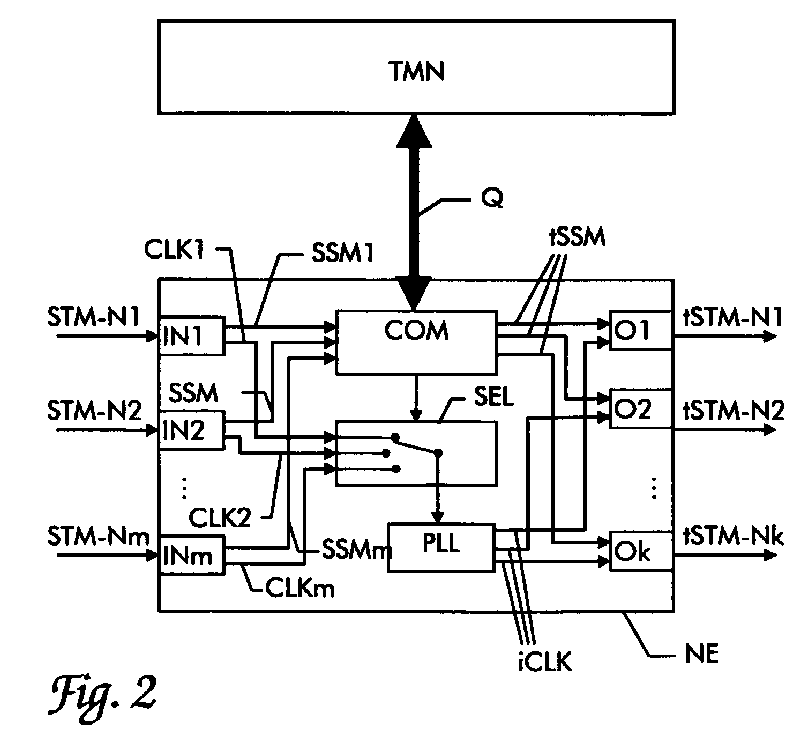
- FIG 2 is an embodiment of a network element according to the invention shown.
- a network element NE has m inputs at which there is one each Receives message signal STM-N1 to STM-Nm.
- the network element NE has interface circuitry at the m inputs IN1 -INm on.
- the received Message signal derived a clock signal CLK1 -CLKm.
- the Clock signals CLK1 -CLKm are one over corresponding connections Selection device SEL supplied.
- In the interface circuits IN1 -INm are also synchronization status messages SSM1 -SSMm in one Header area (overhead) of the synchronous transport modules STM-N1 bis STM-Nm are included, read and sent to a COM connection device headed.
- the connection device COM is available via the Q interface Q the network management device TMN in connection.
- the network management device TMN evaluates the Synchronization status messages and dials based on the Synchronization status messages and based on saved Information about the configuration of the communication network one of the derived clock signals CLK1-CLKm as a clock reference. This Selection notifies it to the network element NE via the Q interface Connection device COM with.
- the connection device COM directs the Message to the selector SEL, which then the switches the selected clock signal to an internal clock generator PLL.
- the connecting device COM can e.g. to the Control device of the network element, the so-called network element manager act.
- the internal clock generator PLL can for example be a digital one Be phase locked loop that in free unsynchronized operation Clock signal generated with the clock quality specified in ITU-T G.812. Is from the Selector SEL a clock signal to the internal clock generator PLL switched through, the clock signal synchronizes the clock generator PLL. On Output signal iCLK of the clock generator PLL is applied as an internal reference clock all output circuits O1-Ok distributed. Message signals to be sent ⁇ STM-N are consequently generated with the internal reference clock iCLK and Posted.
- clock derivation circuits are in at least some of the interface circuits IN1-INm of the network element NE, so that of the message signals received at these interface circuits STMN1-STMNm clock signals CLK1-CLKm are derived. Of These clock signals are then selected by the selection device SEL the selection of the network management device TMN one as a reference clock selected. Alternatively, however, only one clock derivation circuit can be used be provided by the selected message signal Derives reference clock signal.
- the network management device also notifies the network element NE via the Q interface Q and the connection device COM of a synchronization status message ⁇ SSM to be sent for each output O1-Ok.
- This enables the use of the SSM DNU "( Do Not Use for Synchronization ") in all directions to the selected reference clock source, so that network elements that do not work according to the synchronization method according to the invention but instead make a selection based on the SSM itself can also be operated in the message transmission network.
- the network element NE can also be operated, as is provided by the standardization, use the SSM of the received message signal selected as the clock reference, because the formation of clock loops is avoided by the network management device TMN due to the consideration of the information stored there about the structure and configuration of the message transmission network.
- the network management device shown in Figure 4 has means for Receive those transmitted by a network element Synchronization status messages, means for storing information about the structure and configuration of the message network and means to choose from a clock reference for a network element based on the transmitted Synchronization status messages and based on saved Information.
- the network management device advantageously contains one Q interface circuit I / O that with that for communication networks specified Q interface Q is connected to a semiconductor memory MEM for buffering a selection request of a network element and intermediate results of the selection algorithm, a data store with a database DATA, for example in the form of a hard disk, a Processor CPU, which carries out the selection by means of a control program, and a bus system, which Q interface circuit I / O, semiconductor memory MEM, data memory DATA and processor CPU connects.
- the one in the Database containing data storage contains all information about construction and configuration of the message network.
- the invention is applicable in the selection of a Reference clock source for a network node NODE that has multiple network elements NE1-NE6 and a central node clock generator SASE contains.
- FIG 5 is shown schematically as a second embodiment.
- the network node NODE contains six network elements NE1-NE6 and the central one SASE node clock generator.
- the node clock generator SASE can be used both as separate device in the node as well as in one of the Network elements, preferably a cross-connect, can be integrated.
- Each of the Network elements NE1-NE6 sends one out of a received one Message signal STM-N derived clock signal CLK1-CLK6 to the SASE node clock generator.
- the node clock generator is synchronized one of these clock signals and sends a common reference clock signal REF back to all network elements.
- the network elements NE1-NE6 synchronize again to that received from the node clock generator SASE Reference clock signal REF.
- the network node NODE has a central one Network management facility TMN in connection. And that's both each of the network elements with the network manager TMN connected as well as the central node clock generator SASE.
- the network elements send the to the network management device TMN Synchronization status message SSM1-SSM6 received in the Message signal is included, from which the respective to the Node clock generator SASE forwarded clock signal CLK1-CLK6 is derived.
- Based on the synchronization status messages SSM1-SSM6 and based on data stored in the network management facility TMN selects the structure and configuration of the message transmission network Network management device TMN one of the clock signals CLK1-CLK6 as Reference clock source for the node NODE.
- the selection shares the Network management device TMN the central node clock generator SASE via the Q interface Q with.
- the node clock generator SASE then synchronizes with the selected clock signal.
- the network management device TMN shares the individual network elements NE1-NE6 also due to the quality of the selected clock reference with which synchronization status message they send at their outputs should (see Table 1).
- SSM1-SSM6 can also be used anyway between network elements and the network management device TMN existing Q interface can be used.
- the network elements NE1-NE6 are preferably add / drop multiplexers and represents a crossconnect.
- the network node can be the one in a Intermediate network elements of the synchronous digital Act transmission network through which the switching center Long-distance traffic handled.
- the node clock generator is preferably in the Crossconnect is integrated and is also used as the internal clock generator of the Crossconnects used.
- the node clock generator SASE is for the Clock processing and clock distribution of the uniform reference clock signal REF of the network node NODE. It stands like the network elements with the Network management device TMN in connection via the Q interface.
- the node clock generator SASE is designed as an independent device, it can also be regarded as a network element in the sense of the invention, the input signals of which from the other network elements of the Are received clock signals CLK1-CLK6.
- the clock signals can be 2 MHz signals or 2 MBit signals in which the synchronization status message also to the node clock generator can be transferred.
- the clock signal CLK1-CLK6 which this to the node clock generator SASE send, switch off, e.g. when a malfunction occurs.
- This function is called Called squelch. If this is the clock signal, to which the node clock generator synchronizes, then there is Need to make a new selection.
- the node clock generator provides determined that the input signal to which it is synchronizing has failed and notifies the network manager TMN that a new one Selection is required.
- the network management device TMN then leads according to the method of the invention and the selection Node clock generator SASE the new selection via the Q interface Q with. In in the meantime, the node clock generator switches to unsynchronized Operation (so-called holdover mode).
Landscapes
- Engineering & Computer Science (AREA)
- Computer Networks & Wireless Communication (AREA)
- Signal Processing (AREA)
- Synchronisation In Digital Transmission Systems (AREA)
- Data Exchanges In Wide-Area Networks (AREA)
- Time-Division Multiplex Systems (AREA)
- Telephonic Communication Services (AREA)
- Mobile Radio Communication Systems (AREA)
Abstract
In einem synchronen digitalen Nachrichtenübertragungsnetz (NET) müssen alle Netzelemente (NE1-NE5; NE) synchron miteinander arbeiten. Bei gegenseitiger Synchronisierung ist darauf zu achten, daß keine Taktschleifen gebildet werden.In a synchronous digital communications network (NET) you need all network elements (NE1-NE5; NE) work synchronously with each other. At mutual synchronization, make sure that there are no clock loops be formed.
Ein Netzelement empfängt an seinen Eingängen Nachrichtensignale (STM-N1-STM-Nm)
und liest die darin enthaltenen Synchronisationsstatusmeldungen
(SSM1-SSMm). Diese überträgt es an eine zentrale
Netzwerkverwaltungeinrichtung (TMN), die anhand der
Synchronisationsstatusmeldungen und anhand von gespeicherten
Informationen (DATA) über Aufbau und Konfiguration des Netzes (NET) eines
der Nachrichtensignale als Taktreferenz auswählt und dem Netzelement (NE;
NE1-NE6) die Auswahl mitteilt. Das Netzelement (NE; NE1-NE6) leitet von
dem ausgewählten Nachrichtensignal ein Taktsignal (CLK1-CLKm) ab und
gleicht einen internen Taktgenerator (PLL) mit dem abgeleiteten, ausgewählten
Taktsignal ab. Da die Netzwerkverwaltungseinrichtung (TMN) auch
Informationen über parallele Verbindungen (BUNDLE) von
Übertragungswegen hat, wird die Bildung von Taktschleifen wirksam
verhindert.
Description
Die Erfindung betrifft ein Verfahren zur Synchronisation von Netzelementen in
einem synchronen digitalen Nachrichtenübertragungsnetz nach dem
Oberbegriff des Anspruchs 1, ein Netzelement für ein synchrones digitales
Nachrichtenübertragungsnetz nach dem Oberbegriff des Anspruchs 6 und
eine Netzwerkverwaltungseinrichtung nach Anspruch 7.The invention relates to a method for synchronizing network elements in
a synchronous digital communications network after
Preamble of
Die Netzelemente eines synchronen digitalen Nachrichtenübertragungsnetzes arbeiten nach den Empfehlungen der ITU-T für synchrone digitale Hierarchie (NET) oder Synchronous Optical Network (SONET). Unter Netzelementen werden Add/Drop-Multiplexer, Crossconnects oder Leitungsmultiplexer verstanden. Bei der Nachrichtenübertragung in einem solchen Nachrichtenübertragungsnetz kommt es wesentlich darauf an, daß alle Netzelemente synchron miteinander arbeiten. Dies wird durch eine gegenseitige Synchronisation der Netzelemente oder durch Master/Slave-Synchronisation erreicht, indem jedes Netzelement von einem empfangenen Nachrichtensignal ein Taktsignal ableitet und seinen internen Taktgenerator auf dieses externe Taktsignal synchronisiert. Zur Takteinspeisung eines hochgenauen Referenztaktes in das Netz dienen ein oder mehrere primäre Referenztaktgeneratoren. The network elements of a synchronous digital communication network work according to the recommendations of the ITU-T for synchronous digital hierarchy (NET) or Synchronous Optical Network (SONET). Under network elements become add / drop multiplexers, crossconnects or line multiplexers Roger that. When sending messages in such a way It is essential for the communications network that everyone Network elements work synchronously with each other. This is done by a mutual synchronization of the network elements or by master / slave synchronization accomplished by receiving each network element from a Message signal derives a clock signal and its internal clock generator synchronized to this external clock signal. For feeding a clock high-precision reference clock in the network serve one or more primary Reference clock generators.
Um die Auswahl eines Nachrichtensignals als Taktreferenz zu verbessern
wurde eine Synchronisationsstatusmeldung (SSM) eingeführt, die als Teil des
Nachrichtensignals mitübertragen wird. Die SSM gibt die Qualität des
Referenztaktes an, auf den das sendende Netzelement synchronisiert ist. Die
Auswahl einer Taktreferenz geschieht anhand der SSM, indem ein Netzelement
stets das Nachrichtensignal als Taktreferenz auswählt, dessen SSM die höchste
Taktqualität anzeigt. Es wurde auch die Nachricht ,
Bei der Synchronisation muß strikt darauf geachtet werden, daß keine
Taktschleifen gebildet werden, d.h. daß nicht zwei Netzelemente sich
gegenseitig als Synchronisationstaktquelle auswählen. Die Gefahr der Bildung
von Taktschleifen ist besonders dann gegeben, wenn zwischen zwei
Netzelementen mehrere parallele Übertragungswege vorhanden sind. Solche
parallelen Übertragungswege werden auch als Bündel bezeichnet. Durch die
Verwendung der SSM
In der Europäischen Patentanmeldung EP 0 723 344 wird vorgeschlagen, zur Vermeidung von Taktschleifen zwei Klassen von Schnittstelleneinrichtungen zu definieren, wobei nur Nachrichtensignale, die an einer Schnittstelleneinrichtung der ersten Klasse empfangen werden als Taktreferenz ausgewählt werden dürfen, jedoch Nachrichtensignale, die an Schnittstelleneinrichtungen der zweiten Klasse empfangen werden, bei der Auswahl eines Referenztaktes zu ignorieren sind. Durch geeignete Konfiguration des Netzes, indem beispielsweise nur Schnittstellen der ersten Klasse mit Schnittstellen der zweiten Klasse verbunden werden, lassen sich Taktschleifen vermeiden. Diese Lösung ist jedoch fehleranfällig, da es auf die richtige Konfiguration des Netzes ankommt. Insbesondere bei Bündeln paralleler Übertragungswege können sich leicht Fehler in die Konfiguration einschleichen, die dann zur Bildung von Synchronisationsschleifen führen. In European patent application EP 0 723 344 it is proposed to Avoiding clock loops to two classes of interface devices define, with only message signals that are on a Interface devices of the first class are received as a clock reference may be selected, but message signals sent to Second class interface devices are received at which Selection of a reference clock must be ignored. By suitable Configuration of the network, for example, only interfaces of the first Class can be connected with interfaces of the second class Avoid cycle loops. However, this solution is prone to errors because it affects the correct configuration of the network arrives. Especially with bundles parallel transmission paths can easily cause errors in the configuration creep in, which then lead to the formation of synchronization loops.
Die Europäische Patentanmeldung EP 0 849 904 schlägt einen anderen Weg
zur Vermeidung von Taktschleifen vor: Die Auswahl eines Referenztaktes soll in
einem zentralen Taktgenerator eines Netzknotens vorgenommen werden. Die
ausgewählte Taktquelle wird einer zentralen Netzwerkverwaltungseinrichtung
mitgeteilt, die daraufhin alle Netzelemente des Knotens, die ihren Referenztakt
von dem zentralen Taktgenerator des Knotens empfangen, instruiert, welche
SSM jedes Netzelement an welchem seiner Ausgänge zu senden hat. Dadurch
läßt sich erreichen, daß an allen Ausgängen, bei denen die Gefahr einer
Taktschleifenbildung besteht, die SSM
Aufgabe der Erfindung ist es, ein Verfahren zur Synchronisation eines Netzelementes anzugeben, bei dem die Gefahr der Bildung von Taktschleifen insbesondere bei parallelen Übertragungspfaden vermindert ist, welches aber mit einfachen technischen Mitteln auskommt. Weitere Aufgaben der Erfindung bestehen darin, ein Netzelement und eine Netzwerkverwaltungseinrichtung anzugeben, die zur Durchführung des Verfahrens geeignet sind.The object of the invention is a method for synchronizing a Specify network element at which the risk of formation of clock loops is reduced in particular in the case of parallel transmission paths, but this is manages with simple technical means. Other objects of the invention consist of a network element and a network management facility specify which are suitable for carrying out the procedure.
Die Aufgabe wird hinsichtlich des Verfahrens gelöst durch die Merkmale des
Anspruchs 1, hinsichtlich des Netzelementes durch die Merkmale des
Anspruchs 6 und hinsichtlich der Netzwerkverwaltungseinrichtung durch die
Merkmale des Anspruchs 7. Vorteilhafte Ausgestaltungen sind den
abhängigen Ansprüchen zu entnehmen.The problem is solved with regard to the method by the features of
Im folgenden wird die Erfindung anhand der Figuren 1-5 in zwei Ausführungsbeispielen beschrieben. Es zeigt:
- Figur 1:
- Ein synchrones digitales Nachrichtenübertragunsgnetz,
- Figur 2:
- ein Blockdiagramm eines erfindungsgemäßen Netzelementes und einer Netzwerkverwaltungseinrichtung,
- Figur 3:
- ein Flußdiagramm des erfindungsgemäßen Verfahrens,
- Figur 4:
- ein Blockdiagramm der erfindungsgemäßen Netzwerverwaltungseinrichtung und
- Figur 5:
- ein Blockdiagramm eines Netzknotens.
- Figure 1:
- A synchronous digital communication network,
- Figure 2:
- 1 shows a block diagram of a network element according to the invention and a network management device,
- Figure 3:
- 2 shows a flow diagram of the method according to the invention,
- Figure 4:
- a block diagram of the network management device according to the invention and
- Figure 5:
- a block diagram of a network node.
Eine Grundidee der Erfindung besteht darin, die Auswahl einer Taktreferenz nicht von einem Netzelement oder von einem zentralen Taktgenerator durchzuführen, sondern von einer zentralen Netzwerkverwaltungseinrichtung. In der ohnehin vorhandenen Netzwerkverwaltungseinrichtung sind alle Informationen über den Aufbau und die Konfiguration des Netzes gespeichert. Eine weitere Grundidee besteht nun darin, daß ein Netzelement, wenn es die Notwendigkeit für eine neue Auswahl feststellt, der Netzwerkverwaltungseinrichtung für alle an seinen Eingängen empfangenen Nachrichtensignale die darin jeweils enthaltenen Synchronisationsstatusmeldungen überträgt und die Netzwerkverwaltungseinrichtung dann anhand der übertragenen Synchronisationsstatusmeldungen und anhand der gespeicherten Informationen über den Aufbau und die Konfiguration des Netzes eines der empfangenen Nachrichtensignale als neue Taktreferenz auswählt und dem Netzelement diese Auswahl mitteilt.A basic idea of the invention is the selection of a clock reference not from a network element or from a central clock generator but from a central network management facility. Everyone is in the existing network management facility Information about the structure and configuration of the network is saved. Another basic idea is that a network element, if it is the Need for a new selection that notes Network management facility for everyone received at its inputs Message signals each contained therein Transmits synchronization status messages and the Network management device then based on the transmitted Synchronization status messages and based on the saved Information on the structure and configuration of the network one of the received message signals as a new clock reference and the Network element communicates this selection.
Bekanntermaßen kann die Informationsübertragung zwischen Netzelementen und der zentralen Netzwerkverwaltungseinrichtung über die vorhandenen Q-Schnittstellen einige Sekunden bis Minuten betragen. Die Erfindung basiert aber auf der Erkenntnis, daß es zu keiner wesentliche Beeinträchtigung der Nachrichtenübertragung in dem Nachrichtenübertragungsnetz führt, wenn nach einem Verlust oder einer Störung seiner Referenztaktquelle ein Netzelement nicht umgehend neu synchronisiert wird. Entsprechend der Erfindung schaltet ein Nefzelement in diesem Fall auf den freien, unsynchronisierten Betrieb um - den sogenannten Holdover-Modus - und wartet bis es von der Netzkwerksteuerungseinrichtung eine neue Auswahl mitgeteilt bekommt. Verzögerungen bis zu einigen Minuten durch die Informationsübertragung über die Q-Schnittstelle sowie Warte- und Bearbeitungszeiten in der Netzwerkverwaltungseinrichtung sind für den Betrieb des Netzes unkritisch.As is known, the information transmission between network elements and the central network management facility via the existing Q interfaces are a few seconds to minutes. The invention is based but on the recognition that there was no significant impairment of the Message transfer in the message transfer network results when after a loss or malfunction of its reference clock source Network element is not immediately resynchronized. According to the Invention in this case switches a Nefzelement to the free, unsynchronized operation around - the so-called holdover mode - and waits for a new selection from the network controller gets communicated. Delays of up to a few minutes Information transfer via the Q interface as well as waiting and Processing times in the network administration facility are for operation of the network is not critical.
Alternativ kann ein Netzelement nach dem Verlust seiner Referenztaktquelle auch wie im Stand der Technik üblich selbst eine neue Referentaktquelle auswählen. Diese Auswahl ist dann jedoch vorübergehend, um die Zeitspanne zu überbrücken, bis von der Netzwerkverwaltungseinrichtung eine neue Referenztaktquelle ausgewählt wurde. Nach Mitteilung einer neuen Referenztaktquelle durch die Netzwerkverwaltungseinrichtung schaltet das Netzelement auf die mitgeteilte um.Alternatively, a network element after losing its reference clock source also, as is customary in the state of the art, a new source of lectures choose. However, this selection is then temporary for the period to bridge until a new one from the network management facility Reference clock source was selected. After notification of a new one Reference clock source through the network management device switches that Network element to the communicated.
Ein synchrones digitales Nachrichtenübertragungsnetz NET, welches nach den Empfehlungen für Synchrone Digitale Hierarchie (SDH) arbeitet, ist in Figur 1 dargestellt. Es besteht aus einer Reihe untereinanden durch optische oder elektrische Übertragungsmedien LINK bidirektional verbundene Netzelemente NE1 -NE5 und aus einer zentralen Netzwerksverwaltungseinrichtung TMN. Die Netzwerkverwaltungeeinrichtung TMN dient dazu, logische Verbindungen zwischen den Netzelementen zu schalten, Fehlermeldungen und Alarme zu überwachen und das Netz NET zu konfigurieren. Außerdem hat sie nach dem erfindungsgemäßen Verfahren die Aufgabe, jedem Netzelement eine Referenztaktquelle zuzuweisen. Eine solche Netzwerkverwaltungseinrichtung wird auch oft als Netzwerkmanagement bezeichnet. Ein hochgenauer Referenztakt REF wird am Netzelemenet NE1 von einem primären Referenztaktgenerator (primäry reference clock) PRC in das Netz eingespeist.A synchronous digital communication network NET, which according to Recommendations for Synchronous Digital Hierarchy (SDH) works is shown in Figure 1 shown. It consists of a series by optical or one another electrical transmission media LINK bidirectionally connected network elements NE1-NE5 and from a central network management facility TMN. The Network management device TMN is used to create logical connections to switch between the network elements, error messages and alarms monitor and configure the network NET. In addition, after the inventive method the task of each network element Assign reference clock source. Such a network management facility is also often referred to as network management. A highly accurate one Reference clock REF is generated by a primary on network element NE1 PRC fed into the network.
Die Netzelemente NE1-NE5 tauschen untereinander über die Übertragungsmedien LINK synchrone Nachrichtensignale aus, die in Form von synchronen Transportmodulen STM-N strukturiert sind. Die Synchronisation erfolgt, indem für jedes Netzelement ein empfangenes Nachrichtensignal als Taktreferenz auswählt wird, das Netzelement von dem ausgewählten Nachrichtensignal ein Taktsignal ableitet und seinen internen Taktgenerator mit diesem Taktsignal abstimmt. Fällt eine Verbindung zwischen zwei Netzelementen aufgrund eines Defektes aus, so kann eine Neusynchronisation erforderlich werden. Dabei wird für die betroffenen Netzelemente ein anderes empfangenes Nachrichtensignal als neue Taktreferenz ausgewählt.The network elements NE1-NE5 exchange among themselves over the Transmission media LINK synchronous message signals in the form of synchronous transport modules STM-N are structured. The synchronization takes place by a received message signal as for each network element Clock reference is selected, the network element from the selected one Message signal derives a clock signal and its internal clock generator tunes with this clock signal. If there is a connection between two Network elements due to a defect, so a re-synchronization become necessary. A different one is used for the affected network elements received message signal selected as a new clock reference.
Die Auswahl einer Referenztaktquelle erfolgt anhand von den synchronen
Transportmodulen enthaltenen und mitübertragenen
Synchronisationsstatusmeldungen SSM, die jeweils die Taktqualität des
sendenen Netzelementes angeben. Für die SSM sind die in Tabelle 1
aufgeführten Meldungen definiert.

Wählt ein Netzelement ein anderes anhand der SSM als Referenztaktquelle
aus, so muß es in die Rückrichtung die SSM
In Figur 2 ist ein Ausführungsbeispiel eines erfindungsgemäßen Netzelementes gezeigt. Ein Netzelement NE hat m Eingänge, an denen es jeweils ein Nachrichtensignal STM-N1 bis STM-Nm empfängt. Die Nachrichtensignale sind als synchrone Transportmodule STM-N der Multiplexstufe N (N= 1, 2, 4, 16, ...) für SDH-Systeme strukturiert. Über eine Q-Schnittstelle Q steht das Netzelement mit einer zentralen Netzwerkverwaltungseinrichtung TMN in Verbindung. In dem Blockdiagramm sind bei dem Netzelemenet NE nur die zur Synchronisation wichtigen Einrichtungen und Verbindungen gezeigt.In Figure 2 is an embodiment of a network element according to the invention shown. A network element NE has m inputs at which there is one each Receives message signal STM-N1 to STM-Nm. The news signals are as synchronous transport modules STM-N of multiplex stage N (N = 1, 2, 4, 16, ...) structured for SDH systems. This is via a Q interface Q Network element with a central network management facility TMN in Connection. In the block diagram, only those are in the network element NE important facilities and connections shown for synchronization.
Das Netzelement NE weist an den m Eingängen jeweils Schnittstellenschaltung IN1 -INm auf. In jeder Schnittstellenschaltung wird aus dem empfangenen Nachrichtensignal jeweils ein Taktsignal CLK1 -CLKm abgeleitet. Die Taktsignale CLK1 -CLKm werden über entsprechende Verbindungen einer Auswahleinrichtung SEL zugeführt. In den Schnittstellenschaltungen IN1 -INm werden auch Synchronisationsstatusmeldungen SSM1 -SSMm, die in einem Kopfbereich (Overhead) der synchronen Transportmodule STM-N1 bis STM-Nm enthalten sind, gelesen und an eine Verbindungseinrichtung COM geleitet. Die Verbindungseinrichtung COM steht über die Q-Schnittstelle Q mit der Netzwerkverwaltungeinrichtung TMN in Verbindung. Sie sendet die Synchronisationsstatusmeldungen SSM1-SSMm zusammen mit einer Information, von welchem der empfangenen Nachrichtensignale die jeweilige Synchronisationsstatusmeldung stammt an die Netzwerkverwaltungeinrichtung TMN. Die Netzwerkverwaltungseinrichtung TMN wertet dann die Synchronisationsstatusmeldungen aus und wählt anhand der Synchronisationsstatusmeldungen und anhand von gespeicherten Informationen über die Konfiguration des Nachrichtenübertragungsnetzes eines der abgeleiteten Taktsignale CLK1-CLKm als Taktreferenz aus. Diese Auswahl teilt sie dem Netzelement NE über die Q-Schnittstelle an die Verbindungseinrichtung COM mit. Die Verbindungseinrichtung COM leitet die Mitteilung an die Auswahleinrichtung SEL weiter, welche daraufhin das ausgewählte Taktsignal an einen internen TaktgeneratorPLL durchschaltet. Bei der Verbindungseinrichtung COM kann es sich z.B. um die Steuerungseinrichtung des Netzelementes, den sogenannten Netzelement-Manager handeln.The network element NE has interface circuitry at the m inputs IN1 -INm on. In each interface circuit, the received Message signal derived a clock signal CLK1 -CLKm. The Clock signals CLK1 -CLKm are one over corresponding connections Selection device SEL supplied. In the interface circuits IN1 -INm are also synchronization status messages SSM1 -SSMm in one Header area (overhead) of the synchronous transport modules STM-N1 bis STM-Nm are included, read and sent to a COM connection device headed. The connection device COM is available via the Q interface Q the network management device TMN in connection. It sends the Synchronization status messages SSM1-SSMm together with one Information from which of the received message signals the respective one Synchronization status message comes to the network management facility TMN. The network management device TMN then evaluates the Synchronization status messages and dials based on the Synchronization status messages and based on saved Information about the configuration of the communication network one of the derived clock signals CLK1-CLKm as a clock reference. This Selection notifies it to the network element NE via the Q interface Connection device COM with. The connection device COM directs the Message to the selector SEL, which then the switches the selected clock signal to an internal clock generator PLL. At the connecting device COM can e.g. to the Control device of the network element, the so-called network element manager act.
Der interne Taktgenerator PLL kann beispielsweise eine digitale Phasenregelschleife sein, die im freien unsynchronisierten Betrieb ein Taktsignal mit der in ITU-T G.812 festgelegten Taktqualität erzeugt. Ist von der Auswahleinrichtung SEL ein Taktsignal zu dem internen Taktgenerator PLL durchgeschaltet, so synchronisiert das Taktsignal den Taktgenerator PLL. Ein Ausgangssignal iCLK des Taktgererators PLL wird als interner Referenztakt an alle Ausgangsschaltungen O1-Ok verteilt. Zu sendende Nachrichtensignale †STM-N werden infolgedessen mit dem internen Referenztakt iCLK erzeugt und gesendet.The internal clock generator PLL can for example be a digital one Be phase locked loop that in free unsynchronized operation Clock signal generated with the clock quality specified in ITU-T G.812. Is from the Selector SEL a clock signal to the internal clock generator PLL switched through, the clock signal synchronizes the clock generator PLL. On Output signal iCLK of the clock generator PLL is applied as an internal reference clock all output circuits O1-Ok distributed. Message signals to be sent † STM-N are consequently generated with the internal reference clock iCLK and Posted.
Üblicherweise befinden sich Taktableitungsschaltungen in zumindest einigen der Schniitstellenschaltungen IN1-INm des Netzelementes NE, so daß von den an diesen Schnittstellenschaltungen empfangenen Nachrichtensignalen STMN1-STMNm jeweils Taktsignale CLK1-CLKm abgeleitet werden. Von diesen Taktsignalen wird dann von der Auswahleinrichtung SEL entsprechend der Auswahl der Netzwerkverwaltungseinrichtung TMN eines als Referenztakt ausgewählt. Alternativ kann jedoch auch nur eine Taktableitungsschaltung vorgesehen sein, die von dem jeweils ausgewählten Nachrichtensignal das Referenztaktsignal ableitet.Typically, clock derivation circuits are in at least some of the interface circuits IN1-INm of the network element NE, so that of the message signals received at these interface circuits STMN1-STMNm clock signals CLK1-CLKm are derived. Of These clock signals are then selected by the selection device SEL the selection of the network management device TMN one as a reference clock selected. Alternatively, however, only one clock derivation circuit can be used be provided by the selected message signal Derives reference clock signal.
Bei einer bevorzugten Ausführung teilt die Netzwerkverwaltungseinrichtung
dem Netzelement NE über die Q-Schnittstelle Q und die
Verbindungseinrichtung COM auch eine zu sendende
Synchronisationsstatusmeldung †SSM für jeden Ausgang O1-Ok mit. Dies
ermöglicht die Verwendung der SSM
Das erfindungsgemäße Verfahren des Ausführungsbeispiels ist als Flußdiagramm in Figur 3 abgebildet. Das Verfahren wird durchgeführt, wenn ein Netzelement synchronisiert werden soll oder wenn ein Netzelement aufgrund einer Störung seine bisherige Referenztaktquelle verloren hat und neu synchronisiert werden soll. Das Verfahren enthält die folgenden Schritte:
- Schritt S1:
- An dem zu synchronisierenden Netzelement werden mehrere Nachrichtensignale empfangen. Eines dieser Nachrichtensignale soll als neue Taktreferenz verwendet werden. Alle empfangenen Nachrichtensignale enthalten eine Synchronisationsstatusmeldung.
- Schritt S2:
- Die Synchronisationsstatusmeldungen der einzelnen empfangenen Nachrichtensignale werden von dem Netzelement gelesen.
- Schritt S3:
- Das Netzelement übertragt die gelesenen Synchronisationsstatusmeldungen zusammen mit einer Information, von welchem Nachrichtensignal die jeweilige Synchonisationsstatusmeldung stammt oder an welchem Eingang das betreffende Nachrichtensignal empfangen wurde, an die zentrale Netzwerkverwaltungseinrichtung.
- Schritt S4:
- Die Netzwerkverwaltungseinrichtung wählt anhand der Synchronisationsstatusmeldungen, der empfangenen Information über die Herkunft der jeweiligen Synchronisationsstatusmeldung und anhand der gespeicherten Informationen über Aufbau und Konfiguration des Nachrichtennetzes eines der Nachrichtensignale als neue Taktreferenz aus.
- Schritt S5:
- Die Netzwerkverwaltungseinrichtung teilt dem Netzelement die getroffene Auswahl mit.
- Schritt S6:
- Das Netzelement leitet von dem ausgewählten Nachrichtensignal ein Taktsignal ab.
- Schritt S7:
- Mit dem von dem ausgewählten Nachrichtensignal abgeleiteten Taktsignal gleicht es seinen internen Taktgenerator ab, um sich auf die neue Referenztaktquelle zu synchronisieren.
- Step S1:
- Several message signals are received at the network element to be synchronized. One of these message signals is to be used as a new clock reference. All received message signals contain a synchronization status message.
- Step S2:
- The synchronization status messages of the individual received message signals are read by the network element.
- Step S3:
- The network element transmits the read synchronization status messages together with information about the message signal from which the respective synchronization status message originates or the input at which the relevant message signal was received to the central network management device.
- Step S4:
- On the basis of the synchronization status messages, the information received about the origin of the respective synchronization status message and the stored information about the structure and configuration of the message network, the network management device selects one of the message signals as a new clock reference.
- Step S5:
- The network management device notifies the network element of the selection made.
- Step S6:
- The network element derives a clock signal from the selected message signal.
- Step S7:
- It compares its internal clock generator with the clock signal derived from the selected message signal in order to synchronize itself with the new reference clock source.
Die in Figur 4 gezeigte Netzwerkverwaltungseinrichtung besitzt Mittel zum Empfangen der von einem Netzelement übertragenen Synchronisationsstatusmeldungen, Mittel zum Speichern von Informationen über Aufbau und Konfiguration des Nachrichtennetzes und Mittel zur Auswahl einer Taktreferenz für ein Netzelement anhand der übertragenen Synchronisationsstatusmeldungen und anhand von gespeicherten Informationen. Vorteilhaft enthält die Netzwerkverwaltungseinrichtung eine Q-Schnittstellenschaltung I/O, die mit der für Nachrichtenübertragungsnetze spezifizierten Q-Schnittstelle Q verbunden ist, einen Halbleiterspeicher MEM zum Zwischenspeichern von einer Auswahlanforderung eines Netzelementes und von Zwischenergebnissen des Auswahlalgorithmus, einen Datenspeicher mit einer Datenbank DATA, beispielsweise in Form einer Festplatte, einen Prozessor CPU, der mittels eines Steuerprogrammes die Auswahl durchführt, sowie ein Bussystem, welches Q-Schnittstellenschaltung I/O, Halbleiterspeicher MEM, Datanspeicher DATA und Prozessor CPU verbindet. Die in dem Datenspeicher enthaltene Datenbank enthält alle Informationen über Aufbau und Konfiguration des Nachrichtennetzes.The network management device shown in Figure 4 has means for Receive those transmitted by a network element Synchronization status messages, means for storing information about the structure and configuration of the message network and means to choose from a clock reference for a network element based on the transmitted Synchronization status messages and based on saved Information. The network management device advantageously contains one Q interface circuit I / O that with that for communication networks specified Q interface Q is connected to a semiconductor memory MEM for buffering a selection request of a network element and intermediate results of the selection algorithm, a data store with a database DATA, for example in the form of a hard disk, a Processor CPU, which carries out the selection by means of a control program, and a bus system, which Q interface circuit I / O, semiconductor memory MEM, data memory DATA and processor CPU connects. The one in the Database containing data storage contains all information about construction and configuration of the message network.
Genauso wie für die Auswahl einer Referenztaktquelle eines einzelnen Netzelementes ist die Erfindung anwendbar bei der Auswahl einer Referenztaktquelle für einen Netzknoten NODE, der mehrere Netzelemente NE1 -NE6 und einen zentralen Knotentaktgenerator SASE enthält. Dies ist in Figur 5 als zweites Ausführungsbeispiel schematisch gezeigt. Der Netzknoten NODE enthält sechs Netzelemente NE1-NE6 und den zentralen Knotentaktgenerator SASE. Der Knotentaktgenerator SASE kann sowohl als separates Gerät in dem Knoten aufgestellt sein als auch in eines der Netzelemente, vorzugsweise einen Crossconnect, integriert sein. Jedes der Netzelemente NE1 -NE6 sendet ein aus einem empfangenen Nachrichtensignal STM-N abgeleitetes Taktsignal CLK1-CLK6 an den Knotentaktgenerator SASE. Der Knotentaktgenerator synchronisiert sich auf eines dieser Taktsignale und sendet ein gemeinsames Referenztaktsignal REF an alle Netzelemente zurück. Die Netzelemente NE1-NE6 synchronisieren sich wiederum auf das von dem Knotentaktgenerator SASE empfangene Referenztaktsignal REF.Just like for the selection of an individual reference clock source Network element, the invention is applicable in the selection of a Reference clock source for a network node NODE that has multiple network elements NE1-NE6 and a central node clock generator SASE contains. This is in Figure 5 is shown schematically as a second embodiment. The network node NODE contains six network elements NE1-NE6 and the central one SASE node clock generator. The node clock generator SASE can be used both as separate device in the node as well as in one of the Network elements, preferably a cross-connect, can be integrated. Each of the Network elements NE1-NE6 sends one out of a received one Message signal STM-N derived clock signal CLK1-CLK6 to the SASE node clock generator. The node clock generator is synchronized one of these clock signals and sends a common reference clock signal REF back to all network elements. The network elements NE1-NE6 synchronize again to that received from the node clock generator SASE Reference clock signal REF.
Der Netzknoten NODE steht mit einer zentralen Netzwerkverwaltungseinrichtung TMN in Verbindung. Und zwar ist sowohl jedes der Netzelemente mit der Netzwerkverwaltungseinrichtung TMN verbunden als auch der zentrale Knotentaktgenerator SASE. Die Netzelemente senden an die Netzwerkverwaltungseinrichtung TMN die Synchronisationsstatusmeldung SSM1-SSM6, die in dem empfangenen Nachrichtensignal enthalten ist, aus dem das jeweilige an den Knotentaktgenerator SASE weitergeleitete Taktsignal CLK1-CLK6 abgeleitet ist. Anhand der mitgeteilten Synchronisationsstatusmeldungen SSM1-SSM6 und anhand in der Netzwerkverwaltungseinrichtung TMN gespeicherten Daten über Aufbau und Konfiguration des Nachrichtenübertragungsnetzes wählt die Netzwerkverwaltungseinrichtung TMN eines der Taktsignale CLK1-CLK6 als Referenztaktquelle für den Netzknoten NODE aus. Die Auswahl teilt die Netzwerkverwaltungseinrichtung TMN dem zentralen Knotentaktgenerator SASE über die Q-Schnittstelle Q mit. Der Knotentaktgenerator SASE synchronisiert sich daraufhin auf das ausgewählte Taktsignal. Vorzugsweise teilt die Netzwerkverwaltungseinrichtung TMN den einzelnen Netzelementen NE1-NE6 auch noch aufgrund der Qualität der ausgewählten Taktreferenz mit, welche Synchronisationsstatusmeldung diese an ihren Ausgängen senden sollen (siehe Tabelle 1). Für die Übertragung der Synchronisationsstatusmeldungen SSM1-SSM6 kann ebenfalls die ohnehin zwischen Netzelementen und der Netzwerkverwaltungseinrichtung TMN vorhandene Q-Schnittstelle verwendet werden.The network node NODE has a central one Network management facility TMN in connection. And that's both each of the network elements with the network manager TMN connected as well as the central node clock generator SASE. The network elements send the to the network management device TMN Synchronization status message SSM1-SSM6 received in the Message signal is included, from which the respective to the Node clock generator SASE forwarded clock signal CLK1-CLK6 is derived. Based on the synchronization status messages SSM1-SSM6 and based on data stored in the network management facility TMN selects the structure and configuration of the message transmission network Network management device TMN one of the clock signals CLK1-CLK6 as Reference clock source for the node NODE. The selection shares the Network management device TMN the central node clock generator SASE via the Q interface Q with. The node clock generator SASE then synchronizes with the selected clock signal. Preferably the network management device TMN shares the individual network elements NE1-NE6 also due to the quality of the selected clock reference with which synchronization status message they send at their outputs should (see Table 1). For the transfer of the Synchronization status messages SSM1-SSM6 can also be used anyway between network elements and the network management device TMN existing Q interface can be used.
Die Netzelemente NE1-NE6 stellen vorzugsweise Add/Drop-Multiplexer und einen Crossconnect dar. Bei dem Netzknoten kann es sich um die in einer Vermiitlungsstelle aufgestellten Netzelemente des synchronen digitalen Nachrichtenübertragungsnetzes handeln, über das die Vermittlungsstelle ihren Fernverkehr abwickelt. Der Knotentaktgenerator ist vorzugsweise in den Crossconnect integriert und wird zusätzlich als interner Taktgenerator des Crossconnects verwendet. Der Knotentaktgenerator SASE ist für die Taktaufbereitung und Taktverteilung des einheitlichen Referenztaktsignales REF des Netzknotens NODE zuständig. Er steht wie die Netzelemente mit der Netzwerkverwaltungseinrichtung TMN über die Q-Schnittstelle in Verbindung. Wenn der Knotentaktgenerator SASE als eigenständiges Gerät ausgeführt ist, kann er im Sinne der Erfindung auch als Netzelement angesehen werden, wobei dessen Eingangssignale die von den übrigen Netzelementen des Knotens empfangenen Taktsignale CLK1-CLK6 sind. Bei den Taktsignalen kann es sich um 2 MHz-Signale handeln oder auch um 2 MBit-Signale in denen die Synchronisationsstatusmeldung auch an den Knotentaktgenerator übertragen werden kann.The network elements NE1-NE6 are preferably add / drop multiplexers and represents a crossconnect. The network node can be the one in a Intermediate network elements of the synchronous digital Act transmission network through which the switching center Long-distance traffic handled. The node clock generator is preferably in the Crossconnect is integrated and is also used as the internal clock generator of the Crossconnects used. The node clock generator SASE is for the Clock processing and clock distribution of the uniform reference clock signal REF of the network node NODE. It stands like the network elements with the Network management device TMN in connection via the Q interface. If the node clock generator SASE is designed as an independent device, it can also be regarded as a network element in the sense of the invention, the input signals of which from the other network elements of the Are received clock signals CLK1-CLK6. With the clock signals can be 2 MHz signals or 2 MBit signals in which the synchronization status message also to the node clock generator can be transferred.
Es ist weiterhin möglich, daß eines oder mehrere der Netzelemente NE1-NE6 das Taktsignal CLK1-CLK6, welches diese an den Knotentaktgenerator SASE senden, abschalten, z.B. wenn eine Störung auftritt. Diese Funktion wird als Squelch bezeichnet. Wenn es sich dabei gerade um das Taktsignal handelt, auf welches der Knotentaktgenerator sich synchronisiert, dann besteht die Notwendigkeit eine neue Auswahl zu treffen. Der Knotentaktgenerator stellt fest daß das Eingangssignal, auf das er sich synchronisiert, ausgefallen ist und teilt der Netzwerkverwaltungseinrichtung TMN mit, daß eine neue Auswahl erforderlich ist. Die Netzwerkverwaltungseinrichtung TMN führt dann nach dem erfindungsgemäßen Verfahren die Auswahl durch und teilt dem Knotentaktgenerator SASE die neue Auswahl über die Q-Schnittstelle Q mit. In der Zwischenzeit schaltet der Knotentaktgenerator auf unsynchronisierten Betrieb (sogenannten Holdover-Modus) um.It is also possible for one or more of the network elements NE1-NE6 the clock signal CLK1-CLK6, which this to the node clock generator SASE send, switch off, e.g. when a malfunction occurs. This function is called Called squelch. If this is the clock signal, to which the node clock generator synchronizes, then there is Need to make a new selection. The node clock generator provides determined that the input signal to which it is synchronizing has failed and notifies the network manager TMN that a new one Selection is required. The network management device TMN then leads according to the method of the invention and the selection Node clock generator SASE the new selection via the Q interface Q with. In in the meantime, the node clock generator switches to unsynchronized Operation (so-called holdover mode).
Claims (7)
die Netzelemente (NE; NE1-NE6) die Synchronisationsstatusmeldungen (SSM1-SSMm) an eine zentrale Netzwerkverwaltungseinrichtung (TMN) übertragen, daß die Netzwerkverwaltungseinrichtung (TMN) anhand der Synchronisationsstatusmeldungen (SSM1-SSMm) und anhand von gespeicherten Informationen über den Aufbau des Nachrichtenübertragungsnetzes (NET) eines der Nachrichtensignale auswählt und daß die Netzwerkverwaltungseinrichtung (TMN) den Netzelementen (NE; NE1-NE6) das ausgewählte Nachrichtensignal mitteilt, das diese zur Synchronisation verwenden sollen. Method for the synchronization of network elements (NE; NE1-NE6) in a synchronous digital communication network (NET), with the following steps:
the network elements (NE; NE1-NE6) transmit the synchronization status messages (SSM1-SSMm) to a central network management device (TMN), that the network management device (TMN) based on the synchronization status messages (SSM1-SSMm) and on the basis of stored information about the structure of the message transmission network ( NET) selects one of the message signals and that the network management device (TMN) notifies the network elements (NE; NE1-NE6) of the selected message signal that they are to use for synchronization.
gekennzeichnet durch
marked by
Applications Claiming Priority (2)
| Application Number | Priority Date | Filing Date | Title |
|---|---|---|---|
| DE19901588 | 1999-01-16 | ||
| DE19901588A DE19901588A1 (en) | 1999-01-16 | 1999-01-16 | Synchronization of a network element in a synchronous digital communication network |
Publications (3)
| Publication Number | Publication Date |
|---|---|
| EP1021009A2 true EP1021009A2 (en) | 2000-07-19 |
| EP1021009A3 EP1021009A3 (en) | 2004-07-28 |
| EP1021009B1 EP1021009B1 (en) | 2005-04-13 |
Family
ID=7894502
Family Applications (1)
| Application Number | Title | Priority Date | Filing Date |
|---|---|---|---|
| EP00440009A Expired - Lifetime EP1021009B1 (en) | 1999-01-16 | 2000-01-14 | Synchronisation of a network element in a synchronous digital communication network |
Country Status (5)
| Country | Link |
|---|---|
| US (1) | US6707828B1 (en) |
| EP (1) | EP1021009B1 (en) |
| JP (1) | JP4358397B2 (en) |
| AT (1) | ATE293317T1 (en) |
| DE (2) | DE19901588A1 (en) |
Families Citing this family (22)
| Publication number | Priority date | Publication date | Assignee | Title |
|---|---|---|---|---|
| US20040090983A1 (en) * | 1999-09-10 | 2004-05-13 | Gehring Stephan W. | Apparatus and method for managing variable-sized data slots within a time division multiple access frame |
| US7023833B1 (en) * | 1999-09-10 | 2006-04-04 | Pulse-Link, Inc. | Baseband wireless network for isochronous communication |
| US20030193924A1 (en) * | 1999-09-10 | 2003-10-16 | Stephan Gehring | Medium access control protocol for centralized wireless network communication management |
| DE19943779A1 (en) * | 1999-09-13 | 2001-03-22 | Siemens Ag | Arrangement for synchronizing communication system components coupled via a communication network |
| US7088795B1 (en) * | 1999-11-03 | 2006-08-08 | Pulse-Link, Inc. | Ultra wide band base band receiver |
| US6952456B1 (en) | 2000-06-21 | 2005-10-04 | Pulse-Link, Inc. | Ultra wide band transmitter |
| US6970448B1 (en) | 2000-06-21 | 2005-11-29 | Pulse-Link, Inc. | Wireless TDMA system and method for network communications |
| GB0031839D0 (en) * | 2000-12-29 | 2001-02-14 | Marconi Comm Ltd | A multi-service digital cross-connect |
| US7035246B2 (en) * | 2001-03-13 | 2006-04-25 | Pulse-Link, Inc. | Maintaining a global time reference among a group of networked devices |
| US7012934B1 (en) * | 2001-10-31 | 2006-03-14 | Nortel Networks Limited | Method and apparatus for detecting a network timing loop |
| JP3993508B2 (en) * | 2002-12-02 | 2007-10-17 | 株式会社エヌ・ティ・ティ・ドコモ | Wireless access network system, wireless communication method, synchronization server, and node device |
| CN1784843A (en) * | 2003-05-07 | 2006-06-07 | 皇家飞利浦电子股份有限公司 | Communication system |
| CN101931524A (en) * | 2009-06-25 | 2010-12-29 | 中兴通讯股份有限公司 | A clock source selection method for synchronous digital transmission network |
| US8149881B2 (en) * | 2009-06-26 | 2012-04-03 | Alcatel Lucent | Centralized node clock auto reconfiguration |
| US8203969B2 (en) * | 2009-12-10 | 2012-06-19 | Alcatel Lucent | Network timing topology via network manager |
| EP2434674B1 (en) | 2010-09-24 | 2013-10-30 | Siemens Aktiengesellschaft | Method for synchronising time in a communications network |
| US9762340B1 (en) * | 2012-02-01 | 2017-09-12 | Ciena Corporation | Synchronization timing loop detection systems and methods |
| CN103248445B (en) * | 2012-02-09 | 2018-01-05 | 中兴通讯股份有限公司 | A kind of clock synchronizing method and device |
| CN103716106B (en) * | 2012-09-28 | 2017-08-29 | 华为技术有限公司 | Clock synchronization method, system and device |
| JP6018908B2 (en) * | 2012-12-27 | 2016-11-02 | 株式会社日立製作所 | Synchronous ether machine |
| CN105553596B (en) * | 2015-12-22 | 2018-10-30 | 大唐电信(成都)信息技术有限公司 | A kind of synchronous clock equipment output interface and its type configuration method |
| EP3703241B1 (en) * | 2019-02-26 | 2022-07-13 | Hitachi Energy Switzerland AG | Communication in a converter device |
Family Cites Families (14)
| Publication number | Priority date | Publication date | Assignee | Title |
|---|---|---|---|---|
| DE3833940A1 (en) * | 1988-09-22 | 1990-04-05 | Siemens Ag | METHOD FOR RE-SYNCHRONIZING A SWITCH CENTER IN A TELECOMMUNICATION NETWORK |
| ATE147213T1 (en) * | 1990-10-22 | 1997-01-15 | Siemens Ag | METHOD AND ARRANGEMENT FOR TRANSMITTING SYNCHRONIZING SIGNALS IN A NETWORK OF THE SYNCHRONOUS-DIGITAL HIERARCHY |
| DE69130148T2 (en) * | 1990-10-31 | 1999-01-28 | Nec Corp., Tokio/Tokyo | Synchronous end station system |
| FI91691C (en) * | 1992-11-09 | 1994-07-25 | Nokia Telecommunications Oy | Hierarchical synchronization method |
| DE4446511A1 (en) * | 1994-12-24 | 1996-06-27 | Sel Alcatel Ag | Synchronous digital message transmission system with hierarchical synchronization network |
| US5790519A (en) * | 1995-10-26 | 1998-08-04 | Dsc Communications Corporation | Broadband digital cross-connect system architecture |
| DE19653261A1 (en) * | 1996-12-20 | 1998-06-25 | Alsthom Cge Alcatel | Synchronous digital message transmission system, control device, network element and central clock generator |
| FI103307B (en) * | 1997-02-11 | 1999-05-31 | Nokia Telecommunications Oy | Communication network synchronization |
| JPH10322379A (en) | 1997-05-21 | 1998-12-04 | Nec Miyagi Ltd | Clock path changeover method |
| AT408593B (en) * | 1997-07-10 | 2002-01-25 | Siemens Ag Oesterreich | METHOD FOR IMPROVING THE DISCLOSURE OF CLOCK QUALITY INFORMATION IN SDH NETWORKS |
| JPH11122207A (en) * | 1997-10-14 | 1999-04-30 | Fujitsu Ltd | Transmission apparatus and signal transmission method in synchronous network |
| US6314114B1 (en) * | 1998-06-23 | 2001-11-06 | Oracle Corporation | Distributed resource management |
| US6317439B1 (en) * | 1999-06-03 | 2001-11-13 | Fujitsu Network Communications, Inc. | Architecture for a SONET line unit including optical transceiver, cross-connect and synchronization subsystem |
| GB2353173B (en) * | 1999-08-10 | 2001-09-19 | Marconi Comm Ltd | Communications system |
-
1999
- 1999-01-16 DE DE19901588A patent/DE19901588A1/en not_active Withdrawn
-
2000
- 2000-01-05 US US09/478,195 patent/US6707828B1/en not_active Expired - Fee Related
- 2000-01-07 JP JP2000001280A patent/JP4358397B2/en not_active Expired - Fee Related
- 2000-01-14 EP EP00440009A patent/EP1021009B1/en not_active Expired - Lifetime
- 2000-01-14 AT AT00440009T patent/ATE293317T1/en not_active IP Right Cessation
- 2000-01-14 DE DE50010021T patent/DE50010021D1/en not_active Expired - Lifetime
Also Published As
| Publication number | Publication date |
|---|---|
| DE50010021D1 (en) | 2005-05-19 |
| EP1021009B1 (en) | 2005-04-13 |
| ATE293317T1 (en) | 2005-04-15 |
| US6707828B1 (en) | 2004-03-16 |
| JP2000216741A (en) | 2000-08-04 |
| DE19901588A1 (en) | 2000-07-20 |
| EP1021009A3 (en) | 2004-07-28 |
| JP4358397B2 (en) | 2009-11-04 |
Similar Documents
| Publication | Publication Date | Title |
|---|---|---|
| EP1021009B1 (en) | Synchronisation of a network element in a synchronous digital communication network | |
| EP0723344B1 (en) | Synchronous digital transmission system with hierarchical synchronisation network | |
| DE69329162T2 (en) | Network element with cross-connection matrix and server | |
| DE69534623T2 (en) | INTEGRATED COMMUNICATION CONNECTIONS FOR A DISTRIBUTED DIGITAL CROSS CONNECTOR WITH MERHFACHEN COUPLING FIELDS | |
| DE69523898T2 (en) | COMMUNICATION NETWORK WITH A CHANNEL SWITCH PROTECTOR | |
| DE69434789T2 (en) | Communication system consisting of interconnected, weggeschaltenen ring transmission systems | |
| EP0849904B1 (en) | Synchronous digital transmission system, control device, network element and central clock generator | |
| DE69224751T2 (en) | CROSS-CONNECTION OF A COMMUNICATION NETWORK | |
| EP0571424B1 (en) | Process for the reception and issue of section overheads of and for stm-1 signals in a section overhead server of a network node | |
| DE69228370T2 (en) | METHOD FOR SYNCHRONIZING A SYNCHRONOUS DATA COMMUNICATION NETWORK AND COMMUNICATION DEVICE FOR USE IN THE SYNCHRONOUS DATA COMMUNICATION NETWORK | |
| EP1107497B1 (en) | Synchonous digital communication system | |
| DE60034412T2 (en) | communication system | |
| DE69738078T2 (en) | SYSTEM AND METHOD FOR TIMING CONTROL IN A DISTRIBUTED CROSS-CONCRETE DIGITAL SYSTEM | |
| DE10064929A1 (en) | Method and compensation module for phase compensation of clock signals | |
| DE69924902T2 (en) | Radio station for an SDH network and method of selecting the working clock thereof | |
| EP0982890A1 (en) | Telecommunication system and method for generating a master clock in it | |
| DE69803019T2 (en) | Apparatus and method for synchronizing an external system | |
| EP0530393A1 (en) | Method and apparatus for synchronising a clockcircuit of a switching communication system | |
| DE19959813A1 (en) | Synchronous digital message transmission system | |
| DE19542230C2 (en) | Process for the selection of concatenated signals from received signals of the synchronous digital hierarchy | |
| DE19618953C2 (en) | Synchronous clock circuit | |
| DE69801553T2 (en) | Digital cross-connect switching system with bit slice architecture | |
| EP0482279B1 (en) | Circuit for converting digital tributaries in higher order signals in the synchronous digital hierarchy | |
| EP1081887A2 (en) | Method of synchronising network elements | |
| DE3843182C2 (en) |
Legal Events
| Date | Code | Title | Description |
|---|---|---|---|
| PUAI | Public reference made under article 153(3) epc to a published international application that has entered the european phase |
Free format text: ORIGINAL CODE: 0009012 |
|
| AK | Designated contracting states |
Kind code of ref document: A2 Designated state(s): AT BE CH CY DE DK ES FI FR GB GR IE IT LI LU MC NL PT SE |
|
| AX | Request for extension of the european patent |
Free format text: AL;LT;LV;MK;RO;SI |
|
| PUAL | Search report despatched |
Free format text: ORIGINAL CODE: 0009013 |
|
| AK | Designated contracting states |
Kind code of ref document: A3 Designated state(s): AT BE CH CY DE DK ES FI FR GB GR IE IT LI LU MC NL PT SE |
|
| AX | Request for extension of the european patent |
Extension state: AL LT LV MK RO SI |
|
| 17P | Request for examination filed |
Effective date: 20040622 |
|
| 17Q | First examination report despatched |
Effective date: 20040827 |
|
| GRAP | Despatch of communication of intention to grant a patent |
Free format text: ORIGINAL CODE: EPIDOSNIGR1 |
|
| GRAS | Grant fee paid |
Free format text: ORIGINAL CODE: EPIDOSNIGR3 |
|
| GRAA | (expected) grant |
Free format text: ORIGINAL CODE: 0009210 |
|
| AK | Designated contracting states |
Kind code of ref document: B1 Designated state(s): AT BE CH CY DE DK ES FI FR GB GR IE IT LI LU MC NL PT SE |
|
| AX | Request for extension of the european patent |
Extension state: AL LT LV MK RO SI |
|
| PG25 | Lapsed in a contracting state [announced via postgrant information from national office to epo] |
Ref country code: FI Free format text: LAPSE BECAUSE OF FAILURE TO SUBMIT A TRANSLATION OF THE DESCRIPTION OR TO PAY THE FEE WITHIN THE PRESCRIBED TIME-LIMIT Effective date: 20050413 Ref country code: IE Free format text: LAPSE BECAUSE OF FAILURE TO SUBMIT A TRANSLATION OF THE DESCRIPTION OR TO PAY THE FEE WITHIN THE PRESCRIBED TIME-LIMIT Effective date: 20050413 Ref country code: NL Free format text: LAPSE BECAUSE OF FAILURE TO SUBMIT A TRANSLATION OF THE DESCRIPTION OR TO PAY THE FEE WITHIN THE PRESCRIBED TIME-LIMIT Effective date: 20050413 |
|
| REG | Reference to a national code |
Ref country code: GB Ref legal event code: FG4D Free format text: NOT ENGLISH |
|
| REG | Reference to a national code |
Ref country code: CH Ref legal event code: EP |
|
| AKX | Designation fees paid |
Designated state(s): AT BE CH CY DE DK ES FI FR GB GR IE IT LI LU MC NL PT SE |
|
| GBT | Gb: translation of ep patent filed (gb section 77(6)(a)/1977) |
Effective date: 20050413 |
|
| REG | Reference to a national code |
Ref country code: IE Ref legal event code: FG4D Free format text: LANGUAGE OF EP DOCUMENT: GERMAN |
|
| REF | Corresponds to: |
Ref document number: 50010021 Country of ref document: DE Date of ref document: 20050519 Kind code of ref document: P |
|
| PG25 | Lapsed in a contracting state [announced via postgrant information from national office to epo] |
Ref country code: SE Free format text: LAPSE BECAUSE OF FAILURE TO SUBMIT A TRANSLATION OF THE DESCRIPTION OR TO PAY THE FEE WITHIN THE PRESCRIBED TIME-LIMIT Effective date: 20050713 Ref country code: GR Free format text: LAPSE BECAUSE OF FAILURE TO SUBMIT A TRANSLATION OF THE DESCRIPTION OR TO PAY THE FEE WITHIN THE PRESCRIBED TIME-LIMIT Effective date: 20050713 Ref country code: DK Free format text: LAPSE BECAUSE OF FAILURE TO SUBMIT A TRANSLATION OF THE DESCRIPTION OR TO PAY THE FEE WITHIN THE PRESCRIBED TIME-LIMIT Effective date: 20050713 |
|
| PG25 | Lapsed in a contracting state [announced via postgrant information from national office to epo] |
Ref country code: PT Free format text: LAPSE BECAUSE OF FAILURE TO SUBMIT A TRANSLATION OF THE DESCRIPTION OR TO PAY THE FEE WITHIN THE PRESCRIBED TIME-LIMIT Effective date: 20050913 |
|
| NLV1 | Nl: lapsed or annulled due to failure to fulfill the requirements of art. 29p and 29m of the patents act | ||
| REG | Reference to a national code |
Ref country code: IE Ref legal event code: FD4D |
|
| ET | Fr: translation filed | ||
| PG25 | Lapsed in a contracting state [announced via postgrant information from national office to epo] |
Ref country code: AT Free format text: LAPSE BECAUSE OF NON-PAYMENT OF DUE FEES Effective date: 20060114 |
|
| PG25 | Lapsed in a contracting state [announced via postgrant information from national office to epo] |
Ref country code: CH Free format text: LAPSE BECAUSE OF NON-PAYMENT OF DUE FEES Effective date: 20060131 Ref country code: BE Free format text: LAPSE BECAUSE OF NON-PAYMENT OF DUE FEES Effective date: 20060131 Ref country code: LI Free format text: LAPSE BECAUSE OF NON-PAYMENT OF DUE FEES Effective date: 20060131 Ref country code: LU Free format text: LAPSE BECAUSE OF NON-PAYMENT OF DUE FEES Effective date: 20060131 Ref country code: MC Free format text: LAPSE BECAUSE OF NON-PAYMENT OF DUE FEES Effective date: 20060131 |
|
| PLBE | No opposition filed within time limit |
Free format text: ORIGINAL CODE: 0009261 |
|
| STAA | Information on the status of an ep patent application or granted ep patent |
Free format text: STATUS: NO OPPOSITION FILED WITHIN TIME LIMIT |
|
| 26N | No opposition filed |
Effective date: 20060116 |
|
| REG | Reference to a national code |
Ref country code: CH Ref legal event code: PL |
|
| BERE | Be: lapsed |
Owner name: ALCATEL Effective date: 20060131 |
|
| PG25 | Lapsed in a contracting state [announced via postgrant information from national office to epo] |
Ref country code: CY Free format text: LAPSE BECAUSE OF FAILURE TO SUBMIT A TRANSLATION OF THE DESCRIPTION OR TO PAY THE FEE WITHIN THE PRESCRIBED TIME-LIMIT Effective date: 20050413 |
|
| PG25 | Lapsed in a contracting state [announced via postgrant information from national office to epo] |
Ref country code: ES Free format text: LAPSE BECAUSE OF NON-PAYMENT OF DUE FEES Effective date: 20060131 |
|
| REG | Reference to a national code |
Ref country code: GB Ref legal event code: 732E Free format text: REGISTERED BETWEEN 20131114 AND 20131120 |
|
| REG | Reference to a national code |
Ref country code: FR Ref legal event code: GC Effective date: 20140717 |
|
| REG | Reference to a national code |
Ref country code: FR Ref legal event code: RG Effective date: 20141016 |
|
| REG | Reference to a national code |
Ref country code: FR Ref legal event code: PLFP Year of fee payment: 16 |
|
| PGFP | Annual fee paid to national office [announced via postgrant information from national office to epo] |
Ref country code: IT Payment date: 20150128 Year of fee payment: 16 Ref country code: DE Payment date: 20150121 Year of fee payment: 16 |
|
| PGFP | Annual fee paid to national office [announced via postgrant information from national office to epo] |
Ref country code: FR Payment date: 20150122 Year of fee payment: 16 Ref country code: GB Payment date: 20150121 Year of fee payment: 16 |
|
| REG | Reference to a national code |
Ref country code: DE Ref legal event code: R119 Ref document number: 50010021 Country of ref document: DE |
|
| GBPC | Gb: european patent ceased through non-payment of renewal fee |
Effective date: 20160114 |
|
| REG | Reference to a national code |
Ref country code: FR Ref legal event code: ST Effective date: 20160930 |
|
| PG25 | Lapsed in a contracting state [announced via postgrant information from national office to epo] |
Ref country code: GB Free format text: LAPSE BECAUSE OF NON-PAYMENT OF DUE FEES Effective date: 20160114 Ref country code: DE Free format text: LAPSE BECAUSE OF NON-PAYMENT OF DUE FEES Effective date: 20160802 |
|
| PG25 | Lapsed in a contracting state [announced via postgrant information from national office to epo] |
Ref country code: FR Free format text: LAPSE BECAUSE OF NON-PAYMENT OF DUE FEES Effective date: 20160201 |
|
| PG25 | Lapsed in a contracting state [announced via postgrant information from national office to epo] |
Ref country code: IT Free format text: LAPSE BECAUSE OF NON-PAYMENT OF DUE FEES Effective date: 20160114 |