EP1022724B1 - Adaptation au locuteur pour des mots portant à confusion - Google Patents
Adaptation au locuteur pour des mots portant à confusion Download PDFInfo
- Publication number
- EP1022724B1 EP1022724B1 EP19990100952 EP99100952A EP1022724B1 EP 1022724 B1 EP1022724 B1 EP 1022724B1 EP 19990100952 EP19990100952 EP 19990100952 EP 99100952 A EP99100952 A EP 99100952A EP 1022724 B1 EP1022724 B1 EP 1022724B1
- Authority
- EP
- European Patent Office
- Prior art keywords
- adaptation
- words
- word
- confusable
- speech recognition
- Prior art date
- Legal status (The legal status is an assumption and is not a legal conclusion. Google has not performed a legal analysis and makes no representation as to the accuracy of the status listed.)
- Expired - Lifetime
Links
- 230000006978 adaptation Effects 0.000 title claims description 41
- 238000000034 method Methods 0.000 claims description 42
- 238000012790 confirmation Methods 0.000 claims description 10
- 238000007476 Maximum Likelihood Methods 0.000 claims description 2
- 238000012417 linear regression Methods 0.000 claims description 2
- 230000001419 dependent effect Effects 0.000 description 6
- 238000012795 verification Methods 0.000 description 5
- 238000009826 distribution Methods 0.000 description 4
- 239000013598 vector Substances 0.000 description 4
- 238000012549 training Methods 0.000 description 3
- 230000007423 decrease Effects 0.000 description 2
- 230000002411 adverse Effects 0.000 description 1
- 238000013459 approach Methods 0.000 description 1
- 238000012937 correction Methods 0.000 description 1
- 230000000694 effects Effects 0.000 description 1
- 238000005516 engineering process Methods 0.000 description 1
- 230000006870 function Effects 0.000 description 1
- 238000005457 optimization Methods 0.000 description 1
- 238000011524 similarity measure Methods 0.000 description 1
- 230000007704 transition Effects 0.000 description 1
Images

Classifications
-
- G—PHYSICS
- G10—MUSICAL INSTRUMENTS; ACOUSTICS
- G10L—SPEECH ANALYSIS TECHNIQUES OR SPEECH SYNTHESIS; SPEECH RECOGNITION; SPEECH OR VOICE PROCESSING TECHNIQUES; SPEECH OR AUDIO CODING OR DECODING
- G10L15/00—Speech recognition
- G10L15/06—Creation of reference templates; Training of speech recognition systems, e.g. adaptation to the characteristics of the speaker's voice
- G10L15/065—Adaptation
-
- G—PHYSICS
- G10—MUSICAL INSTRUMENTS; ACOUSTICS
- G10L—SPEECH ANALYSIS TECHNIQUES OR SPEECH SYNTHESIS; SPEECH RECOGNITION; SPEECH OR VOICE PROCESSING TECHNIQUES; SPEECH OR AUDIO CODING OR DECODING
- G10L15/00—Speech recognition
- G10L15/06—Creation of reference templates; Training of speech recognition systems, e.g. adaptation to the characteristics of the speaker's voice
- G10L15/063—Training
- G10L2015/0631—Creating reference templates; Clustering
Definitions
- This invention is related to a method to perform an adaptation of an automatic speech recognition system, in particular to a method to prevent an adaptation of the wrong models in a speech recognition system.
- State of the art speech recognizers consist of a set of statistical distribustions modeling the acoustic properties of certain speech segments. These acoustic properties are encoded in feature vectors. As an example, one Gaussian distribution can be taken for each phoneme. These distributions are attached to states.
- a (stochastic) state transition network (usually hidden Markov models) defines the probabilities for sequences of states and sequences of feature vectors. Passing a state consumes one feature vector covering a frame of e.g. 10 ms of the speech signal.
- the stochastic parameters of such a recognizer are trained using a large amount of speech data either from a single speaker yielding a speaker dependent (SD) system or from many speakers yielding a speaker independent (SI) system.
- SD speaker dependent
- SI speaker independent
- SA Speaker adaptation
- the speaker adaptation is performed in supervised mode. That is the spoken words are known and the recognizer is forced to recognize them. Herewith a time alignment of the segment-specific distributions is achieved. The mismatch between the actual feature vectors and the parameters of the corresponding distribution builds the basis for the adaptation.
- the supervised adaptation requires an adaptation session to be done with every new speaker before he/she can actually use the recognizer.
- the speaker adaptation techniques modify the parameters of the hidden Markov models so that they better match the new speakers acoustics.
- a speaker has to read a pre-defined text before he/she can use the system for recognition, which is then processed to do the adaptation. Once this is finished the system can be used for recognition.
- This mode is also called supervised adaptation, since the text was known to the system and a forced alignment of the corresponding speech signal to the models corresponding to the text is performed and used for adaptation.
- an unsupervised or on-line method is better suited for most kinds of consumer devices.
- adaptation takes place while the system is in use.
- the recognized utterance is used for adaptation and the modified models are used for recognizing the next utterance and so on.
- the spoken text is not known to the system, but the word(s) that were recognized are taken instead.
- An adapatation of the speaker adapted model set can be repreatedly performed to further improve the performance of specific speakers.
- There are several existing methods for speaker adaptation e.g. maximum a posteriori adaptation (MAP) or maximum likelihood linear regression (MLLR) adaptation.
- MAP maximum a posteriori adaptation
- MLLR maximum likelihood linear regression
- EP 0 763 812 A1 Another method disclosed in EP 0 763 812 A1 is the use of verification methods to reduce the confusability of certain words. It is a mathematical approach in which confidence measures are used for verification of n-best recognized words strings. The result of this verification procedure (the derivative of the loss function) is used as an optimization criterion for HMM training prior to the use of the system. In this case, all utterances are used for training and the method is used to maximize the difference in the likelihood of confusable words.
- This problem is solved by avoiding adaptation based on a misrecognized word if this is confusable, e.g. highly confusable with other words.
- the speech recognition system is made aware of such highly confusable words and if such a word is recognized, double checks the recognition result by asking for confirmation from the user. Only when the system can be sure that such a word was recognized correctly, it will be used for adaptation.
- a grade of confusabiltity of a certain word contained in the vocabulary to the other words of the vocabulary can be determined. This can be done manually or automatically using well known similarity measures for phoneme strings and/or HMMs. In this case not only highly confusable words, but also words that are confusable at all have to get a confirmation or may also or instead be processed with other verification technologies.
- Figure 1 shows the determination of confusability between words in the vocabulary prior to the recognition phase. According to the exemplary embodiment, it is determined here which words in the vocabulary are highly confusable with other words.
- step S1 After the start of the procedure in a step S0, it is confirmed in a step S1 whether to process another word or not. In case no additional word should be processed the procedure will be set forth with step S6 to be ended. In the other case the procedure will be set forth with step S2 in which a new word is added to the vocabulary. Thereafter, the confusability of this new word to all other words already contained in the vocabulary is computed in a step S3.
- a step S4 it is determined if this new word is highly confusable to other words.
- the determination whether this word is highly confusable with other words is no limitation of the present invention. It could also be checked in this step S4 if the word is confusable with other words at all and the grade of confusability will be passed on to the next step. In this exemplary embodiment, however, a classification of the grade of confusability is already performed in step S4.
- step S5 If the new word is highly confusable with other words, this word is marked as highly confusable in a step S5. Thereafter, the procedure is set forth again with step Sl in which it is checked if another word should be processed. If the word is not regarded as to be highly confusable with other words in step S4, the procedure is directly set forth with step S1.
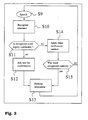
- Figure 2 shows the endless loop in which an adaptation according to the present invention is performed during the recognition process.
- a recognition of this utterance is performed in a step S10.
- a step S11 it is checked whether one of the recognized words is highly confusable with other words (that are possible in this context) or not.
- step S11 If the recognized word is regarded as to be highly confusable with at least one other word of the vocabulary in step S11, the user is asked for confirmation of the word in step S12. After the user's confirmation an adaptation of the models is performed in step S13 and the next spoken utterance is received in step S9.
- step S11 If the recognized word is not regarded as to be highly confusable with any other words in step S11 any other verification method can be applied to the word in step S14. Thereafter, it is checked whether the word was recognized correctly or not in step S15. If the word was recognized correctly in step S15, an adaptation is performed in step S13, whereafter the next spoken utterance is received in step S9. If the word was not recognized correctly the next spoken utterance is directly received in step S9 without performing the adaptation in step S13.
Landscapes
- Engineering & Computer Science (AREA)
- Artificial Intelligence (AREA)
- Computational Linguistics (AREA)
- Health & Medical Sciences (AREA)
- Audiology, Speech & Language Pathology (AREA)
- Human Computer Interaction (AREA)
- Physics & Mathematics (AREA)
- Acoustics & Sound (AREA)
- Multimedia (AREA)
- Machine Translation (AREA)
Claims (12)
- Procédé permettant de réaliser une adaptation d'un système de reconnaissance automatique de la parole, caractérisé par les étapes suivantes :marquage des mots dans le vocabulaire du système de reconnaissance de la parole qui peuvent être confondus avec d'autres mots avant le processus de reconnaissance ;demande d'une confirmation pendant le processus de reconnaissance quand un mot marqué comme pouvant être confondu est reconnu ; etréalisation d'une adaptation du système de reconnaissance automatique de la parole avec des mots reconnus marqués comme pouvant être confondus pour lesquels une confirmation positive a été donnée.
- Procédé selon la revendication 1, caractérisé par l'étape suivante :vérification des mots reconnus non marqués comme pouvant être confondus ; etréalisation d'une adaptation du système de reconnaissance automatique de la parole avec des mots vérifiés.
- Procédé selon la revendication 1 ou 2, caractérisé par l'étape suivante :réalisation d'une adaptation du système de reconnaissance automatique de la parole avec des mots reconnus non marqués comme pouvant être confondus.
- Procédé selon l'une quelconque des revendications 1 à 3, caractérisé en ce qu'un mot dans le vocabulaire du système de reconnaissance de la parole est marqué comme pouvant être confondu sur la base d'une comparaison et d'un calcul du nombre de phonèmes différents par rapport au nombre total de phonèmes du mot.
- Procédé selon l'une quelconque des revendications 1 à 4, caractérisé en ce qu'un mot dans le vocabulaire du système de reconnaissance de la parole est marqué comme pouvant être confondu sur la base d'un calcul d'une mesure de distance entre tous les mots dans le vocabulaire à l'aide d'un ensemble de signaux de parole de référence représentant tous les mots dans le vocabulaire.
- Procédé selon la revendication 5, caractérisé en ce que ledit ensemble de signaux de parole de référence sont des Modèles de Markov Cachés.
- Procédé selon l'une quelconque des revendications 1 à 6, caractérisé en ce qu'en cas de confirmation négative, l'utilisateur est invité à répéter le mot méconnu.
- Procédé selon l'une quelconque des revendications 1 à 7, caractérisé en ce qu'en cas de confirmation négative, l'utilisateur est invité à épeler le mot méconnu.
- Procédé selon la revendication 7 ou 8, caractérisé en ce que le mot précédemment méconnu est utilisé pour une adaptation après sa reconnaissance correcte sur la base de la répétition et/ou de l'épellation.
- Procédé selon l'une quelconque des revendications 1 à 9, caractérisé en ce qu'en cas de confirmation négative, l'utilisateur est invité à taper le mot méconnu.
- Procédé selon l'une quelconque des revendications 1 à 10, caractérisé en ce que l'adaptation du système de reconnaissance de la parole est une adaptation des Modèles de Markov Cachés indépendants du locuteur aux Modèles de Markov Cachés adaptés au locuteur.
- Procédé selon la revendication 11, caractérisé en ce que le procédé d'adaptation est une adaptation maximum a posteriori ou une adaptation de la régression linéaire par maximum de vraisemblance.
Priority Applications (3)
| Application Number | Priority Date | Filing Date | Title |
|---|---|---|---|
| DE69939151T DE69939151D1 (de) | 1999-01-20 | 1999-01-20 | Sprecheradaption für verwechselbare Wörter |
| EP19990100952 EP1022724B8 (fr) | 1999-01-20 | 1999-01-20 | Adaptation au locuteur pour des mots portant à confusion |
| JP2000014227A JP4638970B2 (ja) | 1999-01-20 | 2000-01-20 | 音声認識装置の適応化方法 |
Applications Claiming Priority (1)
| Application Number | Priority Date | Filing Date | Title |
|---|---|---|---|
| EP19990100952 EP1022724B8 (fr) | 1999-01-20 | 1999-01-20 | Adaptation au locuteur pour des mots portant à confusion |
Publications (3)
| Publication Number | Publication Date |
|---|---|
| EP1022724A1 EP1022724A1 (fr) | 2000-07-26 |
| EP1022724B1 true EP1022724B1 (fr) | 2008-07-23 |
| EP1022724B8 EP1022724B8 (fr) | 2008-10-15 |
Family
ID=8237375
Family Applications (1)
| Application Number | Title | Priority Date | Filing Date |
|---|---|---|---|
| EP19990100952 Expired - Lifetime EP1022724B8 (fr) | 1999-01-20 | 1999-01-20 | Adaptation au locuteur pour des mots portant à confusion |
Country Status (3)
| Country | Link |
|---|---|
| EP (1) | EP1022724B8 (fr) |
| JP (1) | JP4638970B2 (fr) |
| DE (1) | DE69939151D1 (fr) |
Families Citing this family (7)
| Publication number | Priority date | Publication date | Assignee | Title |
|---|---|---|---|---|
| EP1205906B1 (fr) * | 2000-11-07 | 2003-05-07 | Telefonaktiebolaget L M Ericsson (Publ) | Adaptation des modèles de référence pour la reconnaissance de la parole |
| DE10122828A1 (de) * | 2001-05-11 | 2002-11-14 | Philips Corp Intellectual Pty | Verfahren zum Training oder zur Adaption eines Spracherkenners |
| US20020178004A1 (en) * | 2001-05-23 | 2002-11-28 | Chienchung Chang | Method and apparatus for voice recognition |
| JP4497834B2 (ja) * | 2003-04-28 | 2010-07-07 | パイオニア株式会社 | 音声認識装置及び音声認識方法並びに音声認識用プログラム及び情報記録媒体 |
| JP5041934B2 (ja) * | 2006-09-13 | 2012-10-03 | 本田技研工業株式会社 | ロボット |
| EP2954514B1 (fr) | 2013-02-07 | 2021-03-31 | Apple Inc. | Déclencheur vocale pour un assistant numérique |
| JP7650002B2 (ja) * | 2022-03-30 | 2025-03-24 | パナソニックIpマネジメント株式会社 | 判定システム、判定方法及びプログラム |
Family Cites Families (10)
| Publication number | Priority date | Publication date | Assignee | Title |
|---|---|---|---|---|
| JPS6126133A (ja) * | 1984-07-17 | 1986-02-05 | Nippon Signal Co Ltd:The | 音声認識入力装置 |
| JP2966852B2 (ja) * | 1989-01-24 | 1999-10-25 | キヤノン株式会社 | 音声処理方法及び装置 |
| JPH0481898A (ja) * | 1990-07-25 | 1992-03-16 | Nec Corp | 音声認識装置 |
| JP2502880B2 (ja) * | 1992-03-13 | 1996-05-29 | 松下電器産業株式会社 | 音声認識方法 |
| JPH0713591A (ja) * | 1993-06-22 | 1995-01-17 | Hitachi Ltd | 音声認識装置および音声認識方法 |
| US5488652A (en) * | 1994-04-14 | 1996-01-30 | Northern Telecom Limited | Method and apparatus for training speech recognition algorithms for directory assistance applications |
| US5737723A (en) * | 1994-08-29 | 1998-04-07 | Lucent Technologies Inc. | Confusable word detection in speech recognition |
| JPH09326856A (ja) * | 1996-06-03 | 1997-12-16 | Mitsubishi Electric Corp | 音声認識応答装置 |
| US5999896A (en) * | 1996-06-25 | 1999-12-07 | Microsoft Corporation | Method and system for identifying and resolving commonly confused words in a natural language parser |
| JPH10268072A (ja) * | 1997-03-27 | 1998-10-09 | Seiko Kurotsuku Kk | 時 計 |
-
1999
- 1999-01-20 EP EP19990100952 patent/EP1022724B8/fr not_active Expired - Lifetime
- 1999-01-20 DE DE69939151T patent/DE69939151D1/de not_active Expired - Lifetime
-
2000
- 2000-01-20 JP JP2000014227A patent/JP4638970B2/ja not_active Expired - Fee Related
Also Published As
| Publication number | Publication date |
|---|---|
| EP1022724B8 (fr) | 2008-10-15 |
| EP1022724A1 (fr) | 2000-07-26 |
| DE69939151D1 (de) | 2008-09-04 |
| JP2000214879A (ja) | 2000-08-04 |
| JP4638970B2 (ja) | 2011-02-23 |
Similar Documents
| Publication | Publication Date | Title |
|---|---|---|
| EP1011094B1 (fr) | Adaptation au locuteur semi-supervisée | |
| EP1226574B1 (fr) | Procede et dispositif d'apprentissage discriminatif de modeles acoustiques dans un systeme de reconnaissance vocale | |
| JP4301102B2 (ja) | 音声処理装置および音声処理方法、プログラム、並びに記録媒体 | |
| JP4709663B2 (ja) | ユーザ適応型の音声認識方法及び音声認識装置 | |
| EP1557822B1 (fr) | Adaptation de la reconnaissance automatique de la parole en utilisant les corrections de l'utilisateur | |
| EP2048655B1 (fr) | Reconnaissance vocale à plusieurs étages sensible au contexte | |
| US7966183B1 (en) | Multiplying confidence scores for utterance verification in a mobile telephone | |
| US20090119103A1 (en) | Speaker recognition system | |
| EP1022725B1 (fr) | Sélection des modèles acoustiques utilisant de la vérification de locuteur | |
| US7181395B1 (en) | Methods and apparatus for automatic generation of multiple pronunciations from acoustic data | |
| US6148284A (en) | Method and apparatus for automatic speech recognition using Markov processes on curves | |
| US20030023438A1 (en) | Method and system for the training of parameters of a pattern recognition system, each parameter being associated with exactly one realization variant of a pattern from an inventory | |
| US6499011B1 (en) | Method of adapting linguistic speech models | |
| EP1116219B1 (fr) | Traitement robuste de la parole a partir de modeles de parole bruitee | |
| EP1022724B1 (fr) | Adaptation au locuteur pour des mots portant à confusion | |
| EP1734509A1 (fr) | Méthode et système de reconnaissance de la parole | |
| US8874438B2 (en) | User and vocabulary-adaptive determination of confidence and rejecting thresholds | |
| US20030187645A1 (en) | Automatic detection of change in speaker in speaker adaptive speech recognition system | |
| KR100940641B1 (ko) | 음소레벨 로그우도 비율 분포와 음소 지속시간 분포에 의한단어음색 모델 기반 발화검증 시스템 및 방법 | |
| JP2001175276A (ja) | 音声認識装置及び記録媒体 | |
| EP1008983B1 (fr) | Adaptation au locuteur par regression linéaire à maximum de vraissemblance utilisant une pondération dynamique | |
| JPH0997095A (ja) | 音声認識装置 | |
| KR20250134912A (ko) | 음성 인식을 이용한 차량 제어 장치 및 방법 | |
| JPH08110797A (ja) | パターンマッチング装置 | |
| JPH10319987A (ja) | 音声認識システムにおける誤認識再発防止装置 |
Legal Events
| Date | Code | Title | Description |
|---|---|---|---|
| PUAI | Public reference made under article 153(3) epc to a published international application that has entered the european phase |
Free format text: ORIGINAL CODE: 0009012 |
|
| AK | Designated contracting states |
Kind code of ref document: A1 Designated state(s): DE FR GB |
|
| AX | Request for extension of the european patent |
Free format text: AL;LT;LV;MK;RO;SI |
|
| 17P | Request for examination filed |
Effective date: 20001222 |
|
| AKX | Designation fees paid |
Free format text: DE FR GB |
|
| RAP1 | Party data changed (applicant data changed or rights of an application transferred) |
Owner name: SONY DEUTSCHLAND GMBH |
|
| RAP1 | Party data changed (applicant data changed or rights of an application transferred) |
Owner name: SONY DEUTSCHLAND GMBH |
|
| GRAP | Despatch of communication of intention to grant a patent |
Free format text: ORIGINAL CODE: EPIDOSNIGR1 |
|
| GRAS | Grant fee paid |
Free format text: ORIGINAL CODE: EPIDOSNIGR3 |
|
| GRAA | (expected) grant |
Free format text: ORIGINAL CODE: 0009210 |
|
| RIN1 | Information on inventor provided before grant (corrected) |
Inventor name: BUCHNER, PETERC/O SONY DEUTSCHLAND GMBH Inventor name: KOMPE, RALFC/O SONY DEUTSCHLAND GMBH Inventor name: GOROZNY, SILKEC/O SONY DEUTSCHLAND GMBH |
|
| AK | Designated contracting states |
Kind code of ref document: B1 Designated state(s): DE FR GB |
|
| REG | Reference to a national code |
Ref country code: GB Ref legal event code: FG4D |
|
| REF | Corresponds to: |
Ref document number: 69939151 Country of ref document: DE Date of ref document: 20080904 Kind code of ref document: P |
|
| RIN2 | Information on inventor provided after grant (corrected) |
Inventor name: BUCHNER, PETERC/O SONY DEUTSCHLAND GMBH Inventor name: KOMPE, RALFC/O SONY DEUTSCHLAND GMBH Inventor name: GORONZY, SILKEC/O SONY DEUTSCHLAND GMBH |
|
| PLBE | No opposition filed within time limit |
Free format text: ORIGINAL CODE: 0009261 |
|
| STAA | Information on the status of an ep patent application or granted ep patent |
Free format text: STATUS: NO OPPOSITION FILED WITHIN TIME LIMIT |
|
| 26N | No opposition filed |
Effective date: 20090424 |
|
| REG | Reference to a national code |
Ref country code: GB Ref legal event code: 746 Effective date: 20120618 |
|
| REG | Reference to a national code |
Ref country code: DE Ref legal event code: R084 Ref document number: 69939151 Country of ref document: DE Effective date: 20120614 |
|
| PGFP | Annual fee paid to national office [announced via postgrant information from national office to epo] |
Ref country code: DE Payment date: 20140122 Year of fee payment: 16 |
|
| PGFP | Annual fee paid to national office [announced via postgrant information from national office to epo] |
Ref country code: FR Payment date: 20140123 Year of fee payment: 16 |
|
| PGFP | Annual fee paid to national office [announced via postgrant information from national office to epo] |
Ref country code: GB Payment date: 20140121 Year of fee payment: 16 |
|
| REG | Reference to a national code |
Ref country code: DE Ref legal event code: R119 Ref document number: 69939151 Country of ref document: DE |
|
| GBPC | Gb: european patent ceased through non-payment of renewal fee |
Effective date: 20150120 |
|
| PG25 | Lapsed in a contracting state [announced via postgrant information from national office to epo] |
Ref country code: GB Free format text: LAPSE BECAUSE OF NON-PAYMENT OF DUE FEES Effective date: 20150120 Ref country code: DE Free format text: LAPSE BECAUSE OF NON-PAYMENT OF DUE FEES Effective date: 20150801 |
|
| REG | Reference to a national code |
Ref country code: FR Ref legal event code: ST Effective date: 20150930 |
|
| PG25 | Lapsed in a contracting state [announced via postgrant information from national office to epo] |
Ref country code: FR Free format text: LAPSE BECAUSE OF NON-PAYMENT OF DUE FEES Effective date: 20150202 |