EP1022916A1 - Procédé combinant le fonctionnement d'un poste téléphonique fixe et d'un téléphone mobile sans fil associé, et système de mise en oeuvre d'un tel procédé - Google Patents
Procédé combinant le fonctionnement d'un poste téléphonique fixe et d'un téléphone mobile sans fil associé, et système de mise en oeuvre d'un tel procédé Download PDFInfo
- Publication number
- EP1022916A1 EP1022916A1 EP99810034A EP99810034A EP1022916A1 EP 1022916 A1 EP1022916 A1 EP 1022916A1 EP 99810034 A EP99810034 A EP 99810034A EP 99810034 A EP99810034 A EP 99810034A EP 1022916 A1 EP1022916 A1 EP 1022916A1
- Authority
- EP
- European Patent Office
- Prior art keywords
- pbx
- phones
- mobile phone
- telephones
- telephone
- Prior art date
- Legal status (The legal status is an assumption and is not a legal conclusion. Google has not performed a legal analysis and makes no representation as to the accuracy of the status listed.)
- Withdrawn
Links
Images

Classifications
-
- H—ELECTRICITY
- H04—ELECTRIC COMMUNICATION TECHNIQUE
- H04W—WIRELESS COMMUNICATION NETWORKS
- H04W84/00—Network topologies
- H04W84/02—Hierarchically pre-organised networks, e.g. paging networks, cellular networks, WLAN [Wireless Local Area Network] or WLL [Wireless Local Loop]
- H04W84/10—Small scale networks; Flat hierarchical networks
- H04W84/16—WPBX [Wireless Private Branch Exchange]
-
- H—ELECTRICITY
- H04—ELECTRIC COMMUNICATION TECHNIQUE
- H04M—TELEPHONIC COMMUNICATION
- H04M1/00—Substation equipment, e.g. for use by subscribers
- H04M1/72—Mobile telephones; Cordless telephones, i.e. devices for establishing wireless links to base stations without route selection
- H04M1/725—Cordless telephones
-
- H—ELECTRICITY
- H04—ELECTRIC COMMUNICATION TECHNIQUE
- H04M—TELEPHONIC COMMUNICATION
- H04M3/00—Automatic or semi-automatic exchanges
- H04M3/42—Systems providing special services or facilities to subscribers
- H04M3/42314—Systems providing special services or facilities to subscribers in private branch exchanges
-
- H—ELECTRICITY
- H04—ELECTRIC COMMUNICATION TECHNIQUE
- H04M—TELEPHONIC COMMUNICATION
- H04M2207/00—Type of exchange or network, i.e. telephonic medium, in which the telephonic communication takes place
- H04M2207/18—Type of exchange or network, i.e. telephonic medium, in which the telephonic communication takes place wireless networks
-
- H—ELECTRICITY
- H04—ELECTRIC COMMUNICATION TECHNIQUE
- H04M—TELEPHONIC COMMUNICATION
- H04M2207/00—Type of exchange or network, i.e. telephonic medium, in which the telephonic communication takes place
- H04M2207/20—Type of exchange or network, i.e. telephonic medium, in which the telephonic communication takes place hybrid systems
-
- H—ELECTRICITY
- H04—ELECTRIC COMMUNICATION TECHNIQUE
- H04M—TELEPHONIC COMMUNICATION
- H04M7/00—Arrangements for interconnection between switching centres
- H04M7/12—Arrangements for interconnection between switching centres for working between exchanges having different types of switching equipment, e.g. power-driven and step by step or decimal and non-decimal
Definitions
- the present invention relates to a method for the combined operation of an a PBX connected wired telephone and an assigned one cordless mobile phone and an arrangement for performing the method.
- Newer telecommunications systems for company-wide telecommunications in larger companies typically include a PBX (Private Branch Exchange, too Telecommunications system or private branch exchange), to which via Wired lines both one or more fixed telephones (so-called wired Telephones) as well as one or more for communication via radio interfaces cordless mobile phones trained base stations are connected. That the Mobile phones and the cordless system comprising the base stations can be used as Subsystem of the company-wide telecommunications system, for example, according to DECT standard (Digital Enhanced Cordless Telecommunication).
- the fixed telephone is preferably a desk phone with many Comfort functions designed, such as a speakerphone, one Loudspeaker, a variety of function keys, an alphanumeric Keyboard, a large display, etc.
- Comfort functions designed, such as a speakerphone, one Loudspeaker, a variety of function keys, an alphanumeric Keyboard, a large display, etc.
- the user of one a wired telephone and a cell phone would like a combined one Use the two devices in such a way that as many advantages as possible for each Devices come into play without at the same time buying their disadvantages must be taken.
- the invention has for its object a method for combined operation a wired telephone connected to a PBX and one associated cordless mobile phones, which is a simple, natural switching between making calls with the wired phone and mobile phone.
- a wired telephone connected to a PBX and an assigned one Cordless mobile phone which is used for communication via a radio interface is formed with a base station connected to the PBX, user data of the wired phone and its associated cell phone in one Storage device of the PBX managed jointly.
- user data are in the present description and the claims understand the data that is functionally assigned to a single user are. Examples of user data are the last dialed numbers, the numbers a user's private file of callers who have not reached the called party etc.
- the common data management means that both phones for changes and / or querying the jointly managed user data for the same data access.
- the jointly managed user data of the line-bound Telephone and its assigned mobile phone are thus always updated in equally available on both telephones, independently of which of the two devices was last used and an update of this data.
- the common administration of the user data causes that a common operating and display philosophy for the two telephones is the basis. This makes a user-friendly, largely identical Operation of the two devices enables.
- the method according to the invention is suitable for the Combined operation of a line-bound connected to a PBX Phone and an associated cordless cell phone excellent for one
- a numbering service is suitable, in which the user of the line-bound Assigned a single number to the phone and the assigned mobile phone and conversations for this user always automatically to the appropriate one Telephone be routed.
- the wired telephone can be used a support recess for his assigned mobile phone, in which a Switch is integrated to route calls to the wired phone when the mobile phone is in the cradle.
- the method according to the invention can however, also in the case of mutually assigned telephones with different ones Numbers can be used advantageously.
- the telecommunications number entered is stored in the storage device of the PBX.
- This telecommunications number is then available for both of them Phones are available so that one user can use the two phones for one Redial to this number from either of the two phones can access. The user then no longer has to remember which one of the two phones from which he last made one or more calls.
- the the last numbers entered on one or both devices are the same Way available to both devices.
- the number of a caller is any of the two of each other calls associated phones, stored in the storage device of the PBX and managed together so that they can then be used to answer later unanswered calls or to call you back in the case of calls that have already been answered is available on both phones.
- the user when he is not at work and has the mobile phone with him simple way to answer calls to his assigned wired phone can.
- the ongoing charges apply to calls from any of the associated telephones in the storage device of the PBX are added up and managed together so that they can then be added to both Phones can be displayed.
- the ongoing charges can be for both Phones summed up separately or in a single common Fee storage can be summed up together.
- often dialing numbers from any of the associated phones in a private file are stored in the storage device of the PBX so that they then for the purpose of dialing the numbers on both phones To be available.
- appointment data of one any of the telephones assigned to each other in an appointment memory in the Storage device of the PBX are stored, whereupon to given An appointment reminder function is triggered on both phones.
- the programmed functions can be set in stored in the PBX storage device and managed jointly in this way, that they are available to both phones for calling and performing the functions stand.
- functions via the keyboard of the PBX connected telephones are programmable, they can be connected to each other functions available from associated phones preferably from any of the two telephones can be programmed.
- the course of Configuration of the PBX can be determined whether the user data of a wired telephone and a mobile phone in the storage device of PBX can be managed together or separately. This can do that wired telephone and mobile phone optionally independent of each other (in a conventional way) or in a combined operation according to the invention operate.
- An arrangement for carrying out the method according to the invention comprises one PBX, a base station connected to the PBX, a base station connected to the PBX wired telephone and a cordless mobile phone assigned to it, which is used for communication via a radio interface with the base station is trained.
- the wired telephone is one in the radio coverage area Base station installed to which the assigned mobile phone has access. The In this case, the mobile phone can be assigned as its handset be wired telephone.
- this is wired telephone with a handset connected via a cable Mistake.
- a confidential telephone call is as bug-proof as possible to be performed, this can be done via the wired headset become. This eliminates the possibility of listening to radio signals, which otherwise when using the mobile phone.
- Figure 1 is a simplified schematic representation of part of the Data model for a method for operating a telecommunications system according to a preferred embodiment of the invention.
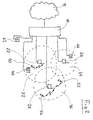
- Figure 2 shows in a simplified schematic representation of an arrangement for performing the Method using the data model from FIG. 1.
- the exemplary arrangement shown in FIG. 2 comprises one PBX 10, three Base stations 22, 24, 26, three fixed wired telephones 40, 42, 44 and three cordless mobile phones 50, 52, 55.
- the PBX 10 is on via a wireline usual type connected to the international telecommunications network 15.
- the three fixed telephones 40, 42, 44 are connected via wire lines.
- One The first 40 of these wired telephones is a cordless mobile telephone 50 assigned. This first line-bound telephone 40 is described in the following described inventive method in a combined operation operated together with its associated cordless mobile phone 50.
- the two other wired telephones 42, 44 are used in the usual way, operated independently of other telephones.
- the three base stations 22, 24, 26 are also connected to the PBX 10 in order to Radio interfaces to a large number of cordless mobile telephones 50, 52, 54 create.
- the radio interfaces are shown in the figures by zigzag arrows symbolizes while the radio coverage areas or cells 32, 34, 36 of the Base stations 22, 24, 26 are shown in broken lines in FIG.
- the Base stations 22, 24, 26 and the mobile phones 50, 52, 54 form a multicellular one Cordless telephone system (also as "cordless telephone system” or as "CT system” referred to), which is generally operated according to the DECT standard.
- the cordless mobile telephones 50, 52, 54 are radio-controlled within the cells 32, 34, 36 connected to the PBX 10 and connected via this to the telecommunications network 15.
- the mobile phone 50 associated with the above-mentioned wired phone 40 is according to the inventive method described below in one combined operation together with its assigned wired telephone 40 operated, while the other two of the three shown in Figure 2 Mobile phones 52, 54 in a conventional manner as cordless DECT handsets 52, 54 operate.
- the mobile phone 50 assigned to the first line-bound telephone 40 as Wired phone 40 headphones can be used, which wired telephone 40 via no other (e.g. via a cable connected) headphones.
- the wired phone 40 is with the in today's table top devices, the usual comfort functions such as one Speakerphone, a loudspeaker, a multitude of function keys, an alphanumeric keyboard and a large display.
- the wired phone 40 is further associated with a trough for his Mobile phone 50 provided, the cradle as a charging station for the mobile phone 50 is formed.
- the wired telephone 40 is in the radio coverage area 32 a base station 22 connected to the PBX 10 installed and the associated mobile phone 50 is with a transceiver provided for communication via a bidirectional radio interface with this Base station 22 (and also for communication with the others on the PBX 10 connected base stations 24, 26). Communication from Mobile phone 50 takes place via the radio interface to the PBX 10, on which the wired telephone 40 is connected. Another transmission route between the cell phone 50 and the associated wired phone 40 is neither required nor available.
- the mobile phone 50 When the mobile phone 50 is used in the same room as it is in assigned wired phone 40, the mobile phone 50 can be as Corded phone 40 handset (with an imaginary cable) to be viewed as.
- the mobile phone 50 is at a distance from this room Used, it is to be regarded as a normal mobile phone of a CT system. It however, there is no difference between the operation of the cellular phone 50 in the immediate vicinity of its associated wired telephone 40 and operating at a remote location.
- FIG. 1 the model of the in a storage device 110 of the PBX 10 stored portion of the subscriber-related data for the arrangement shown in Figure 2 is shown.
- the (logical) data blocks are shown as solid rectangles in FIG Lines are shown, and the vertical connecting lines between the data blocks as well as to the connections 101, 102, 103, 104, 105, 106 of the PBX 10 (logical)
- the area outlined with broken lines in 1 shows the storage device 110 of the PBX 10.
- PBX 10 is any one connected to the PBX 10 Understand telecommunications terminal, such as a wired phone 40, 42, 44, a cordless mobile phone 50, 52, 54, a fax machine, etc.
- the subscriber-related stored in the storage device 110 of the PBX 10 Data can be broken down into system data 160, which is suitable for a large number of Participants apply together (e.g. a company-wide, common speed dial list) in User data 130 (according to the definition given above, data which are functionally assigned to a single user) and in device-specific data, which must be assigned to each participant separately.
- system data 160 e.g. a company-wide, common speed dial list
- User data 130 e.g. a company-wide, common speed dial list
- device-specific Data that is mostly technically oriented is device configuration data like that Contrast for a comfort device, the selected ring melody for a telephone etc.
- the wired telephone 40 which the cordless mobile phone 50 is assigned and which in a combined operation together with his assigned mobile phone 50 is operated via its connection 101 on the PBX 10 access to a data block 122 with its device-specific data, one Data block 130 with the user data and a data block 160 with the System data.
- Access to data block 122 with the device-specific data is exclusive, i.e. there are no other subscribers connected to the PBX 10 Access to this data block 122.
- Data block 130 with the user data can, in addition to the line-bound telephone 40, also its assigned mobile telephone 50 access to enable a common management of this data. Otherwise no other participants have access to this data block 130, except for the System configuration. Have on data block 160 with the system data all of the subscribers connected to the PBX 10 have access.
- Each of the other two of the wired shown in Figure 1 Phones 42, 44 have exclusive access to each via its PBX connection 105, 106 a data block 146, 148 which contains both the device-specific data and the data Telephone 42, 44 includes assigned user data.
- the two wired Phones 42, 44 still have access to all of the PBX 10 data block 160 accessible to connected subscribers with the system data.
- the base stations 22, 24, 26 and the mobile telephones 50, 52, 54 of the type shown in FIG arrangement shown form a multicellular cordless telephone system in which each cell phone 50, 52, 54 in each cell 32, 34, 36 via the respective base station 22, 24, 26 of the cell 32, 34, 36 has access to the PBX 10, one is accessed Cellular phones 50, 52, 54 on its subscriber related data in the PBX storage device 110 via the PBX connection 102, 103, 104 of the base station 22, 24, 26, in the cell 32, 34, 46 of which the mobile telephone 50, 52, 54 is located, and above a mobile phone switching point 150, which is based on a mobile phone identification number the data connection to the subscriber-related data of the Manufactures mobile phones 50, 52, 54 in the storage device 110 of the PBX 10.
- the other two mobile phones 52, 54 which are conventional as cordless DECT handsets 52, 54 are operated via the PBX connection 103 the base station 26, in the cell 36 of which they are located, and via the mobile telephone switching point 150 exclusive access to a data block 142, 144, which both the device-specific data as well as that of the respective mobile phone 52, 54 assigned user data includes.
- the two mobile phones 52, 54 also have Access to all participants connected to the PBX 10 Data block 160 with the system data.
- the local device-related data are not shown in the usual Way are stored in storage devices of the individual devices.
- this data e.g. screen display, buffered data of choice, etc.
- the inventive method for the combined operation of the wired phone 40 and its associated cordless mobile phone 50 becomes the user data in data block 130, to which the line-bound Phone 40 and its assigned mobile phone 50 have shared access, managed together. If a user of the wired telephone 40 and of his assigned mobile phone 50 from the wired telephone 40 or dials a telecommunication number from the assigned mobile phone 50 and on If the call is in progress, the dialed telecommunication number is included in data block 130 the jointly managed user data. The accruing Call charges are continuously becoming a collective fee store in this Data block 130 added.
- the invention provides a method for the Combined operation of a line-bound connected to a PBX 10 Phone 40 and an associated cordless mobile phone 50 is specified, which is a simple, natural change between making calls with the wired phone 40 and the mobile phone 50 allows.
Landscapes
- Engineering & Computer Science (AREA)
- Signal Processing (AREA)
- Computer Networks & Wireless Communication (AREA)
- Mobile Radio Communication Systems (AREA)
Priority Applications (1)
| Application Number | Priority Date | Filing Date | Title |
|---|---|---|---|
| EP99810034A EP1022916A1 (fr) | 1999-01-19 | 1999-01-19 | Procédé combinant le fonctionnement d'un poste téléphonique fixe et d'un téléphone mobile sans fil associé, et système de mise en oeuvre d'un tel procédé |
Applications Claiming Priority (1)
| Application Number | Priority Date | Filing Date | Title |
|---|---|---|---|
| EP99810034A EP1022916A1 (fr) | 1999-01-19 | 1999-01-19 | Procédé combinant le fonctionnement d'un poste téléphonique fixe et d'un téléphone mobile sans fil associé, et système de mise en oeuvre d'un tel procédé |
Publications (1)
| Publication Number | Publication Date |
|---|---|
| EP1022916A1 true EP1022916A1 (fr) | 2000-07-26 |
Family
ID=8242633
Family Applications (1)
| Application Number | Title | Priority Date | Filing Date |
|---|---|---|---|
| EP99810034A Withdrawn EP1022916A1 (fr) | 1999-01-19 | 1999-01-19 | Procédé combinant le fonctionnement d'un poste téléphonique fixe et d'un téléphone mobile sans fil associé, et système de mise en oeuvre d'un tel procédé |
Country Status (1)
| Country | Link |
|---|---|
| EP (1) | EP1022916A1 (fr) |
Cited By (3)
| Publication number | Priority date | Publication date | Assignee | Title |
|---|---|---|---|---|
| EP1309161A3 (fr) * | 2001-11-06 | 2004-12-29 | Grundig Multimedia B.V. | Installation téléphonique |
| EP1536621A1 (fr) * | 2003-11-27 | 2005-06-01 | Alcatel | Portabilité de numéros de terminal dans un réseau de télécommunications IP |
| EP2461557A1 (fr) * | 2010-12-01 | 2012-06-06 | Funai Electric Co., Ltd. | Autocommutateur téléphonique privé |
Citations (3)
| Publication number | Priority date | Publication date | Assignee | Title |
|---|---|---|---|---|
| DE4424896A1 (de) * | 1993-07-16 | 1995-01-19 | Mitel Corp | Verfahren zum Errichten und Abrufen eines Telefonbenutzerprofils |
| GB2284727A (en) * | 1993-12-09 | 1995-06-14 | Stephen Robin Temple | Portable radio telephone capable of receiving calls over fixed telephone network |
| US5524045A (en) * | 1994-03-10 | 1996-06-04 | Fujitsu Limited | Cordless telephone terminal controlling system |
-
1999
- 1999-01-19 EP EP99810034A patent/EP1022916A1/fr not_active Withdrawn
Patent Citations (3)
| Publication number | Priority date | Publication date | Assignee | Title |
|---|---|---|---|---|
| DE4424896A1 (de) * | 1993-07-16 | 1995-01-19 | Mitel Corp | Verfahren zum Errichten und Abrufen eines Telefonbenutzerprofils |
| GB2284727A (en) * | 1993-12-09 | 1995-06-14 | Stephen Robin Temple | Portable radio telephone capable of receiving calls over fixed telephone network |
| US5524045A (en) * | 1994-03-10 | 1996-06-04 | Fujitsu Limited | Cordless telephone terminal controlling system |
Cited By (4)
| Publication number | Priority date | Publication date | Assignee | Title |
|---|---|---|---|---|
| EP1309161A3 (fr) * | 2001-11-06 | 2004-12-29 | Grundig Multimedia B.V. | Installation téléphonique |
| EP1536621A1 (fr) * | 2003-11-27 | 2005-06-01 | Alcatel | Portabilité de numéros de terminal dans un réseau de télécommunications IP |
| EP2461557A1 (fr) * | 2010-12-01 | 2012-06-06 | Funai Electric Co., Ltd. | Autocommutateur téléphonique privé |
| US8843176B2 (en) | 2010-12-01 | 2014-09-23 | Funai Electric Co., Ltd. | Private branch exchange and telephone system |
Similar Documents
| Publication | Publication Date | Title |
|---|---|---|
| DE69018331T2 (de) | Zugangsnetzwerk für drahtlosen Telefondienst. | |
| DE69725578T2 (de) | Telefonvorrichtung | |
| DE69718019T2 (de) | Multi-mode telekommunikationendgerät | |
| DE3128529A1 (de) | Verfahren zur anzeige von informationen an einer fernsprechteilnehmerstation | |
| DE3311032A1 (de) | Anordnung zum selbsttaetigen waehlen von zielnummern | |
| EP0742990A1 (fr) | Systeme de communication a telephones mobiles et son procede d'exploitation | |
| DE19712273A1 (de) | Verfahren zum Aussenden von Abwesenheitsmitteilungen in einem ISDN-Vermittlungssystem | |
| DE69500083T2 (de) | Verfahren und Vorrichtung zur Herstellung von Fernsprechverbindungen von oder zu einem mobilen Teilnehmer mit mehreren Abonnementenmoden | |
| EP1022916A1 (fr) | Procédé combinant le fonctionnement d'un poste téléphonique fixe et d'un téléphone mobile sans fil associé, et système de mise en oeuvre d'un tel procédé | |
| EP0623267B1 (fr) | Dispositif modulaire telephonique d'abonne | |
| DE4207748A1 (de) | Funknetz aus schnurlosen telefonen | |
| DE10153526A1 (de) | Verfahren zur Signalisierung eines für ein Telekommunikationsendgerät eingehenden Rufes, Telekommunikationsendgerät und Netzwerkeinheit | |
| EP0975182B1 (fr) | Appareil de télécommunication avec une interface pour un téléviseur comme un moniteur pour mise en application des télécommunications | |
| EP0785660B1 (fr) | Dispositif de télécommunication sans fil | |
| DE3234093C2 (fr) | ||
| DE19961510A1 (de) | Verfahren zum Betreiben eines Kommunikationsendgeräts | |
| DE3824190A1 (de) | Verfahren zum gegenseitigen datenaustausch zwischen einer kommunikations-vermittlungsanlage und einer personalzeit-erfassungsanlage | |
| DE19615563C2 (de) | Verfahren zum Betrieb einer Telekommunikationsanlage und Telekommunikationsanlage, in der das Verfahren benutzt werden kann | |
| DE3428355A1 (de) | Verfahren zum herstellen von nachrichtenverbindungen | |
| AT406815B (de) | Verfahren zur vermittlung von gesprächen | |
| DE3629475A1 (de) | Fernsprechendgeraet mit notizspeicherfunktion | |
| DE2609035A1 (de) | Fernsprechapparat, insbesondere fuer automatischen waehlbetrieb | |
| EP0926870A2 (fr) | Méthode pour réaliser un appel automatique | |
| DE1925054A1 (de) | Verfahren zur Gespraechsvermittlung zwischen ortsfesten Fernsprechstationen und beweglichen Funksprechstellen mit unbekanntem Standort | |
| EP2093985A1 (fr) | Procédé de fonctionnement d'une installation téléphonique dotée d'au moins deux terminaux de téléphonie et terminal de téléphonie destiné à la réalisation du procédé |
Legal Events
| Date | Code | Title | Description |
|---|---|---|---|
| PUAI | Public reference made under article 153(3) epc to a published international application that has entered the european phase |
Free format text: ORIGINAL CODE: 0009012 |
|
| AK | Designated contracting states |
Kind code of ref document: A1 Designated state(s): CH DE ES FR GB IT LI |
|
| AX | Request for extension of the european patent |
Free format text: AL;LT;LV;MK;RO;SI |
|
| 17P | Request for examination filed |
Effective date: 20000831 |
|
| AKX | Designation fees paid |
Free format text: CH DE ES FR GB IT LI |
|
| 17Q | First examination report despatched |
Effective date: 20031009 |
|
| RAP1 | Party data changed (applicant data changed or rights of an application transferred) |
Owner name: AASTRA TECHNOLOGIES LIMITED |
|
| STAA | Information on the status of an ep patent application or granted ep patent |
Free format text: STATUS: THE APPLICATION IS DEEMED TO BE WITHDRAWN |
|
| 18D | Application deemed to be withdrawn |
Effective date: 20040420 |