EP1023718B1 - Reconnaissance de formes au moyen de modeles de reference multiples - Google Patents
Reconnaissance de formes au moyen de modeles de reference multiples Download PDFInfo
- Publication number
- EP1023718B1 EP1023718B1 EP98947663A EP98947663A EP1023718B1 EP 1023718 B1 EP1023718 B1 EP 1023718B1 EP 98947663 A EP98947663 A EP 98947663A EP 98947663 A EP98947663 A EP 98947663A EP 1023718 B1 EP1023718 B1 EP 1023718B1
- Authority
- EP
- European Patent Office
- Prior art keywords
- segment
- speaker
- reference data
- input signal
- comparison result
- Prior art date
- Legal status (The legal status is an assumption and is not a legal conclusion. Google has not performed a legal analysis and makes no representation as to the accuracy of the status listed.)
- Expired - Lifetime
Links
Images



Classifications
-
- G—PHYSICS
- G10—MUSICAL INSTRUMENTS; ACOUSTICS
- G10L—SPEECH ANALYSIS TECHNIQUES OR SPEECH SYNTHESIS; SPEECH RECOGNITION; SPEECH OR VOICE PROCESSING TECHNIQUES; SPEECH OR AUDIO CODING OR DECODING
- G10L17/00—Speaker identification or verification techniques
- G10L17/02—Preprocessing operations, e.g. segment selection; Pattern representation or modelling, e.g. based on linear discriminant analysis [LDA] or principal components; Feature selection or extraction
-
- G—PHYSICS
- G06—COMPUTING OR CALCULATING; COUNTING
- G06F—ELECTRIC DIGITAL DATA PROCESSING
- G06F18/00—Pattern recognition
- G06F18/20—Analysing
- G06F18/28—Determining representative reference patterns, e.g. by averaging or distorting; Generating dictionaries
-
- G—PHYSICS
- G10—MUSICAL INSTRUMENTS; ACOUSTICS
- G10L—SPEECH ANALYSIS TECHNIQUES OR SPEECH SYNTHESIS; SPEECH RECOGNITION; SPEECH OR VOICE PROCESSING TECHNIQUES; SPEECH OR AUDIO CODING OR DECODING
- G10L17/00—Speaker identification or verification techniques
- G10L17/06—Decision making techniques; Pattern matching strategies
Definitions
- This invention relates to automatic pattern recognition in which an unknown input is compared with reference data representative of allowed patterns and the unknown input is identified as the most likely reference pattern.
- Reference data for each member of a set of allowed patterns is stored and a test input compared with the reference data to recognise the input pattern.
- An important factor to consider in automatic pattern recognition is that of undesired variations in characteristics, for instance in speech or handwriting due to time-localised anomalous events.
- the anomalies can have different forms such as the communication channel, environmental noise, uncharacteristic sounds from speakers, unmodelled writing conditions etc.
- the resultant variations cause a mismatch between the corresponding test and reference patterns which in turn can lead to a significant reduction in the recognition accuracy.
- the invention has particular, although not exclusive, application to automatic speaker recognition.
- Speaker recognition covers both the task of speaker identification and speaker verification. In the former case, the task is to identify an unknown speaker as one from a pre-determined set of speakers; in the latter case, the task is to verify that a person is the person they claim to be, again from a pre-determined set of speakers.
- the field of speaker recognition but the technique is applicable to other fields of pattern recognition.
- a reference model is usually based on a number of repetitions of the training utterance recorded in multiple sessions.
- the aim is to increase the possibility of capturing the recording conditions and speaking behaviour which are close to those of the testing through at least one of the utterance repetitions in the training set.
- the enrolled speaker may then be represented using a single reference model formed by combining the given training utterance repetitions.
- a potential disadvantage of the above approach is that a training utterance repetition which is very different from the test utterance may corrupt the combined model and hence seriously affect the verification performance.
- An alternative method is to represent each registered speaker using multiple reference models. However, since the level of mismatch normally varies across the utterance, the improvement achieved in this way may not be significant.
- the above expression can be viewed as obtaining the verification score by normalising the score for the target speaker.
- a well known normalisation method is that based on the use of a general (speaker-independent) reference model formed by using utterances from a large population of speakers M. J. Carey and E. S. Parris, "Speaker Verification Using Connected Words", Proceedings of the Institute of Acoustics (UK), vol. 14, pp. 95-100, 1992.
- the score for the general model is used for normalising the score for the target speaker.
- Another effective method in this category involves calculating a statistic of scores for a cohort of speakers, and using this to normalise the score for the target speaker as described in A. E. Rosenberg, J.
- WO-A-98/54694 is cited under Article 54(3) EPC. It discloses a speaker verification method consisting of the following steps:
- the invention seeks to reduce the adverse effects of variation in patterns.
- a method of pattern recognition comprising comparing an input signal representing an unknown pattern with each of a plurality of pre-defined patterns and identifying the unknown pattern on the basis of the comparison results, wherein at least one of the pre-defined patterns is represented by at least two instances of reference data, and wherein the step of comparing the input signal with such a pattern comprises:
- the invention relies on representing allowed patterns using segmented multiple reference models and minimising the mismatch between the test and reference patterns. This is achieved by using the best segments from the collection of models for each pattern to form a complete reference template.
- the mismatch associated with each individual segment is then estimated and this information is then used to compute a weighting factor for correcting each segmental distance prior to the calculation of the final distance.
- the invention provides a method of speaker recognition comprising comparing an input signal representing speech from an unknown speaker with reference data representing speech from each of a plurality of pre-defined speakers and identifying the unknown speaker on the basis of the comparison results, wherein at least one of the pre-defined speakers is represented by at least two instances of reference data, and wherein the step of comparing the input signal with the reference data for such a speaker comprises:
- pattern recognition apparatus comprising
- Pattern recognition apparatus generally operates in two modes: training and test.
- training mode reference models are formed from the utterances of an allowed speaker. These reference models are then stored for subsequent use in speaker recognition, a test utterance from an unknown speaker being compared with the reference model for the claimed speaker (for verification) or with all the reference models for all the allowed speakers (for identification) and the comparison results are used to determined whether the speaker is the or an allowed speaker.
- each allowed speaker is represented using linearly segmented multiple reference models.
- Each reference model is formed using a single utterance repetition.
- the invention involves evaluating the relative dissimilarities (or similarities) between each segment of a given test utterance and the corresponding segments in the collection of reference models (or reference data) for each allowed speaker or, in the case of verification, the claimed speaker.
- the best individual reference segments for each targeted speaker are then selected to form a complete model for the purpose of identification/verification.
- All the reference models for a given utterance text are of the same length. To achieve this, the length of each model is made equal, in the training mode, to the mean length of all the available models for the given text, by a linear decimation-interpolation technique for instance as described in C. S. Myers, L. R. Rabiner, and A. E.
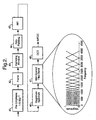
- Speaker recognition apparatus comprises an end-point detector 2 for detecting the start and end of an utterance in a received signal.
- Any suitable end-point detector may be used such as that described in "An Improved Endpoint Detector for Isolated Word Recognition” by L. F. Lamel, L. R. Rabiner, A. E. Rosenberg and J. C. Wilpon IEEE transactions on Acoustics, Speech, and Signal Processing , Vol. ASSP-29, No.4, pp 777-785, August 1981 or "An Improved Word-Detection Algorithm for Telephone-Quality Speech Incorporating Both Semantic Constraints", by J.C. Wilpon, L. F Lamel, L. R. Rabiner and T. Martin AT&T Bell Laboratories Technical Journal, Vol. 63, No.3, pp 479-497, March 1984.
- the signal is passed to a feature extractor 4 which generates, for each of a plurality of frames into which the utterance is divided , a feature vector of Mel Frequency Cepstrum Coefficients (MFCCs) from the received signal.
- MFCCs Mel Frequency Cepstrum Coefficients
- the digitised speech is first pre-emphasised (41) using a simple first order digital network and then blocked into frames (42) of 200 samples with consecutive frames overlapping by 100 samples.
- Each speech frame is windowed (43) by a 200-sample Hamming window and then extended to 1024 points by padding it (44) with zeros at the end.
- the log-energy output of the filterbank is transformed using a Discrete Cosine Transform (DCT) (48) to give the FFT-MFCC coefficients.
- DCT Discrete Cosine Transform
- the MFCCs are then input to a linear length adjustment unit 6 as shown in Figure 1.
- the length of the input vector sequence (M frames) is adjusted to a predetermined length (N frames) by using a linear interpolation method.
- the modified feature vectors resulting from this process can be expressed as: where x m is the m th original feature vector and ⁇ denotes the greatest integer less than or equal to ⁇ and
- the linearly interpolated MFCCs are stored in a reference pattern store 7.
- the reference data store 7 comprises a field 72 for storing an identifier of a pattern.
- the reference data stored in the store 7 represents utterances of the same speech (e.g. an identification phrase) from four speakers 721, 722, 723 and 724. Only one instance of an utterance of the phrase by speaker 721 is stored; three instances 7221, 7222 and 7223 of an utterance of the phrase by speaker 722 are stored; two instances of an utterance of the phrase by speaker 723 are stored; and two instances of an utterance of the phrase by speaker 724 are stored.
- Each field 74 represents the linearly adjusted MFCCs generated for a frame of the training utterance. If the reference data represents the same utterance from each allowed speaker, the reference data is linearly adjusted such that the number of frames in each instance of reference data is equal to the mean number of samples for all the reference data. If the reference data represents different utterances for each allowed speaker, the reference data is linearly adjusted such that the number of frames in each instance of reference data is equal to the mean number of frames for the reference data for that allowed user.
- the linearly adjusted feature vector sequence is passed to the unit 8 where a set of DTWs are performed between the test utterance and the reference data.
- the DTW algorithm used in this work is similar to the one described in S. Furui, "Cepstral Analysis Technique for Automatic Speaker Verification,” IEEE Trans. on Acoustics, Speech and Signal Processing , Vol. ASSP-29, pp 254-272, April 1981, and consists of three steps:
- ⁇ is the maximum anticipated range of mismatch (in frames) between boundary points of the considered utterance
- d'(n,m) is a weighted Euclidean distance between the n th reference frame and m th test frame
- M L ( n ) and M H ( n ) are the lower and upper boundaries of the global constraint respectively and have the forms:
- M L ( n ) max ⁇ 0.5 n , (2 n -N- ⁇ ),1 ⁇
- M H ( n ) min ⁇ (2 n + ⁇ -1), 0.5( N + n ),N ⁇ .
- g(m) is a non-linear weight which is given as:
- the smallest d(n) for a given segment (or frame) of this received signal is used to determine the optimum path.
- the output d(n) of the unit 9 is input to a decision unit 10 which determines the most likely speaker to be recognised.
- the test utterance is compared with the reference models for the claimed speaker.
- the claimed identity of the speaker is obtained via an input from the claimed user. This input may be in the form of spoken digits, DTMF signals, a swipe of a magnetic strip on a card or by any other suitable means to convey data to the speaker recognition apparatus.
- the reference models for that claimed speaker are used to determine whether the speaker is the claimed speaker.
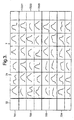
- Figure 4 is a graph showing the distances d(n) between each of three training utterances and a test utterance of a digit spoken by the same speaker. An examination of this figure clearly shows that the relative closeness of the reference data to the test data varies considerably and irregularly across the length of the utterance. By partitioning the utterance into shorter segments, a set of reference segments (from the given data for a given user) with the minimum distances from their corresponding test segments is selected. An important issue to consider in this approach is the size of the segments. Based on the graphs in Figure 4, it can be argued that in order to minimise the overall distance, the segments should have the shortest possible length. DTW is one technique which provides the possibility of reducing the segment size to that covering only a single frame.
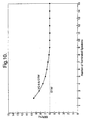
- Figure 5 illustrates the effect of the segment size on the speaker verification performance. It is observed that the equal error rate (EER) increases almost linearly from 9.98% to 10.86% as the segment size is increased from one to ten frames. These results confirm the earlier suggestion that the approach performs best when the segments are of single frame size.
- EER equal error rate
- Figure 6 shows a second embodiment of the invention in which elements common to Figure 1 are indicated by like numerals.
- This second embodiment seeks to reduce further the effects of any existing mismatch between the test utterance and the generated best reference model. This is achieved by weighting each segmental distance in accordance with the estimated level of mismatch associated with that segment. The overall distance is then computed as the average of these weighted segmental distances. i.e. where N is the adjusted number of frames in the given utterance, w(n) is the weighting factor for the n th segmental distance, and d ( n ) is the distance between the n th test frame and the corresponding frame n in the generated best reference model.
- Equations (1) and (2) indicate that any segmental distance affected due to an undesired mismatch is appropriately scaled prior to the calculation of the overall distance.
- Figure 6 illustrates the operations involved in this approach.
- the identity of the unknown speaker is recognised or verified on the basis of the comparison i.e. the value of D will determine whether the unknown speaker is identified.
- the threshold value for D is determined a posteriori for each allowed speaker to result in the equal error rate (EER) for the speaker.
- EER error rate
- the threshold is determined a priori using statistical methods, for instance as described by J P Campbell "Features and Measures for Speaker Recognition” PhD Thesis, Oklahoma State University, USA, 1992
- the competing model may be a conventional generic speech model which models speech rather than particular speakers.
- the competing speaker models can be pre-selected based on their closeness to the target model.
- the J competing models are pre-defined for each allowed speaker in dependence on the similarities between the reference data for a given allowed user and the reference data for some or all of the remaining allowed users i.e. the J competing models for a particular speaker are those for which the reference data is most similar to the reference data for the particular speaker. Refer to equation 1 for the following examples.
- a disadvantage of the above method of selecting J competing speakers is that, if an impostor produces a test utterance which is almost equally dissimilar from the target model and the competing models (example (C) above), then the approach may lead to a small overall distance, and hence the impostor may be accepted as the true speaker. This is simply because, in this case, the large segmental distances given by d ( n,m ) are almost cancelled out by the small values of w ( n ).
- the competing speaker models may be based on their closeness to the given test input.
- the J competing speaker models can be assumed to be adequately close to the true speaker reference model. Therefore the method can be expected to be almost as effective as the previous approach.
- the competing speaker models will be similar to the test utterance and not necessarily to the target model.
- d ( n,m ) and w ( n ) will both become large and the probability of false acceptance will be reduced significantly.
- This method of robust speaker verification is summarised in Figure 7.
- the above two methods involving weighting are referred to as segmental weighting type 1 (SWT1) and segmental weighting type 2 (SWT2) respectively.
- the example is similar to the example (A) given above for SWT1.
- test utterance When the test utterance is produced by an impostor it is more dissimilar from the target model than from the competing model. This is because the competing model is selected based on its closeness to the test utterance.
- the speech data used in the experimental study was a subset of a database consisting of 47 repetitions of isolated digit utterances 1 to 9 and zero.
- the subset was collected from telephone calls made from various locations by 11 male and 9 female speakers. For each speaker, the first 3 utterance repetitions (recorded in a single call) formed the training set. The remaining 44 repetitions (1 recorded per week) were used for testing.
- the utterances which had a sample rate of 8 kHz and a bandwidth of 3.1 kHz, were pre-emphasised using a first order digital filter. These were segmented using a 25 ms Hamming window shifted every 12.5 ms, and then subjected to a 12 th -order linear prediction analysis.
- the resultant linear predictive coding (LPC) parameters for each frame were appropriately analysed using a 10 th -order fast Fourier transform, a filter bank, and a discrete cosine transform to extract a 12 th -order mel-frequency cepstral feature vector [2,8,9].
- the filter bank used for this purpose consisted of 20 filters. The centre frequencies of the first 10 filters were linearly spaced up to 1 kHz, and the other 10 were logarithmically spaced over the remaining frequency range (up to 4 kHz).
- SWT2 The main drawback of SWT2 is its computational complexity owing to the large number of DTW-based comparisons to be carried out to select the competing speakers. This problem can, to a certain extent, be overcome by selecting the competing speakers through a method which is computationally more efficient.
- the DTW technique may then be used for the subsequent parts of the operation. It should be noted that the technique used to replace DTW for selecting competing speakers may not be as efficient. It is therefore possible that the selected competing speakers are different from those that should, and would, be obtained with DTW.
- An alternative approach would be to use a computationally efficient method to select a larger-than-required number of competing speaker models and then reduce this using DTW.
- VQ vector quantisation
- HMMs Hidden Markov Models
- each utterance from an allowed speaker may be stored using single state, multi-model HMMs.
- Each state of the HMM represents a frame of the utterance and each model represents a training utterance for the given allowed speaker.
- the invention may also be used in the recognition of patterns other than speech for instance image recognition.
- reference data is stored for each of the images to be recognised.
- At least one of the images has at least two instances of reference data representing the image.
- successive segments of an unknown input signal are compared with the reference data and, for that or those image(s) that have more than one instance of reference data, a composite comparison result is formed from the best scoring segments of the reference data.
- a weighting factor may be applied as described for the speaker recognition implementation.
Landscapes
- Engineering & Computer Science (AREA)
- Computer Vision & Pattern Recognition (AREA)
- Physics & Mathematics (AREA)
- Theoretical Computer Science (AREA)
- Data Mining & Analysis (AREA)
- Multimedia (AREA)
- Acoustics & Sound (AREA)
- Human Computer Interaction (AREA)
- Audiology, Speech & Language Pathology (AREA)
- Health & Medical Sciences (AREA)
- Bioinformatics & Computational Biology (AREA)
- General Physics & Mathematics (AREA)
- General Engineering & Computer Science (AREA)
- Business, Economics & Management (AREA)
- Game Theory and Decision Science (AREA)
- Evolutionary Computation (AREA)
- Evolutionary Biology (AREA)
- Bioinformatics & Cheminformatics (AREA)
- Artificial Intelligence (AREA)
- Life Sciences & Earth Sciences (AREA)
- Complex Calculations (AREA)
- Image Analysis (AREA)
Claims (21)
- Procédé de reconnaissance des formes comprenant la comparaison d'un signal d'entrée représentant une forme inconnue avec chacune d'une pluralité de formes prédéfinies et l'identification de la forme inconnue sur la base des résultats de comparaison, dans lequel au moins l'une des formes prédéfinies est représentée par au moins deux instances des données de référence, et dans lequel l'étape consistant à comparer le signal d'entrée avec une telle forme comprend :(a) la comparaison de chacun des segments successifs du signal d'entrée avec un segment respectif d'une première instance des données de référence pour cette forme afin de générer un premier résultat de comparaison pour chaque segment ;(b) la comparaison de chacun des segments successifs du signal d'entrée avec un segment respectif d'au moins une instance supplémentaire des données de référence pour cette forme afin de générer au moins un résultat supplémentaire de comparaison pour chaque segment ;(c) la sélection, pour chaque segment du signal d'entrée, de celui entre le premier et les résultats supplémentaires de comparaison pour ce segment qui correspond à l'équivalence la plus proche ;(d) la combinaison des résultats de comparaison sélectionnés pour produire un résultat de comparaison composite pour ladite forme prédéfinie.
- Procédé selon la revendication 1, dans lequel la longueur de chaque instance des données de référence est rendue égale à la longueur moyenne des instances des données de référence.
- Procédé selon la revendication 2, dans lequel la longueur du signal d'entrée est rendue égale à la longueur moyenne des données de référence avant l'exécution de l'étape de comparaison.
- Procédé selon l'une quelconque des revendications, dans lequel chaque résultat de comparaison pour chaque segment est pondéré, avant le calcul du résultat de comparaison, conformément à un niveau estimé de désadaptation associé avec le segment et les données de référence.
- Procédé selon la revendication 4, dans lequel le résultat de comparaison composite D est la moyenne du résultat pondéré pour chaque segment de concordance la plus proche, c'est-à-direoù N est le nombre de segments, w(n) est un facteur de pondération pour le nième segment et d(n) est le résultat de comparaison pour le nième segment.

- Procédé selon la revendication 5, dans lequeloù J est le nombre de formes prédéfinies utilisées pour déterminer le facteur de pondération et d'j(n) est le résultat de comparaison pour le nième segment du signal d'entrée et le nième segment de la jième forme.

- Procédé d'identification du locuteur comprenant la comparaison d'un signal d'entrée représentant la voix d'un locuteur inconnu avec des données de référence représentant la voix de chacun d'une pluralité de locuteurs prédéfinis et l'identification du locuteur inconnu sur la base des résultats de comparaison, dans lequel au moins l'un des locuteurs prédéfinis est représenté par au moins deux instances des données de référence, et dans lequel l'étape consistant à comparer le signal d'entrée avec les données de référence pour un tel locuteur comprend :(a) la comparaison de chacun des segments successifs du signal d'entrée avec un segment respectif d'une première instance des données de référence pour générer un premier résultat de comparaison pour chaque segment ;(b) la comparaison de chacun des segments successifs du signal d'entrée avec un segment respectif d'au moins une instance supplémentaire des données de référence pour cette forme afin de générer au moins un résultat supplémentaire de comparaison pour chaque segment ;(c) la sélection, pour chaque segment du signal d'entrée, de celui entre le premier et les résultats supplémentaires de comparaison pour ce segment qui correspond à l'équivalence la plus proche ;(d) la combinaison des résultats de comparaison sélectionnés pour produire un résultat de comparaison composite pour ledit locuteur prédéfini.
- Procédé selon la revendication 7, dans lequel le signal est divisé en cadres et les segments sont un cadre en longueur.
- Procédé selon l'une quelconque des revendications précédentes pour vérifier l'identité d'un locuteur inconnu, dans lequel le locuteur inconnu donne des informations liées à une identité demandée, le résultat de comparaison pour les données de référence associées avec les informations est comparé avec les résultats de comparaison pour les autres données de référence et, si un critère est rempli, le locuteur inconnu est vérifié en tant que locuteur associé aux informations.
- Procédé selon la revendication 9 lorsqu'elle dépend de la revendication 5 ou 6, dans lequel le facteur de pondération dépend des résultats de comparaison pour les locuteurs autorisés J + 1, où les locuteurs J + 1 représentent le locuteur identifié et les locuteurs J ayant des indices de comparaison les plus proches de celui du locuteur inconnu.
- Appareil de reconnaissance des formes comprenant :dans lequel le moyen de décision (10) contient le moyen utilisable pour recevoir à partir du moyen de comparaison, concernant une forme prédéfinie ayant au moins deux instances des données de référence, les résultats de comparaison pour chacune instance de cette sorte, pour sélectionner, pour chaque segment du signal d'entrée, celui des résultats de comparaison pour ce segment qui correspond à l'équivalence la plus proche et pour combiner les résultats sélectionnés pour produire le résultat de comparaison composite.une entrée pour recevoir un signal d'entrée représentant une forme inconnue ;un moyen (7) de stockage des données de référence représentant chacune de la pluralité de formes prédéfinies, au moins l'une des formes prédéfinies étant représentée par au moins deux instances des données de référence ;un moyen de comparaison (9) utilisable pour comparer chacun des segments successifs du signal d'entrée avec un segment respectif des données de référence et de ce fait générer un résultat de comparaison pour chaque segment ; etun moyen de décision (10) pour combiner les résultats de comparaison pour le segment afin de produire un résultat de comparaison composite pour la forme et pour identifier la forme inconnue sur la base des résultats de comparaison ;
- Appareil selon la revendication 11 comprenant en outre un moyen de réglage linéaire (6) pour régler la longueur de chaque instance des données de référence afin d'être égale à la longueur moyenne des instances des données de référence.
- Appareil selon la revendication 12, dans lequel le moyen de réglage linéaire (6) est agencé également afin de régler la longueur du signal d'entrée pour être égale à la longueur moyenne des instances des données de référence avant la réalisation de l'étape de comparaison.
- Appareil selon l'une quelconque des revendications 11 à 13, dans lequel chaque résultat de comparaison pour chaque segment est pondéré, avant le calcul du résultat de comparaison composite, conformément au niveau estimé de désadaptation associé avec le segment et les données de référence.
- Appareil selon la revendication 14, dans lequel le résultat de comparaison D est la moyenne du résultat pondéré pour chaque segment de concordance la plus proche, c'est-à-direoù N est le nombre de segments, w(n) est un facteur de pondération pour le nième segment et d(n) est le résultat de comparaison pour le nième segment.

- Appareil son la revendication 15, dans lequeloù J est le nombre de formes prédéfinies utilisées pour déterminer le facteur de pondération et d'j(n) est le résultat de comparaison pour le nième segment du signal d'entrée et le nième segment de la jième forme.

- Appareil selon l'une quelconque des revendications 11 à 16, dans lequel les formes représentent des énoncés vocaux.
- Appareil selon la revendication 17, dans lequel l'appareil est agencé pour exécuter l'identification du locuteur.
- Appareil selon l'une quelconque des revendications 11 à 18, dans lequel le signal d'entrée est divisé en cadres, chaque cadre représentant une partie d'un énoncé inconnu, et les segments sont un cadre en longueur.
- Appareil selon l'une quelconque des revendications 11 à 19 pour vérifier l'identité d'un locuteur inconnu, dans lequel l'appareil contient une entrée pour recevoir des informations reliées à une identité demandée du locuteur inconnu et le résultat de comparaison pour le locuteur correspondant à l'identité demandée est comparé aux autres indices de comparaison et, si un critère est rempli, le locuteur inconnu est vérifié en tant que locuteur correspondant.
- Appareil selon la revendication 20 lorsque dépendante de la revendication 15 ou 16, dans lequel le facteur de pondération dépend des résultats de comparaison pour les locuteurs autorisés J + 1, où les locuteurs J + 1 représentent le locuteur identifié et les locuteurs J ayant des résultats de comparaison les plus proches de ceux du locuteur identifié.
Priority Applications (1)
| Application Number | Priority Date | Filing Date | Title |
|---|---|---|---|
| EP98947663A EP1023718B1 (fr) | 1997-10-15 | 1998-10-14 | Reconnaissance de formes au moyen de modeles de reference multiples |
Applications Claiming Priority (4)
| Application Number | Priority Date | Filing Date | Title |
|---|---|---|---|
| EP97308174 | 1997-10-15 | ||
| EP97308174 | 1997-10-15 | ||
| PCT/GB1998/003078 WO1999019865A1 (fr) | 1997-10-15 | 1998-10-14 | Reconnaissance de formes au moyen de modeles de reference multiples |
| EP98947663A EP1023718B1 (fr) | 1997-10-15 | 1998-10-14 | Reconnaissance de formes au moyen de modeles de reference multiples |
Publications (2)
| Publication Number | Publication Date |
|---|---|
| EP1023718A1 EP1023718A1 (fr) | 2000-08-02 |
| EP1023718B1 true EP1023718B1 (fr) | 2003-04-16 |
Family
ID=8229547
Family Applications (1)
| Application Number | Title | Priority Date | Filing Date |
|---|---|---|---|
| EP98947663A Expired - Lifetime EP1023718B1 (fr) | 1997-10-15 | 1998-10-14 | Reconnaissance de formes au moyen de modeles de reference multiples |
Country Status (6)
| Country | Link |
|---|---|
| US (1) | US6389392B1 (fr) |
| EP (1) | EP1023718B1 (fr) |
| AU (1) | AU744678B2 (fr) |
| CA (1) | CA2304747C (fr) |
| DE (1) | DE69813597T2 (fr) |
| WO (1) | WO1999019865A1 (fr) |
Families Citing this family (17)
| Publication number | Priority date | Publication date | Assignee | Title |
|---|---|---|---|---|
| IL145285A0 (en) * | 1999-03-11 | 2002-06-30 | British Telecomm | Speaker recognition |
| US20030023439A1 (en) * | 2001-05-02 | 2003-01-30 | Gregory Ciurpita | Method and apparatus for automatic recognition of long sequences of spoken digits |
| JP4369132B2 (ja) * | 2001-05-10 | 2009-11-18 | コーニンクレッカ フィリップス エレクトロニクス エヌ ヴィ | 話者音声のバックグランド学習 |
| US7398208B2 (en) * | 2001-10-11 | 2008-07-08 | Siemens Atkiengesellschaft | Method for producing reference segments describing voice modules and method for modeling voice units of a spoken test model |
| DE10254612A1 (de) * | 2002-11-22 | 2004-06-17 | Humboldt-Universität Zu Berlin | Verfahren zur Ermittlung spezifisch relevanter akustischer Merkmale von Schallsignalen für die Analyse unbekannter Schallsignale einer Schallerzeugung |
| US7720012B1 (en) | 2004-07-09 | 2010-05-18 | Arrowhead Center, Inc. | Speaker identification in the presence of packet losses |
| US7725318B2 (en) * | 2004-07-30 | 2010-05-25 | Nice Systems Inc. | System and method for improving the accuracy of audio searching |
| US7437398B2 (en) * | 2004-07-30 | 2008-10-14 | Intel Corporation | Pattern matching architecture |
| US9123350B2 (en) * | 2005-12-14 | 2015-09-01 | Panasonic Intellectual Property Management Co., Ltd. | Method and system for extracting audio features from an encoded bitstream for audio classification |
| CN101197131B (zh) * | 2006-12-07 | 2011-03-30 | 积体数位股份有限公司 | 随机式声纹密码验证系统、随机式声纹密码锁及其产生方法 |
| US20080189109A1 (en) * | 2007-02-05 | 2008-08-07 | Microsoft Corporation | Segmentation posterior based boundary point determination |
| RU2419890C1 (ru) | 2009-09-24 | 2011-05-27 | Общество с ограниченной ответственностью "Центр речевых технологий" | Способ идентификации говорящего по фонограммам произвольной устной речи на основе формантного выравнивания |
| US8719019B2 (en) * | 2011-04-25 | 2014-05-06 | Microsoft Corporation | Speaker identification |
| RU2530314C1 (ru) * | 2013-04-23 | 2014-10-10 | Общество с ограниченной ответственностью "ЦРТ-инновации" | Способ гибридной генеративно-дискриминативной сегментации дикторов в аудио-потоке |
| GB2555661A (en) * | 2016-11-07 | 2018-05-09 | Cirrus Logic Int Semiconductor Ltd | Methods and apparatus for biometric authentication in an electronic device |
| US10540978B2 (en) * | 2018-05-30 | 2020-01-21 | Cirrus Logic, Inc. | Speaker verification |
| CN111667838B (zh) * | 2020-06-22 | 2022-10-14 | 清华大学 | 一种用于声纹识别的低功耗模拟域特征向量提取方法 |
Citations (1)
| Publication number | Priority date | Publication date | Assignee | Title |
|---|---|---|---|---|
| WO1998054694A1 (fr) * | 1997-05-27 | 1998-12-03 | Ameritech, Inc. | Procede de verification du locuteur mettant en oeuvre de multiples groupes de classe |
Family Cites Families (8)
| Publication number | Priority date | Publication date | Assignee | Title |
|---|---|---|---|---|
| US4831551A (en) * | 1983-01-28 | 1989-05-16 | Texas Instruments Incorporated | Speaker-dependent connected speech word recognizer |
| US5509104A (en) * | 1989-05-17 | 1996-04-16 | At&T Corp. | Speech recognition employing key word modeling and non-key word modeling |
| CA2015410C (fr) * | 1989-05-17 | 1996-04-02 | Chin H. Lee | Reconnaissance vocale utilisant un modele a mots-cles et un modele sans moto-cles |
| US5025471A (en) * | 1989-08-04 | 1991-06-18 | Scott Instruments Corporation | Method and apparatus for extracting information-bearing portions of a signal for recognizing varying instances of similar patterns |
| US5167004A (en) * | 1991-02-28 | 1992-11-24 | Texas Instruments Incorporated | Temporal decorrelation method for robust speaker verification |
| US5199077A (en) * | 1991-09-19 | 1993-03-30 | Xerox Corporation | Wordspotting for voice editing and indexing |
| JP2692581B2 (ja) * | 1994-06-07 | 1997-12-17 | 日本電気株式会社 | 音響カテゴリ平均値計算装置及び適応化装置 |
| US5839103A (en) * | 1995-06-07 | 1998-11-17 | Rutgers, The State University Of New Jersey | Speaker verification system using decision fusion logic |
-
1998
- 1998-10-14 CA CA002304747A patent/CA2304747C/fr not_active Expired - Fee Related
- 1998-10-14 WO PCT/GB1998/003078 patent/WO1999019865A1/fr not_active Ceased
- 1998-10-14 US US09/202,026 patent/US6389392B1/en not_active Expired - Fee Related
- 1998-10-14 AU AU94503/98A patent/AU744678B2/en not_active Ceased
- 1998-10-14 EP EP98947663A patent/EP1023718B1/fr not_active Expired - Lifetime
- 1998-10-14 DE DE69813597T patent/DE69813597T2/de not_active Expired - Lifetime
Patent Citations (1)
| Publication number | Priority date | Publication date | Assignee | Title |
|---|---|---|---|---|
| WO1998054694A1 (fr) * | 1997-05-27 | 1998-12-03 | Ameritech, Inc. | Procede de verification du locuteur mettant en oeuvre de multiples groupes de classe |
Also Published As
| Publication number | Publication date |
|---|---|
| US6389392B1 (en) | 2002-05-14 |
| AU9450398A (en) | 1999-05-03 |
| DE69813597T2 (de) | 2004-02-12 |
| CA2304747A1 (fr) | 1999-04-22 |
| WO1999019865A1 (fr) | 1999-04-22 |
| CA2304747C (fr) | 2007-08-14 |
| EP1023718A1 (fr) | 2000-08-02 |
| DE69813597D1 (de) | 2003-05-22 |
| AU744678B2 (en) | 2002-02-28 |
Similar Documents
| Publication | Publication Date | Title |
|---|---|---|
| US9646614B2 (en) | Fast, language-independent method for user authentication by voice | |
| US7904295B2 (en) | Method for automatic speaker recognition with hurst parameter based features and method for speaker classification based on fractional brownian motion classifiers | |
| EP0501631B1 (fr) | Procédé de décorrélation temporelle pour vérification robuste de locuteur | |
| EP1023718B1 (fr) | Reconnaissance de formes au moyen de modeles de reference multiples | |
| EP0744734B1 (fr) | Méthode et appareil de vérification du locuteur utilisant une discrimination basée sur la décomposition des mixtures | |
| EP0891618B1 (fr) | Elaboration de la parole | |
| US6539352B1 (en) | Subword-based speaker verification with multiple-classifier score fusion weight and threshold adaptation | |
| US5583961A (en) | Speaker recognition using spectral coefficients normalized with respect to unequal frequency bands | |
| US6205424B1 (en) | Two-staged cohort selection for speaker verification system | |
| EP2189976A1 (fr) | Procédé d'adaptation d'un guide de codification pour reconnaissance vocale | |
| US6922668B1 (en) | Speaker recognition | |
| EP1005019B1 (fr) | Procédé de mesure de la similarité pour la reconnaissance de la parole basé sur un découpage en segments | |
| Sumithra et al. | A study on feature extraction techniques for text independent speaker identification | |
| Ariyaeeinia et al. | Analysis and comparison of score normalisation methods for text-dependent speaker verification | |
| Kasuriya et al. | Comparative study of continuous hidden Markov models (CHMM) and artificial neural network (ANN) on speaker identification system | |
| Ganchev et al. | Text-independent speaker verification for real fast-varying noisy environments | |
| Thakur et al. | Speaker authentication using gmm-ubm | |
| Seck et al. | The irisa/elisa speaker detection and tracking systems for the nist'99 evaluation campaign | |
| Monte et al. | Text independent speaker identification on noisy environments by means of self organizing maps | |
| Narayanaswamy | Improved text-independent speaker recognition using Gaussian mixture probabilities | |
| Docío-Fernández et al. | Comparison of several compensation techniques for Robust speaker verification | |
| Muhammad | Acoustic quality normalization for robust automatic speech recognition | |
| Gâta et al. | System of Speaker Identification Independent of Text for Romanian Language based on Gaussian Mixture Models extract from the MFCC vectors |
Legal Events
| Date | Code | Title | Description |
|---|---|---|---|
| PUAI | Public reference made under article 153(3) epc to a published international application that has entered the european phase |
Free format text: ORIGINAL CODE: 0009012 |
|
| 17P | Request for examination filed |
Effective date: 20000320 |
|
| AK | Designated contracting states |
Kind code of ref document: A1 Designated state(s): BE CH DE FR GB LI SE |
|
| 17Q | First examination report despatched |
Effective date: 20001219 |
|
| GRAG | Despatch of communication of intention to grant |
Free format text: ORIGINAL CODE: EPIDOS AGRA |
|
| RIC1 | Information provided on ipc code assigned before grant |
Free format text: 7G 10L 17/00 A, 7G 06K 9/62 B |
|
| GRAG | Despatch of communication of intention to grant |
Free format text: ORIGINAL CODE: EPIDOS AGRA |
|
| GRAH | Despatch of communication of intention to grant a patent |
Free format text: ORIGINAL CODE: EPIDOS IGRA |
|
| GRAH | Despatch of communication of intention to grant a patent |
Free format text: ORIGINAL CODE: EPIDOS IGRA |
|
| GRAA | (expected) grant |
Free format text: ORIGINAL CODE: 0009210 |
|
| AK | Designated contracting states |
Designated state(s): BE CH DE FR GB LI SE |
|
| PG25 | Lapsed in a contracting state [announced via postgrant information from national office to epo] |
Ref country code: LI Free format text: LAPSE BECAUSE OF FAILURE TO SUBMIT A TRANSLATION OF THE DESCRIPTION OR TO PAY THE FEE WITHIN THE PRESCRIBED TIME-LIMIT Effective date: 20030416 Ref country code: CH Free format text: LAPSE BECAUSE OF FAILURE TO SUBMIT A TRANSLATION OF THE DESCRIPTION OR TO PAY THE FEE WITHIN THE PRESCRIBED TIME-LIMIT Effective date: 20030416 Ref country code: BE Free format text: LAPSE BECAUSE OF FAILURE TO SUBMIT A TRANSLATION OF THE DESCRIPTION OR TO PAY THE FEE WITHIN THE PRESCRIBED TIME-LIMIT Effective date: 20030416 |
|
| REG | Reference to a national code |
Ref country code: GB Ref legal event code: FG4D |
|
| REG | Reference to a national code |
Ref country code: CH Ref legal event code: EP |
|
| REF | Corresponds to: |
Ref document number: 69813597 Country of ref document: DE Date of ref document: 20030522 Kind code of ref document: P |
|
| PG25 | Lapsed in a contracting state [announced via postgrant information from national office to epo] |
Ref country code: SE Free format text: LAPSE BECAUSE OF FAILURE TO SUBMIT A TRANSLATION OF THE DESCRIPTION OR TO PAY THE FEE WITHIN THE PRESCRIBED TIME-LIMIT Effective date: 20030716 |
|
| REG | Reference to a national code |
Ref country code: CH Ref legal event code: PL |
|
| ET | Fr: translation filed | ||
| PLBE | No opposition filed within time limit |
Free format text: ORIGINAL CODE: 0009261 |
|
| STAA | Information on the status of an ep patent application or granted ep patent |
Free format text: STATUS: NO OPPOSITION FILED WITHIN TIME LIMIT |
|
| 26N | No opposition filed |
Effective date: 20040119 |
|
| REG | Reference to a national code |
Ref country code: FR Ref legal event code: PLFP Year of fee payment: 18 |
|
| REG | Reference to a national code |
Ref country code: FR Ref legal event code: PLFP Year of fee payment: 19 |
|
| REG | Reference to a national code |
Ref country code: FR Ref legal event code: PLFP Year of fee payment: 20 |
|
| PGFP | Annual fee paid to national office [announced via postgrant information from national office to epo] |
Ref country code: DE Payment date: 20171019 Year of fee payment: 20 Ref country code: FR Payment date: 20171024 Year of fee payment: 20 |
|
| PGFP | Annual fee paid to national office [announced via postgrant information from national office to epo] |
Ref country code: GB Payment date: 20171019 Year of fee payment: 20 |
|
| REG | Reference to a national code |
Ref country code: DE Ref legal event code: R071 Ref document number: 69813597 Country of ref document: DE |
|
| REG | Reference to a national code |
Ref country code: GB Ref legal event code: PE20 Expiry date: 20181013 |
|
| PG25 | Lapsed in a contracting state [announced via postgrant information from national office to epo] |
Ref country code: GB Free format text: LAPSE BECAUSE OF EXPIRATION OF PROTECTION Effective date: 20181013 |