EP1024161A2 - Verfahren zum Befestigen von Kunststoffteilen an Kannen - Google Patents
Verfahren zum Befestigen von Kunststoffteilen an Kannen Download PDFInfo
- Publication number
- EP1024161A2 EP1024161A2 EP99126256A EP99126256A EP1024161A2 EP 1024161 A2 EP1024161 A2 EP 1024161A2 EP 99126256 A EP99126256 A EP 99126256A EP 99126256 A EP99126256 A EP 99126256A EP 1024161 A2 EP1024161 A2 EP 1024161A2
- Authority
- EP
- European Patent Office
- Prior art keywords
- plastic
- plastic part
- adhesive
- gas burner
- flame
- Prior art date
- Legal status (The legal status is an assumption and is not a legal conclusion. Google has not performed a legal analysis and makes no representation as to the accuracy of the status listed.)
- Granted
Links
Images

Classifications
-
- A—HUMAN NECESSITIES
- A47—FURNITURE; DOMESTIC ARTICLES OR APPLIANCES; COFFEE MILLS; SPICE MILLS; SUCTION CLEANERS IN GENERAL
- A47J—KITCHEN EQUIPMENT; COFFEE MILLS; SPICE MILLS; APPARATUS FOR MAKING BEVERAGES
- A47J45/00—Devices for fastening or gripping kitchen utensils or crockery
- A47J45/06—Handles for hollow-ware articles
- A47J45/067—Handles for coffee pots or the like
Definitions
- the invention relates to a method for fastening plastic parts such as Handles and / or plastic edges surrounding the top of cans with or without pouring spout made of polypropylene on glass jugs by means of a Glue.
- the invention also relates to a jug according to the preamble Claim 20.
- Glass jugs that serve as serving and collecting containers for cold and hot drinks (for example coffee) or can also be used to prepare it, are used to reduce the susceptibility to breakage when hitting the can neck provided with a plastic edge.
- plastic handles For holding pots even when they are filled with hot drinks are usually plastic handles used, which are either an independent part of the jug or in Plastic edge are integrated.
- ABS Acrylonitrile-butadiene-styrene copolymer is a good adhesive and inexpensive plastic (hereinafter referred to as ABS).
- ABS adhesive and inexpensive plastic
- USA Food and Drug Agency
- the approved ABS variants keep the temperatures in ordinary Household dishwashers stood, but show deformations and Discolouration when cleaning in industrial dishwashers.
- Polypropylene is for economic and health reasons ABS preferred.
- polypropylene meets the requirements for molding and Color stability at temperatures of 90 ° C and higher.
- Plastic edges among other things, if they are made of Are polypropylene, have a circumferential groove on their lower edge, by means of which they sit and are jammed on the edge of the glass jug additionally secured by adhesive that is inserted into the groove.
- the glue primarily has the function here, the freedom between the Fill the glass jug rim and the groove of the plastic rim.
- the Power transmission is mainly accomplished mechanically. in the In general, ABS is a liability between sufficient strength Plastic part and glass jug thanks to silicone two-component adhesive and the additional use of chemical adhesion promoters (primers) achieved. So will receive a cohesive fracture pattern when the bond is overloaded which the tear goes through the glue.
- the adhesive also has a sealing function to prevent that the liquid runs out between the edge of the glass jug and the edge of the plastic.
- To sealing rings can also be used for this purpose.
- a jug is known in which the handle is not integrated into the plastic edge, but both parts are independent Components of the jug are.
- the handle is on the outside of the one hand Jug attached, on the other hand it is form-fitting with the plastic edge connected. This positive connection is located opposite one in the pouring spout worked into the plastic rim.
- the plastic edge and the Handle must therefore be complex in design, manufacture and assembly difficult and expensive. About the resistance of the adhesive bond to No statement is made about high usage temperatures.
- gluing polypropylene is non-polar and is dependent on means such as good adhesives for glass that are more polar than polypropylene, poorly wetted.
- This also includes the Plasma polymerization (op. Cit., Pp. 179ff.) And gas flaming (op. Cit., P. 179ff.) 210ff).
- the plasma polymerization is based on a plasma selected atmosphere on a substrate a polymer layer with polar separate functional groups. On the one hand, with gas flaming the surface is oxidized, on the other hand by those contained in the flame Ions and electrons polarize the surface.
- the invention has for its object a method for fastening of polypropylene on glass using an adhesive to find one sufficient adhesive strength, even for service temperatures of 90 ° C and to find higher.
- This object is achieved by two methods for fastening of plastic parts, such as handles or the top of cans Plastic edges with or without pouring spout made of polypropylene on glass jugs solved by means of an adhesive, in which before applying the adhesive Plastic part is surface activated at least at the glue point.
- the Surface activation is done either in a low pressure plasma or by Flaming carried out.
- the first method according to the invention is based on surface activation in a low pressure plasma.
- the low pressure plasmas are through Action of sufficient electric fields on a gas at low Generates pressure.
- the ionization occurring under the influence of the electric fields leads to electrically neutral gas atoms due to the energy excitation in Electrons and positively charged ions are split. Because in the plasma the same number of positive and negative charge carriers is present, it is after electrically neutral on the outside, but still has electrical conductivity.
- the impact of plasma particles on near-surface atoms or molecules of the parts to be treated leads to an activation of the surface.
- a both cleansing and activating Effect can be with the plasma using oxygen or oxygen-containing gas mixtures, in the simplest case air.
- oxygen or oxygen-containing gas mixtures in the simplest case air.
- organic coatings become water and implemented carbon dioxide and then oxygen-containing, polar functional groups on the chains of the cleaned plastic surface fixed. Functional groups are important for the wetting properties Carbonyl, carboxyl, hydroxy and possibly peroxide groups.
- a chemical adhesion promoter also has the function of being bonded Surface of e.g. dust, grease and to clean any other foreign objects.
- the second method according to the invention is based on surface activation by flaming. Through the oxidation and entry of electrons and Ions thus arise in the originally nonpolar surface of the Polypropylene plastic part polar molecules, which in turn the Adhesive molecules offer the possibility of binding.
- a great advantage of flaming is that with this type of It is possible to activate the surface by activating only the adhesive point.
- a plastic edge for example, only the webs and the Floor covering of the circumferential groove can be activated, which is what the Pouring behavior positive poor wettability of the pouring spout Polypropylene plastic edge would receive.
- a gas burner is preferably used for the flaming. Because about it no special treatment tools are required, this is preferred embodiment of the method extremely simple and inexpensive.
- the resulting properties of the activated polypropylene surface depend crucially on the flame characteristics, i.e. on Temperature, ion distribution and size of the active area.
- the active one Area is the oxidizing area that acts as a dark blue flame to the eye is visible.
- the light blue flame cone is strongly reducing and therefore for the surface activation is unusable.
- temperature and ion density are distributed differently. Also hang the resulting properties of the intensity of the interaction with the Surface from the distance between the burner - plastic surface and the Exposure time is also determined.
- Polypropylene has a distance between the burner and the plastic surface from 70 to 100 mm. This ensures that the surface always with the flame range of favorable temperature, ion density and thus oxidizing effect.
- the preferred exposure time must be be determined and a way to regulate them.
- the burner and plastic part are used to regulate the exposure time moved relative to each other.
- the burner attached and the plastic part to be treated is moved.
- the precision of flame treatment can be defined more precisely increase limited surfaces by using gas burners with round. jet so that you get a long, pointed flame with a round horizontal cross section.
- the degree of Activation of certain areas can be controlled by either the angle of attack of the gas burner as approximately 0 ° to the perpendicular to the Bottom surface of the groove selects and both webs equally flamed or the Gas burner tilts slightly away from the plumb line (up to about 15 °) and so predominantly that Flamed floor area and the outer web, which compared to the inner Web of the circumferential groove are more heavily loaded and therefore a higher Adhesion required.
- a major advantage in terms of process technology is that there are no complex devices are required, the flaming in the Manufacturing process can be integrated and therefore the plastic part processed immediately after flame treatment, e.g. with a chemical adhesion promoter (primer) can be provided.
- the investment costs for switching from glued handles and Plastic edges made of polypropylene on flamed handles and plastic edges is minimal.
- a last but all the more significant advantage of flaming is that one sufficient adhesive strength also for service temperatures of 90 ° C and can reach higher without using additional chemical adhesion promoters (primers) to have to fall back. So far, the application of chemical adhesion promoters was done by hand, this means a huge saving of time Manufacturing and also an immense cost reduction. In addition, for chemical coupling agents used large amounts of organic solvents, which are harmful to the environment and the health of workers and can be avoided with this.
- the invention also includes a glass jug with plastic parts, such as handles and / or encompassing the top of cans Plastic edges with or without pouring spout made from surface activated Polypropylene exist.
- a plastic part 1 is shown during flame treatment.
- Plastic part 1 is a plastic edge 2 with an integrated handle 3 and circumferential groove 4, which is dimensioned so that it exactly the upper Edge of the glass jug.
- the adhesive is introduced into this groove 4 become.
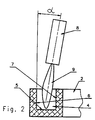
- the groove 4 must be surface activated, which is due to Flame happens by means of a gas burner 8 and its flame 9.
- the gas burner 8 remains in a certain one Position, in this example above the plastic edge 2.
- the Plastic edge 2, however, is in this way under the gas burner 8 turned around (the direction of rotation is indicated by the arrow) that the flame 9 travels exactly the inside of the groove 4 and is flamed.
- the burner 8 was chosen so that the flame 9 round a horizontal Has cross-section, so that only the groove 4 is targeted.
- Figure 2 is a section through the groove 4 and the gas burner 8 and the Flame 9 along the line II-II shown in Figure 1 to the position of the Gas burner 8 and the flame 9 relative to flame 4 groove illustrate.
- the outer side surface 6 and the base surface 5 of the groove 4 be surface activated because of the forces involved in lifting and carrying the Can work against the connection, more on them than on the inside Attack side surface 7.
- the flame 9 is not vertical aligned to the base 5 of the groove 4 but at an angle ⁇ to Plumb to the base 5.
Landscapes
- Engineering & Computer Science (AREA)
- Food Science & Technology (AREA)
- Treatments Of Macromolecular Shaped Articles (AREA)
- Lining Or Joining Of Plastics Or The Like (AREA)
- Adhesives Or Adhesive Processes (AREA)
- Manufacture Of Macromolecular Shaped Articles (AREA)
- Details Of Rigid Or Semi-Rigid Containers (AREA)
Abstract
Description
- 1
- Kunststoffteil
- 2
- Kunststoffrand
- 3
- Griff
- 4
- Nut
- 5
- Grundfläche
- 6
- außenliegende Seitenfläche
- 7
- innenliegende Seitenfläche
- 8
- Gasbrenner
- 9
- Flamme
- -->
- Drehrichtung
Claims (19)
- Verfahren zum Befestigen von Kunststoffteilen wie Griffen und/oder den oberen Rand von Kannen umfassenden Kunststoffrändern mit oder ohne Ausgußtülle aus Polypropylen an Glaskannen mittels eines Klebers, dadurch gekennzeichnet, daß vor dem Aufbringen des Klebers das Kunststoffteil mindestens an der Klebstelle in einem Niederdruckplasma oberflächenaktiviert wird.
- Verfahren nach Anspruch 1, dadurch gekennzeichnet, daß das Niederdruckplasma bei einem Druck von 10-500 Pa erzeugt wird.
- Verfahren nach Anspruch 1 oder 2, dadurch gekennzeichnet, daß das Niederdruckplasma unter Verwendung von Sauerstoff oder einem sauerstoffhaltigen Gasgemisch erzeugt wird.
- Verfahren nach mindestens einem der Ansprüche 1 bis 3, dadurch gekennzeichnet, daß nach der Oberflächenaktivierung im Niederdruckplasma und vor dem Aufbringen des Klebers ein chemischer Haftvermittler (Primer) auf das Kunststoffteil aufgebracht wird.
- Verfahren nach mindestens einem der Ansprüche 1 bis 4, dadurch gekennzeichnet, daß zwischen Niederdruckplasmaaktivierung und Kleben einige Tage bis Wochen liegen.
- Verfahren zum Befestigen von Kunststoffteilen wie Griffen und/oder den oberen Rand von Kannen umfassenden Kunststoffrändern mit oder ohne Ausgußtülle aus Polypropylen an Glaskannen mittels eines Klebers, dadurch gekennzeichnet, daß vor dem Aufbringen des Klebers das Kunststoffteil mindestens an der Klebestelle durch Beflammen oberflächenaktiviert wird.
- Verfahren nach Anspruch 6, dadurch gekennzeichnet, daß das Kunststoffteil gezielt nur an der Klebstelle beflammt wird.
- Verfahren nach Anspruch 6 oder 7, dadurch gekennzeichnet, daß zum Beflammen ein Gasbrenner verwendet wird.
- Verfahren nach mindestens einem der Ansprüche 6 bis 8, dadurch gekennzeichnet, daß dem Gasbrenner ein Luft-Gasgemisch aus 8 bis 12 Vol.-Teilen Luft und 1 Vol.-Teil Erdgas zugeführt wird.
- Verfahren nach mindestens einem der Ansprüche 6 bis 9, dadurch gekennzeichnet, daß der Abstand zwischen Gasbrenner und Griff bzw. Schüttrand auf 70 bis 100 mm eingestellt wird.
- Verfahren nach einem der Ansprüche 6 bis 10, dadurch gekennzeichnet, daß das Kunststoffteil relativ zum feststehenden Gasbrenner bewegt wird.
- Verfahren nach Anspruch 11, dadurch gekennzeichnet, daß die Relativgeschwindigkeit zwischen Kunststoffteil und Gasbrenner 300 bis 600 mm/s beträgt.
- Verfahren nach mindestens einem der Ansprüche 6 bis 12, dadurch gekennzeichnet, daß die Flamme des Gasbrenners oberhalb der zu aktivierenden Oberfläche des Kunststoffteils positioniert wird.
- Verfahren nach mindestens einem der Ansprüche 6 bis 13, dadurch gekennzeichnet, daß ein Gasbrenner mit einer Flamme mit rundem horizontalen Querschnitt verwendet wird.
- Verfahren nach mindestens einem der Ansprüche 6 bis 14 bei dem ein Kunststoffrand mit einer den oberen Rand der Kanne umgreifenden Nut befestigt wird, dadurch gekennzeichnet, daß der Anstellwinkel des Gasbrenners zwischen 0° bis 15° zum Lot auf die Grundfläche der Nut gewählt wird.
- Verfahren nach Anspruch 15, dadurch gekennzeichnet, daß nur die Grundfläche und die außenliegende Seitenfläche der Nut beflammt werden.
- Verfahren nach mindestens einem der Ansprüche 6 bis 16, dadurch gekennzeichnet, daß das Kunststoffteil unmittelbar nach dem Beflammen weiterverarbeitet wird.
- Verfahren nach mindestens einem der Ansprüche 6 bis 17, dadurch gekennzeichnet, daß das Kunststoffteil nach dem Beflammen ohne Zuhilfenahme eines zusätzlichen chemischen Haftvermittlers (Primers) geklebt wird.
- Kanne aus Glas mit Kunststoffteilen wie Griffen und/oder den oberen Rand von Kannen umfassenden Kunststoffrändern mit oder ohne Ausgußtülle, dadurch gekennzeichnet, daß das Kunststoffteil aus oberflächenaktiviertem Polypropylen besteht.
Applications Claiming Priority (2)
| Application Number | Priority Date | Filing Date | Title |
|---|---|---|---|
| DE19903479A DE19903479C2 (de) | 1999-01-29 | 1999-01-29 | Verfahren zum Befestigen von Kunststoffteilen an Kannen |
| DE19903479 | 1999-01-29 |
Publications (3)
| Publication Number | Publication Date |
|---|---|
| EP1024161A2 true EP1024161A2 (de) | 2000-08-02 |
| EP1024161A3 EP1024161A3 (de) | 2004-01-02 |
| EP1024161B1 EP1024161B1 (de) | 2006-03-15 |
Family
ID=7895739
Family Applications (1)
| Application Number | Title | Priority Date | Filing Date |
|---|---|---|---|
| EP99126256A Expired - Lifetime EP1024161B1 (de) | 1999-01-29 | 1999-12-31 | Verfahren zum Befestigen von Kunststoffteilen an Kannen |
Country Status (5)
| Country | Link |
|---|---|
| US (1) | US6432251B1 (de) |
| EP (1) | EP1024161B1 (de) |
| CN (1) | CN1270885A (de) |
| DE (2) | DE19903479C2 (de) |
| TW (1) | TW483821B (de) |
Cited By (1)
| Publication number | Priority date | Publication date | Assignee | Title |
|---|---|---|---|---|
| US10070752B2 (en) | 2013-04-15 | 2018-09-11 | Wmf Group Gmbh | Pot lid having a handle |
Families Citing this family (7)
| Publication number | Priority date | Publication date | Assignee | Title |
|---|---|---|---|---|
| DE10108456B4 (de) * | 2001-02-22 | 2004-08-26 | Christof Diener | Verfahren zur Oberflächenvorbehandlung |
| JP4109117B2 (ja) * | 2001-03-01 | 2008-07-02 | シーメンス アクチエンゲゼルシヤフト | 表面層および接着フィルムがカバーされて成る固体 |
| CN100360302C (zh) * | 2002-10-23 | 2008-01-09 | 仲田涂覆株式会社 | 表面处理装置及表面处理方法 |
| JP5047811B2 (ja) * | 2005-02-11 | 2012-10-10 | シーカ・テクノロジー・アーゲー | エアープラズマ処理熱可塑性プラスチックの接着 |
| JP5055283B2 (ja) * | 2005-09-19 | 2012-10-24 | アドバンスト テクノロジー マテリアルズ,インコーポレイテッド | 物質処理容器のためのドレンコネクタ |
| US20110052102A1 (en) * | 2005-09-19 | 2011-03-03 | Sven Stiers | Drain connector for substance processing receptacle |
| CN108903713A (zh) * | 2018-08-07 | 2018-11-30 | 佛山市云米电器科技有限公司 | 壶体手柄连接结构及其制备方法 |
Citations (1)
| Publication number | Priority date | Publication date | Assignee | Title |
|---|---|---|---|---|
| EP0413196B1 (de) | 1989-08-12 | 1993-10-06 | Schott Glaswerke | Hotelkanne und Verfahren zur Herstellung derselben |
Family Cites Families (5)
| Publication number | Priority date | Publication date | Assignee | Title |
|---|---|---|---|---|
| DE1053773B (de) * | 1953-03-05 | 1959-03-26 | Werner Kreidl | Verfahren und Vorrichtung zur Verbesserung der Oberflaechenhaft-eigenschaften von Erzeugnissen aus Kunststoffen der Polyaethylenharztype |
| US4090648A (en) * | 1976-04-09 | 1978-05-23 | Bloomfield Industries, A Division Of Beatrice Foods Co. | Decanter and molded interlocking handle |
| DE4407478C2 (de) * | 1993-03-10 | 1997-09-18 | Fraunhofer Ges Forschung | Verfahren zum Fügen von faserverstärkten Polyetheretherketon-Kunststoffen |
| DE19503038C1 (de) * | 1995-01-31 | 1996-10-31 | Tomas Meinen | Verfahren zur Herstellung von Chip-Karten |
| BR9609594A (pt) * | 1995-06-30 | 1999-02-23 | Commw Scient Ind Res Org | Tratamento melhorado da superfície de polímeros |
-
1999
- 1999-01-29 DE DE19903479A patent/DE19903479C2/de not_active Expired - Fee Related
- 1999-12-31 DE DE59913227T patent/DE59913227D1/de not_active Expired - Fee Related
- 1999-12-31 EP EP99126256A patent/EP1024161B1/de not_active Expired - Lifetime
-
2000
- 2000-01-24 TW TW089101080A patent/TW483821B/zh not_active IP Right Cessation
- 2000-01-28 CN CN00101912A patent/CN1270885A/zh active Pending
- 2000-01-31 US US09/494,680 patent/US6432251B1/en not_active Expired - Fee Related
Patent Citations (1)
| Publication number | Priority date | Publication date | Assignee | Title |
|---|---|---|---|---|
| EP0413196B1 (de) | 1989-08-12 | 1993-10-06 | Schott Glaswerke | Hotelkanne und Verfahren zur Herstellung derselben |
Cited By (1)
| Publication number | Priority date | Publication date | Assignee | Title |
|---|---|---|---|---|
| US10070752B2 (en) | 2013-04-15 | 2018-09-11 | Wmf Group Gmbh | Pot lid having a handle |
Also Published As
| Publication number | Publication date |
|---|---|
| DE59913227D1 (de) | 2006-05-11 |
| CN1270885A (zh) | 2000-10-25 |
| DE19903479A1 (de) | 2000-08-10 |
| EP1024161A3 (de) | 2004-01-02 |
| US6432251B1 (en) | 2002-08-13 |
| DE19903479C2 (de) | 2003-03-20 |
| EP1024161B1 (de) | 2006-03-15 |
| TW483821B (en) | 2002-04-21 |
Similar Documents
| Publication | Publication Date | Title |
|---|---|---|
| DE69531456T2 (de) | Verfahren zum verbinden eines gehärteten elastomers und eines plastikmaterials | |
| EP1024161A2 (de) | Verfahren zum Befestigen von Kunststoffteilen an Kannen | |
| EP1353882A1 (de) | Verfahren zur schmutzabweisenden ausrüstung von oberflächen | |
| DE3814652C2 (de) | ||
| DE1553761A1 (de) | Verfahren zum UEberziehen der Schneiden von geschaerften Geraeten | |
| DE69920421T2 (de) | Klebeetikett und plastikgefäss mit klebeetikett | |
| DE3730477C2 (de) | ||
| DE1241732B (de) | Verfahren zum UEberziehen von Gegenstaenden mit Kunststoffen durch Aufdampfen im Vacuum | |
| DE2450260A1 (de) | Verfahren zur kunststoffbeschichtung von glasgegenstaenden | |
| DE19530696A1 (de) | Körper mit optisch wahrnehmbaren Informationen | |
| DE2341595A1 (de) | Verfahren zum ueberziehen eines glasgegenstandes | |
| DE10248085A1 (de) | Plasmapolymere Haftschichten | |
| DE102004028197B4 (de) | Verfahren zur Vorbehandlung verzinkter Stahlbleche oder Aluminiumbleche zum Schweißen | |
| DE69705774T2 (de) | Glas- oder glasartiger Gegenstand mit satiniertem Aussehen und Verfahren zu dessen Herstellung | |
| EP0846037A1 (de) | Formkörper aus metallpulver und verfahren zu seiner herstellung | |
| DE4444546A1 (de) | Klebeverbindung und -verfahren für Polyethylen- und Polypropylenschäume | |
| WO2006024316A1 (de) | Verfahren zum verbinden einer schicht aus thermoplastischem polymer mit der oberfläche eines elastomers | |
| DE4013253A1 (de) | Verfahren zur herstellung von farbflachglaesern und zum aufbringen von farbigen und farblosen schichten und dekoren auf flachglas | |
| DE3871605T2 (de) | Verfahren zur behandlung von polymerischen gegenstaenden durch coronaentladung. | |
| DE202024104340U1 (de) | Flasche mit verbesserter Tropfschutzvorrichtung | |
| DE2032465A1 (de) | Verfahren und Vorrichtung zur Her stellung oberflachenbehandelter hohler Glaskörper wie Flaschen u dgl | |
| DE10204228B4 (de) | Verwendung eines Beschichtungsmittels | |
| EP3187320A1 (de) | Verfahren zum befestigen von streifenförmigen flächengebilden, insbesondere kantenbändern an schmalseiten von werkstücken | |
| DE102014110253B4 (de) | Formmesser, eine Schweißmaschine, ein Verfahrenzum Verschweißen und Fensterrahmen | |
| EP1502971A2 (de) | Verbessertes Verfahren und Vorrichtung zum Reinigen von Metalloberflächen |
Legal Events
| Date | Code | Title | Description |
|---|---|---|---|
| PUAI | Public reference made under article 153(3) epc to a published international application that has entered the european phase |
Free format text: ORIGINAL CODE: 0009012 |
|
| 17P | Request for examination filed |
Effective date: 19991231 |
|
| AK | Designated contracting states |
Kind code of ref document: A2 Designated state(s): AT BE CH CY DE DK ES FI FR GB GR IE IT LI LU MC NL PT SE |
|
| AX | Request for extension of the european patent |
Free format text: AL;LT;LV;MK;RO;SI |
|
| PUAL | Search report despatched |
Free format text: ORIGINAL CODE: 0009013 |
|
| AK | Designated contracting states |
Kind code of ref document: A3 Designated state(s): AT BE CH CY DE DK ES FI FR GB GR IE IT LI LU MC NL PT SE |
|
| AX | Request for extension of the european patent |
Extension state: AL LT LV MK RO SI |
|
| RIC1 | Information provided on ipc code assigned before grant |
Ipc: 7A 47J 45/06 B Ipc: 7A 47J 45/07 B Ipc: 7C 08J 5/12 A |
|
| RAP1 | Party data changed (applicant data changed or rights of an application transferred) |
Owner name: CARL-ZEISS-STIFTUNGTRADING AS SCHOTT GLAS Owner name: SCHOTT GLAS |
|
| AKX | Designation fees paid |
Designated state(s): DE FR GB |
|
| RAP1 | Party data changed (applicant data changed or rights of an application transferred) |
Owner name: SCHOTT AG |
|
| 17Q | First examination report despatched |
Effective date: 20050502 |
|
| GRAP | Despatch of communication of intention to grant a patent |
Free format text: ORIGINAL CODE: EPIDOSNIGR1 |
|
| GRAS | Grant fee paid |
Free format text: ORIGINAL CODE: EPIDOSNIGR3 |
|
| GRAA | (expected) grant |
Free format text: ORIGINAL CODE: 0009210 |
|
| AK | Designated contracting states |
Kind code of ref document: B1 Designated state(s): DE FR GB |
|
| PG25 | Lapsed in a contracting state [announced via postgrant information from national office to epo] |
Ref country code: GB Free format text: LAPSE BECAUSE OF FAILURE TO SUBMIT A TRANSLATION OF THE DESCRIPTION OR TO PAY THE FEE WITHIN THE PRESCRIBED TIME-LIMIT Effective date: 20060315 |
|
| REG | Reference to a national code |
Ref country code: GB Ref legal event code: FG4D Free format text: NOT ENGLISH |
|
| REF | Corresponds to: |
Ref document number: 59913227 Country of ref document: DE Date of ref document: 20060511 Kind code of ref document: P |
|
| GBV | Gb: ep patent (uk) treated as always having been void in accordance with gb section 77(7)/1977 [no translation filed] |
Effective date: 20060315 |
|
| PLBE | No opposition filed within time limit |
Free format text: ORIGINAL CODE: 0009261 |
|
| STAA | Information on the status of an ep patent application or granted ep patent |
Free format text: STATUS: NO OPPOSITION FILED WITHIN TIME LIMIT |
|
| EN | Fr: translation not filed | ||
| 26N | No opposition filed |
Effective date: 20061218 |
|
| PG25 | Lapsed in a contracting state [announced via postgrant information from national office to epo] |
Ref country code: DE Free format text: LAPSE BECAUSE OF NON-PAYMENT OF DUE FEES Effective date: 20070703 |
|
| PG25 | Lapsed in a contracting state [announced via postgrant information from national office to epo] |
Ref country code: FR Free format text: LAPSE BECAUSE OF FAILURE TO SUBMIT A TRANSLATION OF THE DESCRIPTION OR TO PAY THE FEE WITHIN THE PRESCRIBED TIME-LIMIT Effective date: 20070309 |
|
| PG25 | Lapsed in a contracting state [announced via postgrant information from national office to epo] |
Ref country code: FR Free format text: LAPSE BECAUSE OF FAILURE TO SUBMIT A TRANSLATION OF THE DESCRIPTION OR TO PAY THE FEE WITHIN THE PRESCRIBED TIME-LIMIT Effective date: 20060315 |