EP1024632A2 - Procédé et dispositif de transmission de signaux numériques par multiplexage inverse - Google Patents
Procédé et dispositif de transmission de signaux numériques par multiplexage inverse Download PDFInfo
- Publication number
- EP1024632A2 EP1024632A2 EP00101370A EP00101370A EP1024632A2 EP 1024632 A2 EP1024632 A2 EP 1024632A2 EP 00101370 A EP00101370 A EP 00101370A EP 00101370 A EP00101370 A EP 00101370A EP 1024632 A2 EP1024632 A2 EP 1024632A2
- Authority
- EP
- European Patent Office
- Prior art keywords
- transmitted
- streams
- derived streams
- symbols
- time
- Prior art date
- Legal status (The legal status is an assumption and is not a legal conclusion. Google has not performed a legal analysis and makes no representation as to the accuracy of the status listed.)
- Granted
Links
- 238000000034 method Methods 0.000 title claims description 10
- 230000008054 signal transmission Effects 0.000 title 1
- 230000005540 biological transmission Effects 0.000 claims abstract description 32
- 230000000694 effects Effects 0.000 claims description 3
- 238000010586 diagram Methods 0.000 description 7
- 230000015654 memory Effects 0.000 description 6
- 230000001934 delay Effects 0.000 description 3
- 230000006399 behavior Effects 0.000 description 2
- 230000003111 delayed effect Effects 0.000 description 2
- 238000003780 insertion Methods 0.000 description 2
- 230000037431 insertion Effects 0.000 description 2
- 230000001419 dependent effect Effects 0.000 description 1
- 230000001747 exhibiting effect Effects 0.000 description 1
- 230000006870 function Effects 0.000 description 1
- 230000001360 synchronised effect Effects 0.000 description 1
Images


Classifications
-
- H—ELECTRICITY
- H04—ELECTRIC COMMUNICATION TECHNIQUE
- H04L—TRANSMISSION OF DIGITAL INFORMATION, e.g. TELEGRAPHIC COMMUNICATION
- H04L25/00—Baseband systems
- H04L25/02—Details ; arrangements for supplying electrical power along data transmission lines
- H04L25/14—Channel dividing arrangements, i.e. in which a single bit stream is divided between several baseband channels and reassembled at the receiver
-
- H—ELECTRICITY
- H04—ELECTRIC COMMUNICATION TECHNIQUE
- H04J—MULTIPLEX COMMUNICATION
- H04J3/00—Time-division multiplex systems
- H04J3/02—Details
- H04J3/06—Synchronising arrangements
- H04J3/0602—Systems characterised by the synchronising information used
-
- H—ELECTRICITY
- H04—ELECTRIC COMMUNICATION TECHNIQUE
- H04L—TRANSMISSION OF DIGITAL INFORMATION, e.g. TELEGRAPHIC COMMUNICATION
- H04L12/00—Data switching networks
- H04L12/54—Store-and-forward switching systems
- H04L12/56—Packet switching systems
- H04L12/5601—Transfer mode dependent, e.g. ATM
-
- H—ELECTRICITY
- H04—ELECTRIC COMMUNICATION TECHNIQUE
- H04L—TRANSMISSION OF DIGITAL INFORMATION, e.g. TELEGRAPHIC COMMUNICATION
- H04L7/00—Arrangements for synchronising receiver with transmitter
- H04L7/04—Speed or phase control by synchronisation signals
- H04L7/08—Speed or phase control by synchronisation signals the synchronisation signals recurring cyclically
-
- H—ELECTRICITY
- H04—ELECTRIC COMMUNICATION TECHNIQUE
- H04L—TRANSMISSION OF DIGITAL INFORMATION, e.g. TELEGRAPHIC COMMUNICATION
- H04L12/00—Data switching networks
- H04L12/54—Store-and-forward switching systems
- H04L12/56—Packet switching systems
- H04L12/5601—Transfer mode dependent, e.g. ATM
- H04L2012/5672—Multiplexing, e.g. coding, scrambling
- H04L2012/5674—Synchronisation, timing recovery or alignment
Definitions
- the present invention relates to the transmission of digital signals and faces the problem of transferring a digital stream by subdividing it into a plurality of streams at lower bit rate (hereinafter referred to as derived streams) transmitted in parallel over respective transmission links each exhibiting a respective pass band lower than that of the overall stream to be transmitted.
- derived streams lower bit rate
- a solution of this type is applicable, for instance, to the transmission of a digital video signal (of a band typically ranging from 3 to 13 Mbit/s) over a number (usually between 2 and 8) of transmission links at 2 Mbit/s. It is however understood that the scope of the invention is not limited to this specific example of application.
- the present invention aims at solving this problem in a particularly simple way, without requiring the use - in particular at the level of the end interfaces of the links - of complex and expensive system architectures.
- the solution according to the invention essentially starts from a digital incoming stream I a (for instance, an MPEG video stream).
- a digital incoming stream I a for instance, an MPEG video stream.
- the incoming stream is converted into a plurality of digital derived streams I b at lower bit rate transmitted over a respective plurality of links through a transmission network R of any known type.
- the links are assumed in the sequel to be equal in terms of bandwidth. Though each of them has an individual bandwidth lower than that of the stream I a , the links guarantee on the whole the availability of a pass band sufficient for the transmission of the incoming stream I a .
- the network R may be a conventional public network at 2 Mbit/s, where the transmission is organised according to ITU-T recommendations G.703, G 704.
- reception interface 20 At the input of a reception interface 20 there is a set of received streams I c virtually identical to the set of the streams I b , but actually modified owing to the different delays suffered by the individual streams, during propagation through the network R.
- the function of reception interface 20 is to rebuild, starting from the set of streams I c, an outgoing stream I d virtually identical to the incoming stream I a .
- Fig. 2 schematically shows the operation of the interface 10.
- the inverse multiplexing operation is performed by generating, starting from the incoming stream I a , three derived streams denoted by #1, #2 and #3.
- the digital incoming stream is a continuous byte sequence (the bytes being identified by a respective serial number in the Figures, for sake of clarity), presented at the input of the interface 10 at a rate equal to the sum of the rates available on the transmission links being used.
- Different solutions are known in the technique to meet this requirement. Since these solutions are well known and as such they are not critical for the purposes of implementing of the invention, a detailed description is not required here.
- the possibility is mentioned here of inserting the digital stream into ATM cells, leaving to the ATM convergence level the task of generating the filling cells required to obtain the rate of the stream I a .
- An important feature of the invention lies in the fact that the interface 10 simultaneously inserts into all the streams, with a constant periodicity T, a symbol, denoted by S in Figure 2 and consisting of a byte or in general of a bit string, so as to subdivide the transmitted information into time-aligned packets of a same duration.
- this operation takes for granted that the streams are structured in such a way as to allow distinguishing at their inside the strings S from the other information carried, without imposing a restriction to the values that the latter may take.
- the mutual positions of the strings S must not vary during the propagation along the transmission network R. Also in this case, the possible solutions to meet these constraints are dependent on particular implementations of the method. It is also required that all the transmission streams are mutually synchronous: this may be obtained for instance by generating them starting from a common timing signal.
- Fig. 3 schematically shows the effect of the propagation over the network R on the various derived streams #1, #2, and #3.
- the most significant effect is that, since the respective transmission links give rise to different propagation times through the network, the relating streams suffer different delays.
- the stream #2 precedes the stream #3 by a time interval (here assumed to be equal to the transmission time of two bytes, but it is obviously an example).
- Stream #3 in turn precedes the stream #1 by a time interval of the same duration.
- T i.e. the interval corresponding to the periodicity of insertion of the strings S into the streams #1, #2, #3
- D is smaller than T/2
- references 21, 22 and 23 essentially denote three alignment modules, each receiving at its input a respective stream #1, #2 and #3.
- the modules 21, 22 and 23 are configured (in a known way) so as to be able to recognise the symbols S and to emit, at the reception instant of any of such symbols, a corresponding pulse signal S 1 , S 2 , and S 3 .
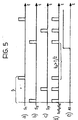
- the behaviours of these signals are schematically depicted in the time diagrams of Figures 5a, 5b, and 5c, shown for the sake of clarity also in Fig. 4.
- the recognition exploits the conventional timing signals relating to the transmission, not shown.
- the output of gate 24 (which passes to a "high" level whenever a signal S i is generated) resets a counter 25 capable of reaching a predetermined threshold (in practice, a pre-set count) only during the interval t 0 . It is therefore evident that such count is not attained during the interval denoted by D in Fig. 3.
- D is the time interval in which the signals S i identifying the arrival of the symbols S are generated one after the other. In this respect, reference may also be made to the time diagram of Fig. 5d.
- the output of the counter 25 is a signal AS (see the time diagram of Fig. 5e) that passes to a "high" logical level, thus enabling the modules 21, 22, and 23 to load the streams of incoming bytes, only near the end of the interval t 0 .
- the actual writing of the streams into the modules 21 to 23 will start from the byte immediately following the first symbol S received after the enabling.
- References 26, 27 and 28 indicate three additional receiving modules essentially formed by three FIFO memories. Reading from the memories 26, 27 and 28 is enabled only at the instant in which writing in all the alignment modules 21, 22 and 23 is started, with the addition of a possible additional delay to compensate (according to known criteria) possible jitter and wander phenomena introduced by the network R. Thus, reading will start at an instant adequately delayed with respect to the arrival, following the passage of AS to high level, of the first symbol S (S 1 in the example), associated to the most delayed stream. The generation of a corresponding signal enabling reading from the memories is well known to the person skilled in the art.
- reference 29 shows a bundling module that loads the outputs of the memories 26, 27 and 28 according to the same logic of alternation utilised during the transmission.
- the overall result is the building of the outgoing stream I d performed by meeting the sequential incoming order.
- the differences in the propagation times through the network R are in fact absorbed due to the re-alignment action performed in the modules 21 to 23.
- the solution according to the invention also allows compensating phenomena which may lead to a different time order of the different streams #1, #2, #3 within the interval D over which said information streams are distributed due to the propagation along the network R.
Landscapes
- Engineering & Computer Science (AREA)
- Computer Networks & Wireless Communication (AREA)
- Signal Processing (AREA)
- Power Engineering (AREA)
- Data Exchanges In Wide-Area Networks (AREA)
- Time-Division Multiplex Systems (AREA)
- Communication Control (AREA)
- Two-Way Televisions, Distribution Of Moving Picture Or The Like (AREA)
- Numerical Control (AREA)
Applications Claiming Priority (2)
| Application Number | Priority Date | Filing Date | Title |
|---|---|---|---|
| ITTO990059 | 1999-01-27 | ||
| IT1999TO000059A IT1307016B1 (it) | 1999-01-27 | 1999-01-27 | Procedimento e dispositivo per la trasmissione di segnali numerici. |
Publications (3)
| Publication Number | Publication Date |
|---|---|
| EP1024632A2 true EP1024632A2 (fr) | 2000-08-02 |
| EP1024632A3 EP1024632A3 (fr) | 2005-08-31 |
| EP1024632B1 EP1024632B1 (fr) | 2008-10-22 |
Family
ID=11417393
Family Applications (1)
| Application Number | Title | Priority Date | Filing Date |
|---|---|---|---|
| EP00101370A Expired - Lifetime EP1024632B1 (fr) | 1999-01-27 | 2000-01-24 | Procédé et dispositif de transmission de signaux numériques par multiplexage inverse |
Country Status (6)
| Country | Link |
|---|---|
| US (1) | US6625228B1 (fr) |
| EP (1) | EP1024632B1 (fr) |
| JP (1) | JP3437518B2 (fr) |
| CA (1) | CA2297236C (fr) |
| DE (1) | DE60040571D1 (fr) |
| IT (1) | IT1307016B1 (fr) |
Cited By (8)
| Publication number | Priority date | Publication date | Assignee | Title |
|---|---|---|---|---|
| EP1315397A3 (fr) * | 2001-11-21 | 2004-01-14 | Alcatel Canada Inc. | Bus haute vitesse à multiples canaux avec sequencement |
| US6687263B2 (en) * | 2001-04-18 | 2004-02-03 | Nonend Inventions N.V. | Method for inverse multiplexing |
| EP1424871A3 (fr) * | 2002-11-27 | 2006-06-14 | Alcatel Canada Inc. | Procédé et appareil pour la transmission de données à dèbit binaire élevée sur un médian ou fond de panier |
| WO2006065142A1 (fr) * | 2004-12-14 | 2006-06-22 | Telefonaktiebolaget Lm Ericsson | Protocole multiplex inverse |
| EP1720294A3 (fr) * | 2001-03-14 | 2007-05-16 | McData Corporation | Procédé d'agrégation d'une pluralité de liens stimulant une connexion unitaire |
| US7529190B2 (en) | 2001-07-04 | 2009-05-05 | Nonend Inventions N.V. | Method, device and software for digital inverse multiplexing |
| US7593336B2 (en) | 2003-10-31 | 2009-09-22 | Brocade Communications Systems, Inc. | Logical ports in trunking |
| US7619974B2 (en) | 2003-10-31 | 2009-11-17 | Brocade Communication Systems, Inc. | Frame traffic balancing across trunk groups |
Families Citing this family (3)
| Publication number | Priority date | Publication date | Assignee | Title |
|---|---|---|---|---|
| US6560292B1 (en) * | 2000-04-07 | 2003-05-06 | Qualcomm Incorporated | Method for coding in a telecommunications system |
| US7529276B1 (en) * | 2002-09-03 | 2009-05-05 | Cisco Technology, Inc. | Combined jitter and multiplexing systems and methods |
| CN109617834B (zh) * | 2019-02-01 | 2021-08-24 | 国网江苏省电力有限公司 | 一种精准切负荷系统及其通信方法、接入装置 |
Family Cites Families (15)
| Publication number | Priority date | Publication date | Assignee | Title |
|---|---|---|---|---|
| CA1232693A (fr) * | 1985-09-05 | 1988-02-09 | Alan F. Graves | Structure de multiplexage pour reseau |
| US4703475A (en) | 1985-12-04 | 1987-10-27 | American Telephone And Telegraph Company At&T Bell Laboratories | Data communication method and apparatus using multiple physical data links |
| JPS6376649A (ja) | 1986-09-19 | 1988-04-06 | Fujitsu Ltd | 端末付加装置 |
| JPH03104344A (ja) | 1989-09-18 | 1991-05-01 | Nec Corp | 複数チャンネル通信方式 |
| US5065396A (en) * | 1990-01-02 | 1991-11-12 | At&T Bell Laboratories | Inverse multiplexer and demultiplexer techniques |
| JP2946693B2 (ja) | 1990-08-28 | 1999-09-06 | 日本電気株式会社 | 並列データ伝送回路 |
| FR2669798B1 (fr) * | 1990-11-23 | 1994-09-16 | Lmt Radio Professionelle | Dispositif pour la transmission d'informations synchrones par un reseau asynchrone, notamment un reseau atm. |
| JPH04264843A (ja) | 1991-02-19 | 1992-09-21 | Nippon Telegr & Teleph Corp <Ntt> | マルチリンク伝送制御装置 |
| JPH06188882A (ja) | 1992-12-21 | 1994-07-08 | Oi Denki Kk | 伝搬遅延時間補償方法 |
| US5617417A (en) * | 1994-09-07 | 1997-04-01 | Stratacom, Inc. | Asynchronous transfer mode communication in inverse multiplexing over multiple communication links |
| SE503920C2 (sv) * | 1994-10-03 | 1996-09-30 | Ericsson Telefon Ab L M | Sätt att synkronisera signaler och anordning härför |
| DE69738484T2 (de) * | 1996-08-16 | 2008-05-21 | Nortel Networks Ltd., St. Laurent | Invertierte multiplexierung von digitalen daten |
| US6240140B1 (en) * | 1997-02-24 | 2001-05-29 | Picturetel Corporation | Channel aggregation having low latency and overhead |
| US6002670A (en) * | 1997-12-12 | 1999-12-14 | Nortel Networks Corporation | Optimization and recovery techniques in IMA networks |
| US6148010A (en) * | 1998-06-24 | 2000-11-14 | Qualcomm Incorporated | Method and apparatus for distributing and consolidating data packets onto multiple network interfaces |
-
1999
- 1999-01-27 IT IT1999TO000059A patent/IT1307016B1/it active
- 1999-12-30 US US09/475,937 patent/US6625228B1/en not_active Expired - Lifetime
-
2000
- 2000-01-24 EP EP00101370A patent/EP1024632B1/fr not_active Expired - Lifetime
- 2000-01-24 DE DE60040571T patent/DE60040571D1/de not_active Expired - Lifetime
- 2000-01-25 JP JP2000015857A patent/JP3437518B2/ja not_active Expired - Fee Related
- 2000-01-26 CA CA002297236A patent/CA2297236C/fr not_active Expired - Fee Related
Cited By (13)
| Publication number | Priority date | Publication date | Assignee | Title |
|---|---|---|---|---|
| EP1720294A3 (fr) * | 2001-03-14 | 2007-05-16 | McData Corporation | Procédé d'agrégation d'une pluralité de liens stimulant une connexion unitaire |
| US6687263B2 (en) * | 2001-04-18 | 2004-02-03 | Nonend Inventions N.V. | Method for inverse multiplexing |
| US7995624B2 (en) | 2001-04-18 | 2011-08-09 | Nonend Inventions N.V. | Systems and methods for multiplexing digital data |
| US7738513B2 (en) * | 2001-04-18 | 2010-06-15 | Nonend Inventions N.V. | Method for inverse multiplexing |
| US7529190B2 (en) | 2001-07-04 | 2009-05-05 | Nonend Inventions N.V. | Method, device and software for digital inverse multiplexing |
| EP1315397A3 (fr) * | 2001-11-21 | 2004-01-14 | Alcatel Canada Inc. | Bus haute vitesse à multiples canaux avec sequencement |
| US7286570B2 (en) | 2001-11-21 | 2007-10-23 | Alcatel-Lucent Canada Inc | High speed sequenced multi-channel bus |
| EP1424871A3 (fr) * | 2002-11-27 | 2006-06-14 | Alcatel Canada Inc. | Procédé et appareil pour la transmission de données à dèbit binaire élevée sur un médian ou fond de panier |
| US7327725B2 (en) | 2002-11-27 | 2008-02-05 | Alcatel Canada Inc. | Method and apparatus capable of transferring very high data rates across a midplane or backplane |
| US7619974B2 (en) | 2003-10-31 | 2009-11-17 | Brocade Communication Systems, Inc. | Frame traffic balancing across trunk groups |
| US7593336B2 (en) | 2003-10-31 | 2009-09-22 | Brocade Communications Systems, Inc. | Logical ports in trunking |
| US7948895B2 (en) | 2003-10-31 | 2011-05-24 | Brocade Communications Systems, Inc. | Frame traffic balancing across trunk groups |
| WO2006065142A1 (fr) * | 2004-12-14 | 2006-06-22 | Telefonaktiebolaget Lm Ericsson | Protocole multiplex inverse |
Also Published As
| Publication number | Publication date |
|---|---|
| JP2000224128A (ja) | 2000-08-11 |
| DE60040571D1 (de) | 2008-12-04 |
| EP1024632A3 (fr) | 2005-08-31 |
| US6625228B1 (en) | 2003-09-23 |
| JP3437518B2 (ja) | 2003-08-18 |
| IT1307016B1 (it) | 2001-10-11 |
| EP1024632B1 (fr) | 2008-10-22 |
| CA2297236A1 (fr) | 2000-07-27 |
| CA2297236C (fr) | 2004-09-28 |
| ITTO990059A1 (it) | 2000-07-27 |
Similar Documents
| Publication | Publication Date | Title |
|---|---|---|
| US6480902B1 (en) | Intermedia synchronization system for communicating multimedia data in a computer network | |
| US5422876A (en) | Out-of-band loopback control scheme | |
| US6839322B1 (en) | Method and system for optical routing of variable-length packet data | |
| EP0700610B1 (fr) | Procede et dispositif de transmission de paquets de donnees | |
| US6625228B1 (en) | Method of and a device for digital signal transmission | |
| CA1288848C (fr) | Systeme de commutation hybride a multiplexage temporel | |
| GB2182528A (en) | Stochastic time division multiplexing | |
| EP0121410B1 (fr) | Réseau local à structure en bus apte à la commutation de données | |
| US6188697B1 (en) | ATM cell transport system for wireless communications | |
| US4663755A (en) | Transmission system | |
| US8711889B2 (en) | Asynchronous line interface rate adaptation to the physical layer with synchronous lines at the connection layer | |
| WO1998018245A2 (fr) | Systeme de transmission a structure de trame souple | |
| US4105869A (en) | Time-division multiplex digital transmission system with intermediate stations adapted to transit insert and extract digital channels | |
| US7286570B2 (en) | High speed sequenced multi-channel bus | |
| US20100284425A1 (en) | System and method of using tdm variable frame lengths in a telecommunications network | |
| EP3729752B1 (fr) | Communication de données | |
| US6487176B1 (en) | Measuring method and measuring device for data communication networks | |
| US7301960B2 (en) | Apparatus for and method of control and communication of multiple stations in a TDM network | |
| US5995257A (en) | Add/drop multiplexer for multiwavelength pulse oriented optical communications systems | |
| US20020037018A1 (en) | Apparatus and method for reducing the line rate of time-multiplexed signals | |
| KR100498939B1 (ko) | 방송 통신 융합 시스템에서 방송 신호와 통신 신호를 시간분할 다중화하는 방법 | |
| JP2005519541A (ja) | 第1データストリームを第2データストリームに変換する方法及び装置 | |
| US7471699B2 (en) | Station for optical network suitable for inserting packets into a stream of packets in transit | |
| JP3679214B2 (ja) | 冗長構成システムにおける伝搬位相差吸収方法及び装置 | |
| JPH04207733A (ja) | 固定長パケット多重化装置 |
Legal Events
| Date | Code | Title | Description |
|---|---|---|---|
| PUAI | Public reference made under article 153(3) epc to a published international application that has entered the european phase |
Free format text: ORIGINAL CODE: 0009012 |
|
| AK | Designated contracting states |
Kind code of ref document: A2 Designated state(s): DE FR GB IT NL SE |
|
| AX | Request for extension of the european patent |
Free format text: AL;LT;LV;MK;RO;SI |
|
| RAP1 | Party data changed (applicant data changed or rights of an application transferred) |
Owner name: TELECOM ITALIA LAB S.P.A. |
|
| RAP1 | Party data changed (applicant data changed or rights of an application transferred) |
Owner name: TELECOM ITALIA S.P.A. |
|
| PUAL | Search report despatched |
Free format text: ORIGINAL CODE: 0009013 |
|
| AK | Designated contracting states |
Kind code of ref document: A3 Designated state(s): DE FR GB IT NL SE |
|
| AX | Request for extension of the european patent |
Extension state: AL LT LV MK RO SI |
|
| 17P | Request for examination filed |
Effective date: 20060125 |
|
| AKX | Designation fees paid |
Designated state(s): DE FR GB IT NL SE |
|
| 17Q | First examination report despatched |
Effective date: 20060329 |
|
| GRAP | Despatch of communication of intention to grant a patent |
Free format text: ORIGINAL CODE: EPIDOSNIGR1 |
|
| GRAS | Grant fee paid |
Free format text: ORIGINAL CODE: EPIDOSNIGR3 |
|
| GRAA | (expected) grant |
Free format text: ORIGINAL CODE: 0009210 |
|
| AK | Designated contracting states |
Kind code of ref document: B1 Designated state(s): DE FR GB IT NL SE |
|
| REG | Reference to a national code |
Ref country code: GB Ref legal event code: FG4D |
|
| REF | Corresponds to: |
Ref document number: 60040571 Country of ref document: DE Date of ref document: 20081204 Kind code of ref document: P |
|
| NLV1 | Nl: lapsed or annulled due to failure to fulfill the requirements of art. 29p and 29m of the patents act | ||
| PG25 | Lapsed in a contracting state [announced via postgrant information from national office to epo] |
Ref country code: NL Free format text: LAPSE BECAUSE OF FAILURE TO SUBMIT A TRANSLATION OF THE DESCRIPTION OR TO PAY THE FEE WITHIN THE PRESCRIBED TIME-LIMIT Effective date: 20081022 |
|
| PLBE | No opposition filed within time limit |
Free format text: ORIGINAL CODE: 0009261 |
|
| STAA | Information on the status of an ep patent application or granted ep patent |
Free format text: STATUS: NO OPPOSITION FILED WITHIN TIME LIMIT |
|
| PG25 | Lapsed in a contracting state [announced via postgrant information from national office to epo] |
Ref country code: SE Free format text: LAPSE BECAUSE OF FAILURE TO SUBMIT A TRANSLATION OF THE DESCRIPTION OR TO PAY THE FEE WITHIN THE PRESCRIBED TIME-LIMIT Effective date: 20090122 |
|
| 26N | No opposition filed |
Effective date: 20090723 |
|
| REG | Reference to a national code |
Ref country code: FR Ref legal event code: PLFP Year of fee payment: 17 |
|
| REG | Reference to a national code |
Ref country code: FR Ref legal event code: PLFP Year of fee payment: 18 |
|
| PGFP | Annual fee paid to national office [announced via postgrant information from national office to epo] |
Ref country code: FR Payment date: 20170125 Year of fee payment: 18 Ref country code: DE Payment date: 20170125 Year of fee payment: 18 |
|
| PGFP | Annual fee paid to national office [announced via postgrant information from national office to epo] |
Ref country code: GB Payment date: 20170127 Year of fee payment: 18 |
|
| PGFP | Annual fee paid to national office [announced via postgrant information from national office to epo] |
Ref country code: IT Payment date: 20180122 Year of fee payment: 19 |
|
| REG | Reference to a national code |
Ref country code: DE Ref legal event code: R119 Ref document number: 60040571 Country of ref document: DE |
|
| GBPC | Gb: european patent ceased through non-payment of renewal fee |
Effective date: 20180124 |
|
| PG25 | Lapsed in a contracting state [announced via postgrant information from national office to epo] |
Ref country code: FR Free format text: LAPSE BECAUSE OF NON-PAYMENT OF DUE FEES Effective date: 20180131 Ref country code: DE Free format text: LAPSE BECAUSE OF NON-PAYMENT OF DUE FEES Effective date: 20180801 |
|
| REG | Reference to a national code |
Ref country code: FR Ref legal event code: ST Effective date: 20180928 |
|
| PG25 | Lapsed in a contracting state [announced via postgrant information from national office to epo] |
Ref country code: GB Free format text: LAPSE BECAUSE OF NON-PAYMENT OF DUE FEES Effective date: 20180124 |
|
| PG25 | Lapsed in a contracting state [announced via postgrant information from national office to epo] |
Ref country code: IT Free format text: LAPSE BECAUSE OF NON-PAYMENT OF DUE FEES Effective date: 20190124 |