EP1026436A2 - Article et procédé destinés à protéger des substrats - Google Patents
Article et procédé destinés à protéger des substrats Download PDFInfo
- Publication number
- EP1026436A2 EP1026436A2 EP00201130A EP00201130A EP1026436A2 EP 1026436 A2 EP1026436 A2 EP 1026436A2 EP 00201130 A EP00201130 A EP 00201130A EP 00201130 A EP00201130 A EP 00201130A EP 1026436 A2 EP1026436 A2 EP 1026436A2
- Authority
- EP
- European Patent Office
- Prior art keywords
- substrate
- article
- tape
- heat
- composition
- Prior art date
- Legal status (The legal status is an assumption and is not a legal conclusion. Google has not performed a legal analysis and makes no representation as to the accuracy of the status listed.)
- Withdrawn
Links
- 239000000758 substrate Substances 0.000 title claims abstract description 102
- 238000000034 method Methods 0.000 title claims abstract description 35
- 239000000853 adhesive Substances 0.000 claims abstract description 32
- 230000001070 adhesive effect Effects 0.000 claims abstract description 32
- 230000005291 magnetic effect Effects 0.000 claims abstract description 5
- 239000000203 mixture Substances 0.000 claims description 45
- 238000010438 heat treatment Methods 0.000 claims description 34
- 230000006698 induction Effects 0.000 claims description 18
- 230000001681 protective effect Effects 0.000 claims description 11
- 230000002500 effect on skin Effects 0.000 claims description 6
- 230000002708 enhancing effect Effects 0.000 claims description 3
- 239000012530 fluid Substances 0.000 claims description 3
- 229910052751 metal Inorganic materials 0.000 abstract description 8
- 239000002184 metal Substances 0.000 abstract description 8
- 239000003795 chemical substances by application Substances 0.000 description 16
- 239000010410 layer Substances 0.000 description 14
- 229920005989 resin Polymers 0.000 description 13
- 239000011347 resin Substances 0.000 description 13
- 239000012790 adhesive layer Substances 0.000 description 12
- 239000004593 Epoxy Substances 0.000 description 10
- 239000004831 Hot glue Substances 0.000 description 10
- 239000000463 material Substances 0.000 description 8
- 229920000647 polyepoxide Polymers 0.000 description 8
- 239000004952 Polyamide Substances 0.000 description 7
- 229920002647 polyamide Polymers 0.000 description 7
- -1 polyethylene Polymers 0.000 description 7
- 239000011800 void material Substances 0.000 description 7
- 238000000576 coating method Methods 0.000 description 6
- RAXXELZNTBOGNW-UHFFFAOYSA-N imidazole Chemical class C1=CNC=N1 RAXXELZNTBOGNW-UHFFFAOYSA-N 0.000 description 6
- 239000007788 liquid Substances 0.000 description 6
- 150000001412 amines Chemical class 0.000 description 5
- 230000008901 benefit Effects 0.000 description 5
- 230000007246 mechanism Effects 0.000 description 5
- 229910000831 Steel Inorganic materials 0.000 description 4
- 239000011248 coating agent Substances 0.000 description 4
- 230000007797 corrosion Effects 0.000 description 4
- 238000005260 corrosion Methods 0.000 description 4
- 239000003822 epoxy resin Substances 0.000 description 4
- 229920002635 polyurethane Polymers 0.000 description 4
- 239000004814 polyurethane Substances 0.000 description 4
- 239000007787 solid Substances 0.000 description 4
- 239000010959 steel Substances 0.000 description 4
- 229920001187 thermosetting polymer Polymers 0.000 description 4
- IISBACLAFKSPIT-UHFFFAOYSA-N Bisphenol A Natural products C=1C=C(O)C=CC=1C(C)(C)C1=CC=C(O)C=C1 IISBACLAFKSPIT-UHFFFAOYSA-N 0.000 description 3
- VGGSQFUCUMXWEO-UHFFFAOYSA-N Ethene Chemical compound C=C VGGSQFUCUMXWEO-UHFFFAOYSA-N 0.000 description 3
- 239000005977 Ethylene Substances 0.000 description 3
- ZMANZCXQSJIPKH-UHFFFAOYSA-N Triethylamine Chemical compound CCN(CC)CC ZMANZCXQSJIPKH-UHFFFAOYSA-N 0.000 description 3
- 230000003197 catalytic effect Effects 0.000 description 3
- 230000000694 effects Effects 0.000 description 3
- ISWSIDIOOBJBQZ-UHFFFAOYSA-N phenol group Chemical group C1(=CC=CC=C1)O ISWSIDIOOBJBQZ-UHFFFAOYSA-N 0.000 description 3
- 229920000728 polyester Polymers 0.000 description 3
- 239000002904 solvent Substances 0.000 description 3
- 229920001897 terpolymer Polymers 0.000 description 3
- XLYOFNOQVPJJNP-UHFFFAOYSA-N water Substances O XLYOFNOQVPJJNP-UHFFFAOYSA-N 0.000 description 3
- 238000004804 winding Methods 0.000 description 3
- BJELTSYBAHKXRW-UHFFFAOYSA-N 2,4,6-triallyloxy-1,3,5-triazine Chemical compound C=CCOC1=NC(OCC=C)=NC(OCC=C)=N1 BJELTSYBAHKXRW-UHFFFAOYSA-N 0.000 description 2
- 239000003341 Bronsted base Substances 0.000 description 2
- 229910000975 Carbon steel Inorganic materials 0.000 description 2
- NQRYJNQNLNOLGT-UHFFFAOYSA-N Piperidine Chemical compound C1CCNCC1 NQRYJNQNLNOLGT-UHFFFAOYSA-N 0.000 description 2
- 239000004642 Polyimide Substances 0.000 description 2
- JUJWROOIHBZHMG-UHFFFAOYSA-N Pyridine Chemical compound C1=CC=NC=C1 JUJWROOIHBZHMG-UHFFFAOYSA-N 0.000 description 2
- PPBRXRYQALVLMV-UHFFFAOYSA-N Styrene Chemical compound C=CC1=CC=CC=C1 PPBRXRYQALVLMV-UHFFFAOYSA-N 0.000 description 2
- GWEVSGVZZGPLCZ-UHFFFAOYSA-N Titan oxide Chemical compound O=[Ti]=O GWEVSGVZZGPLCZ-UHFFFAOYSA-N 0.000 description 2
- DAKWPKUUDNSNPN-UHFFFAOYSA-N Trimethylolpropane triacrylate Chemical compound C=CC(=O)OCC(CC)(COC(=O)C=C)COC(=O)C=C DAKWPKUUDNSNPN-UHFFFAOYSA-N 0.000 description 2
- 229920000800 acrylic rubber Polymers 0.000 description 2
- 239000000654 additive Substances 0.000 description 2
- 150000004982 aromatic amines Chemical class 0.000 description 2
- TZCXTZWJZNENPQ-UHFFFAOYSA-L barium sulfate Chemical compound [Ba+2].[O-]S([O-])(=O)=O TZCXTZWJZNENPQ-UHFFFAOYSA-L 0.000 description 2
- 239000004841 bisphenol A epoxy resin Substances 0.000 description 2
- 235000013877 carbamide Nutrition 0.000 description 2
- YCIMNLLNPGFGHC-UHFFFAOYSA-N catechol Chemical compound OC1=CC=CC=C1O YCIMNLLNPGFGHC-UHFFFAOYSA-N 0.000 description 2
- 239000011280 coal tar Substances 0.000 description 2
- 239000004020 conductor Substances 0.000 description 2
- 125000003700 epoxy group Chemical group 0.000 description 2
- 230000020169 heat generation Effects 0.000 description 2
- 150000002460 imidazoles Chemical class 0.000 description 2
- 239000011256 inorganic filler Substances 0.000 description 2
- 229910003475 inorganic filler Inorganic materials 0.000 description 2
- 238000009434 installation Methods 0.000 description 2
- 238000004519 manufacturing process Methods 0.000 description 2
- 229920003986 novolac Polymers 0.000 description 2
- 229920000058 polyacrylate Polymers 0.000 description 2
- 229920000768 polyamine Polymers 0.000 description 2
- 229920001601 polyetherimide Polymers 0.000 description 2
- 229920001721 polyimide Polymers 0.000 description 2
- 229920000642 polymer Polymers 0.000 description 2
- 229920000098 polyolefin Polymers 0.000 description 2
- 229920001296 polysiloxane Polymers 0.000 description 2
- 229920001021 polysulfide Polymers 0.000 description 2
- 239000002689 soil Substances 0.000 description 2
- 150000003512 tertiary amines Chemical class 0.000 description 2
- 229920005992 thermoplastic resin Polymers 0.000 description 2
- 229940096522 trimethylolpropane triacrylate Drugs 0.000 description 2
- 150000003672 ureas Chemical class 0.000 description 2
- KOMNUTZXSVSERR-UHFFFAOYSA-N 1,3,5-tris(prop-2-enyl)-1,3,5-triazinane-2,4,6-trione Chemical compound C=CCN1C(=O)N(CC=C)C(=O)N(CC=C)C1=O KOMNUTZXSVSERR-UHFFFAOYSA-N 0.000 description 1
- WZCQRUWWHSTZEM-UHFFFAOYSA-N 1,3-phenylenediamine Chemical compound NC1=CC=CC(N)=C1 WZCQRUWWHSTZEM-UHFFFAOYSA-N 0.000 description 1
- XQUPVDVFXZDTLT-UHFFFAOYSA-N 1-[4-[[4-(2,5-dioxopyrrol-1-yl)phenyl]methyl]phenyl]pyrrole-2,5-dione Chemical compound O=C1C=CC(=O)N1C(C=C1)=CC=C1CC1=CC=C(N2C(C=CC2=O)=O)C=C1 XQUPVDVFXZDTLT-UHFFFAOYSA-N 0.000 description 1
- VLDPXPPHXDGHEW-UHFFFAOYSA-N 1-chloro-2-dichlorophosphoryloxybenzene Chemical compound ClC1=CC=CC=C1OP(Cl)(Cl)=O VLDPXPPHXDGHEW-UHFFFAOYSA-N 0.000 description 1
- MCTWTZJPVLRJOU-UHFFFAOYSA-N 1-methyl-1H-imidazole Chemical compound CN1C=CN=C1 MCTWTZJPVLRJOU-UHFFFAOYSA-N 0.000 description 1
- VILCJCGEZXAXTO-UHFFFAOYSA-N 2,2,2-tetramine Chemical compound NCCNCCNCCN VILCJCGEZXAXTO-UHFFFAOYSA-N 0.000 description 1
- AHDSRXYHVZECER-UHFFFAOYSA-N 2,4,6-tris[(dimethylamino)methyl]phenol Chemical compound CN(C)CC1=CC(CN(C)C)=C(O)C(CN(C)C)=C1 AHDSRXYHVZECER-UHFFFAOYSA-N 0.000 description 1
- PISLZQACAJMAIO-UHFFFAOYSA-N 2,4-diethyl-6-methylbenzene-1,3-diamine Chemical compound CCC1=CC(C)=C(N)C(CC)=C1N PISLZQACAJMAIO-UHFFFAOYSA-N 0.000 description 1
- SMZOUWXMTYCWNB-UHFFFAOYSA-N 2-(2-methoxy-5-methylphenyl)ethanamine Chemical compound COC1=CC=C(C)C=C1CCN SMZOUWXMTYCWNB-UHFFFAOYSA-N 0.000 description 1
- NIXOWILDQLNWCW-UHFFFAOYSA-N 2-Propenoic acid Natural products OC(=O)C=C NIXOWILDQLNWCW-UHFFFAOYSA-N 0.000 description 1
- KXGFMDJXCMQABM-UHFFFAOYSA-N 2-methoxy-6-methylphenol Chemical compound [CH]OC1=CC=CC([CH])=C1O KXGFMDJXCMQABM-UHFFFAOYSA-N 0.000 description 1
- RNLHGQLZWXBQNY-UHFFFAOYSA-N 3-(aminomethyl)-3,5,5-trimethylcyclohexan-1-amine Chemical compound CC1(C)CC(N)CC(C)(CN)C1 RNLHGQLZWXBQNY-UHFFFAOYSA-N 0.000 description 1
- YBRVSVVVWCFQMG-UHFFFAOYSA-N 4,4'-diaminodiphenylmethane Chemical compound C1=CC(N)=CC=C1CC1=CC=C(N)C=C1 YBRVSVVVWCFQMG-UHFFFAOYSA-N 0.000 description 1
- KOGSPLLRMRSADR-UHFFFAOYSA-N 4-(2-aminopropan-2-yl)-1-methylcyclohexan-1-amine Chemical compound CC(C)(N)C1CCC(C)(N)CC1 KOGSPLLRMRSADR-UHFFFAOYSA-N 0.000 description 1
- NWIVYGKSHSJHEF-UHFFFAOYSA-N 4-[(4-amino-3,5-diethylphenyl)methyl]-2,6-diethylaniline Chemical compound CCC1=C(N)C(CC)=CC(CC=2C=C(CC)C(N)=C(CC)C=2)=C1 NWIVYGKSHSJHEF-UHFFFAOYSA-N 0.000 description 1
- QJENIOQDYXRGLF-UHFFFAOYSA-N 4-[(4-amino-3-ethyl-5-methylphenyl)methyl]-2-ethyl-6-methylaniline Chemical compound CC1=C(N)C(CC)=CC(CC=2C=C(CC)C(N)=C(C)C=2)=C1 QJENIOQDYXRGLF-UHFFFAOYSA-N 0.000 description 1
- FLNVGZMDLLIECD-UHFFFAOYSA-N 4-[(4-amino-3-methyl-5-propan-2-ylphenyl)methyl]-2-methyl-6-propan-2-ylaniline Chemical compound CC1=C(N)C(C(C)C)=CC(CC=2C=C(C(N)=C(C)C=2)C(C)C)=C1 FLNVGZMDLLIECD-UHFFFAOYSA-N 0.000 description 1
- QBNMYCJUFDBARZ-UHFFFAOYSA-N 4-[[4-amino-3,3-di(propan-2-yl)cyclohexa-1,5-dien-1-yl]methyl]-6,6-di(propan-2-yl)cyclohexa-2,4-dien-1-amine Chemical compound C1=CC(N)C(C(C)C)(C(C)C)C=C1CC1=CC(C(C)C)(C(C)C)C(N)C=C1 QBNMYCJUFDBARZ-UHFFFAOYSA-N 0.000 description 1
- AOFIWCXMXPVSAZ-UHFFFAOYSA-N 4-methyl-2,6-bis(methylsulfanyl)benzene-1,3-diamine Chemical compound CSC1=CC(C)=C(N)C(SC)=C1N AOFIWCXMXPVSAZ-UHFFFAOYSA-N 0.000 description 1
- 239000004925 Acrylic resin Substances 0.000 description 1
- 229920000178 Acrylic resin Polymers 0.000 description 1
- NLHHRLWOUZZQLW-UHFFFAOYSA-N Acrylonitrile Chemical compound C=CC#N NLHHRLWOUZZQLW-UHFFFAOYSA-N 0.000 description 1
- LCFVJGUPQDGYKZ-UHFFFAOYSA-N Bisphenol A diglycidyl ether Chemical compound C=1C=C(OCC2OC2)C=CC=1C(C)(C)C(C=C1)=CC=C1OCC1CO1 LCFVJGUPQDGYKZ-UHFFFAOYSA-N 0.000 description 1
- ZOXJGFHDIHLPTG-UHFFFAOYSA-N Boron Chemical compound [B] ZOXJGFHDIHLPTG-UHFFFAOYSA-N 0.000 description 1
- RYGMFSIKBFXOCR-UHFFFAOYSA-N Copper Chemical compound [Cu] RYGMFSIKBFXOCR-UHFFFAOYSA-N 0.000 description 1
- MQJKPEGWNLWLTK-UHFFFAOYSA-N Dapsone Chemical class C1=CC(N)=CC=C1S(=O)(=O)C1=CC=C(N)C=C1 MQJKPEGWNLWLTK-UHFFFAOYSA-N 0.000 description 1
- RPNUMPOLZDHAAY-UHFFFAOYSA-N Diethylenetriamine Chemical compound NCCNCCN RPNUMPOLZDHAAY-UHFFFAOYSA-N 0.000 description 1
- 229920002943 EPDM rubber Polymers 0.000 description 1
- JIGUQPWFLRLWPJ-UHFFFAOYSA-N Ethyl acrylate Chemical compound CCOC(=O)C=C JIGUQPWFLRLWPJ-UHFFFAOYSA-N 0.000 description 1
- PIICEJLVQHRZGT-UHFFFAOYSA-N Ethylenediamine Chemical compound NCCN PIICEJLVQHRZGT-UHFFFAOYSA-N 0.000 description 1
- CERQOIWHTDAKMF-UHFFFAOYSA-N Methacrylic acid Chemical compound CC(=C)C(O)=O CERQOIWHTDAKMF-UHFFFAOYSA-N 0.000 description 1
- WFBLCQBGPREYPZ-UHFFFAOYSA-N N=C=O.CCC1=NC=NC=N1 Chemical compound N=C=O.CCC1=NC=NC=N1 WFBLCQBGPREYPZ-UHFFFAOYSA-N 0.000 description 1
- 229920000459 Nitrile rubber Polymers 0.000 description 1
- 239000004677 Nylon Substances 0.000 description 1
- 239000004697 Polyetherimide Substances 0.000 description 1
- 239000004698 Polyethylene Substances 0.000 description 1
- 239000004721 Polyphenylene oxide Substances 0.000 description 1
- 239000004743 Polypropylene Substances 0.000 description 1
- 239000004793 Polystyrene Substances 0.000 description 1
- XTXRWKRVRITETP-UHFFFAOYSA-N Vinyl acetate Chemical compound CC(=O)OC=C XTXRWKRVRITETP-UHFFFAOYSA-N 0.000 description 1
- 238000005299 abrasion Methods 0.000 description 1
- GTDPSWPPOUPBNX-UHFFFAOYSA-N ac1mqpva Chemical compound CC12C(=O)OC(=O)C1(C)C1(C)C2(C)C(=O)OC1=O GTDPSWPPOUPBNX-UHFFFAOYSA-N 0.000 description 1
- 150000001252 acrylic acid derivatives Chemical class 0.000 description 1
- 230000001154 acute effect Effects 0.000 description 1
- 150000004703 alkoxides Chemical class 0.000 description 1
- 125000005250 alkyl acrylate group Chemical group 0.000 description 1
- 125000000217 alkyl group Chemical group 0.000 description 1
- 239000004411 aluminium Substances 0.000 description 1
- 229910052782 aluminium Inorganic materials 0.000 description 1
- XAGFODPZIPBFFR-UHFFFAOYSA-N aluminium Chemical compound [Al] XAGFODPZIPBFFR-UHFFFAOYSA-N 0.000 description 1
- 125000003277 amino group Chemical group 0.000 description 1
- 229920006020 amorphous polyamide Polymers 0.000 description 1
- 150000008064 anhydrides Chemical class 0.000 description 1
- 239000011952 anionic catalyst Substances 0.000 description 1
- 239000002585 base Substances 0.000 description 1
- 230000015572 biosynthetic process Effects 0.000 description 1
- 229920001400 block copolymer Polymers 0.000 description 1
- 229910052796 boron Inorganic materials 0.000 description 1
- DQXBYHZEEUGOBF-UHFFFAOYSA-N but-3-enoic acid;ethene Chemical compound C=C.OC(=O)CC=C DQXBYHZEEUGOBF-UHFFFAOYSA-N 0.000 description 1
- 229920005549 butyl rubber Polymers 0.000 description 1
- 239000004202 carbamide Substances 0.000 description 1
- 239000003054 catalyst Substances 0.000 description 1
- 230000008859 change Effects 0.000 description 1
- 150000001875 compounds Chemical class 0.000 description 1
- 238000010924 continuous production Methods 0.000 description 1
- 238000001816 cooling Methods 0.000 description 1
- 229920001577 copolymer Polymers 0.000 description 1
- 239000010949 copper Substances 0.000 description 1
- 229910052802 copper Inorganic materials 0.000 description 1
- 238000004132 cross linking Methods 0.000 description 1
- 229920003020 cross-linked polyethylene Polymers 0.000 description 1
- 239000004703 cross-linked polyethylene Substances 0.000 description 1
- GEQHKFFSPGPGLN-UHFFFAOYSA-N cyclohexane-1,3-diamine Chemical compound NC1CCCC(N)C1 GEQHKFFSPGPGLN-UHFFFAOYSA-N 0.000 description 1
- 230000007547 defect Effects 0.000 description 1
- QGBSISYHAICWAH-UHFFFAOYSA-N dicyandiamide Chemical compound NC(N)=NC#N QGBSISYHAICWAH-UHFFFAOYSA-N 0.000 description 1
- ZBCBWPMODOFKDW-UHFFFAOYSA-N diethanolamine Chemical compound OCCNCCO ZBCBWPMODOFKDW-UHFFFAOYSA-N 0.000 description 1
- 229940043237 diethanolamine Drugs 0.000 description 1
- IUNMPGNGSSIWFP-UHFFFAOYSA-N dimethylaminopropylamine Chemical compound CN(C)CCCN IUNMPGNGSSIWFP-UHFFFAOYSA-N 0.000 description 1
- XXBDWLFCJWSEKW-UHFFFAOYSA-N dimethylbenzylamine Chemical compound CN(C)CC1=CC=CC=C1 XXBDWLFCJWSEKW-UHFFFAOYSA-N 0.000 description 1
- 229920001971 elastomer Polymers 0.000 description 1
- 229920005558 epichlorohydrin rubber Polymers 0.000 description 1
- 229920001038 ethylene copolymer Polymers 0.000 description 1
- 239000005038 ethylene vinyl acetate Substances 0.000 description 1
- 230000001747 exhibiting effect Effects 0.000 description 1
- 239000002902 ferrimagnetic material Substances 0.000 description 1
- 230000005294 ferromagnetic effect Effects 0.000 description 1
- 239000000945 filler Substances 0.000 description 1
- LNEPOXFFQSENCJ-UHFFFAOYSA-N haloperidol Chemical compound C1CC(O)(C=2C=CC(Cl)=CC=2)CCN1CCCC(=O)C1=CC=C(F)C=C1 LNEPOXFFQSENCJ-UHFFFAOYSA-N 0.000 description 1
- 229920001903 high density polyethylene Polymers 0.000 description 1
- 239000004700 high-density polyethylene Substances 0.000 description 1
- 125000002887 hydroxy group Chemical group [H]O* 0.000 description 1
- ZFSLODLOARCGLH-UHFFFAOYSA-N isocyanuric acid Chemical compound OC1=NC(O)=NC(O)=N1 ZFSLODLOARCGLH-UHFFFAOYSA-N 0.000 description 1
- 239000004850 liquid epoxy resins (LERs) Substances 0.000 description 1
- 230000005923 long-lasting effect Effects 0.000 description 1
- 229940018564 m-phenylenediamine Drugs 0.000 description 1
- FPYJFEHAWHCUMM-UHFFFAOYSA-N maleic anhydride Chemical compound O=C1OC(=O)C=C1 FPYJFEHAWHCUMM-UHFFFAOYSA-N 0.000 description 1
- 239000000155 melt Substances 0.000 description 1
- 238000002844 melting Methods 0.000 description 1
- 230000008018 melting Effects 0.000 description 1
- 150000002739 metals Chemical class 0.000 description 1
- 239000010445 mica Substances 0.000 description 1
- 229910052618 mica group Inorganic materials 0.000 description 1
- 229920001778 nylon Polymers 0.000 description 1
- PNJWIWWMYCMZRO-UHFFFAOYSA-N pent‐4‐en‐2‐one Natural products CC(=O)CC=C PNJWIWWMYCMZRO-UHFFFAOYSA-N 0.000 description 1
- 230000035699 permeability Effects 0.000 description 1
- 150000002978 peroxides Chemical class 0.000 description 1
- 229920001568 phenolic resin Polymers 0.000 description 1
- 239000005011 phenolic resin Substances 0.000 description 1
- 229920006287 phenoxy resin Polymers 0.000 description 1
- 239000013034 phenoxy resin Substances 0.000 description 1
- 229920003023 plastic Polymers 0.000 description 1
- 239000004033 plastic Substances 0.000 description 1
- 229920003192 poly(bis maleimide) Polymers 0.000 description 1
- 229920001200 poly(ethylene-vinyl acetate) Polymers 0.000 description 1
- 229920003229 poly(methyl methacrylate) Polymers 0.000 description 1
- 229920002492 poly(sulfone) Polymers 0.000 description 1
- 229920002239 polyacrylonitrile Polymers 0.000 description 1
- 239000004417 polycarbonate Substances 0.000 description 1
- 229920000515 polycarbonate Polymers 0.000 description 1
- 229920000573 polyethylene Polymers 0.000 description 1
- 239000004848 polyfunctional curative Substances 0.000 description 1
- 239000004926 polymethyl methacrylate Substances 0.000 description 1
- 229920006380 polyphenylene oxide Polymers 0.000 description 1
- 229920001155 polypropylene Polymers 0.000 description 1
- 229920002223 polystyrene Polymers 0.000 description 1
- 239000005077 polysulfide Substances 0.000 description 1
- 150000008117 polysulfides Polymers 0.000 description 1
- UMJSCPRVCHMLSP-UHFFFAOYSA-N pyridine Natural products COC1=CC=CN=C1 UMJSCPRVCHMLSP-UHFFFAOYSA-N 0.000 description 1
- 238000011084 recovery Methods 0.000 description 1
- 239000005060 rubber Substances 0.000 description 1
- 239000000565 sealant Substances 0.000 description 1
- 150000003335 secondary amines Chemical class 0.000 description 1
- 238000007493 shaping process Methods 0.000 description 1
- 238000005507 spraying Methods 0.000 description 1
- 239000003381 stabilizer Substances 0.000 description 1
- 229910001220 stainless steel Inorganic materials 0.000 description 1
- 229920006132 styrene block copolymer Polymers 0.000 description 1
- 229920006345 thermoplastic polyamide Polymers 0.000 description 1
- 239000004408 titanium dioxide Substances 0.000 description 1
- 230000001052 transient effect Effects 0.000 description 1
- 229960001124 trientine Drugs 0.000 description 1
- 229940086542 triethylamine Drugs 0.000 description 1
- 229920006305 unsaturated polyester Polymers 0.000 description 1
- 150000003673 urethanes Chemical class 0.000 description 1
- 239000001993 wax Substances 0.000 description 1
- 229910000859 α-Fe Inorganic materials 0.000 description 1
Images

Classifications
-
- F—MECHANICAL ENGINEERING; LIGHTING; HEATING; WEAPONS; BLASTING
- F16—ENGINEERING ELEMENTS AND UNITS; GENERAL MEASURES FOR PRODUCING AND MAINTAINING EFFECTIVE FUNCTIONING OF MACHINES OR INSTALLATIONS; THERMAL INSULATION IN GENERAL
- F16L—PIPES; JOINTS OR FITTINGS FOR PIPES; SUPPORTS FOR PIPES, CABLES OR PROTECTIVE TUBING; MEANS FOR THERMAL INSULATION IN GENERAL
- F16L58/00—Protection of pipes or pipe fittings against corrosion or incrustation
- F16L58/02—Protection of pipes or pipe fittings against corrosion or incrustation by means of internal or external coatings
- F16L58/16—Protection of pipes or pipe fittings against corrosion or incrustation by means of internal or external coatings the coating being in the form of a bandage
-
- B—PERFORMING OPERATIONS; TRANSPORTING
- B29—WORKING OF PLASTICS; WORKING OF SUBSTANCES IN A PLASTIC STATE IN GENERAL
- B29C—SHAPING OR JOINING OF PLASTICS; SHAPING OF MATERIAL IN A PLASTIC STATE, NOT OTHERWISE PROVIDED FOR; AFTER-TREATMENT OF THE SHAPED PRODUCTS, e.g. REPAIRING
- B29C53/00—Shaping by bending, folding, twisting, straightening or flattening; Apparatus therefor
- B29C53/80—Component parts, details or accessories; Auxiliary operations
- B29C53/8008—Component parts, details or accessories; Auxiliary operations specially adapted for winding and joining
- B29C53/8083—Improving bonding of wound materials or layers
-
- B—PERFORMING OPERATIONS; TRANSPORTING
- B29—WORKING OF PLASTICS; WORKING OF SUBSTANCES IN A PLASTIC STATE IN GENERAL
- B29C—SHAPING OR JOINING OF PLASTICS; SHAPING OF MATERIAL IN A PLASTIC STATE, NOT OTHERWISE PROVIDED FOR; AFTER-TREATMENT OF THE SHAPED PRODUCTS, e.g. REPAIRING
- B29C63/00—Lining or sheathing, i.e. applying preformed layers or sheathings of plastics; Apparatus therefor
- B29C63/02—Lining or sheathing, i.e. applying preformed layers or sheathings of plastics; Apparatus therefor using sheet or web-like material
- B29C63/04—Lining or sheathing, i.e. applying preformed layers or sheathings of plastics; Apparatus therefor using sheet or web-like material by folding, winding, bending or the like
- B29C63/08—Lining or sheathing, i.e. applying preformed layers or sheathings of plastics; Apparatus therefor using sheet or web-like material by folding, winding, bending or the like by winding helically
- B29C63/10—Lining or sheathing, i.e. applying preformed layers or sheathings of plastics; Apparatus therefor using sheet or web-like material by folding, winding, bending or the like by winding helically around tubular articles
-
- B—PERFORMING OPERATIONS; TRANSPORTING
- B29—WORKING OF PLASTICS; WORKING OF SUBSTANCES IN A PLASTIC STATE IN GENERAL
- B29C—SHAPING OR JOINING OF PLASTICS; SHAPING OF MATERIAL IN A PLASTIC STATE, NOT OTHERWISE PROVIDED FOR; AFTER-TREATMENT OF THE SHAPED PRODUCTS, e.g. REPAIRING
- B29C63/00—Lining or sheathing, i.e. applying preformed layers or sheathings of plastics; Apparatus therefor
- B29C63/02—Lining or sheathing, i.e. applying preformed layers or sheathings of plastics; Apparatus therefor using sheet or web-like material
- B29C63/04—Lining or sheathing, i.e. applying preformed layers or sheathings of plastics; Apparatus therefor using sheet or web-like material by folding, winding, bending or the like
- B29C63/08—Lining or sheathing, i.e. applying preformed layers or sheathings of plastics; Apparatus therefor using sheet or web-like material by folding, winding, bending or the like by winding helically
- B29C63/10—Lining or sheathing, i.e. applying preformed layers or sheathings of plastics; Apparatus therefor using sheet or web-like material by folding, winding, bending or the like by winding helically around tubular articles
- B29C63/105—Lining or sheathing, i.e. applying preformed layers or sheathings of plastics; Apparatus therefor using sheet or web-like material by folding, winding, bending or the like by winding helically around tubular articles continuously
-
- B—PERFORMING OPERATIONS; TRANSPORTING
- B29—WORKING OF PLASTICS; WORKING OF SUBSTANCES IN A PLASTIC STATE IN GENERAL
- B29C—SHAPING OR JOINING OF PLASTICS; SHAPING OF MATERIAL IN A PLASTIC STATE, NOT OTHERWISE PROVIDED FOR; AFTER-TREATMENT OF THE SHAPED PRODUCTS, e.g. REPAIRING
- B29C35/00—Heating, cooling or curing, e.g. crosslinking or vulcanising; Apparatus therefor
- B29C35/02—Heating or curing, e.g. crosslinking or vulcanizing during moulding, e.g. in a mould
- B29C35/08—Heating or curing, e.g. crosslinking or vulcanizing during moulding, e.g. in a mould by wave energy or particle radiation
- B29C35/0805—Heating or curing, e.g. crosslinking or vulcanizing during moulding, e.g. in a mould by wave energy or particle radiation using electromagnetic radiation
- B29C2035/0811—Heating or curing, e.g. crosslinking or vulcanizing during moulding, e.g. in a mould by wave energy or particle radiation using electromagnetic radiation using induction
-
- B—PERFORMING OPERATIONS; TRANSPORTING
- B29—WORKING OF PLASTICS; WORKING OF SUBSTANCES IN A PLASTIC STATE IN GENERAL
- B29C—SHAPING OR JOINING OF PLASTICS; SHAPING OF MATERIAL IN A PLASTIC STATE, NOT OTHERWISE PROVIDED FOR; AFTER-TREATMENT OF THE SHAPED PRODUCTS, e.g. REPAIRING
- B29C61/00—Shaping by liberation of internal stresses; Making preforms having internal stresses; Apparatus therefor
-
- B—PERFORMING OPERATIONS; TRANSPORTING
- B29—WORKING OF PLASTICS; WORKING OF SUBSTANCES IN A PLASTIC STATE IN GENERAL
- B29C—SHAPING OR JOINING OF PLASTICS; SHAPING OF MATERIAL IN A PLASTIC STATE, NOT OTHERWISE PROVIDED FOR; AFTER-TREATMENT OF THE SHAPED PRODUCTS, e.g. REPAIRING
- B29C65/00—Joining or sealing of preformed parts, e.g. welding of plastics materials; Apparatus therefor
- B29C65/02—Joining or sealing of preformed parts, e.g. welding of plastics materials; Apparatus therefor by heating, with or without pressure
- B29C65/44—Joining a heated non plastics element to a plastics element
- B29C65/46—Joining a heated non plastics element to a plastics element heated by induction
-
- B—PERFORMING OPERATIONS; TRANSPORTING
- B29—WORKING OF PLASTICS; WORKING OF SUBSTANCES IN A PLASTIC STATE IN GENERAL
- B29C—SHAPING OR JOINING OF PLASTICS; SHAPING OF MATERIAL IN A PLASTIC STATE, NOT OTHERWISE PROVIDED FOR; AFTER-TREATMENT OF THE SHAPED PRODUCTS, e.g. REPAIRING
- B29C65/00—Joining or sealing of preformed parts, e.g. welding of plastics materials; Apparatus therefor
- B29C65/48—Joining or sealing of preformed parts, e.g. welding of plastics materials; Apparatus therefor using adhesives, i.e. using supplementary joining material; solvent bonding
- B29C65/4805—Joining or sealing of preformed parts, e.g. welding of plastics materials; Apparatus therefor using adhesives, i.e. using supplementary joining material; solvent bonding characterised by the type of adhesives
- B29C65/481—Non-reactive adhesives, e.g. physically hardening adhesives
- B29C65/4815—Hot melt adhesives, e.g. thermoplastic adhesives
-
- B—PERFORMING OPERATIONS; TRANSPORTING
- B29—WORKING OF PLASTICS; WORKING OF SUBSTANCES IN A PLASTIC STATE IN GENERAL
- B29C—SHAPING OR JOINING OF PLASTICS; SHAPING OF MATERIAL IN A PLASTIC STATE, NOT OTHERWISE PROVIDED FOR; AFTER-TREATMENT OF THE SHAPED PRODUCTS, e.g. REPAIRING
- B29C66/00—General aspects of processes or apparatus for joining preformed parts
- B29C66/01—General aspects dealing with the joint area or with the area to be joined
- B29C66/05—Particular design of joint configurations
- B29C66/10—Particular design of joint configurations particular design of the joint cross-sections
- B29C66/11—Joint cross-sections comprising a single joint-segment, i.e. one of the parts to be joined comprising a single joint-segment in the joint cross-section
- B29C66/112—Single lapped joints
- B29C66/1122—Single lap to lap joints, i.e. overlap joints
-
- B—PERFORMING OPERATIONS; TRANSPORTING
- B29—WORKING OF PLASTICS; WORKING OF SUBSTANCES IN A PLASTIC STATE IN GENERAL
- B29C—SHAPING OR JOINING OF PLASTICS; SHAPING OF MATERIAL IN A PLASTIC STATE, NOT OTHERWISE PROVIDED FOR; AFTER-TREATMENT OF THE SHAPED PRODUCTS, e.g. REPAIRING
- B29C66/00—General aspects of processes or apparatus for joining preformed parts
- B29C66/40—General aspects of joining substantially flat articles, e.g. plates, sheets or web-like materials; Making flat seams in tubular or hollow articles; Joining single elements to substantially flat surfaces
- B29C66/41—Joining substantially flat articles ; Making flat seams in tubular or hollow articles
- B29C66/43—Joining a relatively small portion of the surface of said articles
- B29C66/432—Joining a relatively small portion of the surface of said articles for making tubular articles or closed loops, e.g. by joining several sheets ; for making hollow articles or hollow preforms
- B29C66/4322—Joining a relatively small portion of the surface of said articles for making tubular articles or closed loops, e.g. by joining several sheets ; for making hollow articles or hollow preforms by joining a single sheet to itself
-
- B—PERFORMING OPERATIONS; TRANSPORTING
- B29—WORKING OF PLASTICS; WORKING OF SUBSTANCES IN A PLASTIC STATE IN GENERAL
- B29C—SHAPING OR JOINING OF PLASTICS; SHAPING OF MATERIAL IN A PLASTIC STATE, NOT OTHERWISE PROVIDED FOR; AFTER-TREATMENT OF THE SHAPED PRODUCTS, e.g. REPAIRING
- B29C66/00—General aspects of processes or apparatus for joining preformed parts
- B29C66/40—General aspects of joining substantially flat articles, e.g. plates, sheets or web-like materials; Making flat seams in tubular or hollow articles; Joining single elements to substantially flat surfaces
- B29C66/41—Joining substantially flat articles ; Making flat seams in tubular or hollow articles
- B29C66/43—Joining a relatively small portion of the surface of said articles
- B29C66/432—Joining a relatively small portion of the surface of said articles for making tubular articles or closed loops, e.g. by joining several sheets ; for making hollow articles or hollow preforms
- B29C66/4329—Joining a relatively small portion of the surface of said articles for making tubular articles or closed loops, e.g. by joining several sheets ; for making hollow articles or hollow preforms the joint lines being transversal but non-orthogonal with respect to the axis of said tubular articles, i.e. being oblique
-
- B—PERFORMING OPERATIONS; TRANSPORTING
- B29—WORKING OF PLASTICS; WORKING OF SUBSTANCES IN A PLASTIC STATE IN GENERAL
- B29C—SHAPING OR JOINING OF PLASTICS; SHAPING OF MATERIAL IN A PLASTIC STATE, NOT OTHERWISE PROVIDED FOR; AFTER-TREATMENT OF THE SHAPED PRODUCTS, e.g. REPAIRING
- B29C66/00—General aspects of processes or apparatus for joining preformed parts
- B29C66/50—General aspects of joining tubular articles; General aspects of joining long products, i.e. bars or profiled elements; General aspects of joining single elements to tubular articles, hollow articles or bars; General aspects of joining several hollow-preforms to form hollow or tubular articles
- B29C66/51—Joining tubular articles, profiled elements or bars; Joining single elements to tubular articles, hollow articles or bars; Joining several hollow-preforms to form hollow or tubular articles
- B29C66/53—Joining single elements to tubular articles, hollow articles or bars
- B29C66/532—Joining single elements to the wall of tubular articles, hollow articles or bars
- B29C66/5326—Joining single elements to the wall of tubular articles, hollow articles or bars said single elements being substantially flat
-
- B—PERFORMING OPERATIONS; TRANSPORTING
- B29—WORKING OF PLASTICS; WORKING OF SUBSTANCES IN A PLASTIC STATE IN GENERAL
- B29C—SHAPING OR JOINING OF PLASTICS; SHAPING OF MATERIAL IN A PLASTIC STATE, NOT OTHERWISE PROVIDED FOR; AFTER-TREATMENT OF THE SHAPED PRODUCTS, e.g. REPAIRING
- B29C66/00—General aspects of processes or apparatus for joining preformed parts
- B29C66/70—General aspects of processes or apparatus for joining preformed parts characterised by the composition, physical properties or the structure of the material of the parts to be joined; Joining with non-plastics material
- B29C66/72—General aspects of processes or apparatus for joining preformed parts characterised by the composition, physical properties or the structure of the material of the parts to be joined; Joining with non-plastics material characterised by the structure of the material of the parts to be joined
- B29C66/723—General aspects of processes or apparatus for joining preformed parts characterised by the composition, physical properties or the structure of the material of the parts to be joined; Joining with non-plastics material characterised by the structure of the material of the parts to be joined being multi-layered
-
- B—PERFORMING OPERATIONS; TRANSPORTING
- B29—WORKING OF PLASTICS; WORKING OF SUBSTANCES IN A PLASTIC STATE IN GENERAL
- B29C—SHAPING OR JOINING OF PLASTICS; SHAPING OF MATERIAL IN A PLASTIC STATE, NOT OTHERWISE PROVIDED FOR; AFTER-TREATMENT OF THE SHAPED PRODUCTS, e.g. REPAIRING
- B29C66/00—General aspects of processes or apparatus for joining preformed parts
- B29C66/70—General aspects of processes or apparatus for joining preformed parts characterised by the composition, physical properties or the structure of the material of the parts to be joined; Joining with non-plastics material
- B29C66/74—Joining plastics material to non-plastics material
- B29C66/742—Joining plastics material to non-plastics material to metals or their alloys
- B29C66/7428—Transition metals or their alloys
- B29C66/74283—Iron or alloys of iron, e.g. steel
-
- B—PERFORMING OPERATIONS; TRANSPORTING
- B29—WORKING OF PLASTICS; WORKING OF SUBSTANCES IN A PLASTIC STATE IN GENERAL
- B29K—INDEXING SCHEME ASSOCIATED WITH SUBCLASSES B29B, B29C OR B29D, RELATING TO MOULDING MATERIALS OR TO MATERIALS FOR MOULDS, REINFORCEMENTS, FILLERS OR PREFORMED PARTS, e.g. INSERTS
- B29K2995/00—Properties of moulding materials, reinforcements, fillers, preformed parts or moulds
- B29K2995/0037—Other properties
- B29K2995/0049—Heat shrinkable
-
- Y—GENERAL TAGGING OF NEW TECHNOLOGICAL DEVELOPMENTS; GENERAL TAGGING OF CROSS-SECTIONAL TECHNOLOGIES SPANNING OVER SEVERAL SECTIONS OF THE IPC; TECHNICAL SUBJECTS COVERED BY FORMER USPC CROSS-REFERENCE ART COLLECTIONS [XRACs] AND DIGESTS
- Y10—TECHNICAL SUBJECTS COVERED BY FORMER USPC
- Y10T—TECHNICAL SUBJECTS COVERED BY FORMER US CLASSIFICATION
- Y10T428/00—Stock material or miscellaneous articles
- Y10T428/13—Hollow or container type article [e.g., tube, vase, etc.]
- Y10T428/1352—Polymer or resin containing [i.e., natural or synthetic]
- Y10T428/1355—Elemental metal containing [e.g., substrate, foil, film, coating, etc.]
- Y10T428/1359—Three or more layers [continuous layer]
-
- Y—GENERAL TAGGING OF NEW TECHNOLOGICAL DEVELOPMENTS; GENERAL TAGGING OF CROSS-SECTIONAL TECHNOLOGIES SPANNING OVER SEVERAL SECTIONS OF THE IPC; TECHNICAL SUBJECTS COVERED BY FORMER USPC CROSS-REFERENCE ART COLLECTIONS [XRACs] AND DIGESTS
- Y10—TECHNICAL SUBJECTS COVERED BY FORMER USPC
- Y10T—TECHNICAL SUBJECTS COVERED BY FORMER US CLASSIFICATION
- Y10T428/00—Stock material or miscellaneous articles
- Y10T428/19—Sheets or webs edge spliced or joined
- Y10T428/192—Sheets or webs coplanar
- Y10T428/195—Beveled, stepped, or skived in thickness
-
- Y—GENERAL TAGGING OF NEW TECHNOLOGICAL DEVELOPMENTS; GENERAL TAGGING OF CROSS-SECTIONAL TECHNOLOGIES SPANNING OVER SEVERAL SECTIONS OF THE IPC; TECHNICAL SUBJECTS COVERED BY FORMER USPC CROSS-REFERENCE ART COLLECTIONS [XRACs] AND DIGESTS
- Y10—TECHNICAL SUBJECTS COVERED BY FORMER USPC
- Y10T—TECHNICAL SUBJECTS COVERED BY FORMER US CLASSIFICATION
- Y10T428/00—Stock material or miscellaneous articles
- Y10T428/24—Structurally defined web or sheet [e.g., overall dimension, etc.]
- Y10T428/24777—Edge feature
-
- Y—GENERAL TAGGING OF NEW TECHNOLOGICAL DEVELOPMENTS; GENERAL TAGGING OF CROSS-SECTIONAL TECHNOLOGIES SPANNING OVER SEVERAL SECTIONS OF THE IPC; TECHNICAL SUBJECTS COVERED BY FORMER USPC CROSS-REFERENCE ART COLLECTIONS [XRACs] AND DIGESTS
- Y10—TECHNICAL SUBJECTS COVERED BY FORMER USPC
- Y10T—TECHNICAL SUBJECTS COVERED BY FORMER US CLASSIFICATION
- Y10T428/00—Stock material or miscellaneous articles
- Y10T428/28—Web or sheet containing structurally defined element or component and having an adhesive outermost layer
Definitions
- This invention relates to an article for providing a protective covering to a substrate and to methods of applying and securing such an article to a substrate.
- Structures such as, for example, supports, e.g. for oil rigs or piers, and pipes commonly require protection from mechanical abuse and corrosion. It is well known to provide such protection by providing a protective covering, e.g. a sleeve or tape on the structure.
- a protective covering e.g. a sleeve or tape on the structure.
- mechanical abuse e.g. soil stresses or wave battering, poor resistance to heat or cold and/or moisture, and poor initial application of the covering.
- failure of the covering occurs it is normally necessary to remove the original covering and apply a new covering to the structure.
- pipes are connected, e.g. welded, together it is normally necessary to apply a protective covering to the exposed pipe joint.
- a protective covering to a structure, e.g. a pipeline, in the field is disclosed in European Patent Application No. 0181233, the entire disclosure of which is incorporated herein by reference.
- This method comprises coating the pipeline with a liquid curable polymeric primer, e.g. an epoxy resin, and then applying one or more polymeric layers, e.g. a tape or sleeve, the innermost layer of which is capable of interacting with the curable polymeric primer in order to form a secure attachment to the structure.
- the method has the advantage that it does not require the high temperatures and complex equipment needed in some previous coating methods, notably the so-called 'fusion-bonded epoxy' methods, for example as disclosed in U.S. Patents 4213486, 4510,007 and 3502492.
- a tape for providing a protective covering to an elongate substrate by being wrapped around the substrate in an overlapping manner, wherein at least one edge of the tape extending in the direction of wrapping is chamfered in order to alleviate the existence of voids at the overlap.
- a method of applying to an elongate substrate a tape according to the invention which comprises wrapping the tape around the substrate in an overlapping manner so that the or each overlapping edge of the tape is in intimate contact with at least part of the chamfer of the respectively overlapped edge of tape.
- the first and second aspects of the invention solve, or at least alleviate, a problem associated with wrapping tapes (the term 'tape' is used herein to mean tape, sheet or wraparound sleeve) around substrates such that a tape-to-tape overlap is present, namely the presence of a gap or void between the tape and the substrate at the overlap.
- a gap or void and particularly the presence of air in the gap or void, may lead to water or moisture ingress and consequent corrosion of the substrate if metal, eg if a metal pipe it may also lead to poor securement of the tape to the substrate, so that mechanical abuse, e.g. due to soil stresses, of the tape over time may dislodge the tape from the substrate.
- the tape according to the invention has at least one edge which is chamfered, which is intended to mean that the edge is substantially not at 90° to the major surfaces of the tape, in contrast to conventional 'straight-cut' tapes which have edges which are substantially perpendicular to their major surfaces.
- the angle of chamfer that is to say the acute angle between one major surface of the tape and the chamfered edge of the tape may be, for example no greater than 25°or 20°. It is preferably no greater than 10°, more preferably no greater than 7°, especially no greater than 5°. Typical values of the angle of chamfer are between 2°50' and 4°50', e.g. 3°30' or 4°15'.
- the preferred angle of chamfer often depends on the flexibility and thickness of the tape, since a relatively thin and flexible tape will not normally require as shallow an angle of chamfer as a relatively thick and inflexible tape, in order to alleviate the existence of voids at the overlap.
- the tape preferably has a thickness of at least 1mm, preferably at least 1.3mm and preferably no greater than 5mm, more preferably no greater than 2.5mm, e.g. about 1.6mm or 1.9mm.
- a typical width of chamfer of the tape is about 2 to 3 cm.
- the chamfered edge of the tape may be substantially planar or it may be concave or convex for example.
- the chamfer is arranged such that it is located on the outside of the tape when the tape is wrapped around the substrate.
- the chamfer may be arranged such that it is located on the inside of the tape when the tape is wrapped around the substrate, in which case the tape is preferably sufficiently flexible that, at least when the tape is wrapped around the substrate, the chamfer conforms to the outer surface of the substrate, producing a taper on the outside of the tape which has substantially the same effect as a chamfer.
- the tape is chamfered on only one of its edges extending in the direction of wrapping.
- the direction of wrapping is meant the direction in which the tape is wrapped or wound around the elongate substrate.
- the tape is wrapped around the elongate substrate such that with each winding the tape traverses along part of the length of the substrate.
- the substrate has a substantially circular cross-section, e.g. when the substrate comprises a pipe, such wrapping is preferably substantially helical.
- the tape is wrapped around the substrate in discrete overlapping sections.
- each discrete section of the tape is preferably wrapped at least once around the substrate substantially without any axial traverse along the substrate and each successive discrete section overlaps the chamfered edge of the previous section of tape.
- the width of the tape i.e. the dimension parallel to the major surfaces of the tape substantially perpendicular to the direction of wrapping of the tape may be chosen to suit particular requirements, but for many applications the tape is preferably no more than 2 metres wide, more preferably no more than 1 metre wide, e.g. 90cm wide, especially when the tape is wrapped around the substrate in discrete overlapping sections.
- the tape may be significantly narrower than 90cm wide, e.g. 50cm or 30cm, especially when the tape is helically wrapped around the substrate.
- the amount of overlap is at least 20mm, more preferably at least 30mm.
- the tape comprises a backing layer and an adhesive layer.
- the backing layer preferably comprises a polyolefin, e.g. polyethylene or polypropylene; acrylic rubber; EPDM; nitrile rubber; nylon; epichlorohydrin elastomer; polysulphide; acrylic elastomer; butyl rubber or the like. Particularly preferred is cross-linked polyethylene.
- the adhesive layer preferably comprises a heat-activatable adhesive, e.g. a hot-melt adhesive.
- the hot melt adhesive can be any sealant typically used to bond corrosion protection coatings to metal and particularly those generally used to bond a coating to a pipeline which is cathodically protected (e.g. impressed current or sacrificial anode) to protect the pipeline from corrosion, abrasion or impact damage, etc.
- Such hot melt adhesives include those based on thermoplastic polyamides, polyolefins, polyesters, polyurethanes, polysulfides and the like. Especially preferred are polyamide or ethylene terpolymer-based hot melt adhesives.
- hot melt adhesives containing ethylene co- or terpolymers for example co- or terpolymers of ethylene with one or more of vinyl acetate, maleic anhydride, acrylic acid, methacrylic acid or alkyl acrylate such as ethyl acrylate.
- Various additives may be included in the hot melt adhesive as desired such as waxes, rubbers, stabilizers and the like. Other examples of additives are disclosed in U.S. Patent Nos. 4,455,204 and 4,287,034 incorporated herein by reference.
- thermosetting resin in this adhesive preferably comprises an epoxy resin and the curing agent is preferably selected from the group consisting of isophthaloyl dihydrazide, benzenephenone tetracarboxylic dianhydride, diethyltoluene diamine, 3,5-dimethylthio-2,4-toluene diamine, dicyandiamide, substituted imidazoles, diaminodiphenyl sulphone, substituted ureas, substituted dicyandiamides, solid polyamides, solid aromatic amines, solid anhydrides, pyromellitic dianhydride, phenolic resin hardeners, poly(p-hydroxystyrene), imidazoles, 2-pheny-4,5-dihydroxymethylimidazole and 2,4-d
- a curing accelerator such as a substituted urea or an imidazole is preferably also included.
- the amorphous thermoplastic resin is preferably selected from the group consisting of polysulphones, polyethersulphones, polystyrene, polyphenylene oxide, amorphous polyamides, phenoxy resins, amorphous polyimides, polyetherimides, polyetherimide/silicone block copolymers, polyurethanes, amorphous polyesters, polycarbonates, acrylic resins, polymethyl methacrylate, styrene/acrylonitrile and styrene block copolymers, and (ii) a thermosetting resin selected from the group consisting of epoxy resins, polyurethanes, bismaleimide resins, unsaturated polyesters, triallyl isocyanurate, triallyl cyanurate, and trimethylol propane triacrylate.
- a further suitable adhesive is that described in USSN 212632 filed 11 March 1994 (Raychem Corporation - Rinde et al).
- This adhesive composition is a curable polymeric composition which is a liquid at 20 °C, and which comprises (1) 25 to 60 % by weight of a resin component which comprises an epoxy; (2) 5 to 25% by weight of a curing agent which comprises (a) a first component which is a cycloaliphatic amine or an aromatic amine [e.g.
- the curing agent preferably further comprises a third component which is a tertiary amine, and/or preferably further comprises a Bronsted base.
- the epoxy comprises a bisphenol A epoxy resin, or a novolak epoxy, or blends thereof. Particularly preferred is a modified epoxy which is a mixtrue of a bisphenol A diglycidyl ether polymer and approximately 10% of a multifunctional resin based on 4-glycidyloxy-N-N-diglycidyl aniline.
- the inorganic filler preferably comprises barium sulphate, lithopone, titanium dioxide, mica, or a mixture thereof.
- the filler preferably has an average paricle size of less than 5 microns.
- the stoichiometric ration of the epoxy to the curing agent is preferably in the range of 1/0.8 to 1/1.5, especially 1/1.
- the composition preferably has a flash point of more than 60 °C.
- a particularly preferred embodiment of the invention is one in which the chamfer of the tape extends through both the backing layer and the adhesive layer. That is, preferably both the backing layer and the adhesive include a chamfer, and most preferably the chamfered edges is continuous across the boundary between the backing layer and the adhesive.
- the adhesive layer preferably includes cut our regions or indents, e.g. in the form of grooves or channels or other-shaped cut-out regions.
- the purpose of these cut out regions or indents is to provide a channel for the escape of air.
- the tape with such an adhesive layer, is helically wrapped, so that adjacent turns overlap, around a heated substrate, the adhesive in direct contact with the substrate will heat and melt and flow first.
- the adhesive in the overlap region which is spaced from the substrate will melt and flow later.
- the cut out regions, e.g. grooves allow any air to escape from the overlap region before the adhesive in the overlap region melts and flows.
- This adhesive layer design minimises the possibility of void formation in the overlap region. It consequently increases the speed at which tape wrapping can be carried out, and avoids the need to apply pressure, e.g. by roller at the overlap region.
- the tape according to the first aspect of the invention is preferably heat-recoverable.
- Heat-recoverable articles are well known and comprise articles that have a dimensional configuration that may be made substantially to change when subjected to heat treatment. Usually these articles recover, on heating, towards an original shape from which they have previously been deformed but the term "heat-recoverable", as used herein, also includes an article which, on heating, adopts a new configuration, even if it has not been previously deformed.
- heat-recoverable articles are made from a polymeric material exhibiting the property of elastic or plastic memory as described, for example, in US Patents 2,027,962; 3,086,242 and 3,597,372.
- the original dimensionally heat-stable form may be a transient form in a continuous process in which, for example, an extruded tube is expanded, whilst hot, to a dimensionally heat-unstable form but, in other applications, a preformed dimensionally heat-stable article is deformed to a dimensionally heat-unstable form in a separate state.
- the polymeric material may be cross-linked at any stage in the production of the article that will enhance the desire dimensional recoverability.
- One manner of producing a heat-recoverable article comprises shaping the polymeric material into the desired heat-stable form, subsequently cross-linking the polymeric material, heating the article to a temperature above the crystalline melting point or, for amorphous materials the softening point, as the case may be, of the polymer, deforming the article and cooling the article whilst in the deformed state so that the deformed state of the article is heat-unstable, application of heat will cause the article to assume its original heat-unstable shape.
- the method according to the second aspect of the invention comprises wrapping the tape around a substrate in an overlapping manner so that the or each overlapping edge of the tape is in intimate contact with at least part of the chamfer of the respectively overlapped edge of tape.
- the method preferably further comprises heating the tape in order to activate the adhesive, thereby securing the tape to the substrate.
- the or each overlapping edge of the tape forms an abutment and part of the adhesive, when heated, exudes out of the overlap to form a fillet adjacent to the abutment.
- a curable polymeric composition is applied to the substrate, so that the adhesive layer is placed in intimate contact with the curable polymeric composition when the tape is wrapped around the substrate, and the curable polymeric composition is allowed to cure while it is in intimate contact with the adhesive layer, thereby enhancing the securement of the tape to the substrate.
- the adhesive is liquid when in contact with the curable polymeric composition, or is preferably at least starting to melt.
- the curable polymeric composition preferably comprises a resin component, a curing agent and optionally a Bronsted base, preferably in excess.
- the resin component is preferably a liquid at 20°C.
- the curing agent also is preferably a liquid at 20°C.
- a solvent may be present in the curable composition but preferred curable compositions contain little or no solvent. In general, no more than about 20% by weight of the composition should comprise solvent, preferably no more than about 5% and most preferably the composition is solvent-free.
- the resin component of the curable composition preferably comprises a thermosetting resin, for example a liquid epoxy resin, such as bisphenol A epoxies, novolak epoxies, 1, 2-epoxies, or coal tar epoxies, prepolymer precursers of polyurethanes and/or coal tar urethanes, polyesters (unsaturated and alkyl), acrylates, polyimides, silicones, etc.
- a thermosetting resin for example a liquid epoxy resin, such as bisphenol A epoxies, novolak epoxies, 1, 2-epoxies, or coal tar epoxies, prepolymer precursers of polyurethanes and/or coal tar urethanes, polyesters (unsaturated and alkyl), acrylates, polyimides, silicones, etc.
- the curable polymeric composition also preferably comprises a curing agent for the resin component.
- the curing agent is selected such that under the conditions of application the resin selected will be cured to a substantial extent within the desired time period.
- the resin component comprises an epoxy resin and the curing agent may be a catalytic curing agent, a reactive curing agent or mixtures thereof.
- catalytic curing agents are anionic catalysts such as metal alkoxides, isocyanurates or more preferably materials containing free amine groups.
- Preferred catalytic curing agents are tertiary amines, for example, pyridine, 2, 4, 6-tris(dimethylaminomethyl) phenol, dimethylaminopropyl amine, benzyldimethyl amine, triethyl amine or 1-methyl imidazole; or secondary amines, for example, piperidine, diethanol amine or imidazole.
- reactive curing agents examples include polyamides (for example, versamid Polyamides from Henkel), polyamines, for example ethylene diamine, ethylene triamine, diethylene triamine, or triethylene tetramine, and adducts of the above polyamides and polyamines or similar amines, for example the adduct of polyamide with a bisphenol A epoxy resin.
- Other catalysts useful in combination with reactive curing agents include phenolic compositions such as phenol, bisphenol A, catechol, resorsinol and other compounds containing hydroxy groups.
- the tape according to the invention is heat-recoverable
- the tape is preferably heated after having been wrapped around the substrate, thereby causing the tape to recover.
- a method of securing an article to a substrate wherein the article comprises a heat-activatable composition, preferably an adhesive
- the method comprising placing the article in thermal contact with the substrate and heating the substrate by induction, i.e. by applying a high frequency alternating magnetic field thereto, such that skin effect induction heating of the substrate heats the composition and the article is thereby secured to the substrate.
- Placing the article in thermal contact with the substrate includes placing the article in direct physical contact with the substrate and placing the article in contact with one or more layers which are in physical contact with the substrate such that heat transfer occurs between the substrate and the article.
- the skin effect is a well-known effect in induction heating, wherein induced alternating currents (eddy currents) in a conductive substrate are not uniformly distributed over the cross-section of the substrate but are denser towards the outer surface of the substrate.
- induced alternating currents eddy currents
- a convenient concept is that of 'skin depth' which is defined as the depth below the surface of a conductor at which current density is reduced to 1/e times its value at the surface of the conductor (where e is the base of the natural logarithm, i.e. about 2.718).
- d k (f ⁇ T) -1/2
- d the depth in metres
- f the frequency of applied alternating field in Hz
- ⁇ the relative permeability of the substrate (dimensionless)
- T the conductivity of the substrate in mhos/metre
- K is a geometrical constant.
- the method according to the third aspect of the invention has a number of advantages.
- Using high frequency induction heating to heat the substrate such that the heat is concentrated in an outer layer, portion or 'skin' of the substrate means that energy normally does not have to be used to heat the entire substrate in order to heat the article. This can be extremely important, especially when the substrate otherwise acts as an effective heat-sink, for example when the substrate comprises a metal pipe, e.g. a steel pipe.
- a fluid-carrying conduit e.g. an oil pipe or a water pipe may act as a particularly effective heat-sink when fluid is flowing through the pipe.
- an article may normally be secured to a pipe while the pipe is in operation, e.g.
- the method substantially ensures that heat is provided to that part of the article (its internal surface) that most needs the heat in order for the article to be secured to the substrate.
- a further advantage of the method according to the third aspect of the invention is that the heating of the article is normally a very fast operation. Because high frequency induction heating is used and therefore only enough energy to heat an outer skin of the substrate is required, the composition will normally be heated sufficiently to be activated after less than a minute of heating, e.g. less than thirty seconds or even less than ten seconds and typically five or six seconds.
- the ratio of the thickness of the substrate to the skin depth is at least 25:1, more preferably at least 40:1, even more preferably at least 60:1, most preferably at least 100:1, especially at least 120:1.
- the thickness of the substrate comprises the thickness of the pipe wall.
- the method may, for example, be used to cover pipes having a wall thickness between about 0.5cm and 4cm, typically about 1.25cm.
- the skin depth is no greater than 0.5mm, more preferably no greater than 0.3mm, especially no greater than 0.2mm , even more preferably no greater than 0.15mm, e.g. 0.1mm.
- the skin depth in a steel pipe when heated by induction at a frequency of 15-20 KHz is typically about 0.1mm, compared to a skin depth of about 5mm when heated at a frequency of 400Hz.
- the induction heating of the substrate may be due to one or both of two well known mechanisms, namely Joule heating and magnetic hysterisis losses.
- the first of these is the sole mechanism of heat generation in nonmagnetic materials (e.g. aluminium, copper, austenitic stainless steels, and carbon steels above the Curie temperature) and the primary mechanism in ferromagnetic metals (e.g. carbon steels below the Curie temperature).
- the second mechanism is the mechanism of heat generation in ferrimagnetic materials, such as ferrites.
- the frequency of induction heating is at least 11 KHz, more preferably at least 13 KHz, especially at least 15 KHz, and most preferably at least 17 KHz.
- the preferred frequency range is between 15 and 30KHz, typically about 20 KHz. However, for other applications the frequency may be much higher, e.g. 100 or 200 KHz, or even 500 KHz.
- the actual frequency used depends on the particular circumstances and requirements and the materials of the substrate and the article. The upper limit of the frequency range will often be determined by electrical safety issues, or by cost, or by the physical characteristics of the induction heating apparatus used.
- induction heating of pipelines has hitherto typically been carried out at frequencies of about 400-800 Hz.
- the article is placed in contact with the substrate such that it substantially surrounds at least part of the substrate, and preferably the article comprises a sleeve or tape that is positioned or wrapped around the substrate. More preferably the article comprises a backing layer for the heat-activatable composition.
- the article may comprise the tape according to the first aspect of the invention as described above either including the chamfered edge(s) or not including the chamfered edge(s).
- the article comprises the tape according to the invention (i.e. including the chamfered edge(s)).
- Securing the tape according to the first aspect of the invention by the method according to the third aspect of the invention has the advantage that the substantial non-existence of voids in the wrapped tape allows substantial conformity of the adhesive of the tape with the outer surface of the substrate. This has the effect that the adhesive may be effectively heated by heat energy emitted from the substrate, even at the overlap points of the wrapped tape, producing a secure and reliable protective covering.
- a curable polymeric composition as described above is applied to the substrate prior to placing the article in contact with the substrate, so that the heat-activatable adhesive is placed in intimate contact with curable polymeric composition when the article is applied to the substrate, and the curable polymeric composition is allowed to cure while it is in intimate contact with the heat-activatable adhesive, thereby enhancing the securement of the article to the substrate.
- the substrate may be heated prior to application of the article and the curable polymeric composition thereto, in order to remove moisture from the substrate.
- the article may, for example, be a heat-recoverable article, as described above.
- a pipeline that requires a protective covering to be applied to it may first be prepared by being pre-heated to drive any moisture from its outer surface (e.g. by a gas torch).
- a curable liquid primer composition may then be applied to the dry surface of the pipe, for example by spraying.
- the two-layer (backing plus adhesive) tape according to the invention may then be helically wrapped around the pipe on top of the curable primer. Subsequent to wrapping the tape around the pipe, the hot-melt adhesive of the tape and the curable primer may be heated by means of high frequency (e.g.
- the heat transferred from the outer skin of the pipe to the primer and the adhesive preferably activates the adhesive and cures the primer (which is in contact with the adhesive) so that the primer and the adhesive interact to form a secure bond to the pipe.
- the tape may advantageously be heat-recoverable, and the induction heating may have caused some recovery of the tape.
- a post-heating of the tape may be carried out, e.g. by infrared heating, to cause the tape to recover and/or to ensure a good tape-to-tape bond at the overlap.
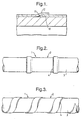
- Figure 1 shows in detail an overlap of a conventional (prior art) straight-cut tape wrapped around a pipe. Because the overlapped edge 10 of the tape is not chamfered, a void 11 is present under the overlapping portion 12 of the tape.
- Figure 2 shows a steel pipe 1 wrapped in discrete overlapping sections of tape 2 according to the invention.
- the tape comprises a backing layer 3 of high density polyethylene and an adhesive layer 4 of ethylene vinyl acetate hot-melt adhesive that is shown partly exuded out of each overlap of the tape to form a fillet.
- Figure 3 shows a steel pipe 1 helically wrapped in a tape 2 according to the invention.
- the fillet of the exuded adhesive 4 is shown extending helically along the length of the pipe.
- Figure 4 shows in cross-section a detail of an overlap of the wrapped tape of Figures 1 and 2 prior to heating the tape.
- the chamfered edge 5 of the tape is shown extending through both the outer backing layer 3 and the inner adhesive layer 4, and the chamfered edge is overlapped by the overlapping portion 6. It can be seen that the overlapping portion 6 of the tape is substantially able to conform to the chamfer of the overlapped portion so that substantially no void is present.
- the angle 34 of chamfer is shown larger than is preferred in reality, for clarity.
- Figure 4 The overlap of Figure 4 is shown in Figure 5 subsequent to heating the tape.
- the adhesive 4 has melted and adhered to the outer surface of the pipe and some of the adhesive has exuded out of the overlap and has formed a fillet 7 adjacent to the abutment 8 of the overlapping portion of the tape.
- the adhesive layer of the overlapping portion 6 and the adhesive portion of the chamfered edge 5 have melted and fused together without leaving a void.
- FIG 6 is a schematic representation of the induction heating method according to the invention.
- a pipe helically wrapped in tape (which may be the tape of figures 3 to 5) has an induction heater, represented by the coil 9, arranged around it.
- the induction heater is arranged to move along the pipe continuously heating sections of the pipe in order to melt the hot-melt adhesive of the tape.
Landscapes
- Engineering & Computer Science (AREA)
- General Engineering & Computer Science (AREA)
- Mechanical Engineering (AREA)
- Manufacturing & Machinery (AREA)
- Lining Or Joining Of Plastics Or The Like (AREA)
- Adhesives Or Adhesive Processes (AREA)
- Adhesive Tapes (AREA)
- Laminated Bodies (AREA)
Applications Claiming Priority (3)
| Application Number | Priority Date | Filing Date | Title |
|---|---|---|---|
| GB9322092 | 1993-10-27 | ||
| GB939322092A GB9322092D0 (en) | 1993-10-27 | 1993-10-27 | Article and method for protecting substrates |
| EP94931105A EP0725911A1 (fr) | 1993-10-27 | 1994-10-27 | Article et procede destines a proteger des substrats |
Related Parent Applications (1)
| Application Number | Title | Priority Date | Filing Date |
|---|---|---|---|
| EP94931105A Division EP0725911A1 (fr) | 1993-10-27 | 1994-10-27 | Article et procede destines a proteger des substrats |
Publications (2)
| Publication Number | Publication Date |
|---|---|
| EP1026436A2 true EP1026436A2 (fr) | 2000-08-09 |
| EP1026436A3 EP1026436A3 (fr) | 2000-08-30 |
Family
ID=10744156
Family Applications (2)
| Application Number | Title | Priority Date | Filing Date |
|---|---|---|---|
| EP94931105A Withdrawn EP0725911A1 (fr) | 1993-10-27 | 1994-10-27 | Article et procede destines a proteger des substrats |
| EP00201130A Withdrawn EP1026436A3 (fr) | 1993-10-27 | 1994-10-27 | Article et procédé destinés à protéger des substrats |
Family Applications Before (1)
| Application Number | Title | Priority Date | Filing Date |
|---|---|---|---|
| EP94931105A Withdrawn EP0725911A1 (fr) | 1993-10-27 | 1994-10-27 | Article et procede destines a proteger des substrats |
Country Status (11)
| Country | Link |
|---|---|
| US (2) | US5700530A (fr) |
| EP (2) | EP0725911A1 (fr) |
| JP (1) | JPH09504484A (fr) |
| AU (1) | AU7998894A (fr) |
| CA (1) | CA2174776A1 (fr) |
| GB (1) | GB9322092D0 (fr) |
| IL (1) | IL111407A0 (fr) |
| RU (1) | RU2132993C1 (fr) |
| TN (1) | TNSN94112A1 (fr) |
| WO (1) | WO1995012087A1 (fr) |
| ZA (1) | ZA948469B (fr) |
Families Citing this family (26)
| Publication number | Priority date | Publication date | Assignee | Title |
|---|---|---|---|---|
| US6299716B1 (en) * | 1999-04-15 | 2001-10-09 | David S. Bettinger | Conformable vehicle coating composite |
| US6247499B1 (en) * | 1999-08-13 | 2001-06-19 | Ico, Inc. | Pipe wrap corrosion protection system |
| GB9924901D0 (en) | 1999-10-21 | 1999-12-22 | Stolt Comex Seaway As | Method and apparatus for laying elongate articles |
| RU2187214C2 (ru) * | 2000-03-21 | 2002-08-10 | Общество с ограниченной ответственностью Научно-производственная фирма "ФРЕАЛ и Ко" | Способ индукционного нагрева плоских металлических изделий, в частности ленты |
| GB0008366D0 (en) * | 2000-04-06 | 2000-05-24 | Raychem Sa Nv | Gel wrap tape |
| DE50006025D1 (de) * | 2000-06-23 | 2004-05-13 | Von Roll Isola Winding Systems | Teilentladungsfeste isolierung für elektrische leiter |
| RU2177582C1 (ru) * | 2000-07-13 | 2001-12-27 | Дедешко Виктор Никифорович | Способ ремонта трубы |
| ES2226676T3 (es) * | 2000-08-31 | 2005-04-01 | TETRA LAVAL HOLDINGS & FINANCE S.A. | Un metodo para empalmar material estratificado para envasar productos alimenticios vertibles. |
| CA2328578C (fr) * | 2000-12-15 | 2010-10-12 | Shaw Industries Ltd. | Methode de chauffage inductif d'un substrat et revetement sur ce substrat |
| RU2211399C2 (ru) * | 2001-02-02 | 2003-08-27 | ООО "Баштрансгаз" ОАО "Газпром" | Способ нанесения изоляционной ленты |
| RU2183785C1 (ru) * | 2001-02-12 | 2002-06-20 | Уфимский государственный нефтяной технический университет | Способ изоляции стальных магистральных трубопроводов |
| FR2822100B1 (fr) * | 2001-03-13 | 2004-04-23 | Inst Francais Du Petrole | Methode de fabrication en grande longueur d'elements tubulaires en composite |
| RU2184303C1 (ru) * | 2001-03-27 | 2002-06-27 | Уфимский государственный нефтяной технический университет | Конструкция изоляционной ленты для трубопроводов |
| JP3943003B2 (ja) * | 2002-10-10 | 2007-07-11 | 第一高周波工業株式会社 | 複層被覆金属曲管の製造方法 |
| WO2006019376A1 (fr) * | 2004-07-16 | 2006-02-23 | Waters Investments Limited | Raccord de tube et procede de soudage de tubes |
| US8088480B2 (en) | 2003-09-29 | 2012-01-03 | Shieldmark, Inc. | Adhesive tape |
| US7361384B2 (en) * | 2005-01-14 | 2008-04-22 | Covalence Specialty Materials Corp. | Corrosion protection system for transport pipe |
| US7235961B1 (en) * | 2006-03-31 | 2007-06-26 | Ulc Robotics, Inc. | Method for managing corrosion of an underground structure |
| DE102006026310A1 (de) * | 2006-06-02 | 2007-12-06 | Endress + Hauser Flowtec Ag | In-Line-Meßgerät mit einem innen mit Polyurethan ausgekleidetem Meßrohr und Verfahren zu dessen Herstellung |
| DE102006026311A1 (de) * | 2006-06-02 | 2007-12-06 | Endress + Hauser Flowtec Ag | In-Line-Meßgerät mit einem innen mit Polyurethan ausgekleidetem Meßrohr und Verfahren zu dessen Herstellung |
| FR2942164B1 (fr) * | 2009-02-13 | 2011-03-18 | Hutchinson | Stratifie souple pour barriere d'etancheite cryogenique, cette barriere comportant ce stratifie colle sur un stratifie sous-jacent et son procede d'assemblage |
| FR2962128B1 (fr) | 2010-07-02 | 2013-06-14 | Prod Plastiques Performants Holding 3P Holding | Materiau ptfe a effet anti-corona |
| US20130240132A1 (en) * | 2012-03-13 | 2013-09-19 | Hsiao-Yin Chen | Method for manufacturing a substrate of blind slats |
| JP5909823B2 (ja) * | 2012-03-23 | 2016-04-27 | グンゼ株式会社 | 複合部材の製造方法 |
| US9523451B1 (en) * | 2013-02-15 | 2016-12-20 | Elkhart Products Corporation, C/O Aalberts Industries N.V. | Utilizing a visual indicator to determine security of a pipe fitting |
| CN115507232B (zh) * | 2022-10-17 | 2023-06-27 | 广东东方管业有限公司 | 一种复合接口管及其制造工艺 |
Citations (9)
| Publication number | Priority date | Publication date | Assignee | Title |
|---|---|---|---|---|
| US2027962A (en) | 1933-03-03 | 1936-01-14 | Nat Carbon Co Inc | Production of articles from plastic compositions |
| US3086242A (en) | 1960-07-15 | 1963-04-23 | Raychem Corp | Process and apparatus for producing materials having plastic memory |
| US3502492A (en) | 1965-12-13 | 1970-03-24 | Ransburg Electro Coating Corp | Metal substrate coated with epoxy powder primer and plasticized polyvinyl chloride topcoat and method of making same |
| US4213486A (en) | 1978-11-06 | 1980-07-22 | The Kendall Company | Coated pipe and process for making same |
| US4287034A (en) | 1979-11-09 | 1981-09-01 | Raychem Corporation | Protecting metal substrates from corrosion |
| US4455204A (en) | 1981-07-13 | 1984-06-19 | Raychem Corporation | Protecting metal substrates from corrosion |
| US4510007A (en) | 1982-07-06 | 1985-04-09 | Mannesmann Ag | Method of jacketing steel pipes |
| EP0181233A2 (fr) | 1984-11-09 | 1986-05-14 | RAYCHEM CORPORATION (a Delaware corporation) | Protection de substrats |
| WO1992008073A1 (fr) | 1990-11-06 | 1992-05-14 | Raychem Corporation | Enrobage d'un substrat a l'aide d'un article thermoreformable |
Family Cites Families (27)
| Publication number | Priority date | Publication date | Assignee | Title |
|---|---|---|---|---|
| GB261724A (en) * | 1925-11-21 | 1927-11-17 | Martin Hochstadter | Improvements relating to the insulation of electric conductors |
| NL270833A (fr) * | 1960-10-31 | |||
| DE1450348B2 (de) * | 1964-12-30 | 1970-05-21 | Hawerkamp, Manfred, 5210 Troiadorf | Verfahren zur Herstellung eines Rohres oder Behälters aus einem mit einer Verstärkungseinlage verstärkten Band aus Kunststoff |
| CA921410A (en) * | 1970-04-16 | 1973-02-20 | Hielema Ralph | Pipe coating |
| DE3105971A1 (de) * | 1981-02-18 | 1982-08-19 | The Kendall Co., 02101 Boston, Mass. | Verfahren zum beschichten von rohren |
| JPS57144721A (en) * | 1981-03-02 | 1982-09-07 | C I Kasei Co Ltd | Manufacture of faced metal tube |
| US4372796A (en) * | 1981-08-10 | 1983-02-08 | Raychem Corporation | Method and apparatus for wrapping a tape around a pipe |
| DE3214447C2 (de) * | 1982-04-20 | 1994-05-11 | Eilentropp Hew Kabel | Ungesintertes Wickelband des Polytetrafluorethylen |
| JPS6092830A (ja) * | 1983-10-27 | 1985-05-24 | Kyosei:Kk | 合成樹脂被覆パイプの製造方法 |
| JPS6159095A (ja) * | 1984-08-31 | 1986-03-26 | 宇部興産株式会社 | 鋼管の接続部の防食被覆方法 |
| US4732632A (en) * | 1984-11-09 | 1988-03-22 | Raychem Corporation | Protecting elongated substrate with multiple-layer polymer covering |
| ES2018021B3 (es) * | 1986-05-06 | 1991-03-16 | N V Raychem S A | Articulo recubrible mediante calor. |
| US4806400A (en) * | 1986-05-23 | 1989-02-21 | The Kendall Company | Tapered adhesive tape |
| US4965119A (en) * | 1986-05-23 | 1990-10-23 | The Kendall Company | Tapered roofing tape |
| US4910059A (en) * | 1986-08-01 | 1990-03-20 | The Kendall Company | Tapered roofing membrane |
| US4802509A (en) * | 1987-12-15 | 1989-02-07 | Brandolf Henry E | Wraparound closure for conduit protection |
| JP2712276B2 (ja) * | 1988-05-06 | 1998-02-10 | 三菱樹脂株式会社 | ライニング管の製法 |
| US5026451A (en) * | 1988-05-12 | 1991-06-25 | Shaw Industries Ltd. | Method and apparatus for applying thermo-plastic protective coating to pipes |
| US5300356A (en) * | 1989-09-06 | 1994-04-05 | The Kendall Company | Tape coating |
| AU642887B2 (en) * | 1989-09-06 | 1993-11-04 | Kendall Company, The | Novel tape coating |
| US4961798A (en) * | 1989-10-02 | 1990-10-09 | Commercial Resins Company | Sleeve applicator assembly for pipe joints |
| JP2834827B2 (ja) * | 1990-02-23 | 1998-12-14 | 第一高周波工業株式会社 | 熱収縮性被覆材の加熱溶着装置 |
| JPH03244527A (ja) * | 1990-02-23 | 1991-10-31 | Dai Ichi High Frequency Co Ltd | 熱収縮性被覆材の溶着方法 |
| JP2834842B2 (ja) * | 1990-04-25 | 1998-12-14 | 第一高周波工業株式会社 | 熱収縮性被覆材の接着装置 |
| GB9113563D0 (en) * | 1991-06-24 | 1991-08-14 | Raychem Sa Nv | Covering for pipelines |
| US5720834A (en) * | 1992-05-04 | 1998-02-24 | Shaw Industries Ltd. | Method for covering a pipeline by wrapping |
| GB9303336D0 (en) * | 1993-02-19 | 1993-04-07 | Raychem Sa Nv | A method of providing a protective cover to an elongate surface |
-
1993
- 1993-10-27 GB GB939322092A patent/GB9322092D0/en active Pending
-
1994
- 1994-10-26 IL IL11140794A patent/IL111407A0/xx unknown
- 1994-10-26 TN TNTNSN94112A patent/TNSN94112A1/fr unknown
- 1994-10-27 AU AU79988/94A patent/AU7998894A/en not_active Abandoned
- 1994-10-27 EP EP94931105A patent/EP0725911A1/fr not_active Withdrawn
- 1994-10-27 EP EP00201130A patent/EP1026436A3/fr not_active Withdrawn
- 1994-10-27 WO PCT/GB1994/002361 patent/WO1995012087A1/fr not_active Ceased
- 1994-10-27 US US08/635,932 patent/US5700530A/en not_active Expired - Fee Related
- 1994-10-27 CA CA002174776A patent/CA2174776A1/fr not_active Abandoned
- 1994-10-27 JP JP7512486A patent/JPH09504484A/ja active Pending
- 1994-10-27 ZA ZA948469A patent/ZA948469B/xx unknown
- 1994-10-27 RU RU96109822A patent/RU2132993C1/ru active
-
1997
- 1997-12-19 US US08/995,295 patent/US6059908A/en not_active Expired - Fee Related
Patent Citations (9)
| Publication number | Priority date | Publication date | Assignee | Title |
|---|---|---|---|---|
| US2027962A (en) | 1933-03-03 | 1936-01-14 | Nat Carbon Co Inc | Production of articles from plastic compositions |
| US3086242A (en) | 1960-07-15 | 1963-04-23 | Raychem Corp | Process and apparatus for producing materials having plastic memory |
| US3502492A (en) | 1965-12-13 | 1970-03-24 | Ransburg Electro Coating Corp | Metal substrate coated with epoxy powder primer and plasticized polyvinyl chloride topcoat and method of making same |
| US4213486A (en) | 1978-11-06 | 1980-07-22 | The Kendall Company | Coated pipe and process for making same |
| US4287034A (en) | 1979-11-09 | 1981-09-01 | Raychem Corporation | Protecting metal substrates from corrosion |
| US4455204A (en) | 1981-07-13 | 1984-06-19 | Raychem Corporation | Protecting metal substrates from corrosion |
| US4510007A (en) | 1982-07-06 | 1985-04-09 | Mannesmann Ag | Method of jacketing steel pipes |
| EP0181233A2 (fr) | 1984-11-09 | 1986-05-14 | RAYCHEM CORPORATION (a Delaware corporation) | Protection de substrats |
| WO1992008073A1 (fr) | 1990-11-06 | 1992-05-14 | Raychem Corporation | Enrobage d'un substrat a l'aide d'un article thermoreformable |
Also Published As
| Publication number | Publication date |
|---|---|
| RU2132993C1 (ru) | 1999-07-10 |
| AU7998894A (en) | 1995-05-22 |
| IL111407A0 (en) | 1994-12-29 |
| TNSN94112A1 (fr) | 1995-09-21 |
| US5700530A (en) | 1997-12-23 |
| CA2174776A1 (fr) | 1995-05-04 |
| US6059908A (en) | 2000-05-09 |
| EP0725911A1 (fr) | 1996-08-14 |
| ZA948469B (en) | 1995-06-20 |
| WO1995012087A1 (fr) | 1995-05-04 |
| GB9322092D0 (en) | 1993-12-15 |
| EP1026436A3 (fr) | 2000-08-30 |
| JPH09504484A (ja) | 1997-05-06 |
Similar Documents
| Publication | Publication Date | Title |
|---|---|---|
| US5700530A (en) | Article and method for protecting substrates | |
| US5482087A (en) | Method of environmentally protecting a pipeline | |
| FI76633B (fi) | Skyddshylsa foer roer och foerfarande foer skyddande av ett roer med denna hylsa. | |
| US4732632A (en) | Protecting elongated substrate with multiple-layer polymer covering | |
| CA1286869C (fr) | Article thermoretrecissable | |
| EP0495560B1 (fr) | Protection de substrat | |
| EP2076703A2 (fr) | Revêtement de joint de conduite pour isolation humide avec adhésion améliorée | |
| EP0421607A1 (fr) | Bande d'enveloppe | |
| US4997685A (en) | Elongated substrate with polymer layer covering | |
| EP0654632B1 (fr) | Procédé pour boucher un trou dans un revêtement pour tuyaux | |
| CA1066469A (fr) | Methode et appareil pour le revetement des surfaces | |
| AU653732B2 (en) | Novel tape coating | |
| WO2001087584A1 (fr) | Manchon protecteur contenant un agent de liaison pour tuyau recouvert de propylene | |
| EP0152213A2 (fr) | Recouvrement d'article | |
| EP0840868A1 (fr) | Revetement de tuyaux | |
| EP0611915A1 (fr) | Procédé pour appliquer une couche de protection sur une base allongée | |
| CA1176813A (fr) | Manches enveloppantes thermoretrecissables | |
| JPH06240699A (ja) | 防食鋼管継手部の被覆方法 | |
| JPS6282022A (ja) | 鋼材の防食方法 | |
| HK40092422A (en) | Platform for discovery and analysis of therapeutic agents | |
| JPH01312297A (ja) | 海洋または配管構造物の防蝕処理方法 | |
| JPS60184827A (ja) | 封入物品 |
Legal Events
| Date | Code | Title | Description |
|---|---|---|---|
| PUAI | Public reference made under article 153(3) epc to a published international application that has entered the european phase |
Free format text: ORIGINAL CODE: 0009012 |
|
| PUAL | Search report despatched |
Free format text: ORIGINAL CODE: 0009013 |
|
| 17P | Request for examination filed |
Effective date: 20000428 |
|
| AC | Divisional application: reference to earlier application |
Ref document number: 725911 Country of ref document: EP |
|
| AK | Designated contracting states |
Kind code of ref document: A2 Designated state(s): AT BE CH DE DK ES FR GB IE IT LI NL PT SE |
|
| AK | Designated contracting states |
Kind code of ref document: A3 Designated state(s): AT BE CH DE DK ES FR GB IE IT LI NL PT SE |
|
| STAA | Information on the status of an ep patent application or granted ep patent |
Free format text: STATUS: THE APPLICATION HAS BEEN WITHDRAWN |
|
| AKX | Designation fees paid |
Free format text: AT BE CH DE DK ES FR GB IE IT LI NL PT SE |
|
| 18W | Application withdrawn |
Withdrawal date: 20010504 |