EP1026461A2 - Procédé et dispositif pour refroidir l'amenée de courant - Google Patents
Procédé et dispositif pour refroidir l'amenée de courant Download PDFInfo
- Publication number
- EP1026461A2 EP1026461A2 EP00101054A EP00101054A EP1026461A2 EP 1026461 A2 EP1026461 A2 EP 1026461A2 EP 00101054 A EP00101054 A EP 00101054A EP 00101054 A EP00101054 A EP 00101054A EP 1026461 A2 EP1026461 A2 EP 1026461A2
- Authority
- EP
- European Patent Office
- Prior art keywords
- power supply
- consumer
- bar
- refrigerant
- supply lines
- Prior art date
- Legal status (The legal status is an assumption and is not a legal conclusion. Google has not performed a legal analysis and makes no representation as to the accuracy of the status listed.)
- Granted
Links
- 238000001816 cooling Methods 0.000 title claims abstract description 37
- 238000000034 method Methods 0.000 title claims abstract description 33
- IJGRMHOSHXDMSA-UHFFFAOYSA-N Atomic nitrogen Chemical compound N#N IJGRMHOSHXDMSA-UHFFFAOYSA-N 0.000 claims abstract description 68
- 239000007789 gas Substances 0.000 claims abstract description 35
- 229910052757 nitrogen Inorganic materials 0.000 claims abstract description 34
- 239000000203 mixture Substances 0.000 claims abstract description 12
- ATUOYWHBWRKTHZ-UHFFFAOYSA-N Propane Chemical compound CCC ATUOYWHBWRKTHZ-UHFFFAOYSA-N 0.000 claims abstract description 6
- VNWKTOKETHGBQD-UHFFFAOYSA-N methane Chemical compound C VNWKTOKETHGBQD-UHFFFAOYSA-N 0.000 claims abstract description 6
- OTMSDBZUPAUEDD-UHFFFAOYSA-N Ethane Chemical compound CC OTMSDBZUPAUEDD-UHFFFAOYSA-N 0.000 claims abstract description 3
- 239000001294 propane Substances 0.000 claims abstract description 3
- 239000003507 refrigerant Substances 0.000 claims description 32
- 239000007788 liquid Substances 0.000 claims description 13
- 239000007792 gaseous phase Substances 0.000 claims description 2
- 239000002826 coolant Substances 0.000 abstract description 8
- 239000002887 superconductor Substances 0.000 description 7
- 238000004172 nitrogen cycle Methods 0.000 description 5
- 239000012071 phase Substances 0.000 description 4
- 238000010791 quenching Methods 0.000 description 3
- 239000007791 liquid phase Substances 0.000 description 2
- 239000000463 material Substances 0.000 description 2
- 238000005057 refrigeration Methods 0.000 description 2
- 230000007704 transition Effects 0.000 description 2
- 230000006835 compression Effects 0.000 description 1
- 238000007906 compression Methods 0.000 description 1
- 230000000694 effects Effects 0.000 description 1
- 230000005611 electricity Effects 0.000 description 1
- 238000005265 energy consumption Methods 0.000 description 1
- 238000001704 evaporation Methods 0.000 description 1
- 230000017525 heat dissipation Effects 0.000 description 1
- 239000001307 helium Substances 0.000 description 1
- 229910052734 helium Inorganic materials 0.000 description 1
- SWQJXJOGLNCZEY-UHFFFAOYSA-N helium atom Chemical compound [He] SWQJXJOGLNCZEY-UHFFFAOYSA-N 0.000 description 1
- 230000007257 malfunction Effects 0.000 description 1
- 229910052751 metal Inorganic materials 0.000 description 1
- 239000002184 metal Substances 0.000 description 1
- 150000002739 metals Chemical class 0.000 description 1
- QGZKDVFQNNGYKY-NJFSPNSNSA-N nitrogen-16 Chemical compound [16NH3] QGZKDVFQNNGYKY-NJFSPNSNSA-N 0.000 description 1
- 230000021715 photosynthesis, light harvesting Effects 0.000 description 1
- 230000002040 relaxant effect Effects 0.000 description 1
- 230000001960 triggered effect Effects 0.000 description 1
Images



Classifications
-
- F—MECHANICAL ENGINEERING; LIGHTING; HEATING; WEAPONS; BLASTING
- F25—REFRIGERATION OR COOLING; COMBINED HEATING AND REFRIGERATION SYSTEMS; HEAT PUMP SYSTEMS; MANUFACTURE OR STORAGE OF ICE; LIQUEFACTION SOLIDIFICATION OF GASES
- F25B—REFRIGERATION MACHINES, PLANTS OR SYSTEMS; COMBINED HEATING AND REFRIGERATION SYSTEMS; HEAT PUMP SYSTEMS
- F25B1/00—Compression machines, plants or systems with non-reversible cycle
- F25B1/06—Compression machines, plants or systems with non-reversible cycle with compressor of jet type, e.g. using liquid under pressure
- F25B1/08—Compression machines, plants or systems with non-reversible cycle with compressor of jet type, e.g. using liquid under pressure using vapour under pressure
-
- F—MECHANICAL ENGINEERING; LIGHTING; HEATING; WEAPONS; BLASTING
- F25—REFRIGERATION OR COOLING; COMBINED HEATING AND REFRIGERATION SYSTEMS; HEAT PUMP SYSTEMS; MANUFACTURE OR STORAGE OF ICE; LIQUEFACTION SOLIDIFICATION OF GASES
- F25B—REFRIGERATION MACHINES, PLANTS OR SYSTEMS; COMBINED HEATING AND REFRIGERATION SYSTEMS; HEAT PUMP SYSTEMS
- F25B7/00—Compression machines, plants or systems, with cascade operation, i.e. with two or more circuits, the heat from the condenser of one circuit being absorbed by the evaporator of the next circuit
-
- H—ELECTRICITY
- H02—GENERATION; CONVERSION OR DISTRIBUTION OF ELECTRIC POWER
- H02G—INSTALLATION OF ELECTRIC CABLES OR LINES, OR OF COMBINED OPTICAL AND ELECTRIC CABLES OR LINES
- H02G15/00—Cable fittings
- H02G15/34—Cable fittings for cryogenic cables
-
- F—MECHANICAL ENGINEERING; LIGHTING; HEATING; WEAPONS; BLASTING
- F25—REFRIGERATION OR COOLING; COMBINED HEATING AND REFRIGERATION SYSTEMS; HEAT PUMP SYSTEMS; MANUFACTURE OR STORAGE OF ICE; LIQUEFACTION SOLIDIFICATION OF GASES
- F25B—REFRIGERATION MACHINES, PLANTS OR SYSTEMS; COMBINED HEATING AND REFRIGERATION SYSTEMS; HEAT PUMP SYSTEMS
- F25B1/00—Compression machines, plants or systems with non-reversible cycle
- F25B1/10—Compression machines, plants or systems with non-reversible cycle with multi-stage compression
-
- F—MECHANICAL ENGINEERING; LIGHTING; HEATING; WEAPONS; BLASTING
- F25—REFRIGERATION OR COOLING; COMBINED HEATING AND REFRIGERATION SYSTEMS; HEAT PUMP SYSTEMS; MANUFACTURE OR STORAGE OF ICE; LIQUEFACTION SOLIDIFICATION OF GASES
- F25B—REFRIGERATION MACHINES, PLANTS OR SYSTEMS; COMBINED HEATING AND REFRIGERATION SYSTEMS; HEAT PUMP SYSTEMS
- F25B2341/00—Details of ejectors not being used as compression device; Details of flow restrictors or expansion valves
- F25B2341/001—Ejectors not being used as compression device
- F25B2341/0012—Ejectors with the cooled primary flow at high pressure
-
- F—MECHANICAL ENGINEERING; LIGHTING; HEATING; WEAPONS; BLASTING
- F25—REFRIGERATION OR COOLING; COMBINED HEATING AND REFRIGERATION SYSTEMS; HEAT PUMP SYSTEMS; MANUFACTURE OR STORAGE OF ICE; LIQUEFACTION SOLIDIFICATION OF GASES
- F25B—REFRIGERATION MACHINES, PLANTS OR SYSTEMS; COMBINED HEATING AND REFRIGERATION SYSTEMS; HEAT PUMP SYSTEMS
- F25B2341/00—Details of ejectors not being used as compression device; Details of flow restrictors or expansion valves
- F25B2341/001—Ejectors not being used as compression device
- F25B2341/0015—Ejectors not being used as compression device using two or more ejectors
-
- F—MECHANICAL ENGINEERING; LIGHTING; HEATING; WEAPONS; BLASTING
- F25—REFRIGERATION OR COOLING; COMBINED HEATING AND REFRIGERATION SYSTEMS; HEAT PUMP SYSTEMS; MANUFACTURE OR STORAGE OF ICE; LIQUEFACTION SOLIDIFICATION OF GASES
- F25B—REFRIGERATION MACHINES, PLANTS OR SYSTEMS; COMBINED HEATING AND REFRIGERATION SYSTEMS; HEAT PUMP SYSTEMS
- F25B41/00—Fluid-circulation arrangements
-
- F—MECHANICAL ENGINEERING; LIGHTING; HEATING; WEAPONS; BLASTING
- F25—REFRIGERATION OR COOLING; COMBINED HEATING AND REFRIGERATION SYSTEMS; HEAT PUMP SYSTEMS; MANUFACTURE OR STORAGE OF ICE; LIQUEFACTION SOLIDIFICATION OF GASES
- F25B—REFRIGERATION MACHINES, PLANTS OR SYSTEMS; COMBINED HEATING AND REFRIGERATION SYSTEMS; HEAT PUMP SYSTEMS
- F25B9/00—Compression machines, plants or systems, in which the refrigerant is air or other gas of low boiling point
- F25B9/02—Compression machines, plants or systems, in which the refrigerant is air or other gas of low boiling point using Joule-Thompson effect; using vortex effect
Definitions
- the invention relates to a method for cooling power supplies for a Consumer or for cooling for a consumer with power supplies.
- Power supplies are used to supply electrical power. Especially at Power supplies for "power applications in the low temperature range", the means applications in the range from approx. 1 to approx. 100,000 A per Power supply and at a temperature less than approx. 200 K is sufficient Power supply cooling necessary.
- the problem and design of power supplies for Power applications in the low temperature range is described, for example, in “Buyanov, Y.L. et al., "A Review of Current Leads for Cryogenic Devices", Cryogenics 15 (1995), pages 193-200; P. Komarek, "High Current Applications of Superconductivity", Teubner Verlag Stuttgart, 1995 and P.F. Herrmann, Current Leads, in: Handbook of Applied Superconductivity, ed. B. Seeber, IOP Publishing Ltd, 1998 described.
- ambient temperature e.g. power supply, converter, Supply network, etc.
- components transported P. Komarek, "High Current Applications of Superconductivity", Teubner Verlag Stuttgart, 1995.
- These components are e.g. B. cables, magnets, transformers or overcurrent limiter, which is preferably based on superconductivity work. They are referred to below as “consumers”.
- the Working temperature of the consumers is typically allowed to be a maximum temperature do not exceed between approx. 120 K and 2 K. It is therefore mostly Complex cooling devices required in terms of energy and equipment.
- Superconducting materials are materials that are in the cooled state and at permissible current strengths are in the so-called “superconducting” state, which is characterized by a disappearing electrical resistance. At higher currents and / or higher temperatures, a transition takes place in the so-called “normally conductive” state, which is characterized by a relative large electrical resistance is marked. This effect can can be used for overcurrent limiters, for example.
- Overcurrent limiters are devices to provide electrical networks Protect overloads or against excessive electrical currents. she should the overcurrent when a certain upper current limit is exceeded prevent that, for example, triggered by an electrical short circuit becomes. Therefore, with the designation “overcurrent limiter” here are also the so-called “short-circuit current limiter” meant. After the disturbance has subsided the overcurrent limiter should allow the current to flow again.
- superconducting overcurrent limiters enable the design of electrical Networks with high short-circuit power, in which the stresses of the electrical components remains low due to the overcurrent in the event of a fault. In less than a millisecond after the occurrence of the short circuit, i.e. in the Usually long before the first peak value of an AC voltage is reached with a frequency of 50 to 60 Hz, the overcurrent will be low limited. The stress on the electrical components after the Current limiter is reduced in this way.
- So-called high-temperature superconductors offer particular advantages for the Overcurrent limiter, which is different from the classic metallic Superconductors with a critical temperature below 30 K make the transition from superconducting in the normal conducting state (also called quench) Have temperatures above about 70 K.
- the superconducting Overcurrent limiter works in two different operating modes, the "regular Operation "or in” Quench Operation ". The one that only occurs sporadically in the event of an error Quench operation is due to a strong heat development in the High temperature superconductors marked, which are dissipated very quickly got to. In contrast, trouble-free regular operation is the predominant one Operating status. To the cooling process and cooling device for Overcurrent limiters have very high requirements.
- Power supplies for power applications work in the low temperature range often between the ambient temperature and the temperature of the liquid nitrogen. These can be liquid nitrogen applications or around the "warm" part of a hybrid power supply, in which the "cold" part consists of a high temperature superconductor.
- the power supplies between the ambient temperature and the temperature of the liquid nitrogen consists of metals.
- the heat inputs are in the Of the order of 0.04 W / A to 0.02 W / A (P. Komarek, "High Current Applications of Superconductivity", Teubner Verlag Stuttgart, 1995 and P.F. Herrmann, Current Leads, in: Handbook of Applied Superconductivity, ed. B. Seeber, IOP Publishing Ltd, 1998). This leads to currents in the kA range to heat inputs that dominate over the other heat loads and lead to high refrigeration supply operating costs.
- Joule-Thomson refrigeration systems are used for cooling purposes in these temperature ranges known that are operated with mixtures as refrigerants (GB 1,336,892, US 5,337,572, Longworth R.C. et al., 80K Closed Cycle Throttle Refrigerator, Cryocoolers 8, 1995, pp. 537-542).
- These Joule-Thomson refrigeration systems have the disadvantage that the efficiency of the process Working temperatures below about 90 K is greatly reduced. Good effectiveness will be reached at working temperatures of approx. 100 K (Longworth R.C. et al., 80 K Closed Cycle Throttle Refrigerator, Cryocoolers 8, 1995, pp. 537-542).
- the object of the invention is to provide a method and an apparatus for To provide power supply cooling, in which the inevitable Heat input through the power supply as effectively as possible and with one little technical effort is compensated, the heat dissipation by the method or the device in the sense of the highest possible efficiency should take place within the entire temperature range in which Temperature range the energy dissipation within the power supply takes place.
- a cryogenic gas as the first refrigerant in a first Circulated and with the help of the cryogenic gas the power supplies or the consumer is cooled directly with power supplies, the cryogenic Gas in counterflow to the incoming heat along the power supply lines is performed and wherein the first refrigerant is cooled with a second refrigerant which second refrigerant is carried in a second, separate circuit becomes.
- the inventive method has the advantage that the Energy consumption is relatively low.
- the second, separate circuit is preferably a mixture Joule-Thomson circuit, the heat exchanger of the mixture Joule-Thomson cycle (Mixture-Joule-Thomson heat exchanger) in counterflow to Low pressure flow of the second refrigerant flows through the first refrigerant becomes.
- the advantage of the Joule-Thomson cycle and the use of the Mixture-Joule-Thomson chiller is the one in the power supply heat output largely equal to the temperature level of their Can be dissipated and not - as with other refrigeration systems - only at a more or less discrete temperature level.
- the mixture-Joule-Thomson chiller with the additional circuit of the first refrigerant can advantageously also a temperature level of less than 100 K. can be achieved.
- nitrogen preferably liquid cryogenic nitrogen
- the Joule-Thomson mixture Chiller preferably expanded with a nitrogen cycle.
- the Nitrogen is compressed in a separate compressor Recooled ambient temperature and in a common heat exchanger pre-cooled to approx. 90-110 K.
- the further lowering of the temperature to e.g. 77 K. is achieved by relaxing in a nitrogen throttle valve.
- the cooling the power is supplied by means of the cold, low-pressure nitrogen stream.
- the second refrigerant is at least a mixture from nitrogen, methane, ethane and propane.
- the consumer is normally conductive with one Working temperature from 70 to 120 K.
- the consumer is preferred superconducting, in particular high temperature superconducting, the Working temperature of the superconducting consumer is particularly preferably 70 K to Is 120 K.
- the consumer is, for example, a cable, magnet, Transformer or overcurrent limiter, but preferably one Overcurrent limiter, particularly preferably an overcurrent limiter Basis of high temperature superconductivity.
- the cooling of the power supply lines by nitrogen is preferred first Refrigerant carried out in a nitrogen cycle, which with the help of a Mixture-chiller based on oil-lubricated compressors as is precooled in a separate circuit with the aid of the second coolant.
- the compressor for the second refrigerant is advantageously a according to the invention oil-lubricated compressor.
- the power supplies are in a heat exchanger embedded, which is flowed through by gaseous nitrogen. Through the Embedding the power supply leads to a small volume of the transformer held.
- an ejector is arranged in the circuit of the first refrigerant, the pressure ratio required by a compressor for the first refrigerant adjust, with compressed, cooled cryogenic gas supplied to the ejector becomes.
- the pressure ratio on the compressor is preferably determined using the ejector set to a value from 4 to 11.
- the consumer has one according to the invention sufficiently large reservoir of liquid, cryogenic gas. This crowd will be like this specified that it meets the operational safety requirements.
- the amount is dimensioned such that also in the event of several consecutive malfunctions of the Overcurrent limiter works safely.
- An advantageous embodiment of the invention is that the nitrogen cycle is relaxed in two stages and that after the first stage the liquid portion is further relaxed, with an ejector (first relaxation stage) the gas coming from the second expansion stage is pre-compressed and the Total flow then in a compressor with a lower pressure ratio is compressed.
- cryogenic gas coming from the consumer with power supplies relatively low pressure of 0.8 to 2 bar to a relatively high pressure of 10 to Compressed 20 bar, then cooled to a temperature of 5 ° C. up to 40 ° C, then with a pressure of 8 to 20 bar the heat exchanger is supplied, then the cryogenic gas is at least partially liquefied is then relaxed and at a pressure of 0.8 bar to 3 bar and at a temperature of 75 K to 87 K to the consumer or the consumer is supplied with power supplies for cooling and then the predominantly gaseous fraction of the cryogenic gas by the at the Consumers subsequent power supplies flow, after which the gas returns is compressed.
- this is from the power supply or the consumer previously cryogenic gas coming with power supplies at a pressure of 0.8 bar to 2 bar at ambient temperature and fed to the ejector Pressure set from 1.1 bar to 4 bar before it is fed to the compressor.
- the cryogenic gas coming from the heat exchanger is inventively with a pressure of 8 to 20 bar and a temperature of 90 K to 110 K Ejector supplied and at a pressure of 1.4 bar to 2 bar and a temperature set from 80 K to 84 K before entering the liquid and gaseous phases is separated, the liquid portion and the gaseous portion of the Power supply or supplied to the consumer with power supplies separately become.
- the inventive device for cooling power supplies or Consumer with power supplies is a first compressor for one before cryogenic gas with a first aftercooler, then one Heat exchanger, then a first evaporator, then one first throttle body and then with power supplies or with a Consumer connected to the power supply, the consumer with the Electricity supply lines are connected and where the consumer and the Power supplies are arranged in a housing and through the cryogenic Gas cooled and a second compressor for a second refrigerant with a second aftercooler, then a heat exchanger, is then connected to a second throttle element and then with the heat exchanger is reconnected.
- the consumer is preferably a high-temperature superconducting overcurrent limiter.
- the heat exchanger be a countercurrent heat exchanger is.
- the first and / or second compressor is an oil-lubricated one Compressor.
- the device shows a device for cooling a power supply, nitrogen as the first coolant and a coolant mixture as the second coolant (Mixture) is used.
- the device consists of a mixture compressor 1, a mixture after-cooler 2, a common Heat exchanger 3, a mixture throttle element 4 and an evaporator 5 and from a nitrogen compressor 11, a nitrogen aftercooler 12, a nitrogen throttle element 13, a nitrogen container 14 and thus in Related power supply heat exchanger 15, in which Nitrogen container 14 cryogenic liquid nitrogen 16, in which the High-temperature superconductor 17, preferably a high-temperature superconductor Overcurrent limiter, located, and over the power supply heat exchanger 15 is electrically contacted with power leads 18.
- pressure 1 bar
- pressure ⁇ 8 bar high pressure nitrogen
- evaporator 5 cooled by the mixture cycle
- temperature 90 to 110 K
- the throttling becomes the liquid nitrogen component at a pressure of approx. 1 bar and collected at a temperature of about 77 K in the container 14.
- the cold Nitrogen vapor flows along the power supply lines 18 and cools them down in the process.
- the device according to FIG. 2 differs from the device according to FIG. 1 in that a "warm" ejector 21 is arranged in the nitrogen cycle, the Via line 22 the nitrogen coming from the power supply lines 18 and Via lines 24 and 25, a partial flow of the from the compressor 11 and aftercooler 12 coming nitrogen is supplied. After nitrogen compression to about 8 to 15 bar in the compressor 11 and recooling in the aftercooler 12 a partial flow of z. B. about 10% to 40% of Total volume flow branched off and through the "warm" ejector 21 directly to Intake side of the compressor 11 out. That with the "warm” ejector 11 The available reduced pressure level is used to achieve the required Pressure level of about 1 bar for cooling consumers 17 and To receive power leads 18.
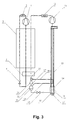
- FIG 3 corresponds to Figure 1, with an additional "cold” ejector 31im Nitrogen circuit is arranged, which comes from the evaporator 5 Nitrogen is fed via line 35, the "cold” ejector 31 via a Line 37 is connected to a separator 32, in which liquid nitrogen 33 is separated.
- the nitrogen high pressure flow (pressure level above all 8 to 15 bar) is here after leaving the common heat exchanger 3 by a "Cold” ejector 31 passed and ended in a phase separator 32 with one Internal pressure from approx. 1.4 to 2 bar.
- the consumer 17 and the lower part of the Power supplies 18 are cooled by a partial flow, which from the Liquid phase removed in the pasepar separator 32 and in a throttle valve 13 further, to about 1 bar, is relaxed.
- the final temperature required pressure level is determined by the "cold" ejector maintain.
- nitrogen is removed from the phase separator 32 and through the Power supply heat exchanger 15 along the power supplies 18 of the Suction side of the compressor 11 supplied.
- FIG. 4 represents a combination of that in FIG. 2 and Fig. 3 shown embodiments of the invention with "warm” 21 as well “cold” 31 ejector.
- the high pressure at the outlet of the Compressor 11 is around 10 to 20 bar, the low pressure at its inlet with approximately 2 to 3 bar approximately at the outlet pressure of the ejector 21.
- the pressure in the Phase separator 32 is approximately 1.4 to 2 bar, the temperature approximately 80 to 84 K.
Landscapes
- Engineering & Computer Science (AREA)
- Physics & Mathematics (AREA)
- Mechanical Engineering (AREA)
- Thermal Sciences (AREA)
- General Engineering & Computer Science (AREA)
- Rectifiers (AREA)
- Motor Or Generator Cooling System (AREA)
- Containers, Films, And Cooling For Superconductive Devices (AREA)
Applications Claiming Priority (2)
| Application Number | Priority Date | Filing Date | Title |
|---|---|---|---|
| DE19904822 | 1999-02-05 | ||
| DE19904822A DE19904822C1 (de) | 1999-02-05 | 1999-02-05 | Verfahren und Vorrichtung zur Kühlung von Stromzuführungen |
Related Child Applications (1)
| Application Number | Title | Priority Date | Filing Date |
|---|---|---|---|
| EP05112270 Division | 2005-12-15 |
Publications (3)
| Publication Number | Publication Date |
|---|---|
| EP1026461A2 true EP1026461A2 (fr) | 2000-08-09 |
| EP1026461A3 EP1026461A3 (fr) | 2000-09-27 |
| EP1026461B1 EP1026461B1 (fr) | 2006-05-10 |
Family
ID=7896617
Family Applications (1)
| Application Number | Title | Priority Date | Filing Date |
|---|---|---|---|
| EP00101054A Expired - Lifetime EP1026461B1 (fr) | 1999-02-05 | 2000-01-20 | Procédé et dispositif pour refroidir l'amenée de courant |
Country Status (3)
| Country | Link |
|---|---|
| EP (1) | EP1026461B1 (fr) |
| AT (1) | ATE325996T1 (fr) |
| DE (2) | DE19904822C1 (fr) |
Cited By (1)
| Publication number | Priority date | Publication date | Assignee | Title |
|---|---|---|---|---|
| CN100416880C (zh) * | 2002-10-23 | 2008-09-03 | 普莱克斯技术有限公司 | 高温超导的多级制冷 |
Families Citing this family (8)
| Publication number | Priority date | Publication date | Assignee | Title |
|---|---|---|---|---|
| GB0315663D0 (en) * | 2003-07-04 | 2003-08-13 | Rolls Royce Plc | A fault current limiter |
| US8037695B2 (en) | 2003-07-04 | 2011-10-18 | Rolls-Royce Plc | Fault current limiter |
| WO2015159258A1 (fr) * | 2014-04-17 | 2015-10-22 | Victoria Link Ltd | Conception de circuit de fluide cryogénique pour le refroidissement efficace d'une structure thermoconductrice allongée s'étendant à partir d'un élément devant être refroidi à une température cryogénique |
| EP3295093B1 (fr) | 2015-05-12 | 2022-10-19 | Carrier Corporation | Circuit de réfrigération à éjection |
| DE102016011311A1 (de) | 2016-09-20 | 2018-03-22 | Linde Aktiengesellschaft | Gasgekühlte Stromzuführung |
| DE102017002475A1 (de) | 2017-03-14 | 2018-09-20 | Linde Aktiengesellschaft | Verfahren und Vorrichtung zum Kühlen einer Anordnung mit einer Stromführung sowie System mit entsprechender Vorrichtung |
| CN111795452B (zh) * | 2019-04-08 | 2024-01-05 | 开利公司 | 空气调节系统 |
| DE102020205184A1 (de) | 2020-04-23 | 2021-10-28 | Karlsruher Institut für Technologie | Stromzuführung und Verfahren zur ihrer Herstellung |
Citations (2)
| Publication number | Priority date | Publication date | Assignee | Title |
|---|---|---|---|---|
| GB1336892A (en) | 1971-05-17 | 1973-11-14 | Nii Kriogennoi Elektroniki | Refrigerant for a cryogenic throttling unit |
| US5337572A (en) | 1993-05-04 | 1994-08-16 | Apd Cryogenics, Inc. | Cryogenic refrigerator with single stage compressor |
Family Cites Families (6)
| Publication number | Priority date | Publication date | Assignee | Title |
|---|---|---|---|---|
| US4020275A (en) * | 1976-01-27 | 1977-04-26 | The United States Of America As Represented By The United States Energy Research And Development Administration | Superconducting cable cooling system by helium gas at two pressures |
| US5166776A (en) * | 1990-10-20 | 1992-11-24 | Westinghouse Electric Corp. | Hybrid vapor cooled power lead for cryostat |
| US5298679A (en) * | 1992-07-01 | 1994-03-29 | Westinghouse Electric Corp. | Current lead for cryostat using composite high temperature superconductors |
| DE19534096A1 (de) * | 1995-09-14 | 1997-03-20 | Siemens Ag | Stromzuführungsvorrichtung für eine auf Tieftemperatur zu haltende elektrische Einrichtung |
| US5758505C1 (en) * | 1995-10-12 | 2001-10-30 | Cryogen Inc | Precooling system for joule-thomson probe |
| DE19648902C2 (de) * | 1996-11-26 | 1998-09-10 | Univ Dresden Tech | Verfahren zur Realisierung eines Gemisch- Joule- Thomson-Prozesses und Vorrichtung zur Durchführung dieses Verfahrens |
-
1999
- 1999-02-05 DE DE19904822A patent/DE19904822C1/de not_active Expired - Fee Related
-
2000
- 2000-01-20 DE DE50012708T patent/DE50012708D1/de not_active Expired - Fee Related
- 2000-01-20 AT AT00101054T patent/ATE325996T1/de not_active IP Right Cessation
- 2000-01-20 EP EP00101054A patent/EP1026461B1/fr not_active Expired - Lifetime
Patent Citations (2)
| Publication number | Priority date | Publication date | Assignee | Title |
|---|---|---|---|---|
| GB1336892A (en) | 1971-05-17 | 1973-11-14 | Nii Kriogennoi Elektroniki | Refrigerant for a cryogenic throttling unit |
| US5337572A (en) | 1993-05-04 | 1994-08-16 | Apd Cryogenics, Inc. | Cryogenic refrigerator with single stage compressor |
Non-Patent Citations (4)
| Title |
|---|
| "Hochstromanwendungen der Supraleitung", 1995, TEUBNER VERLAG STUTTGART, article P. KOMAREK |
| BUYANOV,Y.L.: "A Review of Current leads for Cryogenic devices", CRYOGENICS 15, 1995, pages 193 - 200 |
| HRSG. B. SEEBER: "Handbook of applied superconductivity", 1998, IOP PUBLISHING LTD, article P.F. HERRMANN: "Current leads" |
| LONGWORTH R.C. ET AL.: "Cryocoolers 8", 1995, article LONGWORTH R.C: "80k closed cycle throttle refrigerator", pages: 537 - 542 |
Cited By (1)
| Publication number | Priority date | Publication date | Assignee | Title |
|---|---|---|---|---|
| CN100416880C (zh) * | 2002-10-23 | 2008-09-03 | 普莱克斯技术有限公司 | 高温超导的多级制冷 |
Also Published As
| Publication number | Publication date |
|---|---|
| DE50012708D1 (de) | 2006-06-14 |
| EP1026461B1 (fr) | 2006-05-10 |
| ATE325996T1 (de) | 2006-06-15 |
| EP1026461A3 (fr) | 2000-09-27 |
| DE19904822C1 (de) | 2000-05-18 |
Similar Documents
| Publication | Publication Date | Title |
|---|---|---|
| DE19904822C1 (de) | Verfahren und Vorrichtung zur Kühlung von Stromzuführungen | |
| DE1166798B (de) | Verfahren und Vorrichtung zum Verfluessigen von tiefsiedenden Gasen | |
| DE102016005632A1 (de) | Mischkolonne für Verfahren mit einem Einzelmischkältemittel | |
| EP3749903B1 (fr) | Procédé et dispositif de refroidissement d'un porteur de courant supraconducteur | |
| DE1903643A1 (de) | Verfahren zum Kuehlen eines Verbrauchers,der aus einem teilweise stabilisierten Supraleitungsmagneten besteht | |
| CH625037A5 (fr) | ||
| WO2020043340A1 (fr) | Dispositif de refroidissement d'un élément supraconducteur | |
| DE102014224363A1 (de) | Vorrichtung der Supraleitungstechnik mitSpuleneinrichtungen und Kühlvorrichtung sowie damitausgestattetes Fahrzeug | |
| DE2453182C3 (de) | Anordnung zur Kühlung von Rotorteilen eines Turbogenerators | |
| DE102010028750B4 (de) | Verlustarme Kryostatenanordnung | |
| DE102012017653A1 (de) | Verfahren zum Verflüssigen einer Kohlenwasserstoff-reichen Fraktion | |
| DE19609489A1 (de) | Verfahren und Vorrichtung zur Verflüssigung eines tiefsiedenden Gases | |
| DE102006039889A1 (de) | Verfahren zum Verflüssigen eines Kohlenwasserstoff-reichen Stromes | |
| DE10211568A1 (de) | Kälteanlage für zu kühlende Teile einer Einrichtung | |
| EP3322947B1 (fr) | Procédé de refroidissement d'un flux de traitement | |
| EP0168519A2 (fr) | Dispositif de liquéfaction d'un gaz à bas point d'ébullition, en particulier de gaz d'hélium | |
| WO2006136269A1 (fr) | Procede de liquefaction d'un courant riche en hydrocarbures | |
| DE102004032710A1 (de) | Verfahren zum Verflüssigen eines Kohlenwasserstoff-reichen Stromes | |
| DE112011103478T5 (de) | Stromleitervorrichtung | |
| DE102005021154B4 (de) | Abtausystem für Verdampfer von Kälteanlagen und Wärmepumpen sowie ein Verfahren zum Betrieb hierzu | |
| EP4162215B1 (fr) | Procédé et dispositif de refroidissement cryogénique d'un consommateur | |
| EP3580503B1 (fr) | Procédé de refroidissement d'un consommateur | |
| DE102012005768A1 (de) | Luftzerlegungsanlage mit gekühlter Supraleiterstruktur | |
| DE102013015850A1 (de) | Verfahren zum Betreiben eines Kältekreislaufes | |
| WO2021214213A1 (fr) | Alimentation électrique et son procédé de production |
Legal Events
| Date | Code | Title | Description |
|---|---|---|---|
| PUAI | Public reference made under article 153(3) epc to a published international application that has entered the european phase |
Free format text: ORIGINAL CODE: 0009012 |
|
| AK | Designated contracting states |
Kind code of ref document: A2 Designated state(s): AT BE CH CY DE DK ES FI FR GB GR IE IT LI LU MC NL PT SE |
|
| AX | Request for extension of the european patent |
Free format text: AL;LT;LV;MK;RO;SI |
|
| PUAL | Search report despatched |
Free format text: ORIGINAL CODE: 0009013 |
|
| AK | Designated contracting states |
Kind code of ref document: A3 Designated state(s): AT BE CH CY DE DK ES FI FR GB GR IE IT LI LU MC NL PT SE |
|
| AX | Request for extension of the european patent |
Free format text: AL;LT;LV;MK;RO;SI |
|
| RIC1 | Information provided on ipc code assigned before grant |
Free format text: 7F 25B 7/00 A, 7F 25B 9/02 B, 7H 02H 9/02 - |
|
| 17P | Request for examination filed |
Effective date: 20010327 |
|
| AKX | Designation fees paid |
Free format text: AT BE CH CY DE DK ES FI FR GB GR IE IT LI LU MC NL PT SE |
|
| RAP1 | Party data changed (applicant data changed or rights of an application transferred) |
Owner name: MESSER GRIESHEIM GMBH |
|
| 17Q | First examination report despatched |
Effective date: 20040129 |
|
| RAP1 | Party data changed (applicant data changed or rights of an application transferred) |
Owner name: AIR LIQUIDE DEUTSCHLAND GMBH |
|
| RAP1 | Party data changed (applicant data changed or rights of an application transferred) |
Owner name: AIR LIQUIDE DEUTSCHLAND GMBH |
|
| RAP1 | Party data changed (applicant data changed or rights of an application transferred) |
Owner name: AIR LIQUIDE DEUTSCHLAND GMBH |
|
| GRAP | Despatch of communication of intention to grant a patent |
Free format text: ORIGINAL CODE: EPIDOSNIGR1 |
|
| GRAS | Grant fee paid |
Free format text: ORIGINAL CODE: EPIDOSNIGR3 |
|
| GRAA | (expected) grant |
Free format text: ORIGINAL CODE: 0009210 |
|
| AK | Designated contracting states |
Kind code of ref document: B1 Designated state(s): AT BE CH CY DE DK ES FI FR GB GR IE IT LI LU MC NL PT SE |
|
| PG25 | Lapsed in a contracting state [announced via postgrant information from national office to epo] |
Ref country code: NL Free format text: LAPSE BECAUSE OF FAILURE TO SUBMIT A TRANSLATION OF THE DESCRIPTION OR TO PAY THE FEE WITHIN THE PRESCRIBED TIME-LIMIT Effective date: 20060510 Ref country code: GB Free format text: LAPSE BECAUSE OF FAILURE TO SUBMIT A TRANSLATION OF THE DESCRIPTION OR TO PAY THE FEE WITHIN THE PRESCRIBED TIME-LIMIT Effective date: 20060510 Ref country code: IT Free format text: LAPSE BECAUSE OF FAILURE TO SUBMIT A TRANSLATION OF THE DESCRIPTION OR TO PAY THE FEE WITHIN THE PRESCRIBED TIME-LIMIT;WARNING: LAPSES OF ITALIAN PATENTS WITH EFFECTIVE DATE BEFORE 2007 MAY HAVE OCCURRED AT ANY TIME BEFORE 2007. THE CORRECT EFFECTIVE DATE MAY BE DIFFERENT FROM THE ONE RECORDED. Effective date: 20060510 Ref country code: FI Free format text: LAPSE BECAUSE OF FAILURE TO SUBMIT A TRANSLATION OF THE DESCRIPTION OR TO PAY THE FEE WITHIN THE PRESCRIBED TIME-LIMIT Effective date: 20060510 Ref country code: IE Free format text: LAPSE BECAUSE OF FAILURE TO SUBMIT A TRANSLATION OF THE DESCRIPTION OR TO PAY THE FEE WITHIN THE PRESCRIBED TIME-LIMIT Effective date: 20060510 |
|
| REG | Reference to a national code |
Ref country code: GB Ref legal event code: FG4D Free format text: NOT ENGLISH |
|
| REG | Reference to a national code |
Ref country code: CH Ref legal event code: EP |
|
| REF | Corresponds to: |
Ref document number: 50012708 Country of ref document: DE Date of ref document: 20060614 Kind code of ref document: P |
|
| REG | Reference to a national code |
Ref country code: IE Ref legal event code: FG4D Free format text: LANGUAGE OF EP DOCUMENT: GERMAN |
|
| PG25 | Lapsed in a contracting state [announced via postgrant information from national office to epo] |
Ref country code: SE Free format text: LAPSE BECAUSE OF FAILURE TO SUBMIT A TRANSLATION OF THE DESCRIPTION OR TO PAY THE FEE WITHIN THE PRESCRIBED TIME-LIMIT Effective date: 20060810 Ref country code: DK Free format text: LAPSE BECAUSE OF FAILURE TO SUBMIT A TRANSLATION OF THE DESCRIPTION OR TO PAY THE FEE WITHIN THE PRESCRIBED TIME-LIMIT Effective date: 20060810 |
|
| PG25 | Lapsed in a contracting state [announced via postgrant information from national office to epo] |
Ref country code: ES Free format text: LAPSE BECAUSE OF FAILURE TO SUBMIT A TRANSLATION OF THE DESCRIPTION OR TO PAY THE FEE WITHIN THE PRESCRIBED TIME-LIMIT Effective date: 20060821 |
|
| PG25 | Lapsed in a contracting state [announced via postgrant information from national office to epo] |
Ref country code: PT Free format text: LAPSE BECAUSE OF FAILURE TO SUBMIT A TRANSLATION OF THE DESCRIPTION OR TO PAY THE FEE WITHIN THE PRESCRIBED TIME-LIMIT Effective date: 20061010 |
|
| NLV1 | Nl: lapsed or annulled due to failure to fulfill the requirements of art. 29p and 29m of the patents act | ||
| GBV | Gb: ep patent (uk) treated as always having been void in accordance with gb section 77(7)/1977 [no translation filed] |
Effective date: 20060510 |
|
| REG | Reference to a national code |
Ref country code: IE Ref legal event code: FD4D |
|
| ET | Fr: translation filed | ||
| PG25 | Lapsed in a contracting state [announced via postgrant information from national office to epo] |
Ref country code: MC Free format text: LAPSE BECAUSE OF NON-PAYMENT OF DUE FEES Effective date: 20070131 |
|
| PLBE | No opposition filed within time limit |
Free format text: ORIGINAL CODE: 0009261 |
|
| STAA | Information on the status of an ep patent application or granted ep patent |
Free format text: STATUS: NO OPPOSITION FILED WITHIN TIME LIMIT |
|
| 26N | No opposition filed |
Effective date: 20070213 |
|
| BERE | Be: lapsed |
Owner name: AIR LIQUIDE DEUTSCHLAND G.M.B.H. Effective date: 20070131 |
|
| PG25 | Lapsed in a contracting state [announced via postgrant information from national office to epo] |
Ref country code: BE Free format text: LAPSE BECAUSE OF NON-PAYMENT OF DUE FEES Effective date: 20070131 |
|
| PGFP | Annual fee paid to national office [announced via postgrant information from national office to epo] |
Ref country code: CH Payment date: 20071218 Year of fee payment: 9 |
|
| PG25 | Lapsed in a contracting state [announced via postgrant information from national office to epo] |
Ref country code: GR Free format text: LAPSE BECAUSE OF FAILURE TO SUBMIT A TRANSLATION OF THE DESCRIPTION OR TO PAY THE FEE WITHIN THE PRESCRIBED TIME-LIMIT Effective date: 20060811 |
|
| PGFP | Annual fee paid to national office [announced via postgrant information from national office to epo] |
Ref country code: FR Payment date: 20071210 Year of fee payment: 9 |
|
| PGFP | Annual fee paid to national office [announced via postgrant information from national office to epo] |
Ref country code: DE Payment date: 20071213 Year of fee payment: 9 |
|
| PGFP | Annual fee paid to national office [announced via postgrant information from national office to epo] |
Ref country code: AT Payment date: 20071212 Year of fee payment: 9 |
|
| PG25 | Lapsed in a contracting state [announced via postgrant information from national office to epo] |
Ref country code: CY Free format text: LAPSE BECAUSE OF FAILURE TO SUBMIT A TRANSLATION OF THE DESCRIPTION OR TO PAY THE FEE WITHIN THE PRESCRIBED TIME-LIMIT Effective date: 20060510 Ref country code: LU Free format text: LAPSE BECAUSE OF NON-PAYMENT OF DUE FEES Effective date: 20070120 |
|
| REG | Reference to a national code |
Ref country code: CH Ref legal event code: PL |
|
| PG25 | Lapsed in a contracting state [announced via postgrant information from national office to epo] |
Ref country code: CH Free format text: LAPSE BECAUSE OF NON-PAYMENT OF DUE FEES Effective date: 20090131 Ref country code: LI Free format text: LAPSE BECAUSE OF NON-PAYMENT OF DUE FEES Effective date: 20090131 Ref country code: DE Free format text: LAPSE BECAUSE OF NON-PAYMENT OF DUE FEES Effective date: 20090801 Ref country code: AT Free format text: LAPSE BECAUSE OF NON-PAYMENT OF DUE FEES Effective date: 20090120 |
|
| REG | Reference to a national code |
Ref country code: FR Ref legal event code: ST Effective date: 20091030 |
|
| PG25 | Lapsed in a contracting state [announced via postgrant information from national office to epo] |
Ref country code: FR Free format text: LAPSE BECAUSE OF NON-PAYMENT OF DUE FEES Effective date: 20090202 |