EP1027176B1 - Treatment of waste having a solid matrix containing vaporizable substances - Google Patents
Treatment of waste having a solid matrix containing vaporizable substances Download PDFInfo
- Publication number
- EP1027176B1 EP1027176B1 EP98903018A EP98903018A EP1027176B1 EP 1027176 B1 EP1027176 B1 EP 1027176B1 EP 98903018 A EP98903018 A EP 98903018A EP 98903018 A EP98903018 A EP 98903018A EP 1027176 B1 EP1027176 B1 EP 1027176B1
- Authority
- EP
- European Patent Office
- Prior art keywords
- waste
- cell
- fluid
- mass
- rotor
- Prior art date
- Legal status (The legal status is an assumption and is not a legal conclusion. Google has not performed a legal analysis and makes no representation as to the accuracy of the status listed.)
- Expired - Lifetime
Links
Images


Classifications
-
- B—PERFORMING OPERATIONS; TRANSPORTING
- B09—DISPOSAL OF SOLID WASTE; RECLAMATION OF CONTAMINATED SOIL
- B09B—DISPOSAL OF SOLID WASTE NOT OTHERWISE PROVIDED FOR
- B09B3/00—Destroying solid waste or transforming solid waste into something useful or harmless
- B09B3/40—Destroying solid waste or transforming solid waste into something useful or harmless involving thermal treatment, e.g. evaporation
Definitions
- the present invention relates to a method for treating waste having a predominantly solid matrix which also contains vaporizable substances.
- the invention provides a method which can extract vaporizable substances from the mass of waste, at the same time producing therefrom a substantially sterile solid waste material permitting safe, easy and economical handling, storage, transportation and disposal operations.
- the vaporizable substances to which the invention relates are substances which are in the liquid state at ambient temperature and, in general, all substances which have sufficient vapour pressure to emit odours at ambient temperature.
- waste containing such substances vary according to the particular waste, to the form in which it is present (sediment, sludge, paste and the like), to the type and quantity of liquids contained (which may be up to or more than 80%), to the dimensions of the elements making up the waste itself, and to the specific characteristics of the material to be treated, for example, the heterogeneity of the components and their adhesiveness.
- the problems are due to the emanation of odours, to difficulties in storing the waste inclosed tanks, to mechanical handling difficulties, to risks of the dispersal of dangerous substances or agents into the atmosphere, to limited storage time and to the possibility of the initiation of fermentation.
- solid waste normally containing liquids are: residues resulting from medical uses and medical scientific research, sludges coming from paint-spray booths, discharges in paste form resulting from the production of polymers, adhesives, paints and mastics, and sediments from industrial processes and from purification plants.
- the liquids present in the solid wastes may be of many types, for example alcohols, aldehydes, esters, phenols and solvents in general, naturally as well as water. Their presence in the waste, which is also often due to spontaneous fermentation which starts rapidly owing to the presence of environmental micro-organisms, is often the cause of bad odours.
- US-A-4 869 810 describes a method of the type defined in the pre-characterising part of appended claim 1, for separating oil, water and other evaporable liquids from drilling mud, bleaching earth, sludge from oil tanks and oil shale.
- US-A-5 110 055 describes an apparatus and method for use in cleaning comminuted thermoplastics material for reuse in manufacture of moulded plastic products. Batches of plastic including adherent label materials and adhesives are agitated by a rotor until frictionally heated to a predetermined temperature and a flow of air is used to carry away loosened labels and adhesives. A small amount of water is introduced as a spray to dissolve adhesives and soften remaining label materials.
- US-A-3 897 011 describes a method and apparatus for converting thermoplastic waste material into a commercial-grade natural material, wherein the waste is introduced into a chamber containing a rotating cutter which shreds and frictionally heats the thermoplastic material, which is thereafter cooled by cooling water.
- the apparatus for implementing the method comprises:
- the method of the invention can advantageously treat the waste achieving:
- the method is implemented under a slight vacuum, for example, of about -20mm water column relative to atmospheric pressure, and takes place as follows.
- a suitable bladed rotor which has a shape and profile designed to operate in combination with the base of a cylindrical cell with a vertical axis subjects the waste disposed therein to compression and internal friction so as to generate a considerable amount of heat within the waste and thus to achieve, within a short time, a high regulable working temperature within the range between 120 and 170°C, preferably with a typical value of about 150°C.
- no heat is supplied indirectly through the walls of the cell or directly by means of fluids.
- the temperature is then kept constant by control of the peripheral velocity of the rotor and by the automatic injection of an extraction fluid which has a boiling point below the working temperature and which, as it is transformed into vapour, absorbs energy so that a balance is automatically achieved between the heat generated and that absorbed.
- All of the vaporizable substances contained in the waste can thus be extracted as vapour and are sent,together with the vapours of the extraction fluid, to a condensation system.
- the extraction fluid to be used in the method must have a boiling point below the working temperature; naturally, for reasons of low cost and ease of use, water is the extraction fluid typically used.
- the extraction fluids must in any case have the characteristic of having a boiling point below the working temperature at which the waste is kept.
- solvents those which are insoluble in water are preferred so as to be easily separated.
- the extraction fluid comes into contact with the mass of waste which is at a temperature higher than the boiling point of the extraction fluid, it is immediately vaporized together with the vaporizable substances present in the waste, which are thus removed in the flow of vapour produced for subsequent condensation.
- Non-condensable aeriforms which are discharged from the system by means of a final aspirator are treated in a unit comprising in series: a column for washing with water to which an oxidizing substance which can reduce odours (typically hydrogen peroxide) has been added, the column being filled with packing bodies (typically Raschig rings or the like), a coalescence demister, a pre-filter and a dust filter, an activated-carbon filter, an absolute filter, and an aspirator.
- a column for washing with water to which an oxidizing substance which can reduce odours typically hydrogen peroxide
- stage of short duration typically about 1 minute
- water is injected to eliminate residual quantities of the extraction fluid remaining in the material, causing the material to be cooled to a temperature of about 105°C.
- the method and apparatus have the following preferred characteristics:
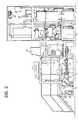
- the cell is constituted by a housing with a cylindrical wall having a vertical axis and a diameter typically between 0.35m and 2m, formed internally of wear-resistant steel, typically manganese steel.
- the cell is closed by a cover and seals.
- a rotor 2 with a vertical axis and with blades extending radially is mounted at a distance of about 50-150 mm from the base of the cell.
- the blades of the rotor of which there are typically two, have the characteristic that their front edges, with reference to the direction of rotation, that is, their so-called "attacking profiles" are formed by surfaces which are inclined, preferably at between 30 and 45 degrees, to the plane of the base, that is, to a plane perpendicular to the axis of rotation.
- the rotor is connected by means of a bearing and a transmission formed by belts and pulleys 3 to a motor 4 the speed of which is variable continuously or in steps, and which has a power of from 5 to 350 kW.
- the rotor bearing is flushed with oil circulated by a device 5 in order to lubricate and cool the rotating shaft.
- the cell has a discharge valve 6 controlled by an oleodynamic device 7.
- the temperature inside the cell is measured and monitored continuously and in real time by a detector sensitive to the infra-red component and installed in the lid of the cell, or by a sensor fitted in the vicinity of the base of the cell.
- the cell is connected by tubing to a tank 8 from which an extraction fluid is injected into the cell by means of a pump 9 in accordance with a temperature program controlled by a programmable logic computer (PLC) and by a temperature regulator.
- PLC programmable logic computer
- vapours which are formed in the cell are conveyed to a condenser 10 and the liquid phase is then cooled in an exchanger 11 whilst the condensable substances still present are stopped in an exchanger 12.
- the liquid fraction is collected in a small tank 13.
- a pump 14 enables the fluid to be homogenized for sampling and analysis and subsequent re-use or transfer for treatment or disposal.
- the gases separated are then sent to a column 15 for washing and absorption with water to which an oxidizing substance, for example, hydrogen peroxide or sodium hypochlorite has been added, so as to damp the vapours and the odours.
- the column is of the type filled with Raschig rings or the like, with a collection tank 16.
- the oxidizing substance is drawn from a container 17 and metered by a metering pump 18.
- the condenser 10 can be by-passed by means of a valve and vapours can be sent directly to the washing and absorption column 15.
- the pump 19 which recycles the washing solution to the top of the column 15 causes the solution to pass through a filter 20.
- the non-condensable gases which emerge from the column are dehumidified in a coalescence demister 21 and then pass into a filtering unit 22 comprising a pre-filter, a dust filter, an activated-carbon filter, and an absolute filter and, finally, are expelled by means of an aspirator 23 which keeps the whole apparatus constantly under a slight vacuum.
- a filtering unit 22 comprising a pre-filter, a dust filter, an activated-carbon filter, and an absolute filter and, finally, are expelled by means of an aspirator 23 which keeps the whole apparatus constantly under a slight vacuum.
- the rotor blades are also provided with cutting edges for chopping and breaking up the waste to be treated if it contains solids which can be chopped. It is intended that, the principle of the invention remaining the same, the details of embodiment and methods of construction may be varied widely with respect to those described and illustrated by way of non-limiting example.
Landscapes
- Physics & Mathematics (AREA)
- Thermal Sciences (AREA)
- Engineering & Computer Science (AREA)
- Environmental & Geological Engineering (AREA)
- Processing Of Solid Wastes (AREA)
- Vaporization, Distillation, Condensation, Sublimation, And Cold Traps (AREA)
- Extraction Or Liquid Replacement (AREA)
Applications Claiming Priority (3)
| Application Number | Priority Date | Filing Date | Title |
|---|---|---|---|
| IT97TO000048A IT1291465B1 (it) | 1997-01-24 | 1997-01-24 | Procedimento e apparecchiatura per il trattamento di rifiuti a matrice solida contenenti sostanze vaporizzabili. |
| ITTO970048 | 1997-01-24 | ||
| PCT/EP1998/000302 WO1998032548A1 (en) | 1997-01-24 | 1998-01-21 | Treatment of waste having a solid matrix containing vaporizable substances |
Publications (2)
| Publication Number | Publication Date |
|---|---|
| EP1027176A1 EP1027176A1 (en) | 2000-08-16 |
| EP1027176B1 true EP1027176B1 (en) | 2003-05-02 |
Family
ID=11415252
Family Applications (1)
| Application Number | Title | Priority Date | Filing Date |
|---|---|---|---|
| EP98903018A Expired - Lifetime EP1027176B1 (en) | 1997-01-24 | 1998-01-21 | Treatment of waste having a solid matrix containing vaporizable substances |
Country Status (6)
| Country | Link |
|---|---|
| EP (1) | EP1027176B1 (it) |
| AR (1) | AR009159A1 (it) |
| AU (1) | AU5988698A (it) |
| HR (1) | HRP980031A2 (it) |
| IT (1) | IT1291465B1 (it) |
| WO (1) | WO1998032548A1 (it) |
Families Citing this family (3)
| Publication number | Priority date | Publication date | Assignee | Title |
|---|---|---|---|---|
| ITTO20020677A1 (it) * | 2002-07-29 | 2004-01-29 | So T I Srl | Procedimento e apparecchiatura per la cottura e stabilizzazione di materiali bioorganici |
| EP2944445B1 (en) * | 2014-05-13 | 2017-03-22 | Rolan Investment OÜ | Device and a method for recycling mixed plastic waste |
| CN116590067B (zh) * | 2023-05-26 | 2024-09-17 | 镇江普境新能源科技有限公司 | 一种利用危废处置衍生燃料制备系统制备危废衍生燃料的方法 |
Family Cites Families (4)
| Publication number | Priority date | Publication date | Assignee | Title |
|---|---|---|---|---|
| US3897011A (en) * | 1973-11-12 | 1975-07-29 | Bob P Gray | Thermoplastic waste converter |
| NO155832C (no) * | 1984-10-08 | 1987-06-10 | Olav Ellingsen | Fremgangsmaate til utvinning av olje fra slam bestaaende av finfordelte uorganiske og/eller organiske partikler og olje og vann eller andre fordampbare vaesker. |
| US5110055A (en) * | 1989-04-03 | 1992-05-05 | Partek Corporation | Method and apparatus for cleaning thermoplastic material for reuse |
| JPH0448983A (ja) * | 1990-06-18 | 1992-02-18 | Masa Kaneko | 感染性医療廃棄物から建材用の骨材を製造する装置 |
-
1997
- 1997-01-24 IT IT97TO000048A patent/IT1291465B1/it active IP Right Grant
-
1998
- 1998-01-21 AU AU59886/98A patent/AU5988698A/en not_active Abandoned
- 1998-01-21 HR HRTO97A000048A patent/HRP980031A2/hr not_active Application Discontinuation
- 1998-01-21 EP EP98903018A patent/EP1027176B1/en not_active Expired - Lifetime
- 1998-01-21 WO PCT/EP1998/000302 patent/WO1998032548A1/en not_active Ceased
- 1998-01-23 AR ARP980100322A patent/AR009159A1/es unknown
Also Published As
| Publication number | Publication date |
|---|---|
| HRP980031A2 (en) | 1998-10-31 |
| WO1998032548A1 (en) | 1998-07-30 |
| ITTO970048A1 (it) | 1998-07-24 |
| EP1027176A1 (en) | 2000-08-16 |
| AU5988698A (en) | 1998-08-18 |
| IT1291465B1 (it) | 1999-01-11 |
| AR009159A1 (es) | 2000-03-08 |
Similar Documents
| Publication | Publication Date | Title |
|---|---|---|
| US11879106B2 (en) | Process for forming a solid fuel composition from mixed solid waste | |
| EP0607195B1 (en) | Processing facility for disposing of infectious medical waste | |
| US20180002624A1 (en) | Solid fuel composition formed from mixed solid waste | |
| US20040050678A1 (en) | Plastic liquefying device | |
| US20160122672A1 (en) | System for forming a solid fuel composition from mixed solid waste | |
| AU2006341575A2 (en) | Method and apparatus for processing of materials | |
| WO2007102488A1 (ja) | エステル結合を組成構造に有する合成樹脂の分解再生方法 | |
| WO1998032548A1 (en) | Treatment of waste having a solid matrix containing vaporizable substances | |
| US6423151B1 (en) | Removal of toxic contaminants from porous material | |
| US5635122A (en) | Process for disposing of refuse which includes pathogenic components | |
| US9737920B2 (en) | Method and apparatus for extracting contaminants from soil and from animal manure | |
| JPH1099819A (ja) | 廃プラスチック処理分別装置 | |
| JPH0975906A (ja) | 包装済食品の処理方法および処理装置 | |
| EP0707858B1 (en) | A process for disposing of refuse which includes pathogenic components | |
| WO2001002027A1 (en) | Process for sterilizing and disposing of potentially contaminated waste | |
| JP4747366B2 (ja) | プラスチック廃棄物の分別回収方法 | |
| US20250319505A1 (en) | Waste Processing Plant and Method for Waste Processing | |
| EP4283193A1 (en) | System for the thermal treatment of municipal solid waste | |
| WO2003086673A1 (en) | Method and device for removing harmful substances | |
| JP4118313B1 (ja) | エステル結合を組成構造に有する合成樹脂の分解再生方法 | |
| CA2134321C (en) | A process for disposing of refuse which includes pathogenic components | |
| HK40078380A (en) | Solid fuel composition from mixed solid waste | |
| KR20050046666A (ko) | 음식물쓰레기 비료화방법 | |
| EP1546623B1 (en) | Process and apparatus for cooking and stabilisation of bio-organic materials | |
| JP2003019428A (ja) | 感染性廃棄物用熱分解炉及び処理装置 |
Legal Events
| Date | Code | Title | Description |
|---|---|---|---|
| PUAI | Public reference made under article 153(3) epc to a published international application that has entered the european phase |
Free format text: ORIGINAL CODE: 0009012 |
|
| 17P | Request for examination filed |
Effective date: 19990818 |
|
| AK | Designated contracting states |
Kind code of ref document: A1 Designated state(s): GB |
|
| AX | Request for extension of the european patent |
Free format text: AL PAYMENT 19990818;MK PAYMENT 19990818;RO PAYMENT 19990818 |
|
| 17Q | First examination report despatched |
Effective date: 20010626 |
|
| GRAH | Despatch of communication of intention to grant a patent |
Free format text: ORIGINAL CODE: EPIDOS IGRA |
|
| GRAH | Despatch of communication of intention to grant a patent |
Free format text: ORIGINAL CODE: EPIDOS IGRA |
|
| RAP1 | Party data changed (applicant data changed or rights of an application transferred) |
Owner name: SICIM SPA |
|
| GRAA | (expected) grant |
Free format text: ORIGINAL CODE: 0009210 |
|
| AK | Designated contracting states |
Designated state(s): GB |
|
| AX | Request for extension of the european patent |
Extension state: AL MK RO |
|
| REG | Reference to a national code |
Ref country code: GB Ref legal event code: FG4D |
|
| PG25 | Lapsed in a contracting state [announced via postgrant information from national office to epo] |
Ref country code: GB Free format text: LAPSE BECAUSE OF NON-PAYMENT OF DUE FEES Effective date: 20040121 |
|
| PLBE | No opposition filed within time limit |
Free format text: ORIGINAL CODE: 0009261 |
|
| STAA | Information on the status of an ep patent application or granted ep patent |
Free format text: STATUS: NO OPPOSITION FILED WITHIN TIME LIMIT |
|
| 26N | No opposition filed |
Effective date: 20040203 |
|
| GBPC | Gb: european patent ceased through non-payment of renewal fee |
Effective date: 20040121 |