EP1027209B1 - Formkörper und verfahren für verbundmesser für reifenformen - Google Patents
Formkörper und verfahren für verbundmesser für reifenformen Download PDFInfo
- Publication number
- EP1027209B1 EP1027209B1 EP97913754A EP97913754A EP1027209B1 EP 1027209 B1 EP1027209 B1 EP 1027209B1 EP 97913754 A EP97913754 A EP 97913754A EP 97913754 A EP97913754 A EP 97913754A EP 1027209 B1 EP1027209 B1 EP 1027209B1
- Authority
- EP
- European Patent Office
- Prior art keywords
- blade
- bend
- blank
- metal
- blade blank
- Prior art date
- Legal status (The legal status is an assumption and is not a legal conclusion. Google has not performed a legal analysis and makes no representation as to the accuracy of the status listed.)
- Expired - Lifetime
Links
- 239000002131 composite material Substances 0.000 title claims abstract description 16
- 238000000034 method Methods 0.000 title description 11
- 239000000463 material Substances 0.000 claims abstract description 22
- 239000012255 powdered metal Substances 0.000 claims abstract description 17
- 238000000465 moulding Methods 0.000 claims abstract description 12
- 238000004519 manufacturing process Methods 0.000 claims abstract description 10
- 239000002184 metal Substances 0.000 claims description 16
- 229910000831 Steel Inorganic materials 0.000 claims description 5
- 239000010959 steel Substances 0.000 claims description 5
- 238000002788 crimping Methods 0.000 claims description 4
- 238000005452 bending Methods 0.000 description 3
- 229910001369 Brass Inorganic materials 0.000 description 2
- 239000010951 brass Substances 0.000 description 2
- 239000007769 metal material Substances 0.000 description 2
- 239000010935 stainless steel Substances 0.000 description 2
- 229910001220 stainless steel Inorganic materials 0.000 description 2
- CWYNVVGOOAEACU-UHFFFAOYSA-N Fe2+ Chemical compound [Fe+2] CWYNVVGOOAEACU-UHFFFAOYSA-N 0.000 description 1
- 238000005299 abrasion Methods 0.000 description 1
- 229910045601 alloy Inorganic materials 0.000 description 1
- 239000000956 alloy Substances 0.000 description 1
- 230000009286 beneficial effect Effects 0.000 description 1
- 150000001875 compounds Chemical class 0.000 description 1
- 238000010276 construction Methods 0.000 description 1
- 238000005520 cutting process Methods 0.000 description 1
- 239000007787 solid Substances 0.000 description 1
Images


Classifications
-
- B—PERFORMING OPERATIONS; TRANSPORTING
- B29—WORKING OF PLASTICS; WORKING OF SUBSTANCES IN A PLASTIC STATE IN GENERAL
- B29C—SHAPING OR JOINING OF PLASTICS; SHAPING OF MATERIAL IN A PLASTIC STATE, NOT OTHERWISE PROVIDED FOR; AFTER-TREATMENT OF THE SHAPED PRODUCTS, e.g. REPAIRING
- B29C33/00—Moulds or cores; Details thereof or accessories therefor
- B29C33/42—Moulds or cores; Details thereof or accessories therefor characterised by the shape of the moulding surface, e.g. ribs or grooves
-
- B—PERFORMING OPERATIONS; TRANSPORTING
- B22—CASTING; POWDER METALLURGY
- B22F—WORKING METALLIC POWDER; MANUFACTURE OF ARTICLES FROM METALLIC POWDER; MAKING METALLIC POWDER; APPARATUS OR DEVICES SPECIALLY ADAPTED FOR METALLIC POWDER
- B22F5/00—Manufacture of workpieces or articles from metallic powder characterised by the special shape of the product
- B22F5/007—Manufacture of workpieces or articles from metallic powder characterised by the special shape of the product of moulds
-
- B—PERFORMING OPERATIONS; TRANSPORTING
- B22—CASTING; POWDER METALLURGY
- B22F—WORKING METALLIC POWDER; MANUFACTURE OF ARTICLES FROM METALLIC POWDER; MAKING METALLIC POWDER; APPARATUS OR DEVICES SPECIALLY ADAPTED FOR METALLIC POWDER
- B22F7/00—Manufacture of composite layers, workpieces, or articles, comprising metallic powder, by sintering the powder, with or without compacting wherein at least one part is obtained by sintering or compression
- B22F7/06—Manufacture of composite layers, workpieces, or articles, comprising metallic powder, by sintering the powder, with or without compacting wherein at least one part is obtained by sintering or compression of composite workpieces or articles from parts, e.g. to form tipped tools
- B22F7/08—Manufacture of composite layers, workpieces, or articles, comprising metallic powder, by sintering the powder, with or without compacting wherein at least one part is obtained by sintering or compression of composite workpieces or articles from parts, e.g. to form tipped tools with one or more parts not made from powder
-
- B—PERFORMING OPERATIONS; TRANSPORTING
- B29—WORKING OF PLASTICS; WORKING OF SUBSTANCES IN A PLASTIC STATE IN GENERAL
- B29D—PRODUCING PARTICULAR ARTICLES FROM PLASTICS OR FROM SUBSTANCES IN A PLASTIC STATE
- B29D30/00—Producing pneumatic or solid tyres or parts thereof
- B29D30/06—Pneumatic tyres or parts thereof (e.g. produced by casting, moulding, compression moulding, injection moulding, centrifugal casting)
- B29D30/0601—Vulcanising tyres; Vulcanising presses for tyres
- B29D30/0606—Vulcanising moulds not integral with vulcanising presses
-
- B—PERFORMING OPERATIONS; TRANSPORTING
- B29—WORKING OF PLASTICS; WORKING OF SUBSTANCES IN A PLASTIC STATE IN GENERAL
- B29D—PRODUCING PARTICULAR ARTICLES FROM PLASTICS OR FROM SUBSTANCES IN A PLASTIC STATE
- B29D30/00—Producing pneumatic or solid tyres or parts thereof
- B29D30/06—Pneumatic tyres or parts thereof (e.g. produced by casting, moulding, compression moulding, injection moulding, centrifugal casting)
- B29D30/0601—Vulcanising tyres; Vulcanising presses for tyres
- B29D30/0606—Vulcanising moulds not integral with vulcanising presses
- B29D2030/0607—Constructional features of the moulds
- B29D2030/0612—Means for forming recesses or protrusions in the tyres, e.g. grooves or ribs, to create the tread or sidewalls patterns
-
- B—PERFORMING OPERATIONS; TRANSPORTING
- B29—WORKING OF PLASTICS; WORKING OF SUBSTANCES IN A PLASTIC STATE IN GENERAL
- B29D—PRODUCING PARTICULAR ARTICLES FROM PLASTICS OR FROM SUBSTANCES IN A PLASTIC STATE
- B29D30/00—Producing pneumatic or solid tyres or parts thereof
- B29D30/06—Pneumatic tyres or parts thereof (e.g. produced by casting, moulding, compression moulding, injection moulding, centrifugal casting)
- B29D30/0601—Vulcanising tyres; Vulcanising presses for tyres
- B29D30/0606—Vulcanising moulds not integral with vulcanising presses
- B29D2030/0607—Constructional features of the moulds
- B29D2030/0613—Means, e.g. sipes or blade-like elements, for forming narrow recesses in the tyres, e.g. cuts or incisions for winter tyres
Definitions
- the present invention relates to blades for the curing mold. More particularly to a composite type blade which has rounded ends and a method of fabricating such composite blades.
- Blades for tire curing molds are well known in the art of tire manufacture. Such blades are conventionally made from a running length or strip of a metallic material such as steel, stainless steel or brass.
- the strip is generally about 0,020 inches (0,5 mm) to 0,040 inches (1 mm) thick and has a width of about one half to 1-1/2 inches (12,7 to 38 mm). Sometimes the strips are of solid form other times perforated strips are used to form the blade.
- the method and apparatus for making blades for use in tire molds includes piercing, notching, bending or otherwise altering the shape of a free end of strip material by successively positioning the free end and a plurality of shape altering tools in operative engagement and cutting off the formed blade from the free end.
- the blade creates a sipe, which is a narrow groove or incision in the tread.
- the lateral ends of the blade even if polished or ground round is a subsequent deburring operations, are sufficiently narrow to initiate crack propagation at this highly stressed region of tread.
- a blade for use in a tire mold is formed from blade blanks having at least two ends and at least one end cap having a substantially enlarged cross-section relative to the blade blank. Each end cap is attached to one end of the blade blank.
- the end cap is of a powdered metal.
- At least one of the ends is crimped, notched or perforated so that when the end of the blade blank is placed in the mold for forming the end cap the crimped notched or perforated end is encapsulated by the material used to form the end cap.
- the enlarged end cap has a rounded cross section.
- the blank may include one or more bends between the two ends.
- a bend cap having a substantially enlarged cross-section is attached to the blade blank at a bend, the bend cap being attached in a similar way as the end cap and preferably has a rounded cross-section.
- the blade blank is metal, of brass, steel or stainless steel.
- the method of fabricating a composite blade for use in a tire mold has the steps of forming a blade blank having at least two ends placing one or more ends of the blade blank in a die and molding a second powdered metal material around the one or more ends forming a rounded end at least partially encapsulating the one or more ends of the steel blade blank.
- the method may further have the step of crimping, notching or perforating the blade blank ends prior to molding thus encapsulating the crimp, notch or perforated end.
- the method may further include bending the blade blank and then molding a second powdered metal material around the bend similar to the method of making the end cap.
- Fig. 1 is a view of a blade having the ends encapsulated with cap ends.
- Fig. 2 is a top view of Fig. 1.
- Fig. 3 is a view of a blade having the ends capped and a bend encapsulated with a bend cap.
- Fig. 4 is a top view of Fig. 3.
- Figs. 5, 6, and 7 are cross sectional view showing a crimped end, a notch and perforation as additional means for attaching cap ends or cap bends.
- Fig. 8 is a portion of the strip used to form a blade.
- Figs. 9 through 13 show various prior art blades of differing shapes commonly used in tire molds, each such blade has ends or ends and bends which create stress risers in the tread element.
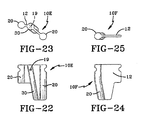
- Figs. 14 - 25 are representations of plan and top views of a variety of different composite blades of the present invention.
- a portion of a strip (100) of metallic material commonly used to form blades for tire curing molds is shown.
- the resultant blades once stamped or punched out from the strip (100) took various shapes as shown in Figs. 9 through 13.
- the blades could have any number of slots (120) or cuts (121) to form the various projections (122), the projections for forming the resultant sipe in the tread of a molded tire. These features are well known in the tire building art.
- the composite blade (10) is formed of a blade blank (12), the blade blank (12) having a pair of ends (14, 16). Encapsulating the ends (14, 16) are end caps (20). Each end cap (20) at least partially if not completely encapsulates the respective ends (14, 16) as shown.
- the top view of the blade (10) shows that the end caps (20) are of a cross-section that is preferably rounded or circular. Alternatively the end cap (20) can be of any number of shapes such as elliptical, conical etc., preferably avoiding sharp edges which can induce crack propagation.
- the blade (10A) further has a bend (18) the bend (18) being encapsulated by a bend cap (30).
- the bend cap (30) preferably is a similar cross section as the end caps (20).
- the end caps (20) and bend caps (30) preferably are about four times the thickness of the blade blank (12). At a thickness of greater than 0,030 to 0,050 of an inch (0,8 mm to 1,3 mm) the end caps (30) and bend caps (30) are about three times the thickness of the blade blank (12).
- Figs. 5, 6 and 7 several means for securing the end caps (20) or bend caps (30) around the blade blank (12) are shown.
- the first means shown in Fig. 5 is crimping the end of (14 or 16) of a blade blank (12).
- the crimped end (15) provides an increased surface contact area and cantilevered spring loaded portion which when placed in a mold under high pressure results in better adhesion of the end cap (20).
- the end cap (20) is shown encapsulating an end (14 or 16) having a notch (17).
- the bend cap (30) is shown encapsulating a bend (18), the blade blank having perforated holes (19) which when placed in a cap mold have the cap material flow into the holes (19) which anchors the bend cap (30) to the blade blank (12).
- notches (17), perforated holes (19) or crimped ends (15) can be found at ends (14, 16) or at the bends (18).
- no mechanical enhancement to attachment of the caps to the blades may be needed, particularly if the cap ends (20) or the bend cap (30) is inclined or sloped relative to the radial direction when placed in an annular tread mold.
- the composite blades (10B through 10F) of the present invention can be fabricated in any number of shapes. Figs. 14 through 25 illustrate a few of these exemplary shapes.
- These beneficial attributes of these composite blades (10, 10A through 10F) rest primarily in their ability to prevent crack propagation at the sipes of the tread elements. These blades (10, 10A through 10F) enable the tire designer to use a wider variety of tread compounds or alternatively to design a deeper tread depth than before with a siped tread.
- the preferred method of manufacturing the composite blades (10, 10A through 10F) is to form a blade bank (12) of any desired shape, the blank (12) having at least two ends. Placing the end of a blank in a die and molding a second powdered metal material forming a enlarged end at least partially encapsulating the one or more ends of the steel blade blank.
- the second powdered metal material can be any material of sufficient durability to withstand the rigors of heat pressure and abrasion the part will be exposed to during the tire curing process.
- the powdered metal is of the ferrous type commercially sold and made of stainless 316 alloy powdered metal.
- the method may further include the steps of bending, crimping, or notching or perforating with holes the blade blank (12) prior to molding the second material.
- the method may further include the step of placing the bend (18) of a blade blank (12) into a die, molding a second powdered metal material around or adjacent to the bend (18) forming an enlarged bend cap (30) at least partially encapsulating the bend (18).
- the enlarged ends (20) or bend caps (30) have a substantially rounded cross-section.
- the second powdered metal material need only extend partially covering the blade end (14, 16) or bend (18).
- the remaining portion (12A) of the blade (12) is at least partially used to anchor the blade in the mold as is commonly understood in the art.
- the end caps (20) and bends (30) are sufficiently small that the cost of material is very low, the time to mold is consequently very fast.
- the cost therefore, is about one third that of trying to bend or otherwise form a round end or bend and unlike a bent round end, there is no open seam to tear or catch rubber in during the tire molding process.
Landscapes
- Engineering & Computer Science (AREA)
- Mechanical Engineering (AREA)
- Manufacturing & Machinery (AREA)
- Chemical & Material Sciences (AREA)
- Composite Materials (AREA)
- Materials Engineering (AREA)
- Moulds For Moulding Plastics Or The Like (AREA)
- Powder Metallurgy (AREA)
- Heating, Cooling, Or Curing Plastics Or The Like In General (AREA)
Claims (11)
- Lamelle (10) zur Verwendung in einer Reifenform mit:dadurch gekennzeichnet, dass die mindestens eine Endkappe (20) aus einem zweiten Material ist, welches zweite Material ein pulverisiertes Metall ist, das geformt ist, um ein vergrößertes Ende zu bilden, das zumindest teilweise das eine oder die mehreren Enden (14, 16) des Lamellenrohlings (12) umschließt.einem Metall-Lamellenrohling (12), der mindestens zwei Enden (14, 16) hat;mindestens einer Endkappe (20), die relativ zu dem Metall-Lamellenrohling (12) einen wesentlich größeren Querschnitt hat, wobei die Endkappe (20) an einem Ende (14, 16) des Metall-Lamellenrohlings befestigt ist,
- Lamelle (10) nach Anspruch 1, wobei mindestens eines der Enden (14, 16) des Metall-Lamellenrohlings (12) gecrimpt ist.
- Lamelle (10) nach Anspruch 1, wobei mindestens eines der Enden (14, 16) des Metall-Lamellenrohlings (12) eingekerbt ist.
- Lamelle (10) nach Anspruch 1, wobei der Metall-Lamellenrohling (12) eine oder mehrere Biegungen (18) zwischen den zwei Enden (14, 16) hat.
- Lamelle (10) nach Anspruch 1, wobei die Lamelle (10) überdies durch Biegekappen (30) gekennzeichnet ist, wobei die Biegekappen (30) einen im Wesentlichen gerundeten Querschnitt haben und jede Biegekappe (30) ein pulverisiertes Metall ist, das an einer Biegung (18) an dem Metall-Lamellenrohling (12) angeformt ist.
- Lamelle (10) nach Anspruch 1, wobei der Lamellenrohling (12) Stahl ist.
- Lamelle (10) nach Anspruch 1, wobei der Querschnitt der Endkappe (20) im Wesentlichen gerundet ist.
- Verfahren zum Herstellen der zusammengesetzten Lamelle (10) zur Verwendung in einer Reifenform nach Anspruch 1, das die Schritte umfasst, dass
ein Metall-Lamellenrohling (12) mit mindestens zwei Enden (14, 16) gebildet wird; dadurch gekennzeichnet, dass ein oder mehrere Enden (14, 16) des Metall-Lamellenrohlings (12) in einem Gesenk angeordnet werden und ein zweites pulverisiertes Metallmaterial geformt wird, das eine Endkappe (20) bildet, die das eine oder die mehreren Enden (14, 16) des Metall-Lamellenrohlings (12) zumindest teilweise umschließt. - Verfahren zur Herstellung einer zusammengesetzten Lamelle (10) nach Anspruch 8, das überdies den Schritt umfasst, dass das eine oder die mehreren Enden (14, 16) des Metall-Lamellenrohlings (12) vor dem Formen eines zweiten pulverisierten Metallmaterials gecrimpt werden, womit folglich das gecrimpte Ende (14, 16) umschlossen wird.
- Verfahren zur Herstellung einer zusammengesetzten Lamelle (10) nach Anspruch 9, das überdies den Schritt umfasst, dass das eine oder die mehreren Enden (14, 16) des Metall-Lamellenrohlings (12) vor einem Formen des zweiten pulverisierten Metallmaterials eingekerbt werden, womit folglich das eingekerbte Ende (14, 16) umschlossen wird.
- Verfahren zur Herstellung einer zusammengesetzten Lamelle (10) zur Verwendung in einer Reifenform, das die Schritte aufweist, dass ein Metall-Lamellenrohling (12) mit zwei oder mehreren Enden (14, 16) und mindestens einer zwischen den zwei Enden (14, 16) angeordneten Biegung (18) gebildet wird; dadurch gekennzeichnet, dass mindestens eine Biegung (18) des Metall-Lamellenrohlings (12) in einem Gesenk angeordnet wird und dass ein zweites pulverisiertes Metallmaterial geformt wird, das eine Biegekappe (30) bildet, die die Biegung (18) des Metall-Lamellenrohlings (12) zumindest teilweise umschließt.
Applications Claiming Priority (1)
| Application Number | Priority Date | Filing Date | Title |
|---|---|---|---|
| PCT/US1997/019258 WO1999021701A1 (en) | 1997-10-27 | 1997-10-27 | Article and method for composite tire mold blades |
Publications (2)
| Publication Number | Publication Date |
|---|---|
| EP1027209A1 EP1027209A1 (de) | 2000-08-16 |
| EP1027209B1 true EP1027209B1 (de) | 2003-04-02 |
Family
ID=22261936
Family Applications (1)
| Application Number | Title | Priority Date | Filing Date |
|---|---|---|---|
| EP97913754A Expired - Lifetime EP1027209B1 (de) | 1997-10-27 | 1997-10-27 | Formkörper und verfahren für verbundmesser für reifenformen |
Country Status (8)
| Country | Link |
|---|---|
| EP (1) | EP1027209B1 (de) |
| JP (1) | JP2001520948A (de) |
| AU (1) | AU5086898A (de) |
| BR (1) | BR9714829A (de) |
| CA (1) | CA2301126A1 (de) |
| DE (1) | DE69720552T2 (de) |
| ES (1) | ES2195126T3 (de) |
| WO (1) | WO1999021701A1 (de) |
Families Citing this family (10)
| Publication number | Priority date | Publication date | Assignee | Title |
|---|---|---|---|---|
| US20020134202A1 (en) * | 2001-03-23 | 2002-09-26 | Andre Domange | Composite blade |
| JP4729326B2 (ja) * | 2005-04-04 | 2011-07-20 | 株式会社ブリヂストン | タイヤ成型用金型及び空気入りタイヤ |
| US7544054B2 (en) | 2006-12-21 | 2009-06-09 | The Goodyear Tire & Rubber Company | Flexible molding device for manufacturing a sunken groove in a tire tread |
| US7544053B2 (en) | 2006-12-21 | 2009-06-09 | The Goodyear Tire And Rubber Company | Flexible molding device for manufacturing a sunken groove or surface tie bar in a tire tread |
| FR2961741B1 (fr) * | 2010-06-25 | 2012-08-03 | Michelin Soc Tech | Lamelle pour une garniture d'un moule destine a la vulcanisation d'une bande de roulement d'un pneumatique |
| DE102010047479A1 (de) | 2010-10-06 | 2012-08-16 | EPS Engineering Gesellschaft für Produktentwicklung mbH | Verfahren zum Einsetzen von Lamellenteilen in einen Formkörper zur Reifenherstellung, Formkörper mit eingesetzten Lamellenteilen und Fixierstift für Lamellenteile |
| FR3000424B1 (fr) | 2012-12-28 | 2015-05-15 | Michelin & Cie | Element de moule comportant des moyens de decoupe pour le moulage et la vulcanisation d'une bande de roulement d'un pneumatique |
| FR3053919A1 (fr) * | 2016-07-18 | 2018-01-19 | Compagnie Generale Des Etablissements Michelin | Lamelle hybride de garniture d’un moule pour pneumatique |
| JP6909082B2 (ja) * | 2017-07-18 | 2021-07-28 | Toyo Tire株式会社 | タイヤ加硫金型 |
| WO2019106540A1 (fr) * | 2017-11-30 | 2019-06-06 | Compagnie Générale Des Établissements Michelin | Element moulant avec pluralite d'elargissements |
Family Cites Families (6)
| Publication number | Priority date | Publication date | Assignee | Title |
|---|---|---|---|---|
| US2736924A (en) * | 1953-10-01 | 1956-03-06 | Morris Bean & Company | Bladed tire molds and method |
| DE1169651B (de) * | 1961-06-20 | 1964-05-06 | Phoenix Gummiwerke Ag | Vulkanisierform fuer profilierte Kraftfahrzeugluftreifen |
| DE1729589C3 (de) * | 1967-07-06 | 1975-03-13 | Continental Gummi-Werke Ag, 3000 Hannover | Form, insbesondere Vulkanisierform, zum Formen einer Lauffläche eines Fahrzeugreifens |
| DE2206897A1 (de) * | 1971-02-17 | 1972-09-21 | Airam Ab Oy | Verfahren zur Herstellung von Gleit Schutzmitteln fur Fahrzeugreifen |
| GB1379592A (en) * | 1971-05-15 | 1975-01-02 | Dunlop Ltd | Mould for the moulding of the tread of a pneumatic tyre |
| GB1460592A (en) * | 1973-05-19 | 1977-01-06 | Girling Ltd | Method of manufacturing a friction disc |
-
1997
- 1997-10-27 CA CA002301126A patent/CA2301126A1/en not_active Abandoned
- 1997-10-27 JP JP2000517835A patent/JP2001520948A/ja active Pending
- 1997-10-27 ES ES97913754T patent/ES2195126T3/es not_active Expired - Lifetime
- 1997-10-27 WO PCT/US1997/019258 patent/WO1999021701A1/en not_active Ceased
- 1997-10-27 EP EP97913754A patent/EP1027209B1/de not_active Expired - Lifetime
- 1997-10-27 AU AU50868/98A patent/AU5086898A/en not_active Abandoned
- 1997-10-27 DE DE69720552T patent/DE69720552T2/de not_active Expired - Fee Related
- 1997-10-27 BR BR9714829-6A patent/BR9714829A/pt not_active IP Right Cessation
Also Published As
| Publication number | Publication date |
|---|---|
| EP1027209A1 (de) | 2000-08-16 |
| CA2301126A1 (en) | 1999-05-06 |
| ES2195126T3 (es) | 2003-12-01 |
| BR9714829A (pt) | 2000-07-18 |
| WO1999021701A1 (en) | 1999-05-06 |
| DE69720552T2 (de) | 2004-01-08 |
| JP2001520948A (ja) | 2001-11-06 |
| AU5086898A (en) | 1999-05-17 |
| DE69720552D1 (de) | 2003-05-08 |
Similar Documents
| Publication | Publication Date | Title |
|---|---|---|
| US6264453B1 (en) | Article and method for composite tire mold blades | |
| EP1243390B1 (de) | Verbundblatt für ein Reifenvulkanisierformwerkzeug | |
| EP0542399B1 (de) | Hohle Diamantschneideschmuckkette | |
| US6412325B1 (en) | Method for phototyping parts from sheet metal | |
| EP3001065B1 (de) | Material mit widerhaken mit variabler höhe | |
| JPH06343509A (ja) | 宝飾チェーン及びその製造方法 | |
| EP1027209A1 (de) | Formkörper und verfahren für verbundmesser für reifenformen | |
| US20040187644A1 (en) | Method for manufacturing a razor blade | |
| US6389790B1 (en) | Chain link, a jewelry chain and a method of forming the same by contouring | |
| US3492519A (en) | Commutator and commutator blank for dynamoelectric machines and method of making same | |
| IL106201A (en) | Link for fin jewelry rope chain a fine jewelry rope chain and method of manufacture thereof | |
| US4448055A (en) | Method to manufacture pole pieces for dynamo electric machine, and so-made pole piece | |
| US6993896B2 (en) | Method of forming chain links | |
| KR100344097B1 (ko) | 손톱깍기용 누름편의 제조방법 | |
| JPH0825365A (ja) | タイヤに細溝を形成するタイヤ・ブレードの製法 | |
| WO1998054800A1 (en) | Wire termination tool and method for producing the same | |
| JP3048135B2 (ja) | 建物の外壁補修用アンカーピンの製造法 | |
| US926875A (en) | Method of forming steel backs for brake-shoes. | |
| US7143571B2 (en) | Method of forming chain links | |
| JPS59500393A (ja) | 整流子の製造方法 | |
| JPH01306028A (ja) | 孔付き金属材の製造方法 | |
| JP2001298916A (ja) | 積層鉄心の製造方法 | |
| CA1224328A (en) | Manufacture of rotatable ignition files or flint wheels | |
| JP3314504B2 (ja) | かしめ加工法 | |
| JPH01306030A (ja) | 打ち抜きパンチ |
Legal Events
| Date | Code | Title | Description |
|---|---|---|---|
| PUAI | Public reference made under article 153(3) epc to a published international application that has entered the european phase |
Free format text: ORIGINAL CODE: 0009012 |
|
| 17P | Request for examination filed |
Effective date: 20000529 |
|
| AK | Designated contracting states |
Kind code of ref document: A1 Designated state(s): DE ES FR GB IT |
|
| 17Q | First examination report despatched |
Effective date: 20011129 |
|
| GRAG | Despatch of communication of intention to grant |
Free format text: ORIGINAL CODE: EPIDOS AGRA |
|
| GRAG | Despatch of communication of intention to grant |
Free format text: ORIGINAL CODE: EPIDOS AGRA |
|
| GRAH | Despatch of communication of intention to grant a patent |
Free format text: ORIGINAL CODE: EPIDOS IGRA |
|
| GRAH | Despatch of communication of intention to grant a patent |
Free format text: ORIGINAL CODE: EPIDOS IGRA |
|
| GRAA | (expected) grant |
Free format text: ORIGINAL CODE: 0009210 |
|
| AK | Designated contracting states |
Designated state(s): DE ES FR GB IT |
|
| REG | Reference to a national code |
Ref country code: GB Ref legal event code: FG4D |
|
| REF | Corresponds to: |
Ref document number: 69720552 Country of ref document: DE Date of ref document: 20030508 Kind code of ref document: P |
|
| ET | Fr: translation filed | ||
| PG25 | Lapsed in a contracting state [announced via postgrant information from national office to epo] |
Ref country code: ES Free format text: LAPSE BECAUSE OF NON-PAYMENT OF DUE FEES Effective date: 20031028 |
|
| PLBE | No opposition filed within time limit |
Free format text: ORIGINAL CODE: 0009261 |
|
| STAA | Information on the status of an ep patent application or granted ep patent |
Free format text: STATUS: NO OPPOSITION FILED WITHIN TIME LIMIT |
|
| 26N | No opposition filed |
Effective date: 20040105 |
|
| REG | Reference to a national code |
Ref country code: ES Ref legal event code: FD2A Effective date: 20031028 |
|
| PG25 | Lapsed in a contracting state [announced via postgrant information from national office to epo] |
Ref country code: IT Free format text: LAPSE BECAUSE OF NON-PAYMENT OF DUE FEES;WARNING: LAPSES OF ITALIAN PATENTS WITH EFFECTIVE DATE BEFORE 2007 MAY HAVE OCCURRED AT ANY TIME BEFORE 2007. THE CORRECT EFFECTIVE DATE MAY BE DIFFERENT FROM THE ONE RECORDED. Effective date: 20051027 |
|
| PGFP | Annual fee paid to national office [announced via postgrant information from national office to epo] |
Ref country code: GB Payment date: 20070918 Year of fee payment: 11 |
|
| PGFP | Annual fee paid to national office [announced via postgrant information from national office to epo] |
Ref country code: DE Payment date: 20071031 Year of fee payment: 11 |
|
| PGFP | Annual fee paid to national office [announced via postgrant information from national office to epo] |
Ref country code: FR Payment date: 20071004 Year of fee payment: 11 |
|
| GBPC | Gb: european patent ceased through non-payment of renewal fee |
Effective date: 20081027 |
|
| REG | Reference to a national code |
Ref country code: FR Ref legal event code: ST Effective date: 20090630 |
|
| PG25 | Lapsed in a contracting state [announced via postgrant information from national office to epo] |
Ref country code: DE Free format text: LAPSE BECAUSE OF NON-PAYMENT OF DUE FEES Effective date: 20090501 |
|
| PG25 | Lapsed in a contracting state [announced via postgrant information from national office to epo] |
Ref country code: FR Free format text: LAPSE BECAUSE OF NON-PAYMENT OF DUE FEES Effective date: 20081031 |
|
| PG25 | Lapsed in a contracting state [announced via postgrant information from national office to epo] |
Ref country code: GB Free format text: LAPSE BECAUSE OF NON-PAYMENT OF DUE FEES Effective date: 20081027 |