EP1027254B1 - Metallbehälter mit flexiblem scharnier - Google Patents
Metallbehälter mit flexiblem scharnier Download PDFInfo
- Publication number
- EP1027254B1 EP1027254B1 EP98910498A EP98910498A EP1027254B1 EP 1027254 B1 EP1027254 B1 EP 1027254B1 EP 98910498 A EP98910498 A EP 98910498A EP 98910498 A EP98910498 A EP 98910498A EP 1027254 B1 EP1027254 B1 EP 1027254B1
- Authority
- EP
- European Patent Office
- Prior art keywords
- container
- connector
- ring member
- lid
- container lid
- Prior art date
- Legal status (The legal status is an assumption and is not a legal conclusion. Google has not performed a legal analysis and makes no representation as to the accuracy of the status listed.)
- Expired - Lifetime
Links
- 239000002184 metal Substances 0.000 title claims description 64
- 230000002093 peripheral effect Effects 0.000 claims description 30
- 238000005304 joining Methods 0.000 claims description 13
- 239000004033 plastic Substances 0.000 claims description 4
- 229920001169 thermoplastic Polymers 0.000 claims description 4
- 239000004416 thermosoftening plastic Substances 0.000 claims description 4
- 238000002347 injection Methods 0.000 claims description 3
- 239000007924 injection Substances 0.000 claims description 3
- 239000004743 Polypropylene Substances 0.000 claims description 2
- -1 polypropylene Polymers 0.000 claims description 2
- 229920001155 polypropylene Polymers 0.000 claims description 2
- 238000010104 thermoplastic forming Methods 0.000 claims 1
- 230000007246 mechanism Effects 0.000 description 7
- 238000004806 packaging method and process Methods 0.000 description 5
- 238000004519 manufacturing process Methods 0.000 description 4
- 230000008901 benefit Effects 0.000 description 3
- 230000008859 change Effects 0.000 description 2
- 238000010276 construction Methods 0.000 description 2
- 230000001788 irregular Effects 0.000 description 2
- 238000012986 modification Methods 0.000 description 2
- 230000004048 modification Effects 0.000 description 2
- 238000003860 storage Methods 0.000 description 2
- 230000015572 biosynthetic process Effects 0.000 description 1
- 230000002452 interceptive effect Effects 0.000 description 1
- 239000000463 material Substances 0.000 description 1
- 238000005555 metalworking Methods 0.000 description 1
- 238000000034 method Methods 0.000 description 1
- 239000002991 molded plastic Substances 0.000 description 1
- 230000009467 reduction Effects 0.000 description 1
- 239000012815 thermoplastic material Substances 0.000 description 1
Images




Classifications
-
- B—PERFORMING OPERATIONS; TRANSPORTING
- B65—CONVEYING; PACKING; STORING; HANDLING THIN OR FILAMENTARY MATERIAL
- B65D—CONTAINERS FOR STORAGE OR TRANSPORT OF ARTICLES OR MATERIALS, e.g. BAGS, BARRELS, BOTTLES, BOXES, CANS, CARTONS, CRATES, DRUMS, JARS, TANKS, HOPPERS, FORWARDING CONTAINERS; ACCESSORIES, CLOSURES, OR FITTINGS THEREFOR; PACKAGING ELEMENTS; PACKAGES
- B65D43/00—Lids or covers for rigid or semi-rigid containers
- B65D43/14—Non-removable lids or covers
- B65D43/16—Non-removable lids or covers hinged for upward or downward movement
- B65D43/163—Non-removable lids or covers hinged for upward or downward movement the container and the lid being made separately
- B65D43/168—Non-removable lids or covers hinged for upward or downward movement the container and the lid being made separately and connected by one or more hinges formed by a separate, single container and a flexible, band-like element fixed to the container and the lid
-
- B—PERFORMING OPERATIONS; TRANSPORTING
- B65—CONVEYING; PACKING; STORING; HANDLING THIN OR FILAMENTARY MATERIAL
- B65D—CONTAINERS FOR STORAGE OR TRANSPORT OF ARTICLES OR MATERIALS, e.g. BAGS, BARRELS, BOTTLES, BOXES, CANS, CARTONS, CRATES, DRUMS, JARS, TANKS, HOPPERS, FORWARDING CONTAINERS; ACCESSORIES, CLOSURES, OR FITTINGS THEREFOR; PACKAGING ELEMENTS; PACKAGES
- B65D2251/00—Details relating to container closures
- B65D2251/10—Details of hinged closures
- B65D2251/1016—Means for locking the closure in closed position
- B65D2251/1058—Latching mechanisms
-
- Y—GENERAL TAGGING OF NEW TECHNOLOGICAL DEVELOPMENTS; GENERAL TAGGING OF CROSS-SECTIONAL TECHNOLOGIES SPANNING OVER SEVERAL SECTIONS OF THE IPC; TECHNICAL SUBJECTS COVERED BY FORMER USPC CROSS-REFERENCE ART COLLECTIONS [XRACs] AND DIGESTS
- Y10—TECHNICAL SUBJECTS COVERED BY FORMER USPC
- Y10S—TECHNICAL SUBJECTS COVERED BY FORMER USPC CROSS-REFERENCE ART COLLECTIONS [XRACs] AND DIGESTS
- Y10S16/00—Miscellaneous hardware, e.g. bushing, carpet fastener, caster, door closer, panel hanger, attachable or adjunct handle, hinge, window sash balance
- Y10S16/13—Plastic hinge
Definitions
- This invention relates generally to containers, and more specifically to thin-walled metal containers with formed edges.
- Thin-walled metal containers are popular for packaging certain items, where the packaging is intended to have a degree of permanency. They are advantageous in that they provide good protection for the contents, and they provide the opportunity to permanently print attractive designs on the containers themselves.
- the containers thus can be used for long periods of time, or, in cases where the contents are consumed after a short time, the containers are often kept for other storage purposes.
- Thin-walled metal containers are typically made from thin metal sheets by deep drawing. Some of them have separable lids and bottoms, while others, including many low-profile containers, have hinged lids that are not separable from the bottoms. Both hinged and non-hinged metal containers share the aspect that the lids are not identical to the bottoms, because they are intended to interfit. Thus, two different tool sets are normally required to form a container, one for making the container lid, the other for the bottom. Typically, the bottom has an edge which is inwardly rolled or hemmed to avoid exposing raw metal edges, and sometimes has a ledge formed at the upper part to serve as a receiving area/stop for the lid.
- the lid or cover typically has a rolled or hemmed edge to also avoid exposing raw metal edges, and that edge is typically rolled outwardly, to leave the inside wall of the lid available to fit the container bottom.
- the lid further has a hinge half that interfits an associated hinge half on the container bottom.
- hinged connection between the lid and the bottom of a hinged container facilitates repeated opening and closing of the container and also eliminates the possibility of mislaying the container lid.
- Hinged containers are generally more expensive to make than non-hinged containers with separable container halves, due to the costs involved in forming the hinges.
- the hinge on a low-profile metal container is typically integrally formed from metal tabs extending from the sides of the container halves.
- the sheet metal blank from which a container half is formed has to be processed to form the tabs, and the tabs are then rolled or otherwise processed to form a hinge half.
- the exact configurations of hinges on hinged metal containers may differ, the formation of such hinges generally requires extra metal processing steps and more complicated tool sets than those required for non-hinged metal containers.
- the tool sets and machine setups for making a particular metal container can involve a significant expense. That expense can be justified when production runs are relatively long, so that the same tool sets can be used to produce a large number of container components. It is not straightforward or inexpensive to change tool sets or machine setups to change from one size container to another. For example, when it is desired to form a shallower or taller container, it is necessary to alter the drawing and forming tools which, as pointed above, can be expensive. This problem is even more significant in the case of hinged containers, due to the relatively more expensive tool sets and more complicated setups required for making them.
- container can conceptually be made utilizing two identical container halves produced using the same equipment in order to reduce costs, the identical halves cannot interfit to form a container in general, and cannot be readily combined to form a hinged container in particular.
- FR 2.196.944 A discloses a metal box with a bottom and a lid part, both fabricated from metal. A joint of plastic material is provided having two ring portions receiving the edges of the bottom part and lid part of the metal box, respectively.
- a resilient hinged connector for joining a metal container lid and a metal container bottom to form a hinged container.
- the container lid and bottom are typically formed of drawn sheet metal and each has a closed end and an upstanding wall terminated in a formed edge.
- the formed edges of the container lid and bottom define a peripheral container shape.
- the hinged connector is shaped to generally match the peripheral container shape or a portion thereof and comprises a ring member, a partial segment, and an integrally formed hinge joining the ring member and the partial segment.
- the ring member is preferably substantially continuous about its periphery and has a down-facing seat for gripping the formed edge of the container bottom, and an up-facing seat for gripping fewer than all sides of the formed edge of the container lid, leaving at least one side of formed edge of the lid free.
- the partial segment has an up-facing seat which is sized for securely gripping at least the free side of the formed edge of the container lid.
- the integrally formed hinge is positioned to close the container in a normal condition and allow the container lid to pivot about the hinge to open the container.
- the hinged connector is preferably formed of injection molded thermoplastic, which is relatively inexpensive to produce.
- the lid and bottom have simple formed edges, and the need to form hinge components separately on the container halves is avoided, resulting in substantial reduction of the cost of the hinged container.
- the container halves do not have to interfit, and may have identical size and shape.
- two identical regular container lids with simple formed edges are joined together by a hinged connector to form a low-profile hinged container.
- Using identical container halves further reduces the cost of the container, since both container halves can be formed using the same tools.
- the hinged connector can be advantageously used to join the lid and bottom of a conventional non-hinged container to form a hinged container.
- existing non-hinged metal containers can be readily converted into hinged containers.
- FIG. 1 shows a container 30 constructed according to the teaching of the present invention.
- the container has a container lid 32 and a container bottom 34 joined by a resilient hinged connector 40 to form a hinged container.
- Each of the container lid 32 and bottom 34 has a thin metal body which is typically formed by deep drawing.
- the container lid has a closed end 42, an upstanding wall 44 , and a formed edge 46.
- the container bottom has a closed end 48, an upstanding wall 50, and a formed edge 52 (FIG. 6).
- the formed edge 46 of the container lid matches the formed edge 52 of the container bottom.
- the term "match" thus used is intended to indicate that the two formed edges either interfit, or have substantially identical peripheral size and shape. In the latter case, the two edges need not be identically formed.
- the edge of the lid may be an outwardly curled edge, while the edge of the bottom may be a hemmed edge.
- the formed edges define a general peripheral container shape. Because neither of the container halves 32,34 has any hinge component formed directly thereon, the container halves cannot be directly combined to form a hinged container.
- the resilient hinged connector 40 is provided as an inexpensive yet effective interface between the container lid 32 and bottom 34 so that they can be hingedly joined to form a closed container.
- the connector 40 is shaped to match the peripheral container shape and has seats for fitting the formed edges of the container halves.
- the connector 40 comprises a ring member 54 which is normally attached to the container bottom 34, and a swingable partial segment 56 which is securely attached to the container lid 32.
- the ring member 54 and the partial segment 56 are connected by a hinge 58 which is integrally formed with the partial segment and the ring member.
- the connector 40 is preferably made of molded thermoplastic material, which preferably is polypropylene. Because the molded plastic connector is fairly inexpensive to produce, the hinged container 30 utilizing the hinged connector 40 can be substantially less expensive than conventional all-metal hinged containers.
- FIG. 2 shows a top view of the hinged connector 40 with the connector in a "fully open” position. In this position, the partial segment 56 is swung about 180 degrees away from its closed position where it is folded onto the ring member 54.
- a bottom view of the connector 40 in the fully open position is shown in FIG. 3.
- Both the ring member 54 and the partial segment 56 are sized and shaped to match the peripheral container shape defined by the formed edges of the container halves.
- the ring member 54 has a down-facing lower seat 60 for receiving the formed edge of the container bottom, and an up-facing upper seat 62 for receiving less than all sides of the formed edge of the container lid, leaving at least one side of formed edge free.
- the swingable partial segment 56 has a seat 64 which faces up when the partial segment 56 is in the closed position, although it appears to be facing down in the fully open position shown in FIG. 3.
- the seat 64 is sized for securely gripping at least the free side (the side not received by the upper seat of the ring member) of the formed edge of the container lid.
- the integrally formed hinge 58 is positioned such that the formed edge of the container lid is received by both the upper seat 62 and the seat 64 of the partial segment when the container is closed. When the container is open, the formed edge 46 of the container lid 32 is disengaged from the upper seat 62, but is still held by the seat 64 of the partial segment to allow the container lid to pivot about the hinge 58.
- the ring member 54 has a continuous body corresponding to the entire periphery of the container halves. It will be appreciated, however, that the ring member 54 need not be a continuous piece, and may comprise separate segments. In such a case, the overall shape of the ring member 54 will be maintained by the formed edge 52 of the container bottom 34.
- all of the three seats 60, 62, 64 on the ring member 54 and the partial segment 56 are in the form of channels.
- the ring member 54 has an upper channel 70 and a lower channel 72 separated by a base 76 (see also FIG. 6) which has the form of a web.
- the ring member 54 includes an inner peripheral wall 78 and an outer peripheral wall 80 which are connected by the base 76 to form the upper and lower channels 70, 72.
- the partial segment 56 similarly has a base 82 and a channel 84 extending upwardly from the base 82.
- the upper side of the base 76 of the ring member 54 along the hinge is open for receiving the base 82 of the partial segment 56.
- FIG. 2 the cross sectional view of FIG.
- the base 82 of the swingable segment is connected to the base 76 of the ring member by the hinge 58.
- the hinge 58 is in the form of a thin, flexible web which allows the partial segment 56 to pivot about the hinge.
- FIG. 4B when the partial segment 56 is pivoted to the closed position, its base 82 overlies the open section of the base 76 of the ring member 54. In this position, the channel 84 of the partial segment cooperates with the upper channel 70 the ring member for receiving the formed edge 46 of the container lid 32.
- the ring member 54 When the container is open, it is intended that the ring member 54 remains fixed on the container bottom 34, and the partial segment remains attached to the container lid 32, as illustrated in FIG. 1.
- "gripping" is broadly intended to extend from a relatively secure snap fit as will be discussed below to a relatively loose sliding fit.
- the lower channel 72 has gripping means for firmly capturing the formed edge 52 of the container bottom when inserted therein.
- the gripping means in the lower channel 72 includes a plurality of detent protrusions and "crush" ribs.
- the detent protrusions are used to relatively rigidly attach the ring member 54 to the formed edge 52 of the container bottom.
- the detent protrusions in the lower channel include nibs 86 protruding from spaced locations on the wall 80 into the channel 72. The nibs 86 are located at a predetermined height from the base 76 such that they snap on and capture the formed edge 52 of the container bottom 34 when inserted therein.
- the illustrated gripping means in the lower channel 72 also includes a plurality of crush ribs 90 located at selected locations around the lower channel.
- the crush ribs 90 project from the wall 80 into the lower channel.
- the crush ribs engage and press on the inner surface of the upstanding wall 50 of the container bottom adjacent to the formed edge 52.
- the crush ribs 90 thus firmly hold the formed edge 52 towards the detent nibs 86 such that the formed edge is securely captured by the nibs.
- similar nibs 83 and crush ribs 81 may be formed in the channel 84 on the swingable segment 56 so that the channel is capable of firmly gripping the formed edge of the lid 32.
- the nibs can be eliminated to use only the crush ribs for gripping the formed edge.
- the upper channel 70 is provided with crush ribs 92 to provide a frictional fit with the edge 46 of the container lid 32.
- gripping means can also be employed in the channels to provide the desired gripping characteristics.
- the formed edges 46, 52 of the container lid 32 and bottom 34 are substantial identical.
- the lid 32 and bottom 34 therefore normally do not interfit and cannot be directly combined to form a closed container.
- the hinged connector is advantageously used to join such container halves to form a hinged, closed container.
- the formed edges may be identical, the container lid and bottom need not be identical.
- two regular container lids with an identical peripheral shapes and identically formed edges but different heights may be combined by means of the connector 40 to form a low profile container. It is, however, presently preferred to use two identical container halves, such as two regular container lids, to form a hinged container in order to take advantage of the reduced fixed cost due to the use of the same tools to produce both container halves.
- the connector 40 has an integrally formed wedge for facilitating the opening of the container.
- the wedge 94 is supported on a U-shaped web 96 integrally formed with the ring member 54 and disposed across the ring member from the hinge 58.
- FIG. 7 shows a cross sectional view of the closed container 30 in FIG, 5. As illustrated therein, the upper portion of the outer wall 80 is relieved between the two legs of the U-shaped web 96 so that the formed edge 46 of the container lid 32 is exposed.
- the wedge 94 is supported on the U-shaped web 96 such that the tip of the wedge points towards the gap between the formed edge 46 of the container lid 32 and the base 76.
- a user attempting to open the container simply pushes on the web 96 as indicated by the arrow 98 towards the ring member 54, and the wedge 94 is inserted between the formed edge 46 and the base 76 to pry the lid 32 out of the upper channel 70, thereby opening the container.
- FIG. 8 shows a top view of an alternative embodiment of the hinged connector.
- the connector 100 has a ring member 102 and a partial segment 104 joined by an integrally formed hinge web 106.
- the ring member 102 has a latch section 108 located across the ring from the hinge web 106.
- the outer wall 112 of the ring member in the latch section has an integrally molded, downward depending, release tab 118 on the outside, and a detent nib 116 on the inside protruding into the upper channel 130 for capturing the formed edge of a container lid.
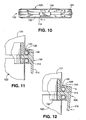
- FIG. 10 shows a front view of a container 120 formed by joining two identical container halves 121, 122 with the hinged connector 100.
- FIG. 11 shows a cross sectional view of the closed container 120 along the line 11-11 in FIG. 10. As illustrated, the formed edge 128 of the container lid 121 is received in the upper channel 130 of the ring member, and the detent nib 116 in the latch section grips the formed edge to resist the removal of the formed edge from the upper channel, thereby maintaining the container lid in the closed position.
- FIG. 12 The operation of the latch section 108 to allow the container to be easily opened is illustrated in FIG. 12.
- the outer wall 112 is twisted so that the upper portion of the outer wall moves outwardly sufficiently so that the detent nib 116 is disengaged from the formed edge 128 of the container lid.
- the detent nib 116 would not obstruct the removal of the formed edge 128 of the container lid from the upper channel 130 of the ring member.
- the container lid 121 may then be easily removed from the upper channel 130 to open the container.
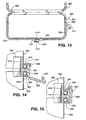
- FIGS. 13-15 show another alternative embodiment of a hinged connector 300.
- the connector 300 like the two embodiments described above, includes a ring member 302 and a partial segment 304 joined by an integrally formed hinge web 306.
- the connector 300 has a clasp 308 integrally formed on the ring member 302 for holding the formed edge of a container lid in the upper channel 310 of the ring member.
- the connector 300 is also provided with a hanging tab 312 integrally formed on the ring member 302.
- the hanging tab 312 has a hole formed therein which can be used to hang the container formed with the connector 300 on a peg or the like for display or storage purposes.
- FIG. 14 shows a cross sectional view of a container formed with the hinged connector 300.
- the ring member 302 has an inner wall 316 and an outer wall 318 connected by a base web 320 to form an upper channel 310 for receiving the formed edge 324 of the container lid 325 and a lower channel 326 for receiving the formed edge 328 of the container bottom 329.
- the clasp 308 and the hanging tab 312 are preferably integrally molded on the outer periphery of the ring member 302.
- the clasp 308 is pivotally connected to the lower end of the outer wall 318 of the ring member by a thin web 330.
- the free end of the clasp 308 is formed into a latch head 332.
- the outer wall 318 of the ring member is provided with two detent tabs 334 which are arranged to provide a snap-in fitting with the clasp 308 such that they hold the clasp tightly when the latter is moved into a locking position abutting the outer wall 318 of the ring member.
- the hanging tab 312 (FIG. 13) is similarly pivotally connected to the outer wall 318 of the ring member so that it can be folded against the outer wall 318 when not in use.
- Two detent tabs 336 are provided on the outer wall for holding the hanging tab 312 in the folded position.
- the latch head 332 extends over the upper channel 310 of the ring member 302. In this position, the latch head 332 prevents the formed edge 324 of the container lid from being disengaged from the upper channel 310 of the ring member, thereby locking the container lid in the closed position.
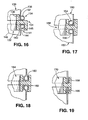
- FIG. 16 shows an alternative embodiment of a hinged connector 131.
- the upper seat 134 on the ring member has only one upstanding wall 136 instead of two walls forming a channel.
- Crush ribs 138 are formed on the wall to provide a snug frictional fit between the wall 136 and the wall of the container lid 139 adjacent the formed edge 137. The frictional fit allows the container lid 139 to be released from the upper seat 134 with relative ease.
- the lower seat 141 on the ring member is in the form of a channel with gripping means such as crush ribs 143 and nibs 145 so that the ring member 132 is attached securely to the formed edge 144 of the container bottom 142.
- gripping means such as crush ribs 143 and nibs 145
- both the upper and lower seats, or even the seat on the partial segment be formed to have only one upstanding wall.
- the seats may also be formed to have shapes other than a channel or an upstanding wall to provide the desired gripping characteristics.
- the edges of the containers are formed to eliminate any exposed raw edges of the sheet metal making up the container halves.
- the formed edges also rigidifies the container halves by providing a channel-like structure at the open end. They also provide a container feature to which the connector can be readily adapted.
- the term "formed edge,” unless otherwise indicated by the context, is intended to encompass the various metal forming techniques that can be used to shape the container edge.
- the formed edges of the containers described above are in the form of outwardly turned curled edges. It will be appreciated, however, that the invention also has applicability to other types of formed edges, such as teardrop-shaped or hemmed edges, both of which are broadly encompassed within the term formed edge. In addition, the edges can also in most cases be inwardly formed.
- FIG. 17 is a partial view showing the application of the present invention to a container which has metal edges curled inwardly rather than outwardly.
- a container lid 150 and a container bottom 152 having formed edges 154, 156 joined by a connector 158.
- the edges 154, 156 are curled inwardly to provide a substantially planar outer wall and a curled inner wall.
- the manner of configuring the hinged connector to interface with such formed edges will be apparent.
- FIG. 18 illustrates application of the invention to a container in which the edges 160, 162 are formed to have a teardrop-shaped cross section and are joined by a connector 164.
- the teardrop-shaped edges present a configuration in which the upstanding walls of the channels are both in contact with contoured portions of the formed edges, in contrast to the prior embodiments where one wall of the channel would be in contact with a curved edge, and the other wall would be in contact with a substantially flat portion of the edge.
- FIG. 19 shows yet a further embodiment in which the formed edges 166, 168 are hemmed, and the hemmed edges are joined by a connector 170.
- the hemmed edges 166, 168 present a much flatter profile, in which the forming of the edges folds and then compresses the edge seam.
- the hinged connector of the present invention not only serves the function of joining two container halves to form a hinged container, but also presents the opportunity to add additional features to the container. Advantages could be taken of the injection molded connector by forming the connector to include internal or external features for a variety of special purposes.
- FIG. 20 An example of a container utilizing a connector with internal features is illustrated in FIG. 20.
- the container 180 in this embodiment has two substantially identical container halves 182, 184 with a generally square peripheral shape.
- the connector 186 has two swingable segments 188, 190 connected to a ring member 192 by hinge webs 194, 196. Each partial segment is securely attached to a container half by gripping the formed edge of the container half. Thus, each container half is hinged on the connector 186, and the container can be opened from either side.
- FIG. 21 shows a cross sectional view of the ring member 192 illustrating the internal feature of the connector.
- the internal feature comprises a base plate 200 of a substantially square shape and two rosettes 202, 204, one at the center of each side of the base plate 200.
- the width of the base plate 200 is preferably slightly larger than the diameter of conventional compact discs, and the rosettes 202, 204 preferably are shaped to provide an interfering fit with the central hole of a compact disc.
- the metal container 180 formed with the plastic connector 186 provides a commercially attractive low-profile compact disc packaging which can be used for holding two compact discs.
- FIG. 22 illustrates the utilization of special purpose external features on a connector 206 for support of the container 208 formed utilizing the connector.
- the connector 206 has two special-purpose supports 210 molded integrally with the connector 206 on the side of the ring member 212, so that the supports can be used to stand the container on end on a flat surface.
- Other types of ornamental or functional external features can be formed on the connector.
- FIG. 23 shows a container 214 which is formed to resemble the shape of a sea shell.
- the embodiment of FIG. 23 is like that illustrated and described in connection with the previous drawings. More particularly, it will be seen that the container 214 includes two container halves 216, 218 joined by a resilient hinged connector 220 which has a ring member 222 and a partial segment 224 joined by a hinge 226. Both the ring member 222 and the partial segment 224 are shaped to match the peripheral shape of the container.
- the ring member has an upper channel 228 for receiving less than all sides of the formed edge 217 of the container lid 216, leaving the hinge side free for attachment to the partial segment 224.
- the invention is especially advantageous for forming containers with fanciful, irregular, shapes which tend to be more expensive to make than containers with conventional simple shapes. This is because identical container halves can be used to form a container. Thus, drawing and forming equipment can be configured and set up to draw a large number of identical container halves, thereby reducing the fixed cost of the container.
- the container 230 includes a container lid 232, a container bottom 234, and a hinged connector 236 joining the lid and bottom to form a hinged container.
- the hinged connector 236 has a ring member 238 attached to the container bottom, a swingable partial segment 240 gripping the container lid, and an integrally formed hinge 242 joining the ring member and the partial segment.
- the ring member 238 has a lower channel 246 for receiving the formed edge 248 of the bottom, and an upper channel 250 for receiving the formed edge 252 of the lid 232.
- the partial segment 240 also has a channel 254 for gripping the formed edge of the container lid.
- the container halves in this case do interfit and may form a closed, non-hinged container without the aid of the connector 236. Because the container halves interfit, the formed edges 252, 248 of the container lid 232 and bottom 234 are necessarily different, and the ring member 238 and the partial segment 240 are adapted to receive the respective portions of the two non-identical formed edges.
- the container top 232 has an outwardly turned curled edge 252, and the container bottom 234 has an inwardly folded hemmed edge 248, as is typical for conventional, non-hinged containers.
- the upper channel 250 of the ring member 238 and the channel 254 of the partial segment 240 are configured for receiving the curled edge 252 of the lid, and the lower channel 246 of the ring member is configured to receive the hemmed edge 248 of the bottom 234.
- the channel 254 of the partial segment is provided with nibs 256 and crush ribs 258 for gripping the formed edge of the lid.
- the lower channel 246 of the ring member is provided with nibs 260 for securely gripping the hemmed edge 248 of the container bottom.
- the upper channel 250 has crush ribs 262 formed therein to provide a snug frictional fit to the wall of the container lid adjacent the formed edge 252 of the lid.
- FIG. 26 shows another embodiment which uses a container bottom 264 with an inwardly turned curled edge 266 which interfits the outwardly turned edge 268 of the lid 270.
- the lower channel 272 of the ring member 274 is accordingly configured to receive the inwardly curled edge 266 of the bottom.
- FIG. 27 shows a further embodiment of a hinged connector 276 for joining two interfitting container halves 278, 280 which are similar to those in FIG. 25.
- the upper seat 282 of the ring member 284 has only one upstanding wall 288, instead of two walls forming a channel.
- the wall 288 has crush ribs 290 for providing a snug fit to the flat inner side of the outwardly turned edge 292 of the container lid 278.
- a resilient hinged connector which can be advantageously used to connect normally non-interfitting metal container halves with simple formed edges to form a hinged container.
- the hinged connector can also be advantageously used to convert conventional non-hinged containers into hinged containers.
- the use of the hinged connector eliminates the need to form hinge components directly on the metal container halves, resulting in much simpler metal processing required to form the container halves.
- the hinged connector can be shaped to match complex and irregular container peripheral shapes for forming containers of fanciful and commercially attractive designs.
- the connector further provides the opportunity to form special purpose containers with ornamental or functional internal or external features.
Landscapes
- Engineering & Computer Science (AREA)
- Mechanical Engineering (AREA)
- Closures For Containers (AREA)
- Rigid Containers With Two Or More Constituent Elements (AREA)
- Moulds For Moulding Plastics Or The Like (AREA)
Claims (29)
- Metallbehälter (30; 120; 180; 208; 214; 230), umfassend die Kombination von:Behälterdeckel (32; 121; 182; 216; 232; 325) und Behälterboden (34; 122; 184; 218; 234; 329), jeweils mit einem geschlossenen Ende (42; 48) und einer Seitenwand (44; 50), welche mit einer Formkante (46; 52; 128; 248; 252; 324; 328) abschließt, wobei die Formkanten des Behälterdeckels und -bodens eine periphere Behältergestalt definieren; undflexibler Verbinder (40; 100; 206; 220; 236; 300), der auf die periphere Behältergestalt abgestimmt gestaltet ist und Sitze aufweist, die den Formkanten (46; 52; 128; 324; 328) des Behälterdeckels (32; 121; 182; 216; 232; 325) und -bodens (34; 122; 184; 218; 234; 329) angepasst dimensioniert sind, zum Bilden eines geschlossenen Behälters, wobei der Verbinder (40; 100; 220; 236; 300) ein Ringelement (54; 102; 222; 238; 302) und ein integral ausgebildetes Gelenk (58; 106; 226; 242; 330) aufweist,wobei das Ringelement (54; 102; 222; 238; 302) sich im Wesentlichen kontinuierlich um die Peripherie erstreckt und einen nach unten gerichteten Sitz (60) aufweist zum Angreifen an der Formkante (52; 128; 248; 328) des Behälterbodens (34; 122; 184; 218; 234; 329),
dadurch gekennzeichnet, dass der flexible Verbinder (40; 100; 206; 220; 236; 300) ein Teilsegment (56; 104; 224; 240; 304) aufweist;
wobei das Ringelement (54; 102; 222; 238; 302) einen nach oben gerichteten Sitz (62) aufweist zum Angreifen an weniger als allen Seiten der Formkante (46; 128; 252; 324) des Behälterdeckels (32; 121; 182; 216; 232; 325), wobei mindestens eine Seite der Formkante (46; 128; 252; 324) des Behälterdeckels (32; 121; 182; 216; 232; 325) frei gelassen wird,
wobei das Teilsegment (56; 104; 224; 240; 304) einen nach oben gerichteten Sitz (64) aufweist zum sicheren Greifen von mindestens der freien Seite der Formkante des Behälterdeckels (32; 121; 182; 216; 232; 325); und
wobei das Gelenk (58; 106; 226; 242; 330) das Ringelement (54; 102; 222; 238; 302) und das Teilsegment (56; 104; 224; 240; 304) verbindet und so positioniert ist, dass der Behälter (30; 120; 180; 208; 214; 230) in einem Normalzustand geschlossen ist und der Behälterdeckel um das Gelenk (58; 106; 226; 242; 330) drehen kann, um den Behälter zu öffnen. - Metallbehälter nach Anspruch 1, wobei die Formkanten (46; 52; 128) des Behälterdeckels (32; 121) und -bodens (34; 122) identisch ausgebildet sind.
- Metallbehälter nach Anspruch 2, wobei der Behälterdeckel (32; 121) und der Behälterboden (34; 122) im Wesentlichen identisch sind.
- Metallbehälter nach Anspruch 1, wobei die Formkanten (252; 248) des Behälterdeckels (232) und -bodens (234) nicht identisch sind.
- Metallbehälter nach Anspruch 1, wobei der Verbinder (40; 100; 300) aus geformtem Thermoplast ist.
- Metallbehälter nach Anspruch 5, wobei der den Verbinder bildende Thermoplast Polypropylen ist.
- Metallbehälter nach Anspruch 1, wobei das Ringelement (54) einen oberen und einen unteren Kanal umfasst, die nicht-identische Greifeigenschaften aufweisen, derart, dass der untere Kanal (72) dem Behälterboden (34) fester anhaftet als der obere Kanal (70) dem Behälterdeckel (32).
- Metallbehälter nach Anspruch 1, wobei der untere Sitz (60) einen Kanal (72) umfasst mit Greifmitteln zum sicheren Greifen der Formkante (52) des Behälterbodens (34), wenn sie darin eingeführt wird.
- Metallbehälter nach Anspruch 1, wobei der Sitz (64) des Teilsegments (56) einen Kanal (84) umfasst mit Greifmitteln zum sicheren Greifen der Formkante (46) des Behälterdeckels (32), wenn sie darin eingeführt wird.
- Metallbehälter nach Anspruch 1, wobei das Gelenk (58; 106) des Verbinders (40; 100) die Form eines flexiblen dünnen Stegs aufweist.
- Metallbehälter nach Anspruch 1, wobei der Verbinder (40) einen integral ausgebildeten, an dem Ringelement (54) getragenen Keil (94) umfasst zum Auseinanderdrücken der Formkanten (46; 52) des geschlossenen Behälters, um den Behälter (30) zu öffnen.
- Metallbehälter nach Anspruch 1, wobei der flexible Verbinder (300) ferner einen integral ausgebildeten Haken (308) umfasst, der mit einer äußeren Peripherie des Ringelementes (302) drehbar verbunden ist, wobei der Haken (308) in eine Verriegelungsposition bewegbar ist, um ein Lösen der Formkante (324) des Behälterdeckels (325) von dem nach oben gerichteten Sitz des Ringelementes (302) zu verhindern.
- Metallbehälter nach Anspruch 1, ferner umfassend eine integral ausgebildete Hängelasche (118), welche mit einer äußeren Peripherie des Ringelementes (102) verbunden ist.
- Metallbehälter nach Anspruch 1, wobei das Ringelement (54; 102) umfasst: eine innere periphere Wand und eine äußere periphere Wand, welche durch einen Basissteg verbunden sind, um einen oberen Kanal, der als der obere Sitz zum Aufnehmen der Formkante (46; 128) des Behälterdeckels (32; 121) dient, und einen unteren Kanal, der als der untere Sitz zum Aufnehmen der Formkante (52; 128) des Behälterbodens (34; 122) dient, zu bilden.
- Metallbehälter nach Anspruch 14, wobei das Ringelement (102) umfasst: einen Verriegelungsabschnitt (108) mit einer integral ausgebildeten, von der äußeren peripheren Wand nach unten ragenden Freigabelasche (118) und einer von der äußeren peripheren Wand in den oberen Kanal vorstehenden Haltenase (116) zum Festhalten der Formkante (128) des Behälterdeckels (121), und wobei die äußere periphere Wand sich verwindet, um die Haltenase (116) von der Formkante (128) des Behälterdeckels (121) zu lösen, wenn die Freigabelasche (118) gedrückt wird, um das Öffnen des Behälters (120) zu erleichtern.
- Metallbehälter (214) nach Anspruch 1, wobei der Behälterdeckel (216) und -boden (218) eine nicht-rechtwinklige periphere Gestalt aufweisen, wobei der Gelenkverbinder (220) ein auf die nicht-rechtwinklige periphere Gestalt abgestimmt spritzgegossenes Kunststoffelelement ist.
- Metallbehälter nach Anspruch 1, wobei die Formkanten in der Gestalt ausgebildet sind, die ausgewählt ist aus der Gruppe, welche einwärts und auswärts geformte Roll-, tropfenförmige und Umlegekanten umfasst.
- Metallbehälter (180) nach Anspruch 1, wobei der Verbinder (186) mindestens ein internes Element (200) umfasst, welches einteilig mit dem Gelenkverbinder geformt und so positioniert ist, dass es vollständig innerhalb des Behälters angeordnet ist.
- Metallbehälter (208) nach Anspruch 1, wobei der Verbinder (206) mit mindestens einem integralen externen Element (210) ausgebildet ist, welches sich einteilig von dem Verbinder erstreckt, um außerhalb des Behälters (208) angeordnet zu werden.
- Metallbehälter nach Anspruch 1, wobei der Behälterdeckel (32; 182; 325) und der Behälterboden (34; 184; 329) aus gezogenem Metall gebildet sind, jeweils mit einem geschlossenen Ende und einer stehenden Seitenwand, welche mit einer Formkante (46; 52; 324; 328) abschließt, wobei die Formkanten des Behälterdeckels und -bodens im Wesentlichen identisch sind und eine periphere Behältergestalt definieren; und
wobei der Verbinder (40; 100; 300) ein einteiliger Gelenkverbinder ist, gebildet aus geformtem Thermoplast, zum Verbinden des Behälterdeckels und -bodens an deren jeweiligen Formkanten, um einen geschlossenen Behälter herzustellen, wobei der Gelenkverbinder umfasst: einen festen Ring (54; 102; 302) und ein schwenkbares Segment (56; 104; 304), auf die periphere Behältergestalt abgestimmt ausgebildet zum Aufnehmen der Formkanten (46; 52; 324; 328), und einen Gelenksteg (58; 306), der den festen Ring und das schwenkbare Segment verbindet, wobei der Gelenksteg flexibel ist, um eine Drehbewegung des schwenkbaren Segments relativ zu dem festen Ring zu erlauben, wobei der feste Ring aufweist:eine feste Basis, die einen nach unten gerichteten unteren Sitz (60) zum Aufnehmen der Formkante (52) des Behälterbodens (34) und einen nach oben gerichteten oberen Sitz (62) zum Aufnehmen weniger als aller Seiten der Formkante des Behälterdeckels, wobei mindestens eine Seite der Formkante (46) des Behälterdeckels (32) frei gelassen wird, trennt, wobei die feste Basis einen nach oben gerichteten offenen Abschnitt zum Aufnehmen des schwenkbaren Segments (56; 104; 304) aufweist;wobei das schwenkbare Segment (56; 104; 304) eine schwenkbare Basis aufweist, welche den offenen Abschnitt der festen Basis überlagert, wenn das schwenkbare Segment (56; 104; 304) in eine Geschlossenposition gedreht ist, und einen nach oben gerichteten Sitz (64) an der schwenkbaren Basis zum sicheren Greifen der freien Seite der Formkante (46; 324) des Behälterdeckels (32; 182; 325), so dass bei in der Geschlossenposition befindlichem schwenkbarem Segment (56; 104; 304) der Sitz daran mit dem oberen Sitz (62) an dem Ringelement (54; 102; 302) zusammenwirkt zum Aufnehmen der Formkante (46; 324) des Behälterdeckels. - Metallbehälter nach Anspruch 20, wobei der obere und der untere Sitz (60; 62) an dem festen Ring (54) nicht-identische Greifeigenschaften aufweisen, derart, dass der untere Sitz (60) dem Behälterboden (34) fester anhaftet als der obere Kanal (62) dem Behälterdeckel (32).
- Metallbehälter nach Anspruch 20, wobei der Behälterdeckel (32) und der Behälterboden (34) im Wesentlichen identisch sind.
- Metallbehälter nach Anspruch 20, wobei der Gelenkverbinder (40) einen integral ausgebildeten, an dem festen Ring (54) getragenen Keil (94) umfasst zum Herausdrücken der Formkante (46) des Behälterdeckels aus dem oberen Sitz.
- Metallbehälter nach Anspruch 20, wobei der Gelenkverbinder (300) einen integral ausgebildeten Haken (308) umfasst, der mit dem festen Ring (302) drehbar verbunden ist, wobei der Haken (308) in eine Verriegelungsposition bewegbar ist, um ein Lösen der Formkante (324) des Behälterdeckels (325) von dem oberen Sitz des festen Rings (302) zu verhindern.
- Metallbehälter nach Anspruch 20, wobei der feste Ring (102) umfasst:eine innere periphere Wand (114) und eine äußere periphere Wand (112), welche durch die feste Basis verbunden sind, um einen oberen und einen unteren Kanal zu bilden, die als der obere bzw. untere Sitz dienen.
- Metallbehälter nach Anspruch 25, wobei der feste Ring (102) aufweist:einen Verriegelungsabschnitt (108) umfassend eine integral ausgebildete, von der äußeren peripheren Wand (112) nach unten ragende Freigabelasche (118) und eine von der äußeren peripheren Wand (112) in den oberen Kanal vorstehende Haltenase (116) zum Festhalten der Formkante des Behälterdeckels, und wobei die äußere periphere Wand sich verwindet, um die Haltenase (116) von der Formkante des Behälterdeckels zu lösen, wenn die Freigabelasche (118) gedrückt wird, um das Öffnen des Behälters zu erleichtern.
- Gelenkverbinder (40; 100; 206; 220; 236; 300) aus geformtem Thermoplast zum Verbinden eines Metallbehälterdeckels und eines Metallbehälterbodens, um einen Behälter mit Gelenk zu bilden, wobei der Behälterdeckel eine Formkante einer ersten gegebenen Größe und Gestalt aufweist, wobei der Behälterboden eine Formkante einer zweiten gegebenen Größe und Gestalt aufweist, die auf die Formkante des Behälterdeckels abgestimmt ist, wobei die Formkanten eine periphere Behältergestalt definieren, wobei der Gelenkverbinder umfasst:ein Ringelement (54; 102; 222; 238; 302) und ein Teilsegment (56; 104; 224; 240; 304), verbunden durch ein integral ausgebildetes Gelenk (58; 106; 226; 242; 306), wobei das Ringelement (54; 102; 222; 238; 302) und das Teilsegment (56; 104; 224; 240; 304) auf die periphere Behältergestalt abgestimmt gestaltet sind,wobei das Ringelement (54; 102; 222; 238; 302) einen nach unten gerichteten unteren Sitz (60) zum Aufnehmen einer Formkante der zweiten Größe und Gestalt und einen nach oben gerichteten oberen Sitz (62) zum Aufnehmen einer Formkante der ersten gegebenen Größe und Gestalt aufweist, wobei der obere Sitz (62) sich entlang weniger als allen Seiten des Ringelements erstreckt, wobei mindestens eine Gelenkseite des Ringelements (54; 102; 222; 238; 302) frei gelassen wird;
wobei das Teilsegment (56; 104; 224; 240; 304) mit der Gelenkseite des Ringelements (54; 102; 222; 238; 302) durch das Gelenk (58; 106; 226; 242; 306) verbunden ist und einen nach oben gerichteten Sitz aufweist zum sicheren Greifen einer Formkante der ersten gegebenen Größe und Gestalt, wobei das Gelenkelement (58; 106; 226; 242; 306) flexibel ist, um das Teilsegment in eine Geschlossenposition drehen zu lassen, in der das Teilsegment (56; 104; 224; 240; 304) die Gelenkseite des Ringelementes (54; 102; 222; 238; 302) überlagert, derart, dass der Sitz des Teilsegments und der obere Sitz des Ringelements zusammenwirken, um korrespondierende Bereiche einer Formkante der ersten gegebenen Größe und Gestalt aufzunehmen. - Gelenkverbinder nach Anspruch 27, wobei die erste Größe und Gestalt im Wesentlichen identisch ist mit der zweiten Größe und Gestalt.
- Gelenkverbinder nach Anspruch 27, wobei eine Formkante der ersten Größe und Gestalt mit einer Formkante der zweiten Größe und Gestalt ineinandergreifend zusammenpasst.
Applications Claiming Priority (3)
| Application Number | Priority Date | Filing Date | Title |
|---|---|---|---|
| US08/810,871 US5782371A (en) | 1997-03-05 | 1997-03-05 | Metal container having resilient hinged connector |
| US810871 | 1997-03-05 | ||
| PCT/US1998/005395 WO1998039223A1 (en) | 1997-03-05 | 1998-02-27 | Metal container having resilient hinged connector |
Publications (3)
| Publication Number | Publication Date |
|---|---|
| EP1027254A1 EP1027254A1 (de) | 2000-08-16 |
| EP1027254A4 EP1027254A4 (de) | 2005-07-20 |
| EP1027254B1 true EP1027254B1 (de) | 2007-04-04 |
Family
ID=25204924
Family Applications (1)
| Application Number | Title | Priority Date | Filing Date |
|---|---|---|---|
| EP98910498A Expired - Lifetime EP1027254B1 (de) | 1997-03-05 | 1998-02-27 | Metallbehälter mit flexiblem scharnier |
Country Status (8)
| Country | Link |
|---|---|
| US (1) | US5782371A (de) |
| EP (1) | EP1027254B1 (de) |
| JP (1) | JP3193727B2 (de) |
| AU (1) | AU722818B2 (de) |
| CA (1) | CA2283512C (de) |
| DE (1) | DE69837490T2 (de) |
| WO (1) | WO1998039223A1 (de) |
| ZA (1) | ZA981792B (de) |
Families Citing this family (43)
| Publication number | Priority date | Publication date | Assignee | Title |
|---|---|---|---|---|
| USD435752S1 (en) | 2000-02-29 | 2001-01-02 | Myszka Kevin E | Mini CD-Rom storage container |
| DK1636800T3 (da) * | 2003-09-08 | 2006-10-30 | Glud & Marstrand As | Metalemballage |
| US20040173481A1 (en) * | 2003-11-06 | 2004-09-09 | Encore Holdings Limited | Media storage disk box |
| US7784632B2 (en) * | 2005-10-27 | 2010-08-31 | Thai Vo Truong | Collapsible cargo organizer |
| US7878324B2 (en) * | 2007-11-30 | 2011-02-01 | Philip Morris Usa Inc. | Pocket-size container for consumer items |
| USD646159S1 (en) | 2007-11-30 | 2011-10-04 | Philip Morris Usa Inc. | Container |
| US8485390B2 (en) * | 2008-07-07 | 2013-07-16 | J.L. Clark, Inc. | Hinge ring for pivotally coupling a container lid to a container bottom |
| US8505768B2 (en) * | 2009-12-02 | 2013-08-13 | Envionmental Dining, LLC | Food tray |
| GB2507012B (en) | 2011-08-12 | 2017-02-01 | Clark J L Inc | Metal container with slideable top |
| USD692298S1 (en) | 2011-12-07 | 2013-10-29 | R.J. Reynolds Tobacco Company | Container |
| US8910781B2 (en) * | 2013-01-11 | 2014-12-16 | R.J. Reynolds Tobacco Company | Container for smokeless tobacco products and related packaged product assembly and method |
| EP2984000A4 (de) | 2013-04-08 | 2017-02-22 | Disc Graphics Inc. | Verpackung und behälteranordnung sowie verfahren zur herstellung davon |
| US9694951B2 (en) * | 2013-07-03 | 2017-07-04 | Kittrich Corporation | Reclosable elastomeric fastener |
| US9370227B2 (en) | 2013-09-25 | 2016-06-21 | Eliana Ghantous | Customizable clutch with interchangeable shells and drop-in clasps |
| US9445631B1 (en) | 2015-03-20 | 2016-09-20 | R. J. Reynolds Tobacco Company | Container for smokeless tobacco products and related packaged product assembly and method |
| USD832240S1 (en) * | 2016-07-07 | 2018-10-30 | Gn Audio A/S | Ear gel for an earphone |
| EP3664467B1 (de) | 2018-12-07 | 2022-03-30 | GN Audio A/S | Kopfhörer mit lüftungsöffnung |
| USD911020S1 (en) * | 2018-12-26 | 2021-02-23 | E-Link Plastic & Metal Industrial Co., Ltd. | Pill organizer |
| CA3080678C (en) * | 2019-06-27 | 2025-10-07 | Jing Lei | Container with security lock |
| USD943553S1 (en) * | 2019-09-04 | 2022-02-15 | Shenzhen Duntuo Electronics Co., Ltd | Set of earphones and charging case |
| USD956418S1 (en) | 2019-09-04 | 2022-07-05 | Gn Audio A/S | Case for earphones |
| USD940109S1 (en) * | 2019-09-04 | 2022-01-04 | Gn Audio A/S | Earphones and case |
| USD912015S1 (en) * | 2019-09-04 | 2021-03-02 | Shenzhen KingAnDa Technology Development Co., LTD. | Combined earphone with charging cradle |
| USD945404S1 (en) | 2019-09-04 | 2022-03-08 | Gn Audio A/S | Pair of ear buds |
| USD943554S1 (en) * | 2019-10-08 | 2022-02-15 | Shenzhen Duntuo Electronics Co., Ltd | Set of earphones and charging case |
| US11049822B1 (en) | 2019-12-20 | 2021-06-29 | Capital One Services, Llc | Systems and methods for the use of fraud prevention fluid to prevent chip fraud |
| US10810475B1 (en) | 2019-12-20 | 2020-10-20 | Capital One Services, Llc | Systems and methods for overmolding a card to prevent chip fraud |
| US10888940B1 (en) | 2019-12-20 | 2021-01-12 | Capital One Services, Llc | Systems and methods for saw tooth milling to prevent chip fraud |
| US10817768B1 (en) | 2019-12-20 | 2020-10-27 | Capital One Services, Llc | Systems and methods for preventing chip fraud by inserts in chip pocket |
| US10977539B1 (en) | 2019-12-20 | 2021-04-13 | Capital One Services, Llc | Systems and methods for use of capacitive member to prevent chip fraud |
| USD890725S1 (en) * | 2020-03-26 | 2020-07-21 | Ming Liu | Wireless earphones with charging case |
| US11958667B2 (en) | 2020-03-30 | 2024-04-16 | J.L. Clark Llc | Child resistant package with multiple storage compartments |
| DE202020104424U1 (de) | 2020-04-30 | 2020-08-07 | Michael Schmid-Dreyer | Tragbare Vorrichtung zum Verstauen einer Gesichtsmaske |
| US11715103B2 (en) | 2020-08-12 | 2023-08-01 | Capital One Services, Llc | Systems and methods for chip-based identity verification and transaction authentication |
| USD952610S1 (en) * | 2021-01-15 | 2022-05-24 | Shenzhen Xiwxi Technology Co., Ltd | Earphones with charging case |
| KR102560620B1 (ko) * | 2021-02-08 | 2023-07-27 | 김상훈 | 보관함 |
| USD1031644S1 (en) | 2021-08-18 | 2024-06-18 | Gn Audio A/S | Battery charging case for mobile devices |
| USD994634S1 (en) * | 2021-08-20 | 2023-08-08 | Guangdong Xizhongxi Technology Co., Ltd. | Earphones |
| USD1034452S1 (en) | 2021-08-26 | 2024-07-09 | Gn Audio A/S | Battery charging case for mobile devices |
| US11970314B2 (en) * | 2022-03-31 | 2024-04-30 | Big Bee, Little Bee LLC | Food storage container |
| USD1003277S1 (en) * | 2022-04-14 | 2023-10-31 | Hongzhuang Wu | Earphones with charging case |
| US20260115099A1 (en) * | 2022-04-22 | 2026-04-30 | Janssen Pharmaceuticals, Inc. | Vial holder |
| USD1062701S1 (en) * | 2023-08-16 | 2025-02-18 | Shenzhen Maoshengyi Technology Co., Ltd. | Earphones with charging case |
Family Cites Families (6)
| Publication number | Priority date | Publication date | Assignee | Title |
|---|---|---|---|---|
| FR2196944B1 (de) * | 1972-08-22 | 1976-02-13 | Bindschedler Pierre Fr | |
| CH565335A5 (de) * | 1973-07-31 | 1975-08-15 | Studia Technica Ets | |
| US4351165A (en) * | 1981-01-07 | 1982-09-28 | Marten Gottsegen | Portable cooler |
| US4452373A (en) * | 1982-06-15 | 1984-06-05 | Packaging By Forming Industries, Inc. | Jewelry box hinge structure |
| US4546874A (en) * | 1984-02-27 | 1985-10-15 | Kirchhan James J | Container and sealing enclosure |
| US5676272A (en) * | 1996-03-15 | 1997-10-14 | J.L. Clark, Inc. | Metal container having resilient interface ring |
-
1997
- 1997-03-05 US US08/810,871 patent/US5782371A/en not_active Expired - Lifetime
-
1998
- 1998-02-27 DE DE69837490T patent/DE69837490T2/de not_active Expired - Fee Related
- 1998-02-27 WO PCT/US1998/005395 patent/WO1998039223A1/en not_active Ceased
- 1998-02-27 AU AU64726/98A patent/AU722818B2/en not_active Ceased
- 1998-02-27 CA CA002283512A patent/CA2283512C/en not_active Expired - Lifetime
- 1998-02-27 JP JP53893098A patent/JP3193727B2/ja not_active Expired - Fee Related
- 1998-02-27 EP EP98910498A patent/EP1027254B1/de not_active Expired - Lifetime
- 1998-03-03 ZA ZA981792A patent/ZA981792B/xx unknown
Also Published As
| Publication number | Publication date |
|---|---|
| US5782371A (en) | 1998-07-21 |
| CA2283512A1 (en) | 1998-09-11 |
| EP1027254A1 (de) | 2000-08-16 |
| ZA981792B (en) | 1998-09-04 |
| JP2000509688A (ja) | 2000-08-02 |
| CA2283512C (en) | 2003-12-30 |
| AU6472698A (en) | 1998-09-22 |
| DE69837490D1 (de) | 2007-05-16 |
| EP1027254A4 (de) | 2005-07-20 |
| JP3193727B2 (ja) | 2001-07-30 |
| DE69837490T2 (de) | 2007-12-20 |
| AU722818B2 (en) | 2000-08-10 |
| WO1998039223A1 (en) | 1998-09-11 |
Similar Documents
| Publication | Publication Date | Title |
|---|---|---|
| US5782371A (en) | Metal container having resilient hinged connector | |
| US5676272A (en) | Metal container having resilient interface ring | |
| CA1122132A (en) | Children's lunch box | |
| US4634019A (en) | Container with plastic hinge | |
| JP3137123B2 (ja) | 蓋の開放機構 | |
| US3087498A (en) | Holder device | |
| US6889860B2 (en) | Plastic drink-through cup lid with fold-back tab | |
| US11896550B2 (en) | Pill container and methods | |
| US6672471B2 (en) | Tablet box construction | |
| MX2008011845A (es) | Contenedor y tapa de contenedor a prueba de niños. | |
| CN115298106A (zh) | 用于容器的可重新闭合盖体 | |
| US8485390B2 (en) | Hinge ring for pivotally coupling a container lid to a container bottom | |
| JPH0535071Y2 (de) | ||
| US5123540A (en) | Folding lunch box | |
| US20060071059A1 (en) | Hinged clip for gable top carton | |
| CN219258261U (zh) | 防伪扣以及包装盒 | |
| MXPA99008121A (en) | Metal container having resilient hinged connector | |
| JP3046153B2 (ja) | ピルファープルーフ特性を有する樹脂製キャップ | |
| JPH052458Y2 (de) | ||
| WO1996006016A1 (en) | Containers with decorative covers | |
| CA1333709C (en) | Squeeze resistant carton holder | |
| JPH0515771Y2 (de) | ||
| JPH07101458A (ja) | 蓋の開放機構、一体成形ケースの蓋の開放機構、ワンプッシュ開放式ケース、一体成形ケースの製造方法及びワンプッシュ開放式ケースの製造方法 | |
| JPH047090Y2 (de) | ||
| JPH0219368Y2 (de) |
Legal Events
| Date | Code | Title | Description |
|---|---|---|---|
| PUAI | Public reference made under article 153(3) epc to a published international application that has entered the european phase |
Free format text: ORIGINAL CODE: 0009012 |
|
| 17P | Request for examination filed |
Effective date: 19990921 |
|
| AK | Designated contracting states |
Kind code of ref document: A1 Designated state(s): DE FR GB IT |
|
| R17P | Request for examination filed (corrected) |
Effective date: 19990921 |
|
| A4 | Supplementary search report drawn up and despatched |
Effective date: 20050607 |
|
| RIC1 | Information provided on ipc code assigned before grant |
Ipc: 7B 65D 43/16 A |
|
| GRAP | Despatch of communication of intention to grant a patent |
Free format text: ORIGINAL CODE: EPIDOSNIGR1 |
|
| GRAS | Grant fee paid |
Free format text: ORIGINAL CODE: EPIDOSNIGR3 |
|
| GRAA | (expected) grant |
Free format text: ORIGINAL CODE: 0009210 |
|
| AK | Designated contracting states |
Kind code of ref document: B1 Designated state(s): DE FR GB IT |
|
| REG | Reference to a national code |
Ref country code: GB Ref legal event code: FG4D |
|
| REF | Corresponds to: |
Ref document number: 69837490 Country of ref document: DE Date of ref document: 20070516 Kind code of ref document: P |
|
| PLBE | No opposition filed within time limit |
Free format text: ORIGINAL CODE: 0009261 |
|
| STAA | Information on the status of an ep patent application or granted ep patent |
Free format text: STATUS: NO OPPOSITION FILED WITHIN TIME LIMIT |
|
| 26N | No opposition filed |
Effective date: 20080107 |
|
| PGFP | Annual fee paid to national office [announced via postgrant information from national office to epo] |
Ref country code: IT Payment date: 20080226 Year of fee payment: 11 Ref country code: GB Payment date: 20080227 Year of fee payment: 11 Ref country code: DE Payment date: 20080221 Year of fee payment: 11 |
|
| PGFP | Annual fee paid to national office [announced via postgrant information from national office to epo] |
Ref country code: FR Payment date: 20080208 Year of fee payment: 11 |
|
| GBPC | Gb: european patent ceased through non-payment of renewal fee |
Effective date: 20090227 |
|
| REG | Reference to a national code |
Ref country code: FR Ref legal event code: ST Effective date: 20091030 |
|
| PG25 | Lapsed in a contracting state [announced via postgrant information from national office to epo] |
Ref country code: DE Free format text: LAPSE BECAUSE OF NON-PAYMENT OF DUE FEES Effective date: 20090901 |
|
| PG25 | Lapsed in a contracting state [announced via postgrant information from national office to epo] |
Ref country code: GB Free format text: LAPSE BECAUSE OF NON-PAYMENT OF DUE FEES Effective date: 20090227 Ref country code: FR Free format text: LAPSE BECAUSE OF NON-PAYMENT OF DUE FEES Effective date: 20090302 |
|
| PG25 | Lapsed in a contracting state [announced via postgrant information from national office to epo] |
Ref country code: IT Free format text: LAPSE BECAUSE OF NON-PAYMENT OF DUE FEES Effective date: 20090227 |