EP1027356B1 - Precurseurs a base de polyols pour films minces nanoporeux de silice - Google Patents
Precurseurs a base de polyols pour films minces nanoporeux de silice Download PDFInfo
- Publication number
- EP1027356B1 EP1027356B1 EP98953977A EP98953977A EP1027356B1 EP 1027356 B1 EP1027356 B1 EP 1027356B1 EP 98953977 A EP98953977 A EP 98953977A EP 98953977 A EP98953977 A EP 98953977A EP 1027356 B1 EP1027356 B1 EP 1027356B1
- Authority
- EP
- European Patent Office
- Prior art keywords
- composition
- volatility solvent
- glycol
- water
- solvent composition
- Prior art date
- Legal status (The legal status is an assumption and is not a legal conclusion. Google has not performed a legal analysis and makes no representation as to the accuracy of the status listed.)
- Expired - Lifetime
Links
Images


Classifications
-
- C—CHEMISTRY; METALLURGY
- C07—ORGANIC CHEMISTRY
- C07F—ACYCLIC, CARBOCYCLIC OR HETEROCYCLIC COMPOUNDS CONTAINING ELEMENTS OTHER THAN CARBON, HYDROGEN, HALOGEN, OXYGEN, NITROGEN, SULFUR, SELENIUM OR TELLURIUM
- C07F7/00—Compounds containing elements of Groups 4 or 14 of the Periodic Table
- C07F7/02—Silicon compounds
- C07F7/04—Esters of silicic acids
-
- C—CHEMISTRY; METALLURGY
- C01—INORGANIC CHEMISTRY
- C01B—NON-METALLIC ELEMENTS; COMPOUNDS THEREOF; METALLOIDS OR COMPOUNDS THEREOF NOT COVERED BY SUBCLASS C01C
- C01B37/00—Compounds having molecular sieve properties but not having base-exchange properties
- C01B37/02—Crystalline silica-polymorphs, e.g. silicalites dealuminated aluminosilicate zeolites
-
- C—CHEMISTRY; METALLURGY
- C09—DYES; PAINTS; POLISHES; NATURAL RESINS; ADHESIVES; COMPOSITIONS NOT OTHERWISE PROVIDED FOR; APPLICATIONS OF MATERIALS NOT OTHERWISE PROVIDED FOR
- C09D—COATING COMPOSITIONS, e.g. PAINTS, VARNISHES OR LACQUERS; FILLING PASTES; CHEMICAL PAINT OR INK REMOVERS; INKS; CORRECTING FLUIDS; WOODSTAINS; PASTES OR SOLIDS FOR COLOURING OR PRINTING; USE OF MATERIALS THEREFOR
- C09D4/00—Coating compositions, e.g. paints, varnishes or lacquers, based on organic non-macromolecular compounds having at least one polymerisable carbon-to-carbon unsaturated bond ; Coating compositions, based on monomers of macromolecular compounds of groups C09D183/00 - C09D183/16
-
- H—ELECTRICITY
- H10—SEMICONDUCTOR DEVICES; ELECTRIC SOLID-STATE DEVICES NOT OTHERWISE PROVIDED FOR
- H10P—GENERIC PROCESSES OR APPARATUS FOR THE MANUFACTURE OR TREATMENT OF DEVICES COVERED BY CLASS H10
- H10P14/00—Formation of materials, e.g. in the shape of layers or pillars
- H10P14/60—Formation of materials, e.g. in the shape of layers or pillars of insulating materials
- H10P14/65—Formation of materials, e.g. in the shape of layers or pillars of insulating materials characterised by treatments performed before or after the formation of the materials
- H10P14/6516—Formation of materials, e.g. in the shape of layers or pillars of insulating materials characterised by treatments performed before or after the formation of the materials of treatments performed after formation of the materials
- H10P14/6529—Formation of materials, e.g. in the shape of layers or pillars of insulating materials characterised by treatments performed before or after the formation of the materials of treatments performed after formation of the materials by exposure to a gas or vapour
-
- H—ELECTRICITY
- H10—SEMICONDUCTOR DEVICES; ELECTRIC SOLID-STATE DEVICES NOT OTHERWISE PROVIDED FOR
- H10P—GENERIC PROCESSES OR APPARATUS FOR THE MANUFACTURE OR TREATMENT OF DEVICES COVERED BY CLASS H10
- H10P14/00—Formation of materials, e.g. in the shape of layers or pillars
- H10P14/60—Formation of materials, e.g. in the shape of layers or pillars of insulating materials
- H10P14/65—Formation of materials, e.g. in the shape of layers or pillars of insulating materials characterised by treatments performed before or after the formation of the materials
- H10P14/6516—Formation of materials, e.g. in the shape of layers or pillars of insulating materials characterised by treatments performed before or after the formation of the materials of treatments performed after formation of the materials
- H10P14/6534—Formation of materials, e.g. in the shape of layers or pillars of insulating materials characterised by treatments performed before or after the formation of the materials of treatments performed after formation of the materials by exposure to a liquid
-
- H—ELECTRICITY
- H10—SEMICONDUCTOR DEVICES; ELECTRIC SOLID-STATE DEVICES NOT OTHERWISE PROVIDED FOR
- H10P—GENERIC PROCESSES OR APPARATUS FOR THE MANUFACTURE OR TREATMENT OF DEVICES COVERED BY CLASS H10
- H10P14/00—Formation of materials, e.g. in the shape of layers or pillars
- H10P14/60—Formation of materials, e.g. in the shape of layers or pillars of insulating materials
- H10P14/63—Formation of materials, e.g. in the shape of layers or pillars of insulating materials characterised by the formation processes
- H10P14/6326—Deposition processes
- H10P14/6342—Liquid deposition, e.g. spin-coating, sol-gel techniques or spray coating
-
- H—ELECTRICITY
- H10—SEMICONDUCTOR DEVICES; ELECTRIC SOLID-STATE DEVICES NOT OTHERWISE PROVIDED FOR
- H10P—GENERIC PROCESSES OR APPARATUS FOR THE MANUFACTURE OR TREATMENT OF DEVICES COVERED BY CLASS H10
- H10P14/00—Formation of materials, e.g. in the shape of layers or pillars
- H10P14/60—Formation of materials, e.g. in the shape of layers or pillars of insulating materials
- H10P14/66—Formation of materials, e.g. in the shape of layers or pillars of insulating materials characterised by the type of materials
- H10P14/665—Porous materials
-
- H—ELECTRICITY
- H10—SEMICONDUCTOR DEVICES; ELECTRIC SOLID-STATE DEVICES NOT OTHERWISE PROVIDED FOR
- H10P—GENERIC PROCESSES OR APPARATUS FOR THE MANUFACTURE OR TREATMENT OF DEVICES COVERED BY CLASS H10
- H10P14/00—Formation of materials, e.g. in the shape of layers or pillars
- H10P14/60—Formation of materials, e.g. in the shape of layers or pillars of insulating materials
- H10P14/66—Formation of materials, e.g. in the shape of layers or pillars of insulating materials characterised by the type of materials
- H10P14/668—Formation of materials, e.g. in the shape of layers or pillars of insulating materials characterised by the type of materials the materials being characterised by the deposition precursor materials
- H10P14/6681—Formation of materials, e.g. in the shape of layers or pillars of insulating materials characterised by the type of materials the materials being characterised by the deposition precursor materials the precursor containing a compound comprising Si
- H10P14/6684—Formation of materials, e.g. in the shape of layers or pillars of insulating materials characterised by the type of materials the materials being characterised by the deposition precursor materials the precursor containing a compound comprising Si the compound comprising silicon and oxygen
- H10P14/6686—Formation of materials, e.g. in the shape of layers or pillars of insulating materials characterised by the type of materials the materials being characterised by the deposition precursor materials the precursor containing a compound comprising Si the compound comprising silicon and oxygen the compound being a molecule comprising at least one silicon-oxygen bond and the compound having hydrogen or an organic group attached to the silicon or oxygen, e.g. a siloxane
-
- H—ELECTRICITY
- H10—SEMICONDUCTOR DEVICES; ELECTRIC SOLID-STATE DEVICES NOT OTHERWISE PROVIDED FOR
- H10P—GENERIC PROCESSES OR APPARATUS FOR THE MANUFACTURE OR TREATMENT OF DEVICES COVERED BY CLASS H10
- H10P14/00—Formation of materials, e.g. in the shape of layers or pillars
- H10P14/60—Formation of materials, e.g. in the shape of layers or pillars of insulating materials
- H10P14/69—Inorganic materials
- H10P14/692—Inorganic materials composed of oxides, glassy oxides or oxide-based glasses
- H10P14/6921—Inorganic materials composed of oxides, glassy oxides or oxide-based glasses containing silicon
- H10P14/6922—Inorganic materials composed of oxides, glassy oxides or oxide-based glasses containing silicon the material containing Si, O and at least one of H, N, C, F or other non-metal elements, e.g. SiOC, SiOC:H or SiONC
Definitions
- the present invention relates to nanoporous dielectric films and to a process for their manufacture. Such films are useful in the production of integrated circuits.
- K low dielectric constant
- ILD interlevel dielectric
- IMD intermetal dielectric
- a number of organic and inorganic polymers have K in the range of 2.2 to 3.5, however, these polymers suffer from problems including low thermal stability, poor mechanical properties including low glass transition temperature (Tg), sample outgassing, and long term reliability questions.
- Tg glass transition temperature
- One alternative is to employ nanoporous silicas which can have dielectric constants in the range of about 1 to 3.
- Nanoporous silica is attractive because it employs similar precursors (e.g., TEOS, tetraethoxysilane) as used for spin-on glasses (SOG's) and CVD SiO 2 and because of the ability to control pore size of the nanoporous silica.
- precursors e.g., TEOS, tetraethoxysilane
- CVD SiO 2 because of the ability to control pore size of the nanoporous silica.
- nanoporous silica offers other advantages for microelectronics including thermal stability up to 900°C, small pore size ( « microelectronics features), use of materials that are widely used in the semiconductor industry, namely silica and precursors (e.g., TEOS), the ability to tune dielectric constant over a wide range, and deposition using similar tools as employed for conventional SOG processing.
- Nanoporous silicas are preferably prepared from precursors comprising an alkoxysilane, a relatively high volatility solvent and a relatively low volatility solvent which is a polyol having an ether linkage.
- the principal reactions for an alkoxysilane such as tetraethoxysilane, tetramethoxysilane, triethoxysilane, methyltriethoxysilane, colloidal silica, and silica precursors which contain silicon-organic-silicon linkages are shown below. The following are exemplary reactions since the extent of hydrolysis and transesterification can vary from 0 to 4.
- ethers of ethylene glycol and propylene glycol are the ethers of ethylene glycol and propylene glycol.
- the compounds useful for this invention have ether linkages (C-O-C) and are polyols (multiple alcohol groups on the same molecule). A single compound may be used or a mixture of compounds may be employed to achieve the desired properties.
- the invention provides a nanoporous silica precursor composition which comprises at least one alkoxysilane composition; at least one low volatility solvent composition comprising an ether of a C 1 to C 4 alkylene glycol which is miscible in water and alkoxysilanes, having a hydroxyl concentration of 0.021 mole/cm 3 or less, a boiling point of 175 °C or more at atmospheric pressure and a weight average molecular weight of 100 or more; at least one high volatility solvent composition having a boiling point below that of the low volatility solvent composition; optional water and an optional catalytic amount of an acid.
- the invention further provides a process for forming a nanoporous dielectric coating on a substrate which comprises a) blending a nanoporous silica precursor compositic comprising at least one alkoxysilane composition; at least one low volatility solvent composition comprising an ether of a C 1 to C 4 alkylene glycol which is miscible in water and alkoxysilanes, having a hydroxyl concentration of 0.021 mole/cm 3 or less, a boiling point of 175 °C or more at atmospheric pressure and a weight average molecular weight of 100 or more; at least one high volatility solvent composition having a boiling point below that of the low volatility solvent composition; optional water and an optional catalytic amount of an acid, thus forming a mixture and causing a partial hydrolysis and partial condensation ofthe alkoxysilane b) depositing the composition onto a substrate while evaporating at least a portion of the high volatility solvent composition; c) exposing the composition to a water vapor and a base vapor,
- the invention also provides a semiconductor device produced by a process which comprises:
- the invention forms a blend of at least one alkoxysilane with a high volatility solvent composition, a low volatility solvent composition, optional water and an optional catalytic amount of an acid. Water is included to provide a medium for hydrolyzmg the alkoxysilane. This blend is then applied onto a substrate. The high volatility solvent evaporates during and immediately after deposition of the mixture. The low volatility solvent is then removed by increasing the temperature.
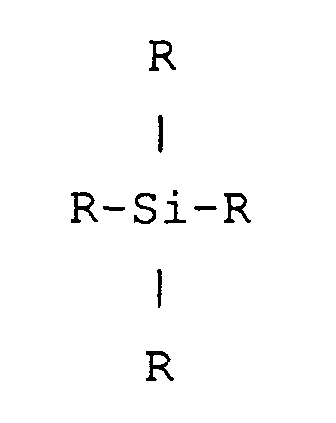
- Useful alkoxyatanes for this invention include those which have the formula: wherein at least 2 of the R groups are independently C 1 to C 4 alkoxy groups and the balance, if any, are independently selected from the group consisting of hydrogen, alkyl, phenyl, halogen, substituted phenyl.
- alkoxy includes any other organic group which can be readily cleaved from silicon at temperatures near room temperature by hydrolysis.
- R groups can be ethylene glycoxy or propylene glycoxy or the like, but preferably all four R groups are methoxy, ethoxy, propoxy or butoxy.
- the most preferred alkoxysilanes nonexclusively include tetraethoxysilane (TEOS) and tetramethoxysilane.
- the high volatility solvent composition is one which evaporates at a temperature below, and preferably significantly below that of the low volatility solvent composition.
- the high volatility solvent composition preferably has a boiling point of about 120°C or less, more preferably about 100 °C or less.
- Suitable high volatility solvent composition nonexclusively include methanol, ethanol, n-propanol, isopropanol, n-butanol and mixtures thereof.
- Other high volatility solvent compositions which are compatible with the other ingredients can be readily determined by those skilled in the art.
- the low volatility solvent composition is one which evaporates at a temperature above, preferably significantly above that of the high volatility solvent composition.
- the low volatility solvent composition preferably has a boiling point of about 175 °C or more, more preferably about 200 °C or more.
- Suitable low volatility solvent compositions nonexclusively include an ether of a C 1 to C 4 alkylene glycol which is miscible in water and alkoxysilanes, having a hydroxyl concentration of 0.021 mole/cm 3 or less, with a boiling point of about 175 °C or more at atmospheric pressure and a weight average molecular weight of about 100 or more.
- Preferred low volatility solvent composition components include di(ethylene)glycol, tri(ethylene)glycol, tetra(ethylene)glycol; penta(ethylene)glycol, di(propylene)glycol, hexa(ethylene)glycol and mixtures thereof.
- the high and low volatility solvent compositions as well as the alkoxysilane should be ultrapurified prior to blending them together.
- the amount of trace metals in the resulting nanoporous layer is significantly reduced. This results in a reduction of layer interference such as RC delay, power consumption and crosstalk in the integrated circuits produced with these materials.
- ultrapurified means that the solvent compositions should have no more than than about 250 parts per billion of trace metal impurities, preferably no more than about 50 parts per billion and more preferably no more than about 10 parts per billion of trace metal impurities. Such may be obtained by any convenient means such as by filtration, distillation or vacuum distillation.
- the optional acid serves to catalyze the reaction of the alkoxysilane with the relatively high volatility solvent composition, a relatively low volatility solvent composition and water.
- Suitable acids are nitric acid and compatible organic acids which are volatile, i.e. which evaporate from the resulting reaction product under the process operating conditions, and which do not introduce impurities into the reaction product.
- the alkoxysilane component is present in an amount of from about 3 % to about 50 % by weight of the overall blend. A more preferred range is from about 5 % to about 45 % and most preferably from about 10 % to about 40 %.
- the high volatility solvent composition component is present in an amount of from about 20 % to about 90 % by weight of the overall blend. A more preferred range is from about 30 % to about 70 % and most preferably from about 40 % to about 60 %.
- the mole ratio of water to silane is preferably from about 0 to about 50. A more preferred range is from about 0.1 to about 10 and most preferably from about 0.5 to about 1.5.
- the acid is present in a catalytic amount which can be readily determined by those skilled in the art.
- the molar ratio of acid to silane ranges from about 0 to about 0.2, more preferably from about 0.001 to about 0.05, and most preferably from about 0.005 to about 0.02.
- the alkoxysilane containing composition is then coated on a substrate optionally having a pattern of lines on its surface, and forms a dielectric film on the surface.
- Typical substrates are those suitable to be processed into an integrated circuit or other microelectronic device.
- Suitable substrates for the present invention non-exclusively include semiconductor materials such as gallium arsenide (GaAs), silicon and compositions containing silicon such as crystalline silicon, polysilicon, amorphous silicon, epitaxial silicon, and silicon dioxide (SiO 2 ) and mixtures thereof.
- the layer is relatively uniformly applied to the substrate.
- the lines, when present, are lithographically formed and may be composed of a metal, an oxide, a nitride or an oxynitride.
- Suitable materials include silica, silicon nitride, titanium nitride, tantalum nitride, aluminum, aluminum alloys, copper, copper alloys, tantalum, tungsten and silicon oxynitride. These lines form the conductors or insulators of an integrated circuit. Such are typically closely separated from one another at distances of about 20 micrometers or less, preferably 1 micrometer or less, and more preferably from about 0.05 to about 1 micrometer.
- the high volatility solvent is then partially evaporated over a period of seconds or minutes. At this point, the film is a viscous liquid of the silica precursors and the less volatile solvent. Slightly elevated temperatures may optionally be employed to accelerate this step. Such temperatures may range from about 20 °C to about 80 °C, preferably range from about 20 °C to about 50 °C and more range from about 20 °C to about 35 °C.
- the base vapor may be introduced first followed by the water vapor, or both the water vapor and the base vapor may be introduced simultaneously.
- Water can be provided by ambient air containing moisture. The water vapor causes a continued hydrolysis of the alkoxysilane alkoxy groups, and the base catalyzes condensation of the hydrolyzed alkoxysilane and serves to increase molecular weight until the coating gels and ultimately increases gel strength.
- condensation rate is much faster than hydrolysis, a significant number of alkoxy groups will remain after the gel point. If little hydrolysis has occurred, then the film will maintain the same thickness as after the coating step. Continued exposure to basic water vapor results in continued hydrolysis of alkoxy groups forming silanols and the generation of volatile alcohols.
- the film is then dried in a conventional way by solvent evaporation of the less volatile solvent with no further shrinkage. Elevated temperatures may be employed to dry the coating in this step. Such temperatures may range from about 20 °C to about 450 °C, preferably from about 50 °C to about 350 °C and more preferably from about 175 °C to about 320 °C.
- the silicon containing polymer composition preferably has a dielectric constant of from about 1.3 to about 3.5, more preferably from about 1.5 to about 3.0, and most preferably from about 1.8 to about 2.5.
- the pore size of silica composition ranges from about 1 nm to about 100 nm, more preferably from about 2 nm to about 30 nm, and most preferably from about 3 nm to about 20 nm.
- the density of the silicon containing composition, including the pores ranges from about 0.25 to about 1.9 g/cm 2 , more preferably from about 0.4 to about 1.6 g/cm 2 , and most preferably from about 0.7 to about 1.2 g/cm 2 .
- Suitable bases for use in the base vapor nonexclusively include ammonia and amines, such as primary, secondary and tertiary alkyl amines, aryl amines, alcohol amines and mixtures thereof which have a boiling point of about 200 °C or less, preferably 100 °C or less and more preferably 25 °C or less.
- Preferred amines are methyl amine, dimethyl amine, trimethyl amine, n-butyl amine, n-propyl amine, tetramethyl ammonium hydroxide, piperidine and 2-methoxyethyl amine.
- the pK b of the base may range from about less than 0 to about 9. A more preferred range is from about 2 to about 6 and most preferably from about 4 to about 5.
- the mole ratio of water vapor to base vapor ranges from about 1:3 to about 1:100, preferably from about 1:5 to about 1:50, and more preferably from about 1:10 to about 1:30.
- ethylene glycol based precursor has an unstable shelf-life when diluted with ethanol (EtOH).
- EtOH ethanol
- ethylene glycol undergoes a large amount of crosslinking in the polymer and the molecular weight grows.
- the precursor is diluted to achieve the correct solids content for adequate deposition, the polymer immediately de-polymerizes making it unstable and unsuitable as a precursor.
- a precursor was synthesized by adding 61.0 mL of tetraethoxysilane, 61.0 mL of ethylene glycol, 4.87 mL of deionized water, and 0.2 mL of 1N nitric acid together in a round bottom flask. The solution was allowed to mix vigorously then heated to ⁇ 80 °C and refluxed for 1.5 hours to form a solution. After the solution was allowed to cool, it was stored in refrigeration at 4 °C.
- a tetraethylene glycol-based precursor has a more stable shelf-life when diluted with EtOH then the ethylene glycol-based precursor. Because the molecular weight of tetraethylene glycol is larger than ethylene glycol, the number of hydroxyls per volume is less in tetraethylene glycol, reducing the extent of crosslinking, and in-turn less de-polymerization occurs upon dilution.
- the precursor was synthesized by adding 61.0 mL of tetraethoxysilane, 61.0 mL of tetraethylene glycol, 4.87 mL of deionized water, and 0.2 mL of 1N nitric acid together in a round bottom flask. The solution was allowed to mix vigorously then heated to ⁇ 80 °C and refluxed for 1.5 hours to form a solution. After the solution was allowed to cool, it was stored in refrigeration at 4 °C.
- the molecular weight drops by only 18% as compared to the ethylene glycol precursor as shown in Example 1 demonstrating that it is a more stable precursor. Change in molecular weight as a function of time for a ethanol diluted tetraethylene glycol precursor. Time (days) Average Molecular weight 0 1172 4 901 10 921 20 878 26 900
- the precursor was synthesized by adding 61.0 mL of tetraethoxysilane, 61.0 mL of ethylene glycol, 4.87 mL of deionized water, and 0.2 mL of 1N nitric acid together in a round bottom flask. The solution was allowed to mix vigorously then heated to ⁇ 80 °C and refluxed for 1.5 hours to form a solution. After the solution was allowed to cool, the solution was diluted with ethanol to reduce the viscosity and achieve a desirable thickness. The diluted precursor was filtered to 0.1 ⁇ m using a teflon filter.
- Approximately 2.0 ml of the precursor was deposited onto a 101.6 mm (4 inch) silicon wafer on a spin chuck, and spun on at 2500 rpm for 30 seconds.
- the films were aged for 10.0 minutes statically by adding 1 ml of 15M ammonium hydroxide to the bottom of a petri-dish. A film is placed on a stand in the petri-dish and the dish is covered. Water and ammonia from the base are evaporated in the dish and allowed to diffuse into the film to promote gelation and aging.
- the films were then solvent exchanged in a two step process by which -20 mL of ethanol was spun on the film at 250 rpm for 10 seconds without allowing the film to dry.
- This example illustrates that good quality films can be made with tetraethylene glycol precursors because the precursor is more stable.
- a precursor was synthesized by adding 61.0 mL of tetraethoxysilane, 61.0 mL of tetraethylene glycol, 4.87 mL of deionized water, and 0.2 mL of 1N nitric acid together in a round bottom flask. The solution was allowed to mix vigorously then heated to -80 °C and refluxed for 1.5 hours to form a solution. After the solution was allowed to cool, the solution was diluted with ethanol to reduce the viscosity and achieve a desirable thickness and 0.3% by weight with FC-430 surfactant (3M, St. Paul MN 55144). The diluted precursor was filtered to 0.1 ⁇ m using a teflon filter.
- Approximately 2.0 ml of the precursor was deposited onto a 101.6 mm (4 inch) silicon wafer on a spin chuck, and spun on at 2500 rpm for 30 seconds.
- the films were aged for 10.0 min. statically by adding 1 ml of 15M ammonium hydroxide to the bottom of a petri-dish. A film is placed on a stand in the petri-dish and the dish is covered. Water and ammonia from the base are evaporated in the dish and allowed to diffuse into the film to promote gelation and aging.
- the films were then solvent exchanged in a rwo step process by which -20 mL of ethanol was spun on the film at 250 rpm for 10 seconds without allowing the film to dry.
- This example illustrates the different drying rates for ethylene glycol and tetraethylene glycol. Since the time required to process nanoporous silica thin films is on the order of minutes it is critical for the low volatility solvent to have minimal evaporation during the film formation process.
- Ethylene glycol and tetraethylene glycol were diluted 60% and 50% by weight respectively with ethanol and mixed vigorously to mimic typical drying rates of nanoporous silica precursor solutions. Approximately 2 mls of the mixtures were deposited on a silicon substrate at 2500 rpm's for 30 seconds. The ethanol quickly evaporates during the spin and the low volatility glycol remains. The film thicknesses were measured as a function of time and temperature using ellipsometry.
- Figure 3 illustrates the evaporation rates for the mixtures of ethylene glycol and tetraethylene glycol. As seen in Figure 3 the rate of evaporation for ethylene glycol is quite high thus making it unsuitable for nanoporous silica processing, whereas the evaporation of tetraethylene glycol is quite low even at elevated temperatures.
- This example demonstrates that distilling the precursor raw materials before synthesis of the nanoporous silica lowers the trace level metals content. It also allows a deposited and processed film to be low in metals when aerial density is measured by inductively coupled plasma mass spectrometry (ICP/MS) or graphite furnace atomic absorption spectroscopy (GFAAS).
- ICP/MS inductively coupled plasma mass spectrometry
- GFAAS graphite furnace atomic absorption spectroscopy
- the raw materials were distilled by one of two methods based on their boiling points and hydrolytic stability.
- EtOH was distilled by using a simple distillation apparatus. For all distillations, the first quarter of the total volume was distilled and discarded. The next one half of the total volume was distilled and collected.
- the EtOH was added to a flask and was heated to its boiling point. The distillation occurred by allowing the vapors to rise up a cooled condenser. After a few minutes the vapors became saturated and then condensed and were collected in a receiver flask. The collected solvent in a receiver flask was decanted and stored in a polypropylene bottle.
- Tetraethoxysilane (TEOS) and tetraethylene glycol (TEG) were vacuum distilled due to TEOS being a readily hydrolyzable material and TEG having a high boiling point.
- the solvent was added to a two neck flask that was connected to a thermometer and a Friedrich condenser that was jacketed and flowing cooled water throughout it.
- the vacuum source was connected to the apparatus and the other end of the condenser was connected to the distillate flask.
- the sample was heated by connecting a variac to the heating mantle which was set at 30 volts.
- a vacuum of 2000-2667 Pa (15-20 torr) was applied to the apparatus.
- the variac was set to 40 volts and a vacuum of 2000-2667 Pa (15-20 torr) was drawn on the apparatus. The solvent was purified and the distillate was decanted and stored in a polypropylene bottle at room temperature.
- Approximately 8-10 ml of the precursors were deposited onto 8 inch silicon wafers on a spin chuck, and spun at 2500 rpm for 30 seconds.
- the films were gelled and aged in a vacuum chamber using the following conditions.
- the chamber was evacuated to -2667 Pa (-20 inches of Hg).
- 15M ammonium hydroxide was heated and equilibrated at 45 °C and dosed into the chamber to increase the pressure to -533 Pa (-4.0 inches Hg) for 2-3 minutes.
- the chamber was evacuated to -2667 Pa (20.0 inches of Hg) and backfilled with nitrogen.
- the film was heated at elevated temperatures for 1 min. each at 175 °C and 320 °C in air.
- precursors prepared from C 1 to C 4 alkylene glycol ethers meeting the criteria of this invention have a more stable shelf-life than precursors prepared from alkylene glycols.
Landscapes
- Chemical & Material Sciences (AREA)
- Organic Chemistry (AREA)
- Life Sciences & Earth Sciences (AREA)
- Engineering & Computer Science (AREA)
- Materials Engineering (AREA)
- Wood Science & Technology (AREA)
- Inorganic Chemistry (AREA)
- Geology (AREA)
- General Life Sciences & Earth Sciences (AREA)
- Formation Of Insulating Films (AREA)
- Silicon Polymers (AREA)
- Liquid Deposition Of Substances Of Which Semiconductor Devices Are Composed (AREA)
- Silicon Compounds (AREA)
- Compositions Of Macromolecular Compounds (AREA)
Claims (22)
- Composition de précurseur de silice nanoporeuse comprenant au moins une composition d'alcoxysilane, au moins une composition de solvant de faible volatilité comprenant un éther d'un C1-C4-alkylèneglycol qui est miscible dans de l'eau et des alcoxysilanes, présentant une concentration en hydroxyle de 0,021 mol/cm3 ou moins, un point d'ébullition de 175°C ou plus à la pression atmosphérique et un poids moléculaire moyen en poids de 100 ou plus ; au moins une composition de solvant de volatilité élevée présentant un point d'ébullition inférieur à celui de la composition de solvant de faible volatilité; éventuellement de l'eau et une quantité catalytique facultative d'un acide.
- Composition selon la revendication 1, comprenant de l'eau.
- Composition selon la revendication 1 ou la revendication 2, comprenant une quantité catalytique d'un acide.
- Composition selon la revendication 1, qui est exempte d'eau et exempte d'un catalyseur acide.
- Composition selon l'une quelconque des revendications 1 à 4, dans laquelle la composition d'alcoxysilane comprend un ou plusieurs composants choisis parmi le groupe constitué d'alcoxysilanes de formule :dans laquelle au moins 2 des groupes R sont indépendamment des groupes alcoxy en C1 à C4 et les autres, s'il y en a, sont choisis indépendamment parmi le groupe constitué d'un hydrogène, d'un alkyle, d'un phényle, d'un halogène et d'un phényle substitué.
- Composition selon la revendication 5, dans laquelle chaque R est un méthoxy, un éthoxy ou un propoxy.
- Composition selon l'une quelconque des revendications 1 à 6, dans laquelle l'alcoxysilane comprend un ou plusieurs composants choisis parmi le groupe constitué du tétraéthoxysilane et du tétraméthoxysilane.
- Composition selon l'une quelconque des revendications 1 à 7, dans laquelle la composition de solvant de volatilité élevée présente un point d'ébullition de 120°C ou moins.
- Composition selon l'une quelconque des revendications 1 à 8, dans laquelle la composition de solvant de volatilité élevée comprend un ou plusieurs composants choisis parmi le groupe constitué du méthanol, de l'éthanol, du n-propanol, de l'isopropanol, du n-butanol et de leurs mélanges.
- Composition selon l'une quelconque des revendications 1 à 9, dans laquelle la composition de solvant de faible volatilité comprend le diéthylèneglycol, le triéthylèneglycol, le tétraéthylèneglycol, le pentaéthylèneglycol, le dipropylèneglycol, l'hexaéthylèneglycol et leurs mélanges.
- Composition selon l'une quelconque des revendications 1 à 10, dans laquelle la composition de précurseur ne renferme pas plus de 250 parties par milliard d'impuretés métalliques à l'état de traces.
- Procédé de formation d'un revêtement diélectrique nanoporeux sur un substrat, comprenant les étapes consistant à :a) mélanger une composition de précurseur de silice nanoporeuse selon l'une quelconque des revendications 1 à 11, en formant ainsi un mélange et en causant une hydrolyse partielle et une condensation partielle de l'alcoxysilane ;b) déposer la composition sur un substrat tout en évaporant au moins une portion de la composition de solvant de volatilité élevée ;c) exposer la composition à une vapeur d'eau et à une vapeur de base ; etd) évaporer la composition de solvant de faible volatilité, en formant ainsi une composition polymère siliciée sur le substrat.
- Procédé selon la revendication 12, dans lequel l'étape (a) comprend l'incorporation d'eau dans la composition.
- Procédé selon la revendication 12 ou la revendication 13, dans lequel l'étape (a) comprend en outre l'incorporation d'une quantité catalytique d'un acide dans la composition.
- Procédé selon l'une quelconque des revendications 12 à 14, dans lequel la vapeur de base comprend un ou plusieurs composants choisis parmi le groupe constitué de l'ammoniac, d'amines et de leurs mélanges.
- Procédé selon l'une quelconque des revendications 12 à 15, dans lequel le rapport molaire entre la vapeur d'eau et la vapeur de base s'échelonne de 1:3 à 1:100.
- Procédé selon l'une quelconque des revendications 12 à 16, dans lequel la vapeur de base présente un pKb de moins de 0 à 9.
- Procédé selon l'une quelconque des revendications 12 à 17, dans lequel le substrat comprend un motif de lignes en relief comprenant un matériau métallique, oxyde, nitrure et/ou oxynitrure.
- Procédé selon l'une quelconque des revendications 12 à 18, dans lequel le substrat comprend un matériau semi-conducteur.
- Procédé selon l'une quelconque des revendications 12 à 19, dans lequel le substrat comprend de l'arséniure de silicium ou de gallium.
- Substrat revêtu formé par le procédé selon l'une quelconque des revendications 12 à 20.
- Dispositif semi-conducteur produit par un procédé comprenant les étapes consistant à :a) mélanger une composition de précurseur de silice nanoporeuse comprenant au moins un alcoxysilane; au moins une composition de solvant de faible volatilité comprenant un éther d'un C1-C4-alkylèneglycol qui est miscible dans de l'eau et des alcoxysilanes, présentant une concentration en hydroxyle de 0,021 mol/cm3 ou moins, un point d'ébullition de 175°C ou plus à la pression atmosphérique et un poids moléculaire moyen en poids de 100 ou plus ; au moins une composition de solvant de volatilité élevée présentant un point d'ébullition inférieur à celui de la composition de solvant de faible volatilité ; éventuellement de l'eau et une quantité catalytique facultative d'un acide, en formant ainsi un mélange et en causant une hydrolyse partielle et une condensation partielle de l'alcoxysilane ;b) déposer la composition sur un substrat semi-conducteur tout en évaporant au moins une portion de la composition de solvant de volatilité élevée ;c) exposer la composition à une vapeur d'eau et à une vapeur de base ; etd) évaporer la composition de solvant de faible volatilité, en formant ainsi une composition polymère siliciée sur le substrat.
Applications Claiming Priority (5)
| Application Number | Priority Date | Filing Date | Title |
|---|---|---|---|
| US6381697P | 1997-10-31 | 1997-10-31 | |
| US63816P | 1997-10-31 | ||
| US111802 | 1998-07-07 | ||
| US09/111,082 US6090448A (en) | 1997-10-31 | 1998-07-07 | Polyol-based precursors for producing nanoporous silica thin films |
| PCT/US1998/022615 WO1999023102A1 (fr) | 1997-10-31 | 1998-10-26 | Precurseurs a base de polyols pour films minces nanoporeux de silice |
Publications (2)
| Publication Number | Publication Date |
|---|---|
| EP1027356A1 EP1027356A1 (fr) | 2000-08-16 |
| EP1027356B1 true EP1027356B1 (fr) | 2003-12-03 |
Family
ID=26743845
Family Applications (1)
| Application Number | Title | Priority Date | Filing Date |
|---|---|---|---|
| EP98953977A Expired - Lifetime EP1027356B1 (fr) | 1997-10-31 | 1998-10-26 | Precurseurs a base de polyols pour films minces nanoporeux de silice |
Country Status (8)
| Country | Link |
|---|---|
| US (1) | US6090448A (fr) |
| EP (1) | EP1027356B1 (fr) |
| JP (1) | JP2003525847A (fr) |
| KR (1) | KR100569741B1 (fr) |
| AU (1) | AU1121299A (fr) |
| DE (1) | DE69820289T2 (fr) |
| TW (1) | TW530028B (fr) |
| WO (1) | WO1999023102A1 (fr) |
Cited By (1)
| Publication number | Priority date | Publication date | Assignee | Title |
|---|---|---|---|---|
| US7727931B2 (en) | 2003-09-26 | 2010-06-01 | 3M Innovative Properties Company | Catalysts, activating agents, support media, and related methodologies useful for making catalyst systems especially when the catalyst is deposited onto the support media using physical vapor deposition |
Families Citing this family (25)
| Publication number | Priority date | Publication date | Assignee | Title |
|---|---|---|---|---|
| US6410150B1 (en) * | 1999-09-29 | 2002-06-25 | Jsr Corporation | Composition for film formation, method of film formation, and insulating film |
| US6313045B1 (en) * | 1999-12-13 | 2001-11-06 | Dow Corning Corporation | Nanoporous silicone resins having low dielectric constants and method for preparation |
| US6576568B2 (en) * | 2000-04-04 | 2003-06-10 | Applied Materials, Inc. | Ionic additives for extreme low dielectric constant chemical formulations |
| JP2005503312A (ja) * | 2001-09-14 | 2005-02-03 | バッテル メモリアル インスティテュート | 高純度で低誘電率のセラミックおよびハイブリッドセラミック薄膜を製造する方法 |
| US8042771B2 (en) | 2007-05-25 | 2011-10-25 | Karl F. Milde, Jr. | Method and apparatus for treating fuel to temporarily reduce its combustibility |
| US7222821B2 (en) * | 2001-11-21 | 2007-05-29 | Matos Jeffrey A | Method and apparatus for treating fuel to temporarily reduce its combustibility |
| EP1509533B1 (fr) * | 2002-05-31 | 2009-10-21 | McMaster University | Silanes modifies par des polyols en tant que precurseurs de silice |
| EP1542926A1 (fr) * | 2002-08-23 | 2005-06-22 | McMaster University | Procedes et composes destines a reguler la morphologie et le retrecissement de silice derivee de silanes a polyol modifie |
| JP2007524754A (ja) | 2003-01-22 | 2007-08-30 | ハネウエル・インターナシヨナル・インコーポレーテツド | 薄膜または薄層をイオン化蒸着する装置およびその方法 |
| JP5128044B2 (ja) * | 2003-12-10 | 2013-01-23 | 東京応化工業株式会社 | シリコン基板又は金属配線パターンが設けられたシリコン基板被覆用シリカ系被膜形成用材料の製造方法 |
| US8901268B2 (en) | 2004-08-03 | 2014-12-02 | Ahila Krishnamoorthy | Compositions, layers and films for optoelectronic devices, methods of production and uses thereof |
| JP2007046020A (ja) * | 2005-08-12 | 2007-02-22 | Shiseido Co Ltd | シリカコーティング剤 |
| JP5080061B2 (ja) * | 2005-11-10 | 2012-11-21 | 多摩化学工業株式会社 | 中性コロイダルシリカの製造方法 |
| US20080173541A1 (en) * | 2007-01-22 | 2008-07-24 | Eal Lee | Target designs and related methods for reduced eddy currents, increased resistance and resistivity, and enhanced cooling |
| US8702919B2 (en) * | 2007-08-13 | 2014-04-22 | Honeywell International Inc. | Target designs and related methods for coupled target assemblies, methods of production and uses thereof |
| US20090111925A1 (en) * | 2007-10-31 | 2009-04-30 | Burnham Kikue S | Thermal interface materials, methods of production and uses thereof |
| JP5357442B2 (ja) * | 2008-04-09 | 2013-12-04 | 東京応化工業株式会社 | インクジェット用拡散剤組成物、当該組成物を用いた電極及び太陽電池の製造方法 |
| US8557877B2 (en) | 2009-06-10 | 2013-10-15 | Honeywell International Inc. | Anti-reflective coatings for optically transparent substrates |
| JP5489950B2 (ja) * | 2010-10-20 | 2014-05-14 | 株式会社アルバック | シリカ膜前駆体組成物の製造方法及びシリカ膜 |
| US8864898B2 (en) | 2011-05-31 | 2014-10-21 | Honeywell International Inc. | Coating formulations for optical elements |
| JP6803842B2 (ja) | 2015-04-13 | 2020-12-23 | ハネウェル・インターナショナル・インコーポレーテッドHoneywell International Inc. | オプトエレクトロニクス用途のためのポリシロキサン製剤及びコーティング |
| TWI706913B (zh) * | 2017-08-24 | 2020-10-11 | 南韓商Lg化學股份有限公司 | 二氧化矽膜之製法 |
| US11208518B2 (en) | 2018-12-11 | 2021-12-28 | The Goodyear Tire & Rubber Company | Functionalized polymer, rubber composition and pneumatic tire |
| US10822807B2 (en) | 2019-02-18 | 2020-11-03 | Royal Building Products (Usa) Inc. | Assembly for improved insulation |
| WO2021220507A1 (fr) * | 2020-05-01 | 2021-11-04 | 昭和電工マテリアルズ株式会社 | Solution de revêtement pour former un corps poreux, corps poreux et procédé de fabrication d'un corps poreux |
Family Cites Families (3)
| Publication number | Priority date | Publication date | Assignee | Title |
|---|---|---|---|---|
| EP0459003A1 (fr) * | 1990-06-01 | 1991-12-04 | Kabushikikaisha Nippan Kenkyusho | Composition de revêtement et désodorisant antimicrobien constitué de compositions de revêtement |
| EP0775669B1 (fr) * | 1995-11-16 | 2001-05-02 | Texas Instruments Incorporated | Précurseurs pour aérogels nanoporeuse à base de solvent peu volatile |
| TW376408B (en) * | 1995-12-01 | 1999-12-11 | Nissan Chemical Ind Ltd | Coating film having water repellency and low refractive index |
-
1998
- 1998-07-07 US US09/111,082 patent/US6090448A/en not_active Expired - Lifetime
- 1998-10-26 AU AU11212/99A patent/AU1121299A/en not_active Abandoned
- 1998-10-26 DE DE1998620289 patent/DE69820289T2/de not_active Expired - Lifetime
- 1998-10-26 EP EP98953977A patent/EP1027356B1/fr not_active Expired - Lifetime
- 1998-10-26 JP JP2000518972A patent/JP2003525847A/ja active Pending
- 1998-10-26 KR KR1020007004621A patent/KR100569741B1/ko not_active Expired - Fee Related
- 1998-10-26 WO PCT/US1998/022615 patent/WO1999023102A1/fr not_active Ceased
-
1999
- 1999-02-09 TW TW087118138A patent/TW530028B/zh not_active IP Right Cessation
Cited By (5)
| Publication number | Priority date | Publication date | Assignee | Title |
|---|---|---|---|---|
| US7727931B2 (en) | 2003-09-26 | 2010-06-01 | 3M Innovative Properties Company | Catalysts, activating agents, support media, and related methodologies useful for making catalyst systems especially when the catalyst is deposited onto the support media using physical vapor deposition |
| US7989384B2 (en) | 2003-09-26 | 2011-08-02 | 3M Innovative Properties Company | Catalysts, activating agents, support media, and related methodologies useful for making catalyst systems especially when the catalyst is deposited onto the support media using physical vapor deposition |
| US8314048B2 (en) | 2003-09-26 | 2012-11-20 | 3M Innovative Properties Company | Catalysts, activating agents, support media, and related methodologies useful for making catalyst systems especially when the catalyst is deposited onto the support media using physical vapor deposition |
| US8618020B2 (en) | 2003-09-26 | 2013-12-31 | 3M Innovative Properties Company | Catalysts, activating agents, support media, and related methodologies useful for making catalyst systems especially when the catalyst is deposited onto the support media using physical vapor deposition |
| US8664148B2 (en) | 2003-09-26 | 2014-03-04 | 3M Innovative Properties Company | Catalysts, activating agents, support media, and related methodologies useful for making catalyst systems especially when the catalyst is deposited onto the support media using physical vapor deposition |
Also Published As
| Publication number | Publication date |
|---|---|
| KR100569741B1 (ko) | 2006-04-11 |
| TW530028B (en) | 2003-05-01 |
| AU1121299A (en) | 1999-05-24 |
| EP1027356A1 (fr) | 2000-08-16 |
| JP2003525847A (ja) | 2003-09-02 |
| US6090448A (en) | 2000-07-18 |
| DE69820289D1 (de) | 2004-01-15 |
| DE69820289T2 (de) | 2004-11-18 |
| WO1999023102A1 (fr) | 1999-05-14 |
| KR20010031573A (ko) | 2001-04-16 |
Similar Documents
| Publication | Publication Date | Title |
|---|---|---|
| EP1027355B1 (fr) | Processeurs a base d'alcool pour la production de films minces nanoporeuses de silice | |
| EP1027356B1 (fr) | Precurseurs a base de polyols pour films minces nanoporeux de silice | |
| US6022812A (en) | Vapor deposition routes to nanoporous silica | |
| US6048804A (en) | Process for producing nanoporous silica thin films | |
| EP0975548B1 (fr) | PROCEDE DE PRODUCTION DE PELLICULES DIELECTRIQUES NANOPOREUSES A pH ELEVE | |
| US6318124B1 (en) | Nanoporous silica treated with siloxane polymers for ULSI applications | |
| US6319855B1 (en) | Deposition of nanoporous silic films using a closed cup coater | |
| US20090130862A1 (en) | Multi-functional cyclic silicate compound, siloxane-based polymer prepared from the compound and process of producing insulating film using the polymer | |
| US20050136268A1 (en) | Method for forming interlayer dielectric film for semiconductor device by using polyhedral molecular silsesquioxane | |
| US20030062600A1 (en) | Process for optimizing mechanical strength of nanoporous silica | |
| WO1998047177A1 (fr) | Pellicules dielectriques nanoporeuses a densite progressive, et leur procede de fabrication | |
| US6455130B1 (en) | Nanoporous dielectric films with graded density and process for making such films | |
| US20040096398A1 (en) | Siloxane-based resin and method of forming an insulating film between interconnect layers of a semiconductor device using the same | |
| WO2003069672A1 (fr) | Films dielectriques nanoporeux a densite progressive et procede de production desdits films |
Legal Events
| Date | Code | Title | Description |
|---|---|---|---|
| PUAI | Public reference made under article 153(3) epc to a published international application that has entered the european phase |
Free format text: ORIGINAL CODE: 0009012 |
|
| 17P | Request for examination filed |
Effective date: 20000522 |
|
| AK | Designated contracting states |
Kind code of ref document: A1 Designated state(s): DE FR GB IE NL |
|
| 17Q | First examination report despatched |
Effective date: 20001115 |
|
| GRAG | Despatch of communication of intention to grant |
Free format text: ORIGINAL CODE: EPIDOS AGRA |
|
| GRAG | Despatch of communication of intention to grant |
Free format text: ORIGINAL CODE: EPIDOS AGRA |
|
| GRAH | Despatch of communication of intention to grant a patent |
Free format text: ORIGINAL CODE: EPIDOS IGRA |
|
| GRAH | Despatch of communication of intention to grant a patent |
Free format text: ORIGINAL CODE: EPIDOS IGRA |
|
| GRAA | (expected) grant |
Free format text: ORIGINAL CODE: 0009210 |
|
| AK | Designated contracting states |
Kind code of ref document: B1 Designated state(s): DE FR GB IE NL |
|
| REG | Reference to a national code |
Ref country code: GB Ref legal event code: FG4D |
|
| REG | Reference to a national code |
Ref country code: IE Ref legal event code: FG4D |
|
| REF | Corresponds to: |
Ref document number: 69820289 Country of ref document: DE Date of ref document: 20040115 Kind code of ref document: P |
|
| ET | Fr: translation filed | ||
| PLBE | No opposition filed within time limit |
Free format text: ORIGINAL CODE: 0009261 |
|
| STAA | Information on the status of an ep patent application or granted ep patent |
Free format text: STATUS: NO OPPOSITION FILED WITHIN TIME LIMIT |
|
| 26N | No opposition filed |
Effective date: 20040906 |
|
| PGFP | Annual fee paid to national office [announced via postgrant information from national office to epo] |
Ref country code: NL Payment date: 20050916 Year of fee payment: 8 |
|
| PGFP | Annual fee paid to national office [announced via postgrant information from national office to epo] |
Ref country code: IE Payment date: 20051026 Year of fee payment: 8 |
|
| PGFP | Annual fee paid to national office [announced via postgrant information from national office to epo] |
Ref country code: GB Payment date: 20060915 Year of fee payment: 9 |
|
| PG25 | Lapsed in a contracting state [announced via postgrant information from national office to epo] |
Ref country code: IE Free format text: LAPSE BECAUSE OF NON-PAYMENT OF DUE FEES Effective date: 20061026 |
|
| PG25 | Lapsed in a contracting state [announced via postgrant information from national office to epo] |
Ref country code: NL Free format text: LAPSE BECAUSE OF NON-PAYMENT OF DUE FEES Effective date: 20070501 |
|
| NLV4 | Nl: lapsed or anulled due to non-payment of the annual fee |
Effective date: 20070501 |
|
| REG | Reference to a national code |
Ref country code: IE Ref legal event code: MM4A |
|
| GBPC | Gb: european patent ceased through non-payment of renewal fee |
Effective date: 20071026 |
|
| REG | Reference to a national code |
Ref country code: FR Ref legal event code: ST Effective date: 20080630 |
|
| PGFP | Annual fee paid to national office [announced via postgrant information from national office to epo] |
Ref country code: FR Payment date: 20061003 Year of fee payment: 9 |
|
| PG25 | Lapsed in a contracting state [announced via postgrant information from national office to epo] |
Ref country code: GB Free format text: LAPSE BECAUSE OF NON-PAYMENT OF DUE FEES Effective date: 20071026 |
|
| PG25 | Lapsed in a contracting state [announced via postgrant information from national office to epo] |
Ref country code: FR Free format text: LAPSE BECAUSE OF NON-PAYMENT OF DUE FEES Effective date: 20071031 |
|
| PGFP | Annual fee paid to national office [announced via postgrant information from national office to epo] |
Ref country code: DE Payment date: 20101029 Year of fee payment: 13 |
|
| PG25 | Lapsed in a contracting state [announced via postgrant information from national office to epo] |
Ref country code: DE Free format text: LAPSE BECAUSE OF NON-PAYMENT OF DUE FEES Effective date: 20120501 |
|
| REG | Reference to a national code |
Ref country code: DE Ref legal event code: R119 Ref document number: 69820289 Country of ref document: DE Effective date: 20120501 |