EP1028143A1 - Structure composite polymere metallique/organique contenant des particules metalliques ultrafines disposees en rangees et procede de production correspondant - Google Patents
Structure composite polymere metallique/organique contenant des particules metalliques ultrafines disposees en rangees et procede de production correspondant Download PDFInfo
- Publication number
- EP1028143A1 EP1028143A1 EP99940515A EP99940515A EP1028143A1 EP 1028143 A1 EP1028143 A1 EP 1028143A1 EP 99940515 A EP99940515 A EP 99940515A EP 99940515 A EP99940515 A EP 99940515A EP 1028143 A1 EP1028143 A1 EP 1028143A1
- Authority
- EP
- European Patent Office
- Prior art keywords
- metal
- block copolymer
- microphase
- organic polymer
- polymer
- Prior art date
- Legal status (The legal status is an assumption and is not a legal conclusion. Google has not performed a legal analysis and makes no representation as to the accuracy of the status listed.)
- Granted
Links
Images


Classifications
-
- C—CHEMISTRY; METALLURGY
- C08—ORGANIC MACROMOLECULAR COMPOUNDS; THEIR PREPARATION OR CHEMICAL WORKING-UP; COMPOSITIONS BASED THEREON
- C08K—Use of inorganic or non-macromolecular organic substances as compounding ingredients
- C08K3/00—Use of inorganic substances as compounding ingredients
- C08K3/02—Elements
- C08K3/08—Metals
-
- Y—GENERAL TAGGING OF NEW TECHNOLOGICAL DEVELOPMENTS; GENERAL TAGGING OF CROSS-SECTIONAL TECHNOLOGIES SPANNING OVER SEVERAL SECTIONS OF THE IPC; TECHNICAL SUBJECTS COVERED BY FORMER USPC CROSS-REFERENCE ART COLLECTIONS [XRACs] AND DIGESTS
- Y10—TECHNICAL SUBJECTS COVERED BY FORMER USPC
- Y10T—TECHNICAL SUBJECTS COVERED BY FORMER US CLASSIFICATION
- Y10T428/00—Stock material or miscellaneous articles
- Y10T428/25—Web or sheet containing structurally defined element or component and including a second component containing structurally defined particles
-
- Y—GENERAL TAGGING OF NEW TECHNOLOGICAL DEVELOPMENTS; GENERAL TAGGING OF CROSS-SECTIONAL TECHNOLOGIES SPANNING OVER SEVERAL SECTIONS OF THE IPC; TECHNICAL SUBJECTS COVERED BY FORMER USPC CROSS-REFERENCE ART COLLECTIONS [XRACs] AND DIGESTS
- Y10—TECHNICAL SUBJECTS COVERED BY FORMER USPC
- Y10T—TECHNICAL SUBJECTS COVERED BY FORMER US CLASSIFICATION
- Y10T428/00—Stock material or miscellaneous articles
- Y10T428/25—Web or sheet containing structurally defined element or component and including a second component containing structurally defined particles
- Y10T428/256—Heavy metal or aluminum or compound thereof
Definitions
- the present invention relates to a novel metal-organic polymer composite structure with high potential application in electronic materials, magnetic materials and optical materials and other purposes, and a process for producing the same.
- ultrafine metal particles of nanometer size (metal nanoclusters) into a polymer (an organic polymer) to make a composite is an important technology for creating functional materials having new functions imparted thereto, such as electroconductivity, optical properties (linear or nonlinear), magnetic properties and the like.
- Another example of the processes for incorporating ultrafine metal particles into one of the phases of a block copolymer includes the one as described in [R. W. Zehner, W. A. Lopes, T. L. Morkved, H. Jaeger, and L. R. Sita, Langmuir 14, 241 (1998)].
- the above-mentioned object is achieved by providing a metal-organic polymer composite structure comprising a microphase-separated structure from a block copolymer composed of two or more polymer chains which are incompatible with each other bonded in an end-to-end manner, wherein one of the polymer phases of said microphase-separated structure selectively contains ultrafine metal particles arranged in a row or rows.
- the microphase-separated structure from the block copolymer is of a lamellar structure.
- a process for producing such metal-organic polymer composite material comprises (i) the step of dissolving "metal ions" and "a block copolymer comprising one or more polymer chains having an affinity for the metal and, bonded thereto in an end-to-end manner, one or more polymer chains having no or little affinity for the metal” in a mixed solvent of "a high-boiling solvent having the ability to reduce the metal ion and having a boiling point of 80 to 200°C" and "a low-boiling solvent having a boiling point of 10 to 80°C "; (ii) the step of removing the low-boiling solvent at the boiling point thereof to cause the block copolymer to form a microphase-separated structure ; and then (iii) the step of reducing the metal ions while removing the high-boiling solvent at the boiling point thereof.
- a case is here excluded where both the boiling point of the low-boiling solvent and that of the
- the process of the present invention comprises quite simple operations of dissolving a block copolymer and metal ions to be incorporated into the copolymer in a mixed solvent of two solvents having different boiling points, followed by removing such solvents by vaporization.
- the composite structure produced by the process features a unique structure wherein ultrafine metal particles are arranged in an orderly and one-dimensional manner, i.e. arranged in a row or rows, which has never been seen in conventional metal-organic polymer composite structures.
- the present invention is particularly suitable for the production of a metal-organic composite structure of a lamella structure among various types of microphase-separated structures. It was found through TEM and SAXS that the resultant composite structure takes a lamellar structure composed of two types of phases present one after another having a domain size on the order of several tens of nanometers, with one being the phase of the metal and the polymer having an affinity for the metal and the other being the phase of the polymer having no (or low) affinity for the metal, and that ultrafine metal particles (metal dusters) having a particle diameter on the order of several nanometers are arranged in a row or rows (i.e., arranged orderly and one-dimensionally) within the phase of the polymer having an affinity for the metal.
- metal dusters ultrafine metal particles having a particle diameter on the order of several nanometers
- microphase-separated structures such as those of cylindrical or spherical structures
- the orderly one-dimensional arrangement of ultrafine metal particles is considered to be caused by the following mechanisms 1) through 4) :
- PI polyisoprene
- P2VP poly(2-vinylpyridine)
- any diblock copolymer is expressed in a similar abbreviated manner.
- Pd(acac) 2 palladium acetylacetonate
- the amounts of Pd(acac) 2 added were 24.1mg [8% by weight based on the polymer (2.8% by weight as the metal content)], 60.3mg [20% by weight (7.0% by weight as the metal content), 120.5mg [40% by weight (14% by weight as the metal content)] and 241mg [80% by weight (28% by weight as the metal content)].
- a structure not containing the metal was also prepared by not adding Pd(acac) 2 .
- the chloroform was removed by vaporization over a period of one day at room temperature (at about 30°C in a thermostat) to prepare a solution of concentrated block copolymer PI-b-P2VP (the polymer concentration being 33% by weight).
- benzyl alcohol serves an a reducing agent as well as a casting solvent.
- the resultant film was dried at room temperature for 24 hours under vacuum. Morphological studies of the microphase-separated structures of the cast films were made by SAXS measurement as well as TEM observation of ultrathin segments of the films.
- Figure 2 is a TEM micrograph of the cast film prepared from a solution of the block copolymer PI(18000)-b-P2VP(12600) not containing the metal ions.
- the TEM observation reveals that there was formed a microphase-separated structure of a lamellar structure (with the spacing between the domains being about 25nm) from the PI-b-P2VP.
- third-order lattice scattering peaks at the positions of integer times of the position of the first-order peak (see Fig. 3).
- Figure 4 is a TEM micrograph of a cast film prepared from the solution containing the block copolymer PI(18000)-b-P2VP(12600) (300mg) and Pd(acac) 2 (24.1mg : 8% by weight).
- the bright portions show the PI phase
- the slightly dark portions show the P2VP phase
- the black dots show the Pd clusters.
- the TEM observation reveals that the microphase-separated structure produced from the PI-b-P2VP is of a lamellar structure (with the spacing between the domains being about 30 to 35nm) in which Pd clusters of about 4nm are arranged one-dimensionally in the center of the P2VP phase.
- Figure 2 is a TEM micrograph in which the system was stained with osmium oxide (OsO 4 ) whereas Figure 4 is an unstained TEM micrograph. Stained TEM observations were also made on the system as shown in Figure 4, where the contrast between the PI phase and the P2VP phase was reversed. However, the contrast is clearer without staining and unstained TEM micrographs are shown here for the composite structures containing the metal including those given below.
- OsO 4 osmium oxide
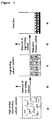
- Figure 12 and Figure 13 are schematic expressions of the results of the TEM observations of the cast films prepared by the present invention, for easy understanding thereof.
- Figure 12 shows a typical case in which the metal content is relatively low as in the case shown in Figure 4
- Figure 13 shows a typical case in which the metal content is high as in the case shown in Figure 11.
- one of the phases composing the microphase-separated structure contains ultrafine metal particles arranged in a row along the phase and, as the metal content increases, the metal clusters are arranged in plural rows overlapping each other within the polymer phase.
- a metal-organic polymer composite structure composed of a microphase-separated structure by an extremely easy process, i.e., simply by dissolving a block copolymer and a metallic compound as the starting materials in a mixture of the two different types of solvents and then removing such solvents one after another by vaporization.
- the metal-organic polymer composite structure of the present invention has a unique morphology wherein ultrafine metal particles are arranged in a row or rows in a polymer phase.
- the composite structure of a lamellar structure according to the present invention is, among various types of microphase-separated structures, preferable in that it takes a lamellar structure composed of the phase of the polymer having an affinity for the metal and the phase of the polymer having no affinity for the metal, being present one after another with a domain size on the order of several tens of nanometers, and that ultrafine metal particles (metal clusters) having a particle diameter of 10nm or smaller are arranged orderly and one-dimensionally within the metal-affinitive phase.
- such composite structure is applicable, as it is or after removing the phase of the polymer having no affinity for the metal in any suitable manner, to new types of electronic materials, magnetic materials or optical materials which will exhibit anisotropic properties.
Landscapes
- Chemical & Material Sciences (AREA)
- Health & Medical Sciences (AREA)
- Chemical Kinetics & Catalysis (AREA)
- Medicinal Chemistry (AREA)
- Polymers & Plastics (AREA)
- Organic Chemistry (AREA)
- Graft Or Block Polymers (AREA)
- Compositions Of Macromolecular Compounds (AREA)
- Manufacture Of Metal Powder And Suspensions Thereof (AREA)
- Manufacture Of Macromolecular Shaped Articles (AREA)
- Powder Metallurgy (AREA)
- Processes Of Treating Macromolecular Substances (AREA)
Applications Claiming Priority (3)
| Application Number | Priority Date | Filing Date | Title |
|---|---|---|---|
| JP10262366A JP2980899B1 (ja) | 1998-09-01 | 1998-09-01 | 列状に配置された金属超微粒子を含有する金属・有機ポリマー複合構造体とその製造方法 |
| JP26236698 | 1998-09-01 | ||
| PCT/JP1999/004629 WO2000012624A1 (fr) | 1998-09-01 | 1999-08-26 | Structure composite polymere metallique/organique contenant des particules metalliques ultrafines disposees en rangees et procede de production correspondant |
Publications (3)
| Publication Number | Publication Date |
|---|---|
| EP1028143A1 true EP1028143A1 (fr) | 2000-08-16 |
| EP1028143A4 EP1028143A4 (fr) | 2003-06-18 |
| EP1028143B1 EP1028143B1 (fr) | 2006-05-17 |
Family
ID=17374753
Family Applications (1)
| Application Number | Title | Priority Date | Filing Date |
|---|---|---|---|
| EP99940515A Expired - Lifetime EP1028143B1 (fr) | 1998-09-01 | 1999-08-26 | Procédé de production d'une structure composite metal/polymère organique contenant des particules metalliques ultrafines disposees en rangees |
Country Status (6)
| Country | Link |
|---|---|
| US (1) | US6565965B1 (fr) |
| EP (1) | EP1028143B1 (fr) |
| JP (1) | JP2980899B1 (fr) |
| CA (1) | CA2307775C (fr) |
| DE (1) | DE69931341T2 (fr) |
| WO (1) | WO2000012624A1 (fr) |
Cited By (3)
| Publication number | Priority date | Publication date | Assignee | Title |
|---|---|---|---|---|
| WO2002098925A3 (fr) * | 2001-05-25 | 2003-09-12 | Basf Ag | Transport de gaz a catalyse colloidale en phase surcritique |
| WO2004056699A3 (fr) * | 2002-12-20 | 2005-11-24 | Leibniz Inst Polymerforschung | Nanoparticules, structures nanoscopiques et procede pour leur production |
| WO2008135749A1 (fr) * | 2007-05-04 | 2008-11-13 | The University Of Nottingham | Nanoparticules et leur fabrication |
Families Citing this family (6)
| Publication number | Priority date | Publication date | Assignee | Title |
|---|---|---|---|---|
| JP4563162B2 (ja) * | 2004-12-10 | 2010-10-13 | 旭化成株式会社 | ミクロ相分離構造体及びミクロ相分離体の製造方法 |
| US7211364B1 (en) * | 2005-10-21 | 2007-05-01 | Eastman Kodak Company | Thermally conducive material and use in high-speed printing |
| JP5333777B2 (ja) * | 2006-05-22 | 2013-11-06 | ナンヤン テクノロジカル ユニヴァーシティー | 有機メモリデバイス及びその製造方法 |
| IT1392754B1 (it) * | 2008-12-18 | 2012-03-16 | St Microelectronics Srl | Nanoarray ad incrocio con strato organico attivo anisotropico |
| JP5394857B2 (ja) * | 2009-08-27 | 2014-01-22 | 富士フイルム株式会社 | 高分子膜の製造方法 |
| JP5472446B2 (ja) * | 2010-03-18 | 2014-04-16 | 株式会社豊田中央研究所 | ナノヘテロ構造体およびその製造方法 |
Family Cites Families (7)
| Publication number | Priority date | Publication date | Assignee | Title |
|---|---|---|---|---|
| EP0864362B1 (fr) * | 1997-03-10 | 2003-11-05 | Japan Science and Technology Corporation | Procédé de préparation d'une structure composite à base de nanoparticules métalliques enrobées d'un polymère organique |
| JP3197500B2 (ja) * | 1997-03-10 | 2001-08-13 | 科学技術振興事業団 | 有機ポリマー保護金属クラスター複合体 |
| JP3227109B2 (ja) * | 1997-05-29 | 2001-11-12 | 科学技術振興事業団 | 金属・有機ポリマー複合体と多孔体 |
| JP3244652B2 (ja) * | 1997-08-22 | 2002-01-07 | 科学技術振興事業団 | 金属含有量の高い金属・有機ポリマー複合構造体および多孔体ならびにその製造方法 |
| JP3244653B2 (ja) * | 1997-08-22 | 2002-01-07 | 科学技術振興事業団 | 金属・有機ポリマー複合構造体および多孔体ならびにその製造方法 |
| JPH10330528A (ja) * | 1997-05-29 | 1998-12-15 | Res Dev Corp Of Japan | 金属・有機ポリマー複合体 |
| DE19738913B4 (de) * | 1997-09-05 | 2004-03-18 | MAX-PLANCK-Gesellschaft zur Förderung der Wissenschaften e.V. | Blockcopolymerphasen als Template für strukturierte organisch-anorganische Hybridmaterialien |
-
1998
- 1998-09-01 JP JP10262366A patent/JP2980899B1/ja not_active Expired - Fee Related
-
1999
- 1999-08-26 CA CA002307775A patent/CA2307775C/fr not_active Expired - Fee Related
- 1999-08-26 EP EP99940515A patent/EP1028143B1/fr not_active Expired - Lifetime
- 1999-08-26 DE DE69931341T patent/DE69931341T2/de not_active Expired - Lifetime
- 1999-08-26 WO PCT/JP1999/004629 patent/WO2000012624A1/fr not_active Ceased
- 1999-08-26 US US09/530,179 patent/US6565965B1/en not_active Expired - Fee Related
Cited By (6)
| Publication number | Priority date | Publication date | Assignee | Title |
|---|---|---|---|---|
| WO2002098925A3 (fr) * | 2001-05-25 | 2003-09-12 | Basf Ag | Transport de gaz a catalyse colloidale en phase surcritique |
| US7193120B2 (en) | 2001-05-25 | 2007-03-20 | Basf Aktiengesellschaft | Colloid-catalyzed gas transfer in supercritical phases |
| WO2004056699A3 (fr) * | 2002-12-20 | 2005-11-24 | Leibniz Inst Polymerforschung | Nanoparticules, structures nanoscopiques et procede pour leur production |
| WO2008135749A1 (fr) * | 2007-05-04 | 2008-11-13 | The University Of Nottingham | Nanoparticules et leur fabrication |
| GB2461473A (en) * | 2007-05-04 | 2010-01-06 | Univ Nottingham | Nanoparticles and fabrication thereof |
| GB2461473B (en) * | 2007-05-04 | 2012-10-24 | Univ Nottingham | Nanoparticles and fabrication thereof |
Also Published As
| Publication number | Publication date |
|---|---|
| EP1028143A4 (fr) | 2003-06-18 |
| CA2307775A1 (fr) | 2000-03-09 |
| DE69931341T2 (de) | 2007-04-19 |
| JP2980899B1 (ja) | 1999-11-22 |
| DE69931341D1 (de) | 2006-06-22 |
| CA2307775C (fr) | 2007-01-09 |
| JP2000072952A (ja) | 2000-03-07 |
| WO2000012624A1 (fr) | 2000-03-09 |
| EP1028143B1 (fr) | 2006-05-17 |
| US6565965B1 (en) | 2003-05-20 |
Similar Documents
| Publication | Publication Date | Title |
|---|---|---|
| Boott et al. | Scalable and uniform 1D nanoparticles by synchronous polymerization, crystallization and self-assembly | |
| Moffitt et al. | Spherical assemblies of semiconductor nanoparticles in water-soluble block copolymer aggregates | |
| Wan et al. | One-pot synthesis of polymeric nanomaterials via RAFT dispersion polymerization induced self-assembly and re-organization | |
| EP0864362B1 (fr) | Procédé de préparation d'une structure composite à base de nanoparticules métalliques enrobées d'un polymère organique | |
| EP1028143B1 (fr) | Procédé de production d'une structure composite metal/polymère organique contenant des particules metalliques ultrafines disposees en rangees | |
| Ruotsalainen et al. | Towards internal structuring of electrospun fibers by hierarchical self-assembly of polymeric comb-shaped supramolecules | |
| Schlotterbeck et al. | Shape‐selective synthesis of palladium nanoparticles stabilized by highly branched amphiphilic polymers | |
| Liu | Nanofibers | |
| Clay et al. | Synthesis of metal nanoclusters within microphase-separated diblock copolymers: a ‘universal’approach | |
| DE60217401T2 (de) | Herstellung von metallnanoteilchen mit schalenvernetztem micell als formwerkzeug | |
| Andersson et al. | Macroscopic alignment of silver nanoparticles in reverse hexagonal liquid crystalline templates | |
| WO1999012994A1 (fr) | Phases de copolymere sequence servant de matrice pour des materiaux hybrides organiques-inorganiques structures | |
| DE102011105900A1 (de) | Herstellung nanostrukturierter poröser hohler Kugeln mit einstellbarer Struktur | |
| Park et al. | Iron cluster and microstructure formation in metal-centered star block copolymers: Amphiphilic iron tris (bipyridine)-centered polyoxazolines | |
| Koh et al. | Fabrication of Pt/Au concentric spheres from triblock copolymer | |
| Ehret et al. | Bimetallic PdAg nanoparticle arrays from monolayer films of diblock copolymer micelles | |
| DE2339782A1 (de) | Fluessige zusammensetzung aus einer waessrigen loesung einer wasserloeslichen metallverbindung | |
| Mallick et al. | Polymerization of aniline by cupric sulfate: A facile synthetic route for producing polyaniline | |
| US8114187B2 (en) | Synthesis of platinum nanostructures | |
| Mallick et al. | Fabrication of a nanostructured gold-polymer composite material | |
| Betthausen et al. | Nanoporous sheets and cylinders via bulk templating of triblock terpolymer/homopolymer blends | |
| Wostek-Wojciechowska et al. | Synthesis of gold nanoparticles in solid state by thermal decomposition of an organometallic precursor | |
| Bhattacharjee et al. | Synthesis of dendrimer-stabilized gold-polypyrrole core-shell nanoparticles | |
| Okumura et al. | Nanohybrids of metal nanoparticles and block copolymers. Control of spatial distribution of the nanoparticles in microdomain space | |
| Meristoudi et al. | Self‐assembly in solutions of block and random copolymers during metal nanoparticle formation |
Legal Events
| Date | Code | Title | Description |
|---|---|---|---|
| PUAI | Public reference made under article 153(3) epc to a published international application that has entered the european phase |
Free format text: ORIGINAL CODE: 0009012 |
|
| 17P | Request for examination filed |
Effective date: 20000425 |
|
| AK | Designated contracting states |
Kind code of ref document: A1 Designated state(s): AT BE CH CY DE DK ES FI FR GB GR IE IT LI LU MC NL PT SE |
|
| A4 | Supplementary search report drawn up and despatched |
Effective date: 20030508 |
|
| 17Q | First examination report despatched |
Effective date: 20031218 |
|
| RBV | Designated contracting states (corrected) |
Designated state(s): DE FR GB |
|
| RAP1 | Party data changed (applicant data changed or rights of an application transferred) |
Owner name: JAPAN SCIENCE AND TECHNOLOGY AGENCY |
|
| GRAP | Despatch of communication of intention to grant a patent |
Free format text: ORIGINAL CODE: EPIDOSNIGR1 |
|
| RTI1 | Title (correction) |
Free format text: PROCESS FOR PRODUCING METAL/ORGANIC POLYMER COMPOSITE STRUCTURE CONTAINING ULTRAFINE METAL PARTICLES ARRANGED IN ROW |
|
| GRAS | Grant fee paid |
Free format text: ORIGINAL CODE: EPIDOSNIGR3 |
|
| GRAA | (expected) grant |
Free format text: ORIGINAL CODE: 0009210 |
|
| AK | Designated contracting states |
Kind code of ref document: B1 Designated state(s): DE FR GB |
|
| REG | Reference to a national code |
Ref country code: GB Ref legal event code: FG4D |
|
| REF | Corresponds to: |
Ref document number: 69931341 Country of ref document: DE Date of ref document: 20060622 Kind code of ref document: P |
|
| ET | Fr: translation filed | ||
| PLBE | No opposition filed within time limit |
Free format text: ORIGINAL CODE: 0009261 |
|
| STAA | Information on the status of an ep patent application or granted ep patent |
Free format text: STATUS: NO OPPOSITION FILED WITHIN TIME LIMIT |
|
| 26N | No opposition filed |
Effective date: 20070220 |
|
| PGFP | Annual fee paid to national office [announced via postgrant information from national office to epo] |
Ref country code: FR Payment date: 20090814 Year of fee payment: 11 |
|
| PGFP | Annual fee paid to national office [announced via postgrant information from national office to epo] |
Ref country code: GB Payment date: 20090826 Year of fee payment: 11 Ref country code: DE Payment date: 20090821 Year of fee payment: 11 |
|
| GBPC | Gb: european patent ceased through non-payment of renewal fee |
Effective date: 20100826 |
|
| REG | Reference to a national code |
Ref country code: FR Ref legal event code: ST Effective date: 20110502 |
|
| REG | Reference to a national code |
Ref country code: DE Ref legal event code: R119 Ref document number: 69931341 Country of ref document: DE Effective date: 20110301 |
|
| PG25 | Lapsed in a contracting state [announced via postgrant information from national office to epo] |
Ref country code: FR Free format text: LAPSE BECAUSE OF NON-PAYMENT OF DUE FEES Effective date: 20100831 Ref country code: DE Free format text: LAPSE BECAUSE OF NON-PAYMENT OF DUE FEES Effective date: 20110301 |
|
| PG25 | Lapsed in a contracting state [announced via postgrant information from national office to epo] |
Ref country code: GB Free format text: LAPSE BECAUSE OF NON-PAYMENT OF DUE FEES Effective date: 20100826 |