EP1028593A2 - Méthode et appareil pour le contrôle et le transport de données digitales visuelles compressées dans un reseau de communication hétérogène - Google Patents
Méthode et appareil pour le contrôle et le transport de données digitales visuelles compressées dans un reseau de communication hétérogène Download PDFInfo
- Publication number
- EP1028593A2 EP1028593A2 EP00300597A EP00300597A EP1028593A2 EP 1028593 A2 EP1028593 A2 EP 1028593A2 EP 00300597 A EP00300597 A EP 00300597A EP 00300597 A EP00300597 A EP 00300597A EP 1028593 A2 EP1028593 A2 EP 1028593A2
- Authority
- EP
- European Patent Office
- Prior art keywords
- bitstream
- bits
- discarding
- video
- standard type
- Prior art date
- Legal status (The legal status is an assumption and is not a legal conclusion. Google has not performed a legal analysis and makes no representation as to the accuracy of the status listed.)
- Withdrawn
Links
- 238000000034 method Methods 0.000 title claims abstract description 33
- 238000004891 communication Methods 0.000 title abstract description 22
- 230000000007 visual effect Effects 0.000 title abstract description 22
- 230000006872 improvement Effects 0.000 claims abstract description 4
- 239000013598 vector Substances 0.000 claims description 10
- 230000004807 localization Effects 0.000 claims description 5
- 230000003252 repetitive effect Effects 0.000 claims description 3
- 238000013519 translation Methods 0.000 abstract description 8
- 238000003780 insertion Methods 0.000 abstract description 7
- 230000037431 insertion Effects 0.000 abstract description 7
- 238000010586 diagram Methods 0.000 description 9
- 230000002123 temporal effect Effects 0.000 description 6
- 230000001105 regulatory effect Effects 0.000 description 5
- 230000005540 biological transmission Effects 0.000 description 3
- 238000000638 solvent extraction Methods 0.000 description 3
- 230000004075 alteration Effects 0.000 description 2
- 230000003139 buffering effect Effects 0.000 description 2
- 230000015556 catabolic process Effects 0.000 description 2
- 230000010267 cellular communication Effects 0.000 description 2
- 238000006731 degradation reaction Methods 0.000 description 2
- 230000006870 function Effects 0.000 description 2
- 239000000463 material Substances 0.000 description 2
- 230000007246 mechanism Effects 0.000 description 2
- 238000012986 modification Methods 0.000 description 2
- 230000004048 modification Effects 0.000 description 2
- 230000009467 reduction Effects 0.000 description 2
- 238000013459 approach Methods 0.000 description 1
- 230000001276 controlling effect Effects 0.000 description 1
- 230000000593 degrading effect Effects 0.000 description 1
- 230000001934 delay Effects 0.000 description 1
- 230000001419 dependent effect Effects 0.000 description 1
- 238000011161 development Methods 0.000 description 1
- 230000000694 effects Effects 0.000 description 1
- 238000005516 engineering process Methods 0.000 description 1
- 239000000284 extract Substances 0.000 description 1
- 230000003116 impacting effect Effects 0.000 description 1
- 239000003550 marker Substances 0.000 description 1
- 238000010295 mobile communication Methods 0.000 description 1
- 238000012913 prioritisation Methods 0.000 description 1
- 238000013139 quantization Methods 0.000 description 1
- 238000012549 training Methods 0.000 description 1
- 230000002747 voluntary effect Effects 0.000 description 1
Images




Classifications
-
- H—ELECTRICITY
- H04—ELECTRIC COMMUNICATION TECHNIQUE
- H04N—PICTORIAL COMMUNICATION, e.g. TELEVISION
- H04N19/00—Methods or arrangements for coding, decoding, compressing or decompressing digital video signals
- H04N19/70—Methods or arrangements for coding, decoding, compressing or decompressing digital video signals characterised by syntax aspects related to video coding, e.g. related to compression standards
-
- H—ELECTRICITY
- H04—ELECTRIC COMMUNICATION TECHNIQUE
- H04N—PICTORIAL COMMUNICATION, e.g. TELEVISION
- H04N21/00—Selective content distribution, e.g. interactive television or video on demand [VOD]
- H04N21/20—Servers specifically adapted for the distribution of content, e.g. VOD servers; Operations thereof
- H04N21/23—Processing of content or additional data; Elementary server operations; Server middleware
- H04N21/236—Assembling of a multiplex stream, e.g. transport stream, by combining a video stream with other content or additional data, e.g. inserting a URL [Uniform Resource Locator] into a video stream, multiplexing software data into a video stream; Remultiplexing of multiplex streams; Insertion of stuffing bits into the multiplex stream, e.g. to obtain a constant bit-rate; Assembling of a packetised elementary stream
- H04N21/23608—Remultiplexing multiplex streams, e.g. involving modifying time stamps or remapping the packet identifiers
-
- H—ELECTRICITY
- H04—ELECTRIC COMMUNICATION TECHNIQUE
- H04N—PICTORIAL COMMUNICATION, e.g. TELEVISION
- H04N19/00—Methods or arrangements for coding, decoding, compressing or decompressing digital video signals
- H04N19/40—Methods or arrangements for coding, decoding, compressing or decompressing digital video signals using video transcoding, i.e. partial or full decoding of a coded input stream followed by re-encoding of the decoded output stream
-
- H—ELECTRICITY
- H04—ELECTRIC COMMUNICATION TECHNIQUE
- H04N—PICTORIAL COMMUNICATION, e.g. TELEVISION
- H04N19/00—Methods or arrangements for coding, decoding, compressing or decompressing digital video signals
- H04N19/65—Methods or arrangements for coding, decoding, compressing or decompressing digital video signals using error resilience
- H04N19/66—Methods or arrangements for coding, decoding, compressing or decompressing digital video signals using error resilience involving data partitioning, i.e. separation of data into packets or partitions according to importance
-
- H—ELECTRICITY
- H04—ELECTRIC COMMUNICATION TECHNIQUE
- H04N—PICTORIAL COMMUNICATION, e.g. TELEVISION
- H04N19/00—Methods or arrangements for coding, decoding, compressing or decompressing digital video signals
- H04N19/65—Methods or arrangements for coding, decoding, compressing or decompressing digital video signals using error resilience
- H04N19/68—Methods or arrangements for coding, decoding, compressing or decompressing digital video signals using error resilience involving the insertion of resynchronisation markers into the bitstream
-
- H—ELECTRICITY
- H04—ELECTRIC COMMUNICATION TECHNIQUE
- H04N—PICTORIAL COMMUNICATION, e.g. TELEVISION
- H04N21/00—Selective content distribution, e.g. interactive television or video on demand [VOD]
- H04N21/20—Servers specifically adapted for the distribution of content, e.g. VOD servers; Operations thereof
- H04N21/23—Processing of content or additional data; Elementary server operations; Server middleware
- H04N21/238—Interfacing the downstream path of the transmission network, e.g. adapting the transmission rate of a video stream to network bandwidth; Processing of multiplex streams
Definitions
- the present invention relates to automatically managing the delivery of digitally compressed visual data, and more particularly, to a device and method for controlling the bitrate and error robustness of digitally compressed video bitstreams in a heterogeneous communications network.
- Such new communication systems comprise both wireline and wireless networks.
- packet and circuit switched communication systems have been developed in both the private and public domains for wide and local area coverage.
- packet-based communications a significant amount of data is exchanged between local area networks, such as those which are part of a corporate infrastructure, and wide area networks, such as the public Internet.
- QoS Quality of Service
- New wireless systems have also been developed to support the transmission of information at higher bitrates than previously possible. These wireless systems conform to international cellular communication standards, and consist of digital communication air-interface standards using Time Division Multiple Access (TDMA) and Code Division Multiple Access (CDMA).
- TDMA Time Division Multiple Access
- CDMA Code Division Multiple Access
- GSM Global System for Mobile communication
- GSM Global System for Mobile communication
- CDMA forms the basis for the third generation cellular communication standard IMT-2000.
- IMT-2000 protocols can support data communication from wireless terminals to terminals residing on packet switched wireline systems.
- terminals, or clients may connect to other terminals, acting as servers, at different bitrates depending on their location in each system. This leads to the concept of heterogeneous communication networks , which are networks consisting of diverse or dissimilar connections yet often communicating similar information.
- a first problematic issue which arises is that visual information, and, in particular, digitally compressed video signals, require substantially more bandwidth than comparable voice signals compressed over similar time intervals. Transmitting visual information between systems designed with different nominal transmission bitrates presents some difficulty because of delays that result from these incompatible bitrates. In addition, varying error characteristics of the different communication systems in a heterogeneous network also present a problem for the transmission of visual information because it is very difficult to mask errors in the visual space.
- this invention provides a method and apparatus for changing a digitally compressed video bitstream at a source point in a network, in an automatic way, such that the resulting bitstream is compatible with different bandwidth and error resilience requirements at a receiving point in a heterogeneous communication network.
- the novel method consists of analyzing the header information of the original bitstream to determine its coding parameters. Feedback from the receiving point on the network is then used to determine error properties of the network.
- the bandwidth and error resilience requirements establish a prioritization and selection of relevant and irrelevant bits from the original bitstream, of which the relevant bits are manipulated by a robustness regulator to achieve error protection in the network.
- the principal inventive components of the method include identification of irrelevant and low priority video bits, intentional introduction of packet losses to reduce bitrate, use of replacement tags for irrelevant and low priority components of the bitstream, and insertion of resynchronization tags for the improvement of error resilience.
- FIG. 1 illustrates a block diagram 100 of a visual bitstream regulation method which defines a control system operated in the manner described herein.
- the input bitstream 101 is passed through a header analysis stage 103 which extracts information about the type of standard used to create the bitstream.
- This information is passed through the standard type identification stage 105, which results in the assignment of control parameters in the main bitstream control 107 which is coupled to accept input parameters describing the receiving terminal's capabilities 109.
- These steps are designed to set up the system for proper regulation and compatible delivery of the bitstream from the sender to the receiving terminal.
- identification of the original visual coding standard used to encode the bitstream coupled with information about the capabilities of the receiving terminal determines the extent to which the bitstream must be manipulated before compatible communication is possible.
- the output of the main bitstream control step is coupled to the robustness regulation stage 111.
- the bitrate-regulated bitstream is modified to provide a bitstream which is compatible with the error characteristics of the channel connecting the source and receiving terminals.
- This robustness regulation is dependent on the standard type of the original bitstream identified in 105.
- the regulation is accomplished through the packetization of bits in the coded frames of visual information in such a way that errors may be detected, localized and concealed by a robust decoder.
- the use of resynchronization tags 113 is applied for visual bitstreams conforming to standards which support sub-frame resynchronization.
- the robustness regulation step manipulates the bitstream such that independent decoding is possible for each segment of bits delimited by the inserted resynchronization tags.
- this information is replaced with equivalent information utilizing only predictors within the same segment.
- This stage is referred to as video packet translation 115. For example, this would apply to the replacement of codewords for motion vector differences computed across resynchronization segments with motion vector differences computed from information in the same segment.
- the output of the video packet translation step is directed to the bitrate regulation stage 119 which is coupled to receive intentional packet loss information 117 and, additionally, to discard irrelevant bits 121 in order to reduce the bitstream bitrate.
- the purpose of the bitrate regulation stage is to adjust the bitrate of the input bitstream so that the delivered stream is compatible with the capabilities of the receiving terminal and its delivery channel. This is accomplished through manipulation and removal of bits in the incoming bitstream.
- the present method does not provide a mechanism for explicit decoding and re-encoding of bitstreams, also known as transcoding, but rather supports translation of codewords in the compressed domain of the bitstream.
- the bitrate regulator selectively removes information from the incoming bitstream so that the output bitstream conform to a compatible delivery bitrate.
- Intentional packet losses 117 provide a mechanism to reduce the bitrate below the lowest base layer bitrate of the original incoming bitstream.
- the term base layer is used to describe the lowest priority independently decodable layer of a scalable bitstream.
- replacement tags 123 inserted into the bitstream enables a decoder to seamlessly decode a bitrate-regulated bitstream without additional capabilities over those of the nominal relevant standard decoder.
- An example of this is the case where a standard such as MPEG-2 requires a pre-specified coded frame rate, such as 30 frames per second, but where frames are dropped by the bitrate regulator.
- the replacement tags are predetermined binary codewords which represent empty frames, and which preserve the time relationships of coded frames in the bitstream.
- the inventive method 100 outlined above provides a solution to the problem of delivering standardized digitally compressed visual information from a variety of sources to receiving terminals with dissimilar bandwidth and error robustness capabilities.
- the overall method supports all classes of existing visual coding standards by adapting to the specific syntax elements of each, and utilizing each stage of the present method for its purpose only to the degree to which it still produces a bitstream which conforms to that standard.
- FIG. 2 illustrates a generalized flow diagram 200 of a preferred embodiment of a method for regulating a bitstream encoded with prioritized frame types such as INTRA (I), PREDICTED (P), and BI_DIRECTIONALLY PREDICTED (B) frames, and/or scalable frame types including temporal, spatial, and SNR scalability frames.
- prioritized frame types such as INTRA (I), PREDICTED (P), and BI_DIRECTIONALLY PREDICTED (B) frames
- scalable frame types including temporal, spatial, and SNR scalability frames.
- Examples of voluntary international standards for the bitstreams having I, P, and B frames include MPEG-1, MPEG-2, MPEG-4, and H.263 v2.
- standards for bitstreams having scalability frames include MPEG-2, H.263 v2, and MPEG-4.
- the preferred embodiment 200 defines a method for manipulating a standards compliant bitstream with multiple frame types in order to regulate the bitrate and error robustness of that bitstream before delivery over a
- the preferred embodiment of the present invention is shown in the flow diagram 200 with respect to an incoming MPEG-4 bitstream 201 with two layers: a base layer 209 and a temporal scalability enhancement layer 211.
- the temporal scalability enhancement layer is a syntax element supported by the MPEG-4 standard, and consists of multiple frames of video which are temporally interleaved with the video frames of the base layer.
- a decoder can decode all, some, or no frames of the temporal scalability layer without affecting the nominal quality of the decoded base layer. This is a result of the fact that the scalability layer is not used for the prediction of any information at an equal or lower layer of scalability in the syntax of MPEG-4.
- the incoming bitstream 201 is analyzed as shown at 203 with the input of a predetermined list of standard header codes 204.
- the analysis exhaustively compares the list of standard header codes with the relevant leading bits in the incoming bitstream to determine the standard and syntax used to compress the bitstream.
- the bitstream is then demultiplexed 207 to provide two independent bitstreams, a base layer 209 and a temporal scalability layer 211. Parameters defining the relationship and type of the base and enhancement layers are extracted from the incoming bitstream 205 and passed to the main bitstream control stage 213 of this preferred embodiment.
- the independent bitstreams 209 and 211 are jointly processed by the main bitstream control stage.
- the main bitstream control stage is also coupled to receive control signals from the network 215 which describe the capabilities of the receiving terminal, identified as "Recv. Caps" in 215.
- these control signals indicate the desired bandwidth to be transmitted over the network and the location of the receiver terminal on the network.
- This location information describes the channel state of the receiving terminal and indicates whether it is connected through a wired or wireless branch of the network.
- the main bitstream control 213 passes the bitstreams to the robustness regulation stage 217.
- the error resilience of the input data is adjusted so that the effect of errors is mitigated in the decoder at the receiving terminal.
- this is accomplished by the insertion of resync markers 219 into the base layer bitstream 209, a syntax element of MPEG-4 which permits the localization of errors in a robust decoder.
- resync markers 219 into the base layer bitstream 209, a syntax element of MPEG-4 which permits the localization of errors in a robust decoder.
- it can be necessary to adjust the codewords in the bitstream so that predictively coded information does not require values from independent video packets, which are spatial regions represented by bits contained in segments delimited by different sets of resync markers. This is accommodated by the translation of differentially encoded codes 221, explained in more detail below.
- FIGS. 3A, 3B and 3C illustratively provide examples of insertion of resynchronization tags into a bitstream and translation of differentially encoded components within a video packet to support robust decoding.
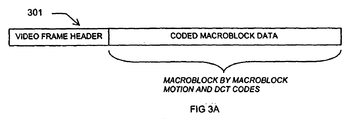
- FIG. 3A an illustration 301 is shown of an original video frame bitstream of the highest level of syntax elements of a video frame having no sub-frame resynchronization.
- Such a bitstream has poor error resilience in the presence of channel errors because all of the information is predictively coded within the coded macroblock data portion of the bitstream.
- FIG. 3B and generally designated at 303 This poor localization of errors is remedied by the present invention as illustrated in FIG. 3B and generally designated at 303.
- a bitstream with video packet resynchronization is shown.
- the inserted resynchronization tags enable a decoder to localize errors to smaller portions of the bitstream, and consequently produce a greater level of quality at a receiving terminal in an error prone heterogeneous communications network.
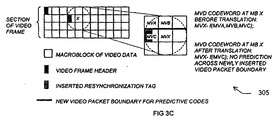
- the method for translating predictively coded codewords within the newly formed video packets is illustrated at 305 in FIG. 30 with respect to the most common predictively coded syntax element: motion vectors.
- the motion vector codeword at macroblock X is computed as the difference of the motion vector at X and a function of those at neighboring macroblock positions A, B, and C.
- MVD motion vector difference
- the method of localizing predictive codes includes parsing and identifying only the present codewords which use predictive coding in the relevant standard, and translating those to the appropriate symbols for the localized predictive codewords.
- this applies to simple translation of motion vector difference codewords, as illustratively shown at 303 in FIG. 3C, and in the same fashion to any predictively coded texture data including quantization parameters and DCT coefficient values.
- the modified bitstream data, and those components of the bitstreams not modified by steps 219 and 221 are delivered to the bitrate regulation stage 223.
- Two techniques are used to achieve the desired bitrate, which is lower than the bitrate of the incoming bitstream.
- the first approach to the reduction of bitrate is through the discarding of bits associated with low priority frames in the bitstream. Bits associated with temporal scalability frames represent the lowest priority bits and are discarded from the incoming bitstream first as shown at 227.
- the base layer bitstream represents the lowest bitrate bitstream achievable without directly impacting the performance of a typical decoder.
- Intentional packet losses are then introduced through packet loss indicator flags 225 coupled to the bitrate regulation stage 223. These packet loss indicator flags 225 are used to discard bits 229 from the base layer bitstream resulting in an output bitstream which has reduced bitrate.
- the introduction of intentional packet losses represents a key novel element of this preferred embodiment.
- the particular means to intentionally introduce packet losses to the base layer bitstream uses a predetermined dropping scheme.
- a predetermined scheme for intentionally dropping packets is to remove the bits associated with non-contiguous logical resynchronization segments of each video frame, known in MPEG-4 as video packets, at uniform spacing until the desired bitrate reduction has been achieved.
- video packets When a packet is dropped from a frame, a packet which does not overlap the same spatial region in the next frame is dropped. This prevents the serious degradation of any single region of the scene. This is accomplished by keeping historical information about the macroblock numbers in each dropped packet. Packets beginning with macroblock numbers overlapping the macroblock range of the last dropped packet are not dropped. The first sequential non-overlapping packet in the next frame is the first candidate for dropping according to this method. This use of statistical information in the introduction of packet losses is integral in reducing the bitrate without substantially degrading the video quality.
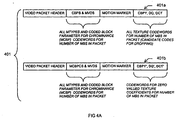
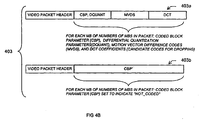
- FIGS. 4A and 4B further describe the inserting of replacement information for two scenarios of dropped MPEG-4 video packet information in accordance with this preferred embodiment.
- bits associated with the texture coding part of a video packet are dropped by the bitrate regulator 217 in FIG. 2.
- Portion 401a of the first example identified an original data partitioned video packet bitstream; and portion 401b represents video packet bitstream with replacement tags.
- the bits dropped, which are delimited by a unique motion marker, are associated with the spatial prediction error codewords (CBPY, DQ, DCT), which decode to values applied to a spatial portion of a video frame after motion compensation has been applied.
- This information is the lowest priority component of an MPEG-4 video packet. While this example illustratively provides details for the syntax of MPEG-4, the identical concept applies to the video syntax of the MPEG-2 standard.
- replacement bits are inserted into the bitstream in the form of code words for zero valued prediction error coefficients (CBPY',DQ',DCT').
- codewords require negligible bitrate in relation to the bitrate consumed by the dropped bits.
- a more extreme case of the same concept is illustrated in example 403 shown in FIG. 4B, where data partitioning is not present in the incoming bitstream.
- Portion 403a of FIG. 4B represents an original combined motion texture video packet bitstream; and portion 403b represents video packet bitstream with replacement tags.
- the replacement bits used are the codewords for combined motion and texture information for blocks containing no motion and no prediction error information (CBP'). This is referred to as "NOT CODED" codewords in example 403.
- CBP' no motion and no prediction error information
- a bitrate regulated bitstream is output at 233 from the bitrate regulation stage.
- the output bitstream is delivered to the heterogeneous network 237 for subsequent decoding at the receiving terminal 239.
- FIG. 5 illustrates a diagram of a device 500 for manipulating a digitally compressed video bitstream to produce an output bitstream compatible with the bandwidth and error resilience requirements of heterogeneous communications network.
- the device 500 comprises a header analysis unit for determining a standard type and a syntax used to compress the input bitstream 501 coupled to a main bitstream controller 505.
- a header analysis unit 503 is coupled to receive input from a memory module holding a list of predetermined standard header codes 504 enabling the analysis unit to compute the present standard and syntax by exhaustive matching of header bits.
- the main bitstream controller 505 is a means for discarding selected bits from the input bitstream on the basis of the syntax determined in the unit 503.
- the main bitstream controller 505 comprises a robustness regulation module 509, a bitrate regulation module 511, and a replacement tag generator 515.
- the robustness regulation module 509 is a means for inserting predetermined bits into the bitstream to improve the error robust localization and decoding of the bitstream in accordance with the standard type and syntax determined in the unit 503.
- the robustness regulation module 509 also translates any predictively coded information into codewords relying only on bits within the present video packet in accordance with inserted resynchronization markers. Operation of the robustness regulation module 509 is reliant on signals from the header analysis unit 503 and feedback from the receiving terminal 507, which are both coupled to input to the main bitstream controller 505 containing those modules.
- the output of the robustness regulation module 509 is coupled to input to the bitrate regulation module 511, which is a means to discard selected bits 513 from the bitstream on the basis of the standard type and the syntax determined in the unit 503.
- the bitrate regulation module 509 is a means for dropping low priority bits associated with frames in an enhancement layer of a scalable bitstream, and means for discarding packets of low priority bits associated with segments in a packet of video bits delimited by resynchronization markers or picture headers.
- the bitrate regulation module 509 also contains memory for recording historical information of the packets dropped in a previous frame which is used to compute the next packets to drop. This enables avoiding repetitive removal of identical spatial areas of a scene.
- the bitrate regulation module 511 produces an output which is compatible with the capabilities of a receiving terminal as indicated by the feedback signal 507 coupled to input to the main bitstream controller 505.
- the output of the bitrate regulation module 511 is coupled to the input of the replacement tag generator 515, which is a means for inserting predetermined bits to improve the decoding of the bitstream in accordance with the standard type and syntax determined in the unit 503.
- the replacement tag generator 515 replaces bits dropped by the bitrate regulation module 509 with short code words designed to preserve timing and spatial information in any decoder such that it will not suffer from unrecoverable errors.
- the output of the main bitstream controller 505 is coupled to a heterogeneous network 519, which in turn delivers a resultant bitstream 517 to a robust decoder at a receiving terminal 521.
- the device 500 is capable of manipulating bitstreams generated by any video coding standard. Depending on the degree of flexibility of the particular standard, varying degrees of functionality in terms of bitrate regulation and error robustness are achieved. In general, the most recent standards, H.263 and MPEG-4, can provide for the most fine control of these bitstream attributes by the device 500.
Landscapes
- Engineering & Computer Science (AREA)
- Multimedia (AREA)
- Signal Processing (AREA)
- Compression Or Coding Systems Of Tv Signals (AREA)
- Communication Control (AREA)
- Data Exchanges In Wide-Area Networks (AREA)
Applications Claiming Priority (2)
| Application Number | Priority Date | Filing Date | Title |
|---|---|---|---|
| US09/248,462 US6498865B1 (en) | 1999-02-11 | 1999-02-11 | Method and device for control and compatible delivery of digitally compressed visual data in a heterogeneous communication network |
| US248462 | 1999-02-11 |
Publications (2)
| Publication Number | Publication Date |
|---|---|
| EP1028593A2 true EP1028593A2 (fr) | 2000-08-16 |
| EP1028593A3 EP1028593A3 (fr) | 2005-01-26 |
Family
ID=22939238
Family Applications (1)
| Application Number | Title | Priority Date | Filing Date |
|---|---|---|---|
| EP00300597A Withdrawn EP1028593A3 (fr) | 1999-02-11 | 2000-01-27 | Méthode et appareil pour le contrôle et le transport de données digitales visuelles compressées dans un reseau de communication hétérogène |
Country Status (6)
| Country | Link |
|---|---|
| US (1) | US6498865B1 (fr) |
| EP (1) | EP1028593A3 (fr) |
| JP (1) | JP2000244923A (fr) |
| KR (1) | KR20000076641A (fr) |
| CN (1) | CN1154362C (fr) |
| CA (1) | CA2298098A1 (fr) |
Cited By (7)
| Publication number | Priority date | Publication date | Assignee | Title |
|---|---|---|---|---|
| WO2002007326A1 (fr) * | 2000-07-17 | 2002-01-24 | Koninklijke Philips Electronics N.V. | Codage d'un flot de donnees |
| WO2002052801A1 (fr) * | 2000-12-22 | 2002-07-04 | Nokia Corporation | Selection de paquets de donnees |
| WO2003046756A3 (fr) * | 2001-11-26 | 2003-12-18 | Imec Inter Uni Micro Electr | Procede permettant d'analyser syntaxiquement un train de bits a l'aide d'un schema et procede permettant de generer un train de bits se basant sur celui-ci |
| EP1562383A3 (fr) * | 2004-02-09 | 2005-08-17 | Broadcom Corporation | Décodeur vidéo multistandard |
| WO2013083984A1 (fr) * | 2011-12-06 | 2013-06-13 | Global Invacom Ltd | Système de transmission de données de configuration utilisant un réseau de distribution coaxial et/ou à fibres optiques |
| FR3006539A1 (fr) * | 2013-05-31 | 2014-12-05 | Aviwest | Procede de transfert d'au moins deux flux de donnees audiovisuelles. |
| US9215498B2 (en) | 2009-09-30 | 2015-12-15 | Huawei Technologies Co., Ltd. | Video data transmission processing method, video data sending processing method, apparatus, network system |
Families Citing this family (90)
| Publication number | Priority date | Publication date | Assignee | Title |
|---|---|---|---|---|
| FI112427B (fi) * | 1999-11-05 | 2003-11-28 | Nokia Corp | Menetelmä langattoman päätelaitteen ominaisuuksien määrittämiseksi multimediasanoman välityspalvelussa, multimediasanoman välityspalvelu ja multimediapäätelaite |
| JP3349490B2 (ja) * | 2000-02-14 | 2002-11-25 | インターナショナル・ビジネス・マシーンズ・コーポレーション | 画像表示方法、画像表示システム、ホスト装置、画像表示装置、およびディスプレイ用インターフェイス |
| US7812856B2 (en) | 2000-10-26 | 2010-10-12 | Front Row Technologies, Llc | Providing multiple perspectives of a venue activity to electronic wireless hand held devices |
| US7630721B2 (en) | 2000-06-27 | 2009-12-08 | Ortiz & Associates Consulting, Llc | Systems, methods and apparatuses for brokering data between wireless devices and data rendering devices |
| US7111163B1 (en) | 2000-07-10 | 2006-09-19 | Alterwan, Inc. | Wide area network using internet with quality of service |
| US6816194B2 (en) * | 2000-07-11 | 2004-11-09 | Microsoft Corporation | Systems and methods with error resilience in enhancement layer bitstream of scalable video coding |
| FI112307B (fi) * | 2000-08-02 | 2003-11-14 | Nokia Corp | Viestintäpalvelu |
| JP3561485B2 (ja) * | 2000-08-18 | 2004-09-02 | 株式会社メディアグルー | 符号化信号分離・合成装置、差分符号化信号生成装置、符号化信号分離・合成方法、差分符号化信号生成方法、符号化信号分離・合成プログラムを記録した媒体および差分符号化信号生成プログラムを記録した媒体 |
| EP1327360A1 (fr) * | 2000-10-11 | 2003-07-16 | Koninklijke Philips Electronics N.V. | Codage a geometrie variable d'objets multimedia |
| US7133455B2 (en) * | 2000-12-29 | 2006-11-07 | Intel Corporation | Providing error resilience and concealment for video data |
| US20020126759A1 (en) * | 2001-01-10 | 2002-09-12 | Wen-Hsiao Peng | Method and apparatus for providing prediction mode fine granularity scalability |
| EP1231793A1 (fr) * | 2001-02-09 | 2002-08-14 | STMicroelectronics S.r.l. | Procédé, système et programme pour changer la syntaxe, la résolution et le débit d'un flux de données MPEG |
| US7184548B2 (en) * | 2001-05-04 | 2007-02-27 | Hewlett-Packard Development Company, L.P. | Encoding and decoding methods for secure scalable streaming and related systems |
| KR100440952B1 (ko) * | 2001-08-04 | 2004-07-21 | 삼성전자주식회사 | 압축 영상 비트 스트림의 부호어 교환을 통한 비트율 변환 방법 및 이에 적합한 장치 |
| US7240001B2 (en) | 2001-12-14 | 2007-07-03 | Microsoft Corporation | Quality improvement techniques in an audio encoder |
| US7656950B2 (en) | 2002-05-29 | 2010-02-02 | Diego Garrido | Video interpolation coding |
| US7627042B2 (en) * | 2003-01-23 | 2009-12-01 | Ittiam Systems (P) Ltd. | System, method, and apparatus for error recovery in coded video signals |
| US7519274B2 (en) | 2003-12-08 | 2009-04-14 | Divx, Inc. | File format for multiple track digital data |
| US8472792B2 (en) | 2003-12-08 | 2013-06-25 | Divx, Llc | Multimedia distribution system |
| US7460990B2 (en) | 2004-01-23 | 2008-12-02 | Microsoft Corporation | Efficient coding of digital media spectral data using wide-sense perceptual similarity |
| WO2005074278A2 (fr) * | 2004-01-23 | 2005-08-11 | Sarnoff Corporation | Procede et appareil d'encodage et d'encapsulation par separation en fonction du degre de priorite |
| KR100526189B1 (ko) | 2004-02-14 | 2005-11-03 | 삼성전자주식회사 | 트랜스코딩 전후에 타이밍 파라미터를 일정하게유지시키는 트랜스코딩 시스템 및 방법 |
| US20070011277A1 (en) * | 2005-07-11 | 2007-01-11 | Ralph Neff | System and method for transferring data |
| US7630882B2 (en) * | 2005-07-15 | 2009-12-08 | Microsoft Corporation | Frequency segmentation to obtain bands for efficient coding of digital media |
| US7562021B2 (en) * | 2005-07-15 | 2009-07-14 | Microsoft Corporation | Modification of codewords in dictionary used for efficient coding of digital media spectral data |
| WO2007076486A2 (fr) * | 2005-12-22 | 2007-07-05 | Vidyo, Inc. | Systeme et procede pour la videoconference utilisant le decodage video echelonnable et serveurs de videoconference de composition d'images |
| WO2007075196A1 (fr) | 2005-09-07 | 2007-07-05 | Vidyo, Inc. | Systeme et procede pour circuit a couche de base haute fiabilite |
| US7676591B2 (en) * | 2005-09-22 | 2010-03-09 | Packet Video Corporation | System and method for transferring multiple data channels |
| KR100891662B1 (ko) * | 2005-10-05 | 2009-04-02 | 엘지전자 주식회사 | 비디오 신호 디코딩 및 인코딩 방법 |
| KR100904440B1 (ko) * | 2005-10-05 | 2009-06-26 | 엘지전자 주식회사 | 레지듀얼 데이터 스트림을 생성하는 방법과 장치 및 이미지블록을 복원하는 방법과 장치 |
| KR20070096751A (ko) * | 2006-03-24 | 2007-10-02 | 엘지전자 주식회사 | 영상 데이터를 코딩/디코딩하는 방법 및 장치 |
| KR20070038396A (ko) * | 2005-10-05 | 2007-04-10 | 엘지전자 주식회사 | 영상 신호의 인코딩 및 디코딩 방법 |
| WO2007044556A2 (fr) * | 2005-10-07 | 2007-04-19 | Innovation Management Sciences, L.L.C. | Procede et appareil pour decodeur video scalable faisant appel a un flux d'amelioration |
| WO2007047560A2 (fr) * | 2005-10-18 | 2007-04-26 | Packetvideo Corp. | Systeme et procede de commande et/ou de gestion de metadonnees multimedia |
| KR100740202B1 (ko) * | 2005-10-21 | 2007-07-18 | 삼성전자주식회사 | 듀얼 전송 스트림 생성 장치 및 그 방법 |
| US7900818B2 (en) * | 2005-11-14 | 2011-03-08 | Packetvideo Corp. | System and method for accessing electronic program guide information and media content from multiple locations using mobile devices |
| JP2009518981A (ja) | 2005-12-08 | 2009-05-07 | ヴィドヨ,インコーポレーテッド | ビデオ通信システムでのエラー回復力およびランダムアクセスのためのシステムおよび方法 |
| US8867340B2 (en) * | 2005-12-21 | 2014-10-21 | Alcatel Lucent | Discarded packet indicator |
| US8436889B2 (en) * | 2005-12-22 | 2013-05-07 | Vidyo, Inc. | System and method for videoconferencing using scalable video coding and compositing scalable video conferencing servers |
| EP3641239B1 (fr) * | 2006-02-10 | 2022-08-03 | III Holdings 2, LLC | Système et procédé permettant de connecter des dispositifs mobiles |
| US8693538B2 (en) | 2006-03-03 | 2014-04-08 | Vidyo, Inc. | System and method for providing error resilience, random access and rate control in scalable video communications |
| US7493106B2 (en) * | 2006-03-17 | 2009-02-17 | Packet Video Corp. | System and method for delivering media content based on a subscription |
| US8161111B2 (en) * | 2006-03-27 | 2012-04-17 | Packet Video, Corp | System and method for identifying common media content |
| US20070245399A1 (en) * | 2006-03-27 | 2007-10-18 | Joel Espelien | System and method for assessing electronic program guide information |
| US8874645B2 (en) * | 2006-03-28 | 2014-10-28 | Packetvideo Corp. | System and method for sharing an experience with media content between multiple devices |
| WO2007112111A2 (fr) * | 2006-03-29 | 2007-10-04 | Packetvideo Corp. | Système et procédé pour sécuriser des évaluations de contenu |
| US8897371B2 (en) * | 2006-04-04 | 2014-11-25 | Qualcomm Incorporated | Video decoding in a receiver |
| US20080037489A1 (en) * | 2006-08-10 | 2008-02-14 | Ahmed Adil Yitiz | System and method for intelligent media recording and playback on a mobile device |
| US20080039967A1 (en) * | 2006-08-11 | 2008-02-14 | Greg Sherwood | System and method for delivering interactive audiovisual experiences to portable devices |
| CN101523371B (zh) * | 2006-09-29 | 2012-04-25 | 维德约股份有限公司 | 用于具有可缩放视频编码服务和多播的多点会议的系统和方法 |
| US20080090590A1 (en) * | 2006-10-12 | 2008-04-17 | Joel Espelien | System and method for creating multimedia rendezvous points for mobile devices |
| US7953880B2 (en) | 2006-11-16 | 2011-05-31 | Sharp Laboratories Of America, Inc. | Content-aware adaptive packet transmission |
| US20080120672A1 (en) * | 2006-11-21 | 2008-05-22 | Francesco Caggioni | Methods and Apparatus for Weighted Multicasting of Data Streams |
| EP2102988A4 (fr) | 2007-01-09 | 2010-08-18 | Vidyo Inc | Systèmes et procédés améliorés de résilience aux pannes dans des systèmes de communication vidéo |
| US7706384B2 (en) * | 2007-04-20 | 2010-04-27 | Sharp Laboratories Of America, Inc. | Packet scheduling with quality-aware frame dropping for video streaming |
| US7668170B2 (en) * | 2007-05-02 | 2010-02-23 | Sharp Laboratories Of America, Inc. | Adaptive packet transmission with explicit deadline adjustment |
| US7761290B2 (en) | 2007-06-15 | 2010-07-20 | Microsoft Corporation | Flexible frequency and time partitioning in perceptual transform coding of audio |
| US8046214B2 (en) * | 2007-06-22 | 2011-10-25 | Microsoft Corporation | Low complexity decoder for complex transform coding of multi-channel sound |
| US7885819B2 (en) | 2007-06-29 | 2011-02-08 | Microsoft Corporation | Bitstream syntax for multi-process audio decoding |
| US20090052380A1 (en) * | 2007-08-21 | 2009-02-26 | Joel Espelien | Mobile media router and method for using same |
| WO2009035578A1 (fr) * | 2007-09-11 | 2009-03-19 | Packetvideo Corp. | Systeme et procede de stockage virtuel de service multimedia sur un dispositif portable |
| US8249883B2 (en) | 2007-10-26 | 2012-08-21 | Microsoft Corporation | Channel extension coding for multi-channel source |
| WO2009065137A1 (fr) | 2007-11-16 | 2009-05-22 | Divx, Inc. | Structures à indexes réduites et hiérarchiques pour fichiers multimédia |
| US8379729B2 (en) * | 2007-11-21 | 2013-02-19 | Texas Instruments Incorporated | Content adaptive error localization to improve quality of corrupted video data streams upon decode |
| WO2009075771A1 (fr) * | 2007-12-12 | 2009-06-18 | Packetvideo Corp. | Systeme et procede de creation de metadonnees |
| US9497583B2 (en) | 2007-12-12 | 2016-11-15 | Iii Holdings 2, Llc | System and method for generating a recommendation on a mobile device |
| JP5590614B2 (ja) * | 2007-12-12 | 2014-09-17 | パケットビデオ コーポレーション | モバイル装置上にレコメンデーションを生成する方法 |
| US8855211B2 (en) * | 2008-01-22 | 2014-10-07 | At&T Intellectual Property I, Lp | Method and apparatus for managing video transport |
| US8335259B2 (en) | 2008-03-12 | 2012-12-18 | Packetvideo Corp. | System and method for reformatting digital broadcast multimedia for a mobile device |
| US8224775B2 (en) * | 2008-03-31 | 2012-07-17 | Packetvideo Corp. | System and method for managing, controlling and/or rendering media in a network |
| US8421840B2 (en) * | 2008-06-09 | 2013-04-16 | Vidyo, Inc. | System and method for improved view layout management in scalable video and audio communication systems |
| US8544046B2 (en) * | 2008-10-09 | 2013-09-24 | Packetvideo Corporation | System and method for controlling media rendering in a network using a mobile device |
| CN101741752B (zh) | 2008-11-17 | 2015-08-19 | 华为技术有限公司 | 视频流传输的方法、装置和系统 |
| US8578259B2 (en) * | 2008-12-31 | 2013-11-05 | Microsoft Corporation | Media portability and compatibility for different destination platforms |
| JP2012525076A (ja) | 2009-04-24 | 2012-10-18 | デルタ・ヴィディオ・インコーポレイテッド | デジタルビデオ配信システムにおける即時マルチチャネルビデオコンテンツブラウジングのためのシステム、方法、およびコンピュータ可読媒体 |
| WO2011005563A1 (fr) * | 2009-06-24 | 2011-01-13 | Delta Vidyo, Inc. | Système et procédé pour un guide de programmation électronique vidéo actif |
| US9195775B2 (en) | 2009-06-26 | 2015-11-24 | Iii Holdings 2, Llc | System and method for managing and/or rendering internet multimedia content in a network |
| US11647243B2 (en) | 2009-06-26 | 2023-05-09 | Seagate Technology Llc | System and method for using an application on a mobile device to transfer internet media content |
| CN101631387B (zh) * | 2009-08-24 | 2013-01-16 | 华为技术有限公司 | 一种微波链路的业务调度方法、装置及系统 |
| WO2011028281A1 (fr) * | 2009-09-04 | 2011-03-10 | Packetvideo Corporation | Système et procédé pour gérer un contenu multimédia internet |
| US20110173300A1 (en) * | 2009-11-25 | 2011-07-14 | Isaac Levy | IPTV Presence And Interaction Protocol |
| US20120063515A1 (en) * | 2010-09-09 | 2012-03-15 | Qualcomm Incorporated | Efficient Coding of Video Parameters for Weighted Motion Compensated Prediction in Video Coding |
| US8934530B2 (en) | 2011-02-01 | 2015-01-13 | Vidyo, Inc. | Spatial scalability using redundant pictures and slice groups |
| WO2012109568A1 (fr) | 2011-02-11 | 2012-08-16 | Packetvideo Corporation | Système et procédé d'utilisation d'une application sur un dispositif mobile afin de transférer un contenu média internet |
| US9503223B2 (en) * | 2011-03-04 | 2016-11-22 | Blackberry Limited | Controlling network device behavior |
| US8798777B2 (en) | 2011-03-08 | 2014-08-05 | Packetvideo Corporation | System and method for using a list of audio media to create a list of audiovisual media |
| US9025458B2 (en) * | 2012-10-23 | 2015-05-05 | Verizon Patent And Licensing Inc. | Reducing congestion of media delivery over a content delivery network |
| CN105532003B (zh) | 2013-07-15 | 2020-10-02 | Ge视频压缩有限责任公司 | 在多层编码中的层特征信令 |
| US10303488B2 (en) * | 2016-03-30 | 2019-05-28 | Sony Interactive Entertainment Inc. | Real-time adjustment of application-specific operating parameters for backwards compatibility |
| CN106327559B (zh) * | 2016-08-22 | 2019-03-19 | 苏州伟卓奥科三维科技有限公司 | 通信方法、数据处理方法和计算系统 |
Family Cites Families (8)
| Publication number | Priority date | Publication date | Assignee | Title |
|---|---|---|---|---|
| US5140417A (en) * | 1989-06-20 | 1992-08-18 | Matsushita Electric Co., Ltd. | Fast packet transmission system of video data |
| US5726711A (en) * | 1993-01-13 | 1998-03-10 | Hitachi America, Ltd. | Intra-coded video frame data processing methods and apparatus |
| JPH0730896A (ja) * | 1993-06-25 | 1995-01-31 | Matsushita Electric Ind Co Ltd | 動きベクトル符号化及び復号化方法 |
| US5812760A (en) * | 1996-06-25 | 1998-09-22 | Lsi Logic Corporation | Programmable byte wise MPEG systems layer parser |
| US5793895A (en) * | 1996-08-28 | 1998-08-11 | International Business Machines Corporation | Intelligent error resilient video encoder |
| US5898897A (en) * | 1996-10-18 | 1999-04-27 | Samsung Electronics Company, Ltd. | Bit stream signal feature detection in a signal processing system |
| JP3193947B2 (ja) * | 1997-01-08 | 2001-07-30 | 株式会社ディジタル・ビジョン・ラボラトリーズ | データ送信システム及びデータ送信方法 |
| EP0861001B1 (fr) * | 1997-02-07 | 2012-05-23 | Texas Instruments Incorporated | Codage vidéo résistant aux erreurs |
-
1999
- 1999-02-11 US US09/248,462 patent/US6498865B1/en not_active Expired - Lifetime
-
2000
- 2000-01-14 CN CNB001003070A patent/CN1154362C/zh not_active Expired - Fee Related
- 2000-01-27 EP EP00300597A patent/EP1028593A3/fr not_active Withdrawn
- 2000-02-04 CA CA002298098A patent/CA2298098A1/fr not_active Abandoned
- 2000-02-11 KR KR1020000006370A patent/KR20000076641A/ko not_active Ceased
- 2000-02-14 JP JP2000035044A patent/JP2000244923A/ja active Pending
Non-Patent Citations (1)
| Title |
|---|
| YAO WANG ET AL: "Error Control and Concealment for Video Communication: A Review", PROCEEDINGS OF THE IEEE, IEEE. NEW YORK, US, vol. 86, no. 5, 1 May 1998 (1998-05-01), XP011044024, ISSN: 0018-9219 * |
Cited By (12)
| Publication number | Priority date | Publication date | Assignee | Title |
|---|---|---|---|---|
| WO2002007326A1 (fr) * | 2000-07-17 | 2002-01-24 | Koninklijke Philips Electronics N.V. | Codage d'un flot de donnees |
| KR100870048B1 (ko) * | 2000-07-17 | 2008-11-24 | 코닌클리케 필립스 일렉트로닉스 엔.브이. | 데이터 스트림을 코딩하는 방법과 인코더, 데이터 스트림을 디코딩하는 방법과 디코더, 송신기, 수신기 및 저장 매체 |
| WO2002052801A1 (fr) * | 2000-12-22 | 2002-07-04 | Nokia Corporation | Selection de paquets de donnees |
| WO2003046756A3 (fr) * | 2001-11-26 | 2003-12-18 | Imec Inter Uni Micro Electr | Procede permettant d'analyser syntaxiquement un train de bits a l'aide d'un schema et procede permettant de generer un train de bits se basant sur celui-ci |
| US7570180B2 (en) | 2001-11-26 | 2009-08-04 | Koninklijke Philips Electronics N.V. | Method for syntactically analyzing a bit stream using a schema and a method of generating a bit stream based thereon |
| EP1562383A3 (fr) * | 2004-02-09 | 2005-08-17 | Broadcom Corporation | Décodeur vidéo multistandard |
| US7720294B2 (en) | 2004-02-09 | 2010-05-18 | Broadcom Corporation | Unified decoder architecture |
| US9215498B2 (en) | 2009-09-30 | 2015-12-15 | Huawei Technologies Co., Ltd. | Video data transmission processing method, video data sending processing method, apparatus, network system |
| WO2013083984A1 (fr) * | 2011-12-06 | 2013-06-13 | Global Invacom Ltd | Système de transmission de données de configuration utilisant un réseau de distribution coaxial et/ou à fibres optiques |
| GB2511956A (en) * | 2011-12-06 | 2014-09-17 | Global Invacom Ltd | Configuration data transmission system using coaxial and/or fibre optic distribution network |
| GB2511956B (en) * | 2011-12-06 | 2018-12-19 | Global Invacom Ltd | Configuration data transmission system using coaxial and/or fibre optic distribution network |
| FR3006539A1 (fr) * | 2013-05-31 | 2014-12-05 | Aviwest | Procede de transfert d'au moins deux flux de donnees audiovisuelles. |
Also Published As
| Publication number | Publication date |
|---|---|
| HK1027704A1 (en) | 2001-01-19 |
| JP2000244923A (ja) | 2000-09-08 |
| US6498865B1 (en) | 2002-12-24 |
| CN1263421A (zh) | 2000-08-16 |
| EP1028593A3 (fr) | 2005-01-26 |
| KR20000076641A (ko) | 2000-12-26 |
| CA2298098A1 (fr) | 2000-08-11 |
| CN1154362C (zh) | 2004-06-16 |
Similar Documents
| Publication | Publication Date | Title |
|---|---|---|
| US6498865B1 (en) | Method and device for control and compatible delivery of digitally compressed visual data in a heterogeneous communication network | |
| FI120125B (fi) | Kuvankoodaus | |
| KR100761181B1 (ko) | 시스템 디코더 장치 및 패킷 데이터의 수정 방법 | |
| US20090097563A1 (en) | Method and apparatus for handling video communication errors | |
| US9635376B2 (en) | Method and apparatus to prioritize video information during coding and decoding | |
| CN101790099A (zh) | 视频编码 | |
| KR100990916B1 (ko) | 동화상 배신 시스템 및 변환 장치 | |
| EP1371230B1 (fr) | Codage de longueur de tirage de macro-blocs non codes | |
| US20040062304A1 (en) | Spatial quality of coded pictures using layered scalable video bit streams | |
| JP2000307637A (ja) | マルチメディア端末装置及び網間接続装置 | |
| US7773633B2 (en) | Apparatus and method of processing bitstream of embedded codec which is received in units of packets | |
| US7142566B1 (en) | Jitterless processing of bitstreams | |
| JP4137270B2 (ja) | ビットストリーム変換装置 | |
| HK1027704B (en) | Method and device for control and compatible delivery of digitally compressed visual data in a heterogeneous communication network | |
| US6947387B1 (en) | Video data resending method | |
| JP4043952B2 (ja) | 通信ネットワークにおけるデータパケット転送方法及び装置 | |
| de los Reyes et al. | Video transcoding for resilience in wireless channels | |
| KR100236822B1 (ko) | 가변 비트율 신호의 다중화율 결정방법 | |
| HK1123655A (en) | Dynamic image distribution system and conversion device | |
| AU2002243161A1 (en) | Run-length coding of non-coded macroblocks |
Legal Events
| Date | Code | Title | Description |
|---|---|---|---|
| PUAI | Public reference made under article 153(3) epc to a published international application that has entered the european phase |
Free format text: ORIGINAL CODE: 0009012 |
|
| AK | Designated contracting states |
Kind code of ref document: A2 Designated state(s): AT BE CH CY DE DK ES FI FR GB GR IE IT LI LU MC NL PT SE |
|
| AX | Request for extension of the european patent |
Free format text: AL;LT;LV;MK;RO;SI |
|
| PUAL | Search report despatched |
Free format text: ORIGINAL CODE: 0009013 |
|
| AK | Designated contracting states |
Kind code of ref document: A3 Designated state(s): AT BE CH CY DE DK ES FI FR GB GR IE IT LI LU MC NL PT SE |
|
| AX | Request for extension of the european patent |
Extension state: AL LT LV MK RO SI |
|
| RIC1 | Information provided on ipc code assigned before grant |
Ipc: 7H 04N 7/64 B Ipc: 7H 04N 7/26 B Ipc: 7H 04N 7/24 A |
|
| 17P | Request for examination filed |
Effective date: 20050722 |
|
| AKX | Designation fees paid |
Designated state(s): AT BE CH CY DE DK ES FI FR GB GR IE IT LI LU MC NL PT SE |
|
| 17Q | First examination report despatched |
Effective date: 20071008 |
|
| RAP1 | Party data changed (applicant data changed or rights of an application transferred) |
Owner name: ALCATEL LUCENT INTERNATIONAL |
|
| RAP1 | Party data changed (applicant data changed or rights of an application transferred) |
Owner name: ALCATEL-LUCENT USA INC. |
|
| 111Z | Information provided on other rights and legal means of execution |
Free format text: AT BE CH CY DE DK ES FI FR GB GR IE IT LU MC NL PT SE Effective date: 20130703 |
|
| D11X | Information provided on other rights and legal means of execution (deleted) | ||
| GRAP | Despatch of communication of intention to grant a patent |
Free format text: ORIGINAL CODE: EPIDOSNIGR1 |
|
| RIC1 | Information provided on ipc code assigned before grant |
Ipc: H04N 21/236 20110101ALI20150925BHEP Ipc: H04N 21/238 20110101ALI20150925BHEP Ipc: H04N 19/66 20140101ALI20150925BHEP Ipc: H04N 19/68 20140101ALI20150925BHEP Ipc: H04N 19/40 20140101AFI20150925BHEP |
|
| INTG | Intention to grant announced |
Effective date: 20151020 |
|
| RIN1 | Information on inventor provided before grant (corrected) |
Inventor name: BANHAM, MARK R. Inventor name: CHAN, CHEUK L. Inventor name: BRAILEAN, JAMES C. Inventor name: AL-SHAYKH, OSAMA Inventor name: WEN, JIANGTAO |
|
| STAA | Information on the status of an ep patent application or granted ep patent |
Free format text: STATUS: THE APPLICATION IS DEEMED TO BE WITHDRAWN |
|
| 18D | Application deemed to be withdrawn |
Effective date: 20160229 |