EP1029256B1 - Elektrochromes system - Google Patents
Elektrochromes system Download PDFInfo
- Publication number
- EP1029256B1 EP1029256B1 EP98965138A EP98965138A EP1029256B1 EP 1029256 B1 EP1029256 B1 EP 1029256B1 EP 98965138 A EP98965138 A EP 98965138A EP 98965138 A EP98965138 A EP 98965138A EP 1029256 B1 EP1029256 B1 EP 1029256B1
- Authority
- EP
- European Patent Office
- Prior art keywords
- adhesive
- oder
- bis
- und
- electrochromic
- Prior art date
- Legal status (The legal status is an assumption and is not a legal conclusion. Google has not performed a legal analysis and makes no representation as to the accuracy of the status listed.)
- Expired - Lifetime
Links
- 230000001070 adhesive effect Effects 0.000 claims abstract description 78
- 239000000853 adhesive Substances 0.000 claims abstract description 77
- 229920006332 epoxy adhesive Polymers 0.000 claims abstract description 30
- 239000011324 bead Substances 0.000 claims abstract description 27
- 238000011049 filling Methods 0.000 claims abstract description 24
- 239000011521 glass Substances 0.000 claims abstract description 18
- NIXOWILDQLNWCW-UHFFFAOYSA-M Acrylate Chemical compound [O-]C(=O)C=C NIXOWILDQLNWCW-UHFFFAOYSA-M 0.000 claims abstract description 13
- 125000006850 spacer group Chemical group 0.000 claims abstract description 11
- 239000011248 coating agent Substances 0.000 claims abstract description 9
- 238000000576 coating method Methods 0.000 claims abstract description 9
- 230000000977 initiatory effect Effects 0.000 claims abstract description 8
- 239000004033 plastic Substances 0.000 claims abstract description 7
- 229920003023 plastic Polymers 0.000 claims abstract description 7
- 238000007789 sealing Methods 0.000 claims abstract description 7
- 239000012530 fluid Substances 0.000 claims abstract 6
- UFHFLCQGNIYNRP-UHFFFAOYSA-N Hydrogen Chemical compound [H][H] UFHFLCQGNIYNRP-UHFFFAOYSA-N 0.000 claims description 60
- -1 epoxide compound Chemical class 0.000 claims description 59
- 125000002496 methyl group Chemical group [H]C([H])([H])* 0.000 claims description 50
- 229910052739 hydrogen Inorganic materials 0.000 claims description 40
- 239000001257 hydrogen Substances 0.000 claims description 40
- 239000000126 substance Substances 0.000 claims description 33
- 150000001875 compounds Chemical class 0.000 claims description 27
- 229910052760 oxygen Inorganic materials 0.000 claims description 20
- 239000002841 Lewis acid Substances 0.000 claims description 14
- 125000003118 aryl group Chemical group 0.000 claims description 14
- 239000007848 Bronsted acid Substances 0.000 claims description 13
- 150000001412 amines Chemical class 0.000 claims description 13
- 238000000034 method Methods 0.000 claims description 11
- 229910052755 nonmetal Inorganic materials 0.000 claims description 11
- 150000005309 metal halides Chemical class 0.000 claims description 10
- 150000002118 epoxides Chemical class 0.000 claims description 9
- 239000002253 acid Substances 0.000 claims description 7
- 239000011261 inert gas Substances 0.000 claims description 5
- 239000012476 oxidizable substance Substances 0.000 claims description 5
- 230000008569 process Effects 0.000 claims description 4
- 238000001228 spectrum Methods 0.000 claims description 4
- 238000002835 absorbance Methods 0.000 claims description 3
- 125000001931 aliphatic group Chemical group 0.000 claims description 3
- 125000003700 epoxy group Chemical group 0.000 claims description 3
- 125000000623 heterocyclic group Chemical group 0.000 claims description 3
- 150000007517 lewis acids Chemical class 0.000 claims description 3
- 239000011159 matrix material Substances 0.000 claims description 3
- HBMJWWWQQXIZIP-UHFFFAOYSA-N silicon carbide Chemical compound [Si+]#[C-] HBMJWWWQQXIZIP-UHFFFAOYSA-N 0.000 claims description 3
- 229910010271 silicon carbide Inorganic materials 0.000 claims description 3
- 239000012298 atmosphere Substances 0.000 claims description 2
- QVGXLLKOCUKJST-UHFFFAOYSA-N atomic oxygen Chemical compound [O] QVGXLLKOCUKJST-UHFFFAOYSA-N 0.000 claims description 2
- 230000001588 bifunctional effect Effects 0.000 claims description 2
- 239000001301 oxygen Substances 0.000 claims description 2
- 238000000016 photochemical curing Methods 0.000 claims description 2
- 238000001029 thermal curing Methods 0.000 claims 2
- 230000001681 protective effect Effects 0.000 claims 1
- 230000007704 transition Effects 0.000 claims 1
- 125000001997 phenyl group Chemical group [H]C1=C([H])C([H])=C(*)C([H])=C1[H] 0.000 description 33
- 239000007788 liquid Substances 0.000 description 28
- 150000003254 radicals Chemical class 0.000 description 27
- 239000000203 mixture Substances 0.000 description 26
- 229910052717 sulfur Inorganic materials 0.000 description 24
- 125000001495 ethyl group Chemical group [H]C([H])([H])C([H])([H])* 0.000 description 21
- 150000002431 hydrogen Chemical class 0.000 description 18
- 238000001723 curing Methods 0.000 description 17
- 125000004093 cyano group Chemical group *C#N 0.000 description 15
- 150000001450 anions Chemical class 0.000 description 13
- 125000000484 butyl group Chemical group [H]C([*])([H])C([H])([H])C([H])([H])C([H])([H])[H] 0.000 description 13
- 125000001797 benzyl group Chemical group [H]C1=C([H])C([H])=C(C([H])=C1[H])C([H])([H])* 0.000 description 12
- 125000004051 hexyl group Chemical group [H]C([H])([H])C([H])([H])C([H])([H])C([H])([H])C([H])([H])C([H])([H])* 0.000 description 12
- 125000001436 propyl group Chemical group [H]C([*])([H])C([H])([H])C([H])([H])[H] 0.000 description 12
- 0 CC(C)=C(C)C1C(C2)=*2C1C1CCCCC1 Chemical compound CC(C)=C(C)C1C(C2)=*2C1C1CCCCC1 0.000 description 11
- IJGRMHOSHXDMSA-UHFFFAOYSA-N Atomic nitrogen Chemical compound N#N IJGRMHOSHXDMSA-UHFFFAOYSA-N 0.000 description 10
- WTEOIRVLGSZEPR-UHFFFAOYSA-N boron trifluoride Chemical compound FB(F)F WTEOIRVLGSZEPR-UHFFFAOYSA-N 0.000 description 10
- PXBRQCKWGAHEHS-UHFFFAOYSA-N dichlorodifluoromethane Chemical compound FC(F)(Cl)Cl PXBRQCKWGAHEHS-UHFFFAOYSA-N 0.000 description 10
- 125000001147 pentyl group Chemical group C(CCCC)* 0.000 description 10
- 125000000217 alkyl group Chemical group 0.000 description 9
- 125000000753 cycloalkyl group Chemical group 0.000 description 9
- VLKZOEOYAKHREP-UHFFFAOYSA-N n-Hexane Chemical compound CCCCCC VLKZOEOYAKHREP-UHFFFAOYSA-N 0.000 description 9
- 150000003839 salts Chemical class 0.000 description 9
- VYPSYNLAJGMNEJ-UHFFFAOYSA-N Silicium dioxide Chemical compound O=[Si]=O VYPSYNLAJGMNEJ-UHFFFAOYSA-N 0.000 description 8
- 125000004432 carbon atom Chemical group C* 0.000 description 8
- 125000003754 ethoxycarbonyl group Chemical group C(=O)(OCC)* 0.000 description 8
- 229910052736 halogen Inorganic materials 0.000 description 8
- 150000002367 halogens Chemical class 0.000 description 8
- 229910052711 selenium Inorganic materials 0.000 description 8
- 125000003342 alkenyl group Chemical group 0.000 description 7
- 125000001160 methoxycarbonyl group Chemical group [H]C([H])([H])OC(*)=O 0.000 description 7
- UCFFGYASXIPWPD-UHFFFAOYSA-N methyl hypochlorite Chemical compound COCl UCFFGYASXIPWPD-UHFFFAOYSA-N 0.000 description 7
- 239000012299 nitrogen atmosphere Substances 0.000 description 7
- WEVYAHXRMPXWCK-UHFFFAOYSA-N Acetonitrile Chemical compound CC#N WEVYAHXRMPXWCK-UHFFFAOYSA-N 0.000 description 6
- XEEYBQQBJWHFJM-UHFFFAOYSA-N Iron Chemical compound [Fe] XEEYBQQBJWHFJM-UHFFFAOYSA-N 0.000 description 6
- OKKJLVBELUTLKV-UHFFFAOYSA-N Methanol Chemical compound OC OKKJLVBELUTLKV-UHFFFAOYSA-N 0.000 description 6
- HEMHJVSKTPXQMS-UHFFFAOYSA-M Sodium hydroxide Chemical compound [OH-].[Na+] HEMHJVSKTPXQMS-UHFFFAOYSA-M 0.000 description 6
- YXFVVABEGXRONW-UHFFFAOYSA-N Toluene Chemical compound CC1=CC=CC=C1 YXFVVABEGXRONW-UHFFFAOYSA-N 0.000 description 6
- 238000006243 chemical reaction Methods 0.000 description 6
- 239000000945 filler Substances 0.000 description 6
- 239000003292 glue Substances 0.000 description 6
- 125000003187 heptyl group Chemical group [H]C([*])([H])C([H])([H])C([H])([H])C([H])([H])C([H])([H])C([H])([H])C([H])([H])[H] 0.000 description 6
- 229910052757 nitrogen Inorganic materials 0.000 description 6
- 125000002347 octyl group Chemical group [H]C([*])([H])C([H])([H])C([H])([H])C([H])([H])C([H])([H])C([H])([H])C([H])([H])C([H])([H])[H] 0.000 description 6
- 230000003647 oxidation Effects 0.000 description 6
- 238000007254 oxidation reaction Methods 0.000 description 6
- 230000009467 reduction Effects 0.000 description 6
- 230000002441 reversible effect Effects 0.000 description 6
- 229910015900 BF3 Inorganic materials 0.000 description 5
- 125000006539 C12 alkyl group Chemical group [H]C([H])([H])C([H])([H])C([H])([H])C([H])([H])C([H])([H])C([H])([H])C([H])([H])C([H])([H])C([H])([H])C([H])([H])C([H])([H])C([H])([H])* 0.000 description 5
- 239000004593 Epoxy Substances 0.000 description 5
- 239000002585 base Substances 0.000 description 5
- 239000012039 electrophile Substances 0.000 description 5
- 239000000463 material Substances 0.000 description 5
- 239000012038 nucleophile Substances 0.000 description 5
- 239000002904 solvent Substances 0.000 description 5
- CSCPPACGZOOCGX-UHFFFAOYSA-N Acetone Chemical compound CC(C)=O CSCPPACGZOOCGX-UHFFFAOYSA-N 0.000 description 4
- XKRFYHLGVUSROY-UHFFFAOYSA-N Argon Chemical compound [Ar] XKRFYHLGVUSROY-UHFFFAOYSA-N 0.000 description 4
- ZAMOUSCENKQFHK-UHFFFAOYSA-N Chlorine atom Chemical compound [Cl] ZAMOUSCENKQFHK-UHFFFAOYSA-N 0.000 description 4
- LFQSCWFLJHTTHZ-UHFFFAOYSA-N Ethanol Chemical compound CCO LFQSCWFLJHTTHZ-UHFFFAOYSA-N 0.000 description 4
- FMRHJJZUHUTGKE-UHFFFAOYSA-N Ethylhexyl salicylate Chemical compound CCCCC(CC)COC(=O)C1=CC=CC=C1O FMRHJJZUHUTGKE-UHFFFAOYSA-N 0.000 description 4
- VEXZGXHMUGYJMC-UHFFFAOYSA-N Hydrochloric acid Chemical compound Cl VEXZGXHMUGYJMC-UHFFFAOYSA-N 0.000 description 4
- KDLHZDBZIXYQEI-UHFFFAOYSA-N Palladium Chemical compound [Pd] KDLHZDBZIXYQEI-UHFFFAOYSA-N 0.000 description 4
- 150000007513 acids Chemical class 0.000 description 4
- 239000000460 chlorine Substances 0.000 description 4
- 229910052801 chlorine Inorganic materials 0.000 description 4
- 239000004020 conductor Substances 0.000 description 4
- 239000012954 diazonium Substances 0.000 description 4
- IPZJQDSFZGZEOY-UHFFFAOYSA-N dimethylmethylene Chemical compound C[C]C IPZJQDSFZGZEOY-UHFFFAOYSA-N 0.000 description 4
- 125000000449 nitro group Chemical group [O-][N+](*)=O 0.000 description 4
- 125000004433 nitrogen atom Chemical group N* 0.000 description 4
- 239000000843 powder Substances 0.000 description 4
- RUOJZAUFBMNUDX-UHFFFAOYSA-N propylene carbonate Chemical compound CC1COC(=O)O1 RUOJZAUFBMNUDX-UHFFFAOYSA-N 0.000 description 4
- 241000894007 species Species 0.000 description 4
- 230000009974 thixotropic effect Effects 0.000 description 4
- XLYOFNOQVPJJNP-UHFFFAOYSA-N water Substances O XLYOFNOQVPJJNP-UHFFFAOYSA-N 0.000 description 4
- 229910002012 Aerosil® Inorganic materials 0.000 description 3
- WKBOTKDWSSQWDR-UHFFFAOYSA-N Bromine atom Chemical compound [Br] WKBOTKDWSSQWDR-UHFFFAOYSA-N 0.000 description 3
- VYZAMTAEIAYCRO-UHFFFAOYSA-N Chromium Chemical compound [Cr] VYZAMTAEIAYCRO-UHFFFAOYSA-N 0.000 description 3
- RTZKZFJDLAIYFH-UHFFFAOYSA-N Diethyl ether Chemical compound CCOCC RTZKZFJDLAIYFH-UHFFFAOYSA-N 0.000 description 3
- RWSOTUBLDIXVET-UHFFFAOYSA-N Dihydrogen sulfide Chemical class S RWSOTUBLDIXVET-UHFFFAOYSA-N 0.000 description 3
- ZMXDDKWLCZADIW-UHFFFAOYSA-N N,N-Dimethylformamide Chemical compound CN(C)C=O ZMXDDKWLCZADIW-UHFFFAOYSA-N 0.000 description 3
- SECXISVLQFMRJM-UHFFFAOYSA-N N-Methylpyrrolidone Chemical compound CN1CCCC1=O SECXISVLQFMRJM-UHFFFAOYSA-N 0.000 description 3
- JCXJVPUVTGWSNB-UHFFFAOYSA-N Nitrogen dioxide Chemical class O=[N]=O JCXJVPUVTGWSNB-UHFFFAOYSA-N 0.000 description 3
- URLKBWYHVLBVBO-UHFFFAOYSA-N Para-Xylene Chemical compound CC1=CC=C(C)C=C1 URLKBWYHVLBVBO-UHFFFAOYSA-N 0.000 description 3
- ISWSIDIOOBJBQZ-UHFFFAOYSA-N Phenol Chemical compound OC1=CC=CC=C1 ISWSIDIOOBJBQZ-UHFFFAOYSA-N 0.000 description 3
- DIYJBUVMRKUYSW-UHFFFAOYSA-N [1-[[2,2-bis(bromomethyl)-3-[[4-(oxoazaniumylmethylidene)pyridin-1-yl]methoxy]propoxy]methyl]pyridin-4-ylidene]methyl-oxoazanium;dichloride Chemical compound [Cl-].[Cl-].C1=CC(=C[NH+]=O)C=CN1COCC(CBr)(CBr)COCN1C=CC(=C[NH+]=O)C=C1 DIYJBUVMRKUYSW-UHFFFAOYSA-N 0.000 description 3
- 239000006096 absorbing agent Substances 0.000 description 3
- 150000001252 acrylic acid derivatives Chemical class 0.000 description 3
- 239000000654 additive Substances 0.000 description 3
- 230000015572 biosynthetic process Effects 0.000 description 3
- GDTBXPJZTBHREO-UHFFFAOYSA-N bromine Substances BrBr GDTBXPJZTBHREO-UHFFFAOYSA-N 0.000 description 3
- 229910052794 bromium Inorganic materials 0.000 description 3
- 230000008859 change Effects 0.000 description 3
- 238000001816 cooling Methods 0.000 description 3
- 238000002484 cyclic voltammetry Methods 0.000 description 3
- 150000001989 diazonium salts Chemical class 0.000 description 3
- GYZLOYUZLJXAJU-UHFFFAOYSA-N diglycidyl ether Chemical compound C1OC1COCC1CO1 GYZLOYUZLJXAJU-UHFFFAOYSA-N 0.000 description 3
- 239000007789 gas Substances 0.000 description 3
- XMBWDFGMSWQBCA-UHFFFAOYSA-N hydrogen iodide Chemical class I XMBWDFGMSWQBCA-UHFFFAOYSA-N 0.000 description 3
- 239000012442 inert solvent Substances 0.000 description 3
- 239000004922 lacquer Substances 0.000 description 3
- QQWAKSKPSOFJFF-UHFFFAOYSA-N oxiran-2-ylmethyl 2,2-dimethyloctanoate Chemical compound CCCCCCC(C)(C)C(=O)OCC1CO1 QQWAKSKPSOFJFF-UHFFFAOYSA-N 0.000 description 3
- 229920002120 photoresistant polymer Polymers 0.000 description 3
- 238000007086 side reaction Methods 0.000 description 3
- CYRMSUTZVYGINF-UHFFFAOYSA-N trichlorofluoromethane Chemical compound FC(Cl)(Cl)Cl CYRMSUTZVYGINF-UHFFFAOYSA-N 0.000 description 3
- 125000004178 (C1-C4) alkyl group Chemical group 0.000 description 2
- ULTHEAFYOOPTTB-UHFFFAOYSA-N 1,4-dibromobutane Chemical compound BrCCCCBr ULTHEAFYOOPTTB-UHFFFAOYSA-N 0.000 description 2
- CDVGOPJOZUAFPX-UHFFFAOYSA-N 1-(oxiran-2-ylmethoxy)hexan-1-ol Chemical compound CCCCCC(O)OCC1CO1 CDVGOPJOZUAFPX-UHFFFAOYSA-N 0.000 description 2
- OJWYYSVOSNWCCE-UHFFFAOYSA-N 2-methoxyethyl hypofluorite Chemical compound COCCOF OJWYYSVOSNWCCE-UHFFFAOYSA-N 0.000 description 2
- CMJLMPKFQPJDKP-UHFFFAOYSA-N 3-methylthiolane 1,1-dioxide Chemical compound CC1CCS(=O)(=O)C1 CMJLMPKFQPJDKP-UHFFFAOYSA-N 0.000 description 2
- YBRVSVVVWCFQMG-UHFFFAOYSA-N 4,4'-diaminodiphenylmethane Chemical compound C1=CC(N)=CC=C1CC1=CC=C(N)C=C1 YBRVSVVVWCFQMG-UHFFFAOYSA-N 0.000 description 2
- YEJRWHAVMIAJKC-UHFFFAOYSA-N 4-Butyrolactone Chemical compound O=C1CCCO1 YEJRWHAVMIAJKC-UHFFFAOYSA-N 0.000 description 2
- 125000000339 4-pyridyl group Chemical group N1=C([H])C([H])=C([*])C([H])=C1[H] 0.000 description 2
- MQJKPEGWNLWLTK-UHFFFAOYSA-N Dapsone Chemical compound C1=CC(N)=CC=C1S(=O)(=O)C1=CC=C(N)C=C1 MQJKPEGWNLWLTK-UHFFFAOYSA-N 0.000 description 2
- PXGOKWXKJXAPGV-UHFFFAOYSA-N Fluorine Chemical compound FF PXGOKWXKJXAPGV-UHFFFAOYSA-N 0.000 description 2
- WYURNTSHIVDZCO-UHFFFAOYSA-N Tetrahydrofuran Chemical compound C1CCOC1 WYURNTSHIVDZCO-UHFFFAOYSA-N 0.000 description 2
- 238000003848 UV Light-Curing Methods 0.000 description 2
- XLOMVQKBTHCTTD-UHFFFAOYSA-N Zinc monoxide Chemical compound [Zn]=O XLOMVQKBTHCTTD-UHFFFAOYSA-N 0.000 description 2
- FDLQZKYLHJJBHD-UHFFFAOYSA-N [3-(aminomethyl)phenyl]methanamine Chemical group NCC1=CC=CC(CN)=C1 FDLQZKYLHJJBHD-UHFFFAOYSA-N 0.000 description 2
- 239000003522 acrylic cement Substances 0.000 description 2
- 229910052787 antimony Inorganic materials 0.000 description 2
- WATWJIUSRGPENY-UHFFFAOYSA-N antimony atom Chemical compound [Sb] WATWJIUSRGPENY-UHFFFAOYSA-N 0.000 description 2
- 229910052786 argon Inorganic materials 0.000 description 2
- 239000012300 argon atmosphere Substances 0.000 description 2
- 150000008366 benzophenones Chemical class 0.000 description 2
- 229910052799 carbon Inorganic materials 0.000 description 2
- 125000006297 carbonyl amino group Chemical group [H]N([*:2])C([*:1])=O 0.000 description 2
- 238000004040 coloring Methods 0.000 description 2
- 230000000052 comparative effect Effects 0.000 description 2
- 238000005520 cutting process Methods 0.000 description 2
- 238000004042 decolorization Methods 0.000 description 2
- 229910052731 fluorine Inorganic materials 0.000 description 2
- 239000011737 fluorine Substances 0.000 description 2
- 239000000499 gel Substances 0.000 description 2
- ZTOMUSMDRMJOTH-UHFFFAOYSA-N glutaronitrile Chemical compound N#CCCCC#N ZTOMUSMDRMJOTH-UHFFFAOYSA-N 0.000 description 2
- 125000003055 glycidyl group Chemical group C(C1CO1)* 0.000 description 2
- AMGQUBHHOARCQH-UHFFFAOYSA-N indium;oxotin Chemical compound [In].[Sn]=O AMGQUBHHOARCQH-UHFFFAOYSA-N 0.000 description 2
- 239000003999 initiator Substances 0.000 description 2
- 150000002500 ions Chemical class 0.000 description 2
- 238000004519 manufacturing process Methods 0.000 description 2
- 230000007246 mechanism Effects 0.000 description 2
- 125000004573 morpholin-4-yl group Chemical group N1(CCOCC1)* 0.000 description 2
- QUAMTGJKVDWJEQ-UHFFFAOYSA-N octabenzone Chemical compound OC1=CC(OCCCCCCCC)=CC=C1C(=O)C1=CC=CC=C1 QUAMTGJKVDWJEQ-UHFFFAOYSA-N 0.000 description 2
- FIWHJQPAGLNURC-UHFFFAOYSA-N oxiran-2-ylmethyl 7,7-dimethyloctanoate Chemical compound CC(C)(C)CCCCCC(=O)OCC1CO1 FIWHJQPAGLNURC-UHFFFAOYSA-N 0.000 description 2
- 229910052763 palladium Inorganic materials 0.000 description 2
- 238000006303 photolysis reaction Methods 0.000 description 2
- 230000015843 photosynthesis, light reaction Effects 0.000 description 2
- 229920000768 polyamine Polymers 0.000 description 2
- WPPDXAHGCGPUPK-UHFFFAOYSA-N red 2 Chemical compound C1=CC=CC=C1C(C1=CC=CC=C11)=C(C=2C=3C4=CC=C5C6=CC=C7C8=C(C=9C=CC=CC=9)C9=CC=CC=C9C(C=9C=CC=CC=9)=C8C8=CC=C(C6=C87)C(C=35)=CC=2)C4=C1C1=CC=CC=C1 WPPDXAHGCGPUPK-UHFFFAOYSA-N 0.000 description 2
- 229910052703 rhodium Inorganic materials 0.000 description 2
- 239000010948 rhodium Substances 0.000 description 2
- MHOVAHRLVXNVSD-UHFFFAOYSA-N rhodium atom Chemical compound [Rh] MHOVAHRLVXNVSD-UHFFFAOYSA-N 0.000 description 2
- 238000007790 scraping Methods 0.000 description 2
- 150000003335 secondary amines Chemical class 0.000 description 2
- 239000000741 silica gel Substances 0.000 description 2
- 229910002027 silica gel Inorganic materials 0.000 description 2
- 229910052709 silver Inorganic materials 0.000 description 2
- 239000004332 silver Substances 0.000 description 2
- 125000001424 substituent group Chemical group 0.000 description 2
- 229920001187 thermosetting polymer Polymers 0.000 description 2
- 239000002562 thickening agent Substances 0.000 description 2
- XOLBLPGZBRYERU-UHFFFAOYSA-N tin dioxide Chemical compound O=[Sn]=O XOLBLPGZBRYERU-UHFFFAOYSA-N 0.000 description 2
- 229910001887 tin oxide Inorganic materials 0.000 description 2
- 125000004169 (C1-C6) alkyl group Chemical group 0.000 description 1
- JGTNAGYHADQMCM-UHFFFAOYSA-M 1,1,2,2,3,3,4,4,4-nonafluorobutane-1-sulfonate Chemical compound [O-]S(=O)(=O)C(F)(F)C(F)(F)C(F)(F)C(F)(F)F JGTNAGYHADQMCM-UHFFFAOYSA-M 0.000 description 1
- YFSUTJLHUFNCNZ-UHFFFAOYSA-M 1,1,2,2,3,3,4,4,5,5,6,6,7,7,8,8,8-heptadecafluorooctane-1-sulfonate Chemical compound [O-]S(=O)(=O)C(F)(F)C(F)(F)C(F)(F)C(F)(F)C(F)(F)C(F)(F)C(F)(F)C(F)(F)F YFSUTJLHUFNCNZ-UHFFFAOYSA-M 0.000 description 1
- XTFIVUDBNACUBN-UHFFFAOYSA-N 1,3,5-trinitro-1,3,5-triazinane Chemical compound [O-][N+](=O)N1CN([N+]([O-])=O)CN([N+]([O-])=O)C1 XTFIVUDBNACUBN-UHFFFAOYSA-N 0.000 description 1
- IVSZLXZYQVIEFR-UHFFFAOYSA-N 1,3-Dimethylbenzene Natural products CC1=CC=CC(C)=C1 IVSZLXZYQVIEFR-UHFFFAOYSA-N 0.000 description 1
- MEZZCSHVIGVWFI-UHFFFAOYSA-N 2,2'-Dihydroxy-4-methoxybenzophenone Chemical compound OC1=CC(OC)=CC=C1C(=O)C1=CC=CC=C1O MEZZCSHVIGVWFI-UHFFFAOYSA-N 0.000 description 1
- VILCJCGEZXAXTO-UHFFFAOYSA-N 2,2,2-tetramine Chemical compound NCCNCCNCCN VILCJCGEZXAXTO-UHFFFAOYSA-N 0.000 description 1
- VEPOHXYIFQMVHW-XOZOLZJESA-N 2,3-dihydroxybutanedioic acid (2S,3S)-3,4-dimethyl-2-phenylmorpholine Chemical compound OC(C(O)C(O)=O)C(O)=O.C[C@H]1[C@@H](OCCN1C)c1ccccc1 VEPOHXYIFQMVHW-XOZOLZJESA-N 0.000 description 1
- ZXDDPOHVAMWLBH-UHFFFAOYSA-N 2,4-Dihydroxybenzophenone Chemical compound OC1=CC(O)=CC=C1C(=O)C1=CC=CC=C1 ZXDDPOHVAMWLBH-UHFFFAOYSA-N 0.000 description 1
- JLZIIHMTTRXXIN-UHFFFAOYSA-N 2-(2-hydroxy-4-methoxybenzoyl)benzoic acid Chemical compound OC1=CC(OC)=CC=C1C(=O)C1=CC=CC=C1C(O)=O JLZIIHMTTRXXIN-UHFFFAOYSA-N 0.000 description 1
- VQMHSKWEJGIXGA-UHFFFAOYSA-N 2-(benzotriazol-2-yl)-6-dodecyl-4-methylphenol Chemical compound CCCCCCCCCCCCC1=CC(C)=CC(N2N=C3C=CC=CC3=N2)=C1O VQMHSKWEJGIXGA-UHFFFAOYSA-N 0.000 description 1
- MHOFGBJTSNWTDT-UHFFFAOYSA-M 2-[n-ethyl-4-[(6-methoxy-3-methyl-1,3-benzothiazol-3-ium-2-yl)diazenyl]anilino]ethanol;methyl sulfate Chemical compound COS([O-])(=O)=O.C1=CC(N(CCO)CC)=CC=C1N=NC1=[N+](C)C2=CC=C(OC)C=C2S1 MHOFGBJTSNWTDT-UHFFFAOYSA-M 0.000 description 1
- LBLYYCQCTBFVLH-UHFFFAOYSA-M 2-methylbenzenesulfonate Chemical compound CC1=CC=CC=C1S([O-])(=O)=O LBLYYCQCTBFVLH-UHFFFAOYSA-M 0.000 description 1
- FPPLREPCQJZDAQ-UHFFFAOYSA-N 2-methylpentanedinitrile Chemical compound N#CC(C)CCC#N FPPLREPCQJZDAQ-UHFFFAOYSA-N 0.000 description 1
- 125000004105 2-pyridyl group Chemical group N1=C([*])C([H])=C([H])C([H])=C1[H] 0.000 description 1
- FRIBMENBGGCKPD-UHFFFAOYSA-N 3-(2,3-dimethoxyphenyl)prop-2-enal Chemical compound COC1=CC=CC(C=CC=O)=C1OC FRIBMENBGGCKPD-UHFFFAOYSA-N 0.000 description 1
- BCGCCTGNWPKXJL-UHFFFAOYSA-N 3-(2-cyanoethoxy)propanenitrile Chemical compound N#CCCOCCC#N BCGCCTGNWPKXJL-UHFFFAOYSA-N 0.000 description 1
- MWVTWFVJZLCBMC-UHFFFAOYSA-N 4,4'-bipyridine Chemical group C1=NC=CC(C=2C=CN=CC=2)=C1 MWVTWFVJZLCBMC-UHFFFAOYSA-N 0.000 description 1
- 241001136792 Alle Species 0.000 description 1
- 229910021630 Antimony pentafluoride Inorganic materials 0.000 description 1
- 241000974482 Aricia saepiolus Species 0.000 description 1
- 125000000882 C2-C6 alkenyl group Chemical group 0.000 description 1
- RUTNDVYAEVNIAN-UHFFFAOYSA-N COBr(Cl)(F)OCC Chemical compound COBr(Cl)(F)OCC RUTNDVYAEVNIAN-UHFFFAOYSA-N 0.000 description 1
- VEXZGXHMUGYJMC-UHFFFAOYSA-M Chloride anion Chemical compound [Cl-] VEXZGXHMUGYJMC-UHFFFAOYSA-M 0.000 description 1
- RYGMFSIKBFXOCR-UHFFFAOYSA-N Copper Chemical compound [Cu] RYGMFSIKBFXOCR-UHFFFAOYSA-N 0.000 description 1
- XZMCDFZZKTWFGF-UHFFFAOYSA-N Cyanamide Chemical compound NC#N XZMCDFZZKTWFGF-UHFFFAOYSA-N 0.000 description 1
- XDTMQSROBMDMFD-UHFFFAOYSA-N Cyclohexane Chemical compound C1CCCCC1 XDTMQSROBMDMFD-UHFFFAOYSA-N 0.000 description 1
- 240000005702 Galium aparine Species 0.000 description 1
- DGAQECJNVWCQMB-PUAWFVPOSA-M Ilexoside XXIX Chemical compound C[C@@H]1CC[C@@]2(CC[C@@]3(C(=CC[C@H]4[C@]3(CC[C@@H]5[C@@]4(CC[C@@H](C5(C)C)OS(=O)(=O)[O-])C)C)[C@@H]2[C@]1(C)O)C)C(=O)O[C@H]6[C@@H]([C@H]([C@@H]([C@H](O6)CO)O)O)O.[Na+] DGAQECJNVWCQMB-PUAWFVPOSA-M 0.000 description 1
- 239000002879 Lewis base Substances 0.000 description 1
- WHXSMMKQMYFTQS-UHFFFAOYSA-N Lithium Chemical compound [Li] WHXSMMKQMYFTQS-UHFFFAOYSA-N 0.000 description 1
- AFVFQIVMOAPDHO-UHFFFAOYSA-N Methanesulfonic acid Chemical compound CS(O)(=O)=O AFVFQIVMOAPDHO-UHFFFAOYSA-N 0.000 description 1
- 229910002651 NO3 Inorganic materials 0.000 description 1
- NHNBFGGVMKEFGY-UHFFFAOYSA-N Nitrate Chemical compound [O-][N+]([O-])=O NHNBFGGVMKEFGY-UHFFFAOYSA-N 0.000 description 1
- YBGZDTIWKVFICR-JLHYYAGUSA-N Octyl 4-methoxycinnamic acid Chemical compound CCCCC(CC)COC(=O)\C=C\C1=CC=C(OC)C=C1 YBGZDTIWKVFICR-JLHYYAGUSA-N 0.000 description 1
- 229910019142 PO4 Inorganic materials 0.000 description 1
- PCNDJXKNXGMECE-UHFFFAOYSA-N Phenazine Natural products C1=CC=CC2=NC3=CC=CC=C3N=C21 PCNDJXKNXGMECE-UHFFFAOYSA-N 0.000 description 1
- 206010037867 Rash macular Diseases 0.000 description 1
- 241000220317 Rosa Species 0.000 description 1
- BQCADISMDOOEFD-UHFFFAOYSA-N Silver Chemical compound [Ag] BQCADISMDOOEFD-UHFFFAOYSA-N 0.000 description 1
- QAOWNCQODCNURD-UHFFFAOYSA-L Sulfate Chemical compound [O-]S([O-])(=O)=O QAOWNCQODCNURD-UHFFFAOYSA-L 0.000 description 1
- DAKWPKUUDNSNPN-UHFFFAOYSA-N Trimethylolpropane triacrylate Chemical compound C=CC(=O)OCC(CC)(COC(=O)C=C)COC(=O)C=C DAKWPKUUDNSNPN-UHFFFAOYSA-N 0.000 description 1
- 238000010521 absorption reaction Methods 0.000 description 1
- NIXOWILDQLNWCW-UHFFFAOYSA-N acrylic acid group Chemical group C(C=C)(=O)O NIXOWILDQLNWCW-UHFFFAOYSA-N 0.000 description 1
- 150000001298 alcohols Chemical class 0.000 description 1
- 125000003545 alkoxy group Chemical group 0.000 description 1
- HSFWRNGVRCDJHI-UHFFFAOYSA-N alpha-acetylene Natural products C#C HSFWRNGVRCDJHI-UHFFFAOYSA-N 0.000 description 1
- 229910052782 aluminium Inorganic materials 0.000 description 1
- XAGFODPZIPBFFR-UHFFFAOYSA-N aluminium Chemical compound [Al] XAGFODPZIPBFFR-UHFFFAOYSA-N 0.000 description 1
- 150000001408 amides Chemical class 0.000 description 1
- 150000008064 anhydrides Chemical class 0.000 description 1
- XPHBRTNHVJSEQD-UHFFFAOYSA-N anidoxime Chemical compound C=1C=CC=CC=1C(CCN(CC)CC)=NOC(=O)NC1=CC=C(OC)C=C1 XPHBRTNHVJSEQD-UHFFFAOYSA-N 0.000 description 1
- 125000000129 anionic group Chemical group 0.000 description 1
- VBVBHWZYQGJZLR-UHFFFAOYSA-I antimony pentafluoride Chemical compound F[Sb](F)(F)(F)F VBVBHWZYQGJZLR-UHFFFAOYSA-I 0.000 description 1
- VMPVEPPRYRXYNP-UHFFFAOYSA-I antimony(5+);pentachloride Chemical compound Cl[Sb](Cl)(Cl)(Cl)Cl VMPVEPPRYRXYNP-UHFFFAOYSA-I 0.000 description 1
- 150000004982 aromatic amines Chemical class 0.000 description 1
- YBGKQGSCGDNZIB-UHFFFAOYSA-N arsenic pentafluoride Chemical compound F[As](F)(F)(F)F YBGKQGSCGDNZIB-UHFFFAOYSA-N 0.000 description 1
- 125000003710 aryl alkyl group Chemical group 0.000 description 1
- 229940077388 benzenesulfonate Drugs 0.000 description 1
- SRSXLGNVWSONIS-UHFFFAOYSA-M benzenesulfonate Chemical compound [O-]S(=O)(=O)C1=CC=CC=C1 SRSXLGNVWSONIS-UHFFFAOYSA-M 0.000 description 1
- AGEZXYOZHKGVCM-UHFFFAOYSA-N benzyl bromide Chemical compound BrCC1=CC=CC=C1 AGEZXYOZHKGVCM-UHFFFAOYSA-N 0.000 description 1
- 230000008033 biological extinction Effects 0.000 description 1
- 238000004061 bleaching Methods 0.000 description 1
- 229910052796 boron Inorganic materials 0.000 description 1
- 238000005282 brightening Methods 0.000 description 1
- NIKBCKTWWPVAIC-UHFFFAOYSA-N butyl benzenesulfonate Chemical compound CCCCOS(=O)(=O)C1=CC=CC=C1 NIKBCKTWWPVAIC-UHFFFAOYSA-N 0.000 description 1
- 235000013877 carbamide Nutrition 0.000 description 1
- 125000002091 cationic group Chemical group 0.000 description 1
- 239000004568 cement Substances 0.000 description 1
- JOYKCMAPFCSKNO-UHFFFAOYSA-N chloro benzenesulfonate Chemical compound ClOS(=O)(=O)C1=CC=CC=C1 JOYKCMAPFCSKNO-UHFFFAOYSA-N 0.000 description 1
- 239000000470 constituent Substances 0.000 description 1
- 238000010276 construction Methods 0.000 description 1
- 229910052802 copper Inorganic materials 0.000 description 1
- 239000010949 copper Substances 0.000 description 1
- 230000008878 coupling Effects 0.000 description 1
- 238000010168 coupling process Methods 0.000 description 1
- 238000005859 coupling reaction Methods 0.000 description 1
- 238000006731 degradation reaction Methods 0.000 description 1
- 125000004386 diacrylate group Chemical group 0.000 description 1
- 239000012955 diaryliodonium Substances 0.000 description 1
- 125000005520 diaryliodonium group Chemical group 0.000 description 1
- YRIUSKIDOIARQF-UHFFFAOYSA-N dodecyl benzenesulfonate Chemical compound CCCCCCCCCCCCOS(=O)(=O)C1=CC=CC=C1 YRIUSKIDOIARQF-UHFFFAOYSA-N 0.000 description 1
- 229940071161 dodecylbenzenesulfonate Drugs 0.000 description 1
- 238000001035 drying Methods 0.000 description 1
- 239000003792 electrolyte Substances 0.000 description 1
- 229920006335 epoxy glue Polymers 0.000 description 1
- 238000005530 etching Methods 0.000 description 1
- CCIVGXIOQKPBKL-UHFFFAOYSA-M ethanesulfonate Chemical compound CCS([O-])(=O)=O CCIVGXIOQKPBKL-UHFFFAOYSA-M 0.000 description 1
- IAJNXBNRYMEYAZ-UHFFFAOYSA-N ethyl 2-cyano-3,3-diphenylprop-2-enoate Chemical compound C=1C=CC=CC=1C(=C(C#N)C(=O)OCC)C1=CC=CC=C1 IAJNXBNRYMEYAZ-UHFFFAOYSA-N 0.000 description 1
- KTWOOEGAPBSYNW-UHFFFAOYSA-N ferrocene Chemical compound [Fe+2].C=1C=C[CH-]C=1.C=1C=C[CH-]C=1 KTWOOEGAPBSYNW-UHFFFAOYSA-N 0.000 description 1
- 230000004313 glare Effects 0.000 description 1
- 238000010438 heat treatment Methods 0.000 description 1
- 125000005842 heteroatom Chemical group 0.000 description 1
- 150000004761 hexafluorosilicates Chemical class 0.000 description 1
- 125000002887 hydroxy group Chemical group [H]O* 0.000 description 1
- 230000000415 inactivating effect Effects 0.000 description 1
- WOFDVDFSGLBFAC-UHFFFAOYSA-N lactonitrile Chemical compound CC(O)C#N WOFDVDFSGLBFAC-UHFFFAOYSA-N 0.000 description 1
- 239000004611 light stabiliser Substances 0.000 description 1
- 239000004973 liquid crystal related substance Substances 0.000 description 1
- 229910052744 lithium Inorganic materials 0.000 description 1
- 230000007774 longterm Effects 0.000 description 1
- QSHDDOUJBYECFT-UHFFFAOYSA-N mercury Chemical compound [Hg] QSHDDOUJBYECFT-UHFFFAOYSA-N 0.000 description 1
- 229910052753 mercury Inorganic materials 0.000 description 1
- 229910052751 metal Inorganic materials 0.000 description 1
- 239000002184 metal Substances 0.000 description 1
- 239000007769 metal material Substances 0.000 description 1
- 150000002739 metals Chemical class 0.000 description 1
- 238000003801 milling Methods 0.000 description 1
- 125000000896 monocarboxylic acid group Chemical group 0.000 description 1
- 125000001624 naphthyl group Chemical group 0.000 description 1
- 125000004957 naphthylene group Chemical group 0.000 description 1
- FMJSMJQBSVNSBF-UHFFFAOYSA-N octocrylene Chemical compound C=1C=CC=CC=1C(=C(C#N)C(=O)OCC(CC)CCCC)C1=CC=CC=C1 FMJSMJQBSVNSBF-UHFFFAOYSA-N 0.000 description 1
- 239000003921 oil Substances 0.000 description 1
- 238000006384 oligomerization reaction Methods 0.000 description 1
- 239000012074 organic phase Substances 0.000 description 1
- 229920000620 organic polymer Polymers 0.000 description 1
- UUEVFMOUBSLVJW-UHFFFAOYSA-N oxo-[[1-[2-[2-[2-[4-(oxoazaniumylmethylidene)pyridin-1-yl]ethoxy]ethoxy]ethyl]pyridin-4-ylidene]methyl]azanium;dibromide Chemical compound [Br-].[Br-].C1=CC(=C[NH+]=O)C=CN1CCOCCOCCN1C=CC(=C[NH+]=O)C=C1 UUEVFMOUBSLVJW-UHFFFAOYSA-N 0.000 description 1
- 239000002245 particle Substances 0.000 description 1
- ZSRZHCIWJJKHAU-UHFFFAOYSA-N pentachloro-$l^{5}-arsane Chemical compound Cl[As](Cl)(Cl)(Cl)Cl ZSRZHCIWJJKHAU-UHFFFAOYSA-N 0.000 description 1
- TWBKZBJAVASNII-UHFFFAOYSA-N pentadecane-1-sulfonic acid Chemical compound CCCCCCCCCCCCCCCS(O)(=O)=O TWBKZBJAVASNII-UHFFFAOYSA-N 0.000 description 1
- VLTRZXGMWDSKGL-UHFFFAOYSA-M perchlorate Inorganic materials [O-]Cl(=O)(=O)=O VLTRZXGMWDSKGL-UHFFFAOYSA-M 0.000 description 1
- VLTRZXGMWDSKGL-UHFFFAOYSA-N perchloric acid Chemical compound OCl(=O)(=O)=O VLTRZXGMWDSKGL-UHFFFAOYSA-N 0.000 description 1
- 150000002978 peroxides Chemical class 0.000 description 1
- NFBAXHOPROOJAW-UHFFFAOYSA-N phenindione Chemical class O=C1C2=CC=CC=C2C(=O)C1C1=CC=CC=C1 NFBAXHOPROOJAW-UHFFFAOYSA-N 0.000 description 1
- 150000002989 phenols Chemical class 0.000 description 1
- WVDDGKGOMKODPV-ZQBYOMGUSA-N phenyl(114C)methanol Chemical compound O[14CH2]C1=CC=CC=C1 WVDDGKGOMKODPV-ZQBYOMGUSA-N 0.000 description 1
- 125000000843 phenylene group Chemical group C1(=C(C=CC=C1)*)* 0.000 description 1
- NHKJPPKXDNZFBJ-UHFFFAOYSA-N phenyllithium Chemical compound [Li]C1=CC=CC=C1 NHKJPPKXDNZFBJ-UHFFFAOYSA-N 0.000 description 1
- NBIIXXVUZAFLBC-UHFFFAOYSA-K phosphate Chemical compound [O-]P([O-])([O-])=O NBIIXXVUZAFLBC-UHFFFAOYSA-K 0.000 description 1
- 239000010452 phosphate Substances 0.000 description 1
- OBCUTHMOOONNBS-UHFFFAOYSA-N phosphorus pentafluoride Chemical compound FP(F)(F)(F)F OBCUTHMOOONNBS-UHFFFAOYSA-N 0.000 description 1
- 239000002985 plastic film Substances 0.000 description 1
- 229920001197 polyacetylene Polymers 0.000 description 1
- 229920000058 polyacrylate Polymers 0.000 description 1
- 229920000767 polyaniline Polymers 0.000 description 1
- 239000004417 polycarbonate Substances 0.000 description 1
- 229920001692 polycarbonate urethane Polymers 0.000 description 1
- 229920000728 polyester Polymers 0.000 description 1
- 229940068918 polyethylene glycol 400 Drugs 0.000 description 1
- 229920000642 polymer Polymers 0.000 description 1
- 229920000193 polymethacrylate Polymers 0.000 description 1
- 229920000128 polypyrrole Polymers 0.000 description 1
- 229920002635 polyurethane Polymers 0.000 description 1
- 239000004814 polyurethane Substances 0.000 description 1
- JCBJVAJGLKENNC-UHFFFAOYSA-N potassium;ethoxymethanedithioic acid Chemical compound [K+].CCOC(S)=S JCBJVAJGLKENNC-UHFFFAOYSA-N 0.000 description 1
- 238000001556 precipitation Methods 0.000 description 1
- 238000007639 printing Methods 0.000 description 1
- 230000002035 prolonged effect Effects 0.000 description 1
- FVSKHRXBFJPNKK-UHFFFAOYSA-N propionitrile Chemical compound CCC#N FVSKHRXBFJPNKK-UHFFFAOYSA-N 0.000 description 1
- 239000010453 quartz Substances 0.000 description 1
- 230000005855 radiation Effects 0.000 description 1
- 150000005837 radical ions Chemical class 0.000 description 1
- 230000027756 respiratory electron transport chain Effects 0.000 description 1
- 229920006395 saturated elastomer Polymers 0.000 description 1
- 238000006748 scratching Methods 0.000 description 1
- 230000002393 scratching effect Effects 0.000 description 1
- 239000012945 sealing adhesive Substances 0.000 description 1
- 239000003566 sealing material Substances 0.000 description 1
- 238000005204 segregation Methods 0.000 description 1
- 150000004760 silicates Chemical class 0.000 description 1
- 239000000377 silicon dioxide Substances 0.000 description 1
- 229910052708 sodium Inorganic materials 0.000 description 1
- 239000011734 sodium Substances 0.000 description 1
- 230000003595 spectral effect Effects 0.000 description 1
- 238000004544 sputter deposition Methods 0.000 description 1
- 230000003068 static effect Effects 0.000 description 1
- HXJUTPCZVOIRIF-UHFFFAOYSA-N sulfolane Chemical compound O=S1(=O)CCCC1 HXJUTPCZVOIRIF-UHFFFAOYSA-N 0.000 description 1
- WDFTWKQHSSVVJK-UHFFFAOYSA-N tert-butyl benzenesulfonate Chemical compound CC(C)(C)OS(=O)(=O)C1=CC=CC=C1 WDFTWKQHSSVVJK-UHFFFAOYSA-N 0.000 description 1
- 150000005621 tetraalkylammonium salts Chemical class 0.000 description 1
- DZLFLBLQUQXARW-UHFFFAOYSA-N tetrabutylammonium Chemical compound CCCC[N+](CCCC)(CCCC)CCCC DZLFLBLQUQXARW-UHFFFAOYSA-N 0.000 description 1
- MYOWBHNETUSQPA-UHFFFAOYSA-N tetradecane-1-sulfonic acid Chemical compound CCCCCCCCCCCCCCS(O)(=O)=O MYOWBHNETUSQPA-UHFFFAOYSA-N 0.000 description 1
- FAGUFWYHJQFNRV-UHFFFAOYSA-N tetraethylenepentamine Chemical compound NCCNCCNCCNCCN FAGUFWYHJQFNRV-UHFFFAOYSA-N 0.000 description 1
- YLQBMQCUIZJEEH-UHFFFAOYSA-N tetrahydrofuran Natural products C=1C=COC=1 YLQBMQCUIZJEEH-UHFFFAOYSA-N 0.000 description 1
- 125000003831 tetrazolyl group Chemical group 0.000 description 1
- YRHRIQCWCFGUEQ-UHFFFAOYSA-N thioxanthen-9-one Chemical compound C1=CC=C2C(=O)C3=CC=CC=C3SC2=C1 YRHRIQCWCFGUEQ-UHFFFAOYSA-N 0.000 description 1
- 125000005409 triarylsulfonium group Chemical group 0.000 description 1
- FAQYAMRNWDIXMY-UHFFFAOYSA-N trichloroborane Chemical compound ClB(Cl)Cl FAQYAMRNWDIXMY-UHFFFAOYSA-N 0.000 description 1
- 229960001124 trientine Drugs 0.000 description 1
- ITMCEJHCFYSIIV-UHFFFAOYSA-M triflate Chemical compound [O-]S(=O)(=O)C(F)(F)F ITMCEJHCFYSIIV-UHFFFAOYSA-M 0.000 description 1
- 150000003672 ureas Chemical class 0.000 description 1
- 150000003673 urethanes Chemical class 0.000 description 1
- 230000000007 visual effect Effects 0.000 description 1
- 238000010792 warming Methods 0.000 description 1
- 229910052724 xenon Inorganic materials 0.000 description 1
- FHNFHKCVQCLJFQ-UHFFFAOYSA-N xenon atom Chemical compound [Xe] FHNFHKCVQCLJFQ-UHFFFAOYSA-N 0.000 description 1
- 239000011787 zinc oxide Substances 0.000 description 1
Images


Classifications
-
- G—PHYSICS
- G02—OPTICS
- G02F—OPTICAL DEVICES OR ARRANGEMENTS FOR THE CONTROL OF LIGHT BY MODIFICATION OF THE OPTICAL PROPERTIES OF THE MEDIA OF THE ELEMENTS INVOLVED THEREIN; NON-LINEAR OPTICS; FREQUENCY-CHANGING OF LIGHT; OPTICAL LOGIC ELEMENTS; OPTICAL ANALOGUE/DIGITAL CONVERTERS
- G02F1/00—Devices or arrangements for the control of the intensity, colour, phase, polarisation or direction of light arriving from an independent light source, e.g. switching, gating or modulating; Non-linear optics
- G02F1/01—Devices or arrangements for the control of the intensity, colour, phase, polarisation or direction of light arriving from an independent light source, e.g. switching, gating or modulating; Non-linear optics for the control of the intensity, phase, polarisation or colour
- G02F1/15—Devices or arrangements for the control of the intensity, colour, phase, polarisation or direction of light arriving from an independent light source, e.g. switching, gating or modulating; Non-linear optics for the control of the intensity, phase, polarisation or colour based on an electrochromic effect
- G02F1/153—Constructional details
- G02F1/161—Gaskets; Spacers; Sealing of cells; Filling or closing of cells
-
- G—PHYSICS
- G02—OPTICS
- G02F—OPTICAL DEVICES OR ARRANGEMENTS FOR THE CONTROL OF LIGHT BY MODIFICATION OF THE OPTICAL PROPERTIES OF THE MEDIA OF THE ELEMENTS INVOLVED THEREIN; NON-LINEAR OPTICS; FREQUENCY-CHANGING OF LIGHT; OPTICAL LOGIC ELEMENTS; OPTICAL ANALOGUE/DIGITAL CONVERTERS
- G02F2202/00—Materials and properties
- G02F2202/28—Adhesive materials or arrangements
Definitions
- the invention relates to an electrochromic device and its manufacture.
- Electrochromic devices that contain an electrochromic system are already available known.
- Such devices usually contain pairs of as an electrochromic system Redox substances that are dissolved in an inert solvent.
- Redox substances that are dissolved in an inert solvent.
- Conductive salts, light stabilizers and substances that influence the viscosity be included.
- a reducible and an oxidizable substance are used as a pair of redox substances. Both are colorless or only slightly colored. Under the influence of an electrical voltage, one substance is reduced, the other is oxidized, at least one becoming colored. After the voltage is switched off, the two original redox substances re-form, with decolorization or color brightening occurring.
- Electrochromic devices can be used in a variety of ways. So can you e.g. be designed as an automobile rear-view mirror, which goes through at night Applying a voltage can be darkened and thus the glare Headlights of other vehicles is prevented (see e.g. US-A 3 280 701, US-A 4,902,108, EP-A 0 435 689). Furthermore, such devices can also be used in Window panes or car sunroofs are used where they are put on darken the sunlight with a tension. Ultimately, with such devices a display device can also be constructed for the visual representation of Information such as letters, numbers and characters.
- Electrochromic devices usually consist of a pair of glass or Plastic panes, one of which is mirrored in the case of a car mirror. A Side of these discs is with a translucent, electrically conductive layer, e.g. Indium tin oxide (ITO), coated. These disks become a cell constructed by being electrically conductive with their facing each other coated side connected with an annular or rectangular sealing ring, preferably be glued. The sealing ring provides an even one Distance between the disks forth, for example 0.01 to 0.5 mm. In these An electrochromic solution is now poured into the cell through an opening and the cell tightly closed. The two panes can be separated via the ITO layer to contact.
- ITO Indium tin oxide
- Suitable solvents are known from the patents cited above.
- the sealing and sealing material of the electrochromic cell must also do so be such that it contains no reactive components, splits off or comes into contact with the electrochromic system that forms with the electrochromic substances or the species electrochemically formed from them, such as those just mentioned radical or radical ionic species or the electrochemically formed or double reduced or double always present in equilibrium oxidized species react.
- the back reaction to RED 1 and OX 2 formulated according to the above reaction equation also takes place continuously during operation of the electrochromic device away from the electrodes within the solution volume. Because of the described dangers of degradation reactions of the radical (ions) by electrophiles, nucleophiles or radicals, it is important for the long-term stability of the display that the back reaction according to the above reaction equation can take place as quickly as possible and without side reactions.
- Suitable adhesives have also been found, as a seal and as a closure the electrochromic device can be used after filling, as well as suitable curing conditions for these adhesives, so that none of the above described dangerous side reactions occur.
- the present invention accordingly relates to an electrochromic device consisting of a pair of transparent and conductive coated glass or Plastic sheets, one of which can be mirrored and one of which is two plates or both, the conductive layer in separate, individually electrically contacted segments can be divided, which is carried by an adhesive bead, can be embedded in the spacers on the sides of their conductive Coating are assembled, and in which the volume is formed from the both plates and the adhesive bead is filled with an electrochromic liquid and in which the necessary for the filling of the electrochromic liquid Filling opening or openings after filling with an adhesive is closed, characterized in that for the adhesive bead to build the electrochromic device a thermal or photochemical or after photochemical initiation of thermosetting epoxy adhesive is used and that for closure a photochemically curing acrylate adhesive or a photochemically or after photochemical initiation at room temperature Epoxy adhesive is used.
- Epoxy adhesives are, for example, from J. W. Muskopf, S. B. McCollister in Ullmann's Encyclopedia of Organic Chemistry, VCH Verlagsgesellschaft mbH, 5th edition, Vol. A 9, pp. 547 ff, 1987 known.
- the curing can be done according to an anionic or cationic mechanism.
- Acrylate adhesives are, for example, from W. Dierichs et al. in Ullmann's Encyclopedia der Technische Chemie, VCH Verlagsgesellschaft mbH, 4th edition, volume 14, p. 233 ff, known in 1977.
- the curing takes place according to a radical mechanism, which started by ultraviolet radiation with the help of added photoinitiators can be.
- the epoxy glue used here for the glue bead, which the two transparent Holding plates together at the desired distance is a two-component or Component adhesive. It is preferably a two-component epoxy adhesive, in which, for example, the one component is an epoxidic Compound contains and the other component an amine, anhydride or Contains Lewis acid or Lewis base compound or a one-component epoxy adhesive, for example an epoxidic compound and a masked one Contains Lewis or Br ⁇ nsted acid or Lewis or Br ⁇ nsted base compound, a Lewis or Br ⁇ nsted acid or Lewis or Br ⁇ nsted base compound releases.
- non-metal halides examples include boron trifluoride, boron trichloride, phosphorus pentafluoride, arsenic pentafluoride, arsenic pentachloride, antimony pentafluoride or antimony pentachloride.
- the protonic acids derived therefrom are then, for example, HBF 4 , HBCl 4 , HPF 6 , HAsF 6 , HAsCl 6 , HSbF 6 , HSbCl 6 .
- Capped non-metal halides are, for example, adducts of amines with these non-metal halides, for example BF 3 .NH (C 2 H 5 ) 2 , BF 3 .NH (CH 3 ) C 2 H 5 etc.
- Such compounds thermally cleave the non-metal holgenides. Tetrafluoroborates of aromatic or heterocyclic diazonium salts are also blocked non-metal halides. They split off BF 3 photochemically. Diaryliodonium or triarylsulfonium salts with anions of the above protonic acids, e.g. B. (C 6 H 5 ) 2 I + PF 6 - . cleave photochemically into the corresponding protonic acids, e.g. B. HPF 6 on.
- Such capped products are known, for example, from RS Bauer in RW Tess, GW Poehlein (eds.) Applied Polymer Science, 2 nd ed., ACS Symposium Series 285, ACS Washington, 1985 , pp. 931-961.
- These adhesives can also contain other components such as For example, glycidyl ester or glycidyl ether, phenols or alcohols, and in In the case of the photochemically curable also peroxides or ferrocene.
- examples are Glycidyl neodecanoate. Hexanediol glycidyl ether, phenol, benzyl alcohol, cumene hydroperoxide.
- Spacers can be added to these adhesives, so that through the Glue bead in a simple manner also a constant distance between the two transparent plates is ensured.
- Typical distances are, for example, 0.005 to 2 mm, preferably 0.01 to 0.5 mm.
- Suitable spacers are, for example Glass or plastic balls and sieved fractions of sands, silicon carbide or similar materials.
- the adhesive for sealing the electrochromic device according to the Filling with the electrochromic liquid is preferably a One-component epoxy adhesive, for example an epoxy compound and a capped Lewis or Br ⁇ nsted acid or Lewis or Br ⁇ nsted base compound contains that under the influence of heat or light, especially under the influence of light, a Lewis or Br ⁇ nsted acid or Lewis or Br ⁇ nsted base compound releases or around an acrylate adhesive, which preferably consists of a bis and a tris-acrylate component, which is mixed with a photoinitiator, which under the influence of light in the UV or adjacent blue spectral range Releases radicals.
- a One-component epoxy adhesive for example an epoxy compound and a capped Lewis or Br ⁇ nsted acid or Lewis or Br ⁇ nsted base compound contains that under the influence of heat or light, especially under the influence of light, a Lewis or Br ⁇ nsted acid or Lewis or Br ⁇ nsted base compound releases or around an acrylate adhesive, which preferably consists of a bis and a tris-acrylate component, which
- the photoinitiators are particularly preferably compounds the base of benzophenone derivatives or thioxanthone, which is used in photolysis Deliver radicals.
- Photoinitiators for UV curing are particularly preferred used, e.g. B. Irgacure® 651 (Ciba-Geigy), Darocur® 1116, Darocur® 1173, Darocur® 1664, Darocur® 2273, Darocur® 4043 (all from E. Merck, Darmstadt).
- the particularly preferred concentration range of these photoinitiators is in the range of 0.01 to 5% by weight.
- the photoinitiators are very particularly preferably compounds based on benzophenone derivatives or thioxanthones, which are used in photolysis Deliver radicals.
- Photoinitiators for are very particularly preferred UV curing used, e.g. especially Darocur® 1173 (E. Merck, Darmstadt) and Irgacure® 651 (Ciba-Geigy). The most preferred concentration range these photoinitiators range from 0.1 to 3% by weight.
- the particularly preferred photo initiator Darocur® 1173 (E. Merck, Darmstadt) is used in a concentration of 0.5% by weight.
- the epoxy and acrylate adhesives preferably have a high viscosity. This makes the application of the adhesive transparent when the two are joined together Plates are lightened and the bead of adhesive does not run during curing. Thereby are used especially when closing the electrochromic used here Liquid-filled cells avoided problems because higher-viscosity adhesives are not mix with the liquid as easily as low viscosity. Such mixes can be insufficient adhesive effect, but also partially undesirable Bonding and thus inactivating the conductive coating inside the cell to lead. For example, viscosities> 10,000 mPas are preferred > 20,000 mPas, particularly preferably> 30,000 mPas well suited.
- the viscosity can by the adhesive components themselves, for example by the degree of oligomerization n, m, p and / or q in the above formulas (CI) and (CIII) to (CV), to be influenced. But it can also be influenced by additives such as fillers become.
- Such fillers can be aerosils, e.g. B. based on silica gels or the like, clays, organoclays, cements, silicates, sands, silicon carbide, glass or quartz powder, organic plastic powder or particles or organic Oligomers such as ureas, urethanes, amides, polyesters and the like.
- Prefers are aerosils.
- Such fillers also reduce the shrinkage during curing and thus prevent a change in the shape of the adhesive bead or even formation of cracks in the adhesive bead.
- the curing of the adhesives depends on their chemical composition.
- the adhesive components in particular the epoxidic components and amine constituents so firmly and completely in the macromolecular Structure built in that they are no longer compatible with the electrochromic used here React liquid or the species formed by reduction or oxidation can.
- the bonds are also so firm that they can withstand thermal loads, for example Withstand between -40 and + 105 ° C without any problems and also in this one Temperature range not from the electrochromic liquid used here dissolved, swollen or infiltrated.
- Adhesives cured in this way can withstand thermal loads, for example between -40 and + 105 ° C without problems and are not in this temperature range dissolved in the electrochromic liquid used here, swollen or infiltrated.
- the electrochromic liquid preferably contains at least one oxidizable substance RED 1 , which is released by electron donation at an anode, and at least one reducible substance OX 2 , which is transferred into its respective forms OX 1 or RED 2 by electron acceptance at a cathode, with at least one of these Electron donations or electron recordings are associated with a change in absorbance in the visible region of the spectrum, the original forms RED 1 and OX 2 being re-formed after charge equalization.
- at least one of the substances RED 1 and OX 2 contained is covalently linked to one another via a bridge.
- the reduction and oxidation processes in the liquid of the electrochromic device according to the invention generally take place by electron absorption or emission at a cathode or anode, with a potential difference of 0.3 to 3 V preferably prevailing between the electrodes.
- a charge equalization between the substances RED 2 and OX 1 generally takes place spontaneously, with decolorization or lightening of the color occurring.
- Such charge equalization also takes place during the current flow inside the electrolyte volume.
- the electrochromic device preferably contains in its electrochromic liquid at least one electrochromic substance of the formula (I), in which Y stands for OX 2 and Z for RED 1 and Y and Z alternate in their order.
- alkyl radicals including modified ones, such as, for example, alkoxy or aralkyl radicals, are preferably those with 1 to 12 C atoms, in particular with 1 to 8 C atoms, unless stated otherwise. They can be straight-chain or branched and optionally carry further substituents, for example C 1 -C 4 -alkoxy, fluorine, chlorine, hydroxy, cyano, C 1 -C 4 -alkoxycarbonyl or COOH.
- Cycloalkyl radicals are preferably those having 3 to 7 carbon atoms, in particular understood 5 or 6 carbon atoms.
- Alkenyl radicals are preferably those with 2 to 8 carbon atoms, in particular 2 to 4 C-atoms.
- Aryl residues including those in aralkyl residues, are preferably phenyl or naphthyl residues, especially phenyl residues. They can be substituted by 1 to 3 of the following radicals: C 1 - to C 6 -alkyl, C 1 - to C 6 -alkoxy, fluorine, chlorine, bromine, cyano, hydroxy, C 1 - to C 6 -alkoxycarbonyl or nitro , Two adjacent residues can also form a ring.
- the electrochromic liquid used here preferably contains at least a solvent.
- Suitable solvents are all redox-inert under the selected voltages Solvents that cannot split off electrophiles or nucleophiles or themselves react as sufficiently strong electrophiles or nucleophiles and thus with the colored radical ions could react.
- Examples are propylene carbonate, ⁇ -butyrolactone, acetonitrile, propionitrile, glutaronitrile, methylglutaronitrile, 3,3'-oxydipropionitrile, Hydroxypropionitrile, dimethylformamide, N-methylpyrrolidone, sulfolane, 3-methylsulfolane or mixtures thereof.
- the electrochromic liquid used here can contain at least one inert, conductive salt.
- inert conductive salts are, for example, lithium.
- Sodium and tetraalkylammonium salts are suitable, especially the latter.
- the alkyl groups can contain between 1 and 18 carbon atoms and can be the same or different. Tetrabutylammonium is preferred.
- All redox-inert, colorless anions are suitable as anions to these salts, but also as anions X ⁇ in the formulas (I), (II), (IV), (VII).
- Examples are tetrafluoroborate, tetraphenylborate, cyano-triphenylborate, tetramethoxyborate, Tetrapropoxyborate, tetraphenoxyborate, perchlorate, chloride, nitrate, Sulfate, phosphate, methanesulfonate, ethanesulfonate, tetradecanesulfonate, pentadecanesulfonate, Trifluoromethanesulfonate, perfluorobutanesulfonate, perfluorooctanesulfonate, benzenesulfonate, Chlorobenzenesulfonate, toluenesulfonate, butylbenzenesulfonate, tert-butylbenzenesulfonate, Dodecylbenzenesulfonate, trfluoromethylbenzenesulfonate, he
- X - stands for an equivalent, for example for 1 ⁇ 2 SiF 6 2- .
- the conductive salts are preferably used in the range from 0 to 1 molar.
- Thickeners can be used as further additives to the electrochromic liquid to control the viscosity of the liquid. That can have meaning for Avoiding segregation, i.e. the formation of streaky or blotchy Color formation with prolonged operation of the etectrochrome used here Liquid-containing electrochromic device in the on state, and to control the bleaching speed after the power is turned off.
- Suitable as thickeners are all compounds which are customary for this purpose, such as Polyacrylate, polymethacrylate (Luctite L®), polycarbonate and polyurethane.
- the electrochromic liquid can also be in the form of a gel.
- UV absorbers for improving the light fastness can be considered as further additives for the electrochromic liquid.
- Examples are Uvinul® 3000 (2,4-dihydroxybenzophenone, BASF), SANDUVOR® 3035 (2-hydroxy-4-n-octyloxybenzophenone, Clariant), Tinuvin® 571 (2- (2H-benzotriazol-2-yl) -6- dodecyl-4-methylphenol, Ciba), Cyasorb 24 TM (2,2'-dihydroxy-4-methoxybenzophenone, American Cyanamid Company), UVINUL® 3035 (ethyl 2-cyano-3,3-diphenylacrylate, BASF), Uvinul® 3039 (2-ethylhexyl-2-cyano-3,3-diphenyl acrylate, BASF), UVINUL® 3088 (2-ethylhexyl p-methoxycinnamate, BASF), CHIMASSORB® 90 (4-methoxy-2-hydroxi
- the UV absorbers are in the range of 0.01 to 2 mol / l, preferably 0.04 to 1 mol / l used and can also be mixed.
- the electrochromic liquid used here contains the substances of the formula (I), in particular of the formulas (Ia) to (Id), in each case in a concentration of at least 10 -4 mol / l, preferably 0.001 to 1 mol / l. Mixtures of several can also be used electrochromic substances of formula (I) are used.
- Type 1 uses glass or plastic panes that are on one side are completely coated with a transparent conductive layer.
- This conductive layer consists, for example, of indium tin oxide (ITO), Antimony or fluorine-doped tin oxide, antimony or aluminum-doped Zinc oxide, tin oxide or conductive organic polymers such as optionally substituted polythienyls, polypyrroles, polyanilines, polyacetylene.
- ITO indium tin oxide
- Antimony or fluorine-doped tin oxide Antimony or aluminum-doped Zinc oxide
- tin oxide or conductive organic polymers such as optionally substituted polythienyls, polypyrroles, polyanilines, polyacetylene.
- Type 2 washers are used as for type 1.
- This mirroring can be non-conductive on the second coated side of one of the two plates.
- it can also applied to one of the two plates instead of the conductive coating mentioned be and thus the function of the conductive layer and the mirroring meet at the same time.
- the plate can also be non-transparent.
- to Mirroring can be silver, chrome, aluminum, palladium or rhodium or also palladium on chrome or rhodium on chrome or other known ones Materials are used. A reflective electrochromic device is thus obtained.
- the construction can be chosen as with type 1 or 2.
- a transmissive or reflective electrochromic display device is thus obtained.
- at least one of the two conductive layers or both is divided into segments which are electrically separated from one another and which are contacted individually.
- only one of the two plates can be conductively coated and divided into segments.
- the segments can be separated, for example, by mechanical removal of the conductive layer, for example by scratching, scraping, scraping or milling, or by chemical means, for example by etching using, for example, a hydrochloric acid solution of FeCl 2 and SnCl 2 .
- This removal of the conductive layer can be done using masks, e.g. B. those made of photoresist, locally controlled.
- the electrically separated segments can also be produced by targeted, for example by means of masks, application, for example sputtering or printing, the conductive layer.
- the segments are contacted, for example, by means of fine strips of conductive material, with which the segment is electrically conductively connected to a contact on the edge of the electrochromic device.
- These fine contact strips can either consist of the same material as the conductive layer itself and can also be produced, for example, when it is divided into segments as described above. However, they can also consist, for example, of another material such as fine metallic conductors, for example of copper or silver, in order to improve the conductivity.
- a combination of metallic material and the material of the conductive coating is also possible.
- These metallic conductors can, for example, either be applied in fine wire form, for example glued on, or else be printed on. All of the techniques just described are generally known from the manufacture of liquid crystal displays (LCD).
- the displays can be viewed in transmitted light or reflectively via a mirror become.
- one of the two plates (1) on the conductive coated side an adhesive that can be used as a spacer e.g. Contains glass beads, applied in this way, for example with a syringe or automatic metering device that creates a bead of adhesive (2) that at least leaves a filling opening (3) free.
- the filling opening / openings can also be attached to another edge of the plate (1). You can also click on two different edges, for example opposite edges, attached his.
- the second plate (4) with the side of its conductive coating on the adhesive bead is placed and pressed on.
- the spacer is the Layer spacing set to the desired value. Then this cell cured according to the selected adhesive type, as described above. This Curing can be initiated thermally, photochemically or photochemically respectively.
- the cell will over the Filling openings (3) with the electrochromic liquid used here, the itself is oxygen-free and either degassed or charged with the inert gas, filled.
- the filling can be done, for example, with a pipette or a syringe take place, the displaced gas volume escaping through a second opening (3).
- the filling can also be done so that the cell and the electrochromic Solution are placed in an evacuable vessel.
- the vessel is evacuated.
- the cell is opened with its filler opening (3) (if there are several openings, all of them must one edge) are immersed in the electrochromic liquid.
- the vessel is now aerated with inert gas, with the electrochromic liquid in the Cell rises and finally, with the exception of a small gas bubble, completely fills.
- the filled cell is transferred to the Filling openings (3) cleaned of any adhering electrochromic liquid. e.g. with a paper towel. Then the opening (s) (3) with a sealed adhesive provided for the cell closure.
- the Glue is used, for example, with a syringe or an automatic one Dosing device on the opening (3) and possibly its immediate vicinity applied, possibly also pressed into the opening (3). It can do so be proceeded that in the filling opening between electrochromic Liquid and glue is a small gas bubble or that such a bubble is avoided. Then the glue is as above for this glue described cured. Depending on the type of adhesive, this can be done with light alone or initiated thermally by light.
- Thermal here means a non-photochemical Curing, preferably at room temperature or the Temperature that prevailed during filling and adhesive application. Warming during the curing process, even with pure light curing, should be excluded, as the cell content can expand and thus the not yet hardened sealing adhesive can be lifted off and a more secure Closure is thus prevented.
- the distance between the two plates (1) and (4) is generally 0.005 to 2 mm, preferably 0.01 to 0.5 mm.
- the self-extinguishing single-cell electrochromic device according to the invention can also contain others in addition to the electrochromic substances of the formulas (I) described above, in particular the formulas (Ia) to (Id), as described, for example, in US Pat 92, pp. 1-44 (1980) and Angew. Chem. 90 , 927 (1978).
- electrochromic substances originate, for example, from the groups given above under formulas (II) to (XX), in which case none of the radicals mentioned can have the meaning "direct bond to bridge B".
- electrochromic mixed components are, for example, tetrazolium salts and salts or complexes of metals such as, for example, [Fe (C 5 H 5 ) 2 ] 0 / + .
- An admixture of such redox systems can be advantageous, for example, in order to correct or intensify the color tone, for example of the display, when the electrochromic device according to the invention is switched on.
- component B polyaminoimidazoline, tetraethylene pentamine, triethylene tetra
- a second ITO coated glass plate (4) with its coating side was placed on this bead of adhesive. After 5 minutes at room temperature, the adhesive was cured at 150 ° C. for 20 minutes.
- a solution was filled with a pipette under a nitrogen atmosphere, which was 0.02 molar of the electrochromic compound of the formula and 0.4 molar of UV absorber of the formula in anhydrous, oxygen-free propylene carbonate.
- the filling openings (3) were closed with a mixture of photochemically initiated epoxy adhesive DELO-Katiobond® 4594, DELO industrial adhesives, Landsberg, thickened with 5% silica gel aerosil or the already thixotropic DELO-Katiobond® VE 4218, DELO industrial adhesives, Landsberg. It was then exposed to daylight near a window for 10 minutes and cured at room temperature overnight.
- this exposure of the DELO adhesive with a photo flash lamp or by exposure for 1 minute with the DELOLUX® 03, DELO lamp Industrial adhesives, Landsberg, at a distance of 30 cm. The In any case, curing took place overnight at room temperature.
- the solution in the cell was practically colorless. After applying a voltage of 0.9 V the solution turned an intense greenish blue with maxima at 466 and 607 nm. After switching off the power supply and short-circuiting, the contents decolored again within 10 s.
- Example 2 The procedure was as in Example 1, except that instead of the 2-component epoxy adhesive the cell with a mixture of the photochemically initiable Epoxy adhesive DELO-Katiobond® 4594 or DELO-Katiobond® VE 4218, DELO Industrial adhesives, Landsberg, and 3% glass balls with a diameter of 200 mm built up. Curing was carried out by exposure to daylight in 10 minutes close to a window and then for 20 min at 105 ° C without Exposure. Alternatively, this exposure could also be done with a photo flash lamp or by exposure for 1 minute with the DELOLUX® 03, DELO lamp Industrial adhesives, Landsberg, at a distance of 30 cm.
- Example 2 a mixture of 3 parts of trimethylolpropane triacrylate, 5 parts Polyethylene glycol 400 diacrylate and 0.5 weight percent UV initiator Darocur® 1173, E. Merck, Darmstadt, closed.
- DELOLUX® 03 lamp DELO industrial adhesives, Landsberg, at a distance The adhesive was cured by 30 cm.
- DELO Industrial adhesives Landsberg
- a glass plate coated with ITO was sprayed with a commercially available photoresist, for example Positiv 20 from Griffin Chemie, Iffezheim, on the coated side and dried in the dark at 50 to 70 ° C. for 1 h.
- the lacquer layer was then covered with a film which, as shown in Figure 2, contained black segments in a transparent environment.
- This film was printed using a laser printer in accordance with a template produced on the computer.
- the film was then used to expose the photoresist layer to UV light (from a mercury lamp, for example HBO 200W / 2 from Osram or from a xenon high-pressure lamp XBO 75W / 2 from Osram) for 1 to 5 minutes.
- the film was removed and the lacquer layer was treated in a sodium hydroxide solution (7 g sodium hydroxide per liter of water) so that the exposed areas were rinsed off.
- the glass plate prepared in this way was then placed in a bath of 67 g FeCl 2 ⁇ 4 H 2 O, 6 g SnCl 2 ⁇ 2 H 2 O, 104 ml water and 113 ml 37% by weight. Hydrochloric acid, whereby the ITO layer was removed at the paint-free, previously exposed areas. The remaining lacquer layer was removed with acetone.
- a glass plate (11) was thus obtained which carried segments (14), conductor connections (13) and contacts (12).
- the cell was placed under a nitrogen or argon atmosphere with the opening (16) downwards vertically in a dish containing a solution containing 0.06 molar of the electrochromic compound of the formula in anhydrous, oxygen-free propylene carbonate contained that the opening (16) was below the liquid level.
- the bowl with the cell was placed in a desiccator and evacuated to 0.05 mbar. The desiccator was then carefully aerated with nitrogen or argon. The electrochromic solution rose into the cell and filled up the entire volume except for a small bubble.
- the cell was removed from the solution, cleaned under the nitrogen or argon atmosphere at the opening (16), for example with a paper towel, and then with the photochemically initiatable DELO-Katiobond® 4594 epoxy adhesive, DELO industrial adhesives, Landsberg, thickened with 2% silica gel aerosil, locked. It was then exposed to daylight near a window for 10 minutes and cured at room temperature overnight.
- Example 1 The procedure was as in Example 1, but the cell was closed by the K ⁇ RAPOX® 733 two-component epoxy adhesive from Kömmerling, Pirmasens, (composition see Example 1) used. The curing took place overnight at room temperature. This formed in the vicinity of the filler openings (3) a deep blue coloration of the electrochromic solution gradually spread over the whole cell and no longer disappeared.
- Example 1 to 4 and 6 and 7 were stored in a heating cabinet at 105 ° C. for 1 to 3 h.
- the results are shown in the following table: cell 1 h 3 h colour tightness colour tightness example 1 colorless close colorless close Example 2 colorless close colorless close Example 3 colorless close colorless close Example 4 colorless close colorless close Example 6 blue leaked - - Example 7 blue close blue leaked
Landscapes
- Physics & Mathematics (AREA)
- Nonlinear Science (AREA)
- General Physics & Mathematics (AREA)
- Optics & Photonics (AREA)
- Adhesives Or Adhesive Processes (AREA)
- Electrochromic Elements, Electrophoresis, Or Variable Reflection Or Absorption Elements (AREA)
- Photoreceptors In Electrophotography (AREA)
- Steroid Compounds (AREA)
- Joining Of Glass To Other Materials (AREA)
Description

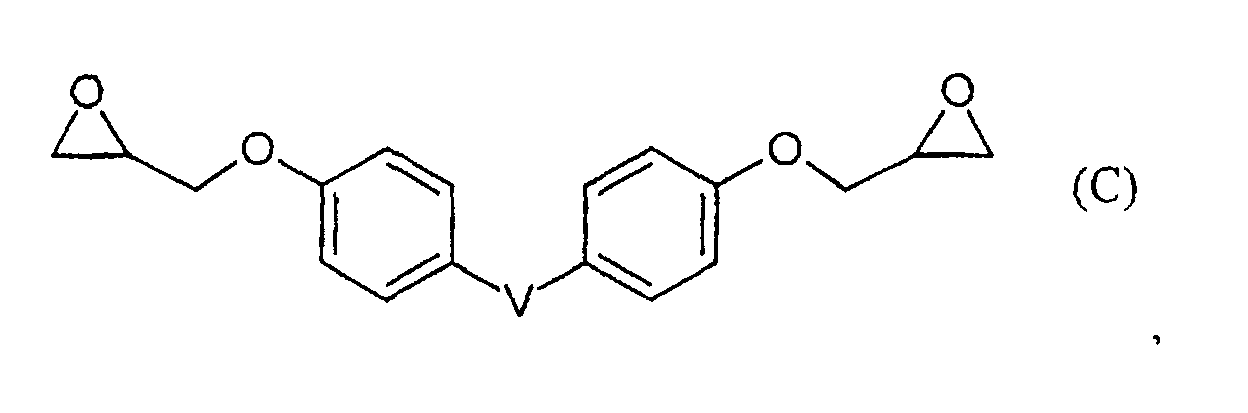
- V
- für eine Brücke steht, die ebenfalls Epoxi-Gruppen tragen kann, und die
aminische Komponente ein primäres oder sekundäres aliphatisches, cycloaliphatisches,
aromatisches, araliphatisches oder heterocyclisches, mindestens
bifunktionelles Amin ist
und die Lewis-Säure-Verbindung, die in verkappter Form vorliegt, ein Nichtmetallhalogenid ist und die Brønsted-Säure-Verbindung, die in verkappter Form vorliegt, eine starke Protonensäure ist, die sich von Nichtmetallhalogeniden ableitet.

- V
- für eine Brücke steht, die ebenfalls Epoxi-Gruppen tragen kann,

- n
- für eine ganze Zahl von 0 bis 20, vorzugsweise 0 bis 10 steht und
- R101
- für Wasserstoff oder Methyl steht und

- R102
- für Wasserstoff oder Methyl steht.


- m und p
- unabhängig voneinander für eine ganze Zahl von 0 bis 20, vorzugsweise 0 bis 5 stehen und
- R100
- für Wasserstoff oder Methyl steht

- q
- für eine ganze Zahl von 2 bis 10, vorzugsweise 2 bis 4 steht, oder
um Polyaminoimidazolin oder
um ein aromatisches Amin wie Bis-(4-aminophenyl)methan oder Bis-(4-aminophenyl)sulfon
und bei der verkappten Lewis-Säure-Verbindung um ein Addukt von Bortrifluorid an sekundäre Amine wie BF3 -NH(CH3)C2H5 oder um ein Diazoniumsalz wie Ar-N2 +BF4 - oder bei der verkappten Brønsted-Säure-Verbindung um ein Iodoniumsalz wie (Ar)2I+BF4 - oder (Ar)2I+PF6 - oder um ein Sulfoniumsalz wie (Ar)3S+BF4 - oder (Ar)3S+PF6 -,
worin
- Ar
- für einen aromatischen Rest, vorzugsweise Phenyl, steht.
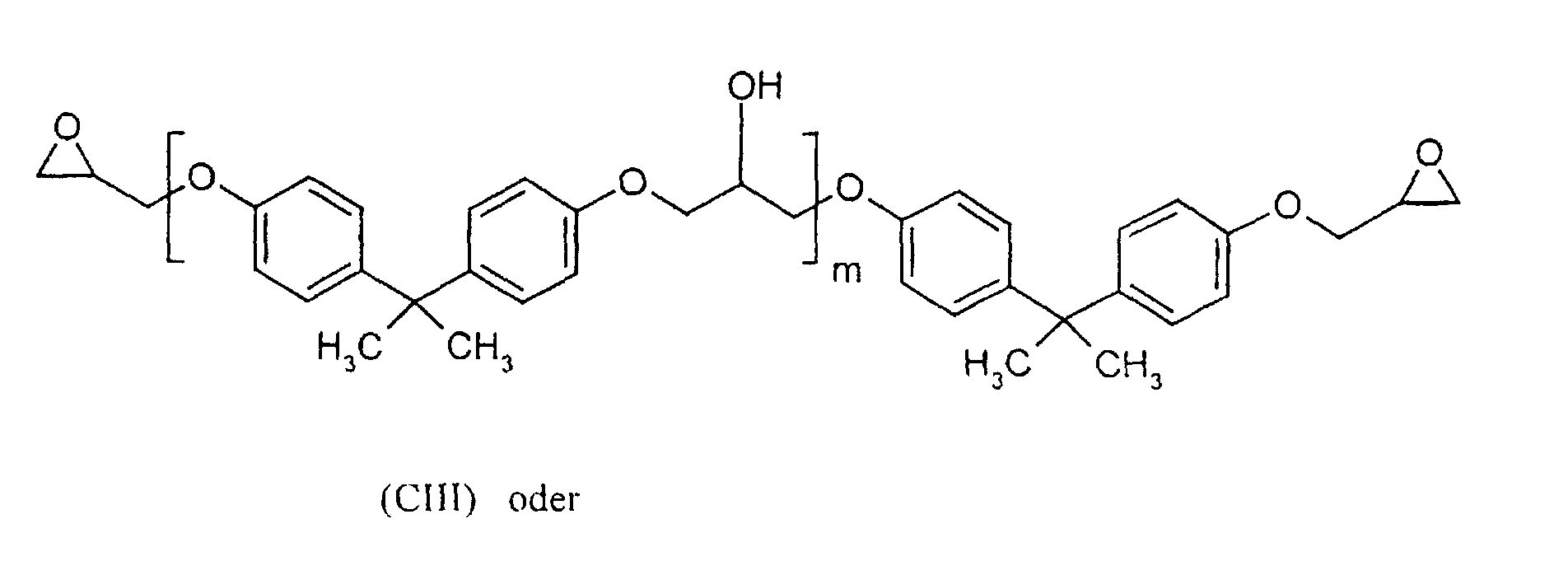

- m und p
- unabhängig voneinander für eine ganze Zahl von 0 bis 20, vorzugsweise 0 bis 5 stehen und
- R100
- für Wasserstoff oder Methyl steht,
worin
- Ar
- für einen aromatischen Rest, vorzugsweise Phenyl, steht.

- n
- für eine ganze Zahl von 0 bis 20, vorzugsweise 5 bis 15 steht und
- R101
- für Wasserstoff oder Methyl steht und

- R102
- für Wasserstoff oder Methyl steht.
worin
- m
- für 2 bis 5 steht,
worin
- q
- für 2 bis 4 steht,
worin
- m
- für 2 bis 5 steht,
worin
- Ar
- für einen aromatischen Rest, vorzugsweise Phenyl, steht.
worin
- n
- für 5 bis 10 steht und
- R101
- für Wasserstoff steht und
worin
- R102
- für Wasserstoff steht.
worin
- m
- für 2 bis 5 steht,
worin
- q
- für 2 bis 4 steht,
worin
- m
- für 2 bis 5 steht,
worin
- n
- für 5 bis 15 steht und
- R101
- für Wasserstoff steht und
worin
- R102
- für Wasserstoff steht

- Y und Z
- unabhängig voneinander für einen Rest OX2 oder RED1 stehen,
wobei aber mindestens ein Y für OX2 und mindestens ein Z für RED1
steht,
wobei- OX2
- für den Rest eines reversibel elektrochemisch reduzierbaren Redoxsystems steht, und
- RED1
- für den Rest eines reversibel elektrochemisch oxidierbaren Redoxsystems steht,
- B
- für ein Brückenglied steht,
- c
- für eine ganze Zahl von 0 bis 1000 steht, bevorzugt 0 bis 100, besonders bevorzugt 0 bis 5 steht, und
- a und b
- unabhängig voneinander für eine ganze Zahl von 0 bis 100 stehen, vorzugsweise für eine ganze Zahl von 0 bis 10 stehen, besonders bevorzugt für 0 bis 3 stehen.
Y für OX2 und Z für RED1 steht und Y und Z in ihrer Reihenfolge alternieren.
OX2, RED1 und B die oben angegebene Bedeutung haben, und
- d
- für eine ganze Zahl von 1 bis 5 steht.
worin
- OX2
- für den Rest einer kathodisch reduzierbaren Substanz steht, die im cyclischen Voltammogramm, aufgenommen in einem inerten Lösungsmittel bei Raumtemperatur, wenigstens zwei chemisch reversible Reduktionswellen zeigt, wobei die erste dieser Reduktionswellen zu einer Zunahme der Extinktion bei wenigstens einer Wellenlänge im sichtbaren Bereich des elektromagnetischen Spektrums führt,
- RED1
- für den Rest der anodisch reversibel oxidierbaren Substanz steht, die im cyclischen Voltammogramm, aufgenommen in einem inerten Lösungsmittel bei Raumtemperatur, wenigstens zwei chemisch reversible Oxidationswellen zeigt, wobei die erste dieser Oxidationswellen zu einer Zunahme der Extinktion bei wenigstens einer Wellenlänge im sichtbaren Bereich des elektromagnetischen Spektrums führt, und
- B
- für ein Brückenglied steht.
- OX2
- für einen Rest der Formeln
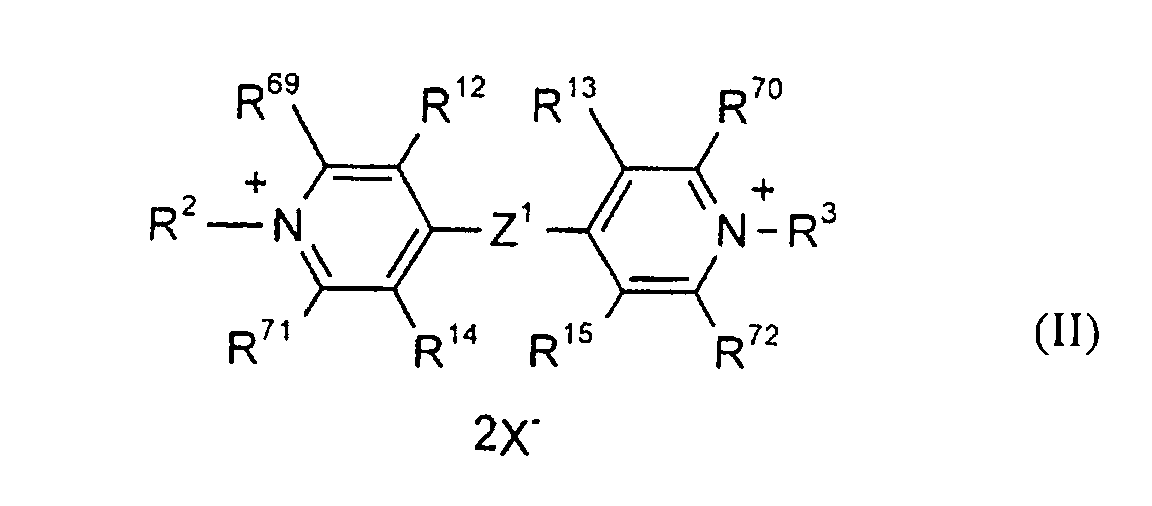
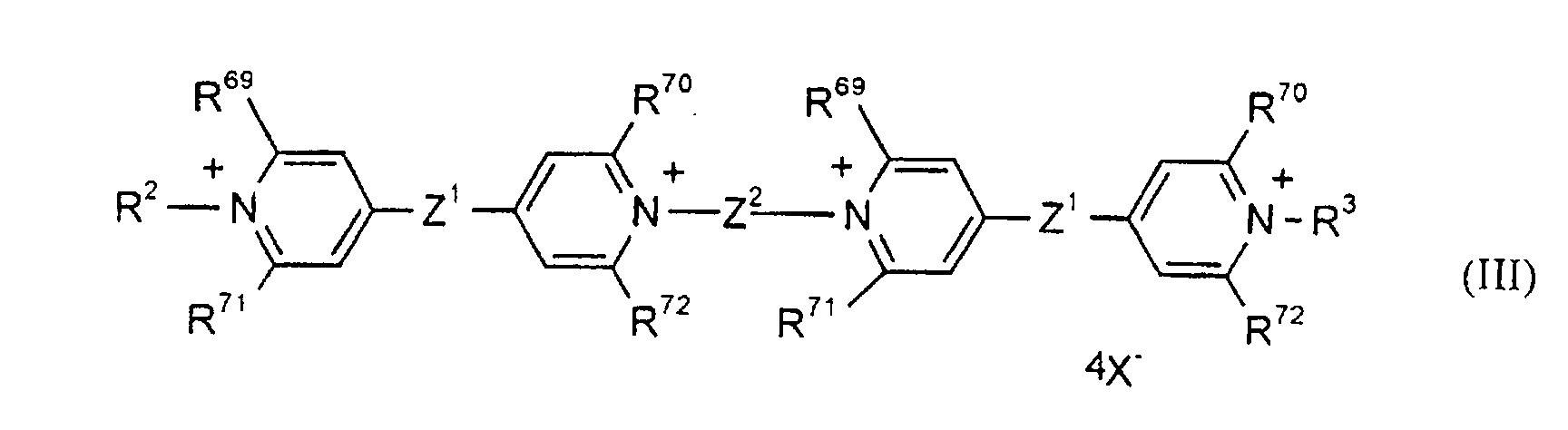
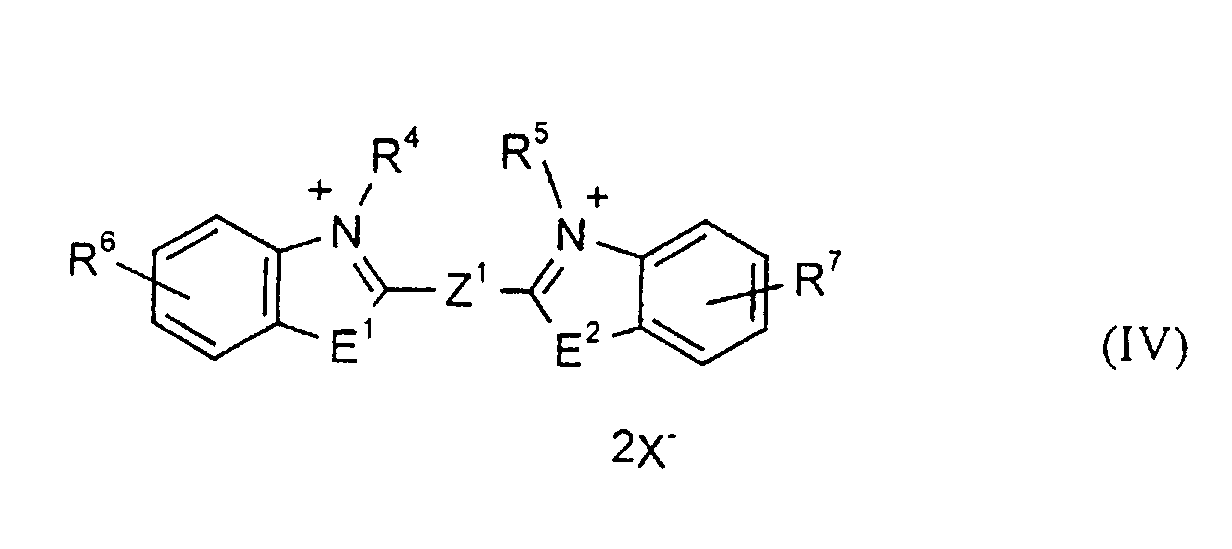


- R2 bis R5, R8 , R9, R16 bis R19
- unabhängig voneinander C1- bis C18-Alkyl, C2- bis C12-Alkenyl, C3- bis C7-Cycloalkyl, C7- bis C15-Aralkyl oder C6- bis C10-Aryl bedeuten oder
- R4 und R5 oder R8 und R9
- gemeinsam eine -(CH2)2- oder -(CH)3-Brücke bilden,
- R6, R7 und R22 bis R25
- unabhängig voneinander Wasserstoff, C1- bis C4-Alkyl, C1- bis C4-Alkoxy, Halogen, Cyano, Nitro oder C1- bis C4-Alkoxycarbonyl bedeuten oder
- R22 und R23 und/oder R24 und R25
- eine -CH=CH-CH=CH-Brücke bilden,
- R10 und R11; R12 und R13; R14 und R15
- unabhängig voneinander Wasserstoff oder paarweise eine -(CH2)2-, -(CH2)3- oder -CH=CH-Brücke bedeuten,
- R20 und R21
- unabhängig voneinander O, N-CN, C(CN)2 oder N-C6- bis C10-Aryl bedeuten,
- R26
- Wasserstoff, C1- bis C4-Alkyl, C1- bis C4-Alkoxy, Halogen, Cyano. Nitro, C1- bis C4-Alkoxycarbonyl oder C6- bis C10-Aryl bedeutet,
- R69 bis R74
- unabhängig voneinander Wasserstoff oder C1-C6-Alkyl bedeuten, oder
- R69; R12
- und/oder R70; R13 eine -CH=CH-CH=CH-Brücke bilden,
- E1 und E2
- unabhängig voneinander O, S, NR1 oder C(CH3)2 bedeuten oder
- E1 und E2
- gemeinsam eine -N-(CH2)2-N-Brücke bilden,
- R1
- C1- bis C18-Alkyl, C2- bis C12-Alkenyl, C4- bis C7-Cycloalkyl, C7- bis C15-Aralkyl, C6- bis C10-Aryl bedeutet,
- Z1
- eine direkte Bindung, -CH=CH-, -C(CH3)=CH-, -C(CN)=CH-, -CCl=CCl-, -C(OH)=CH-, -CCl=CH-, -C=C-, -CH=N-N=CH-, -C(CH3)=N-N-C(CH3)- oder -CCl=N-N=CCl- bedeutet,
- Z2
- -(CH2)r- oder -CH2-C6H4-CH2- bedeutet,
- r
- eine ganze Zahl von 1 bis 10 bedeutet,
- X-
- ein unter den Bedingungen redox-inertes Anion bedeutet,
- RED1
- für einen der folgenden Reste
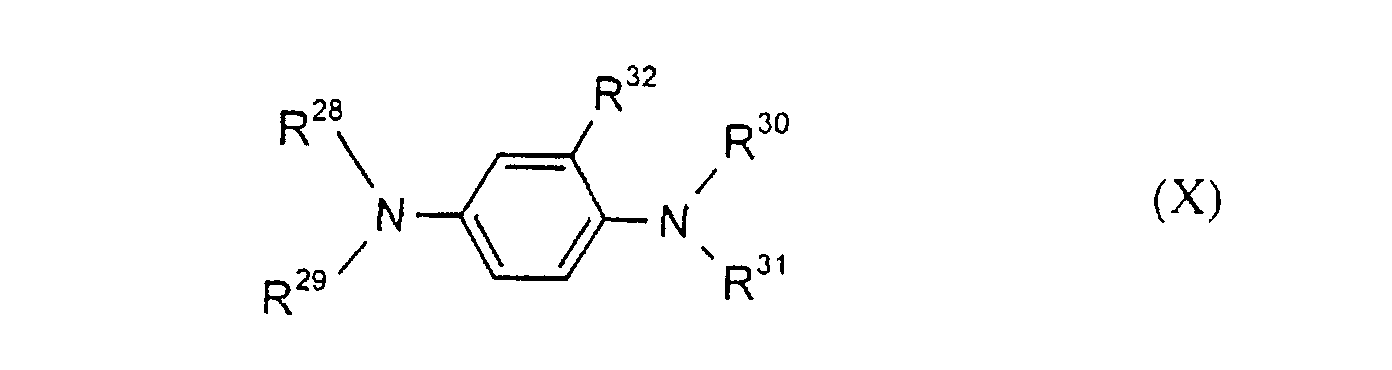

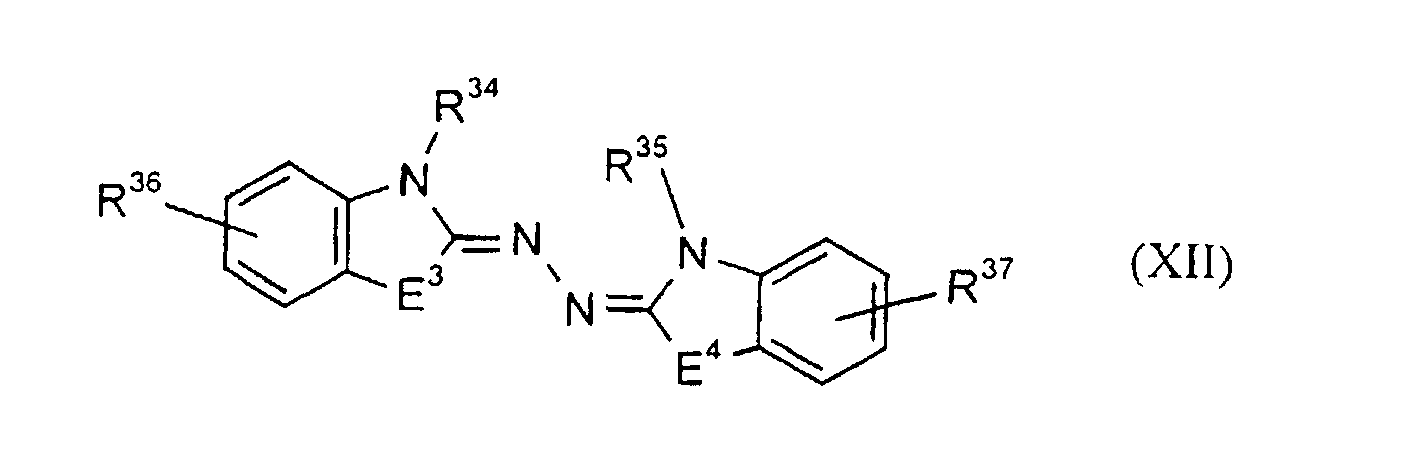


- R28 bis R31, R34, R35, R38, R39, R46, R53 und R54
- unabhängig voneinander C1- bis C18-Alkyl, C2- bis C12-Alkenyl, C3- bis C7-Cycloalkyl, C7- bis C15-Aralkyl oder C6- bis C10-Aryl bedeuten, und R46, R53 und R54 zusätzlich Wasserstoff bedeuten,
- R32, R33, R36, R37, R40, R41, R42 bis R45, R47, R48, R49 bis R52 und R55 bis R57
- unabhängig voneinander Wasserstoff, C1- bis C4-Alkyl, C1- bis C4- Alkoxy, Halogen, Cyano, Nitro, C1- bis C4-Alkoxycarbonyl oder C6- bis C10-Aryl bedeuten und R57 und R58 zusätzlich einen gegebenenfalls benzanellierten aromatischen oder quasiaromatischen fünf- oder sechsgliedrigen heterocyclischen Ring bedeuten und R48 zusätzlich NR75R76 bedeutet,
- R49 und R50 und/oder R51 und R52
- eine -(CH2)3-, -(CH2)4-, -(CH2)5- oder -CH=CH-CH=CH-Brücke bilden,
- Z3
- eine direkte Bindung, eine -CH=CH- oder -N=N-Brücke bedeutet,
- =Z4=
- eine direkte Doppelbindung, eine =CH-CH= oder =N-N=-Brücke bedeutet,
- E3 bis E5, E10 und E11
- unabhängig voneinander O, S, NR59 oder C(CH3)2 bedeuten und E5 zusätzlich C = O oder SO2 bedeutet, oder
- E3 und E4
- unabhängig voneinander -CH=CH- bedeuten,
- E6 bis E9
- unabhängig voneinander S, Se oder NR59 bedeuten,
- R59, R75 und R76
- unabhängig voneinander C1- bis C12-Alkyl, C2- bis C8-Alkenyl, C3- bis C7-Cycloalkyl, C7- bis C15-Aralkyl oder C6- bis C10-Aryl bedeuten und R73 zusätzlich Wasserstoff bedeutet, oder
- R75 und R76
- in der Bedeutung von NR75R76 gemeinsam mit dem N-Atom, an das sie gebunden sind, einen fünf- oder sechsgliedrigen, gesättigten Ring bilden, der weitere Heteroatome enthalten kann,
- R61 bis R68
- unabhängig voneinander Wasserstoff, C1- bis C6-Alkyl, C1- bis C4-Alkoxy, Cyano, C1 - bis C4-Alkoxycarbonyl oder C6- bis C10-Aryl bedeuten, oder
- R61; R62 und R67; R68
- unabhängig voneinander gemeinsam eine -(CH2)3-, -(CH2)4- oder -CH=CH-CH=CH-Brücke bilden,
- v
- eine ganze Zahl zwischen 0 und 10 bedeutet,
- B
- für ein Brückenglied der Formeln -(CH2)n- oder -[Y1 s(CH2)m-Y2]o-(CH2)p-Y3 q- steht, welche jeweils gegebenenfalls durch C1-C4-Alkyl, C1- bis C4-Alkoxy, Halogen oder Phenyl substituiert sind.
- Y1 bis Y3
- unabhängig voneinander für O, S, NR60, COO, CONH, NHCONH, Cyclopentandiyl, Cyclohexandiyl, Phenylen oder Naphthylen stehen,
- R60
- C1- bis C6-Alkyl, C2- bis C6-Alkenyl, C4- bis C7-Cycloalkyl, C7- bis C15-Aralkyl oder C6- bis C10-Aryl bedeutet,
- n
- eine ganze Zahl von 1 bis 12 bedeutet,
- m und p
- unabhängig voneinander eine ganze Zahl von 0 bis 8 bedeuten,
- o
- eine ganze Zahl von 0 bis 6 bedeutet und
- q und s
- unabhängig voneinander 0 oder 1 bedeuten.
worin
- OX2
- für einen Rest der Formeln (II), (III), (IV) oder (V) steht,
- R2, R3, R4, R5, R8 und R9
- unabhängig voneinander für C1- bis C12-Alkyl, C2- bis C8-Alkenyl, C5- bis C7-Cycloalkyl, C7- bis C15-Aralkyl oder C6- bis C10-Aryl stehen,
- R6 und R7
- unabhängig voneinander für Wasserstoff, Methyl, Ethyl, Methoxy, Ethoxy, Fluor, Chlor, Brom, Cyano, Nitro, Methoxycarbonyl oder Ethoxycarbonyl stehen,
- R10, R11; R12, R13 und R14, R15
- unabhängig voneinander für Wasserstoff oder, falls Z1 eine direkte Bindung bedeutet, jeweils gemeinsam für eine -(CH2)2-, -(CH2)3- oder -CH=CH-Brücke stehen,
- R4, R5 und R8, R9
- unabhängig voneinander paarweise gemeinsam für -(CH2)2- oder -(CH3)3-Brücke stehen, falls Z1 eine direkte Bindung bedeutet,
- R69 bis R74
- unabhängig voneinander Wasserstoff oder C1-C4-Alkyl bedeuten,
- E1 und E2
- gleich sind und für O, S, NR1 oder C(CH3)2 stehen oder gemeinsam eine -N-(CH2)2-N-Brücke bilden,
- R1
- für C1- bis C12-Alkyl, C2- bis C4-Alkenyl, C5- bis C7-Cycloalkyl, C7- bis C15-Aralkyl oder C6- bis C10-Aryl steht,
- Z1
- für eine direkte Bindung, -CH=CH-, -C(CH3)=CH-, -C(CN)=CH-, -C=C- oder -CH=N-N=CH- steht,
- Z2
- für -(CH)r- oder -CH2-C6H4-CH2- steht,
- r
- für eine ganze Zahl zwischen 1 und 6 steht,
- X-
- für ein unter den Bedingungen redox-inertes, farbloses Anion steht,
- RED1
- für einen Rest der Formeln (X), (XI), (XII), (XIII), (XVI), (XVII), (XVIII) oder (XX) steht,
- R28 bis R31, R34, R35, R38, R39, R46, R53 und R54
- unabhängig voneinander C1bis C12-Alkyl, C2- bis C8-Alkenyl, C5- bis C7-Cycloalkyl, C7- bis C15-Aralkyl oder C6- bis C10-Aryl bedeuten und
- R46, R53 und R54
- zusätzlich Wasserstoff bedeuten,
- R32, R33, R36, R37, R40, R41, R47 bis R52, R55 und R56
- unabhängig voneinander Wasserstoff, Methyl, Ethyl, Methoxy, Ethoxy, Fluor, Chlor, Brom, Cyan, Nitro, Methoxycarbonyl, Ethoxycarbonyl oder Phenyl bedeuten und
- R57 und R58
- zusätzlich 2- oder 4-Pyridyl bedeuten und
- R48
- zusätzlich NR75R76 bedeutet,
- Z3
- eine direkte Bindung, eine -CH=CH- oder -N=N-Brücke bedeutet,
- =Z4=
- eine direkte Doppelbindung, eine =CH-CH= oder =N-N=-Brücke bedeutet,
- E3 bis E5, E10 und E11
- unabhängig voneinander O, S, NR59 oder C(CH3)2 bedeuten, E3 und E4 aber die gleiche Bedeutung haben,
- E6 bis E9
- untereinander gleich sind und S, Se oder NR59 bedeuten und
- E5
- zusätzlich C = O bedeutet,
- E6
- für NR59 steht, wobei R59 eine direkte Bindung zur Brücke B bedeutet und
- E7 bis E9
- die oben angegebene Bedeutung besitzen, aber untereinander nicht gleich sein müssen,
- R59, R75 und R76
- unabhängig voneinander C1- bis C12-Alkyl, C2- bis C8-Alkenyl, C5- bis C7-Cycloalkyl, C7- bis C15-Aralkyl oder C6- bis C10-Aryl bedeuten, und R73 zusätzlich Wasserstoff bedeutet oder
- R75 und R76
- in der Bedeutung NR75R76 gemeinsam mit dem N-Atom, an das sie gebunden sind, Pyrrolidino, Piperidino oder Morpholino bedeuten,
- R61, R62 und R67, R68
- unabhängig voneinander für Wasserstoff, C1- bis C4-Alkyl, Methoxycarbonyl, Ethoxycarbonyl oder Phenyl oder paarweise gemeinsam für eine -(CH2)3- oder -(CH2)4-Brücke stehen,
- R63 bis R66
- für Wasserstoff stehen und
- v
- für eine ganze Zahl von 1 bis 6 steht,
- B
- für ein Brückenglied der Formeln -(CH2)n-, -(CH2)m-O-(CH2)p-, -(CH)m-NR60-(CH2)p-, -(CH2)m-C6H4-(CH2)p-, -[O-(CH2)p]o-O-, -[NR60-(CH2)p]o-NR60-, -[C6H4-(CH2)p]o-C6H4-, -(CH2)m-OCO-C6H4-COO-(CH2)p-, -(CH2)m-NHCO-C6H4-CONH-(CH2)p-, -(CH2)m-NHCONH-C6H4-NHCONH-(CH2)p-, -(CH2)m-OCO-(CH2)t-COO-(CH2)-, -(CH2)m-NHCO-(CH2)t-CONH-(CH)p-, -(CH2)m-NHCONH-(CH2)t-NHCONH-(CH2)p- steht,
- R60
- für Methyl, Ethyl, Benzyl oder Phenyl steht,
- n
- für eine ganze Zahl von 1 bis 10 steht,
- m und p
- unabhängig voneinander für eine ganze Zahl von 0 bis 4 stehen,
- o
- für eine ganze Zahl von 0 bis 2 steht und
- t
- für eine ganze Zahl von 1 bis 6 steht.
worin
- OX2
- für einen Rest der Formeln (II), (IV) oder (V) steht,
- R2, R4 und R8
- für eine direkte Bindung zum Brückenglied B stehen,
- R3, R5 und R9
- unabhängig voneinander für Methyl, Ethyl, Propyl, Butyl, Pentyl, Hexyl, Heptyl, Octyl, Benzyl oder Phenyl stehen, oder im Falle der Formeln Ic oder Id ebenfalls für eine direkte Bindung zum Brückenglied B stehen,
- R6 und R7
- gleich sind und für Wasserstoff, Methyl, Methoxy, Chlor, Cyano oder Methoxycarbonyl stehen,
- R10, R11; R12, R13 und R14, R15
- unabhängig voneinander für Wasserstoff oder, falls Z1 eine direkte Bindung bedeutet, jeweils paarweise zusammen für eine -CH=CH-Brücke stehen,
- R69 bis R72
- gleich sind und Wasserstoff, Methyl oder Ethyl bedeuten,
- R73 und R74
- Wasserstoff bedeuten,
- E1 und E2
- gleich sind und für O oder S stehen,
- Z1
- für eine direkte Bindung oder -CH=CH- steht,
- X-
- für ein unter den Bedingungen redox-inertes, farbloses Anion steht,
- RED1
- für einen Rest der Formeln (X), (XII), (XIII), (XVI) oder (XVII) steht,
- R28, R34, R38, R46 und R49
- für eine direkte Bindung zum Brückenglied B stehen,
- R29 bis R31, R35 und R39
- unabhängig voneinander für Methyl, Ethyl, Propyl, Butyl, Pentyl, Hexyl, Heptyl, Octyl, Benzyl oder Phenyl stehen, oder im Falle der Formeln Ib oder Id R30, R35 und R39 ebenfalls für die direkte Bindung zum Brückenglied B stehen,
- R32, R47 und R48
- für Wasserstoff stehen,
- R36 R37, R40, R41 und R50 bis R52
- unabhängig voneinander für Wasserstoff, Methyl, Methoxy, Chlor, Cyan, Methoxycarbonyl oder Phenyl stehen, oder im Falle der Formeln Ib oder Id R51 ebenfalls für eine direkte Bindung zum Brückenglied B steht,
- Z3
- für eine direkte Bindung, eine -CH=CH- oder -N=N-Brücke steht,
- =Z4=
- für eine direkte Doppelbindung, eine =CH-CH= oder =N-N=-Brücke steht,
- E3 bis E5
- unabhängig voneinander für O, S oder NR59 stehen, E3 und E4 aber die gleiche Bedeutung haben,
- E6 bis E9
- untereinander gleich sind und für S, Se oder NR59 stehen,
- R59
- für Methyl, Ethyl, Propyl, Butyl, Pentyl, Hexyl, Heptyl, Octyl, Benzyl oder Phenyl steht, oder im Falle der Formel XVI in Ib oder Id ebenfalls für eine direkte Bindung zum Brückenglied B steht,
- B
- für ein Brückenglied der Formeln -(CH2)n-, -(CH2)m-O-(CH2)p-, -(CH2)m-NR60-(CH2)p-, -(CH2)m-C6H4-(CH2)p-, -O-(CH2)p-O-, -NR60-(CH2)p-NR60-, -(CH2)m-OCO-C6H4-COO-(CH2)p-, -(CH2)m-NHCO-C6H4-CONH-(CH2)p-, -(CH2)m-NHCONH-C6H4-NHCONH-(CH2)p-, -(CH2)m-OCO-(CH2)t-COO-(CH2)p-,-(CH2)m-NHCO-(CH2)t-CONH- (CH2)p-, -(CH2)m-NHCONH-(CH2)t-NHCONH-(CH2)p- steht,
- R60
- für Methyl steht,
- n
- für eine ganze Zahl von 1 bis 10 steht,
- m und p
- gleich sind und für eine ganze Zahl von 0 bis 2 stehen und
- t
- für eine ganze Zahl von 1 bis 6 steht.


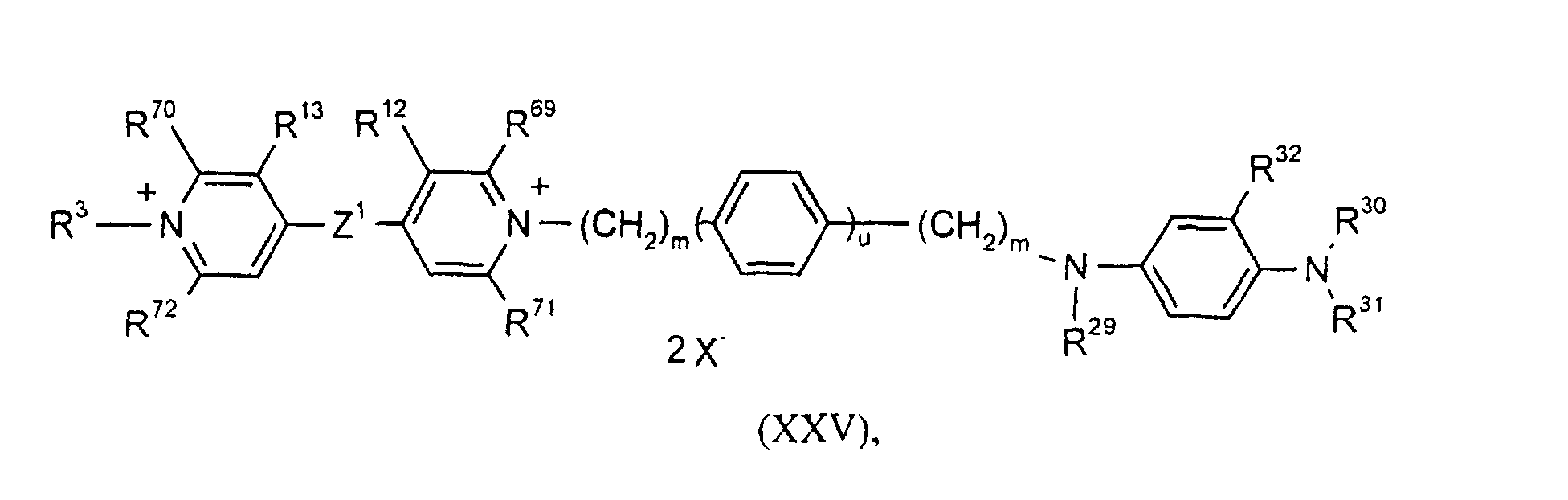


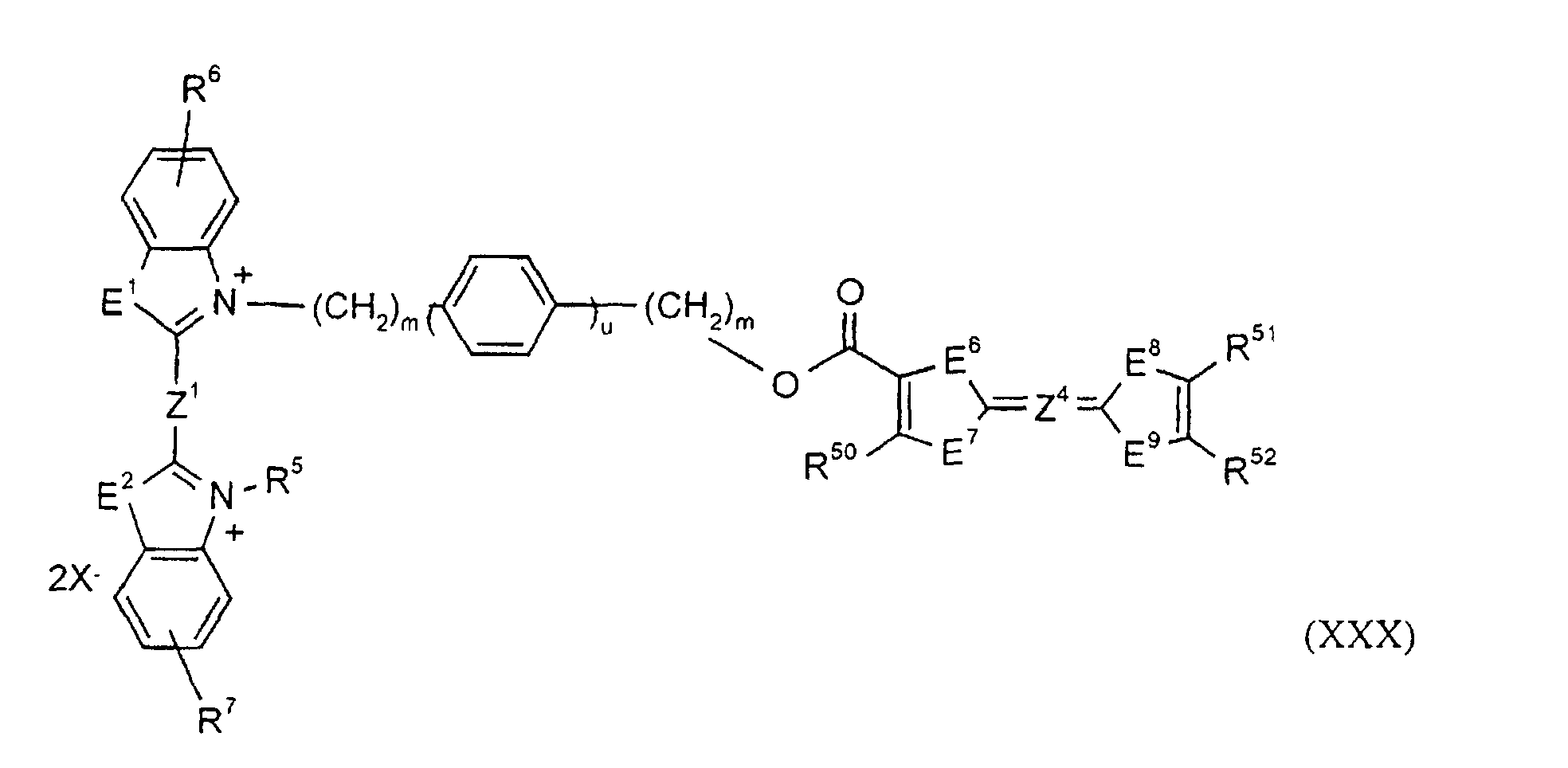

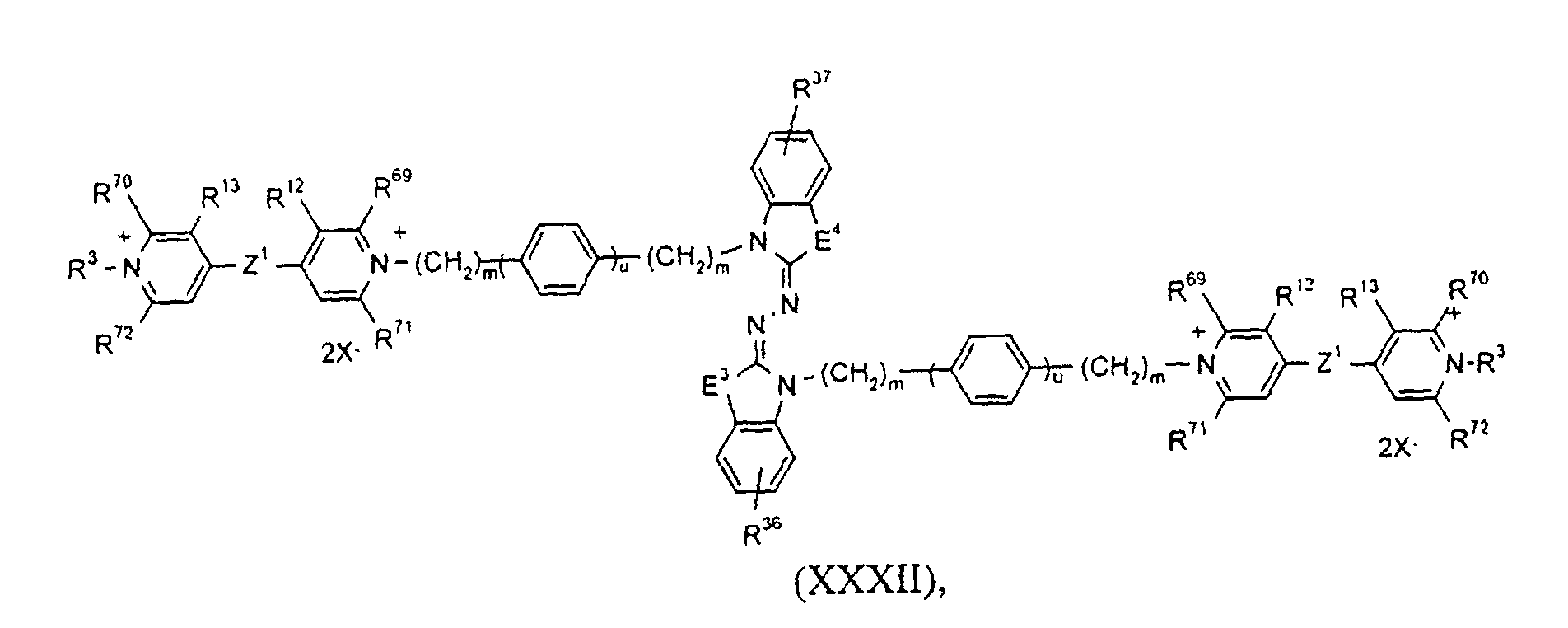


- R3, R5, R35 und R39
- unabhängig voneinander für Methyl, Ethyl, Propyl, Butyl, Pentyl. Hexyl oder Benzyl stehen,
- R6, R7 und R36, R37
- paarweise gleich sind und für Wasserstoff, Methyl, Methoxy, Chlor, Cyano oder Methoxycarbonyl stehen,
- R12 und R13
- für Wasserstoff oder, wenn Z1 eine direkte Bindung bedeutet, gemeinsam für eine CH=CH-Brücke stehen,
- R69 bis R72
- gleich sind und für Wasserstoff oder Methyl stehen,
- E1 und R2
- gleich sind und für O oder S stehen,
- Z1
- für eine direkte Bindung oder -CH=CH- steht,
- R32, R47 and R48
- für Wasserstoff stehen,
- E3 bis E5
- unabhängig voneinander für O, S oder NR59 stehen, wobei E3 und E4 aber gleich sind,
- R29 bis R31 und R59
- unabhängig voneinander für Methyl, Ethyl, Propyl, Butyl, Pentyl, Hexyl oder Benzyl stehen, wobei R29 bis R31 vorzugsweise gleich sind,
- R40 und R41
- gleich sind und für Wasserstoff, Methyl, Ethyl, Propyl, Butyl oder Phenyl stehen,
- Z3
- für eine direkte Bindung, -CH=CH- oder -N=N- steht,
- R50 bis R52
- unabhängig voneinander für Wasserstoff, Methyl, Methoxy, Chlor, Cyano, Methoxycarbonyl, Ethoxycarbonyl oder Phenyl stehen, vorzugsweise jedoch gleich sind,
- E6 bis E9
- untereinander gleich sind und für S, Se oder NR59 stehen,
- Z4
- für eine direkte Doppelbindung, eine =CH-CH= oder =N-N=-Brücke steht,
- m
- für eine ganze Zahl von 1 bis 5 steht,
- u
- für 0 oder 1 steht und
- X-
- für ein unter den Bedingungen redox-inertes, farbloses Anion steht.
- Typ 1:
- vollflächige elektrochrome Vorrichtung, beispielsweise für Fensterscheiben.
- Typ 2:
- elektrisch abblendbare verspiegelte Vorrichtungen, beispielsweise Autospiegel.
- Typ 3:
- elektrochrome Anzeigevorrichtungen, beispielsweise Segment- oder Matrixanzeigen.
- Typ 1:
- aus dem Bereich Lichtschutz/Lichtfilter: Fensterscheiben für z.B. Gebäude,
Straßenfahrzeuge, Flugzeuge, Eisenbahnen, Schiffe, Dachverglasungen,
Autosonnendächer, Verglasung von Gewächshäusern und Wintergärten,
Lichtfilter beliebiger Art.
aus dem Bereich Sicherheit/Geheimhaltung: Trennscheiben für z.B. Raumteiler in z.B. Büros, Straßenfahrzeugen, Flugzeugen, Eisenbahnen, Sichtschutzscheiben an z.B. Bankschaltern, Türverglasungen, Scheiben für z.B. Motorrad- oder Pilotenhelme.
aus dem Bereich Design: Verglasung von Backöfen, Mikrowellengeräten, anderen Haushaltsgeräten, Möbeln. - Typ 2:
- Spiegel jeglicher Art, z.B. Rückspiegel, für z.B. Straßenfahrzeuge, Eisenbahnen, insbesondere plane, sphärische, asphärische Spiegel und Kombinationen daraus, z.B. sphärisch/asphärisch, Spiegelverglasung in Möbeln.
- Typ 3:
- Anzeigenvorrichtungen jeglicher Art, z.B. Segment- oder Matrixanzeigen, z.B. für Uhren, Computer, Elektrogeräte, Elektronikgeräte wie Radios, Verstärker, Fernseher, CD-Player etc., Zielanzeige in Bussen und Zügen, Abfahrts- oder Abflugsanzeigen in Bahnhöfen und Flughäfen, Flachbildschirme, alle Anwendungen, die unter Typ 1 und 2 genannt sind, die mindestens eine schaltbare, statische oder variable Anzeigevorrichtung enthalten, z.B. Trennscheiben, die Anzeigen wie z.B. "Bitte nicht stören", "Schalter nicht besetzt" enthalten, z.B. Auto-Spiegel, die Anzeigen beliebiger Art enthalten wie z.B. Anzeige der Temperatur, Störungen im Fahrzeug (z.B. Öltemperatur, offene Türen), Zeit, Himmelsrichtung etc.


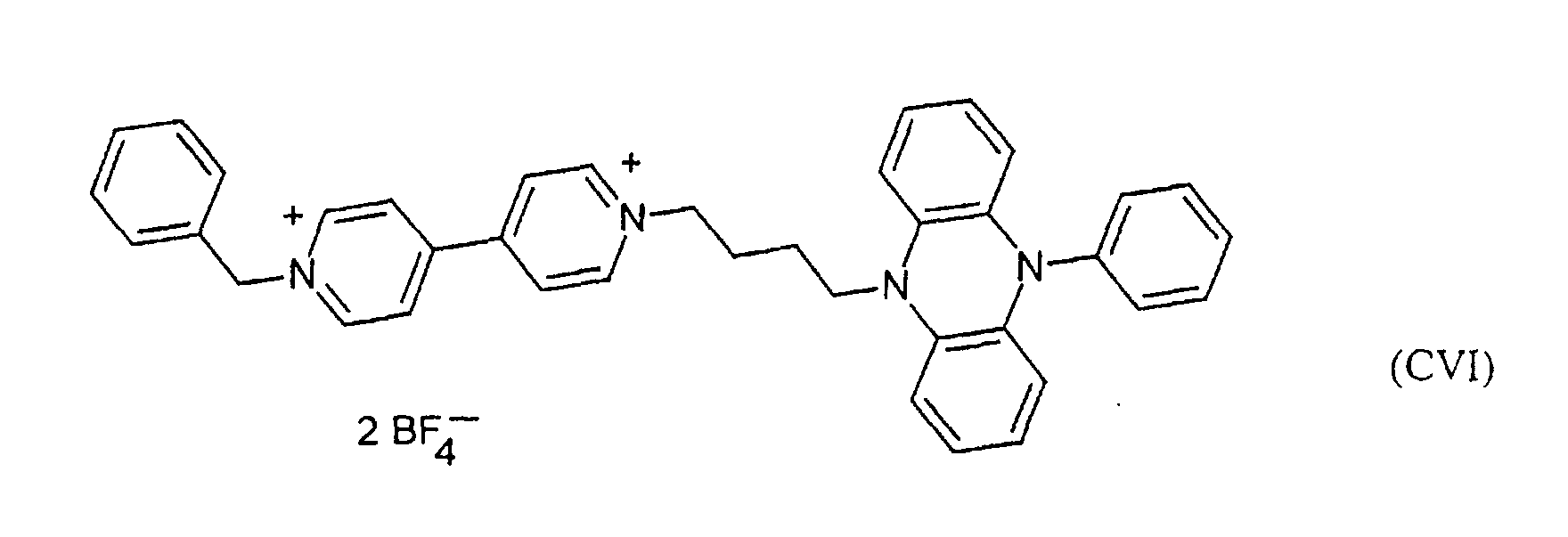
| Zelle | 1 h | 3 h | ||
| Farbe | Dichtigkeit | Farbe | Dichtigkeit | |
| Beispiel 1 | farblos | dicht | farblos | dicht |
| Beispiel 2 | farblos | dicht | farblos | dicht |
| Beispiel 3 | farblos | dicht | farblos | dicht |
| Beispiel 4 | farblos | dicht | farblos | dicht |
| Beispiel 6 | blau | ausgelaufen | - | - |
| Beispiel 7 | blau | dicht | blau | ausgelaufen |
Bei 15°C wurden in einer Portion 30,2 ml 1,4-Dibrombutan dazugegeben. Die Temperatur stieg dabei bis 38°C an. Nach 6 h bei Raumtemperatur wurde mit 200 ml Wasser versetzt und der pH auf 7,0 gestellt. Die organische Phase wurde abgetrennt, dreimal mit je 100 ml Wasser gewaschen und im Vakuum eingeengt. Schließlich wurde überschüssiges 1,4-Dibrombutan bei einem Druck von 0,2 mbar abdestilliert. Der ölige Rückstand wurde in 400 ml Ethanol heiß gelöst. Das nach dem Erkalten ausgefalfene Produkt wurde abgesaugt, mit Ethanol und Hexan gewaschen und getrocknet. Man erhielt 8,0 g (41 % d. Th.) blaßgelbes Pulver des 9.10-Dihydrophenazins der Formel


In einer elektrochromen Vorrichtung gemäß Beispiel 1 bis 5 wurde eine grünlich-blaue Färbung mit max = 466 und 607 nm erzielt
Claims (14)
- Elektrochrome Vorrichtung, bestehend aus einem Paar transparent und leitfähig beschichteter Glas- oder Kunststoffplatten (1,4;11,17), von denen eine verspiegelt sein kann und von denen bei einer der beiden Platten oder auch bei beiden die leitfähige Schicht in getrennte, einzeln elektrisch kontaktierte Segmente (14), aufgeteilt sein kann, die über eine Klebstoffraupe (2;15), in die Abstandshalter eingebettet sein können, auf den Seiten ihrer leitfähigen Beschichtung zusammengefügt sind, und bei der das Volumen gebildet aus den beiden Platten und der Klebstoffraupe mit einer elektrochromen Flüssigkeit gefüllt ist und bei der die zum Einfüllen der elektrochromen Flüssigkeit nötige(n) Befüllöffnung oder Befüllöffnungen (3;16) nach dem Befüllen mit einem Klebstoff verschlossen ist, dadurch gekennzeichnet, daß die Klebstoffraupe zum Bau der elektrochromen Vorrichtung aus einem thermisch oder photochemisch oder nach photochemischer Initiierung thermisch gehärteten Epoxi-Kleber besteht und daß der Klebstoff zum Verschluß ein photochemisch gehärteter Acrylatkleber oder ein photochemisch oder nach photochemischer Initiierung bei Raumtemperatur gehärteter Epoxikleber ist.
- Elektrochrome Vorrichtung nach Anspruch 1, wobei der Epoxi-Kleber ein Einkomponentenkleber ist.
- Elektrochrome Vorrichtung nach Anspruch 1, wobei der Epoxi-Kleber eine epoxidische Verbindung, eine aminische Verbindung und eine verkappte Lewis-Säure oder eine verkappte Brøansted-Säure enthält, die unter Wärme- oder Lichteinwirkung eine Lewis- oder Brønsted-Säure- oder Lewis- oder Brønsted-Base-Verbindung freisetzt.
- Elektrochrome Vorrichtung nach Anspruch 3, wobei im Epoxi-Kleber die epoxidische Komponente ein Epoxid der Formelenthält, worin

- V
- für eine Brücke steht, die ebenfalls Epoxigruppen tragen kann
und die aminische Komponente ein primäres oder sekundäres aliphatisches,
cycloaliphatisches, aromatisches, araliphatisches oder heterocyclisches,
mindestens bifunktionelles Amin ist
und die Lewis-Säure-Verbindung, die in verkappter Form vorliegt, ein Nichtmetallhalogenid ist und die Brønsted-Säure-Verbindung, die in verkappter Form vorliegt, eine starke Protonensäure ist, die sich von Nichtmetallhalogeniden ableitet.
- Elektrochrome Vorrichtung nach Anspruch 1, wobei der Epoxi-Kleber für die Klebstoffraupe Abstandshalter enthält.
- Elektrochrome Vorrichtung nach Anspruch 1, wobei der Epoxi-Kleber für die Klebstoffraupe Abstandshalter mit einem Durchmesser von 0,005 bis 2 mm aus der Gruppe der Glaskugeln, Kunststoffkugeln, Sande und Siliciumcarbidkugeln enthält.
- Elektrochrome Vorrichtung nach Anspruch 1, wobei der Acrylatkleber eine Verbindung der Formelworin

- n
- für eine ganze Zahl von 0 bis 20, vorzugsweise 0 bis 10 steht und
- R101
- für Wasserstoff oder Methyl steht,
worin
- R102
- für Wasserstoff oder Methyl steht,
- Elektrochrome Vorrichtung nach Anspruch 1, wobei die Viskosität der Kleber > 10.000 mPas beträgt.
- Elektrochrome Vorrichtung nach Anspruch 1, wobei die elektrochrome Flüssigkeit mindestens eine oxidierbare Substanz RED1, die durch Elektronenabgabe an einer Anode, und mindestens eine reduzierbare Substanz OX2, die durch Elektronenaufnahme an einer Kathode, jeweils unter Zunahme der Extinktion im sichtbaren Bereich des Spektrums von einer schwach gefärbten oder farblosen Form in eine gefärbte Form OX2 bzw. RED1 übergeht, wobei nach Ladungsausgleich jeweils die schwach gefärbte bzw. farblose Form zurückgebildet wird, enthält.
- Elektrochrome Vorrichtung nach Anspruch 9, wobei mindestens eine der in der elektrochromen Lösung enthaltenen Substanzen RED1 und OX2 über eine Brücke kovalent miteinander verknüpft sind.
- Verfahren zur Herstellung der elektrochromen Vorrichtung nach Anspruch 1, wobei auf eine der Platten (1) auf der leitfähig beschichteten Seite ein erfindungsgemäßer Kleber, der Abstandshalter enthält, so aufgebracht wird, daß eine Klebstoffraupe (2) entsteht, die mindestens eine Einfüllöffnung (3) freiläßt, die zweite Platte (4) mit der Seite ihrer leitfähigen Beschichtung auf die Klebstoffraupe gelegt und angedrückt wird, der Kleber thermisch, photochemisch oder photochemisch initiiert thermisch ausgehärtet wird, unter Inertgasatmosphäre die Zelle über die Einfüllöffnungen (3) mit der elektrochromen Flüssigkeit, die selbst sauerstofffrei ist und entweder entgast oder mit dem Inertgas beaufschlagt ist, befüllt wird, und die Öffnungen (3) mit dem für den Zellenverschluß vorgesehenen Klebstoff verschlossen werden, der allein mit Licht oder aber durch Licht initiiert bei Raumtemperatur ausgehärtet wird.
- Verwendung der elektrochromen Vorrichtung nach Anspruch 1 in Form von Fensterscheiben, Trennscheiben, Sichtschutzscheiben.
- Verwendung der elektrochromen Vorrichtung nach Anspruch 1 in Form von Autospiegeln.
- Verwendung der elektrochromen Vorrichtung nach Anspruch 1 in Form von Segment- oder Matrixanzeige.
Applications Claiming Priority (3)
| Application Number | Priority Date | Filing Date | Title |
|---|---|---|---|
| DE19748358A DE19748358A1 (de) | 1997-11-03 | 1997-11-03 | Elektrochromes System |
| DE19748358 | 1997-11-03 | ||
| PCT/EP1998/006721 WO1999023528A2 (de) | 1997-11-03 | 1998-10-22 | Elektrochromes system |
Publications (2)
| Publication Number | Publication Date |
|---|---|
| EP1029256A1 EP1029256A1 (de) | 2000-08-23 |
| EP1029256B1 true EP1029256B1 (de) | 2003-01-15 |
Family
ID=7847345
Family Applications (1)
| Application Number | Title | Priority Date | Filing Date |
|---|---|---|---|
| EP98965138A Expired - Lifetime EP1029256B1 (de) | 1997-11-03 | 1998-10-22 | Elektrochromes system |
Country Status (12)
| Country | Link |
|---|---|
| US (1) | US6404532B1 (de) |
| EP (1) | EP1029256B1 (de) |
| JP (1) | JP2001522066A (de) |
| KR (1) | KR20010031697A (de) |
| AT (1) | ATE231249T1 (de) |
| AU (1) | AU731700B2 (de) |
| BR (1) | BR9813915A (de) |
| CA (1) | CA2308308A1 (de) |
| DE (2) | DE19748358A1 (de) |
| PL (1) | PL188886B1 (de) |
| TW (1) | TW426612B (de) |
| WO (1) | WO1999023528A2 (de) |
Families Citing this family (20)
| Publication number | Priority date | Publication date | Assignee | Title |
|---|---|---|---|---|
| DE19804314A1 (de) * | 1998-02-04 | 1999-08-12 | Bayer Ag | Elektrochromes Display |
| US6606183B2 (en) * | 1999-12-24 | 2003-08-12 | Nippon Oil Corporation | Method for producing a cell for an electrochromic mirror and an electrochromic mirror |
| JP4522519B2 (ja) * | 1999-12-28 | 2010-08-11 | 株式会社ホンダロック | エレクトロクロミックミラー用セルの製造方法及びエレクトロクロミックミラー |
| JP2001183706A (ja) * | 1999-12-24 | 2001-07-06 | Nippon Mitsubishi Oil Corp | エレクトロクロミックミラー用セルの製造方法及びエレクトロクロミックミラー |
| KR101032337B1 (ko) | 2002-12-13 | 2011-05-09 | 가부시키가이샤 한도오따이 에네루기 켄큐쇼 | 발광장치 및 그의 제조방법 |
| US7595011B2 (en) | 2004-07-12 | 2009-09-29 | Ciba Specialty Chemicals Corporation | Stabilized electrochromic media |
| WO2007003508A1 (en) * | 2005-06-30 | 2007-01-11 | Ciba Specialty Chemicals Holding Inc. | Stabilized electrochromic media |
| DE602007012890D1 (de) | 2006-07-28 | 2011-04-14 | Chromogenics Sweden Ab | Kontaktierung von elektrochromen anordnungen |
| US7808692B2 (en) | 2006-07-28 | 2010-10-05 | Chromogenics Sweden Ab | Manufacturing of curved electrochromic devices |
| WO2008013499A1 (en) * | 2006-07-28 | 2008-01-31 | Chromogenics Sweden Ab | Manufacturing of electrochromic devices |
| EP2165238A4 (de) * | 2007-06-01 | 2011-04-06 | Chromogenics Ab | Steuerung einer elektrochromen vorrichtung |
| US8858748B2 (en) * | 2009-08-27 | 2014-10-14 | Guardian Industries Corp. | Electrochromic devices, assemblies incorporating electrochromic devices, and/or methods of making the same |
| US10780017B2 (en) | 2013-03-15 | 2020-09-22 | Somne Llc | Treating sleep apnea with negative pressure |
| US20140261449A1 (en) * | 2013-03-15 | 2014-09-18 | Elwha Llc | Sleep-apnea-treatment system with multiple pressure and sealing surfaces |
| US8867116B1 (en) | 2013-03-15 | 2014-10-21 | Gentex Corporation | Distate electrochromic device |
| US11162688B2 (en) * | 2017-02-06 | 2021-11-02 | Schott Gemtron Corp. | Thermally insulating glass laminates with a plurality of glass spacers submerged in a coating layer to form a sealed cavity of gas molecules |
| CN108443158A (zh) * | 2018-04-26 | 2018-08-24 | 贺吉军 | 空调系统和螺杆压缩机及其润滑油检测装置 |
| EP3844566B1 (de) * | 2018-08-31 | 2025-03-05 | Gentex Corporation | Pulsbreitenmodulation zum löschen einer elektrooptischen vorrichtung |
| WO2020076743A1 (en) * | 2018-10-09 | 2020-04-16 | Gentex Corporation | Conductive bus bar with dark or colored appearance |
| CN111025809A (zh) * | 2019-11-18 | 2020-04-17 | 爱卓智能科技(上海)有限公司 | 电致变色后视镜中方便灌注电致变色液的方法 |
Family Cites Families (7)
| Publication number | Priority date | Publication date | Assignee | Title |
|---|---|---|---|---|
| US3280701A (en) | 1961-09-05 | 1966-10-25 | Donnelly Mirrors Inc | Optically variable one-way mirror |
| US4227779A (en) * | 1979-04-09 | 1980-10-14 | Timex Corporation | Hermetic seal for electrochromic display |
| JPS57177126A (en) * | 1981-04-24 | 1982-10-30 | Hitachi Ltd | Sealant for electrochromic display element |
| US4902108A (en) | 1986-03-31 | 1990-02-20 | Gentex Corporation | Single-compartment, self-erasing, solution-phase electrochromic devices, solutions for use therein, and uses thereof |
| US5151816A (en) | 1989-12-29 | 1992-09-29 | Donnelly Corporation | Method for reducing current leakage and enhancing uv stability in electrochemichromic solutions and devices |
| JPH0348827A (ja) * | 1989-07-18 | 1991-03-01 | Hitachi Maxell Ltd | エレクトロクロミック表示素子 |
| US5239405A (en) * | 1991-09-06 | 1993-08-24 | Donnelly Corporation | Electrochemichromic solutions, processes for preparing and using the same, and devices manufactured with the same |
-
1997
- 1997-11-03 DE DE19748358A patent/DE19748358A1/de not_active Withdrawn
-
1998
- 1998-10-22 US US09/530,216 patent/US6404532B1/en not_active Expired - Fee Related
- 1998-10-22 PL PL98340825A patent/PL188886B1/pl not_active IP Right Cessation
- 1998-10-22 DE DE59806959T patent/DE59806959D1/de not_active Expired - Fee Related
- 1998-10-22 AU AU20476/99A patent/AU731700B2/en not_active Ceased
- 1998-10-22 JP JP2000519328A patent/JP2001522066A/ja active Pending
- 1998-10-22 CA CA002308308A patent/CA2308308A1/en not_active Abandoned
- 1998-10-22 BR BR9813915-0A patent/BR9813915A/pt not_active IP Right Cessation
- 1998-10-22 AT AT98965138T patent/ATE231249T1/de not_active IP Right Cessation
- 1998-10-22 KR KR1020007004760A patent/KR20010031697A/ko not_active Withdrawn
- 1998-10-22 EP EP98965138A patent/EP1029256B1/de not_active Expired - Lifetime
- 1998-10-22 WO PCT/EP1998/006721 patent/WO1999023528A2/de not_active Ceased
- 1998-10-30 TW TW087118012A patent/TW426612B/zh not_active IP Right Cessation
Also Published As
| Publication number | Publication date |
|---|---|
| DE19748358A1 (de) | 1999-05-06 |
| BR9813915A (pt) | 2001-04-03 |
| TW426612B (en) | 2001-03-21 |
| DE59806959D1 (de) | 2003-02-20 |
| US6404532B1 (en) | 2002-06-11 |
| AU731700B2 (en) | 2001-04-05 |
| EP1029256A1 (de) | 2000-08-23 |
| KR20010031697A (ko) | 2001-04-16 |
| PL188886B1 (pl) | 2005-05-31 |
| WO1999023528A2 (de) | 1999-05-14 |
| PL340825A1 (en) | 2001-02-26 |
| WO1999023528A3 (de) | 1999-08-05 |
| AU2047699A (en) | 1999-05-24 |
| CA2308308A1 (en) | 1999-05-14 |
| JP2001522066A (ja) | 2001-11-13 |
| ATE231249T1 (de) | 2003-02-15 |
Similar Documents
| Publication | Publication Date | Title |
|---|---|---|
| EP1029256B1 (de) | Elektrochromes system | |
| EP1088256B1 (de) | Elektrochrome anzeigevorrichtung mit vom elektrochomen medium isolierten zuleitungen | |
| EP1027397B1 (de) | Elektrochrome polymersysteme | |
| DE69426040T2 (de) | Elektrochrome polymerische Festfilme, Herstellung elektrochromer Vorrichtungen mit solchen Filmen, und Verfahren zur Herstellung solcher Festfilme und Vorrichtungen | |
| EP0880568B1 (de) | Elektrochromes system | |
| EP0917556B1 (de) | Elektrochrome anzeigevorrichtung | |
| EP1007602B1 (de) | Uv-geschützte elektrochrome lösung | |
| EP1285040B1 (de) | Elektrochrome vorrichtung | |
| EP1116767B1 (de) | Elektrochrome Vorrichtung | |
| DE19735733A1 (de) | Elektrochromes System mit gekoppeltem RED-OX-System und speziellen Anionen | |
| US6388796B1 (en) | Electrochromic device having improved light stability | |
| DE10023744A1 (de) | Elektrochrome Anzeigevorrichtung mit hoher Kantenschärfe | |
| US6806989B2 (en) | Electrochromic device and novel electrochromic compounds | |
| DE10148438B4 (de) | Elektrochrome Vorrichtung | |
| DE19801638A1 (de) | Elektrochrome Polymersysteme | |
| CZ20001628A3 (cs) | Elektrochromní systém |
Legal Events
| Date | Code | Title | Description |
|---|---|---|---|
| PUAI | Public reference made under article 153(3) epc to a published international application that has entered the european phase |
Free format text: ORIGINAL CODE: 0009012 |
|
| 17P | Request for examination filed |
Effective date: 20000605 |
|
| AK | Designated contracting states |
Kind code of ref document: A1 Designated state(s): AT DE ES FR GB IE IT NL SE |
|
| D17D | Deferred search report published (deleted) | ||
| RIC1 | Information provided on ipc code assigned before grant |
Free format text: 7G 02F 1/161 A |
|
| GRAG | Despatch of communication of intention to grant |
Free format text: ORIGINAL CODE: EPIDOS AGRA |
|
| 17Q | First examination report despatched |
Effective date: 20020410 |
|
| GRAG | Despatch of communication of intention to grant |
Free format text: ORIGINAL CODE: EPIDOS AGRA |
|
| GRAH | Despatch of communication of intention to grant a patent |
Free format text: ORIGINAL CODE: EPIDOS IGRA |
|
| GRAH | Despatch of communication of intention to grant a patent |
Free format text: ORIGINAL CODE: EPIDOS IGRA |
|
| GRAA | (expected) grant |
Free format text: ORIGINAL CODE: 0009210 |
|
| AK | Designated contracting states |
Kind code of ref document: B1 Designated state(s): AT DE ES FR GB IE IT NL SE |
|
| PG25 | Lapsed in a contracting state [announced via postgrant information from national office to epo] |
Ref country code: NL Free format text: LAPSE BECAUSE OF FAILURE TO SUBMIT A TRANSLATION OF THE DESCRIPTION OR TO PAY THE FEE WITHIN THE PRESCRIBED TIME-LIMIT Effective date: 20030115 Ref country code: IT Free format text: LAPSE BECAUSE OF FAILURE TO SUBMIT A TRANSLATION OF THE DESCRIPTION OR TO PAY THE FEE WITHIN THE PRESCRIBED TIME-LIMIT;WARNING: LAPSES OF ITALIAN PATENTS WITH EFFECTIVE DATE BEFORE 2007 MAY HAVE OCCURRED AT ANY TIME BEFORE 2007. THE CORRECT EFFECTIVE DATE MAY BE DIFFERENT FROM THE ONE RECORDED. Effective date: 20030115 Ref country code: GB Free format text: LAPSE BECAUSE OF FAILURE TO SUBMIT A TRANSLATION OF THE DESCRIPTION OR TO PAY THE FEE WITHIN THE PRESCRIBED TIME-LIMIT Effective date: 20030115 Ref country code: FR Free format text: LAPSE BECAUSE OF NON-PAYMENT OF DUE FEES Effective date: 20030115 |
|
| REG | Reference to a national code |
Ref country code: GB Ref legal event code: FG4D Free format text: NOT ENGLISH |
|
| REG | Reference to a national code |
Ref country code: IE Ref legal event code: FG4D Free format text: GERMAN |
|
| REF | Corresponds to: |
Ref document number: 59806959 Country of ref document: DE Date of ref document: 20030220 Kind code of ref document: P |
|
| PG25 | Lapsed in a contracting state [announced via postgrant information from national office to epo] |
Ref country code: SE Free format text: LAPSE BECAUSE OF FAILURE TO SUBMIT A TRANSLATION OF THE DESCRIPTION OR TO PAY THE FEE WITHIN THE PRESCRIBED TIME-LIMIT Effective date: 20030415 |
|
| NLV1 | Nl: lapsed or annulled due to failure to fulfill the requirements of art. 29p and 29m of the patents act | ||
| GBV | Gb: ep patent (uk) treated as always having been void in accordance with gb section 77(7)/1977 [no translation filed] |
Effective date: 20030115 |
|
| PG25 | Lapsed in a contracting state [announced via postgrant information from national office to epo] |
Ref country code: ES Free format text: LAPSE BECAUSE OF FAILURE TO SUBMIT A TRANSLATION OF THE DESCRIPTION OR TO PAY THE FEE WITHIN THE PRESCRIBED TIME-LIMIT Effective date: 20030730 |
|
| PG25 | Lapsed in a contracting state [announced via postgrant information from national office to epo] |
Ref country code: AT Free format text: LAPSE BECAUSE OF NON-PAYMENT OF DUE FEES Effective date: 20031022 |
|
| PLBE | No opposition filed within time limit |
Free format text: ORIGINAL CODE: 0009261 |
|
| STAA | Information on the status of an ep patent application or granted ep patent |
Free format text: STATUS: NO OPPOSITION FILED WITHIN TIME LIMIT |
|
| EN | Fr: translation not filed | ||
| 26N | No opposition filed |
Effective date: 20031016 |
|
| PGFP | Annual fee paid to national office [announced via postgrant information from national office to epo] |
Ref country code: IE Payment date: 20050915 Year of fee payment: 8 |
|
| PG25 | Lapsed in a contracting state [announced via postgrant information from national office to epo] |
Ref country code: IE Free format text: LAPSE BECAUSE OF NON-PAYMENT OF DUE FEES Effective date: 20061023 |
|
| REG | Reference to a national code |
Ref country code: IE Ref legal event code: MM4A |
|
| PGFP | Annual fee paid to national office [announced via postgrant information from national office to epo] |
Ref country code: DE Payment date: 20081009 Year of fee payment: 11 |
|
| PG25 | Lapsed in a contracting state [announced via postgrant information from national office to epo] |
Ref country code: DE Free format text: LAPSE BECAUSE OF NON-PAYMENT OF DUE FEES Effective date: 20100501 |