EP1030254B1 - Procédé et systeme de gestion de documents - Google Patents
Procédé et systeme de gestion de documents Download PDFInfo
- Publication number
- EP1030254B1 EP1030254B1 EP99103194A EP99103194A EP1030254B1 EP 1030254 B1 EP1030254 B1 EP 1030254B1 EP 99103194 A EP99103194 A EP 99103194A EP 99103194 A EP99103194 A EP 99103194A EP 1030254 B1 EP1030254 B1 EP 1030254B1
- Authority
- EP
- European Patent Office
- Prior art keywords
- documents
- type
- codings
- database
- stored
- Prior art date
- Legal status (The legal status is an assumption and is not a legal conclusion. Google has not performed a legal analysis and makes no representation as to the accuracy of the status listed.)
- Expired - Lifetime
Links
Images
Classifications
-
- G—PHYSICS
- G06—COMPUTING OR CALCULATING; COUNTING
- G06F—ELECTRIC DIGITAL DATA PROCESSING
- G06F16/00—Information retrieval; Database structures therefor; File system structures therefor
- G06F16/90—Details of database functions independent of the retrieved data types
- G06F16/93—Document management systems
- G06F16/94—Hypermedia
-
- G—PHYSICS
- G06—COMPUTING OR CALCULATING; COUNTING
- G06F—ELECTRIC DIGITAL DATA PROCESSING
- G06F16/00—Information retrieval; Database structures therefor; File system structures therefor
- G06F16/20—Information retrieval; Database structures therefor; File system structures therefor of structured data, e.g. relational data
- G06F16/25—Integrating or interfacing systems involving database management systems
- G06F16/258—Data format conversion from or to a database
Definitions
- the present invention relates to a method and a system for unlocking and managing documents in electronic form.
- HTML Hypertext Markup Language
- Characteristic of these systems is that of certain, by so-called Hyperlinks marked areas of documents references to places in other or even the same documents exist, via, for example, by clicking with the mouse, a navigation between different documents and / or reference points located therein is possible.
- references are usually fixed as relative or absolute paths stated in the respective documents.
- the defined by these references Structure is therefore rigid and inflexible, since when changing the Positions of the individual documents within the file system and / or shifting reference points within or between documents the references must be changed in each case.
- This object is achieved by a method in which the source content from present in one source data format or in multiple source data formats Documents of a first type are automatically analyzed and stored in a uniform target data format is converted, at least for a part of the source content of the documents of the first type according to the Source data format or descriptive rules for the source data formats Automatically generates tags and these together with at least a portion of the source content in the target data format as documents of the second type are stored, in addition these Labels are stored in a database, and the in the second-type documents stored source content via a hypertext system is displayed, wherein at least part of the source content, for which tags were generated when hyperlinks are displayed the information for dereferencing the hyperlinks from those in the database stored markings is derived and in addition via logic-based query elements automatically documents a third Type can be generated, which is displayed via the hypertext system and contain hyperlinks from those stored in the database Markings are derived.
- Documents in their entirety, as documents of a first Type, automatically analyzed and unified Converted to target data format. Contains this uniform target data format thereby labels for those contained in the documents of the first type Information and relationships by which these are identified by machine and as data objects can be transferred to a database. These markings are automatically set in accordance with Descriptive rules generated, which are also stored in documents are and are also referred to below as a meta-model.
- This meta model must be unique depending on the desired source data formats be defined so that through the meta model all for the respective Documents relevant objects and relationships are describable.
- the meta model is preferably based on a fixed element specification, which is also referred to as a meta-meta-model, and is based freely definable on this meta-meta model. This ensures that that within the meta-meta-model the meta-model is arbitrary Can be defined and a variety of different document, Object and relationship types are defined and managed can.
- Meta-model identifiers generated in second-type documents can be automatically extracted and stored in a database be stored. It will not be the documents themselves and their structural structure is stored as data, but the meta-data than the facts and relationships described in the documents between these facts, typed according to the filed Metamodel be saved.
- the information stored in the documents is accessed then hyperlinks contained in the documents, with the information for dereferencing the hyperlinks from those in the database stored markings is derived.
- the navigation within The documents thus take place via the documents themselves, whereby the places of a document on which objects or relationships are described These relationships are hyperlinked using the can be tracked in the database stored meta-data.
- the method according to the invention and the system according to the invention may, for example, be ambiguous about a hyperlink achievable goal a selection of possible goals from which the desired destination can be selected. It is additional possible that automatically via documents based on logic-based query elements of a third type are generated via the hypertext system and in turn contain hyperlinks that appear in the Database stored markings are derived. Through this Logic-based query elements becomes virtually unlimited flexibility reached in the formulation of possible inquiries made on the Based on the freely configurable meta-model.
- these logic-based queries can be considered standard questions be predefined or as individual requests in a given Query language to be formulated in this way an even larger To achieve flexibility.
- Target data format uses XML (Extensible Markup Language) format.
- XML Extensible Markup Language
- the XML format is a standardized format, described with the very flexible properties of objects and relationships can be.
- HTML Hypertext Markup Language
- HTML Hypertext Markup Language
- Prolog As a query language Prolog is preferably used, the deterministic Returns answers and returns no duplicate result sets. Farther if an object-oriented database is advantageously used as the database, cooperates closely with the prologue, so that objects and Relationships do not need to be saved twice. In the formulation individual requests can make use of Prolog predicates which correspond directly to the terms of the meta-model.
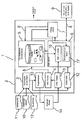
- inventive client / server system 1 is simplified in Form shown in a block diagram.
- the client / server system 1 comprises a server instance 2, which on a Server machine is running and away from clients under a specific network address can appeal. It can handle a variety of server instances 2 simultaneously under different network addresses independently work on each other on a computer.
- the server instance 2 comprises a command line client 3, an XML parser 4, an object-oriented database 5, an advanced web server 6 and a prolog system 7, which exchange data with each other or call each other, as indicated by a variety of arrows 8 is shown.
- a web client 9 is shown on a client computer runs and with the server instance 2 also exchanges data.
- Origin files designated 10 form one or more different source data formats present documents of a first Type whose content in the inventive client / server system 1 is entered. Examples of possible document types are computer programs, Personnel records of a personnel administration, dictionaries, Dictionaries or the like.
- style sheets 12 may be provided for each document type by which a display layout of the contents of the source files 10 is defined becomes.
- the source files 10, the meta-model 11 and the stylesheets 12 arrive by calling the command line client 3 in the server instance 2.
- the command line client 3 in the respective client computer loaded and transferred from there the original files 10, the Metamodel 11 and the stylesheets 12 via the network to the server computer, where they are in a project document repository as project files 13 be filed.
- the contents of the source files 10 of the server instance 2 automatically must be analyzed and recorded for each of the used Source data formats provided a suitable scanner / parser 14 by which according to the meta-model 11 the source files 10 in Documents of a second type with a uniform target data format can be converted.
- This destination data format can be, for example the so-called XML format, so that the illustrated in the figure XML files 15 are generated.
- This conversion will include those contained in the source files 10 Content as well as the relationships between these contents of the Scanner / parser 14 according to the meta-model 11 and according to the XML usage concept marked so that the stored XML files 15 in addition to the original contents of the original files 10 markings contain this content.
- XML files 15 are examined by the XML parser 4, which is based on of the metamodel the automatically generated identifications from the XML files 15 is extracted and entered into the object-oriented database 5. It will not be the document content itself and you structural structure stored in the database, but exclusively the automatically generated labels, which are the ones in the documents described facts and relations between describe this situation according to the deposited meta-model.
- the source files 10 are already in the destination data format, i. in the Example in XML format or an XML-compliant format (for example, HTML), the contents of the source files become from the parser 14 passed transparent or just a marker the objects and relationships performed. Contain documents Graphics or similar elements, so the parser 14 in this Step decompose the source files 10 into several files.
- the generated XML files 15 are supplied to the extended Web server 6, the part of the server instance is 2.
- the web server 6 provides the appropriate Hypertext navigation capabilities ready so that the XML files 15 can be displayed via a hypertext browser. These it turns in the hypertext browser to an HTML browser so the Web server 6 the files in XML format when sending to the web client 9 online to HTML as it is through a XML ⁇ HTML converter 16 is indicated.
- the XML ⁇ HTML converter 16 converts only the markings in the HTML format, the Highlight objects and relationships according to the respective metamodel 11. This allows the source files 10 to be in HTML format displayed correctly. Furthermore, when converting a special Marking of the target object generated during navigation, so that this is highlighted when displayed via the web client 9 and by the user is easier to find. The type of emphasis is thereby determines the stylesheets 12 to which the documents refer and which ones automatically retrieved from the web client 9.
- the web client 9 in addition to the documents and program code, for example in the form of Java and / or Javascript, containing the menus and dialogues that are used to execute searches as well as to define and executions of requests and the like.
- requests are processed by the Prolog system 7.
- the requests can be in the form of standard requests, it can in the formulation of the requests but also on Prolog predicates be used directly from the terms used Metamodel 11 correspond.
- the result of such a request is then a document 17 with references to document locations where the Query results are defined.
- First results may be in the hypertext browser even before the end the entire requests are displayed because the Prolog system 7 this in sets.
- the transaction control is done so that the request always refers to the state of the database 5, as he at the start of the Request was present.
- object types contains optional information of the document types in which they are defined, as well as the optional specification of object type supertypes in the form Object Type Object Type Name (is (a
- the relationship type declaration contains the target resource specifications, or any subtypes derived from them, and their cardinalities, with optional specification of the document types in which they can be defined and optionally specifying relationship type supertypes.
- This can be formulated as Relationship Type Relationship Type Name [aka Alias Name] from n1 to n2
- This section of a meta-model definition looks like this in XML, with the parts that were taken unchanged from the input shown in bold.
- the automatically inserted markings are used to that contained in the document and for a human reader understandable information for further processing explicitly to label and thus make it mechanically extractable.
- only those specified in the pointed brackets Meta data stored in the object-oriented database while the actual document content outside the angle brackets intended only for the human reader.
- the documents are managed in the file system of the server ordered and on request sent to the hypertext browser for display.
- a semicolon has the meaning of a disjunction while the comma has the meaning of a conjunction.
- the user can access predicates defined by the Prolog system itself, by self-defined rules, by the meta-meta-model, or by the meta-model. Predicates are special functions whose result set consists only of the truth values "true” and "false”, whereby constants or so-called free variables can be used as arguments. It is also possible to use a universal free variable as a placeholder for uninteresting things (represented by'_ ').
- the Prolog system 7 searches all possible Assignments of the free variables where the query expression overall, the truth value "true" results.
- the result consists of a List of possible occupancies, each occupancy in its own Line stands.
- a resource name refers to the definition point of the object or on the document.
Landscapes
- Engineering & Computer Science (AREA)
- Databases & Information Systems (AREA)
- Theoretical Computer Science (AREA)
- Data Mining & Analysis (AREA)
- Physics & Mathematics (AREA)
- General Engineering & Computer Science (AREA)
- General Physics & Mathematics (AREA)
- Business, Economics & Management (AREA)
- General Business, Economics & Management (AREA)
- Information Retrieval, Db Structures And Fs Structures Therefor (AREA)
- Document Processing Apparatus (AREA)
Claims (10)
- Procédé pour exploiter et gérer des documents existants sous forme électronique, dans lequel le contenu source des documents d'un premier type existant dans un format de données source ou dans plusieurs formats de données source est analysé automatiquement et converti dans un format de données cible uniforme, moyennant quoi au moins pour une partie du contenu source des documents du premier type selon les règles de description caractéristiques du ou des format(s) de données source, des caractérisations automatiques sont générées et sont mémorisées conjointement avec au moins une partie du contenu source dans le format de données cible comme documents du deuxième type, ces caractérisations sont, en outre, mémorisées dans une base de données, et le contenu source enregistré dans les documents du deuxième type est affiché à l'aide d'un système d'hypertexte, moyennant quoi au moins une partie du contenu source, pour laquelle des caractérisations ont été générées, est affichée comme hyperliens, les informations de déréférenciation des hyperliens sont issues des caractérisations mémorisées dans la base de données, et des documents automatiques d'un troisième type peuvent également être générés via des éléments d'interrogation basés sur la logique, documents qui sont affichés via le système d'hypertexte et comportent des hyperliens qui sont issus des caractérisations mémorisées dans la base de données.
- Procédé selon la revendication 1, caractérisé en ce qu'une spécification d'élément fixe est prédéfinie et en ce que les règles de description sont librement définissables en fonction de la spécification d'élément fixe.
- Procédé selon la revendication 2, caractérisé en ce que dans la spécification d'élément fixe, des déclarations de types d'objets, de types de documents et de types de relation sont définies.
- Procédé selon la revendication 1, 2 ou 3, caractérisé en ce que les règles de description sont mémorisées dans un document, plus particulièrement du premier type.
- Procédé selon l'une des revendications précédentes, caractérisé en ce que le format XML (Extensible Markup Language) est utilisé comme format de données cible.
- Procédé selon l'une des revendications précédentes, caractérisé en ce que les documents existant dans le format de données cible sont gérés par un serveur hypertexte et affichés dans un navigateur hypertexte, plus particulièrement en ce que les documents existant dans le format de données cible sont convertis au format HTML (Hypertext Markup Language), les documents HTML générés sont gérés par un serveur Web et affichés dans un navigateur Web.
- Procédé selon l'une des revendications précédentes, caractérisé en ce que les éléments d'interrogation basés sur la logique sont définis comme questions standard prédéfinies et/ou sont formulés comme questions individuelles dans une langue d'interrogation prédéfinie.
- Procédé selon la revendication 7, caractérisé en ce qu'un prologue est utilisé comme langue d'interrogation.
- Procédé selon l'une des revendications précédentes, caractérisé en ce qu'une base de données orientée objet est utilisée comme base de données.
- Système d'exploitation et de gestion de documents (10) existant sous forme électronique, plus particulièrement pour un procédé selon l'une quelconque des revendications précédentes, avec une structure serveur client, moyennant quoi le serveur (2) comprend :une interface (3) pour reprendre par le client des documents (10) d'un premier type existant dans un format de données source ou dans plusieurs formats de données source,une unité d'analyse et de conversion (14) pour analyser automatiquement le contenu source des documents (10) du premier type et pour convertir le contenu source dans un format de données cible uniforme, moyennant quoi, grâce à l'unité d'analyse et de conversion (14), des caractérisations automatiques peuvent être générées au moins pour une partie du contenu source des documents (10) du premier type selon les règles de description (11) caractéristiques du format de données source et ces caractérisations peuvent être mémorisées conjointement avec au moins une partie du contenu source dans un format de données cible comme documents (15) du deuxième type,une base de données (5) et une unité d'extraction (4) pour mémoriser ces caractérisations dans la base de données (5),et un système hypertexte (6, 9) pour afficher le contenu source enregistré dans les documents (15) du deuxième type, moyennant quoi au moins une partie du contenu source, pour laquelle des caractérisations ont été générées, peut être affichée comme hyperliens, les informations de déréférenciation des hyperliens peuvent être issues des caractérisations mémorisées dans la base de données (5), et des documents automatiques (17) d'un troisième type peuvent également être générés via des éléments d'interrogation basés sur la logique, documents qui peuvent être affichés via des systèmes hypertexte et comportent des hyperliens qui sont issus des caractérisations mémorisées dans la base de données.
Priority Applications (3)
| Application Number | Priority Date | Filing Date | Title |
|---|---|---|---|
| EP99103194A EP1030254B1 (fr) | 1999-02-18 | 1999-02-18 | Procédé et systeme de gestion de documents |
| DE59912115T DE59912115D1 (de) | 1999-02-18 | 1999-02-18 | Verfahren und System zum Verwalten von Dokumenten |
| AT99103194T ATE297033T1 (de) | 1999-02-18 | 1999-02-18 | Verfahren und system zum verwalten von dokumenten |
Applications Claiming Priority (1)
| Application Number | Priority Date | Filing Date | Title |
|---|---|---|---|
| EP99103194A EP1030254B1 (fr) | 1999-02-18 | 1999-02-18 | Procédé et systeme de gestion de documents |
Publications (2)
| Publication Number | Publication Date |
|---|---|
| EP1030254A1 EP1030254A1 (fr) | 2000-08-23 |
| EP1030254B1 true EP1030254B1 (fr) | 2005-06-01 |
Family
ID=8237581
Family Applications (1)
| Application Number | Title | Priority Date | Filing Date |
|---|---|---|---|
| EP99103194A Expired - Lifetime EP1030254B1 (fr) | 1999-02-18 | 1999-02-18 | Procédé et systeme de gestion de documents |
Country Status (3)
| Country | Link |
|---|---|
| EP (1) | EP1030254B1 (fr) |
| AT (1) | ATE297033T1 (fr) |
| DE (1) | DE59912115D1 (fr) |
Families Citing this family (9)
| Publication number | Priority date | Publication date | Assignee | Title |
|---|---|---|---|---|
| US6810429B1 (en) * | 2000-02-03 | 2004-10-26 | Mitsubishi Electric Research Laboratories, Inc. | Enterprise integration system |
| DE10058395A1 (de) * | 2000-11-24 | 2002-06-13 | Siemens Ag | Verfahren und Vorrichtung zur Datenwandlung |
| US7257820B2 (en) | 2001-04-14 | 2007-08-14 | Siebel Systems, Inc. | Method and system for using integration objects with enterprise business applications |
| US7370272B2 (en) | 2001-04-14 | 2008-05-06 | Siebel Systems, Inc. | Data adapter |
| WO2002103564A1 (fr) * | 2001-06-14 | 2002-12-27 | Firstdoor.Com, Inc. | Procede et appareil d'elaboration de documents compatibles avec un site web |
| US7685562B2 (en) | 2001-09-28 | 2010-03-23 | Siebel Systems, Inc. | Method and code generator for integrating different enterprise business applications |
| NL1019286C2 (nl) | 2001-11-05 | 2003-05-07 | Koninkl Kpn Nv | Informatie-opslagstelsel. |
| US7322022B2 (en) | 2002-09-05 | 2008-01-22 | International Business Machines Corporation | Method for creating wrapper XML stored procedure |
| CN116644031B (zh) * | 2023-07-27 | 2023-10-13 | 北京联创高科信息技术有限公司 | 不同格式的煤矿水害数据统一标准化的方法及系统 |
Family Cites Families (3)
| Publication number | Priority date | Publication date | Assignee | Title |
|---|---|---|---|---|
| US5809317A (en) * | 1992-12-30 | 1998-09-15 | Intel Corporation | Creating and maintaining hypertext links among heterogeneous documents by the establishment of anchors and connections among anchors |
| US5649192A (en) * | 1993-01-15 | 1997-07-15 | General Electric Company | Self-organized information storage system |
| US5708828A (en) * | 1995-05-25 | 1998-01-13 | Reliant Data Systems | System for converting data from input data environment using first format to output data environment using second format by executing the associations between their fields |
-
1999
- 1999-02-18 EP EP99103194A patent/EP1030254B1/fr not_active Expired - Lifetime
- 1999-02-18 AT AT99103194T patent/ATE297033T1/de active
- 1999-02-18 DE DE59912115T patent/DE59912115D1/de not_active Expired - Lifetime
Also Published As
| Publication number | Publication date |
|---|---|
| ATE297033T1 (de) | 2005-06-15 |
| EP1030254A1 (fr) | 2000-08-23 |
| DE59912115D1 (de) | 2005-07-07 |
Similar Documents
| Publication | Publication Date | Title |
|---|---|---|
| EP1311989B1 (fr) | Procede de recherche automatique | |
| DE69724356T2 (de) | Verfahren und Apparat für die Darstellung von Information im Bezug auf jeden einzelnen von mehreren Hyperlinks | |
| DE60213409T2 (de) | Erstellung von strukturierten daten aus unformatiertem text | |
| DE69811066T2 (de) | Datenzusammenfassungsgerät. | |
| DE3650736T2 (de) | Informationswiederauffindungsverfahren | |
| DE69805437T2 (de) | Informationsmanagementsystem | |
| DE69229453T2 (de) | Verfahren und Anordnung zum Zugriff auf eine relationelle Datenbank, ohne eine objektorientierte Umgebung verlassen zu müssen | |
| DE69813652T2 (de) | System und Verfahren zum hierarchischen Zusammenstellen und Einordnen eines Satzes von Objekten in einem Abfragekontext | |
| DE60129652T2 (de) | Bildwiederauffindungssystem und Methode mit semantischer und eigenschaftenbasierter Relevanzrückmeldung | |
| DE69931256T2 (de) | Verfahren und system zum zurückholen einer elektronischen akte | |
| DE69024932T2 (de) | Verfahren um Dokumente, die ein bestimmtes Attribut haben, mit Hilfe eines vektorrelationalen charakteristischen Objektes zu identifizieren | |
| DE10358834A1 (de) | Verfahren, Einrichtung und Computer-Produkt zum Analysieren von Binärdaten | |
| DE202014010938U1 (de) | Omega-Namen: Namenserzeugung und -ableitung | |
| DE10231161A1 (de) | Domain-spezifisches wissensbasiertes Metasuchsystem und Verfahren zum Verwenden desselben | |
| WO2009030288A1 (fr) | Détection de corrélations entre des données représentant des informations | |
| DE60101668T2 (de) | Verfahren und gerät zum erzeugen eines auf einer formatvorlage basierten index für ein strukturiertes dokument | |
| EP1030254B1 (fr) | Procédé et systeme de gestion de documents | |
| DE102005028675A1 (de) | Aktualisierungs- und Transformationssystem für strukturierte Daten | |
| EP2538347B1 (fr) | Système et dispositif de traitement de données | |
| EP2193455A1 (fr) | Détection de corrélations entre des données qui représentent des informations | |
| EP1224579A2 (fr) | Procede de traitement d'objets de donnees | |
| EP2193457A1 (fr) | Détection de corrélations entre des données représentant des informations | |
| EP1754171A1 (fr) | Procede et systeme de generation automatisee de dispositifs de commande et d'analyse assistes par ordinateur | |
| EP1094405A2 (fr) | Mèthode de creation d'une interface dynamique d'une base de donnees | |
| DE10025219A1 (de) | Verfahren, Computerprogrammprodukt und Vorrichtung zum automatischen Verknüpfen von Datensätzen aus zumindest einer Datenquelle sowie System zum Abrufen von verknüpften Datensätzen aus zumindest einer Datenquelle |
Legal Events
| Date | Code | Title | Description |
|---|---|---|---|
| PUAI | Public reference made under article 153(3) epc to a published international application that has entered the european phase |
Free format text: ORIGINAL CODE: 0009012 |
|
| AK | Designated contracting states |
Kind code of ref document: A1 Designated state(s): AT BE CH CY DE DK ES FI FR GB GR IE IT LI LU MC NL PT SE Kind code of ref document: A1 Designated state(s): AT CH DE LI |
|
| AX | Request for extension of the european patent |
Free format text: AL;LT;LV;MK;RO;SI |
|
| RAP1 | Party data changed (applicant data changed or rights of an application transferred) |
Owner name: SD&M SOFTWARE DESIGN & MANAGEMENT AG |
|
| AKX | Designation fees paid | ||
| 17P | Request for examination filed |
Effective date: 20010202 |
|
| RBV | Designated contracting states (corrected) |
Designated state(s): AT CH DE LI |
|
| GRAP | Despatch of communication of intention to grant a patent |
Free format text: ORIGINAL CODE: EPIDOSNIGR1 |
|
| GRAS | Grant fee paid |
Free format text: ORIGINAL CODE: EPIDOSNIGR3 |
|
| GRAA | (expected) grant |
Free format text: ORIGINAL CODE: 0009210 |
|
| AK | Designated contracting states |
Kind code of ref document: B1 Designated state(s): AT CH DE LI |
|
| REG | Reference to a national code |
Ref country code: CH Ref legal event code: EP |
|
| REF | Corresponds to: |
Ref document number: 59912115 Country of ref document: DE Date of ref document: 20050707 Kind code of ref document: P |
|
| PLBE | No opposition filed within time limit |
Free format text: ORIGINAL CODE: 0009261 |
|
| STAA | Information on the status of an ep patent application or granted ep patent |
Free format text: STATUS: NO OPPOSITION FILED WITHIN TIME LIMIT |
|
| 26N | No opposition filed |
Effective date: 20060302 |
|
| PGFP | Annual fee paid to national office [announced via postgrant information from national office to epo] |
Ref country code: CH Payment date: 20140218 Year of fee payment: 16 |
|
| PGFP | Annual fee paid to national office [announced via postgrant information from national office to epo] |
Ref country code: AT Payment date: 20140212 Year of fee payment: 16 |
|
| PGFP | Annual fee paid to national office [announced via postgrant information from national office to epo] |
Ref country code: DE Payment date: 20140429 Year of fee payment: 16 |
|
| REG | Reference to a national code |
Ref country code: DE Ref legal event code: R119 Ref document number: 59912115 Country of ref document: DE |
|
| REG | Reference to a national code |
Ref country code: CH Ref legal event code: PL |
|
| REG | Reference to a national code |
Ref country code: AT Ref legal event code: MM01 Ref document number: 297033 Country of ref document: AT Kind code of ref document: T Effective date: 20150218 |
|
| PG25 | Lapsed in a contracting state [announced via postgrant information from national office to epo] |
Ref country code: LI Free format text: LAPSE BECAUSE OF NON-PAYMENT OF DUE FEES Effective date: 20150228 Ref country code: CH Free format text: LAPSE BECAUSE OF NON-PAYMENT OF DUE FEES Effective date: 20150228 |
|
| PG25 | Lapsed in a contracting state [announced via postgrant information from national office to epo] |
Ref country code: AT Free format text: LAPSE BECAUSE OF NON-PAYMENT OF DUE FEES Effective date: 20150218 |
|
| PG25 | Lapsed in a contracting state [announced via postgrant information from national office to epo] |
Ref country code: DE Free format text: LAPSE BECAUSE OF NON-PAYMENT OF DUE FEES Effective date: 20150901 |