EP1030459A2 - Récepteur à voies multiples AMRC - Google Patents
Récepteur à voies multiples AMRC Download PDFInfo
- Publication number
- EP1030459A2 EP1030459A2 EP00103314A EP00103314A EP1030459A2 EP 1030459 A2 EP1030459 A2 EP 1030459A2 EP 00103314 A EP00103314 A EP 00103314A EP 00103314 A EP00103314 A EP 00103314A EP 1030459 A2 EP1030459 A2 EP 1030459A2
- Authority
- EP
- European Patent Office
- Prior art keywords
- despreading
- reception signal
- code
- transmission paths
- multiplying
- Prior art date
- Legal status (The legal status is an assumption and is not a legal conclusion. Google has not performed a legal analysis and makes no representation as to the accuracy of the status listed.)
- Granted
Links
Images



Classifications
-
- H—ELECTRICITY
- H04—ELECTRIC COMMUNICATION TECHNIQUE
- H04B—TRANSMISSION
- H04B1/00—Details of transmission systems, not covered by a single one of groups H04B3/00 - H04B13/00; Details of transmission systems not characterised by the medium used for transmission
- H04B1/69—Spread spectrum techniques
- H04B1/707—Spread spectrum techniques using direct sequence modulation
- H04B1/7097—Interference-related aspects
- H04B1/711—Interference-related aspects the interference being multi-path interference
- H04B1/7115—Constructive combining of multi-path signals, i.e. RAKE receivers
Definitions
- the present invention relates to a receiver, and more particularly to a receiver for use in a CDMA (Code Division Multiplex Access) communication system.
- CDMA Code Division Multiplex Access
- Receivers for use in broadband CDMA communication systems which are expected to be next-generation portable telephone system standards should comprise RAKE receivers for removing multipath fading interference.
- multiplier 102 in transmitter 101 spreads transmission data x(t) by multiplying it by spreading code c(t), and the transmitter 101 transmits the spread data as transmission signal s(t).
- the transmission signal s(t) transmitted from the transmitter 101 is subjected to multipath fading over a plurality of transmission paths 103-1 through 103-N with respective delays ⁇ 1 - ⁇ N . Thereafter, the signal is received as a reception signal r(t) by a RAKE receiver 104.
- the transmission signal s(t) is given the respective delays ⁇ 1 - ⁇ N , and the results are multiplied by respective coefficients a 1 - a N representing respective phase/amplitude ratios of the transmission paths.
- the signals from the transmission paths 103-1 through 103-N are then added together, producing the reception signal r(t).
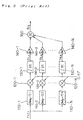
- the RAKE receiver 104 has a plurality of fingers comprising a plurality of delay units 110-1 - 110-N for giving delays ⁇ 1 - ⁇ N depending on the respective transmission paths to the reception signal r(t), a plurality of multipliers 120-1 - 120-N for multiplying signals which are produced by delaying the reception signal r(t) for the delays ⁇ 1 - ⁇ N with the delay units 110-1 - 110-N, by a complex conjugate value c(t)* of c(t), and outputting product signals, a plurality of integrators 130-1 - 130-N for integrating the product signals from the multipliers 120-1 - 120-N for the period of one symbol, and outputting integrals f 1,n - f N,n , respectively, a plurality of multipliers 140-1 - 140-N for multiplying the integrals f 1,n - f N,n outputted from the integrators 130-1 - 130-N by complex conjug
- Multiplying the integrals f 1,n - f N,n outputted from the integrators 130-1 - 130-N by the complex conjugate values a 1 * - a N * with the multipliers 140-1 - 140-N is equivalent to correcting carrier phase differences caused between the transmission paths over the transmission paths and weighting the signals depending on amplitude differences between the transmission paths. Therefore, when the signals outputted from the multipliers 140-1 - 140-N are added by the adder 150, their vectors can be combined for a maximum S/N ratio.
- the delay units 110-1 - 110-N give the reception signal r(t) the delay times ⁇ i of the transmission paths, as shown by the equation (4) below. Then, the multipliers 120-1 - 120-N multiplies the signals from the delay units 110-1 - 110-N by the complex conjugate value c(t)* of the spreading code. Thereafter, the integrators 130-1 - 130-N integrate the product signals from the multipliers 120-1 - 120-N for the period of one symbol, producing integrals f j,n .
- the integrals f j,n outputted from the integrators 130-1 - 130-N are represented by the sum of the products of the transmission data series x n and the phase/amplitude ratios of the transmission paths, and interferences I j,n composed of signal components from other transmission paths having different delay times.
- the multipliers 140-1 - 140-N multiply the integrals f j,n outputted from the integrators 130-1 - 130-N by the complex conjugate values a j * of the phase/amplitude ratios of the transmission paths. Thereafter, the adder 150 adds the outputs from the fingers together, and outputs the sum as the output signal series Rn, as shown by the equations (6), (7) below.
- the multipliers 140-1 - 140-N multiply the integrals f j,n by the complex conjugate values a j * of the phase/amplitude ratios, the phase errors of the respective paths are corrected, and the signals are weighted for a maximum S/N ratio.
- the RAKE receiver tends to have a large circuit scale because it needs to have a plurality of despreaders parallel to each other for despreading the reception signal.
- terminals which have the RAKE receiver are required to have a small circuit scale in view of demands for a low price and power requirements.
- terminals have a large circuit scale due to the incorporation of the RAKE receiver, then the price and power requirements of the terminals cannot be reduced.
- a plurality of delay means add delays over transmission paths to a complex conjugate value of a spreading code used when a reception signal is transmitted, and output delayed signals.
- a plurality of multiplying means multiply the delayed signals outputted from the delay means by complex conjugate values of coefficients representing respective phase/amplitude ratios of the transmission paths, and output product signals.
- An adding means adds the product signals outputted from the multiplying means, and outputs the sum as a code for despreading the reception signal.
- a despreading means despreads the reception signal using the code outputted from the adding means.
- the receiver according to the present invention is reduced in circuit scale.
- a receiver comprises a despreading code calculator 1 for calculating a despreading code c x (t) for despreading a reception signal r(t) based on delays given to the reception signal r(t) over a plurality of transmission paths through which the reception signal r(t) is transmitted and coefficients representing respective phase/amplitude ratios of the transmission paths, a despreader 20 for despreading the reception signal r(t) using the despreading code c x (t) calculated by the despreading code calculator 1, and an integrator 30 for integrating the reception signal despread by the despreader 20 and outputting the integrated signal as a reception signal series Rn.
- a despreading code calculator 1 for calculating a despreading code c x (t) for despreading a reception signal r(t) based on delays given to the reception signal r(t) over a plurality of transmission paths through which the reception signal r(t) is transmitted and coefficients representing respective phase
- the despreading code calculator 1 comprises a plurality of delay units 10-1 - 10-N for adding delays ⁇ 1 - ⁇ N over the transmission paths through which the reception signal r(t) is transmitted, to complex conjugate value c(t)* of the spreading code, and outputting delayed signals, a plurality of multipliers 40-1 - 40-N for multiplying the delayed signals outputted from the delay units 10-1 - 10-N by complex conjugate values a 1 * - a N * of coefficients a 1 - a N by which the transmission signal has been multiplied, and outputting product signals, and an adder 50 for adding the product signals outputted from the multipliers 40-1 - 40-N, and outputting the sum as the despreading code c x (t).
- the reception signal r(t) is not branched into as many as signals as the number of transmission paths for being delayed and corrected in phase. Instead, the delays ⁇ 1 - ⁇ N over the transmission paths through which the reception signal r(t) is transmitted are added to the code c(t)* used to despread the reception signal r(t) for delaying and correcting the reception signal r(t) in phase and adding amplitude weights to the reception signal r(t).
- the delayed signals are multiplied by the complex conjugate values a 1 * - a N * of the coefficients a 1 - a N by which the transmission signal has been multiplied over the respective transmission paths, thereby producing the code c x (t) for despreading the reception signal r(t).
- the reception signal r(t) is despread into the reception signal series Rn.
- the code c(t)* used to despread the reception signal r(t) is given the delays over the respective transmission paths, the delayed codes are multiplied by the complex conjugate values representing the phase/amplitude ratios of the transmission paths, and the product signals are added into the code c x (t) for despreading the reception signal.
- the reception signal r(t) is thereafter despread by the code c x (t).
- the receiver according to the embodiment of the present invention can thus comprise a single finger.
- the receiver can be constructed of a single despreader only, and hence can be of a highly simplified circuit arrangement.
- the despreading code may be calculated and stored as a table if fading parameters (delay times and phase/amplitude ratios) suffer no time-dependent variations or slow time-dependent variations.
Landscapes
- Engineering & Computer Science (AREA)
- Computer Networks & Wireless Communication (AREA)
- Signal Processing (AREA)
- Mobile Radio Communication Systems (AREA)
- Noise Elimination (AREA)
- Radio Transmission System (AREA)
Applications Claiming Priority (2)
| Application Number | Priority Date | Filing Date | Title |
|---|---|---|---|
| JP4142799 | 1999-02-19 | ||
| JP4142799A JP3173600B2 (ja) | 1999-02-19 | 1999-02-19 | 受信機 |
Publications (3)
| Publication Number | Publication Date |
|---|---|
| EP1030459A2 true EP1030459A2 (fr) | 2000-08-23 |
| EP1030459A3 EP1030459A3 (fr) | 2002-10-30 |
| EP1030459B1 EP1030459B1 (fr) | 2007-11-21 |
Family
ID=12608077
Family Applications (1)
| Application Number | Title | Priority Date | Filing Date |
|---|---|---|---|
| EP20000103314 Expired - Lifetime EP1030459B1 (fr) | 1999-02-19 | 2000-02-18 | Récepteur à voies multiples AMRC |
Country Status (5)
| Country | Link |
|---|---|
| US (1) | US6888812B1 (fr) |
| EP (1) | EP1030459B1 (fr) |
| JP (1) | JP3173600B2 (fr) |
| AU (1) | AU733612B2 (fr) |
| DE (1) | DE60037153T2 (fr) |
Families Citing this family (7)
| Publication number | Priority date | Publication date | Assignee | Title |
|---|---|---|---|---|
| FR2778679B1 (fr) | 1998-05-12 | 2002-01-18 | Moulinex Sa | Fer a repasser electrique |
| US7301993B2 (en) * | 2002-09-13 | 2007-11-27 | Broadcom Corporation | Channel estimation in a spread spectrum receiver |
| JP2005354255A (ja) * | 2004-06-09 | 2005-12-22 | Fujitsu Ltd | 干渉除去装置及び干渉除去方法 |
| US20060164145A1 (en) * | 2005-01-21 | 2006-07-27 | Andrei Poskatcheev | Method and apparatus for creating variable delay |
| US8229041B2 (en) * | 2009-05-26 | 2012-07-24 | Broadcom Corporation | Direct detection of wireless interferers in a communication device for multiple modulation types |
| US8743848B2 (en) * | 2009-05-26 | 2014-06-03 | Broadcom Corporation | Hybrid location determination for wireless communication device |
| CN120238177B (zh) * | 2025-05-30 | 2025-08-26 | 长沙金维集成电路股份有限公司 | 用于cdma信号的捕获方法、系统及其存储介质 |
Family Cites Families (10)
| Publication number | Priority date | Publication date | Assignee | Title |
|---|---|---|---|---|
| JPH05292063A (ja) | 1992-04-06 | 1993-11-05 | Nippon Telegr & Teleph Corp <Ntt> | スペクトラム拡散受信機 |
| JPH05292059A (ja) | 1992-04-10 | 1993-11-05 | Toshiba Corp | スペクトラム拡散受信機 |
| US5305349A (en) * | 1993-04-29 | 1994-04-19 | Ericsson Ge Mobile Communications Inc. | Quantized coherent rake receiver |
| US5574747A (en) | 1995-01-04 | 1996-11-12 | Interdigital Technology Corporation | Spread spectrum adaptive power control system and method |
| US5644592A (en) * | 1995-04-24 | 1997-07-01 | California Institute Of Technology | Parallel interference cancellation for CDMA applications |
| JPH0974372A (ja) | 1995-09-04 | 1997-03-18 | Matsushita Electric Ind Co Ltd | スペクトラム拡散無線伝送受信装置 |
| JP3745430B2 (ja) | 1995-12-22 | 2006-02-15 | 株式会社エヌ・ティ・ティ・ドコモ | Cdmaマルチパス・サーチ方法及びcdma信号受信装置 |
| JPH10200503A (ja) | 1997-01-09 | 1998-07-31 | Matsushita Electric Ind Co Ltd | スペクトル拡散通信用適応等化回路 |
| JP3406831B2 (ja) * | 1998-03-19 | 2003-05-19 | 富士通株式会社 | 無線基地局のアレーアンテナシステム |
| US6507604B1 (en) * | 2000-08-31 | 2003-01-14 | Wen-Yi Kuo | Rake receiver for CDMA wireless communications |
-
1999
- 1999-02-19 JP JP4142799A patent/JP3173600B2/ja not_active Expired - Fee Related
-
2000
- 2000-02-15 AU AU16426/00A patent/AU733612B2/en not_active Ceased
- 2000-02-17 US US09/505,662 patent/US6888812B1/en not_active Expired - Fee Related
- 2000-02-18 DE DE2000637153 patent/DE60037153T2/de not_active Expired - Fee Related
- 2000-02-18 EP EP20000103314 patent/EP1030459B1/fr not_active Expired - Lifetime
Also Published As
| Publication number | Publication date |
|---|---|
| DE60037153D1 (de) | 2008-01-03 |
| US6888812B1 (en) | 2005-05-03 |
| JP3173600B2 (ja) | 2001-06-04 |
| EP1030459B1 (fr) | 2007-11-21 |
| AU1642600A (en) | 2000-08-24 |
| AU733612B2 (en) | 2001-05-17 |
| EP1030459A3 (fr) | 2002-10-30 |
| DE60037153T2 (de) | 2008-03-20 |
| JP2000244453A (ja) | 2000-09-08 |
Similar Documents
| Publication | Publication Date | Title |
|---|---|---|
| KR100298976B1 (ko) | 최적 수신 상태를 갖는 간섭 캔슬러를 구비하는 부호 분할 다원접속 멀티-유저 수신 장치 | |
| EP1017182A2 (fr) | Récepteur à AMRC/SD pour un environment avec évanouissement rapid | |
| US6600729B1 (en) | DS-CDMA multi-user interference canceller and DS-CDMA Communication system | |
| US6882682B1 (en) | Fixed pattern detection apparatus | |
| US20070110137A1 (en) | Iterative interference canceller for wireless multiple-access systems employing closed loop transmit diversity | |
| EP1279239B1 (fr) | Filtre adapte et recepteur destines a un systeme de radiocommunication mobile | |
| US20090304132A1 (en) | Method and Apparatus for Efficient Estimation of Interference in a Wireless Receiver | |
| EP1030459A2 (fr) | Récepteur à voies multiples AMRC | |
| WO2005034404A2 (fr) | Recepteurs cdma fondes sur rake pour plusieurs antennes receptrices | |
| US6888877B2 (en) | CDMA receiver | |
| CN1157074C (zh) | 移动无线通信系统中的基带信号解调装置与方法 | |
| EP1229667A2 (fr) | Sélection des trajets de propagation multiple par l'élimination et la détection successive des autocorrelations élevées | |
| JP2977019B2 (ja) | 2重スペクトラム拡散送信機及び受信機 | |
| JP2002077104A (ja) | スペクトル拡散受信装置 | |
| US7050486B2 (en) | Path searcher for spread spectrum receiver | |
| JPH0832548A (ja) | 同期追従方法 | |
| JP2974004B1 (ja) | Cdma受信装置およびcdma通信システム | |
| US7573934B2 (en) | Spread spectrum rake receiver | |
| JPH07264112A (ja) | 符号分割多元接続通信の干渉除去方法 | |
| EP1548953B1 (fr) | Recepteur de rake a spectre etale | |
| EP1039653A2 (fr) | Appareil et procédé de récéption et désétalement de signaux à AMRC de séquence directe | |
| JP2006500804A (ja) | Umts信号の検出方法及び検出装置 | |
| JP2001136105A (ja) | マッチトフィルタ及び受信装置 | |
| CN100397801C (zh) | 传送参数至耙式接收器的方法及装置 | |
| JPS6336698B2 (fr) |
Legal Events
| Date | Code | Title | Description |
|---|---|---|---|
| PUAI | Public reference made under article 153(3) epc to a published international application that has entered the european phase |
Free format text: ORIGINAL CODE: 0009012 |
|
| AK | Designated contracting states |
Kind code of ref document: A2 Designated state(s): AT BE CH CY DE DK ES FI FR GB GR IE IT LI LU MC NL PT SE |
|
| AX | Request for extension of the european patent |
Free format text: AL;LT;LV;MK;RO;SI |
|
| PUAL | Search report despatched |
Free format text: ORIGINAL CODE: 0009013 |
|
| AK | Designated contracting states |
Kind code of ref document: A3 Designated state(s): AT BE CH CY DE DK ES FI FR GB GR IE IT LI LU MC NL PT SE |
|
| AX | Request for extension of the european patent |
Free format text: AL;LT;LV;MK;RO;SI |
|
| 17P | Request for examination filed |
Effective date: 20021004 |
|
| AKX | Designation fees paid |
Designated state(s): DE FR GB |
|
| 17Q | First examination report despatched |
Effective date: 20060516 |
|
| GRAP | Despatch of communication of intention to grant a patent |
Free format text: ORIGINAL CODE: EPIDOSNIGR1 |
|
| GRAS | Grant fee paid |
Free format text: ORIGINAL CODE: EPIDOSNIGR3 |
|
| GRAA | (expected) grant |
Free format text: ORIGINAL CODE: 0009210 |
|
| AK | Designated contracting states |
Kind code of ref document: B1 Designated state(s): DE FR GB |
|
| REG | Reference to a national code |
Ref country code: GB Ref legal event code: FG4D |
|
| REF | Corresponds to: |
Ref document number: 60037153 Country of ref document: DE Date of ref document: 20080103 Kind code of ref document: P |
|
| ET | Fr: translation filed | ||
| PLBE | No opposition filed within time limit |
Free format text: ORIGINAL CODE: 0009261 |
|
| STAA | Information on the status of an ep patent application or granted ep patent |
Free format text: STATUS: NO OPPOSITION FILED WITHIN TIME LIMIT |
|
| 26N | No opposition filed |
Effective date: 20080822 |
|
| PGFP | Annual fee paid to national office [announced via postgrant information from national office to epo] |
Ref country code: DE Payment date: 20090213 Year of fee payment: 10 |
|
| PGFP | Annual fee paid to national office [announced via postgrant information from national office to epo] |
Ref country code: GB Payment date: 20090217 Year of fee payment: 10 |
|
| PGFP | Annual fee paid to national office [announced via postgrant information from national office to epo] |
Ref country code: FR Payment date: 20090213 Year of fee payment: 10 |
|
| GBPC | Gb: european patent ceased through non-payment of renewal fee |
Effective date: 20100218 |
|
| REG | Reference to a national code |
Ref country code: FR Ref legal event code: ST Effective date: 20101029 |
|
| PG25 | Lapsed in a contracting state [announced via postgrant information from national office to epo] |
Ref country code: FR Free format text: LAPSE BECAUSE OF NON-PAYMENT OF DUE FEES Effective date: 20100301 |
|
| PG25 | Lapsed in a contracting state [announced via postgrant information from national office to epo] |
Ref country code: DE Free format text: LAPSE BECAUSE OF NON-PAYMENT OF DUE FEES Effective date: 20100901 |
|
| PG25 | Lapsed in a contracting state [announced via postgrant information from national office to epo] |
Ref country code: GB Free format text: LAPSE BECAUSE OF NON-PAYMENT OF DUE FEES Effective date: 20100218 |