EP1030492A1 - Appareil et procédé pour l'établissement des communications - Google Patents
Appareil et procédé pour l'établissement des communications Download PDFInfo
- Publication number
- EP1030492A1 EP1030492A1 EP00301101A EP00301101A EP1030492A1 EP 1030492 A1 EP1030492 A1 EP 1030492A1 EP 00301101 A EP00301101 A EP 00301101A EP 00301101 A EP00301101 A EP 00301101A EP 1030492 A1 EP1030492 A1 EP 1030492A1
- Authority
- EP
- European Patent Office
- Prior art keywords
- connection
- remotely located
- service
- host
- address
- Prior art date
- Legal status (The legal status is an assumption and is not a legal conclusion. Google has not performed a legal analysis and makes no representation as to the accuracy of the status listed.)
- Withdrawn
Links
- 238000004891 communication Methods 0.000 title claims abstract description 49
- 238000000034 method Methods 0.000 title claims description 40
- 230000008569 process Effects 0.000 claims description 23
- 238000012545 processing Methods 0.000 claims description 10
- 101001094649 Homo sapiens Popeye domain-containing protein 3 Proteins 0.000 description 3
- 101000608234 Homo sapiens Pyrin domain-containing protein 5 Proteins 0.000 description 3
- 101000578693 Homo sapiens Target of rapamycin complex subunit LST8 Proteins 0.000 description 3
- 102100027802 Target of rapamycin complex subunit LST8 Human genes 0.000 description 3
- 238000010586 diagram Methods 0.000 description 3
- 102100024412 GTPase IMAP family member 4 Human genes 0.000 description 2
- 101000833375 Homo sapiens GTPase IMAP family member 4 Proteins 0.000 description 2
- 230000004048 modification Effects 0.000 description 2
- 238000012986 modification Methods 0.000 description 2
- 230000006855 networking Effects 0.000 description 2
- 230000000694 effects Effects 0.000 description 1
- 230000006870 function Effects 0.000 description 1
- 238000012423 maintenance Methods 0.000 description 1
- 230000007246 mechanism Effects 0.000 description 1
- 238000005192 partition Methods 0.000 description 1
- 238000006467 substitution reaction Methods 0.000 description 1
Images



Classifications
-
- H—ELECTRICITY
- H04—ELECTRIC COMMUNICATION TECHNIQUE
- H04L—TRANSMISSION OF DIGITAL INFORMATION, e.g. TELEGRAPHIC COMMUNICATION
- H04L63/00—Network architectures or network communication protocols for network security
- H04L63/02—Network architectures or network communication protocols for network security for separating internal from external traffic, e.g. firewalls
- H04L63/0281—Proxies
-
- H—ELECTRICITY
- H04—ELECTRIC COMMUNICATION TECHNIQUE
- H04L—TRANSMISSION OF DIGITAL INFORMATION, e.g. TELEGRAPHIC COMMUNICATION
- H04L67/00—Network arrangements or protocols for supporting network services or applications
- H04L67/01—Protocols
- H04L67/10—Protocols in which an application is distributed across nodes in the network
- H04L67/1001—Protocols in which an application is distributed across nodes in the network for accessing one among a plurality of replicated servers
-
- H—ELECTRICITY
- H04—ELECTRIC COMMUNICATION TECHNIQUE
- H04L—TRANSMISSION OF DIGITAL INFORMATION, e.g. TELEGRAPHIC COMMUNICATION
- H04L69/00—Network arrangements, protocols or services independent of the application payload and not provided for in the other groups of this subclass
- H04L69/18—Multiprotocol handlers, e.g. single devices capable of handling multiple protocols
Definitions
- the present invention relates to an apparatus and method for establishing communications.
- the present invention has particular application to an architecture for Internet application hosting services, and, in a preferred embodiment, to an Internet application hosting architecture that is scalable, fault-tolerant and able to service various transaction protocols for a great many unique internet (IP) addresses through a series of central communication points, referred to herein as proxy hosts.
- IP internet
- Network communication systems requiring large numbers of different remotely located computers to communicate with a central source have been known for a long time. Examples of such network communication systems abound. In such systems, it has long been desirable to have redundancy at the central source, and this is typically implemented by having a number of servers at the central source. Thus, when the remotely located computer attempts to connect to and communicate with the central source, the remotely located computer will communicate with any one of a number of different servers.
- apparatus for establishing internet communications using any of a plurality of predetermined protocols between any of a plurality of remote computers and one of a plurality of servers, said apparatus comprising: a communication interface for receiving incoming communications from the remotely located computers, each incoming communication being based on one of the plurality of different protocols; and, a processor capable of processing each of the incoming communications received by the communication interface, establishing a first connection with the remotely located computer associated with each connection, and establishing a second connection with one of a plurality of said servers, wherein the processor uses a different instantiation of software to process each incoming communication based upon a different one of the plurality of predetermined protocols so that for each incoming communication, further communications between said associated remotely located computer and said server can take place.
- a method of establishing a communication link between a remotely located computer and one of a plurality of service hosts using a proxy host comprising the steps of: receiving an incoming communication from a remotely located computer at said proxy host; establishing a first connection between the remotely located computer and the proxy host; selecting one of a predetermined plurality of software instantiations to use to process each incoming communication based upon which one of a plurality of predetermined protocols each incoming communication is based upon; and, processing each incoming communication using said selected software instantiation to establish a second connection between the proxy host and one of the plurality of service hosts.
- a method of establishing a communication link between a remotely located computer and one of a plurality of service hosts using a proxy host comprising the steps of: receiving an incoming communication from a remotely located computer at said proxy host; establishing a first connection between the remotely located computer and the proxy host; determining whether an IP address associated with said incoming communication is supported, said step of determining comparing the IP address associated with said incoming communication to a plurality of predetermined local IP addresses; and, processing each incoming communication to establish a second connection between the proxy host and one of the plurality of service hosts, each of said plurality of services hosts having associated therewith only a singe IP address, each said single IP address being different from the plurality of predetermined local IP addresses.
- the present invention provides a computer (herein referred to as a "proxy host") that is capable of relaying a plurality of different session or transaction based protocols.
- the computer is capable of relaying POP3, SMTP, HTTP, IMAP4, LDAP, and other protocols.
- the present invention provides a plurality of computers (herein referred to as "service hosts") that are each capable of satisfying requests via a plurality of different session or transaction based protocols. This is achieved by providing a series of proxy hosts distributing requests among a pool of service hosts capable of satisfying those requests.
- the proxy hosts maintain tables containing information regarding the operational status of the service hosts.
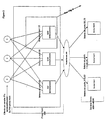
- Fig. 1 illustrates an overview of an embodiment of the present invention.
- the service hosting system 100 preferably contains a plurality of proxy hosts 200, each of which is able to receive connections from remotely located computers on the internet.
- the proxy hosts 200 are also each separately connected to a private network 300, such as a LAN, which allows each of the proxy hosts 200-1 to 200-n to communicate with a plurality of service hosts 400-1 to 400-n, as will be described in further detail hereinafter.
- a private network 300 such as a LAN
- Each of the proxy hosts 200 is implemented using a computer running a UNIX-based operating system providing TCP/IP networking and loaded with software that implements the functionalities described herein, which computer has, as is conventionally known, a processor, internal memory, communication interfaces, internal buses and other components.
- Each of the service hosts 400 is implemented using a computer running a UNIX-based operating system providing TCP/IP networking and loaded with software that implements the applications for each of the protocol functionalities described herein.
- Fig. 2 illustrates a functional block diagram of logical components of a proxy host 200.
- the proxy host 200 determines which proxy process to use based upon header information that is contained in each message, which header information identifies the logical port to be used. As illustrated in Fig. 2, logical ports 110, 80 and 25 are shown, which correspond to the logical ports for POP, HTTP and SMTP protocol processes, respectively.
- Each of the various protocol processes preferably has associated therewith sets of service host 400 identification tables, there being one set of three identification tables for each protocol supported.
- Fig. 3 illustrates a functional diagram illustrating the set of three tables for the SMTP functional protocol process illustrated Fig. 2 and the associations that exist between the tables. These tables are also implemented for each of the other protocol processes, although it should be noted that if each of the service hosts 400 is capable of handling all of the protocol processes, only one set of three tables is needed.
- each set of three tables includes one table that provides a master list 220 of service hosts 400, another table that provides a known good list 222 of service hosts 400, and the third table that provides a known bad list 224 of service hosts 400.
- the known good list 222 is a list of service hosts 400 that are known to be good
- the known bad list 224 is a list of service hosts 400 that are not good at a moment in time
- the master is a master list of service hosts 400 that are available for connection.
- This known list can be updated in two ways: from the master list 220, which can be manually updated by an administrator to add or delete a service host 400, and by automatically adding service hosts 400 that should no longer be on the known bad list 224.
- a service host is placed onto the known bad list when the proxy host 200 attempts to connect that particular service host 400 with the remotely located computer, but the connection cannot be made.
- Such a connection may fail for many reasons, for example, the particular service host 400 may be down for maintenance, may be fully used and not able to accept any new connections, or may be malfunctioning.
- an administratively defined period of time such as 20 seconds, the service host 400 that has been placed on the known bad list 224 will then be re-inserted onto the known good list 222.
- the master list 220 can be used to update the known good list 222 while the system 100 is operational. Accordingly, this allows for servers 400 to be added to the system 100, which can be advantageous if extra resources are needed during a period of peak demand.
- Fig. 4 illustrates a flowchart detailing the operation of the Internet application hosting service system 100 according to the present invention.
- a request is made by a remotely located computer on the internet.
- the proxy host 200 determines whether the received request is for, or to, or addressed to an internet (IP) address serviced by the system 100, called a "local" IP address hereinafter.
- IP internet
- associated with step 502 is a table of local IP addresses that correspond to connections that will be accepted. Many thousands of different local IP addresses can be serviced in this manner. If the message is not addressed to a local IP address supported by the service hosting system 100, as identified in the table associated with the proxy host, the connection is not accepted, as illustrated by step 503. Further, the proxy host 200 only accepts communications corresponding to the supported protocols, thereby preventing unauthorised access to other resources. In this sense, the proxy host behaves as a firewall.
- the proxy host 200 directs the request to the proxy process for the appropriate protocol based on the logical port on which the request came in.
- the proxy host 200 For each supported protocol, there is a separate software instantiation that is used to establish a connection, and each separate software instantiation is called as needed, depending upon the type of message that is received.
- a POP instantiation, a HTTP instantiation, and a SMTP instantiation exist for the functional illustration of the proxy host 200 illustrated in Fig 2.
- the software instantiations for each process are protocol independent, but are distinct for each protocol. Further, such software instantiations can be based upon conventional software, which software needs to be modified in order to take into account the functionalities described herein.
- step 506 the process on the proxy host serving the requested protocol accepts the communication with the remote client and attempts to establish a corresponding connection with a service host 400 using the selected software instantiation for that particular protocol.
- the proxy host 200 After having initiated the appropriate protocol process, the proxy host 200 sends in step 506 a request for service to a specific service host 400.
- This allows the service host 400, which is uniquely identified with only a single IP address (and which is different from any of the local IP addresses), to communicate with proxy host 200, and that proxy host 200 then to communicate with the remotely located computer.
- the service hosting system 100 can serve the many thousands of local IP addresses (which are in the table associated with the proxy host 200 as previously discussed), by using service hosts that have only a single IP address associated therewith.
- a service host 400 that is presently at the top of the known good list 222 will be attempted. If a connection with the first service host 400 cannot be made, the next service host 400 in the list is attempted (step 507). This continues until a service host responds to the particular proxy host 200 sending the request to the effect that a connection can be made.
- the proxy host 200 completes the connection in step 508. It does this by sending a connection command that identifies both the local IP address for which the request is being made by the remotely located computer and the remote IP address of the remotely located computer to the selected service host. (The local IP address is the unique internet address of a particular domain that is being hosted as a function of the invention and to which the remotely located computer wishes to connect, as described previously.) Then in step 510, the proxy host sends the data contained in the original request made by the remote computer.
- the proxy process continues to relay data bi-directionally between the service host and the remotely located computer (step 511) until either terminates the connection.
- step 508 the same steps identified above take place, except that instead of proceeding to step 508 and sending a message that includes both the local IP address and the remote IP address before beginning to relay data, an HTTP header is included in step 509 containing the remote IP address as part of the data stream and then the process moves to step 510.
- each of the proxy hosts 200 records in a log all connections accepted from the Internet, the number of simultaneous connections being relayed at any given time, and the movement of service hosts 400 from the good list 222 to the bad list 224.
Landscapes
- Engineering & Computer Science (AREA)
- Computer Networks & Wireless Communication (AREA)
- Signal Processing (AREA)
- Computer Hardware Design (AREA)
- Computer Security & Cryptography (AREA)
- Computing Systems (AREA)
- General Engineering & Computer Science (AREA)
- Data Exchanges In Wide-Area Networks (AREA)
- Communication Control (AREA)
Applications Claiming Priority (2)
| Application Number | Priority Date | Filing Date | Title |
|---|---|---|---|
| US25263799A | 1999-02-19 | 1999-02-19 | |
| US252637 | 1999-02-19 |
Publications (1)
| Publication Number | Publication Date |
|---|---|
| EP1030492A1 true EP1030492A1 (fr) | 2000-08-23 |
Family
ID=22956884
Family Applications (1)
| Application Number | Title | Priority Date | Filing Date |
|---|---|---|---|
| EP00301101A Withdrawn EP1030492A1 (fr) | 1999-02-19 | 2000-02-14 | Appareil et procédé pour l'établissement des communications |
Country Status (2)
| Country | Link |
|---|---|
| EP (1) | EP1030492A1 (fr) |
| JP (1) | JP2000244584A (fr) |
Citations (6)
| Publication number | Priority date | Publication date | Assignee | Title |
|---|---|---|---|---|
| US5341477A (en) * | 1989-02-24 | 1994-08-23 | Digital Equipment Corporation | Broker for computer network server selection |
| WO1996013113A1 (fr) * | 1994-10-12 | 1996-05-02 | Secure Computing Corporation | Systeme et procede de securisation des services inter-reseaux |
| EP0713311A1 (fr) * | 1994-11-18 | 1996-05-22 | Milkyway Networks Corporation | Méthode et passerelle sécurisée pour communication entre réseaux |
| WO1997029413A2 (fr) * | 1996-02-09 | 1997-08-14 | Secure Computing Corporation | Systeme et procede de separation dans un reseau |
| EP0817020A2 (fr) * | 1996-07-01 | 1998-01-07 | Sun Microsystems, Inc. | Service de noms pour un réseau redondant de serveurs Internet |
| US5774668A (en) * | 1995-06-07 | 1998-06-30 | Microsoft Corporation | System for on-line service in which gateway computer uses service map which includes loading condition of servers broadcasted by application servers for load balancing |
-
2000
- 2000-02-14 EP EP00301101A patent/EP1030492A1/fr not_active Withdrawn
- 2000-02-16 JP JP2000037631A patent/JP2000244584A/ja active Pending
Patent Citations (6)
| Publication number | Priority date | Publication date | Assignee | Title |
|---|---|---|---|---|
| US5341477A (en) * | 1989-02-24 | 1994-08-23 | Digital Equipment Corporation | Broker for computer network server selection |
| WO1996013113A1 (fr) * | 1994-10-12 | 1996-05-02 | Secure Computing Corporation | Systeme et procede de securisation des services inter-reseaux |
| EP0713311A1 (fr) * | 1994-11-18 | 1996-05-22 | Milkyway Networks Corporation | Méthode et passerelle sécurisée pour communication entre réseaux |
| US5774668A (en) * | 1995-06-07 | 1998-06-30 | Microsoft Corporation | System for on-line service in which gateway computer uses service map which includes loading condition of servers broadcasted by application servers for load balancing |
| WO1997029413A2 (fr) * | 1996-02-09 | 1997-08-14 | Secure Computing Corporation | Systeme et procede de separation dans un reseau |
| EP0817020A2 (fr) * | 1996-07-01 | 1998-01-07 | Sun Microsystems, Inc. | Service de noms pour un réseau redondant de serveurs Internet |
Non-Patent Citations (1)
| Title |
|---|
| PETERSON L L: "A YELLOW-PAGES SERVICE FOR A LOCAL-AREA NETWORK", COMPUTER COMMUNICATIONS REVIEW,US,ASSOCIATION FOR COMPUTING MACHINERY. NEW YORK, vol. 17, no. 5, 1 August 1988 (1988-08-01), pages 235 - 242, XP002061706, ISSN: 0146-4833 * |
Also Published As
| Publication number | Publication date |
|---|---|
| JP2000244584A (ja) | 2000-09-08 |
Similar Documents
| Publication | Publication Date | Title |
|---|---|---|
| US7353276B2 (en) | Bi-directional affinity | |
| US6735206B1 (en) | Method and apparatus for performing a fast service lookup in cluster networking | |
| US6766371B1 (en) | Virtual network environment | |
| US8477609B1 (en) | Method and system for scaling network traffic managers | |
| US7089318B2 (en) | Multi-protocol communication subsystem controller | |
| EP0381365B1 (fr) | Système et méthode pour l'interconnexion d'applications à travers différents réseaux de systèmes de traitement de données | |
| US6370583B1 (en) | Method and apparatus for portraying a cluster of computer systems as having a single internet protocol image | |
| US7509435B2 (en) | Network Address Translation and Port Mapping | |
| US6667980B1 (en) | Method and apparatus for providing scalable services using a packet distribution table | |
| US7107609B2 (en) | Stateful packet forwarding in a firewall cluster | |
| US6735205B1 (en) | Method and apparatus for fast packet forwarding in cluster networking | |
| US6792463B1 (en) | System, method and program product for providing invisibility to a proxy-server | |
| US20180146068A1 (en) | Micro-services in a telecommunications network | |
| US7676599B2 (en) | System and method of binding a client to a server | |
| US20080232356A1 (en) | Internet protocol compliant private branch electronic exchange and a method for redundantly configuring terminal interfaces | |
| EP1320977B1 (fr) | Cadre ip virtuel et procede d'interfacage | |
| US20040003099A1 (en) | Bi-directional affinity within a load-balancing multi-node network interface | |
| CN100446495C (zh) | 一种动态共享连接的方法和系统 | |
| US6647427B1 (en) | High-availability computer system and method for switching servers having an imaginary address | |
| US8850056B2 (en) | Method and system for managing client-server affinity | |
| US20050271049A1 (en) | DHCP cache method and apparatus | |
| EP1030492A1 (fr) | Appareil et procédé pour l'établissement des communications | |
| US11258848B1 (en) | Load balancing requests such that target resources serve a single client | |
| HK1030318A (en) | Apparatus and method for establishing communications | |
| JPH10116257A (ja) | 分散メディア処理サーバおよび該分散メディア処理サーバを用いた通信ネットワーク |
Legal Events
| Date | Code | Title | Description |
|---|---|---|---|
| PUAI | Public reference made under article 153(3) epc to a published international application that has entered the european phase |
Free format text: ORIGINAL CODE: 0009012 |
|
| AK | Designated contracting states |
Kind code of ref document: A1 Designated state(s): AT BE CH CY DE DK ES FI FR GB GR IE IT LI LU MC NL PT SE |
|
| AX | Request for extension of the european patent |
Free format text: AL;LT;LV;MK;RO;SI |
|
| 17P | Request for examination filed |
Effective date: 20010208 |
|
| AKX | Designation fees paid |
Free format text: AT BE CH CY DE DK ES FI FR GB GR IE IT LI LU MC NL PT SE |
|
| STAA | Information on the status of an ep patent application or granted ep patent |
Free format text: STATUS: THE APPLICATION HAS BEEN WITHDRAWN |
|
| 18W | Application withdrawn |
Withdrawal date: 20020503 |
|
| REG | Reference to a national code |
Ref country code: HK Ref legal event code: WD Ref document number: 1030318 Country of ref document: HK |