EP1030757B2 - Verbundhonring - Google Patents
Verbundhonring Download PDFInfo
- Publication number
- EP1030757B2 EP1030757B2 EP98951637A EP98951637A EP1030757B2 EP 1030757 B2 EP1030757 B2 EP 1030757B2 EP 98951637 A EP98951637 A EP 98951637A EP 98951637 A EP98951637 A EP 98951637A EP 1030757 B2 EP1030757 B2 EP 1030757B2
- Authority
- EP
- European Patent Office
- Prior art keywords
- honing
- composite
- honing ring
- ring according
- section
- Prior art date
- Legal status (The legal status is an assumption and is not a legal conclusion. Google has not performed a legal analysis and makes no representation as to the accuracy of the status listed.)
- Expired - Lifetime
Links
- 239000002131 composite material Substances 0.000 title claims description 9
- 239000003822 epoxy resin Substances 0.000 claims description 8
- 229920000647 polyepoxide Polymers 0.000 claims description 8
- 239000000463 material Substances 0.000 claims description 7
- 230000003014 reinforcing effect Effects 0.000 claims description 5
- 239000011230 binding agent Substances 0.000 claims description 4
- 239000002184 metal Substances 0.000 claims description 4
- 229910052751 metal Inorganic materials 0.000 claims description 4
- 150000004767 nitrides Chemical class 0.000 claims description 4
- 239000006061 abrasive grain Substances 0.000 claims description 3
- 239000010432 diamond Substances 0.000 claims description 3
- 229910003460 diamond Inorganic materials 0.000 claims description 3
- 239000003082 abrasive agent Substances 0.000 claims description 2
- 238000000034 method Methods 0.000 description 6
- 239000000203 mixture Substances 0.000 description 4
- 239000010431 corundum Substances 0.000 description 3
- 229910052593 corundum Inorganic materials 0.000 description 3
- 239000000835 fiber Substances 0.000 description 3
- OKTJSMMVPCPJKN-UHFFFAOYSA-N Carbon Chemical compound [C] OKTJSMMVPCPJKN-UHFFFAOYSA-N 0.000 description 2
- 229910052799 carbon Inorganic materials 0.000 description 2
- 239000000919 ceramic Substances 0.000 description 2
- 238000013016 damping Methods 0.000 description 2
- 239000000945 filler Substances 0.000 description 2
- LNEPOXFFQSENCJ-UHFFFAOYSA-N haloperidol Chemical compound C1CC(O)(C=2C=CC(Cl)=CC=2)CCN1CCCC(=O)C1=CC=C(F)C=C1 LNEPOXFFQSENCJ-UHFFFAOYSA-N 0.000 description 2
- 239000004615 ingredient Substances 0.000 description 2
- 239000002245 particle Substances 0.000 description 2
- 238000005498 polishing Methods 0.000 description 2
- 239000011347 resin Substances 0.000 description 2
- 229920005989 resin Polymers 0.000 description 2
- 150000001408 amides Chemical class 0.000 description 1
- 229920003235 aromatic polyamide Polymers 0.000 description 1
- 238000005056 compaction Methods 0.000 description 1
- 239000011521 glass Substances 0.000 description 1
- 238000009499 grossing Methods 0.000 description 1
- 238000003754 machining Methods 0.000 description 1
- 239000011159 matrix material Substances 0.000 description 1
- 150000001247 metal acetylides Chemical class 0.000 description 1
- 150000002739 metals Chemical class 0.000 description 1
- 229910003465 moissanite Inorganic materials 0.000 description 1
- 239000012766 organic filler Substances 0.000 description 1
- 239000004033 plastic Substances 0.000 description 1
- 229920003023 plastic Polymers 0.000 description 1
- 229920000728 polyester Polymers 0.000 description 1
- 239000004848 polyfunctional curative Substances 0.000 description 1
- 230000002787 reinforcement Effects 0.000 description 1
- 150000003839 salts Chemical class 0.000 description 1
- 229910010271 silicon carbide Inorganic materials 0.000 description 1
- 230000008961 swelling Effects 0.000 description 1
Images
Classifications
-
- B—PERFORMING OPERATIONS; TRANSPORTING
- B24—GRINDING; POLISHING
- B24D—TOOLS FOR GRINDING, BUFFING OR SHARPENING
- B24D18/00—Manufacture of grinding tools or other grinding devices, e.g. wheels, not otherwise provided for
-
- B—PERFORMING OPERATIONS; TRANSPORTING
- B23—MACHINE TOOLS; METAL-WORKING NOT OTHERWISE PROVIDED FOR
- B23F—MAKING GEARS OR TOOTHED RACKS
- B23F21/00—Tools specially adapted for use in machines for manufacturing gear teeth
- B23F21/03—Honing tools
-
- B—PERFORMING OPERATIONS; TRANSPORTING
- B24—GRINDING; POLISHING
- B24D—TOOLS FOR GRINDING, BUFFING OR SHARPENING
- B24D3/00—Physical features of abrasive bodies, or sheets, e.g. abrasive surfaces of special nature; Abrasive bodies or sheets characterised by their constituents
- B24D3/02—Physical features of abrasive bodies, or sheets, e.g. abrasive surfaces of special nature; Abrasive bodies or sheets characterised by their constituents the constituent being used as bonding agent
- B24D3/20—Physical features of abrasive bodies, or sheets, e.g. abrasive surfaces of special nature; Abrasive bodies or sheets characterised by their constituents the constituent being used as bonding agent and being essentially organic
- B24D3/28—Resins or natural or synthetic macromolecular compounds
- B24D3/30—Resins or natural or synthetic macromolecular compounds for close-grained structure
Definitions
- the invention relates to composite honing rings, consisting of a honing part and a carrier part, the two parts made of different materials consist.
- Honing rings are in the tooth flank processing technique known for a long time, as well as their applications. They can be made of different materials be constructed, with the sanding zone usually consists of resin-bonded abrasive material and the carrier rings made of the same materials are. The abrasive part has considerable porosity, for some applications by adding hollow spheres or ceramic agglomerates induced artificially or increased.
- the preferably used fibrous Reinforcing elements have in particular a length from 0.5 to 10 mm.
- Such fibers can be advantageous Whiskers and not only reinforce the binder matrix, but act according to another preferred Embodiment during the honing process also workpiece machining - so abrasive - what an additional smoothing the material surface and thus an improvement the surface quality brings with it.
- Whiskers are by definition (see Römpp Chemie Lexikon 9th edition, Page 5039, to which reference is made in full is) fibrous monocrystals of metals, oxides, Borides, carbides, nitrides, polytitanate, carbon etc. with mostly polygonal cross-section.
- the carrier part of the honing ring is made of unfilled epoxy resin, whereby the materials for the abrasive honing ring part and the carrier part different damping properties exhibit.
- the carrier part is elastic and causes damping of engine vibrations and bearing vibrations received by the support member become. This allows you to do even less stable machines with the subject invention optimal Honing results achieved and swelling Process forces are avoided.
- the carrier part has flow properties under Tension.
- this backlash i. similar to a press fit. This allows a very high concentricity, even with repeated tool change, since such a Press fit is maintained.
- abrasive active honing ring with abrasive grains preferably Corundum, SiC, metal nitrides, diamond and CBN- Kom, filled, in particular a particle size of ⁇ 200 microns, which is efficient and uniform Honing with simultaneous low wear of the honing ring allows.
- Polishing grits 10-95 Cew .-% preferably corundum having average grain diameter of 200 ⁇ m and finer; alternatively SIC, diamond, CBN, metalicarbides, nitrides and microcrystalline corundum; Binders (resins) 5-50% by weight, preferably epoxy resins; Fillers 0-15% by weight, inorganic metal salts and / or oxides, organic fillers; Fibers 1-10 wt .-%, preferably 0.5-10 mm in length of glass, ceramic, carbon, plastics (eg aramids, amides, polyesters, etc.) and / or whiskers.
- Binders (resins) 5-50% by weight, preferably epoxy resins
- Fibers 1-10 wt .-% preferably 0.5-10 mm in length of glass, ceramic, carbon, plastics (eg aramids, amides, polyester
- Epoxy resins with different amounts of hardener from 0.02 to 0.3 MA.
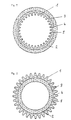
- Fig. 1 illustrates a honing ring with internal Gearing
- Fig. 2 shows a honing ring, wherein the abrasive active honing part is arranged outside.
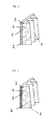
- the Figs. 3 and 4 show corresponding sections of Honringen.
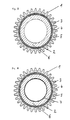
- Fig. 5 is on the carrier body of the honing ring to recognize a machine shot hinted which is not yet biased.
- Fig. 6 is the same Arrangement can be seen as in Fig. 5, however, is in this Case the machine seat biased
- Fig. 1 shows a honing ring with internal Honteil 1 and to this closing Carrier body 2.
- the carrier body 2 consists of a unfilled epoxy resin composition which under pressure shows flow property. This attribute allows the honing ring on Honmaschinenissuen to be fastened so that after only a small amount of Dressing is ready for use and immediately optimum concentricity having. If you solve the bias of Maschinenflansches, the interference fit is canceled and the honing ring can be removed.
- the honing part 1 consists of grinding / polishing mass, consisting of Abrasive grits 4, fiber 5 and resin binder 3 and possibly fillers.
- the cited Components are under "Composition of the Honing elements "and may vary depending on the machined Material type can be varied accordingly.
- Figs. 2, 3 and 4 show honing ring variants or cuts by honing rings; those described under Fig. 1 However, features remain the same for all variants.
- Fig. 5 illustrates a honing ring with a metaillschen Machine seat 6, the pressure on the Honing is hung up.
- the Honringbohrung forms with the flange bore a cylindrical surface, i.e. Honing ring and flange hole are in alignment.
- FIG. 6 shows the same honing ring as in FIG. 5, FIG. with the difference that here is the machine 6 was biased. In this case will the elastic support body 2 compressed, resulting in has that the bore diameter of the ring body minimally reduced (in Fig. 6 with reference numeral 7th designated). This change of shape requires the optimal Seat of the honing ring on the receiver and guaranteed its excellent running properties.
Landscapes
- Engineering & Computer Science (AREA)
- Mechanical Engineering (AREA)
- Manufacturing & Machinery (AREA)
- Polishing Bodies And Polishing Tools (AREA)
- Grinding-Machine Dressing And Accessory Apparatuses (AREA)
Description
Füllstoffe 0-15 Gew.-%, anorganische Metallsalze und/oder Oxide, organische Füllstoffe;
Faserstoffe 1-10 Gew.-%, vorzugsweise mit 0,5-10 mm Länge aus Glas, Keramik, Kohlenstoff, Kunststoffen (z.B. Aramiden, Amiden, Polyestern, etc.) und/oder Whiskers.
Claims (6)
- Verbundhonring, bestehend aus einem Honteil und einem Trägerteil, die aus unterschiedlichen Materialien bestehen und jeweils Epoxidharz als Bindemittel umfassen, wobei der schleifaktive Honteil (1) heißverpreßt ist, eine niedrige Porosität von unter 5 % aufweist und vorzugsweise faserförmige Verstärkungselemente (5) enthält wobei der Trägerteil (2) höhere Elastizität als der Honteil (1) aufweist, aus ungefülltem Epoxidharz besteht und unter Spannung Fließeigenschaften aufweist.
- Verbundhonring nach Anspruch 1, dadurch gekennzeichnet, daß die Verstärkungselemente (5) eine Länge von 0,5 bis 10 mm aufweisen.
- Verbundhonring nach Anspruch 2, dadurch gekennzeichnet, daß die Verstärkungselemente Whiskers sind.
- Verbundhonring nach Anspruch 2 oder 3, dadurch gekennzeichnet, daB die Verstärkungselemente aus Abrasivmaterial bestehen.
- Verbundhonring nach einem der Ansprüche 1 bis 4, dadurch gekennzeichnet, daß der Honteil (1) mit Schleifkörnungen (4), ausgewählt aus Korunden, SIG, Metallnitriden, Diamant und CBN-Korn, gefüllt ist.
- Verbundhonring nach Anspruch 5, dadurch gekennzeichnet, daß die Schleifkömungen (4) eine Komgröße von ≤ 200 µm aufweisen.
Applications Claiming Priority (3)
| Application Number | Priority Date | Filing Date | Title |
|---|---|---|---|
| AT0070197U AT2836U1 (de) | 1997-11-10 | 1997-11-10 | Verbundhonring |
| AT70197U | 1997-11-10 | ||
| PCT/IB1998/001824 WO1999024203A1 (de) | 1997-11-10 | 1998-11-10 | Verbundhonring |
Publications (3)
| Publication Number | Publication Date |
|---|---|
| EP1030757A1 EP1030757A1 (de) | 2000-08-30 |
| EP1030757B1 EP1030757B1 (de) | 2001-10-10 |
| EP1030757B2 true EP1030757B2 (de) | 2005-10-26 |
Family
ID=3497544
Family Applications (1)
| Application Number | Title | Priority Date | Filing Date |
|---|---|---|---|
| EP98951637A Expired - Lifetime EP1030757B2 (de) | 1997-11-10 | 1998-11-10 | Verbundhonring |
Country Status (7)
| Country | Link |
|---|---|
| US (1) | US6273801B1 (de) |
| EP (1) | EP1030757B2 (de) |
| JP (1) | JP2001522728A (de) |
| KR (1) | KR100387742B1 (de) |
| AT (1) | AT2836U1 (de) |
| DE (1) | DE59801713D1 (de) |
| WO (1) | WO1999024203A1 (de) |
Families Citing this family (8)
| Publication number | Priority date | Publication date | Assignee | Title |
|---|---|---|---|---|
| DE20207016U1 (de) * | 2002-05-03 | 2002-08-14 | The Gleason Works, Rochester, N.Y. | Innenverzahntes Honrad |
| AT414104B (de) * | 2003-02-05 | 2006-09-15 | Rappold Internat Sales Ag | Verbundhonring |
| DE102013011941A1 (de) * | 2013-07-17 | 2015-01-22 | The Gleason Works | Verfahren und Vorrichtung zum Feinbearbeiten eines verzahnten Werkstücks und Programm zu deren Steuerung |
| DE102017104625A1 (de) * | 2017-03-06 | 2018-09-06 | Präwema Antriebstechnik GmbH | Werkzeug zum Verzahnen oder Abrichten eines eine Außenverzahnung aufweisenden Feinbearbeitungswerkzeugs |
| AT522706B1 (de) * | 2019-07-03 | 2021-05-15 | Tyrolit Gmbh & Co Kg | Honring zur Oberflächenbearbeitung verzahnter Werkstücke |
| CN112223130B (zh) * | 2020-10-16 | 2022-09-02 | 郑州恒锐磨料磨具有限公司 | 一种轴承滚子球基面磨削无磁磨砂轮及其生产工艺 |
| AT524577B1 (de) * | 2021-05-12 | 2022-07-15 | Tyrolit Schleifmittelwerke Swarovski Kg | Verfahren zur Herstellung eines keramisch gebundenen Schleifwerkzeugs |
| EP4470699B1 (de) * | 2023-06-01 | 2025-11-05 | Krebs & Riedel Schleifscheibenfabrik GmbH & Co. KG | Honring und verfahren zur herstellung des honrings |
Family Cites Families (15)
| Publication number | Priority date | Publication date | Assignee | Title |
|---|---|---|---|---|
| US1924380A (en) * | 1931-04-02 | 1933-08-29 | Westinghouse Electric & Mfg Co | Gear wheel lapping tool |
| DE1261772B (de) | 1955-05-02 | 1968-02-22 | Minnesota Mining & Mfg | Verfahren zur Herstellung einer Verstaerkungsnabe an einer Schleifscheibe mit Kunstharzbindung mittels Schleuderguss |
| US3623275A (en) * | 1969-11-10 | 1971-11-30 | Michigan Tool Co | Composite abrasive finishing tool |
| CA983729A (en) * | 1971-03-15 | 1976-02-17 | Norton Company | Grinding wheels |
| CH595172A5 (de) * | 1976-05-14 | 1978-01-31 | Diamantscheiben Apparate Ag | |
| US4707950A (en) * | 1986-04-16 | 1987-11-24 | Toho Yogyo Kabushiki Kaisha | Ring grinding tool |
| JP3075288B2 (ja) * | 1990-09-28 | 2000-08-14 | 勝美 山口 | ウィスカー砥石の製造方法 |
| SE9100895D0 (sv) | 1991-03-25 | 1991-03-25 | Sandvik Ab | Saett att framstaella skaer foeretraedesvis foer skaerande bearbetning av varmhaallfasta material |
| US5221294A (en) | 1991-05-22 | 1993-06-22 | Norton Company | Process of producing self-bonded ceramic abrasive wheels |
| JP3050712B2 (ja) * | 1993-02-08 | 2000-06-12 | トーヨーエイテック株式会社 | ギアホーニング加工方法 |
| JP2991012B2 (ja) * | 1993-10-05 | 1999-12-20 | 日産自動車株式会社 | 歯車の仕上処理用砥石 |
| JPH07214423A (ja) * | 1994-02-02 | 1995-08-15 | Toyo A Tec Kk | ギアホーニング装置 |
| DE4447036C2 (de) * | 1994-12-28 | 2002-08-29 | Haug Verzahnungen Gmbh | Werkzeug zur Oberflächenbearbeitung von Werkstücken |
| JP3366772B2 (ja) * | 1995-03-17 | 2003-01-14 | 株式会社不二越 | ハードギヤホーニングのドレス補正方法 |
| DE19703261A1 (de) * | 1997-01-30 | 1998-08-06 | Deutsch Zentr Luft & Raumfahrt | Honschleifwerkzeug zur spanabhebenden Bearbeitung von Werkstücken |
-
1997
- 1997-11-10 AT AT0070197U patent/AT2836U1/de not_active IP Right Cessation
-
1998
- 1998-11-10 DE DE59801713T patent/DE59801713D1/de not_active Expired - Lifetime
- 1998-11-10 KR KR10-2000-7000095A patent/KR100387742B1/ko not_active Expired - Lifetime
- 1998-11-10 EP EP98951637A patent/EP1030757B2/de not_active Expired - Lifetime
- 1998-11-10 JP JP2000520262A patent/JP2001522728A/ja active Pending
- 1998-11-10 WO PCT/IB1998/001824 patent/WO1999024203A1/de not_active Ceased
- 1998-11-10 US US09/463,189 patent/US6273801B1/en not_active Expired - Lifetime
Also Published As
| Publication number | Publication date |
|---|---|
| AT2836U1 (de) | 1999-05-25 |
| US6273801B1 (en) | 2001-08-14 |
| DE59801713D1 (de) | 2001-11-15 |
| KR100387742B1 (ko) | 2003-06-18 |
| EP1030757B1 (de) | 2001-10-10 |
| KR20010021537A (ko) | 2001-03-15 |
| EP1030757A1 (de) | 2000-08-30 |
| WO1999024203A1 (de) | 1999-05-20 |
| JP2001522728A (ja) | 2001-11-20 |
Similar Documents
| Publication | Publication Date | Title |
|---|---|---|
| DE69917965T2 (de) | Verfahren zum Schleifen von Präzisionskomponenten | |
| DE68919908T2 (de) | Schleifscheibe mit hoher Schlagfestigkeit zum in-situ-Schleifen von Rollen. | |
| AT522810B1 (de) | Schleifsegment für eine Schleifwalze | |
| DE69512425T2 (de) | Verbundschleifkörper | |
| DE2518246B2 (de) | Rotierendes ziehschleif- oder honwerkzeug | |
| EP1030757B1 (de) | Verbundhonring | |
| DE4338077C2 (de) | Honelement | |
| DE69905135T2 (de) | Poliermaschine mit einem Drehkopf, der eine Vielzahl von Poliersektoren mit segmentierten und elastischen Strukturen trägt | |
| EP0336066B1 (de) | Schleifscheibe zum Tiefschleifen | |
| EP2956271A1 (de) | Verfahren und schleifwerkzeug zum hochgenauen centerless-schleifen von wellenteilen mit hoher oberflächengüte | |
| EP1827762B1 (de) | Schleifmittel und verfahren zu dessen herstellung | |
| DE102010025677A1 (de) | Abrichtwerkzeug | |
| EP0794273A1 (de) | Offenend-Spinnvorrichtung | |
| DE4300417C2 (de) | Rotierendes oder schwingendes Schleifwerkzeug mit einem Grundkörper, der aus räumlich angeordneten und miteinander verbundenen Stegen aufgebaut ist, sowie Herstellungsverfahren für ein derartiges Schleifwerkzeug | |
| EP1054753B1 (de) | Rubber hog scheibe | |
| AT414104B (de) | Verbundhonring | |
| DE69007467T2 (de) | Doppelseitige Schleifscheibe mit interner Verstärkung. | |
| EP0906173B1 (de) | Vorrichtung zum massfinishen von kurbelwellen oder dergleichen werkstücken | |
| EP0603495A1 (de) | Schleifwerkzeug, insbesondere Feinschleifwerkzeug, und Verfahren zu dessen Herstellung | |
| DE19742665B4 (de) | Verfahren zum Schleifen mittels anhaftender Schleifmittel | |
| DE3126158A1 (de) | Verfahren zur herstellung von mit phenol-harz gebundenen schleifscheiben | |
| DE102005056368B4 (de) | Schleifmittel und Verfahren zu dessen Herstellung | |
| DE9318285U1 (de) | Mit Fasern verstärkte Kunststoffwalze mit Rautierung | |
| CH720898B1 (de) | Schleifscheibe, insbesondere für die Bearbeitung von Verzahnungen vorzugsweise für die Herstellung eines Zahnrades | |
| EP4501542A1 (de) | Schleifwerkzeug |
Legal Events
| Date | Code | Title | Description |
|---|---|---|---|
| PUAI | Public reference made under article 153(3) epc to a published international application that has entered the european phase |
Free format text: ORIGINAL CODE: 0009012 |
|
| 17P | Request for examination filed |
Effective date: 19991115 |
|
| AK | Designated contracting states |
Kind code of ref document: A1 Designated state(s): BE CH DE ES FR GB IT LI LU NL SE |
|
| GRAG | Despatch of communication of intention to grant |
Free format text: ORIGINAL CODE: EPIDOS AGRA |
|
| 17Q | First examination report despatched |
Effective date: 20010523 |
|
| GRAG | Despatch of communication of intention to grant |
Free format text: ORIGINAL CODE: EPIDOS AGRA |
|
| GRAH | Despatch of communication of intention to grant a patent |
Free format text: ORIGINAL CODE: EPIDOS IGRA |
|
| GRAH | Despatch of communication of intention to grant a patent |
Free format text: ORIGINAL CODE: EPIDOS IGRA |
|
| GRAA | (expected) grant |
Free format text: ORIGINAL CODE: 0009210 |
|
| AK | Designated contracting states |
Kind code of ref document: B1 Designated state(s): BE CH DE ES FR GB IT LI LU NL SE |
|
| PG25 | Lapsed in a contracting state [announced via postgrant information from national office to epo] |
Ref country code: NL Free format text: LAPSE BECAUSE OF FAILURE TO SUBMIT A TRANSLATION OF THE DESCRIPTION OR TO PAY THE FEE WITHIN THE PRESCRIBED TIME-LIMIT Effective date: 20011010 |
|
| REG | Reference to a national code |
Ref country code: CH Ref legal event code: EP |
|
| PG25 | Lapsed in a contracting state [announced via postgrant information from national office to epo] |
Ref country code: LU Free format text: LAPSE BECAUSE OF NON-PAYMENT OF DUE FEES Effective date: 20011110 |
|
| REF | Corresponds to: |
Ref document number: 59801713 Country of ref document: DE Date of ref document: 20011115 |
|
| REG | Reference to a national code |
Ref country code: CH Ref legal event code: NV Representative=s name: HANS RUDOLF GACHNANG PATENTANWALT |
|
| PG25 | Lapsed in a contracting state [announced via postgrant information from national office to epo] |
Ref country code: BE Free format text: LAPSE BECAUSE OF NON-PAYMENT OF DUE FEES Effective date: 20011130 |
|
| REG | Reference to a national code |
Ref country code: GB Ref legal event code: IF02 |
|
| GBT | Gb: translation of ep patent filed (gb section 77(6)(a)/1977) |
Effective date: 20020110 |
|
| NLV1 | Nl: lapsed or annulled due to failure to fulfill the requirements of art. 29p and 29m of the patents act | ||
| ET | Fr: translation filed | ||
| PG25 | Lapsed in a contracting state [announced via postgrant information from national office to epo] |
Ref country code: ES Free format text: LAPSE BECAUSE OF FAILURE TO SUBMIT A TRANSLATION OF THE DESCRIPTION OR TO PAY THE FEE WITHIN THE PRESCRIBED TIME-LIMIT Effective date: 20020430 |
|
| BERE | Be: lapsed |
Owner name: RAPPOLD INTERNATIONAL SALES A.G. Effective date: 20011130 |
|
| PLBQ | Unpublished change to opponent data |
Free format text: ORIGINAL CODE: EPIDOS OPPO |
|
| PLBI | Opposition filed |
Free format text: ORIGINAL CODE: 0009260 |
|
| PLBF | Reply of patent proprietor to notice(s) of opposition |
Free format text: ORIGINAL CODE: EPIDOS OBSO |
|
| 26 | Opposition filed |
Opponent name: HERMES SCHLEIFMITTEL GMBH & CO. Effective date: 20020709 |
|
| PLBF | Reply of patent proprietor to notice(s) of opposition |
Free format text: ORIGINAL CODE: EPIDOS OBSO |
|
| RDAF | Communication despatched that patent is revoked |
Free format text: ORIGINAL CODE: EPIDOSNREV1 |
|
| APBP | Date of receipt of notice of appeal recorded |
Free format text: ORIGINAL CODE: EPIDOSNNOA2O |
|
| APBQ | Date of receipt of statement of grounds of appeal recorded |
Free format text: ORIGINAL CODE: EPIDOSNNOA3O |
|
| APAA | Appeal reference recorded |
Free format text: ORIGINAL CODE: EPIDOS REFN |
|
| APBU | Appeal procedure closed |
Free format text: ORIGINAL CODE: EPIDOSNNOA9O |
|
| PUAH | Patent maintained in amended form |
Free format text: ORIGINAL CODE: 0009272 |
|
| STAA | Information on the status of an ep patent application or granted ep patent |
Free format text: STATUS: PATENT MAINTAINED AS AMENDED |
|
| APAH | Appeal reference modified |
Free format text: ORIGINAL CODE: EPIDOSCREFNO |
|
| 27A | Patent maintained in amended form |
Effective date: 20051026 |
|
| AK | Designated contracting states |
Kind code of ref document: B2 Designated state(s): BE CH DE ES FR GB IT LI LU NL SE |
|
| PG25 | Lapsed in a contracting state [announced via postgrant information from national office to epo] |
Ref country code: IT Free format text: LAPSE BECAUSE OF NON-PAYMENT OF DUE FEES;WARNING: LAPSES OF ITALIAN PATENTS WITH EFFECTIVE DATE BEFORE 2007 MAY HAVE OCCURRED AT ANY TIME BEFORE 2007. THE CORRECT EFFECTIVE DATE MAY BE DIFFERENT FROM THE ONE RECORDED. Effective date: 20051110 |
|
| REG | Reference to a national code |
Ref country code: CH Ref legal event code: AEN Free format text: AUFRECHTERHALTUNG DES PATENTES IN GEAENDERTER FORM |
|
| REG | Reference to a national code |
Ref country code: SE Ref legal event code: RPEO |
|
| GBTA | Gb: translation of amended ep patent filed (gb section 77(6)(b)/1977) | ||
| REG | Reference to a national code |
Ref country code: ES Ref legal event code: FD2A Effective date: 20011112 |
|
| ET3 | Fr: translation filed ** decision concerning opposition | ||
| PGRI | Patent reinstated in contracting state [announced from national office to epo] |
Ref country code: IT Effective date: 20110616 |
|
| REG | Reference to a national code |
Ref country code: CH Ref legal event code: NV Representative=s name: GACHNANG AG PATENTANWAELTE, CH |
|
| REG | Reference to a national code |
Ref country code: FR Ref legal event code: PLFP Year of fee payment: 18 |
|
| REG | Reference to a national code |
Ref country code: DE Ref legal event code: R082 Ref document number: 59801713 Country of ref document: DE Representative=s name: HOEFER & PARTNER PATENTANWAELTE MBB, DE Ref country code: DE Ref legal event code: R081 Ref document number: 59801713 Country of ref document: DE Owner name: 3M (SCHWEIZ) GMBH, CH Free format text: FORMER OWNER: RAPPOLD INTERNATIONAL SALES AG, KUESNACHT, CH Ref country code: DE Ref legal event code: R081 Ref document number: 59801713 Country of ref document: DE Owner name: 3M (SCHWEIZ) GMBH, CH Free format text: FORMER OWNER: WINTERTHUR TECHNOLOGIE AG, ZUG, CH Ref country code: DE Ref legal event code: R081 Ref document number: 59801713 Country of ref document: DE Owner name: 3M (SCHWEIZ) GMBH, CH Free format text: FORMER OWNER: RAPPOLD INTERNATIONAL SALES AG, ZUMIKON, CH Ref country code: DE Ref legal event code: R081 Ref document number: 59801713 Country of ref document: DE Owner name: 3M (SCHWEIZ) GMBH, CH Free format text: FORMER OWNER: WINTERTHUR HOLDING (WST ZUG) AG, ZUG, CH |
|
| REG | Reference to a national code |
Ref country code: CH Ref legal event code: PFUS Owner name: WINTERTHUR TECHNOLOGIE AG ZUG, CH Free format text: FORMER OWNER: WINTERTHUR HOLDING (WST ZUG) AG, CH Ref country code: CH Ref legal event code: PFUS Owner name: 3M (SCHWEIZ AG), CH Free format text: FORMER OWNER: WINTERTHUR TECHNOLOGIE AG ZUG, CH Ref country code: CH Ref legal event code: PFUS Owner name: WINTERTHUR HOLDING (WST ZUG) AG, CH Free format text: FORMER OWNER: RAPPOLD INTERNATIONAL SALES AG, CH Ref country code: CH Ref legal event code: PFA Owner name: 3M (SCHWEIZ) GMBH, CH Free format text: FORMER OWNER: 3M (SCHWEIZ AG), CH Ref country code: CH Ref legal event code: NV Representative=s name: E. BLUM AND CO. AG PATENT- UND MARKENANWAELTE , CH |
|
| REG | Reference to a national code |
Ref country code: FR Ref legal event code: TP Owner name: 3M (SCHWEIZ) GMBH, CH Effective date: 20160509 |
|
| REG | Reference to a national code |
Ref country code: FR Ref legal event code: PLFP Year of fee payment: 19 |
|
| REG | Reference to a national code |
Ref country code: GB Ref legal event code: 732E Free format text: REGISTERED BETWEEN 20170331 AND 20170405 |
|
| REG | Reference to a national code |
Ref country code: GB Ref legal event code: 732E Free format text: REGISTERED BETWEEN 20170406 AND 20170412 |
|
| REG | Reference to a national code |
Ref country code: FR Ref legal event code: PLFP Year of fee payment: 20 |
|
| PGFP | Annual fee paid to national office [announced via postgrant information from national office to epo] |
Ref country code: FR Payment date: 20171012 Year of fee payment: 20 Ref country code: DE Payment date: 20171108 Year of fee payment: 20 |
|
| PGFP | Annual fee paid to national office [announced via postgrant information from national office to epo] |
Ref country code: IT Payment date: 20171123 Year of fee payment: 20 Ref country code: CH Payment date: 20171114 Year of fee payment: 20 Ref country code: GB Payment date: 20171108 Year of fee payment: 20 Ref country code: SE Payment date: 20171113 Year of fee payment: 20 |
|
| REG | Reference to a national code |
Ref country code: DE Ref legal event code: R071 Ref document number: 59801713 Country of ref document: DE |
|
| REG | Reference to a national code |
Ref country code: CH Ref legal event code: PL |
|
| REG | Reference to a national code |
Ref country code: GB Ref legal event code: PE20 Expiry date: 20181109 |
|
| REG | Reference to a national code |
Ref country code: SE Ref legal event code: EUG |
|
| PG25 | Lapsed in a contracting state [announced via postgrant information from national office to epo] |
Ref country code: GB Free format text: LAPSE BECAUSE OF EXPIRATION OF PROTECTION Effective date: 20181109 |