EP1031378A2 - Kobaltkatalysator für die Fischer-Tropsch-Synthese - Google Patents
Kobaltkatalysator für die Fischer-Tropsch-Synthese Download PDFInfo
- Publication number
- EP1031378A2 EP1031378A2 EP00250063A EP00250063A EP1031378A2 EP 1031378 A2 EP1031378 A2 EP 1031378A2 EP 00250063 A EP00250063 A EP 00250063A EP 00250063 A EP00250063 A EP 00250063A EP 1031378 A2 EP1031378 A2 EP 1031378A2
- Authority
- EP
- European Patent Office
- Prior art keywords
- cobalt
- catalyst according
- carrier material
- catalyst
- microwave plasma
- Prior art date
- Legal status (The legal status is an assumption and is not a legal conclusion. Google has not performed a legal analysis and makes no representation as to the accuracy of the status listed.)
- Withdrawn
Links
Images
Classifications
-
- C—CHEMISTRY; METALLURGY
- C10—PETROLEUM, GAS OR COKE INDUSTRIES; TECHNICAL GASES CONTAINING CARBON MONOXIDE; FUELS; LUBRICANTS; PEAT
- C10G—CRACKING HYDROCARBON OILS; PRODUCTION OF LIQUID HYDROCARBON MIXTURES, e.g. BY DESTRUCTIVE HYDROGENATION, OLIGOMERISATION, POLYMERISATION; RECOVERY OF HYDROCARBON OILS FROM OIL-SHALE, OIL-SAND, OR GASES; REFINING MIXTURES MAINLY CONSISTING OF HYDROCARBONS; REFORMING OF NAPHTHA; MINERAL WAXES
- C10G2/00—Production of liquid hydrocarbon mixtures of undefined composition from oxides of carbon
- C10G2/30—Production of liquid hydrocarbon mixtures of undefined composition from oxides of carbon from carbon monoxide with hydrogen
- C10G2/32—Production of liquid hydrocarbon mixtures of undefined composition from oxides of carbon from carbon monoxide with hydrogen with the use of catalysts
- C10G2/33—Production of liquid hydrocarbon mixtures of undefined composition from oxides of carbon from carbon monoxide with hydrogen with the use of catalysts characterised by the catalyst used
- C10G2/331—Production of liquid hydrocarbon mixtures of undefined composition from oxides of carbon from carbon monoxide with hydrogen with the use of catalysts characterised by the catalyst used containing group VIII-metals
- C10G2/332—Production of liquid hydrocarbon mixtures of undefined composition from oxides of carbon from carbon monoxide with hydrogen with the use of catalysts characterised by the catalyst used containing group VIII-metals of the iron-group
-
- B—PERFORMING OPERATIONS; TRANSPORTING
- B01—PHYSICAL OR CHEMICAL PROCESSES OR APPARATUS IN GENERAL
- B01J—CHEMICAL OR PHYSICAL PROCESSES, e.g. CATALYSIS OR COLLOID CHEMISTRY; THEIR RELEVANT APPARATUS
- B01J23/00—Catalysts comprising metals or metal oxides or hydroxides, not provided for in group B01J21/00
- B01J23/70—Catalysts comprising metals or metal oxides or hydroxides, not provided for in group B01J21/00 of the iron group metals or copper
- B01J23/74—Iron group metals
- B01J23/75—Cobalt
-
- B—PERFORMING OPERATIONS; TRANSPORTING
- B01—PHYSICAL OR CHEMICAL PROCESSES OR APPARATUS IN GENERAL
- B01J—CHEMICAL OR PHYSICAL PROCESSES, e.g. CATALYSIS OR COLLOID CHEMISTRY; THEIR RELEVANT APPARATUS
- B01J37/00—Processes, in general, for preparing catalysts; Processes, in general, for activation of catalysts
- B01J37/34—Irradiation by, or application of, electric, magnetic or wave energy, e.g. ultrasonic waves ; Ionic sputtering; Flame or plasma spraying; Particle radiation
- B01J37/349—Irradiation by, or application of, electric, magnetic or wave energy, e.g. ultrasonic waves ; Ionic sputtering; Flame or plasma spraying; Particle radiation making use of flames, plasmas or lasers
-
- C—CHEMISTRY; METALLURGY
- C07—ORGANIC CHEMISTRY
- C07C—ACYCLIC OR CARBOCYCLIC COMPOUNDS
- C07C1/00—Preparation of hydrocarbons from one or more compounds, none of them being a hydrocarbon
- C07C1/02—Preparation of hydrocarbons from one or more compounds, none of them being a hydrocarbon from oxides of a carbon
- C07C1/04—Preparation of hydrocarbons from one or more compounds, none of them being a hydrocarbon from oxides of a carbon from carbon monoxide with hydrogen
- C07C1/0425—Catalysts; their physical properties
-
- C—CHEMISTRY; METALLURGY
- C07—ORGANIC CHEMISTRY
- C07C—ACYCLIC OR CARBOCYCLIC COMPOUNDS
- C07C1/00—Preparation of hydrocarbons from one or more compounds, none of them being a hydrocarbon
- C07C1/02—Preparation of hydrocarbons from one or more compounds, none of them being a hydrocarbon from oxides of a carbon
- C07C1/04—Preparation of hydrocarbons from one or more compounds, none of them being a hydrocarbon from oxides of a carbon from carbon monoxide with hydrogen
- C07C1/0425—Catalysts; their physical properties
- C07C1/0445—Preparation; Activation
-
- C—CHEMISTRY; METALLURGY
- C07—ORGANIC CHEMISTRY
- C07C—ACYCLIC OR CARBOCYCLIC COMPOUNDS
- C07C2521/00—Catalysts comprising the elements, oxides or hydroxides of magnesium, boron, aluminium, carbon, silicon, titanium, zirconium or hafnium
- C07C2521/06—Silicon, titanium, zirconium or hafnium; Oxides or hydroxides thereof
-
- C—CHEMISTRY; METALLURGY
- C07—ORGANIC CHEMISTRY
- C07C—ACYCLIC OR CARBOCYCLIC COMPOUNDS
- C07C2523/00—Catalysts comprising metals or metal oxides or hydroxides, not provided for in group C07C2521/00
- C07C2523/70—Catalysts comprising metals or metal oxides or hydroxides, not provided for in group C07C2521/00 of the iron group metals or copper
- C07C2523/74—Iron group metals
- C07C2523/75—Cobalt
Definitions
- the invention relates to an improved cobalt catalyst which can be used in the Fischer-Tropsch synthesis for the production of long-chain hydrocarbons from CO and H 2 .
- a variety of methods are known to apply to substrates by plasma processes (e.g. sputtering) metallic Apply layers or metal oxide layers.
- the deposition is from Thin Solid Films 305 (1997) 210-218 of cobalt and Co-Fe-Cr on glass surfaces by ultrasonic excitation known from cobalt acetylacetonate, in particular for the production of layers with special optical properties.
- Plasma-assisted organometallic vapor deposition of cobalt acetylacetonate has been used to produce oxidic Cobalt layers used on planar substrates [Jpn.J.Appl.Phys., Vol. 32 (1993) pp. L1448-L1450].
- the invention is based on the task, restructured To provide cobalt compounds on supports as a catalyst.
- the new catalyst is characterized in that that it is made by a solid organic Cobalt compound selected from the group consisting of cobalt salts organic acids, cobalt alcoholate, cobalt crown compounds, Cobalt acetylacetonate, cobalt chelate, cobalt carbonyls, Cobalt carbonyl complexes and mixtures thereof, in the presence a powdery, calcined carrier material in a Temperature from 15 to 150 ° C a microwave plasma of 50 up to 1200 W at a frequency of 2.46 GHz for a period from 30 minutes to 50 hours at a pressure of 0.1 to 5 exposed to mbar with simultaneous movement of the carrier material becomes.
- a solid organic Cobalt compound selected from the group consisting of cobalt salts organic acids, cobalt alcoholate, cobalt crown compounds, Cobalt acetylacetonate, cobalt chelate, cobalt carbonyls, Cobalt carbonyl complexes and mixtures thereof
- discrete metal particles those particles that are essentially non-contiguous Form layer but individually and / or island-shaped at certain intervals from each other on the carrier material available.
- the distances can preferably be 4-6 nm; they can also be up to 50 nm.
- the carrier material is a powder or granulate Body with an irregular surface, preferably a finely divided one powder material.
- the grain sizes can be between from a few micrometers to several millimeters lying, e.g. 5-10 ⁇ m to 5 mm. It can also be made with a material regular surface, e.g. Tile.
- the preferably powdery material is at least moved during a period of exposure to plasma, preferably throughout the deposition process in order to an even distribution of the metal particles on the substrate surface to ensure.
- An inorganic oxide such as TiO 2 , a zeolite, a silicate, an aluminosilicate, an activated carbon, kaolin, alumina, talc, silica gel, diatomaceous earth or a mixture thereof can be used as the carrier material if, for example, a catalytically active material is to be produced.
- Other substrates can also be used for these and other uses, such as Glasses or substrates from the semiconductor industry (silicon, GaAs, Al 2 O 3 ).
- the organic cobalt compound is one at 50 to 200 ° C vaporizable organic compound with bound or deposited cobalt metal. It means that the term "organic cobalt compound" is not strictly Sense of a carbon-metal bond is used, but in addition to salts of organic acids, alcoholates, crown compounds etc. also cobalt acetylacetonates, cobalt chelates, Cobalt-carbonyl complexes can be used. Are preferred Cobalt acetylacetonates, chelates and alcoholates.
- a special feature of the invention is that the organic cobalt compound in solid form in the process is used and not as a liquid or vapor in the Reactor vessel must be introduced.
- the one for the flyover the organic cobalt compound required in the gas phase Temperature of 50 to 200 ° C is advantageous due to the microwave radiation generated.
- the organic cobalt compound is advantageously used in one tableted form together with the powdered carrier material exposed to the microwave plasma.
- the organic cobalt compound can also be used in powder form.
- a low-pressure microwave plasma used with a power of 50 to 1200 W, preferably 100 to 500 W.
- the microwave plasma preferably has one Frequency of 2.46 GHz.
- the one required for plasma generation Pressure in a vacuum chamber is preferably 0.01 up to 100 mbar and can, if necessary, ignite the plasma can be increased to 1 bar.
- the plasma can be an oxygen plasma, a water vapor plasma or a mixture of both, these being plasmas inert carrier gases, e.g. Argon or helium can be added can. Inert plasmas can also be used alone become.
- the size of the metal particles on the surface of the substrate can be moved by moving the substrate respective partial pressures, the time of plasma treatment, the Plasma power, the amount of organometallic compound so controlled that particles with diameters below 10 nm, preferably 4-6 nm can be applied to the surface.
- the plasma treatment is for a period of time maintained in at least 50% of the surface of the carrier material no coherent surface made of metal particles is formed, but essentially only discrete Metal particles with diameters of approx. 4-10 nm are deposited become.
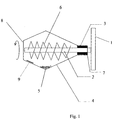
- the catalyst can be produced in one device take place, which is in a vacuum chamber and off a rotor 1 with a shaft 2 arranged horizontally thereon a seal 3 to the rotor 1 and one arranged around the shaft 2 and there is a firmly connected reaction container 4, the walls of the reactor vessel 4 have a sufficient Have a distance to the shaft 2 to without contact with the shaft 2 when the reactor vessel 4 rotates or to be able to accommodate finely divided substrate 5, and in order a wire mesh 6 arranged around the shaft for elevation to be able to record the plasma density in this area.
- the rotor 1 is a rotary feedthrough, which is in the wall of the vacuum chamber, with one outside the Chamber located motor coupled.
- the shaft 2 can also have bores through which the carrier gas passes to the reactor vessel 4 can be supplied, or the carrier gas is over separate lines inserted into the vacuum chamber.
- wire mesh 6 which is advantageously made of stainless steel there is, for example, spiral or loop-like formed as a continuous wire is likely to be a causes hollow cathodic plasma effect, so that by appropriate Control a microwave plasma only inside the Reactor vessel 4 can burn.
- the wire mesh can also made of other metal, e.g. Cu, Ni etc.
- the device for the plasma-assisted deposition of metal / metal oxide particles consists of a vacuum chamber which can be pumped down to 10 -5 mbar and in which a horizontally rotatable reactor vessel or glass cylinder is attached to a shaft.
- the shaft is connected to a rotor via an opening in the glass cylinder. A wire mesh is pushed onto the shaft.
- the substrate On the walls inside the horizontally arranged Glass substrate is the substrate, which is either lumpy or can be a particulate powder. Furthermore, in the Glass cylinder the solid organometallic connection for example introduced in the form of a compact.
- Oxygen is metered in until running vacuum pump sets a pressure of about 1 mbar.
- the side loading opening with a metal foil or can be covered with a flanged frit generates a microwave-excited oxygen plasma.
- the glass cylinder rotates at approx. 10 to 100 Revolutions per minute.
- the organic cobalt compound is caused by the microwave radiation and the plasma effect warmed up and into the Gas phase transferred.
- the organic cobalt compound decomposes through the action of oxygen Plasmas, the metallic part being an oxide on the carrier material deposited and the organic part of the compound mostly sucked off by the vacuum pump.
- An amount of 7 g of calcined TiO 2 powder with a particle size of 5 nm was treated in a vacuum chamber in the device according to the invention at about 1 mbar with the addition of 3 g of cobalt (III) acetylacetonate for a period of 16 hours in a continuous microwave-excited oxygen plasma .
- the frequency of the plasma was 2.46 GHz and the power was 120 W.
- the speed of rotation of the glass cylinder in the recipient was 30 rpm.
- the catalyst produced in this way was pressed into pellets (10 MPa, holding time 1 min) and then crushed and sieved. The resulting fraction of 255-355 ⁇ m was reduced in a tube furnace. For this purpose, a stream of H 2 (flow: 30 ml / min; purity 5.0) was passed over the catalyst located in a porcelain container. The catalyst was first heated from room temperature to 400 ° C. (heating rate 6.2 K / min) and then left at this temperature for 12 hours.
- the catalyst was then used in the Fischer-Tropsch synthesis (production of long-chain hydrocarbons from CO and H 2 with C n >) from CO / H 2 under the following conditions: CO / H 2 2/1 p total 20 bar T reak 237 ° C ICP (Co) 5.5% by weight GHSV 1500 h -1 .
- the following selectivities were obtained with a CO conversion of 41.65%
Landscapes
- Chemical & Material Sciences (AREA)
- Organic Chemistry (AREA)
- Chemical Kinetics & Catalysis (AREA)
- Engineering & Computer Science (AREA)
- Oil, Petroleum & Natural Gas (AREA)
- General Chemical & Material Sciences (AREA)
- Materials Engineering (AREA)
- Physics & Mathematics (AREA)
- Optics & Photonics (AREA)
- Health & Medical Sciences (AREA)
- Plasma & Fusion (AREA)
- Toxicology (AREA)
- Catalysts (AREA)
- Chemical Vapour Deposition (AREA)
- Organic Low-Molecular-Weight Compounds And Preparation Thereof (AREA)
Abstract
Description
Gläser oder Substrate aus der Halbleiterindustrie (Silicium, GaAs, Al2O3).
| CO/H2 | 2/1 |
| pgesamt | 20 bar |
| Treak | 237 °C |
| ICP (Co) | 5,5 Gew-% |
| GHSV | 1500 h-1. |
| S | C1 | 1,35 |
| S | C2 | 0,39 |
| S | C3 | 1,5 |
| S | C4 | 1,8 |
| S | C5 | 2,1 |
| S | C6 | 1,5 |
| S | C5+ | 94,8 |
| S | C1 | 4,75 |
| S | C2 | 1,23 |
| S | C3 | 4,02 |
| S | C4 | 3,08 |
| S | C5 | 3,86 |
| S | C6 | 4,7 |
| S | C5+ | 86,89 |
Claims (7)
Applications Claiming Priority (2)
| Application Number | Priority Date | Filing Date | Title |
|---|---|---|---|
| DE19910151A DE19910151A1 (de) | 1999-02-26 | 1999-02-26 | Verfahren zur Abscheidung von diskreten Metallteilchen auf einem Trägermaterial |
| DE19910151 | 1999-02-26 |
Publications (2)
| Publication Number | Publication Date |
|---|---|
| EP1031378A2 true EP1031378A2 (de) | 2000-08-30 |
| EP1031378A3 EP1031378A3 (de) | 2001-09-05 |
Family
ID=7900123
Family Applications (1)
| Application Number | Title | Priority Date | Filing Date |
|---|---|---|---|
| EP00250063A Withdrawn EP1031378A3 (de) | 1999-02-26 | 2000-02-25 | Kobaltkatalysator für die Fischer-Tropsch-Synthese |
Country Status (2)
| Country | Link |
|---|---|
| EP (1) | EP1031378A3 (de) |
| DE (1) | DE19910151A1 (de) |
Cited By (8)
| Publication number | Priority date | Publication date | Assignee | Title |
|---|---|---|---|---|
| EP1239019A1 (de) * | 2001-03-08 | 2002-09-11 | ENI S.p.A. | Auf Kobalt basierter Katalysator und seine Verwendung beim Fischer-Tropsch Verfahren |
| EP1739068A3 (de) * | 2005-07-01 | 2007-09-05 | Saltigo GmbH | Verfahren zur Ruthenium-katalysierten Oxidation von Alkoholen mit Hypochlorit |
| US7727931B2 (en) | 2003-09-26 | 2010-06-01 | 3M Innovative Properties Company | Catalysts, activating agents, support media, and related methodologies useful for making catalyst systems especially when the catalyst is deposited onto the support media using physical vapor deposition |
| US8058202B2 (en) | 2005-01-04 | 2011-11-15 | 3M Innovative Properties Company | Heterogeneous, composite, carbonaceous catalyst system and methods that use catalytically active gold |
| CN102719802A (zh) * | 2012-07-02 | 2012-10-10 | 兰州大学 | 硅包覆金刚石增加其金属黏合性的装置及其使用方法 |
| CN103769099A (zh) * | 2012-10-24 | 2014-05-07 | 中国石油化工股份有限公司 | 一种钴基费托合成催化剂及其制备方法和应用 |
| CN110052251A (zh) * | 2019-03-20 | 2019-07-26 | 浙江财经大学 | 用于城市污水处理的发酵改性复合生物炭及其制备方法 |
| CN114243249A (zh) * | 2021-12-13 | 2022-03-25 | 哈尔滨工业大学 | 一种基于金属基颗粒的微波协同作用方法 |
Families Citing this family (3)
| Publication number | Priority date | Publication date | Assignee | Title |
|---|---|---|---|---|
| DE10219643B4 (de) * | 2002-05-02 | 2010-04-29 | Fraunhofer-Gesellschaft zur Förderung der angewandten Forschung e.V. | Verfahren zur Herstellung von Katalysatoren |
| DE10335355B4 (de) * | 2003-04-23 | 2012-05-31 | Futurecarbon Gmbh | Katalysatormaterial und Verfahren zur Herstellung von geträgertem Katalysatormaterial |
| CN110639583A (zh) * | 2019-09-05 | 2020-01-03 | 中南民族大学 | 一种用于费-托合成反应的高活性、高稳定性催化剂的制备方法 |
Family Cites Families (1)
| Publication number | Priority date | Publication date | Assignee | Title |
|---|---|---|---|---|
| US5169821A (en) * | 1991-11-14 | 1992-12-08 | Exxon Research And Engineering Company | Method for stabilizing titania supported cobalt catalyst and the catalyst for use in Fischer-Tropsch process |
-
1999
- 1999-02-26 DE DE19910151A patent/DE19910151A1/de not_active Withdrawn
-
2000
- 2000-02-25 EP EP00250063A patent/EP1031378A3/de not_active Withdrawn
Cited By (19)
| Publication number | Priority date | Publication date | Assignee | Title |
|---|---|---|---|---|
| EP1239019A1 (de) * | 2001-03-08 | 2002-09-11 | ENI S.p.A. | Auf Kobalt basierter Katalysator und seine Verwendung beim Fischer-Tropsch Verfahren |
| US6586481B2 (en) | 2001-03-08 | 2003-07-01 | Eni S.P.A. | Catalyst based on cobalt and its use in the fischer-tropsch process |
| US8314048B2 (en) | 2003-09-26 | 2012-11-20 | 3M Innovative Properties Company | Catalysts, activating agents, support media, and related methodologies useful for making catalyst systems especially when the catalyst is deposited onto the support media using physical vapor deposition |
| US8664148B2 (en) | 2003-09-26 | 2014-03-04 | 3M Innovative Properties Company | Catalysts, activating agents, support media, and related methodologies useful for making catalyst systems especially when the catalyst is deposited onto the support media using physical vapor deposition |
| US7727931B2 (en) | 2003-09-26 | 2010-06-01 | 3M Innovative Properties Company | Catalysts, activating agents, support media, and related methodologies useful for making catalyst systems especially when the catalyst is deposited onto the support media using physical vapor deposition |
| US7989384B2 (en) | 2003-09-26 | 2011-08-02 | 3M Innovative Properties Company | Catalysts, activating agents, support media, and related methodologies useful for making catalyst systems especially when the catalyst is deposited onto the support media using physical vapor deposition |
| US8618020B2 (en) | 2003-09-26 | 2013-12-31 | 3M Innovative Properties Company | Catalysts, activating agents, support media, and related methodologies useful for making catalyst systems especially when the catalyst is deposited onto the support media using physical vapor deposition |
| US8058202B2 (en) | 2005-01-04 | 2011-11-15 | 3M Innovative Properties Company | Heterogeneous, composite, carbonaceous catalyst system and methods that use catalytically active gold |
| US8314046B2 (en) | 2005-01-04 | 2012-11-20 | 3M Innovative Properties Company | Heterogeneous, composite, carbonaceous catalyst system and methods that use catalytically active gold |
| US8518854B2 (en) | 2005-01-04 | 2013-08-27 | 3M Innovative Properties Company | Heterogeneous, composite, carbonaceous catalyst system and methods that use catalytically active gold |
| US8664149B2 (en) | 2005-01-04 | 2014-03-04 | 3M Innovative Properties Company | Heterogeneous, composite, carbonaceous catalyst system and methods that use catalytically active gold |
| US7718827B2 (en) | 2005-07-01 | 2010-05-18 | Saltigo Gmbh | Process for the ruthenium-catalysed oxidation of alcohols by means of hypochlorite |
| EP1739068A3 (de) * | 2005-07-01 | 2007-09-05 | Saltigo GmbH | Verfahren zur Ruthenium-katalysierten Oxidation von Alkoholen mit Hypochlorit |
| CN102719802A (zh) * | 2012-07-02 | 2012-10-10 | 兰州大学 | 硅包覆金刚石增加其金属黏合性的装置及其使用方法 |
| CN103769099A (zh) * | 2012-10-24 | 2014-05-07 | 中国石油化工股份有限公司 | 一种钴基费托合成催化剂及其制备方法和应用 |
| CN103769099B (zh) * | 2012-10-24 | 2015-08-12 | 中国石油化工股份有限公司 | 一种钴基费托合成催化剂及其制备方法和应用 |
| CN110052251A (zh) * | 2019-03-20 | 2019-07-26 | 浙江财经大学 | 用于城市污水处理的发酵改性复合生物炭及其制备方法 |
| CN114243249A (zh) * | 2021-12-13 | 2022-03-25 | 哈尔滨工业大学 | 一种基于金属基颗粒的微波协同作用方法 |
| CN114243249B (zh) * | 2021-12-13 | 2022-12-20 | 哈尔滨工业大学 | 一种基于金属基颗粒的微波协同作用方法 |
Also Published As
| Publication number | Publication date |
|---|---|
| DE19910151A1 (de) | 2000-09-14 |
| EP1031378A3 (de) | 2001-09-05 |
Similar Documents
| Publication | Publication Date | Title |
|---|---|---|
| EP1031378A2 (de) | Kobaltkatalysator für die Fischer-Tropsch-Synthese | |
| DE10145958B4 (de) | Verfahren zur Herstellung eines Oxidkatalysators für die Oxidation oder Ammonoxidation | |
| Hoseini et al. | Platinum nanostructures at the liquid–liquid interface: catalytic reduction of p-nitrophenol to p-aminophenol | |
| EP0073417B1 (de) | Verwendung homogener Beschichtungen aus zwei oder mehreren Metallen und/oder Metallverbindungen | |
| US9782764B2 (en) | Procedure for obtaining a substrate with Au nanoclusters attached to its surface, and the substrate and catalyst obtained through this procedure | |
| EP2194162B1 (de) | Verwendung einer Schicht | |
| WO2011042459A1 (de) | Atmosphärendruckplasmaverfahren zur herstellung oberflächenmodifizierter partikel und von beschichtungen | |
| EP3826789A1 (de) | Cobalthaltige metallschaumkörper und verfahren zu ihrer herstellung | |
| EP1576060A1 (de) | Nanoskalige kern-hülle-teilchen sowie deren herstellung | |
| DE102005035762A1 (de) | Hochporöse Schichten aus MOF-Materialien und Verfahren zur Herstellung derartiger Schichten | |
| DE69610064T2 (de) | Verfahren und Vorrichtung zum Reinigen eines Metallsubstrats | |
| DE102007025151A1 (de) | Verfahren zum Beschichten eines Substrats | |
| WO2008145102A2 (de) | Verfahren zum beschichten eines substrats | |
| DE10131173C2 (de) | Verfahren zur Herstellung von Kern-Hülle-Teilchen und deren Verwendung | |
| EP1928597A1 (de) | Verfahren zur anlagerung von nanopartikeln an substratpartikel | |
| Takahashi et al. | Reductive deposition of Ni-Zn nanoparticles selectively on TiO2 fine particles in the liquid phase | |
| DE4221659C2 (de) | Flüchtige, metallorganische Alkoxide und ihre Verwendung zur Herstellung von Mikrokompositen aus Keramik und Metall | |
| EP2186922B1 (de) | Verfahren zum Abscheiden einer Nanokomposit-Schicht auf einem Substrat mittels chemischer Dampfabscheidung | |
| DE4122473A1 (de) | Verfahren zur abscheidung von titan, zirkonium oder hafnium enthaltenden schichten | |
| Myagmarjav et al. | Characterization of the Ni-Zn/TiO2 nanocomposite synthesized by the liquid-phase selective-deposition method | |
| EP0536355B1 (de) | Verfahren zum aufbringen einer beschichtung auf ein substrat | |
| EP0848711A1 (de) | Verfahren zur selektiven hydrierung von vinyloxiran zu butylenoxid | |
| AT398580B (de) | Beschichtung für metallische oder nichtmetallische substrate, verfahren und vorrichtung zu deren herstellung | |
| EP4338837A1 (de) | Verfahren zur herstellung eines katalysators zur herstellung von kohlenstoffnanoröhrchen | |
| Wang et al. | Highly Active Ag-TiO2 Nanocomposite from Atom Deposition in Ethylenediamine-Complexing Silver Mirror Reaction |
Legal Events
| Date | Code | Title | Description |
|---|---|---|---|
| PUAI | Public reference made under article 153(3) epc to a published international application that has entered the european phase |
Free format text: ORIGINAL CODE: 0009012 |
|
| AK | Designated contracting states |
Kind code of ref document: A2 Designated state(s): AT BE CH CY DE DK ES FI FR GB GR IE IT LI LU MC NL PT SE |
|
| AX | Request for extension of the european patent |
Free format text: AL;LT;LV;MK;RO;SI |
|
| RIN1 | Information on inventor provided before grant (corrected) |
Inventor name: GAEHDE, DR. JOACHIM Inventor name: DITTMAR, ANDREA Inventor name: MUELLER, DR. JENS-PETER Inventor name: HIDDE, GUNDULA Inventor name: STEINFELDT, DR. NORBERT Inventor name: KRAUM, DR. MARTIN Inventor name: BAERNS, PROF. DR.MANFRED |
|
| PUAL | Search report despatched |
Free format text: ORIGINAL CODE: 0009013 |
|
| AK | Designated contracting states |
Kind code of ref document: A3 Designated state(s): AT BE CH CY DE DK ES FI FR GB GR IE IT LI LU MC NL PT SE |
|
| AX | Request for extension of the european patent |
Free format text: AL;LT;LV;MK;RO;SI |
|
| RIC1 | Information provided on ipc code assigned before grant |
Free format text: 7B 01J 23/75 A, 7B 01J 37/34 B, 7C 07C 1/04 B, 7C 10G 2/00 B |
|
| AKX | Designation fees paid | ||
| REG | Reference to a national code |
Ref country code: DE Ref legal event code: 8566 |
|
| STAA | Information on the status of an ep patent application or granted ep patent |
Free format text: STATUS: THE APPLICATION IS DEEMED TO BE WITHDRAWN |
|
| 18D | Application deemed to be withdrawn |
Effective date: 20020721 |