EP1031671A2 - Tragende Schalldämmelemente - Google Patents
Tragende Schalldämmelemente Download PDFInfo
- Publication number
- EP1031671A2 EP1031671A2 EP99305582A EP99305582A EP1031671A2 EP 1031671 A2 EP1031671 A2 EP 1031671A2 EP 99305582 A EP99305582 A EP 99305582A EP 99305582 A EP99305582 A EP 99305582A EP 1031671 A2 EP1031671 A2 EP 1031671A2
- Authority
- EP
- European Patent Office
- Prior art keywords
- elements
- acoustic
- face
- block
- chamber
- Prior art date
- Legal status (The legal status is an assumption and is not a legal conclusion. Google has not performed a legal analysis and makes no representation as to the accuracy of the status listed.)
- Withdrawn
Links
- 230000015572 biosynthetic process Effects 0.000 claims description 20
- 238000005755 formation reaction Methods 0.000 claims description 20
- 230000013011 mating Effects 0.000 claims description 17
- 239000007787 solid Substances 0.000 claims description 17
- 230000002250 progressing effect Effects 0.000 claims description 2
- 125000006850 spacer group Chemical group 0.000 abstract description 34
- 238000009414 blockwork Methods 0.000 description 29
- 239000004570 mortar (masonry) Substances 0.000 description 22
- 238000010276 construction Methods 0.000 description 19
- 238000010521 absorption reaction Methods 0.000 description 18
- 230000005540 biological transmission Effects 0.000 description 15
- 238000000034 method Methods 0.000 description 13
- 239000000203 mixture Substances 0.000 description 12
- 238000013461 design Methods 0.000 description 11
- 230000000694 effects Effects 0.000 description 7
- 238000005192 partition Methods 0.000 description 7
- 238000004519 manufacturing process Methods 0.000 description 6
- 230000004888 barrier function Effects 0.000 description 5
- 230000008901 benefit Effects 0.000 description 5
- 230000003667 anti-reflective effect Effects 0.000 description 4
- 238000003825 pressing Methods 0.000 description 4
- 230000008569 process Effects 0.000 description 4
- 238000012360 testing method Methods 0.000 description 4
- 239000006096 absorbing agent Substances 0.000 description 3
- 238000009413 insulation Methods 0.000 description 3
- 239000000463 material Substances 0.000 description 3
- 238000000465 moulding Methods 0.000 description 3
- 230000002829 reductive effect Effects 0.000 description 3
- 230000004044 response Effects 0.000 description 3
- 230000009286 beneficial effect Effects 0.000 description 2
- 230000000903 blocking effect Effects 0.000 description 2
- 238000009792 diffusion process Methods 0.000 description 2
- 230000036541 health Effects 0.000 description 2
- 230000009467 reduction Effects 0.000 description 2
- 230000010255 response to auditory stimulus Effects 0.000 description 2
- 238000003892 spreading Methods 0.000 description 2
- 230000007480 spreading Effects 0.000 description 2
- 238000002835 absorbance Methods 0.000 description 1
- 230000002745 absorbent Effects 0.000 description 1
- 239000002250 absorbent Substances 0.000 description 1
- 230000006978 adaptation Effects 0.000 description 1
- 239000000853 adhesive Substances 0.000 description 1
- 230000001070 adhesive effect Effects 0.000 description 1
- 230000002411 adverse Effects 0.000 description 1
- 239000005030 aluminium foil Substances 0.000 description 1
- 238000004458 analytical method Methods 0.000 description 1
- 238000003491 array Methods 0.000 description 1
- 239000011449 brick Substances 0.000 description 1
- 230000001066 destructive effect Effects 0.000 description 1
- 230000001627 detrimental effect Effects 0.000 description 1
- 230000003467 diminishing effect Effects 0.000 description 1
- 230000009365 direct transmission Effects 0.000 description 1
- 238000009826 distribution Methods 0.000 description 1
- 238000002474 experimental method Methods 0.000 description 1
- 239000002657 fibrous material Substances 0.000 description 1
- 238000001914 filtration Methods 0.000 description 1
- 239000006261 foam material Substances 0.000 description 1
- 230000005484 gravity Effects 0.000 description 1
- 238000003780 insertion Methods 0.000 description 1
- 230000037431 insertion Effects 0.000 description 1
- 238000009434 installation Methods 0.000 description 1
- 238000002955 isolation Methods 0.000 description 1
- 230000000670 limiting effect Effects 0.000 description 1
- 230000036961 partial effect Effects 0.000 description 1
- 230000000149 penetrating effect Effects 0.000 description 1
- 238000003908 quality control method Methods 0.000 description 1
- 238000007493 shaping process Methods 0.000 description 1
- 230000003313 weakening effect Effects 0.000 description 1
- 239000002023 wood Substances 0.000 description 1
Images




Classifications
-
- E—FIXED CONSTRUCTIONS
- E04—BUILDING
- E04B—GENERAL BUILDING CONSTRUCTIONS; WALLS, e.g. PARTITIONS; ROOFS; FLOORS; CEILINGS; INSULATION OR OTHER PROTECTION OF BUILDINGS
- E04B2/00—Walls, e.g. partitions, for buildings; Wall construction with regard to insulation; Connections specially adapted to walls
- E04B2/02—Walls, e.g. partitions, for buildings; Wall construction with regard to insulation; Connections specially adapted to walls built-up from layers of building elements
- E04B2/14—Walls having cavities in, but not between, the elements, i.e. each cavity being enclosed by at least four sides forming part of one single element
-
- E—FIXED CONSTRUCTIONS
- E01—CONSTRUCTION OF ROADS, RAILWAYS, OR BRIDGES
- E01F—ADDITIONAL WORK, SUCH AS EQUIPPING ROADS OR THE CONSTRUCTION OF PLATFORMS, HELICOPTER LANDING STAGES, SIGNS, SNOW FENCES, OR THE LIKE
- E01F8/00—Arrangements for absorbing or reflecting air-transmitted noise from road or railway traffic
- E01F8/0005—Arrangements for absorbing or reflecting air-transmitted noise from road or railway traffic used in a wall type arrangement
- E01F8/0047—Arrangements for absorbing or reflecting air-transmitted noise from road or railway traffic used in a wall type arrangement with open cavities, e.g. for covering sunken roads
- E01F8/0076—Cellular, e.g. as wall facing
-
- E—FIXED CONSTRUCTIONS
- E04—BUILDING
- E04B—GENERAL BUILDING CONSTRUCTIONS; WALLS, e.g. PARTITIONS; ROOFS; FLOORS; CEILINGS; INSULATION OR OTHER PROTECTION OF BUILDINGS
- E04B1/00—Constructions in general; Structures which are not restricted either to walls, e.g. partitions, or floors or ceilings or roofs
- E04B1/62—Insulation or other protection; Elements or use of specified material therefor
- E04B1/74—Heat, sound or noise insulation, absorption, or reflection; Other building methods affording favourable thermal or acoustical conditions, e.g. accumulating of heat within walls
- E04B1/82—Heat, sound or noise insulation, absorption, or reflection; Other building methods affording favourable thermal or acoustical conditions, e.g. accumulating of heat within walls specifically with respect to sound only
- E04B1/84—Sound-absorbing elements
- E04B1/8404—Sound-absorbing elements block-shaped
-
- E—FIXED CONSTRUCTIONS
- E04—BUILDING
- E04B—GENERAL BUILDING CONSTRUCTIONS; WALLS, e.g. PARTITIONS; ROOFS; FLOORS; CEILINGS; INSULATION OR OTHER PROTECTION OF BUILDINGS
- E04B2/00—Walls, e.g. partitions, for buildings; Wall construction with regard to insulation; Connections specially adapted to walls
- E04B2/02—Walls, e.g. partitions, for buildings; Wall construction with regard to insulation; Connections specially adapted to walls built-up from layers of building elements
- E04B2/04—Walls having neither cavities between, nor in, the solid elements
-
- E—FIXED CONSTRUCTIONS
- E04—BUILDING
- E04B—GENERAL BUILDING CONSTRUCTIONS; WALLS, e.g. PARTITIONS; ROOFS; FLOORS; CEILINGS; INSULATION OR OTHER PROTECTION OF BUILDINGS
- E04B1/00—Constructions in general; Structures which are not restricted either to walls, e.g. partitions, or floors or ceilings or roofs
- E04B1/62—Insulation or other protection; Elements or use of specified material therefor
- E04B1/74—Heat, sound or noise insulation, absorption, or reflection; Other building methods affording favourable thermal or acoustical conditions, e.g. accumulating of heat within walls
- E04B1/82—Heat, sound or noise insulation, absorption, or reflection; Other building methods affording favourable thermal or acoustical conditions, e.g. accumulating of heat within walls specifically with respect to sound only
- E04B1/84—Sound-absorbing elements
- E04B2001/8457—Solid slabs or blocks
- E04B2001/8476—Solid slabs or blocks with acoustical cavities, with or without acoustical filling
- E04B2001/848—Solid slabs or blocks with acoustical cavities, with or without acoustical filling the cavities opening onto the face of the element
- E04B2001/8485—Solid slabs or blocks with acoustical cavities, with or without acoustical filling the cavities opening onto the face of the element the opening being restricted, e.g. forming Helmoltz resonators
-
- E—FIXED CONSTRUCTIONS
- E04—BUILDING
- E04B—GENERAL BUILDING CONSTRUCTIONS; WALLS, e.g. PARTITIONS; ROOFS; FLOORS; CEILINGS; INSULATION OR OTHER PROTECTION OF BUILDINGS
- E04B1/00—Constructions in general; Structures which are not restricted either to walls, e.g. partitions, or floors or ceilings or roofs
- E04B1/62—Insulation or other protection; Elements or use of specified material therefor
- E04B1/74—Heat, sound or noise insulation, absorption, or reflection; Other building methods affording favourable thermal or acoustical conditions, e.g. accumulating of heat within walls
- E04B1/82—Heat, sound or noise insulation, absorption, or reflection; Other building methods affording favourable thermal or acoustical conditions, e.g. accumulating of heat within walls specifically with respect to sound only
- E04B1/84—Sound-absorbing elements
- E04B2001/8457—Solid slabs or blocks
- E04B2001/8476—Solid slabs or blocks with acoustical cavities, with or without acoustical filling
- E04B2001/848—Solid slabs or blocks with acoustical cavities, with or without acoustical filling the cavities opening onto the face of the element
- E04B2001/849—Groove or slot type openings
Definitions
- This invention relates to acoustic structural elements such as blocks, particularly sound-absorbing acoustic blocks that are adapted to absorb sound energy and are preferably of load-bearing design.
- acoustic structural elements such as blocks, particularly sound-absorbing acoustic blocks that are adapted to absorb sound energy and are preferably of load-bearing design.
- Such elements can be used to construct, or can be incorporated into, the walls, floors and ceilings that define rooms or other spaces within a building.
- the elements can also be used to construct acoustic barriers beside noise sources, for example beside busy highways running through residential areas.
- structural elements we mean elements that can bear their own weight and that of other similar elements laid above, including but not limited to elements that can contribute to the overall structural strength of a building. These elements are preferably mass-produced to a standard design.
- acoustics of a building can have a major impact upon its utility to its occupants, careful acoustic design is not merely the preserve of concert halls: various buildings, both public and private, can benefit from acoustic design measures.
- the aim of these measures is usually to absorb sound energy, thereby to reduce transmission of sound through, from or into the building and also to reduce reflection of sound in spaces within the building.
- anti-reflective acoustic blocks are sold under the trade mark ACOUSTAWAL by Trenwyth Industries, Inc., headquartered in Pennsylvania, USA.
- the blocks are designed to be exposed in use and can present a bare or painted rough concrete face, or can have a glazed or ground face finish. They share several features with the blocks taught by the patent literature, which will be discussed later.
- Document E Part E of the current United Kingdom Building Regulations, also known as Document E, outlines brick and block party wall constructions that are deemed to provide adequate sound insulation between neighbouring properties.
- the subject matter of Document E is incorporated herein by reference.
- Document E was drafted with the aim of reducing sound levels from one property to the next by about 53 to 55 dB.
- Document E simply lays down a set of approved construction options that, when the Regulations were drafted, were expected to achieve the desired sound reduction.
- UK Building Regulations permit three party wall options for dense concrete blockwork and one for lightweight blockwork. All involve attaching a sheet of plasterboard to the face of the finished blockwork on each side of the party wall, while preserving a gap between the plasterboard and the blockwork. This gap creates a shallow air-filled cavity or dead air space extending over the face of the blockwork behind the plasterboard. Air trapped within the cavities, one on each side of the party wall, lends a measure of thermal insulation and sound absorption to the wall.
- Applicant currently regards the frequency range of about 100 Hz to about 4 kHz typically encountered in a private dwelling as being of most concern to acoustic designers, although frequencies as high as approximately 8 kHz may be encountered and so, ideally, should be considered too.
- the UK Building Regulations do not identify the sound frequencies that are typically encountered in a building, and give no guidance as to if, or how, the permitted options may be adapted to suit different frequencies.
- party wall designs employing plain concrete blockwork and plasterboard as defined in Document E cannot effectively absorb different frequencies across such a range. For example, experiments with party walls constructed in accordance with Document E have shown that sound with a frequency of 100 Hz is reduced by approximately 23 dB, whereas sound with a frequency of 4 kHz is reduced by approximately 60 dB.
- known sound-absorbing measures extend beyond the inherently sound-absorbing quality of the materials from which a building is constructed. They may take the form of add-on fittings to the building or may be incorporated into the structure of the building itself.
- An example of the former category is the acoustic space absorber of US Patent No. 4,319,661 to Proudfoot, which is a self-contained unit that is simply suspended in a room in which the noise level is to be reduced. It is of no use in constructing a wall, and so need not be discussed further.
- Examples of the latter category are the structural blocks of US Patent Nos. 3,866,001 and 3,837,426 to Kleinschmidt et al, 3,506,089 to Junger and 2,933,146 to Zaldastani et al. These blocks can be used to build an inherently sound-absorbing structure, thereby to reduce or eliminate dependence upon add-on acoustic measures with their inherent cost and other disadvantages.
- the orifices of Zaldastani et al are each defined by a respective tapered slot penetrating one major face of the block. That face therefore presents an array of slots to a sound source whereas the opposed major face of the block is uninterrupted by such slots.
- the slots are kept small so as to avoid unduly weakening the block. Whilst the chambers are all of the same size, the slots are of different lengths; in this way, each slot tailors its associated chamber to respond to a different respective frequency/wavelength of impinging sound.
- Zaldastani et al contains a useful discussion of the various processes of sound absorbance, all of which have the ultimate effect of converting sound energy into heat that is absorbed by the block and/or by the air within the chambers. These processes all depend to some extent upon friction of air moving past the (usually rough) walls of the block and are:
- the acoustic impedance of a chamber is frequency-related, meaning that the effectiveness of each chamber as an absorber of an impinging sound depends upon the frequency of that sound. Impedance is small and resistive when the frequency of the impinging sound is near the natural or Helmholtz resonance frequency of the chamber.
- the impedance of the chamber is close to that of air, being well matched to the impedance that characterises the incident sound waves. So, at and around the natural or Helmholtz resonance frequency, absorption is at a peak.
- Frequencies above the Helmholtz range are a major problem, however, for here lie sounds whose absorption is most desirable; most notably the frequencies associated with speech.
- the problem in this frequency range is that absorption is also low, the acoustic impedance of a chamber being mass-like and large. This impedance mismatch limits the transmission of sound energy through the slot into the chamber, thus reducing the sound absorption capability of the block.
- the septa of Kleinschmidt et al are thin partitions of, for example, aluminium foil that block and reflect relatively high frequency sounds, thus confining higher-frequency sounds to reflect around merely a portion of the chamber. Conversely, the septa allow the passage of lower-frequency sounds which can therefore reflect around the entire chamber.
- This differential transmission characteristic creates a secondary absorption peak at a frequency above the natural or fundamental frequency at which the chamber as a whole will resonate.
- the designer's aim is to position each septum in such a way that the portions of the chamber thus defined are appropriately tuned. This matches the secondary absorption peak to the higher-frequency sound that one wishes to absorb.
- different chambers in a block can be provided with differently-positioned septa that divide the chambers in respectively different proportions. Further, more than one septum can be used in each chamber.
- a septum is to be effective in blocking higher-frequency sound, it is essential that it is sealed around its periphery to the walls of the chamber in which the septum is placed.
- US Patent No. 3,866,001 to Kleinschmidt et al speaks of achieving this seal by an adhesive bond, a caulked joint or a friction fit, any of which appear to require manual labour and careful quality control.
- acoustic blocks only anti-reflectively, especially to create or to line walls around public spaces like sports arenas.
- the orifices and chambers of the blocks all face inwardly toward the source of the sound energy that is to be absorbed.
- No specific measures are taken to reduce sound transmission through the wall, particularly from the outside in, although absorption will of course inherently reduce transmission through the block.
- the only measures taken to reduce sound transmission through a wall are constructions like those set out in Document E of the UK Building Regulations, with all of their problems as outlined above.
- the invention resides in an acoustic structural element containing at least one acoustic chamber that communicates with the exterior of the element through at least one orifice positioned to be exposed in use to impinging sound, the element being adapted to be laid in a planar course of elements aligned end-to-end mating with neighbouring non-identical elements, wherein the element has opposed ends at least one of which has interface formations shaped to prevent an identical mated element lying in the course and preferably shaped to prevent the identical element lying in the plane of the course when the elements are laid end-to-end with their interface formations mating with one another.
- the interface formations may, for example, each comprise a stepped end face which is preferably stepped in plan, the stepped end face defining a rebate comprising a shoulder between first and second end face portions.
- opposed ends of the element each have a stepped end face defining respective first and second end face portions, the first end face portions being on one side of the block and the second end face portions being on an opposite side of the block, it is preferred that the shoulders of the respective end faces are not aligned with each other. In this way, the aggregate width of the first and second end face portions of one end may be less than the aggregate width of the first end portion of one end and the second end portion of the other end.
- each opposed end of the element has a shoulder between first and second end face portions
- end-to-end mating with the identical element to bring the respective first and second end face portions of the elements into mutually opposed relationship preferably brings the shoulders of the respective elements into mutual abutment to prevent the identical element lying in the plane of the course.
- This aspect of the invention may also be expressed as an acoustic structural element containing at least one acoustic chamber that communicates with the exterior of the element through at least one orifice positioned to be exposed in use to impinging sound, the element being adapted to be laid in a planar course of elements aligned end-to-end with neighbouring non-identical elements, wherein the element has opposed ends at least one of which has interface formations comprising a stepped end face having a shoulder between first and second end face portions for mating with a correspondingly equipped but non-identical element.
- the orifice opens to one side of the element and that the acoustic chamber is defined by walls of the element and is offset toward that one side to define a substantially thicker wall of the element on a side of the chamber opposed to the orifice than on the side of the chamber including the orifice.
- the element defines a height dimension and the acoustic chamber is a greater acoustic chamber that occupies a major portion of the height of the element and the thicker wall contains at least one lesser acoustic chamber that occupies a minor portion of the height of the element and opens to the side of the element opposed to the orifice.
- the invention extends to a set of acoustic structural elements comprising a plurality of non-identical elements, each having acoustic characteristics that are substantially unique within the set and being adapted to be laid in a course of elements mating with at least one neighbouring non-identical element of the set, at least one element of the set further including interface formations that prevent an identical mated element lying in the course.
- the set may for example comprise a plurality of non-identical elements, each having acoustic characteristics that are substantially unique within the set and being adapted to be laid in a course of elements mating with at least one element of the set, the elements of the set further including interface formations that impose a sequence upon the elements within the course.
- At least one element of the set can be mated with any other element of the set and that element can also be mated with another identical element. It is also advantageous if at least one element of the set can be mated only with one or more specific other elements of the set.
- At least one element of the set may be substantially solid and at least one other element may contain an acoustic chamber that communicates with the exterior of the element through an orifice positioned to be exposed in use to impinging sound.
- the set includes a plurality of elements each containing an acoustic chamber, the chambers of those elements are suitably tuned to resonate at substantially different frequencies of impinging sound.
- the set of the invention may include elements as previously defined wherein the shoulders of the end faces are positioned progressively closer to a datum face of the element when progressing through successive elements of the sequence of the set.
- that element preferably has a shoulder at one end that is closer to the datum face and a shoulder at an opposed end that is further from the datum face than the corresponding shoulder of any other member of the set.
- the invention also encompasses an acoustic structure comprising an array of elements as herein defined or at least one set of elements as herein defined.
- the acoustic structure may be defined as a mix of substantially solid acoustic elements and acoustic elements that contain an acoustic chamber communicating with the exterior of the element through an orifice positioned to be exposed in use to impinging sound, different ones of the elements that contain an acoustic chamber preferably being tuned to resonate at substantially different frequencies of impinging sound.
- the elements of the structure are preferably laid in at least one course with substantially solid elements situated at the end of the or each course.
- the substantially solid elements are advantageously positioned where the party wall joins to a flanking wall.
- the elements in a course are preferably similarly oriented but the orientation of elements in any neighbouring course is preferably reversed.
- the orientation of elements suitably alternates from course to successive course.
- the above-defined interface formations co-operate and mate to define a labyrinthine junction that helps to prevent transmission of sound through gaps between elements laid end-to-end in a course.
- This aspect of the invention has benefit even if control over the sequence or mix of elements is not required and so, from another aspect, the invention extends to an acoustic structural element containing at least one acoustic chamber that communicates with the exterior of the element through at least one orifice positioned to be exposed in use to impinging sound, the element being adapted to be laid in an acoustic structure in a manner mating with at least one neighbouring element in the structure, wherein the element has at least one face that is shaped to define a labyrinthine junction between itself and a corresponding mating face of a neighbouring element of the structure.
- labyrinthine does not necessarily require a very complex junction shape but the shape should at least prevent direct transmission of sound energy between mated elements through any gap between them, by blocking and/or diverting such sound energy.
- the face is stepped to define a shoulder between first and second face portions.
- the shoulder suitably opposes or faces toward the exposed gap between neighbouring mated elements and thereby blocks or at least diverts sound energy entering that gap.
- the faces defining the junction are in contact along at least a line or area of contact, for example shoulder-to-shoulder, so that sound transmission through the junction is blocked by that contact. Nevertheless, it is also advantageous if the desired contact is achieved without requiring contact across the entire mating face area, thus leaving room for mortar between elements to seal the gap and to block or at least attenuate sound energy entering the gap.
- the invention may also be defined in terms of an acoustic structural element containing at least two acoustic chambers that each communicate with the exterior of the element through at least one respective orifice positioned to be exposed in use to impinging sound, wherein the element has first and second opposed sides each of which contains at least one of said orifices.
- a partition such as a party wall constructed of a plurality of the elements, such as blocks, is capable of effectively absorbing sound impinging from both sides of the partition.
- the surfaces of the element are also exploited to maximum sound-absorbing effect.
- the element is tuned to offer a substantially different acoustic response to sound impinging the element from one side than from the other side. This may be achieved in an arrangement where the or each orifice on the first side leads to a first chamber and the or each orifice on the second side leads to a second chamber, the first and second chambers having a substantially different resonant frequency to each other.
- the invention resides in an acoustic structural element containing at least two acoustic chambers that each communicate with the exterior of the element through at least one respective orifice positioned to be exposed in use to impinging sound, the respective chambers being tuned to resonate at substantially different frequencies of impinging sound by being of substantially different volumes, wherein the respective chambers are defined by walls that are integral with the element.
- the frequency response of a chamber can be tuned without recourse to septa or other insertions and without compromising the manufacture or utility of the element.
- a preferred way of achieving this is to select the local thickness of at least one wall defining a chamber, thereby to determine the volume of that chamber; different ones of said chambers may then be defined by walls of respectively different local thickness.
- At least one greater chamber is defined by walls that are integral with the element and at least one lesser chamber is embedded in a wall of the element that defines the or each greater chamber. This maximises the number and range of chambers, without significantly compromising the strength of the block. Indeed, the lesser chambers can be made so small that they do not significantly weaken the wall in which they are situated and yet can be provided in such numbers as to achieve a large aggregate orifice area.
- the invention extends to an acoustic structural element containing at least two acoustic chambers that each communicate with the exterior of the element through at least one respective orifice positioned to be exposed in use to impinging sound, the respective chambers being tuned to resonate at substantially different frequencies of impinging sound by being of substantially different volumes, wherein at least one greater chamber is partially defined by a wall that is integral with the element and at least one lesser chamber is embedded in the wall that defines the greater chamber.
- the lesser chamber is positioned between the greater chamber and an exterior surface of the element to be exposed in use to impinging sound.
- the or each wall also defines an exterior surface of the element; the or each wall may also be adapted to bear structural loads. In this way, the or each wall of the element performs more than one function, to the benefit of simplicity.
- the element of the invention advantageously includes integral spacer means for maintaining a cavity between the element and a cover sheet defining the cavity when the element is in use in an acoustic structure that includes the cover sheet.
- the spacer means comprises at least one protrusion standing proud from a face of the element that includes an orifice.
- the spacer means suitably comprises first and second mutually spaced protrusions. Where the element has at least one face including an orifice, said face having opposed edges, each protrusion may be situated at or adjacent to a respective one of the opposed edges. Where the element is moulded, it is preferred that the protrusions are situated at or adjacent to the edge of the element that is the first to leave the mould upon demoulding.
- the invention extends to an acoustic structure comprising an array of substantially identical elements as hereinbefore defined.
- the elements are blocks and that the array is part of a wall.
- the structure of the invention preferably includes a sheet spaced from the array of elements to define a cavity that communicates with the orifices of the elements. It is preferred that the sheet is permeable to sound and that the cavity is configured to lead sound passing through the sheet to the chambers of the elements via the orifices.
- the sheet would most commonly be a sheet of plasterboard.
- the structure described hereinbefore advantageously includes fixing means for fixing the sheet to the array of elements, wherein the fixing means, including battens or mortar dabs applied to the array of elements, are accommodated in recesses.
- the fixing means include a batten
- the batten may extend from the recess of one block to the recess of another juxtaposed block in a neighbouring course.
- the invention encompasses a method for absorbing sound energy impinging an acoustic structure having a plurality of sound-absorbing chambers that each receive a portion of the impinging sound energy through at least one respective orifice, the method comprising permitting at least part of the impinging sound energy to pass through a sheet and spreading or diffusing the impinging sound energy across a face of the structure within a cavity that communicates with the orifices, the cavity being defined between the sheet and the face of the structure.
- This aspect of the invention may also be expressed as a method for improving the absorption of sound energy by an acoustic structure having a plurality of sound-absorbing chambers that each receive a portion of the impinging sound energy through at least one respective orifice, the method comprising applying a sound-permeable sheet to a face of the structure while preserving a cavity between the sheet and the face of the structure, which cavity communicates with the orifices.
- the invention extends to a method for fixing a sound-permeable sheet to an acoustic structure, comprising applying the sheet to a face of the structure, pressing the sheet against spacers integral with the structure that define a cavity between the sheet and the face of the structure, and fixing the sheet to the structure in a manner that preserves the cavity.
- the element of the invention preferably includes at least one recess for accommodating fixing means capable of fixing a cover sheet to the element when the element is in use in an acoustic structure that includes the cover sheet. Where the element is moulded, the or each recess is suitably elongate and extends in the demoulding direction.
- the element of the invention is preferably adapted to be laid in courses with similar elements to form an acoustic structure with the recesses of juxtaposed elements in neighbouring courses in mutual alignment when the elements are laid in straight or broken bond.
- the aligned recesses of juxtaposed elements may extend into one another, thereby allowing fixing means such as a batten lying in the aligned recesses to extend from one element to another.
- each element may have one first recess and two second recesses, the width of the first recess being greater than or equal to the aggregate width of the second recesses.
- the element of the invention as described above has a face including an orifice and a first recess divides that face into first and second face portions, wherein the face has opposed edges, and a second recess is situated at or adjacent to each respective one of the opposed edges.
- At least one element of the array may be reversed with respect to another element of the array. If it is desired to create a structure having a different acoustic response on each side, a substantially greater number of elements of the array may be reversed than are not reversed, Conversely, a substantially equal number of elements of the array can be reversed as are not reversed if a similar acoustic response is required on both sides of the structure. In that event, reversed and non-reversed elements suitably alternate in rows or courses.
- the structure of the invention can have a different acoustic response to sound impinging from one side of the structure than from another, opposed side of the structure.
- one side may be configured primarily to absorb sound and an opposed side may be adapted primarily for decorative purposes.
- Such a structure can be useful as an acoustic barrier, for example beside a highway.
- the structure may also be a wall which is a partition or party wall between adjoining spaces in a building, an external wall of a building, or an acoustic barrier built adjacent a noise source.
- the acoustic structure has a plurality of sound-absorbing chambers each for receiving, in use, a portion of impinging sound energy through at least one respective orifice, the structure including a sound-permeable sheet defining a cavity between itself and a face of the structure, which the cavity communicates with the orifices.
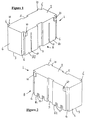
- a concrete structural acoustic block 1 of the invention is of generally cuboidal shape, having six generally oblong rectangular faces A, B, 2, 3 and 4 each disposed at a right angle to its neighbouring faces.
- the concrete can be of any composition that meets the designer's requirements for weight, strength, finish and cost.
- the block 1 presents opposed first and second major side faces which, when laid with other similar blocks 1 to form a blockwork wall, define the exposed sides of the wall.
- these major side faces of the block 1 will be referred to hereinafter simply as side faces A and B.
- the block 1 also has a top face 2, a bottom face 3 and two end faces 4.
- the prototype block 1 illustrated in the Figures and tested to date measures overall 440mm in length, 190mm in width and 215mm in height.
- the weight of the block 1 is less than 25kg.
- Each side face A and B is indented by three continuous elongate recesses 5, 6 - one inner recess 5 and two outer recesses 6 - that cross the side faces A and B from the top face 2 to the bottom face 3.
- the recesses 5, 6 are parallel to the end faces 4 and to each other, and each interrupt the long side edges of the top face 2 and the bottom face 3.
- the inner recess 5 bisects each side face A and B to define generally equal face portions A1 and A2 on side face A and B1 and B2 on side face B.
- the inner recess 5 has a base and two parallel sides.
- a respective outer recess 6 or rebate is situated at each end of each side face A and B.
- Each outer recess 6 has a side defining a respective end edge of the corresponding side face A or B but is open to the corresponding end face 4 of the block.
- the plain rectangular end faces 4 of the block 1 are therefore narrower than the distance between side faces A and B, by twice the depth of each outer recess 6.
- each outer recess 6 is marginally less than half the width of the inner recess 5, for example 27.5mm for each outer recess 6 vs. 65mm for the inner recess 5 in the prototype block.
- the idea of this is that when identical blocks 1 are laid end-to-end in horizontal courses, the adjoining outer recesses 6 of two adjacent blocks 1 will abut to form a recess of similar width to the inner recess 5, allowing for a typical thickness of say 10mm of mortar between the blocks.
- Each side face A and B has two integral rectangular spacers 10 or nibs that protrude orthogonally outwardly from the general plane of the respective side faces A and B.
- the spacers 10 are situated in an outermost and uppermost position with respect to the side faces A and B: the spacers 10 therefore create projections that interrupt the long side edges of the top face 2 and the end edges of the side faces A and B.
- the spacers 10 stand proud by 10mm from the side faces A and B and are 35mm high by 22.5mm wide.
- FIG 10 shows a course of blocks 1 from above when in use, supporting two sheets of plasterboard 9 (one on each side) via an array of mortar dabs 7 applied to the recesses 5, 6 of the blocks.
- the mortar dabs 7 were initially thicker than the combined depth of the recesses 5, 6 and the height of the spacers 10.
- the dabs 7 have been flattened by applying the plasterboard 9 to them and then pressing the plasterboard 9 against the blockwork until it bears against the spacers 10 and so can go no further.
- the spacers 10 ensure that a cavity 11 of whatever depth may be deemed optimum (in the prototype block 1, 10mm) is maintained between the plasterboard 9 and the face of the blockwork.
- the spacers 10 allow positioning of the plasterboard 9 to be transformed from a matter of inaccurate guesswork or, at best, a painstaking task for skilled labour to a foolproof process allowing readily-achievable and repeatable accuracy.
- Similar accuracy can be achieved by using timber battens 8 in the channels or recesses 5, 6, either instead of or in addition to mortar dabs 7.
- the battens 8 have a thickness equal to the depth of the recesses 5, 6 plus the height of the spacers 10 - in the prototype illustrated, 25mm.
- the battens 8 can be attached to the blockwork by any suitable means, preferably by nails, and the plasterboard 9 can in turn be attached to the battens 8 by any suitable means but again preferably by nails.
- the battens 8 are short discontinuous pieces leaving intermittent gaps in each channel, rather than defining closed cells bounded by lengthy battens. This is to allow a reasonably unobstructed flow of air across the cavity 11, which is believed to help the sound waves spread across the face of the blockwork, aiding their subsequent absorption by the blocks 1. This process of spreading or diffusion may be helped by the undulating face of the blockwork due in large part to the recesses 5, 6. Other shaping may be applied to the side faces A, B of the blocks 10 to aid the diffusion of sound energy.
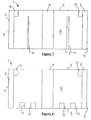
- the block 1 is hollow: it contains two major acoustic chambers CA1 and CA2 and four minor acoustic chambers CB.
- Each chamber CA1, CA2, CB is generally cuboidal, being defined by five internal faces each disposed at right angles to each of its neighbouring faces. There are only five internal faces because each chamber CA1, CA2, CB is wholly open at its bottom end to the bottom face 3 of the block 1. This is a prerequisite of manufacturing by moulding.
- the major chambers CA1, CA2 occupy respective opposed end portions of the block 1. They are separated and partially defined by a thick central partition 12 that extends from side face A to side face B within the block 1, in the region of the inner recesses 5. Otherwise, the major chambers CA1, CA2 are defined by end walls 13 that define the end faces 4, side walls 14A, 14B that define the side faces A and B respectively and a top wall (visible only as the top face 2 in the Figures) that defines the top face 2 of the block. In the prototype block 1 of the Figures, all of these walls 12, 13, 14A, 14B are at least 20mm thick and in most cases thicker than that: this ensures good load-bearing characteristics.
- the depth of the major chambers CA1, CA2 occupies most of the height of the block 1 between the top face 2 and the bottom face 3, except for the thickness of the top wall that closes the top of each major chamber CA1, CA2.
- the top wall is 35mm thick.
- the minor chambers CB are set in to or embedded in the side wall 14B that defines side face B of the block. They are much smaller than the major chambers CA1, CA2 both in width and also in depth, which does not extend far from the bottom face 3 of the block 1, occupying only a minor portion of the height of the block 1 as can be seen. Indeed, the minor chambers CB are so small that they do not significantly weaken the side wall 14B in which they are situated. Moreover, the minor chambers CB can be provided in such numbers as to offset their small size by increasing their aggregate orifice area, thus absorbing more of the sound energy to whose frequency they are tuned.
- Each chamber CA1, CA2, CB is entirely closed on three sides as well as at its top, but the other side - the side adjacent to side face A for the major chambers CA1, CA2 and to side face B for the minor chambers CB - is penetrated by an orifice in the form of an oblong parallel-sided slot 15 that penetrates the respective side face A or B as appropriate.
- the slots 15 extend generally parallel to the end faces 4 of the block 1 and, like the chambers CA1, CA2, CB, are open to the bottom face 3 of the block.
- the chambers CA1, CA2, CB therefore assume a general C-shape in bottom plan view, as best shown in Figure 6.
- Chamber CA1 the largest acoustic chamber and the larger of the two major chambers, lies behind one face portion A1 of side face A.
- chamber CA1 measures 105mm x 170mm in plan and is 170mm deep. It communicates with a slot 15 10mm wide that penetrates a side wall 14A 40mm thick and bisects side face portion A1.
- the resonant frequency of this chamber has been found to be 173 Hz.
- Chamber CA2 lies behind another face portion A2 of side face A; it is the smaller of the two major chambers.
- chamber CA2 measures 105mm x 105mm in plan and is 170mm deep. It communicates with a slot 15 5mm wide that penetrates a side wall 14A 20mm thick and bisects side face portion A2. Its resonant frequency has been found to be 208 Hz.
- the four minor chambers CB are all identical in the abovementioned prototype block. They each measure 37mm x 10mm in plan and are 30mm deep. Each communicates with a slot 15 25mm wide that penetrates 10mm into the wall 14B. The resonant frequency of these, the smallest chambers, has been found to be 3109 Hz.
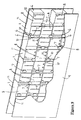
- the visible face of the blockwork of Figure 12 presents an equal distribution of side faces B to side faces A, but it would be equally possible to vary the relative proportions of the side faces simply by reversing more or less of the blocks 1 in relation to the other blocks 1 of the wall.
- This is an exceptionally simple way to tailor the acoustics of the wall if different sound frequencies are expected from different sides of the wall. Indeed, in the extreme, all of the blocks 1 could be disposed the same way round. However, in most party wall constructions one would normally expect and cater for the same sound frequencies from both sides of the wall: in that case, the simple alternation of the blockwork of Figure 12 is all that is required.
- a block 16 is akin to the prototype block 1 illustrated in the preceding Figures, and like numerals are used to identify like parts.
- the walls, faces and edges defining features such as the slots 15, chambers CA1, CA2, CB1, CB2 and spacer nibs 10 taper, all with the aim of easing demoulding.
- the walls of female features such as the slots 15 taper inwardly towards the top 2 of the block 16, whereas the walls of male features such as the spacers 10 taper inwardly towards the bottom 3 of the block 16. Similar tapering may also be applied to the main external faces of the block 16, for the same reason.
- FIG. 16 Another variation of block 16 is that the four minor chambers CB are no longer all identical: they are divided into two pairs CB1, CB2, one pair on each side face portion B1 and B2 of side face B. Taper aside (balanced by being enlarged to 40mm x 10mm in bottom plan view), chambers CB1 are the same as chambers CB of the prototype block 1 and have the same nominal resonant frequency of 3109 Hz. Chambers CB2, on the other hand, are a little larger than chambers CB1 and hence resonate at a correspondingly lower frequency: chambers CB2 are 40mm x 15mm in bottom plan view and have a nominal resonant frequency of 2511 Hz, although they communicate through slots 15 of the same size as those associated with chambers CB1.
- a further variation of block 16 is that only one spacer 10 is provided on each side face A, B. These two spacers 10 of the block 16 are diagonally opposed about the top face 2. Thanks to this, when two blocks 16 are laid side face-to-side face in a 'cubed' arrangement, their spacers 10 do not clash; instead, each spacer 10 bears against the adjacent side face of the other block 16.
- each side face A, B in corresponding but opposed positions with respect to the spacers 10.
- Each hollow would be shaped and dimensioned to accommodate a spacer 10 of an adjacent block laid in a cubed arrangement, thereby allowing the side faces A, B of the cubed blocks to lie flush against each other.
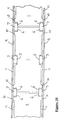
- Figures 15 and 16 illustrate a set of blocks 17, 18, 19, 20 laid sequentially end-to-end in a row to form part of a course, the blocks being modified in accordance with a further embodiment of the invention.
- the blocks 17, 18, 19, 20 in the row are shown inverted in Figures 15 and 16 to display the internal features that are only evident from their undersides, particularly the different chamber sizes therein.
- the blocks 17, 18, 19, 20 would of course be laid the other way up in practice to prevent mortar falling into the chambers CA, CB or the slots 15.
- the blocks 17, 18, 19, 20 therein are of four different types.
- Three blocks 17, 18, 19 each have a single major chamber CA of relatively large volume, intermediate volume and small volume respectively.
- the block 17 containing the large chamber CA lies between the blocks 18 and 19 containing the intermediate and small chambers CA.
- the fourth block 20 has no major chamber at all, being solid save for the pair of minor chambers CB1 and CB2 that are common to all of the four types of block 17, 18, 19, 20.
- the blocks 17, 18 and 19 are akin to a major portion of a block 1 or 16 of the preceding Figures created by dividing the block 1 or 16 along the offset central partition 12.
- This analogy is apt because the blocks 17, 18, 19 and 20 of Figures 15 and 16 are intended to be smaller than the blocks 1 and 16 of Figures 1 to 14.
- the aim is to ensure that no block 17, 18, 19, 20 is heavier than 20kg and is therefore comfortably within any foreseeable statutory limits on the weight that can be lifted repetitively by one worker.
- each block 17, 18, 19, 20 for example a length of about 300mm. This in turn permits only one major chamber in each block 17, 18, 19 while leaving enough wall thickness for structural strength and acoustically-beneficial mass.
- each major chamber CA is offset where possible towards the side face A with which it communicates through a slot 15.
- the side wall 14B is therefore substantially thicker than the side wall 14A to an extent permitted by the size of the chamber CA, creating a zone of increased mass behind the internal wall of the major chamber CA that is opposed to the slot 15. In acoustic testing, this zone of increased mass opposed to the slot 15 has been found beneficial to the absorption of sound that would otherwise tend to travel straight through the block 17, 18, 19, 20 via the slot 15.
- the aforementioned need to absorb different sound frequencies in a party wall construction imposes a requirement for a mix of differently-sized major chambers CA and hence a mix of different blocks 17, 18 and 19 in the party wall.
- the combination of three blocks 17, 18 and 19 allows the acoustic properties of the wall to be tailored, each block responding to a selected frequency range so that, for example, the intermediate chamber CA of block 18 fills a gap in sound absorption curves between the larger and smaller chambers CA of blocks 17 and 19 respectively.
- substantially solid block 20 Whilst the substantially solid block 20 has no major chamber, its inclusion in the mix of blocks is desirable because the solid block adds to the overall mass of the wall. Mass is a fundamental factor in the sound absorption characteristics of a structure as a whole; generally speaking, more mass is better for sound absorption for reasons of rigidity and because a greater mass takes more energy to vibrate although, in isolation, mass is not a cure-all. Acoustic test results also suggest that it is advantageous to start and finish each course of blocks with a substantially solid block where the party wall joins to a flanking wall.
- each end face 4 of each block 17, 18, 19, 20 is heavily stepped in plan view to create a rebate defined by a shoulder 21 disposed orthogonally between first and second end face portions 4A and 4B.
- the shoulder 21 thus lies in a plane parallel to the side faces A and B of the block 17, 18, 19, 20, and each end face 4 is broadly of L-shape in plan view.
- End face portion 4A extends from the shoulder 21 to side face A and end face portion 4B extends from the shoulder 21 to side face B of the block 17, 18, 19, 20.
- the position or offset of the shoulder 21 in relation to the side faces A and B and hence the relative sizes of the end face portions 4A and 4B vary from one block 17, 18, 19, 20 to the next.
- the shoulder 21 at the left end of a first, solid block 20 is close to side face B.
- the shoulder 21 on the right end of that block 20 is centrally positioned between the side faces A and B.
- the shoulder 21 on the left end of the second, intermediate-chamber block 18 is correspondingly centrally positioned between the side faces A and B, so that the blocks 20 and 18 can seat snugly against each other with their shoulders 21 abutting and their side faces A and B aligned with their counterparts.
- the side faces A and B then lie in respective parallel planes that define at least one of the exposed faces of the courses and thus of the wall.
- the shoulder 21 on the right end of the second block 18 is closer to the side face B, and so the shoulder 21 on the left end of the third, large-chamber block 17 is positioned to match.
- the shoulder 21 on the right end of the third block 17 is still closer to the side face B, and the shoulder 21 on the left end of the fourth, small-chamber block 19 is positioned to match.
- the shoulder 21 on the right end of the fourth block 19 is as close to the side face B as was the shoulder 21 at the left end of the first, solid block 20 at the left end of the row. Accordingly, another solid block 20 can be the fifth block of the row as illustrated, and the sequence starts again.
- a beneficial side-effect of the cooperating and mating end formations 4A, 4B, 21 is that they create a labyrinthine junction that helps to prevent transmission of sound through gaps between the blocks 17, 18, 19, 20, even if the application of mortar is incomplete. It will be noted in this respect that the facing shoulders 21 of adjacent blocks 17, 18, 19, 20 can be in direct face-to-face contact with each other while a space is preserved between the opposed end face portions 4A, 4B of the adjacent blocks to accommodate mortar.
- the shoulders 21 of the solid block 20 will only abut the shoulder 21 of an adjacent block when laid in the positional sequence illustrated.
- a solid block 20 can be placed out of sequence in a manner that leaves a gap between its shoulder and the shoulder 21 of an adjacent block 17, 18, 19, 20 but still allows the blocks 17, 18, 19, 20 to lie in proper alignment with their side faces A and B in the general plane of the course.
- this is achieved by ensuring that one end 4 of the block 20 has its shoulder 21 closer than that of any other block 17, 18, 19 to one side face A and that the other end 4 of the block 20 has its shoulder 21 closer than that of any other block 17, 18, 19 to the other side face B.
- the shoulder 21 at the left end of the block 20 is closer than the shoulder 21 of any other block 17, 18, 19 to side face B and the shoulder 21 at the right end of the block 20 is closer than the shoulder 21 of any other block 17, 18, 19 to side face A.
- the blocks 17, 18, 19, 20 are preferably laid so that successive courses alternate, one course having its major chambers CA all opening to one side of the wall and the adjacent course(s) above and/or below having their major chambers CA all opening to the other side of the wall.
- the minor chambers CB1 and CB2 are set in to or embedded in the side wall 14B that defines side face B of a block 17, 18, 19, 20, extending only a short distance from the bottom face 3 of the block 17, 18, 19, 20 to occupy only a minor portion of the height of the block 17, 18, 19, 20. Also, whilst the tapering of the various features evident in block 16 of Figures 13 and 14 is not evident in the schematically-illustrated blocks 17, 18, 19, 20 of Figures 15 and 16, such tapering can be applied in practice.
- each spacer 10 is situated in a top corner of the respective side faces A and B and the spacers are diagonally opposed about the top face 2.
- the invention is particularly suitable for constructing partitions such as party walls
- the invention could also be used with benefit in external walls where an internal side of the block is used for its anti-reflective properties and an external side is adapted to absorb incoming ambient sound. It is also possible to use structural elements designed in accordance with the invention to construct or to line floors and ceilings.
- acoustic barrier which may be a free-standing wall or a retaining wall
- sound-absorbing orifices and, optionally, sound-diffusing formations are concentrated on one side of a block.
- minor chambers can be set in to the side wall of the block that includes orifices leading to major chambers situated within the block behind the minor chambers.
- the other side of the block can have a split face or other decorative finish that is free of orifices.
- spacers and recesses of the preferred embodiments can also be applied to conventional elements such as the conventional acoustic blocks sold by Trenwyth Industries, Inc. or indeed typical non-acoustic blocks that do not have acoustic chambers and orifices.
Landscapes
- Engineering & Computer Science (AREA)
- Architecture (AREA)
- Physics & Mathematics (AREA)
- Civil Engineering (AREA)
- Structural Engineering (AREA)
- Electromagnetism (AREA)
- Acoustics & Sound (AREA)
- Building Environments (AREA)
Applications Claiming Priority (2)
| Application Number | Priority Date | Filing Date | Title |
|---|---|---|---|
| GB9904253A GB2334537B (en) | 1998-02-24 | 1999-02-24 | Acoustic structural elements |
| GB9904253 | 1999-02-24 |
Publications (2)
| Publication Number | Publication Date |
|---|---|
| EP1031671A2 true EP1031671A2 (de) | 2000-08-30 |
| EP1031671A3 EP1031671A3 (de) | 2002-11-13 |
Family
ID=10848421
Family Applications (1)
| Application Number | Title | Priority Date | Filing Date |
|---|---|---|---|
| EP99305582A Withdrawn EP1031671A3 (de) | 1999-02-24 | 1999-07-14 | Tragende Schalldämmelemente |
Country Status (1)
| Country | Link |
|---|---|
| EP (1) | EP1031671A3 (de) |
Cited By (12)
| Publication number | Priority date | Publication date | Assignee | Title |
|---|---|---|---|---|
| US8028800B2 (en) | 2009-04-10 | 2011-10-04 | Saint-Gobain Performance Plastics Rencol Limited | Acoustic damping compositions |
| RU2528357C1 (ru) * | 2013-08-19 | 2014-09-10 | Олег Савельевич Кочетов | Акустический экран кочетова |
| RU2528353C1 (ru) * | 2013-08-21 | 2014-09-10 | Олег Савельевич Кочетов | Панель шумопоглощающая кочетова |
| RU2528362C1 (ru) * | 2013-08-21 | 2014-09-10 | Олег Савельевич Кочетов | Шумопоглощающая панель кочетова |
| RU2528356C1 (ru) * | 2013-08-19 | 2014-09-10 | Олег Савельевич Кочетов | Звукопоглощающая конструкция кочетова |
| RU2528802C1 (ru) * | 2013-08-19 | 2014-09-20 | Олег Савельевич Кочетов | Звукопоглощающий элемент |
| RU2531154C1 (ru) * | 2013-08-19 | 2014-10-20 | Олег Савельевич Кочетов | Звукопоглощающая конструкция |
| US9637913B2 (en) | 2009-04-10 | 2017-05-02 | Saint-Gobain Performance Plastics Corporation | Acoustic damping compositions having elastomeric particulate |
| WO2017093693A1 (fr) * | 2015-12-02 | 2017-06-08 | Université de Franche-Comté | Métamatériau acoustique absorbant |
| RU2641330C1 (ru) * | 2017-03-14 | 2018-01-17 | Олег Савельевич Кочетов | Акустический экран для безопасной деятельности человека-оператора |
| RU2646256C1 (ru) * | 2017-03-07 | 2018-03-02 | Олег Савельевич Кочетов | Акустический экран для производственных помещений |
| RU2648087C1 (ru) * | 2017-03-07 | 2018-03-22 | Олег Савельевич Кочетов | Акустический экран |
Citations (4)
| Publication number | Priority date | Publication date | Assignee | Title |
|---|---|---|---|---|
| US2933146A (en) | 1956-01-26 | 1960-04-19 | Zaldastani Othar | Structural material |
| US3506089A (en) | 1968-10-25 | 1970-04-14 | Cambridge Acoustical Associate | Sound absorptive structural block |
| US3837426A (en) | 1974-01-04 | 1974-09-24 | Junger M | Sound absorbing structural block |
| US3866001A (en) | 1974-03-04 | 1975-02-11 | Junger Miguel C | Structural block with septum |
Family Cites Families (4)
| Publication number | Priority date | Publication date | Assignee | Title |
|---|---|---|---|---|
| US4071989A (en) * | 1976-01-19 | 1978-02-07 | Warren Insulated Bloc, Inc. | Sound insulative masonry block |
| DE4101125A1 (de) * | 1991-01-16 | 1992-07-23 | Mantel Juval | Verbesserte, schalldaemmende ziegel |
| US5226267A (en) * | 1991-10-23 | 1993-07-13 | Rpg Diffusor Systems, Inc. | Acoustical diffusing and absorbing cinder blocks |
| US5551198A (en) * | 1995-05-09 | 1996-09-03 | Schaaf; Cecil F. | Sound collecting block and sound absorbing wall system |
-
1999
- 1999-07-14 EP EP99305582A patent/EP1031671A3/de not_active Withdrawn
Patent Citations (4)
| Publication number | Priority date | Publication date | Assignee | Title |
|---|---|---|---|---|
| US2933146A (en) | 1956-01-26 | 1960-04-19 | Zaldastani Othar | Structural material |
| US3506089A (en) | 1968-10-25 | 1970-04-14 | Cambridge Acoustical Associate | Sound absorptive structural block |
| US3837426A (en) | 1974-01-04 | 1974-09-24 | Junger M | Sound absorbing structural block |
| US3866001A (en) | 1974-03-04 | 1975-02-11 | Junger Miguel C | Structural block with septum |
Cited By (14)
| Publication number | Priority date | Publication date | Assignee | Title |
|---|---|---|---|---|
| US9637913B2 (en) | 2009-04-10 | 2017-05-02 | Saint-Gobain Performance Plastics Corporation | Acoustic damping compositions having elastomeric particulate |
| US8028800B2 (en) | 2009-04-10 | 2011-10-04 | Saint-Gobain Performance Plastics Rencol Limited | Acoustic damping compositions |
| RU2531154C1 (ru) * | 2013-08-19 | 2014-10-20 | Олег Савельевич Кочетов | Звукопоглощающая конструкция |
| RU2528357C1 (ru) * | 2013-08-19 | 2014-09-10 | Олег Савельевич Кочетов | Акустический экран кочетова |
| RU2528356C1 (ru) * | 2013-08-19 | 2014-09-10 | Олег Савельевич Кочетов | Звукопоглощающая конструкция кочетова |
| RU2528802C1 (ru) * | 2013-08-19 | 2014-09-20 | Олег Савельевич Кочетов | Звукопоглощающий элемент |
| RU2528362C1 (ru) * | 2013-08-21 | 2014-09-10 | Олег Савельевич Кочетов | Шумопоглощающая панель кочетова |
| RU2528353C1 (ru) * | 2013-08-21 | 2014-09-10 | Олег Савельевич Кочетов | Панель шумопоглощающая кочетова |
| WO2017093693A1 (fr) * | 2015-12-02 | 2017-06-08 | Université de Franche-Comté | Métamatériau acoustique absorbant |
| FR3044812A1 (fr) * | 2015-12-02 | 2017-06-09 | Univ De Franche-Comte | Metamateriau acoustique absorbant |
| US11081095B2 (en) | 2015-12-02 | 2021-08-03 | Université de Franche-Comté | Absorbent acoustic metamaterial |
| RU2646256C1 (ru) * | 2017-03-07 | 2018-03-02 | Олег Савельевич Кочетов | Акустический экран для производственных помещений |
| RU2648087C1 (ru) * | 2017-03-07 | 2018-03-22 | Олег Савельевич Кочетов | Акустический экран |
| RU2641330C1 (ru) * | 2017-03-14 | 2018-01-17 | Олег Савельевич Кочетов | Акустический экран для безопасной деятельности человека-оператора |
Also Published As
| Publication number | Publication date |
|---|---|
| EP1031671A3 (de) | 2002-11-13 |
Similar Documents
| Publication | Publication Date | Title |
|---|---|---|
| US7513082B2 (en) | Sound reducing system | |
| EP1031671A2 (de) | Tragende Schalldämmelemente | |
| ES2227788T3 (es) | Estructura acustica de edificacion. | |
| US9353520B2 (en) | Energy and weight efficient building block, manufacturing and application process thereof | |
| JP7016132B2 (ja) | 連結式建設用ブロック | |
| KR20090003503U (ko) | 레실리언트 채널을 이용한 건식벽체 | |
| US3817013A (en) | Insulated concrete block | |
| GB2334537A (en) | Acoustic structural elements | |
| IE83549B1 (en) | Acoustic structural elements | |
| KR102567893B1 (ko) | 콘크리트 구조체를 이용한 조립식 벽체 | |
| US20080168725A1 (en) | Masonry Wall System | |
| EP1214484B1 (de) | Verbesserte baukonstruktion mit betonschalungswänden | |
| ES2551884T3 (es) | Sistema de bloques de encofrado, estructura construida con el mismo y método para la construcción de una estructura | |
| JP3909938B2 (ja) | 床衝撃音低減構造 | |
| CA3231616A1 (en) | Structural load-bearing wall | |
| KR101680738B1 (ko) | 공동주택용 차음벽 | |
| US20210230868A1 (en) | Improvements in or relating to building structures | |
| KR200268198Y1 (ko) | 다층건축물의 바닥충격음 저감패널 | |
| US5341618A (en) | Non-rectangular block and wall | |
| ES2233150B2 (es) | Sistema constructivo para la instalacion de elementos divisorios de elevado aislamiento acustico. | |
| KR20120006062U (ko) | 구운 황토벽돌 | |
| RU2583383C1 (ru) | Комплект строительных блоков для скоростного возведения малоэтажных зданий | |
| JPH031459B2 (de) | ||
| KR200335404Y1 (ko) | 자체결합식 건축 벽재 | |
| JPH0444726Y2 (de) |
Legal Events
| Date | Code | Title | Description |
|---|---|---|---|
| PUAI | Public reference made under article 153(3) epc to a published international application that has entered the european phase |
Free format text: ORIGINAL CODE: 0009012 |
|
| AK | Designated contracting states |
Kind code of ref document: A2 Designated state(s): AT BE CH CY DE DK ES FI FR GB GR IE IT LI LU MC NL PT SE |
|
| AX | Request for extension of the european patent |
Free format text: AL;LT;LV;MK;RO;SI |
|
| PUAL | Search report despatched |
Free format text: ORIGINAL CODE: 0009013 |
|
| AK | Designated contracting states |
Kind code of ref document: A3 Designated state(s): AT BE CH CY DE DK ES FI FR GB GR IE IT LI LU MC NL PT SE |
|
| AX | Request for extension of the european patent |
Free format text: AL;LT;LV;MK;RO;SI |
|
| RIC1 | Information provided on ipc code assigned before grant |
Free format text: 7E 04B 1/84 A, 7E 01F 8/00 B, 7E 04B 2/18 B |
|
| 17P | Request for examination filed |
Effective date: 20030512 |
|
| RAP1 | Party data changed (applicant data changed or rights of an application transferred) |
Owner name: FORTICRETE LIMITED |
|
| 17Q | First examination report despatched |
Effective date: 20030617 |
|
| AKX | Designation fees paid |
Designated state(s): GB IE |
|
| REG | Reference to a national code |
Ref country code: DE Ref legal event code: 8566 |
|
| STAA | Information on the status of an ep patent application or granted ep patent |
Free format text: STATUS: THE APPLICATION IS DEEMED TO BE WITHDRAWN |
|
| 18D | Application deemed to be withdrawn |
Effective date: 20050909 |