EP1031906A2 - Verfahren und Kopplungsvorrichtung zur Verhinderung eines auf einem Mikroprozessor unerlaubten Zugriffs - Google Patents
Verfahren und Kopplungsvorrichtung zur Verhinderung eines auf einem Mikroprozessor unerlaubten Zugriffs Download PDFInfo
- Publication number
- EP1031906A2 EP1031906A2 EP00103666A EP00103666A EP1031906A2 EP 1031906 A2 EP1031906 A2 EP 1031906A2 EP 00103666 A EP00103666 A EP 00103666A EP 00103666 A EP00103666 A EP 00103666A EP 1031906 A2 EP1031906 A2 EP 1031906A2
- Authority
- EP
- European Patent Office
- Prior art keywords
- processor
- component
- interface
- disabling
- indication
- Prior art date
- Legal status (The legal status is an assumption and is not a legal conclusion. Google has not performed a legal analysis and makes no representation as to the accuracy of the status listed.)
- Granted
Links
Images


Classifications
-
- G—PHYSICS
- G06—COMPUTING OR CALCULATING; COUNTING
- G06F—ELECTRIC DIGITAL DATA PROCESSING
- G06F21/00—Security arrangements for protecting computers, components thereof, programs or data against unauthorised activity
- G06F21/70—Protecting specific internal or peripheral components, in which the protection of a component leads to protection of the entire computer
- G06F21/71—Protecting specific internal or peripheral components, in which the protection of a component leads to protection of the entire computer to assure secure computing or processing of information
-
- G—PHYSICS
- G06—COMPUTING OR CALCULATING; COUNTING
- G06F—ELECTRIC DIGITAL DATA PROCESSING
- G06F21/00—Security arrangements for protecting computers, components thereof, programs or data against unauthorised activity
- G06F21/70—Protecting specific internal or peripheral components, in which the protection of a component leads to protection of the entire computer
- G06F21/81—Protecting specific internal or peripheral components, in which the protection of a component leads to protection of the entire computer by operating on the power supply, e.g. enabling or disabling power-on, sleep or resume operations
-
- G—PHYSICS
- G06—COMPUTING OR CALCULATING; COUNTING
- G06F—ELECTRIC DIGITAL DATA PROCESSING
- G06F11/00—Error detection; Error correction; Monitoring
- G06F11/07—Responding to the occurrence of a fault, e.g. fault tolerance
- G06F11/0703—Error or fault processing not based on redundancy, i.e. by taking additional measures to deal with the error or fault not making use of redundancy in operation, in hardware, or in data representation
- G06F11/0751—Error or fault detection not based on redundancy
- G06F11/0754—Error or fault detection not based on redundancy by exceeding limits
- G06F11/0757—Error or fault detection not based on redundancy by exceeding limits by exceeding a time limit, i.e. time-out, e.g. watchdogs
Definitions
- the invention concerns generally the technology of protecting electronic circuits and their stored programs against unauthorized access. Especially the invention concerns the technology of preventing the unauthorized use of a certain interface to a processor.
- a microprocessor may comprise a so-called debug interface for providing extensive control over the operation of the processor.
- the debug interface can be used e.g. for uploading and downloading programs, reading the contents of the internal registers of the processor and performing step-by-step execution of stored programs.
- the debug interface offers a more or less direct access to all such functional features of the processor which may be proprietary to the manufacturer and/or authorized operator of the device. Manufacturers are therefore very eagerly looking for solutions which would prevent the unauthorized use of the debug interface.
- Depending on the structure of the processor there may also be other processor interfaces that should be similarly protected.
- An additional object of the invention is to implement the protection without a large number of additional components.
- the objects of the invention are achieved by associating the use of the debug interface with a change in a certain routine performed by the processor, arranging for the detection of such a change outside the processor and linking the detection with the disabling of a major part of the processor's operation if a certain enabling procedure has not been activated.
- the method according to the invention is characterized in that it comprises the steps of
- the invention also applies to a circuit arrangement which comprises a processor and within the processor a first interface. It is characterized in that for preventing the unauthorized use of the first interface it comprises
- the invention applies to an electronic device which is characterized in that for preventing the unauthorized use of a certain first interface to a processor it comprises
- a processor-controlled electronic device comprises also other components, among which there may be another circuit that is programmable in the sense that it can be arranged to wait for certain inputs and react to them with a certain response.
- such an external circuit is arranged to act like a so-called watchdog: the processor the interface(s) of which should be protected has to regularly "pat the watchdog" or give a certain input to the external circuit in order to keep it from disabling at least a major part of the processor's operation.
- the processor is also arranged to associate the use of a protected interface with delaying or stalling the issuance of such inputs, so normally an attempt to use the protected interface will result in at least a major part of the processor's operation being disabled.
- An authorized user knows a secret command or procedure that will either keep the external circuit from reacting or override the reaction so that the processor remains operative.
- the concept of "patting the watchdog” may also be understood in an inverse manner: under normal conditions the processor does not issue inputs to the external circuit, which keeps the processor enabled. An attempt to use the protected interface(s) causes the processor to issue an alarm to the external circuit which in turn disables at least a major part of the processor's operation. A release command or procedure is available for authorized users to keep the alarm from causing the disabling.
- Figs. 1a to 1c show a processor 101 with an interface 102 which should be protected against unauthorized access. Another part of the arrangement is a watchdog circuit 103. Under normal conditions, when there are no attempts to use the interface 102, the processor issues regularly a piece of input information to the watchdog circuit according to the "PAT" arrow. As a result the watchdog circuit 103 enables the operation of the processor 101 according to the "ENABLE” arrow.
- the processor 101 has been so constructed and programmed that when an attempt is made to use the protected interface 102 as in Fig. 1b, the processor stalls or delays the issuance of inputs to the watchdog circuit 103. The latter normally responds by disabling at least a major part of the processor's operation.
- FIG. 1c illustrates a situation where the attempt to use the protected interface 102 is accompanied with a release command to the watchdog circuit.
- the release command keeps the watchdog circuit 103 from disabling the processor 101 so that the user which knew the correct release command may proceed in using the protected interface e.g. for debugging a newly loaded software in the processor.
- Figs. 2a to 2c show again a processor and a watchdog circuit which now have been designated as 101 and 103 respectively because their operation differs slightly from that of the processor 101 and watchdog circuit 103 of Figs. 1a to 1c.
- An attempt to use the protected interface causes an alarm to be issued to the watchdog circuit 103 according to Fig. 2b, which disables at least a major part of the operation of the processor 101 . If the attempted use of the protected interface is accompanied with a certain release command as in Fig. 2c, the watchdog circuit 103 ignores the alarm and allows the enabled operation of the processor 101 to continue.
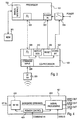
- Fig. 3 is an exemplary coupling arrangement which can be used to implement the principle of Figs. 1a to 1c.
- the arrangement comprises a processor 101 with a debug interface 102 to be protected as well as a co-processor 103 that acts as a watchdog circuit.
- the debug interface is coupled to a Background Debugging Mode connector 301.
- the other displayed functional blocks of the processor 101 are the I 2 C interface block 302 and the Power In block 303.
- the former is an interface block known as such: the I 2 C interface is a two-wire de facto industrial standard bus for coupling programmable circuit elements locally together.
- the Power In block 303 is responsible for providing operational voltages for at least a major part of the processor 101.
- the co-processor 103 It is coupled to a power source through a switch 304 and has also other of which a reset input has been shown.
- Some of the specifically shown operational blocks of the co-processor 103 are the I 2 C interface block 305, the reset signal output block 306, the standby signal output block 307 and the command input block 308. Of these the first one is for communicating with the main processor 101, the reset signal output block 306 is for issuing reset commands to the main processor 101, the standby signal output block 307 is for controlling the switch 304 and the command input block 308 is for receiving commands from external sources like an infrared receiver 309. There is also a watchdog block 310 the implementation and operation of which are described in more detail below.
- a simple implementation is based on a watchdog register within block 310.
- the co-processor receives a "patting" signal through the I 2 C interface, it resets the value of such a register to zero or other suitable fixed value. Between patting signals the co-processor regularly increments (or decrements) the value of the watchdog register. If the value reaches a certain limit, the co-processor takes it as an indication that the main processor is not responding any more. According to the principle of Figs. 1a to 1c it transmits, through the standby signal output block 307, a signal that opens the switch 304. The main processor is thus blacked out completely. In a typical mode of operation the co-processor activates simultaneously the reset signal to block 303.
- the recovery from the standby/reset condition occurs as determined in the program executed by the co-processor 103.
- a feasible mode of operation is such where the co-processor waits for a certain delay interval, then releases the standby signal causing the switch 304 to close and thereafter releases the reset signal. If the unauthorized user is still attempting to use the debug interface, the main processor does not even start issuing the "watchdog patting" signals so the watchdog register in the co-processor will soon reach its limit value again, causing another processor shutdown round. Only after the unauthorized attempts for using the debug interface 102 have been stopped, the processor 101 may resume normal operation.
- An authorized debugging user of the system of Fig. 3 has an infrared transmitter which has been programmed to transmit a secret code word. If the co-processor 103 receives the code word through its command input block 308, it either stops incrementing (or decrementing) the value of the watchdog register in block 310 or disables the issuance of reset and standby signals from blocks 306 and 307 irrespective of the value of the watchdog register. These functions are again most advantageously realized through corresponding sets of instructions in the program executed by the co-processor. Through similar programming the co-processor may also be arranged to release an already-issued reset and/or standby signal as a response to a certain secret command or code word.
- Fig. 3 The coupling arrangement of Fig. 3 is easily generalized to implement the principle of Figs. 2a to 2c: the I 2 C interface is now used to carry the alarm signal, and the watchdog register 310 can be omitted.
- the main processor When an alarm signal is received in the co-processor, it sets the main processor into the standby mode by cutting the main power line with switch 304. Recovery takes place after the alarm signal is not active any more.
- the previously described principle is regarded as more advantageous because the standby condition is entered also if for some other reason the processor stops responding.
- Fig. 4 illustrates an exemplary electronic device where the invention may be applied.
- the device is a multimedia terminal 401 where a radio frequency receiver 402 is arranged to receive a (number of) radio frequency signal(s) and convert it/them to a (number of) baseband stream(s).
- a signal processing block 403 is used to further convert the baseband stream(s) to video, audio and data output signals.
- a power control block 404 is responsible for providing the voltages and reset signals to the other blocks. If the coupling arrangement of Fig. 3 is realized as a part of this exemplary device, the power control block 404 houses the co-processor and IR receiver blocks and the signal processing block consists mostly of the processor 101.
- the invention does not require the main processor and the co-processor to be physically separate entities. They may be realized within a single chip or on parallel chips in a so-called multi-chip module. Indeed the continuing miniaturization of signal processing electronics certainly calls for continuously enhancing the integration ratios, so a very plausible application for the invention is to integrate the processor and watchdog functions to a single physical entity.
Landscapes
- Engineering & Computer Science (AREA)
- Computer Hardware Design (AREA)
- Theoretical Computer Science (AREA)
- Physics & Mathematics (AREA)
- Computer Security & Cryptography (AREA)
- Software Systems (AREA)
- General Engineering & Computer Science (AREA)
- General Physics & Mathematics (AREA)
- Mathematical Physics (AREA)
- Debugging And Monitoring (AREA)
- Storage Device Security (AREA)
- Microcomputers (AREA)
Applications Claiming Priority (2)
| Application Number | Priority Date | Filing Date | Title |
|---|---|---|---|
| FI990414 | 1999-02-26 | ||
| FI990414A FI990414A7 (fi) | 1999-02-26 | 1999-02-26 | Menetelmä ja kytkentäjärjestely luvattoman pääsyn estämiseksi mikrosuorittimeen |
Publications (3)
| Publication Number | Publication Date |
|---|---|
| EP1031906A2 true EP1031906A2 (de) | 2000-08-30 |
| EP1031906A3 EP1031906A3 (de) | 2006-05-17 |
| EP1031906B1 EP1031906B1 (de) | 2010-08-18 |
Family
ID=8553960
Family Applications (1)
| Application Number | Title | Priority Date | Filing Date |
|---|---|---|---|
| EP00103666A Expired - Lifetime EP1031906B1 (de) | 1999-02-26 | 2000-02-22 | Verfahren und Kopplungsvorrichtung zur Verhinderung eines auf einem Mikroprozessor unerlaubten Zugriffs |
Country Status (7)
| Country | Link |
|---|---|
| US (1) | US6754830B1 (de) |
| EP (1) | EP1031906B1 (de) |
| AT (1) | ATE478392T1 (de) |
| DE (1) | DE60044833D1 (de) |
| ES (1) | ES2347519T3 (de) |
| FI (1) | FI990414A7 (de) |
| PT (1) | PT1031906E (de) |
Families Citing this family (3)
| Publication number | Priority date | Publication date | Assignee | Title |
|---|---|---|---|---|
| US7340596B1 (en) * | 2000-06-12 | 2008-03-04 | Altera Corporation | Embedded processor with watchdog timer for programmable logic |
| JP4302078B2 (ja) * | 2005-04-28 | 2009-07-22 | 株式会社東芝 | 電子機器 |
| US9141776B2 (en) * | 2008-04-30 | 2015-09-22 | Telefonaktiebolaget Lm Ericsson (Publ) | Method and apparatus for secure hardware analysis |
Citations (2)
| Publication number | Priority date | Publication date | Assignee | Title |
|---|---|---|---|---|
| EP0831399A2 (de) | 1996-09-12 | 1998-03-25 | United Technologies Corporation | Zeitüberwachungsschaltung |
| EP0897144A2 (de) | 1997-08-11 | 1999-02-17 | Motorola, Inc. | Verfahren und Vorrichtung zum Zugriffsschutz in einer integrierten Schaltung |
Family Cites Families (14)
| Publication number | Priority date | Publication date | Assignee | Title |
|---|---|---|---|---|
| US4494114B1 (en) | 1983-12-05 | 1996-10-15 | Int Electronic Tech | Security arrangement for and method of rendering microprocessor-controlled electronic equipment inoperative after occurrence of disabling event |
| US4791565A (en) * | 1984-06-20 | 1988-12-13 | Effective Security Systems, Inc. | Apparatus for controlling the use of computer software |
| US4766516A (en) * | 1987-09-24 | 1988-08-23 | Hughes Aircraft Company | Method and apparatus for securing integrated circuits from unauthorized copying and use |
| US4901341A (en) * | 1988-06-22 | 1990-02-13 | Messager Partners | Method and apparatus for caller-controlled receipt and delivery of voice messages |
| US5144659A (en) * | 1989-04-19 | 1992-09-01 | Richard P. Jones | Computer file protection system |
| US5440725A (en) * | 1989-06-24 | 1995-08-08 | Robert Bosch Gmbh | Microprocessor circuit arrangement with watchdog circuit |
| JPH0484348A (ja) | 1990-07-27 | 1992-03-17 | Nec Corp | Romデータ保護方式 |
| US5053992A (en) * | 1990-10-04 | 1991-10-01 | General Instrument Corporation | Prevention of inspection of secret data stored in encapsulated integrated circuit chip |
| US5406261A (en) | 1993-01-11 | 1995-04-11 | Glenn; James T. | Computer security apparatus and method |
| US5355414A (en) | 1993-01-21 | 1994-10-11 | Ast Research, Inc. | Computer security system |
| FI101031B (fi) * | 1995-05-12 | 1998-03-31 | Nokia Telecommunications Oy | Tilaajalaitteen käyttöoikeuden tarkistus |
| US5724027A (en) * | 1995-09-28 | 1998-03-03 | Intel Corporation | Method and apparatus for providing system security to personal computer systems using transparent system interrupt |
| US6272637B1 (en) * | 1997-04-14 | 2001-08-07 | Dallas Semiconductor Corporation | Systems and methods for protecting access to encrypted information |
| KR100308216B1 (ko) * | 1999-03-15 | 2001-09-26 | 윤종용 | 밀봉된 전자기기의 비인가된 개봉을 검출하는 장치 |
-
1999
- 1999-02-26 FI FI990414A patent/FI990414A7/fi unknown
-
2000
- 2000-02-22 PT PT00103666T patent/PT1031906E/pt unknown
- 2000-02-22 DE DE60044833T patent/DE60044833D1/de not_active Expired - Lifetime
- 2000-02-22 ES ES00103666T patent/ES2347519T3/es not_active Expired - Lifetime
- 2000-02-22 EP EP00103666A patent/EP1031906B1/de not_active Expired - Lifetime
- 2000-02-22 AT AT00103666T patent/ATE478392T1/de not_active IP Right Cessation
- 2000-02-25 US US09/513,594 patent/US6754830B1/en not_active Expired - Lifetime
Patent Citations (2)
| Publication number | Priority date | Publication date | Assignee | Title |
|---|---|---|---|---|
| EP0831399A2 (de) | 1996-09-12 | 1998-03-25 | United Technologies Corporation | Zeitüberwachungsschaltung |
| EP0897144A2 (de) | 1997-08-11 | 1999-02-17 | Motorola, Inc. | Verfahren und Vorrichtung zum Zugriffsschutz in einer integrierten Schaltung |
Also Published As
| Publication number | Publication date |
|---|---|
| EP1031906A3 (de) | 2006-05-17 |
| FI990414L (fi) | 2000-08-27 |
| FI990414A0 (fi) | 1999-02-26 |
| EP1031906B1 (de) | 2010-08-18 |
| ATE478392T1 (de) | 2010-09-15 |
| PT1031906E (pt) | 2010-09-20 |
| US6754830B1 (en) | 2004-06-22 |
| DE60044833D1 (de) | 2010-09-30 |
| ES2347519T3 (es) | 2010-11-02 |
| FI990414A7 (fi) | 2000-08-27 |
Similar Documents
| Publication | Publication Date | Title |
|---|---|---|
| US5548782A (en) | Apparatus for preventing transferring of data with peripheral device for period of time in response to connection or disconnection of the device with the apparatus | |
| EP3330939B1 (de) | Medienrenderingsystem | |
| US6085265A (en) | System for handling an asynchronous interrupt a universal serial bus device | |
| US7013409B2 (en) | Method and apparatus for debugging a data processing system | |
| KR0157129B1 (ko) | 확장장치와 휴대용 컴퓨터간의 신호 연결 제어장치 및 이를 포함한 확장장치 | |
| TWI482044B (zh) | 防止攝影功能被盜用之電腦裝置及網路攝影機電源控制方法 | |
| US20090150652A1 (en) | Computer monitoring system and monitoring method | |
| US20050198399A1 (en) | System and method for authorizing use of a connection device coupled to a processing system | |
| US6754830B1 (en) | Method and coupling arrangement for preventing unauthorized access to a microprocessor | |
| CN110704288B (zh) | 一种信息处理方法、电子设备 | |
| US7107489B2 (en) | Method and apparatus for debugging a data processing system | |
| US5831849A (en) | Data control system | |
| US20040019828A1 (en) | Method and apparatus for debugging a data processing system | |
| KR950008089B1 (ko) | 마이컴의 프로그램 폭주 처리방법 및 장치 | |
| US7624315B2 (en) | Adapter card for connection to a data bus in a data processing unit and method for operating a DDR memory module | |
| KR100595198B1 (ko) | 이동통신 단말기에서의 에러 처리방법 및 장치 | |
| JP2605995B2 (ja) | マイクロコンピュータシステム | |
| JP2863249B2 (ja) | リセット方式 | |
| KR100263178B1 (ko) | 휴대용 무선 단말기와 컴퓨터 사이의 데이터 통신을 위한 데이터 케이블 회로 및 그 통신 방법 | |
| KR100385454B1 (ko) | 컨트롤시스템에있어서오동작방지회로 | |
| JPH05219058A (ja) | 相互接続制御装置 | |
| KR101182218B1 (ko) | 컴퓨터 | |
| CN121764844A (zh) | 通信模组、通信控制方法及电子设备 | |
| KR0176097B1 (ko) | 호스트 시스템과 비디오 codec 칩간 블럭데이타 흐름을 제어하는 통신 입출력 제어 장치 및 그 방법 | |
| JP2591862B2 (ja) | 電源制御信号変換装置 |
Legal Events
| Date | Code | Title | Description |
|---|---|---|---|
| PUAI | Public reference made under article 153(3) epc to a published international application that has entered the european phase |
Free format text: ORIGINAL CODE: 0009012 |
|
| AK | Designated contracting states |
Kind code of ref document: A2 Designated state(s): AT BE CH CY DE DK ES FI FR GB GR IE IT LI LU MC NL PT SE |
|
| AX | Request for extension of the european patent |
Free format text: AL;LT;LV;MK;RO;SI |
|
| RAP1 | Party data changed (applicant data changed or rights of an application transferred) |
Owner name: NOKIA CORPORATION |
|
| PUAL | Search report despatched |
Free format text: ORIGINAL CODE: 0009013 |
|
| AK | Designated contracting states |
Kind code of ref document: A3 Designated state(s): AT BE CH CY DE DK ES FI FR GB GR IE IT LI LU MC NL PT SE |
|
| AX | Request for extension of the european patent |
Extension state: AL LT LV MK RO SI |
|
| 17P | Request for examination filed |
Effective date: 20061108 |
|
| AKX | Designation fees paid |
Designated state(s): AT BE CH CY DE DK ES FI FR GB GR IE IT LI LU MC NL PT SE |
|
| 17Q | First examination report despatched |
Effective date: 20070117 |
|
| GRAP | Despatch of communication of intention to grant a patent |
Free format text: ORIGINAL CODE: EPIDOSNIGR1 |
|
| RIC1 | Information provided on ipc code assigned before grant |
Ipc: G06F 21/02 20060101AFI20091026BHEP |
|
| GRAS | Grant fee paid |
Free format text: ORIGINAL CODE: EPIDOSNIGR3 |
|
| GRAA | (expected) grant |
Free format text: ORIGINAL CODE: 0009210 |
|
| AK | Designated contracting states |
Kind code of ref document: B1 Designated state(s): AT BE CH CY DE DK ES FI FR GB GR IE IT LI LU MC NL PT SE |
|
| REG | Reference to a national code |
Ref country code: GB Ref legal event code: FG4D |
|
| REG | Reference to a national code |
Ref country code: CH Ref legal event code: EP |
|
| REG | Reference to a national code |
Ref country code: IE Ref legal event code: FG4D |
|
| REG | Reference to a national code |
Ref country code: PT Ref legal event code: SC4A Free format text: AVAILABILITY OF NATIONAL TRANSLATION Effective date: 20100914 |
|
| REF | Corresponds to: |
Ref document number: 60044833 Country of ref document: DE Date of ref document: 20100930 Kind code of ref document: P |
|
| REG | Reference to a national code |
Ref country code: ES Ref legal event code: FG2A Ref document number: 2347519 Country of ref document: ES Kind code of ref document: T3 |
|
| REG | Reference to a national code |
Ref country code: NL Ref legal event code: VDEP Effective date: 20100818 |
|
| PG25 | Lapsed in a contracting state [announced via postgrant information from national office to epo] |
Ref country code: FI Free format text: LAPSE BECAUSE OF FAILURE TO SUBMIT A TRANSLATION OF THE DESCRIPTION OR TO PAY THE FEE WITHIN THE PRESCRIBED TIME-LIMIT Effective date: 20100818 Ref country code: AT Free format text: LAPSE BECAUSE OF FAILURE TO SUBMIT A TRANSLATION OF THE DESCRIPTION OR TO PAY THE FEE WITHIN THE PRESCRIBED TIME-LIMIT Effective date: 20100818 |
|
| PG25 | Lapsed in a contracting state [announced via postgrant information from national office to epo] |
Ref country code: CY Free format text: LAPSE BECAUSE OF FAILURE TO SUBMIT A TRANSLATION OF THE DESCRIPTION OR TO PAY THE FEE WITHIN THE PRESCRIBED TIME-LIMIT Effective date: 20100818 |
|
| PG25 | Lapsed in a contracting state [announced via postgrant information from national office to epo] |
Ref country code: NL Free format text: LAPSE BECAUSE OF FAILURE TO SUBMIT A TRANSLATION OF THE DESCRIPTION OR TO PAY THE FEE WITHIN THE PRESCRIBED TIME-LIMIT Effective date: 20100818 Ref country code: SE Free format text: LAPSE BECAUSE OF FAILURE TO SUBMIT A TRANSLATION OF THE DESCRIPTION OR TO PAY THE FEE WITHIN THE PRESCRIBED TIME-LIMIT Effective date: 20100818 Ref country code: BE Free format text: LAPSE BECAUSE OF FAILURE TO SUBMIT A TRANSLATION OF THE DESCRIPTION OR TO PAY THE FEE WITHIN THE PRESCRIBED TIME-LIMIT Effective date: 20100818 Ref country code: GR Free format text: LAPSE BECAUSE OF FAILURE TO SUBMIT A TRANSLATION OF THE DESCRIPTION OR TO PAY THE FEE WITHIN THE PRESCRIBED TIME-LIMIT Effective date: 20101119 |
|
| PG25 | Lapsed in a contracting state [announced via postgrant information from national office to epo] |
Ref country code: DK Free format text: LAPSE BECAUSE OF FAILURE TO SUBMIT A TRANSLATION OF THE DESCRIPTION OR TO PAY THE FEE WITHIN THE PRESCRIBED TIME-LIMIT Effective date: 20100818 |
|
| PG25 | Lapsed in a contracting state [announced via postgrant information from national office to epo] |
Ref country code: IT Free format text: LAPSE BECAUSE OF FAILURE TO SUBMIT A TRANSLATION OF THE DESCRIPTION OR TO PAY THE FEE WITHIN THE PRESCRIBED TIME-LIMIT Effective date: 20100818 |
|
| PLBE | No opposition filed within time limit |
Free format text: ORIGINAL CODE: 0009261 |
|
| STAA | Information on the status of an ep patent application or granted ep patent |
Free format text: STATUS: NO OPPOSITION FILED WITHIN TIME LIMIT |
|
| 26N | No opposition filed |
Effective date: 20110519 |
|
| PGFP | Annual fee paid to national office [announced via postgrant information from national office to epo] |
Ref country code: ES Payment date: 20110315 Year of fee payment: 12 Ref country code: GB Payment date: 20110216 Year of fee payment: 12 |
|
| REG | Reference to a national code |
Ref country code: DE Ref legal event code: R097 Ref document number: 60044833 Country of ref document: DE Effective date: 20110519 |
|
| PG25 | Lapsed in a contracting state [announced via postgrant information from national office to epo] |
Ref country code: MC Free format text: LAPSE BECAUSE OF NON-PAYMENT OF DUE FEES Effective date: 20110228 |
|
| REG | Reference to a national code |
Ref country code: CH Ref legal event code: PL |
|
| PG25 | Lapsed in a contracting state [announced via postgrant information from national office to epo] |
Ref country code: CH Free format text: LAPSE BECAUSE OF NON-PAYMENT OF DUE FEES Effective date: 20110228 Ref country code: LI Free format text: LAPSE BECAUSE OF NON-PAYMENT OF DUE FEES Effective date: 20110228 |
|
| REG | Reference to a national code |
Ref country code: FR Ref legal event code: ST Effective date: 20111102 |
|
| REG | Reference to a national code |
Ref country code: IE Ref legal event code: MM4A |
|
| PG25 | Lapsed in a contracting state [announced via postgrant information from national office to epo] |
Ref country code: FR Free format text: LAPSE BECAUSE OF NON-PAYMENT OF DUE FEES Effective date: 20110228 Ref country code: IE Free format text: LAPSE BECAUSE OF NON-PAYMENT OF DUE FEES Effective date: 20110222 |
|
| GBPC | Gb: european patent ceased through non-payment of renewal fee |
Effective date: 20120222 |
|
| PG25 | Lapsed in a contracting state [announced via postgrant information from national office to epo] |
Ref country code: GB Free format text: LAPSE BECAUSE OF NON-PAYMENT OF DUE FEES Effective date: 20120222 |
|
| PG25 | Lapsed in a contracting state [announced via postgrant information from national office to epo] |
Ref country code: LU Free format text: LAPSE BECAUSE OF NON-PAYMENT OF DUE FEES Effective date: 20110222 |
|
| REG | Reference to a national code |
Ref country code: ES Ref legal event code: FD2A Effective date: 20130708 |
|
| PG25 | Lapsed in a contracting state [announced via postgrant information from national office to epo] |
Ref country code: ES Free format text: LAPSE BECAUSE OF NON-PAYMENT OF DUE FEES Effective date: 20120223 |
|
| REG | Reference to a national code |
Ref country code: DE Ref legal event code: R081 Ref document number: 60044833 Country of ref document: DE Owner name: NOKIA TECHNOLOGIES OY, FI Free format text: FORMER OWNER: NOKIA CORP., 02610 ESPOO, FI |
|
| REG | Reference to a national code |
Ref country code: PT Ref legal event code: PC4A Owner name: NOKIA TECHNOLOGIES OY, FI Effective date: 20151127 |
|
| PGFP | Annual fee paid to national office [announced via postgrant information from national office to epo] |
Ref country code: DE Payment date: 20190212 Year of fee payment: 20 |
|
| PGFP | Annual fee paid to national office [announced via postgrant information from national office to epo] |
Ref country code: PT Payment date: 20190221 Year of fee payment: 20 |
|
| REG | Reference to a national code |
Ref country code: DE Ref legal event code: R071 Ref document number: 60044833 Country of ref document: DE |
|
| PG25 | Lapsed in a contracting state [announced via postgrant information from national office to epo] |
Ref country code: PT Free format text: LAPSE BECAUSE OF EXPIRATION OF PROTECTION Effective date: 20200305 |