EP1031983A2 - Appareil d'entraínement de disque et appareil de disque l'utilisant - Google Patents
Appareil d'entraínement de disque et appareil de disque l'utilisant Download PDFInfo
- Publication number
- EP1031983A2 EP1031983A2 EP00103405A EP00103405A EP1031983A2 EP 1031983 A2 EP1031983 A2 EP 1031983A2 EP 00103405 A EP00103405 A EP 00103405A EP 00103405 A EP00103405 A EP 00103405A EP 1031983 A2 EP1031983 A2 EP 1031983A2
- Authority
- EP
- European Patent Office
- Prior art keywords
- video
- audio data
- area
- recorded
- recording
- Prior art date
- Legal status (The legal status is an assumption and is not a legal conclusion. Google has not performed a legal analysis and makes no representation as to the accuracy of the status listed.)
- Withdrawn
Links
Images





Classifications
-
- H—ELECTRICITY
- H04—ELECTRIC COMMUNICATION TECHNIQUE
- H04L—TRANSMISSION OF DIGITAL INFORMATION, e.g. TELEGRAPHIC COMMUNICATION
- H04L12/00—Data switching networks
- H04L12/28—Data switching networks characterised by path configuration, e.g. LAN [Local Area Networks] or WAN [Wide Area Networks]
- H04L12/40—Bus networks
- H04L12/40052—High-speed IEEE 1394 serial bus
- H04L12/40117—Interconnection of audio or video/imaging devices
-
- G—PHYSICS
- G11—INFORMATION STORAGE
- G11B—INFORMATION STORAGE BASED ON RELATIVE MOVEMENT BETWEEN RECORD CARRIER AND TRANSDUCER
- G11B27/00—Editing; Indexing; Addressing; Timing or synchronising; Monitoring; Measuring tape travel
- G11B27/02—Editing, e.g. varying the order of information signals recorded on, or reproduced from, record carriers
- G11B27/031—Electronic editing of digitised analogue information signals, e.g. audio or video signals
- G11B27/036—Insert-editing
-
- G—PHYSICS
- G11—INFORMATION STORAGE
- G11B—INFORMATION STORAGE BASED ON RELATIVE MOVEMENT BETWEEN RECORD CARRIER AND TRANSDUCER
- G11B27/00—Editing; Indexing; Addressing; Timing or synchronising; Monitoring; Measuring tape travel
- G11B27/10—Indexing; Addressing; Timing or synchronising; Measuring tape travel
- G11B27/19—Indexing; Addressing; Timing or synchronising; Measuring tape travel by using information detectable on the record carrier
- G11B27/28—Indexing; Addressing; Timing or synchronising; Measuring tape travel by using information detectable on the record carrier by using information signals recorded by the same method as the main recording
-
- G—PHYSICS
- G11—INFORMATION STORAGE
- G11B—INFORMATION STORAGE BASED ON RELATIVE MOVEMENT BETWEEN RECORD CARRIER AND TRANSDUCER
- G11B27/00—Editing; Indexing; Addressing; Timing or synchronising; Monitoring; Measuring tape travel
- G11B27/10—Indexing; Addressing; Timing or synchronising; Measuring tape travel
- G11B27/19—Indexing; Addressing; Timing or synchronising; Measuring tape travel by using information detectable on the record carrier
- G11B27/28—Indexing; Addressing; Timing or synchronising; Measuring tape travel by using information detectable on the record carrier by using information signals recorded by the same method as the main recording
- G11B27/32—Indexing; Addressing; Timing or synchronising; Measuring tape travel by using information detectable on the record carrier by using information signals recorded by the same method as the main recording on separate auxiliary tracks of the same or an auxiliary record carrier
- G11B27/327—Table of contents
- G11B27/329—Table of contents on a disc [VTOC]
-
- G—PHYSICS
- G11—INFORMATION STORAGE
- G11B—INFORMATION STORAGE BASED ON RELATIVE MOVEMENT BETWEEN RECORD CARRIER AND TRANSDUCER
- G11B2220/00—Record carriers by type
- G11B2220/20—Disc-shaped record carriers
-
- G—PHYSICS
- G11—INFORMATION STORAGE
- G11B—INFORMATION STORAGE BASED ON RELATIVE MOVEMENT BETWEEN RECORD CARRIER AND TRANSDUCER
- G11B2220/00—Record carriers by type
- G11B2220/40—Combinations of multiple record carriers
- G11B2220/45—Hierarchical combination of record carriers, e.g. HDD for fast access, optical discs for long term storage or tapes for backup
- G11B2220/455—Hierarchical combination of record carriers, e.g. HDD for fast access, optical discs for long term storage or tapes for backup said record carriers being in one device and being used as primary and secondary/backup media, e.g. HDD-DVD combo device, or as source and target media, e.g. PC and portable player
-
- G—PHYSICS
- G11—INFORMATION STORAGE
- G11B—INFORMATION STORAGE BASED ON RELATIVE MOVEMENT BETWEEN RECORD CARRIER AND TRANSDUCER
- G11B2220/00—Record carriers by type
- G11B2220/90—Tape-like record carriers
-
- G—PHYSICS
- G11—INFORMATION STORAGE
- G11B—INFORMATION STORAGE BASED ON RELATIVE MOVEMENT BETWEEN RECORD CARRIER AND TRANSDUCER
- G11B27/00—Editing; Indexing; Addressing; Timing or synchronising; Monitoring; Measuring tape travel
- G11B27/02—Editing, e.g. varying the order of information signals recorded on, or reproduced from, record carriers
- G11B27/031—Electronic editing of digitised analogue information signals, e.g. audio or video signals
- G11B27/032—Electronic editing of digitised analogue information signals, e.g. audio or video signals on tapes
-
- G—PHYSICS
- G11—INFORMATION STORAGE
- G11B—INFORMATION STORAGE BASED ON RELATIVE MOVEMENT BETWEEN RECORD CARRIER AND TRANSDUCER
- G11B27/00—Editing; Indexing; Addressing; Timing or synchronising; Monitoring; Measuring tape travel
- G11B27/02—Editing, e.g. varying the order of information signals recorded on, or reproduced from, record carriers
- G11B27/031—Electronic editing of digitised analogue information signals, e.g. audio or video signals
- G11B27/034—Electronic editing of digitised analogue information signals, e.g. audio or video signals on discs
-
- G—PHYSICS
- G11—INFORMATION STORAGE
- G11B—INFORMATION STORAGE BASED ON RELATIVE MOVEMENT BETWEEN RECORD CARRIER AND TRANSDUCER
- G11B27/00—Editing; Indexing; Addressing; Timing or synchronising; Monitoring; Measuring tape travel
- G11B27/10—Indexing; Addressing; Timing or synchronising; Measuring tape travel
- G11B27/11—Indexing; Addressing; Timing or synchronising; Measuring tape travel by using information not detectable on the record carrier
Definitions
- the present invention relates to a disk control apparatus which controls video and audio data being continuously input through a digital interface, so as to be recordable and reproducible onto and from a disk apparatus such as a hard disk device, and a disk apparatus using the disk control apparatus.
- disk apparatuses such as magnetic disk devices and optical disk devices have been rapidly improving in performance such as storage capacity and data transfer speed.
- the performance improvement of the hard disk devices is particularly remarkable, and the hard disk devices have been more frequently used for recording and reproducing of video and audio data.
- the IEEE 1394 standard defines an isochronous transmission mode to continuously transmit digital video and audio data.
- IEC61883 defines a transmission mode for video and audio data of a digital VCR format (hereinafter, abbreviated as DV format).
- An object of the present invention is to provide a disk control apparatus capable of, solving the above-mentioned problems, easily thereby to perform edit processing, even after overwriting of video and audio data recorded on a disk apparatus by inputting video and audio data from external source and even after erasing only a part of video and audio data, and provide a disk apparatus using the disk control apparatus.
- a disk control apparatus comprises:
- the index information generation unit When the recorded area is overwritten with different video and audio data, the index information generation unit generates index information corresponding to the video and audio data in the overwritten area and index information corresponding to video and audio data in other areas separated by the video and audio data in the overwritten area.
- the disk control apparatus according to the present invention structured as described above is capable of easily performing edit processing on recorded video and audio data even after part of the video and audio data recorded on the disk apparatus is erased and after the video and audio data are replaced with external video and audio data.
- a disk control apparatus according to another aspect of the present invention comprises:
- the video and audio data management unit erases an area requested to be erased from the recorded area, adds the area requested to be erased to the unrecorded area, and assigns continuous logical addresses to the video and audio data in the recorded area.
- the disk control apparatus structured as described above is capable of easily performing edit processing on recorded video and audio data even after a block is erased, in response to an external request, from the video and audio data recorded on the disk apparatus.
- a disk apparatus comprises:
- the index information generation unit When the recorded area is overwritten with different video and audio data, the index information generation unit generates index information corresponding to the video and audio data in the overwritten area, and index information corresponding to video and audio data in other areas separated by the video and audio data in the overwritten area.
- the disk apparatus according to the present invention structured as described above is capable of easily performing edit processing on recorded video and audio data even after part of the video and audio data recorded on the disk is erased and after the video and audio data are replaced with external video and audio data.
- a disk apparatus according to another aspect of the present invention comprises:
- the video and audio data management unit erases an area requested to be erased from the recorded area, adds the area requested to be erased to the unrecorded area, and assigns continuous logical addresses to the video and audio data in the recorded area.
- the disk apparatus according to the present invention structured as described above is capable of easily performing edit processing on recorded video and audio data even after a block is erased, in response to an external request, from the video and audio data recorded on the disk.
- FIG. 1 is a block diagram showing the configuration of a disk control apparatus according to a first embodiment of the present invention.
- a disk control apparatus 100 of the first embodiment shown in FIG. 1 is connected to an IEEE 1394 bus 101 for transmitting video and audio data and control signals (commands) from an external apparatus such as a digital VCR (not shown).
- the disk control apparatus 100 is provided with an external interface unit 102 for transmitting and receiving video and audio data and digital signals such as control signals to and from the external apparatus through the IEEE 1394 bus 101.
- digital data of the DV format standardized by IEC 61883 hereinafter, abbreviated as DV data
- the external interface unit 102 has a function to receive DV data and transfer DV data to a data recording and reproducing unit 103.
- the data recording and reproducing unit 103 records the DV data received from the external interface unit 102 onto a disk apparatus 104 by following a predetermined procedure.
- a hard disk device provided with an IDE interface is used as the disk apparatus 104.
- the recording area of the hard disk device is managed in units of 512-byte sectors, and a logical block address (LBA) is assigned to each sector.
- LBA logical block address
- the top area (area with a small LBA) of the recordable area of the disk apparatus 104 is allocated as a system data recording area, and the remaining area is allocated as a DV data recording area.
- the data recording and reproducing unit 103 divides the DV data into blocks in units of video frames (hereinafter, this block data will be referred to as DV frame data), and records and reproduces DV data onto and from the disk apparatus 104 with the DV frame data as one unit.
- the data recording and reproducing unit 103 posts a frame top address request to a video and audio data management unit 109. Based on the reply to the frame top address request from the video and audio data management unit 109, the data recording and reproducing unit 103 transfers the DV frame data to the recording area of the disk apparatus 104 corresponding to the frame top address.
- the video and audio data management unit 109 manages the DV data recording area of the disk apparatus 104 in units of DV frame data. Moreover, the video and audio data management unit 109 manages the DV data by dividing the DV data recording area into a recorded area where DV data have already been recorded and an unrecorded area where DV data have not been recorded yet. In the recorded area, there are cases where the logical block addresses (LBAs) are separated and present in discontinuous areas because of block erasure processing performed in response to an external block erasure request described later. In order that the DV frame data recorded in the recorded area are recorded in continuous recording areas even in such cases, the video and audio data management unit 109 assigns continuous logical frame addresses to the recorded DV frame data. Moreover, the video and audio data management unit 109 manages the logical block addresses (LBAs) corresponding to the logical frame addresses as selectable recording address conversion information.
- LBAs logical block addresses
- the video and audio data management unit 109 posts the recording address on the disk apparatus 104 where the next DV frame data is to be recorded (hereinafter, this recording address will be referred to as frame top address) to the data recording and reproducing unit 103. At this time, the video and audio data management unit 109 posts the frame top address as a logical block address (LBA).
- LBA logical block address
- the video and audio data management unit 109 stores the frame top address and the corresponding logical frame address posted to the data recording and reproducing unit 103 as current frame address information. Moreover, the video and audio data management unit 109 stores the logical frame address corresponding to the last recorded DV frame data as last recorded frame address information.
- the data recording and reproducing unit 103 successively reads DV frame data recorded on the disk apparatus 104 in response to a reproduction command from the external apparatus, and transfers the DV frame data to the external interface unit 102.
- the external interface unit 102 successively sends the DV frame data transferred from the data recording and reproducing unit 103 to the external device through the IEEE 1394 bus 101.
- recording command processing will be described which is performed by the disk control apparatus of the first embodiment after the disk control apparatus receives a recording command from the external apparatus.
- the external interface unit 102 starts the reception of DV data through the IEEE 1394 bus 101.
- An index generation unit 105 reads from the video and audio data management unit 109 the frame top address corresponding to the first DV frame data which is received by the external interface unit 102, and stores the frame top address as index information.
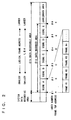
- FIG. 2 is an explanatory view showing the data storage condition in the recording area of the disk apparatus 104.
- the DV frame data are arranged, for example, in the order of frame #1, frame #2, frame #3, frame #4, ... in a scene A.
- a frame top address A is stored in correspondence with the index number #1.
- the video and audio data management unit 109 manages the logical frame address corresponding to each DV frame data. As shown in FIG. 2, when DV frame data are recorded for the first time on the disk apparatus 104 in a completely unrecorded condition, the orders of arrangement of the logical block addresses (LBAs) and the logical frame addresses are completely the same.
- LBAs logical block addresses
- the index generation unit 105 takes in necessary information from among the DV data received by the external interface unit 102, analyzes the information, and detects the scene change points of the video scenes.
- one video scene is defined as DV data of which time information corresponding to DV frame data is continuous.
- the scene change point is defined as the top DV frame data of each video scene.
- the information read from the DV data includes shooting date and time information, ATNs (absolute track numbers) and TTCs (title time codes: time codes).
- the shooting date and time information is stored in a predetermined area in the DV data while changing, for example, per second (corresponding to approximately 30 video frames in the case of the DV data of NTSC signals). Therefore, when the interval between the shooting dates and times of two continuously stored DV frame data is two seconds or longer, it can be judged that the two DV frame data are different video scenes and the latter video frame is the top frame of a new video scene.
- ATNs are recorded such that the numeral of the ATNs increases by ten per one video frame. Therefore, when the difference in ATN between two continuously stored DV frame data is 20 or more, it can be judged that the two DV frame data are different video scenes and the latter video frame is the top frame of a new video scene.
- TTCs are recorded such that the numeral of the TTCs increases by one per one frame. Therefore, when the difference in TTC between two continuously stored DV frame data is 2 or more, it can be judged that the latter video frame is the top frame of a new video scene. As shown in FIG. 2, the DV data are analyzed as described above in correspondence with the index numbers #2, #3, #4 and #5, and the frame top addresses B, C, D and E are automatically stored in the disk apparatus 104 as index information.
- the scene change points of video scenes may be detected by reading the kinds of the audio signals from among the DV data and detecting the DV data whose audio signals are of the same kind as one video scene.
- data in an auxiliary information area (AAUX area) where auxiliary information on the recorded audio signals is stored are read from among the DV data, and the kinds of the audio signals which will be described later are determined.
- the kinds of the audio signals are determined by reading auxiliary information on the number of recorded channels, the sampling frequency, the quantization method and the like from the AAUX area. Based on the read auxiliary information, the DV data whose audio signals are of the same kind are selected as one video scene, and the frame top address corresponding to the top of the scene is stored as index information.
- the index generation unit 105 Based on the generated index information, the index generation unit 105 writes the index information into part of the DV frame data corresponding to the index information.
- the index information is written in a subcode area, specifically in a tag ID storage area allocated in the DV data.
- the data recording and reproducing unit 103 of this embodiment has a header information writing unit that records header information about the DV data recorded on the disk apparatus 104 into DV data.
- the header information writing unit has a function to write recording start information which is header information into part of DV data when recording is started. Specifically, in the DV format, a signal "REC ST" is written into auxiliary information (VAUX) of video signals as the recording start information. It is defined that this information is continuously written into 30 frames from the top frame to be recorded.
- the signal "REC ST" in the auxiliary information (VAUX) of video signals is used, for example, when the shooting start frame is detected from among the DV data reproduced in a digital VCR apparatus.
- the header writing unit also writes the signal "REC ST" into auxiliary information (AAUX) of audio signals as recording start information as header information.
- AAUX auxiliary information
- the signal "REC ST” is written only into the top frame to be recorded.
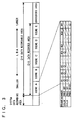
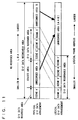
- FIG. 3 is an explanatory view of the recording start information written when the above-mentioned scene A is recorded on the disk apparatus 104.
- the signal "REC ST” is written into corresponding frames in the auxiliary information (VAUX) of video signals and in the auxiliary information (AAUX) of audio signals.
- the signal "REC ST” is represented by ⁇ .
- the external interface unit 102 stops the DV data reception processing.
- the index generation unit 105 reads a frame top address to be recorded on the hard disk device.
- the frame top address corresponds to the last DV frame data which is received from the video and audio data management unit 109.
- the index generation unit 105 stores the frame top address as index information.
- the frame top address corresponding to the index number #6 is stored on the disk apparatus 104 as index information.
- the index generation unit 105 stores the index information obtained by analyzing the DV data as described above, and posts it to an index information management unit 106 by following a predetermined procedure.
- the index information management unit 106 Based on the index information posted from the index generation unit 105, the index information management unit 106 produces an index management list carrying index numbers and frame top addresses as shown in FIG. 4.
- the header information writing unit of the data recording and reproducing unit 103 of this embodiment has a function to write recording end information, which is header information, into a part of DV data when recording is stopped.
- recording end information which is header information
- a signal "REC END" is written into the auxiliary information (AAUX) of audio signals as the recording end information. It is defined that this auxiliary information is written only into the last frame when recording is stopped.
- AAUX auxiliary information
- FIG. 3 with respect to the recording end information written in the scene A, the signal "REC END" is represented by ⁇ , and is shown in the column of the frame number #N.
- the external interface unit 102 When receiving the recording command again from the external apparatus, the external interface unit 102 again starts the DV data reception processing as described above.
- the data recording and reproducing unit 103 starts to record DV data into a recording position in the recording area of the disk apparatus 104 which position corresponds to the current frame top address read from the video and audio data management unit 109.
- the index generation unit 105 generates index information like in the above-mentioned recording command processing, and the data recording and reproducing unit 103 successively stores the generated index information into the disk apparatus 104.
- the index generation unit 105 reads the frame top address corresponding to the DV frame data next to the last recorded DV frame data (hereinafter, this next DV frame data will be referred to as un-updated area top frame) from the video and audio data management unit 109, and then stores it as index information.
- this next DV frame data will be referred to as un-updated area top frame
- the above-mentioned recording command processing and recording stop command processing will be referred to as re-recording processing.
- the index generation unit 105 posts the index information stored in the above-mentioned re-recording processing to the index information management unit 106.
- the index information management unit 106 deletes the last index information corresponding to the re-recorded area from the index information list.
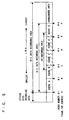
- FIG. 5 is an explanatory view of a case where video frames are newly recorded in the recording area of the disk apparatus 104.
- the last frame top addresses C, D and E corresponding to the last index numbers #3, #4 and #5 are deleted from the index management list.
- the new index information received from the index generation unit 105 is added to the index management list.
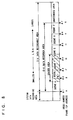
- FIG. 6 is an explanatory view of a case where video frames (scenes F, G and H) are newly recorded in the recording area of the disk apparatus 104.
- the frame top addresses F, G, H and Y corresponding to the index numbers #3, #4, #5 and #6 are added to the index management list.
- the index information management unit 106 rearranges the index numbers in the order of increasing frame top address, that is, in the order of logical frame address on the disk apparatus 104.
- the order coincides with the order of LBA on the disk apparatus 104.
- scenes B' and E' are video scenes comprising partly deleted scenes B and C, respectively.
- FIG. 7 is a view showing an example of the index management list after the re-recording.
- the index information management unit 106 temporarily stores the index information posted from the index information generation unit 105 as the index management list. Moreover, the index information management unit 106 stores the index information stored as the index management list into the system data recording area of the disk apparatus 104 at predetermined intervals.
- the immediately preceding index information can be used later even when the disk control apparatus 100 is momentarily turned off.
- the key input device 107 posts an index registration request to a key input acceptance unit 108 provided in the disk control apparatus 100 every time the index registration key is depressed.
- the key input acceptance unit 108 posts an index generation request to the index generation unit 105.
- the index generation unit 105 posts a frame top address reading request to the video and audio data management unit 109, reads the current frame top address, and stores it as index information.
- the index generation unit 105 posts the stored index information to the index information management unit 106, and writes the index information into the subcode area of the corresponding DV data.
- the index information management unit 106 In response to the index information posted from the index generation unit 105, the index information management unit 106 adds the index information to the index management list.
- the external interface unit 102 posts an all erasure request to the video and audio data management unit 109 and the index information management unit 106.
- the video and audio data management unit 109 having received the all erasure request clears (invalidates) the last recorded frame address in response to the all erasure request.
- the index information management unit 106 erases all the index information registered in the index management list in response to the all erasure request.
- the external interface unit 102 posts a block erasure request to the video and audio data management unit 109 and the index information management unit 106.
- the video and audio data management unit 109 having received the block erasure request invalidates the DV data in the specified recording area in units of blocks in response to the block erasure request.
- the index information management unit 106 erases, of the index information stored in the index management list, the index information corresponding to the recording area of the DV data to be erased, from the index management list in response to the block erasure request.
- FIG. 8 is an explanatory view showing an example of a case where a DV data recorded area is newly erased in units of blocks in the recording area of the disk apparatus 104.
- the frame top addresses B, F and G corresponding to the index numbers #2, #3 and #4 are erased from the index management list. Further, index information corresponding to the frame adjoining the erased area is added.
- FIG. 9 is an explanatory view showing a condition in a case where DV data are erased as shown in FIG. 8 in the recording area of the disk apparatus 104.
- frame top addresses Z and P corresponding to the index numbers #2 and #3 are added as index information.
- scenes A' and G' are video scenes comprising partly deleted scenes A and G, respectively.
- FIG. 10 is a view showing the index management list after the processing corresponding to the block erasure request is performed.
- the video and audio data management unit 109 rearranges the recording areas as shown in FIG. 11. That is, in response to the block erasure request, the video and audio data management unit 109 assigns continuous logical frame addresses to the physically separated recording areas of the scene A' and the scenes G', H and E' so that the scenes A', G', H and E' are disposed in logically continuous recording areas for management. Consequently, unrecorded areas A and B separated in the recording area aggregate.
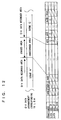
- FIG. 12 is an explanatory view explaining processing for the data recording and reproducing unit 103 to add recording start and end information to the frames adjoining the erased area in response to a recording start and end information addition request from the video and audio data management unit 109.
- the video and audio data management unit 109 requests the data recording and reproducing unit 103 to write the signal "REC END" as the auxiliary information (AAUX) of audio signals to the last one of the frames (scene A') recorded immediately before the unrecorded area.
- AAUX auxiliary information
- the data recording and reproducing unit 103 In response to the request from the video and audio data management unit 109, the data recording and reproducing unit 103 reads the last frame of the scene A' from the disk apparatus 104, writes the signal "REC END" as the auxiliary information (AAUX) of audio signals, and then, writes the last frame of the scene A' back into the disk apparatus 104. Further, the video and audio data management unit 109 requests the data recording and reproducing unit 103 to write the signal "REC ST" as the auxiliary information (VAUX) of video signals and the signal "REC ST” as the auxiliary information (AAUX) of audio signals to the 30 frames (scene G') recorded immediately behind the unrecorded area. In response to the request from the video and audio data management unit 109, the data recording and reproducing unit 103 performs the processing described below.
- the top frame of the scene G' is read from the disk apparatus 104, and after the signal "REC ST" is written to each of the auxiliary information (VAUX) of video signals and the auxiliary information (AAUX) of audio signals, the top frame is written back to the disk apparatus 104.
- VAUX auxiliary information
- AAUX auxiliary information
- the second to the thirtieth frames of the scene G' are read from the disk apparatus 104 frame by frame, and the frames are written back to the disk apparatus 104 after the signal "REC ST" as the auxiliary information (VAUX) of video signals is written to each of them.
- VAUX auxiliary information
- the signal "REC ST" of the auxiliary information (VAUX) of video signals is newly written into the recording areas separated by block erasure. Consequently, the external apparatus connected through the IEEE 1394 bus 101 can easily detect video scenes separated by block erasure by searching for the signal "REC ST". Moreover, the disk control apparatus of this embodiment is capable of performing initialization of audio signal reproduction processing and the like by detecting the signal "REC ST” as the auxiliary information (AAUX) of audio signals, so that audio signals can be normally reproduced.
- the external interface unit 102 posts an index reproduction request to the index information management unit 106.
- the index information management unit 106 having received the index reproduction request selects one frame top address from the index information registered in the index management list by a predetermined method in response to the index reproduction request. Then, the index information management unit 106 posts to the data recording and reproducing unit 103 a request to reproduce the DV frame data corresponding to the selected frame top address.
- the data recording and reproducing unit 103 reads the DV frame data requested by the index information management unit 106 from the disk apparatus 104, and sends it onto the IEEE 1394 bus 101 through the external interface unit 102.
- the video frame corresponding to the index information can be displayed as a still image. For this reason, the top frame of a video scene can be easily confirmed by using the disk control apparatus 100 of the first embodiment.
- the external interface unit 102 posts an index reading request to the index information management unit 106.
- the index information management unit 106 having received the index reading request selects the frame top address from the index management list by a predetermined method. Further, the index information management unit 106 converts the information corresponding to the selected frame top address into an externally specified format (for example, a format of ATN or TTC), and posts it to the external interface unit 102.
- an externally specified format for example, a format of ATN or TTC
- the external interface unit 102 sends the index information received from the index information management unit 106 onto the IEEE 1394 bus 101 by following a predetermined procedure.
- the externally input index information corresponds to the arrangement of the order of the recorded areas from the top because it is specified as a logical address.
- the disk control apparatus 100 of the first embodiment externally receives an index information addition command and the index information thereof.
- the external interface unit 102 posts an index addition request to the index information management unit 106, and transfers the externally received index information.
- the index information management unit 106 adds the index information transferred from the external interface unit 102 to the index management list.
- the external interface unit 102 posts an index erasure request to the index information management unit 106.
- the index information management unit 106 deletes the externally specified index information from the index management list.
- the disk control apparatus 100 of the first embodiment new index information is automatically generated in accordance with recording processing and erasure processing of DV data, and the index information is stored. Consequently, the disk control apparatus 100 of the first embodiment is capable of always reproducing the DV frame data at the top of a video scene with ease and reliability in response to a reproduction request based on external index information.
- the present invention is not limited to this structure. Any disk apparatus that performs recording and reproducing of a recording medium may be used; similar effects are obtained, for example, when an optical disk apparatus is used.
- connection means of the present invention may be any interface means which is capable of transmitting digital signals such as a SCSI interface, and is not limited to the structure of the first embodiment.
- FIG. 13 is a block diagram showing the configuration of the disk apparatus of the second embodiment.
- FIG. 13 parts and elements having similar functions and structures to those of the first embodiment shown in FIG. 1 are denoted by the same reference numerals, and descriptions thereof are omitted.
- the disk apparatus of the second embodiment has the function of the disk control apparatus of the first embodiment, and includes means the same as those of the disk control apparatus of the first embodiment.
- the disk apparatus of the second embodiment has therein a magnetic disk 111 which serves as a recording medium, and a magnetic head 112 which writes and reads digital signals onto and from the magnetic disk 111.
- the data recording and reproducing unit 110 which controls the data recording and reproducing onto and from the disk apparatus through an IDE interface in the first embodiment, controls the digital signal writing and reading onto and from the magnetic disk 111 through the magnetic head 112 in the second embodiment.
- the blocks denoted by the same numbers as those of the first embodiment perform similar processing to that of the first embodiment. Therefore, in response to various requests from the external apparatus connected to the IEEE 1394 bus 101 and the key input device 107, the blocks of the disk apparatus of the second embodiment perform similar operations to those of the first embodiment.
- the disk apparatus of the second embodiment it is possible to configure the function of the disk control apparatus of the first embodiment with an electric/electronic circuit and mount it in the disk apparatus. Consequently, compared to the case where the disk control apparatus and the disk apparatus are separate devices like in the first embodiment, the cost and the size are small as a disk apparatus recording and reproducing video and audio data.
- any bus which is capable of transmission and reception of DV data may be used in the present invention; the present invention is not limited to the structure of the embodiment.
- the present invention has the following technical advantages:
- the disk control apparatus and the disk apparatus of the present invention have a function to newly generate index information or perform processing by handling the recording areas which are separated by an erased area produced therebetween such that the separated recording area are logically continuous areas in case the video and audio data recorded on the disk apparatus are replaced with input video and audio data from external source or in case some of the video and audio data are erased. Consequently, with the disk control apparatus and the disk apparatus of the present invention, edit processing can be easily performed even after video and audio data recorded on the disk apparatus are replaced with external video and audio data and after some of the video and audio data are erased.
Landscapes
- Engineering & Computer Science (AREA)
- Multimedia (AREA)
- Computer Networks & Wireless Communication (AREA)
- Signal Processing (AREA)
- Management Or Editing Of Information On Record Carriers (AREA)
- Indexing, Searching, Synchronizing, And The Amount Of Synchronization Travel Of Record Carriers (AREA)
- Signal Processing For Digital Recording And Reproducing (AREA)
Applications Claiming Priority (4)
| Application Number | Priority Date | Filing Date | Title |
|---|---|---|---|
| JP5171199 | 1999-02-26 | ||
| JP5171199 | 1999-02-26 | ||
| JP2000032377A JP2000311469A (ja) | 1999-02-26 | 2000-02-09 | ディスク制御装置及びそれを用いたディスク装置 |
| JP2000032377 | 2000-02-09 |
Publications (2)
| Publication Number | Publication Date |
|---|---|
| EP1031983A2 true EP1031983A2 (fr) | 2000-08-30 |
| EP1031983A3 EP1031983A3 (fr) | 2004-02-11 |
Family
ID=26392275
Family Applications (1)
| Application Number | Title | Priority Date | Filing Date |
|---|---|---|---|
| EP00103405A Withdrawn EP1031983A3 (fr) | 1999-02-26 | 2000-02-24 | Appareil d'entraínement de disque et appareil de disque l'utilisant |
Country Status (3)
| Country | Link |
|---|---|
| US (1) | US6775466B1 (fr) |
| EP (1) | EP1031983A3 (fr) |
| JP (1) | JP2000311469A (fr) |
Families Citing this family (5)
| Publication number | Priority date | Publication date | Assignee | Title |
|---|---|---|---|---|
| JP2003132621A (ja) * | 2001-10-26 | 2003-05-09 | Matsushita Electric Ind Co Ltd | 情報記録再生方法 |
| JP3762347B2 (ja) | 2002-10-01 | 2006-04-05 | 株式会社東芝 | 情報記録再生装置 |
| JP4760572B2 (ja) * | 2006-06-30 | 2011-08-31 | ソニー株式会社 | 編集装置および編集方法、並びにプログラム |
| JP5381454B2 (ja) * | 2009-07-23 | 2014-01-08 | ソニー株式会社 | 映像音声記録装置及び編集方法 |
| US12079511B2 (en) * | 2020-12-26 | 2024-09-03 | SanDisk Technologies, Inc. | Devices and methods for optimized fetching of multilingual content in media streaming |
Family Cites Families (16)
| Publication number | Priority date | Publication date | Assignee | Title |
|---|---|---|---|---|
| US5107481A (en) * | 1988-03-16 | 1992-04-21 | Matsushita Electric Industrial Co., Ltd. | Recording area management system for writable type optional disk |
| JP2712656B2 (ja) | 1989-10-25 | 1998-02-16 | 日本電気ホームエレクトロニクス株式会社 | Cd―rom記録方法 |
| US5267351A (en) | 1989-12-22 | 1993-11-30 | Avid Technology, Inc. | Media storage and retrieval system |
| US5099322A (en) | 1990-02-27 | 1992-03-24 | Texas Instruments Incorporated | Scene change detection system and method |
| JPH0414672A (ja) | 1990-05-07 | 1992-01-20 | Canon Inc | 記録再生装置 |
| JP3184630B2 (ja) * | 1992-10-21 | 2001-07-09 | キヤノン株式会社 | 画像処理装置 |
| US5485595A (en) * | 1993-03-26 | 1996-01-16 | Cirrus Logic, Inc. | Flash memory mass storage architecture incorporating wear leveling technique without using cam cells |
| US5740435A (en) * | 1994-10-31 | 1998-04-14 | Sony Corporation | Data management apparatus and method for managing data of variable lengths recorded on a record medium |
| JPH08129859A (ja) | 1994-11-02 | 1996-05-21 | Sony Corp | 編集方法及びそのシステム |
| US5896364A (en) * | 1994-11-08 | 1999-04-20 | Matsushita Electric Industrial Co., Ltd. | Optical recording medium having both serial data and random data recording areas |
| US5675769A (en) * | 1995-02-23 | 1997-10-07 | Powerquest Corporation | Method for manipulating disk partitions |
| US6546186B2 (en) * | 1995-09-11 | 2003-04-08 | Matsushita Electric Industrial Co., Ltd. | Video/audio information collecting system using video camera and its editing system |
| JPH10143977A (ja) | 1996-09-10 | 1998-05-29 | Sony Corp | ディスク装置およびそれを用いたビデオカメラ装置 |
| JP3932631B2 (ja) | 1997-03-21 | 2007-06-20 | 松下電器産業株式会社 | 圧縮動画像データカット検出装置 |
| US6477632B1 (en) * | 1997-12-05 | 2002-11-05 | Tokyo Electron Device Limited | Storage device and accessing method |
| US6038636A (en) * | 1998-04-27 | 2000-03-14 | Lexmark International, Inc. | Method and apparatus for reclaiming and defragmenting a flash memory device |
-
2000
- 2000-02-09 JP JP2000032377A patent/JP2000311469A/ja active Pending
- 2000-02-24 EP EP00103405A patent/EP1031983A3/fr not_active Withdrawn
- 2000-02-25 US US09/513,093 patent/US6775466B1/en not_active Expired - Fee Related
Also Published As
| Publication number | Publication date |
|---|---|
| EP1031983A3 (fr) | 2004-02-11 |
| JP2000311469A (ja) | 2000-11-07 |
| US6775466B1 (en) | 2004-08-10 |
Similar Documents
| Publication | Publication Date | Title |
|---|---|---|
| US7952971B2 (en) | Recording/reproducing method suitable for recording/reproducing AV data on/from disc, recorder and reproducer for the method, information recording disc and information processing system | |
| EP2053609A2 (fr) | Procédé d'enregistrement de données, procédé de suppression de données, procédé d'affichage de données, appareil d'enregistrement, support d'enregistrement et programme | |
| JPH11242850A (ja) | リアルタイムデータ記録方式 | |
| CN100354970C (zh) | 含有虚拟删除信息的记录媒体的记录、再现方法 | |
| US6775466B1 (en) | Disk control apparatus dividing a recording area into recorded and unrecorded areas | |
| JPH1031881A (ja) | データ記録装置及びデータ記録媒体 | |
| US6996326B2 (en) | Data recording apparatus and data recording method | |
| JP3443304B2 (ja) | 動画像記録装置 | |
| JPH11273314A (ja) | デジタルデータ記録再生装置 | |
| KR20000035410A (ko) | 데이터 기록 장치 및 방법과, 데이터 재생 방법 및 기록매체 | |
| JPH11273262A (ja) | 情報記録再生装置 | |
| US20050022233A1 (en) | Method and apparatus for storing/reproducing data in multimedia system | |
| KR100378173B1 (ko) | 정지화를 위한 가상 삭제 정보를 저장하는 기록매체 | |
| JPH07327189A (ja) | 映像情報記録テープとその記録・再生装置 | |
| KR20000004860A (ko) | 정지화를 위한 가상 삭제 정보를 저장하는 기록 매체 및 기록재생방법과 장치 | |
| WO2001080240A1 (fr) | Dispositif de controle de disques, procede de controle de disques et unite de disques | |
| JPH09102183A (ja) | 記録再生装置 | |
| JP2002324383A (ja) | 記録媒体及び情報記録装置 | |
| JP2001210015A (ja) | データ記録・再生装置 | |
| JP2007164894A (ja) | 画像処理装置及び方法 |
Legal Events
| Date | Code | Title | Description |
|---|---|---|---|
| PUAI | Public reference made under article 153(3) epc to a published international application that has entered the european phase |
Free format text: ORIGINAL CODE: 0009012 |
|
| 17P | Request for examination filed |
Effective date: 20000224 |
|
| AK | Designated contracting states |
Kind code of ref document: A2 Designated state(s): AT BE CH CY DE DK ES FI FR GB GR IE IT LI LU MC NL PT SE |
|
| AX | Request for extension of the european patent |
Free format text: AL;LT;LV;MK;RO;SI |
|
| PUAL | Search report despatched |
Free format text: ORIGINAL CODE: 0009013 |
|
| AK | Designated contracting states |
Kind code of ref document: A3 Designated state(s): AT BE CH CY DE DK ES FI FR GB GR IE IT LI LU MC NL PT SE |
|
| AX | Request for extension of the european patent |
Extension state: AL LT LV MK RO SI |
|
| AKX | Designation fees paid |
Designated state(s): DE FR GB IT |
|
| 17Q | First examination report despatched |
Effective date: 20041019 |
|
| RAP1 | Party data changed (applicant data changed or rights of an application transferred) |
Owner name: PANASONIC CORPORATION |
|
| STAA | Information on the status of an ep patent application or granted ep patent |
Free format text: STATUS: THE APPLICATION IS DEEMED TO BE WITHDRAWN |
|
| 18D | Application deemed to be withdrawn |
Effective date: 20080731 |