EP1032038A2 - Matériau conductrice et résistive électriquement stabil pour utilisation dans des appareils électroniques - Google Patents
Matériau conductrice et résistive électriquement stabil pour utilisation dans des appareils électroniques Download PDFInfo
- Publication number
- EP1032038A2 EP1032038A2 EP00102225A EP00102225A EP1032038A2 EP 1032038 A2 EP1032038 A2 EP 1032038A2 EP 00102225 A EP00102225 A EP 00102225A EP 00102225 A EP00102225 A EP 00102225A EP 1032038 A2 EP1032038 A2 EP 1032038A2
- Authority
- EP
- European Patent Office
- Prior art keywords
- composition
- weight percent
- amount
- group
- derivatives
- Prior art date
- Legal status (The legal status is an assumption and is not a legal conclusion. Google has not performed a legal analysis and makes no representation as to the accuracy of the status listed.)
- Withdrawn
Links
Images

Classifications
-
- H—ELECTRICITY
- H01—ELECTRIC ELEMENTS
- H01B—CABLES; CONDUCTORS; INSULATORS; SELECTION OF MATERIALS FOR THEIR CONDUCTIVE, INSULATING OR DIELECTRIC PROPERTIES
- H01B1/00—Conductors or conductive bodies characterised by the conductive materials; Selection of materials as conductors
- H01B1/06—Conductors or conductive bodies characterised by the conductive materials; Selection of materials as conductors mainly consisting of other non-metallic substances
- H01B1/12—Conductors or conductive bodies characterised by the conductive materials; Selection of materials as conductors mainly consisting of other non-metallic substances organic substances
-
- H—ELECTRICITY
- H10—SEMICONDUCTOR DEVICES; ELECTRIC SOLID-STATE DEVICES NOT OTHERWISE PROVIDED FOR
- H10W—GENERIC PACKAGES, INTERCONNECTIONS, CONNECTORS OR OTHER CONSTRUCTIONAL DETAILS OF DEVICES COVERED BY CLASS H10
- H10W70/00—Package substrates; Interposers; Redistribution layers [RDL]
- H10W70/60—Insulating or insulated package substrates; Interposers; Redistribution layers
- H10W70/62—Insulating or insulated package substrates; Interposers; Redistribution layers characterised by their interconnections
- H10W70/66—Conductive materials thereof
- H10W70/666—Organic materials or pastes
-
- C—CHEMISTRY; METALLURGY
- C09—DYES; PAINTS; POLISHES; NATURAL RESINS; ADHESIVES; COMPOSITIONS NOT OTHERWISE PROVIDED FOR; APPLICATIONS OF MATERIALS NOT OTHERWISE PROVIDED FOR
- C09J—ADHESIVES; NON-MECHANICAL ASPECTS OF ADHESIVE PROCESSES IN GENERAL; ADHESIVE PROCESSES NOT PROVIDED FOR ELSEWHERE; USE OF MATERIALS AS ADHESIVES
- C09J9/00—Adhesives characterised by their physical nature or the effects produced, e.g. glue sticks
- C09J9/02—Electrically-conducting adhesives
-
- H—ELECTRICITY
- H01—ELECTRIC ELEMENTS
- H01B—CABLES; CONDUCTORS; INSULATORS; SELECTION OF MATERIALS FOR THEIR CONDUCTIVE, INSULATING OR DIELECTRIC PROPERTIES
- H01B1/00—Conductors or conductive bodies characterised by the conductive materials; Selection of materials as conductors
- H01B1/20—Conductive material dispersed in non-conductive organic material
-
- H—ELECTRICITY
- H01—ELECTRIC ELEMENTS
- H01B—CABLES; CONDUCTORS; INSULATORS; SELECTION OF MATERIALS FOR THEIR CONDUCTIVE, INSULATING OR DIELECTRIC PROPERTIES
- H01B1/00—Conductors or conductive bodies characterised by the conductive materials; Selection of materials as conductors
- H01B1/20—Conductive material dispersed in non-conductive organic material
- H01B1/22—Conductive material dispersed in non-conductive organic material the conductive material comprising metals or alloys
-
- H—ELECTRICITY
- H01—ELECTRIC ELEMENTS
- H01B—CABLES; CONDUCTORS; INSULATORS; SELECTION OF MATERIALS FOR THEIR CONDUCTIVE, INSULATING OR DIELECTRIC PROPERTIES
- H01B1/00—Conductors or conductive bodies characterised by the conductive materials; Selection of materials as conductors
- H01B1/20—Conductive material dispersed in non-conductive organic material
- H01B1/24—Conductive material dispersed in non-conductive organic material the conductive material comprising carbon-silicon compounds, carbon or silicon
-
- H—ELECTRICITY
- H05—ELECTRIC TECHNIQUES NOT OTHERWISE PROVIDED FOR
- H05K—PRINTED CIRCUITS; CASINGS OR CONSTRUCTIONAL DETAILS OF ELECTRIC APPARATUS; MANUFACTURE OF ASSEMBLAGES OF ELECTRICAL COMPONENTS
- H05K1/00—Printed circuits
- H05K1/02—Details
- H05K1/09—Use of materials for the conductive, e.g. metallic pattern
- H05K1/092—Dispersed materials, e.g. conductive pastes or inks
- H05K1/095—Dispersed materials, e.g. conductive pastes or inks for polymer thick films, i.e. having a permanent organic polymeric binder
-
- H—ELECTRICITY
- H05—ELECTRIC TECHNIQUES NOT OTHERWISE PROVIDED FOR
- H05K—PRINTED CIRCUITS; CASINGS OR CONSTRUCTIONAL DETAILS OF ELECTRIC APPARATUS; MANUFACTURE OF ASSEMBLAGES OF ELECTRICAL COMPONENTS
- H05K3/00—Apparatus or processes for manufacturing printed circuits
- H05K3/30—Assembling printed circuits with electric components, e.g. with resistors
- H05K3/32—Assembling printed circuits with electric components, e.g. with resistors electrically connecting electric components or wires to printed circuits
- H05K3/321—Assembling printed circuits with electric components, e.g. with resistors electrically connecting electric components or wires to printed circuits by conductive adhesives
Definitions
- This invention relates to compositions that are suitable for use as conductive or resistive materials in microelectronic devices or semiconductor packages to provide electrically stable interconnections.
- Conductive and resistive compositions are used for a variety of purposes in the fabrication and assembly of semiconductor packages and microelectronic devices.
- conductive adhesives are used to bond integrated circuit chips to substrates (die attach adhesives) or circuit assemblies to printed wire boards (surface mount conductive adhesives), and resistive materials are used to form planar or buried resistors in circuit boards.
- compositions are vulnerable to environmental conditions, and high temperature and high humidity can cause the electrical resistance of the assembly fabricated with these compositions to increase substantially over time.
- the suspected mode of failure is electrochemical corrosion of the circuitry at the interface of the conductive filler in the composition with another contiguous metal surface, for example, a metal lead frame or other circuitry.
- Two conductors with dissimilar electrochemical potentials will form an electrochemical cell in the presence of water.
- the conductors act as cathode and anode, and environmental humidity provides the necessary aqueous medium to bridge the anode and cathode.
- the metal with the higher electrochemical potential acts as the cathode ⁇ 2H 2 O + O 2 + 4 e ⁇ 4OH - ⁇ .
- the metal with the lower electrochemical potential acts as the anode resulting in the loss of electrons ⁇ M - n e ⁇ M n+ ⁇ and the corrosion of the metal. Oxygen is involved in this mechanism but does not directly react with the anode metal.
- the metal ion M n+ will combine with OH - and form a metal hydroxide that stabilizes by developing into a metal oxide, which over time forms on the anode surface.
- Metal oxides in general are non-conductive, the result being a decrease in conductivity of the metal circuitry.
- the problem is less acute when the filler in the composition is the same metal as the contiguous circuitry or the substrate.
- a semiconductor package using a conductive composition one comprising an epoxy resin and silver filler, for example, will not be as susceptible to eleotrochemical failure when a silver-filled composition is used on a silver substrate.
- the composition is used on a nickel plated substrate, electrochemical corrosion will result under high humidity conditions.
- the composition is a resistive composition containing carbon black as the filler, corrosion will become a problem under high humidity conditions if the substrate contains metal with a low electrochemical potential, such as Ni, Cu, and Sn/Pb solder.
- This invention is a composition that comprises a polymeric resin, a conductive filler, an oxygen scavenger or corrosion inhibitor or both, optionally other additives such as reactive or nonreactive diluents, inert fillers, and adhesion promoters.
- the compositions exhibit improved electrical stability over those compositions that do not contain an oxygen scavenger or corrosion inhibitor.
- the oxygen scavengers or corrosion inhibitors will be present in an amount up to 10 weight percent (but not 0%); the resin will be present in an amount of 10 to 90 weight percent: the filler, in an amount of 1 to 90 weight percent; the diluent, in an amount of 0 to 50 weight percent; the inert fillers, in an amount of 0 to 80 weight percent; and the adhesion promoters, in an amount of 0 to 10 weight percent, for a total of 100 weight percent.
- this invention is a method for improving the electrical stability of a composition by adding one or more oxygen scavengers, one or more corrosion inhibitors, or one or more oxygen scavengers and corrosion inhibitors to the composition.
- compositions that may be used in the fabrication of semiconductor packages can be given improved electrical stability by the addition of an oxygen scavenger or corrosion inhibitor or both to the formulation.
- oxygen scavengers and corrosion inhibitors have been used in aqueous medium to inhibit corrosion, it was unexpected that these materials could be added to compositions for use in the electronics industry without any loss in initial conductivity or adhesion properties of these compositions.
- a conductive composition achieves its conductivity through metal particles dispersed throughout the composition. When these metal particles are in contact with another contiguous metal, as is required to form the circuitry for the ultimate electronic device, and water is present, an electrochemical cell is formed.
- the reaction at the cathode utilizes oxygen, and the reaction at the anode eventually produces a metal oxide.
- An oxygen scavenger is defined herein to be any chemical compound that will react with oxygen to prevent the oxygen from further reaction at the electrochemical cell cathode.
- Exemplary oxygen scavengers are hydroquinone, carbohydrazide, trihydroxybenzene, aminophenol, hydrazine, pyrogallol, carbohydrazone, polyethyleneamine, cyclohexanedione, hydroxylamine, methoxypropylamine, cyclohexylamine, diethylethanolamine, hydroxyalkylhydroxylamine, tetrasubstituted phenylenediamines, morpholinohexose reductone, keto-gluconates, amine bisulfites, lactone derivatives, phenol derivatives, and substituted quinolines.
- a corrosion inhibitor is defined herein to be any chemical compound that has a lone pair of electrons, such as nitrogen-, sulfur-, and oxygen-containing compounds, that will bind with metal and impede the reactivity of the metal at the electrochemical anode.
- Exemplary corrosion inhibitors are 1,10-phenathiodine, phenothiazine, benzothriazole, benzimidazole, mercaptobenzothiazole, dicyandiamide, 3-isoprolyamino-1-butyne, propargyl quinolinium bromide, 3-benzylamino-1-butyne, dipropargl ether, dipropargyl thioether, propargyl caproate, dianimoheptane, phenathroline, amine, diamine, triamine, hexamethyleneimide, decamethyleneimide, hexamethyleneiminebenzoate, hexamethyleneimine-3,5-dinitrobenzoate, hexam
- oxygen scavengers have corrosion inhibition capability, and some corrosion inhibitors have oxygen scavenger ability.
- Exemplary resins for use in these formulations are any of the resins currently used throughout the industry, such as, vinyl, acrylic, phenolic, epoxy, maleimide, polyimide, or silicon-containing resins.
- the formulations and physical properties are known to those skilled in the art.
- Exemplary reactive diluents are glycidyl ethers, for example, 1,4-butanediol diglycidyl ether; vinyl ethers, for example, ethylene vinyl ether, and vinyl esters, for example, ethylene vinyl ester, and acrylates, for example, methyl methacrylate.
- An exemplary nonreactive diluents is butyl carbitol.
- adhesion promoters are silanes and polyvinyl butyrol.
- compositions are used in the fabrication of electronic packages, for example, as adhesives, encapsulants, or to form integral passives, such as resistors or capacitors.
- these compositions can be formulated to give a broad range of resistivity, conductivity, capacitance, or dielectric properties as needed for the specific circuit component.
- Providing the precise type and amount of filler for obtaining the electrical properties desired for a specific end use application is within the expertise of one skilled in the art. It will be understood that all resistors necessarily exhibit some conductance, and all conductors exhibit some resistance, and that resistors and conductors form a continuum of resistance and conductance depending on the specific property of the individual material. This continuum is also the case for dielectrics and capacitors.
- a dielectric may function as a true dielectric or isolating component, or as a capacitor, depending on the specific dielectric constant.
- Exemplary conductive fillers are silver, copper, gold, palladium, platinum, carbon black, carbon fiber, graphite, aluminum, and antimony doped tin oxide.
- Exemplary inert fillers include talc, silica, silicate, aluminum nitride, and mica.
- Exemplary capacitance/dielectric fillers which also will be deemed inert fillers herein, are ceramic, barium titanate, and titantium dioxide.
- this invention is a method of enhancing the electrical stability of a conductive or resistive composition comprising adding to the composition an oxygen scavenger or corrosion inhibitor or both.
- compositions designated A-C were prepared from a phenolic resin and varying amounts of carbon black.
- the compositions had the following formulations set out in Table 1: Composition A Composition B Composition C Fillers: Fillers: Fillers: 15g carbon black 8g carbon black 2g carbon black 21g talc 21g talc 21g talc 1g silica 1g silica 1g silica Resin: Resin: Resin: 54g phenolic resin 54g phenolic resin 54g phenolic resin 54g phenolic resin 6g polyvinyl butyral 6g polyvinyl butyral 6g polyvinyl butyral Diluent: Diluent: Diluent: 15-20g butyl carbitol 15-20g butyl carbitol 15-20g butyl carbitol 15-20g butyl carbitol 15-20g butyl carbitol 15-20g butyl carbitol
- the fillers were mixed together by a kneader or planetary mixer.
- the phenolic resin was a xylene-formaldehyde resin available from Emerson & Cuming; the resin components were mixed together and slowly added with mixing to the fillers.
- the resulting paste was dispersed and blended with a three roll mill until the paste became uniform.
- the viscosity was adjusted with butylcarbitol to 0.6 Pa.s at 25°C as measured by a Brookfield viscometer using a #14 spindle at 5 rpm.
- Composition A was measured for its resistivity without contact with any contiguous metal, denominated its bulk resistivity.
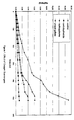
- the resistivity test vehicle shown in Figure 3, consisted of the test composition cured on a glass slide. The composition was dispensed along the length of the slide 78 mm, in an approximate thickness of 20 ⁇ m, and width of 4mm, and then cured for 4 hours at 175° C. After cure, the resistivity was measured using a four probe GenRad 1689 Precision RLC Digibridge. In Figure 3, A stands for electrical current and V stands for electrical voltage.
- test specimen was then subjected to 85°C and 85% relative humidity for 500 hours, after which resistivity was again measured. The results indicated only a minor change in resistivity.
- EXAMPLE 2 This example demonstrates the effect of temperature and humidity on the resistivity of Compositions A, B, and C, when contacted with a contiguous metal, denominated contact resistivity.
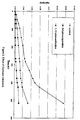
- the contact resistivity test vehicle shown in Figure 4, consisted of a FR-4 board substrate on which was printed a pattern of an open circuit with metal segments 3mm long separated by 1 mm gaps in a horseshoe shape. The number of connections between the composition and the metal segments was ten. The compositions were cured for 4 hours at 175°C.
- contact resistance was measured across the circuit using a Fluke 45 Dual Display Multimeter and was deemed to be the combination of the resistance as determined by resistivity plus the interfacial resistance between the end of each metal segment and the test composition.
- each of the Compositions A, B, and C was doped with 7 weight percent hydroquinone.
- the contact resistivity was tested both before and after conditioning at 85°C/85%RH. The results are reported in Table 3 and show a significant improvement in the electrical stability of the compositions when doped with an oxygen scavenger.
- Compositions with 7 Weight Percent Hydroquinone Composition Initial contact resistivity ⁇ /cm Contact resistivity after 85°/85 RH for 500 hours ⁇ /cm Percent Increase in resistivity % A 90 120 34 B 1180 3705 214 C 9000 19260 114
- EXAMPLE 3 A series of compositions were prepared from Composition A of Example 1, doped with varying amounts of an oxygen scavenger or corrosion inhibitor. The contact resistivity was measured as in Example 2 both before and after conditioning at 85°C/85% Relative Humidity. The results are reported in Table 4 and show that, with the exception of mercaptobenzothiazole, the presence of the oxygen scavenger or corrosion inhibitor effectively prevents significant increase in resistivity.
- EXAMPLE 4 Several compositions suitable for attaching semiconductor dies to lead frames or for attaching semiconductor packages to circuit boards were prepared with oxygen scavengers and corrosion inhibitors and tested for die shear strength.
- the basic formulation, Composition D contained 1.0g of a bisphenol F epoxy resin from Shell Chemical Company, 0.12g of a urea catalyst, and 4g silver flakes. The oxygen scavenger or corrosion inhibitor was added in the amount of 0.05g to this Composition D. An aliquot of the composition was dispensed on a copper substrate, and a 80milX80mil silicon die contacted with the composition with heat (150°C) for 60 minutes and light pressure. Die shear strength was measured in kg using a Royce system 552 instrument.
- EXAMPLE 5 The five compositions from Example 4 were tested for change in contact resistivity after 85°C/85% RH conditioning over a period of 500 hours as in the previous examples, except Sn/Pb solder was used instead of copper. Three specimens for each were tested and the results pooled and averaged. The percent increase in resistivity after conditioning is reported in Table 6 for each of the samples. The data show that an oxygen scavenger or corrosion inhibitor can be used to provide electrical stability by preventing increases in resistivity.
- EXAMPLE 6 To test for retention of adhesion in the presence of oxygen scavengers or corrosion inhibitors, samples were prepared from Composition A and doped with varying weight percents of an oxygen scavenger or corrosion inhibitor. The test compositions were prepared for resistivity testing as in Example 1. Initial resistivity along the strip of composition was measured after cure using a GenRad 1689 Precision RLC Digibridge. A strip of Scotch® 810 adhesive tape was placed along the entire length of the pattern of composition on the glass slide with the adhesive contacting the composition. A 1.5kg weight was rolled over the tape 6 times. The glass slide was secured in a vertical position and an end of the tape pulled from the composition and allowed to hang vertically down from the glass slide. A 500 g weight was attached to the end of the tape and allowed to fall and peel the tape from the glass slide. The resistance was then remeasured.
- test compositions and change in resistance are reported in Table 7 Percentage Change in Resistivity after Peel Test COMPOSITION On glass slide % change On polyimide film % change
- Composition A 0.1 0.9 with 2 weight% hydroquinone 0.3 -0.3 with 7 weight% hydroquinone 0.4 -1.1 with 2 weight% dicyandiamide 0.3 0.8 with 5 weight% dicyandiamide 0.7 2623 with 2 weight% diaminoheptane 0.6 -1.9 with 5 weight% diaminoheptane 0.5 1.6 with 5 weight% benzimidazole 0.3 174.4 with 5 weight% phenathroline 0.1 -1.0 with 5 weight% phenothiazine 0.0 0.2 with 5 weight% benzotriazole 0.2 1815
Landscapes
- Chemical & Material Sciences (AREA)
- Physics & Mathematics (AREA)
- Dispersion Chemistry (AREA)
- Spectroscopy & Molecular Physics (AREA)
- Organic Chemistry (AREA)
- Engineering & Computer Science (AREA)
- Microelectronics & Electronic Packaging (AREA)
- Compositions Of Macromolecular Compounds (AREA)
- Preventing Corrosion Or Incrustation Of Metals (AREA)
Applications Claiming Priority (2)
| Application Number | Priority Date | Filing Date | Title |
|---|---|---|---|
| US24992799A | 1999-02-12 | 1999-02-12 | |
| US249927 | 1999-02-12 |
Publications (2)
| Publication Number | Publication Date |
|---|---|
| EP1032038A2 true EP1032038A2 (fr) | 2000-08-30 |
| EP1032038A3 EP1032038A3 (fr) | 2002-07-24 |
Family
ID=22945603
Family Applications (1)
| Application Number | Title | Priority Date | Filing Date |
|---|---|---|---|
| EP00102225A Withdrawn EP1032038A3 (fr) | 1999-02-12 | 2000-02-11 | Matériau conductrice et résistive électriquement stabil pour utilisation dans des appareils électroniques |
Country Status (5)
| Country | Link |
|---|---|
| EP (1) | EP1032038A3 (fr) |
| JP (1) | JP2000273317A (fr) |
| KR (1) | KR20000058019A (fr) |
| CN (1) | CN1267891A (fr) |
| MY (1) | MY126770A (fr) |
Cited By (15)
| Publication number | Priority date | Publication date | Assignee | Title |
|---|---|---|---|---|
| EP1231248A1 (fr) * | 2001-02-13 | 2002-08-14 | National Starch and Chemical Investment Holding Corporation | Matériau conducteur résistant et électriquement stable pour une utilisation dans des appareils électroniques |
| WO2002089152A1 (fr) * | 2001-04-25 | 2002-11-07 | National Starch And Chemical Investment Holding Corporation | Materiaux conducteurs a stabilite electrique utilises dans des dispositifs electroniques |
| GB2407578A (en) * | 2001-04-25 | 2005-05-04 | Nat Starch Chem Invest | Conductive polymer compositions |
| EP1650265A4 (fr) * | 2003-07-24 | 2006-08-02 | Kuraray Co | Corps absorbant l'oxygene, procede de production de ce corps et matiere d'emballage utilisant ce corps |
| US7108806B2 (en) * | 2003-02-28 | 2006-09-19 | National Starch And Chemical Investment Holding Corporation | Conductive materials with electrical stability and good impact resistance for use in electronics devices |
| EP1758163A1 (fr) * | 2005-08-25 | 2007-02-28 | National Starch and Chemical Investment Holding Corporation | Quinolinoles comme agents de fondant et accelerateurs pour compositions de remplissage sous-jacent. |
| EP1878780A1 (fr) * | 2006-07-11 | 2008-01-16 | DSMIP Assets B.V. | Compositions désoxygénantes |
| WO2008006493A1 (fr) * | 2006-07-11 | 2008-01-17 | Dsm Ip Assets B.V. | Composition contenant un polymère et un catalyseur d'oxydation |
| US7858675B2 (en) | 2006-07-11 | 2010-12-28 | Dsm Ip Assets B.V. | Composition with polymer and an oxidation-catalyst |
| WO2011003948A3 (fr) * | 2009-07-08 | 2011-05-05 | Henkel Ag & Co. Kgaa | Adhésifs électroconducteurs |
| CN102070945A (zh) * | 2010-11-18 | 2011-05-25 | 苏州美亚美建筑涂料有限公司 | 涂料用抗静电剂 |
| CN103897681A (zh) * | 2012-12-28 | 2014-07-02 | 中国石油天然气集团公司 | 一种油气田用缓蚀剂及其制备方法 |
| US20170210951A1 (en) * | 2014-05-29 | 2017-07-27 | Tanaka Kikinzoku Kogyo K.K. | Thermally and electrically conductive adhesive composition |
| GB2551191A (en) * | 2016-06-10 | 2017-12-13 | Imperial Innovations Ltd | Corrosion protection coating |
| CN115584231A (zh) * | 2022-09-29 | 2023-01-10 | 哈尔滨工业大学(深圳) | 一种封装用改性各向同性导电胶及其制备方法 |
Families Citing this family (15)
| Publication number | Priority date | Publication date | Assignee | Title |
|---|---|---|---|---|
| JP5167570B2 (ja) * | 2005-01-14 | 2013-03-21 | 住友ベークライト株式会社 | 樹脂組成物及び樹脂組成物を使用して作製した半導体装置 |
| US7468407B2 (en) * | 2005-09-26 | 2008-12-23 | National Starch And Chemical Investment Holding Copporation | Metal salts of quinolinols and quinolinol derivatives in curable compositions |
| CN102650057B (zh) * | 2009-06-26 | 2015-04-15 | 中国石油化工股份有限公司 | 一种丁基橡胶氯甲烷甘醇脱水再生系统的复合缓蚀剂 |
| CN101747593B (zh) * | 2009-11-19 | 2011-08-10 | 哈尔滨工业大学 | 钛酸钡陶瓷粉作为导电填料的导电胶及其制备方法 |
| JP5677107B2 (ja) * | 2011-01-26 | 2015-02-25 | 日東電工株式会社 | 配線回路基板 |
| DE102011080724A1 (de) * | 2011-08-10 | 2013-02-14 | Tesa Se | Elektrisch leitfähige hitzeaktivierbare Klebemasse |
| CN102329587A (zh) * | 2011-08-24 | 2012-01-25 | 贵州振华亚太高新电子材料有限公司 | 无溶剂型具有稳定接触电阻的导电银胶 |
| KR102024778B1 (ko) * | 2012-11-23 | 2019-09-24 | 엘지디스플레이 주식회사 | 블랙 실런트 조성물, 이를 포함하는 표시장치 및 그 제조방법 |
| CN103788821A (zh) * | 2014-01-20 | 2014-05-14 | 南通耀华机电有限公司 | 一种电子元件保护膜 |
| CN107207656B (zh) * | 2015-02-10 | 2019-10-18 | 三井化学株式会社 | 聚合性组合物及新型炔化合物 |
| CN108913047B (zh) * | 2018-07-26 | 2020-12-25 | 深圳广恒威科技有限公司 | 导电固晶粘结胶液、高导热性能导电胶膜及其制备方法 |
| JP7435026B2 (ja) * | 2020-02-27 | 2024-02-21 | 株式会社リコー | 導電性組成物 |
| CN115584503B (zh) * | 2022-10-19 | 2024-05-17 | 安徽万磁电子有限公司 | 降低基材腐蚀的烧结钕铁硼镍铜镍镀层退镀工艺 |
| CN115819943B (zh) * | 2022-12-01 | 2024-04-09 | 国网河南省电力公司平顶山供电公司 | 一种接地降阻材料及其使用方法 |
| WO2025174799A1 (fr) * | 2024-02-13 | 2025-08-21 | Schlumberger Technology Corporation | Protection contre la corrosion d'un câble métallique blindé |
Family Cites Families (11)
| Publication number | Priority date | Publication date | Assignee | Title |
|---|---|---|---|---|
| JPS5734606A (en) * | 1980-08-08 | 1982-02-25 | Mitsui Toatsu Chemicals | Conductive composition |
| JPS59165255A (ja) * | 1983-03-11 | 1984-09-18 | Mitsui Toatsu Chem Inc | 高密度記録媒体 |
| DE3827120A1 (de) * | 1988-08-10 | 1990-02-15 | Basf Ag | Hitzehaertbare bismaleinimid-copolymere sowie 2,6-disubstituierte pyridin-verbindungen als comonomere |
| JPH0266802A (ja) * | 1988-08-31 | 1990-03-06 | Toyama Pref Gov | 導電性組成物 |
| US5156771A (en) * | 1989-05-31 | 1992-10-20 | Kao Corporation | Electrically conductive paste composition |
| JP2702796B2 (ja) * | 1990-02-23 | 1998-01-26 | 旭化成工業株式会社 | 銀合金導電性ペースト |
| JPH06338219A (ja) * | 1993-05-28 | 1994-12-06 | Hitachi Chem Co Ltd | 導電ペースト |
| KR0124788B1 (ko) * | 1994-06-16 | 1997-11-26 | 황인길 | 반도체 패키지용 구리산화물-충진 폴리머 다이 어태치 접착제 조성물 |
| US5951918A (en) * | 1995-02-08 | 1999-09-14 | Hitachi Chemical Company, Ltd. | Composite electroconductive powder, electroconductive paste, process for producing electroconductive paste, electric circuit and process for producing electric circuit |
| JP3290348B2 (ja) * | 1996-04-10 | 2002-06-10 | 住友ベークライト株式会社 | 導電性銅ペースト組成物 |
| US5840215A (en) * | 1996-12-16 | 1998-11-24 | Shell Oil Company | Anisotropic conductive adhesive compositions |
-
2000
- 2000-02-10 JP JP2000033208A patent/JP2000273317A/ja active Pending
- 2000-02-11 KR KR1020000006470A patent/KR20000058019A/ko not_active Withdrawn
- 2000-02-11 MY MYPI20000491A patent/MY126770A/en unknown
- 2000-02-11 CN CN00104862A patent/CN1267891A/zh active Pending
- 2000-02-11 EP EP00102225A patent/EP1032038A3/fr not_active Withdrawn
Cited By (28)
| Publication number | Priority date | Publication date | Assignee | Title |
|---|---|---|---|---|
| KR100844970B1 (ko) * | 2001-02-13 | 2008-07-11 | 내쇼날 스타치 앤드 케미칼 인베스트멘트 홀딩 코포레이션 | 전자 장치 용도의 전기적 안정성을 가진 전도성 및 저항성재료 |
| EP1231248A1 (fr) * | 2001-02-13 | 2002-08-14 | National Starch and Chemical Investment Holding Corporation | Matériau conducteur résistant et électriquement stable pour une utilisation dans des appareils électroniques |
| WO2002089152A1 (fr) * | 2001-04-25 | 2002-11-07 | National Starch And Chemical Investment Holding Corporation | Materiaux conducteurs a stabilite electrique utilises dans des dispositifs electroniques |
| US6583201B2 (en) | 2001-04-25 | 2003-06-24 | National Starch And Chemical Investment Holding Corporation | Conductive materials with electrical stability for use in electronics devices |
| GB2393442A (en) * | 2001-04-25 | 2004-03-31 | Nat Starch Chem Invest | Conductive materials with electrical stability for use in electronics devices |
| GB2407578A (en) * | 2001-04-25 | 2005-05-04 | Nat Starch Chem Invest | Conductive polymer compositions |
| GB2407578B (en) * | 2001-04-25 | 2005-06-15 | Nat Starch Chem Invest | Conductive materials with electrical stability for use in electronics devices |
| GB2393442B (en) * | 2001-04-25 | 2005-06-15 | Nat Starch Chem Invest | Conductive materials with electrical stability for use in electronics devices |
| US7108806B2 (en) * | 2003-02-28 | 2006-09-19 | National Starch And Chemical Investment Holding Corporation | Conductive materials with electrical stability and good impact resistance for use in electronics devices |
| EP1650265A4 (fr) * | 2003-07-24 | 2006-08-02 | Kuraray Co | Corps absorbant l'oxygene, procede de production de ce corps et matiere d'emballage utilisant ce corps |
| US7396865B2 (en) | 2003-07-24 | 2008-07-08 | Kuraray Co., Ltd. | Oxygen absorber, method for producing the same, and packaging material using the same |
| US7378523B2 (en) | 2005-08-25 | 2008-05-27 | National Starch And Chemical Investment Holding Corporation | Quinolinols as fluxing and accelerating agents for underfill compositions |
| EP1758163A1 (fr) * | 2005-08-25 | 2007-02-28 | National Starch and Chemical Investment Holding Corporation | Quinolinoles comme agents de fondant et accelerateurs pour compositions de remplissage sous-jacent. |
| CN1919525B (zh) * | 2005-08-25 | 2010-06-09 | 国家淀粉及化学投资控股公司 | 用作底层填充组合物的助熔剂和促进剂的羟基喹啉 |
| WO2008006493A1 (fr) * | 2006-07-11 | 2008-01-17 | Dsm Ip Assets B.V. | Composition contenant un polymère et un catalyseur d'oxydation |
| US7858675B2 (en) | 2006-07-11 | 2010-12-28 | Dsm Ip Assets B.V. | Composition with polymer and an oxidation-catalyst |
| EP1878780A1 (fr) * | 2006-07-11 | 2008-01-16 | DSMIP Assets B.V. | Compositions désoxygénantes |
| US10524364B2 (en) | 2009-07-08 | 2019-12-31 | Henkel Ag & Co. Kgaa | Electrically conductive adhesives |
| WO2011003948A3 (fr) * | 2009-07-08 | 2011-05-05 | Henkel Ag & Co. Kgaa | Adhésifs électroconducteurs |
| CN102070945A (zh) * | 2010-11-18 | 2011-05-25 | 苏州美亚美建筑涂料有限公司 | 涂料用抗静电剂 |
| CN103897681B (zh) * | 2012-12-28 | 2016-06-08 | 中国石油天然气集团公司 | 一种油气田用缓蚀剂及其制备方法 |
| CN103897681A (zh) * | 2012-12-28 | 2014-07-02 | 中国石油天然气集团公司 | 一种油气田用缓蚀剂及其制备方法 |
| US20170210951A1 (en) * | 2014-05-29 | 2017-07-27 | Tanaka Kikinzoku Kogyo K.K. | Thermally and electrically conductive adhesive composition |
| US10633564B2 (en) * | 2014-05-29 | 2020-04-28 | Tanaka Kikinzoku Kogyo K.K. | Thermally and electrically conductive adhesive composition |
| GB2551191A (en) * | 2016-06-10 | 2017-12-13 | Imperial Innovations Ltd | Corrosion protection coating |
| GB2551191B (en) * | 2016-06-10 | 2020-01-15 | Imperial Innovations Ltd | Electrically conductive composite coating with azole corrosion inhibitor |
| CN115584231A (zh) * | 2022-09-29 | 2023-01-10 | 哈尔滨工业大学(深圳) | 一种封装用改性各向同性导电胶及其制备方法 |
| CN115584231B (zh) * | 2022-09-29 | 2023-11-03 | 哈尔滨工业大学(深圳) | 一种封装用改性各向同性导电胶及其制备方法 |
Also Published As
| Publication number | Publication date |
|---|---|
| EP1032038A3 (fr) | 2002-07-24 |
| CN1267891A (zh) | 2000-09-27 |
| MY126770A (en) | 2006-10-31 |
| JP2000273317A (ja) | 2000-10-03 |
| KR20000058019A (ko) | 2000-09-25 |
Similar Documents
| Publication | Publication Date | Title |
|---|---|---|
| US6344157B1 (en) | Conductive and resistive materials with electrical stability for use in electronics devices | |
| EP1032038A2 (fr) | Matériau conductrice et résistive électriquement stabil pour utilisation dans des appareils électroniques | |
| US6583201B2 (en) | Conductive materials with electrical stability for use in electronics devices | |
| KR101170395B1 (ko) | 전기적 안정성 및 양호한 내충격성을 갖는 전자 소자용도전성 접착제 조성물 | |
| US5776587A (en) | Electronic package comprising a substrate and a semiconductor device bonded thereto | |
| US20110140162A1 (en) | Conductive adhesive and led substrate using the same | |
| KR20100031111A (ko) | 부식 방지 접착성 조성물 | |
| US6666994B2 (en) | Conductive adhesive and packaging structure using the same | |
| KR20150100621A (ko) | 도전성 접착제 조성물 및 그것을 사용한 전자 소자 | |
| WO2008130955A1 (fr) | Compositions conductrices anisotropes résistantes à la corrosion | |
| CN108456501A (zh) | 导电性粘接剂组合物 | |
| JP3981341B2 (ja) | 異方導電性接着剤 | |
| GB2407578A (en) | Conductive polymer compositions | |
| JP2001002893A (ja) | 一液熱硬化型樹脂組成物 | |
| HK1050264A (en) | Conductive and resistive materials with electrical stability for use in electronics devices | |
| Phosri et al. | Galvanic corrosion behavior of Ag-filled electrically conductive adhesive on Sn-plated of surface mount chip resistor | |
| JP3243655B2 (ja) | ハイブリッドic | |
| Li et al. | Stabilizing contact resistance of conductive adhesives on Sn surface by novel corrosion inhibitors | |
| JPH09245523A (ja) | 導電性ペースト |
Legal Events
| Date | Code | Title | Description |
|---|---|---|---|
| PUAI | Public reference made under article 153(3) epc to a published international application that has entered the european phase |
Free format text: ORIGINAL CODE: 0009012 |
|
| AK | Designated contracting states |
Kind code of ref document: A2 Designated state(s): AT BE CH CY DE DK ES FI FR GB GR IE IT LI LU MC NL PT SE |
|
| AX | Request for extension of the european patent |
Free format text: AL;LT;LV;MK;RO;SI |
|
| PUAL | Search report despatched |
Free format text: ORIGINAL CODE: 0009013 |
|
| AK | Designated contracting states |
Kind code of ref document: A3 Designated state(s): AT BE CH CY DE DK ES FI FR GB GR IE IT LI LU MC NL PT SE |
|
| AX | Request for extension of the european patent |
Free format text: AL;LT;LV;MK;RO;SI |
|
| RIC1 | Information provided on ipc code assigned before grant |
Free format text: 7H 01L 23/498 A, 7H 01L 23/29 B, 7H 05K 1/09 B, 7H 01B 1/22 B, 7C 09J 9/02 B, 7C 09D 5/24 B |
|
| AKX | Designation fees paid | ||
| REG | Reference to a national code |
Ref country code: DE Ref legal event code: 8566 |
|
| STAA | Information on the status of an ep patent application or granted ep patent |
Free format text: STATUS: THE APPLICATION IS DEEMED TO BE WITHDRAWN |
|
| 18D | Application deemed to be withdrawn |
Effective date: 20030125 |