EP1032143A2 - Optisches Gleichwellennetzwerk mit zentralisierter Anrufverarbeitung - Google Patents
Optisches Gleichwellennetzwerk mit zentralisierter Anrufverarbeitung Download PDFInfo
- Publication number
- EP1032143A2 EP1032143A2 EP00301432A EP00301432A EP1032143A2 EP 1032143 A2 EP1032143 A2 EP 1032143A2 EP 00301432 A EP00301432 A EP 00301432A EP 00301432 A EP00301432 A EP 00301432A EP 1032143 A2 EP1032143 A2 EP 1032143A2
- Authority
- EP
- European Patent Office
- Prior art keywords
- optical
- radio frequency
- signals
- signal
- cable
- Prior art date
- Legal status (The legal status is an assumption and is not a legal conclusion. Google has not performed a legal analysis and makes no representation as to the accuracy of the status listed.)
- Withdrawn
Links
- 230000003287 optical effect Effects 0.000 title claims description 54
- 239000000835 fiber Substances 0.000 claims abstract description 23
- 238000004891 communication Methods 0.000 claims abstract description 15
- 239000013307 optical fiber Substances 0.000 claims description 15
- 230000008878 coupling Effects 0.000 claims description 4
- 238000010168 coupling process Methods 0.000 claims description 4
- 238000005859 coupling reaction Methods 0.000 claims description 4
- 238000013459 approach Methods 0.000 abstract description 7
- 238000000034 method Methods 0.000 abstract description 4
- 230000008901 benefit Effects 0.000 abstract description 3
- 238000001914 filtration Methods 0.000 abstract description 3
- 238000013461 design Methods 0.000 abstract description 2
- 230000002708 enhancing effect Effects 0.000 abstract 1
- 230000008672 reprogramming Effects 0.000 abstract 1
- 230000005540 biological transmission Effects 0.000 description 9
- 239000000969 carrier Substances 0.000 description 6
- 238000010586 diagram Methods 0.000 description 6
- 230000001413 cellular effect Effects 0.000 description 3
- 238000006243 chemical reaction Methods 0.000 description 3
- 230000003321 amplification Effects 0.000 description 2
- 230000006870 function Effects 0.000 description 2
- 230000006872 improvement Effects 0.000 description 2
- 238000003199 nucleic acid amplification method Methods 0.000 description 2
- 238000001514 detection method Methods 0.000 description 1
- 230000000694 effects Effects 0.000 description 1
- 238000012423 maintenance Methods 0.000 description 1
- 230000008569 process Effects 0.000 description 1
- 230000000135 prohibitive effect Effects 0.000 description 1
- 230000005855 radiation Effects 0.000 description 1
- 230000008054 signal transmission Effects 0.000 description 1
- 230000011664 signaling Effects 0.000 description 1
- 230000009131 signaling function Effects 0.000 description 1
Images


Classifications
-
- H—ELECTRICITY
- H04—ELECTRIC COMMUNICATION TECHNIQUE
- H04B—TRANSMISSION
- H04B10/00—Transmission systems employing electromagnetic waves other than radio-waves, e.g. infrared, visible or ultraviolet light, or employing corpuscular radiation, e.g. quantum communication
- H04B10/25—Arrangements specific to fibre transmission
- H04B10/2575—Radio-over-fibre, e.g. radio frequency signal modulated onto an optical carrier
- H04B10/25752—Optical arrangements for wireless networks
- H04B10/25753—Distribution optical network, e.g. between a base station and a plurality of remote units
- H04B10/25755—Ring network topology
Definitions
- the present invention relates generally to wireless communication systems, and more particularly to a distribution network for coupling communication signals between centrally located base station equipment and remotely located subscriber units.
- Wireless communication networks such as cellular mobile telephone and personal communications services (PCS)
- PCS personal communications services
- Emerging PCS networks presently still in the stages of being implemented, demand additional design considerations such as low build out cost as they must compete with entrenched cellular networks.
- the operator of the system may deploy a relatively large number of base stations with small footprints. While this avoids blind spots, it greatly increases the total capital cost for base station transceiving equipment which may cost upwards of $200,000 or more per cell site.
- coaxial cable television networks suffer from an additional disadvantage of experiencing substantial variations in their electrical properties within even a single network, resulting in varying gain and amplification.
- controlling transmission power levels can be difficult.
- precise control over transmit power levels is critical to providing reliable data transmission and predictable cell coverage, especially with digital modulation schemes.
- the present invention aims to provide a simple and low cost system for coupling wireless communication signals between centrally located base station equipment and remote cell sites.
- the invention seeks to provide such a system with adequate control over signal power levels to enable optimum control of the resulting transmission signal power levels of the remote antennas.
- the present invention endeavours to eliminate some of the complexities involved with deploying such systems in the past, such as by reducing the need to mix the various types of physical communication media used to implement such a network.
- the present invention aims to provide a system which may distribute digitally encoded signals, such as Code Division Multiple Access (CDMA) signals, efficiently.
- CDMA Code Division Multiple Access
- the present invention makes use of a broadband distribution network consisting of optical fiber transmission media to distribute signals between centrally located base transceiver station (BTS) equipment and remotely located transceiver equipment referred to herein as "cable microcell integrators" (CMI).
- BTS base transceiver station
- CMI configurable microcell integrators
- a single optical carrier at a given optical wavelength preferably carries the channelized radio frequency signals for a number of different cells or sectors thereof.
- the CMIs are deployed in a configuration such as one per cell and/or even sectors thereof, to provide radio frequency coverage in a pattern which approximates the eventual expected required deployment of base stations when the system is at full capacity.
- the same active traffic channels may then be broadcast to multiple CMIs and hence to multiple coverage areas.
- Common system elements include a fiber node, which in the forward direction collects the signals radiated by one or more base stations and converts them to suitable format for transmission over the optical fiber such as at a 1550 nanometer (nm) wavelength optical carrier.
- an optical fiber "drop” or splitter At the remote sites, an optical fiber "drop” or splitter in turn feeds a fiber optic input to each cable microcell integrator (CMI).
- CMI cable microcell integrator
- the CMIs then convert the information at the optical wavelength to an appropriate radio frequency signal with appropriate forward radiation frequencies.
- the forward radiated signals may occupy a 1.25 MHz bandwidth at a carrier frequency in the range of 1930-1990 MHz.
- the CMIs in each cell or sector receive radio frequency communication signals such as in the PCS band from 1850-1910 MHz and convert such signals to an appropriate optical signal at an appropriate reverse link carrier wavelength such as 1310 nm.
- the single fiber distribution network then carries the reverse link signal to the fiber node.
- the fiber node in turn reconverts the optical signals to the appropriate radio frequency signals at the expected PCS reverse link frequencies such as in the band from 1850-1930 MHz.
- the reverse link CMIs generate diversity signals at different RF carriers so that a primary and a diversity channel may be fed back to the BTS.
- Multiple CMIs may be configured to transmit and receive at the same RF channel frequencies.
- a group of CMIs arranged in this manner are referred to as a "simulcast cluster.”
- an RF channel may not only be extended, but carefully controlled via the simulcast and is a significant improvement to network efficiency.
- a group of up to eight cells may be assigned in a simulcast group thereby increasing service by a single channel transceiver back at the base transceiver system equipment.
- Simulcast groups may also be defined by assigning other signal characteristics in common. For example, in CDMA systems, simulcast groups are defined by assigning a common cater frequency, common pseudonoise (PN) code, and common PN code phase offset.
- PN pseudonoise
- a single fiber can be used as the sole distribution physical media to an entire wireless communication network, with the single optical fiber providing an RF cater to a simulcast group directly off that single fiber.
- radio frequency coverage can be engineered once, at initial deployment, with the CMIs deployed in each sector of each of what will eventually become fully operational cells.
- basic coverage is provided by assigning a large number of CMIs as a simulcast group to use the same radio frequency carrier signals.
- individual CMIs may be reconfigured to operate on different cater frequencies, either by manual reinstallation of filtering equipment or by command signals provided over separate control channels who operate at different radio carrier frequencies.
- the system thus also avoids the need to redesign the RF coverage characteristics of the system as capacity increases.
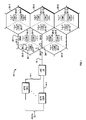
- Fig. 1 is a block diagram of the components of a wireless communication system such as a Personal Communication System (PCS), or other cellular mobile telephone system, in which a fiber optic distribution media 18 is used to distribute channelized radio frequency signals upbanded onto one or more optical carriers as one or more simulcast groups.
- PCS Personal Communication System
- fiber optic distribution media 18 is used to distribute channelized radio frequency signals upbanded onto one or more optical carriers as one or more simulcast groups.
- the system 10 includes one or more conventional base transceiver stations (BTSs) 12-1, ..., 12-n, a Hub Interface Convener (HIC) 16, and a number of Cable Microcell Integrators (CMIs) 20-1, 20-2, ..., 20-c.
- BTSs base transceiver stations
- HIC Hub Interface Convener
- CMIs Cable Microcell Integrators
- an exemplary cell 22-1 is divided into three 120 degree sectors 24-1, 24-2, 24-3, and there is a corresponding CMI 20-1, 20-2, 20-3 deployed for each sector.
- each CMI 20-1 has associated with it typically three sectorized antennas 26-1, 26-2, 26-3.
- three antennas 26-1, 26-2, 26-3 are typically employed in each of the sectors 24.
- the first antenna 26-1 is used as a transmitter antenna.
- the second antenna 26-2 is used as a primary reception antenna
- a third antenna 26-3 is used as a secondary reception or diversity reception antenna.
- the cell 22-1 is divided into three microcells 24-1, 24-2, 24-3, in which case the antennas 26-1, 26-2, 26-3 are omnidirectional antennas located approximately in the center of each microcell 24. It should therefore be understood that when a "sector" is referred to in the following discussion, the same can be said for a microcell in the alternate embodiment.
- the BTSs 12-1 ... 12-b are each coupled to the HIC 16 using appropriate radio frequency (RF) transmission media, such as coaxial cables 14-1, 14-n.
- RF radio frequency
- the HIC 16 is physically located at the same centralized location as the BTSs 12. However, the HIC 16 is coupled to each of the remotely located CMIs 20-1, 20-2, ..., 20-c using an optical fiber 18.
- the manner of interconnecting the CMIs and their particular manner of allocating frequency channels between the BTS 12-1 and CMIs 20 is the particular subject of the present invention.
- the system 10 provides voice and/or data traffic signals between subscriber units, such as a mobile subscriber unit 28-1 located in a vehicle, and hand-held subscriber units such as 28-2. Specifically, the system 10 provides traffic signals between subscriber units 28 and a network, such as the public switched telephone network (PSTN) 30.
- PSTN public switched telephone network
- the signaling protocol also known as the "air interface" between the base transceiver stations (BTS) 12 and the subscriber units 28 may, for example, be the Code Division Multiple Access (CDMA) IS 95-B standard promulgated by the Telecommunications Industry Association (TIA) in the United States.
- CDMA Code Division Multiple Access
- TIA Telecommunications Industry Association
- the CMIs 20 in the illustrated embodiment are each associated with a sector or microcell 24.
- an exemplary CMI 20-1 is associated with a 120 degree sector 24-1 of a cell 22-1.
- CMI 20-1 is thus responsible for receiving radio signals from the subscriber unit 28-2 located within the sector 24-1 and forwarding them to one of the associated BTSs 12.
- radio signals originating at one of the BTSs 12 and intended for subscriber unit 28-2 are forwarded through coaxial cable 14, HIC 16, over the optic fiber 18, to respective CMI 20-1.
- multiple CMIs 20 are arranged as a simulcast group such that the physical channels used to communicate with the subscriber units 28 in more than one sector, are shared.
- the CMIs 20-1, 20-2, 20-3 associated with cell 22-1 are sharing the same radio carrier frequencies with the CMIs 20-4, 20-5, and 20-6 associated with another cell 22-2.
- a single BTS, such as BTS 12-1, may therefore be used to service a number of subscriber units 28 located in both cells 22-1 and 22-2.
- each of the CMIs 20-1 is fed from an optical fiber 18 via a corresponding optical splitter 32-1, 32-2, ..., 32-c-1, 32-c.
- the single fiber 18 is used to distribute a number of RF signals which may be modulated onto a single optical carrier wavelength to a plurality of the CMIs 20-1, 20-2, ..., 20-c.
- a mode is supported wherein the same radio frequency signal is to be radiated within multiple sectors 24-1, 24-2, ..., 24-s of a particular simulcast group.
- This mode eliminates the need for coaxial cables, repeaters, and other radio frequency equipment that might otherwise be necessary to be deployed between various CMIs 20-1, 20-2, ..., 20-s in the sectors 24-1, 24-2, ..., 24-s.
- the various optical couplers 32-1, 32-2, ..., 32-c efficiently sum the optically modulated carriers emanating from each corresponding CMI 20-1, 20-2, ..., 20-c. With this arrangement, a single centrally located BTS 12-1 may service a number of CMIs 20, therefore reducing initial build out cost.
- a bank of centrally located BTSs 12-1, 12-2, ..., 12-n may use the common optic fiber 18 to distribute signals to a number of CMIs 20. Even at full capacity, there is a benefit to centrally locating the BTSs 12 in order to facilitate access for maintenance and logistics. In addition, in areas of hilly terrain and/or large numbers of tall buildings, link propagation distance may be naturally limited. Therefore, multiple CMIs 20 may be deployed in a configuration which optimizes radio frequency coverage while at the same time minimizing the need to deploy multiple BTSs 12.
- the radio frequency carrier f1 may be identical for each CMI 20-1, 20-2, ..., 20-c.
- the sectors 24-1 and 24-2 may still constitute a simulcast group in which they are radiating with the carrier frequency f1.
- other sectors such as 24-c-1 and 24-c-2 may be assigned a different RF carrier frequency f2 to form a second simulcast group.
- the two RF simulcast groups may still be carried on a single optical carrier.
- a second capacity increased configuration may make use of the same carrier frequency f1 with a different pseudorandom code c1 or c2 for the different simulcast groups.
- a third capacity enhanced scenario D
- the same frequency f1 and code c1 but a different code phases p1 and p2 may be assigned for the two simulcast groups.
- the HIC 16 is shown in more detail in Fig. 3.
- the portion associated with implementing the forward direction namely the direction of transmission of signals from the BTSs 12 out to the CMIs 20, is illustrated. That portion is seen to include a number of RF down converters 40-1, 40-2, ..., 40-n that couple to an RF combiner 42 which in turn feeds an optical modulator 44.
- the optical modulator 44 provides the forward link direction component of a fiber optic transceiver 45.
- An exemplary RF down converter 40-1 receives the RF signals generated by an associated BTS 12-1 and translates their carrier frequency to a carrier frequency in a range more typical of cable distribution networks.
- the RF down converter 40-1 accepts a 1.25 MHz bandwidth signal, which according to the CDMA wireless interface standard in the forward direction may exist at an RF carrier in a range from 1930-1990 MHz, and converts the RF energy to a lower intermediate frequency (IF) in the range of from, for example, 57-750 MHz.
- IF intermediate frequency
- the BTS 12-1 has provided signals at a carrier frequency f1 in the range indicated and a second base station 12-2 has provided a signal of 1.25 MHz at a different carrier frequency f2 but still within the forward link range of 1930-1990 MHz typical of the PCS band.
- each BTS 12 There is typically a single RF down converter 40 associated with each BTS 12; however, it should be understood that various other scenarios are possible.
- the function of the RF combiner 42 may be provided prior to the down conversion process implemented by the elements 40.
- the RF combiner 42 accepts the down converted RF signals produced by the down converters 40-1 ... 40-2 ... 40-n to produce a single combined RF signal 43.
- the combined RF signal still contains signal components limited to within a 6 MHz bandwidth within the range of 57-750 MHz, containing the carrier frequencies f1, f2, ..., fn. It should be understood in accordance with the above discussion that a given RF signal of 1.25 MHz on a given carrier frequency f1 may actually contain multiple traffic channels implemented with different codes c1, c2, ..., c Q or even code phases p1, p2, ..., pz.
- the combined RF signal 43 is then provided to the optical modulator 44 and upbanded to an optical frequency such as at a carrier wavelength of 1550 nanometers (nm) appropriate for transmission over the optic fiber 18.
- Fig. 4 shows the reverse direction portions of the HIC 16 in more detail.
- an optical detector 50 accepts signals from the fiber 18 as received from multiple CMIs 20 in the various sectors 24. Such signals may, for example, be optically modulated onto a single optical carrier within a wavelength range of 1310 nanometers. The optical detector 50 then provides a conversion of the energy in the optical band down to a convenient intermediate frequency (IF) band such as in the range from 5-52 MHz. The optical detector 50 serves as the receiver or reverse link portion of the optical transceiver 45.
- the combined RF signal 51 produced by the optical detector 50 may therefore contain information at a number of carrier frequencies f4, f5, ..., fm.
- the RF upconverter 52 in turn translates such signals to a band within the PCS band used for reverse wireless transmission such as from 1850-1910 MHz as suitable for coupling to the standardized base transceiver system 12.
- the 1550 nm signal received from the optic fiber 18 is first fed to a splitter 60 to allow a portion of the optical energy to be fed to an optical detector 62.
- the optical detector 62 in the preferred embodiment accepts optical signals in a range of, for example, 1550 nanometers providing a detected signal in a 60 MHz wide forward link band at the 57-750 MHz IF carrier.
- This signal which may contain the multiple RF carriers f1 ,f2, ..., fn, codes or code phases as previously described, is then fed to the RF upconverter 64.
- the optical detector 62 and an optical modulator 79 provide an optical transceiver 80 for the CMI 20.
- the output of the RF upconverter 64 is the radio frequency signal in the expected forward link range of from 1930-1990 MHz.
- a filter 66 restricts the transmission bandwidth to the single channel frequency bandwidth of approximately 1.25 MHz.
- a signal processor 67 may provide further filtering, automatic gain control, pre-amplification, or control signaling functions.
- signals received on the primary reception antenna 26-2 are first fed to a low noise amplifier 72-1 and filter 74-1.
- Such signals of interest are in the range of 1850-1910 MHz which are the frequency band typically associated with reverse links in the PCS region.
- the filter 74-1 thus produces a band limited signal of 1.25 MHz that may have multiple carriers, codes and/or phases as previously described.
- the signal processor 75-1 prepares such signals for RF down conversion to the IF band from 5-52 MHz.
- Signals for the secondary or diversity antenna 26-3 are fed through associated filter 74-2, signal processor 75-2, and RF down converter 76-2 which perform functions analogous to that of their associated counterparts 72-1, 74-1, 75-1, and 76-1 in the primary chain.
- the RF down converter 76-2 provides a frequency shift which is different than that of RF down converter 76-1 but still within the band of 5-52 MHz. This provides a system 10 with the ability to feed back a diversity antenna signal so that they can be properly processed by the receive side of the BTSs 12.
- the RF combiner 78 accepts the signals from the RF down converter 76-1 and 76-2 and feeds them to an optical modulator 44 which upbands the information of interest to an optical carrier such as in the range of 1310 nanometers. The optical signal is then fed to the combiner 60 and back to the fiber 18.
- the particular filters 66, 74-1, and 74-2 deployed in each CMI 20 are chosen to achieve the desired operational effect of the invention.
- the filters 66 and 74 need to be set to the appropriate RF carrier frequency so that the CMI simulcast clusters are appropriately implemented.
- the filters 66 associated with given CMI cluster such as the cluster 24-1, 24-2, 24-3, will each be tuned to the same RF carrier frequency.
- the filters 74-1, 74-2 associated with such CMIs 20-1, 20-2, 20-3 intended to be part of a cluster are also tuned to the same carrier frequency.
- reconfiguration of the distribution network such as when a higher capacity system is desired, requires only reconfiguration of the filters 66 and 74.
- This may be carried out manually, by either implementing such filters as a tunable circuit that may be adjusted by a technician in the field with potentiometers or the like or in a more sophisticated system, it may be programmable such that they may be controlled by control signals provided over the optic fiber 18 and various dedicated control channels within the associated available bandwidth of operation.
Landscapes
- Physics & Mathematics (AREA)
- Electromagnetism (AREA)
- Engineering & Computer Science (AREA)
- Computer Networks & Wireless Communication (AREA)
- Signal Processing (AREA)
- Mobile Radio Communication Systems (AREA)
- Optical Communication System (AREA)
Applications Claiming Priority (2)
| Application Number | Priority Date | Filing Date | Title |
|---|---|---|---|
| US09/256,244 US6504831B1 (en) | 1999-02-23 | 1999-02-23 | Optical simulcast network with centralized call processing |
| US256244 | 1999-02-23 |
Publications (2)
| Publication Number | Publication Date |
|---|---|
| EP1032143A2 true EP1032143A2 (de) | 2000-08-30 |
| EP1032143A3 EP1032143A3 (de) | 2004-06-23 |
Family
ID=22971531
Family Applications (1)
| Application Number | Title | Priority Date | Filing Date |
|---|---|---|---|
| EP00301432A Withdrawn EP1032143A3 (de) | 1999-02-23 | 2000-02-23 | Optisches Gleichwellennetzwerk mit zentralisierter Anrufverarbeitung |
Country Status (4)
| Country | Link |
|---|---|
| US (1) | US6504831B1 (de) |
| EP (1) | EP1032143A3 (de) |
| CA (1) | CA2299096A1 (de) |
| IL (1) | IL134704A0 (de) |
Cited By (4)
| Publication number | Priority date | Publication date | Assignee | Title |
|---|---|---|---|---|
| EP1479182A4 (de) * | 2002-02-25 | 2006-08-09 | Radioframe Networks Inc | Verteiltes funksystem mit mehreren sendern/empfängern zum simulcasting und selektiven verarbeiten empfangener signale |
| EP1579710A4 (de) * | 2002-12-06 | 2011-01-19 | Lgc Wireless Inc | System und verfahren zum verteilen von signalen der drahtlosenkommunikation über städtische telekommunikationsnetze |
| US10321328B2 (en) | 2000-03-27 | 2019-06-11 | Commscope Technologies Llc | Multiprotocol antenna system for multiple service providers |
| US10499269B2 (en) | 2015-11-12 | 2019-12-03 | Commscope Technologies Llc | Systems and methods for assigning controlled nodes to channel interfaces of a controller |
Families Citing this family (46)
| Publication number | Priority date | Publication date | Assignee | Title |
|---|---|---|---|---|
| US6704545B1 (en) | 2000-07-19 | 2004-03-09 | Adc Telecommunications, Inc. | Point-to-multipoint digital radio frequency transport |
| US7127043B2 (en) * | 2001-11-01 | 2006-10-24 | Net2Phone, Inc. | Secondary subscriber line override system and method |
| US8958789B2 (en) | 2002-12-03 | 2015-02-17 | Adc Telecommunications, Inc. | Distributed digital antenna system |
| US7573862B2 (en) * | 2003-02-06 | 2009-08-11 | Mahdi Chambers | System and method for optimizing network capacity in a cellular wireless network |
| US20060252461A1 (en) * | 2005-05-06 | 2006-11-09 | Grant Neil G | Controlling wireless communications from a multi-sector antenna of a base station |
| US7805073B2 (en) | 2006-04-28 | 2010-09-28 | Adc Telecommunications, Inc. | Systems and methods of optical path protection for distributed antenna systems |
| US8693525B2 (en) * | 2006-07-14 | 2014-04-08 | Qualcomm Incorporated | Multi-carrier transmitter for wireless communication |
| US8873585B2 (en) | 2006-12-19 | 2014-10-28 | Corning Optical Communications Wireless Ltd | Distributed antenna system for MIMO technologies |
| EP2394379B1 (de) | 2009-02-03 | 2016-12-28 | Corning Optical Communications LLC | Verteilte antennensysteme auf glasfaserbasis, bestandteile und entsprechende verfahren zu ihrer kalibrierung |
| US9673904B2 (en) | 2009-02-03 | 2017-06-06 | Corning Optical Communications LLC | Optical fiber-based distributed antenna systems, components, and related methods for calibration thereof |
| AU2010210766A1 (en) | 2009-02-03 | 2011-09-15 | Corning Cable Systems Llc | Optical fiber-based distributed antenna systems, components, and related methods for monitoring and configuring thereof |
| US9001811B2 (en) | 2009-05-19 | 2015-04-07 | Adc Telecommunications, Inc. | Method of inserting CDMA beacon pilots in output of distributed remote antenna nodes |
| DE102009052936B8 (de) | 2009-11-12 | 2012-05-10 | Andrew Wireless Systems Gmbh | Master-Einheit, Remote-Einheit sowie Multiband-Übertragungssystem |
| US8280259B2 (en) | 2009-11-13 | 2012-10-02 | Corning Cable Systems Llc | Radio-over-fiber (RoF) system for protocol-independent wired and/or wireless communication |
| US8275265B2 (en) | 2010-02-15 | 2012-09-25 | Corning Cable Systems Llc | Dynamic cell bonding (DCB) for radio-over-fiber (RoF)-based networks and communication systems and related methods |
| US9252874B2 (en) | 2010-10-13 | 2016-02-02 | Ccs Technology, Inc | Power management for remote antenna units in distributed antenna systems |
| CN103548290B (zh) | 2011-04-29 | 2016-08-31 | 康宁光缆系统有限责任公司 | 判定分布式天线系统中的通信传播延迟及相关组件、系统与方法 |
| WO2012148940A1 (en) | 2011-04-29 | 2012-11-01 | Corning Cable Systems Llc | Systems, methods, and devices for increasing radio frequency (rf) power in distributed antenna systems |
| US9276685B2 (en) * | 2011-10-14 | 2016-03-01 | Qualcomm Incorporated | Distributed antenna systems and methods of wireless communications for facilitating simulcasting and de-simulcasting of downlink transmissions |
| US9312941B2 (en) * | 2011-10-14 | 2016-04-12 | Qualcomm Incorporated | Base stations and methods for facilitating dynamic simulcasting and de-simulcasting in a distributed antenna system |
| WO2013148986A1 (en) | 2012-03-30 | 2013-10-03 | Corning Cable Systems Llc | Reducing location-dependent interference in distributed antenna systems operating in multiple-input, multiple-output (mimo) configuration, and related components, systems, and methods |
| EP2842245A1 (de) | 2012-04-25 | 2015-03-04 | Corning Optical Communications LLC | Verteilte antennensystemarchitekturen |
| WO2014024192A1 (en) | 2012-08-07 | 2014-02-13 | Corning Mobile Access Ltd. | Distribution of time-division multiplexed (tdm) management services in a distributed antenna system, and related components, systems, and methods |
| EP2904831B1 (de) | 2012-10-05 | 2017-10-04 | Andrew Wireless Systems GmbH | Kapazitätsoptimierungssubsystem für ein verteiltes antennensystem |
| US9455784B2 (en) | 2012-10-31 | 2016-09-27 | Corning Optical Communications Wireless Ltd | Deployable wireless infrastructures and methods of deploying wireless infrastructures |
| US9077508B2 (en) * | 2012-11-15 | 2015-07-07 | Mitsubishi Electric Research Laboratories, Inc. | Adaptively coding and modulating signals transmitted via nonlinear channels |
| CN105308876B (zh) | 2012-11-29 | 2018-06-22 | 康宁光电通信有限责任公司 | 分布式天线系统中的远程单元天线结合 |
| US9647758B2 (en) | 2012-11-30 | 2017-05-09 | Corning Optical Communications Wireless Ltd | Cabling connectivity monitoring and verification |
| WO2014199384A1 (en) | 2013-06-12 | 2014-12-18 | Corning Optical Communications Wireless, Ltd. | Voltage controlled optical directional coupler |
| EP3008828B1 (de) | 2013-06-12 | 2017-08-09 | Corning Optical Communications Wireless Ltd. | Zeitduplexierung (tdd) in verteilten kommunikationssystemen, einschliesslich verteilten antennensystemen (dass) |
| US9247543B2 (en) | 2013-07-23 | 2016-01-26 | Corning Optical Communications Wireless Ltd | Monitoring non-supported wireless spectrum within coverage areas of distributed antenna systems (DASs) |
| US9661781B2 (en) | 2013-07-31 | 2017-05-23 | Corning Optical Communications Wireless Ltd | Remote units for distributed communication systems and related installation methods and apparatuses |
| US9385810B2 (en) | 2013-09-30 | 2016-07-05 | Corning Optical Communications Wireless Ltd | Connection mapping in distributed communication systems |
| US9178635B2 (en) | 2014-01-03 | 2015-11-03 | Corning Optical Communications Wireless Ltd | Separation of communication signal sub-bands in distributed antenna systems (DASs) to reduce interference |
| US9775123B2 (en) | 2014-03-28 | 2017-09-26 | Corning Optical Communications Wireless Ltd. | Individualized gain control of uplink paths in remote units in a distributed antenna system (DAS) based on individual remote unit contribution to combined uplink power |
| US9357551B2 (en) | 2014-05-30 | 2016-05-31 | Corning Optical Communications Wireless Ltd | Systems and methods for simultaneous sampling of serial digital data streams from multiple analog-to-digital converters (ADCS), including in distributed antenna systems |
| US9525472B2 (en) | 2014-07-30 | 2016-12-20 | Corning Incorporated | Reducing location-dependent destructive interference in distributed antenna systems (DASS) operating in multiple-input, multiple-output (MIMO) configuration, and related components, systems, and methods |
| US9730228B2 (en) | 2014-08-29 | 2017-08-08 | Corning Optical Communications Wireless Ltd | Individualized gain control of remote uplink band paths in a remote unit in a distributed antenna system (DAS), based on combined uplink power level in the remote unit |
| US9602210B2 (en) | 2014-09-24 | 2017-03-21 | Corning Optical Communications Wireless Ltd | Flexible head-end chassis supporting automatic identification and interconnection of radio interface modules and optical interface modules in an optical fiber-based distributed antenna system (DAS) |
| US9420542B2 (en) | 2014-09-25 | 2016-08-16 | Corning Optical Communications Wireless Ltd | System-wide uplink band gain control in a distributed antenna system (DAS), based on per band gain control of remote uplink paths in remote units |
| US9729267B2 (en) | 2014-12-11 | 2017-08-08 | Corning Optical Communications Wireless Ltd | Multiplexing two separate optical links with the same wavelength using asymmetric combining and splitting |
| US20160249365A1 (en) | 2015-02-19 | 2016-08-25 | Corning Optical Communications Wireless Ltd. | Offsetting unwanted downlink interference signals in an uplink path in a distributed antenna system (das) |
| US9681313B2 (en) | 2015-04-15 | 2017-06-13 | Corning Optical Communications Wireless Ltd | Optimizing remote antenna unit performance using an alternative data channel |
| US9948349B2 (en) | 2015-07-17 | 2018-04-17 | Corning Optical Communications Wireless Ltd | IOT automation and data collection system |
| US10560214B2 (en) | 2015-09-28 | 2020-02-11 | Corning Optical Communications LLC | Downlink and uplink communication path switching in a time-division duplex (TDD) distributed antenna system (DAS) |
| US10236924B2 (en) | 2016-03-31 | 2019-03-19 | Corning Optical Communications Wireless Ltd | Reducing out-of-channel noise in a wireless distribution system (WDS) |
Family Cites Families (28)
| Publication number | Priority date | Publication date | Assignee | Title |
|---|---|---|---|---|
| JPS6110327Y2 (de) | 1980-01-10 | 1986-04-03 | ||
| US4449247A (en) * | 1980-07-30 | 1984-05-15 | Harris Corporation | Local orderwire facility for fiber optic communication system |
| CA2008900C (en) * | 1989-04-04 | 1998-01-20 | Ta-Shing Chu | Optical fiber microcellular mobile radio |
| US5175727A (en) * | 1990-04-16 | 1992-12-29 | Maher John W | Communication system network interconnecting a plurality of communication systems |
| US5129098A (en) | 1990-09-24 | 1992-07-07 | Novatel Communication Ltd. | Radio telephone using received signal strength in controlling transmission power |
| US5173933A (en) * | 1990-09-25 | 1992-12-22 | World Communication Systems, Inc. | Interface between mobile telecommunication stations and trunks that link to communication carriers |
| US5513176A (en) | 1990-12-07 | 1996-04-30 | Qualcomm Incorporated | Dual distributed antenna system |
| JP2868899B2 (ja) | 1990-12-20 | 1999-03-10 | モトローラ・インコーポレーテッド | 時分割多重アクセス無線周波送信機の電力制御回路 |
| US5067173A (en) | 1990-12-20 | 1991-11-19 | At&T Bell Laboratories | Microcellular communications system using space diversity reception |
| US5802173A (en) | 1991-01-15 | 1998-09-01 | Rogers Cable Systems Limited | Radiotelephony system |
| US5809395A (en) | 1991-01-15 | 1998-09-15 | Rogers Cable Systems Limited | Remote antenna driver for a radio telephony system |
| GB2289198B (en) | 1991-01-15 | 1996-01-10 | Rogers Cantel Inc | A remote antenna driver |
| JPH0529997A (ja) | 1991-07-18 | 1993-02-05 | Iwatsu Electric Co Ltd | 時間分割移動体通信のダイバーシテイ通信方法 |
| CA2067637C (en) | 1991-07-29 | 1997-11-18 | John Lappington | System for distributing radio telephone signals over a cable television network |
| CA2058737C (en) | 1992-01-03 | 1997-03-18 | Andrew S. Beasley | Rf repeater arrangement with improved frequency reuse for wireless telephones |
| CA2125411E (en) | 1992-01-03 | 1996-06-25 | Andrew S. Beasley | Distributed rf repeater arrangement and method for linking wireless handsets to basestations |
| US5590173A (en) | 1992-08-05 | 1996-12-31 | Beasley; Andrew S. | Delay insensitive base station-to-handset interface for radio telephone systems |
| US5303287A (en) | 1992-08-13 | 1994-04-12 | Hughes Aircraft Company | Integrated personal/cellular communications system architecture |
| US5768279A (en) | 1994-01-25 | 1998-06-16 | Ibm Corporation | Broad band transmission system |
| US5452473A (en) | 1994-02-28 | 1995-09-19 | Qualcomm Incorporated | Reverse link, transmit power correction and limitation in a radiotelephone system |
| US5475870A (en) | 1994-09-12 | 1995-12-12 | Qualcomm Incorporated | Apparatus and method for adding and removing a base station from a cellular communications system |
| US5515014A (en) | 1994-11-30 | 1996-05-07 | At&T Corp. | Interface between SAW filter and Gilbert cell mixer |
| US5822324A (en) | 1995-03-16 | 1998-10-13 | Bell Atlantic Network Services, Inc. | Simulcasting digital video programs for broadcast and interactive services |
| GB2300549B (en) * | 1995-05-02 | 2000-04-26 | Northern Telecom Ltd | Communications system |
| US5781541A (en) | 1995-05-03 | 1998-07-14 | Bell Atlantic Network Services, Inc. | CDMA system having time-distributed transmission paths for multipath reception |
| US5867763A (en) * | 1996-02-08 | 1999-02-02 | Qualcomm Incorporated | Method and apparatus for integration of a wireless communication system with a cable T.V. system |
| US5970410A (en) | 1996-02-27 | 1999-10-19 | Airnet Communications Corp. | Cellular system plan using in band-translators to enable efficient deployment of high capacity base transceiver systems |
| US5805983A (en) | 1996-07-18 | 1998-09-08 | Ericsson Inc. | System and method for equalizing the delay time for transmission paths in a distributed antenna network |
-
1999
- 1999-02-23 US US09/256,244 patent/US6504831B1/en not_active Expired - Lifetime
-
2000
- 2000-02-22 CA CA002299096A patent/CA2299096A1/en not_active Abandoned
- 2000-02-23 EP EP00301432A patent/EP1032143A3/de not_active Withdrawn
- 2000-02-23 IL IL13470400A patent/IL134704A0/xx unknown
Cited By (5)
| Publication number | Priority date | Publication date | Assignee | Title |
|---|---|---|---|---|
| US10321328B2 (en) | 2000-03-27 | 2019-06-11 | Commscope Technologies Llc | Multiprotocol antenna system for multiple service providers |
| EP1479182A4 (de) * | 2002-02-25 | 2006-08-09 | Radioframe Networks Inc | Verteiltes funksystem mit mehreren sendern/empfängern zum simulcasting und selektiven verarbeiten empfangener signale |
| EP1579710A4 (de) * | 2002-12-06 | 2011-01-19 | Lgc Wireless Inc | System und verfahren zum verteilen von signalen der drahtlosenkommunikation über städtische telekommunikationsnetze |
| EP3343820A1 (de) * | 2002-12-06 | 2018-07-04 | LGC Wireless, Inc. | VERTEILUNG VON DRAHTLOSEN KOMMUNIKATIONSSIGNALEN ÜBER GROßSTÄDTISCHE TELEKOMMUNIKATIONSNETZE |
| US10499269B2 (en) | 2015-11-12 | 2019-12-03 | Commscope Technologies Llc | Systems and methods for assigning controlled nodes to channel interfaces of a controller |
Also Published As
| Publication number | Publication date |
|---|---|
| CA2299096A1 (en) | 2000-08-23 |
| IL134704A0 (en) | 2001-04-30 |
| US6504831B1 (en) | 2003-01-07 |
| EP1032143A3 (de) | 2004-06-23 |
Similar Documents
| Publication | Publication Date | Title |
|---|---|---|
| US6504831B1 (en) | Optical simulcast network with centralized call processing | |
| EP1047276B1 (de) | Verteiltes Fasersystem mit Unterstützung von sanftem Weiterreichen in einem zellularen CDMA System | |
| EP1037411A2 (de) | Verstärkungsausgleich für ein fiberoptisches Verteilungsnetzwerk | |
| JP4426098B2 (ja) | 無線電話システムのための改良型中央配置装置 | |
| CA2268309C (en) | Cellular system with optical link between mobile telephone switching office and cell sites | |
| EP1173034B1 (de) | Mobiles Kommunikationsnetzwerk mit digitalen optischen Verbindungen | |
| JP3812787B2 (ja) | 光変換中継増幅システム | |
| US6374124B1 (en) | Dynamic reallocation of transceivers used to interconnect wireless telephones to a broadband network | |
| JP4988094B2 (ja) | アンテナ・システム及びその送受信方法 | |
| AU750264B2 (en) | Cellular system plan using in band-translators | |
| JP3553942B2 (ja) | 集中配置基地局と分散アンテナユニットを有するセルラ無線システム | |
| JP2609418B2 (ja) | 集積化パーソナル/セルラ通信システム | |
| US6477154B1 (en) | Microcellular mobile communication system | |
| US6560441B1 (en) | Low noise in-building distribution network for wireless signals | |
| US7003322B2 (en) | Architecture for digital shared antenna system to support existing base station hardware | |
| KR100719786B1 (ko) | 송신 다이버시티를 갖는 코드-분할, 다중-접속 기지국 | |
| KR19990023811A (ko) | 적응성 있는 파장 다중화를 이용하는 무선망의 동적 재구성 | |
| EP1400141A1 (de) | Netzwerk und verfahren zur verbindung von antennen mit basisstationen in einem raumdiversity verwendenden drahtlosen kommunikationssystem | |
| JPH02288624A (ja) | 移動ラジオシステム | |
| US20070019679A1 (en) | Mobile communications network with multiple radio units | |
| US5903592A (en) | Radio transmission system | |
| JP4280551B2 (ja) | 光伝送システム | |
| KR100316811B1 (ko) | 서비스 영역의 확장기능을 갖는 기지국 장치 |
Legal Events
| Date | Code | Title | Description |
|---|---|---|---|
| PUAI | Public reference made under article 153(3) epc to a published international application that has entered the european phase |
Free format text: ORIGINAL CODE: 0009012 |
|
| AK | Designated contracting states |
Kind code of ref document: A2 Designated state(s): AT BE CH CY DE DK ES FI FR GB GR IE IT LI LU MC NL PT SE |
|
| AX | Request for extension of the european patent |
Free format text: AL;LT;LV;MK;RO;SI |
|
| PUAL | Search report despatched |
Free format text: ORIGINAL CODE: 0009013 |
|
| AK | Designated contracting states |
Kind code of ref document: A3 Designated state(s): AT BE CH CY DE DK ES FI FR GB GR IE IT LI LU MC NL PT SE |
|
| AX | Request for extension of the european patent |
Extension state: AL LT LV MK RO SI |
|
| AKX | Designation fees paid | ||
| REG | Reference to a national code |
Ref country code: DE Ref legal event code: 8566 |
|
| STAA | Information on the status of an ep patent application or granted ep patent |
Free format text: STATUS: THE APPLICATION IS DEEMED TO BE WITHDRAWN |
|
| 18D | Application deemed to be withdrawn |
Effective date: 20041227 |