EP1033568B1 - Methode et utilisation d'un dispositif aux fins de recherche de principes actifs - Google Patents
Methode et utilisation d'un dispositif aux fins de recherche de principes actifs Download PDFInfo
- Publication number
- EP1033568B1 EP1033568B1 EP00103366A EP00103366A EP1033568B1 EP 1033568 B1 EP1033568 B1 EP 1033568B1 EP 00103366 A EP00103366 A EP 00103366A EP 00103366 A EP00103366 A EP 00103366A EP 1033568 B1 EP1033568 B1 EP 1033568B1
- Authority
- EP
- European Patent Office
- Prior art keywords
- active compound
- raman
- reference active
- sample
- drug
- Prior art date
- Legal status (The legal status is an assumption and is not a legal conclusion. Google has not performed a legal analysis and makes no representation as to the accuracy of the status listed.)
- Expired - Lifetime
Links
Images

Classifications
-
- B—PERFORMING OPERATIONS; TRANSPORTING
- B82—NANOTECHNOLOGY
- B82Y—SPECIFIC USES OR APPLICATIONS OF NANOSTRUCTURES; MEASUREMENT OR ANALYSIS OF NANOSTRUCTURES; MANUFACTURE OR TREATMENT OF NANOSTRUCTURES
- B82Y15/00—Nanotechnology for interacting, sensing or actuating, e.g. quantum dots as markers in protein assays or molecular motors
-
- G—PHYSICS
- G01—MEASURING; TESTING
- G01J—MEASUREMENT OF INTENSITY, VELOCITY, SPECTRAL CONTENT, POLARISATION, PHASE OR PULSE CHARACTERISTICS OF INFRARED, VISIBLE OR ULTRAVIOLET LIGHT; COLORIMETRY; RADIATION PYROMETRY
- G01J3/00—Spectrometry; Spectrophotometry; Monochromators; Measuring colours
- G01J3/28—Investigating the spectrum
- G01J3/44—Raman spectrometry; Scattering spectrometry ; Fluorescence spectrometry
-
- G—PHYSICS
- G01—MEASURING; TESTING
- G01J—MEASUREMENT OF INTENSITY, VELOCITY, SPECTRAL CONTENT, POLARISATION, PHASE OR PULSE CHARACTERISTICS OF INFRARED, VISIBLE OR ULTRAVIOLET LIGHT; COLORIMETRY; RADIATION PYROMETRY
- G01J3/00—Spectrometry; Spectrophotometry; Monochromators; Measuring colours
- G01J3/28—Investigating the spectrum
- G01J3/457—Correlation spectrometry, e.g. of the intensity
-
- G—PHYSICS
- G01—MEASURING; TESTING
- G01N—INVESTIGATING OR ANALYSING MATERIALS BY DETERMINING THEIR CHEMICAL OR PHYSICAL PROPERTIES
- G01N21/00—Investigating or analysing materials by the use of optical means, i.e. using sub-millimetre waves, infrared, visible or ultraviolet light
- G01N21/62—Systems in which the material investigated is excited whereby it emits light or causes a change in wavelength of the incident light
- G01N21/63—Systems in which the material investigated is excited whereby it emits light or causes a change in wavelength of the incident light optically excited
- G01N21/65—Raman scattering
-
- G—PHYSICS
- G01—MEASURING; TESTING
- G01J—MEASUREMENT OF INTENSITY, VELOCITY, SPECTRAL CONTENT, POLARISATION, PHASE OR PULSE CHARACTERISTICS OF INFRARED, VISIBLE OR ULTRAVIOLET LIGHT; COLORIMETRY; RADIATION PYROMETRY
- G01J3/00—Spectrometry; Spectrophotometry; Monochromators; Measuring colours
- G01J3/28—Investigating the spectrum
- G01J2003/2866—Markers; Calibrating of scan
-
- G—PHYSICS
- G01—MEASURING; TESTING
- G01N—INVESTIGATING OR ANALYSING MATERIALS BY DETERMINING THEIR CHEMICAL OR PHYSICAL PROPERTIES
- G01N21/00—Investigating or analysing materials by the use of optical means, i.e. using sub-millimetre waves, infrared, visible or ultraviolet light
- G01N21/62—Systems in which the material investigated is excited whereby it emits light or causes a change in wavelength of the incident light
- G01N21/63—Systems in which the material investigated is excited whereby it emits light or causes a change in wavelength of the incident light optically excited
- G01N21/65—Raman scattering
- G01N21/658—Raman scattering enhancement Raman, e.g. surface plasmons
Definitions
- the present invention relates to a method and a device which are used to search for an effective active ingredient, in particular of pharmaceutical or plant protection active ingredients.
- the determination of an effective drug is carried out indirectly, it being assumed that a reference drug from a submitted complex of substrate and reference drug is displaced by a more effective drug from the substance bank, which has a larger binding constant to the substrate; This is why we also speak of displacement methods.
- Another possibility is to start from heterogeneous assays which work via coupling to solid phases or dispersed particles and require complicated washing or separation steps, which are omitted in homogeneous detection methods.
- the determination of drug concentrations must be made by additional calibrations, which in correlation methods, such.
- the fluorescence correlation spectroscopy or Raman correlation spectroscopy deleted because they are based on number fluctuations and thus a concrete statement about the drug concentration is not necessary, as in the DE 195 33 092.7 is described.
- DE 196 30 956 A1 discloses a method and apparatus for Raman correlation spectroscopy for determining diffusion parameters, concentration, size or flow behavior of particles in a sample, wherein excitation light from a light source is directed into the sample, Raman scattered light is collected from an observation volume of the sample and fed to a spectrograph.
- WO 97/05280 A discloses a method for detecting nucleic acids and nucleic acid groups in a sample by including the SER (R) S spectrum of a SER (R) S-active complex containing the molecule to be assayed.
- the process according to the invention represents a process to search for an effective drug by displacing a reference drug from a presented complex of substrate and reference drug by a more effective drug from the drug library having a greater binding constant to the substrate, registration of the translational diffusion behavior of the at least one reference drug using Raman correlation spectroscopy, wherein the at least a reference drug is modified with a high Raman cross-section and a characteristic Raman spectrum having aromatic molecule, and this modified reference drug is coupled with a metallic nanoparticle, which does not lose its bioactivity.
- Raman correlation spectroscopy determines the dynamics of selected particles.
- the fluctuation behavior of the Raman signal of bands characteristic of the particles is analyzed from a small closed measurement volume.
- the decay constant of the correlation function of the selected Raman bands can be determined directly from this function.
- the decay constant is, inter alia, a function of the thermal diffusion coefficient of the corresponding particles, which thus makes it possible to make a concrete statement about the diffusion behavior of the particles in question.
- the value of the correlation function at the correlation time 0 contains the mean number of particles that are in the measurement volume.
- the size of the selected particles can be measured using the Stokes-Einstein relation. From the likewise measurable cross-correlation function of two Raman bands, which can originate from two particle types with different chemical composition, it can be determined whether both particle types have the same fluctuation pattern, ie they move uniformly, ie are complexed.
- the inventive method is initially based on a homogeneous displacement method, wherein it is assumed that a reference active substance is displaced from a presented complex of substrate and reference drug by an active ingredient from a substance bank or substances produced by combinatorial chemistry, if this is more effective against the reference drug , d. H. has a larger binding constant to the substrate.
- the displacement of the reference drug by the more effective drug can be concluded by observing the translational behavior of the reference drug.
- the translation behavior of the reference active substance determines the fluctuation behavior of the corresponding Raman signal, which can be determined by Raman correlation spectroscopy, of bands characteristic of the reference active substance within a measuring volume of a sample.
- the autocorrelation function can be used to determine the average number and the diffusion constant of the particles of the relevant reference active substance, and finally a definitive statement can be made as to whether a transition of the reference active substance from the state bound to the substrate into the freely diffusing state has taken place the drug added to the sample is more effective than the reference drug or not.
- SERS Surface Enhanced Raman Scattering
- SERRS Surface Enhanced Raman Scattering
- the irradiated light wavelength preferably laser light
- the Ramanstreuquerrough is additionally increased via the resonance Raman effect occurring (SERRS effect).
- the reference active ingredient is modified according to the invention with a radical having a high Raman cross-section and a characteristic Raman spectrum.
- the reference active substance is preferably attached via a so-called "spacer", for example an alkyl chain, to an aromatic molecule, in particular a polyaromatic molecule having a plurality of conjugated aromatic nuclei, for example to fluorescent dyes of, for example, one of the classes of acridines (eg acridine orange).
- the xanthenes eg, flourescein, rhodamine, behgalrosa, eosin, erythrosin
- the thioxanthenes or the pyrenes or other fluorochromes, such as tetracycline or porphyrin, which preferably each have intrinsic regions that have a strong affinity for metal surfaces, equipped or substituted therewith. These intrinsic regions may be N- and / or S-containing radicals.
- the aromatic moiety has a high Raman cross section and a characteristic, highly structured Raman spectrum.
- the reference drug can be very selectively determined from the bands of the aromatic moiety
- the above described multiple amplification mechanisms are detected very sensitively. Any fluorescence problems do not occur Metallic surfaces effectively suppress fluorescence emissions.
- the actual measurement effect, namely the displacement of the reference drug from its binding to the substrate by a more effective drug is, as already explained, selectively and sensitively detected by the fluctuation experiment on the determination of translational diffusion. If the active substance to be tested is more effective than the reference active ingredient, the reference active ingredient, which still depends on the metallic nanoparticle, changes from the bound state to the free state. This causes an increase in the translation diffusion constant of the reference drug by reducing its size or mass as a direct measuring effect.
- the metallic nanoparticles are coated with several different reference agents.
- the characteristic Raman bands allow a spectral separation of the individual drug systems. In this way, different tests can be carried out simultaneously within one measuring volume. With the help of this parallel arrangement, the search for active ingredients can be performed faster and more effectively.
- the various channels in which the respective Raman bands of the individual reference substances are recorded can be detected simultaneously. Statements about regressions that have taken place are made via the characteristic shortening of the correlation time constant.
- the at least one reference active substance is modified with a plurality of different particles each having a high Raman cross section and a characteristic Raman spectrum, the Raman spectra of the different particles being distinguishable from one another. This can increase the security of the identification of displacement events. The displacement of the reference drug must then by shortening the
- Correlation time constant can be detected in several detection channels on the comparison of the corresponding autocorrelation functions. Effects that occur in just one channel can be ignored as noise effects.
- the device has a light source with variable exposure wavelength, preferably in the UV spectral range.
- a high-pressure xenon lamp with upstream Einstrahlmonochromator can be used.
- a tunable laser system such as a frequency-doubled optical parametric oscillator is used.
- the light emerging from the light source is focused by means of a focusing device on the sample to be examined such that thereby at least one measurement volume is defined within the sample.
- the measurement volume thus defined can be in the range of less than 0.1 ⁇ m 3 or more, preferably from 0.1 ⁇ m 3 to 5 mm 3 .
- the device has a device for detecting scattered light generated by the reference active. Preferably, this detection device operates with good time resolution ⁇ 10 ⁇ s.
- the device has a device for carrying out a fluctuation analysis for drug search.
- the substances or active substances to be analyzed are first added to a buffer solution of substrate or substrates and reference active substances before the measurement. This is followed by an incubation period. Subsequently, a correlation measurement of the scattered light is performed.
- all light detection systems can be used in principle, which allow detection by spectroscopic bands, such as photomultipliers, photodiodes, two-dimensional detectors (CCD photodiodes, etc.) in conjunction with spectrographs, gratings, prisms or Color or interference filters.
- the scattered light components are collected, which have a wavelength shift with respect to the incident light, that is to say on an inelastic light scattering Sample, such as molecular vibrations, namely the Raman bands.
- the backscattered light is detected from the defined measurement volume of the sample. So you can also examine samples that are not or hardly translucent, especially optically thick samples such. B. polymer samples.
- a confocal Raman microscope is used as the focusing device.
- the sample is preferably illuminated by the microscope objective with laser light, whereby a defined measurement volume is defined within the sample.
- the Raman light scattered in the backward direction is first spectrally separated from the laser light by means of a filter, preferably a holographic notch filter.
- the depth plane within the sample is selected via the confocal diaphragm of the microscope in the detection beam path, and thus a measurement volume is preferably confined to a few ⁇ m 3 in three dimensions. It can be an accuracy of about 1 to 3 microns with respect to the set focus, ie the desired depth segment can be achieved.
- the spectral decomposition of the Raman light is then carried out by means of a simple grating spectrograph.
- An optical mapping ensures that the selected Raman bands are detected in one or more high-sensitivity photodetectors with high temporal resolution.
- the electrical signal of the detectors in a correlator preferably a frequency analyzer or an AD conversion with subsequent appropriate software signal processing, fed, which ultimately determines the auto and / or the coincidence analysis.
- the autocorrelation curve after the addition of the active substances to be analyzed is calculated with the autocorrelation curve without addition of the compared to analyzing agents. Shortening after addition means a displacement and thus detects a new active ingredient.
- a fiber optic structure is used as the focusing device. This simplifies the experimental design considerably, which is associated with a considerable cost savings.
- microtiter plates are used which have, for example, 96, 384, 1536 or more pots, into each of which a sample can be introduced.
- the device now has a controllable translation table on which at least one sample, preferably a microtiter plate mentioned above, can be attached.
- the microtiter plate with the various samples by means of the controllable, preferably computer controllable translation table is moved so that a new potty can be analyzed with another sample.
- the correlation curves obtained are then preferably analyzed together with suitable evaluation programs. Subsequently, pots are registered with samples in which a new drug was found.
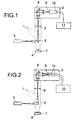
- FIG. 1 is shown schematically the structure of the device.
- a confocal microscope 1 is linked to a Raman spectrometer 2 such that a laser 3 is focused via the imaging optics of the microscope 1 to a very small volume within the sample 4.
- the resulting Raman light is first spectrally separated in the detection beam path by the laser light by means of a notch filter 5, preferably a high-efficiency holographic notch filter.
- the depth plane is selected via the confocal diaphragm 6 in the detection beam path, and thus the measurement volume 7 is limited in three dimensions to a few ⁇ m 3 , preferably to approximately 1 ⁇ m 3 .
- a bright grid spectrograph 8 takes over the spectral decomposition of the Raman light.
- An optical image 9 ensures that the selected Raman band (s) in a high-sensitivity photodetector 10, such. B. a silicon avalanche photodiode with high temporal resolution can be detected. Subsequently, the electrical signal of the detector in a correlator 11 is fed with subsequent corresponding software signal processing, which determines the autocorrelation function.
- the decay constant of the correlation function of the selected Raman bands contains, as already mentioned, information about the diffusion behavior, and the value of the correlation function at the correlation time 0 contains the mean number of particles that are in the confocal measurement volume. From a computationally feasible comparison of the autocorrelation curve after and before the addition of the active substances to be analyzed can be determined whether a displacement event has taken place or not. A shortening after the addition of the active substances to be analyzed means a displacement and thus detects a new active ingredient.
- FIG. 2 shows another preferred embodiment of the device.
- a plurality of photodetectors 10 are provided.
- several selected Raman bands can be detected simultaneously. If a metallic nanoparticle with several different reference active substances, which have characteristic Raman bands which can be distinguished from each other, is now occupied, this can be determined with the aid of the cross-correlation or with the aid of a cross-correlator 12.
- the cross-correlation can be used to determine whether substances belonging to different Raman lines fluctuate in a correlated manner and are thus simultaneously located on a particle. Again, displacement events are identified by a characteristic shortening of the correlation time constant. In this way, different tests can be accommodated in a test. This parallel arrangement results in a more effective search for drugs.
- the security of the identification of displacement events in one and the same reference active substance can be increased, namely by the reference active substance having a plurality of different, a high Raman cross section and a characteristic Raman spectrum containing radicals is modified.
- the displacement of the reference drug must then be detected by a reduction of the correlation constants in the various photodetectors 10 by comparing the corresponding autocorrelation functions.
- FIG. 3 shows a part of a further embodiment of the device, here the confocal microscope of FIGS. 1 and 2 is replaced by an analog fiber optic assembly 13.
- the laser radiation is coupled into a monomode fiber 14.
- a spatial filter 15 is additionally installed, so as to improve the mode quality.
- the laser radiation is directed into the sample 4 via a notch filter 16 and a focusing optics 17, preferably a microscope objective.
- the Raman scattering from the measurement volume 7 is collected in backward scattering from the focusing optics 17 and passes through the notch filter 16, wherein most of the laser wavelength is suppressed.
- the confocal imaging is achieved by a lens 18 which focuses on an adjustable confocal aperture 19.
- the coupling takes place directly into the detection fiber 20, which leads into the spectrometer.
- the Raman light is spectrally dissected and directed with deflecting optics or other optical fibers to the individual detectors.
Landscapes
- Physics & Mathematics (AREA)
- Spectroscopy & Molecular Physics (AREA)
- Chemical & Material Sciences (AREA)
- General Physics & Mathematics (AREA)
- Health & Medical Sciences (AREA)
- Engineering & Computer Science (AREA)
- General Health & Medical Sciences (AREA)
- Life Sciences & Earth Sciences (AREA)
- Nanotechnology (AREA)
- Molecular Biology (AREA)
- Crystallography & Structural Chemistry (AREA)
- Nuclear Medicine, Radiotherapy & Molecular Imaging (AREA)
- Analytical Chemistry (AREA)
- Biochemistry (AREA)
- Immunology (AREA)
- Pathology (AREA)
- Investigating, Analyzing Materials By Fluorescence Or Luminescence (AREA)
- Medical Treatment And Welfare Office Work (AREA)
Claims (5)
- Procédé de recherche d'une substance active effective en substituant une substance active de référence d'un complexe existant constitué d'un substrat et d'une substance active de référence par une substance active plus efficace provenant d'une banque de substances qui présente une constante de liaison au substrat plus élevée et en enregistrant le comportement de diffusion translatoire de la substance active de référence, caractérisé en ce que l'enregistrement du comportement translatoire s'effectue au moyen d'une spectroscopie à corrélation Raman, l'au moins une substance active de référence étant modifiée par une molécule aromatique présentant une section transversale de diffusion Raman élevée et un spectre Raman caractéristique et cette substances active de référence modifiée étant couplée avec une nanoparticule métallique, celle-ci ne perdant pas sa bioactivité.
- Procédé selon la revendication 1, caractérisé en ce que l'au moins une substance active de référence est modifiée avec plusieurs radicaux différents présentant respectivement une section transversale Raman élevée et un spectre Raman caractéristique, les spectres Raman des différents radicaux pouvant être distingués les uns des autres.
- Utilisation d'un dispositif destiné à mettre en oeuvre le procédé selon la revendication 1 ou 2, le dispositif présentant au moins les éléments suivants :a. une source de lumière avec une longueur d'onde d'éclairage variable ;b. un dispositif de concentration pour régler un volume de mesure à analyser donné à l'intérieur d'un échantillon ;c. au moins un dispositif pour détecter avec une bonne résolution dans le temps la lumière diffusée Raman produite par la substance active de référence ;d. un dispositif pour effectuer une analyse de la fluctuation en vue de rechercher la substance active.
- Utilisation d'un dispositif selon la revendication 3, caractérisée en ce que le dispositif présente une platine de transition commandable pour la fixation d'au moins un échantillon.
- Utilisation du procédé selon la revendication 1 ou 2 pour la recherche de la substance active.
Applications Claiming Priority (2)
| Application Number | Priority Date | Filing Date | Title |
|---|---|---|---|
| DE19909351A DE19909351A1 (de) | 1999-03-03 | 1999-03-03 | Verfahren und Vorrichtung zur Wirkstoffsuche |
| DE19909351 | 1999-03-03 |
Publications (3)
| Publication Number | Publication Date |
|---|---|
| EP1033568A2 EP1033568A2 (fr) | 2000-09-06 |
| EP1033568A3 EP1033568A3 (fr) | 2001-10-10 |
| EP1033568B1 true EP1033568B1 (fr) | 2008-11-26 |
Family
ID=7899585
Family Applications (1)
| Application Number | Title | Priority Date | Filing Date |
|---|---|---|---|
| EP00103366A Expired - Lifetime EP1033568B1 (fr) | 1999-03-03 | 2000-02-22 | Methode et utilisation d'un dispositif aux fins de recherche de principes actifs |
Country Status (4)
| Country | Link |
|---|---|
| EP (1) | EP1033568B1 (fr) |
| JP (1) | JP2000314703A (fr) |
| AT (1) | ATE415621T1 (fr) |
| DE (2) | DE19909351A1 (fr) |
Cited By (1)
| Publication number | Priority date | Publication date | Assignee | Title |
|---|---|---|---|---|
| CN107063456A (zh) * | 2017-04-24 | 2017-08-18 | 中国科学院上海光学精密机械研究所 | 原位时间分辨光栅衍射效率光谱测量装置和方法 |
Families Citing this family (4)
| Publication number | Priority date | Publication date | Assignee | Title |
|---|---|---|---|---|
| JP2006250655A (ja) * | 2005-03-09 | 2006-09-21 | Institute Of Physical & Chemical Research | ラマン分光法によるタンパク質溶液結晶化過程の解析方法及び装置 |
| JP5006215B2 (ja) * | 2006-02-07 | 2012-08-22 | 古河電気工業株式会社 | 光検出装置及び測定対象読取装置 |
| JP7386444B2 (ja) * | 2019-05-17 | 2023-11-27 | パナソニックIpマネジメント株式会社 | ラマン分光スペクトル解析装置及びラマン分光スペクトル解析方法 |
| KR102897855B1 (ko) | 2019-06-18 | 2025-12-08 | 삼성전자주식회사 | 라만 스펙트럼 측정 장치 및 방법 |
Citations (2)
| Publication number | Priority date | Publication date | Assignee | Title |
|---|---|---|---|---|
| WO1997005280A1 (fr) * | 1995-07-25 | 1997-02-13 | University Of Strathclyde | Detection d'acides nucleiques et d'unites d'acides nucleiques |
| DE19533092A1 (de) * | 1995-09-07 | 1997-03-13 | Basf Ag | Vorrichtung zur parallelisierten Zweiphotonen-Fluoreszenz-Korrelations-Spektroskopie (TPA-FCS) und deren Verwendung zum Wirkstoff-Screening |
Family Cites Families (2)
| Publication number | Priority date | Publication date | Assignee | Title |
|---|---|---|---|---|
| DE4429239A1 (de) * | 1994-08-18 | 1996-02-22 | Basf Ag | Verfahren zur Fluoreszenz-Korrelations-Spektroskopie und Vorrichtung zu dessen Durchführung |
| DE19630956A1 (de) * | 1996-07-31 | 1998-02-05 | Basf Ag | Verfahren und Vorrichtung zur Raman-Korrelationsspektroskopie |
-
1999
- 1999-03-03 DE DE19909351A patent/DE19909351A1/de not_active Withdrawn
-
2000
- 2000-02-22 AT AT00103366T patent/ATE415621T1/de not_active IP Right Cessation
- 2000-02-22 EP EP00103366A patent/EP1033568B1/fr not_active Expired - Lifetime
- 2000-02-22 DE DE50015465T patent/DE50015465D1/de not_active Expired - Fee Related
- 2000-02-28 JP JP2000050820A patent/JP2000314703A/ja not_active Withdrawn
Patent Citations (2)
| Publication number | Priority date | Publication date | Assignee | Title |
|---|---|---|---|---|
| WO1997005280A1 (fr) * | 1995-07-25 | 1997-02-13 | University Of Strathclyde | Detection d'acides nucleiques et d'unites d'acides nucleiques |
| DE19533092A1 (de) * | 1995-09-07 | 1997-03-13 | Basf Ag | Vorrichtung zur parallelisierten Zweiphotonen-Fluoreszenz-Korrelations-Spektroskopie (TPA-FCS) und deren Verwendung zum Wirkstoff-Screening |
Cited By (1)
| Publication number | Priority date | Publication date | Assignee | Title |
|---|---|---|---|---|
| CN107063456A (zh) * | 2017-04-24 | 2017-08-18 | 中国科学院上海光学精密机械研究所 | 原位时间分辨光栅衍射效率光谱测量装置和方法 |
Also Published As
| Publication number | Publication date |
|---|---|
| ATE415621T1 (de) | 2008-12-15 |
| JP2000314703A (ja) | 2000-11-14 |
| DE19909351A1 (de) | 2000-09-07 |
| DE50015465D1 (de) | 2009-01-08 |
| EP1033568A3 (fr) | 2001-10-10 |
| EP1033568A2 (fr) | 2000-09-06 |
Similar Documents
| Publication | Publication Date | Title |
|---|---|---|
| EP0822395B1 (fr) | Procédé et dispositif de spectroscopie à corrélation d'émission Raman | |
| EP0834066B1 (fr) | Procede et dispositif permettant de mettre en evidence des reactions et des interactions d'ordre physique, chimique, biologique ou biochimique | |
| DE4438391C2 (de) | Vorrichtung zur Bestimmung stoffspezifischer Parameter eines oder weniger Moleküle mittels Korrelations-Spektroskopie | |
| EP0941466B1 (fr) | Procede et dispositif pour determiner des caracteristiques predefinies de particules cibles d'un milieu d'echantillonnage | |
| DE69615818T2 (de) | Ein biospezifisches multiparametrisches testverfahren | |
| DE60037184T2 (de) | Abbildungssystem für optischen bildabtaster | |
| DE19649048C1 (de) | Verfahren zur Unterscheidung oder Erfassung von Partikeln in einer Probe durch Identifizierung von Signalabschnitten zeitaufgelöster, optischer Rohsignale aus der Probe auf Basis von Einzelphotonendetektion | |
| DE69722800T2 (de) | Probenanalyseverfahren mittels bestimmung einer funktion der spezifischen helligkeit | |
| DE19533092A1 (de) | Vorrichtung zur parallelisierten Zweiphotonen-Fluoreszenz-Korrelations-Spektroskopie (TPA-FCS) und deren Verwendung zum Wirkstoff-Screening | |
| DE69804612T2 (de) | Verfahren zur charakterisierung von proben unter verwendung statistischer zwischendaten | |
| DE68919892T2 (de) | Fluoreszenz-Mikroskopvorrichtung. | |
| EP1504300A2 (fr) | Procede et systeme pour analyser des echantillons | |
| DE2446032A1 (de) | Verfahren und vorrichtung zur feststellung submikrometrisch bemessener partikel | |
| DE19615161A1 (de) | Optische Abtastvorrichtung | |
| DE2422016A1 (de) | Diagnose von krankheitszustaenden durch fluoreszenzmessungen unter verwendung von abtastlaserstrahlen | |
| DE3037983A1 (de) | Verfahren und vorrichtung zur lichtinduzierten rastermikroskopischen darstellung von probenparametern in ihrer raeumlichen verteilung | |
| DE10223438B4 (de) | Fluoreszenz-Mess-System | |
| DE19955556A1 (de) | Meßanordnung zum parallelen Auslesen von SPR-Sensoren | |
| EP0411070A1 (fr) | Spectromicroscope a photometre. | |
| DE10327531B4 (de) | Verfahren zur Messung von Fluoreszenzkorrelationen in Gegenwart von langsamen Signalschwankungen | |
| EP2250473A1 (fr) | Procédé et dispositif pour la spectroscopie à résolution temporelle avec un dispositif de mélange photonique | |
| WO2003056309A1 (fr) | Procede et/ou systeme pour identifier des substances fluorescentes, luminescentes et/ou absorbantes sur et/ou dans des supports d'echantillons | |
| EP1678547B1 (fr) | Dispositif et procede de mesure des proprietes optiques d'un objet | |
| EP1033568B1 (fr) | Methode et utilisation d'un dispositif aux fins de recherche de principes actifs | |
| DE69803209T2 (de) | Ein verfahren zur probencharakterisierung durch bestimmung einer funktion mindestens einer spezifischen eigenschaft der probe |
Legal Events
| Date | Code | Title | Description |
|---|---|---|---|
| PUAI | Public reference made under article 153(3) epc to a published international application that has entered the european phase |
Free format text: ORIGINAL CODE: 0009012 |
|
| AK | Designated contracting states |
Kind code of ref document: A2 Designated state(s): AT BE CH CY DE DK ES FI FR GB GR IE IT LI LU MC NL PT SE |
|
| AX | Request for extension of the european patent |
Free format text: AL;LT;LV;MK;RO;SI |
|
| PUAL | Search report despatched |
Free format text: ORIGINAL CODE: 0009013 |
|
| RIC1 | Information provided on ipc code assigned before grant |
Free format text: 7G 01N 21/65 A, 7G 01J 3/453 B |
|
| AK | Designated contracting states |
Kind code of ref document: A3 Designated state(s): AT BE CH CY DE DK ES FI FR GB GR IE IT LI LU MC NL PT SE |
|
| AX | Request for extension of the european patent |
Free format text: AL;LT;LV;MK;RO;SI |
|
| 17P | Request for examination filed |
Effective date: 20011219 |
|
| AKX | Designation fees paid |
Free format text: AT BE CH CY DE DK ES FI FR GB GR IE IT LI LU MC NL PT SE |
|
| 17Q | First examination report despatched |
Effective date: 20040831 |
|
| RTI1 | Title (correction) |
Free format text: METHOD AND USE OF A DEVICE FOR ACTIVE SUBSTANCE SEARCH |
|
| 17Q | First examination report despatched |
Effective date: 20040831 |
|
| 17Q | First examination report despatched |
Effective date: 20040831 |
|
| RAP1 | Party data changed (applicant data changed or rights of an application transferred) |
Owner name: BASF SE |
|
| GRAP | Despatch of communication of intention to grant a patent |
Free format text: ORIGINAL CODE: EPIDOSNIGR1 |
|
| GRAS | Grant fee paid |
Free format text: ORIGINAL CODE: EPIDOSNIGR3 |
|
| GRAA | (expected) grant |
Free format text: ORIGINAL CODE: 0009210 |
|
| AK | Designated contracting states |
Kind code of ref document: B1 Designated state(s): AT BE CH CY DE DK ES FI FR GB GR IE IT LI LU MC NL PT SE |
|
| REG | Reference to a national code |
Ref country code: GB Ref legal event code: FG4D Free format text: NOT ENGLISH |
|
| REG | Reference to a national code |
Ref country code: CH Ref legal event code: EP |
|
| REG | Reference to a national code |
Ref country code: IE Ref legal event code: FG4D Free format text: LANGUAGE OF EP DOCUMENT: GERMAN |
|
| REF | Corresponds to: |
Ref document number: 50015465 Country of ref document: DE Date of ref document: 20090108 Kind code of ref document: P |
|
| PG25 | Lapsed in a contracting state [announced via postgrant information from national office to epo] |
Ref country code: ES Free format text: LAPSE BECAUSE OF FAILURE TO SUBMIT A TRANSLATION OF THE DESCRIPTION OR TO PAY THE FEE WITHIN THE PRESCRIBED TIME-LIMIT Effective date: 20090308 |
|
| NLV1 | Nl: lapsed or annulled due to failure to fulfill the requirements of art. 29p and 29m of the patents act | ||
| PG25 | Lapsed in a contracting state [announced via postgrant information from national office to epo] |
Ref country code: NL Free format text: LAPSE BECAUSE OF FAILURE TO SUBMIT A TRANSLATION OF THE DESCRIPTION OR TO PAY THE FEE WITHIN THE PRESCRIBED TIME-LIMIT Effective date: 20081126 Ref country code: FI Free format text: LAPSE BECAUSE OF FAILURE TO SUBMIT A TRANSLATION OF THE DESCRIPTION OR TO PAY THE FEE WITHIN THE PRESCRIBED TIME-LIMIT Effective date: 20081126 |
|
| REG | Reference to a national code |
Ref country code: IE Ref legal event code: FD4D |
|
| PG25 | Lapsed in a contracting state [announced via postgrant information from national office to epo] |
Ref country code: IE Free format text: LAPSE BECAUSE OF FAILURE TO SUBMIT A TRANSLATION OF THE DESCRIPTION OR TO PAY THE FEE WITHIN THE PRESCRIBED TIME-LIMIT Effective date: 20081126 Ref country code: DK Free format text: LAPSE BECAUSE OF FAILURE TO SUBMIT A TRANSLATION OF THE DESCRIPTION OR TO PAY THE FEE WITHIN THE PRESCRIBED TIME-LIMIT Effective date: 20081126 |
|
| BERE | Be: lapsed |
Owner name: BASF SE Effective date: 20090228 |
|
| PG25 | Lapsed in a contracting state [announced via postgrant information from national office to epo] |
Ref country code: SE Free format text: LAPSE BECAUSE OF FAILURE TO SUBMIT A TRANSLATION OF THE DESCRIPTION OR TO PAY THE FEE WITHIN THE PRESCRIBED TIME-LIMIT Effective date: 20090226 Ref country code: PT Free format text: LAPSE BECAUSE OF FAILURE TO SUBMIT A TRANSLATION OF THE DESCRIPTION OR TO PAY THE FEE WITHIN THE PRESCRIBED TIME-LIMIT Effective date: 20090427 |
|
| PG25 | Lapsed in a contracting state [announced via postgrant information from national office to epo] |
Ref country code: MC Free format text: LAPSE BECAUSE OF NON-PAYMENT OF DUE FEES Effective date: 20090228 |
|
| REG | Reference to a national code |
Ref country code: CH Ref legal event code: PL |
|
| PLBE | No opposition filed within time limit |
Free format text: ORIGINAL CODE: 0009261 |
|
| STAA | Information on the status of an ep patent application or granted ep patent |
Free format text: STATUS: NO OPPOSITION FILED WITHIN TIME LIMIT |
|
| GBPC | Gb: european patent ceased through non-payment of renewal fee |
Effective date: 20090226 |
|
| PG25 | Lapsed in a contracting state [announced via postgrant information from national office to epo] |
Ref country code: CH Free format text: LAPSE BECAUSE OF NON-PAYMENT OF DUE FEES Effective date: 20090228 Ref country code: LI Free format text: LAPSE BECAUSE OF NON-PAYMENT OF DUE FEES Effective date: 20090228 |
|
| 26N | No opposition filed |
Effective date: 20090827 |
|
| REG | Reference to a national code |
Ref country code: FR Ref legal event code: ST Effective date: 20091030 |
|
| PG25 | Lapsed in a contracting state [announced via postgrant information from national office to epo] |
Ref country code: DE Free format text: LAPSE BECAUSE OF NON-PAYMENT OF DUE FEES Effective date: 20090901 |
|
| PG25 | Lapsed in a contracting state [announced via postgrant information from national office to epo] |
Ref country code: BE Free format text: LAPSE BECAUSE OF NON-PAYMENT OF DUE FEES Effective date: 20090228 |
|
| PG25 | Lapsed in a contracting state [announced via postgrant information from national office to epo] |
Ref country code: GB Free format text: LAPSE BECAUSE OF NON-PAYMENT OF DUE FEES Effective date: 20090226 Ref country code: FR Free format text: LAPSE BECAUSE OF NON-PAYMENT OF DUE FEES Effective date: 20090302 |
|
| PG25 | Lapsed in a contracting state [announced via postgrant information from national office to epo] |
Ref country code: AT Free format text: LAPSE BECAUSE OF NON-PAYMENT OF DUE FEES Effective date: 20090222 |
|
| PG25 | Lapsed in a contracting state [announced via postgrant information from national office to epo] |
Ref country code: GR Free format text: LAPSE BECAUSE OF FAILURE TO SUBMIT A TRANSLATION OF THE DESCRIPTION OR TO PAY THE FEE WITHIN THE PRESCRIBED TIME-LIMIT Effective date: 20090227 |
|
| PG25 | Lapsed in a contracting state [announced via postgrant information from national office to epo] |
Ref country code: IT Free format text: LAPSE BECAUSE OF FAILURE TO SUBMIT A TRANSLATION OF THE DESCRIPTION OR TO PAY THE FEE WITHIN THE PRESCRIBED TIME-LIMIT Effective date: 20081126 |
|
| PG25 | Lapsed in a contracting state [announced via postgrant information from national office to epo] |
Ref country code: LU Free format text: LAPSE BECAUSE OF NON-PAYMENT OF DUE FEES Effective date: 20090222 |
|
| PG25 | Lapsed in a contracting state [announced via postgrant information from national office to epo] |
Ref country code: CY Free format text: LAPSE BECAUSE OF FAILURE TO SUBMIT A TRANSLATION OF THE DESCRIPTION OR TO PAY THE FEE WITHIN THE PRESCRIBED TIME-LIMIT Effective date: 20081126 |